Sunday, March 10, 2019

Army to talk to ‘pro-NPA’ officials in Negros

From Politiko Visayas (Mar 11, 2019): Army to talk to ‘pro-NPA’ officials in Negros


Philippine Army officials in Negros island are scheduling dialogues with local officials in the area believed to be supporting the communist New People’s Army (NPA).

Col. Benedict Arevalo, commander of the 303rd Infantry Brigade, did not name the officials but said there are about 30 of them.

“It’s not my objective to name names and ruin their reputation, especially now that it is election period,” Arevalo said.

He said the aim is to stop elected government officials from supporting the NPA and to preserve their reputation.

Earlier, Negros Occidental Governor Alfredo Marañon and Vice Governor Eugenio Lacson called on the Philippine Army to disclose the names of alleged NPA supporters.

But Arevalo said they consider the officials in the list as victims of the alleged extortion schemes of the NPA.

He said the local government officials allegedly gave financial and logistical supports to the NPA.

In return, they supposedly avail of the NPA’s services as private armed goons during and even before elections.

Earlier, Marañon said it is “not fair” to link officials to the NPA. Lacson suggested that the Army talk to government officials allegedly supporting the NPAs.

https://visayas.politics.com.ph/army-to-talk-to-pro-npa-officials-in-negros/

‘IPs most vulnerable to Red propaganda’

From the Manila Times (Mar 11, 2019): ‘IPs most vulnerable to Red propaganda’

BUTUAN CITY, Agusan del Norte: The Indigenous Peoples (IPs) in Mindanao is the sector most vulnerable to the propaganda of the Communist Party of the Philippines (CPP) and its armed wing, the New People’s Army (NPA), according to a top military official.

Lt. Gen. Felimon Santos Jr., commander of the Eastern Mindanao Command (EastMinCom), said this in a statement sent to the media over the weekend.

Santos said the IPs were considered major stakeholders in the peace and development in eastern Mindanao, but they continue to be defenseless and exposed to the influence of the CPP and NPA. This was manifested, he added, in the large number or percentage of IPs in the ranks of NPA combatants.

“We shall continue to implement our peace and development program with culture and conflict sensitivity. We will be the bridge of the IPs in their development as a tribe, people and community,” Santos said.

In the same statement, EastMinCom spokesman Lt. Col. Ezra Balagtey said Santos represented Defense Secretary Delfin Lorenzana during the 17th founding anniversary celebration of the Sovereign Tribal Council for Peace and Development (STCPD) held in Butuan City on Friday, March 8.

STCPD is a conglomeration of 39 tribal groups and communities in Mindanao, Balagtey added.

https://www.manilatimes.net/ips-most-vulnerable-to-red-propaganda/523671/

NPA rebel slain, soldier wounded in Masbate 2-hour skirmish

From the Manila Bulletin (Mar 10, 2019): NPA rebel slain, soldier wounded in Masbate 2-hour skirmish

CAMP ELIAS ANGELES, Camarines Sur – A suspected New People’s Army (NPA) was killed while one soldier was wounded in a two-hour encounter in Barangay Gangao, Baleno town in Masbate province on Satur­day morning.

Captain Joash Pramis, spokesperson of 9th Infantry Division (9ID) based in Pili, Camarines Sur told the Manila Bulletin that the firefight started around 9:40 a.m. and lasted about 12 noon that resulted in the killing of still unidentified suspected NPA rebel, wounding of 1 soldier and recovery of firearms, ammunitions, and explosives.

Pramis said that combined elements of 2nd Infantry Battalion and 1st Masbate Mobile Force Company were conducting combat operation in response to reports of NPA’s presence in Brgy. Gangao, when they encountered undetermined number of NPA rebels.

Chief Inspector Malu Calubaquib, Police Regional Office 5 (PRO-5) spokesperson said at least 30 NPAs led by certain Rolidel Tugbo y Salcedo, alyas Nonoy, Tugbo or Ka Bungkig of KP4-Masbate, Larangan 1 was encoun­tered by troops of PNP and Philippine Army while conducting combat operations in line with 1st MPMFC Oplan 08/2019 “Sugod.”

https://news.mb.com.ph/2019/03/10/npa-rebel-slain-soldier-wounded-in-masbate-2-hour-skirmish/

Troopers seize IED, firearms in Agusan

From the Philippine Star (Mar 11, 2019): Troopers seize IED, firearms in Agusan

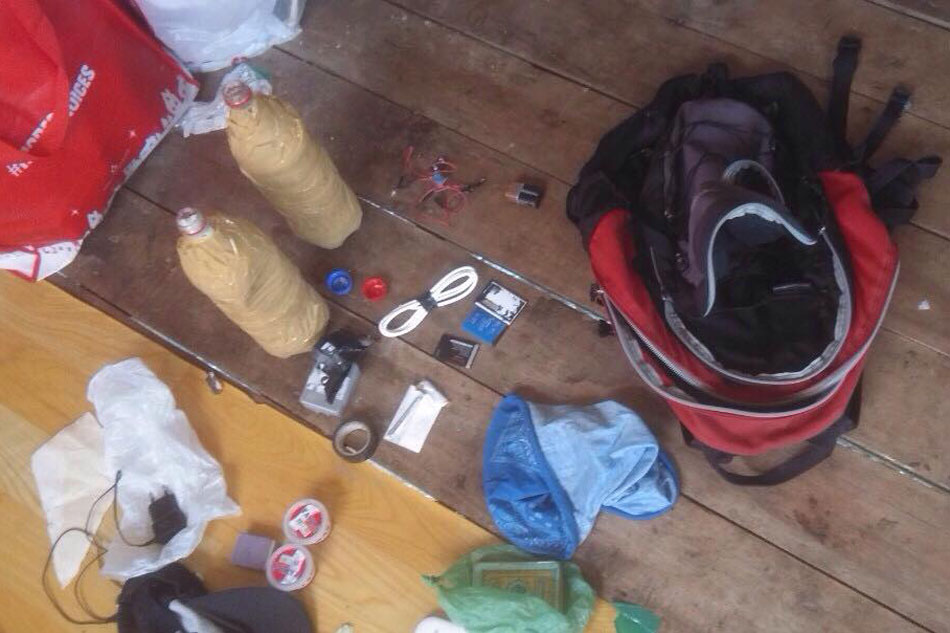
Army soldiers recovered an improvised explosive device (IED), firearms and other items following an encounter with suspected New People’s Army (NPA) guerrillas in Buenavista, Agusan del Norte over the weekend.

Aside from the IED, among the items recovered were two rifles, a pistol, electrical wires, a grenade, ammunition, five phones, binoculars and personal belongings.

The encounter between the troopers and at least 10 guerrillas occurred in Barangay Lower Olave on Saturday, according to 1/Lt. Roel Magla-lang, civil military operations officer of the Army’s 23rd Infantry Battalion (IB).

Maglalang said the troopers were responding to a report about the presence of armed men in the area when they clashed with the rebels.

Lt. Col. Francisco Molina Jr., chief of the 23rd IB, attributed the recovery of the items to the cooperation between the residents and the military.

“Through the cooperation of the civilian stakeholders, we were able to save lives by thwarting the hostile plans of the rebels,” Molina said.

https://www.philstar.com/nation/2019/03/11/1900343/troopers-seize-ied-firearms-agusan

AFP verifying 10 Abu bandits killed in Patikul air strikes

From the Journal Online (Mar 10, 2019): AFP verifying 10 Abu bandits killed in Patikul air strikes

THE Armed Forces of the Philippines (AFP) is verifying reports that at least 10 members of the Abu Sayyaf Group ( ASG) were killed in the aerial bombardment by the military against the terrorist group last Friday in Bgy. Kabuntakas, Patikul, Sulu.

“May mga report on casualties pero hindi pa confirmed. Wala pang body count. ‘Di namin ma-pinpoint pa, maraming nagsasabi may sampu, may siyam, wala pang confirmation,” Brig. General Divino Rey Pabayo, commander of the Joint Task Force Sulu ( JTFS), said.

Pabayo said they received an intelligence report that nine to ten bandits were killed but the bodies were yet to be retrieved by their comrades.


He said government forces are scouring the area to look for the casualties.

“Kasi masukal masyado, malaki ‘yung area, ongoing pa, ini-scour pa,” he said.

Government forces launched an aerial assault after receiving reports about the bandits spotted in the area.

The report said ASG sub-leader Hatib Hajan Sawadjaan was seen in the village when the aerial bombardment was conducted.

However, troops could not yet confirm if Sawadjaan was among the casualties.

Brother of ASG sub-leader hurt in clash 


Meanwhile an ASG member on Saturday was killed while a brother of their sub-leader was wounded in an encounter with government forces in Talipao, Sulu.

Killed was Rakib Dasul while the injured was Jaber Susukan, a brother of ASG sub-leader Idang Susukan.


Dasul was involved in a series of kidnappings perpetrated by a group led by ASG sub-leader Apoh Mike.

Members of the 2nd Special Forces Batallion were patrolling the mountainous area of Talipao when they met the bandits at 6:30 a.m. on Saturday.

A firefight ensued which lasted for several minutes and resulted to the death of Dasul and the wounding of Susukan.

Recovered at the clash site were two M16 rifles, magazines and ammunition.


https://journal.com.ph/news/provincial/afp-verifying-10-abu-bandits-killed-patikul-air-strikes

DWDD: 10th Infantry Battalion "Whole of Nation Approach" Symposium

Posted to Katropa DWDD-CRS Virtual RTV (Mar 10): 10th Infantry Battalion "Whole of Nation Approach" Symposium

ATM: Just concluded "Whole of Nation Approach (WNA) through the Convergence Area for Peace and Development (CAPDev)" Symposium hosted by Headquarters 2nd Mechan...ized Infantry (MAGBALANTAY) Brigade at Ditucalan, Maria Christina, Iligan City with Dir. MYLAH FAYE AURORA B CARIÑO (CESO III) Regional Director NEDA X and BGEN FRANCO NEMESIO M GACAL AFP, Commander 4th Infantry Division PA as Guest Speakers.

Image may contain: 1 person, standing and outdoor

https://www.facebook.com/steadyontenIB/photos/pcb.544172042771869/544171942771879/?type=3&theater

https://www.facebook.com/pg/dwdd1134/posts/?ref=page_internal

WESTMINCOM: Army official: “Feel free to approach us for any security concern”

Posted to the Western Mindanao Command (WESTMINCOM) Website (Mar 10, 2019): Army official: “Feel free to approach us for any security concern”


Barangay officials and security forces convene in a security conference held at the Headquarters of the 4th Special Forces Battalion (Riverine) in Cabunbata, Isabela City, Basilan yesterday (March 9).


The conference was held to address the pressing issues about security following the shooting incident which transpired the other day.

Lieutenant Colonel Achilles A. Dela Cruz, the Commanding Officer of 4SFBN(R), addressed the security concerns of the barangay officials and stated his condemnation on the politically-motivated and other forms of atrocities.


“It’s our job to secure our community. Feel free to approach us for any security concern,” LtC Dela Cruz added.

The 4th Special Forces Battalion (Riverine) together with the 15th Special Forces Company and the PNP strictly implement checkpoints along strategic locations all over the city.


“All security forces work hand-in-hand to keep each and every citizen safe and secured,” said WestMinCom Chief Lieutenant General Arnel B. Dela Vega.

“We are your defenders, you can count on us,” he added.

http://www.westmincom.com/army-official-feel-free-to-approach-us-for-any-security-concern/

Sayyaf militant in Sabah raids slain in Sulu

From the Mindanao Examiner (Mar 10, 2019): Sayyaf militant in Sabah raids slain in Sulu

Filipino troops killed an Abu Sayyaf militant, whose notorious group was believed behind cross-border raids in Malaysia, officials said Sunday.

Officials said Rakib Dahsul was slain in fierce fighting that also wounded Jaber Susukan, brother of Abu Sayyaf leader Idang Susukan, in the hinterlands of Talipao town in Sulu province. There was no report of military casualties in the weekend clashes.

Soldiers managed to recover the body of Dahsul, a follower of militant commander Apoh Mike tagged by Malaysian authorities as behind the spate of ransom kidnappings in Sabah. Troops also retrieved two M16 automatic rifles as military campaign against the pro-ISIS group further intensifies as the Abu Sayyaf has threatened to execute three of its hostages – two Indonesians and a Malaysia fisherman – kidnapped at sea of Sabah in December.

Lt. Gen. Arnel dela Vega, the regional military commander, said the offensives against the terrorist group were meant to debilitate and inflict more casualties on the enemies. “While we are advancing on our campaign, we will sustain our offensives and employ more pressure on the terrorists,” he said.

Abu Sayyaf militants, whose group has pledged allegiance to ISIS, said they will kill the hostages if ransoms are not paid in exchange for their lives, Malaysian media reports said.

It said militants, who spoke in Bahasa Malaysia, released a video clip which showed the Indonesian hostages – believed to be Heri Ardiansyah, 19, and Hariadin, 45 – being guarded by gunmen. The Malaysian hostage, Jari Abdulla, 24, was not with the duo.

The captives, their eyes covered with black cloth and hands tied behind their back, made an emotional appeal for their government to save them. One militant even held a bolo on the neck of Hariadin as he spoke to the camera in forested area.

The video, reports said, surfaced several days after Abu Sayyaf gunmen phoned Jari’s wife, Nadin Junianti, saying that no Malaysian authorities or negotiators have contacted them to secure her husband’s release.

The gunmen said that her husband would face difficulties if there was no contact from Malaysia. They also asked her for telephone contacts of Malaysian journalists. Nadin has appealed to Malaysian authorities to help secure her husband’s release. She said it was second time the kidnap group had contacted her.

Conflicting reports on Abu Sayyaf ransom demands said the militant were asking between P10 million to P100 million. The militants are believed to be holding nearly a dozen captives, mostly foreigners. Sabah Police Commissioner Datuk Omar Mammah has said that they were working with their Philippines counterparts to secure the hostages’ release.

Malaysian Premier Mahathir Mohamad was in the Philippines on Friday and met separately with Filipino leader Rodrigo Duterte and former rebel chieftain Murad Ebrahim, who is now the Chief Minister of the newly-created Bangsamoro Autonomous Region in Muslim Mindanao.

It was unknown whether Mahathir discussed with Duterte and Ebrahim the continued Abu Sayyaf incursions and ransom kidnappings in Sabah or the impending execution of the hostages.

https://mindanaoexaminer.com/sayyaf-militant-in-sabah-raids-slain-in-sulu/

Misuari under Duterte’s wings

From the Mindanao Examiner (Mar 10, 2019): Misuari under Duterte’s wings

FORMER REBEL leader Nur Misuari, who is accused of rebellion by authorities for the September 2013 deadly attack on Zamboanga City in southern Philippines, is being protected from arrest by President Rodrigo Duterte.

Duterte, who admitted being a good friend of Misuari, the chairman of the Moro National Liberation Front (MNLF), interceded to the police and military on behalf of the Libyan firebrand so he would be free to move around without any fear of being arrested.


Nur Misuari (Mindanao Examiner Photo)

He also admitted that he intervened to allow Misuari to travel abroad to attend two conferences of the Organization of Islamic Cooperation in Abu Dhabi and Morocco despite criminal charges against the MNLF leader.

“He came to see me to ask me to intercede in his behalf that he be given temporary pass to go out – kasi may kaso siya eh, ipi-preso siya dito – para maka-attend ng OIC,” Duterte said.

Misuari is also facing graft charges at the Sandigan Bayan over the alleged anomalous purchase of education materials when he was governor of the defunct Autonomous Region in Muslim Mindanao. Misuari denied all criminal and graft accusations against him.

Duterte assured the public that Misuari would return after the conferences this month.

“So I told the military and the police, hayaan ninyo na at babalik ‘yan. He is not a fugitive, he is a revolutionary. And you know what? That guy will always come back. It would be an insult to his person if he is buried in another land. Babalik dito ‘yan, dito magpakamatay,” he said.

Justice

While Duterte is protecting Misuari, local government leaders and residents of Zamboanga are demanding justice for the deadly siege that left over 200,000 people without homes following weeks of street battles between security and MNLF forces that killed and wounded some 300 civilians.

It was the second time that MNLF forces raided Zamboanga. In November 2001, Misuari’s loyal forces also attacked Zamboanga and left dozens of civilians dead and wounded. Heavily-armed MNLF gunmen also took hostage over 100 civilians, including women and children, and used them as shield and pawn so they can escape to Basilan and Sulu provinces.

In 2016, Mayor Beng Climaco banned all MNLF rallies in Zamboanga City following attempts by Misuari’s group to hold a peace caravan. “I am giving you a categorical no, you must not disturb Zamboanga anymore. If you want to come up with your rally, make it in your area, Zamboanga will not welcome a rally by MNLF, not at this time because you still have to be accountable with the killings and devastations we are suffering from,” Climaco said.

“The destruction wrought by the 2013 siege continues to linger, as internally displaced persons – both Muslims, Christians and Lumads, most of whom are those who eluded the conflicts in Sulu and Basilan – have suffered the brunt of the MNLF attack in Zamboanga,” Climaco said.

Failure

In Sulu, security forces failed to arrest Misuari following a massive show of force by the MNLF and Abu Sayyaf rebels who attended the plenum called by the ageing leader in Indanan town to discuss the Islamic Inter-Parliamentary Union and summit by the Organization of Islamic Cooperation in that year.

The plenum forced the military to declare a red alert status in Sulu for fear the MNLF and Abu Sayyaf may launch a surprise attacks on government targets.

Misuari signed a peace deal with Manila in September 1996 ending decades of bloody war. After the peace agreement was signed, Misuari became the governor of the Muslim autonomous region. But despite the peace accord, there was a widespread disillusionment with the weak autonomy they were granted.

Under the peace agreement, Manila would have to provide a mini-Marshal Plan to spur economic development in Muslim areas in the south and livelihood and housing assistance to tens of thousands of former rebels to uplift their poor living standards.

Misuari’s loyal forces and former MNLF rebels who joined the Philippine Army following the peace accord, attacked a key military base in Sulu’s Jolo town and civilian targets in Zamboanga in an effort to stop the government from calling an election in the autonomous region where Misuari wanted to be a perpetual governor.

Misuari then escaped by boat to Malaysia, where he had been arrested and deported to the Philippines and was eventually pardoned and released by then President Gloria Arroyo in exchange for MNLF support to her election bid as well as her allies in the Senate and Congress in 2004. He also ran thrice for governor in Sulu even while under detention, but lost miserably.
 

United Mothers of Marawi one in fight vs violent extremism

From the Philippine Information Agency (Mar 10, 2019): United Mothers of Marawi one in fight vs violent extremism

MARAWI CITY -- To further enhance the role of mothers in preventing and countering violent extremism (PCVE) as well as in influencing good deeds among young Maranaos, the Institute for Autonomy and Governance (IAG) conducted a two-day workshop for the United Mothers of Marawi Initiatives (UMMI) Core Group, injecting family-based approaches in the development of age-appropriate, culture-sensitive and family-based modules on PCVE.


Participants shared ideas on leveling-off, and review of the organizational purpose and other agreements of UMMI. (Photo by Jazz Cuaresma/IAG)

The workshop, which was held last March 3 and 4, sought to establish a family-based framework anchored on the specific narratives, aspiration, and the cultural-religious ideals of the Maranao community as its core principles.

According to the mother-participants, there is a need to craft a women-led module on PCVE that will introduce a deeper understanding and appreciation among the young on the roles of mothers in recognizing their vulnerability to being recruited by violent extremist groups in Marawi City and its neighboring communities.

"Masaya kami na may ganitong workshop para sa aming mga nanay. Lahat kami na nandito concern sa community namin especially what happened to Marawi, yung experience ng Marawi Seige. It is a moving lesson para sa amin to do our best to contribute whatever we can, to help rebuild our homeland," said Aquisah Barazar, one of the participants during workshop.

[We are glad to have this kind of workshop for the mothers. We're all concerned about our community especially on what had happened to Marawi and our experiences during the Marawi siege. It is a moving lesson for us to do our best to contribute whatever we can, to help rebuild our homeland.]

Also, the workshop sought to deepen a shared understanding of the responsibilities of the family in Maranao communities in supporting the development of children to shield them from wrong ideologies.


Prof. Rey Danilo Lacson, Program Manager, Enhancing Political Dialogue for Inclusive Peace (EnPolD) gives opening remarks during the workshop. (Photo by Jazz Cuaresma/IAG)

Furthermore, in order to create a youth-responsive strategy in countering violent extremism, IAG is implementing Enpold Bangsamoro Politics for Peace Phase 2 project, in partnership with the Bangsamoro Women Services Center (BWSC), Institute for Bangsamoro Studies (IBS), Initiatives for International Dialogue (IID), Organization of Teduray and Lambangian Conference and Zamboanga Basilan Integrated Alliance, Inc. (ZABIDA), and supported by the Department of Foreign Affairs and Trade - Australia.

The project includes a consensus building for developing a module on family-based approaches on PCVE in support of Marawi recovery and rehabilitation.

https://pia.gov.ph/news/articles/1019515

Reds also source funds from Fil-Ams in US, Canada: ex-rebels

From the Philippine News Agency (Mar 10, 2019): Reds also source funds from Fil-Ams in US, Canada: ex-rebels

As a group of ex-rebels welcomed the move of European leaders to look into the information presented by the Philippine government on the reported funding of EU-member countries for activities of the Communist Party of the Philippines (CPP), it said the communist group also receive funds from Filipino-American communities in the US and Canada.

“Pinapahayag namin ang pagsuporta sa inisyatibang ilantad ang gawain ng CPP-NPA-NDF para magpasok ng pondo para sa digmaan bayan (We are expressing support to the initiative to expose the CPP-NPA-NDF acquisition of funds for the people’s war),” the Kilusan at Alyansa ng mga Dating Rebelde (KADRE) said in a statement dated March 6.

KADRE, a group of more than 300 former members of the CPP and its armed wing New Peoples Army (NPA) nationwide, issued the statement following reports that a Philippine delegation showed European leaders documents indicating that communist front organizations receive funds from the Belgian government and some European countries in the guise of marginalized and pro-poor programs.

The group said it was common for CPP-NPA, and National Democratic Front (NDF) to use legitimate advocacies such as human rights, climate change, education reform, among others, to convince progressive nations to grant them financial aid.

“Eksperto ang international unit ng Partido na gumamit ng campaign advocacy groups particular sa larangan ng human rights, climate change advocacy, environmental issues, educational reform agenda dahil dito galante at nakatutok ang mga mauunlad na bansa sa aspeto ng pagtulong sa mga developing countries (The international unit of the party are experts when it comes to using campaign advocacy groups particularly in the field of human rights, climate change, environmental issues, educational reform because progressive nations are generous to developing countries),” said Ka Apo, a leader of KADRE.

Other fund donors

He said aside from EU-member states, some Filipino-American communities are also funding the CPP.

“Hindi lang Europa ang kanilang ginagatasan, nandyan din ang pang- gagatas nila sa mga ‘Fil-Am Communities’ sa Estados Unidos at Canada. Ang lagi na lang sinasabi yung pondo ay gagamitin sa ‘Campaign Info Drive on Climate Change Resiliency (It’s not only Europe spending for them, there is also the Fil-Am communities in the US and Canada. They keep saying that the funds will be used for a ‘Campaign Info Drive on Climate Change Resiliency),” he added.

Ka Apo said questionable handling of the international unit of the CPP-NPA prompted him to leave the group.

As one of the original founders of Migrante International, he said CPP sent him abroad as an overseas Filipino worker to form the alliance of progressive organizations composed of overseas Filipinos and their families.

A Philippine delegation engaged with officials of the European Union (EU), European Parliament, and European Commission (EC) in Brussels, Belgium in February to request the latter to stop the flow of funds to the CPP-NPA.

The Armed Forces of the Philippines (AFP) revealed that the Belgian government has already released its first tranche of more than 621,000 Euros (PHP36,663,840) out of the 15-million Euro (PHP885,600,000) grant to some seven non-government organizations for the 2017-2021 program. This year, some 1.3 million Euros (PHP76,752,000) are expected to be released.

Brig. Gen. Antonio Parlade Jr., AFP Deputy Chief of Staff for Civil Military Operations, confirmed that communist terrorist groups hide behind legitimate organizations.

Parlade added that the information about the EU and Belgian government funding organizations affiliated with the CPP-NPA came from EU and the Belgian government themselves.

The CPP-NPA was earlier declared a terrorist organization by the US and EU.

http://www.pna.gov.ph/articles/1064140

Saturday, March 9, 2019

'They fooled us': the men who left Isis in the Philippines

From The Guardian (Mar 8, 2019): 'They fooled us': the men who left Isis in the Philippines

As the caliphate in Syria crumbles, men who fought for ‘true jihad’ in Marawi tell of how the suffering of civilians made them flee

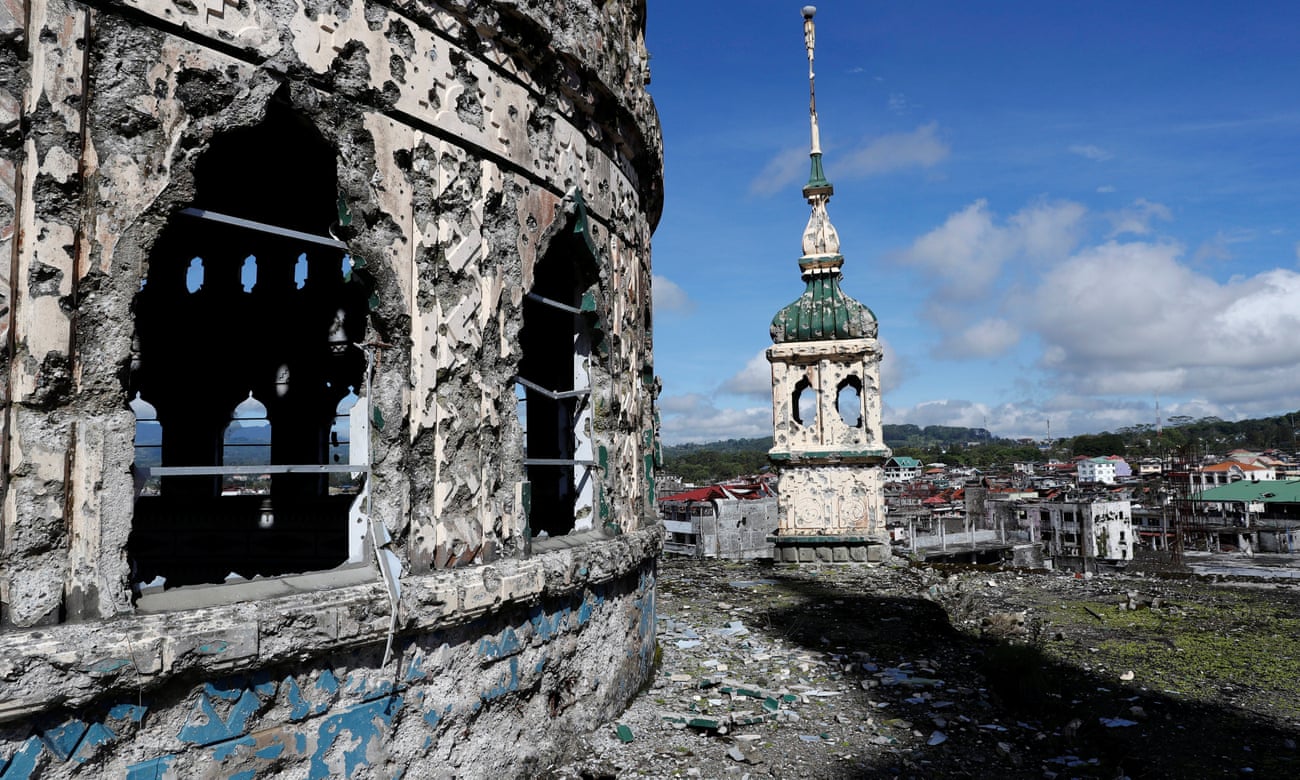
The bullet-riddled domes of Marawi’s grand mosque serve as reminders of the brutal siege of 2017 by Isis affiliate the Maute Group in the southern Philippines.

 The bullet-riddled domes of Marawi’s grand mosque serve as reminders of the brutal siege of 2017 by Isis affiliate the Maute Group in the southern Philippines. Photograph: Erik de Castro/Reuters

As Isis’s last stronghold in Syria burns, half a world away in the Philippines are men who know how it feels to watch a caliphate crumble.

If Alex could turn back time, he would. He wouldn’t have languished in Marawi City with his 13-year-old son in May 2017 and they wouldn’t have taken the guns the Isis-linked Maute Group handed out on the day that marked the start of a five-month conflict that destroyed the city.

“They said ‘they’re the ones fighting for the true jihad. We’re going to fight to the death to defend our religion and we will reap our rewards in the afterlife,” 38-year-old Alex* tells the Guardian, in one of the first sit-down interviews with a former Isis fighter in the Philippines.

His son died in the ensuing siege. He also lost relatives and friends.

Alex’s testimony comes as Isis fighters in the Syrian town of Baghuz are trapped by advancing Kurdish-led Syrian Democratic Forces (SDF), the Syrian regime and Russia. The last days of Isis in the Middle East have finally come.


Marawi one year after the battle: a ghost town still haunted by threat of Isis

But in the Philippines the memory of war is still fresh.

“I was worried because I don’t think my son knew how to hold a firearm. But he said he wanted to fight and I couldn’t do anything to stop him,” says Alex. “I only wanted to fight for the true Islam. They fooled us. What we did was really wrong.”

Close to two years after the siege began, Alex says the memories are painful and the violence feels “like a bad dream”.


An example of the vessels Maute Group fighters would use to enter and exit the fight in Marawi. Photograph: Philippines military/Western Mindanao command

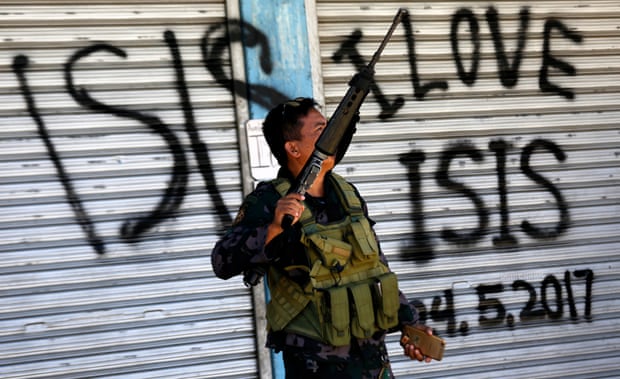
In 2017, the Maute Group laid siege to the city under the banner of Isis, leading to the deaths of more than 1,000 people. More than a year later, the military is still fighting remnant fighters determined to recruit.

The battle area remains a ghost town as government rehabilitation work continues to suffer delays, meaning about 50,000 residents – or a quarter of the city’s population – are still unable to return to their homes.

Alex says he left the fighting in Marawi after about two months, stricken by guilt when he saw how civilians had died and suffered. He escaped Marawi by threatening a boatman who was delivering ammunition to the battle. His son refused to leave with him.

Until his surrender last year, Alex had been on the run, both from soldiers who knew his name, and from surviving Maute Group fighters who regarded him as traitor. He later learned about his son’s death.
‘I want a peaceful life.

“I’m tired of running. I just want a fresh start and a peaceful life,” says Alex. It is the prayer of about 135 former fighters who have surrendered, hopeful of government promises that they can begin a new life if they give up their guns.

The Philippines government is seeking to reintegrate the former fighters back into the community, one of the measures in the campaign to prevent the possible resurgence of Isis in the country.

“The spirit of reconciliation is the main concept behind this endeavour,” says Colonel Romeo Brawner, the military commander on the ground. “While the government is addressing the needs of the IDPs [internally displaced persons], it is also seeking for a solution to the problem of violent extremism and terrorism.”


A Filipino soldier patrols an area of Marawi city reclaimed from the Maute Group in 2017. Photograph: Francis R. Malasig/EPA

Alex wouldn’t call himself a die-hard Isis follower. He was recruited to join the Maute Group in April 2016 by a local religious leader in his home town of Piagapo, which shares a border with Marawi. He twice rejected calls to fight for Isis – first in Butig in 2016 and then in Piagapo just a month before the siege of Marawi.

But the death of Alex’s religious leader in the Piagapo clashes drove him and many of his friends to avenge his death. His 29-year-old cousin Asis* was part of that group.


Former Maute Group fighters in the Philippines, Asis [middle], with ‘Alex’ on right. Photograph: Carmela Fonbuena/The Guardian
“I got angry. I really wanted to avenge his death,” Asis told the Guardian. He volunteered to fight and, within a week of the battles, sailed to Marawi with nine others on a boat delivering ammunition. They were told they would receive their firearms in Marawi, and that their families would receive P25,000 (about £370) each.

Alex and Asis fought fiercely at first, both armed by the training they received from the Moro Islamic Liberation Front (MILF), the main rebel group that has since signed a peace agreement with the government. Their fighting experience as former MILF fighters was perhaps why they were targeted by Isis recruiters, they say.

The MILF will now lead a new autonomous Muslim region that promises to fight extremism in the region.

Like, Alex, Asis also left the fighting in Marawi after about two months, along with 16 other fighters who disagreed with the group’s decision to keep civilian hostages. After a standoff with other fighters, they boarded two boats and risked sailing away. “If they didn’t let us go, we would have fought each other there,” Asis says.

Life on the run was difficult. Alex and Asis sought refuge in the mountainous towns around Marawi when even their relatives shunned them. Yet they felt they had “no choice” but to surrender when their families grew scared as the military began knocking on doors to look for them, says Asis.

They know their former colleagues are also hunting them. “They call us traitors. They will kill me if they saw me. But I will kill them first,” says Asis.

But outreach from the government – in the form of livelihoods and financial help – has improved matters.

“We’re better. We can stay with our families now,” said Alex. “I now have friends in the military. Who would have thought that I could make friends with the soldiers I used to fight?” says Asis.

* Not their real names

https://www.theguardian.com/world/2019/mar/09/they-fooled-us-the-men-who-left-isis-in-the-philippines

12,000 MILF fighters to be decommissioned under Philippines’ peace pact

From the Arab News (Mar 9, 2019): 12,000 MILF fighters to be decommissioned under Philippines’ peace pact


Fighters of the Moro Islamic Liberation Front (MILF) man a checkpoint along a road leading to the group's main camp in the southern island of Mindanao in the Philippines. (AN file photo)

  • The Philippine government and the MILF signed a peace pact last year to end the decades-long conflict
  • Under the peace pact, the Autonomous Region of Muslim Mindanao was expanded and the MILF plays a main role in governance

  • MANILA: With the new autonomous Bangsamoro government in place in Mindanao, south Philippines, the implementation of the peace process between the government of the Philippines and Moro Islamic Liberation Front (MILF) forces is now underway, which includes the decommissioning of 12,000 combatants “within this year,” according to Presidential Peace Adviser Carlito Galvez Jr.

    The normalization track of the Comprehensive Agreement on the Bangsamoro (CAB) has four major components: Security, a socio-economic development program, confidence-building measures, and transitional justice and reconciliation.

    It is one of two primary tracks of the CAB, the final peace agreement signed between the government and the MILF in 2014 after four decades of conflict that killed over 120,000 people.

    Last Monday, an executive order (EO) on the execution of the normalization track was approved by President Duterte and Galvez said both sides are working double time to finalize its Implementing Rules and Regulations (IRR) which include the decommissioning of MILF combatants, surrendering their weapons and the transformation of several camps into productive communities.

    "The IRR will contain the work plan and other activities covering the three-year period. It will also cover critical timeline, the scope of work, and all the programs for the security, socio-economic programs, and transitional justice," Galvez said.

    Right at the heart of the security component is the decommissioning of MILF combatants and the disbandment of private armed groups, and at least symbolically, that phase began back in 2015 when 145 former MILF rebels turned over their weapons to the International Decommissioning Body.

    According to Galvez, 35 percent of remaining combatants will be decommissioned in 2020, and the rest in 2021-22 before the signing of exit agreements.

    In an interview with Arab News in 2018, MILF's Eduardo Uy Guerra, chairman of the Joint Normalization Committee, said the MILF had trained more than 100,000 fighters.

    Most notably, he said most of the firearms were owned by the combatants themselves, and that even when MILF members were towing their buffalos, they kept their guns on hand — just one example of the deep-rooted nature of the decades long civil conflict.

    According to Galvez, there were planned rehabilitation programs to transform “combatants and camps into peace-loving individuals and productive, sustainable villages and communities.”

    Roman Catholic priest Eliseo Mercado, policy adviser at the Cotabato-based Institute for Autonomy and Governance, cited the importance of the decommissioning process, but said it was less about how many fighters were decommissioned, and more about the building of confidence.

    "After decommissioning, where do you put them? It's important for the government to ensure they will not be dislocated. They must have livelihood, have the opportunity to become entrepreneurs, or give them employment in the BARMM. Without this, what will you do with those thousands of people? They will go back to lawlessness," he said.

    http://www.arabnews.com/node/1464211/world

    How ISIS Is Rising in the Philippines as It Dwindles in the Middle East

    From the New York Times (Mar 9, 2019): How ISIS Is Rising in the Philippines as It Dwindles in the Middle East


    Soldiers inspecting vehicles last month in Zamboanga, the Philippines, the gateway to the southern islands of Jolo and Basilan, where the nation’s Muslim minority is concentrated and local insurgencies have long battled the state.CreditCreditJes Aznar for The New York Times

    BASILAN, the Philippines — Across the islands of the southern Philippines, the black flag of the Islamic State is flying over what the group considers its East Asia province.

    Men in the jungle, two oceans away from the arid birthplace of the Islamic State, are taking the terrorist brand name into new battles.

    As worshipers gathered in January for Sunday Mass at a Catholic cathedral, two bombs ripped through the church compound, killing 23 people. The Islamic State claimed a pair of its suicide bombers had caused the carnage.

    An illustration circulated days later on Islamic State chat groups, showing President Rodrigo Duterte of the Philippines kneeling on a pile of skulls and a militant standing over him with a dagger. The caption on the picture sounded a warning: “The fighting has just begun.”


    Image: Soldiers securing a post on the island of Basilan, the Philippines.CreditJes Aznar for The New York Times

    The Islamic State’s territory in Iraq and Syria, once the size of Britain, has shriveled after four years of American-backed bombing and ground combat by Kurdish and Shiite militia fighters. What is left is a tiny village in southeast Syria that could fall any day.

    But far from defeated, the movement has sprouted elsewhere. And here in the Mindanao island group of the southern Philippines, long a haven for insurgents because of dense wilderness and weak policing, the Islamic State has attracted a range of militant jihadists.


    Image : On Basilan, local officials say that the island is now safe from the Abu Sayyaf separatists who began fighting from the jungles in 1991.CreditJes Aznar for The New York Times

    “ISIS has a lot of power,” said Motondan Indama, a former child fighter on the island of Basilan and cousin of Furuji Indama, a militant leader who has pledged fealty to the group. “I don’t know why my cousin joined, but it’s happening all over.”

    The group first made a big push for southern Philippines recruitment in 2016, circulating videos online beckoning militants who could not travel to its self-proclaimed caliphate in Iraq and Syria. Hundreds of fighters poured in from as far away as Chechnya, Somalia and Yemen, intelligence officials said.

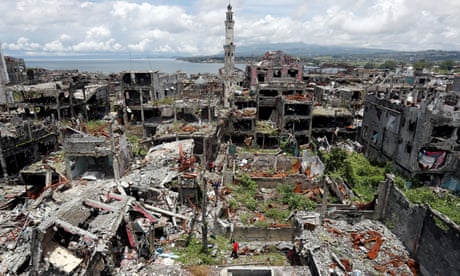
    The next year, militants who had pledged allegiance to the Islamic State took over the city of Marawi in Mindanao. By the time the army prevailed five months later, the largest Muslim-majority city in the country lay in ruins. At least 900 insurgents were killed, including foreign fighters and Isnilon Hapilon, the Islamic State’s East Asia emir.


    Image: On a visit to a cathedral in Jolo that was bombed by militants, President Rodrigo Duterte and his aides trampled over evidence, church officials said.CreditMalacanang Palace, via Associated Press

    Mr. Duterte declared victory over the Islamic State. But his triumphalism apparently has not deterred its loyalists from regrouping.

    “ISIS has money coming into the Philippines, and they are recruiting fighters,” said Rommel Banlaoi, chairman of the Philippine Institute for Peace, Violence and Terrorism Research. “ISIS is the most complicated, evolving problem for the Philippines today, and we should not pretend that it doesn’t exist because we don’t want it to exist.”

    Since the Jan. 27 cathedral bombing on the island of Jolo, the Philippine military has responded with airstrikes and 10,000 soldiers in Jolo, according to Col. Gerry Besana, spokesman for the regional military command in the city of Zamboanga.


    Image: Soldiers carrying the casket of Cpl. Nemesis Salviejo, a special forces soldier killed in a battle with Abu Sayyaf in Jolo last month.CreditJes Aznar for The New York Times

    American surveillance drones monitor the southern Philippine archipelago, where the nation’s Muslim minority is concentrated and local insurgencies have long battled the Christian-majority state.

    But even as the military offensive intensifies, the government avoids conceding that the Philippines is in the global slipstream of Islamist extremism. Top officials have played down incidents in which the Islamic State has sent foreign fighters and financing to the Philippines for deadly attacks. The violence, they often say, is squabbling between Muslim clans, or common banditry.

    Within a week of the Jolo cathedral bombing, the police declared the case solved, blaming a local militant group, Abu Sayyaf, with scant acknowledgment of how many of its insurgents have partnered with the Islamic State.


    Image: A house for former Abu Sayyaf members built by the government.CreditJes Aznar for The New York Times

    Visiting the Jolo cathedral, Our Lady of Mount Carmel, Mr. Duterte and his entourage trampled over evidence, church officials said. Forensic investigators were kept from the crime scene for days. Dogs gnawed on body parts.

    “We are asking for an independent investigation because it was too quick, too soon to say it’s a closed case,” said Jefferson Nadua, a parish priest. “This is a serious matter that needs to be looked at more deeply because the threat is not just local. It’s maybe coming from outside, from ISIS.”

    For decades, local insurgencies like Abu Sayyaf, which launched a campaign of bombings and beheadings, have thrived in the lawless wilderness and seas stretching toward Malaysia and Indonesia.


    Image: Soldiers returning from the front line in Jolo at an airbase in Zamboanga, in the southern Philippines.CreditJes Aznar for The New York Times

    In the 1990s, after Filipinos returned from the mujahedeen battlefields in Afghanistan and hard-line madrassas in Yemen and Saudi Arabia, local grievances fused with global calls for jihad. In a crescent-shaped swath of Southeast Asia, militants dreamed of a caliphate free of secular governance.

    Jemaah Islamiyah, the Qaeda offshoot that killed more than 200 people in a Bali nightclub in 2002, trained recruits in Philippine jungles.

    Later, as the Islamic State constructed its caliphate in the Middle East, it connected disparate militants in the Philippines under one ideological banner, said Sidney Jones, the director of the Institute for Policy Analysis of Conflict in Jakarta, Indonesia.


    Image: Students at a Muslim school playing with mobile devices in Zamboanga.CreditJes Aznar for The New York Times

    “The government didn’t recognize its strength in attracting everyone from university-educated students to Abu Sayyaf kids in the jungle,” Ms. Jones said. “Whatever happens to the pro-ISIS coalition in Mindanao, it has left behind the idea of an Islamic state as a desirable alternative to corrupt democracy.”

    Basilan officials say the island is now safe from the Abu Sayyaf separatists who began their fight in 1991. No foreign fighters are hiding in the jungles, the local authorities insist, and they claim that the rebels have been reduced to about 20 trapped stragglers.

    But Colonel Besana puts the overall number of militants on Basilan at perhaps 200, and their leader has pledged allegiance to the Islamic State.


    Image: In 2017, militants who pledged allegiance to the Islamic State took over the city of Marawi in Mindanao. By the time the army prevailed five months later, the largest Muslim majority city in the country lay in ruins.CreditJes Aznar for The New York Times

    Mr. Indama, the former fighter who says he left Abu Sayyaf last year because he rejected the Islamic State’s ideology, claimed he saw foreign operatives in the Basilan jungle camps.

    The idea that no overseas fighters have stolen onto Basilan was shattered last July when it was the site of the first suicide bombing in the Philippines.

    The Islamic State claimed that the attack, which killed 11 people, had been the work of a Moroccan recruit. The Philippine authorities initially denied the attack had been by a suicide bomber, much less a foreigner. Weeks later, they admitted it had been carried out by a German-Moroccan suicide bomber.

    Last year, a Spaniard was arrested in Basilan with bomb-making materials. An Egyptian carrying $19,000 in cash was also stopped on his way to Basilan, according to Mujiv Hataman, the governor of the autonomous Muslim region of the Philippines.

    Mr. Hataman, who travels by armored convoy, expressed worry that if the bombing raids intensify in Jolo, militants will slip undetected into Basilan via small boats. Already, they travel among Indonesia, Malaysia and the Philippines over poorly patrolled seas.

    “One problem goes away and another starts,” Mr. Hataman said.

    Interior Secretary Eduardo Año has blamed the Jolo attack on an Indonesian couple, although Indonesian investigators say there is little evidence.

    Colonel Besana acknowledged that a number of foreign fighters were hiding in the Jolo hills, under the command of Hatib Hajan Sawadjaan, who is believed to have replaced Mr. Hapilon as the regional Islamic State emir.

    The Islamic State’s lure seems never far from the surface in the southern Philippines. At a government ceremony in Basilan where houses were awarded to former Abu Sayyaf rebels under a long-gestating peace deal to bring autonomy to the Muslim south, security was so heavy that they were outnumbered by Philippine soldiers.

    Jem Habing, 22, a former Abu Sayyaf fighter who said he had joined at age 11, like many children in his village, seemed noncommittal when asked if he might rejoin.

    “They convinced me that if you die in battle, you will be rewarded in the hereafter,” he said. “They said it was the right path.”

    https://www.nytimes.com/2019/03/09/world/asia/isis-philippines-jolo.html

    Alleged Abu bandit arrested in Zamboanga City

    From ABS-CBN (Mar 8, 2019): Alleged Abu bandit arrested in Zamboanga City


    Police recovered bomb components inside the suspect's house in Zamboanga City. Contributed photo

    A suspected Abu Sayyaf bandit was nabbed in Sitio Asinan in the village of Kasanyangan in Zamboanga City Friday morning.

    Police identified the bandit as Benwagas Salapuddin, also known as Nidz Ahamad and Midel Isnaji, said to be a follower of the late Abu Sayyaf sub-commander Muamar Askali in Sulu.


    Police Lt. Col. Edilberto Alvarez of the Zamboanga City Police Office said Salapuddin has standing arrest warrants for double murder, multiple frustrated murder, and multiple attempted murder in relation to the January 2015 bombing near the Zamboanga City bus terminal.

    The attack killed one and wounded around 50 others.

    The bomb, an improvised explosive device, was planted in a red car parked along the road near a bar and just across the bus terminal.

    The car was intentionally set on fire by the suspects before the bomb went off.

    The loud blast happened a few minutes after firefighters arrived in the area. It tore through some nearby business establishments, wounding a number of workers and passersby.

    Alvarez said Salapuddin was one of the suspects in the planning and execution of the attack.

    Police also recovered bomb components inside Salapuddin’s house, including 2 plastic bottles of ammonium nitrate, 1 detonator leg wire, toggle switch, batteries and pyrotechnic powder.

    However, Alvarez said they are still investigating if the suspect is planning to mount another attack in the city with the bomb components found in his house.

    The Jolo, Sulu native has been in the city for more than a year now working as a security guard in one of the public schools, police said.

    Authorities said a tactical interrogation is necessary before Salapuddin will be presented to court and eventually turned over to the Zamboanga City Reformatory Center.

    https://news.abs-cbn.com/news/03/08/19/alleged-abu-bandit-arrested-in-zamboanga-city