
Monday, February 27, 2023
Senior MILF leader arrested on gun charges
This summary is not available. Please
click here to view the post.

PHP1.2-B new equipment boosts PNP modernization efforts
From the Philippine News Agency (Feb 27, 2023): PHP1.2-B new equipment boosts PNP modernization efforts (By Christopher Lloyd Caliwan)

NEW ASSETS. The Philippine National Police (PNP) presents its newly purchased assets as part of the modernization program at Camp Crame in Quezon City on Monday (Feb. 27, 2023). The new equipment is worth PHP1.2 billion. (Photo courtesy of PNP)
MANILA – The Philippine National Police (PNP) on Monday said it has acquired PHP1.2 billion million worth of new vehicles, equipment and weapons aimed at boosting the capabilities of the service and as part of its modernization efforts.
Maj. Gen. Ronaldo E. Olay, PNP director for logistics, said the new PNP equipment were procured under the PNP’s capability enhancement programs (CEPs) 2020 (balances), 2021 (balances) and 2022, with a total contract price of PHP1,239,586,796.
“The newly procured equipment will further enhance and improve the operational functions and duties of PNP offices/units nationwide in consonance with the PNP’s peace and security framework M+K+K=K or the Malasakit, Kaayusan, Kapayapaan Tungo sa Kaunlaran,” Olay said during the presentation rites of the equipment to PNP chief Gen. Rodolfo Azurin Jr. at Camp Crame in Quezon City.
Olay said the new equipment includes mobility assets -- 200 units patrol jeep (4x2) and 326 units of light motorcycle 150cc for municipal police stations; 10 units of brand new utility truck for logistics support service; on firepower 4,033 units 5.56mm basic assault rifle “Galil” and 9,544 units 9mm striker fired pistol “Taurus” for PNP wide; two high-speed tactical watercraft for the Maritime Group; and 5,458 units digital handheld radio and 221 units VHF lowband handheld radio on communication equipment.
Azurin said the equipment will be deployed in Region 1 (Ilocos Region), 2 (Cagayan Valley), and Central Luzon for patrol vehicles while the motorcycle will be deployed in some parts of Visayas.
Azurin said the sea assets will be deployed in Ilocos Norte and La Union because during the last procurement the concentration of deployment was in Zamboanga and some parts of the Bangsamoro Autonomous Region in Muslim Mindanao (BARMM).
“This time bigyan naman natin ng asset ang norte because as we experienced in the past yung mga bagyo na dumating so nahirapan tayo sa rescue operation natin dahil kulang yung equipment natin sa sea mobility natin doon sa Region 1 and Region 2 (This time let's give an asset to the north because as we experienced in the past the typhoons that came we had difficulty in our rescue operation because we lacked the equipment for our sea mobility in Region 1 and Region 2),” Azurin told reporters.
Azurin said that PNP is willing to augment the inshore patrol duties of the Coast Guard and Philippine Navy with their fleet of high-speed boats.
“Actually ginagamit natin yung mga high-speed tactical watercraft natin sa maritime patrols that's why we also invited yung Coast Guard and Navy because we wanted to have a memorandum of understanding na magsanib puwersa kami para sa pagsesecure natin sa mga karagatan natin para sa mga nagdadatingan na mga kontrabando kasama na diyan yung mga human trafficking in person na idinadaan sa mga boundaries lalo na sa malapit sa Malaysia, Indonesia papasok o palabas dito sa ating bansa (Actually, we use our high-speed tactical watercraft in maritime patrols that's why we also invited the Coast Guard and Navy because we wanted to have a memorandum of understanding that we will join forces to secure our oceans for those arriving contraband including human trafficking in persons that are passed through borders especially near Malaysia, Indonesia entering or exiting our country),” Azurin said.
https://www.pna.gov.ph/articles/1196124
PH continues to protest China's ‘illegal’ presence in WPS
From the Philippine News Agency (Feb 27, 2023): PH continues to protest China's ‘illegal’ presence in WPS (By Ma. Teresa Montemayor)

MANILA – The Philippine government continues to file protests against China’s “illegal presence” in the West Philippine Sea (WPS).
Department of Foreign Affairs (DFA) spokesperson Ma. Teresita Daza said the Philippines has filed a total of 77 protests against China, including 10 this year, under the administration of President Ferdinand R. Marcos Jr.
“The Philippines continues to protest China’s persistent and illegal presence in the Philippine waters, including those near Ayungin Shoal,” Daza said in a message to reporters.
Senator Risa Hontiveros has urged the DFA to broker security agreements with other nations to show China that the Philippines “will never stand down”.
Hontiveros emphasized the country should not only depend on its Mutual Defense Treaty with the United States in protecting its sovereign rights as similar deals can also be forged with other countries wanting peace and stability.
She said tangible steps must be taken to provide immediate help for Filipinos directly affected by China’s actions, particularly fisherfolk and coast guard personnel.
On Feb. 6, a Chinese security vessel was accused of pointing a military-grade laser at a Philippine patrol boat about 20 kilometers from Ayungin Shoal in the WPS.
In response, Marcos summoned Chinese Ambassador to the Philippines Huang Xilian to Malacañang to express serious concern on Beijing’s "increasing frequency and intensity of actions" the Philippine Coast Guard and Filipino fisherfolk in Ayungin Shoal.
China denied the allegations and reiterated that the Philippine vessel "intruded" their waters.
Consequently, their personnel were compelled to respond in accordance with the law and warned the Filipinos to leave the area using “navigation safety” lasers.
Ayungin Shoal is part of the Kalayaan Island Group, which is an integral part of the Philippines, as well as its exclusive economic zone (EEZ) and continental shelf, and over which the Philippines has sovereignty, sovereign rights and jurisdiction.
It is located about 105 nautical miles off Palawan and well within the Philippines’ 200-nautical-mile EEZ.
https://www.pna.gov.ph/articles/1196173
Ex-Cafgu shot dead in NegOr town; police eye “NPA involvement”
From the Philippine News Agency (Feb 27, 2023): Ex-Cafgu shot dead in NegOr town; police eye “NPA involvement” (By Mary Judaline Partlow)

Map of Ayungon town in Negros Oriental. (PNA)
DUMAGUETE CITY – A former member of the Citizens Armed Geographical Forces Unit (CAFGU) of the Armed Forces of the Philippines (AFP) was shot dead Sunday night in a remote hinterland in Ayungon, Negros Oriental.
Maj. Fortunato Villafuerte, Ayungon police chief, told the Philippine News Agency on Monday that the victim, Teotimo Sisoy Jr., was shot by four unidentified armed men wearing hooded jackets and riding on two motorcycles at a dimly-lit area in Barangay Amdus, Ayungon.
Villafuerte said they are considering the possible involvement of the Communist Party of the Philippines-New People’s Army (CPP-NPA) behind the killing of the former paramilitary man.
“We cannot discount the possibility of the NPA’s possible involvement considering his former job as a CAFGU member as we have interviewed the wife and other family members who said they have no knowledge of the victim having a serious personal grudge that would warrant killing him,” he said in mixed English and Cebuano.
Sisoy, 47, a resident of Barangay Cabang, Jimalalud, Negros Oriental, was riding a motorcycle, together with his brother, also a former CAFGU member, when the perpetrators fired at him, Villafuerte said.
The brother was not hurt in the attack.
The victim was shot six times which caused his instant death.
Recovered from the crime scene were six empty shells of caliber .45.
Villafuerte said they are also looking into another possible motive but he declined to elaborate, pending their efforts to obtain security camera footage of the route that the victim took from Barangay Tibyawan to Barangay Amdus.
https://www.pna.gov.ph/articles/1196104
389 add'l soldiers deployed to fight Abu Sayyaf in Sulu
From the Philippine News Agency (Feb 27, 2023): 389 add'l soldiers deployed to fight Abu Sayyaf in Sulu (By Teofilo Garcia, Jr.)

AUGMENTATION FORCE. Major Gen. Ignatius Patrimonio, the Army's 11th Infantry Division commander (left), entrusts a firearm to a soldier who belong to Infantry Orientation Course Class 06-2022 after the completion of their training at the 11th Division Training School in Indanan, Sulu on Saturday (Feb. 18, 2023). The 389 class members are set to be deployed to pursue the remaining leaders and members of the Abu Sayyaf Group in Sulu. (Photo courtesy of 11ID)
ZAMBOANGA CITY – The Armed Forces of the Philippines has deployed 389 additional soldiers to pursue the remaining leaders and members of the Abu Sayyaf Group (ASG) in Sulu province, a top military official said Monday.
Maj. Gen. Ignatius Patrimonio, Joint Task Force-Sulu commander, said the additional force belongs to the Infantry Orientation Course (INFOC) Class of 06-2022 of the 11th Infantry Division (ID).
Patrimonio, also the 11ID commander, said the deployed soldiers completed seven months infantry training over the weekend at the 11th Division Training School (11DTS) in Camp Bud Datu, Barangay Tagbak, Indanan town.
Col. Leomar Doctolero, 11DTS commandant, is confident the new Army personnel possess the necessary skills, knowledge and “the right attitude to perform your duties.”
“Of the 389 newly-graduates of INFOC Class 06-2022, 64 are Tausugs. They were deployed to the different units to be additional forces in support to the peace and security campaign here in Sulu,” Doctolero said in a statement.
Among the remaining top leaders of the ASG in Sulu are Radulan Sahiron, the one-armed bandit leader, and Mudzrimar Sawadjaan, a bomb maker.
During the graduation ceremony, Patrimonio congratulated the infantry course graduates for their perseverance in hurdling the hardship of training.
“This Command, together with your families, are very proud of you. Always remember the pain and sweat that you experienced during the training is temporary, but the lessons and experiences that you will bring will remain with you forever,” he said.
https://www.pna.gov.ph/articles/1196123
211 Anakpawis members, supporters pledge allegiance to gov't
From the Philippine News Agency (Feb 27, 2023): 211 Anakpawis members, supporters pledge allegiance to gov't (By Roselle Aquino)

SIGNING FOR PEACE. A total of 211 former supporters of Anakpawis party-list and communist terrorist groups in Taytay town, Rizal province seal their withdrawal of support from the rebel organization by affixing their signatures in a peace covenant on Sunday (Feb. 26, 2023). The local government pledged continued assistance to the Taytay Municipal Task Force–ELCAC (End Local Communist Armed Conflict) partnership that resulted in the mass withdrawal of support to the left-leaning groups. (Photo courtesy of 202nd Brigade, PA)
CAVINTI, Laguna – A total of 211 members and supporters of Anakpawis and communist terrorist groups (CTGs) have publicly withdrawn their support from the rebel movement during a ceremony facilitated by the Taytay Municipal Task Force–ELCAC (End Local Communist Armed Conflict) held Taytay town, Rizal province on Sunday.
Anakpawis, a party-list group claiming to represent the marginalized sectors of workers, peasants, fisher folks, minorities, urban and rural poor, and an electoral wing of the Kilusang Mayo Uno (KMU) and the peasant group Kilusang Magbubukid ng Pilipinas (KMP), has long been identified by authorities as one of the legal fronts of the Communist Party of the Philippines (CPP) and recruitment ground for its armed wing, the New People's Army (NPA).
In the program at Sitio Pyramid, Barangay Dolores, the former CTG supporters shared their experiences of being deceived by the left-leaning organization. They expressed appreciation for the government’s continuous awareness campaign that led to their withdrawal of support and membership from the CPP-NPA sectoral organizations.
Brig. Gen. Cerilo Balaoro Jr., commander of the 202nd Infantry Brigade, commended the former Anakpawis members and supporters for their brave decision to discontinue their support for Anakpawis.
"Your disaffiliation and withdrawal of support is an opportunity for all of you to tread your own path away from any deception and manipulation by the communist terrorist groups. I also thank the local government unit (LGU) of Taytay for making this activity possible and for the continuous support and assistance to its constituents. This occasion reflects the level of cooperation among the security sector, the local government units, and the national government,” Balaoro said in a social media post.
For his part, Taytay Mayor Allan Martine de Leon said: “The military is fighting this decades-long insurgency and the government realized that the security forces cannot solve this insurgency problem alone. If we want a better future for our children, we must do our part and work together to end this insurgency that hinders peace and development in our community.”
He reiterated the importance of former President Rodrigo Duterte's Executive Order No. 70 which institutionalizes the whole-of-nation approach in ending local communist armed conflicts.
De Leon also assured that the LGU of Taytay will continue to provide assistance in addressing issues in the community.
As an affirmation of their disaffiliation and withdrawal from Anakpawis and CTGs, the former members and supporters pledged allegiance to the government and burned CPP-NPA flags.
https://www.pna.gov.ph/articles/1196143
Army gives livelihood aid to 2 people’s organizations in Aurora
From the Philippine News Agency (Feb 27, 2023): Army gives livelihood aid to 2 people’s organizations in Aurora (By Jason De Asis)

ASSISTANCE. The Philippine Army’s 91st Infantry “Sinagtala” Battalion (91IB) has awarded tilapia fingerlings as livelihood assistance to two people’s organizations in Aurora province. Lt. Col. Julito Recto Jr., commander of 91IB said on Monday (Feb. 27, 2023) the assistance will help the POs living in far-flung areas to have a sustainable source of income and also help develop and nurture the communities to become stable and resilient against any influence of the communist terrorist group. (Photo courtesy of Army's 91IB)
BALER, Aurora – The Philippine Army’s 91st Infantry Battalion (91IB) has provided livelihood assistance to two people’s organizations in this province.
Lt. Col. Julito Recto Jr., commander of 91IB, said on Monday around 6,000 tilapia fingerlings were awarded to the Calaocan New Life Association (CNLA) and Malikha Mamayang Lingkod Para Isulong Ang Kaunlaran sa Aurora (MMLIKA) over the weekend.
“We encouraged them to manage well the assistance given to them by the government to increase their production of tilapia and their income, which could also contribute to the growth of the aquaculture industry in the province. They are now operating a small fishpond. It is their turn to sustain them. Our part is to help them technically,” Recto said in an interview.
Likewise, he said four other people’s organizations in the province received 100 food packs as part of the soldiers’ humanitarian missions to help the community.
“We, in the 91IB, together with the local government unit awarded food assistance to POs as part of our community-based efforts through the “Kapwa Ko Sagot Ko” to alleviate the plight of poor communities,” Recto said.
The four recipients were the Nagkakaisa sa Pagbabago; Mamamayang Lingkod para Isulong ang Kaunlaran sa Aurora; Samahan ng Mangingisdang Agta; and the Samahan ng Mangingisda ng Sitio Dumaguipo at Dinipan.
Recto said the 91IB will also provide livelihood assistance to the four POs.
“We will assist them for livelihood assistance that their organizations needed like funds for bigasan (rice retailing business), tilapia fingerlings, and among others,” he said.
“We dispense the basic services to the POs living in far-flung areas to help develop and nurture the communities to become stable and resilient against any influence of the communist terrorist groups,” Recto added.
https://www.pna.gov.ph/articles/1196152
Troops seize anti-personnel mines, ammunition in Albay town
From the Philippine News Agency (Feb 27, 2023): Troops seize anti-personnel mines, ammunition in Albay town (By Connie Calipay)

RECOVERED. The war materiel recovered by government troops in Oas town, Albay province on Saturday (Feb. 25, 2023). The 9th Infantry Division believes that the buried equipment and ammunition were owned by rebels who encountered their troops and killed a soldier on Feb. 15. (Photo from the 9ID's Facebook page)
LEGAZPI CITY – Government troops have recovered war materiel belonging to communist terrorist groups (CTGs) in Barangay San Antonio, Oas town in Albay province over the weekend.
Capt. Frank Roldan, 9th Infantry Division (9ID) spokesperson, told the Philippine News Agency on Monday that troops from the 49th Infantry Battalion (49IB) were patrolling in the area on Saturday when they found and recovered eight anti-personnel mines, 1,747 pieces of ammunition and 180 meters of electrical wires after receiving information from a civilian.
On the other hand, Maj. Gen. Adonis Bajao, commander of 9ID and Joint Task Force Bicolandia (JTFB), assured residents of security in the area with the discovery of the war materiel.
"It seems that the CTGs do not consider the danger it poses to the community. The explosives and bullets discovered by the soldiers are hazardous, especially to our innocent countrymen. These devices are not taken for granted, especially the bombs can explode at any time and cause severe damage to the lives of our innocent countrymen," Bajao said in a statement.
The 9ID believes that the buried equipment and ammunition were owned by rebels who encountered its troops on Feb. 15 in Barangay Ramay, where 2Lt. Nico Malcampo died and four other soldiers were wounded.
https://www.pna.gov.ph/articles/1196132
Saturday, February 25, 2023
Chinese fighter jet confronts US Navy plane with CNN crew aboard
Posted to KSLTV (Feb 25, 2023): Chinese fighter jet confronts US Navy plane with CNN crew aboard (By IVAN WATSON AND EMIKO JOZUKA)

Chinese PLA J-11 fighter jet near the Paracel Island over the South China Sea on Friday. (Dan Campesi/CNN)
(CNN) — The US Navy reconnaissance jet flies at 21,500 feet over the South China Sea, 30 miles from the contested Paracel Islands, a group of about 130 small atolls, the biggest of which are home to Chinese military bases.
A voice, saying it’s coming from a People’s Liberation Army (PLA) airport, crackles over the radio of the US Navy P-8 Poseidon as a CNN crew, given rare access aboard the US flight, listens in.
“American aircraft. Chinese airspace is 12 nautical miles. Not approaching any more or you bear all responsibility,” it says.
In a few minutes, a Chinese fighter jet armed with air-to-air missiles intercepts the US plane, nestling in just 500 feet off its port side.
The Chinese fighter jet was so close, the CNN crew could see the pilots turning their heads to look at them — and could make out the red star on the tail fins and the missiles it was armed with.
Lt. Nikki Slaughter, the pilot of the American plane, hails the twin-seat, twin-engine PLA aircraft.
“PLA fighter aircraft, this is US Navy P-8A … I have you off my left wing and I intend to proceed to the west. I request that you do the same, over.”
There’s no reply from the Chinese fighter jet, which escorted the US plane for 15 minutes before turning away.
To a CNN crew aboard the American jet, it’s stark evidence of the tensions brewing in the South China Sea, and between the US and China.
The commander of this US Navy mission has a different take.
“I’d say its another Friday afternoon in the South China Sea,” Navy Cmdr. Marc Hines tells the CNN crew.
Potential flashpoint
Over the past several years, the South China Sea has emerged as a major potential flashpoint in the Asia Pacific. Islands in it, like the Paracels near which the US Navy plane was intercepted Friday, are the subject of overlapping territorial claims in part from China, the Philippines, Vietnam, Malaysia, Brunei and Taiwan.
Not only does the strategic waterway hold vast resources of fish, oil and gas, but about a third of global shipping passes through it — worth about $3.4 trillion in 2016, according to the Center for Strategic and International Studies’ (CSIS) China Power Project.
China claims historic jurisdiction over almost the entirety of the vast sea, and since 2014 has built up tiny reefs and sandbars into artificial islands heavily fortified with missiles, runways and weapons systems — sparking outcry from the other claimants.
The Paracel Islands, called the Xisha Islands by China, are in the northern part of the South China Sea, east of Da Nang, Vietnam, and south of China’s Hainan Island.
Named by 16th century Portuguese mapmakers, they have no indigenous population to speak of, only Chinese military garrisons amounting to 1,400 people, according to the CIA Factbook.
Surrounding them is 12 nautical miles of airspace that China was claiming as its own Friday — a claim Washington doesn’t recognize.
Far to the southeast sits the Spratly Islands chain, just 186 miles from the Philippine island of Palawan.
In 2016, in a case brought by the Philippines, an international tribunal in the Hague ruled that China’s claim to historic rights to the bulk of the sea had no legal basis.
But Beijing has rejected the tribunal’s ruling and continued its military buildup, building bases in the Spratlys, which it calls the Nansha Islands.
China also conducts regular military exercises in much of the South China Sea and maintains a large presence of coast guard and fishing vessels in the disputed waters — which has frequently stoked tensions with its neighbors.
On Friday, while flying close to the Philippines, the US Navy P-8 spotted a PLA Navy guided-missile destroyer and descended to around 1,000 feet to get a closer look — bringing more warnings from the PLA.
“US aircraft. US aircraft. This is Chinese naval warship 173. You are approaching to me at low altitude. State your intention over,” a voice comes over the US plane’s radio.
PLA warship 173 is the destroyer Changsha, likely armed with dozens of surface-to-air missiles.
The US plane will keep a safe distance, its pilot, Lt. Slaughter, replies.
“US aircraft. US aircraft. This is Chinese naval warship 173. You are clearly endangering my safety. You are clearly endangering my safety,” the Chinese ship says.
“I am a United States military aircraft. I will maintain a safe distance from your unit,” Slaughter replies, and the US mission continues.
The US Navy says these missions are routine.
US vessels and aircraft operate regularly where international law allows, the Pentagon says. But China claims the US presence in the South China Sea is what’s fueling the tensions.
When a US guided-missile cruiser steamed near the Spratly Islands in November, the PLA said such action “seriously infringes on China’s sovereignty and security” and is “hard proof is that the US is seeking maritime hegemony and militarizing the South China Sea.”
The US Navy said the US cruiser conducted the operation “in accordance with international law and then continued on to conduct normal operations in waters where high seas freedoms apply.”
For Hines, the US commander of Friday’s mission, the tensions are always less when he’s talking with the Chinese side.
Silence brings uncertainty, he says.
“Whenever there’s no response, it leaves questions. Do they understand what were saying? Do they understand our intentions? Do they understand we don’t mean any harm?” he says.
For the most part Friday, the answers were there. And the encounters were “professional,” Hines says. And he wants to keep it that way.
https://ksltv.com/528088/chinese-fighter-jet-confronts-us-navy-plane-with-cnn-crew-aboard/
Chinese military orders US Navy plane to stay away from its airspace
From the New York Post (Feb 25, 2023): Chinese military orders US Navy plane to stay away from its airspace (By Isabel Vincent)

The US aircraft was 30 miles outside Chinese airspace over the South China Sea but was warned to get back.


In a sign of growing tension between China and the US, the Chinese military warned a US plane to leave its airspace over the South China Sea.REUTERS
MORE ON:SOUTH CHINA SEA
US holds drills in South China Sea amid China balloon tensions
NASA chief warns China could claim territory on the moon if it wins new ‘space race’
Chinese fighter jet comes within 10 feet of US military aircraft in near collision
China used Pelosi’s visit to step up military press on Taiwan: Pentagon
In an encounter that added to growing tensions between the US and China, the crew aboard a Chinese fighter jet warned a US Navy surveillance pilot to move away from Chinese airspace Friday.
The US aircraft was 30 miles outside Chinese airspace over the South China Sea but was warned to get back by an operative of the People’s Liberation Army (PLA) who addressed the US pilot in a radio call, according to CNN, whose reporter was aboard the US plane at the time of the encounter.
“American aircraft, Chinese airspace is 12 nautical miles. Not approaching anymore or you bear all responsibility,” came the voice over the radio.
Lt. Nikki Slaughter, who was piloting the US Navy P-8 aircraft, responded quickly to the radio transmission, just as a Chinese jet armed with air-to-air missiles came up alongside them.
“PLA fighter aircraft, this is US Navy P-8A,” said Slaughter. “I have you off my left wing and I intend to proceed to the west. I request that you do the same, over.”The video player is currently playing an ad. You can skip the ad in 5 sec with a mouse or keyboard
The US aircraft was 30 miles outside Chinese airspace over the South China Sea but was warned to get back.

The aircraft was warned by an operative of the Chinese People’s Liberation Army.CNN
The Chinese did not respond to Slaughter, but the Chinese pilot continued to escort the US plane for 15 more minutes from a few hundred feet away.
Navy Commander Marc Hines, head of the US Navy mission at Kadena Air Base, Japan, downplayed the incident, describing it as “another Friday afternoon in the South China Sea,” in an interview with CNN.
But later in the mission over another part of the disputed region, near the Philippines, Slaughter’s plane spotted a PLA Navy guided-missile destroyer warship. When Slaughter descended to 1,000 feet to have a closer look, she received further warnings.

Lt. Nikki Slaughter, who was piloting the US Navy P-8 aircraft, responded quickly to the radio transmission but got no response back.AP

But later in the mission near the Philippines, Slaughter’s plane spotted a PLA Navy guided-missile destroyer warship.via REUTERS
“US aircraft. US aircraft. This is Chinese naval warship 173. You are approaching to me at low altitude. State your intention over,” a voice said on the radio.
PLA warship 173 is the destroyer Changsha, likely armed with dozens of surface-to-air missiles, according to CNN.
Slaughter, replied that she would keep a safe distance, but the Chinese ship countered, “US aircraft. US aircraft. This is the Chinese naval warship 173. You are clearly endangering my safety. You are clearly endangering my safety.”
“I am a United States military aircraft. I will maintain a safe distance from your unit,” Slaughter replied, and the U.S. mission, which the Navy said was routine, continued.
https://nypost.com/2023/02/25/chinese-military-orders-us-navy-plane-to-leave-its-airspace/
Opinion: Crossing the ‘laser’ thin line: A growing support for joint maritime patrols
Opinion piece posted to the Philippine Star (Feb 26, 2023): Crossing the ‘laser’ thin line: A growing support for joint maritime patrols (Ambassador B. Romualdez )
BABE’S EYE VIEW FROM WASHINGTON D.C.The decision of President Ferdinand Marcos Jr. to expand the Enhanced Defense Cooperation Agreement (EDCA) with the addition of four locations and the resumption of joint maritime patrols in the South China Sea with the United States has buoyed up the sentiment of Filipinos – whose patience has finally crossed the “laser” thin line and is now running very low due to the continued incursion of Chinese vessels in areas that are within our exclusive economic zone (EEZ).
During the recent visit of US Naval Operations chief Admiral Michael Gilday, where he separately met with Armed Forces of the Philippines chief Gen. Andres Centino and Philippine Navy chief Vice Admiral Toribio Adaci, discussions delved on expanded Balikatan Exercises with more US and Filipino military personnel participating as the United States reiterated its commitment to conduct joint maritime patrols.
There is definitely a snowballing resolve among many nations to work together in promoting a free and open Indo-Pacific and in supporting freedom of navigation, among them Australia, as seen in the recent visit of Australian Deputy Prime Minister and Defense Minister Richard Marles.
In the meeting between the Australian Defense Minister with his Philippine counterpart, Defense chief Carlito Galvez, discussions centered on the strategic alignment between the two nations and the possibility of conducting joint maritime patrols in the South China Sea.
“We reaffirm the need to continue working together towards a common goal of maintaining a free, open and secure Indo-Pacific Region,” the Philippine Defense chief reiterated.
Australia and the Philippines have a Status of Visiting Forces Agreement (SOVFA) that was ratified by the Philippine Senate in July 2012, and was described by then Australian Ambassador Bill Tweddell as “an important part of the strong and expanding bilateral relationship” the two countries share.
An online article titled, “The Philippines could be Australia’s most important defense partner in Southeast Asia” published last September in The Strategist (the commentary and analysis site of the Australian Strategic Policy Institute) written by Asian strategy and geopolitics expert and International Institute for Strategic Studies fellow Euan Graham, underscored the potential of the Philippines to become “an indispensable partner” in the face of “demanding military scenarios that may confront the Australian Defense Force in the decade ahead” – for instance, a war over Taiwan or in the South China Sea.
Dr. Graham cited the location of the Philippines, plus the fact that it is a fellow treaty ally of the United States and its “potential willingness” to grant access and logistical support to Australian forces, as positives. And while the defense relationship between the Philippines and Australia may be “low profile,” it has “surprising depth and potential, meriting a closer look,” he said.
Graham points out that since 2015, the Philippines and Australia have been strategic partners and thus have “already established a notably broad-based and bilateral defence relationship. It has deeper historical roots than widely assumed. In World War II, Australian forces made an active contribution to the liberation of the Philippines, incurring significant losses at Lingayen Gulf. The newly independent Philippines and Australia fought side by side in the Korean War.”
President Marcos himself noted during the courtesy call of Minister Marles that “the future lies in strong alliances and in a united front in promoting again the values that we consider important to our countries.”
As correctly pointed out by Defense Secretary Charlie Galvez, counter-terrorism and maritime security remain as core pillars of our bilateral defense relations with Australia, noting that joint patrols in 2017 covering the Celebes and Sulu seas heightened defense cooperation with Indonesia and Malaysia due to kidnapping and hijacking activities by terrorists.
Concern over maritime security, transnational crimes and terrorism prompted the Philippines, Malaysia and Indonesia to engage in joint patrols in 2017 known as “Trilateral Maritime Patrol Indomalphi” to secure their water borders from security challenges that include armed robbery against ships, kidnapping, transnational crimes such as human and drug trafficking, gun smuggling and terrorism in the region, particularly in maritime areas of common concern.
Support for joint maritime patrols is undoubtedly snowballing, with many agreeing to the earlier suggestion of Senator Francis Tolentino, vice chair of the Senate foreign relations committee, to form not just a “security triad” but a “quad” involving the Philippines, US, Australia and Japan. During the visit of President Marcos to Tokyo earlier, there were talks about the possibility of Japan and the Philippines forming a security triad with the United States.
The latest Pulse Asia Survey released earlier in January showed the US, Japan and Australia being the top three choices of respondents as nations that they want the administration to work with in terms of strengthened security cooperation to defend our national sovereignty in the West Philippine Sea. The survey conducted in November-December 2022 had the same results as the June 2022 survey with the US, Japan and Australia emerging as countries that are most trusted by Filipinos.
An initiative of this type – meaning the joint patrols and a possible security quad with allies – has long been awaited by Filipinos to signal that no country should be allowed to claim the territory of others.
While the Philippines wants to maintain balance in the region and continues to adhere to an international rules-based order, there is no question that it also wants to maintain its territorial integrity and protect its national sovereignty.
President Marcos unequivocally stated: “This country will not lose an inch of its territory. We will continue to uphold our territorial integrity and sovereignty in accordance with our Constitution and with international law.”
https://www.philstar.com/opinion/2023/02/26/2247657/crossing-laser-thin-line-growing-support-joint-maritime-patrols
Presence of Islamic State in the Philippines poses gravest threat to global security
Posted to Hindu Post (Feb 25, 2023): Presence of Islamic State in the Philippines poses gravest threat to global security (By Salah Uddin Shoaib Choudhury)

Image used for representational purposes only. Image source - indianexpress.com
Ever since the fall of Islamic State (ISIS) in Syria, this dangerous radical Islamic terror outfit has been eyeing on a number of countries as its next destination. Since then, ISIS fighters, with the help of its followers amongst the Filipino Muslim community have been gradually expanding its existence, thus posing the gravest threat to the national security of the Philippines. The most alarming fact is – ISIS has received pledges of support from certain local militant entities, none represents a viable vehicle for furthering sustained attacks outside of Mindanao. Arguably a more relevant threat relates to the large Filipino expatriate community in the Middle East that could either be co-opted as recruits or targeted in attacks.
The Philippines has long been a significant source of Islamist extremism in Southeast Asia. Although the largest and most infamous militant group, the Moro Islamic Liberation Front (MILF), apparently has abandoned its terrorism madness, at least two other established entities remain active and new ones have emerged. There also are disturbing indications about ISIS recruiting and sending its fighters into other provinces in the country, with the notorious agenda of continuing various types of jihadist activities.
Two main militant entities operate in the Philippines: the Abu Sayyaf Group (ASG), and the Bangsamoro Islamic Freedom Fighters (BIFF).
ASG was established in 1991 by Abdurajak Janjalini, a veteran of the Afghan mujahideen campaign against the Soviet Union during the 1980s. Its stated goals are the purge of all Christian influence in the southern Philippines and the establishment of an independent Islamic State of Mindanao (MIS). From the outset this agenda was tied to larger, transnational extremist plans, mostly rhetorically but occasionally substantively.
In its early years ASG operated as a cohesive and explicitly religious organization. It had also regular interaction with the Tablighi Jamaat (TJ), while hundreds of ASG members along with a vast majority of the Muslims from Mindanao were also associated with TJ.
The loss of several senior commanders, however, has progressively seen the group degenerate into a fractured and criminalized entity. Until 2016, the organization, which numbered no more than 100 members, was split between roving kidnap-for-ransom bands operating on the islands of Basilan and Jolo. Isnilon Hapilon, an elderly cleric who now goes by the name of Sheikh Mujahideen Abdullah al-Philippine, was leading the largest and most active of these factions from the island of Basilan.
Other jihadist groups in the Philippines
Besides ASG and BIFF, there are at least three smaller groups that have emerged in the Philippines in the last few years: Jamaal al-Tawhid Wal Jihad Philippines, Ansar Khalifah Sarangani (AKS, or Supporters of the Caliphate), and Khilafa Islamiyah Mindanao (KIM). While information on these entities is scant, none is believed to number more than a handful of followers.
Jamaal al-Tawhid Wal Jihad Philippines (JaTWJP, sometimes also referred to as Tawhid and Jihad Group in the Land of the Philippines and Pride) emerged sometime in 2012. The organization espouses a jihadist ideology, and it has taken responsibility for a number of sporadic assaults against the military. Abu ‘Atikah al Mujahir is thought to lead the group although it is not known how many members he oversees.
AKS surfaced in 2014 under the leadership of Abdul Basit Usman, one of the most wanted men in the Philippines with a US$1 million bounty on his head under the United States’ Rewards for Justice Program. It is essentially a bomb-making outfit but has lost much of its relevance largely due to the death of Usman who was killed by elements of MILF on May 3, 2015. Many of the remaining members have since migrated to KIM.
KIM, the largest of the three, is a dedicated jihadi organization that seeks the creation of an independent religious state in Mindanao. It is led by an Afghan-trained Islamic cleric known as Humam Abdul Najid, who is believed to have carried out twin bombings against the al-Imam mosque and Rural Bus Transit station in Zamboanga City on August 16, 2012. KIM has occasionally been referred to as an umbrella movement that links Islamists from ASG, BIFF, and rump local elements from the now-defunct Jemaah Islamyyia (JI) network, though it is still unclear whether the group acts as a collective entity rather than a stand-alone in its own right.
ISIS in the Philippines
Eversince Islamic State had emerged back in 2014 in Iraq, there have been growing concern amongst the counterterrorism experts as well as law enforcement agencies in the Philippines about ISIS’s spreading ideological and operational influence in Southeast Asia. This far, most attention has been centered on Muslim majority countries such as Indonesia, Pakistan, Malaysia, and Maldives. While these Muslim nations do warrant a cause for worry, there are clear indications that the Islamic State has also sought to extend its reach into the Philippines, alongside some other non-Muslim nations in Asia, such as Bharat, Singapore, Thailand, Sri Lanka, China and Myanmar.
In a 24-minute audio narration that the al-Furqan Media Foundation aired on December 26, 2015, for instance, ISIS-founder Abu Bakr al-Baghdadi specifically included the Bangsamoro struggle as one of several campaigns that Muslims from around the world should support. The speech came on the heels of a purported Islamic State-produced video that featured militants performing physical exercises at a “boot camp” in the jungles of Mindanao. There has also been at least some speculation that the bomb attacks in Jakarta on January 14, 2016, were a response to the activities of pro-Islamic State Filipino supporters who were seen as competing with Indonesian jihadists as the recognized standard bearers for al-Baghdadi’s group in Southeast Asia.
While some experts argue saying, none of the above provides definitive evidence that the Islamic State has managed to establish a concerted operational presence in the Philippines, but in my opinion, as Islamic State has used social media tools in an attempt to co-opt potential followers and sympathizers from schools and universities in Mindanao – there is no room to think – this notorious radical Islamic jihadist group has no existence in the Philippines. We also need to remember, Tablighi Jamaat, for instance, has been radicalizing Muslims and recruiting them for jihadist activities under the disguise of preaching Islam.
Equally, Filipino Muslims are also getting radicalized through the mosques and Koranic schools (madrassas).
According to anti-jihadist sites, local Islamist terror groups in the Philippines were directly connected to the Islamic State and had enlisted fighters to join al-Baghdadi’s self-defined jihad in Iraq and Syria. Each of the recruits were offered an amount between US$ 150-200 as joining bonus with the promise of monthly salaries. Such activities first came to light in July 2014 when Musa Ceratino—an Australian-born Christian convert to Islam and regular attendee of the now-closed radical al-Risalah Salafist center in Sydney, Australia—was arrested in Cebu City for inciting terrorism on the internet and exhorting Filipinos to go fight for the Islamic State in the Middle East.
It is not clear how successful the Islamic State’s recruitment efforts have been and/or the extent to which it has been able to sway popular sentiments among radically prone Muslims in Mindanao.
One organization that has certainly not been influenced is MILF, the dominant rebel group in the area. The Front has not only vociferously denounced the “savagery and barbarism” of al-Baghdadi and his movement, it has also stressed a ready willingness to work with Manila to prevent the latent spread of Islamic State ideology.
In August 2014, leaked government documents claimed that as many as 200 Filipino nationals had infiltrated Iraq to undergo militant training with the Islamic State, further warning that many of these volunteers intended to return with the agenda of waging jihad. These were hardened and trained radical Islamic jihadists. Although the Philippines’ Foreign Ministry had quickly issued a statement saying the postulated figures were “entirely hypothetical”, in my personal opinion, the real figure actually would be much bigger.
There had also been a number of intelligence reports confirming the presence of Filipino jihadists in the Middle East, alongside several Filipina sex slaves and brides of the ISIS fighters.
Irrespective of the number of Filipinos who had gone to fight with the Islamic State, it is clear that the group has enjoyed at least a degree of moral support from a major segment of the Muslim population in the Philippines. This first became apparent on June 25, 2014, when the leader of ASG’s largest faction, Isnilon Hapilon, pledged full “loyalty and obedience” to the Islamic State and al-Baghdadi. The bay`a (oath of allegiance) was made on an uploaded YouTube video that also featured more than a dozen men who were praying with him in a forest clearing while shouting “Allahu Akbar.”
In January 2016, Hapilon put out a second video announcing his support of the Islamic State. The seven-minute taping, which also featured a pair of militants claiming to represent the previously unheard-of Ansar al-Shariah Battalion and the Ma’arakat al-Ansar Battalion, was distributed on Twitter, Telegram, and the Deep Web forum Shumukh al-Islam. In it, Hapilon declared “a pledge of allegiance to the Caliph, Sheikh Abu Bakr al-Baghdadi Ibrahim bin ‘Awwad ibn Ibrahim al-Qurashi al-Husseini al-Hashimi,” and exhorts Allah to “preserve him, to listen and obey… and not to dispute about rule with those in power.”
In common with ASG, BIFF has also affirmed its backing for the Islamic State, this time in an amateur visual recording that was aired on August 13, 2014. Although not as strong as Hapilon’s twin bay`a—in the sense of articulating full obedience to al-Baghdadi – the video nevertheless made clear that a mutually beneficial alliance had been made. Abu Misry Mama, a spokesman for BIFF, later confirmed the authenticity of the recording, declaring that while his group did not intend to impose the Islamic State’s highly radical brand of Sunni Islam in the Philippines, assistance to the movement would be proffered should such a request be made.
The various smaller groups that have emerged in the Philippines have similarly expressed support for the Islamic State. In November 2012 Jamaal al-Tawhid Wal Jihad Philippines posted a film urging Muslims in Mindanao to back the group’s jihad. Just under two years later, AKS produced its own video pledging allegiance to the Islamic State while also threatening to deploy suicide bombers in the Philippines and make the country a graveyard for American soldiers. And KIM, which uses the black flag as a backdrop on its Twitter and Facebook accounts, has made no secret either of its admiration for al-Baghdadi or its own self-defined role as the leading force of the so-called Black Flag Movement in the Philippines (BFMP).
The various pledges of allegiance that ISIS has managed to solicit from militant groups in Mindanao have generated growing fears that his group has found a new operational base in the heart of Southeast Asia.
Hapilon’s bay`a in January 2016 caused particular concern as it seemed to suggest that ASG had moved to coalesce its own backing for the Islamic State with other additional jihadist outfits, possibly presenting a new unified extremist front against Manila that could have been further buttressed by returning fighters from the Middle East.
https://hindupost.in/world/presence-of-islamic-state-in-the-philippines-poses-gravest-threat-to-global-security/
CPP/Ang Bayan Daily News & Analysis: Pamilyang inaakusahang tumulong sa BHB sa Bukidnon, ginipit ng militar
Ang Bayan Daily News & Analysis online propaganda posted to the PRWC Newsroom, the blog site of the Communist Party of the Philippines (CPP) Information Bureau (Feb 21, 2023): Pamilyang inaakusahang tumulong sa BHB sa Bukidnon, ginipit ng militar (Family accused of helping the NPA in Bukidnon, harassed by the military)


February 21, 2023
Labag sa karapatang-tao at internasyunal na makataong batas ang ginagawang panggigipit ng mga pwersa ng Armed Forces of the Philippines (AFP) sa isang pamilya sa Sityo Gabonan, Barangay Dumalaguing, Impasug-ong, Bukidnon noong Enero 29. Pinararatangan ang pamilya na tumulong at naghatid ng suplay sa Bagong Hukbong Bayan (BHB).
Niransak ng mga sundalo ang bahay ni Nerisa Lumayag, kanyang asawa at mga anak at tinakot sila. Sampung sundalo ang sumugod sa bahay ng mag-anak. Nagdulot ng labis na takot ang teroristang panggigipit na ito ng mga sundalo sa pamilya laluna sa mga bata.
Ayon sa ulat, bago sila sinugod ng mga sundalo, minanmanan ang bahay nila nang madaling araw ng Enero 29 ng mga bayarang aset ng kaaway sa barangay.
Kasalukuyang tumutuloy sa sentro ng barangay ang pamilya dahil sa takot na bumalik sa kanilang komunidad.
Ang pag-atake ng militar ay labag sa Comprehensive Agreement on Respect for Human Rights and International Humanitarian Law (CARHRIHL), na pinirmahan ng National Democratic Front of the Philippines at Gubyerno ng Republika ng Pilipinas.
Nakasaad sa seksyon ukol sa paggalang sa internasyunal na makataong batas, Artikulo 4, Bilang 4:
“Ang sibilyang populasyon at mga sibilyan ay itatrato bilang sibilyan at ipag-iiba sa mga mandirigma at, kasama ang kanilang ari-arian, ay hindi maaaring atakihin.”
https://philippinerevolution.nu/angbayan/pamilyang-inaakusahang-tumulong-sa-bhb-sa-bukidnon-ginipit-ng-militar/
CPP/Ang Bayan Daily News & Analysis: Presensyang militar ng US sa Pilipinas, maaring magpasiklab ng gerang nukleyar
Ang Bayan Daily News & Analysis online propaganda posted to the PRWC Newsroom, the blog site of the Communist Party of the Philippines (CPP) Information Bureau (Feb 22, 2023): Presensyang militar ng US sa Pilipinas, maaring magpasiklab ng gerang nukleyar (US military presence in the Philippines, could spark a nuclear war)

February 22, 2023
Sa pamamagitan ng presensya ng tropa, gamit militar at nukleyar na arsenal nito sa Pilipinas, inilalagay ng US ang buong rehiyong Asia sa “bingit ng isang nukleyar na Armageddon.” Ito ang babala ni Prof. Roland Simbulan sa isang webinar na pinamagatang “Countercurrents: Foreign Policies and Anti-imperialist Struggle na inilunsad noong Pebrero 4. Si Simbulan ay isang propesor sa University of the Philippines at pangalawang pangulo ng Center for People’s Empowerment in Governance.
“Imbwelto ang Pilipinas sa mahigpit na kumpetisyon sa pagitan ng US at China dahil sa lokasyong geopulitikal nito,” aniya. Matagal nang bahagi ang bansa sa “imprastrukturang nukleyar” ng US, na nagsisilbing daungan ng malalaking barkong pandigma na nagdadala ng mga armas nukleyar at pinatatakbo ng enerhiyang nukleyar. “Bahagi na tayo (Pilipinas) ng opensibong first island chain ng pagkubkob sa China dahil sa Mutual Defense Treaty, Visiting Forces Agreement at ng Enhanced Defense Cooperation Agreement,” aniya.
Sa pamamagitan ng mga tratado at kasunduang ito, napanatili ng US ang hegemonyang militar ng US sa Pilipinas, kahit wala na itong minamantineng malalaking permanenteng base militar sa bansa.
“Matagal nang itinuturing ng US na krusyal na lokasyon ang Pilipinas para sa sarili nitong pangmatagalang seguridad,” ayon kay Prof. Simbulan. Tinawag niyang “muog ng US” ang Pilipinas sa Asia na nagsisilbing lunsaran ng mga operasyong pandagat at panghimpapawid hindi lamang sa South China Sea, kundi sa buong Asia-Pacific at Middle East.
Ang kontrol ng US at “bakal na ugnayan” nito sa Pilipinas ay hindi nauga at lalong di natumbasan ng pakikipagmabutihan at pagkukunwari ng nagdaang presidente na si Rodrigo Duterte na pagpaling nito sa China.
Katunayan, humigpit pa ang hawak ng US sa Pilipinas sa termino ni Duterte. Isinagawa sa ilalim ng kanyang termino ang luma at bagong malalaking pagsasanay-miliatr. Sa ilalim din niya nagsimula ang “renegosasyon” ng EDCA at MDT para bigyan ng dagdag na mga pribiliheyo at ekstra-teritoryal na mga karapatan ang US sa bansa. Nagsimula din habang presidente pa siya ang negosasyon para gamitin ng Cerberus, isang kumpanyang Amerikano, ang naluging Hanjin Shipyard sa Subic para sa pagkukumpuni, pag-refuel at pagdaong ng US Navy.
Sa ilalim ng rehimeng Marcos Jr, sunud-sunod ang pagbisita ng matatas na upisyal at upisyal-militar ng US sa Pilipinas. Noong Nobyembre 2022, lumapag si US Vice President Kamala Harris para pormal na ipabatid ang intensyon ng US na dagdagan ng lima pang kampo ng AFP para itayo ang mga pasilidad ng US para sa mga tropa at gamit militar nito sa Pilipinas. Sinundan ito ng pagbisita ni Lloyd Austin, kalihim ng State Department ng US noong Pebrero 2.
Naipirmi sa mga pagbisitang ito ang pagpapabilis sa konstruksyon sa unang limang base militar ng US sa bansa na gagastusan ng \$100 milyon, at ang pagdagdag na apat pang lokasyong maaaring lagakan ng kanilang tropa at armas. Ang mga lokasyong ito ay nagbibigay sa US ng bentahe para sa mabilis na paglulunsad ng mga operasyon sakaling magkaroon ng tunggalian sa Taiwan o habang nagsasagawa ang US Navy ng mapanghamong mga “operasyon sa malayang paglalalayag” sa South China Sea.
Pang-uupat ng gera
Noong Pebrero 4, dumating sa Pilipinas ang mataaas na upisyal-miltiar ng US para ipinalisa ang plano para sa paglulunsad ng mas masisinsin at malalaking pagsasanay-militar ng US sa Pilipinas, kabilang ang Balikatan 2023. Noong 2022, inianunsyo ng AFP na magkakaroon ng 469 na iba’t ibang pagsasanay at aktibidad militar ang US sa bansa para sa taong 2023. Mas mataas ito sa 461 na mga operasyong militar ng US sa 2022 at 353 nooong 2021.
Ang mga pagsasanay na lakip dito ay bahagi ng opensibong militar ng US para udyukan ang China. Kasabay at karugtong ang mga ito sa libu-libo pang pagsasanay sa digma (war exercises) na inilulunsad ng US sa rehiyon.
Bagamat sa Abril pa idadaos ang ika-38 serye ng Balikatan, ang taunang “pagsasanay-militar” sa pagitan ng mga armadong hukbo ng US at Pilipinas, nasa Pilipinas na ang mga pwersang Amerikano. Noong Pebrero 20, inilunsad ng US at Philippine Army ang Warfighting Functions Exchange, isang 3-araw na kumperensya bilang paghahanda sa pagdaraos Salaknib 2023, ang dalawang-seryeng pagsasanay na ilulunsad bago at pagkatapos ng Balikatan. Lalahukan ang pagsasanay na ito ng 3,000 tropa mula sa 25th ID ng US at 5th ID, 7th ID at 1st Brigade Combat Team ng Pilipinas. Magsisimula ang Salaknib sa Marso 5, at tatagal ng 20 araw.
Samantala, lalahukan ang Balikatan 2023 ng 16,000 tropa, pinakamarami sa kasaysayan nito. Idadaos ang mga pagsasanay sa Ilocos Norte, at Batanes, Fuga at Calayan — mga islang dikit sa Taiwan Strait.
Hindi lamang ang US ang gumagamit sa Pilipinas bilang lunsaran ng digma. Noong Pebrero 20, binuksan ng AFP at Australian Defense Force ang Philippine-Australia Army-to-Army Exercise 23-1 sa Camp Siongco, Awang, Datu Odin Sinsuat, Maguindanao del Norte. Katulad ng US, may visiting forces agreement ang Pilipinas at Australia. Nakatakda ring pumirma ang Japan at Pilipinas ng katulad na kasunduan para sa malayang paglabas-masok naman ng mga tropang Japanese sa bansa. Parehong alyado ng US ang Australia at Japan sa panunulsol nito ng gera laban sa China.
Higit sa mga pagsasanay, muli na ring ilulunsad ang mga magkasanib na pagpapatrulya ng US at Pilipians sa South China Sea. Direkta nitong isasangkot ang mga tropang Pilipino sa pakikipaggiriian nito sa mga barko at pwersa ng China.
Mapanganib ng plantang nukleyar
Isa sa itinulak ni US Vice Presidente Harris nang bumista siya sa bansa ang pagtatayo ng US ng mga plantang nukleyar sa tabing ng paglutas ng krisis ng enerhiya ng Pilipinas. Sa ilalim ng “123 Agreement Negotiations for Civil Nuclear Energy Cooperation,” itatayo sa bansa ang mga plantang nukleyar (small modular reactor) na pinaunlad ng US Army at sinubok sa mga base militar nito.
Nitong Pebrero, ibinunyag ng Pangasinan People’s Strike for the Environment ang pagraratsada ng lokal na gubyerno para sa pagtatayo ng anim na mga plantang nukleyar, lahat sa Labrador, Pangasinan. Nakaharap ang bayan na ito sa Lingayen Gulf, isa sa pinakamayamang pangisdaan sa bansa.
Babala ng mga kinatawan ng Makabayan, dalawang gamit ang teknolohiyang ipapasok ng US sa bansa — sibil at militar. Maraming aspeto ng programang nukleyar ng US ay napakadaling gamitin para sa gera, kahit ang mga kunwa’y para sa mga gamit sibilyan.
Katunayan, pinauunlad ngayon ng US ang Project Pele na naglalayong maglatag ng mga “mobile nuclear power plant” o “battlefield nuke reactors” na bahagi ng paghahanda nito ng “teatro ng digma” sa rehiyon ng Asia. Lalabas na gagamitin ng US ang Pilipinas bilang laboratoryo ng proyektong ito, na nasa antas eksperimento pa lamang.
Kagyat at kinakailangang pagtutol
Sa kasalukuyan, papalaki ang posibilidad ng paggamit ng armas nukleyar sa gerang itinulak ng US at NATO sa Ukraine, sa Korean Peninsula, Taiwan Straits at South China Sea. Sa gayon, lalong nagiging kagyat ang pangangailangang hadlangan ito ng mamamayan.
“Itinutulak ng papalaking banta ng gerang nukleyar ang lahat ng nagmamahal ng kapayapaan sa buong mundo na pigilan ang paglaki ng posibilidad nito,” ayon kay Prof. Simbulan. “Pigilan natin ang mga probokasyong ginagawa ng US, gayundin ang mga operasyong militar ng China, na maaaring sumiklab sa isang dambuhalang gera para sa kapangyarihan.”
https://philippinerevolution.nu/angbayan/presensyang-militar-ng-us-sa-pilipinas-maaring-magpasiklab-ng-gerang-nukleyar/
CPP/Ang Bayan Daily News & Analysis: 4 na batalyong itinambak sa Samar, magpapalala sa paglabag sa karapatang-tao
Ang Bayan Daily News & Analysis online propaganda posted to the PRWC Newsroom, the blog site of the Communist Party of the Philippines (CPP) Information Bureau (Feb 23, 2023): 4 na batalyong itinambak sa Samar, magpapalala sa paglabag sa karapatang-tao (4 battalions concentrated in Samar, aggravate the violation of human rights)
February 23, 2023
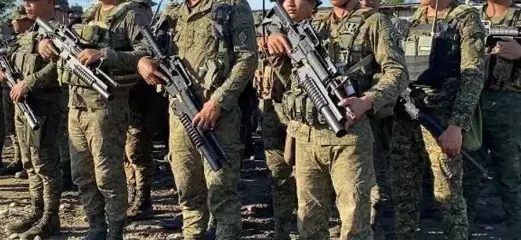
Apat na batalyon ang itinambak ng Armed Forces of the Philippines sa Eastern Visayas sa pagitan ng Disyembre 2022 at Pebrero para “gapiin” ang “natitirang apat na aktibong larangang gerilya” sa hilagang bahagi ng Samar. Tiyak na patitindihin ng mga ito ang pamamaslang, pang-aaresto, pambabanta at pwersahang pagpapasurender sa mga komunidad ng magsasaka sa rehiyon.
Dumating sa Palo, Leyte noong Pebrero 20 ang 74th IB galing sa Basilan at 42nd IB na galing sa Quezon-Bicol noong Pebrero 20. Dumating din sa rehiyon ang 21st Scout Ranger Company na nakapailalim sa 4th Scout Ranger Battalion mula sa Davao City noong Pebrero 17. Bago nito, 400 elemento na ng 4th SRB ang lumapag sa daungan ng Calbayog City noong Disyembre 11, 2022. Dagdag sa mga tropang ito ang 564 bagong mga sundalo na nagtapos sa isang 6-buwang pagsasanay militar sa Camp Eugenio Daza sa Hinabangan, Samay noon ding Pebrero 20.
Duguang batalyon
Mahaba ang listahan ng mga paglabag ng 4th SRC na sangkot sa mga operasyong pamboboma, pamamaslang, pang-aaresto at pwersahang pagpapasurender sa mga sibilyan sa mga barangay sa Agusan del Norte at Misamis Oriental. Mayor din ang naging papel nito sa pagdurog sa Marawi City na nagpalayas sa halos isang milyong Moro.
Samantala, bantog ang 42nd IB sa Bicol sa papel nito sa pagpapatupad ng Memorandum Order 32 ng noo’y rehimeng US-Duterte mula 2018. Ayon sa National Democratic Front-Bicol, nagresulta ang kautusang ito sa pagpaslang ng isang Bikolano kada linggo ng mga pwersa ng AFP at PNP sa rehiyon. Batay sa pagmonitor ng mga kaso ng paglabag sa karapatang-tao, hindi bababa sa 17 ang biktima ng pamamaslang noong Enero-Nobyembre 2022 lamang.
https://philippinerevolution.nu/angbayan/4-na-batalyong-itinambak-sa-samar-magpapalala-sa-paglabag-sa-karapatang-tao/
Subscribe to:
Posts (Atom)