From the Philippine News Agency (Feb 12): Villagers flee due to NPA harassment in Bukidnon
Residents of an entire barangay in Bukidnon province sought shelter at the Kibawe town hall compound since Sunday following clashes between government and communist rebel forces, the military said.
Fear gripped the whole village of Cagawasan in Kibawe after suspected New People's Army (NPA) rebels hogtied the barangay's chief tanod Saturday afternoon, forcing the residents to flee, said the town's chief of police, Senior Insp. Harvey Sanchez.
A day later, on Sunday, several NPA combatants were spotted coercing the people in the area, Sanchez said.
Cagawasan barangay captain Roland Perequitte said the rebels started harrassing them when he and his fellow villagers decided to withdraw their support to the NPA.
"Dili na namo gusto nga pahimuslan pa mi sa mga NPA pinaagi sa paghatod sa ilang mga supply ug pag monitor sa mga sundalo. Labaw sa tanan, dili na namo gusto nga makatugaw sila sa among kinabuhi pinaagi sa ilang pagpanghilabot sa among pagpadagan sa barangay," Perequitte said . (We don't want to be exploited by the NPA by acting as couriers of their supplies and in monitoring the soldiers. Above all, we don't want them to bother our lives by interfering in the affairs of the barangay).
Because they distanced themselves from the rebel movement, Perequitte said the NPA accused the villagers of being military informants.
1Lt. Tere Ingente, spokesman for the Army's Fourth Infantry Division (4ID), said the 88th Infantry Battalion assigned in the area "is closely coordinating with the municipal government of Kibawe, particularly the Municipal Disaster Risk Reduction and Management Office and the municipal police station, to address the immediate needs of the evacuees."
In a separate statement, 403rd Infantry Brigade commander Brig. Gen. Eric Vinoya assured the Cagawasan residents that the brigade will coordinate with local authorities to address the peace and order situation in the area.
The residents' exodus happened less than a week following an ambush by the NPA that wounded six soldiers in the nearby municipality of Quezon, also in Bukidnon.
http://www.pna.gov.ph/articles/1024918

Monday, February 12, 2018

Alleged MNLF official, 4 others nabbed in Maguindanao drug raid
From the Philippine Daily Inquirer (Feb 11): Alleged MNLF official, 4 others nabbed in Maguindanao drug raid
Joint police and anti-narcotics operatives arrested an alleged official of a Moro rebel group and four others during a raid on a drug den in Maguindanao on Sunday.
Juvenal Azurin, the director of the Philippine Drug Enforcement Agency in the Autonomous Region in Muslim Mindanao (PDEA-ARMM), identified those arrested as Juhery Sampulna Abdul, 39, alias “Tho,” who allegedly maintained the drug den in Sitio Siawan in Barangay Tamontaka in Datu Odin Sinsuat town; Muslimin Banigan Udtong, 27; Madelo Kasan Abdulkadir, 25; Datu Solban Makasasa Maulana, 22; and Abdillah B. Abdullah, 36.
He described Abdul as troop commander of the Muhtalla National Force Command of the Moro National Liberation Front (MNLF). Abdullah was also an alleged MNLF member.
Azurin said the joint operation was conducted at 6 a.m. after months of surveillance by the local police and PDEA agents.
Seized during the raid were 16 sachets of suspected shabu with an estimated market value of P100,000, a cal. 45 pistol, mobile phones and computer sets that contained illegal drug transactions.
Charges for violation of RA 9165 (Comprehensive Dangerous Drugs Act of 2002) and Republic Act 10591 (Illegal Possessions of Firearms and Ammunitions) were being readied against the arrested suspects, who were detained at the PDEA-ARMM custodial facility here.
http://newsinfo.inquirer.net/967921/maguindanao-police-drug-raid-mnlf-moro-rebel-group-arrest-pdea
Joint police and anti-narcotics operatives arrested an alleged official of a Moro rebel group and four others during a raid on a drug den in Maguindanao on Sunday.
Juvenal Azurin, the director of the Philippine Drug Enforcement Agency in the Autonomous Region in Muslim Mindanao (PDEA-ARMM), identified those arrested as Juhery Sampulna Abdul, 39, alias “Tho,” who allegedly maintained the drug den in Sitio Siawan in Barangay Tamontaka in Datu Odin Sinsuat town; Muslimin Banigan Udtong, 27; Madelo Kasan Abdulkadir, 25; Datu Solban Makasasa Maulana, 22; and Abdillah B. Abdullah, 36.
He described Abdul as troop commander of the Muhtalla National Force Command of the Moro National Liberation Front (MNLF). Abdullah was also an alleged MNLF member.
Azurin said the joint operation was conducted at 6 a.m. after months of surveillance by the local police and PDEA agents.
Seized during the raid were 16 sachets of suspected shabu with an estimated market value of P100,000, a cal. 45 pistol, mobile phones and computer sets that contained illegal drug transactions.
Charges for violation of RA 9165 (Comprehensive Dangerous Drugs Act of 2002) and Republic Act 10591 (Illegal Possessions of Firearms and Ammunitions) were being readied against the arrested suspects, who were detained at the PDEA-ARMM custodial facility here.
http://newsinfo.inquirer.net/967921/maguindanao-police-drug-raid-mnlf-moro-rebel-group-arrest-pdea
5 Abu Sayyaf bandits die, 7 soldiers wounded in clash
From the Sun Star-Zamboanga (Feb 12): 5 Abu Sayyaf bandits die, 7 soldiers wounded in clash
FIVE Abu Sayyaf bandits were killed while seven soldiers were wounded in a clash as rescue operations for the remaining kidnap victims continue in Sulu, military officials said Monday, February 12.
The clash broke out when members of the Marine Battalion Landing Team-3 (MBLT-3) spotted 30 Abu Sayyaf bandits at 4:15 a.m. Sunday in Bud (Mount) Bawis, Panamao, Sulu.
The troops were scouring Bud Bawis after they received information that the group of Abu Sayyaf sub-leaders Sansibar Bensio and Hatib Munap Binda are in the area, hiding along with some kidnap victims.
Brigadier General Cirilito Sobejana, Joint Task Force Sulu commander, said the firefight lasted for one and a half hour. The bandits then fled and left behind the remains of four Abu Sayyaf gunmen and an M-14 rifle.
Sobejana said the four slain bandits were identified as Mikdak Juhurim, Annin Black, Tasom Hammiri, and Undil Husin.
He said the military was informed by witnesses that another Abu Sayyaf follower, identified as a certain Roger, has expired.
He said they also saw the bandits carrying some of their wounded companions as they fled.
The troops have coordinated with the local officials of Panamao town to afford appropriate and decent burial to the slain bandits if their remains left unclaimed, Sobejana added.
He said the troops are tracking down the group of Bensio and Binda, who are operating in the towns of Panamao, Omar and Luuk.
The identities of the seven wounded troops were withheld, but they all belong to the MBLT-3.
Lieutenant General Carlito Galvez Jr., Western Mindanao Command (Westmincom) chief, said operations continue to rescue all the hostages.
The Abu Sayyaf is still holding captives nine people -- five foreigners and four Filipinos. The foreigners included three Indonesians, one Vietnamese and one Dutch.
How Marawi pushed Asean nations to join forces against terrorism
From the Asian Correspondent (Feb 12): How Marawi pushed Asean nations to join forces against terrorism (By Michael Hart)

Government soldiers stand by a mural painted by Muslim students as a symbol of call for peace after the end of assault against pro-Islamic State militant groups in Marawi, on a wall along a main highway of Pantar, Lanao Del Norte, southern Philippines, October 28, 2017. Source: Reuters/Romeo Ranoco
DESPITE parts of Southeast Asia experiencing the scourge of Islamist terrorism for decades, the ten Asean member states have in the past struggled to co-operate to tackle the jihadist threat.
After a spate of attacks in the 2000s carried out by Jemaah Islamiyah in Indonesia and Abu Sayyaf bandits in the southern Philippines, the regional bloc made determined efforts to forge a region-wide response. These well-intentioned moves to implement a multilateral counter-terrorism framework ended up amounting to little more than a set of non-binding protocols and agreements outlining desired outcomes and suggesting best practices for member-states to follow, rather than ushering in a new era of enhanced security cooperation between countries in the region.
Last year’s five-month siege of Marawi by Islamic State-aligned militants, however, proved to be a game-changer. The militants’ brazen attempt to take over a mid-sized city of more than 200,000 people and forge a Southeast Asian IS province centred on the Philippines’ war-ravaged southern island of Mindanao reignited the lingering threat, finally sparking the region’s authorities into action.
SEE ALSO: Philippines most affected by terrorism in Asia Pacific
Southeast Asia has long been afflicted by the presence of local, regional and transnational terrorist groups. Mindanao has been the site of an intractable armed Islamist insurgency since the early-1970s, which started off as a separatist movement but later spawned radical groups such as Abu Sayyaf and the Bangsamoro Islamic Freedom Fighters (BIFF). Meanwhile Indonesia suffered a string of attacks at the hands of homegrown militant group Jemaah Islamiyah (JI) in the 1990s and 2000s, supported by Al-Qaeda cells operational within the country. The presence of these groups also caused significant alarm in neighbouring Malaysia and Singapore, whilst sparking fears in the wider region.
Terror groups were able to establish a home in the Southeast Asia’s maritime states, taking advantage of porous sea borders and areas of weak state presence to set up training camps and bases from which to plan and launch attacks. This was especially true for remote parts of the Indonesian archipelago and in the lawless chain of Philippine islands which divides the Sulu and Celebes seas. In 2002, more than 200 people were killed in suicide attacks by JI targeting nightclubs on the Indonesian resort island of Bali, before Abu Sayyaf bombed a packed passenger ferry in Manila Bay in 2004, killing 116 civilians.

Memorial to the 202 people killed in a nightclub bombing on Oct 12, 2002, in Bali, Indonesia. Source: Jorge Láscar/Flickr
These high-profile attacks in the post-9/11 era prompted Asean to introduce a raft of measures intended to combat terrorism. The most important of these was the 2007 Asean Convention on Counter-Terrorism (ACCT), designed to ‘‘provide for the framework for regional cooperation to counter, prevent and suppress terrorism in all its forms’’ and ‘‘deepen cooperation among law enforcement agencies’’. However, the convention was not ratified by all ten member-states until 2013, and remained merely a set of guidelines with no enforcement or compliance mechanism. Several other region-wide agreements including the 2009 Asean Comprehensive Plan of Action on Counter-Terrorism (CPACT) have only had a marginal influence.
The impact of these counter-terrorism measures has been limited for several reasons. Asean’s strict adherence to consensus-based decision-making and the principle of non-interference has faced criticism, whilst the bloc’s use of vague language and its lack of enforcement capabilities have prevented the introduction of concrete region-wide measures to tackle terrorism. The grouping has often been described as a forum for discussion rather than a powerful body willing to push its members into taking firm action.
SEE ALSO: Ties between Southeast Asia and Bangladesh’s jihadis growing
The varied threat level across Asean and the differing military and financial capabilities of its ten member-states have also hindered cooperation. For example, the threat from Islamist terrorism may be high in countries such as the Philippines, Malaysia, Indonesia and Singapore, whilst their armed forces are also relatively well-resourced. In comparison, countries such as Cambodia, Laos and Vietnam face a far lower threat, and may not be prepared or equipped to contribute resources to the fight. The past reluctance of Asean nations to share intelligence or permit foreign troops to operate across national boundaries has also blocked greater co-operation in the field of counter-terrorism.
Historically, Asean’s ten member-states have displayed a preference for strengthening domestic legislation and signing bilateral level agreements to tackle terrorism, seeing the threats as national rather than regional or global in nature, and therefore not requiring a multilateral response.

Black smoke comes from a burning building in a commercial area of Osmena street in Marawi city, Philippines, on June 14, 2017. Source: Reuters
That was until jihadists stormed the southern Philippine city of Marawi last May. The threat which had lain dormant beneath the surface since the decline of JI in the late 2000s had suddenly re-emerged in a form that was clearly regional in nature as Islamic State announced their intention to carve out a Southeast Asian caliphate. Leaders quickly realised the need for closer co-operation to prevent the violence spreading, amid fears of further IS-inspired attacks and terrorist infiltration across borders.
Even before the Marawi siege ended in October, regional leaders gathered on several occasions to discuss responses to the evolving threat. Indonesian President Joko Widodo described Marawi as a ‘‘wake-up call’’ regarding the threat posed to Southeast Asia, whilst Malaysia’s Prime Minister Najib Razak reaffirmed his country’s commitment to tackle Islamist terror groups in the region. In September, security officials from all ten Asean states took part in a specially-convened meeting on the “Rise of Radicalisation and Violent Extremism” in the region, whilst terrorism also topped the agenda at November’s 31st Asean Summit hosted by Philippine President Rodrigo Duterte in Manila.
SEE ALSO: How prepared is Singapore amid Southeast Asia’s raised terror threat?
The discussions sparked by the takeover of Marawi first resulted in strengthened bilateral and trilateral measures agreed between the states most affected. In June, Indonesia, Malaysia and the Philippines began conducting naval patrols in the Sulu Sea to restrict the movement of jihadist fighters to-and-from Mindanao. These measures were later bolstered by the addition of coordinated air patrols to spot suspicious activity from the skies. Indonesia and the Philippines have also agreed to establish a hotline to alert one another about security threats along their shared maritime frontier.
More recently two multilateral regional counter-terror initiatives have been established, indicating that Asean nations now appear more willing to cooperate on a collective basis than in the past.
In mid-November, the Southeast Asian Counter-Terrorism Financing Working Group (SACTFWG) was established to crack down on the funding of terrorist groups linked to Islamic State. The new regional grouping will include law enforcement agencies from across Southeast Asia, and will be led by the Philippines’ Anti-Money Laundering Council and Australia’s Transaction Reports and Analysis Centre (Austrac).

Australian and Philippine soldiers demonstrate an anti-terror training drill at Camp Aguinaldo, on the sidelines of the Association of South East Asian Nations Summit, in Quezon City, metro Manila, Philippines, on Nov 13, 2017. Source: Reuters/Dondi Tawatao
Then in a landmark agreement on Jan 25, six Asean members – Brunei, Indonesia, Malaysia, the Philippines, Singapore and Thailand – signed-up to a new intelligence-sharing pact labelled the “Our Eyes” initiative. The agreement is expected to facilitate the most extensive counter-terrorism cooperation within Asean to date. It will see senior defence officials from the participating nations meet twice a month, and will allow for the development of a new database of suspected militants which can be accessed by law enforcement agencies across the region.
At its launch, Malaysia’s Deputy Defence Minister Mohd Johari Baharum said the initiative would be crucial in enabling a collective response to emerging security threats which are ‘‘complex and trans-boundary in nature’’. It is hoped that the four remaining Asean states will later join the group, as well as external actors with a stake in the region’s stability such as Australia, India, Japan and the US.
SEE ALSO: Philippines: Duterte vows to crush drugs, terrorism in second SONA
The crisis in Marawi certainly got the region’s leaders thinking about how to better pool resources to tackle the growing threat from Islamist terrorism, but it has not yet resulted in an all-encompassing strategy involving all ten of Asean’s member-nations. Such an aim will always be difficult to achieve, due to the huge variation in threat along with the differing capabilities and priorities of Asean states.
However, ad-hoc collaborative responses have emerged involving the countries most concerned, on a scale not witnessed previously in the region. Indonesia, Malaysia and the Philippines have looked to work with other interested parties to find workable and pragmatic multilateral solutions to the most pressing and immediate problems facing the region’s vulnerable maritime states.
With a series of overlapping bilateral, trilateral and multilateral mechanisms now in place, Asean integration in the sphere of counter-terrorism has been significantly upgraded. In the post-Marawi era of elevated risk, a set of guidelines which meant little in practice is rapidly being superseded by a more coordinated regional strategy, aimed at tackling the most critical threat facing Southeast Asia today.
DESPITE parts of Southeast Asia experiencing the scourge of Islamist terrorism for decades, the ten Asean member states have in the past struggled to co-operate to tackle the jihadist threat.
After a spate of attacks in the 2000s carried out by Jemaah Islamiyah in Indonesia and Abu Sayyaf bandits in the southern Philippines, the regional bloc made determined efforts to forge a region-wide response. These well-intentioned moves to implement a multilateral counter-terrorism framework ended up amounting to little more than a set of non-binding protocols and agreements outlining desired outcomes and suggesting best practices for member-states to follow, rather than ushering in a new era of enhanced security cooperation between countries in the region.
Last year’s five-month siege of Marawi by Islamic State-aligned militants, however, proved to be a game-changer. The militants’ brazen attempt to take over a mid-sized city of more than 200,000 people and forge a Southeast Asian IS province centred on the Philippines’ war-ravaged southern island of Mindanao reignited the lingering threat, finally sparking the region’s authorities into action.
SEE ALSO: Philippines most affected by terrorism in Asia Pacific
Southeast Asia has long been afflicted by the presence of local, regional and transnational terrorist groups. Mindanao has been the site of an intractable armed Islamist insurgency since the early-1970s, which started off as a separatist movement but later spawned radical groups such as Abu Sayyaf and the Bangsamoro Islamic Freedom Fighters (BIFF). Meanwhile Indonesia suffered a string of attacks at the hands of homegrown militant group Jemaah Islamiyah (JI) in the 1990s and 2000s, supported by Al-Qaeda cells operational within the country. The presence of these groups also caused significant alarm in neighbouring Malaysia and Singapore, whilst sparking fears in the wider region.
Terror groups were able to establish a home in the Southeast Asia’s maritime states, taking advantage of porous sea borders and areas of weak state presence to set up training camps and bases from which to plan and launch attacks. This was especially true for remote parts of the Indonesian archipelago and in the lawless chain of Philippine islands which divides the Sulu and Celebes seas. In 2002, more than 200 people were killed in suicide attacks by JI targeting nightclubs on the Indonesian resort island of Bali, before Abu Sayyaf bombed a packed passenger ferry in Manila Bay in 2004, killing 116 civilians.
Memorial to the 202 people killed in a nightclub bombing on Oct 12, 2002, in Bali, Indonesia. Source: Jorge Láscar/Flickr
These high-profile attacks in the post-9/11 era prompted Asean to introduce a raft of measures intended to combat terrorism. The most important of these was the 2007 Asean Convention on Counter-Terrorism (ACCT), designed to ‘‘provide for the framework for regional cooperation to counter, prevent and suppress terrorism in all its forms’’ and ‘‘deepen cooperation among law enforcement agencies’’. However, the convention was not ratified by all ten member-states until 2013, and remained merely a set of guidelines with no enforcement or compliance mechanism. Several other region-wide agreements including the 2009 Asean Comprehensive Plan of Action on Counter-Terrorism (CPACT) have only had a marginal influence.
The impact of these counter-terrorism measures has been limited for several reasons. Asean’s strict adherence to consensus-based decision-making and the principle of non-interference has faced criticism, whilst the bloc’s use of vague language and its lack of enforcement capabilities have prevented the introduction of concrete region-wide measures to tackle terrorism. The grouping has often been described as a forum for discussion rather than a powerful body willing to push its members into taking firm action.
SEE ALSO: Ties between Southeast Asia and Bangladesh’s jihadis growing
The varied threat level across Asean and the differing military and financial capabilities of its ten member-states have also hindered cooperation. For example, the threat from Islamist terrorism may be high in countries such as the Philippines, Malaysia, Indonesia and Singapore, whilst their armed forces are also relatively well-resourced. In comparison, countries such as Cambodia, Laos and Vietnam face a far lower threat, and may not be prepared or equipped to contribute resources to the fight. The past reluctance of Asean nations to share intelligence or permit foreign troops to operate across national boundaries has also blocked greater co-operation in the field of counter-terrorism.
Historically, Asean’s ten member-states have displayed a preference for strengthening domestic legislation and signing bilateral level agreements to tackle terrorism, seeing the threats as national rather than regional or global in nature, and therefore not requiring a multilateral response.
Black smoke comes from a burning building in a commercial area of Osmena street in Marawi city, Philippines, on June 14, 2017. Source: Reuters
That was until jihadists stormed the southern Philippine city of Marawi last May. The threat which had lain dormant beneath the surface since the decline of JI in the late 2000s had suddenly re-emerged in a form that was clearly regional in nature as Islamic State announced their intention to carve out a Southeast Asian caliphate. Leaders quickly realised the need for closer co-operation to prevent the violence spreading, amid fears of further IS-inspired attacks and terrorist infiltration across borders.
Even before the Marawi siege ended in October, regional leaders gathered on several occasions to discuss responses to the evolving threat. Indonesian President Joko Widodo described Marawi as a ‘‘wake-up call’’ regarding the threat posed to Southeast Asia, whilst Malaysia’s Prime Minister Najib Razak reaffirmed his country’s commitment to tackle Islamist terror groups in the region. In September, security officials from all ten Asean states took part in a specially-convened meeting on the “Rise of Radicalisation and Violent Extremism” in the region, whilst terrorism also topped the agenda at November’s 31st Asean Summit hosted by Philippine President Rodrigo Duterte in Manila.
SEE ALSO: How prepared is Singapore amid Southeast Asia’s raised terror threat?
The discussions sparked by the takeover of Marawi first resulted in strengthened bilateral and trilateral measures agreed between the states most affected. In June, Indonesia, Malaysia and the Philippines began conducting naval patrols in the Sulu Sea to restrict the movement of jihadist fighters to-and-from Mindanao. These measures were later bolstered by the addition of coordinated air patrols to spot suspicious activity from the skies. Indonesia and the Philippines have also agreed to establish a hotline to alert one another about security threats along their shared maritime frontier.
More recently two multilateral regional counter-terror initiatives have been established, indicating that Asean nations now appear more willing to cooperate on a collective basis than in the past.
In mid-November, the Southeast Asian Counter-Terrorism Financing Working Group (SACTFWG) was established to crack down on the funding of terrorist groups linked to Islamic State. The new regional grouping will include law enforcement agencies from across Southeast Asia, and will be led by the Philippines’ Anti-Money Laundering Council and Australia’s Transaction Reports and Analysis Centre (Austrac).
Australian and Philippine soldiers demonstrate an anti-terror training drill at Camp Aguinaldo, on the sidelines of the Association of South East Asian Nations Summit, in Quezon City, metro Manila, Philippines, on Nov 13, 2017. Source: Reuters/Dondi Tawatao
Then in a landmark agreement on Jan 25, six Asean members – Brunei, Indonesia, Malaysia, the Philippines, Singapore and Thailand – signed-up to a new intelligence-sharing pact labelled the “Our Eyes” initiative. The agreement is expected to facilitate the most extensive counter-terrorism cooperation within Asean to date. It will see senior defence officials from the participating nations meet twice a month, and will allow for the development of a new database of suspected militants which can be accessed by law enforcement agencies across the region.
At its launch, Malaysia’s Deputy Defence Minister Mohd Johari Baharum said the initiative would be crucial in enabling a collective response to emerging security threats which are ‘‘complex and trans-boundary in nature’’. It is hoped that the four remaining Asean states will later join the group, as well as external actors with a stake in the region’s stability such as Australia, India, Japan and the US.
SEE ALSO: Philippines: Duterte vows to crush drugs, terrorism in second SONA
The crisis in Marawi certainly got the region’s leaders thinking about how to better pool resources to tackle the growing threat from Islamist terrorism, but it has not yet resulted in an all-encompassing strategy involving all ten of Asean’s member-nations. Such an aim will always be difficult to achieve, due to the huge variation in threat along with the differing capabilities and priorities of Asean states.
However, ad-hoc collaborative responses have emerged involving the countries most concerned, on a scale not witnessed previously in the region. Indonesia, Malaysia and the Philippines have looked to work with other interested parties to find workable and pragmatic multilateral solutions to the most pressing and immediate problems facing the region’s vulnerable maritime states.
With a series of overlapping bilateral, trilateral and multilateral mechanisms now in place, Asean integration in the sphere of counter-terrorism has been significantly upgraded. In the post-Marawi era of elevated risk, a set of guidelines which meant little in practice is rapidly being superseded by a more coordinated regional strategy, aimed at tackling the most critical threat facing Southeast Asia today.
Army compiling list of ‘rebel-supporters’
From Sun Star-Cagayan de Oro (Feb 11): Army compiling list of ‘rebel-supporters’
AN ARMY official said he will provide Interior Secretary Eduardo Ano with a list of barangay officials who are allegedly supporting the New People's Army.
"Troops are being deployed in these areas to clear and to conduct the Community Support Programs (CSP), but during the deployment, troops were engaged with the NPA terrorists in Cawayan, it got me wondering why do these barangays have terrorists presence and why does the barangay officials allowed the entry of these terrorists"," Brigadier General Eric Vinoya, commander of the Army’s 403rd Infantry Brigade, said.
The 403rd Brigade based in Malaybalay City operates in the hinterlands of Quezon town in Bukidnon, inlcuding Papacao, Lipa, Linabo, Sta. Felomina and Cawayan, all in Bukidnon.
Vinoya was reacting to an NPA statement saying that 4th Infantry Division's CSP is a lie and is only meant to cloak and intensify combat operations that began in January.
The NPA statement said the CSP was initiated to help state security forces go after communist rebels to pave the way for mining companies and allow plantations to expand.
In the statement issued last week, the NPA also claimed to have killed 19 soldiers in an encounter at barangay Cawayan, Quezon town, Bukidnon province last February 6, a claim denied by the Army.
Lieutenant Colonel Randy Remonte, 88th Infantry Battalion commanding officer, said the encounter only wounded 6 of their troops and did not kill 19 as claimed by the NPA.
"According to their medical records, they are all stable and recuperating at Camp Evangelista Station Hospital," Remonte said.
Major General Ronald Villanueva, 4th Infantry Division (4ID) commander, meanwhile refuted the allegations of abuse committed by troops.
"When there are abuse complaints, the 4ID will consider it a form of cleansing our ranks. It will be dealt with accordingly. Further, I want to remind everybody to know the difference of facts versus propaganda. The NPA terrorists are very desperate to inflict casualty to our troops and very desperate for support. They give false hope to the lowest element in their ranks due to the influx of surrenders in Bukidnon. Your Army, will not stop crushing them, may it be an exchange of our own lives," Villanueva said.
http://www.sunstar.com.ph/cagayan-de-oro/local-news/2018/02/11/army-compiling-list-rebel-supporters-588372
AN ARMY official said he will provide Interior Secretary Eduardo Ano with a list of barangay officials who are allegedly supporting the New People's Army.
"Troops are being deployed in these areas to clear and to conduct the Community Support Programs (CSP), but during the deployment, troops were engaged with the NPA terrorists in Cawayan, it got me wondering why do these barangays have terrorists presence and why does the barangay officials allowed the entry of these terrorists"," Brigadier General Eric Vinoya, commander of the Army’s 403rd Infantry Brigade, said.
The 403rd Brigade based in Malaybalay City operates in the hinterlands of Quezon town in Bukidnon, inlcuding Papacao, Lipa, Linabo, Sta. Felomina and Cawayan, all in Bukidnon.
Vinoya was reacting to an NPA statement saying that 4th Infantry Division's CSP is a lie and is only meant to cloak and intensify combat operations that began in January.
The NPA statement said the CSP was initiated to help state security forces go after communist rebels to pave the way for mining companies and allow plantations to expand.
In the statement issued last week, the NPA also claimed to have killed 19 soldiers in an encounter at barangay Cawayan, Quezon town, Bukidnon province last February 6, a claim denied by the Army.
Lieutenant Colonel Randy Remonte, 88th Infantry Battalion commanding officer, said the encounter only wounded 6 of their troops and did not kill 19 as claimed by the NPA.
"According to their medical records, they are all stable and recuperating at Camp Evangelista Station Hospital," Remonte said.
Major General Ronald Villanueva, 4th Infantry Division (4ID) commander, meanwhile refuted the allegations of abuse committed by troops.
"When there are abuse complaints, the 4ID will consider it a form of cleansing our ranks. It will be dealt with accordingly. Further, I want to remind everybody to know the difference of facts versus propaganda. The NPA terrorists are very desperate to inflict casualty to our troops and very desperate for support. They give false hope to the lowest element in their ranks due to the influx of surrenders in Bukidnon. Your Army, will not stop crushing them, may it be an exchange of our own lives," Villanueva said.
http://www.sunstar.com.ph/cagayan-de-oro/local-news/2018/02/11/army-compiling-list-rebel-supporters-588372
July 2 hearing for man and Filipino brother-in-law charged with becoming Abu Sayyaf members
From the Sun Daily (Feb 12): July 2 hearing for man and Filipino brother-in-law charged with becoming Abu Sayyaf members
The High Court here today fixed nine days, from July 2, to hear the case of a man and his brother-in-law facing charges with becoming members of the Abu Sayyaf terrorist group and not disclosing information on the group.
A local, Hajar Abdul Mubin,25, and his Filipino brother-in-law, Abdul Syamir Dabilin, 25, were believed to be among 19 suspects who attempted to stage an attack at the closing ceremony of the 29th Southeast Asian Games Kuala Lumpur 2017 (KL2017) on Aug 30.
Judge Datuk Mohd Sofian Abd Razak set the dates after being informed by the prosecution, conducted by deputy public prosecutor Azlina Rasdi, that the Attorney-General's Chamber had rejected a representation by Hajar for the charge against him to be dropped.
"The Attorney-General's Chamber rejected the representation submitted by Hajar, request the court to fix the dates of hearing together with his (Hajar) brother-in-law, Abdul Syamir because it involves the same witnesses," she said.
According to Azlina, 12 prosecution witnesses would be called to testify.
On Dec 11 last year, Hajar and Abdul Syamir, both construction workers, pleaded not guilty to the charges made against them.
Hajar, from Sabah, who is believed to be the mastermind in planning the attack at the closing ceremony of the Kuala Lumpur Southeast Asian Games 2017, was charged with becoming a member of the Abu Sayyaf terrorist group.
The offence, under Section 130KA of the Penal Code, provides an imprisonment which may extend for life and shall also be liable to fine, if found guilty.
He was charged with committing the offence at ZA 2-14 Lorong Pangsa Baiduri 2, Taman Desa Baiduri, Cheras between 2010 and Aug 30, 2017.
Abdul Syamir was charged under Section 130M of the Penal Code with knowingly omitting information about the group at the same place, time and date and faced an imprisonment for up to seven years, or fine, or both, if found guilty.
Hajar and Abdul Syamir were represented by lawyer Zaini Bakar. — Bernama
http://www.thesundaily.my/news/2018/02/12/july-2-hearing-man-and-filipino-brother-law-charged-becoming-abu-sayyaf-members
The High Court here today fixed nine days, from July 2, to hear the case of a man and his brother-in-law facing charges with becoming members of the Abu Sayyaf terrorist group and not disclosing information on the group.
A local, Hajar Abdul Mubin,25, and his Filipino brother-in-law, Abdul Syamir Dabilin, 25, were believed to be among 19 suspects who attempted to stage an attack at the closing ceremony of the 29th Southeast Asian Games Kuala Lumpur 2017 (KL2017) on Aug 30.
Judge Datuk Mohd Sofian Abd Razak set the dates after being informed by the prosecution, conducted by deputy public prosecutor Azlina Rasdi, that the Attorney-General's Chamber had rejected a representation by Hajar for the charge against him to be dropped.
"The Attorney-General's Chamber rejected the representation submitted by Hajar, request the court to fix the dates of hearing together with his (Hajar) brother-in-law, Abdul Syamir because it involves the same witnesses," she said.
According to Azlina, 12 prosecution witnesses would be called to testify.
On Dec 11 last year, Hajar and Abdul Syamir, both construction workers, pleaded not guilty to the charges made against them.
Hajar, from Sabah, who is believed to be the mastermind in planning the attack at the closing ceremony of the Kuala Lumpur Southeast Asian Games 2017, was charged with becoming a member of the Abu Sayyaf terrorist group.
The offence, under Section 130KA of the Penal Code, provides an imprisonment which may extend for life and shall also be liable to fine, if found guilty.
He was charged with committing the offence at ZA 2-14 Lorong Pangsa Baiduri 2, Taman Desa Baiduri, Cheras between 2010 and Aug 30, 2017.
Abdul Syamir was charged under Section 130M of the Penal Code with knowingly omitting information about the group at the same place, time and date and faced an imprisonment for up to seven years, or fine, or both, if found guilty.
Hajar and Abdul Syamir were represented by lawyer Zaini Bakar. — Bernama
http://www.thesundaily.my/news/2018/02/12/july-2-hearing-man-and-filipino-brother-law-charged-becoming-abu-sayyaf-members
4 Sayyaf militants killed, 7 soldiers wounded in Sulu clashes
From the Manila Examiner (Feb 11): 4 Sayyaf militants killed, 7 soldiers wounded in Sulu clashes
SULU – At least four Abu Sayyaf militants were killed and 7 soldiers wounded in fierce clashes early Sunday in the southern Filipino province of Sulu where security forces are searching for foreigners kidnapped by the notorious group linked to ISIS, officials said.
Officials said members of the Marine Battalion Landing Team 3 clashed with about 30 militants under Abu Sayyaf commanders Sansibar Bensio and Hatib Munap Binda in Mount Bawis in Panamao town.
Army Captain Jo-ann Petinglay, a spokeswoman for the Western Mindanao Command, said troops were sent to the town late Saturday following intelligence reports that the militants were holding several captives in the area.
“Upon arrival in the area, our troops were fired upon by the enemy, resulting to an exchange of gun fires,” Petinglay said, quoting a report from Brigadier General Cirilito Sobejana, commander of the Joint Task Force Sulu.
“Our troops were very careful because we believe there were kidnap victims with the Abus, however, the bandits fired at our marines first prompting our forces to fire back. Due to the superior firepower of the government forces, the bandits were forced to withdraw and escape,” Sobejana said, adding, the soldiers were still tracking down the militants and their hostages.
Petinglay said troops recovered the bodies of the slain militants, including an M14 rifle. The identities of the dead remain unknown, but the military, according to Petinglay, is coordinating with local officials to determine the names of those killed in the fighting.
She said the wounded soldiers had been evacuated to hospital. Their conditions were not made public by Petinglay, but General Carlito Galvez, the regional military commander, has asked the public to pray for the wounded soldiers. “We ask for prayers from all peace-loving people of the country, that our wounded soldiers be able to successfully face the battle in the operating tables. Despite the expertise of our doctors, your prayers will be the most powerful tool for them to stay alive and be well again,” he said in a statement sent to the regional newspaper Mindanao Examiner.
Galvez said the operation against the Abu Sayyaf is continuing in Sulu, one of 5 provinces under the restive Muslim autonomous region. “We will not stop until we rescue all hostages and until we neutralize all these terrorists. Our soldiers are out there hunting for them ready to fight and die just to attain peace in our communities especially in Sulu. I once again enjoin everyone to help and support your Armed Forces through Western Mindanao Command in this fight to eliminate terror here in the region,” he said.
The Abu Sayyaf is believe holding about a dozen hostages in the region.
https://mindanaoexaminer.com/4-sayyaf-militants-killed-7-soldiers-wounded-in-sulu-clashes/
SULU – At least four Abu Sayyaf militants were killed and 7 soldiers wounded in fierce clashes early Sunday in the southern Filipino province of Sulu where security forces are searching for foreigners kidnapped by the notorious group linked to ISIS, officials said.
Officials said members of the Marine Battalion Landing Team 3 clashed with about 30 militants under Abu Sayyaf commanders Sansibar Bensio and Hatib Munap Binda in Mount Bawis in Panamao town.
Army Captain Jo-ann Petinglay, a spokeswoman for the Western Mindanao Command, said troops were sent to the town late Saturday following intelligence reports that the militants were holding several captives in the area.
“Upon arrival in the area, our troops were fired upon by the enemy, resulting to an exchange of gun fires,” Petinglay said, quoting a report from Brigadier General Cirilito Sobejana, commander of the Joint Task Force Sulu.
“Our troops were very careful because we believe there were kidnap victims with the Abus, however, the bandits fired at our marines first prompting our forces to fire back. Due to the superior firepower of the government forces, the bandits were forced to withdraw and escape,” Sobejana said, adding, the soldiers were still tracking down the militants and their hostages.
Petinglay said troops recovered the bodies of the slain militants, including an M14 rifle. The identities of the dead remain unknown, but the military, according to Petinglay, is coordinating with local officials to determine the names of those killed in the fighting.
She said the wounded soldiers had been evacuated to hospital. Their conditions were not made public by Petinglay, but General Carlito Galvez, the regional military commander, has asked the public to pray for the wounded soldiers. “We ask for prayers from all peace-loving people of the country, that our wounded soldiers be able to successfully face the battle in the operating tables. Despite the expertise of our doctors, your prayers will be the most powerful tool for them to stay alive and be well again,” he said in a statement sent to the regional newspaper Mindanao Examiner.
Galvez said the operation against the Abu Sayyaf is continuing in Sulu, one of 5 provinces under the restive Muslim autonomous region. “We will not stop until we rescue all hostages and until we neutralize all these terrorists. Our soldiers are out there hunting for them ready to fight and die just to attain peace in our communities especially in Sulu. I once again enjoin everyone to help and support your Armed Forces through Western Mindanao Command in this fight to eliminate terror here in the region,” he said.
The Abu Sayyaf is believe holding about a dozen hostages in the region.
https://mindanaoexaminer.com/4-sayyaf-militants-killed-7-soldiers-wounded-in-sulu-clashes/
5 Abu Sayyaf militants killed in S. Philippines
From Xinhua (Feb 11): 5 Abu Sayyaf militants killed in S. Philippines
Five members of the terrorist group Abu Sayyaf were killed and seven government soldiers were wounded following a firefight on Sunday morning in the southern Philippines, a security official said.
Brigadier General Cirilito Sobejana, the commander of the military's Joint Task Force Sulu, said the government troops were sent to a village on the Sulu island to rescue victims held by the Abu Sayyaf group.
Sobejana said the soldiers were fired upon by the terrorists around 4:15 a.m. (local time) Sunday as soon as they arrived at the enemy lair, leading to a firefight with about 30 Abu Sayyaf men.
"Upon arrival in the area, our troops were fired upon by the enemy, resulting to an exchange of gun fires," said Sobejana.
"Our troops were very careful because we believe there were kidnap victims with the Abu Sayyaf, however, the bandits fired at our marines first prompting our forces to fire back," said Sobejana.
The Abu Sayyaf is said to be holding about a dozen foreign and Filipino victims in Sulu. It was not immediately clear how many victims were being held by the Abu Sayyaf men engaged by the soldiers.
The military said the terrorists withdrew after they realized the superiority of the firepower of the soldiers.
Meanwhile, the seven wounded soldiers were evacuated to a military hospital for treatment.
http://www.xinhuanet.com/english/2018-02/11/c_136967552.htm
Five members of the terrorist group Abu Sayyaf were killed and seven government soldiers were wounded following a firefight on Sunday morning in the southern Philippines, a security official said.
Brigadier General Cirilito Sobejana, the commander of the military's Joint Task Force Sulu, said the government troops were sent to a village on the Sulu island to rescue victims held by the Abu Sayyaf group.
Sobejana said the soldiers were fired upon by the terrorists around 4:15 a.m. (local time) Sunday as soon as they arrived at the enemy lair, leading to a firefight with about 30 Abu Sayyaf men.
"Upon arrival in the area, our troops were fired upon by the enemy, resulting to an exchange of gun fires," said Sobejana.
"Our troops were very careful because we believe there were kidnap victims with the Abu Sayyaf, however, the bandits fired at our marines first prompting our forces to fire back," said Sobejana.
The Abu Sayyaf is said to be holding about a dozen foreign and Filipino victims in Sulu. It was not immediately clear how many victims were being held by the Abu Sayyaf men engaged by the soldiers.
The military said the terrorists withdrew after they realized the superiority of the firepower of the soldiers.
Meanwhile, the seven wounded soldiers were evacuated to a military hospital for treatment.
http://www.xinhuanet.com/english/2018-02/11/c_136967552.htm
Bodies of 2 NPA members found after encounter with troops in Agusan del Sur, says Army
From GMA News (Feb 11): Bodies of 2 NPA members found after encounter with troops in Agusan del Sur, says Army
Two members of the Communist Party of the Philippines-New Peoples' Army (CPP-NPA) were found dead in Agusan del Sur after an encounter with the Philippine Army over the weekend.
According to reports of the Philippine Army, one of the two fatalities was identified as Levi Amando Bangogan or "King," commander of the Samahang Yunit Pangproganda Platoon and Guerilla Front 3. The other one, a woman, has yet to be identified.
The bodies were found in Barangay Sta Emelia, Veruela, Agusan del Sur after an encounter with the troops of the 26th Infantry Battalion on Saturday afternoon.
"It is clear that NPA terrorists are not mindful of their comrades, leaving their dead bodies during clashes with our government troops," Colonel Andres Centino, commander of the 401Bde, said, in an emailed statement.
"The 26th Infantry Battalion and 401st Infantry Brigade will ensure that the dead bodies will be delivered to their respective families, even though the government considers the NPAs as terrorists. This is a gesture to show that Philippine Army respects Human Rights and International Humanitarian Law," he added.
4th Infantry Division Commander Major General Ronald Villanueva urged the militants to surrender or face the same fate as their comrades.
"Either they can choose to suffer the same fate as their comrades recently experienced, whose bodies were left during the clash with the government forces or they can choose to feel and experience a new life away from the evils of Terrorism and its futile efforts by surrendering with the benefits of Comprehensive Integration Program (CLIP) from the government," he said.
http://www.gmanetwork.com/news/news/regions/642957/bodies-of-2-npa-members-found-after-encounter-with-troops-in-agusan-del-sur-says-army/story/
Two members of the Communist Party of the Philippines-New Peoples' Army (CPP-NPA) were found dead in Agusan del Sur after an encounter with the Philippine Army over the weekend.
According to reports of the Philippine Army, one of the two fatalities was identified as Levi Amando Bangogan or "King," commander of the Samahang Yunit Pangproganda Platoon and Guerilla Front 3. The other one, a woman, has yet to be identified.
The bodies were found in Barangay Sta Emelia, Veruela, Agusan del Sur after an encounter with the troops of the 26th Infantry Battalion on Saturday afternoon.
"It is clear that NPA terrorists are not mindful of their comrades, leaving their dead bodies during clashes with our government troops," Colonel Andres Centino, commander of the 401Bde, said, in an emailed statement.
"The 26th Infantry Battalion and 401st Infantry Brigade will ensure that the dead bodies will be delivered to their respective families, even though the government considers the NPAs as terrorists. This is a gesture to show that Philippine Army respects Human Rights and International Humanitarian Law," he added.
4th Infantry Division Commander Major General Ronald Villanueva urged the militants to surrender or face the same fate as their comrades.
"Either they can choose to suffer the same fate as their comrades recently experienced, whose bodies were left during the clash with the government forces or they can choose to feel and experience a new life away from the evils of Terrorism and its futile efforts by surrendering with the benefits of Comprehensive Integration Program (CLIP) from the government," he said.
http://www.gmanetwork.com/news/news/regions/642957/bodies-of-2-npa-members-found-after-encounter-with-troops-in-agusan-del-sur-says-army/story/
Soldiers kill 2 NPA rebels in Agusan del Sur battle
From the Philippine Daily Inquirer (Feb 11): Soldiers kill 2 NPA rebels in Agusan del Sur battle
Soldiers from the Army’s 26th Infantry Battalion killed two New People’s Army rebels during a clash in Veruela, Agusan del Sur on Saturday, the military reported on Sunday.
One of those killed was a still unidentified female rebel and an NPA platoon leader identified as Levi Bangonan, according to 1st Lt. Teresita Ingente, spokesperson of the 4th Infantry Division based in Cagayan de Oro City.
The bodies of the slain communist rebels were recovered in Barangay Sta. Emelia, along with eight backpacks containing medical supplies and personal items, according to Col. Andres Centino, the commander of the 401st Infantry Brigade based in Agusan del Sur.
Maj. Gen. Ronald Villanueva, the 4th Infantry Division commander, said the military was renewing its call to communist rebels to surrender so that they could live peaceful lives.
The government, he said, would even give them financial assistance.
http://newsinfo.inquirer.net/967920/2-npa-rebels-killed-in-clash-with-26th-infantry-battalion
Soldiers from the Army’s 26th Infantry Battalion killed two New People’s Army rebels during a clash in Veruela, Agusan del Sur on Saturday, the military reported on Sunday.
One of those killed was a still unidentified female rebel and an NPA platoon leader identified as Levi Bangonan, according to 1st Lt. Teresita Ingente, spokesperson of the 4th Infantry Division based in Cagayan de Oro City.
The bodies of the slain communist rebels were recovered in Barangay Sta. Emelia, along with eight backpacks containing medical supplies and personal items, according to Col. Andres Centino, the commander of the 401st Infantry Brigade based in Agusan del Sur.
Maj. Gen. Ronald Villanueva, the 4th Infantry Division commander, said the military was renewing its call to communist rebels to surrender so that they could live peaceful lives.
The government, he said, would even give them financial assistance.
http://newsinfo.inquirer.net/967920/2-npa-rebels-killed-in-clash-with-26th-infantry-battalion
Military Report - 52 alleged NPA rebels killed, 57 surrendered in Southern Luzon in 2017
From the Philippine Daily Inquirer (Feb 12): Military Report - 52 alleged NPA rebels killed, 57 surrendered in Southern Luzon in 2017
At least 52 alleged New People’s Army rebels were killed by state security forces in Southern Luzon last year, the commander of the Armed Forces Southern Luzon Command (Solcom) reported.
In a statement, Solcom Chief Lt. General Danilo Pamonag said some 57 alleged rebels also surrendered in Southern Tagalog and Bicol regions while 18 were captured by state troops.
Government forces also recovered 96 high-powered firearms and 54 low-powered firearms from the NPA in 2017, Pamonag said.
“Last month, two NPA rebels were also killed but no casualties on the side of the government,” Pamonag said.
Just this January, Pamonag added that 17 armed communist guerillas and 35 rebel supporters have also surrendered in Bicol.
“This indicates that more NPAs and their supporters have realized the futility of armed struggle and decided to leave the rebel group,” Pamonag said.
Pamonag said the government forces in Southern Luzon remained unfazed by threats of NPA attacks and are always ready to confront the communist guerillas.
Fake rebel returnees
The Armed Forces of the Philippines (AFP) reported that 326 NPA members surrendered to the military in January alone.
The AFP estimated that from its peak in the late 1980s where the guerilla strength was more than 26,000, it is now down to only 3,700 fighters spread throughout the country.
But exiled Communist Party of the Philippines (CPP) founder Jose Maria “Joma” Sison doubted the number of supposed NPA returnees.
“Are these real NPA surrenderees or fake ones selected from relatives of barangay council members or from the ranks of military draftees?” Sison said on Friday.
The CPP slammed the military for turning the so-called NPA returnees into a media propaganda.
“The AFP’s PR-machinery is working double-time to turn so-called NPA surrenderees into a media spectacle and mount a propaganda offensive to paint the NPA as a waning force,” the CPP said in a statement last week.
The CPP alleged that the military has been making “more frequent and much bigger claims of NPA surrenderees” as part of its counter-insurgency operation “Oplan Kapayapaan”.
The CPP asked the public to look at the reported surrenders of NPA rebels “with a healthy dose of skepticism”.
“It is a well-known fact that the decades-long multi-billion peso ‘Balik Baril’ Program, CLIP (Comprehensive Local Integration Program) and other programs are AFP money-making rackets where field and division commanders recycle surrendered weapons and come up with lists of ghost NPA surrenderees, typically village-folk falsely accused of being NPA members,” the CPP said.
Though it admits that the surrender of few communist guerillas “form part of the realities of war,” the CPP asserted that: “This, however, does not represent a trend nor does it negate in any way the reasons that compel more and more Filipinos to rise up and resist in various forms of struggle, including the armed struggle.”
https://newsinfo.inquirer.net/968040/52-alleged-npa-rebels-killed-57-surrendered-in-southern-luzon-in-2017
At least 52 alleged New People’s Army rebels were killed by state security forces in Southern Luzon last year, the commander of the Armed Forces Southern Luzon Command (Solcom) reported.
In a statement, Solcom Chief Lt. General Danilo Pamonag said some 57 alleged rebels also surrendered in Southern Tagalog and Bicol regions while 18 were captured by state troops.
Government forces also recovered 96 high-powered firearms and 54 low-powered firearms from the NPA in 2017, Pamonag said.
“Last month, two NPA rebels were also killed but no casualties on the side of the government,” Pamonag said.
Just this January, Pamonag added that 17 armed communist guerillas and 35 rebel supporters have also surrendered in Bicol.
“This indicates that more NPAs and their supporters have realized the futility of armed struggle and decided to leave the rebel group,” Pamonag said.
Pamonag said the government forces in Southern Luzon remained unfazed by threats of NPA attacks and are always ready to confront the communist guerillas.
Fake rebel returnees
The Armed Forces of the Philippines (AFP) reported that 326 NPA members surrendered to the military in January alone.
The AFP estimated that from its peak in the late 1980s where the guerilla strength was more than 26,000, it is now down to only 3,700 fighters spread throughout the country.
But exiled Communist Party of the Philippines (CPP) founder Jose Maria “Joma” Sison doubted the number of supposed NPA returnees.
“Are these real NPA surrenderees or fake ones selected from relatives of barangay council members or from the ranks of military draftees?” Sison said on Friday.
The CPP slammed the military for turning the so-called NPA returnees into a media propaganda.
“The AFP’s PR-machinery is working double-time to turn so-called NPA surrenderees into a media spectacle and mount a propaganda offensive to paint the NPA as a waning force,” the CPP said in a statement last week.
The CPP alleged that the military has been making “more frequent and much bigger claims of NPA surrenderees” as part of its counter-insurgency operation “Oplan Kapayapaan”.
The CPP asked the public to look at the reported surrenders of NPA rebels “with a healthy dose of skepticism”.
“It is a well-known fact that the decades-long multi-billion peso ‘Balik Baril’ Program, CLIP (Comprehensive Local Integration Program) and other programs are AFP money-making rackets where field and division commanders recycle surrendered weapons and come up with lists of ghost NPA surrenderees, typically village-folk falsely accused of being NPA members,” the CPP said.
Though it admits that the surrender of few communist guerillas “form part of the realities of war,” the CPP asserted that: “This, however, does not represent a trend nor does it negate in any way the reasons that compel more and more Filipinos to rise up and resist in various forms of struggle, including the armed struggle.”
https://newsinfo.inquirer.net/968040/52-alleged-npa-rebels-killed-57-surrendered-in-southern-luzon-in-2017
Road to peace in Mindanao: The Bangsamoro Basic Law
From CNN-Philippines (Feb 11): Road to peace in Mindanao: The Bangsamoro Basic Law

Children draw peace murals outside Malacañan Palace after the conclusion of the signing of the Comprehensive Agreement on the Bangsamoro between the Philippine government and the MILF on March 27, 2014.
Children draw peace murals outside Malacañan Palace after the conclusion of the signing of the Comprehensive Agreement on the Bangsamoro between the Philippine government and the MILF on March 27, 2014.
Metro Manila (CNN Philippines, February 11) — Conflict in Mindanao has been one of the country's biggest issues that dates back decades, gaining its roots from disputes over land and religion.
The Moros, faced with land-grabbing of their ancestral lands, have been fighting for what their claim is rightfully theirs, with rebel groups such as the Moro National Liberation Front (MNLF) turning to violence.
Past administrations have tried to attain peace in the south through negotiations, but none have succeeded. The Bangsamoro Basic Law (BBL) is the latest of the government's efforts to quell the conflict in Mindanao.
The MOA-AD gave way to the creation of an autonomous political region and was deemed a crucial step to negotiating peace in Mindanao.
Marvic Leonen and Mohagher Iqbal, the respective chairpersons of the government's and MILF's peace panels, signed a peace agreement in Malacañang.
The two panels signed annexes on transitional arrangements, wealth, power-sharing, and water territories.
The BBL provided a basic structure of government focusing on the rights of the Bangsamoro people, described as "natives or original inhabitants of Mindanao and the Sulu archipelago and its adjacent islands including Palawan."
The measure paves the way for the creation of the Bangsamoro, the successor to the Autonomous Region in Muslim Mindanao (ARMM) established in 1989 through Republic Act 6734.
It also delineates authority in the region by assigning jurisdiction for certain powers to either reserved powers for the Central government, exclusive powers for the Bangsamoro government, and concurrent powers for both the Central and the Bangsamoro governments.
Senator Bongbong Marcos, chair of the Senate committee on local government, criticized the bill for creating a sub-state, citing the Supreme Court decision on the MOA-AD.
The 16th Congress eventually failed to pass the BBL when it adjourned in February 2016.
Some leaders of the MILF and the MNLF initially agreed to push for the passage of the BBL. But the MNLF later rejected it, saying there were complicated issues surrounding the proposed law.
http://cnnphilippines.com/news/2018/02/11/bangsamoro-basic-law-bbl-timeline.html
The Moros, faced with land-grabbing of their ancestral lands, have been fighting for what their claim is rightfully theirs, with rebel groups such as the Moro National Liberation Front (MNLF) turning to violence.
Past administrations have tried to attain peace in the south through negotiations, but none have succeeded. The Bangsamoro Basic Law (BBL) is the latest of the government's efforts to quell the conflict in Mindanao.
2008
July
Under the Gloria Macapagal-Arroyo administration, the government and the Moro Islamic Liberation Front (MILF), a breakaway faction of the MNLF, announced the creation of the Memorandum of Agreement-Ancestral Domain (MOA-AD), a document that outlined the creation of a Bangsamoro Juridical Entity with its own police, military and judicial systems.The MOA-AD gave way to the creation of an autonomous political region and was deemed a crucial step to negotiating peace in Mindanao.
October
After issuing a temporary restraining order on the signing of the MOA-AD, the Supreme Court declared the document unconstitutional and illegal.2012
October
Now under the Benigno Aquino III administration, the government and the MILF concluded its 32nd round of exploratory talks, creating the Framework Agreement on the Bangsamoro.Marvic Leonen and Mohagher Iqbal, the respective chairpersons of the government's and MILF's peace panels, signed a peace agreement in Malacañang.
December
President Aquino created the 15-member Bangsamoro Transition Commission (BTC) that will craft the BBL, following a technical impasse on the 34th round of peace talks.2014
March
After multiple rounds of peace talks, with the government and MILF panels negotiating on BBL provisions, the two parties sign the Comprehensive Agreement on the Bangsamoro (CAB), which serves as the basis of the draft BBL.The two panels signed annexes on transitional arrangements, wealth, power-sharing, and water territories.
April
The BTC submitted a partial draft of the proposed BBL to the Malacañang for review.August
The second draft of the proposed BBL was submitted to Aquino for review.September
Aquino handed Senate President Franklin Drilon and House Speaker Feliciano Belmonte the draft proposal of the BBL. The House of Representatives created a "supercommittee" to tackle the bill, while the Senate conducted its first briefing on the proposal.The BBL provided a basic structure of government focusing on the rights of the Bangsamoro people, described as "natives or original inhabitants of Mindanao and the Sulu archipelago and its adjacent islands including Palawan."
The measure paves the way for the creation of the Bangsamoro, the successor to the Autonomous Region in Muslim Mindanao (ARMM) established in 1989 through Republic Act 6734.
It also delineates authority in the region by assigning jurisdiction for certain powers to either reserved powers for the Central government, exclusive powers for the Bangsamoro government, and concurrent powers for both the Central and the Bangsamoro governments.
Senator Bongbong Marcos, chair of the Senate committee on local government, criticized the bill for creating a sub-state, citing the Supreme Court decision on the MOA-AD.
2015
January 25
Forty-four members of the police Special Action Force were killed after an encounter with the MILF and the Bangsamoro Islamic Freedom Fighters in Mamasapano, Maguindanao, despite a ceasefire. They were on a mission to capture Malaysian terrorist Zulkifli bin Hir alias "Marwan." At least 18 rebels and five civilians were also killed in the botched operation.January 26
Senators Alan Peter Cayetano and JV Ejercito withdrew as co-authors of the BBL. Marcos also indefinitely suspended hearings on the BBL under his committee.February 2
Cagayan de Oro Representative Rufus Rodriguez, chair of the House special committee on the BBL, said there will be no hearings until concerned agencies on the Mamasapano encounter submit their reports.March 6
Leaders of the the Congress set a new deadline for the passage of the BBL: June 30, the end of the second regular session.March 19
A survey by Pulse Asia showed that after the Mamasapano encounter, public disapproval of the BBL rose to 44 percent. The same survey "showed that disagreement with the bill was more evident in Mindanao at 62 percent," while public awareness of the BBL rose to 88 percent.April 13
The Senate resumes its hearing on the BBL.May 18
The House begins its two-day discussion on the 109-page BBL draft, which included 220 provisions. The hearings tackled which provisions should be included in the final draft, which will create a political unit to replace the ARMM.May 20
With a 50-17 vote and one abstention, the House Ad Hoc Committee on the BBL approved the draft and the committee report of the proposed measure, which was then renamed as Basic Law for the Bangsamoro Autonomous Region (BLBAR).May 25
Marcos in a hearing invited representatives of the sultanates and various indigenous people of Mindanao who were allegedly not consulted by the government when it created the proposed BBL with the MILF.May 28
Representatives Lito Atienza, Michael Velarde Jr., and Irwin Teng filed criminal complaints of treason and sedition before Manila's Senior Deputy City Prosecutor Eufrosino Sulla against members of the government peace panel and the MILF, for allegedly selling out the country in order to cater to the interests of Bangsamoro rebels in crafting a flawed BBL.June 5
Marcos hinted at sponsoring a substitute bill, saying he will start with the draft version of the BBL and remedy constitutional, administrative, and economic issues, among others.June 11
Members of the House of Representatives set a new September deadline for the passage of the draft BBL, having failed to pass the bill before it adjourned for its break in June.August 11
Marcos said 17 senators had signed the committee report on the substitute bill on the BBL, which was then renamed to the Bangsamoro Autonomous Region Law. He said 80 percent of the provisions had been amended, including creating more inclusivity in the Bangsamoro Transition Authority.November 26
After the Congress missed its new September deadline on the passage of the BBL, the chief negotiators of the government and MILF peace panels urged the lawmakers not to lose more time.December 8
Aquino met with lawmakers to discuss what will become of the BBL, as the measure was still pending at the House plenary for second reading since September due to difficulty in mustering a quorum, while it was still in the period of interpellation in the Senate.The 16th Congress eventually failed to pass the BBL when it adjourned in February 2016.
2016
June 30
Rodrigo Duterte assumes office as the first Philippine president who hails from Mindanao. During his campaign, he promised to bring peace in the south through the passage of the BBL. He also pushed for a federal form of government.August 12
Presidential Peace Adviser Jesus Dureza said he hopes a new version of the BBL can be crafted "as quickly as possible while our national government is working toward federalism."August 16
The number of members of the BTC increased from 15 to 21, to include representatives from the indigenous people communities, local government, sultanates, and other groups in the talks.2017
May 5
Duterte said he had lost optimism over peace negotiations with Moro rebels, as there are still conflicts between the MILF and the MNLF.Some leaders of the MILF and the MNLF initially agreed to push for the passage of the BBL. But the MNLF later rejected it, saying there were complicated issues surrounding the proposed law.
June 8
Government of the Philippines Implementing Panel Chair for the Bangsamoro Irene Santiago said the final draft of the proposed BBL will be submitted to Duterte before his second State of the Nation Address on July 24.July 17
Duterte received the final draft of the proposed BBL approved by the BTC.July 19
Duterte met with MNLF founder and leader Nur Misuari to discuss the BBL and the shift to federalism.September 5
House Speaker Pantaleon Alvarez said he plans to personally author a bill creating the BBL after the Malacañang sent its version of the bill.November 27
Duterte said he would push for a special session in Congress in a bid to fast-track the BBL. Some senators, however, said not even a special session would be enough to pass the BBL before the yearend.2018
January 16
The House of Representatives resumed its discussions on the proposed BBL. Zamboanga Sibugay Rep. Wilter Palma II, who presided over the joint subcommittee hearing, said they replaced the term "territory" with "geographical area" to avoid constitutional questions.January 19
Duterte said a bigger war in Mindanao may erupt if Moro rebel groups do not see any significant development in their fight for autonomy, which meant either the passage of the BBL or the shift to federalism.January 25
Senators Miguel Zubiri, Sonny Angara, JV Ejercito, and Risa Hontiveros conducted the first public consultation in Mindanao on the proposed BBL, taking place in Cotabato City in Maguindanao.February 9
Zubiri said the Senate is determined to pass the proposed law by March 22, to give a legal foundation for the creation of a new Bangsamoro region that will replace the ARMM.February 11
Dureza said Duterte wants Congress to prioritize the passage of the BBL over the shift to a federal form of government. Critics have slammed this move, saying the BBL should happen ahead of charter change since setting up a new autonomous region requires amending the 1987 Constitution.February 12
The Senate committee on public government resumes its public hearing on the proposed BBL.http://cnnphilippines.com/news/2018/02/11/bangsamoro-basic-law-bbl-timeline.html
Police forces to support anti-terrorism campaign
From the Manila Bulletin (Feb 11): Police forces to support anti-terrorism campaign
Police forces will be actively involved in addressing terrorism and insurgency problems, especially in Mindanao, a top police official said.
Director General Ronald de la Rosa, chief of the Philippine National Police (PNP), said that no less than President Duterte has instructed the police leadership to assist the military in running after terror groups and communist rebels.

PNP Director Ronald Bato Dela Rosa (ALI VICOY / MANILA BULLETIN)
“There will be adjustments because the President wants us to be involved more aggressively in the problem of terrorism and insurgency,” said de la Rosa.
Although the PNP has its own elite force to run after insurgents, almost all the operations against terror and rebel groups are being carried out by the Armed Forces of the Philippines (AFP).
“That is the reason why we are expediting the upgrading of our equipment and armaments to help the AFP regarding the problem,” said de la Rosa.
The communist rebel leadership earlier vowed to intensify the campaign against the government following the arrest of some of the peace talks consultants.
On the other hand, dela Rosa disclosed that recruitment is still ongoing by terror groups connected with the Maute Group.
“We are validating reports that there is still recruitment in the Lanao del Sur area,” said dela Rosa.
The official said that once their upgrade is complete, the police assistance will be in northern and southern parts of Mindanao where the presence of communist rebels is strong.
https://news.mb.com.ph/2018/02/11/police-forces-to-support-anti-terrorism-campaign/
Police forces will be actively involved in addressing terrorism and insurgency problems, especially in Mindanao, a top police official said.
Director General Ronald de la Rosa, chief of the Philippine National Police (PNP), said that no less than President Duterte has instructed the police leadership to assist the military in running after terror groups and communist rebels.
PNP Director Ronald Bato Dela Rosa (ALI VICOY / MANILA BULLETIN)
“There will be adjustments because the President wants us to be involved more aggressively in the problem of terrorism and insurgency,” said de la Rosa.
Although the PNP has its own elite force to run after insurgents, almost all the operations against terror and rebel groups are being carried out by the Armed Forces of the Philippines (AFP).
“That is the reason why we are expediting the upgrading of our equipment and armaments to help the AFP regarding the problem,” said de la Rosa.
The communist rebel leadership earlier vowed to intensify the campaign against the government following the arrest of some of the peace talks consultants.
On the other hand, dela Rosa disclosed that recruitment is still ongoing by terror groups connected with the Maute Group.
“We are validating reports that there is still recruitment in the Lanao del Sur area,” said dela Rosa.
The official said that once their upgrade is complete, the police assistance will be in northern and southern parts of Mindanao where the presence of communist rebels is strong.
https://news.mb.com.ph/2018/02/11/police-forces-to-support-anti-terrorism-campaign/
9 Abu Sayyaf, Maute inmates moved from Davao to Taguig
From Rappler (Feb 12): 9 Abu Sayyaf, Maute inmates moved from Davao to Taguig
The inmates face various charges, including terrorism, multiple murder, and kidnapping with homicide
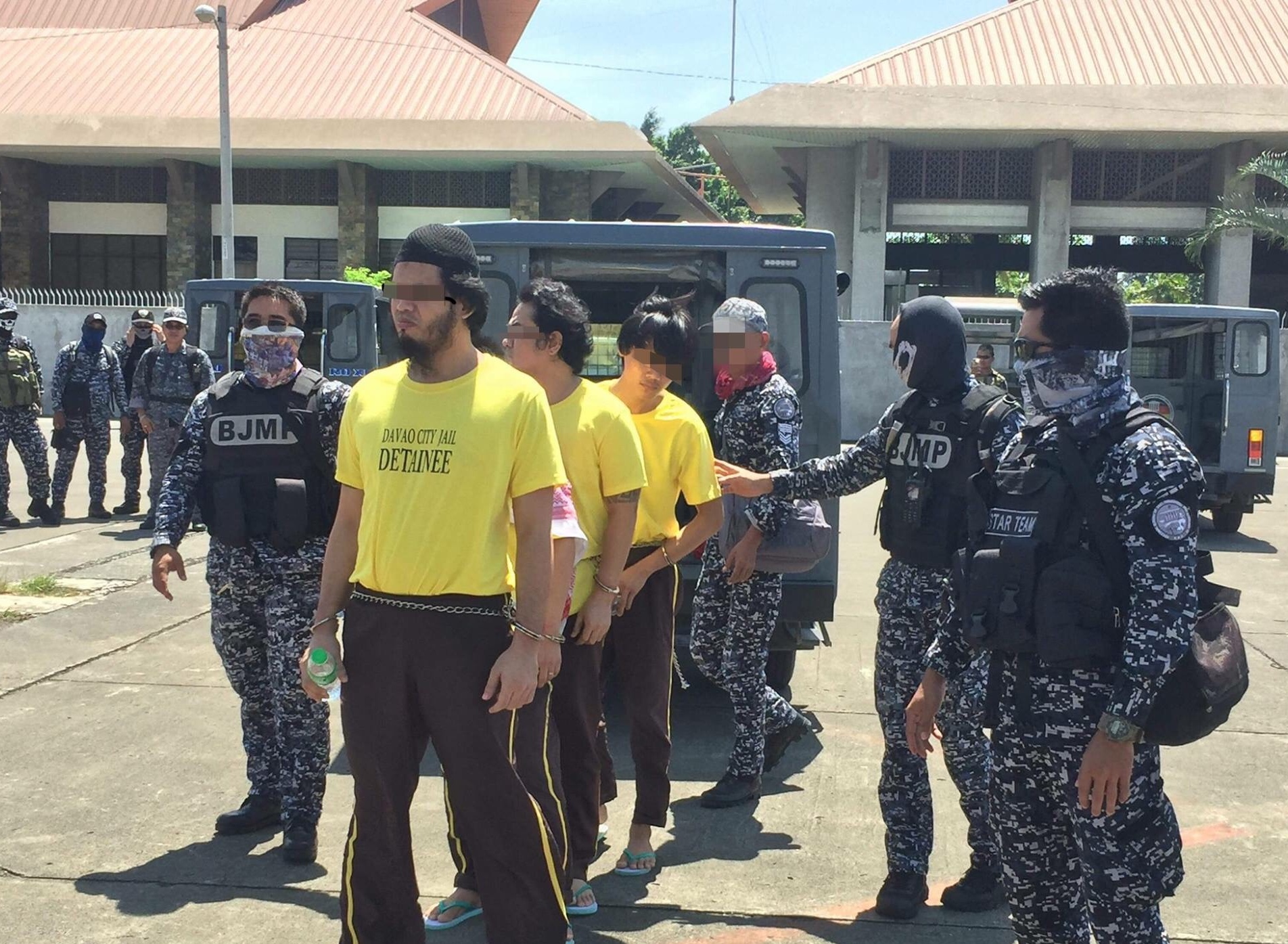
At least 9 "high-risk" inmates belonging to the Abu Sayyaf and Maute groups were transferred from the Davao City Jail to Camp Bagong Diwa in Taguig City on Sunday, February 11.
Jail Senior Superintendent Amelia Rayandayan, regional director of the Bureau of Jail Management and Penology (BJMP) in Davao, said 7 of the inmates are Maute Group members charged with terrorism, multiple murder, and multiple attempted murder.
The remaining two, she said, belong to the Abu Sayyaf and face charges of kidnapping with homicide.
The Special Tactics and Response Team of BJMP Davao led Sunday's transfer, together with Task Force Davao and the Philippine National Police (PNP) Highway Patrol Group (HPG) in the region, according to Jail Inspector Edo Lobenia, the agency's spokesperson.
"High-risk inmates like the Maute and Abu Sayyaf need maximum security as they are known to be risky personalities and may be targets for rescue by their associates or even assassination attempts as some of them may have made ardent enemies prior to their incarceration," Lobenia said.
The transfer came after the Davao City Jail asked the Supreme Court (SC) to have the inmates moved from their facility in Ma-a to Camp Bagong Diwa.
The request was endorsed by Davao City Mayor Sara Duterte-Carpio and "had been helpful to facilitate the immediate transfer of the high-risk inmates," said Jail Superintendent Grace Sun Taculin, Davao City Jail Warden.
The Maute inmates, who pledged allegiance to international terrorist network Islamic State (ISIS), were also implicated in the 2016 Davao City bombing that killed 14 people.
Meanwhile, the Abu Sayyaf inmates were accused of kidnapping 3 foreigners and a Filipina on Samal Island in Davao del Norte in 2015.
The inmates face various charges, including terrorism, multiple murder, and kidnapping with homicide
TRANSFERRED. 'High-risk' inmates are moved from the Davao City Jail to Camp Bagong Diwa in Taguig City on February 11, 2018. Photo courtesy of BJMP Davao
At least 9 "high-risk" inmates belonging to the Abu Sayyaf and Maute groups were transferred from the Davao City Jail to Camp Bagong Diwa in Taguig City on Sunday, February 11.
Jail Senior Superintendent Amelia Rayandayan, regional director of the Bureau of Jail Management and Penology (BJMP) in Davao, said 7 of the inmates are Maute Group members charged with terrorism, multiple murder, and multiple attempted murder.
The remaining two, she said, belong to the Abu Sayyaf and face charges of kidnapping with homicide.
The Special Tactics and Response Team of BJMP Davao led Sunday's transfer, together with Task Force Davao and the Philippine National Police (PNP) Highway Patrol Group (HPG) in the region, according to Jail Inspector Edo Lobenia, the agency's spokesperson.
"High-risk inmates like the Maute and Abu Sayyaf need maximum security as they are known to be risky personalities and may be targets for rescue by their associates or even assassination attempts as some of them may have made ardent enemies prior to their incarceration," Lobenia said.
The transfer came after the Davao City Jail asked the Supreme Court (SC) to have the inmates moved from their facility in Ma-a to Camp Bagong Diwa.
The request was endorsed by Davao City Mayor Sara Duterte-Carpio and "had been helpful to facilitate the immediate transfer of the high-risk inmates," said Jail Superintendent Grace Sun Taculin, Davao City Jail Warden.
The Maute inmates, who pledged allegiance to international terrorist network Islamic State (ISIS), were also implicated in the 2016 Davao City bombing that killed 14 people.
Meanwhile, the Abu Sayyaf inmates were accused of kidnapping 3 foreigners and a Filipina on Samal Island in Davao del Norte in 2015.
Galvez: BBL will ‘significantly’ lower terror threat in Mindanao
From the Manila Bulletin (Feb 11): Galvez: BBL will ‘significantly’ lower terror threat in Mindanao
The passage of the Bangsamoro Basic Law (BBL) and its eventual ratification will redound to a more peaceful Mindanao as this will address the root causes of the armed conflict, a top military commander here said.

Lt. Gen. Carlito Galvez Jr., Western Mindanao Command (Westmincom) chief, noted the provisions of the BBL addresses the underlying factors that breed terrorism in southern Philippines.
“The enactment of the BBL will significantly help in lowering the threat of extremism and terrorism, particularly the Abu-Sayyaf,” Galvez, who is overseeing the government campaign against terrorist groups in the island.
He said the terror groups will now find it hard to recruit new members and carry out attacks, since the implementation of the BBL answers the “issues” of the Bangsamoro people.
“Right now, the terror groups are trying to change the narrative of the conflict in Mindanao,” he said, adding that the extremists are taking advantage of the frustrations of the Bangsamoro people to join in their violent movement.
Galvez said the military fully supports the Duterte administration’s peace agenda, particularly the implementation of the peace agreements the government has signed with the Moro Islamic Liberation Front (MILF) and the Moro National Liberation Front (MNLF).
He earlier noted, “The outcome of the peace process has a direct correlation with our problem on terrorism.”
His statement came as both houses of Congress are conducting a series of public hearings in Mindanao for the proposed BBL.
Senators led by Juan Migual Zubiri, who chairs the subcommittee on the BBL, yesterday went to the island provinces of Basilan, Sulu, and Tawi-Tawi and the city of Zamboanga for public consultations.
During the public hearing here, Zubiri emphasized the implementation of the BBL will help in the campaign against terrorism.
“They (security forces) are the ones who want peace more than all of us. It is them who also wish that the BBL be achieved,” he said.
Basilan governor Hadjiman “Jim” S. Hataman-Saliman said there is a need to fully address violent extremism in his province.
“We have a problem on terrorism. We experienced terrorism since 1991. Kaya sana habang we are discussing the BBL, let’s free Basilan and other areas in ARMM (Autonomous Region in Muslim Mindanao) from terrorism,” he said.
The island province is the birthplace of the notorious Abu-Sayyaf group in the early ’90s. It led some of the country’s worst terrorist attacks, such as the bombing of a passenger ferryboat that left hundreds of people killed, kidnapping of foreign tourists, extortions and beheadings.
For the senators who were present during the hearing, the BBL would provide fiscal autonomy, which will help address the threat of violent extremism by giving the Moro people greater opportunity for development over their ancestral lands.
Senate President Aquilino Pimentel, Jr. said the senators have a “solid” support to enact the bill.
Senators Sonny Angara, Risa Hontiveros, Sherwin Gatchalian, and JV Ejercito agreed that the implementation of BBL would bring the much-needed economic boost and social development in the Moro-dominated areas.
To make the BBL successful, Presidential Peace Adviser Secretary Jesus G. Dureza challenged the Moro people to take an active role in the peace building process.
“The responsibility is on the people. Ang pagbabago ay hindi lang sa batas pero sa sarili natin,” he emphasized.
The Senate is determined to pass the proposed law by March 22, according to Zubiri, to give a legal foundation for the creation of a new Bangsamoro region that would replace the ARMM.
https://news.mb.com.ph/2018/02/11/galvez-bbl-will-significantly-lower-terror-threat-in-mindanao/
The passage of the Bangsamoro Basic Law (BBL) and its eventual ratification will redound to a more peaceful Mindanao as this will address the root causes of the armed conflict, a top military commander here said.
Lt. Gen. Carlito Galvez Jr. (Keith Bacongco / Manila Bulletin)
Lt. Gen. Carlito Galvez Jr., Western Mindanao Command (Westmincom) chief, noted the provisions of the BBL addresses the underlying factors that breed terrorism in southern Philippines.
“The enactment of the BBL will significantly help in lowering the threat of extremism and terrorism, particularly the Abu-Sayyaf,” Galvez, who is overseeing the government campaign against terrorist groups in the island.
He said the terror groups will now find it hard to recruit new members and carry out attacks, since the implementation of the BBL answers the “issues” of the Bangsamoro people.
“Right now, the terror groups are trying to change the narrative of the conflict in Mindanao,” he said, adding that the extremists are taking advantage of the frustrations of the Bangsamoro people to join in their violent movement.
Galvez said the military fully supports the Duterte administration’s peace agenda, particularly the implementation of the peace agreements the government has signed with the Moro Islamic Liberation Front (MILF) and the Moro National Liberation Front (MNLF).
He earlier noted, “The outcome of the peace process has a direct correlation with our problem on terrorism.”
His statement came as both houses of Congress are conducting a series of public hearings in Mindanao for the proposed BBL.
Senators led by Juan Migual Zubiri, who chairs the subcommittee on the BBL, yesterday went to the island provinces of Basilan, Sulu, and Tawi-Tawi and the city of Zamboanga for public consultations.
During the public hearing here, Zubiri emphasized the implementation of the BBL will help in the campaign against terrorism.
“They (security forces) are the ones who want peace more than all of us. It is them who also wish that the BBL be achieved,” he said.
Basilan governor Hadjiman “Jim” S. Hataman-Saliman said there is a need to fully address violent extremism in his province.
“We have a problem on terrorism. We experienced terrorism since 1991. Kaya sana habang we are discussing the BBL, let’s free Basilan and other areas in ARMM (Autonomous Region in Muslim Mindanao) from terrorism,” he said.
The island province is the birthplace of the notorious Abu-Sayyaf group in the early ’90s. It led some of the country’s worst terrorist attacks, such as the bombing of a passenger ferryboat that left hundreds of people killed, kidnapping of foreign tourists, extortions and beheadings.
For the senators who were present during the hearing, the BBL would provide fiscal autonomy, which will help address the threat of violent extremism by giving the Moro people greater opportunity for development over their ancestral lands.
Senate President Aquilino Pimentel, Jr. said the senators have a “solid” support to enact the bill.
Senators Sonny Angara, Risa Hontiveros, Sherwin Gatchalian, and JV Ejercito agreed that the implementation of BBL would bring the much-needed economic boost and social development in the Moro-dominated areas.
To make the BBL successful, Presidential Peace Adviser Secretary Jesus G. Dureza challenged the Moro people to take an active role in the peace building process.
“The responsibility is on the people. Ang pagbabago ay hindi lang sa batas pero sa sarili natin,” he emphasized.
The Senate is determined to pass the proposed law by March 22, according to Zubiri, to give a legal foundation for the creation of a new Bangsamoro region that would replace the ARMM.
https://news.mb.com.ph/2018/02/11/galvez-bbl-will-significantly-lower-terror-threat-in-mindanao/
Subscribe to:
Posts (Atom)