Thursday, February 14, 2019

With Autonomy in the Southern Philippines, Muslim Rebels Must Learn How to Govern

From the World Politics Review (Feb 12, 2019): With Autonomy in the Southern Philippines, Muslim Rebels Must Learn How to Govern (By Michael Hart)


Philippine President Rodrigo Duterte, center, Al-Hajj Murad, chair of Moro Islamic Liberation Front, left, and other leaders at a ceremony at Malacanang Palace in Manila, Philippines, July 17, 2017 (AP photo by Bullit Marquez).

In the fragile west of the Philippines’ war-ravaged southern island of Mindanao, voters in recent weeks overwhelmingly approved an historic peace accord aimed at ending five decades of bloody separatist conflict. The vote ratified a new law on expanded autonomy, known as the Bangsamoro Organic Law, paving the way for a new Muslim-majority self-governing region to replace the existing Autonomous Region in Muslim Mindanao, which has been in place since 1989. The public stamp of approval, in a high-turnout, two-stage referendum on Jan. 21 and Feb. 6, marks the culmination of a lengthy peace process between the Philippine government and the Moro Islamic Liberation Front, Mindanao’s largest and most powerful Islamist rebel group.

Between the two votes, though, the atmosphere of hope was shattered when twin explosions rocked a cathedral on the island of Jolo, killing 22 people. The blast came just six days after voters in Jolo and the rest of Sulu province narrowly rejected inclusion in the new autonomous region. The attack, apparently carried out by ISIS-aligned Abu Sayyaf militants, serves as a stark reminder that radical elements opposed to expanded autonomy remain intent on derailing the final stages of the peace process in Mindanao.

Amid the specter of further violence, even with autonomy secured, the hierarchy of the Moro Islamic Liberation Front now faces the challenge of transitioning from insurgents to politicians capable of governing. Its leaders must navigate a tricky three-year implementation period before contesting elections for the first Bangsamoro parliament, scheduled for 2022. The Front must also oversee the demobilization and disarmament of its own ranks while restricting militant activity and curtailing Mindanao’s ingrained culture of clan-based warlordism.

It may be some time before a lasting peace actually takes hold and prospects improve for Mindanao’s impoverished and long-marginalized Moro Muslim population. Past peace deals with the Moro Islamic Liberation Front and the older Moro National Liberation Front have failed to bring prosperity or eliminate violence. Senior Front figures are hopeful the new region will avoid the pitfalls of the Autonomous Region in Muslim Mindanao, which has been hampered by corruption and roundly criticized as a failed experiment in self-governance.

The new Bangsamoro Autonomous Region in Muslim Mindanao will be governed by an 80-member elected parliament, likely to be controlled by the Moro Islamic Liberation Front. The region will receive an annual $1.3 billion block grant from Manila and 75 percent of tax receipts from areas it governs, up from the current 70 percent. It will see greater profits from most natural resources within its borders, including timber, gold and mineral deposits, while parliamentarians will hold stronger legislative powers allowing for more effective implementation of its development plans.

Given the referendum’s result, Moro leaders have secured a sizeable public mandate. Yet despite an overwhelming majority of residents voting in favor of expanded autonomy, the unexpected rejection of the law in several areas indicates that not everyone is satisfied.

The combined count of the existing provinces—Basilan, Lanao del Sur, Maguindanao, Sulu and Tawi-Tawi—suggests widespread support, with 1.54 million for it and 198,750 against. Yet voters in Sulu rejected the law by a slim margin of 163,526 to 137,630. Their votes, though, were counted in the collective regional total, meaning the province will be forced to accede to the new autonomous region, which could risk a boost in support for Sulu-based Abu Sayyaf among disappointed voters. Isabela city, on the nearby island of Basilan, also rejected the deal, but will not have to join as it is not part of the existing Autonomous Region in Muslim Mindanao.
The key in the southern Philippines will be ensuring that the benefits of expanded autonomy are felt by ordinary people in their everyday lives.
Before the fully functioning and geographically expanded Bangsamoro region becomes a reality, the Moro leadership, more attuned to commanding guerrilla forces in Mindanao’s remote jungles, must quickly adapt to politics. During the three-year transition, the territory will be governed by the 105-member interim Bangsamoro Transition Authority, led by Al Haj Murad Ebrahim, the Moro Islamic Liberation Front’s veteran chairman. The Front formed a political wing, the United Bangsamoro Justice Party, in 2014, which is set to participate in the 2022 poll. Former Front commanders must refine the art of negotiation and compromise, as parties representing Christians, indigenous groups, the rival Moro National Liberation Front and other minorities are allocated a proportion of seats in the transitional authority. The Front will be held to its repeated promise for the new region to be inclusive of all religions.

There are other challenges. The Front must take on the corruption that has plagued Mindanao. The new region’s proposed financial auditing and transparency mechanisms will act as a deterrent, yet there is little room for complacency and Front leaders will have to ensure full compliance to maintain public trust.

The demobilization of rebel fighters is due to take place in four phases in line with a 2014 agreement; the first phase was completed in 2015. The ratification of the autonomy law signals the start of phase two, stipulating that the Moro Islamic Liberation Front must decommission 30 percent of its 30,000-40,000 fighters and turn over a third of its 6,000-7,000 firearms in the coming months. Phases three and four will facilitate the full demobilization of the Front by 2022. Fighters who remain active during the transition will form Joint Peace and Security Teams with the Philippine armed forces and National Police, and will be eligible to join their ranks once the interim period ends. Senior Front leaders will likely find the transition into politics easier than regular insurgents, who must find a new sense of belonging as they re-enter mainstream society and resume civilian life.

Tackling Mindanao’s culture of warlordism and clan politics is vital if peace is to take hold, as the region is awash with weapons and armed bandits due to its history of lawlessness, criminality and a weak state presence. Ebrahim has said “dismantling private armies” and “controlling loose firearms” will be priorities, but it is unclear exactly how they will be achieved. Any attempt to disarm these groups by force may provoke conflict. The new autonomous government must also contend with powerful political families and their well-armed bands of followers—a major cause of violence for generations. In the most notorious case, in 2009, the Ampatuan clan massacred 58 political opponents and journalists traveling in a convoy of vehicles prior to a mayoral election in Maguindanao province.

An even greater threat to peace emanates from the presence of jihadist groups aligned with the Islamic State. Abu Sayyaf, Ansar Khalifah Philippines and the Bangsamoro Islamic Freedom Fighters all reject autonomy and continue to fight for a fully independent Islamic entity. Before the Jolo cathedral bombing late last month, a spate of terrorist attacks targeted civilians last year in Lamitan, Isulan, General Santos and Cotabato city as the peace process gained momentum. Jihadists also continue to clash with Philippine security forces in remote towns and villages. President Rodrigo Duterte and the military are aiming to wipe out these groups under martial law, which was extended in mid-December until the end of 2019. Doing so will require close cooperation from the interim transitional authority in Mindanao and demobilizing Moro rebels on the ground.

The key in the southern Philippines will be ensuring that the benefits of expanded autonomy are felt by ordinary people in their everyday lives. The Moro Islamic Liberation Front has promised to improve infrastructure, public services and job opportunities while reducing poverty, which at 59 percent is the worst of any region in the Philippines.

Opponents of the peace process will only be persuaded to lay down their weapons and support the new autonomous region if these promises are met. The new political structure must benefit everyone in western Mindanao, not just the rebels-turned-politicians, to ensure its public support and to dent the recruitment efforts of ISIS-linked groups who prey on marginalized sectors of society. Expanded autonomy in Mindanao will hopefully also spark a wider cultural shift, away from solving disputes through violence and toward overcoming differences through direct participation in politics. For longtime Moro rebels, the hard task of governing and fulfilling their people’s wishes is only just beginning.

[Michael Hart is a freelance writer and researcher focusing on civil conflict and the politics of East Asia. He has written for The Diplomat, Eurasia Review and Geopolitical Monitor, among other publications.]

https://www.worldpoliticsreview.com/articles/27415/with-autonomy-in-the-southern-philippines-muslim-rebels-must-learn-how-to-govern

AFP denies reports of increased Chinese activities near Pagasa Island

From the Manila Bulletin (Feb 13, 2019): AFP denies reports of increased Chinese activities near Pagasa Island

Armed Forces of the Philippines (AFP) Chief of Staff General Benjamin Madrigal, Jr., said that they have not received any reports of increased number of Chinese fishing boats near Pagasa Island, Palawan.

In an interview at Camp Aguinaldo, Quezon City, Madrigal also said that they have not received reports of activities in the island being hampered due to the reported presence of Chinese ships.


File photo of AFP Chief of staff and former Eastern Mindanao Command chief Lt. Gen Benjamin Madrigal. (Keith Bacongco / FILE / MANILA BULLETIN)
“Wala pa naman kaming na-receive na report na merong ano dito, hampered yung ating activities diyan [We have not received any report that there are, that the activities there are hampered]. But of course iyung, sabi nga iyung continuous monitoring ginagawa natin [We are continuously monitoring],” Madrigal said.

“The same its true with other countries who are also interested in developing… this is happening in their area,” he added.

Washington think tank Asia Maritime Transparency Initiative (AMTI) earlier said China has responded to the new construction in Pagasa Island by deploying a large fleet of ships from Subi Reef, just over 12 nautical miles southwest of Thitu. These include several People’s Liberation Army-Navy (PLAN) and China Coast Guard (CCG) ships, along with dozens of fishing vessels ranging in size from 30 to 70 meters.

The AMTI said a handful of Chinese vessels have operated in the area between Subi and Thitu since at least July 2018, likely in response to the initial Philippine effort to start runway repairs last May 2018. But their numbers increased to at least 24 on December 3, 2018 just before the current construction operations began.

In five subsequent satellite images captured from mid-December to late January, their numbers fluctuate, reaching a high of 95 on December 20 before dropping to 42 by January 26, 2019.

Defense Secretary Delfin Lorenzana, meanwhile, said improving the safety, welfare, livelihood, and personal security of Filipinos in the Municipality of Kalayaan, a distinct and separate town under the province of Palawan, is the government’s Constitutional mandate,

Lorenzana made the remark following reports on the alleged deployment of Chinese militia in response to Philippine efforts to start runway repairs on Pag-asa Island.

Kalayaan, according to Lorenzana, has been part of the sovereignty of the Philippines since 1978, by virtue of Presidential Decree No. 1596 and international laws.

Lorenzana said the Department of National Defense has always been open and transparent in conveying and fulfilling the government’s desire to improve the living conditions of both the civilian and military citizens in the community of Barangay Pag-asa, the largest of the nine islands in the municipality comprising the Kalayaan Island Group (KIG).

The other islands in the KIG include Kota Island, Parola Cay, Patag Reef, Likas Island, Lawak Island, Panata Cay, Rizal Reef, and Ayungin Shoal.

According to the defense chief, among the facilities being constructed / upgraded in Pag-asa are the beaching ramp which will be completed by the first quarter of this year, air strip (Rancudo Airfield), better barracks for soldiers, desalination facilities, sewage disposal system, conventional and renewable power generators, lighthouses, shelters and storage facilities for fishermen.

“These planned modest improvements are basic but nonetheless highly essential in delivering social services to raise the standard of living and improve the quality of life of Filipino citizens on the island,” Lorenzana said.

“Having undergone careful planning and consideration, with full respect to international law and rules-based order governing civilized states, implementing these improvements is a legitimate undertaking, and well within our rights as a sovereign nation,” he added.

Lorenzana said the presence of militia on the Chinese man-made structures is no surprise to them as they have been there since 2012.

“We expect other countries to respect Philippine sovereignty, and to conduct themselves in a civilized manner befitting members of the global community,” Lorenzana said.

https://news.mb.com.ph/2019/02/13/afp-denies-reports-of-increased-chinese-activities-near-pagasa-island/

Philippines: The Black Flag Flies on Facebook

From The Asia Foundation (Feb 13, 2019): Philippines: The Black Flag Flies on Facebook (By Nathan Shea)

The first news that militants had taken to the streets of the Islamic City of Marawi on May 23, 2017, came from Facebook. Pictures of masked men carrying assault rifles and waving the black flag of the Islamic State were swirling across social media well before Philippine and international news channels picked up the story. By the time the military and the media had begun to respond, Marawi’s residents were already streaming out of the city by the tens of thousands to seek refuge from the violence.

The fact that news of the siege spread first on Facebook isn’t surprising. Over 60 million Filipinos have access to the internet; of those, 97 percent are on Facebook. For many, Facebook is the internet, a circumstance encouraged by local telecoms that offer free access to the social media site without the need for a paid data plan.

While the proliferation of Facebook makes Filipinos some of the most digitally connected people in the world, the five-month battle for Marawi in 2017 laid bare a darker side of social media: its power as a tool of violent extremism. In the months leading up to the siege, there had already been speculation that extremist groups were trying to use social media to reach and recruit Muslims across Mindanao. Stories collected from schools and universities in Marawi following the siege confirm that this was the case.


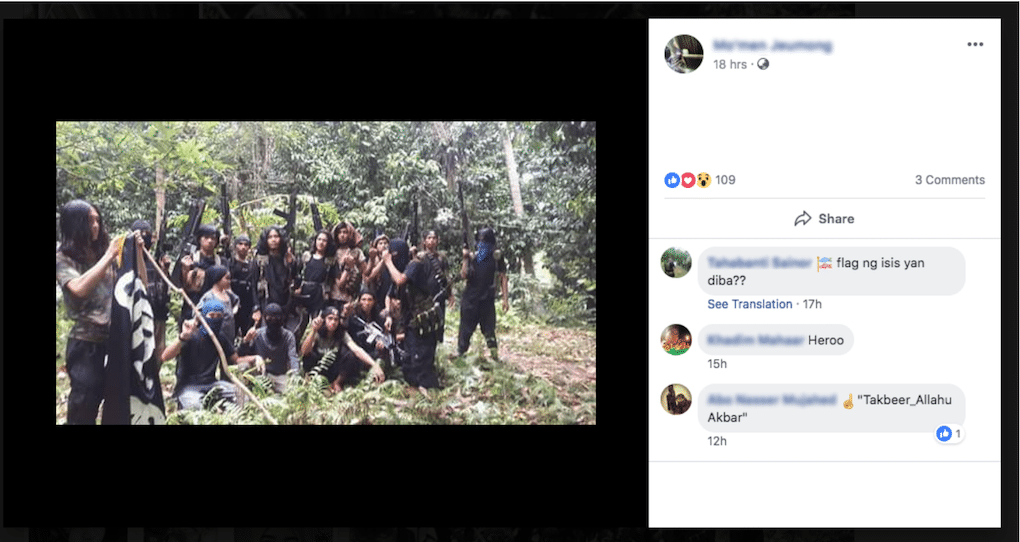
Screengrab from public Facebook profiles reveal the relatively simple and authentic method through which some users promote their violent extremist actions.

The rise of online violent extremism in the Philippines over the last few years occurred despite significant strides in the Mindanao peace process. The island region has been gripped by armed rebellions for more than four decades, caused largely by local grievances against the state. But protracted negotiations with two major rebel groups in Mindanao have produced two peace agreements, the most recent in 2014 between the Philippine government and the Moro Islamic Liberation Front. The acceptance of the Bangsamoro Organic Law in a plebiscite on January 21 is the fruit of decades of peace talks. Suicide bombings in the city of Jolo just days later by a group aligned with the Islamic State are a stark reminder that many challenges remain.

As early as 2014, after the declaration of the caliphate in Iraq and Syria, images and videos had begun appearing online showing armed groups in the Philippines pledging allegiance to ISIS. These groups reject the formally negotiated path to peace, and some of them are now engaged in online extremism to promote or defend their armed efforts in various parts of Mindanao. It was two of these groups—Abu Sayyaf, and Maute—that led the attack on Marawi in 2017 in the name of ISIS.

With online extremism and the siege of Marawi as a backdrop, The Asia Foundation, in partnership with the online media organization Rappler, set out to study the role of social media in the messaging and recruitment practices of violent extremist groups in the Philippines. The project closely engaged with young Filipinos active on social media and at risk of being exposed to extremism, to understand how they use the internet and the content they encounter online. The project studied thousands of pages, groups, and profiles on social media to analyze the methods and networks that allowed extremism to flourish online in 2018. The study’s findings were released in December in the report Understanding Violent Extremism.


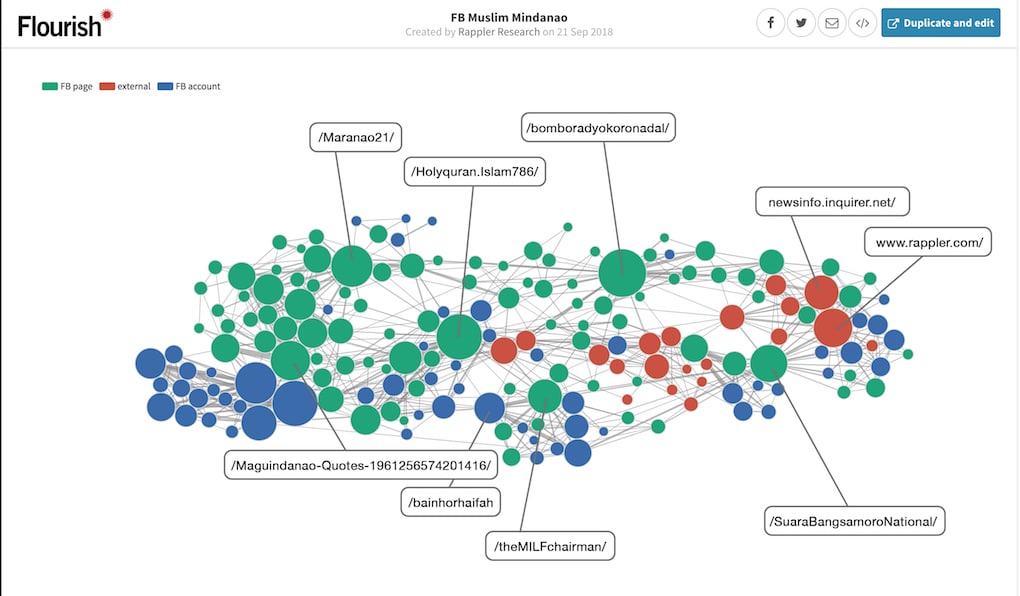
A network map of pages and groups in Facebook where researchers found conversations around hot-button issues identified by young Moro participants in this study.

Despite efforts of the Philippine government and social media companies in the wake of the Marawi siege, online violent extremist activity continues. While much of the coordinated publicity that circulated during the siege has vanished, extremists are still sharing news of their activities online and using the tools of social networking to connect with one another and with potential recruits.

Violent extremist content in the Philippines remains a serious challenge for authorities to monitor and detect. Posts are commonly in local languages that defy software translation, making them difficult to detect using off-the-shelf security tools such as content blockers and scrapers. In addition, content draws predominantly on local grievances, highlighting how both terrorist violence and the conditions that give rise to it in the Philippines are highly local and even idiosyncratic.

This local nature of content on social media confirms the organic character of online extremism in the Philippines. The violent extremists studied in the Foundation report are digital natives, but they are also digitally naïve, spreading messages in an opportunistic and unsophisticated manner that mirrors the way other digitally active youth often use social media in their day-to-day lives. Posts featuring poor-quality images of young men—often boys—posing in front of an Islamic State flag while camped in the jungle reveal how those engaged in terrorism share their lives online in a similar manner to their nonextremist peers. The content is full of the confidence and bravado that is common among teenagers and young adults on social media.


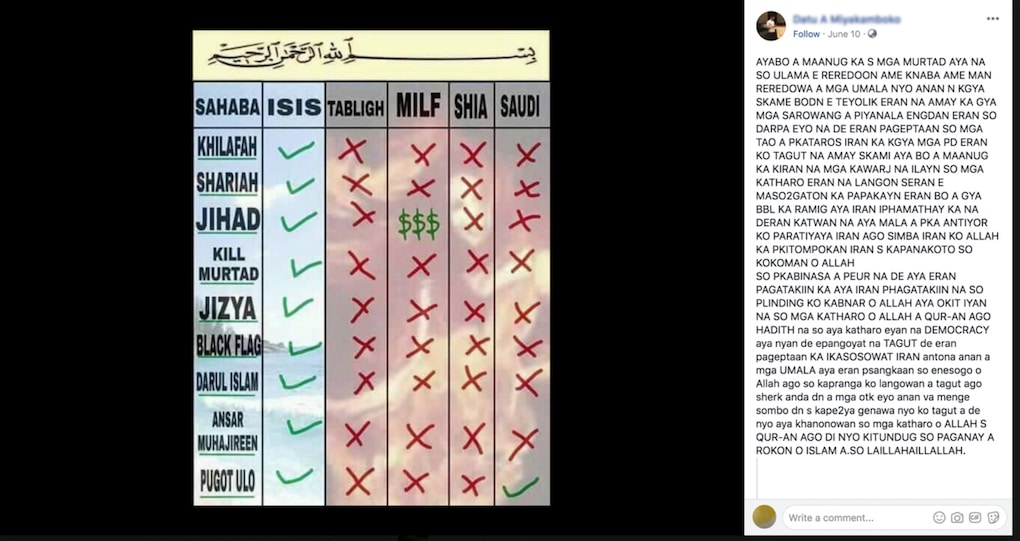
A post comparing elements within Islamic and Bangsamoro society to ISIS, claiming that the Moro Islamic Liberation Front is simply using “jihad” in the pursuit of wealth.

Efforts to radicalize others are mostly confined to private messages or debates on local-interest Facebook groups. Extremist content typically appears in the comment threads of popular or controversial posts. Where private messaging takes place, it is commonly through digital networks that replicate a person’s offline community, suggesting that the primary candidates for online radicalization and recruitment are drawn largely from a person’s friends, family, and acquaintances. There are instances where people have been contacted by strangers, but such outreach is rare, and usually occurs when the target individual has posted content that already appears sympathetic to the extremist cause.

Looking ahead, the new report suggests that the future of violent extremism on social media in the Philippines is hard to predict. The uncoordinated nature of current extremist activity on social media indicates that the immediate danger is low, but the evolution of digital security threats demonstrates that all actors must remain vigilant and engaged in monitoring developments in online activity.

One thing that’s clear is that simply removing offensive content from Facebook is ineffective. Even when the original post is deleted, extremist messages and content can continue to be shared. Meanwhile, those whose posts are censored or deleted may become isolated from more positive communities and begin to conduct their online activities in a secretive manner.

There are specific actions that government, NGOs, social media companies, and others can take to mitigate the influence of terror groups on Facebook, but taken together, the report’s findings emphasize the need for timely, targeted interventions to thwart extremist activity online. Capacity building at the community level, such as courses promoting digital literacy and critical thinking skills among young Filipinos, is one concrete activity that could effectively blunt the tactics of extremists on social media.

Online violent extremism is a global problem for governments and social media companies. What the Philippine case reveals is that within this international trend, local dynamics and social relations are the foundation of extremist messaging and recruitment. Tailored responses that address local grievances are still the best tools to limit the influence of dangerous online content.

This essay is drawn from the report Understanding Violent Extremism: Messaging and Recruitment on Social Media, written by Nathan Shea, Derkie Alfonso, Kathline Tolosa, Datumanong Ebil, Ethan Geary, and Sam Chittick with support from Rappler.
Nathan Shea is a senior program officer in The Asia Foundation’s Conflict and Fragility Program. He can be reached at nathan.shea@asiafoundation.org. The views and opinions expressed here are those of the author, not those of The Asia Foundation.

https://asiafoundation.org/2019/02/13/philippines-the-black-flag-flies-on-facebook/

Police tortured suspect to admit complicity in Jolo bombings, rights group, lawyer say

From the Business Mirror (Feb 14, 2019): Police tortured suspect to admit complicity in Jolo bombings, rights group, lawyer say

One of the suspects arrested by the police in connection with the twin bombings in Sulu was allegedly tortured to admit the crime, his lawyer and human-rights group Karapatan claimed on Wednesday.

Lawyer Meltoni Sibuyan and Karapatan claimed that Mukammar Pae, an alleged member of the Abu Sayyaf Group (ASG) under Commander Hatib Hajan Sawadjaan, was tortured and subjected to water boarding just to admit his participation in the bombings. A form of water torture, waterboarding is carried out by pouring amounts of water over a cloth-covered face and breathing passages of an immobilized captive, causing the person to experience the sensation of drowning.

Philippine National Police chief Director General Oscar D. Albayalde said that Pae, who was arrested along with three others, aided the suicide bombers of the Jolo cathedral, which killed 23 people and wounded 95 others on January 27.

Albayalde said that an improvised explosive device and bomb components were also recovered by policemen when they searched Pae’s house in Sulu.

Sibulan claimed that Pae and his three other companions were tree cutters and lumberyard workers, who wanted to clear their name by turning themselves to the Army’s 35th Infantry Battalion in Sulu, which turned them over to the police.

“Immediately after, Pae was illegally arrested, tortured and detained. Sibulan added that his client was subjected to waterboarding,” Karapatan through its Secretary-General Cristina Palabay said in a statement.

“We agree with Atty. Meltoni Sibulan that this may be a masquerade to make the public believe that this is a closed case. [The] torture of innocent civilians [and] to use [them] as scapegoats reveal the extent of police brutality, incompetence, and deliberate violation of laws that safeguard against cruel and inhumane treatment,” Palabay said.

Karapatan called for an investigation into the allegations of torture.

https://businessmirror.com.ph/2019/02/14/police-tortured-suspect-to-admit-complicity-in-jolo-bombings-rights-group-lawyer-say/

No Proof Indonesians Bombed Philippine Church, Jakarta Security Official Says

From BenarNews (Feb 13, 2019): No Proof Indonesians Bombed Philippine Church, Jakarta Security Official Says

Philippine National Police chief Oscar Albayalde points to a diagram during a news conference in Manila, after the arrest of five suspected Abu Sayyaf militants wanted for alleged involvement in the deadly bombings of a church in the southern Philippines, Feb. 4, 2019.

Philippine National Police chief Oscar Albayalde points to a diagram during a news conference in Manila, after the arrest of five suspected Abu Sayyaf militants wanted for alleged involvement in the deadly bombings of a church in the southern Philippines, Feb. 4, 2019.  AP                    
            
An investigation team sent by Indonesia to Manila last week could not confirm Philippine claims that an Indonesian couple carried out twin bombings that killed 23 people at a Jolo island church, a senior counter-terror source in Jakarta told BenarNews.

Philippine Interior Secretary Eduardo Año had claimed that an Indonesian man and woman were responsible for the Jan. 27 explosions at Our Lady of Mount Carmel Cathedral in Jolo, capital of Sulu province in the southern Philippines.

“There were no DNA profile of the couple, no finger prints according to the post-mortem done on body parts found at the crime scene,” the Indonesian security source told Benar via a phone interview from Jakarta.

Philippine security forces have arrested and filed murder charges against five suspected members of the Abu Sayyaf, a ragtag band of militants linked with the Islamic State (IS) extremist group.

Authorities in the Philippines, including President Rodrigo Duterte, claim that those five men worked with a couple, believed to be Indonesians, who bombed the church.

Indonesian investigators arrived in Manila early this month to help probe those suspicions.

Six days after the bombings, Año told CNN that the couple was sometimes mistaken for Malaysians. “I’m certain they are Indonesians,” he said, identifying the man as “Abu Huda” and adding he had been in Sulu province “for a long time already.”

The woman arrived in Jolo days before the bombings, Año said.

But the Indonesian source told BenarNews that the team of counter-terror investigators has not yet received concrete evidence from Philippine authorities since returning to Jakarta this week.

The source said Philippine authorities had told the team that the Indonesian bomber was named “Abu Huda” and was believed to have travelled to Manila on Jan. 21 with his 10-year-old daughter.

“Indonesian police checked every single passenger who flew out to Manila on January 21 from all airports in the country. Police also checked every male passenger who travelled to Manila with a 10-year-old female child (on that day),” he said.

“There was no ‘Abu Huda’ on the immigration list. Abu Huda is highly likely an alias, a nickname that is commonly used by militants. Under such circumstances, it is very difficult to establish the identity of this Abu Huda,” the source said.

The counter-terrorism source said the Indonesian investigation team also failed to obtain from Philippine authorities the alleged bombers’ digital footprint.

“Indonesian police sent to Manila did not get any digital footprint of the alleged couple that could have shed light on where they went, who they communicated with, anything that could have helped establish their identities,” the source said.

“Under such circumstances, it is going to be very difficult to make headway in this investigation,” he said.

‘One-sided’

When the Philippines first announced that Indonesian suicide bombers were behind the blast, Indonesian Security Minister Wiranto urged Filipino authorities not to rush into accusing Indonesians as the perpetrators before confirming the facts.

He described the statements from Manila as “one-sided news.”

“Until now the coordination has not been completed, and responsibility remains with the Philippine authorities themselves – the police, the parties concerned in the matters,” Wiranto told reporters in Jakarta.

Analysts have also raised doubts over the Philippine claims linking Indonesians to the bombings

“There’s no evidence! Different officials are saying different things – Malaysians, Yemenis, Indonesians,” Sidney Jones, director of the Jakarta-based Institute for Policy Analysis of Conflict, told the Jakarta Post last week. “They actually have no clue.”

https://www.benarnews.org/english/news/indonesian/indonesia-militants-02132019171730.html

Groups condemn ‘illegal detention’ of 2 activists

From the Sun Star-Cagayan de Oro (Feb 13, 2019): Groups condemn ‘illegal detention’ of 2 activists

CAUSE-ORIENTED groups have initiated a fact-finding mission and launched efforts to free two human rights defenders from Cagayan de Oro City who were "forcibly" brought by a government soldier for questioning to a military camp in Bukidnon.

The Gabriela Women's Party and the Rural Missionaries of the Philippines-Northern Mindanao Sub-Region (RMP-NMR) both condemned the incident and demanded the immediate release of Gloria Jandayan and her daughter Gleceria Balangiao.

Jandayan is a member of Gabriela and, at the same time, a barangay health worker in Barangay Macabalan while Balangiao is a lay worker of RMP-NMR as secretary of Panday Bulig, a provincial chapter of the Citizens Disaster Response Center (CDRC).

The mother and daughter were brought by a certain Captain Lorefel Judaya, an intelligence officer of the army's 1st Special Forces Battalion for questioning and verification over their alleged links with the New People's Army (NPA) at a military camp in Manolo Fortich Bukidnon, last Monday.

"We vehemently condemn this abduction and illegal detention of Gloria Jandayan and Gleceria Balangiao which adds to the long list of cases of human rights violations against Gabriela Women's Party and Makabayan volunteers on the eve of electoral campaign period and amid heightened attacks against human rights defenders," Gabriela said.

Human rights group Karapatan-Northern Mindanao earlier said the military and the barangay officials have reached an agreement that the two be released within 24 hours, after the investigation.

But, Karapatan-NMR spokesperson Father Allan Khen Apus said the two have yet to return home as of Wednesday, February 13.

Meanwhile, the RMP-NMR said another worker has received threats through text messages the day after Jandayan and Balangiao were brought by the military.

The group declined to identify their staff for security reasons who received malicious text messages from an unknown number. The messages, all in Filipino, were translated as follows:

"Tagalog, one of your colleagues has been arrested, aren't you going to respond,"

"Why did you even go to Mindanao? You are Tagalog and should not have meddled here. You are quick to make enemies."

"Tagalog, if you want to join the media, just don't do it with the NPA."

The group has called on the faithful to lend their support in calling out these types of harassment and intimidation against human rights defenders.

"RMP-NMR, true to its message of love that is real and active, has lent its voice in calling out abuses against the rural poor. It has joined hands with the farmers, the indigenous communities, the academe, religious formations, and other sectors of society in promoting human rights and the fulfillment of human dignity through its various programs and services," the group said.

"And it will continue to do so despite repeated attacks against it by those threatened with the unified voices of the oppressed," it added.

https://www.sunstar.com.ph/article/1787557/Cagayan-De-Oro/Local-News/Groups-condemn-illegal-detention-of-2-activists

6 BIFF rebels surrender

From the Manila Times (Feb 14, 2019): 6 BIFF rebels surrender

CAMP SIONGCO, Awang, Datu Odin Sinsuat, Maguindanao: Six fully armed Bangsamoro Islamic Freedom Fighters (BIFF) abandoned their comrades in the Liguasan Marsh on Thursday and surrendered to the Army in Maguindanao.

Capt. Arvin Encinas, spokesman for the 6th Infantry Division (ID) said the surrenderers are members of a BIFF faction under Gani Saligan (who is still hiding), a notorious rebel in southwestern Liguasan Marsh.

Encinas added that this group of BIFF rebels decided to surrender upon learning of the Army’s community projects that would benefit them and their families.

The six rebels brought with them six high-powered firearms, including two rocket-propelled grenade launchers, two cal .50 sniper rifles, one M14 rifle and one cal .30 bolt action sniper rifle.

One of the surrenderers was Dido Malawan, 46, the deputy brigade commander of the BIFF’s 2nd Division.

“There are no more reasons for us to fight the government. The soldiers have solved our problems such as the rido (clan feud), and helped our village see the light through the electrification project,” Malawan said. development projects facilitated by the AFP

The 33rd Infantry Battalion and the 1st Mechanized Infantry Battalion have led implementation of a P2-million electrification project in Midpandacan village, GSKP town, Maguindanao,in collaboration with the Sultan Kudarat Electric Cooperative.

The Army had also refurbished a school that was abandoned for three years because of perennial fighting among rival clans.

All six surrenderers will receive immediate cash assistance of P20,000 from Maguindanao Rep. Zaid “Dong” Mangudadatu as well as livelihood package from Gov. Esmael “Toto” Mangudadatu.

The surrender negotiation was a collaboration among the local government of General SK Pendatun, Maguindanao Provincial Police Office, Sultan Kudarat Provincial Police Office, 4th Special Action Battalion and the 1st Mechanized Infantry Brigade.

This year, the 6th ID facilitated the surrender of 18 BIFF rebels in three batches.

The second batch of returnees led by Sindatok Delna, who surrendered in May 2018, will receive their livelihood benefits from the Maguindanao provincial government three months later.

“The surrender of our brothers from the BIFF is a welcome development in our ongoing effort in supporting the peace and development agenda of the government. We would like to transform Liguasan Marsh from a battlefield to an oilfield that would bring economic prosperity for the Moro people and Mindanao as a whole,” Brig. Gen. Cirilito Sobejana, commander of the 6th ID, said.

https://www.manilatimes.net/6-biff-rebels-surrender/511161/

US vows to continue naval operations in WPS

From the Philippine Star (Feb 14, 2019): US vows to continue naval operations in WPS


Following last Monday’s Freedom of Navigation Operations (FONOPS) 12 nautical miles from the now Chinese-occupied man-made island on Panganiban (Mischief) Reef in the West Philippine Sea, the US Navy vowed to continue naval operations to keep the disputed Spratlys open to all ocean-going vessels.

US Indo-Pacific Command commander Admiral Phil Davidson told the US Senate Armed Services Committee on Tuesday that the freedom of navigation operations will push through, a day after US Navy ships USS Spruance and USS Preble sailed within 12 nautical miles of Panganiban Reef.

Located 130 nautical miles west of mainland Palawan, the reef that was a former obscure maritime feature that falls within the Philippines’ 200-nautical mile exclusive economic zone has been transformed by Beijing into one of its highly fortified military bases.

Claiming almost the entire South China Sea as an integral part of Chinese territorial domain, Beijing has been flexing its muscles in an apparent bid to subjugate other claimant-countries in the disputed region.

“Through fear and coercion, Beijing is working to expand its form of ideology in order to bend, break and replace the existing rules-based international order,” Davidson said in a published US Navy report.

“In its place, Beijing seeks to create a new order, one with Chinese characteristics, led by China, an outcome that displaces the stability and peace in the Indo-Pacific that has endured for over 70 years,” he added.

Future US FONOPS in the South China Sea, he said, will soon include allies and partners to include the United Kingdom, Japan, Australia, New Zealand, Canada and France.

On Monday, the UK announced that it will deploy a new aircraft carrier with two squadrons of F-35 fighters in the South China Sea.
UK going to SCS

British Defense Minister Gavin Williamson said Monday that the Royal Navy’s HMS Queen Elizabeth will sail into the South China Sea.

“We have allies and partners in the region, all in one form or another step up their operations in the South China Sea, and I think that shows the international community’s willingness to push back,” Davidson said.

A Philippine Air Force C-130 cargo plane landed Friday on Pag-asa Island, the largest island occupied by the Philippines in the Spratlys, to deliver telecommunication technicians that would restore cellphone signals that bogged down in the middle of last year.

The same military plane was also used on its return flight to accommodate pupils from Pag-asa Elementary School for their “Lakbay Eskwela” to Puerto Princesa City in Palawan.

“The C-130 cargo plane’s landing at Pag-asa Island to bring in technicians and fly pupils to Puerto Princesa City as part of their Lakbay Eskwela has the approval of the defense department,” a Camp Aguinaldo official said.

The official also confirmed the continuing presence of Chinese fishing boats near the island town, which also serves as key military outpost of Filipino soldiers deployed in the region.

A contingent of soldiers from the Puerto Princes City-based Armed Forces of the Philippines Western Command (AFP-Wescom) is on forward deployment in the country’s nine occupied outposts in the Kalayaan Island Group in the Spratlys.

Meanwhile, AFP chief Gen. Benjamin Madrigal Jr. said that the military is continuously updating concerned agencies on the current situation in the disputed region, particularly on the sudden increase of Chinese fishing boats near Pag-asa Island.

“What we are doing is we regularly inform concerned agencies. For example, we report this to the Department of Foreign Affairs and to the Department of National Defense,” Madrigal said, in reference to the presence of Chinese fishing boats in the disputed region.

Defense Secretary Delfin Lorenzana described these fishing boats not as fishing vessels but are in fact Chinese militia boats deployed by the People’s Liberation Army-Navy.

Madrigal added that military monitoring is also being done over the Chinese-occupied Panatag (Scarborough) Shoal up north.

https://www.philstar.com/headlines/2019/02/14/1893555/us-vows-continue-naval-operations-wps

US confident in 'like-minded' allies while Philippines seeks treaty review

From the Philippine Star (Feb 14, 2019): US confident in 'like-minded' allies while Philippines seeks treaty review     


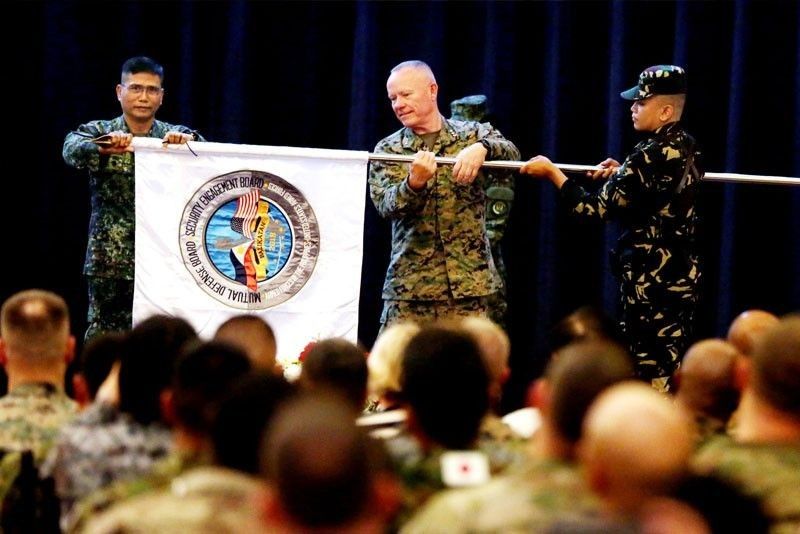
In this May 7, 2018 photo, Lt. Gen. Emmanuel Salamat of the Northern Luzon Command and Lt. Gen. Lawrence Nicholson of the US 3rd Marine Expeditionary Force unfurl the Balikatan flag during the opening ceremony of the Philippines-US Exercise 2018 at Camp Aguinaldo in Quezon City.
The US Indo-Pacific Command has assured the Senate that Southeast Asian nations continue to share common principles with Washington.

"The United States and ASEAN share the common principles of a rules-based international order, respect for international law, and the peaceful resolution of disputes," Indo-Pacific Command commander Adm. Philip Davidson told the Senate Armed Services Committee.

While Davidson declared confidence with Washington's regional allies, Asia Maritime Transparency Initiative director Gregory Poling pointed out that long-time ally the Philippines has been asking for a treaty review.

"During SASC testimony yesterday, Adm. Davidson twice said there is no doubt US credibility in any of our Asian allies. That must come as a big surprise to friends in the Philippines who are demanding a review of the (Mutual Defense Treaty) because of US ambivalence," Poling said on Twitter.

In his statement, Davidson said he was focused on working with allies Thailand and the Philippines, as well as partners Singapore and Vietnam, to "strengthen ASEAN, expand multilateralism, and improve their combined capacity to stand up to the malign influence of state and non-state actors, especially in the South China Sea."

He reported that Beijing continues to maintain claims in the disputed waterway that are contrary to international law and threaten international order.

China continues to ignore the July 2016 ruling of a United Nations-backed arbitral tribunal that invalidated its nine-dash line claim over the South China Sea.

Davidson also pointed out that Chinese Coast Guard vessels regularly harass and intimidate fishing vessels from the Philippines that are operating near Scarborough Shoal off the coast of Zambales.

The US Indo-Pacific Command, meanwhile, is looking to strengthen the region's capability to "deny adversaries' attempts to dominate or disrupt the gateway between the Pacific and Indian Oceans, while enabling the region to promote their sovereign interests."

"The command’s efforts will improve the region’s awareness and capability to enforce their borders, territorial waters and exclusive economic zones," Davidson said.

Defense Secretary Delfin Lorenzana earlier called for a review of the provisions of the 1951 treaty between the Philippines and the US.

The Defense chief said he wanted the US to provide a definitive stand on whether it will support the Armed Forces of the Philippines in case of a confrontation with other South China Sea claimants.

US Ambassador to Manila welcomed Lorenzana's call, saying that any agreement of this importance "should be looked at very closely."

"The circumstances surrounding the agreement on our alliance evolves so we would welcome taking a close look at the treaty to see whether we can make any adjustments to make even better what it is now," Kim told reporters last week.

Wednesday, February 13, 2019

NPA recruitment of minors violates UNICEF rules

From the Philippine News Agency (Feb 14, 2019): NPA recruitment of minors violates UNICEF rules

Efforts of the New People's Army (NPA) to recruit minors into their ranks is a gross violation of the United Nations Children's Fund's (UNICEF) Convention on the Rights of Children, a military official said Thursday.

"It is a gross violation of the provisions of UNICEF's Convention on the Rights of Children, which specifically states that children below the age of 18 must be accorded their basic rights to include the right from exploitation," Armed Forces of the Philippines (AFP) public affairs office chief, Col. Noel Detoyato, said in a test message to the Philippine News Agency (PNA) when sought for a comment.

The NPA is listed as a terrorist organization by the United States and the European Union.

"Recruiting them to become fighters is the height of (Communist Party of the Philippines) CPP-NPA hypocrisy," Detoyato added.

On Tuesday, a 15-year-old female rebel voluntarily surrendered to military units in Capiz due to the extreme hunger and hardships she experienced in the mountains.

The girl, identified only as “Regina”, is from the Central Front in Tapaz, Capiz, and has been a member of the rebel group for more than two months yet, 61st Infantry Battalion commander Lt. Col. Sisenando Magbalot Jr., said.

He added that “Regina” was recruited by her boyfriend, who is also a member of the group.

She said that at first, she was unaware of her boyfriend being a member of the NPA.

Magbalot said “Regina” served as a cook for NPA members, and that she was taught how to use a firearm but was never engaged in an encounter.

http://www.pna.gov.ph/articles/1061864

PH Army welcomes new Scout Rangers, Snipers

From the Philippine News Agency (Feb 14, 2019): PH Army welcomes new Scout Rangers, Snipers


The Philippine Army (PA) formally welcomed to its ranks its newest Scout Rangers and Snipers during a short ceremony at Camp Tecson, San Miguel, Bulacan on Wednesday.

1st Scout Ranger Regiment commander, Brig. Gen. William N. Gonzales, presided over the closing ceremonies for Scout Ranger Course Class 206-2018 and Scout Sniper Course Class 25-2018.

Meanwhile, PA Chief, Lt. Gen. Macairog Alberto, and Philippine National Police (PNP) Chief, Director General Oscar D. Albayalde, led the pinning of Scout Ranger and Scout Sniper badges to the 129 graduates.

These can be broken down into 58 students from the First Scout Ranger Regiment (FSRR), four from the Special Forces Regiment (Airborne) (SFRA), 14 from the Light Reaction Regiment, four from the AFP Special Operations Command, and 49 from various infantry divisions.

The 21 new snipers included 15 from the FSRR, one from the SFRA, and five from various Infantry Divisions. In addition to the class of SR 206-2018, the Philippine Air Force has one graduate while the PNP has 16, bringing the total number of graduates to 146.

The students from the SR 206-2018 class underwent 10 months and one day of training while those from the SS 25-2018 class went on seven months and three days.

Alberto, in his speech, called on members of the regiment to maintain the highest standard of discipline.

“Fight the way we trained and train the way we fight,” he said.

http://www.pna.gov.ph/articles/1061867

Military boosts security ops in Maguindanao after Cafgu member hurt in explosion

From Politiko Mindanao (Feb 14, 2019): Military boosts security ops in Maguindanao after Cafgu member hurt in explosion

cotabato military bomb philippines

The government troops have heightened their security operations following an explosion in Maguindanao, injuring a paramilitary member, an official said.

Joint Task Force Central Commander Maj. Gen. Cirilito Sobejana said member of the Cafgu Active Auxiliary under the 38th Infantry Battalion was slightly wounded when an anti-personnel mine placed near an old nipa house exploded in Sitio Pansol, Barangay Macasampen, Guindulungan town Tuesday, February 12.

“The explosion was meant to inflict harm on troops patrolling the area,” he said.

The official said that personnel from the 90th Infantry Battalion and the Guindulungan Municipal Police immediately responded and secured the area to preempt possible attacks.

The wounded Cafgu member was also rushed to Camp Siongco Station Hospital for medical attention.
https://mindanao.politics.com.ph/military-boosts-security-ops-in-maguindanao-after-cafgu-member-hurt-in-explosion/

Abu Sayyaf suspect linked to Kidapawan blast arrested

From the Manila Bulletin (Feb 12, 2019): Abu Sayyaf suspect linked to Kidapawan blast arrested

A suspected member of the Abu Sayyaf Group (ASG) held responsible for a bomb attack in Kidapawan City in 2012 that left seven people dead was arrested by joint police and military forces in Ermita, Manila, the Philippine National Police said Tuesday.


BOMBING SUSPECT –Abdurahman Dalyung is about to be presented to the media by Metro Manila Police chief Guillermo Eleazar during a briefing at Camp Crame Tuesday. (Alvin Kasiban)

PNP chief Director General Oscar Albayalde identified the suspect as Abdurahman Mataud Daiyung alias “Biznar Salabudin” and “Abu Talha,” an alleged ASG member under the com­mand of slain leader Isnilon Hapilon.

Albayalde said Daiyung was appre­hended inside his house at M. H Del Pilar Street corner Padre Faura, Ermita, Manila, last February 10.

Daiyung was linked to the infamous Kidapawan City bus terminal bombing on October 10, 2012, which left seven persons dead and two dozen others wounded.

Daiyung was also accused in seven separate criminal cases for kidnapping and serious illegal detention in connection with his alleged participation in the kidnap­ping of 15 employees of Golden Harvest Plantation in Barangay Tairan, Lantawan, Basilan, on June 11, 2001.

National Capital Region Police Office (NCRPO) chief Director Guillermo El­eazar said Daiyung was arrested when an arrested Abu Sayyaf suspect revealed his whereabouts.

Albayalde said a warrant of arrest issued by Judge Leo Jay Principe of the Isabela City Regional Trial Court Branch 1 was served against Daiyung by operatives of the National Capital Region Police Office (NCRPO), PNP-Intelligence Group (IG), and the Philippine Navy.

“This is an offshoot of the arrest of his cohort last December before the Traslacion. Remember that we had a joint operation with the PNP-Intelligence Group that led to the arrest of that suspect, who was also one of the respondents or wanted persons in the kidnapping incident in the Golden Harvest plantation,” Eleazar said.
Eleazar was referring to Sudais Asmad alias “Sen,” “Abu Nas,” “Suhud” and “Jul,” an alleged member of ASG under the com­mand of Furuji Indama. He was arrested by joint police forces in Binondo, Manila on December 20, 2018.

Visiting terrorists

Eleazar said Daiyung worked as a welder and has been in Manila just a “few” months ago. He further revealed that Daiyung often visited other Abu Sayyaf terrorists in various parts of Manila.

He said intelligence operatives have yet to confirm the number of Abu Sayyaf terrorists staying in Manila to lie-low.


“We don’t have the figures. Probably mayroong supporters at sympathizers (there are supporters and sympathiz­ers),” the Metro Manila police chief said.

Eleazar assured that the streets of Metro Manila remain free from terrorist at­tacks as no credible information on security threats are monitored by the police.

“But we cannot discount the possibility that they are planning [an attack] that’s why our disruption activities are continuous. This is one disruption [effort] being done by the police in coordination with our AFP counterparts,” he added.

Eleazar also said there is no cause for public alarm despite the arrest of Abu Sayyaf terror suspects in Manila.

https://news.mb.com.ph/2019/02/12/abu-sayyaf-suspect-linked-to-kidapawan-blast-arrested/

NPA’s revolutionary tax collector nabbed in Butuan City

From Politiko Mindanao (Feb 14, 2019): NPA’s revolutionary tax collector nabbed in Butuan City


An alleged “revolutionary tax collector” of the communist New People’s Army (NPA) was arrested in Butuan City, military said.

Identified as Emeliano Bustillo Legayna, with aliases Bukas, Sedoy, Turko and Abba, was nabbed Wednesday, February 13, at Barangay Nongnong during the implementation of a search warrant for illegal possession of firearms and ammunition, said Lt. Col. Francisco L. Molina Jr., commanding officer of the Army’s 23rd Infantry Battalion.

Seized from the suspect were Cal.45 pistol and a hand grenade.

Molina said that Legayna was also identified as liaison, intelligence officer and commanding officer of the Militiang Bayan Butuan West, Guerrilla Front 4A, North Central Mindanao Regional Committee.

He thanked the concerned citizens in the area for providing the information that led to the rebel officer’s arrest.
https://mindanao.politics.com.ph/npas-revolutionary-tax-collector-nabbed-in-butuan-city1/

Soldiers held captive by NPA begs to Duterte: ‘Suspend military operations’

From the pro-Communist Party of the Philippines (CPP) online publication the Davao Today (Feb 13): Soldiers held captive by NPA begs to Duterte: ‘Suspend military operations’


Cpl. Eric Manangan (Left) and Private First Class Darlino Carino Jr. (Right) appeal for help fromm President Rodrigo Duterte to suspend military operations to pave way for their release in a video released by the New People’s Army on Wednesday, February 13, 2019. (Screenshots from the NPA’s video)

DAVAO CITY, Philippines – Two soldiers being held captive by the New Peoples Army (NPA) appealed for help from President Rodrigo Duterte to cease military operations to pave way for their release.

Private First Class Darlino Carino Jr. and Cpl. Eric Manangan made their appeal in a video released by the communist rebels on Wednesday.

“To Mr. President Rodrigo Duterte, all I ask is to have our release expedited through a cessation of military operations,” Carino Jr. said of the Army’s 3rd Special Forces Battalion.

“This is all I ask so that I could be with my wife and child also because our wedding anniversary nears,” he said in Filipino.

Carino was one of the two soldiers and 12 militiamen who were captured last Dec. 18, 2018 when communist rebels overran a Citizen Armed Forces Geographical Unit (CAFGU) detachment belonging to the Army’s 3rd Special Forces Battalion in New Tubigon, Sibagat, Agusan del Sur.

High-powered firearms were also seized by the communist rebels during the raid.

Also, Carino appealed to his commanding officer Maj. Muana and priest Fr. Eddie Dumalig to help expedite their release.

“Even though we are their captives, they treat us as comrades.We eat whatever they have and eat,” said a soldier named Manangan.

“To my loved ones, especially my wife and child, who I know are worried about my situation, I am keeping faith and hope that we will see and be with each other,” Manganan added.

In a previous statement, Ka Maria Malaya, spokesperson of National Democratic Front of the Philippines- North Eastern Mindanao Region said that the planned release of the prisoners of war is “hampered” by the continuous military operations.

The NPA called upon the officials in Agusan del Sur to create conditions to ensure the safe and smooth release of the POWs.

They also challenged the AFP command to implement a Suspension Of Military Operations (SOMO) and Suspension Of Police Operations (SOPO), if “they are genuinely concerned for the welfare of the captured troops.”

http://davaotoday.com/main/politics/soldiers-held-captive-by-npa-begs-to-duterte-suspend-military-operations/