Wednesday, April 27, 2016

Duterte: Joma Sison coming home to talk peace

From MindaNews (Apr 27): Duterte: Joma Sison coming home to talk peace

TULUNAN, North Cotabato (MindaNews / 27 April) – Prof. Jose Maria Sison, founding chair of the Communist Party of the Philippines (CPP) has committed to come home to talk peace, Davao City mayor and Presidential frontrunner Rodrigo Duterte announced before a crowd of civilians and members of the New People’s Army (NPA) Tuesday afternoon during the release of a soldier the NPA held captive for five days. (see other story)

He said among the first things he would do if becomes President is to immediately declare a ceasefire.

PEACE. Members of the New People's Army welcome Davao City Mayor and Presidential frontrunner Rodrigo Duterte upon his arrival to receive Army Private First Class Edgardo Hilaga of the 7th Infantry Battallion in an upland village in Tulunan, North Cotabato on April 26, 2016. Hilaga was freed by the NPA after five days in captivity. MindaNews photo by TOTO LOZANO

PEACE. Young members of the New People’s Army welcome Davao City Mayor and Presidential frontrunner Rodrigo Duterte upon his arrival to receive Army Private First Class Edgardo Hilaga of the 7th Infantry Battallion in an upland village in Tulunan, North Cotabato on April 26, 2016. Hilaga was freed by the NPA after five days in captivity. MindaNews photo by TOTO LOZANO

Duterte narrated that the night before (April 25), he spoke with Sison via Skype and told his former professor on Political Thought, “pauli diri kay magstorya ta” (come home and let’s talk).

He said Sison agreed to come home during their Skype conversation in a venue with some military officials in attendance but added they did not know he was talking with Sison in another room.

Duterte did not say where the venue was but the night before, he was at the birthday celebration of his spiritual adviser, Pastor Apollo Quiboloy of the Kingdom of Jesus Christ. Quiboloy claims to be “The Appointed Son of God.”

After his speech at the barangay plaza Tuesday, Duterte told reporters that as President, he would immediatley declare a ceasefire with the National Democratic Front (NDF) to pave the way for the resumption of peace talks.

He said he suggested to Sison that “pag-uwi nya, ceasefire agad” (ceasefire as soon as he returns home).

The Presidential frontrunner was the speaker at the graduation rites of Lyceum on April 23 where he narrated that Sison was his professor on Political Thought “and that’s why he contaminated us early on and we became the first KM (Kabataang Makabayan members).”

Sison was founding chair of the KM.

“If I make it God-willing to the Presidency, I will be the first Left President in this country,” Duterte said.

[LIKE BROTHERS. A policeman shakes hand with members of the New Peoples Army after the latter released Private First Class Edgardo Hilaga of the 7th Infantry Battallion in Tulunan, North Cotabato on April 26, 2016. Hilaga was captured at a checkpoint in Makilala five days earlier. MindaNews photo by TOTO LOZANO

LIKE BROTHERS. A policeman shakes hand with members of the New Peoples Army after the latter released Private First Class Edgardo Hilaga of the 7th Infantry Battallion in Tulunan, North Cotabato on April 26, 2016. Hilaga was captured at a checkpoint in Makilala five days earlier. MindaNews photo by TOTO LOZANO

He has repeatedly said in speeches before and during the campaign that he is a socialist, is not a member of the CPP and does not believe in armed struggle.

The lone Mindanawon candidate told the crowd here that he opted to eventually run is for President when he realized that not one among the Presidential candidates was talking about Mindanao, about the peace processes that need to be attended to with the NPA, the Moro Islamic Liberation Front (MILF) and the Moro National Liberation Front (MNLF).

He talked about how the elite has been running this country for decades. He explained he would not have minded if government funds had been spent for the common good and not to line the pockets of the corrupt.

“Mao ning magrebolusyon ta ug akoy ma Presidente. Gub-on ko ning gobyernoha. Magtindog kog bag-o” (That is why we will wage a revolution if I become President. I will destroy this government. I will set up a new one), Duterte said. The crowd laughed but applauded when he said, “Ubani ko ninyo” (Be with me).

“Ilisdan ni nako ning gobyernoha. Magrebolusyon kog naa na ko didto kay dili ni para sa tao, dili ni matabang ug kaning Constitution nato (We will change this governemnt. I will wage a revolution if I am there because this government is not for the people, this can’t be helped under the present Constitution), he added.

The lone Mindanawon candidate is also the lone candidate among five contenders who is espousing a change in the system of government, from the unitary, Presidential, highly centralized form to the federal, parliamentary system.

The shift to federalism, however, requires amending the 1987 Constitution.

REVOLT FROM THE INSIDE. Davao City mayor Rodrigo Duterte vows to "change the government" and "revolt from the inside" if he becomes President during his speech at the release ceremonies for Army Private First Class Edgardo Hilaga who was freed by the New People’s Army on April 26, 2016, five days after he was arrested in a checkpoint in Malasila, Makilala. MindaNews photo by TOTO LOZAMO

REVOLT FROM THE INSIDE. Davao City mayor Rodrigo Duterte vows to “change the government” and “revolt from the inside” if he becomes President during his speech at the release ceremonies for Army Private First Class Edgardo Hilaga who was freed by the New People’s Army on April 26, 2016, five days after he was arrested in a checkpoint in Malasila, Makilala. MindaNews photo by TOTO LOZANO

In earlier prounoncements he vowed to set up a revolutionary government and abolish Congress if he cannot effect change within six months should he become President.

“We will change this government. Pag naa na ko, muingon ko nga (when I become President, I will say) I will revolt from the inside, dili hinuan nga revolt nga magpatay. Naa koy back-up sa katawhan, back up ko sa tanan, ang miltary ug pulis musunod na lang na (not a bloody revolt, though. I will be backed up by the people, backed up by all, the military and police will just follow), he told the crowd here.

He said he wants government workers to remember that government funds are not personal funds.

“Ayaw kuhaa nang kwarta sa mga tao kay binayran ka man” (Do not get the people’s money because you are paid to do your work), he said.

“Usbon gyud nako ang utok sa Pilipino. Kinahanglan kaming taga-gobyerno ma-realize gyud namo nga kami suluguon lang” (I will really change the mindset of the Filipino. We must in government realize that we are mere servants of the people), said Duterte, a government prosecutor for 11 years, appointed OIC vice mayor from 1986 to 1988, elected mayor for seven terms (1988-1998; 2001-2010; 2013-2016), representative of the first district (1998-2001) and vice mayor (2010-2013).

If he wins the Presidency, the Filipino people should not expect him to have an oath-taking at the Luneta because he does not want to disturb traffic and would rather have his oath-taking in his office.

Duterte said the traditional oath-taking would also require him to feed the rich who do not need to be fed, anyway. If he will have to spend, he said, he would rather that the money intended for the inauguration be used to feed the poor.

He ended his 29-minute speech by raising his right fist and saying “Mabuhay ang NPA, Mabuhay ang NDF, mabuhay si Duterte” (Long live the NPA, Long live the NDF, Long live Duterte).

It wasn’t the first time he did that during a release ceremony.

http://www.mindanews.com/peace-process/2016/04/27/duterte-joma-sison-coming-home-to-talk-peace/

Body of beheaded Canadian hostage recovered in Southern Philippines

From the Mindanao Examiner (Apr 27): Body of beheaded Canadian hostage recovered in Southern Philippines

The body of a Canadian man beheaded by the Abu Sayyaf in southern Philippines had been recovered Wednesday as security forces intensified its operation against the jihadist group allied with the Islamic State in Iraq and Syria, military intelligence sources said.

The body of the 68-year old John Ridsdel – who was brutally killed on April 25 – was found by villagers in the village of Gatas in Patikul town, a known stronghold of the Abu Sayyaf. His head was recovered the same day he was executed and handed over to his kin who flew to Zamboanga City from Canada.

Ridsdel, a former executive of international miner TVI Resource Development in Zamboanga del Norte province, was beheaded in the hinterlands of Patikul after his family and the Canadian government failed to P300 million ransom demanded by the Abu Sayyaf.

The notorious group is still holding nearly 2 dozen foreign hostages – 14 of them Indonesian seamen kidnapped at sea in Sabah in Malaysia and in Tawi-Tawi, one of five provinces under the restive Muslim autonomous region in Mindanao.

Ridsdel was kidnapped by 10 gunmen from the resort island of Samal in Davao del Norte province in September 21 last year along with fellow Canadian Robert Hall, 50; and a Norwegian man Kjartan Sekkingstad, 56, and his Filipina girlfriend, Maritess Flor.

The Abu Sayyaf demanded as much as P300 million each for the safe release of the foreign hostages and set April 8 for the deadline, but extended this until April 25.

The military’s Western Mindanao Command under General Mayoralgo dela Cruz did not give any details of the on-going operations against the Abu Sayyaf in Sulu, another province in the autonomous region, but President Benigno Aquino ordered a massive assault on the jihadist group also blamed for the spate of terrorism there.

An army brigadier in Sulu, Alan Arrojado, who was earlier relieved by the Western Mindanao Command from his post as commander of the anti-terror task group in the province for failing to stop the Abu Sayyaf kidnappings, has resigned as chief of the 501st Infantry Brigade a day after Ridsdel’s beheading. He was replaced by army Colonel Jose Faustino.

The Armed Forces of the Philippines did not say if it would also relieve Dela Cruz, who is also in-charge of military operations against the Abu Sayyaf in nearby Basilan province in the Muslim autonomous region, where 18 soldiers had been brutally killed and 5 dozens more wounded in fierce clashes in Tipo-Tipo town just this month.

http://mindanaoexaminer.com/body-of-beheaded-canadian-hostage-recovered-in-southern-philippines/

Sulu Army commander resigns after beheading of Canadian hostage

From the Philippine Daily Inquirer (Apr 27): Sulu Army commander resigns after beheading of Canadian hostage
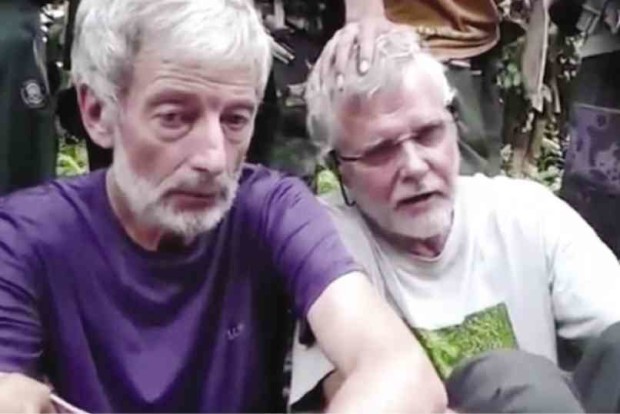
OUTRAGE  Canadians John Ridsdel (right) and Robert Hall are shown in this video grab sent earlier by the Abu Sayyaf to media outlets. MILITANT VIDEO VIA AP VIDEO

OUTRAGE Canadians John Ridsdel (right) and Robert Hall are shown in this video grab sent earlier by the Abu Sayyaf to media outlets. MILITANT VIDEO VIA AP VIDEO
An Army commander in Sulu has filed his resignation from his post on Tuesday in the wake of the beheading of a Canadian hostage.

In his resignation letter, 501st Brigade Commander Brig. Gen. Alan Arrojado said his resignation was “due to conflict of approach [in] addressing the Abu Sayyaf threats in Sulu.”

In a text message to INQUIRER.net, Arrojado said he resigned after he learned that he will be relieved on Wednesday without having been informed.

“I am a general of the armed forces that should have been informed accordingly,” he said.

Arrojado was named commander of Joint Task Group Sulu in October 2014 but was later removed from his post last early this month. He kept his position, however, as commander of the 501st Brigade to oversee the 10th, 32nd and 35th Infantry Battalions.

When asked of the conflict of approach in dealing with the Abu Sayyaf, he refused to elaborate and just said: “Iba ang approach nila kaysa sa akin (Their approach was different from mine).”

READ: AFP vows to bring ASG to justice after Canadian hostage beheaded

Col. Jose Faustino replaced Arrojado in a turnover ceremony on Wednesday. The latter will be assigned as Assistant Division Commander of the First Infantry Division in Zamboanga del Sur.

“I will report to my new assignment without reservation as ordered,” he said.

Military spokesperson Brig. Gen. Restituto Padilla, meanwhile, said that everything is covered by orders in the Army and no officer can resign unless it is a major post.
“There is no blame game here,” he said.

Padilla said that Arrojado “served with distinction” as brigade commander of the 602nd and 501st brigade for a total of two years and five months.

“In the last 18 months he led the campaign against the kidnap for ransom groups in the island of Jolo,” he said, adding that Army officers usually serve a minimum of 1 year & 6 months in major positions to complete their billet requirements.

http://globalnation.inquirer.net/139035/sulu-army-commander-resigns-after-beheading-of-canadian-hostage

PNoy vows to 'neutralize' Abu Sayyaf kidnappers; bares plot to seize Pacquiao, Kris Aquino

From InterAksyon (Apr 27): PNoy vows to 'neutralize' Abu Sayyaf kidnappers; bares plot to seize Pacquiao, Kris Aquino


Abu Sayyaf's Isnilon Hapilon: behind plot to seize Pacquiao, Kris Aquino.

Philippine President Benigno Aquino III vowed Wednesday to launch a military assault aimed at "neutralizing" Islamic militants who beheaded a Canadian hostage and are holding more than 20 other foreigners.

"Casualties are to be expected. But what has to be of utmost importance is neutralising the criminal activities of the ASG," Aquino said in a statement, referring to the Abu Sayyaf militant group by a commonly used acronym.

Aquino released the statement after the severed head of Canadian John Ridsdel, kidnapped seven months ago from aboard a yacht, was dumped Monday on a street on Jolo, a remote southern island that is one of the Abu Sayyaf's main strongholds.

"This murder was meant to terrorize our whole population. The Abu Sayyaf thought they could instill fear in us. Instead, they have galvanized us even further to ensure justice is meted out," Aquino said.

"We have always been open to talks with those who desire peace, but those who commit atrocities can expect the full might of the state."

He did not give a timeframe for the assault.

The Abu Sayyaf militants, whose leaders have pledged allegiance to the Islamic State group, are holding more than 20 other foreigners captive.

These include another Canadian, a Norwegian man and a Filipina who were abducted at the same time as Ridsdel at a marina near Davao, the biggest city in the southern Philippines and about 600 kilometres (370 miles) from Jolo.

The Abu Sayyaf is also believed to be holding a Dutch birdwatcher kidnapped from a southern Philippine island in 2012, as well as 18 Indonesian and Malaysian sailors abducted over the past month.

Aquino said the captives were under the control of Radullan Sahiron, one of the Abu Sayyaf's founders who is famous for losing one arm in battle against the military.

'Smash' the Abu Sayyaf

He said Sahiron had consolidated his forces around himself and the captives in Sulu, a small Muslim-populated archipelago about 1,000 kilometres from Manila. Jolo is the biggest island in Sulu.

"This presents both a problem and an opportunity. It is a problem because of the sizeable force surrounding Sahiron and the captives, but it is also an opportunity because smashing these forces is within our grasp," Aquino said.

The Abu Sayyaf is a radical offshoot of a Muslim separatist insurgency in the south of the mainly Catholic Philippines that has claimed more than 100,000 lives since the 1970s.

It is believed to have just a few hundred militants but has withstood repeated US-backed military offensives against it, surviving by using the mountainous, jungle terrain of the southern islands to its advantage.

Although the Abu Sayyaf's leaders have pledged allegiance to IS, analysts say they are mainly focused on their lucrative kidnappings-for-ransom rather than setting up an Islamic caliphate.

Abu Sayyaf gangs have earned many millions of dollars from kidnapping foreigners and locals since the early 1990s.

One of the Abu Sayyaf's biggest recent windfalls is believed to have come in 2014 when it claimed to have been paid more than $5 million for the release of a German couple abducted from aboard their yacht in the southwest Philippines.

Manny Pacquaio kidnap plot

Aquino also revealed a series of alleged Abu Sayyaf plots to kidnap Filipino boxing hero Manny Pacquiao and the president's younger sister, Kris, a popular television personality.

He said Isnilon Hapilon, who Islamic State has recognized as a local Filipino leader, was behind these plots.

He said Hapilon and other Abu Sayyaf leaders had wanted to conduct the kidnappings, conduct bombings in Manila and even assassinate himself so that IS would give them funds and resources.

He reassured the public that key leaders involved in these plots had been arrested and those threats had been put "to bed".

However he also said Hapilon was on Basilan island, the other key Abu Sayyaf stronghold neighbouring Jolo, and that military assaults against him were continuing.

On April 9, 18 Filipino soldiers were killed as they waged a day-long battle against Abu Sayyaf gunmen on Basilan.

Also Wednesday, the Philippines said it was considering launching joint sea patrols with Malaysia and Indonesia in the waters where the recent kidnappings of the sailors occurred.

http://interaksyon.com/article/127006/pnoy-vows-to-neutralize-abu-sayyaf-kidnappers-bares-plot-to-seize-pacquiao-kris-aquino

Aquino: Abu Sayyaf had planned to kidnap Pacquiao and my sister Kris

From the Gulf News (Apr 27): Aquino: Abu Sayyaf had planned to kidnap Pacquiao and my sister Kris

The militant group tried to conduct a bombing campaign to draw Daesh support, president says

President Benigno Aquino III revealed Abu Sayyaf radicals had planned to abduct his sister, Kris Aquino, and Filipino boxing icon Manny Pacquiao in order to gain favour from Daesh.

In a statement released on the recent execution of Canadian mining executive John Ridsdel, Aquino said the latest Abu Sayyaf atrocity is part of a renewed campaign by the militant group to get noticed by Daesh, which over the last two years has undertaken similarly brutal attacks against their enemies.

“The Abu Sayyaf Group (ASG) and various smaller terrorist groups and factions now want to align themselves with Daesh to gain access to the funds and resources of Daesh. From day one of my administration, they have had aspirations to conduct bombings in Metro Manila to catch the attention of Daesh,” the Philippine leader said.

Aquino said in order to draw the support of Daesh, Abu Sayyaf had tried to conduct a bombing campaign together with the remnants of an organised group of Muslim converts, the Rajah Sulaiman Movement.

“They allegedly even hatched plots to kidnap Manny Pacquiao or one of his children, as well as my sister, Kris, or one of her children, with the plan to use them in bargaining for the release of their cohorts. Threats against my own life have been investigated,” the president said.

Pacquiao is an internationally known Filipino boxer and Congress member and Kris is a local actress.

Aquino said the full resources of the state are being brought to bear on the ASG.

Aquino also said the execution of Ridsdel further fortified the Philippines’ resolve to put an end to kidnapping activities in the South.

“This murder was meant to terrorise our whole population. The Abu Sayyaf thought they could instill fear in us; instead, they have galvanised us even further to ensure justice is meted out,” Aquino said on Wednesday, three days after the militant group executed the Canadian former mining executive in Sulu.

Ridsdel, 68, was executed by the Abu Sayyaf after friends and family working to save him failed to come up with the ransom demanded by the Southern Philippines-based terrorist group.

The Canadian was kidnapped at the Holiday Oceanview Resort in Samal Island in Davao Oriental last September 21 along with compatriot Robert Hall, 50; Norwegian resort manager Kjartan Sekkingstad, 56; and Hall’s Filipina partner, Marites Flor.

The Philippine military had unleashed an all-out operation to rescue the remaining three hostages.

The kidnapping and the brutal execution of Ridsdel drew outrage worldwide, with Canadian Prime Minister Justin Trudeau saying that the Canadian government “is committed to working with the Manila and international partners to pursue those responsible for this heinous act and bring them to justice.” Sulu,

Basilan and certain parts of Mindanao are known hotbeds for kidnap for ransom activities. Aside from Filipinos, a number of the kidnap victims are foreigners.

Last March, Abu Sayyaf abducted several crew members of a tugboat in Tawi-Tawi.The Brahma 12 tugboat and the Anand 12 barge were carrying coal from Indonesia when suspected Abu Sayyaf gunmen descended on them and held the crewmen hostage.

On Tuesday, Indonesian President Joko Widodo (Jokowi), according to state-run news agency Antara, initiated joint patrols involving Indonesia, Malaysia and the Philippines to secure the release of the ten Indonesian sailors and two of their compatriots abducted by Abu Sayyaf.

http://gulfnews.com/news/asia/philippines/aquino-abu-sayyaf-had-planned-to-kidnap-pacquiao-and-my-sister-kris-1.1813024

Tuesday, April 26, 2016

US challenges 13 states’ sea claims

From the Philippine Star (Apr 27): US challenges 13 states’ sea claims

US forces last year challenged the excessive maritime claims of 13 countries throughout the world including the Philippines, China, Vietnam, Malaysia and Taiwan, the Pentagon said.      

In a report released on Monday, it said a US Freedom of Navigation (FON) program was implemented actively every year against excessive maritime claims by claimants in every region of the world in support of the Defense Department’s global interest in mobility and access.

The FON program encompasses all of the rights, freedoms and lawful uses of the sea and airspace available to all nations under international law.

The report provided a summary of excessive maritime claims challenged by US forces in fiscal year 2015 from Oct. 1, 2014 to Sept. 20, 2015.

Eight of the 13 countries challenged were Argentina, Indonesia, India, Iran, Libya, the Maldives, Nicaragua and Oman.

The other five have competing claims to parts of the South China Sea, including the West Philippine Sea.             

China’s excessive maritime claims were listed as excessive straight baselines, jurisdiction over airspace above the exclusive economic zone (EEZ), restriction on foreign aircraft flying through an air defense identification zone (ADIZ) without the intent to enter national airspace, domestic law criminalizing survey activity by foreign entities in the EEZ; and requiring prior permission for innocent passage of foreign military ships through territorial sea.

The Philippines was cited for claiming archipelagic waters as internal waters and Vietnam for excessive straight baselines and requiring prior notification for foreign warships to enter its territorial sea.

Taiwan was faulted for requiring prior notification for military or government vessels to enter its territorial sea and Malaysia for requiring nuclear-powered ships to enter its territorial sea and requiring consent for military exercises or maneuvers in the EEZ.

The Association of Southeast Asian Nations (ASEAN) and Australia underlined the importance of maintaining peace, security and stability and freedom of navigation and overflight in the South China Sea.

At the 28th ASEAN-Australia Forum held in Canberra last April 21 and 22, ASEAN and Australia agreed that disputes should be resolved peacefully, including full respect for legal and diplomatic processes, and without resorting to the threat or use of force, in accordance with universally recognized principles of international law, including the 1982 UNCLOS.

The Philippines, led by Assistant Secretary Helen de la Vega of the Department of Foreign Affairs (DFA)-Office of ASEAN Affairs, participated in this year’s forum that was co-chaired by Australian Gary Quinlan and Country Coordinator Aung Lynn of Myanmar.

During the dialogue, ASEAN and Australia reviewed the status of political security, economic and socio-cultural cooperation in support of ASEAN’s Vision 2025. Both sides committed to deepen existing cooperation as they prepare for the 1st biennial ASEAN-Australia Summit in September 2016 in Laos.

The DFA said there was an extensive discussion on regional and international developments.

De la Vega said “the Australians want to deepen engagement with ASEAN and regional partners would maintain a rules-based regional order.”

Both sides concurred that the regional architecture must continue to evolve as an ASEAN-centric and rules-based order and agreed to explore further joint action under ASEAN-led mechanisms.

ASEAN and Australia are both keen to advance ASEAN-Australia connectivity.
Both sides welcomed the creation of the ASEAN-Australia Council, which is taking a lead in promoting women’s economic empowerment and educational exchanges.

Japanese ship visit

Another Japanese warship made a port call in the Subic Bay Freeport yesterday, underscoring the increasing visits of the Japan Maritime Self-Defense Force (JMSDF) vessels amid the strengthening of defense cooperation between the Philippines and Japan.

The Japanese helicopter carrier JS Ise docked at the Alava Pier for a four-day goodwill visit and maritime training and cooperation between Japanese and Philippine Navy personnel.

The ship carries four helicopters and has 360 officers and men, headed by Capt. Masaki Takada.

JS Ise’s visit to Subic is the third time that JMSDF ships made a port call in the country this year.

Two warships, Uraga and Takashina of the JMSDF Minesweeper Division 51 under the command of Capt. Toshiro Takaiwa, visited Manila on March 2.

The ship visits took place after the two countries signed an agreement for Japan’s transfer of defense equipment and technology to the Philippines.

Submarine ship Oyashio (SS-551), along with two destroyer ships, also visited Subic on April 3.

The ship visits, according to Japanese and Philippine Navy officials, aim to enhance “the already strong relationship” of the Philippine Navy and the JMSDF and promote regional peace and stability.

It also aims to enhance maritime cooperation, according to Philippine Navy Capt. Lued Lincuna, director of the Naval Public Affairs Office.

http://www.philstar.com/headlines/2016/04/27/1577249/us-challenges-13-states-sea-claims

Beheading highlights lucrative kidnap business of PHL rebels

From GMA News (Apr 26): Beheading highlights lucrative kidnap business of PHL rebels

When the deadline for his ransom passed this week, Canadian John Ridsdel was beheaded by his captors, the Abu Sayyaf, whose network in the Philippines is only gaining in strength thanks to vast sums earned from kidnappings that pay.

The Islamic State-linked group has made tens of millions of dollars from ransom money since it was formed in the 1990s, security experts say, channelling it into guns, grenade launchers, high-powered boats and modern equipment.

The Philippine military is finding it increasingly difficult to weaken Abu Sayyaf, whose name translates as "Bearer of the Sword" and is based in the southern island of Jolo.

Although it is a rebel group fighting for an independent Islamic nation in the south of the mainly Roman Catholic Southeast Asian nation, its militants often seem more motivated by the money they can make from kidnappings and piracy.

Neighboring Indonesia said last week after 14 tugboat crew were kidnapped that piracy on a shipping route along its sea border with the Philippines could reach Somalian levels and warned commercial vessels to avoid the area.

Sidney Jones, a Jakarta-based counter-terrorism expert, said there were links between Abu Sayyaf Group—known as ASG—and Islamic State-backed groups in Indonesia, the faction behind Monday's beheading appeared to be in it for the money.

"This ransom business has been hugely successful for Abu Sayyaf ... it's gotten them lots of money and freedom to operate," she said.

Ridsdel, 68, was snatched from a high-end holiday resort last year and beheaded on Monday when the deadline for buying his freedom expired. The group's price for his life was P300 million ($6.41 million), the same set for another Canadian, a Norwegian and a Filipino woman who appeared with him in a video appealing to their governments to save them.

"Board and lodgings" A Philippine Army spokesman said Abu Sayyaf had threatened to behead one of four captives on Monday if the P300 million ransom for each of them was not paid by 3 p.m. local time.

The Philippines rarely publicizes payments of ransom, but it is widely believed no captives are released without them.

Security experts say brokers, messengers and go-betweens are involved at multiple levels, some taking substantial cuts. Payments are euphemistically called "board and lodgings."

A German couple seized on their yacht in 2014 was released after $5.3 million was paid and, in 2000, the Libyan government, acting as an intermediary, handed over $10 million to free 10 European and Middle Eastern tourists.

Security analyst Rommel Banlaoi said executing Westerners raised Abu Sayyaf's profile and the potential sums involved would encourage other rebel groups to play supportive roles in the business.

"The beheading of John Ridsdel has just increased ASG's leverage," he said. "The risks for other captives have become higher as ASG just demonstrated that the it was not bluffing when imposing deadlines."

ASG is holding 23 hostages, including Japanese, Norwegian, Dutch and Malaysian citizens, and the 14 Indonesians.

Outgoing Philippine President Benigno Aquino has ordered security forces to hunt down Abu Sayyaf militants.

The army says 2,500 troops are involved in operations and on Tuesday were pounding rebel mountain positions with artillery fire.

A Philippine intelligence source said that a political solution was vital because the group's ransom earnings were entrenching its network and complicating the military's job.

The region in which Abu Sayyaf operates is impoverished, making it easy to recruit jobless, unschooled youths with the promise of money and gang prestige.

"It's the lifeblood that keeps the lawlessness in the area. Money from kidnap-for-ransom activities is used to buy weapons, faster boats and communications equipment," the source said.

 "More unschooled children are joining them and taking up arms. The military cannot solve this problem alone."

http://www.gmanetwork.com/news/story/564115/news/nation/beheading-highlights-lucrative-kidnap-business-of-phl-rebels

6 NPA members surrender

From Update.Ph (Apr 25): 6 NPA members surrender  

Six former NPA members returned to the folds of the law on March 23 and April 14, 2016 through the efforts of 73rd Infantry Battalion (73IB).

In a press conference held at Headquarters Task Force Gensan on Monday, April 24, the 1002nd Infantry Brigade, 73IB and Task Force Gensan commanders; Col Ronald Villanueva, Ltc Felix Ronnie Babac and Col Paterno Reynato Padua respectively, presented the six Former Rebels (FRs) to the local media of General Santos City.

All six were members of Guerilla Front 71 namely, alias Jomar, alias Jerome, alias Rex, alias Anghel, alias Dondon and alias Daniel. Among them were two minors, Alias Dondon and Alias Daniel, both 17 years old. Alias Jomar brought with him a remote controlled landmine when he submitted himself to 73IB. They jointly revealed that they were deceived by the NPA that led them to join the armed group.

In an earlier interview by troops of 73IB, alias Anghel said that he and other NPA members felt the hardship and trauma after they were encountered by the troops of 73IB last March 28, 2016. He added that two of their members were fatally wounded. Meanwhile, alias Rex said that he was promise a monthly salary of Php2,000 which did not really materialized.

MGen Rafael Valencia, 10ID commander said, “We urge other active members of the NPA to emulate what their former companions did.”

“It is high time that altogether, soldiers, rebels and ordinary citizens alike, should all work towards peace and development without violence and armed struggle,” he added.

(From Philippine Army 10th Infantry Division)

http://www.update.ph/2016/04/6-npa-members-surrender/4693

PVAO, FILVETS launch digitized WWII records

From the Philippine Information Agency (Apr 27): PVAO, FILVETS launch digitized WWII records

The Philippine Veterans Affairs Office (PVAO), in collaboration with the Filipino War Veterans Foundation Inc. (FILVETS), launched on Maonday the digitized surviving records of Filipino soldiers and guerillas during World War II (WW II) at the AFP Museum at Camp General Emilio Aguinaldo in Quezon City.

The digitization project is presented as the “Bgen. Francisco H. Licuanan, Jr. Collection,” in honor of the memory of the late BGen. Francisco H. Licuanan, Jr., the father of the project sponsor, Mr. Francisco H. Licuanan III.

According to Usec. Ernesto G. Carolina, PVAO Administrator, PVAO, FILVETS, and Mr. Licuanan "aimed at putting together the bits and pieces of the history of World War II in our country which are scattered in different institutions."

The found records about WWII in the Philippines are in the custody of the United States National Archives and Records Administration in Maryland, USA. Starting last year, a team led by a former historical researcher, Marie Vallejo, worked for four (4) months to digitize the records and bring them to the Philippines.

“Nine years ago, I embarked on a personal quest to find out what my father did during World War II…Continuing my search in the US, the US National Archives in Maryland yielded a gold mine of Philippine WWII records called the Philippine Collection composed of 1,665 boxes of primary source records of our World War II history.” Vallejo said during her testimonial at the launching of the digitized WWII records.

“This is just the beginning. A pioneering team has successfully done the first phase. There are more boxes of our history waiting to be digitized and brought back. Help us bring them home,” Vallejo added.

The digitized output is composed of more than 284,000 records of Filipino soldiers and guerillas in WWII and was compiled under the Philippines Archives Collection portal. The portal will be installed to different libraries and museums nationwide starting next month.

“Hopefully, the results of this project will serve as a base for historians and historical writers to fill in some blanks in our nation’s history.” Licuanan said in his message during the launch.

“Our father never talked that much about his exploits. It is only after Marie chanced upon these records that we found out that he was actually the head of his unit. I say this not to glorify what my father did but to say that there are so many vignettes of Filipino history that individual Filipinos can access and find out what their parents or grandparents did,” Licuanan added.

Meanwhile, Usec. Carolina also said that a Philippine Center for World War II Studies will be established at the Dambana ng Kagitingan at Mt. Samat, Bataan which will be the depository of the complete history of World War II in the Philippines. Mt. Samat was declared as a Tourism Enterprise Zone last year.

PVAO release stated that the digitized records include memoirs of freedom fighters, officers, soldiers, and civilians. The digitized files were indexed and categorized into military units, regions, prominent leaders, personalities, anecdotes, historical chronology, timelines, among others.

http://news.pia.gov.ph/article/view/2561461660111/pvao-filvets-launch-digitized-wwii-records

DFA, PIA to bring WPS communication campaign to Bacolod

From the Philippine Information Agency (Apr 28): DFA, PIA to bring WPS communication campaign to Bacolod

The Department of Foreign Affairs (DFA) and the Philippine Information Agency – Negros Occidental (PIA) have paired up to conduct a  communication campaign on the West Philippine Sea (WPS) issue on April 27-28 here.

DFA Assistant Secretary Charles Jose will be here to interact with mediamen in a press conference and media interviews on April 27 and talk about the country’s rights and measures to gain possession of the much disputed territory, which China also claims as its own, at a multi-sectoral forum on April 28.

The topics that will be tackled during the forum are core issues of the WPS dispute, China’s activities in the area and principles underpinning the Philippines' position on the issue.

The sectors that will participate in the activity are from national government agencies, local government units, business sector, the academe, students, religious, media, farmers and fisher folks.

Participants of the forum are urged to give their suggestions, assessment and views with regard to the country’s stand on the territorial claim.

DFA has targeted 15 WPS fora to be conducted in the different regions, which started last year, and Negros Occidental has been chosen as one of the areas of the said forum.
The activity will be held at the Sugarland Hotel here.

The West Philippine Sea is considered as an abundant source of maritime life, as well as livelihood for the fisher folks.

As of November 2014, there are 1,403,202 registered municipal fisher folks, data from the Bureau of Fish and Aquatic Resources showed.

Further, the Philippines is 7th among countries in the world in fish production and 3rd in production of aquatic plants (including seaweeds).

http://news.pia.gov.ph/article/view/2971461667315/dfa-pia-to-bring-wps-communication-campaign-to-bacolod

MESSAGE FROM CAMP BAGONG DIWA: Greetings from detained members of NDFP on its 43rd anniversary

From the Manila Times (Apr 25): MESSAGE FROM CAMP BAGONG DIWA: Greetings from detained members of NDFP on its 43rd anniversary

[The following is the unedited greeting to the NDFP sent to The Manila Times by National Democratic Front of the Philippines (NDFP) peace consultants and other political prisoners in Camp Bagong Diwa and in other detention areas throughout the country.]

Militant Greetings to the National Democratic Front of the Philippines on the 43rd Anniversary of its Founding (April 24, 2016).

We, foully detained National Democratic Front of the Philippines (NDFP) peace consultants and other political prisoners in Camp Bagong Diwa and in other detention areas throughout the country, send our militant greetings to the NDFP on the 43rd anniversry of its founding.

The NDFP, a solid and deep alliance of 18 national democratic revolutionary organizations with millions in total membership throughout the country and abroad, has consistently been growing and gaining significant inroads through the wide swath of struggles these patriotic and progressive people’s organizations have been waging, in the interest of the mass of the Filipino people, in the country and abroad.

The NDFP has been carrying on revolutionary struggles of the Filipino people and its various sectors in the country and abroad. Its revolutionary activities have been ranging from arousing, educating, and organizing the masses; waging of mass struggles for agrarian reform, production, health care, environmental protection; waging of revolutionary armed struggle; and building local organs of political power. It has also been promoting extra-parliamentary struggles, and forging various levels of unities and cooperation with other revolutionary, patriotic and other allied forces in the country.

It has also been actively supporting people’s wars and other struggles of fraternal people’s organizations in other countries, joining a number of international organizations, leagues and associations of peoples, and participating in international people’s fora, tribunals and other progressive people’s activities abroad.

The NDFP, a solid and deep alliance of 18 national democratic revolutionary organizations with millions in total membership throughout the country and abroad, has consistently been growing and gaining significant inroads through the wide swath of struggles these patriotic and progressive people’s organizations have been waging, in the interest of the mass of the Filipino people, in the country and abroad.

The NDFP has been carrying on revolutionary struggles of the Filipino people and its various sectors in the country and abroad. Its revolutionary activities have been ranging from arousing, educating, and organizing the masses; waging of mass struggles for agrarian reform, production, health care, environmental protection; waging of revolutionary armed struggle; and building local organs of political power. It has also been promoting extra-parliamentary struggles, and forging various levels of unities and cooperation with other revolutionary, patriotic and other allied forces in the country.

It has also been actively supporting people’s wars and other struggles of fraternal people’s organizations in other countries, joining a number of international organizations, leagues and associations of peoples, and participating in international people’s fora, tribunals and other progressive people’s activities abroad.

The NDFP has, since the downfall of the outright fascist regime of Ferdinand Marcos, also been engaged in peace talks with successive post-martial law regimes.

Just as it had been doing with earlier post-martial law regimes, the NDFP has consistently been seeking peace talks with the current — even if outgoing – ruling regime of Benigno S. Aquino III.
It has, however, been under the present reactionary puppet regime of Benigno S. Aquino III, where practically nothing has been achieved in the peace process. Nor has the latter shown any real interest in the peace process with the NDFP.

Since the downfall of the outright Martial Law regime, it has also been under the present regime where the biggest number of NDFP peace consultants and other political prisoners have been foully hurled into and viciously kept in jail on the basis of trumped-up charges – all, in violation of standing peace agreements, as well as of local and international protocols and laws. Despite the clear, documented existence of more than 500 NDFP-related political prisoners at present, the ruling reactionary regime of Benigno S. Aquino III has even kept on denying the existence of political prisoners.

Since Day One of its rule up to the present eve of its exit and replacement, the current reactionary puppet regime of Benigno S. Aquino III has only shown that it knows nothing and has done nothing, but to kowtow to the interests of its US imperialist master and the interests of the big compradors, big feudal lords and big bureaucrat capitalists.

Worse, it has conditioned the committing of outright fascist violence against hungry, exploited and oppressed people asking for their right to land, food and protection from violence.

The massacre committed in 2004 against peasants and their supporters demanding agrarian reform in the Hacienda Luisita of Benigno S. Aquino III’s clan has recently been followed by the firing of bullets, beatings, arrests, harassments, hurling into jail and other gross acts of violence – against other hungry, exploited and oppressed masses – committed under the reign of Benigno S. Aquino III.

Most recent among these have been the Sept. 2015 and onward killings and other acts of fascism against the Lumad and their communities, their educators and the shutting down of their schools.
They have instigated forced evacuations and further acts of fascism against Lumad refugees seeking protection in the Haran compound of the United Church of Christ in the Philippines (UCCP) in Davao del Norte; the Nov. 2015 total burning down of the Lumad Alternative Learning Center for Livelihood and Development (ALCADEV) and harassment of surrounding Lumad communities in Tandag City; and the April 1, 2016 and onward killings and other acts of fascism against hungry peasants merely asking for rice and seeking protection from violence in the Methodist compound in Kidapawan City, North Cotabato.

Even as it relies mainly on the people’s war – waged by the New People’s Army and related NDFP forces – for as long as such fascist acts will only continue unabated and even be heightened further, and for as long as the other age-old basic problems of the people continue to be ignored and unresolved, and for as long as the people’s demands for substantive solutions are met only with deaf ears and violence from the reactionary ruling state and regimes, still the NDFP remains always open to peace talks with the other side. This, for as long as the other side would also be open to peace efforts.

Aside from its many crimes against the people – including the aforementioned grave acts of violence against the displaced Lumad and hungry peasants – because of the lack of intent and little time left for it to change, the outgoing regime of Benigno S. Aquino III is already a dead duck.

On its 43rd anniversary, the NDFP celebrates the all-rounded victories of the people’s war and the continuing defeat of the US and its local puppet regime’s Oplan Bayanihan and the latter’s arrogant objective of defeating and marginalizing the NPA within a few years.

At the same time, the NDFP always remains open to peace talks and hopeful for the progress of such, and is thus always willing to sit at the negotiating table with its opposite at the helm of the ruling state – for as long as the latter is also truly open to it and serious enough about it.

The NDFP looks forward to more victories for the people at present and in the future!

Long live the NDFP and its allied organizations!

Victory to the causes and struggles of the NDFP and the Filipino people!

[By National Democratic Front of the Philippines (NDFP) peace consultants Adelberto Silva, Alan Jazmines, Ernesto Lorenzo, Loida Magpatoc, Ruben Saluta, Tirso Alcantara and other political prisoners in Camp Bagong Diwa.]

http://www.manilatimes.net/greetings-from-detained-members-of-ndfp-on-its-43rd-anniversary/258362/

The Group Behind Canadian Execution by Philippine Militants

From the Asia Sentinel (Apr 25): The Group Behind Canadian Execution by Philippine Militants
[by Criselda Yabes]

Cycle of violence and futility feeds latest Abu Sayyaf outrage in Mindanao

The Group Behind Canadian Execution by Philippine Militants

Criminals or rebels?

The discovery Monday, April 25, of the beheading of a Canadian tourist held hostage by Islamist militants in the Philippines outraged foreign leaders and locals alike as the outside world again was touched by the country’s seemingly endless cycle of violence in remote parts of Mindanao.
 
John Ridsdel, held hostage with three others since September, was killed after a deadline set by Abu Sayyaf militants passed. The others, a Norwegian and a Filipina, are sill under threat with a demand for $27 million in ransom still on the table. Canadian Prime Minister Justin Trudeau called the death “an act of cold-blooded murder” by terrorists.

The people behind the terror

It is an act of murder that goes back in a long line to thousands of senseless deaths on the strife-torn island. We try to make sense of the senseless through the reporting of Criselda Yabes, who recently spent a week in Mindanao reporting on the conflict. Here is her report:
Scrolling through Facebook posts on her phone, Amina Aban saw the face of the man who had killed her father. He had been a rebel and later a government soldier when he met his end. The photograph was one of many that went viral after 18 soldiers were killed in a long-running gun battle in the southern Philippines.

The man who gunned down Amina’s father was a Muslim, a rebel at the peak of an all-out military campaign that took place nearly two decades ago. He later switched sides and became a sergeant in the Philippine army. Joining the a armed forces was part of an earlier peace resolution with the dominant rebel Moro Islamic Liberation Front in the mid-1990s.

Amina’s story is a simple narrative buried in the complexities of the Mindanao south where both sides – the government and the rebel groups – have failed to build the conditions for peace in what was once a fertile promised land.

The Cycle Starts Again

The Mindanao problem does not end because of corruption, incompetence, tribal rivalries, clan feuds, lack of governance, an entire gamut born of historical misunderstandings.

For Amina, her grief has come full circle, quietly. For the country, Mindanao’s violence has perpetuated itself for nearly half a century of strife and rebellion.

The bloody firefight that claimed the lives of the men of the 44th Infantry Battalion on the island of Basilan two weeks ago was but another example of the chain of setbacks in military strategy. It undergoes repetitions and revisions, strategies that are not consistent in finding an end to the Mindanao saga.

Casualties of this magnitude have occurred twice before in the past decade on Basilan island alone. Always it was a scene of carnage and some beheadings by the rebels, creating shock-waves in Manila when it reaches the news, as if what people read still carries the shades of the pre-colonial wars during the era of the sultanates.

Terrorism in the south has made different turns since the 1970s when independence was the war cry of Filipino Muslims. Years of fighting and losses have narrowed claims for autonomy in five provinces, themselves divided among varied ethnic groups from the mainland of Mindanao to the islands of the Sulu Archipelago, where radicals easily roam.

Abu Sayyaf and ISIS

Today rebels of the extremist Abu Sayyaf Group – many say they are criminals hiding under the banner of Islamism – are seeking an alliance with the Islamic State in Syria and Iraq, with the younger generation splitting away from older rival leaders previously allied with Al-Qaeda. Some are just in their 20s, forming factions within the rim of the archipelago, according to an army source on the ground.

Military intelligence classifies them as “ISIS-inspired” looking for external support and attention for their so-called jihad in Mindanao. Following the near demise of their elders and leaders that was brought on by a “war against terror” aided by American forces in the south during the 2000s, the Abu Sayyaf used kidnappings in exchange for ransom to sustain their militancy.

Acting like pirates from the old days, the Abu Sayyaf kidnap their victims even from across the maritime border in Malaysia and Indonesia. Eighteen have been taken as of late, and millions of pesos have been demanded for their freedom. The Canadian was one such victim; a Malaysian captive was beheaded late last year upon failing to pay ransom, an new development in Abu Sayyaf’s horrific record.

“There is a probability that since they had nowhere else to go, the more radical ones among the Islamists could communicate with ISIS and that could easily be done through social media,” said a retired military analyst. The Abu Sayyaf has done just that by posting videos showing allegiance to ISIS – although intelligence has yet to verify links, if so, that ISIS has made it to the southern shores.

This has left the military virtually helpless in being unable to patrol the seas, poorly equipped as it is. It has downplayed the threat for some time, preferring to strike head on against lairs mixed with poor civilian populations, again resorting to old combat tactics. But at the same time, the value of intelligence has somewhat diminished, resulting in flaws and debacles such as what happened on Basilan in mid- April.

Nation-building Out the Window

It has also wavered from its overall “Bayanihan” campaign based on the concept of “nation-building” as the name suggests, with the help of local government units and civilian organizations. It has reverted to the harsh operations of the past rather than pursuing already -tested results of commanders finding creative ways to lessen the conflict on the ground. It chose the wrong commanders for the job.

The incident in Basilan two weeks ago allegedly stemmed from an army order that the Abu Sayyaf leader there must be arrested or taken down before the chief of staff’s retirement this month, to make it a “legacy” of his term. Such deadlines or quick fixes obviously do not work, as they have failed in the past.

There was no formal ceremony for the 18 soldiers who died, and circumstances of another operation that went wrong received a partial news blackout. So the spate of condolences rolled on Facebook – where Amina was among those who posted that time has a way of healing without the bitterness or the anger that feeds bloodshed.

Local Chieftains Rule

The autonomous region of Muslim Mindanao has underscored a system “characterized by datuism” – the rule of local chieftains – “where political clans have been used by national government officials to promote electoral interests and in return political clans were tolerated to rule and control their municipalities,” according to a confidential report assessing the “ills” in the south.

This description fits the picture in the Sulu archipelago, for example, where one dynastic political family has been ruling for years and which has given the military a dilemma in running after the Abu Sayyaf, whose families too are intertwined with those of local politicians. It gives the terrain a bigger space of grey in which interests complicate the war against the Islamic extremists.

Amina said she wants an entirely different outcome. She has turned her father’s jihad into good, by transforming his former camp into a village for community service – which for her is seeking to end the cycle of violence and aiming for peace. But in many parts of Muslim Mindanao, reports of violence has gone up from incidents in the past three years, according to International Alert monitoring the situation in the region.

Much of it has to do with political competition among warring clans for the coming elections in early May. The root of the problem then is not only about the Islamic rebels but also from those who are supposed to serve the nation.

[Criselda Yabes, a prize-winning Manila-based journalist, is a regular contributor to Asia Sentinel]
 
http://www.asiasentinel.com/society/death-futility-mindanao-philippines/

Abu Sayyaf Militants Thriving as Hostage-Takers in Philippines

From the New York Times (Apr 26): Abu Sayyaf Militants Thriving as Hostage-Takers in Philippines


A soldier in the southern town of Jolo in the Philippines on Tuesday. As soldiers continue to battle Abu Sayyaf, some analysts have begun to question whether the group can be defeated. Credit Ben Hajan/European Pressphoto Agency        

After the militant group Abu Sayyaf kidnapped a group of foreign citizens and killed six soldiers in the southern Philippines in late 2014, President Benigno S. Aquino III vowed to wipe the terrorists out.

“We have several battalions,” he said, not only line infantry but “some of our most elite forces.” Those troops had been ordered into “all of these mountain lairs and very heavily wooded jungle and dense areas to precisely deprive them of safe havens.”
 
Instead, Abu Sayyaf has kidnapped several more foreign citizens in the nearly year and a half since, bringing the total to at least 19, and its heightened campaign of high-profile abductions has attracted growing international attention.
 
This month, it killed 18 soldiers in a single battle. On Monday, the head of one of its hostages, John Ridsdel, a mining executive from Canada, was left in a plastic bag on a street in the southern town of Jolo.
 
Abu Sayyaf has conducted kidnappings, bombings and battles with soldiers for more than 20 years in the southern Philippines, where many members of the impoverished local population regard it as an ally. Since 2002, the United States has periodically advised the Philippine military on combating the group.
 
With an estimated strength of fewer than 500 fighters, the group was once linked to Al Qaeda but has more recently produced videos vowing allegiance to the Islamic State. There is little evidence beyond the videos, however, that it has received any substantive financial or technical assistance from the terrorist network.
 
Abu Sayyaf’s stated goal is to establish an independent Islamic state in the southern Philippines, but the military says it is at bottom a profit-driven criminal organization.
 
In March, 10 sailors from Indonesia were abducted by the group, Philippine military officials said. Less than a week later, four sailors from Malaysia were also abducted in the region where Abu Sayyaf operates. The Malaysian and Indonesian authorities responded by calling for increased patrols of the area, and Indonesian officials have offered to send in their own special forces to help rescue their citizens.
 
Some analysts and political leaders have begun to question whether the armed forces are capable of carrying out Mr. Aquino’s order to defeat the group.
 
“Considering how long this problem has been with us, it appears that the government — not just under this administration but under past administrations as well — has failed miserably to put an end to the kidnapping for ransom operations of the Abu Sayyaf,” wrote Ramon J. Farolan, a former military official, in a column for The Philippine Daily Inquirer this month.
 
Vice President Jejomar Binay, who is a presidential candidate in an election set for May 9, is among those who have called for more efforts to eliminate kidnap-for-ransom groups operating on the island of Mindanao.
 
“These groups are bandits, not rebels, and should be dealt with immediately and decisively,” he said.

Though the military vastly outnumbers Abu Sayyaf and has better training and more sophisticated weaponry, the soldiers face formidable obstacles fighting in the dense jungles where the group operates, said Col. Restituto Padilla Jr., a spokesman for the Armed Forces of the Philippines.
 
“At the tactical level, the bandits have the edge on mastery of the terrain,” he said. “They have clearly mapped the whole area and know every nook and cranny.”
 
In the last two decades, the group has kidnapped dozens of foreign citizens, receiving millions of dollars in ransom money, and some of that has been distributed to the local population, Colonel Padilla said. In addition, many of the Abu Sayyaf fighters have relatives and traditional clan ties to residents, all of which puts them at odds with government troops.
 
“They have become local Robin Hoods, sought and revered by quite a lot of the locals,” the colonel said.
 
Matt Williams, country director in the Philippines for Pacific Strategies and Assessments, a risk management and security company, agreed with the military’s assessment of a hostile theater of operations.
 
“The area where the Abu Sayyaf operate is a nexus of crime, clan rivalries and endemic corruption,” said Mr. Williams, who has been involved in hostage negotiations with the group. “Ransoms paid for the release of foreign hostages pump millions of dollars into an underground economy that is shared by armed clans, corrupt officials and intermediaries promising fast solutions to victims’ families.”
 
In the areas where the group operates, nearly two-thirds of the population lives below the national poverty line, Mr. Williams said. There are also high levels of mistrust of the government and the military in those areas, and many young men see collaboration with Abu Sayyaf as prestigious and lucrative, he said.
 
“The Philippine military has the technical capability to contain and erode the Abu Sayyaf’s operational capacity,” Mr. Williams said. “What is lacking is the political will to resolve this growing security concern. President Aquino’s government does not appear to have a workable military solution to eradicate the Abu Sayyaf.”
 
http://www.nytimes.com/2016/04/27/world/asia/abu-sayyaf-philippines-kidnappings.html?_r=0

Waiting to be freed: 22 foreign hostages in Sulu

From Rappler (Apr 26): Waiting to be freed: 22 foreign hostages in Sulu

They include 14 Indonesians and 4 Malaysians


 The beheading of a Canadian hostage in Sulu on Monday, April 25, was a grisly reminder of the state of lawlessness in the province, where at least 22 foreign hostages are held captive by the Abu Sayyaf.

 KILLED. John Ridsdel before he was kidnapped and during his captivity in Sulu. Photos courtesy of PNP

KILLED. John Ridsdel before he was kidnapped and during his captivity in Sulu. Photos courtesy of PNP
 
John Ridsdel, a tourist who visited Samal Island in Davao del Norte in September 2015 with fellow Canadian Robert Hall, was killed Monday afternoon after ransom talks for his freedom collapsed. A retiree in his early 60s, Ridsdel was from Calgary, Alberta.
Two months after the September 2015 abduction, the Abu Sayyaf, in a video, demanded P1 billion ($21 million) each in exchange for the release of Ridsdel, Hall, the other foreigner caught with them, Norwegian resort manager Kjartan Sekkingstad, as well as a Filipina, Marites Flor.
In that one-minute 27-second video released on November 3, 2015, the 4 hostages were shown sitting in front of armed men, whose faces were covered with masks.The video, posted by the United States-based jihadist monitor SITE Intelligence Group, showed the hostages in a jungle setting
HOSTAGES. John Ridsdel, Robert Hall, and Kjartan Sekkingstad prior to their abduction (above) and during captivity (below).
 
HOSTAGES. John Ridsdel, Robert Hall, and Kjartan Sekkingstad prior to their abduction (above) and during captivity (below).
 
In the video, one unmasked militant is seen holding up a knife to the 3 foreigners, who took turns appealing for help and asking that the ransom be paid. Similar videos were posted over several months in which the hostages looked increasingly frail.
Dropped to P300 million
The ransom demand dropped to P300 million ($6.4 million).
Canada sent a crisis team to Manila after talks bogged down and the Abu Sayyaf threatened to kill them, according to intelligence sources.
Police sources said the Abu Sayyaf set an ultimatum on April 8, but later agreed to extend it to April 25.
In the most recent video before his beheading, Ridsdel said he would be killed on April 25 if the P300 million ($6.39 million) was not paid.
The gunmen beheaded him afternoon of April 25 then threw his head, wrapped in plastic, on a street in Jolo.
The same sources told Rappler that the foreigners were monitored on April 4 to have been under the close watch of the ASG’s top guns led by Radullan Sahiron, Hatib Hajan Sawadjaan, Yasser Igasan, Mujer Sawadjaan, Hairulla Asbang and Idang Susukan. They were spotted in Barangay Lumping Pigi Daho in Talipao, Sulu.
Indonesians, Malaysians
At least 22 foreign captives remain in Sulu.
They include 14 Indonesians who were abducted in two instances this year, 4 Malaysians, one Canadian, one Norwegian, one Dutch, and one Japanese.
Ten of the Indonesians were sailors who were kidnapped while sailing off Sulu waters on March 26 this year. The crew were traveling on a tugboat pulling a barge from Borneo island to the Philippines when they were hijacked. The vessels' owners received a ransom call from someone claiming to be from the Abu Sayyaf group the same day, according to Indonesian officials.
Four Indonesians were again kidnapped on April 14.
On April 1, gunmen kidnapped 4 Malaysians from a ship off the east coast of Sabah, Malaysia.
Intelligence sources said the 4 were brought to Sulu as well.
Last year, Malaysian Bernard Then was kidnapped from a seaside restaurant in Sabah. He was later killed by the Abu Sayyaf.
Dutch birdwatcher
One of the two European birdwatchers abducted in Tawi-Tawi in 2012 is still being held in Sulu, Dutch national Ewold Horn.
His companion, Swiss national Lorenzo Vinciguerra, managed to escape from his captors on December 6, 2014.
ESCAPE. Swiss Lorenzo Vinciguerra was in captivity for 2 years. File photo from Western Mindanao Command
 
ESCAPE. Swiss Lorenzo Vinciguerra was in captivity for 2 years. File photo from Western Mindanao Command
 
Japanese Toshio Ito was kidnapped nearly 3 years ago from Pangutaran Island in Sulu on July 16, 2010.
At one point, the Philippine police believed the 64-year-old “treasure hunter,” a Muslim convert, had joined the Abu Sayyaf – a form of Stockholm Syndrome which had him acting as the group’s cook. However, this was disputed by other nations, including the United States, which includes him on its list of kidnap victims. (READ: The men Rodwell leaves behind with the Abu Sayyaf)
Rodwell's ransom
An Australian was also a former Abu Sayyaf captive: Warren Richard Rodwell, who was kidnapped in December 2011 in Ipil, Zamboanga del Sur, and was also brought to Sulu.
RELEASED. The Abu Sayyaf released Australian national Warren Rodwell (L) on March 23, 2013, more than 14 months after kidnapping him from his home in Zamboanga. Photo by Jong Cadion/AFP PHOTO
 
RELEASED. The Abu Sayyaf released Australian national Warren Rodwell (L) on March 23, 2013, more than 14 months after kidnapping him from his home in Zamboanga. Photo by Jong Cadion/AFP PHOTO
 
The Abu Sayyaf initially demanded P1 million ($21,327.92) for his release, then upped it to P40 million ($853,116). When he was freed two years later, in March 2013, Rodwell's kidnappers had agreed to reduce the ransom to P5 million ($106,659). (READ: The inside story: Ransom and Rodwell)
The Abu Sayyaf has turned kidnapping-for-ransom into a cottage industry.
Handing hostages to larger, better armed groups is a common practice. Larger groups can better protect and evade authorities. All involved then get a cut of the ransom, according to Abu Sayyaf members.
The Indonesian company that employs the 10 kidnapped Indonesian sailors is willing to pay $1 million for their release, according to Indonesia's Chief Security Minister Luhut Pandjaitan.
Indonesia also banned its ships from sailing to the Philippines – for now. As for those with permits already, they must be escorted by the military.
Transport Minister Igansius Jonan earlier told Indonesian media that coal barges currently in Philippine waters will be escorted back by the Indonesian military. For ships that cannot be escorted back by the military for the moment, like those in Tarakan and Manado, Jonan said the ships will remain there.

Duterte, Joma on Skype: Ceasefire if Davao mayor becomes president

From Rappler (Apr 27): Duterte, Joma on Skype: Ceasefire if Davao mayor becomes president

The ceasefire will cover not just the Communist Party of the Philippines-National democratic Front (CPP/NDF) but revolutionary groups like the Moro Islamic Libration front (MILF) and the Moro National Liberation Front (MNLF)

DUTERTE. Photo by Editha Caduaya

DUTERTE. Photo by Editha Caduaya

Davao City Mayor Rodrigo Duterte and exiled communist leader Jose Maria Sison have agreed to observe a ceasefire between government and New People’s Army (NPA) forces if Duterte gets elected as president.

The ceasefire – meant to pave the way for peace negotiations for Mindanao – will cover not just the Communist Party of the Philippines-National democratic Front (CPP/NDF) but revolutionary groups like the Moro Islamic Libration front (MILF) and the Moro National Liberation Front (MNLF).

Duterte revealed this agreement on Tuesday, April 26, as he spoke to the community in Barangay Batang in Tulunan, North Cotabato, before the release of PFC Eduardo Hilaga Jr.

Hilaga is the 6th of the 11 prisoners of war whom the NPA has released to Duterte this week. Five POWs are still being held by the rebels in southern Mindanao.

Duterte said he talked with NDF founding chairman Sison via Skype Monday night. Sison is in The Netherlands.

"Now it's time to stop. Nag storya mi ni Sison sa Skype gabii, wala kabalo ang mga military sa pikas kuarta nga angn akong kaistorya sa pikas kuarta si Sison, kana si Sison 1970 naminaw ako ana niya. Una ko nga membro sa Kabataang Makabayan niadto, mao na nga 1970 kutob anang pagka aktibista. Karon 70 anyos na lang ko naa lang gihpaon ang gira. Maestro ko man na mao akong gi ingan, sir, pauli diri kay ma istorya ta, unsaon na lang na, magsige na lang ta ug gira ning saad sya gabii nga ug modaug ko mouli sya ako syang dad on ngari aron maka programa programa ta,” Duterte said.

(Now it's time to stop. I talked with Sison last night on Skype. The military in the other room did not know I was talking to Sison. Since 1970 I'd been listening to Sison because I was among the first members of the Kabataang Makabayan. Now, I am 70 years old, still there is war. He was my teacher, so I told him, sir, please come home, let's talk. We are always at war, what will happen? So he promised to me if I win the presidency, he will come home and I will bring him here, let's have a program."


A ceasefire, according to Duterte, is necessary for leaders of different groups to talk and hopefully achieve peace. “It will take about two to three years, but we must talk," he told reporters.

A teary-eyed Hilaga told reporters he was taken by the rebels on April 21, when the NPA established a checkpoint along Malasila, Makilala, North Cotabato.

Rushing on his motorbike, and to report to his headquarters, he identified himself at the checkpoint as member of the 7th Infantry Brigade of the 602nd brigade based in Tulunan. He thought those manning the checkpoint were fellow soldiers.

Duterte turned over Hilaga to the Eastern Mindanao Command late Tuesday afternoon.

http://www.rappler.com/nation/politics/elections/2016/130906-duterte-joma-skype-ceasefire