Monday, May 5, 2014

Army conducting blocking operations vs. rebels that held hostage civilians in Compostela Valley

From the Philippine News Agency (May 4): Army conducting blocking operations vs. rebels that held hostage civilians in Compostela Valley

Troopers from the Army's 66th Infantry Battalion on Sunday conducted blocking operations against the New People's Army (NPA) bandits that held hostage several civilians in Sitios Tabon and Dasuran, Barangay Panamin, Mabini town, Compostela Valley since Saturday morning.

Capt. Ernest Carolina, 10th Infantry Division spokesperson, the unit supervising the operations of the 66th Infantry Battalion, said that 26 out of the 39 hostages were freed by the rebels around 4 am. Sunday.

These individuals were made captives by the NPAs around 10:20 a.m. Saturday.

The hostages include Mahayahay barangay chair Juanito Torcende.

Rebels from the NPA's "Front 2" and "PBC 6" were reportedly behind this act.

Carolina said that 10 of the freed hostages are now undergoing debriefing.

As of this posting, 66th Infantry Battalion troopers are still conducting cordoning operations to prevent the rebels from escaping.

http://www.pna.gov.ph/index.php?idn=1&sid=&nid=1&rid=640454

PHL-US 'Balikatan 2014' Exercise formally opens with focus on relief efforts, maritime security

From the Philippine News Agency (May 5): PHL-US 'Balikatan 2014' Exercise formally opens with focus on relief efforts, maritime security

The "Balikatan 2014" Exercise between the Philippine and United States troops officially opened on Monday morning, focused mostly on humanitarian civic assistance (HCA), humanitarian assistance and disaster response (HADR) and maritime security.

The opening ceremonies took place at the Armed Forces of the Philippines (AFP) Commissioned Officers' Clubhouse in Camp Aguinaldo, Quezon City at around 8:30 a.m.

Among those in attendance were Foreign Affairs Secretary Albert Del Rosario, Defense Secretary Voltaire T. Gazmin, U.S. Ambassador to the Philippines Philip Goldberg, AFP chief-of-staff Gen. Emmanuel T. Bautista, Philippine exercise director Major Gen. Emeraldo Magnaye and U.S. exercise director Lt. Gen. Terry Robling of the U.S. Marine Corps.

Lt. (SG) Annaleah Cazcarro, Combined-Joint Information Bureau co-director, said "Balikatan 2014" is the 30th iteration of the annual military maneuvers.

"This year’s exercise will focus on HCA, HADR and maritime security," she added.

"Balikatan" is an annual bilateral combined exercise initiated by the governments of the Philippines and the United States.

For this year, it is scheduled in the Philippines from May 5 to 16.

Cazcarro said the staff planning exercises are scheduled in Camp Aguinaldo and in Western Command in Puerto Princesa City, while the field training exercises will be conducted in military camps in Luzon, Clark Field, Crow Valley and Fort Magsaysay.

"'Balikatan' 2014 is structured to further develop the AFP in crisis-action planning, enhancing its ability to effectively conduct counter-terrorism operations, and promote interoperability with the U.S. Armed Forces," she added.

The annual exercise is consistent with the Mutual Defense Treaty and Visiting Forces Agreement between the Philippines and the U.S. which aim is to continue both countries’ commitment to train, share information and provide support to each other.

http://www.pna.gov.ph/index.php?idn=1&sid=&nid=1&rid=640542

'2014 Balikatan' comes at a unique time for PHL-US defense relations --DND chief

From the Philippine News Agency (May 5): '2014 Balikatan' comes at a unique time for PHL-US defense relations --DND chief

With the formal opening of the "2014 Balikatan Exercise" on Monday, Department of National Defense (DND) Secretary Voltaire Gazmin said that the holding of the annual military maneuvers came at a unique time for United States and Philippines defense relations as both nations are slated to celebrate the 70th anniversary of the world-famous Leyte Landing this coming Oct. 20.

"This year’s 'Balikatan' comes at the unique context in our bilateral defense relations, for one, 2014 marks the 70th anniversary of the Leyte Landing which has since become a symbol of the deep friendship between the Filipino and the American people," the DND chief said during the opening ceremonies held at Camp Aguinaldo, Quezon City.

American and other Allied forces landed in Leyte on Oct. 20, 1944. This marked the initial efforts of the U.S. to liberate the Philippines from Japanese conquest. The liberation forces were commanded by Gen. Douglas MacArthur.

During the naval phase of the Leyte Landing, a huge portion of the Imperial Japanese Navy and Air Force was destroyed, aside from gaining a beachhead for ground forces.

"As allies, Filipinos and Americans worked together to free the Philippines from the occupation by a foreign aggressor. Amazingly, 70 years later in 2013, the same spirit working together was manifested when super typhoon 'Yolanda' struck Leyte and our American friends were among the first to extend assistance to the place where then President Sergio Osmena and General MacArthur landed in 1944, being part of Palo, Leyte, one of the areas devastated by the super typhoon," Gazmin added.

"(And) another, this year’s 'Balikatan' exercises are being held after we, as, allies have just forged the Enhanced Defense Cooperation Agreement which, as the title itself suggests, is meant to further deepen our defense cooperation. We, as allies, both recognized that the agreement would serve as enabler, making it more efficient and effective for us to conduct combined training exercises. With the agreement facilitating the construction of necessary infrastructures and making needed equipment already pre-positioned, readily available, it would now be more expedient for us to undertake exercises such as this balikatan exercise and perhaps needed combined contingency operations if necessary, although the agreement has just been signed," the DND chief pointed out.

Gazmin added that the results of this year's exercise would surely be felt in the years to come, stressing that this series of "Balikatan" exercises "is a manifestation of our alliance as evolved and managed to adjust to the changing strategic context, at a time when other security concerns such as dealing with natural disasters and other so-called non-traditional security challenges emerge as key challenges to our respective nations."

"We exercise to deal with these security concerns. Today as maritime security and maritime domain awareness have become primary considerations, I am sure that this 'Balikatan' exercises will, while building on the positive results of previous exercises, would likewise zero in towards enhancing our combined capacity to undertake humanitarian assistance and disaster response as well as to deal with maritime security and improve our maritime domain awareness," he said.

http://www.pna.gov.ph/index.php?idn=1&sid=&nid=1&rid=640592

PHL-US military alliance boosted by 'Balikatan' --AFP chief

From the Philippine News Agency (May 5): PHL-US military alliance boosted by 'Balikatan' --AFP chief

The military alliance between the Philippines and the United States has been greatly strengthened due to the bilateral exercise called "Balikatan" -- a Filipino word meaning shoulder-to-shoulder.

This year's "Balikatan" exercise is the 30th iteration of the annual military maneuver slated from May 5 to 16.

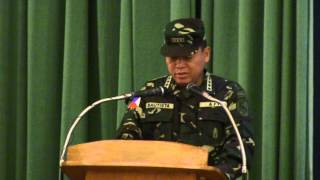
Armed Forces of the Philippines (AFP) chief-of-staff Gen. Emmanuel Bautista officially declared the Philippines-United States "Balikatan" Exercise 2014 open during ceremonies held Monday morning at the AFP Commissioned Officers' Clubhouse in Camp Aguinaldo, Quezon City.

In his speech, Bautista noted that for over 60 years, the Philippines and the U.S. have stood shoulder-to- shoulder in commitment to peace, security, stability, and development.

"The 'Balikatan' Exercise is a clear affirmation of this. Through the 'Balikatan', Philippine and U.S. troops have learned from each other to improve interoperability, advance peace and security in the Asia-Pacific, and ensure that amidst evolving security challenges in an increasingly dynamic world, this alliance can be relied on," Bautista stressed.

Meanwhile, Foreign Affairs Secretary Albert Del Rosario said that, "With the launch of the 'Balikatan' Exercise today, its 30th reiteration, we have once again showed the world the strength and continued relevance of our alliance, and its ability to confront new challenges."

He also mentioned in his speech that the United States has always been a key partner of the Philippines in building the country's defense capabilities.

Del Rosario likewise stressed the significant role of both the Filipino and American troops in the conduct of disaster response operations following super typhoon "Yolanda" in November last year.

This year's exercise will focus on maritime security, humanitarian assistance and disaster response, and humanitarian civic assistance.

Lt. Gen. Hernando DCA Iriberri, Philippine Army commander, who was also present during the opening ceremonies, reiterated that this year's Combined Army Forces (CARFOR) events will be held in Fort Magsaysay, Nueva Ecija to be participated in by combined Philippine Army and U.S. Army forces.

The 20th Infantry Battalion of the Philippine Army will be the biggest contingent of the PA forces and they will be participating in the Battalion Staff Exercises, combat life support training, and Battalion Field training exercises with their U.S. counterparts.

http://www.pna.gov.ph/index.php?idn=1&sid=&nid=1&rid=640579

3 hostages in Compostela Valley freed

From the Philippine News Agency (May 5): 3 hostages in Compostela Valley freed

Three persons, held hostage by the New People's Army (NPA) in Compostela Valley, were freed by the rebels Monday.

This was disclosed to the Philippines News Agency by Capt. Ernest Carolina, 10th Infantry Division spokesman.

The three hostages that have been released were from Barangay Mahayahay, he said.

Carolina, however, said they are still looking into reports that the NPAs still have with them four hostages, all of them children, which they took from the nearby mining area.

Two of the captives are three-year-olds while the other is a one-year-old, and the last one is a four-week old infant.

Last Saturday, rebel forces took hostage around 39 residents from Sitios Tabon and Dasuran, Barangay Panamin and Barangay Mahayahay, Mabini town, Compostela Valley

Rebels from the NPA's "Front 2" and "PBC 6" were reportedly behind this act.

 http://www.pna.gov.ph/index.php?idn=1&sid=&nid=1&rid=640644

'Balikatan' a good example of working relationship between two nations -- Goldberg

From the Philippine News Agency (May 5): 'Balikatan' a good example of working relationship between two nations -- Goldberg

As Filipino and American forces formally commenced "Balikatan 2014" this Monday, US Ambassador to the Philippines Philip Goldberg said that the annual military exercise is a fine example of a working relationship between two nations.

"This year's exercise is a good example of what the relationship can be, defined by shared interests, shared ties, and shared goals, shoulder-to-shoulder we stand together, ready to defend (if) necessary and assist when needed," he said.

Goldberg stated that "Balikatan" is an offshoot of the long standing relations between the US and Philippine militaries, a partnership that has greatly contributed to regional security and stability.

"This is an important time for both our countries when it comes to national security. as most of you know I was on the stage last week with (Defense) Secretary (Voltaire) Gazmin signing the Enhanced Defense Cooperation Agreement. The EDCA will help the US-Philippines alliance continue to promote the peace and stability that has underpinned Asia's remarkable economic growth over the last six decades. The EDCA updates and strengthen US-Philippines defense cooperation to meet 21st century challenges and will facilitate the enhanced rotational presence of US forces, facilitate humanitarian assistance and disaster relief in the Philippines and the region, to improve opportunities for bilateral training and support the long term modernization of the Armed Forces of the Philippines as it works to establish a minimum credible defense, Exercise 'Balikatan' is a prime example of the benefits that mutual security cooperation can bring to both our countries, by strengthen our armed forces, improving communities and developing relationships," the US Ambassador stressed.

Goldberg added that Americans and Filipinos need to look no further as this was exemplified by US rescue efforts during the aftermath of super typhoon "Yolanda" last Nov. 8.

"We need look no further than the response to Typhoon 'Yolanda' which made landfall six months ago today to see the immeasurable value of those relationship. by the end of the initial relief efforts after 'Yolanda' in November the US military coordinated over USD 31 million worth of assistance and working shoulder-to-shoulder with their Philippine counterparts, help evacuate over 21,000 people and move over 2,000 tons of supplies from government and civilian relief organizations into the affected areas," he pointed out.

"Operation 'Damayan' was proof of the American commitment to close friends and neighbors in the Philippines in times of need, the successful response to Typhoon 'Yolanda' began with exercises like this one, regular bilateral training and operations develop strong bonds and effective teamwork which enable rapid and effective action in times of crisis, so remember while this maybe an exercise the skills you practice here have real world implications for the safety and security not just of the Philippines but the entire region," Goldberg concluded.

http://www.pna.gov.ph/index.php?idn=1&sid=&nid=1&rid=640649

Draft of Bangsamoro Basic Law now with Presidential Legal Counsel, says Palace official

From the Philippine News Agency (May 5): Draft of Bangsamoro Basic Law now with Presidential Legal Counsel, says Palace official

The draft of the Bangsamoro Basic Law is with the Office of the Chief Presidential Legal Counsel, which is reviewing it before presenting it to President Benigno S. Aquino III, said Presidential Communication Operations Office (PCOO) Secretary Herminio Coloma, Jr. on Monday.

“The draft Bangsamoro Basic Law prepared by the Bangsamoro Transition Committee is currently being reviewed by the legal team of the Office of the President and by the Office of the Chief Presidential Legal Counsel to determine propriety for inclusion in the legislative agenda of the President,” Coloma said during a press briefing.

“This review ensures meticulous and circumspect evaluation that each provision of the proposed Bangsamoro Basic Law conforms to the Constitution and the signed agreements,” he added.

He said there is a sense of urgency for the draft Bangsamoro Basic Law to be enacted into a law and submitting it to the House of Representatives is paramount.

“Binanggit na rin ito ng Pangulo na matatapos iyong pagsasabatas nito sa loob nitong taong ito para maidaos din iyong plebisito for referendum sa unang bahagi ng 2015, dahil kinakailangang magkaroon din ng transition na kapag naganap na ang pag-ratipika nito, magkakaroon ng Bangsamoro Transition Commission na papalit sa ARMM (Autonomous Region on Muslim Mindanao) na iphe-phase out for approximately one year of last period leading up to the 2016 elections,” Coloma explained.

Both Houses of Congress resumed sessions on Monday.

http://www.pna.gov.ph/index.php?idn=1&sid=&nid=1&rid=640674

PH-US troops begin war games near disputed waters

From Rappler (May 5): PH-US troops begin war games near disputed waters

The exercises, involving 5,500 Filipino and American soldiers, will be held in Palawan and Zambales, among other areas, to demonstrate maritime security cooperation between the two treaty allies

OPENING CEREMONIES: US-PH Balikatan 2014 includes participation of Australian troops. Photo by Carmela Fonbuena/Rappler

OPENING CEREMONIES: US-PH Balikatan 2014 includes participation of Australian troops

The Philippines and the United States launched on Monday, May 5, the annual Balikatan war games a week after US President Barack Obama vowed "ironclad" commitment to defend the country against external attacks.

The exercises that will run from May 5-16 in military bases near the flashpoints of disputes between Manila and Beijing – Palawan and Zambales provinces – will demonstrate maritime security cooperation between the two treaty allies, according to Armed Forces of the Philippines chief General Emmanuel Bautista.

"This year's Balikatan focuses on maritime security and the conduct of exercises will result in a platform of regional engagement and development of military capabilities, advanced inter-operability, capacity joint planning and execution, and demonstrate Philippines and US relationsip in maritime security," said Bautista.
 
Thumbnail

[Video: Balikatan 2014 Speech by AFP chief General Emmanuel Bautista
https://www.youtube.com/watch?v=jOyscwldXlM]

Military cooperation with the US, said Bautista, is important in "maintaining stability in Southeast Asia and Asia Pacific."

Balikatan – literally shoulder to shoulder – is a regular training exercise between the two countries. About 3,000 Filipino troops and 2,500 American troops are participating.

“Remember, while this may be an exercise the skills you practice here have real world implications for the safety and security not just of the Philippines but of the entire region," said US Ambassador to the Philippines Philip Goldberg.

Australian troops numbering less than 100 will participate in the maritime security exercises as mentors, according to Lieutenant Annaleah Cazcarro, co-director of the Combined Joint Information Bureau of the PH-US Balikatan Exercise 2014.

BALIKATAN 2014: Philippines and US officials stand shoulder to shoulder. Ben Nabong/Rappler

Humanitarian assistance too

Staff planning exercises will be held in the military headquarters at Camp Aguinaldo in Quezon City and the Western Command in Palawan, the province where the disputed Kalayaan Group of Islands (Spratlys) are attached to.

Field training exercises, such as Maritime Surveillance Systems Demonstration, will be held at the Naval Education and Training Command in Zambales, the province where the Panatag Shoal (Scarborough) is also attached to. This is the other flashpoint in the dispute between Manila and Beijing.

Demonstration on air movement, live fire, counter improvised explosives devices, and mass casualty response will be held at Fort Magsaysay in Nueva Ecija

A showcase of Philippine Air Force and US Air Power will be held at the Clark Air Base, urban search and rescue field training exercises at Camp Lapu-Lapu in Cebu City, and combined arms live fire exercise at Crow Valley Range in Tarlac.

Balikatan 2014 will also focus on humanitarian assistance and disaster response. Combined cooperative healthcare engagement will be held in typhoon-devastated Leyte province.

Both camps highlighted the military cooperation in the aftermath of typhoon Yolanda (Haiyan), where the US stepped up to assist the Philippines.

EDCA to expand Balikatan

The newly signed Enhanced Defense Cooperation Agreement (EDCA) brings the cooperation to a "new level." (READ: 3 to 5 PH military bases eyed for US use)

It allows the US troops two new activities outside Balikatan:

preposition of defense equipment

construction and upgrade of military facilities

EDCA, a 10-year agreement, is the result of Philippines' request for US military assistance in the wake of escalating tension with China over the West Philippine Sea (South China Sea).

"With the recent signing of EDCA, we expect greater cooperation interoperability amongst our forces outside the Balikatan scheme," said Major General Emeraldo Magnaye, Balikatan 2014 Philippine Exercise director.

The Philippines and US panels have yet to complete the annexes that will identify the military bases where US troops will be allowed to preposition equipment and construct facilties.

http://www.rappler.com/nation/57224-balikatan-exercises-near-disputed-waters

Army soldier killed, 6 others wounded in fresh NPA ambush in Northern Luzon

From InterAksyon (May 5): Army soldier killed, 6 others wounded in fresh NPA ambush in Northern Luzon

CAMP PRESIDENT QUIRINO, Ilocos Sur -- A government trooper was killed and six others were wounded in a fresh ambush staged by suspected members of the New People’s Army (NPA) in Abra last Friday, said a belated report of the Philippine Army reaching here.

The ambush came a day after another NPA ambush where three soldiers were killed and another wounded in Barangay Remedios, Cervantes, Ilocos Sur.

Senior Superintendent Nestor Felix, Ilocos Sur police director, clarified that the latest ambush did not happen in Quirino town of Ilocos Sur as earlier reported but rather in Mount Kingking, Barangay Dilong, Tubo, Abra.

The lone fatality was identified as Private First Class (Pfc) Miguel Lumadi, a member of the Army’s 50th Infantry Battalion and a resident of Cabagan, Isabela.

His companions who were wounded were Corporal Pedrico Miguel; Pfcs. Harold Morareng, Allan Jay Lumas-e, Crisologo Tullao, Hector Salon, and Esmael Orenia.

Lieutenant Colonel Richard Sibayan, commander of the Army’s 50th Infantry Battalion, said the incident happened at about 4 a.m. last Friday.

“Our troops belonging to the Peace and Development Teams of the Army’s 50th Infantry Battalion were on board a KM450 truck while on their way back to their base after attending a meeting with local officials in Abra the day before,” Sibayan said.

He said the soldiers assisted some personnel of other government agencies to coordinate with the local government officials in Abra for the improvement of the Quirino-Bolingon road projects and the repair of the bridge along that road.

“When an undetermined number of NPA remnants fired upon the soldiers who were aboard the KM450 truck, the soldiers returned fire and firefight ensued which lasted until 6 a.m.,” Sibayan narrated.

Reinforcement troops and medical teams proceeded immediately to the place to provide assistance to the soldiers.

The lone fatality soldier and the six wounded troopers were immediately transported to the nearest hospital in Quirino town for medical treatment.
Hot pursuit operations are now being conducted by army soldiers.

Sibayan believed that the NPA remnants also suffered an undetermined number of casualties. He said bloodstains and recovered belongings were found along their escape route.

“This unfortunate incident only shows that the NPAs in the area are out there to impede the local government’s vision of further development for the benefit and the common good of the populace not only in the towns of Cervantes and Quirino but also in the whole province of Ilocos Sur and other surrounding areas,” he added.

http://www.interaksyon.com/article/86078/army-soldier-killed-6-others-wounded-in-fresh-npa-ambush-in-northern-luzon

NPA releases 36 gold-rush miners but still keeps 3 in Compostela Valley

From InterAksyon (May 5): NPA releases 36 gold-rush miners but still keeps 3 in Compostela Valley

The New People’s Army (NPA) has released 36 gold-rush miners in two batches since Sunday in Mabini, Compostela Valley, Capt. Alberto Caber, spokesman of the Eastern Mindanao Command (Eastmincom), said Monday.

“Three civilians, all males, remain in the custody of the NPA using them as human shields,” Caber said.

On Sunday, the rebels released the first batch of 26 at around 3 a.m. and the second batch of 10 at around 4 p.m.

The rebels, members of the Front Committee 2 (F2) and Pulang Bagani Command 6 (PBC6), were still holding three captives in Sitio Tabon, Barangay Panamin.

Lt. Col. Michael Logico, commanding officer of the 66th Infantry Battalion, said all the released miners were escorted to their homes in Barangay Mahayahay in Maragusan town.

“All the miners were from Maragusan where they were originally abducted on May 3 at around 10:20 a.m. by the rebels (who) used them as human shields (against) pursuing soldiers,” Logico said.

The NPA has yet to issue an official statement why they held the gold-rush miners.

Earlier, Logico said the military had to stop artillery fires against NPA positions upon learning that the rebels had civilian captives with them.

Local officials were exerting efforts to negotiate with the rebels to release their three remaining captives.

http://www.interaksyon.com/article/86079/npa-releases-36-gold-rush-miners-but-still-keeps-3-in-compostela-valley

Sunday, May 4, 2014

Where kidnapping is a lucrative industry

From the Star Online (May 4): Where kidnapping is a lucrative industry

Kidnap for ransom groups in Jolo have become increasingly sophisticated and are now working in units that operate like a small army.

USING three glasses filled with kahawa (Tausug word for coffee), an Armed Forces of the Philippines (AFP) intelligence officer illustrated how kidnap for ransom groups have streamlined their cross border kidnapping modus operandi.

“Imagine these glasses are cells. First cell will do intelligence gathering in Semporna, the second cell which is also based in Semporna will do the kidnapping and once they reach Philippines waters, they will pass the hostages to the third cell,” said the officer at a house of a prominent individual in Jolo town on the notorious Jolo island.
Jolo island – in Sulu province in southern Philippines – is where most of the hostages kidnapped in Semporna in the east coast of Sabah end up. In 2000, Malaysians took note of Jolo when 21 people – nine Sabahans, two Filipinos and 10 tourists from Europe, South Africa and Lebanon – were kidnapped in Sipadan island in Semporna waters on Easter Sunday and held on the island about the size of Perlis.

The latest victims abducted from Semporna are Gao Huayuan, a 29-year-old tourist from Shanghai, and Marcy Dayawan, a 40-year-old Filipina resort worker. Filipino gunmen kidnapped them from Singamata Reef Resort at about 10.30pm on April 3.

The kidnap for ransom (KFR) groups have changed their modus operandi, according to Filipino intelligence officers and security experts interviewed by The Star.

“In 2000, a KFR group consisting of 30 armed men travelled in several boats from Sulu to kidnap 21 people in Sipadan and then returned to Sulu.

That was the same modus operandi when they kidnapped 20 people (including three Americans) from Dos Palmas Resort (in Palawan, Philippines) and brought them to Basilan island (about 120km from Jolo island),” said the AFP intelligence officer who did not want to be identified.

Pointing to the three glasses filled with kahawa grown in Sulu, he added: “when you travel in a big group, there is a possibility that the Philippine and Malaysian navies will detect you.”

“But when you travel in a small group,” he said, holding a single glass, “you don’t attract attention.”

Learning from their mistakes, the KFR groups streamlined their operation.

“Post Sipadan and Dos Palmas kidnappings, the KFR would send a cell group to Semporna. These operatives would either live as a local or work in a resort. That is their cover. Their actual job is to find a target and study the place and find the best time for them to kidnap.”

“The spotter will contact the mastermind and inform that the victim is in her room and security is relaxed,” he said.

His description of the modus operandi corresponds with what happened in Singamata Reef Resort on the night of the abduction. Armed men struck minutes after eight General Operations Force (GOF) personnel stationed in the resort had left the reef to conduct patrolling in a boat.

In the aftermath of the Singamata kidnapping, Eastern Sabah Security Command (Esscom) director-general Datuk Mohammad Mentek said an operation to clear the east coast area of moles or informers of cross-border criminals would be conducted.

When a target was identified, the KFR mastermind would inform the second cell. It was a light and quick team consisting of about seven gunmen embedded in Semporna.

“Before, they needed about 30 armed men to execute a kidnapping. Now they can kidnap with seven gunmen,” he said.

“How well armed are these men?” I asked.

“Just like your escorts. They are like a small army,” he said, pointing at the two Philippines National Police policemen, armed with a M204 grenade launcher, pistol and shotgun, who provided security during my three-day trip to Jolo island.

The crew of the second cell would know Semporna waters like the back of their hand, said the AFP intelligence officer.

His account is consistent with Esscom investigations into the Singamata kidnapping. Mohammad has said that at least four of the seven gunmen involved in the kidnapping were no strangers to Sabah’s diving haven of Semporna.

Investigations, he said, had indicated that the four were familiar with the Semporna waters including Sipadan, Mabul and Kapalai islands as they have families and friends living in coastal villages in the area.

“Our investigations with the police have led to the conclusion that these kidnappers will seek shelter with their friends and families every time they come here,” he said.

After entering Philippine waters, the AFP intelligence officer said the second cell will hand over the hostages to the third cell.

“This is so that they can avoid heat (pressure from security forces),” he said.

Octavio A. Dinampo, the CEO of Assist Jolo, which is an NGO, agrees with the AFP intelligence officer’s description of the KFR’s streamlined modus operandi.

Since he was kidnapped with famous Filipino news anchor Ces Drillion and others on Jolo island on June 8, 2008, Dinampo, a 57-year-old Suluk, has been investigating the business of kidnapping in Sulu province, nearby Tawi Tawi islands and Sabah.

Dinampo, who teaches political science in Mindanao State University in Jolo island, said the cross-border kidnappings between Sulu and Semporna were masterminded by smugglers.

He said the actual kidnapping was not done by the Abu Sayyaf but smugglers based on small islands in the Sulu province such as Pandami, Pata, and Siasi which are near Jolo island.

“You need to be an expert on islands and the sea to do cross-border kidnapping over the Sulu seas,” he said.

Esscom director-general Mohammad has been quoted by the media as saying that the four identified Singamata abductors were also involved in various smuggling activities in Semporna.

From smuggling of guns, drugs, cigarettes and sugar in the Sulu archipelago, the smugglers have evolved into kidnapping.

“It is a natural evolution for some of the smugglers who own money, powerful arms and fast boats that can even compete with the Philippine navy to finance a kidnapping,” he said.

“It is natural for them to think of kidnapping as an enterprising business. This explains why Sipadan and Dos Palmas happened.”     

Cross-border kidnapping is an expensive operation, said Dinampo.

“The kidnapping crew is presumed dead before he goes for the kidnapping. And the mastermind will set aside money in the event a crew member is killed so that his family can move on. Just say you have seven crew members and you have set aside 100,000 pesos (RM7,330) for each of them, that means you need to set aside 700,000 pesos (RM51,000),” he said.       
The mastermind also needs to buy sophisticated weapons and equipment for his cells embedded in Semporna and in Tawi Tawi islands in southern Philippines.

“He needs to pay for the house his spotters have to stay in Semporna. The spotters need to be equipped with satellite phones which they use to communicate in split seconds with the mastermind in coded words,” he said.

What’s new for the KFR group, according to Dinampo, is they have placed their men in the Abu Sayyaf, Moro National Liberation Front and other armed groups in Jolo island.

“They need a trusted ‘branch manager’ in these armed groups as they will usually deposit the hostages with the Abu Sayyaf or other armed groups in Jolo island,” he said.

The moment the KFR group abducts hostages from Sabah, Dinampo said the mastermind would contact his ‘branch manager’.

“For example, the mastermind will tell his ‘branch manager’ that he had spent about 1.5mil pesos (RM110,000) and he wanted to make a 5mil-peso (RM360,000) profit, so he would sell a hostage for 6.5mil pesos (RM480,000) to the Abu Sayyaf and it would be up to them to jack up the ransom,” he said.

The KFR mastermind outsources the holding of the hostage to Abu Sayyaf or armed groups in Jolo island because he does not have the “muscle” to keep them.

“Abu Sayyaf is a larger armed group. They have enough men and firepower to hold on to the hostages when pursued by the security forces,” Dinampo said.

“Once the KFR hands over the hostage to the Abu Sayyaf (or other armed groups) in Jolo, they are out of the heat generated by the kidnapping.”

When asked if another cross border kidnapping would happen in Semporna, the AFP intelligence officer picked up a glass and said, “they are already there” and placed it next to a paper he had marked “Sabah”.

http://www.thestar.com.my/News/Nation/2014/05/04/Where-kidnapping-is-a-lucrative-industry/

Game of smoke and mirrors in kidnap isle

From the Star Online (May 4): Game of smoke and mirrors in kidnap isle

People on the move: Jolo town in Jolo island in Sulu province, southern Philippines.

People on the move: Jolo town in Jolo island in Sulu province, southern Philippines

In the last five months, there have been two kidnappings in Semporna, Sabah, by gunmen from Sulu in southern Philippines. PHILIP GOLINGAI visited Jolo island – the Philippines’ cross border capital – to investigate why Filipino kidnappers are targeting Sabah

SULU: If you ask 10 people in Jolo island where the hostages abducted from Singamata Reef Resort in Semporna, Sabah, are located, you might get 10 different answers.

“They are in Sulu. Most probably in the border of Patikul and Talipao,” said Octavio A. Dinampo, the CEO of Assist Jolo, a non-governmental organisation.
“My informers told me that they were transferred from Pandami (an island in Sulu province) to Jolo island on April 17.”

On April 3, Shanghai tourist Gao Huayun, 29, and Filipino resort worker Marcy Dayawan, 40, were kidnapped by Filipino gunmen from Singamata Reef Resort at about 10.30pm.

“I can definitely say they are not in Sulu,” said the Philippines National Police’s Sulu Provincial Director Supt Abraham Orbita.

Welcome to Jolo island where the game of smoke and mirrors is played.

The kidnappings in Semporna, according to Dinampo, were not the handiwork of the Abu Sayyaf group (ASG) but a kidnap-for-ransom (KFR) group.

He said the KFR group would sell a hostage to the Abu Sayyaf or other armed group in Jolo island.

“Once you deposit the hostage to the ASG, the heat generated from the kidnapping will go away. And the KFR leader will be free.


“Nobody will focus on their role in the kidnapping and they can operate like legitimate businessmen,” he said.

Arguably, all of the hostages abducted in Semporna since the first cross-border kidnapping in 2000 have been held in Jolo island.

Currently, armed groups are holding two well-known bird watchers – Ewold Horn, a 53-year-old Dutch, and Lorenzo Vinciguerra, a 48-year-old Swiss, who were abducted in Tawi-Tawi in February 2012 – and Toshio Ito, a 64-year-old Japanese treasure hunter kidnapped from Pangutaran Island in Sulu province in July, 2010.

The island, which is about 300km from Semporna, is the Philippines cross-border kidnap capital because of its terrain.

“In the hinterland, the terrain is mountainous, rocky and treacherous. It is the perfect place to keep hostages,” said an Armed Forces of the Philippines intelligence officer.

“People in the area have close family ties. The community also acts as the eyes for the Abu Sayyaf.”

Dinampo, who was held hostage for 10 days in Talipao/Patikul, Jolo island in 1999, said that a minimum of 15 people guarded him in the daytime and a maximum of 50 people at night.

“That is the first layer of security. The second is the community they live in. The villagers and even their children are trained to monitor the presence of security forces,” he said.

“Our surrounding was also booby trapped with IED (improvised explosive device) – ping pong balls filled with explosives. If you step on it, boom!”

http://www.thestar.com.my/News/Nation/2014/05/04/Game-of-smoke-and-mirrors-in-kidnap-isle/

DVIDS: Philippine, U.S. forces bond over positive community impact

From DVIDS (May 4): Philippine, U.S. forces bond over positive community impact
LEGAZPI CITY, Albay Province, Philippines – Filipino and American soldiers work together to construct a public comfort room April 17 – May 15 in Legazpi City, Albay Province, Philippines.

The comfort room is one of the five engineering civic assistance programs projects being completed as a part of Exercise Balikatan, an annual bilateral training exercise and humanitarian assistance engagement between members of the Armed Forces of the Philippine and U.S. armed forces.

The public comfort room is being built as an addition to the recreational center that is available for local community to use.

“It’s awesome helping and seeing the community come out,” said U.S. Army 1st Lt. Jake Oberlechner, ENCAP site officer in charge with 84th Engineer Battalion. “I’m happy to be here with our Filipino counterparts working alongside us. It’s nothing short of excellent.”

In addition to the Filipino and American soldiers, some local community members and Philippine Air Force reservists have come to the site to assist with the project in their free time.

“I will be teaching in the area when the construction is finished,” said Philippine Air Force Reserves Sgt. Jason Auditor, a civil engineer. “Being here is a great experience. It’s my first time working with Americans, and I’m happy to see we’re all here helping out the community.”

While working on the comfort room, members of the AFP and U.S. armed forces have taken the opportunity to bond over the positive impact their work will have on the community, according to U.S. Army Sgt. Kyle T. O’Keefe.

“The impact on the community will be substantial,” said O’Keefe, a civil engineer with 84th Engineer Battalion. “There is a small language barrier, but we understand each other perfectly when it comes to construction and the way we are helping the Philippine people.”
http://www.dvidshub.net/news/128647/philippine-us-forces-bond-over-positive-community-impact#.U2aXcsZOWAI

DVIDS: Philippine, U.S. forces renovate Malobago Elementary School

From DVIDS (May 4): Philippine, U.S. forces renovate Malobago Elementary School

GUINOBATAN, Albay Province, Philippines – Members of the Armed Forces of the Philippines and U.S. Marines together to renovate Malabago Elementary School April 17 – May 15 in Guinobatan, Albay Province, Philippines. Renovations include the construction of two classrooms, a water catchment system, a kitchen and the repairs of the electrical system and roofs.

The construction and renovations are part of Exercise Balikatan, an annual bilateral exercise that focuses on keeping the international bond strong and improving the quality of life for the people of the Albay Province.

The additions to the school will allow for smaller class sizes and fresh water for the children of the community. The new kitchen will replace an existing bamboo hut and will allow for better production of meals in conjunction with the new source of fresh water, explained U.S. Marine 1st Lt. Daniel B. Comito, the engineering civic assistance program site officer in charge with 9th Engineer Support Battalion, 3rd Marine Logistics Group, III Marine Expeditionary Force.

The partnership between the AFP members and U.S. Marines has been a learning experience for both units. Shared knowledge and expertise on topics ranging from bending metal to ensuring a level foundation has led to more efficient and effective construction, according to U.S. Navy Petty Officer 2nd Class Lee Halls.

“We have learned so much from each other here,” said Halls, a corpsman at the site. “We show each other our construction techniques to build something the community can be proud of.”

The renovated school will provide the community a place to come together, and has already been filled with local community members who visit to watch the work being done.

“We have a close relationship with the people in the area,” said Comito. “It’s really amazing to be able to see the effect we have on the community.”

http://www.dvidshub.net/news/128651/philippine-us-forces-renovate-malobago-elementary-school#.U2aW-MZOWAI

‘US not satisfied with PHL counterinsurgency measures’

From the Business Mirror (May 4): ‘US not satisfied with PHL counterinsurgency measures’

THE United States is not satisfied with how the Philippines military and the Philippine National Police (PNP) conduct their campaigns against lawless groups under the country’s counterterrorism operations, which are being actively supported by the US government.
 
The view of the US government on the country’s efforts was reflected in its country report on counterterrorism released by the US Department of State on April 30.
 
For one, the state department’s report noted that the IPSP Bayanihan, the campaign program of the military against the Communist Party of the Philippines and its armed wing, the New People’s Army (NPA), was ineffective.
 
The counterinsurgency program, which covers the whole term of the Aquino administration, was crafted during the term of Armed Forces Chief of Staff Emmanuel Bautista as deputy chief of staff for operations of the military.
 
Bautista was the most ardent supporter of the campaign plan, which is on its way to missing its objective of clearing the country of guerrillas as shown by the successive and brazen attacks that the rebels carried out against their targets, which included municipal halls and police stations, around the country during the past weeks.
 
“The government of the Philippines continued to implement its 2011-2016 Internal Peace and Security Plan that calls for the transition of internal- security functions from the Armed Forces of the Philippines [AFP] to the PNP,” the report noted.
 
The increasing role and capability of the police to maintain internal security in conflict-affected areas will permit the AFP to shift its focus to enhancing the country’s maritime security and territorial defense capabilities. To date, however, this transition has been slow and ineffective,” it added.
 
Some military officers said that because Bautista is much younger than his area commanders, he could not give orders to his senior commanders, including for them to sustain the operational tempo, not only against the NPA, but even against the other groups, thus making him a “lame duck” chief of staff.
 
The US state department’s report said corruption in the police and even in the judiciary was among the reasons frustrating the country’s counterterrorism efforts.
 
The problem was even worsened by the lack of personnel, the report said.
 
“An underresourced and understaffed law enforcement and judicial system, coupled with widespread official corruption, resulted in limited domestic investigations, unexecuted arrest warrants, few prosecutions and lengthy trials of cases,” the report said.
 
“Philippines investigators and prosecutors lacked necessary tools to build strong cases, such as clear processes for requesting judicially authorized interception of terrorist communications; entering into plea bargains with key witnesses; and seizing assets of those suspected in benefiting from terrorism,” it added.
 
Still, the US said it would continue to work and assist the country in its efforts to combat terrorism, as it will remain an “important partner” in the US Department of State’s Antiterrorism Assistance program.
 
The program includes giving extensive tactical training to PNP officers, including Special Action Force members, “to support the transition in southern Philippines from military to civilian counterterrorism authority.”
 
Meanwhile, MalacaƱang on Sunday allayed the concern of former Sen. Joker Arroyo that the Palace-backed Enhanced Defense Cooperation Agreement  (Edca) with the US skirted the constitutional ban on foreign military bases here except under a new treaty.
 
“We respect the views of Senator Arroyo and other leaders on the Enhanced Defense Cooperation Agreement,” Communications Secretary Herminio B. Coloma Jr. said over Radyo ng Bayan.
 
Coloma said that consistent with President Aquino’s guidelines, the Edca included key features assuring compliance with the Constitution’s provisions on the issue of foreign military presence in the country.
 
These, he said, include a “clear provision that the US would not establish a permanent military presence or base in the Philippines.”
 
“US access to and use of designated areas in Armed Forces of the Philippines [AFP]-owned and –controlled facilities [also called ‘agreed locations’] will be at the invitation of the Philippines government,” he said.
 
Coloma said it also requires prior consent of the Philippines through the Mutual Defense Board and Security Engagement Board with regard to US access and use of such “agreed locations,” referring to existing Philippines military bases that may accommodate US forces, subject to implementing arrangements.
 
The Palace official also cited the Philippines’s retention of primary responsibility for security of the agreed locations, as well as full access of the AFP base commander to the entire area of the agreed locations.