Friday, June 23, 2023

2 NPA killed in Albay encounter

From the Manila Bulletin (Jun 22, 2023): 2 NPA killed in Albay encounter (By NIÑO LUCES)

LEGAZPI CITY, Albay – Two New People's Army (NPA) rebels were killed in an encounter with the 49th Infantry Battalion of the Philippine Army in Guinobatan, this province, on Wednesday, June 21.

Army Major Frank Roldan, Division Public Affairs Office chief, identified the casualties as Santos Seminiano, alias "Santi," and alias "Ilay" or "Elian."

Roldan said troops encountered 12 communist guerrillas in Barangay Balolo during a security patrol which was conducted after they received information about the presence of armed men in the area.

The gun fight lasted about 15 minutes and no casualty was recorded on the government side.

Recovered after the clash were one M16 rifle, M635 rifle, two anti-personnel mines, and five knapsacks.


Troops are conducting follow-up operations.

https://mb.com.ph/2023/6/22/2-npa-killed-in-albay-encounter

NPA claims burning of heavy equipment in Negros city

From the Manila Bulletin (Jun 22, 2023): NPA claims burning of heavy equipment in Negros city (By GLAZYL MASCULINO)

BACOLOD CITY – The Mount Cansermon Command (MCC)-New People's Army (NPA)-South Central Negros Guerrilla Front has owned up the burning of two backhoes worth P7.5 million in Sitio Bulod, Barangay Carabalan, Himamaylan City, Negros Occidental last week.

In a statement released to the media on Thursday, June 22, Ka Dionesio Magbuelas, spokesperson of MCC-NPA, said they sanctioned the construction firm after it allegedly failed to follow the rules of the revolutionary movement, particularly on land taxes covered by the group.

Magbuelas said the firm was first sanctioned in September 2021 for the same reason, and was given a chance to comply with their obligations, but they failed.


The rebel group also alleged that they have received complaints from people about the workers’ situation, including the low salary.

The burning incident happened on the night of June 14, wherein six unidentified persons arrived and told a watchman that the construction firm was allegedly not paying revolutionary taxes, according to the police.

Police said the firm is currently working on a P100-million road project dubbed Himamaylan-Tayasan Road in the area.

But the NPA said that this barangay development project aims to provide opportunities to big mining companies that plan to operate in the hinterlands of Cansermon, Tahod-Ilahas, Cambantog, and other neighboring areas.

The rebel group believed that this project will also affect the livelihood of the people and their lands.


https://mb.com.ph/2023/6/22/npa-claims-burning-of-heavy-equipment-in-negros-city

Police tag NPA as perpetrators of Himamaylan massacre

From the Sun Star-Bacolod (Jun 23, 2023): Police tag NPA as perpetrators of Himamaylan massacre (By TERESA D. ELLERA)


Col. Nhel Patricio, OIC of the 303rd Infantry Brigade, Lt. Col. Reynante Jomocan, Himamaylan City police chief, Himamaylan Mayor Raymund Tongson, Governor Eugenio Jose Lacson, and Flosemer Chris Gonzales, RTF6 ELCAC spokesperson, during a joint press conference Thursday, June 22, Talisay City. (Nanette Guadalquiver/PNA photo)

POLICE Regional Office (PRO-6) acting director Brigadier General Sidney Villaflor said Thursday, June 22, that based on the police investigation, it was the New People's Army (NPA) that killed the Fausto family in Sitio Kalingking, Barangay Buenavista, Himamaylan City, Negros Occidental, on June 14.

"The facts indicate categorically that members of the NPA committed the killings. We present our case based on evidence and not on hearsay and biased statements from the CPP-NPA-NDF (Communist Party of the Philippines-New People's Army-National Democratic Front) propaganda machinery," Villaflor said in response to the statement of Butch Lozande, spokesperson of Unyon ng Manggagawa sa Agrikultura (UMA) in a media interview on June 20.

In a joint press conference Thursday of the Regional Task Force to End Local Conflict in Talisay City, Provincial Police Director Col. Leo Pamittan claimed that Fernando Hermino of Central Negros 2, Komiteng Rehiyonal Negros, Cebu Bohol, and Siquijor of the CPP-NPA along with 15 other rebels, were the alleged perpetrators of killing Rolly and his wife Emilda and their two minor sons in their house on June 14.


“This is also based on the judicial statements of the two witnesses who came to the police. The suspects and victims knew each other and had conversations before the killings happened,” he also said.

Villaflor, meanwhile, said the statements of Ka Butch manifested his “clear bias and prejudice” against the government and the police, which undermined the effort and hard work of the police in Negros Occidental.

"It must be made clear that despite the categorical assertions made by Ka Butch on his perceived inability of the police to objectively investigate the Himamaylan killings, it must be stressed that he issued his malicious statements prematurely while the investigation is being conducted by the local police," he added.

“Ka Butch obtained his information from erroneous sources, particularly from biased, fabricated accounts aimed at vilifying the army unit in Himamaylan. Hearsay after hearsay was accepted by Ka Butch as ‘facts.’ And he peddled his ‘chismis’ based information as his version of the truth. Unfortunately for Ka Butch, his lies are washed aside by the truth, he also said.


Villaflor further said, "Ka Butch should know by now that the investigation has uncovered that NPA terrorists killed four members of the Fausto family."

On his claim that the PNP readily threw the ball to the CPP-NPA, the investigation of the incident is based on the accounts of witnesses and on facts, Villaflor stressed.

https://www.sunstar.com.ph/article/1964758/bacolod/local-news/police-tag-npa-as-perpetrators-of-himamaylan-massacre

5 rebels surrender to police

From Panay News (Jun 23, 2023): 5 rebels surrender to police (By Ruby P. Silubrico)

ILOILO City – Five New People’s Army (NPA) rebels voluntarily surrendered to the 606th Company, Regional Mobile Force Battalion (RMFB-6).

The five, all residents of Barangay Binolusan, Calinog, Iloilo, handed over their firearms on Wednesday, June 21.

They turned over three long-barreled 12-gauge shotguns, a short-barreled 12-gauge shotgun, a .38 revolver, and four live 12-gauge ammunition.


Police Regional Office 6 (PRO-6) director Brigadier General Sidney Villaflor said it was a big help in attaining peace and order in Western Visayas.

“Patuloypokamingmanghihikayatngatingmamamayannanaligawnglandasnamagbalik-loobnasaatinggobyerno. Hindi po kami titigilsapaglabankontraterorismo. Sa atingmamamayan, patuloypotayongmagtulunganparamataposnaanglabangito at mamuhayng may kapayaan at kaunlaran,”Villaflor added.

Last week, 103 rebels also surrendered to the PRO-6 through the efforts of the Local Peace Engagement and PRO-6’s Retooled Community Support Program teams.

One was from Calinog town, while the other 102 rebels were from Barangay BinolusanPequeño, Calinog under the KRP Central Front Committee.

They surrendered seven pieces of homemade long-barreled shotguns, six short shotguns, four 12-gauge ammunition, and four magazines of 12-gauge shotgun.


All surrendered items were under the custody of the 606th Company RMFB-6 for proper disposition.

https://www.panaynews.net/5-rebels-surrender-to-police/

NPA member dead, 2 high-powered firearms seized in Claveria

From the Sun Star-Cagayan de Oro (Jun 23, 2023): NPA member dead, 2 high-powered firearms seized in Claveria (By JO ANN SABLAD)


MISAMIS. Recovered from the encounter site in Barangay Minalwang, Claveria town were one M16 rifle, bandolier, and a magazine loaded with 20 rounds of M16 balls; one M14 rifle, bandolier, and a M14 magazine with 15 rounds of M14 balls; two backpacks, ponchos, jungle hammock, cooking pot; one defective Cignus radio; and medical paraphernalia. (Photo from 58th Infantry Battalion)

A FEMALE member of the New People's Army (NPA) was killed in a clash in Claveria town, Misamis Oriental on June 16, 2023, the military reported.

The 58th Infantry Battalion (58IB) said its troops encountered around 15 NPA rebels believed to be members of SRSDG MTJ Eagles, SRC1, and NCMRC in Barangay Minalwang, Claveria.

The firefight lasted for 20 minutes.


The troops coordinated with the Claveria Municipal Police Station (MPS) and Claveria Disaster Risk Reduction and Management Office (DRRMO) for the retrieval and identification of the body of the female NPA rebel.

Recovered from the encounter site were one M16 rifle, bandolier, and a magazine loaded with 20 rounds of M16 balls; one M14 rifle, bandolier, and a M14 magazine with 15 rounds of M14 balls; two backpacks, ponchos, jungle hammock, cooking pot; one defective Cignus radio; and medical paraphernalia.

The military said all available military assets have been placed on high status alert in support of the ongoing pursuit operation against the fleeing terrorists.

"I am appealing to the remaining members of the CTGs to abandon the armed struggle before another demise will happen," 58IB Commanding Officer Lieutenant Colonel Christian Uy said.

"We will assist you in your reintegration into the community and become productive members of society. However, if you continue espousing terrorism, we are determined to hunt you down until we achieve peace in our area of responsibility," he added.

https://www.sunstar.com.ph/article/1964768/cagayan-de-oro/local-news/npa-member-dead-2-high-powered-firearms-seized-in-claveria

DSWD assists families affected by clash between AFP and alleged NPA members

From the Journal Online (Jun 23, 2023): DSWD assists families affected by clash between AFP and alleged NPA members


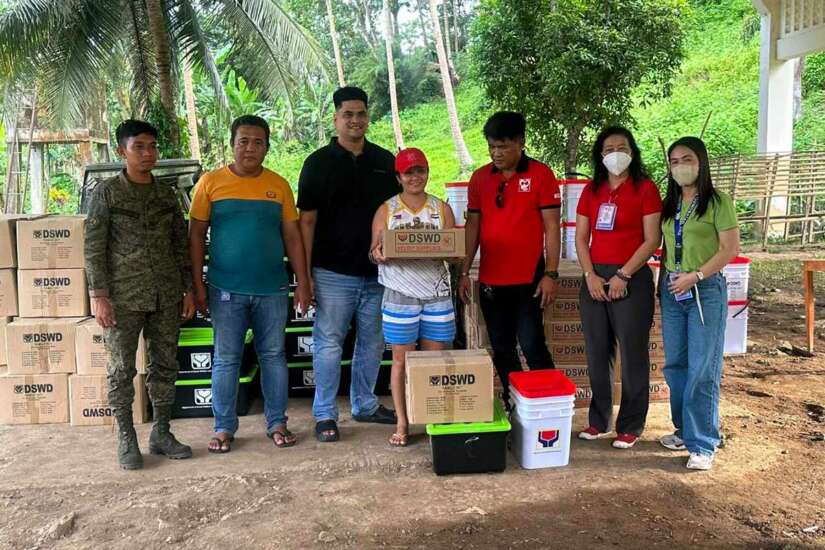
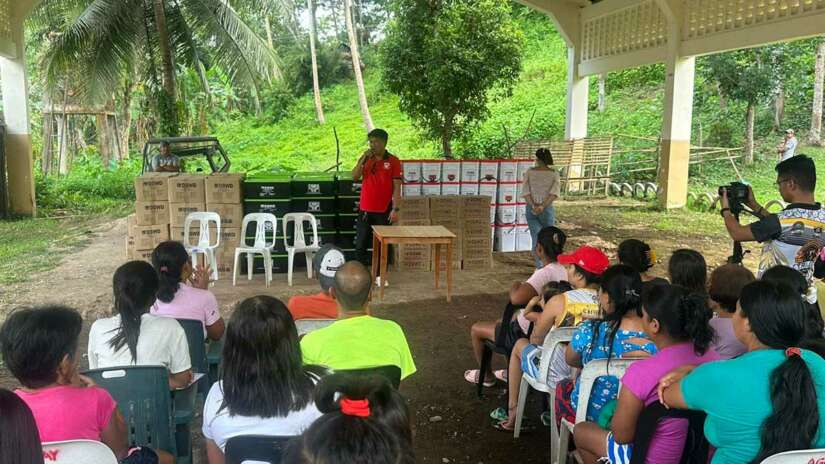
The Department of Social Welfare and Development (DSWD) Field Office in Bicol, headed by Regional Director Norman Laurio, provided relief items to families affected by a recent encounter between soldiers of the Armed Forces of the Philippines (AFP) and alleged members of the New People’s Army (NPA) in Barangay Agpay, Guinobatan, Albay on Thursday (June 22).

Recognizing the immediate needs of the affected families, the DSWD Bicol Regional Office promptly provided essential relief items including family food packs and non-food items such as hygiene, sleeping, and family kits.


The DSWD will also provide psychosocial debriefing to the affected families to help them cope with their traumatic experience.

Based on the recent report of the Municipal Social Welfare and Development (MSWDO) in Guinobatan, at least 75 families are currently taking temporary shelter in Agpay Barangay Hall.

The encounter between AFP soldiers and the alleged NPA members happened on June 21 (Wednesday) at around 7:45 AM.

The firefight lasted for almost an hour, causing panic among several families residing near the Red Zone area.

https://journal.com.ph/dswd-assists-families-affected-by-clash-between-afp-and-alleged-npa-members/

Thursday, June 22, 2023

40 ex-NPA rebels receive P2.8-M E-CLIP aid in Davao Oro

From the Philippine News Agency (Jun 23, 2023): 40 ex-NPA rebels receive P2.8-M E-CLIP aid in Davao Oro (By Che Palicte)


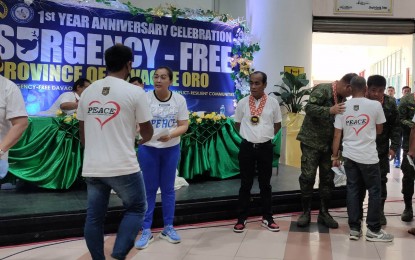
CASH ASSISTANCE. Forty former members of the New People's Army benefited from a PHP 2.8 million Enhanced Comprehensive Local Integration Program (E-CLIP) assistance distributed by the Department of the Interior and Local Government on Thursday (June 22, 2023) at the Davao de Oro Children's Park in Nabunturan town. The provincial government also gave PHP 10,000 each to 35 other former rebels under its own E-CLIP funding. (Photo courtesy of the Army’s 1001st Infantry Brigade)

DAVAO CITY – At least 40 former fighters of the communist New People's Army (NPA) benefited from the PHP2.8 million worth of Enhanced Comprehensive Local Integration Program (E-CLIP) assistance in Davao de Oro province on Thursday.

Led by Governor Dorothy Montejo-Gonzaga, the cash assistance to the former rebels was sourced from the E-CLIP of the Department of the Interior and Local Government at the Davao de Oro Children's Park in Nabunturan town.

Gonzaga also handed over PHP10,000 each to some 35 other former rebels under the provincial government's E-CLIP.

The assistance was dispensed in time for the first-anniversary celebration of being an insurgency-free province since June 22, 2022.

Gonzaga described the event as "a day of reflection, gratitude, and renewed determination" for the province.

“When we make peace through ways of peace, government truly works. I extend my gratitude to all the brave men and women who have tirelessly worked towards ensuring the safety and well-being of the province,” she said.

Gonzaga also urged the public to combat all forms of insurgency to ensure a brighter and more prosperous future for the province.

https://www.pna.gov.ph/articles/1204132

Barangay Elections in the Bangsamoro: A Crucial Test for the Future of the BARMM

Posted to The Diplomat (Jun 23, 2023): Barangay Elections in the Bangsamoro: A Crucial Test for the Future of the BARMM (By Cheng Xu and Jacques Bertrand)

The upcoming local elections in the BARMM, an autonomous region in the southern Philippines, will have implications for the 2025 Bangsamoro parliamentary election and the future stability of the region.


The hands of Philippine President Rodrigo Duterte, Moro Islamic Liberation Front (MILF) leaders as well as that of Government Peace Panel chief negotiator hold the draft copy of the Bangsamoro Basic Law during a ceremony at Malacanang Palace Monday, July 17, 2017, in Manila, Philippines.  Credit: AP Photo/Bullit Marquez

The Moro Islamic Liberation Front (MILF) had its electoral baptism during the general election of May 2022, when it fielded candidates at the municipal level for the Bangsamoro Autonomous Region of Muslim Mindanao (BARMM) in the southern Philippines. The former rebel group learned a hard lesson that its newly created political party, the United Bangsamoro Justice Party (UBJP), has a severe handicap in relation to the traditional politicians who are entrenched across much of the region. After being handed the reins of the transitional authority in the interim parliament of BARMM, it will need to rethink its strategy and approach, if it wants to hold on to power. Some stakeholders in the region have even gone so far as to assert that a UBJP failure in future elections puts at risk the long-term peace and stability in the region.

Since 2019, the BARMM has been in a state of transition. The autonomous region was created as a result of a negotiated settlement after decades of armed struggle between the Philippine government and MILF, which sought self-determination for the Bangsamoro people in the southern Philippines. While the MILF currently helms this interim government, it is obliged to hold regional elections in 2025 for the BARMM parliament to demarcate the end of the transition period. However, their path to victory in the 2025 election is anything but assured. In order to win the parliament, they will need to first win at the grassroots. With the barangay elections coming in October, the MILF is in a race against time to mobilize its base.

In their inaugural electoral test, not only did the UBJP lose in areas previously thought to be MILF strongholds, but also the MILF’s own membership broke ranks and voted against UBJP-backed candidates. The elections were also marred by reports of widespread electoral violence. Despite the existing peace agreement, high hopes for a permanent resolution to the southern Philippine conflict, violence fatigue, and strong feelings of resentment between contesting parties continue to fester and drive the common use of violence during electoral competition. Almost a year after the closing of the polls, in the municipality of Datu Odin Sinsuat in Maguindanao del Norte, streamers all over the city still call for justice for Datu Jamael Sinsuat, a UBJP-backed mayoral candidate who was gunned down as he emerged from Friday prayers on September 30, 2022.

“Since the start of the transition period, we are seeing more horizontal violence in the region,” reported a former member of parliament for the Bangsamoro Transition Authority (BTA). Multiple stakeholders share similar concerns of horizontal or intracommunal violence spreading across the BARMM, particularly across central Mindanao. The director of a non-governmental organization monitoring disaster risk in the region similarly stated that “although the vertical conflict between the rebels and the government have largely subsided, the violence is now horizontal within the communities.” What lies at the heart of this uptick in violence? “Land and political office,” the director stated.

Since taking office last year, Vice President Sara Duterte has on multiple occasions visited Pikit, a municipality particularly embroiled in cycles of horizontal violence, in an attempt to quell the “climate of fear.” Yet, competing political actors continue to point the finger at each other as the root cause of the problem. Traditional political clans and their allies are blaming the MILF for delays in decommissioning their combatants, as outlined in the Normalization Annex of the Comprehensive Agreement of the Bangsamoro. Meanwhile, the MILF attributes the violence to the proliferation of private armed groups working on behalf of the incumbent political clans, claiming that most of the victims of political violence are, in fact, UBJP-backed personnel.

The maintenance of peace in the BARMM is fragile and the 2025 parliamentary elections loom large. A recent International Crisis Group report indicated that these elections will be “the real test of the Bangsamoro’s durability as an autonomous region.” Speaking to observers on the ground, the embattled MILF and UBJP have two simultaneous paths to victory: from top-down, receiving the endorsement of Malacañang over the traditional political clans; and from the bottom up, building support and coalition at the grassroots level to draw support away from the established incumbent politicians. Both paths are mutually reinforcing: getting the support of President Ferdinand Marcos Jr. means that the MILF will also have to deliver the votes for his allies in Congress, and to do so, they must be able to sway the vote among their constituencies. But can they get there?

In April, Marcos offered the strongest indication yet that Malacañang is ready to throw its weight behind the UBJP. He surprised many by appointing as governor of Maguindanao del Norte Abdulroaf Macacua, the chief of staff of the MILF armed wing. This appointment, supported by the then secretaries of the Department of National Defense and the Office of the Presidential Adviser on Peace, Reconciliation, and Unity further signified a clear warming between President Marcos Jr. and the MILF. But while the MILF may have been able to out-maneuver the traditional politicians at the top level, influential political clans are fiercely defending their turf at the grassroots.

The former governor of Maguindanao del Norte, Fatima Ainee Sinsuat, disputed the legitimacy of Macacua’s appointment and enlisted the support of her long-time ally, Mariam Mangudadatu, governor of the neighboring Maguindanao del Sur, in rejecting it. The Mangudadatus, as many local political insiders conveyed, are widely believed to be the kingmakers of the region, and the MILF’s biggest obstacle to the top job of chief minister of the BARMM in the 2025 parliamentary elections.

So, what makes the barangay elections so important? The outcome of these elections in October will set off the first electoral domino that could determine the future of the BARMM. The Philippines’ Local Government Code, passed in 1991, gives local governments a high level of autonomy, including a large share of national revenue through the Internal Revenue Allotment. Even if the MILF/UBJP holds interim power over the BARMM, they must contend with the local governments’ high degree of independence from them. In fact, many MILF MPs in the transitional government have openly expressed their frustration that local government officials actively thwart their efforts at governance and regional development.

But most importantly, the Sangguniang Barangay (barangay council), and barangay captains in particular, hold tremendous influence over the voting behavior of their constituents. They act as de facto gatekeepers between the electorate and the broader political system, from dispute resolution of civil matters to the distribution of financial resources to the community. Members of the Sangguniang Barangay have intimate knowledge of their communities and often exercise tight controls to ensure incumbency by doling out favorable judgments or withholding scarce resources. As the executive director of a local civil society organization explained, this gatekeeping effect is especially pronounced in the BARMM, where poverty levels were once the highest in the country. Barangay captains control much of the disbursement of the few funds available, such as the Pantawid Pamilyang Pilipino program, the national anti-poverty strategy. Consequently, “communities in the BARMM simply do not vote against what their leaders tell them,” he explained.

The political stakes are therefore high in the BARMM’s barangays. Traditional political clans typically pack the Sangguniang Barangay with their own supporters. Even superintendents and elementary school principals become important political actors as they oversee the polling sites and voting centers, which can decisively swing (or rig) an election. With the competition for control now extending to the MILF, there are potential cracks in the organization’s cohesion and unity. Rumors already abound that local politicians are buying off MILF commanders and members on the ground, capitalizing on delays in the normalization process. Some of these dynamics are contributing to episodic violent clashes and infighting amongst the MILF’s own base commands.

Controlling the barangays is largely seen as a crucial step toward enhancing control of scarce financial resources to local communities and potential electoral influence in 2025. How the UBJP performs in the upcoming barangay elections will depend on how well it can navigate divisions among its followers and fierce competition with traditional politicians. Furthermore, the UBJP faces one big challenge that its traditional political counterparts will not – the high expectations that they will deliver on the promises of the peace agreement for the communities in the BARMM.

Although campaigning for the upcoming barangay elections has not yet begun, the violence is already underway. Between January and April, at least 13 elected officials were victims of targeted killings. These were considered direct effects of the new competition, in addition to the already rampant instances of rido (clan feuding) and land conflicts. The violence is only expected to rise as campaigning ramps up in the coming months. For the MILF and UBJP, the key will be to strategically field their candidates, understanding where they have the strongest support and where they can forge coalitions and make the deals necessary to put them in the best position for 2025.

The standoff between the former rebels and the established political clans, therefore, has the potential to become a powder keg. “If the peace process cannot stay on track, then 2025 will be a bloodbath” considered a source closely involved with the process. The 2025 election for the new BARMM parliament and the government will be a key inflection point for the future of the region. The forthcoming barangay elections are a litmus test that could potentially tilt the balance in favor of the UBJP and provide momentum toward victory in 2025. But its failure, or an outbreak of post-election violence, might be a bad omen for the prospects of peace and stability in the BARMM.AUTHORS

[Cheng Xu is a former Canadian Armed Forces infantry officer and paratrooper with the Third Battalion, Princess Patricia’s Canadian Light Infantry. In 2014 he deployed on Roto 0 of Operation Reassurance in Central and Eastern Europe. Cheng has also served as a senior policy analyst with Canada’s Department of Foreign Affairs.]

[Jacques Bertrand is Professor of Political Science at the University of Toronto. He is the co-founder and co-director of the Postcor Lab. His research expertise includes ethnic conflict, nationalism, and secessionist violence in Southeast Asia.]

https://thediplomat.com/2023/06/barangay-elections-in-the-bangsamoro-a-crucial-test-for-the-future-of-the-barmm/

Alleged shabu dealer with terror group links arrested in Koronadal City

From the Philippine Star (Jun 23, 2023): Alleged shabu dealer with terror group links arrested in Koronadal City (By John Unson)


Aileen Lovitos, director of the Philippine Drug Enforcement Agency-12, said Friday Ibrahim Tininti Sally, also known as Kobe, is now detained and will be prosecuted for violation of the Comprehensive Dangerous Drugs Act of 2002.  STAR / File

COTABATO CITY — Anti-narcotics agents seized P408,000 worth of shabu from an alleged dealer Thursday in Koronadal City, 109 kilometers from his hometown in Maguindanao del Sur where he reportedly enjoyed protection from the Dawlah Islamiya.

Aileen Lovitos, director of the Philippine Drug Enforcement Agency-12, said Friday Ibrahim Tininti Sally, also known as Kobe, is now detained and will be prosecuted for violation of the Comprehensive Dangerous Drugs Act of 2002.


Lovitos said the suspect, who is from Datu Anggal Midtimbang in Maguindanao del Sur, was immediately detained after selling shabu to non-uniformed PDEA-12 agents during a tradeoff in Barangay Zone III in Koronadal City on Thursday morning.

Sources from the Maguindanao del Sur Provincial Police Office told reporters Friday that Sally, who has links with the Dawlah Islamiya terror group, distributed shabu in different barangays in Datu Anggal Midtimbang and in nearby towns.

The Dawlah Islamiya, fashioned from the Islamic State of Iraq and Syria, is known for providing sanctuary to drug dealers in exchange for money.


Lovitos said the suspect was entrapped with the help of units under the Police Regional Office-12 and agents of the National Bureau of Investigation.

https://www.philstar.com/nation/2023/06/23/2276042/alleged-shabu-dealer-terror-group-links-arrested-koronadal-city

DOJ, NBI to probe MagSur police op that killed 5 MILF men

From the Philippine News Agency (Jun 23, 2023): DOJ, NBI to probe MagSur police op that killed 5 MILF men (By Edwin Fernandez)


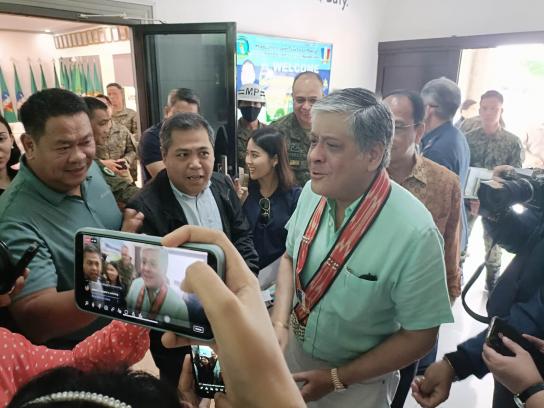
QUICK VISIT. Special Assistant to the President Secretary Anton Lagdameo speaks to reporters after a meeting with military and police officials in Camp Siongco, home of the Army's 6th Infantry Division in Barangay Awang, Datu Odin Sinsuat, Maguindanao del Norte, on Thursday (June 22, 2023). Lagdameo, together with former Presidential Adviser on Peace, Reconciliation, and Unity Secretary Carlito Galvez Jr., assured Bangsamoro Autonomous Region in Muslim Mindanao leaders of the government's support for peace efforts in the region. (Photo from Mark Tayco/DXMS Radio Cotabato)

CAMP SIONGCO, Maguindanao Norte – The Department of Justice (DOJ) and the National Bureau of Investigation (NBI) will conduct separate investigations on the June 18 police operation that left seven Moro Islamic Liberation Front (MILF) men dead in Maguindanao del Sur.

In a visit to this camp Thursday, former Presidential Adviser on Peace, Reconciliation, and Unity Secretary Carlito Galvez Jr. and Special Assistant to the President Secretary Anton Lagdameo Jr. shared that President Ferdinand R. Marcos Jr. has been informed of the request of MILF leaders for the conduct of a separate, independent, and impartial investigation of the operation.

“It is necessary to have a fair investigation and the government is considering the recommendation to bring back third-party monitoring teams,” Galvez told reporters after receiving a briefing from regional police and Army officials on the region’s security situation.

To clear gray areas, Galvez has suggested to the military and police leadership to come up with official reports and forward them to Bangsamoro Autonomous Region in Muslim Mindanao (BARMM) Chief Minister Ahod Balawag Ebrahim.

Officials of the Bangsamoro Transition Authority (BTA) have suggested bringing back the International Monitoring Team (IMT) composed of foreign peacekeepers to ensure the ceasefire agreement is implemented.


The Malaysian-led international peace monitoring group composed of about 60 peacekeepers had departed from the southern Philippines after the administration of former President Rodrigo Duterte.

Police Brig. Gen. Allan Nobleza, BARMM police director, said the operation was legitimate and only went haywire when one of the gunmen opened fire toward law enforcers during a search warrant operation in Barangay Madidis, Datu Paglas, Maguindanao del Sur on June 18.

During that time, operatives of the Criminal Investigation and Detection Group and the military were to serve search warrants against Nasser Husain and his brother Norjihad when a shootout erupted.

Both siblings died in the operation along with five others.

The Husain brothers were earlier charged with violation of Republic Act 10591 or illegal possession of firearms and explosives.


Mohagher Iqbal, former MILF chief peace negotiator, however, insisted that the fatalities were legitimate MILF members and that the operation against them by the police was a clear violation of the ceasefire mechanism.

The MILF stressed that state forces need to coordinate with them before conducting law enforcement operations in MILF communities to avoid unnecessary firefights, as stipulated in the GPH-MILF 1997 general agreement on the cessation of hostilities.


Galvez, citing a report from the law enforcers, said the subject of the Datu Paglas operation was verified to be affiliated with the outlawed Bangsamoro Islamic Freedom Fighters.

He quickly added that a third-party investigation is necessary “to remove all doubts.”


https://www.pna.gov.ph/articles/1204147

Lagdameo, Galvez certain of surrender of more local ISIS-inspired terrorists

Posted to Notre Dame Broadcasting Company (NDBC) Website (Jun 22, 2023): Lagdameo, Galvez certain of surrender of more local ISIS-inspired terrorists (By John M. Unson)


Special Assistant to the President Antonio Ernesto Lagdameo, Jr. while at Camp Siongco. (John Unson)

COTABATO CITY -- Two officials directly under President Ferdinand Marcos, Jr. are optimistic of the surrender soon of more local terrorists after hundreds who yielded ahead had been reintroduced to mainstream society.

Special Assistant to the President Antonio Ernesto Lagdameo, Jr. told reporters, while at the headquarters of the Army’s 6th Infantry Division in Camp Siongco in Datu Odin Sinsuat, Maguindanao del Norte Thursday, he is glad with how the military and police had secured the surrender of hundreds of terrorists from groups fashioned from the Islamic State of Iraq and Syria in recent months.

At least 417 members of the Bangsamoro Islamic Freedom Fighters and the Dawlah Islamiya had returned to the fold of law in batches since 2019 through the intercession of the units of 6th ID and the regional police offices in the Bangsamoro Autonomous Region and in Region 12.


Both groups have a reputation for fomenting hatred for non-Muslims and are tagged in all bombings, in recent years, of public conveyances and commercial establishments in Central Mindanao whose owners had refused to shell out “protection money” on a monthly basis.

“We are appealing to the remaining members of these terrorist groups to allow authorities and agencies of the Bangsamoro government to work out their reintegration into mainstream society,” Lagdameo said.

Lagdameo and Presidential Adviser on Peace, Reconciliation and Unity Carlito Galvez Jr. were at Camp Siongco Thursday for a brief meeting with 6th ID’s commander, Major Gen. Alex Rillera.

Rillera is also overseeing the Army’s anti-terror Task Force Central covering the Bangsamoro provinces of Maguindanao del Sur and Maguindanao del Norte, Sultan Kudarat, South Cotabato, North Cotabato and Sarangani, all in Region 12.


Lagdameo and Galvez also visited the office of Maguindanao del Norte Gov. Abdulrauf Macacua for a peace and security dialogue after their official engagement with Rillera.

Galvez had served as commander of the 6th ID for about two years while still a major general in the Philippine Army.

He told reporters he is glad seeing how units of the 6th ID and agencies of the Bangsamoro Autonomous Region in Muslim Mindanao and local government units in BARMM are together enticing members of the BIFF and the Dawlah Islamiya to avail of the division’s reconciliation program for violent religious extremists.

“Credit also has to go to the Police Regional Office-Bangsamoro Autonomous Region and the Police Regional Office-12,” Galvez said.

Police units in Region 12, under Brig. Gen. Jimili L. Macaraeg, and in the Bangsamoro region, led by Brig. Gen. Allan C. Nobleza, had facilitated the surrender of 189 BIFF and Dawlah Islamiya members in the past 16 months.

https://www.ndbcnews.com.ph/news/lagdameo-galvez-certain-surrender-more-local-isis-inspired-terrorists

Moro Islamic Liberation Front seeks independent probe of Maguindanao del Sur gun fight

 From the Manila Bulletin (Jun 22, 2023): Moro Islamic Liberation Front seeks independent probe of Maguindanao del Sur gun fight (By KEITH BACONGCO)

DAVAO CITY – The Moro Islamic Liberation Front (MILF) Central Committee has sought an independent probe on the recent law enforcement operation in which seven members were killed in Datu Paglas town in Maguindanao del Sur.

In a resolution dated June 20 but made public on June 22, the MILF Central Committee said that the failure of government forces to coordinate the operation was a gross violation of the ceasefire agreement and undermines the primacy of the Bangsamoro peace process.

It also called for an urgent “impartial, honest, credible, and fair fact-finding investigation by a third-party investigator.”

The MILF called on President Ferdinand R. Marcos Jr. to give “paramount importance to justice, peace, and security” amid the ongoing investigation.

Signed by MILF Chairman and Bangsamoro Autonomous Region in Muslim Mindanao Chief Minister Al Haj Murad Ebrahim, the resolution noted that the horrific incident happened in an MILF community where the victims have already filed their applications for amnesty, which is an integral component of the Comprehensive Agreement on the Bangsamoro between the Government of the Philippines (GPH) and the MILF.

Killed in the raid were MILF National Guard Front leader George Kasim and subordinates Nasser Yousef Husain, 34; Norjihad Husain, 29; Nasrullah Mamay Singkala, 38; Ivan Pumpuga, 18; Izrael Laguiab, 41; Morsid Madidis, 50, and Mama Karim, 53.


Bangsamoro Government Member of Parliament Baileng Simpal Utto Mantawil echoed the MILF’s statement, saying the operation was a gross ceasefire violation due to the failure of State security forces failure to coordinate with the MILF.

“As a representative of the Bangsamoro people, it is our solemn duty to protect their rights and to ensure their safety and to seek justice when their rights are violated,” Mantawil said in a speech before fellow members of the parliament. “We cannot turn a blind eye to the atrocities committed to our own people.”

She added that the raid raises serious questions about the manner on how it was executed amid circulating reports that the victims had been handcuffed and allegedly killed in sacred spaces.

“This casts a dark shadow on the credibility of the operation,” Mantawil added in her speech which was streamed live on Facebook.

Bangsamoro Autonomous Region police chief Police Brig. Gen. Allan Nobleza insisted that the raid in Datu Paglas was a legitimate law enforcement operation conducted by the Criminal Investigation and Detection Group in the BARMM.

The Armed Forces of the Philippines-Western Mindanao Command (Wesmincom) said that the fatalities were members of the Bangsamoro Islamic Freedom Fighters-Karialan Faction.

The Wesmincom said that operating troops implemented search warrants No. 01-2023 and 02-2023 for violation of RA 10591 against Nasser Yussef Hussain, alias “Tutin Usop,” and Nurjihad Husain, alias “Datdat Usop.”

“When they were approaching the subject’s residence, an undetermined number of BIFF members fired upon the government forces, which resulted in the wounding of one police personnel.”

Seized in the operation were six firearms – one Uzi, two M16 rifles, and three caliber .45 pistols – and assorted ammunition.

https://mb.com.ph/2023/6/22/milf-seeks-independent-probe-maguindanao-del-sur-gun-fight

Moro Islamic Liberation Front seeks third-party probe on ‘horrific’ Datu Paglas incident

 From MindaNews (Jun 22, 2023): Moro Islamic Liberation Front seeks third-party probe on ‘horrific’ Datu Paglas incident (By BONG S. SARMIENTO)

KORONADAL CITY (MindaNews / 22 June)—The Moro Islamic Liberation Front (MILF) has asked the Government of the Philippines (GPH) to let an independent third party investigate the recent law enforcement operation in Datu Paglas, Maguindanao del Sur that killed seven MILF members.


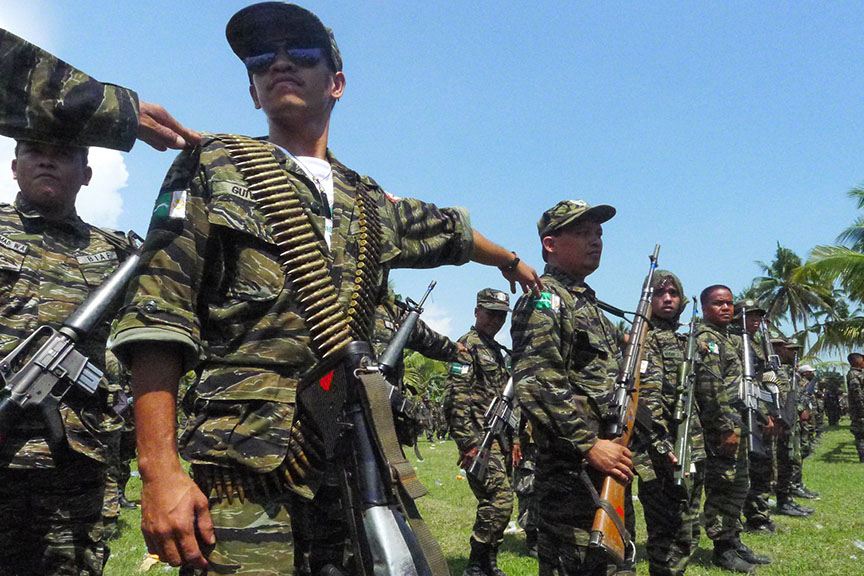
MILF combatants at Camp Darapanan. MindaNews file photo by BONG S. SARMIENTO

The group also called on President Ferdinand Marcos Jr. to give “paramount importance to justice, peace and security” in the Bangsamoro region amidst their call for investigation on the matter.

In a resolution made public Thursday, the MILF’s Central Committee stressed the failure of state security forces to coordinate the law enforcement operation with the front was a gross violation of the ceasefire agreement and undermines the primacy of the Bangsamoro peace process.

MILF chair Ahod “Al Haj Murad” Ebrahim, who is also the interim Chief Minister of the Bangsamoro Autonomous Region in Muslim Mindanao, and Abunawas “Von Alhaq” Maslamama, acting MILF Central Committee secretary and concurrent BARMM Senior Minister, signed the resolution on Tuesday, June 20, following a special meeting called by the front’s main organ at Camp Darapanan, the MILF’s headquarters in Sultan Kudarat, Maguindanao del Norte.

The front confirmed those killed were legitimate MILF members belonging to its National Guard Front, 11th Brigade, Inner Guard Base Command. They were identified as Nasser Yousef Husain, 34; Norjihad Husain, 29; Nasrullah Mamay Singkala, 38; Ivan Pumpugay, 18; Izrael Laguiab, 42; Morsid Madidis, 50; and Mama Karim, 53.

“This horrific incident happened in an MILF community where the victims already filed their applications for amnesty,” the resolution said.


The amnesty program is an integral component of the Comprehensive Agreement on the Bangsamoro (CAB), which the GPH and the MILF signed in 2014 after 17 years of negotiations.

Alhaq said the “loss of lives and injustice” could have been prevented had the operating team followed the guidelines of the Ad Hoc Joint Action Group (AHJAG).

AHJAG is a cooperative mechanism in the Bangsamoro peace process that responds to criminality and terrorism in areas with MILF presence.

Triggered by the bloody incident, the MILF Central Committee also sought the convening of the Joint Peace Implementing Panels of the GPH and MILF in Malaysia, the third-party facilitator during the peace negotiations, in July “in keeping with the signed agreements and towards efforts of resolving divergent views on some aspects of implementation.”

The MILF singled out the Philippine National Police’s (PNP) Criminal Investigation and Detection Group – BARMM for the tragic incident in Barangay Damawato, Datu Paglas in the wee hours of June 18.

The military also took part in the operation.

Brig. Gen. Allan Nobleza, PNP director in the BARMM, said the two main targets, the Husain brothers, were allegedly involved in criminal activities, including the bombing of a power line of the National Grid Corporation of the Philippines and the 2021 attack and occupation of the Datu Paglas public market

Maj. Gen. Alex Rillera, commander of the military’s Joint Task Force Central, said the operating troops were serving search warrants for the Husain brothers for alleged violation of Republic Act 10591 or the Comprehensive Firearms and Ammunition Regulation Act.

Rillera said the troops were met by gunfire, forcing them to retaliate.

A policeman was wounded in the clash.

He said the armed men were members of the Islamic State-aligned Bangsamoro Islamic Freedom Fighters, which the MILF disputed. (Bong S. Sarmiento / MindaNews)

https://www.mindanews.com/peace-process/2023/06/milf-seeks-third-party-probe-on-horrific-datu-paglas-incident/

ACLED: Special Issue: Violence Targeting Local Officials//The Philippines// Rivalries Between Local Elite in The Philippines

Posted to the Armed Conflict Location & Event Data Project (ACLED) (Jun 22, 2023): Special Issue: Violence Targeting Local Officials//The Philippines// Rivalries Between Local Elite in The Philippines Fuel Violence (By Tomas Buenaventura)

The Philippines has historically grappled with a high level of violence targeting local administration officials, particularly in relation to electoral competition between local elite families. The high-profile assassination of Negros Oriental Governor Roel Degamo in March 2023 is a recent example that illustrates this phenomenon.1 However, such violence has long persisted in the Philippine countryside. The most notorious example is the Maguindanao Massacre of November 2009, in which 58 people were killed in an attack masterminded by members of the Ampatuan clan against their rival Mangudadatu family.2 The attack is also thought to be the most lethal assault on the press in contemporary history, as 32 journalists were among those killed.3 The massacre took the lives of several members of the Mangudadatu family during an election-related event, including a vice mayor and other relatives of a Mangudadatu scion set to run against an Ampatuan for governor.4

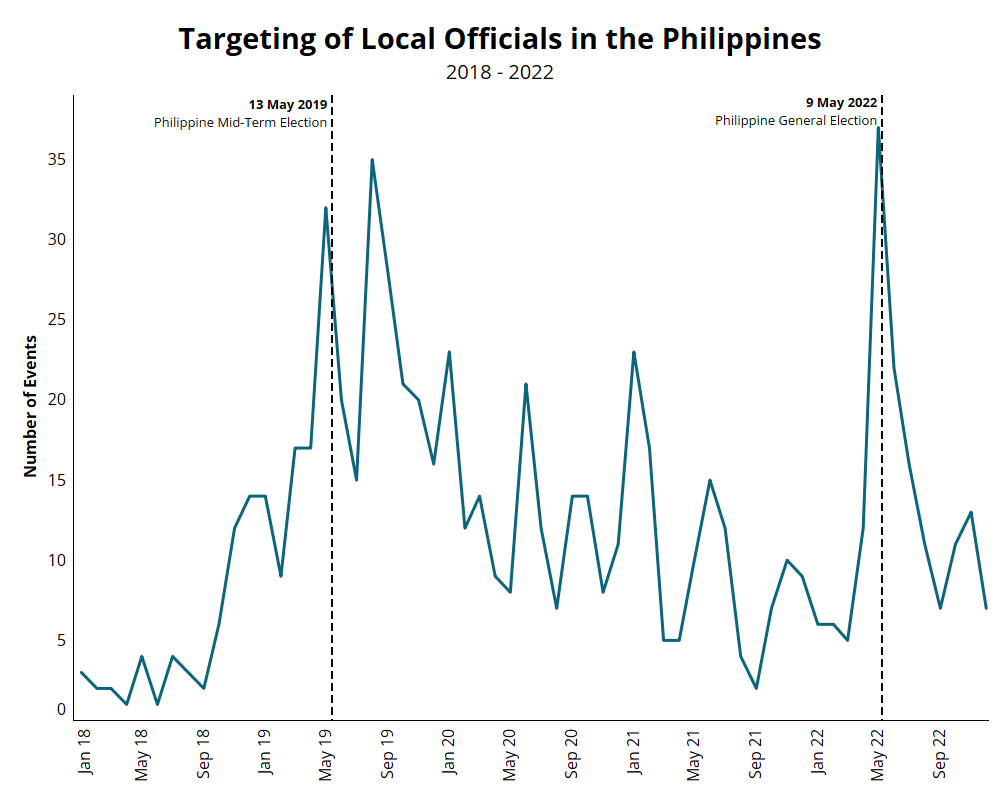
These examples reflect the brazen nature of such violence. However, its prevalence is equally alarming: ACLED records 716 acts of violence against local officials between 2018 and 2022. Such violence is heavily concentrated in rural areas, particularly in the Bangsamoro Autonomous Region in Muslim Mindanao (BARMM), and especially during election periods. ACLED data show notable spikes of violent events targeting local government officials during the May 2019 midterm and May 2022 general elections, with BARMM, particularly the Maguindanao provinces, accounting for a disproportionately high amount of such targeting.

BARMM, like other rural areas that see elevated levels of such violence, is marked by conflict and characterized by a devolved political system, the proliferation of political dynasties, and the domination of ‘strong families’ who find recourse in violence to secure their interests. This report examines the temporal and subnational patterns seen in the targeting of local officials in the Philippines.
Electoral Violence Driven by Hired Unidentified Assailants

While the Philippines is home to many conflicts, including the communist insurgency as well as the Moro separatist struggle in Mindanao, a large percentage of the violence targeting local officials occurs outside of such conflicts. Many attacks occur without clear motives identified in media reports. ACLED data show 79% of violence targeting local government members between 2018 and 2022 was committed by unidentified actors. While the identity of those who carry out such violence is often unknown, much of this violence is thought to be committed by hired killers acting at the behest of local political players, and also possibly by members of private armed groups associated with political families.5 Peace Research Institute Frankfurt Professor Peter Kreuzer found that political players are more likely to engage hired guns for one-off or rare operations, rather than utilizing a private army that might be better known to law enforcement and thus easier to connect to the mastermind. As such, Kreuzer notes that “in the vast majority of cases it cannot be proven who actually ordered the killings.”6

Political competition drives spikes in the targeting of local officials in the Philippines, as evidenced by increases in such violence during election seasons.7 ACLED data show a significant increase in the targeting of local officials around midterm elections in May 2019 and around presidential elections in May 2022 that saw the transition from President Rodrigo Duterte to new President Ferdinand ‘Bongbong’ Marcos, Jr. (see figure below). Over 30 such violent events were seen in May 2019, followed by an even higher peak of nearly 35 events in August 2019, fresh into the election winners’ new terms. The May 2022 election period was even more violent, with over 35 violent events targeting local officials during that election month alone.


This electoral violence is partly driven by electoral competition between political dynasties. The Philippine political landscape is characterized by the proliferation of political dynasties, as well as the system of political patronage they depend on for survival. Political dynasties, or the capture of multiple or successive elective posts by members of the same family, are technically banned by the Philippine 1987 Constitution. However, this ban has not been operationalized due to the lack of a required enabling law8 – one that has a poor chance of passing in a House of Representatives dominated by political dynasties.9 As of 2016, 78% of the members of the House of Representatives were part of political dynasties.10

The 2019 attack on Amado Espino, Jr., a former governor and representative of Pangasinan province in the Ilocos Region, is a typical example of such violence involving political dynasties. Espino is the patriarch of a powerful clan that has seen several members in top elected positions, such as his son who was then the incumbent governor. In an ambush on 11 September 2019, assailants injured Espino and killed a police officer serving as Espino’s aide. Hired assailants, including a former scout ranger from the Philippine Army, perpetrated the ambush.11

Police investigators later identified the attack’s mastermind as Raul Sison, a provincial board member from a smaller political dynasty whose son was also serving as a town mayor. The alleged mastermind died due to COVID-19 in March 2020 and the motive for the attack is still unclear.12 Nonetheless, Sison was described in a media report as a ‘deserter’ of the Espino camp, which was engaged in fierce electoral battles.13 Espino again ran for governor in 2022, though he lost in an upset.14

These dynamics in local politics have led some observers of Philippine society to note the outsized impact of ‘strong families,’ representing a dominant oligarchic class who thrive on political patronage vis-à-vis the ineffectual presence of the so-called ‘weak state’ in their localities.15 Such a reality, coupled with the weakness of political parties in the Philippines, also means families play an outsized role in the political landscape, taking on the role played by parties in other contexts as vectors for political movement.16 When multiple oligarchic families find themselves competing for the same set of elective posts, all promising access to lucrative local budgets and discretionary funds, some end up finding recourse in political violence to secure desired political outcomes. This phenomenon was referred to by Kreuzer as ‘violent self-help,’ which appears to have been accepted as a political reality in certain settings in the Philippines.17 The prevalence of violent self-help among political families collapses the lines separating the institutional and personal, whereby extra-institutional means are used to secure the dynasty’s hold on power.

Further, recent research into the impact of political dynasties on Philippine society shows that political violence is a manifestation of both political and socioeconomic inequality. In areas outside the capital Manila and the main island of Luzon, which enjoy greater distance from close institutional surveillance, the persistence of political dynasties is associated with greater poverty.18 Such areas are commonly dominated by local ‘bosses’ who seize control over an area’s resources, partly through coercion and partly through institutional legal means.19

The poverty in these areas has helped generate a prevalence of actors willing to take up political violence. However, it is not just dejected, impoverished citizens who turn toward violence as an appealing alternative to their current reality. Rather, segments of the elite, usually dynastic political families, try to secure their interests by actively turning toward such actors to do their bidding.20 The concentration of political violence in areas far removed from national centers of power is, thus, a sign of the weakness of institutions and inadequately established government accountability.
Local Officials in BARMM at Higher Risk

The targeting of local officials in the Philippines is concentrated mostly in rural areas. ACLED data show that between 2018 and 2022, just under 86% of events tagged in the ACLED data set as violence targeting local officials occurred in rural areas. For the purposes of this report, rural areas are defined as all areas in the Philippines outside of 33 cities described as “highly urbanized” in the 2020 census, which include 16 cities in the National Capital Region (NCR) and 17 cities outside the NCR.21

The prevalence of this phenomenon in the Philippines, particularly in rural areas, is rooted in certain rural dynamics that facilitate an easy recourse to political violence. One relevant characteristic of the rural Philippines is the power and influence of local politicians in charge of and competing for positions in the local government unit. Such power and influence derive largely from a decades-long governmental push toward devolution. This process was definitively ignited by the enactment of the Local Government Code of 1991, which delegated most basic governmental functions and services to the different levels of local government.22

Violence is often seen in the very lowest levels of Philippine governance. ACLED data show that a significant portion of violence targeting local authorities is committed against officials in barangays (sub-city or sub-town districts), such as barangay chairpersons and barangay councilors. A smaller number of attacks concern other local administrative positions – from the municipal or city levels, all the way to the provincial level.

The geographical patterns of violence against local officials largely track with the general population of the country. As such, the eight regions comprising the country’s largest island group of Luzon – home to nearly 60% of the country’s population – make up the largest share of violent events against local officials between 2018 and 2022. Mindanao and the Visayas followed. However, some regions have a disproportionately higher share of such violence relative to their population, particularly the BARMM. While BARMM falls in the middle of the pack in terms of its national population share, at 4%,23 it sees the second highest number of violent events against local officials between 2018 and 2022 (see map below). Slightly over 10% of violence targeting local officials occurred in BARMM, trailing only slightly behind Calabarzon – the country’s most populous region – at nearly 11%.
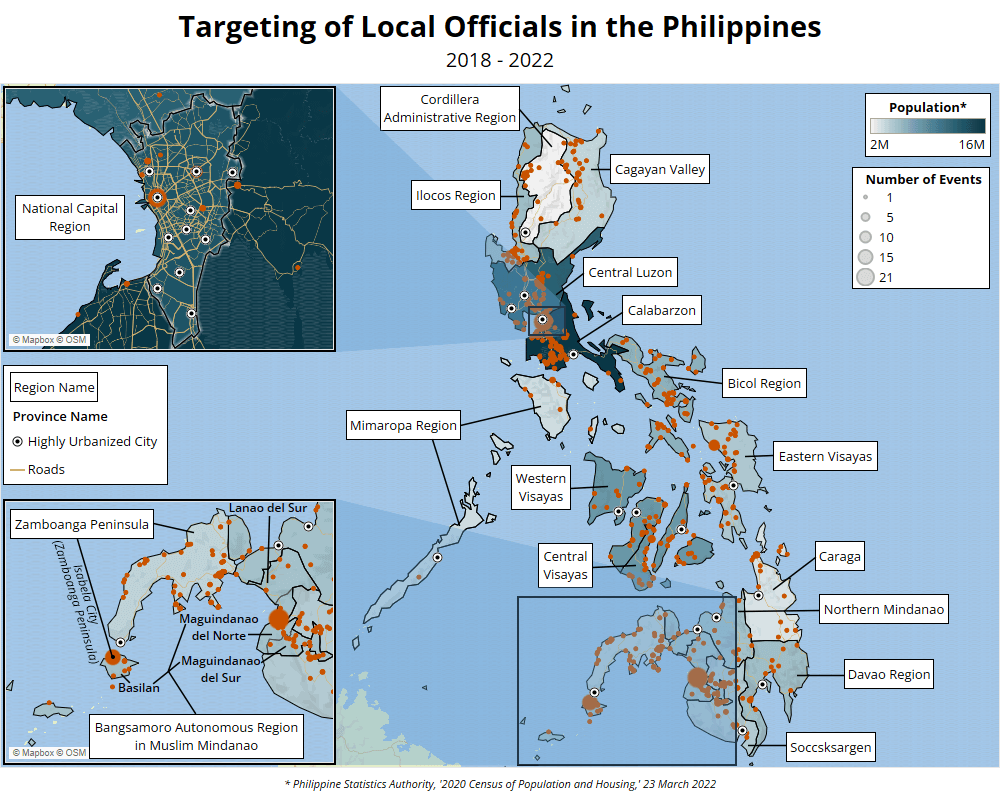


Within BARMM, the two Maguindanao provinces comprised nearly three-fourths of all violent events targeting local officials between 2018 and 2022. Maguindanao del Norte saw 44% of such violent events in the region, while Maguindanao del Sur recorded 32%. Lanao del Sur and Basilan (excluding Isabela City, which is not part of BARMM as per the 2019 Bangsamoro plebiscite) also see elevated levels of violence.

The intersection of multiple issues characterizes the situation in BARMM. In particular, the Maguindanao provinces – a single province until a 2022 referendum – are beset by rivalries between dynastic families caught in rido, a term for clan feuds in BARMM.24 These deeply rooted disputes extend from issues over land, to the contestation of political positions. In rido-related disputes, militias affiliated with rival clans sometimes engage in clashes, or carry out attacks against the rival clan, in some cases leading to the deaths of prominent rival clan members, including those working in local government. Such conflict occurs amid a difficult security landscape defined by the presence of armed groups, such as the Moro Islamic Liberation Front (MILF) and Islamic State-inspired breakaways, such as the Bangsamoro Islamic Freedom Fighters. A telling manifestation of this interplay between preexisting local conflict dynamics and violence targeting local officials is the fact that the masterminds behind the Maguindanao Massacre of 2009 initially tried to pass the blame on to the MILF.25

Notably, data from the 2019 midterm elections show that the former single Maguindanao province also had the highest national rank in terms of the share of ‘fat dynasties,’ defined as families with two or more members in elected office. There, 51% of elected posts were occupied by members of fat dynasties.26 In this context, where actors from different conflicts often associate with powerful families and vice versa, and where ongoing issues have generated an abundance of firearms,27 fighting can involve the killing of local officials who happen to be an obstacle to the interests of a local boss.
Violent Recourse for Elite Interests

Violence against local officials in the Philippines is a multifaceted issue, reflecting long-standing, historically rooted political and socioeconomic realities. Other ongoing issues of political violence in the Philippines also influence the way such realities play out, therefore comprising a complex web of political violence in the country. This political violence was recently again dramatically brought to the spotlight through the aforementioned killing of Negros Oriental Governor Degamo on 4 March 2023. The incident, which followed a high-profile electoral dispute, again illustrated some common aspects of such events: hired killers carrying out an operation after allegedly being contracted by members of a rival political family.

Degamo had faced off in the Negros Oriental gubernatorial race in May 2022 against a member of the powerful, dynastic Teves family, whose dominance in Negros Oriental resembles the Espinos’ position in Pangasinan. While Pryde Henry Teves was initially declared the winner in that May 2022 race, the Commission on Elections later nullified his win after ruling that thousands of additional votes were rightfully awarded to Degamo.28 Degamo thus took over as governor – though his time in office was cut short. The killing was carried out professionally by at least 16 ‘highly skilled’ and heavily armed assailants, including former dishonorably discharged soldiers and even a former New People’s Army rebel.29

The Degamo case is somewhat atypical in that the assailants and the mastermind were identified with relative speed. State prosecutors are considering Arnolfo Teves, Jr., the brother of Pryde Henry and a sitting member of Congress, the top mastermind in the killing.30 The Degamo killing thus demonstrates how some locally powerful elites continue to feel emboldened to engage in violent self-help. Such violence secures an elite’s continued political and economic interests – against not only those of a rival elite, but the public interest at large.

[Tomas Buenaventura is a Philippines Senior Research Assistant at ACLED.]

[The Armed Conflict Location & Event Data Project (ACLED) is a disaggregated data collection, analysis, and crisis mapping project. ACLED collects information on the dates, actors, locations, fatalities, and types of all reported political violence and protest events around the world. The ACLED team conducts analysis to describe, explore, and test conflict scenarios, and makes both data and analysis open for free use by the public.]

https://acleddata.com/2023/06/22/special-issue-on-the-targeting-of-local-officials-the-philippines/

PNP nabs wanted ASG terrorist in QC subdivision

From the Business Mirror (Jun 22, 2023): PNP nabs wanted ASG terrorist in QC subdivision (By Rene Acosta)

A member of the local terrorist Abu Sayyaf Group (ASG) wanted for a string of criminal cases in Zamboanga was arrested on Wednesday by police operatives in Quezon City where he had been hiding for the past two years.

Janhar Abdulhari alias Julpikar Pendiwata, 37, was arrested on Wednesday night at Tierra Pura Homes, Tandang Sora in Quezon City, according to Southern Police District Director Brig. Gen. Kirby John Brion Kraft.

Kraft said that Abdulhari, a notorious member of the ASG fled to Metro Manila, following the filing of murder and kidnapping charges against him in Zamboanga Sibugay, where is also being hunted by local authorities.

“The suspect was a known member of the ASG operating under Kumander Wanning Abdusallam. The ASG has been implicated in numerous cases of kidnapping and murder in Zamboanga Sibugay over the past several years,” Kraft said in a statement.

Specifically, the ASG member was being sought for murder in Zamboanga, which he had managed to elude for the past two years.


Kraft said Abdulhari was also listed in the wanted lists of municipal and provincial levels of Zamboanga Sibugay.

The police director said Abdulhari was traced in Quezon City following intelligence reports where the warrant for murder was also served on him.

The ASG member was taken to the District Special Operations Unit of the Southern Police District office where he underwent arrest-booking procedures.

The suspect is also undergoing debriefing.

https://businessmirror.com.ph/2023/06/23/pnp-nabs-wanted-asg-terrorist-in-qc-subdivision/