Saturday, March 28, 2020

Army delivers donated PPE to Northern Mindanao and Caraga hospitals

Posted to Kalinaw News (Mar 28, 2020): Army delivers donated PPE to Northern Mindanao and Caraga hospitals (By 4th Infantry “Diamond” Division)


CAMP EVANGELISTA, Cagayan de Oro City – Amidst the depletion of medical supplies due to the Corona Virus Disease (COVID) 19 pandemic, the 4th Infantry “Diamond” Division through its 4th Civil-Military Operations “Kasaligan” Battalion and Infantry Brigades delivered boxes of donated Personal Protective Equipment (PPE) to the different hospitals in Northern Mindanao and Caraga regions this March 27-28, 2020.

The said PPE were donated by The Outstanding Women in Nation’s Service (TOWNS) Foundations, Inc. Each box contains 100pcs surgical masks, 100pcs N95 masks, 200pcs disposable gloves, 100pcs goggles, 100pcs face shields, 100pcs raincoats, and 2pcs alcogel. Two boxes of PPE were delivered to Bukidnon Provincial Medical Center (BPMC) in Bukidnon Province, two boxes to Northern Mindanao Medical Center (NMMC), one box to Capitol University Medical Center (CUMC), one box to CDO Medical Center (CDOMC), one box to Xavier University Maria Reyna Hospital, one box to Polymedic Medical Plaza all in Cagayan de Oro City, while two boxes of PPE to D.O. Plaza Memorial Hospital in Agusan del Sur, and two boxes to Caraga Regional Hospital and another two boxes to San Isidro Rural Health Unit all in Surigao del Norte.

Dr. Stephanie Hacutin, Chief Hospital of CDOMC expressed her gratitude to TOWNS Foundation and 4ID.

Dr. Renato Alagadan, Head, CUMC Task Force COVID happily said, “We really appreciate the donations of TOWNS Foundation because the front liners really need these items. These supplies are valuable in keeping my troops healthy to fight another day.”

Maj. Gen. Franco Nemesio Gacal, the Commander of 4th ID said, “In this time of crisis we are glad that our “Bayanihan” spirit is alive and burning. 4ID is always ready and eager to give assistance in delivering the much needed PPE for the medical front liners against COVID-19.” “We also urge our community to follow the health advisories of our medical experts and the Department of Health. Be a hero, stay at home,” Gacal ended.


[Kalinaw News is the official online source of information on the pursuit for peace in the Philippines This website is a property of the Civil-Military Operations Regiment, Philippine Army located at Lawton Avenue, Fort Bonifacio, Taguig City. Contact us: kalinawnews@cmoregiment.com]

https://www.kalinawnews.com/army-delivers-donated-ppe-to-northern-mindanao-and-caraga-hospitals/

Kalinaw News: Three High-Ranking NPAs Yield Firearm After Localized Peace Talks

Posted to Kalinaw News (Mar 28, 2020): Three High-Ranking NPAs Yield Firearm After Localized Peace Talks (By 2nd Infantry Division)


CAMP CAPINPIN, Tanay, Rizal — Three NPA terrorists voluntarily surrendered to government forces after two separate local peace negotiations in different areas across Southern Tagalog were concluded Friday.

The localized peace talks were held in the municipalities of Macalelon, Quezon and Sablayan, Occidental Mindoro.

Brigadier General Norwyn Romeo Tolentino, Commander of the 201st Infantry Brigade which has operational jurisdiction over southern Quezon, said in his report that alias Mark was a ranking leader of the NPA’s Platoon Sol which operates in Bondoc Peninsula before he turned himself in to Brgy Malabahay’s Barangay Task Force to End Local Communist Armed Conflict of BTF ELCAC.

He added that “he handed-over his Cal .30 M1 Garand to joint AFP and PNP forces as a gesture of good faith and belief to the government’s various development initiatives to finally attain the lasting peace which every Filipino truly deserves.”

“The surrender of alias Mark is a telling indicator that the NPA terrorists no longer enjoy the mass base support that they used to have in this area which they consider as one of the bastions of communist terrorism in our country, thus, assuring us that their collapse is, indeed, just a matter of time,” said BGen Tolentino.

Relatedly, Brigadier General Antonio Lastimado, Commander of the 203rd Infantry Brigade which covers Mindoro Island, said that the surrender of alias Jess and alias Lenny, a Platoon Leader and Political Guide, respectively, of the NPA’s SRMA 4D, was facilitated by Mayor Andres Dangeros of the Municipality of Sablayan.

He attributed the continuing influx of surrenders to “RTF ELCAC MIMAROPA’s proactive stance in actively implementing PRRD’s call for a whole of nation approach in putting an end to insurgency that has been hampering our country’s growth and potentials.”

BGen Lastimado ended his statement by assuring the public that “your soldiers will never waver in fulfilling our most sacred oath to serve the Filipino people and secure every inch of land under our jurisdiction.”

The names of the surrenders are being withheld as part of the security protocol being implemented to prevent possible retaliatory actions that may be launched by their former comrades against them for turning their backs to the underground movement.

Major General Arnulfo Marcelo Burgos Jr, Commander of the Philippine Army’s 2nd Infantry Division, expressed his gratitude to the people of Southern Tagalog “for the unconditional support and unwavering trust to their soldiers who have committed themselves to the attainment of peace, prosperity and development in this part of the country.”

He also shared his optimism that his troops, together with the different agencies and LGUs in the region, will be able to deal the enemies of the state the decisive blows while assuring their constituents that “our firm resolve to win the peace will never waver despite your soldiers’ direct involvement in the government’s actions to contain the spread of COVID-19.”

Maj Gen Burgos ended his statement by lauding the former rebels “for choosing their families over the terrorists, for choosing peace over conflict and for choosing to be one with our Filipinos during our generation’s most challenging times.”

The former rebels will be enrolled in the Enhanced Comprehensive Local Integration Program or E-CLIP which provides up to Php 700,000 worth of grants and reintegration packages to members of the NPA terrorists who turned their backs to the underground movement.

Earlier this week, 13 former rebels received Php 688,000 worth of remuneration during a ceremony at Cavinti, Laguna for turning over various firearms to elements of the 202nd Brigade.

They were able to encash their cheques on the same day through the assistance of the provincial government and security forces in the area.

[Kalinaw News is the official online source of information on the pursuit for peace in the Philippines This website is a property of the Civil-Military Operations Regiment, Philippine Army located at Lawton Avenue, Fort Bonifacio, Taguig City. Contact us: kalinawnews@cmoregiment.com]

Kalinaw News: Amidst the COVID-19 crisis, NPA rebel surrenders

Posted to Kalinaw News (Mar 28, 2020): Amidst the COVID-19 crisis, NPA rebel surrenders (By 10th Infantry Division)


MALAPATAN, Sarangani Province – Another member of the Communist Terrorist Group voluntarily surrendered to the troops of 73rd Infantry Battalion on Wednesday, March 27, 2020, bringing along with him one (1) high-powered firearms.

Lt. Col. Ronaldo G. Valdez, Commander of 73IB, identified the surrenderee as Ronnie P. Pilay @ Tamsi, a member of Weakened Guerilla Front 71, FSMR and a resident of Sitio Laral, Brgy Datal Bukay, Glan, Sarangani Province.

Accordingly, @Tamsi was convinced to surrender after he attended a series of pulong-pulong conducted by CMO platoon of 73IB together with FRs who gave testimonies regarding the deception of the communist terrorist and the projects being implemented by the government for the FR and communities.

“Despite the deployment of troops in implementing the Enhanced Community Quarantine imposed in Sarangani, the 73IB is still committed to accomplishing its main mission to secure the people and protect rebels who are willing to return to the folds of the law .” Lt. Col. Ronaldo G. Valdez, said.

[Kalinaw News is the official online source of information on the pursuit for peace in the Philippines This website is a property of the Civil-Military Operations Regiment, Philippine Army located at Lawton Avenue, Fort Bonifacio, Taguig City. Contact us: kalinawnews@cmoregiment.com]

Balikatan exercises canceled because of coronavirus

From Rappler (Mar 28, 2020): Balikatan exercises canceled because of coronavirus (By JC Gotinga)

(UPDATED) What would have been the last iteration of the yearly drills between Filipino and American forces has been called off to protect soldiers’ health, says the US Indo-Pacific Command


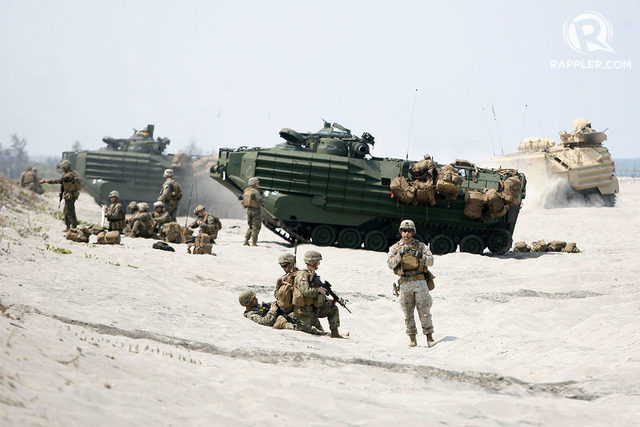
PH-US WAR GAMES. This file photo shows US soldiers and their Filipino counterparts joining forces in an Amphibious Landing operation as part of the 2015 Balikatan Exercises. File photo by Ben Nabong/Rappler

(UPDATED) – This year’s Balikatan (Shoulder-to-shoulder) Exercises, the biggest yearly series of drills between Philippine and US forces, has been canceled due to the novel coronavirus pandemic.

“Due to concerns for the health and safety of the participating exercise forces and local populations near the planned exercise areas, the US Indo-Pacific Command has cancelled Exercise Balikatan 2020 scheduled for May 4 to 15 in the Republic of the Philippines,”
the US Indo-PaCom said in a statement dated Thursday, March 26, and sent to reporters by the US Embassy in Manila on Friday, March 27.

“In light of the extraordinary cirumstances surrounding COVID-19 pandemic and in the best interest of the health and safety of both countries’ forces, it is prudent to cancel Balikatan 2020,”
said US Indo-PaCom commander Admiral Phil Davidson.

“We remain deeply committed to our longstanding alliance and friendship,”
Davidson added.


Defense Secretary Delfin Lorenzana said on Saturday, March 28, that given the current situation, the Philippines has "no problem" with the cancellation of the military exercises.

"As I said, we had 6 months to do the major exercises but we gave them (the US) the decision to go ahead or not. However, events were overtaken by COVID-19, and since foreigners are banned from coming, then the exercises are canceled," Lorenzana said.

To stay updated on news, advisories, and explainers, check out our special coverage page, “Novel Coronavirus Outbreak.”

Balikatan 2020 would have been the last iteration of the annual joint exercises, with the Visiting Forces Agreement (VFA) that allows for it set to lapse in August. President Rodrigo Duterte ordered the VFA’s repeal on February 11, setting off a 180-day countdown to its dissolution.

Set in May, the Balikatan was scheduled to still push through, with several thousand Filipino and American troops and an Australian military contingent set to participate.

https://www.rappler.com/nation/256082-balikatan-exercises-canceled-coronavirus-2020

Army in NegOr, stakeholders meet to prevent Covid-19 spread

From the Philippine News Agency (Mar 28, 2020): Army in NegOr, stakeholders meet to prevent Covid-19 spread (By Mary Judaline Partlow)


BORDER PATROL. The 11th Infantry Battalion of the Philippine Army, led by its commander, Lt. Col. Ramir Redosendo (center) on Friday (March 27, 2020) assures that the military supports ordinances on the prevention of the spread of Covid-19 in Negros Oriental. The military has been tasked by Governor Roel Degamo to help secure the borders of the province while it is under a general community quarantine. (Photo contributed by the 11th IB)

The 11th Infantry Battalion (11IB) of the Philippine Army in Negros Oriental, through its commander, on Friday assured that it fully supports the ordinances being implemented to prevent the spread of the coronavirus disease 2019 (Covid-19) in the province.

Lt. Col. Ramir Redosendo, 11IB commander, said in a statement that as one of the front-liners in the Inter-Agency Task Force on Covid-19, particularly responsible for border control points in the province, they are ready “to give full assistance and cooperation to the community.”

Redosendo coordinated with local chief executives and officials, police chiefs, municipal/health officers, and other stakeholders during a meeting here to discuss the stringent measures being implemented concerning the coronavirus pandemic.


He said the meeting also aimed to “enhance further the coordination and collaboration between different Inter-Agency Task Force members who are at the forefront in the fight” against the disease.

Redosendo emphasized to the mayors the importance of front-liners wearing personal protective equipment and the strict implementation of standard operating procedures during the general community quarantine period in the province.

The Philippine Army, Philippine National Police, Coast Guard, and similar service units have been tasked to patrol and seal the borders after Governor Roel Degamo declared a general community quarantine last week.

The 11IB is one of two battalions in Negros Oriental with headquarters in the southern town of Siaton.

https://www.pna.gov.ph/articles/1098043

8 BIFF fighters yield to Army in Maguindanao

From the Philippine News Agency (Mar 28, 2020): 8 BIFF fighters yield to Army in Maguindanao
(By Edwin Fernandez)


REBEL FIREARMS. Five of the eight firearms surrendered by former members of the Bangsamoro Islamic Freedom Fighters to military authorities in Maguindanao on Friday (March 27, 2020). The guns, which included a .50-caliber sniper rifle (in a tripod), are held for safekeeping and documentation at the Army’s 601st Infantry Brigade headquarters in Shariff Aguak, Maguindanao. (Photo courtesy of 6ID)

CAMP SIONGCO, Maguindanao – Eight combatants of the outlawed Bangsamoro Islamic Freedom Fighters (BIFF) separately surrendered to military authorities in Maguindanao on Friday.

Five of the BIFF radicals surrendered
with their rifles to the Army’s 90th Infantry Battalion (IB) in ceremonies held at the headquarters of the 601st Infantry Brigade (Bde) in Shariff Aguak, Maguindanao.

Col. Jose Narciso, the 601Bde commander,
identified the five BIFF surrenderers as Abdullahsi Zuarto, Saed Sadam Malsek, Mahir Mumna Datumanong, Moktar Saed Pangalao, and Usman Abu Ali.

In a separate program on the same day, three BIFF members identified as Bhuto Oledad, Ebra Kamedon, and Saudi Montawal--all from Barangay Dalgan, Pagalungan, Maguindanao--also voluntarily surrendered to the Army’s 7IB of the 602Bde.


“They decided to yield because of relentless military manhunt operations against them and for them to live peacefully with their families,” Narciso said in a statement.

He said the BIFF surrenderers turned in assorted firearms before renouncing their membership with the Daesh-inspired group.

Maj. Gen. Diosdado Carreon, commander of the Army’s 6th Infantry Division, lauded the military field commanders and the local officials for supporting the whole-of-nation approach in dealing with the enemies of the state.

Carreon said he expects more rebels will come out and surrender.

“They (surrenderers) are most welcome to become productive citizens in their respective communities in Maguindanao than to be hunted as outlaws,” Carreon said.

https://www.pna.gov.ph/articles/1098085

No problem with cancelation of probably last 'Balikatan': DND

From the Philippine News Agency (Mar 28, 2020): No problem with cancelation of probably last 'Balikatan': DND (By Priam Nepomuceno)  March 28, 2020, 10:27 am


Defense Secretary Delfin Lorenzana. (File photo)

Department of National Defense (DND) Secretary Delfin Lorenzana said he sees no problem with the cancelation of what could have been the last "Balikatan" exercises between the Philippines and the United States due to the threats posed by the coronavirus disease 2019 (Covid-19) outbreak.

"We have no problem. As I said, we had six months to do the major exercises but we give them (US) the decision to go ahead or not,"
he said in a message to reporters late Friday.

Earlier, Lorenzana said Washington DC always has the option to cancel any planned military maneuvers within the 180-day period following the abrogation of the Visiting Forces Agreement (VFA) in February.

"But events were overtaken by this (Covid-19). And since foreigners are banned from coming, then the exercises are canceled,"
he said.


This year's "Balikatan" exercises were originally scheduled from May 4 to 15.

More than 10,000 troops from the two countries were supposed to take part in the annual exercises.

Early this week, the United States Indo-Pacific Command in Camp Smith, Hawaii said the decision to cancel the exercises was "due to concerns for the health and safety of the participating forces and local population near the planned exercise area."

"In light of the extraordinary circumstances surrounding (the) Covid-19 pandemic and in the best interest of the health and safety of both countries' forces, it is prudent to cancel Balikatan 2020," US Indo-Pacific Command chief, Admiral Philip Davidson, said in a statement.

He, however, maintained that Washington DC remains committed to the US-Philippines Mutual Defense Treaty.

https://www.pna.gov.ph/articles/1098079

PAF planes airlift medical supplies in Covid-19 fight

From the Philippine News Agency (Mar 28, 2020): PAF planes airlift medical supplies in Covid-19 fight (By Priam Nepomuceno)


HELPING FIGHT VS. COVID-19. Air Force personnel unload medical supplies airlifted from various locations from an aircraft at the Villamor Airbase on Friday (March 27, 2020). The PAF has so far flown and transported over 75,000 pounds of personal protective equipment (PPE) and medical supplies, test kits, and specimen to different provinces in the country to fight the Covid-19 pandemic. (Photo courtesy of Air Force Public Affairs Office)

Transport planes of the Philippine Air Force (PAF) are continuously delivering essential equipment and medical supplies to front-liners to contain the coronavirus disease (Covid-19) outbreak, a spokesperson said on Saturday.

As of Friday, the PAF has flown and transported 75,766 pounds of personal protective equipment (PPE) and medical supplies to different provinces in the country, Maj. Aristides Galang said in a statement.


He added the PAF has provided its NC-212i, C-295, and C-130 transport aircraft to support the Inter-Agency Task Force for the Management of Emerging Infectious Diseases.

"With the widespread of Covid-19 the PAF is always committed to continuously provide assistance and untiringly support the government to win this battle," Galang said.

"Also, the PPE and medical supplies will greatly improve the working condition of our health workers and frontlines as well as protect them against the virus," he said.

https://www.pna.gov.ph/articles/1098088

Navy transports 48 hospital beds to PGH

From the Philippine News Agency (Mar 28, 2020): Navy transports 48 hospital beds to PGH (By Priam Nepomuceno)


BEDS FOR COVID-19 PATIENTS. Navy troops unload hospital beds at the Philippine General Hospital in Manila on Friday (March 27, 2020). The beds donated by St. Luke's Medical Center are for Covid-19 patients confined at the hospital. (Photo courtesy of Naval Public Affairs Office)

The Philippine Navy (PN) transported on Friday 48 donated hospital beds to the Philippine General Hospital (PGH) in Manila.

The hospital beds were donated by St. Luke's Medical Center (SLMC) for the PGH's Covid-19 patients.

In a statement on Saturday, Lt. Commander Maria Christina Roxas, PN public affairs office chief, said the donation was led by SLMC president and chief executive officer, Dr. Arturo de La Peña and executive vice-president and chief medical officer, Dr. Benjamin S.A. Campomanes.

The beds were turned over to the PGH through its head urologist, Dr. Dennis Serrano.

Roxas said the donation will greatly help the state-owned hospital in dealing with the increasing Covid-19 patients.

"PN flag officer-in-command, Rear Admiral Giovanni Carlo Bacordo, himself has reassured the health workers, troops and other government personnel manning the frontlines that the 'PN will continue to provide much-needed assistance as our country is continuously fighting to alleviate the effects of this pandemic'," Roxas said.

https://www.pna.gov.ph/articles/1098087

China Sends Ships, Planes over Disputed Seas to Show Strength after COVID-19 Outbreak

From Voice of America (Mar 25, 2020): China Sends Ships, Planes over Disputed Seas to Show Strength after COVID-19 Outbreak (By Ralph Jennings)


Medical personnel arrive in transport aircraft of the Chinese People's Liberation Army (PLA) Air Force at the Wuhan Tianhe International Airport following the outbreak of the novel coronavirus in Wuhan, Hubei province, China February 17, 2020.

China is asserting itself in disputed waters around Asia this month to look strong after containing the world’s first coronavirus outbreak as the rest of the world grapples with the disease now.

The Communist leadership seeks an image boost among its own population that's beleaguered by shutdowns and lockdowns -- measures to stop the spread of COVID-19. The deadly respiratory disease virus was discovered in central China in December and led to about 81,000 cases there.

Chinese officials hope to appear strong too around the world against growing resentment that China spawned the coronavirus that’s now hurting economic activity in India, Western Europe, the United States and parts of Southeast Asia, scholars say. China is making up as well for any military exercises they may have put on hold to fight the virus, some believe.

“Priority for China is to protect their national interests, so to step up or to implement military exercises is inevitable,” said Andrew Yang, secretary-general of the Chinese Council of Advanced Policy Studies think tank in Taiwan.

South China Sea and Taiwan

Chinese military aircraft carried out an anti-submarine drill this month in the contested South China Sea, apparently in response to patrols by U.S. warships, media in China report.

The U.S. guided-missile destroyer USS McCampbell passed through part of the sea March 10 in the U.S. Navy’s second mission this year to advocate that the waterway remains open internationally rather than coming under Chinese control.

In a less expected move, China held joint exercises March 15 with Cambodia despite risk of offending Vietnam and other Southeast Asian countries that resent China’s military presence in the region.

A Chinese fishing boat “militia” that has pestered the Philippines in the sea’s disputed Spratly Islands never went home in response to the coronavirus outbreak, said Carl Thayer, Southeast Asia-specialized emeritus professor at the University of New South Wales in Australia.


FILE - In this Monday, May 11, 2015, file photo, This aerial photo taken through a glass window of a military plane shows China's alleged on-going reclamation of Mischief Reef in the Spratly Islands in the South China Sea.

Beijing calls about 90% of the South China Sea its own despite competing claims by Brunei, Malaysia, the Philippines, Taiwan and Vietnam. China has reclaimed land to build up the resource-rich sea’s tiny islets for military use. Its coast guard vessels periodically pass through the claims of other countries, all of which are militarily weaker.

China has time from now until the late-year typhoon season to do even more in the South China Sea, Thayer said.

In another show of strength, three Chinese military planes have flown near Taiwanese airspace since February, the defense ministry in Taipei says. China claims sovereignty over self-ruled Taiwan and has not renounced use of force, as needed, to reach its goal of unification.

“Training for war preparedness will not be stopped even in the middle of the COVID-19 epidemic,” Chinese state-controlled news website Global Times said March 25 following an aircraft carrier-based exercise in Chinese territorial waters.

Responses to provocation

Chinese authorities said they had all but stopped the spread of the coronavirus spread this month. But some overseas, including U.S. President Donald Trump, have pointed at China as the source of the virus that has triggered economically destructive city lockdowns around the world. COVID-19 has killed about 18,900 people including 3,281 in China.

The U.S. Navy’s passages through the South China Sea year to date got China all the more fired up, analysts say. But the U.S. government, in the thick of its own COVID-19 response this month, isn’t helping other Asian countries resist China longer term as it has in the past, they add. Annual events where national leaders often discuss China’s maritime activity have been spiked this year.

For China, “it will be business as usual if not intensify,” Thayer said. “China is slapping back (at Washington), and the U.S. is showing no leadership, so it’s a vacuum for China to step in.”

China is likely to increase offshore military activity beyond normal levels only with a “pretext” such as more provocation from the United States, said Oh Ei Sun, senior fellow with the Singapore Institute of International Affairs. Otherwise, he said, China’s Asian neighbors would get angry.

“As long as this COVID thing is still running around over the next few months, I don’t think they will go to the extent of resuming reclamation (or) being too proactive in sending their coast guard,” Oh said. “Many countries would sort of at the back of their minds think this virus actually came from China.” 

Chinese Maritime Militia on the Move in Disputed Spratly Islands

From BenarNews (Mar 24, 2020): Chinese Maritime Militia on the Move in Disputed Spratly Islands


This annotated map shows the path of five Chinese maritime militia ships passing through the Union Banks in the Spratly islands during the first three weeks of March 2020.  RFA

Even as the coronavirus crisis sweeps through Asia, China continues to assert its presence in the South China Sea by deploying maritime militia around disputed islands and reefs in the Spratly island chain, according to vessel tracking data and satellite imagery reviewed by Radio Free Asia (RFA).

A fleet of Chinese ships has been moving this month through the Union Banks, a collection of small land features disputed between China, Malaysia, the Philippines, Vietnam and Taiwan. Among the most significant features in this area are the Chinese-controlled Hughes Reef and Johnson Reef, and Vietnam’s Sin Cowe Island and Collins Reef. These ships were identified as part of China’s infamous maritime militia by the Asia Maritime Transparency Initiative in January 2019.

The five ships whose movements could be tracked by RFA are now at Johnson Reef, in the southwest corner of Union Banks. BenarNews is affiliated with Radio Free Asia.

It may not be a coincidence that that their presence at that location comes within days of the 32nd anniversary of the Battle of Johnson Reef, a March 14, 1988, naval skirmish between Vietnam and China in which dozens of Vietnamese troops died and China seized control of the reef.


Multiple, unidentified vessels can be seen in the top right-hand corner of this satellite image taken just north of the Chinese-occupied base at South Johnson Reef March 22, 2020. [Planet Labs Inc.]

As usual, China has not publicized any build-up of its ships around Union Bank. The People’s Armed Forces Maritime Militia (PAFMM) often consists of what are ostensibly fishing vessels - although they do not engage in fishing. Their presence is meant to 'fly the flag' for Beijing in disputed waters without an overt display of military force that would draw international condemnation.

Zack Cooper, a research fellow specializing on Asian security issues at the American Enterprise Institute, said China was continuing with its assertive behavior in regional disputes despite the COVID-19 pandemic now commanding the world's attention.

“Beijing has stepped up military activity around Taiwan and now appears to be doing some of the same around Union Banks. Whether this is simply a continuation of previous activity or an intentional effort to use this distraction to put pressure on other claimants is unclear,” Cooper said.

Ship-tracking software indicates that five PAFMM vessels – with the call signs Yuetaiyu (Fishing vessel) 18777, 18333, 18888, 18222, and 18555 - passed in early March between China's reclaimed island at Subi Reef - often a waystation for Chinese ships deployed to the region - and Thitu Island, a Philippine-occupied feature where Chinese vessels have engaged in a sustained pressure campaign, as documented by the Asia Maritime Transparency Initiative. The ships first stopped at Whitson Reef, in Union Banks’ northeast, from March 3 to March 8.

Then, the vessels moved southwest to Chinese-controlled Hughes Reef, passing by Vietnamese-controlled Sin Cowe East Island (referred to by Vietnam as Sinh Ton Dong), and further west near Sin Cowe Island (Sinh Ton). The ships lingered near Sin Cowe between March 13 and March 18.

The exact number of Chinese ships deployed to the area very likely exceeds the five detected by RFA using ship-tracking software. Satellite imagery reveals many more vessels gathered in Union Banks although the identity of the vessels is unclear. About 12 ships moved to Hughes Reef between March 8 and March 13.

Additionally, dozens of other ships have been lingering in the northeastern point of Union Banks, inside Whitson Reef, since at least March 6 and were still in the area as of March 19. Whitson is a shallow coral reef, which hosts no artificial islands or facilities. Satellite imagery reveals large clusters of vessels banded together.


A closer-up view of the satellite image taken just north of the Chinese-occupied base at South Johnson Reef, shows multiple, unidentified ships, March 22, 2020. [Planet Labs Inc.]

The Yuetaiyu-series vessels that had been at Chinese-held Hughes Reef and then the Vietnamese controlled Sin Cowe islands, moved to China’s Johnson Reef on March 18. Again, satellite imagery shows far more ships in the area than the five broadcasting an AIS, or Automatic Identification System, signal.

All ships are required to have an AIS transponder to assist in tracking for search-and-rescue contingencies as well as for law enforcement purposes. Frequently, though, Chinese maritime militia ships simply turn their AIS transponders off to mask their activity. This has clearly been the case this time, as satellite imagery shows at least 30 vessels just at Johnson Reef.

Johnson Reef is a rock, according to the 2016 ruling by the United Nations’ tribunal on China’s claims in the South China Sea. Under the United Nations Convention on the Law of the Sea, a rock is stated plainly as a feature “which cannot sustain human habitation or economic life of their own,” and as such has no rights to an exclusive economic zone or a continental shelf on the seabed. Regardless, it has been built up by China into another artificial island it can use as a base.

As of March 23, the PAFMM ships have moved once again to the same spot near Sin Cowe Island they were at on March 13.

https://www.benarnews.org/english/news/philippine/philippines-china-03242020174342.html

Is the Philippines moving to active middle power diplomacy?

Posted to the East Asia Forum (Mar 27): Is the Philippines moving to active middle power diplomacy? (By Aileen S P Baviera, University of the Philippines)

The Philippines was first a colony and then a formal treaty ally of the United States for so long that many Filipinos tend to take the existence of reciprocal defence obligations for granted. For the most part, the Philippines has always supported US security objectives when asked — whether during the Pacific War, the Korean War, the Cold War, the conflicts in Indochina or the ‘Global War on Terror’.


This support was not always unconditional or particularly strong. Domestic opinion and regional sensitivities still had to be considered — including US concerns over entrapment and Philippine fears of abandonment.

But even the closure of major US military bases (Clark Air Base and Subic Naval Base) in the early 1990s following acrimonious negotiations to renew the basing agreement did not completely remove Manila’s importance as a strategic location for US operations in the Asia Pacific. In consequence, the 1998 Visiting Forces Agreement (VFA) and the 2014 Enhanced Defense Cooperation Agreement (EDCA) were put in place to ensure there was a legal framework to regulate the presence of US troops and the conduct of joint activities.

The security interests of the two sides continued to converge post-Cold War. As terrorist networks expanded across Southeast Asia and concerns grew over China’s maritime assertiveness in the disputed South China Sea, the Philippines still found the alliance useful for deterrence, capability-building and armed forces modernisation. The 2012 Scarborough Reef standoff with China and the 2017 Marawi siege by ISIS-inspired extremists are incidents etched in recent memory that underscore the continuing value of the 1951 Mutual Defense Treaty for both sides.

Many were surprised, therefore, when the Duterte administration served the US government notice of termination of the VFA on 11 February this year, to take effect after 180 days.

While the move has been justifiably criticised by many as whimsical, reckless and untimely, it has taken place in a particular context. Both internal factors — improved confidence buttressed by a growing economy, winding down of the longstanding Muslim separatist movement and a declining communist insurgency — and external factors — an improvement in bilateral relations with China, the worrisome trajectory of great power competition, the Trump administration’s credibility issues and the greater security efficacy of other middle powers — are pushing the Philippines out of path-dependent defence reliance on the United States.

Like other countries in the region, the Philippines fears getting caught in the crossfire should US–China animosity lead to conflict. China’s effective use of carrots and sticks — economic incentives alongside coercive diplomacy and economic statecraft — has left countries ambivalent about their own priorities. The prospect of economic connectivity with China via the so-called Belt and Road Initiative is one that the pragmatic elites of the region do not lightly dismiss. This has led most regional governments to adopt hedging strategies on China, rather than balancing or containment behaviour.

At the same time, the security challenges that China presents expose the inadequacy and sometimes irrelevance of traditional security approaches. ‘Grey zone’ attacks cannot be countered using the old tools that defence alliances have in their arsenals.

For the Philippines, losing control of Scarborough Shoal despite the Obama administration’s role in the 2012 negotiations, as well as subsequent US inaction while China embarked on major island construction activities in the South China Sea, brought home hard truth about what one can realistically expect from an ally.

President Duterte is the first Filipino leader to publicly acknowledge this. This does not mean that US support is no longer needed or wanted — only that Washington’s willingness to get involved cannot be assumed, and that its support carries its own risks and uncertainties.

Many countries in Asia are coming to terms with a strategic environment where China expects a louder voice in regional affairs. The challenge for these countries is binding China to a rules-based order to ensure that it respects the rights of its neighbours as sovereign if not equal states.

In Southeast Asia, the preferred order is one that is inclusive rather than exclusionary, where larger powers engage constructively. Weak or small states usually have little influence in these processes and are often pressured into taking sides or remaining silent. But middle powers may act to preserve their autonomy amid great power competition.

This could explain why Duterte invokes the need to end dependence on the United States as a justification for terminating the VFA. Interestingly, ending the VFA reinforces the Trump administration’s preference for minimising alliance obligations and comes at a time when China’s assertiveness is making the Philippines’ neighbours far more jittery. In this sense, the decision is creating more instability, not less.

Multilateral institutions such as ASEAN and its extended dialogue networks remain attractive platforms for middle powers to shape their strategic communities. But these institutions must be strengthened to remain relevant. As the concept of the ‘Indo-Pacific’ continues to be debated in terms of what it can contribute to regional stability and security, ASEAN ‘centrality’ will be challenged.

Will the Philippines gradually transform from a secondary power supportive of, and dependent on, US primacy into a middle power pursuing its own autonomous interests through more inclusive diplomacy? So far, no such vision has been articulated. But by moving farther away from the United States, Duterte is taking a gamble that may force him down this path. Otherwise, the only remaining alternative is alignment with China.

[The Editorial Board and entire EAF team were saddened to learn of the death of Professor Aileen Baveira from COVID-19 in Manila on 21 March. Her scholarship on China’s relations with Southeast Asia and her contributions to this Forum are widely acknowledged and appreciated. She was a warm and generous person and a friend to EAF whose good judgment and wise counsel will be deeply missed.]

[Aileen S P Baviera was Professor of China Studies and International Relations at the Asian Center, University of the Philippines, and the founding president of Asia Pacific Pathways to Progress.]

Bulatlat: Harassment, red-tagging of farmers continue in Quezon amid lockdown

From the pro-Communist Party of the Philippines/National Democratic Front (CPP/NDF) online propaganda publication Bulatlat (Mar 26, 2020): Harassment, red-tagging of farmers continue in Quezon amid lockdown (By Justin Umali)

“Instead of providing aid especially to vulnerable communities, the soldiers of the 85th IB are overtly sowing terror through militarization.”

SANTA ROSA, Laguna – Despite a global coronavirus pandemic, and a declaration by the President of a unilateral ceasefire between government forces and the revolutionary New People’s Army (NPA), rights group Karapatan said soldiers of the 85th Infantry Battalion in Quezon province still find the time to harass local farmers.

Karapatan-Quezon reported that since the March 19 ceasefire declaration, elements of the 85th IB have been involved in multiple incidents of right violations in the municipalities of Lopez, Catanauan, Macalelon, Unisan, Agdangan, Padre Burgos, and Atimonan.

According to the group, the 85th IB was reported to be forcing residents to “admit to being members of the NPA” and “accept the Enhanced Comprehensive Local Integration Program (E-CLIP) offer.”

E-CLIP is a livelihood program being offered by the Armed Forces of the Philippines to NPA members and its people’s militias in order to “help them return to the fold of the law and be with their families”.

The National Democratic Front of the Philippines, however, asserted that E-CLIP is a “money-making scheme” by the government, and the money supposedly being given to “rebel returnees” were instead taken by officials in the PNP and the AFP.

Aside from harassment and red-tagging, Karapatan Quezon noted in particular incidents in barangays Malabahay and San Vicente, Macalelon where soldiers ransacked houses while forcing upon them E-CLIP offers, and an incident in Brgy. San Francisco, Lopez where soldiers called on residents from a list to give them offers for E-CLIP.

In a similar incident, Karapatan Southern Tagalog also reported an incident that occurred on March 16 in barangay Olongtao Ibaba, Macalelon where a soldier accused a tricycle driver of bringing supplies to NPA guerrillas, before taking his phone and searching his belongings while pointing a .45 caliber pistol at him. The driver, however, was simply delivering goods he purchased in General Luna. He made a stop-over in Macalelon in order to relieve himself.

Karapatan Quezon condemned these actions, noting that the country is in the middle of “a global crisis brought about by COVID-19”. The group stated that these incidents were proof that “the army was failing to live up to its sworn duty to ‘serve and protect the Filipino people.’”

Jennelyn Dichoso, Karapatan Quezon secretary general, said, “Instead of providing aid especially to vulnerable communities, the soldiers of the 85th IB are overtly sowing terror through militarization.”

The entire province of Quezon is still under lockdown until April 12. As of press time there are four confirmed cases of COVID-19 in the province, and 136 persons under investigation.

https://www.bulatlat.com/2020/03/27/harassment-red-tagging-of-farmers-continue-in-quezon-amid-lockdown/

Bulatlat: ‘An example across the world,’ UN says of CPP’s ceasefire order

From the pro-Communist Party of the Philippines/National Democratic Front (CPP/NDF) online propaganda publication Bulatlat (Mar 26, 2020): ‘An example across the world,’ UN says of CPP’s ceasefire order (By Raymund Villanueva)


UN Secretary General Antonio Guterres

“The Secretary-General (Guterres) encourages the parties to reach a lasting political solution and end this longstanding conflict.”

The United Nations (UN) welcomed the temporary ceasefire order of the Communist Party of the Philippines (CPP), saying the group’s positive response to the call for a global ceasefire in the face of the corona virus disease (Covid-19) pandemic “will serve as an example across the world.”

In a statement, Stephane Dujarric, spokesperson for UN Secretary General Antonio Guterres, said they welcome the truce order issued by the CPP last Tuesday, March 24, against Government of the Republic of the Philippines (GRP) armed forces.

“The Secretary-General (Guterres) encourages the parties to reach a lasting political solution and end this longstanding conflict,” Dujarric added, referring to the 51-year revolution led by the CPP.

The CPP is the first belligerent force in the world to respond to Guterres’ appeal issued last March 24.

NDFP Negotiating Panel chairperson Fidel Agcaoili said the revolutionary forces in the Philippines deeply appreciates the UN recognition.

“We deeply appreciate the recognition extended by the UN Secretary General for the initiative of the revolutionary movement and the CPP to respond to his call for a global ceasefire in humanity’s common fight against the Covid-19 pandemic,” Agcaoili told Kodao in an online interview.

The CPP’s unilateral ceasefire order to all units and commands of the New People’s Army and the People’s Militias took effect starting midnight of today, Thursday, March 26 and ends on 23:59 of April 15.

The GRP earlier said NDFP chief political consultant Jose Maria Sison advise for the CPP and its forces to observe its own ceasefire during the pandemic “is a positive development.”

The GRP earlier declared a unilateral ceasefire against the CPP, the NPA, and the NDFP effective 00:00 hour of March 19 to 24:00 hours of April 15, Presidential spokesperson Salvador Panelo announced Wednesday evening, March 18.

https://www.bulatlat.com/2020/03/26/an-example-across-the-world-un-says-of-cpps-ceasefire-order/

CHR alarmed over attack against indigenous community in Davao Del Norte

From the Manila Bulletin (Mar 26, 2020): CHR alarmed over attack against indigenous community in Davao Del Norte (By Czarina Nicole Ong Ki)

The Commission on Human Rights (CHR) expressed alarm over the recent attack against an indigenous community in Kapalong, Davao Del Norte by alleged members of the New People’s Army despite the onslaught of the coronavirus disease 2019 (COVID-19) pandemic.


Commission on Human Rights (MANILA BULLETIN)

The reported attack took place early morning of March 24 in the remote village of Sitio Tapayanon, Barangay Gupitan of the town.

CHR Spokesperson Atty. Jacqueline Ann de Guia said that the Commission denounces that act of “deliberate violence” by the armed group. She stressed that the protection of indigenous cultural communities and indigenous peoples (IPs) in times of armed conflict and prohibition have been established under R.A. 8371 or the Indigenous Peoples’ Rights Act and R.A. 9851, otherwise known as the Philippine Act on Crimes Against International Humanitarian Law, Genocide, and Other Crimes Against Humanity.

“As such, we condemn the violence given that, considering the present COVID-19 pandemic, atrocities further push indigenous people into vulnerability,” said de Guia.

She even called on both the government and New People’s Army to agree on a genuine ceasefire in those communities in order to create a “more durable and permanent solution to armed conflict on the ground.”

De Guia likewise lauded the previous efforts made by the Armed Forces of the Philippines (AFP) and the Department of Social Welfare and Development (DSWD) to look into the needs of Sitio Tapayanon. These include civil registration, malnutrition, basic education, health concerns of the elderly and children, registration of IPs political structure, inclusion of ancestral domain, and hygiene and sanitation.