Saturday, September 2, 2017

Maute group possibly hiding in Lanao, Maguindanao border

From the Philippine Star (Sep 2): Maute group possibly hiding in Lanao, Maguindanao border


A police officer holds a poster of wanted militants known as "Maute " group at a checkpoint set up at the entrance to Iligan City on Saturday, May 27, 2017 in Mindanao. Iligan city is one of the safe havens for the tens of thousands of Marawi residents who have fled their city following the rampage by Muslim militants. AP/Bullit Marquez

Islamic militants have been hiding in Mount Cararao, not in Buldon town in Maguindanao, long before the May 23 outbreak of the conflict in Marawi City, officials said early Saturday.

Mount Cararao, a vast swath of highland fields with scattered rainforests, separates the provinces of Maguindanao and Lanao del Sur, both in the Autonomous Region in Muslim Mindanao.

Commanders of the Moro Islamic Liberation Front who belong to the Iranun tribe said on Saturday morning that the militants are nowhere near Buldon, which is located in the first district of Maguindanao.

Senior Superintendent Agustin Tello, director of the Maguindanao provincial police, said on Saturday that the municipal police office in Buldon has not reported of any presence of Maute terrorists in the municipality.

“Possibly they are in Mount Cararao which is at the border of Butig, Lanao del Sur and Buldon, Maguindanao,” Tello said.

President Rodrigo Duterte had said in a speech at the Eastern Mindanao Command Headquarters in Davao City Friday that he is apprehensive of a spillover of the hostilities in Marawi City to Buldon owing to the presence there of unidentified armed men.

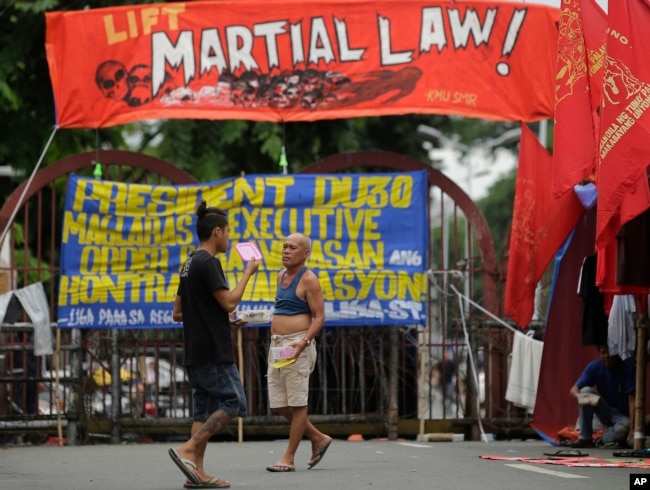
He said he had thought of lifting martial law in Mindanao, which is to last until December 31, but changed his mind due to the security issues besetting Buldon.

Members of the Buldon municipal police office told reporters on Saturday that it is in Mount Cararao where suspected members of the Maute terror group were spotted.

An Iranun farmer, Limon Mandiga Botari, said he is doubtful the terrorists would try to get close to Buldon.

MILF members and armed villagers in Buldon killed five Maute terrorists in an encounter on Dec. 8, 2016 with a group that tried to bring into the municipality nine companions wounded in prior encounters with soldiers in Butig.

The Iranun community who foiled the attempted incursion then of Maute terrorists in Buldon was led by Commander Quiqada, a senior MILF official in the municipality.

Two followers of Commander Quiqada were wounded in the incident, which the MILF even reported to the government’s ceasefire committee and the Malaysian-led International Monitoring Team.

The government’s ceasefire committee and the foreign peacekeeping contingent, comprised of soldiers from Malaysia, Indonesia and Brunei and civilian conflict resolution experts from Japan, Norway and the European Union, are helping enforce all interim security compacts between the MILF and Malacañang.

Local officials in Maguindanao’s Matanog and Barira towns, both close to the border of the province with Lanao del Sur said they are certain that Duterte was referring to Mount Cararao when he spoke of sightings of Islamic militants in Buldon.

It was in Butig, located in the first district of Lanao del Sur, where the Maute terror group, operating in the fashion of the Islamic State of Iraq and Syria, first emerged in 2014.

The founders of the militant group, siblings Omar and Abdullah Maute, belong to a Maranao clan in Butig that is known for its deep-seated animosity with Dimnatang Pansar, the incumbent mayor there.

“We were surprised with President Duterte’s announcement that there is brewing tension in Buldon in relation to the crisis in Marawi City. He could be referring to Mount Cararao, not Buldon,” said an Iranun town official.

The official, who asked not to be identified for security reasons, is one of local leaders Maguindanao Gov. Esmael Mangudadatu had tasked to validate the reported sightings of Maute terrorists at Mount Cararao.

Mangudadatu is chairman of the inter-agency provincial peace and order council, whose members include officials of the 36-member Maguindanao league of Mayors.

Local MILF commanders confirmed to reporters on Saturday that they were alerted Wednesday by Iranun peasants propagating corn and upland rice varieties near Mount Cararao on the presence of no fewer than 50 Maranao-speaking gunmen in the area.

“They are too far away from Buldon. They are just there at Mount Cararao, which is nearer to Lanao del Sur,” an Iranun elder, Madzid Condaw, told reporters in the local dialect.

Von Al-Haq, spokesman of the MILF’s Bangsamoro Islamic Armed Forces, denied on Saturday morning having confirmed that there are 100 ISIS-inspired militants in Buldon.

He told reporters that their commanders in Buldon, just like the local police, have not reported about any presence of ISIS-inspired militants in the municipality.

Members of the MILF’s Task Force Ittihad have been fighting militants in a third faction in the outlawed Bangsamoro Islamic Freedom Fighters in Maguindanao’s adjoining Datu Piang, Salibo and Sharif Saidona towns since August 1.

The hostilities between the two groups erupted after six botched attempts by the militants, led by Abdulmalik Esmael, to hoist the ISIS flag inside government-acknowledged MILF enclaves in Maguindanao.

The police and key MILF sources said 12 members of Task Force Ittihad have been killed in skirmishes in the past four weeks that also exacted 23 fatalities from the BIFF.

Chief Superintendent Reuben Theodore Sindac, director of the Police Regional Office-ARMM, said on Saturday that personnel of the municipal police in Buldon will immediately report to him any unusual security situation in the area.

“We have not received any report yet on the purported presence of Maute terrorists there so far,” Sindac said.

The Army’s 6th Infantry Division also clarified on Saturday, through radio stations in Cotabato City, that there is no presence of Maute terrorists in any barangay in Buldon.

US prepares Filipino troops against chemical attack

From the Philippine Star (Sep 2):  US prepares Filipino troops against chemical attack


A leader of a 20-member band of Maute terrorists holding out in an abandoned building in Bangolo in Marawi City.

The US military is helping Filipino soldiers prepare for possible chemical attack of the Islamic State-inspired Maute group as fighting continues in several parts of Mindanao.

According to the US Embassy in Manila, officials from the Joint United State Military Assistance Group has delivered 1,000 M40 field protective masks and C2 filter canisters to the Philippine Navy.

The turnover of the military protective masks were conducted in two batches; one delivery made on Wednesday and the other on Thursday.

The support came following the request of the Philippine Navy to help sailors and marines prepare for possible chemical attack of terrorists.

The US embassy did not mention the particular operation in Mindanao where the protective equipment will be used. .

The turnover of protective masks also came following North Korea's test-firing of missile, which flew over Japan and landed in the northern Pacific Ocean.

The Armed Forces will receive more munitions and equipment from US military in an accelerated process reserved for allies and close partners of the United States through the Mutual Logistics Support Agreement, the US embassy said.
 
“The United States is proud to work closely with the Republic of the Philippines and will continue to support capacity-building counterterrorism efforts and the AFP’s long-term modernization goals,” it added.

4 soldiers killed in clash with NPA in Nueva Vizcaya

From ABS-CBN (Sep 2): 4 soldiers killed in clash with NPA in Nueva Vizcaya

Four soldiers were killed in an encounter with members of the New People's Army in Kasibu town, Nueva Vizcaya, police said Friday.

Staff Sergeant Dexter John Tagacay, Corporal Jayson Sabado, Corporal Rusty Galan and Private First Class Abraham Lindo were killed in action, according to a report from Nueva Vizcaya police.

Based on an investigation, the soldiers were conducting a clearing operation when a group of rebels opened fire at them.

Meanwhile, Corporal Gerby Soriano was hit on the nape. He was rushed by police officers to the town hospital in Barangay Pudi, but was later transferred to another hospital.

Police Senior Superintendent Leumar Abugan, director of Nueva Vizcaya police, said security in the province has been heightened as authorities launched a pursuit of the rebels.

http://news.abs-cbn.com/news/09/02/17/4-soldiers-killed-in-clash-with-npa-in-nueva-vizcaya

China exploits the Philippines' soft-pedalling in South China Sea

From Nikkei Asian Review (Aug 30): China exploits the Philippines' soft-pedalling in South China Sea (By Richard Heydarian)

Duterte's conciliatory stance on Beijing's territorial claims is backfiring


An aerial view of China occupied Subi Reef at Spratly Islands in disputed South China Sea. © Reuters 

Just days after the Association of Southeast Asian Nations ended a series of ministerial meetings in Manila in early August the Philippines faced a fresh and daunting challenge in the South China Sea.

In what one prominent Filipino official described as an "invasion," a flotilla of Chinese civilian and military vessels gathered within a few nautical miles of the Philippine-occupied Thitu Island, a prized land feature in the area. There are growing concerns that China will gobble up other contested land features in the Spratly chain of islands and tighten the noose around other claimant states as a prelude to full domination of the South China Sea.

The "invasion" was a shocking development for Manila, which has used its one-year term as the rotating chair of ASEAN to shield Beijing against criticism of its maritime assertiveness in the South China Sea. The Philippines has also recently proposed resource-sharing agreements in contested areas to break the impasse among claimant states.

In exchange, Manila was hoping to reach a mutually acceptable modus vivendi with Beijing, leading to expanded trade and investment ties. China's latest action, however, has exposed Beijing's naked opportunism as it exploits the strategic acquiescence of some other ASEAN countries and waning U.S. influence in the region.

Beijing's assertiveness also casts doubt on the conciliatory policy pursued by Philippine President Rodrigo Duterte toward China, and boosts hawks who are urging a tougher stance. Duterte and his Foreign Secretary (and former vice-presidential running mate) Alan Cayetano have sought to play down the issue, but the Philippine defense establishment and media are outraged.

At the recent ASEAN meetings, Philippine officials exercised the country's prerogative as the group's chair to tone down any criticism of China's massive reclamation activities in the South China Sea.

Cayetano claimed that Beijing had not engaged in any reclamation activities in recent months, while indirectly criticizing other claimant states such as Vietnam for engaging in similar activities. But satellite imagery released by the Asia Maritime Transparency Initiative, a monitoring program set up by the Washington-based Center for Strategic and International Studies, has revealed China's relentless expansion and upgrading of disputed land features such as the Fiery Cross, Mischief and Subi reefs in the Spratly Islands of the South China Sea.

The Philippine foreign secretary admitted that he wanted to avoid issues that China consider sensitive in ASEAN's post-summit joint statement, so as to facilitate dialogue. He also expressed skepticism over the wisdom of pursuing a "legally-binding" Code of Conduct in the South China Sea, a key demand of rival ASEAN claimant states such as Vietnam, suggesting that a more symbolic document would be sufficient.

Meanwhile, the U.S. Defense Department is grappling with policy paralysis under President Donald Trump and a series of naval collisions that have diminished the aura of U.S. invincibility and forced the resignation of Vice Admiral Joseph P. Aucoin, head of the U.S. 7th Fleet, the U.S. Navy's largest overseas force.

To China's delight, the Duterte administration has also dangled the option of resource-sharing with China in contested waters, particularly the energy-rich Reed Bank. This way, Manila hopes to avoid conflict and develop new energy resources to feed its booming economy. In effect, the Philippines is legitimizing China's excessive claims, which extend well into the Philippines' Exclusive Economic Zone.

But Beijing's blatant display of force risks undermining its newfound rapprochement with the Philippines, where the defense establishment and public are already highly critical of China.

Suspicious movements
Intelligence reports on suspicious movements of Chinese vessels near Thitu Island were leaked by Philippine defense officials to Gary Alejano, a prominent opposition lawmaker. The information was corroborated by satellite imagery released by CSIS's Asia Maritime Transparency Initiative.

Alejano, a decorated former soldier with strong ties to the military, reported that Chinese frigates and coast guard vessels sailed close to Thitu Island from Aug. 11 to 15. He also suggested that China is intent on occupying Sandy Cay, a low-tide elevation within Thitu's territorial waters.

Rocky Thitu Island, which is the second largest naturally-formed feature in the area, has been under effective Philippine occupation for more than 40 years. It has a mayor, a civilian community, an airstrip that dates to the 1970s and a regular contingent of Philippine marines and other military personnel.

In April, Philippine Defense Secretary Delfin Lorenzana and military chief of staff Eduardo Ano made a high-profile visit to Thitu to demonstrate Manila's resolve to protect its territory. They promised to upgrade local facilities, including the airstrip, and improve basic services and accommodation for civilians living on the island. These plans are now in jeopardy due to the growing presence of Chinese vessels in the area.

There are also growing fears of encirclement and additional reclamation activities by China in the Spratly Islands, which are contested by China, the Philippines, Malaysia, Taiwan and Vietnam. Beijing already occupies nearby Subi Reef, which it has transformed it into a fully-fledged island with a large airstrip and advanced military facilities. A Chinese flag was reportedly planted on a sandbar next to the Philippine-controlled Kota Island. Such actions suggest that Beijing is intent on encircling and squeezing out other claimant states from the area.

Alejano has cautioned the Duterte administration against "denial or silence and inaction" in response to Chinese actions. Supreme Court Justice Antonio Carpio, a prominent hawk on the South China Sea issue, described the episode as an "invasion of Philippine territory," and has urged Duterte and Cayetano to stand up to China. He suggested invoking a mutual defense treaty with the U.S. in the event of clashes with Chinese vessels.

Both Duterte and his foreign secretary have sought to play down the Thitu issue by claiming that China was engaged in routine maritime activities in the area. In a dramatic break with protocol, however, the Philippine military has openly encouraged the government to take a tougher stance. the foreign ministry to raise the issue in the China-Philippines Bilateral Consultative Mechanism, a negotiating forum established by the two countries, which met for the first time in May. It serves as the primary platform for dialogue on sensitive bilateral issues.

However, unless China significantly eases its assertiveness in the South China Sea, the Duterte administration is expected to come under growing domestic pressure to revise its policy toward Beijing. While Duterte is still popular, he cannot afford to continue to ignore public sentiment as well as the concerns of top military officers.

China's aggressive actions underline the perils of Manila's overly conciliatory policy, which is based on the naive notion that acquiescence will tame Beijing's territorial appetite. The latest episode in the South China Sea highlights the necessity for ASEAN countries and the U.S. to actively resist Chinese maritime ambitions. Otherwise, Beijing will continue to push its luck at the expense of regional security and the interests of smaller claimant states.

[Richard Heydarian is a Manila-based academic and columnist. He is the author of "Asia's New Battlefield: US, China and the Struggle for the Western Pacific," and of the forthcoming" Rise of Duterte."]

https://asia.nikkei.com/Viewpoints/Richard-Heydarian/China-exploits-the-Philippines-soft-pedalling-in-South-China-Sea?page=2

New Australia Military Terror Aid For the Philippines?

From The Diplomat (Aug 31): New Australia Military Terror Aid For the Philippines?

A closer look at recent headlines about additional counterterrorism support Canberra could provide to Manila.

New Australia Military Terror Aid For the Philippines?

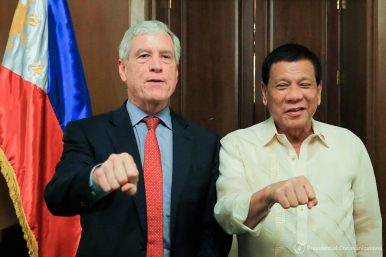
Australian Secret Intelligence Service (ASIS) Director General Nicolas Peter Warner joins Philippine President Rodrigo Duterte in flashing his signature fist bump in a move that sparked controversy. Warner had paid a courtesy call to Duterte at Malacañang Palace on August 22, 2017.
Image Credit: Presidential Communications Office
 
On Monday, Australian Foreign Minister Julie Bishop made headlines when she revealed that she had offered additional military support to the Philippines during a meeting with President Rodrigo Duterte earlier this month. Though her comments about the offer were far from surprising considering the increasing cooperation already underway between both sides, they nonetheless sparked conversation because they would present both opportunities as well as challenges for both sides.

Australia and the Philippines have long had a strong relationship that extends into the defense realm. Security ties include not just regular interactions like exchanges and exercises, but capacity-building in areas ranging from maritime security to counterterrorism as well as assistance with respect to the peace process in the southern Philippines.

Defense ties had deepened even further during the years of former Philippine President Benigno Aquino III as part of the broader comprehensive partnership inked in November 2015. Among other things, the Philippines finally approved a visiting forces agreement (VFA) with Australia – making it just the second country to enjoy such a status other than the United States – and Canberra also became integrated into the U.S.-Philippine Balikatan exercises which have been gradually multilateralizing (See: “How Significant is the 2017 US-Philippines Balikatan Military Exercise?”).

Though the emergence of President Rodrigo Duterte has no doubt complicated things, (as with the U.S.-Philippine alliance, as I’ve noted separately), day-to-day cooperation has largely continued and in some cases even accelerated in response to Manila’s dire needs as well as ongoing developments (See: “Battle for Marawi Exposes Philippines’ Military Intelligence Crisis”). The biggest example of this is the Marawi crisis, which has both exposed the well-known limitations of the Philippine military as well as heightened Australia’s fears of a deeper Islamic State presence in Southeast Asia with implications for regional as well as domestic security (See: “ASEAN’s Islamic State Conundrum”).

It is therefore no surprise that Australia has been repeatedly discussing the ongoing situation with regional states including the Philippines and even offered various forms of support. The one that is discussed the most in public is Canberra’s provision of AP-3C Orion military planes to help with surveillance in Marawi, one of several offers that have come from a string of states including Singapore and the United States. But there are other lines of effort as well that Australian officials – including most recently Bishop herself as well as Australian Secret Intelligence Service Director General Nick Warner – have discussed with Philippine officials as well during their interactions.

Bishop’s recent statement made headlines because it both suggested that Australia could be doing even more and indicated that this role could involve more direct military support. Speaking at a press briefing, she said that the offer she had made to Duterte had included support that would be along the same lines of how Australia is supporting Iraq in terms of “advising, assisting, and training.”

The public approval of an “advise and assist” Australian role in the Philippines would certainly more robust, since, if it is to be operationalized the way it has in Iraq, it would involve not just Australian equipment or expertise – be it in terms of intelligence, aircraft, or urban warfare training – but Australian personnel being directly embedded with Philippine counterparts on the ground.

Though such a role is technically possible, The Diplomat understands that both sides would have to work out specific arrangements for this, since the VFA between them provides a general legal framework for personnel on both sides but does not include authorization for either party to deploy troops or conduct operations in the other’s territory.

It would also be foolish to pretend that this is purely a strategic or technical issue. Advise and assist missions tend to arouse fierce public sentiment from certain groups on both sides – from fears of “creeping militarization” in the contributing country to suspicion of sovereignty violations in the host nation.

The Australian mission in Iraq has not been immune from this sense of “creeping militarization,” despite repeated denials by officials. And Philippine defense officials so far have been keen to emphasize publicly, as Defense Secretary Delfin Lorenzana did following the announcement of the deployment of Australian AP-3C Orions, that such offers of assistance would not require Australian defense personnel being embedded on the ground. As I have noted before, the recent controversy over the U.S. role in drone operations in Marawi was an example of just how quickly and intensely the hype can build up in such instances (See: “What’s Behind the New US-Philippines Drone Hype Under Duterte”).

Australia no doubt recognizes that it would also not be immune from other risks as well. As I have said elsewhere, given that we are living in the Duterte era, such a deeper and more explicit Australian military role in the Philippines also brings with it its share of risks, be it an outburst from the president or greater scrutiny on bilateral ties if Duterte’s poor record on rights continues, as Bishop’s and Warner’s recent trips have demonstrated.

https://thediplomat.com/2017/08/new-australia-military-terror-aid-for-the-philippines/

The United States Has Not Lost the South China Sea

From The Diplomat (Sep 1): The United States Has Not Lost the South China Sea (By

Despite some setbacks, the United States has not lost influence in the vital waterway.

The United States Has Not Lost the South China Sea

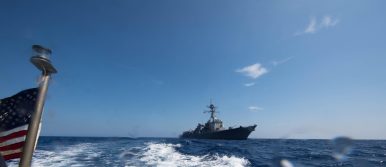
Image Credit: .S. Navy Photo By Mass Communication Specialist 3rd Class Kryzentia Weiermann/ Released

The last two months saw an uptick in tensions in the South China Sea (SCS) following a period of relative calm since the arbitral tribunal at the Hague handed down its historic and sweeping award on maritime entitlements in the SCS, overwhelmingly favoring Manila over Beijing. After a year of successfully diminishing the legal and diplomatic impact of the unfavorable ruling, China has resumed a pattern of brazen intimidation against its fellow SCS claimants.

In July, Beijing bullied Hanoi into suspending oil drilling in a disputed oil block 250 nautical miles off the southeast coast of Vietnam. China reportedly threatened that it would attack Vietnamese bases in the Spratly Islands if the oil drilling did not cease immediately. A month later, Beijing sent a flotilla of Chinese fishing boats, escorted by People’s Liberation Army-Navy (PLAN) ships and Chinese Coast Guard (CCG) vessels to Thitu Island, the largest land feature claimed and occupied by the Philippines in the Spratly Islands.

The purpose of the deployment remains unclear, but some have speculated that it may have been a coercive demonstration to dissuade Manila from carrying out announced infrastructure repairs and upgrades on Thitu; or a more provocative move of posturing (or threatening) to blockade or even land on one or more of the adjoining unoccupied sand bars. If the latter, however unlikely, it would suggest a similar modus operandi to the illegal seizure of Scarborough Shoal in 2012 and a destabilizing escalation with strategic ramifications if one of those sand bars includes Sand Cay – an unoccupied high-water feature that could affect the sovereignty and maritime jurisdiction of nearby Chinese-claimed Subi Reef (one of China’s seven artificial islands in the SCS). As per United Nations Convention on the Law of the Sea (UNCLOS), Subi Reef cannot generate its own territorial sea, but it has the potential to supersede a territorial sea claim from Sandy Cay because the distance between them (unlike Thitu) is less than 12nm.

Also of consequence was the disappointing outcome of the 24th Meeting of the Association of Southeast Asian Nations (ASEAN) Regional Forum (ARF) in Manila 2-8 August. The joint communique of the ASEAN Foreign Ministers Meeting mostly favored China’s positions over those of the United States, Australia, and Japan. Beijing wanted no discussion or reference to its claims or activities in the SCS, last year’s arbitration ruling, and need for an ASEAN Code of Conduct (COC). Washington, meanwhile, advocated for the implementation of the 2016 arbitration decision and a substantive and legally binding COC. In the end, Chinese positions largely won out. The communique wording was far less forceful and China-specific than Vietnam and the United States and its allies preferred. Indeed, it was sufficiently ambiguous that Beijing and its supporters within ASEAN could tolerate and accept – another successful diplomatic obstruction on China’s part.

So, what does all of this mean for the region and the United States? Part one of this two-part series provides perspectives and context to the strategic question. Part two examines ways and means the United States could turn the tide and regain the strategic initiative, recover the high ground of regional influence, and stave off losing the SCS.

Prevailing Perspectives

Pundits within U.S. and foreign think tanks were quick to analyze the recent developments and assess the strategic implications thereof. The assessments vary from diminished U.S. regional influence to loss of the SCS by the United States. The following are two exemplars of such judgments:

A scholar with the National Institute for South China Sea Studies, a Chinese think tank, wrote in the International Public Policy Review and later republished by The Diplomat that the recent ASEAN meetings capped an trend of eroding U.S. regional influence (soft diplomatic power) and that this decrease is both absolute and relative to that of China. The United States, the piece argued, is realizing that “its soft power relationships in Southeast Asia are shallower and more ephemeral than it thought.” Washington, therefore, needs to enhance its soft power commitments in the region if it hopes to keep pace with Beijing, or stem China’s growing influence.

A former journalist and noted author, now an associate fellow with the Chatham House, wrote in Foreign Policy that Vietnam’s capitulation shows China’s neighbors fear that the United States no longer has their backs. If Hanoi thought Washington had its back, Beijing could have been deterred and the credibility of the United States in the region strengthened. Instead, Washington has left the region drifting in the direction of Beijing.

One More Perspective

Although one can quibble on the scope, nature, and extent, America has indeed lost some influence over the years – especially with some allies, partners, and organizations in the region. The whys and wherefores vary, but largely revolve around the geostrategic contest between the United States and China for regional dominance with the SCS as a prominent manifestation of that strategic rivalry.

Washington has generally responded to Chinese assertiveness in the SCS with an ambiguous restraint policy, concurrently accommodating and balancing Beijing. The former reassures China and encourages a cooperative relationship to maintain the regional status quo and acceptance of the greater international system from which Beijing itself has greatly benefited. The latter seeks to dissuade China to not alter the regional order through an amalgamation of soft and hard deterrent powers.

In the beginning, the policy favored accommodation (cooperative), but has since migrated to a more balancing (competitive) posture because of Beijing’s increasingly strident behavior despite repeated U.S. overtures and deference to Chinese national interests. Moreover, the U.S. response to China’s call for a “new type of great-power relationship” has been mostly disjointed, uneven, and at times, confusing. There is still a distinct disconnect in how Beijing and Washington perceive and understand the model. What the United States views as a way to manage competition (weaken instability) and promote cooperation (strengthen stability), China sees it as a framework to acknowledge its new global status and respect its core strategic interests – one of which is territorial integrity and, by extension, maritime sovereignty claims in the SCS.

Most Southeast Asian countries (Vietnam, Malaysia, Brunei, Indonesia, Thailand, and Singapore) have responded to China’s aggression by pursuing a security strategy that seeks to hedge against the prevailing uncertainty, insecurity, and instability from the Sino-American strategic rivalry. They address their security concerns and supplement their security shortfalls by pursuing stronger relations with the United States; maintaining good ties with China; building up their own military capabilities and capacities; forging security partnerships among themselves; and looking to regional institutions (ASEAN) and international law (UNCLOS) to manage disputes and temper U.S.-Chinese competition. Much is driven by the uncertainty of U.S. commitment and policy constancy; geographic reality of China (proximity); and the economic benefits derived from good ties with both Beijing and Washington. All told, this creates a geo-political situation in which many regional countries are unwilling to choose between the United States and China, and resist any initiatives that may be perceived as a counterbalancing coalition against Beijing. That may change though, if China overreaches and pushes them too far.

The loss of regional influence did not happen overnight, but was the result of a cumulative aggregation of events through the years. Hindsight suggests China’s seizure of Scarborough Shoal in 2012 was the beginning of the steady slide in regional trust and confidence in America’s traditional role as the guarantor of the global economy and provider of regional security, stability, and leadership. Beijing interpreted the weak international and U.S. responses to its bold provocation as an opportunity to press ahead with its strategic agenda in the SCS.

For the next three years, China built land out of extant geographic features for permanent presence and occupation; militarized the new land outcrops for maritime security and power projection; and employed an aggressive legal and diplomatic crusade to characterize the developed geographic features as islands deserving of maritime zones. In 2014, Beijing unilaterally placed an oil-drilling rig in waters 120nm from Vietnam’s coast – near islands claimed by both countries and well within Hanoi’s 200nm exclusive economic zone (EEZ) set by international law – and surrounded it with a protective cordon of Chinese fishing boats, PLAN ships, and CCG vessels. In 2015, Beijing tried to intimidate Manila to not submit its arbitration case to the PCA and spent the following year undermining the authority and legitimacy of the court and diminishing the legal and diplomatic impact of the unfavorable ruling.

Hence, the recent events are just the latest in a series of Chinese bullying acts against its regional neighbors and incremental erosion of U.S. standing as the preeminent naval power that ensures the seas are free and open to commerce for all nations. In sum, Southeast Asian leaders took notice of perceived American passivity and acquiescence through the years, and adjusted their foreign policies accordingly and will continue to do so as Washington and Beijing posture (compete) for relative regional dominance.

All things considered, America has had several setbacks, but has not lost the SCS yet. The SCS is a fluid environment that makes any recalibrations transitory. The strategic shift in China’s favor – change in Philippine foreign policy, Manila and Washington’s failure to capitalize on the arbitral tribunal ruling, ASEAN under Manila’s chairmanship, warming relations between Beijing and Bangkok, closer Chinese ties with Laos and Cambodia, Trans-Pacific Partnership withdrawal, inclusion of the RMB in the International Monetary Fund’s Special Drawing Rights basket, and rise of the Chinese economy to second largest in the world – is not permanent.

Regional sentiments constantly change with the geopolitical and economic tides as evidenced by the tenuous ties between Manila and Beijing; rising friction between Hanoi and Beijing; Hanoi joining the U.S.-led coalition at the last ARF; Hanoi agreeing to host a U.S. aircraft carrier port visit next year; Jakarta renaming the resource-rich northern portion around its Natuna Islands, which lie in the southern end of the SCS (and part of Beijing’s disputed nine-dash line claim), as the North Natuna Sea; developing United States-Japan-Australia trilateral alliance; Tokyo’s continuing outreach to SEA capitals; New Delhi’s making greater inroads into SEA (Act East policy); and slowing Chinese economic growth and persistent worries over rising debt, credit, banking, and social demographic challenges. Opportunities exist for America to regain the strategic initiative in the vital waterway and recover the high ground in diminished regional influence.

This concludes a short discourse on the recent developments in the SCS and the strategic implications thereof; and sets the conditions for further discussion in part two on the ways and means the United States could turn the tide and regain the strategic initiative, recover the high ground of regional influence, and stave off losing the SCS.

[Tuan Pham has extensive experience in the Indo-Asia-Pacific, and is widely published in national security affairs. The views expressed therein are his own and do not reflect the official policy or position of the U.S. Government.]

Mayor sees release of Cotabato cop held by rebels

From the Philippine Daily Inquirer (Sep 1): Mayor sees release of Cotabato cop held by rebels
Mayor Rudy Caoagdan of Makilala town in North Cotabato province said a policeman held by communist rebels might be freed soon after he received feelers from his captors.

Caoagdan said a New People’s Army (NPA) emissary informed him that rebels holding PO1 Bristol Catalan wanted to open communication lines with him.
Three armed men, believed to be NPA rebels, seized Catalan, a member of intelligence unit of the Makilala police, in Barangay Katipunan while the policeman was taking his two sons to school on Aug. 16.
Catalan’s children were unharmed but were deeply traumatized, the policeman’s wife, Jessa, said.

Jessa said she had not received any word from her husband or from his captors.

Kidapawan Bishop Jose Colin Bagaforo has appealed to the NPA rebels to free Catalan without condition.

“I hope PO1 Catalan will be with his family soon,” Caoagdan said.

http://newsinfo.inquirer.net/927133/mayor-sees-release-of-cotabato-cop-held-by-rebels

Bayan Muna organizer gunned down in Negros Oriental city – Karapatan

From News 5/InterAksyon (Sep 1): Bayan Muna organizer gunned down in Negros Oriental city – Karapatan


An organizer of the activist party-list Bayan Muna in Guihulngan City, Negros Oriental was gunned down Wednesday as he left the Department of Education office where he worked.

The Negros chapter of the human rights group Karapatan linked the killing of Oscar Solania Asildo Jr. to the government’s counterinsurgency campaign, nothing that he had been openly accused of being a supporter of the New People’s Army, which is active in the hinterlands of the city.

On July 21, Guihulngan chief of police Superintendent Arnel Arpon and five of his men died and three other policemen were wounded when they were ambushed by NPA guerrillas as they responded to an earlier attack in which Councilor Edison dela Rita had been wounded and his aide killed.

http://www.interaksyon.com/bayan-muna-organizer-gunned-down-in-negros-oriental-city-karapatan/

Marawi: Behind the Headlines

From The Diplomat (Aug 31): Marawi: Behind the Headlines (By

How did Marawi become the center of a crisis and what needs to be done next?

Marawi: Behind the Headlines

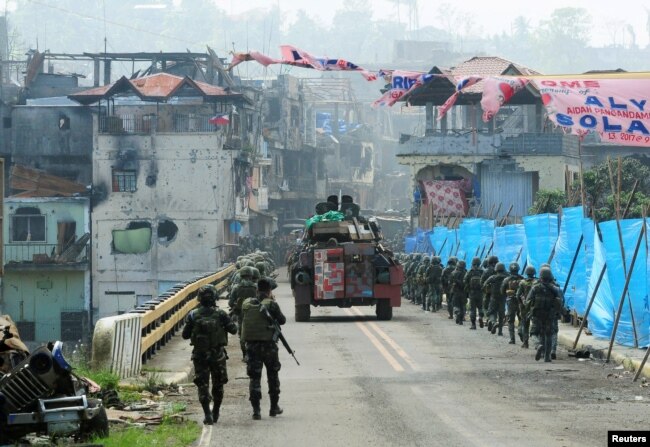
An Armored Personnel Carrier (APC) and government troops march towards Mapandi bridge after 100 days of intense fighting between soldiers and insurgents from the Maute group, who have taken over parts of Marawi city, southern Philippines August 30, 2017.
Image Credit: REUTERS/Froilan Gallardo

Until the recent crisis began, Marawi was not on many people’s radar. Marawi is a small town in Mindanao, in the southern Philippines. Seemingly out of nowhere, a few months ago the city was taken by extremist militants and declared the regional headquarters of ISIS in Southeast Asia. Marawi has subsequently been besieged by Philippine government troops aiming to destroy the militants, and martial law has been declared across the whole of Mindanao. The abruptness of Marawi’s entry into the regional policy spotlight has blindsided many policymakers.

Why Marawi?

In the media storm that has followed the Marawi crisis since it began in May, one question that really hasn’t received enough attention is: Why Marawi? In recent years, most of the major Salafi jihadist action in Southeast Asia has occurred in Indonesia and Malaysia, not the Philippines. Indeed, it’s likely that when Filipino Abu-Sayyaf leader Isnilon Hapilon was dubbed by ISIS’ head Abu-Bakr Al-Baghdadi as Emir of the Southeast Asian wilayat (a province of the caliphate), many Indonesian jihadis would surely have been disappointed that they were overlooked. Until the crisis began, most regional security pundits would have been paying less attention to the southern Philippines than they were to groups like Jemaah Islamiyah in Indonesia. And since Hapilon himself mostly operates out of his headquarters in Jolo, in the Sulu archipelago, it makes sense that Marawi would not have necessarily been on the radar for many analysts.

So how did this small university town in rural Mindanao become the center of ISIS activity in Southeast Asia? The best way to answer this question is to look at the actors involved and their motives and capabilities. The militant group behind the Marawi Crisis is composed primarily of members of the Maute Group and Abu Sayyaf. The Maute Group is led by brothers Omar and Abdullah Maute, members of the powerful local Maute clan, which is based around Lake Lanao, near Marawi City. Abu Sayyaf is an extremist group that has been operating in the nearby Sulu archipelago, engaging in piracy, extortion, bombings, and assassination since 1991. The group is led by Isnilon Hapilon, who cut his teeth with the Moro National Liberation Front in the 1980s and 1990s. As previously mentioned, Abu Sayyaf doesn’t appear to have had a strong, direct prior connection with Marawi city. However, prior to the crisis the Maute Group was already operating there.

The Mautes are a strong local political family, and the mother of the Maute Brothers is an influential matriarch. The broader Maute clan is reported to have been engaged in a Rido (blood-feud) with the Mayor of Butig over a local government contract not being awarded to them. Butig is about a 2-hour drive south of Marawi city, and backs onto Lake Lanao – which is also adjacent to Marawi. The Maute brothers had also been raising revenue by conducting a protection racket in Butig. They conducted the October 2016 Davao City bombing. A few months later the group took control of several major public buildings in Butig, including the town hall, madrasa, and national high school. They were quickly pushed out of the city by the Armed Forces of the Philippines (AFP).

It seems that shortly after this, they linked up with Isnilon Hapilon (the leader of Abu Sayyaf), who brought a new level of paramilitary expertise and resources to their cause through his ISIS affiliation. The combined grouping was subsequently able to capture and hold Marawi city for several months. Marawi may also have been an attractive target to ISIS leadership, including Hapilon for symbolic reasons; Marawi’s official designation is “The Islamic City of Marawi” – the only officially recognized Islamic city in the Philippines.

How Did It Get So Bad?

Through Hapilon, ISIS has provided an influx of supplies, ammunition, high-tech communications equipment and foreign fighters from the Middle East and Chechnya. These foreign fighters have brought a much higher level of know-how and experience in conducting urban guerrilla warfare, and have used this expertise to good effect in showing the Filipino militants how to resist the Armed Forces of the Philippines (AFP).

By contrast, the AFP is poorly equipped and inexperienced in conducting urban counterinsurgency operations. The AFP’s prior counterinsurgency work has mostly, though not exclusively been against communist rebels engaging in jungle warfare. For this reason among others, many say the AFP doesn’t have the technical expertise to target insurgents in an urban environment without destroying densely-packed infrastructure. The result has been a protracted siege that has effectively flattened Marawi city – resulting in a massive and ongoing humanitarian crisis.

The Humanitarian Crisis — Frustration and Radicalization

More than 200,000 people are now internally displaced persons (IDPs) in Mindanao because of the Marawi crisis. Martial law has been in place since May. Frustration is high and mounting amongst the IDPs from Marawi. Local sources indicate they are mostly scattered across the country and staying with friends and relatives. Because martial law was declared so suddenly, most of these people had to leave their personal possessions and identification documents in their homes, many of which have now been destroyed by the AFP’s indiscriminate airstrike campaign. This makes it much harder to keep track of them and to provide aid to them.

Lack of aid, ongoing internal displacement, and the destruction of homes is likely to further play into the narratives used by terrorist recruiters looking to radicalize young people in the Philippines. Estimates of civilian casualties vary, but go as high as 300, and many of these will have been parents. This indicates the protracted crisis could pay dividends for terrorists and terrorist recruiters for years to come.

Additionally, not all of the militants have been killed. Recent reports indicate roughly 40 are still alive and operating in Marawi, and some have been captured and imprisoned by the AFP. If these militants are turned over to the Philippine justice system they will likely be placed in prisons in the Philippines. The Philippine prison system is notoriously overcrowded and under-resourced. Studies by the Australian National University’s Dr. Clarke Jones and others indicate that overcrowded, poorly resourced prisons in the Philippines and Indonesia can serve as recruiting grounds for the spread of violent radicalism.

What Can Be Done to Minimize the Damage?

Many parties in the Philippines and internationally have an interest in minimizing the damage caused by the Marawi crisis and associated humanitarian disaster. From a purely humanitarian perspective, there is an ethical imperative to minimize the damage and help the displaced inhabitants of Marawi to return to their homes as soon as possible and resume normal life. From a regional security perspective, there is the same imperative. The longer the crisis continues, and the longer that the associated humanitarian problems continue, the more that public dissatisfaction will grow, increasing the chances of young people being radicalized.

So what can be done to contribute to the securing and rebuilding of Marawi, and a return to normalcy for the local people? Fast and effective aid and rehabilitation assistance is critical in minimizing the social and economic damage that has been caused by the crisis. But this assistance must be appropriately tailored to the specific needs and cultural context of the people of Marawi, otherwise it runs the risk of being ineffective or even counterproductive. For the famously proud and independent Bangsamoro people, martial law has been going on far too long, and signals a loss of control and autonomy. The battle needs to be won and the city cleared quickly. The aid, rebuilding, and rehabilitation effort needs to commence as soon as possible, and to be conducted in a way that consults and prioritizes the interests of local residents.

[Rory MacNeil is currently completing his MA thesis in International Relations at the Australian National University (ANU). His research focus is on petro-politics in the Asia Pacific region. He also works as a Research Assistant at the ANU Philippines Project.]

http://thediplomat.com/2017/08/marawi-behind-the-headlines/

Duterte eyes moving intel funds to anti-terror campaign

From the Philippine Star (Sep 1): Duterte eyes moving intel funds to anti-terror campaign


President Rodrigo Duterte is looking to transfer intelligence funds of his office for the use of the Armed Forces of the Philippines (AFP) in its campaign against terrorism in Mindanao. PCOO via AP/File

President Duterte is looking to transfer intelligence funds of his office for the use of the Armed Forces of the Philippines (AFP) in its campaign against terrorism in Mindanao.

Senate Minority Leader Franklin Drilon said this was relayed to the leaders of Congress during the Legislative-Executive Development Advisory Council (LEDAC) meeting last Tuesday.

Drilon noted there was no briefing paper prepared for this and that it was just mentioned by the President.

He recalled that the President wanted the funds to be used for purchasing arms for the AFP’s ongoing campaign to address terrorist threats in Mindanao.
 
The Office of the President has around P2.5 billion in intelligence and confidential funds, which are being used by the Philippine Center for Transnational Crime, Philippine Presidential Commission on Visiting Forces Agreement, National Coast Watch Council, Presidential Situation Room, Anti-Terrorism Council and Anti-Organized Crime, all of which are under its jurisdiction.

During the LEDAC meeting, Drilon pointed out that the planned realignment of intelligence funds cannot be done now because of the ruling of the Supreme Court on the Development Assistance Program (DAP) of the Aquino administration.

The administrators of the DAP argued then that savings could be realigned to programs or projects that require additional funding.

Drilon noted, however, that the Supreme Court, in its ruling, stated that savings can only be determined at the end of the year.

“I suggested during the meeting that you cannot do it now because you cannot claim you have savings because according to the Supreme Court, the savings can only be determined in December,” Drilon said.

To address this legal obstacle, Drilon urged Malacañang to craft a bill to amend the General Appropriations Act “and transfer items to the Armed Forces.”

“Items which they cannot use anymore or they would, in their judgment, not need in the next six months, can be moved to areas where they want to move it,” Drilon said.
 

Gov’t to pursue peace with communists despite cancelled talks

From the Voice of America (Sep 1): Gov’t to pursue peace with communists despite cancelled talks


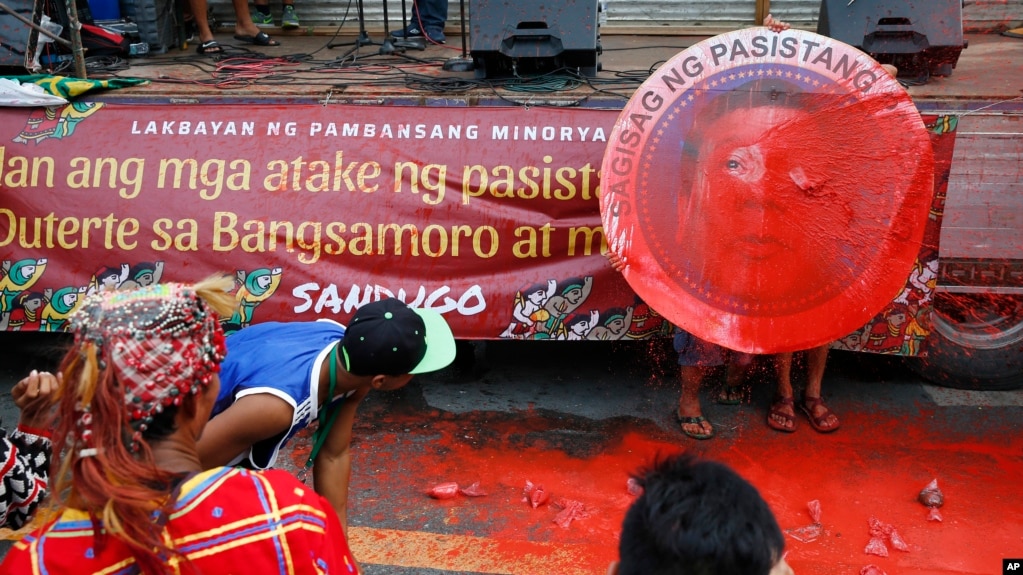
Indigenous people, including Muslims from the besiege city of Marawi, throw red paint at the mock seal of President Rodrigo Duterte to protest the continued siege and the martial law imposed by Duterte on the Mindanao region, Aug. 31, 2017, in Manila, Philippines.

Philippine President Rodrigo Duterte and military officials have promised to quickly defeat the Maute Group at its base, Marawi city. Analysts say fighting in the city on the embattled island of Mindanao could go on as long as that group or its sympathizers pose a terrorism threat, and there is no sign of the threat abating. Rebel violence has killed about 120,000 since the 1960s on Mindanao and curbed the largely impoverished island’s economic development.

“Sometimes it’s contradictory when they say there are only a few barangays (neighborhoods) that are controlled by the Maute Group, but still they cannot stop,” said Maria Ela Atienza, political science professor at University of the Philippines Diliman.

An armored personnel carrier and government troops march toward Mapandi bridge after 100 days of intense fighting between soldiers and insurgents from the Maute group, who have taken over parts of Marawi city, southern Philippines, Aug. 30, 2017.

An armored personnel carrier and government troops march toward Mapandi bridge after 100 days of intense fighting between soldiers and insurgents from the Maute group, who have taken over parts of Marawi city, southern Philippines, Aug. 30, 2017.
 
The government may have miscalculated the rebels’ reach when the battles began in May, she added. Their funding and support network could also extend to other cities and countries, making them harder to beat, scholars in the Philippines say. About 20 other rebel groups also operate on Mindanao to demand more autonomy from the Philippine government.

Officials predict final battles

Duterte on Tuesday “assured that the end of the siege is in sight” when he met in Manila with 35 displaced children from Marawi, according to a statement on his website. Duterte has also vowed to rebuild the city.

As of Monday Philippine media report, 603 terrorists had been killed along with 130 soldiers and police officers and 45 civilians. More than 183,000 people, most of Marawi’s original population, have been displaced.

On Sunday Defense Secretary Delfin Lorenzana was quoted in the Philippine Star online as saying troops were “preparing for final assault” in Marawi. The defense department was not available Friday for comment. Officials had said in June the Maute Group had been confined to just four neighborhoods of Marawi.

Life goes on

“A lot of people want the fighting to end and the reconstruction of Marawi to start,” said Antonio Ledesma, archbishop in the Mindanao city of Cagayan de Oro. But citizens of his city about a two-hour drive from Marawi expect little change for now.

“Actually a number of Muslim families have moved (from Marawi) over to Cagayan to Oro,” Ledesma said. “We’re also trying to provide aid to them, but life on Cagayan de Oro is as it is, not much problem with the situation there.”

Martial law declared for all of Mindanao has affected few people aside from vehicles stopped at road checkpoints, another Cagayan de Oro dweller said in July. Duterte declared martial law through Dec. 31 to make it easier for police and troops to make field decisions in Marawi.

Filipino activists protest near the Malacanang Presidential Palace in Manila, Philippines, July 20, 2017, against Philippine President Rodrigo Duterte's proposed extension of martial law in the whole of Mindanao island until the end of the year.
 
Filipino activists protest near the Malacanang Presidential Palace in Manila, Philippines, July 20, 2017, against Philippine President Rodrigo Duterte's proposed extension of martial law in the whole of Mindanao island until the end of the year.

“Outside the immediate vicinity of Marawi, it seems like everything is sort of business as usual,” said Christian de Guzman, vice president and senior credit officer with Moody’s in Singapore. Government officials have infrastructure plans for Mindanao that are still on track, he added.

“It seems to be more of a political issue rather than one that has had an actual economic impact,” de Guzman said.

Welcoming the war

Normally unaffected by the fighting itself, many Filipinos welcome a longer war if it means eliminating rebels who could spread violence to other parts of the country, analysts say.

In April, Abu Sayyaf tried to stage an attack on the tourist island of Bohol, its first outside Mindanao. Four suspected terrorists, three soldiers, two civilians and a police officer were killed in the initial fight. More rebels died in follow-up skirmishes.

Seventy-five percent of Filipinos trusted the military last year, according to surveys by Metro Manila-based research institution Social Weather Stations, and as of June 57 percent supported the declaration of martial law throughout Mindanao.

Troops believe the Maute Group is working with Isnilon Totoni Hapilon, a leader of Abu Sayyaf, a sympathetic rebel group known for kidnapping and beheading foreign tourists along the Sulu Sea west of Mindanao. Islamic State, the terrorist outfit in Iraq and Syria, last year called Hapilon its Southeast Asian “emir,” the policy nonprofit Counter Extremism Project said.

“People are also thinking it’s good to contain them, otherwise the Maute Group will spread into the Visayas and Luzon Island,” Atienza said, referring to central and northern islands of the Philippine archipelago.
 

Gov’t to pursue peace with communists despite cancelled talks

From the often pro-CPP online publication the Davao Today (Sep 1): Gov’t to pursue peace with communists despite cancelled talks


Presidential Adviser on the Peace Process Secretary Jesus G. Dureza and GRP chief negotiator Silvestre Bello III during the fourth round of talks on April 6, 2017 at the Radisson Blu Palace Hotel in Noordwijk Aan Zee in the Netherlands. (Zea Io Ming C. Capistrano/davaotoday.com)

DAVAO CITY, Philippines – The government is not bound to turn its back from its pursuit to peace in the south despite the collapsed negotiations with the Communist Part of the Philippines, a presidential adviser said.
 
“Negotiation is only one road to peace,” Secretary Jesus Dureza, Presidential Adviser on the Peace Process told reporters on Wednesday, August 30.

In February, the government stepped back from the negotiation table a day after it declared an end to a ceasefire agreement with the New People’s Army on February 3.

President Rodrigo Duterte said he wants the communists to stop attacks against government troops in Mindanao first before they resume the fifth round of peace talks.

As a consequence, several proposed reforms tackled by the National Democratic Front of the Philippines (NDFP) were at stake. One of the proposals was to expand the scope on the government’s agrarian reform.

“Everything is cancelled,” said Dureza.

The NDFP earlier said that despite Duterte’s public announcement, they are yet to receive a formal notice from the government. This comes as clergy and church leaders maintained their calls to resume talks with the communists.

Since the cancellation of the talks, there had been reported cases of rural villagers in Misamis Oriental evacuating due to a series of fighting between the NPA and government troops.

http://davaotoday.com/main/politics/govt-to-pursue-peace-with-communists-despite-cancelled-talks/

4 killed in clash between govt troops, NPA in Nueva Vizcaya

From the Manila Times (Sep 1): 4 killed in clash between govt troops, NPA in Nueva Vizcaya

BAMBANG, Nueva Vizcaya – At least four people were killed in an encounter between government troops and the communist New People’s Army (NPA), which took place in a town here before noon on Friday, police said.

The fatalities were identified as Staff Sergeant Dexter John Tagacay of Tumauini, Isabela; Corporal Jayson Sabado of Lupao, Nueva Ecija, Corporal Rusty Galan and Private First Class Abraham Lindo — all from the 84th Infantry Battalion of the Philippine Army based in Dupax del Norte town of the 7th Infantry Division.

A belated report said that a certain Corporal Jerby Soriano was wounded and another whose identify could not be confirmed was rushed to a nearby hospital in Kasibu town.

Police said the clash took place in the remote Sitio (sub-village) of Bilongay in Barangay (Village) Paquet, near the boundary of Sitio Maglan in Barangay Dine. The firefight lasted noontime.

Many residents of Paquet and Dine Villages were known as anti-mining advocates who stopped the exploration of an Australian mining firm called Royalco a few years ago.

There were reports of massive protest and sabotage in the area against Royalco by residents who collaborated with some members of the of the Bugkalot and Igorot tribes.

An army intelligence officer said the encounter confirmed reports that the communist rebels were rebuilding their mass base in Kasibu.
Kasibu, an upland town in southern Nueva Vizcaya, is a copper and gold rich mountain area and host to a Melbourne-based mining company OceanaGold.

Local small-scale miners are also active in the town particularly in Sitio Ambedbed in Barangay Paquet.

It was towards the end of the 1990s when the last encounter between the military and communist rebels was reported resulting in the death of an NPA commander known as “Ka Boyet”.

http://www.manilatimes.net/4-killed-clash-govt-troops-npa-nueva-vizcaya/348001/

Kidnapped in the Philippines, Kjartan Sekkingstad escaped execution. For the first time, the former hostage tells his harrowing story

From the National Post (Sep 1): Kidnapped in the Philippines, Kjartan Sekkingstad escaped execution. For the first time, the former hostage tells his harrowing story

Kjartan Sekkingstad was held for ransom by Islamist militants and survived. Canadians John Ridsdel and Robert Hall did not

Run, duck. Run, duck.

Deep in the jungles of Sulu province, in the southern Philippines islands, Kjartan Sekkingstad pushed through darkness in search of a way out.

It was April 2016, seven months after armed Islamist militants had kidnapped the Norwegian, along with two Canadian men and a Filipina woman, in a high profile hostage-for-ransom case.

Sekkingstad saw an opportunity to escape when Philippines military forces launched a surprise middle-of-the-night air assault on the group, sending his captors fleeing all directions.

“I got away from the guy who was watching me. He ran for cover himself. And I was sort of free,” Sekkingstad, then 56, said.


Kjartan Sekkingstad, one of two survivors of a months-long hostage-for-ransom drama in the Philippines that saw two Canadians beheaded, pictured at his family’s seafood processing plant in Sotra, Norway Douglas Quan/National Post

As he fought through dense brush in darkness, he had to crouch behind trees or rocks to dodge the machine gun fire from the helicopters above. Like a scene out of a war movie, tracer bullets zigged and zagged in every direction.

It was “total chaos,” he recalled.

But his freedom was short-lived. He soon stumbled upon one of his fellow captives, Canadian John Ridsdel, a man with whom he’d developed a close bond.

Ridsdel had suffered a broken rib in the attack and was moving slowly. Sekkingstad couldn’t leave his “soul mate” behind.

“I got him on my shoulder … and we walked back,” Sekkingstad said. “I did not escape. I could not leave my friend.”


Canadian John Ridsdel became close to Kjartan Sekkingstad during their horrifying ordeal Twitter

Less than 24 hours later, on April 25, 2016, Sekkingstad watched helplessly as Ridsdel said goodbye to his two grown daughters and was led away and beheaded – the first of two executions.

Robert Hall, the other Canadian among the hostages, would be executed on June 13, 2016.

“What can I say? We were all sad,” Sekkingstad said. “But we didn’t have time to mourn him, because we were so busy surviving … We were told right away, ‘You’re next! You’re next!”


***

It’s been almost a year since Sekkingstad’s release from captivity and he has agreed to speak in-depth about his ordeal for the first time with the National Post.

The place he has chosen to meet is his family’s seafood processing plant on Sotra, a quiet island off Norway, just west of Bergen. Tall, lanky with deep-set eyes, Sekkingstad appears relaxed as he skippers his aging workboat through quiet channels that have been travelled by his family for generations.

Sekkingstad’s love affair with the sea started at a young age and never stopped. “The boat is my home,” he said. “If I don’t like the neighbours, I just move.”


Kjartan Sekkingstad in Norway Douglas Quan/National Post

But his demeanour changes inside the offices of the family business as he slowly and methodically recounts the horror of being in captivity for almost a year. He frequently pauses to gather his thoughts and he nervously picks at his fingernails. His shoulders tense up. At times, he wraps his hands around his elbows as if giving himself a hug.

The ordeal started late on the evening of Sept. 21, 2015, at the Holiday Oceanview Marina, a boat resort on Samal Island, in the southern Philippines.

Sekkingstad helped build and manage the marina with the family of his late common-law wife, Ellen Lee-Kwen Bangayan, who had passed away suddenly in 2013 from a blocked brain vessel.

Sekkingstad already had a strong Canadian connection. Years earlier, he worked for a fish farming company on the B.C. coast. He fell in love with the tall trees and the West Coast wilderness and spent more than 12 years there. It is also where he met Bangayan, who was an office manager at the same company.

The couple spent five years sailing around the world together — California, Mexico, French Polynesia and New Zealand — on Sekkingstad’s 48-foot yacht, Wiskun, before settling in Bangayan’s native Philippines in 2007. (In the Haida language, Wiskun means “happy place,” he said).

The marina, which opened in 2011, was marketed as a safe place for boaters to park their vessels because of its location south of the typhoon belt.


Kjartan Sekkingstad at his family’s seafood processing plant Douglas Quan/National Post

“It was paradise until this incident happened,” Sekkingstad said.

That night, he was awoken by his barking Labrador dog, Sheeba. “Why is the dog barking at this hour? She never does. So I got up on deck and at that point, I heard somebody calling, ‘Help! Help!’ It was a male. I just ran to see if I could help this person.”

The cries were coming from an American man staying at the marina with his Japanese wife.

As Sekkingstad ran towards them, he saw they were being manhandled by a couple of “small guys.”

“At this point, I didn’t quite know, I thought it was some petty theft or somebody wanted to grab a wallet. I thought I could … clear it up.”

That’s when John Ridsdel, who earlier that day had taken his new catamaran for a spin with his Filipina girlfriend, emerged from the shadows.

“Be careful, they have guns,” Ridsdel warned, a gun pointed at his own head.

A short time later, another couple — Robert Hall and his Filipina girlfriend, Marites Flor — emerged from their boat with guns pointed at them.

The gunmen decided to let the American man and Japanese woman go — they had been badly beaten — and took Sekkingstad, who was barefoot and shirtless, hostage instead.

One of the gunmen held a 9mm revolver to his body. Sekkingstad instinctively pushed him away. The gunman pushed back and Sekkingstad landed in the water.

“I could swim away under the dock,” Sekkingstad recalled. “But I still thought I could stop this, so I climbed up again. At that point, I’ve got two guns at me.”

The dozen or so gunmen then led the hostages to the offshore breakwater barrier, where a boat waited.

“At that point, I knew. OK, kidnapping.”

***

Listed as a terrorist entity by Canada in 2003, Abu Sayyaf is a loose collection of violent, autonomous gangs spread across the Sulu Archipelago, a chain of islands in southwestern Philippines. Formed in the 1990s with funding from al-Qaida, the group has become notorious in recent years for its use of kidnap-for-ransom as a way to make money.

A year earlier, the same group kidnapped and held a German couple on Jolo Island, freeing them after reportedly receiving a substantial ransom payment.


Members of the Abu Sayyaf extremist group Philippine National Police via Associated Press

The four hostages were forced into a cramped, dank compartment underneath the vessel.

“Very uncomfortable. Cannot lay down. Cannot stretch out. … Feet constantly in water because the boat is leaking,” Sekkingstad recalled. “John was the only one who had clothes. I only had a set of shorts, no shoes, no shirt. They threw a tarp over (us). But as soon as we rounded the corner of Samal Island … all the water came over the boat. We got soaked and terribly cold.”

In those early moments, the group remained optimistic. “These guys are idiots. No way they can get away with this,” Sekkingstad remembered thinking. “They’ll be caught.”

For three days, they remained holed up in the boat’s fish compartment. They stopped only twice — once to refuel in the open water and another time because the boat stalled when the generator running the bilge pump ran out of gasoline.

“We were sitting in water way up to our legs,” Sekkingstad said.

Over those days, they were fed just a few pieces of fish and some crackers, and allowed just a few sips of coffee and water. They were forced to use a fuel can to relieve themselves.

At one point, their captors asked for their names and backgrounds.

Ridsdel, 68, who was born in London and raised in Saskatchewan, was a semi-retired mining executive with a passion for sailing. He had extensive contacts in the Philippines.

Hall, 66, a Calgary native, was a retired tradesman and actor. He had arrived at the marina with Flor at the beginning of the year.

Sekkingstad led his captors to believe he was a mechanic at the marina without a family (he has a brother, two sisters and elderly parents in a care home). For months, his captors were also under the false impression that he was Canadian, something he did not bother to correct.

***

When they finally reached land, a cadre of armed fighters greeted their fellow fighters from the boat with hugs and congratulations.

The hostages were whisked up a mountain in a jeepney and forced to march into the jungle all night. They finally set up camp and were allowed to get some rest at daybreak.

It had become evident to the hostages that this was “going to take time,” Sekkingstad said.

Over the next several months, the group was constantly on the move, never staying in the same spot more than a few days.

“Most of the time, they’re trying not to expose themselves to clear skies and open areas. Whenever there’s a campsite, there’s trees and coverage so helicopters or planes cannot spot them,” Sekkingstad said.

Sekkingstad kept track of the days in his head. “That was my job. I knew exactly what day it was. I kept on counting,” he said.

At each campsite, they were given meagre servings of rice, fish and crackers and dark coffee. Flor would pretend the food they were eating was something better — like cupcakes — to keep their spirits up.

“When you’re starving, even in your sleep, you dream about food, right?” Sekkingstad said.

Sleep did not come easy. Their bed was a flimsy tarp. When it rained they had another tarp for a makeshift roof. “I had a blanket. It was given to us shortly after we got there. We had to take care of it, keep it clean.”

At night, the hostages would be handcuffed together: Hall with Flor and Ridsdel with Sekkingstad. If one person had to relieve themselves, they would have to wake up the other person.

“They had guards watching us all the time, keeping us awake on purpose, just to break us down physically and mentally.

“The weaker we become, the more they laugh. They think it’s funny like hell.”

During quiet periods, their captors would take turns resting in hammocks. They prayed several times a day. The hostages were instructed not to interrupt them during prayers.

The hostages were allowed to get a bit of exercise each day, but couldn’t walk more than 50 feet from their campsite. “I was wearing some kind of slippers in the beginning, second hand, then later on, I got old military boots with holes in them. But they were a lot better than anything else.”

Among the militants, there was a clear hierarchical structure. One of the junior fighters — a skinny, arrogant man who the hostages came to know as “Abu Omar” — served as the hostages’ liaison to the group’s leaders. He also appeared as a spokesman in ransom videos, wearing a mask. Sometimes he carried a revolver, other times a rifle.

When they felt it was safe, the militants would bring their wives and children to the campsites to visit. The wives would sometimes bring fresh vegetables and small amounts would be shared with the hostages.

On a couple of occasions, Flor pleaded with the wife of one of the leaders to reduce the ransom demands, to no avail.

***

The first ransom video was posted October 2015, about three weeks into their ordeal. About a dozen militants, clad in military garb, surround the four hostages who are seated on the ground.

One of them is holding a machete near Ridsdel’s head. No explicit ransom demands are made in the video. Instead, the hostages and one of the masked fighters take turns urging the Philippine government to stop its military assaults.

“We were told what to say (on the video),” said Sekkingstad. They were beaten or cut if they didn’t.

“If you behave, you’re a good boy, say what they want you to say on the video, you get an extra cracker or cookie, like treats to your dog.”

Sekkingstad said the fighters laughed as they re-watched the video on their iPhones. The hostages had to re-shoot the videos if the militants were not happy with how it turned out.

A second video released the following month came with a more dire warning: If the kidnappers did not receive 1 billion pesos — CDN $25 million — for each hostage, they would kill them.

In Sotra, Sekkingstad’s family was not overly worried by the ransom videos because the amount demanded was so outrageous. Working with various Norwegian government and police officials, they focused on what tactic to adopt.

At one point, the anti-kidnapping division of the Philippine National Police presented families with eight different options, said Sekkingstad’s brother, Odd-Kare, who also talked to the Post.

“It put us in a difficult situation,” he said.

Some family members of the hostages advocated for some kind of military intervention, but the families of Sekkingstad and Ridsdel preferred negotiation, the brother said.

On the advice of Philippine authorities, the family chose to play a game of trickery — telling the militants that they were doing everything they could to pool money together — selling cars, boats and mortgaging homes. In reality, they had not done any of those things, at least not yet.

“We had to give the impression that we were doing all we can,” said Odd-Kare.

In the jungle, Ridsdel had received encouraging words by phone from staff at the Canadian embassy in the Philippines. They indicated they were working on “nothing else” but this case, Sekkingstad said. They also gave the hostages a hotline they could call to reach a third party who was assisting the embassy in the negotiations. The person on the other end was named “Joon” — short for Junior, an alias.


John Ridsdel Facebook

They passed the time as best they could. “John and me … we became like soul mates,” Sekkingstad said. “We were thinking about — planning is not the right word — maybe dreaming, what we were going to do when we got out of there.”

Ridsdel had a boat he wanted to sell. They talked about sailing it to Malaysia together and putting it on the market there.

Ridsdel also talked non-stop about his daughters — his “little girls.”

“I had to remind him they’re not little girls anymore,” Sekkingstad said.

***

In March 2016, a third video was released showing Ridsdel, Hall and Sekkingstad bearded, shirtless and skeleton-thin.

Ridsdel made a direct appeal to the Canadian prime minister to “do as needed to meet their demands within one month or they will kill me, they will execute us.”

The following month, a fourth ransom video, with a specific deadline, was released. The hostages made a “final urgent appeal” to pay the kidnappers 300 million pesos — CDN $8 million — for each of the hostages.

“We’re told that this is the absolute final warning, so this is a final urgent appeal to governments — Philippines, Canadian — and families, if 300 million is not paid for me by 3 p.m. on April 25th, they will behead me,” Ridsdel says in the grainy video.

“My specific appeal is to the Canadian government,” Hall says, “who I know has the capacity to get us out of here. I wonder what they are waiting for.”

With the introduction of a deadline, the attitude among the hostages changed. “Now we are thinking, this is getting serious now,” Sekkingstad said.

“I remember John tried (to think) where we could raise money. He gave the names and addresses for former employers, his daughters of course … to see if he can raise some money and save our lives.”

But the third party that the hostages had been in phone contact with was not so encouraging, telling them while a significant amount had been raised privately, it didn’t meet the captors’ target.

The day before the deadline, the spokesman for the fighters put Ridsdel on the phone with one of his daughters.

 “Say goodbye to your father,” the spokesman said on the phone. “He will be beheaded tomorrow if you don’t have 300 million pesos by tomorrow.”

That afternoon, the militants spotted a drone flying over their campsite. The kidnappers ordered their campsite be packed up fast. As they had done countless times before, they were on the move. Hours into their trek, Filipino military forces launched their air attack.

Three helicopters swooped in from different directions, unleashing a volley of machine gun fire.

“They shot at everything. … They couldn’t tell the difference. Blasted whatever they could,” Sekkingstad said.

In the aftermath of the raid, as he unfolded a tarp that had been underneath his backpack, Sekkingstad discovered a bullet that had likely ricocheted off a rock, and embedded itself in the tarp. He had narrowly escaped death.

Not all hostages have been so lucky. In 2002, Filipino ground troops stormed an Abu Sayyaf camp in an effort to rescue an American missionary couple — Martin and Gracia Burnham — who had been taken hostage.

Martin died in the shootout, while his wife was wounded in the leg. A Filipina nurse also held captive was killed as well.

The following day was the ransom deadline. Given the aerial assault the night before, the hostages hoped the fighters might let the deadline pass.

But as the deadline approached, the kidnappers took Ridsdel and handcuffed him. They put him on the phone one final time with his daughter in Canada.

“Bring 300 million right now,” Sekkingstad overheard the spokesman saying into the phone.

“We don’t have that much,” the daughter replied back.

“Whatever you have, send it. … Whatever you can get together,” Sekkingstad heard Ridsdel saying.

The spokesman broke in: “If you don’t have enough, don’t bother.”

 “(John) said goodbye to his daughters. ‘Love you all. Had a great life. Don’t blame yourself. You’ve done the best you could to save my life.’ I remember he said … ‘the Canadian government sucks.’ He said that too. He probably had reason to say it.

“Then Robert, me and Marites were ordered to lay flat on the ground. And they walked John a little bit away. But not far enough. We could still hear his cries.”

The remaining three hostages still held out hope that the militants had just terrorized Ridsdel. It didn’t make sense to kill him, since he was the one with access to money.

Later that night, “we saw the leader come back cleaning all the blood off his knife. Then we knew for sure that it’s…” Sekkingstad said, his voice trailing off.

***

In Norway, upon receiving the grim news of Ridsdel’s death from Norwegian police, Sekkingstad’s family realized they had to prepare for worst-case scenarios.

They also decided not to engage the kidnappers directly until the later stages.

That spring, the brothers were able to speak to each other by phone. Odd-Kare told his brother their parents were doing OK.

Behind the scenes, the family had been working to pool money together privately. Odd-Kare declined to go into specifics, but said the Norwegian government was not a participant. Like Canada, it has an official policy of not paying ransoms to terrorists.

In a subsequent conversation, the brothers knew the captors were listening in. “The purpose of that call was to tell the terrorists there was nothing more. We’ve got everything – even got (Kjartan’s) money saved in Canada,” Odd-Kare said.


This undated image grab taken on October 13, 2015 from a video uploaded on YouTube shows gunmen from Abu Sayyaf Youtube via AFP/Getty Images

Another video was released in May 2016. Hall appeals to Rodrigo Duterte, the newly elected president of the Philippines since, “it appears my government has abandoned me and my family in this endeavour.” Duterte campaigned on a promise to take a tough stance against Abu Sayyaf militants.

Sekkingstad then appeals to the Philippines, Canadian and Norwegian governments to try to negotiate a solution by June 13 at 3 p.m. Or they will be executed.

Sekkingstad and Hall had made an agreement. If they knew death was coming to them, they would put up a fight.


Canadian Robert Hall, right, and Kjartan Sekkingstad of Norway Screenshot/SITE Intel Group

“Being handcuffed down on your knee, having your head chopped off, is not a very honourable way to die,” Sekkingstad said. “If it came to it, we knew for sure we were going to be beheaded, we were going to run for their guns. It would be suicide, but at least we could take out probably six or eight of them.”

Hall would not get a chance to carry out the plan.

Just before his execution on June 13, the militants tricked him, telling him that he was going back to Canada.

Then they slapped cuffs on him before he was able to put up any resistance. They allowed Flor to give Hall a final hug and then led him away. Ten days after Hall’s execution, they freed Flor.


Marites Flor is seen after she was released by Abu Sayyaf Islamic militants in Jolo, on June 24, 2016 AFP/Getty Images

***

Over that summer, negotiations intensified to secure Sekkingstad’s release. One of the leaders issued a blunt warning to negotiators.

“If he doesn’t get more money he’s going to chop my head off,” Sekkingstad said. “If he gets a little more, they cut my arms off. If they get a bit more, they can send me off with one arm. This goes on and on.”

Meanwhile, Sekkingstad, who had lost 20 kilograms over the past year, said he continued to be treated like a slave, forced to carry the group’s equipment, including a heavy munition that looked like something you shoot out of a bazooka.

Sekkingstad remained skeptical when members of the group told him they were preparing for his release.

Then one day in September 2016, the group spokesman, Abu Omar, asked him the meaning of the name of his boat, Wiskun. Negotiators needed to be sure that the man who was about to be released was indeed Sekkingstad.

The following day, when a group leader asked if he had a clean shirt, Sekkingstad knew the end must be near.

The militants gathered about 50 fighters to escort him away from the camp, down to a rendezvous point.

A group leader took his hand and ran him over to members of the Moro National Liberation Front, a former rebel group that was now working with the Philippines government.

“You’re with them now,” he was told.

The Abu Sayyaf fighters then disappeared back into the bushes.

Kjartan Sekkingstad carries a backpack as he boards a plane to take him to Davao city, Sunday, Sept. 18, 2016 on Jolo island, Sulu province in southern Philippines Nickee Butlangan/AP

It is not clear how much in ransom was paid to secure his release, though various media reports suggested between 30 and 50 million pesos — CDN$700,000 to $1 million.

Sekkingstad’s brother says there were inaccuracies in the media reports.
They wouldn’t go into specifics, but the Sekkingstad family credited a one-on-one meeting they had with the Philippines peace minister, Jesus Dureza, in Oslo in the late stages of the kidnapping for bringing a resolution to the case. The meeting was arranged by Norway’s foreign minister.

A convoy of jeepneys then drove Sekkingstad to a safe house where he was able to eat, shower and sleep.

The next day, at the airport in Davao City, Sekkingstad met Duterte, the new Philippines president.

“We’ll get them one day,” Duterte assured him.


Philippine President Rodrigo Duterte, Kjartan Sekkingstad, after being flown from the volatile island of Jolo to Davao city in southern Philippines Sunday, Sept. 18, 2016 Manman Dejeto/Associated Press
After a press conference, and a short detour back to Samal Island to check on his marina and visit with friends and his late wife’s family, he boarded a plane for Norway.

On the drive to his family’s home, people all along the route flew the Norwegian flag in his honour — a gesture he said he will never forget.

***

Looking back, Sekkingstad says he understands why governments have adopted a policy of not negotiating with terrorists, as it would set a “bad precedent.”

But he says he can’t help but feel that governments should remain flexible. “When people are trapped in a situation, it is like getting a death sentence, because there is no way out.”

Since his return to Norway, Sekkingstad has thrown himself back to work in the family business. He has read some of the press coverage of his ordeal, but has not watched any of the ransom videos.


Kjartan Sekkingstad has thrown himself into the family business Douglas Quan/National Post

Despite what he endured, he has not lost faith in humanity.

“After all the evil things I’ve been through, I still believe in the good in people,” he said. “These terrorists are exceptions. Some days up in the bush, the fighters would ask, ‘How are you?’ I would say, ‘I’m OK.’ But what I really meant to say was, ‘I’m much better than them.’ Because if I did get out of there, I would have a life. They don’t have a life. All they do is destruct. They don’t create anything. They don’t build anything. They just destroy. They’re their own prisoners in the bush. If they get out of there they get arrested. Or they get killed.”

His kidnappers have not been caught.

http://nationalpost.com/news/world/kidnapped-in-the-philippines-kjartan-escaped-execution-for-the-first-time-the-former-hostage-tells-his-harrowing-story