Saturday, September 2, 2017

100 IS militants spotted in Buldon, Maguindanao – MILF

From the Philippine Daily Inquirer (Sep 2): 100 IS militants spotted in Buldon, Maguindanao – MILF


A Soldier walks inside a house with Islamic State markings indicating it had been occupied by terrorists in Marawi City. —JEOFFREY MAITEM

The Moro Islamic Liberation Front (MILF) confirmed on Saturday President Duterte’s claim that violence may spread outside of Marawi City which has been under siege for 102 days.

MILF spokesperson Von Al Haq told the Inquirer by phone that their units confirmed the presence of around 100 armed men, believed to be Islamic State (IS) militants, in the mountainous town of Buldon, Maguindanao.

Buldon, about 61 kilometers south of this lakeside city, is one of three towns at the border of Maguindanao and Lanao del Sur.

Al Haq said they were uncertain whether the armed men were planning to reinforce Maute gunmen here or “heading to Butig town because it’s just near Buldon or in Maguindanao.”

The Lanao del Sur town of Butig, only 35 kilometers on the opposite side Lake Lanao, is the burial place of MILF founder Hashim Salamat and birthplace of the Maute group.

The military claimed Cayamora Maute was once an MILF fighter who was expelled for grave misconduct and this led to the formation of the Maute group that is now led by his sons, Abdullah and Omar.

The MILF offered to help the government fight the Maute group after it was criticized for spawning the jihadist group.

But Al Haq said the MILF could not just confront the gunmen in Buldon because their units were already engaged in fighting IS-linked militants in other Maguindanao towns since Aug. 10.

“We cannot just mobilize our forces to hunt down these militants because we also have an ongoing campaign in other parts of Maguindanao. We need resources and bullets,” Al Haq said.

The MILF’s revelation reinforced the military’s claim that militants from other areas were trying to enter the city to reinforce their beleaguered comrades.
The military had earlier said the terrorists in Marawi were already confined to an area of 500 square meters and the fighting was expected to end before December.

The progress of the military operations spurred President Duterte to say that he had been thinking of lifting martial law in Mindanao earlier than its December expiration.

“I was thinking that we could lift it earlier. But it looks like it may spill over to [the Autonomous Region in Muslim Mindanao], in Buldon,” Duterte said during the anniversary of the Eastern Mindanao Command in Davao City on Friday.

Last Monday, the military killed 10 gunmen who were purportedly trying to enter the main battle area through Lake Lanao.

Lt. Gen. Carlito Galvez Jr., commander of the Western Mindanao Command, said the 10 suspected IS militants were on two pump boats and were intercepted by elements of Joint Task Group Lawa.

“The recent accomplishment of our ground forces only showed the successful coordination made by our troops and the local government units,” Galvez said.

“The plan of the terrorists was earlier reported to us. That is why it was easier for patrolling special forces riverine units and maritime policemen to detect and neutralize the movement,” he said.

Since the fighting started on May 23, the government already lost 136 soldiers and policemen.

Forty-five civilians were also killed in the battle that saw the displacement of nearly half a million people from the city and nearby areas.

The military said the militants were still holding some 70 hostages, including Catholic priest Teresito Suganob.

http://newsinfo.inquirer.net/927329/president-duterte-islamic-state-maute-group-milf-maguindanao-armm

Battle of Marawi: 3 dead, 52 hurt

From The Standard (Sep 2): Battle of Marawi: 3 dead, 52 hurt

Home-made bombs set back final push

THREE more government troops were killed and 52 others injured in the battle between soldiers and remnants of the Islamic State-inspired terrorists while retaking a strategic bridge in the Marawi City conflict zone Thursday, eve of the feast of Eid’l Adha.

Capt. Jo-Ann Petinglay, spokesperson of Joint Task Force Marawi, said most of the casualties were inflicted by explosions of improvised explosive devices laid by the terrorists as security forces pushes hard to the last bastion of the militants currently met by the series of ground and air attacks.

“The large number of wounded may have been caused by soldiers accidentally triggering other IEDs [improvised explosive device not used by those in the military] when instinctively trying to save fellow troops previously hit by explosions,” Petinglay said.

The intense fighting at Bangolo Bridge lasted for about 12 hours that brought the total deaths to more than 800 to include civilian fatalities in 102 days of the Marawi siege.

In related developments:

• The Department of Justice has dismissed the rebellion charges against the 59 suspected recruits reportedly as reinforcement of the Maute terrorist group in Marawi City and were arrested in Zamboanga City last July.

Justice Secretary Vitaliano Aguirre II said Friday the prosecutors headed by Senior Assistant State Prosecutor Peter Ong, with prosecutors Sonny Ocampo and Aris Reyes as members, issued a resolution dropping the charges filed by the military against the 59 respondents for lack of probable cause.


GUNFIRE AT BANGGOLO. Marines headed by Brig. Gen. Melquiadez Ordiales and his men patrol the Mapandi perimeter (above), days ahead of a firefight at Banggolo Bridge in Marawi City (below) where three soldiers were killed and 52 others wounded during a clash with the Maute group on the eve of Eid’l Adha in Marawi, authorities said on Friday. Five Maute fighters were also killed for the battle of the Banggolo bridge (formerly called Bayabao bridge). Mark Navales


“The DOJ will not be a part of any injustice. If in the assessment of our Panel of Prosecutors there is no basis to charge a person in court, such a finding should be respected,” Aguirre said, in a statement.

AFP spokesman Brig. Gen. Restituto Padilla also issued a statement, saying “We fully respect the decision and will abide by it.

“It also shows the military is fully compliant with the provisions set forth in our Constitution regarding martial law and the continued jurisdiction of our civil courts on cases we file. We are a professional organization committed to the rule of law.”

• The militant Bagong Alyansang Makabayan itself said there had been a growing clamor within the Australian government to expand Canberra’s military intervention in the Philippines, adding “Against these establishment calls for increased intervention, BAYAN stands with Australian activists calling for the ceasing of military aid to the Duterte administration.”

• President Rodrigo Duterte on Friday dared his “yellow” critics to give him a better way of dealing with the ongoing siege in Marawi, amid their supposed criticisms on the government’s response in ending the already hundred-day crisis there.

“These bleeding hearts, many of them act as if they knew it all. They think they can—these are the people who can never be elected. [They’re] unelectable because nobody knew if they can lead,” the President told soldiers.

Duterte claimed that female members of the opposition Liberal Party had earlier asked him if there was a “better way of fighting the Islamic State, let alone the Maute.”

He asked: “There’s another way of ending ISIS? How? Tell me. How do you deal with the ISIS?”

Petinglay described that the injured soldiers were in “green status,” or slightly injured, by shrapnel from the IEDs.

On the other hand, military snipers were reported to have pinned down five militants to death in frontal fighting at the Bangolo Bridge, a major road network connecting Western Marawi to the main battle area in the east, forcing the terrorists to retreat, leading to the recapturing of the bridge and nearby structures, Petinglay added.

Airstrikes were halted during the prayer times in observance of Eid’l Adha while clearing operations continued Friday.

“We are working to clear the remaining areas where the enemy is holding out,” AFP spokesman Padilla said.

Currently, the military are still clearing 300 structures where militants remain holed out covering the 500 square meters, the remaining battle site.

With the Bangolo Bridge retaken, Defense Secretary Delfin Lorenzana projected the looming end of the Marawi City siege.

“Yes, I’m happy to announce the end of the fighting is near,” Lorenzana said.

Aguirre stressed the 59 suspects had been ordered released by the investigating prosecutors following the dismissal of the charges.

“They did not find the military witness as credible,” Aguirre said.

Of the 59 respondents, 32 men were arrested at a checkpoint in Ipil, Zamboanga Sibugay while the remaining 27, of which four were minors, were arrested along Daisy Road in Guiwan, Zamboanga City. They were all arrested last July 25.

Authorities seized from the suspects military uniforms, boots and Moro National Liberation Front identification cards.

Last Aug. 14, the respondents submitted their counter-affidavit, claiming they were recruited to join the MNLF and promised a P30,000 monthly salary and would each become eventually a military integree.

They accused MNLF member Nur Supian as their recruiter.

http://thestandard.com.ph/news/top-stories/245967/battle-of-marawi-3-dead-52-hurt.html

NPA arms cache seized by government forces (Photo)

From Update Philippines (Sep 1): NPA arms cache seized by government forces


Military photo

The Army on Friday recovered a huge arms cache from suspected communists, following a “timely and accurate intelligence information” provided by civilian informants. Col. Roberto Ancan, chief of the Army’s 1002nd Infantry Brigade, said 18 rifles kept in circular drums were recovered while two other Armalite rifles were seized from two suspected rebels.

Lt. Col. Harold Argamosa, commander of the Army’s 39th Infantry Battalion, said in a radio interview that the two men who claimed they were farmers were caught at past 12 midnight while in the act of burying 18 M-16 Armalite rifles and two hand grenades in Barangay Katipunan, Kidapawan City.

“They did not expect us and about 50 meters from wehre they were accosted was the guns’ burial site,” Argamosa said. “Some have already been buried.”

Ancan said the soldiers arrived in the village at 12:30 a.m. and noticed two young men dragging suspicious sacks into a huge hole at Purok 3 in Katipunan.

“Our troops first observed what the two were doing,” Ancan said. “When accosted, the visibly surprised suspects tried to escape, but later arrested by soldiers.”

Argamosa identified the two suspected New Peoples’ Army guerillas as Wowie Tagapia Boton, 19, a laborer, and George Landungan Cuyo, 20, a farmer, both residents of the area.

Argamosa said the village is listed by the military as “hotspot” due to heavy presence of communist guerillas belonging to Guerilla Front 53.

An intelligence report about the presence of two men with huge number of firearms prompted the 39th IB, North Cotabato Public Safety Battalion and Kidapawan City police to immediately proceed to the village, Argamosa said.

“The 18 Armalite rifles were placed in two separate drums,” he told DXND Radio.

Argamosa said the rebels could have plotted a major attack against government forces or civilian communities in the city prior to the discovery of firearms.

“We commend the informant who provided us the timely and accurate information,” Argamosa later told reporters without naming the informant.

Argamosa did not mention if reward awaits the informant.

https://www.update.ph/2017/09/npa-arms-cache-seized-by-government-forces/20431

LOOK: US, PH air forces conduct expert exchanges

From Update Philippines (Sep 1): LOOK: US, PH air forces conduct expert exchanges


US Airmen from the 644th Combat Communications Squadron demonstrate their remote communication capabilities on August 18 at Basa Air Base. US Air Force photo
United States and Philippine air force personnel conducted several subject matter expert exchanges (SMEE) at various military installations throughout the Philippines from August 16 to 25.

Around 25 US Air Force airmen participated in the exchanges that covered precision guided missile and munitions operations, command and control tactics, and humanitarian assistance and disaster relief response.


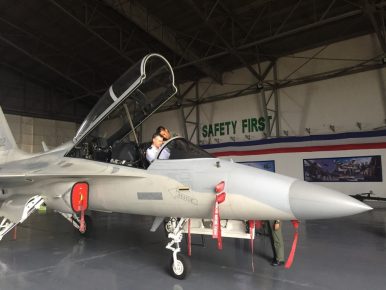
US and Philippine air force personnel pose for a photo in front of PAF FA-50 aircraft on August 17 at Clark Air Base. US Air Force photo
“The exchange is the fifth iteration of a US-Philippine Air Contingent established by US Pacific Command with the approval of the Philippines and executed by Headquarters Pacific Air Forces. The first US-Philippine Air Contingent occurred in April of 2016,” US Pacific Air Forces said.

“We welcome the opportunity to strengthen our cooperation and interoperability with our Philippine counterparts,” 13th Expeditionary Air Squadron commander US Air Force Colonel James Shigekane said. “These exchanges allow us to share best practices and joint capabilities that helps us bolster our regional security interests and goals.”


A US Air Force radio frequency transmission systems technician demonstrates how to setup a Hawkeye communications system to members of the Philippine Air Force on August 18 at Basa Air Base. US Air Force photo

https://www.update.ph/2017/09/look-us-ph-air-forces-conduct-expert-exchanges/20447

LOOK: 5 NPA members surrender amid hardships

From Update Philippines (Sep 2): LOOK: 5 NPA members surrender amid hardships

Five members of NPA, who are also members of indigenous group Lumad surrendered to Philippine Army’s 33rd Infantry (Makabayan) Battalion in Senator Ninoy Aquino, Sultan Kudarat, this was revealed by 33IB commander Lieutenant Colonel Harold Cabunoc today, September 2.

“Pagod, hirap, at lamig sa bundok ang kasama sa rason kung bakit nagpasyang sumuko sa 33rd Infantry (Makabayan) Battalion ang mga dating bandidong NPA,” Lieutenant Colonel Cabunoc said.


Lieutenant Colonel Harold Cabunoc photo
“Naliwanagan ang mga lumad na mali na gamitin ang karahasan para mabawi ang kanilang ancestral domain,” he added.

“Nagtiwala rin ang mga lumad sa tropa ng Makabayan Battalion na tumutulong sa kanilang komunidad sa larangan ng edukasyon at community development,” Cabunoc said.

Cabunoc commended Alpha Company commanding officer First Lieutenant John Jamora and EX-O First LieutenantCesar Ballado.

https://www.update.ph/2017/09/look-5-npa-members-surrender-amid-hardships/20463

Armed Forces of the Philipines must be resilient – Legarda

From Update Philippines (Sep 1): Armed Forces of the Philipines must be resilient – Legarda

The Armed Forces of the Philippines (AFP) must be resilient as an institution so that it does not only respond to disasters but also help build resilient communities, Chair of the Senate Committees on Climate Change and Finance Senator Loren Legarda said during the hearing on her proposed Senate Resolution No. 449 August 30.

The hearing aims to look into the climate related risks and capacity challenges that impact on the AFP’s ability to respond to non-traditional forms of threats.

“As first responders in times of disasters, the AFP has to be a resilient institution – ready and capable to perform its role, not just in times of disasters, but to help build resilient communities. We cannot count on the AFP to be effective in its mission unless it is, on its own, a resilient institution,” Legarda said.

The Senator said there is much to be done in making AFP’s properties and equipment resilient and she shared adaptation measures that the military can do in their camps, within their communities, and in their own homes.

Examples of adaptation measures include multi-hazard early warning systems; putting up rainwater harvesters, seed banks, and rooftop gardens; building roadside ditches and seawalls; reforesting mangroves; utilizing indigenous knowledge on disaster resilience; and undertaking regular drills for disaster preparedness.

“Our military must be resilient because you yourselves must survive to save lives; you cannot be effective first responders if you yourselves are victims. AFP’s disaster resilience as an institution needs to be guaranteed so that it may effectively discharge its expanded roles in the face of climate impacts and increasing disaster risks,” said Legarda.

Among the recommendations during the hearing are promoting peer-to-peer learning among AFP officials and personnel on DRR and CCAM good practices in camps; building capacity for DRR and CCAM from the current competencies and strengths of the AFP and its reservists; and making AFP defense planning and budgeting sensitive to disaster and climate risks.

https://www.update.ph/2017/09/armed-forces-of-the-philipines-must-be-resilient-legarda/20418

US deploys warship capable of operating F-35B to Indo-Asia-Pacific

From Update Philippines (Sep 1): US deploys warship capable of operating F-35B to Indo-Asia-Pacific


United States Navy Amphibious assault ship USS Wasp (LHD 1) departed Norfolk, Virginia, USA for Sasebo, Japan on August 30. Replacing USS Bonhomme Richard (LHD 6), she it will assume duties as the forward-deployed flagship of the amphibious force of the US 7th Fleet, the US Navy said.

USS Wasp is capable of operating the F-35B Joint Strike Fighter.

“USS Wasp has been recently modernized to accommodate the Marine Corps variant of the Joint Strike Fighter (F-35B),” the US NAvy said. F-35B is capable of Short Take-off Vertical Landing (STOVL), enabling it to operate out of a wide range of bases, both afloat and a shore.

US Navy said this deployment will introduce an F-35B Joint Strike Fighter-capable amphibious assault ship to the Indo-Asia-Pacific region, pairing it with the F-35Bs of Marine Fighter Attack Squadron (VMFA) 121.

“This move ensures that our most technologically-advanced air warfare platforms are forward deployed,” said Wasp Commanding Officer Capt. Andrew Smith. “Our capabilities, paired with the F-35B Joint Strike Fighter, increases our Navy’s precision strike capabilities within the 7th Fleet region. Wasp will help America’s commitment to the maritime security and stability in the Indo-Asia-Pacific.”

https://www.update.ph/2017/09/us-deploys-warship-capable-of-operating-f-35b-to-indo-asia-pacific/20412

PH Navy special forces seize US Navy vessel in SEACAT

From Update Philippines (Sep 1): PH Navy special forces seize US Navy vessel in SEACAT

Members of the Philippine Naval Special Operations Group conducted a Visit, Board, Search and Seizure (VBSS) aboard United States Navy Spearhead-class Expeditionary Fast Transport vessel USNS Millinocket (T-EPF-3) in waters off the coast of Puerto Princesa on August 30. 
A Philippine Navy patrol craft and one Islander plane participated in said activity.

USNS Millinocket played the role of hostile vessel or SEACAT-controlled Contact of Interest (COI).


US Navy photo

The said activity was part of South East Asia Cooperation and Training (SEACAT) 2017.


US Navy photo

SEACAT aims to increase multilateral cooperation and information sharing among navies and coast guards across South and Southeast Asia.

This year’s SEACAT includes participants from the US Coast Guard and Coast Guards and Coastal Patrol Agencies from the Philippines, Singapore, Vietnam, Malaysia, and Indonesia.

https://www.update.ph/2017/09/ph-navy-special-forces-seize-us-navy-vessel-in-seacat/20408

Chinese firm is lowest bidder in body armor acquisition for PH army

From Update Philippines (Sep 1): Chinese firm is lowest bidder in body armor acquisition for PH army

Red Dot Imaging Philippines-Hunan Zhongtai China was declared the lowest bidder for the acquisition of 37,774 units of Force Protection Equipment, body armor, for Philippine Army during the Submission and Opening of Bid Envelopes conducted at the Department of Budget Management (DBM) on August 31, MaxDefense Philippines said.

Red Dot Imaging-Hunan Zhongtai’s offer of PHP691,696,544 or PHP18,326 per unit was declared lowest bid.

The above mentioned bidder was followed by Triton & Beijing with PHP812,141,000 offer, China Xingding & Goldbell with PHP847,918,960, and Mars Armor (Bulgaria) with PHP1,234,983,680, MaxDefense added.

Meanwhile, China Xingxing Import & Export, Nashe & Nurol Turkey, Kolon Global (Korea), Fort Bo & Kyung Chang Industry & DK Armor, and Source Vagabond System (Israel) did not qualify for the bidding.

Budget for this acquisition project was sourced from the supposed to be Shore Based Missile System (SBMS) acquisition project in Armed Forces of the Philippines Modernization Program First Horizon.

https://www.update.ph/2017/09/chinese-firm-is-lowest-bidder-in-body-armor-acquisition-for-ph-army/20437

Map: Areas where IS-related groups are active in Mindanao/Southern Philippines

Map of areas where IS-related groups are active in Mindanao/Southern Philippines from the ACAPS reported entitled IS-affiliated groups take control of territories in central Mindanao posted to the Relief Web.

capture.jpg


Source map: Reuters 07/2017

https://www.acaps.org/country/philippines/scenarios#scenario-19

IS-Affiliated groups take control of territories in central Mindanao

Posted to the Relief Web (Sep 1): IS-Affiliated groups take control of territories in central Mindanao

Published on 01 Sep 2017 — View Original


OUTLOOK FOR SEPTEMBER 2017—FEBRUARY 2018

The threat of insecurity posed by IS-affiliated armed groups operating in central Mindanao has increased in the last months. The Philippines’ security forces have shown limited capacity to contain this threat. The risk of these groups taking control of territories has now become likely, and could affect up to 4.9 million people who live in conflict-prone areas (Lanao del Norte, Lanao del Sur, Maguindanao and Cotabato provinces).


RATIONALE

Long-term insurgency and disrupted peace processes

The Moro people - several mostly Muslim ethnolinguistic groups who were initially the majority in Mindanao - have been socially and economically marginalised throughout the 20th century. The central government of the Philippines has initiated several waves of Christian migrants to the region in an attempt to integrate it. As a result, since the late 1960s, Mindanao has experienced several insurgencies led by mostly Muslim Moro separatist armed groups in order to gain independence from the central government, starting in 1972 with the Moro National Liberation Front (MNLF). Several peace agreements have been brokered offering more autonomy to the Moro people. In 1989 there was the creation of the Autonomous Region in Muslim Mindanao (ARMM) and in 2014 the Bangsamoro Basic Law (BBL) - a draft legislation that would guarantee them more rights.

However, no long-standing peace has held due to delays in the implementation of these peace agreements, the mistrust between the parties involved, and the evolving political agenda of the insurgents. The two main peace processes have been hindered by the splintering of the insurgency, further fueling the conflict. In 1977, despite the ongoing peace process between the Moro National Liberation Front (MNLF) and the central government, a splinter group – the Moro Islamic Liberation Front (MILF) was formed in rejection of the autonomy offered by the central government. During the BBL peace process between the MILF and the government, mistrust and delays have resulted in several groups splintering from the MILF, and opting for a more radical Islamic agenda.

Radicalisation of armed groups and support from former insurgencies.

Since 2014 several armed groups in Mindanao have shown support for the Islamic State (IS) and also strengthened collaboration among themselves, moving further away from the peace process. This includes Abu-Sayyaf Happilon (AS-Happilon) - a splinter group of the MNLF, the Bangsamoro Islamic Freedom Fighters (BIFF) - a splinter group of the MILF, and the Maute group - mostly made up of former MILF fighters. Since 2016, these groups have also strengthened their links, covering three different geographic areas. AS-Happilon dominates in Basilan, the BIFF has a strong presence in Maguindanao, and Lanao del Sur region is under Maute’s influence. An example of this cooperation is when BIFF clashed with the Armed Forces of the Philippines (AFP) in Cotabato province, likely attempting to divert AFP’s response to Maute’s besiegement of Marawi city.

In addition, IS-affiliated groups have received support from the MILF. The BIFF and Maute groups have carried out attacks against the Philippines’ security forces and hide in areas under MILF’s control where government forces cannot enter. Despite being involved in the peace process, MILF is divided, with some of its commanders supporting splinter groups by, for example, offering training and camps in central Mindanao to Maute fighters.

Security forces’ lack of capacity and IS’ new warfare strategies

Compounding the support of the MILF, the ability of these armed groups to operate is enhanced by the limited number of AFP forces in central Mindanao and the lack of intelligence capacity to monitor the threat posed by these groups. Some areas remain under the control of MILF forces. Intelligence services have long struggled to gain a clear overview of the threat posed by IS-affiliated groups, with contradicting reports of their strength (number of fighters, scope of foreign fighters, links with local communities).

IS-affiliated armed groups have developed new warfare strategies, thus hindering AFP’s response. The three month-long Marawi siege has been made possible by Maute fighters’ use of snipers, tunnels, and sufficient preparation (food and ammunitions stock). This has prevented the AFP from retaking Marawi quickly. Moreover, despite suffering severe backlash in previous operations such as in Butig, Lanao del Sur in 2016, the Maute groups have shown both resilience and capacity-building skills.

Ethnic and clan links strengthen armed groups

IS-affiliated groups have strengthened because of social and economic roots based on ethnic and clan links. This allows wider collaboration and recruitment. Clans provide substantive financial support to armed groups they are linked with and ensure some political legitimacy as clans are well represented in local political institutions. Some clans also have private militia that can provide support to armed groups. For instance, the Maute armed group has originated from the Maute clan, who run several businesses in Lanao del Sur, is politically strong in Marawi and has its own private militia. The Maute clan has also developed links through marriage with the Mimbantas clan, powerful among the MILF. This has enhanced the recruitment of MILF fighters by the Maute.

The ethnic structure of these groups also helps with recruiting fighters on an ethnic basis. Abu Sayyaf is largely made of Yakan, indigenous to Basilian Island, while BIFF is made up of Maguindanaon, and Maute is mostly Maranao. The last two ethnic groups have dominated the MILF, and some Maranao MILF fighters, disappointed by the lengthy process around the BBL, have joined the Maute group.

PREDICTED DEVELOPMENTS

The combination of armed groups uniting under the IS flag, their connection to local communities, and their links with former insurgencies have strengthened these armed groups’ capacity to hold territories in central Mindanao. Violence will likely increase over the next six months in central Mindanao and IS-affiliated groups will seize territories as a result. Attacks will be carried out simultaneously by IS-affiliated groups in order to divert AFP’s response, weakening their ability to counter IS’ long-term control of territories.

Whatever the losses are for IS-affiliated groups involved in the Marawi crisis, the length of this battle will be their first major comprehensive success and will likely trigger recruitment and increase their capacity to carry out new large attacks and to hold territories.

Lack of unified command among the MILF leadership has already disrupted the peace process and has further fueled the conflict. The Marawi crisis further aggravates the stagnation of the BBL process and will likely increase discontent and dissatisfaction among MILF fighters who will be encouraged to join IS-affiliated armed groups. Some MILF commanders will likely also informally split, and/or let these IS-affiliated groups operate with more freedom in their areas of control.

http://reliefweb.int/report/philippines/affiliated-groups-take-control-territories-central-mindanao

US-Philippines Air Force Cooperation in the Spotlight Amid Exchange

From The Diplomat (Sep 2): US-Philippines Air Force Cooperation in the Spotlight Amid Exchange

The two allies completed the latest iteration of a new exchange established last year.

US-Philippines Air Force Cooperation in the Spotlight Amid Exchange
Image Credit: Pacific Air Forces Public Affairs
 
Last week, the United States and the Philippines completed the latest iteration of a new exchange between their two air forces established last year. The move is just the latest example of the defense cooperation still ongoing between the two longtime allies despite the complications that have arisen since Philippine President Rodrigo Duterte took office last June.

As I have noted in these pages, the United States and the Philippines have a decades-old alliance that was formalized in the Mutual Defense Treaty in 1951 and a long history of security collaboration (See: “The US-Philippine Alliance Under Duterte: A Path to Recalibration”).

Though the environment for security cooperation has been more uncertain amid Duterte’s initial pursuit of a so-called ‘independent foreign policy’ – diversifying Manila’s alignments away from Washington and towards other powers like China and Russia – important collaboration in areas like counterterrorism and maritime security is still ongoing, albeit with some of it more quietly pursued (See: “US Terror Aid to Philippines Signals Enduring Defense Ties Under Duterte”).Enjoying this article? Click here to subscribe for full access. Just $5 a month.

That includes cooperation between their air forces as well. In recent years, both sides have set up annual Airman-to-Airman (A2A) talks and the Philippines had agreed to host more U.S. Pacific Command and U.S. Pacific Air Forces (PACAF) exercises as well as related missions and air contingents. The uptick in collaboration has allowed Washington to increase its regional presence and enabled Manila to get the kind of support and expertise that it badly needs given its own limitations (See: “Where is the Philippines’ Air Force Modernization Under Duterte?”).

As just one example of this ongoing collaboration, last year the U.S. Pacific Command, with the approval of the Philippines, established a U.S.-Philippine Air Contingent with exchanges and other related activities facilitated by PACAF.

According to PACAF, the objective of the exchanges, held quarterly, is for both services to share technical and operational expertise and develop standardized training and practices in various areas that can help streamline cooperation and boost interoperability.

The first U.S.-Philippine Air Contingent occurred in April 2016, and both sides have maintained the quarterly schedule up to this point. Previous iterations have featured open forum discussions and subject matter expert exchanges along with bilateral training missions and some drills featuring U.S. personnel and equipment.

From August 16 to August 25, the two sides conducted the fifth iteration of this exchange. According to Pacific Air Forces, 25 U.S. Air Force Airmen participated in subject matter expert exchanges (SMEE) with their Philippine counterparts at various military installations throughout the country, including Clark Air Force base in Pampanga.

PACAF said in a statement that the exchanges would cover various topics including precision guided missile and munitions operations, command and control tactics, humanitarian assistance and disaster relief operations, and other areas such as explosive ordnance handling, flight line operations, and mishap response and prevention.

https://thediplomat.com/2017/09/us-philippines-air-force-cooperation-in-the-spotlight-amid-exchange/

Troops retake 2nd bridge in Marawi, 3 soldiers killed

From Rappler (Sep 2): Troops retake 2nd bridge in Marawi, 3 soldiers killed
(UPDATED) Three soldiers are killed and 52 others are wounded as troops push forward against local terrorists to end the war that has dragged on for over 3 months

(4th UPDATE) – The Philippine military said it has retaken another critical bridge in Marawi City on Thursday, August 31, as troops pushed forward against local terrorists to end the war that has dragged on for over 3 months.

Troops finally controlled Bayabao Bridge on Thursday, Lieutenant General Carlito Galvez, chief of the Western Mindanao Command, announced in Marawi.

Bayabao Bridge is often referred to by the military as the Banggolo Bridge because it goes right into the city's financial district, Banggolo, where the local terror groups strategically holed up.

Three soldiers were killed and 52 others were wounded in the military offensive, bringing the death toll among troops to 136, based on the latest report from the military. The war erupted on May 23. (READ: TIMELINE: Marawi clashes prompt martial law in all of Mindanao)

Banggolo Bridge is the 2nd of 3 critical bridges in the Marawi battle zone. Troops took control of Baloi Bridge – or what troops refer to as Mapandi Bridge – last month, on July 2.

The last bridge the troops need to retake is Masiu Bridge. It is located near Lake Lanao.

Joint Task Force Marawi spokesperson Captain Jo-ann Petinglay said most of the soldiers wounded on Thursday suffered minor injuries.

"The offensive on the eve of Eid'l Adha has been among the toughest so far. We are working to clear the remaining areas where the enemy is holding out," Brigadier General Restituto Padilla said in a statement on Friday, September 1.

"Following a short pause early today (during the morning prayers) to give due respect to the solemnity and significance of this day, the operations will continue without letup," he added.

The military said it has pinned down the terrorists to an area approximately 500 meters by 500 meters. But they are holding out in well-defended high rise buildings made of hard concrete that even air strikes cannot easily bring down.

Enemy snipers have made it difficult for troops to advance, while improvised explosive devices (IEDs) have slowed down clearing operations. (READ: Sniper and IEDs: Deadly combination in Marawi war zone)

The military has also retaken the Islamic Center or the "Grand Mosque," where the hostages were believed to have been kept during the first months of the war.

None of the hostages were found when the troops moved, however, as they are believed to have been moved to another area in the battle zone.


https://www.rappler.com/nation/180829-marawi-war-casualties-final-push

Duterte makes U-turn: Bombing mosques in Marawi will hurt Muslims

From Rappler (Sep 1): Duterte makes U-turn: Bombing mosques in Marawi will hurt Muslims

President Duterte tells soldiers now the government has to be conscious of the cultural and ideological implications of bombing mosques in the fight against terrorists

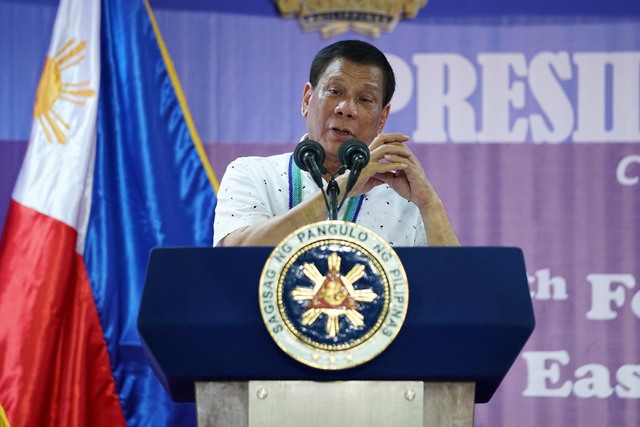
President Rodrigo Roa Duterte during a speech at the 11th Founding Anniversary celebration of the Eastern Mindanao Command (EastMinCom) at the Naval Station Felix Apolinario in Panacan, Davao City on September 1, 2017. Presidential Photo.

President Rodrigo Roa Duterte during a speech at the 11th Founding Anniversary celebration of the Eastern Mindanao Command (EastMinCom) at the Naval Station Felix Apolinario in Panacan, Davao City on September 1, 2017. Presidential Photo.

President Rodrigo Duterte has made a U-turn on the parameters for the government's troops' final push to flush local terrorists out of Marawi City.

Within a few days of declaring he wouldn’t stop the military from bombing the remaining enemy strongholds in Marawi, including mosques with terrorists and hostages inside, Duterte said on Friday, September 1, that bombing the Muslims' place of worship would not help the cause.

“We cannot destroy the mosque.... It will breed an unending hatred,” Duterte said in his speech on Friday, as Muslims celebrated Eid al-Adha.

“What will it give us in terms of goodwill?” he told the military’s Eastern Mindanao Command. He added the government should be conscious of the cultural and ideological implications of destroying the mosques in the fight against terrorists.

On Friday morning, thousands of Filipino Muslims went out to perform the Eid al-Adha prayer, a special occasion where prophet Ibrahim’s sacrifice by offering his son Ismail to God is commemorated.

Still, fighting between government troops and the Maute group continued in Marawi. On Thursday night, August 31, three soldiers were killed, while 52 were wounded after soldiers attempted to retake the Banggolo bridge, the second of 3 strategic bridges in the Lanao del Sur capital.

During his speech, Duterte bared that he had earlier thought of lifting the martial law. However, with the current situation, he said “we’ll just have [to] continue.”

“Parang may spillover na sa ARMM eh,” he said. (It looks like [the conflict] has spilled over into the Autonomous Region in Muslim Mindanao).

https://www.rappler.com/nation/180880-duterte-change-policy-bombing-mosques-marawi-muslims

U.S. turns over gas masks to Philippine Navy

From Rappler (Sep 2): U.S. turns over gas masks to Philippine Navy

The US embassy says the transfer – made through the Mutual Logistics Support Agreement – is part of the ongoing transfers from the US military to multiple branches of the Armed Forces of the Philippines

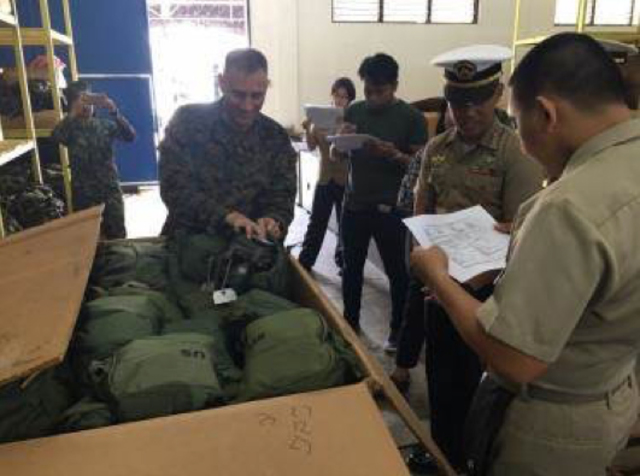
Photos courtesy of the United States embassy in Manila

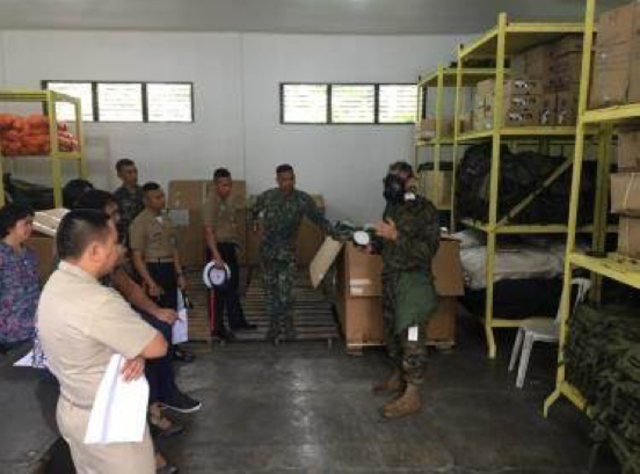
Photos courtesy of the United States embassy in Manila

The Joint United States Military Assistance Group has delivered 1,000 M40 field protective masks and C2 filter canisters to the Philippine Navy.

In a statement on Saturday, September 2, the US embassy in Manila said the Philippine Navy "requested these gas masks in order to better prepare their sailors and marines to respond to chemical threats," as fighting continues in Mindanao.

The transfers were made on August 30 and 31.

The embassy said this transfer – made through the Mutual Logistics Support Agreement (MLSA) – is part of the ongoing transfers from the US military to multiple branches of the Armed Forces of the Philippines (AFP).


 "Through the MLSA, the AFP is able to receive select munitions and equipment from US military stock in an accelerated process reserved for allies and close partners of the United States," the statement read.

The embassy said it will continue to support the Philippines' capacity-building counterterrorism efforts, and the AFP's long-term modernization goals.

The US has reassured the Philippines of continuing partnership and support despite the fact that President Rodrigo Duterte appears to have distanced himself from his country's longtime ally.

https://www.rappler.com/nation/180909-us-transfers-field-protective-masks-philippine-navy