From the Philippine News Agency (May 16): Army activates 1st Negros Island Geographic Battalion in Negros Occidental
The 3rd Infantry Division (ID) of the Philippine Army activated the 1st Negros Island Geographic Battalion in Negros Occidental on Tuesday as part of the measures to strengthen internal security in the two Negros provinces.
The rites held at the Negros Occidental Multi-Purpose Activity Center (NOMPAC) here was led by Major General Jon Aying, commander of the 3rd ID, after the arrival honors given to Governor Alfredo Marañon Jr. held at the Capitol grounds.
This is one step towards strengthening security (in Negros Island),” Aying said in his speech before government troopers.
The 1st Negros Island Geographic Battalion has an integrated force composed of regular and active Army soldiers, CAFGU Active Auxiliary (CAA) members, and Philippine Army reservists.
Aying said the 2nd Negros Island Geographic Battalion in Negros Oriental would be activated next.
He said the 3rd ID has a combined force of 46,000 personnel across six islands including Bohol, Cebu, Siquijor, Negros, Panay and Guimaras.
These include almost 4,962 regular and active Army troopers and officials, 4,700 CAA members, and 36,000 reservists.
Aying added that of the 10 provinces in the six islands, six are already insurgency cleared: Bohol, Cebu, Siquijor, Aklan, Antique and Guimaras.
The remaining four with insurgency concerns include Iloilo, Capiz, Negros Occidental and Negros Oriental.
The Army official cited three human-induced threats to national security which, in the case of the jurisdiction of the 3rd ID, include threat of communist insurgency, threat from violent/terrorist groups in Mindanao, and threat of illegal drugs.
He added climate change as the fourth threat.
To address these threats, Aying mentioned four peace and security strategic objectives. These include putting an end to communist insurgency, overcome the challenge of violent groups from Mindanao, fight illegal drugs, and lessen vulnerability of the public.
http://www.pna.gov.ph/index.php/articles/988291

Tuesday, May 16, 2017

PHL Navy, RSN sign MOU on White Shipping
From the Philippine News Agency (May 16): PHL Navy, RSN sign MOU on White Shipping
In line with ongoing efforts to expand the country's military relations with its ASEAN neighbors, the Philippine Navy and Republic of Singapore Navy on Monday signed a Memorandum of Understanding (MOU) Concerning the Exchange of Information relating to White Shipping.
The MOU was signed by PN flag-officer-in-command Vice Admiral Ronald Joseph Mercado and RSN chief Rear Admiral Lai Chung Han at the Pan Pacific Singapore Hotel, Singapore over the weekend.
Capt. Donn Anthony Miraflor, Naval Task Group (NTG) 80.5 head, said the MOU signing manifests the strong desire of both Navies to further strengthen existing bilateral relations in order to enhance cooperation beneficial to the defense and security of both countries.
NTG 80.5 sailed to Singapore last May 6 aboard the BRP Gregorio Del Pilar (FF-15) which then participated in the events and activities relating to the RSN's 50th founding anniversary from May 11 to 19.
Signing of the MOU is part of the activities, he added.
Core of this understanding emphasizes the need to enhance information sharing relating to White Shipping which generally covers general commercial ships, passenger liners, pleasure craft and fishing boats, which are non-military and non-government in nature.
Miraflor said the MOU underscores the establishment of policies and procedures for the conduct of information sharing and reciprocal protection of information relating to White Shipping between the two nations in order to enhance maritime awareness in their respective areas.
He added that signing of the MOU highlights the PN’s strong commitment and desire to enhance its maritime awareness through partnership and cooperation with the end in view of strengthening its security and protecting common maritime interests.
http://www.pna.gov.ph/index.php/articles/988078
In line with ongoing efforts to expand the country's military relations with its ASEAN neighbors, the Philippine Navy and Republic of Singapore Navy on Monday signed a Memorandum of Understanding (MOU) Concerning the Exchange of Information relating to White Shipping.
The MOU was signed by PN flag-officer-in-command Vice Admiral Ronald Joseph Mercado and RSN chief Rear Admiral Lai Chung Han at the Pan Pacific Singapore Hotel, Singapore over the weekend.
Capt. Donn Anthony Miraflor, Naval Task Group (NTG) 80.5 head, said the MOU signing manifests the strong desire of both Navies to further strengthen existing bilateral relations in order to enhance cooperation beneficial to the defense and security of both countries.
NTG 80.5 sailed to Singapore last May 6 aboard the BRP Gregorio Del Pilar (FF-15) which then participated in the events and activities relating to the RSN's 50th founding anniversary from May 11 to 19.
Signing of the MOU is part of the activities, he added.
Core of this understanding emphasizes the need to enhance information sharing relating to White Shipping which generally covers general commercial ships, passenger liners, pleasure craft and fishing boats, which are non-military and non-government in nature.
Miraflor said the MOU underscores the establishment of policies and procedures for the conduct of information sharing and reciprocal protection of information relating to White Shipping between the two nations in order to enhance maritime awareness in their respective areas.
He added that signing of the MOU highlights the PN’s strong commitment and desire to enhance its maritime awareness through partnership and cooperation with the end in view of strengthening its security and protecting common maritime interests.
http://www.pna.gov.ph/index.php/articles/988078
Gov't urged to tap local industries to modernize military
From the Philippine News Agency (May 16): Gov't urged to tap local industries to modernize military
Amid plans of the Duterte administration to utilize the USD 500-million loan being offered by Chinese government to modernize the Philippine military, a senator on Tuesday urged the government to first consider tapping local industries to create more jobs.
“Buy local, create jobs. This should be the new mantra of the government,” Senate Pres. Pro Tempore Ralph Recto said in a statement.
Recto made this remark following Defense Secretary Delfin Lorenzana’s statement that the government plans to use the loan to procure defense equipment from China.
“We must stop relying on foreign suppliers to modernize the military equipment of our armed forces,” he added. “There is no need to borrow from China. We should tap our domestic industries for the equipment needed by our policemen and soldiers.”
He said that the only equipment or parts that the Philippine government should import are those which the country cannot produce locally.
“We should not bypass local industries which can provide parts or whole of the defense equipment being sought,” Recto said.
He pointed out that if defense equipment can be made locally and the products are of the same price and quality as the ones bought abroad, then they should be manufactured in the Philippines.
“We should look inward and develop our own capability. It is cheaper to produce and maintain them locally, than to import them. That way, jobs are created for the Filipinos and the local industries are given the chance to grow,” he added.
The senator cited the existence of local firearms industry which has been exporting its products for many decades noting that “some of them were licensees of world’s leading gun makers.”
“There are many of them, from boat builders to vehicle manufacturers to firearm/ammunition makers who can step up to the plate once there are firm orders from the government,” Recto said.
Recto said the country’s car manufacturing industry can supply military and police vehicles.
Moreover, he said that Pres. Rodrigo Duterte’s home province of Cebu can even build coastal patrol ships.
“We have a world-class shipbuilding industry in Cebu, but our government agencies have yet to harness its potential as a major source of military and civilian boats,” he added.
http://www.pna.gov.ph/index.php/articles/988134
Amid plans of the Duterte administration to utilize the USD 500-million loan being offered by Chinese government to modernize the Philippine military, a senator on Tuesday urged the government to first consider tapping local industries to create more jobs.
“Buy local, create jobs. This should be the new mantra of the government,” Senate Pres. Pro Tempore Ralph Recto said in a statement.
Recto made this remark following Defense Secretary Delfin Lorenzana’s statement that the government plans to use the loan to procure defense equipment from China.
“We must stop relying on foreign suppliers to modernize the military equipment of our armed forces,” he added. “There is no need to borrow from China. We should tap our domestic industries for the equipment needed by our policemen and soldiers.”
He said that the only equipment or parts that the Philippine government should import are those which the country cannot produce locally.
“We should not bypass local industries which can provide parts or whole of the defense equipment being sought,” Recto said.
He pointed out that if defense equipment can be made locally and the products are of the same price and quality as the ones bought abroad, then they should be manufactured in the Philippines.
“We should look inward and develop our own capability. It is cheaper to produce and maintain them locally, than to import them. That way, jobs are created for the Filipinos and the local industries are given the chance to grow,” he added.
The senator cited the existence of local firearms industry which has been exporting its products for many decades noting that “some of them were licensees of world’s leading gun makers.”
“There are many of them, from boat builders to vehicle manufacturers to firearm/ammunition makers who can step up to the plate once there are firm orders from the government,” Recto said.
Recto said the country’s car manufacturing industry can supply military and police vehicles.
Moreover, he said that Pres. Rodrigo Duterte’s home province of Cebu can even build coastal patrol ships.
“We have a world-class shipbuilding industry in Cebu, but our government agencies have yet to harness its potential as a major source of military and civilian boats,” he added.
http://www.pna.gov.ph/index.php/articles/988134
International cooperation needed in negating terror threats
From the Philippine News Agency (May 16): International cooperation needed in negating terror threats
Further international cooperation in defense and security are among the initiatives which could prevent ISIS and other terror groups from gaining a foothold in the Philippines and other parts of the country.
"First of all, terrorism and violent extremism are threats that necessitate an international response. As such, the Department of National Defense (DND) has expanded our international defense and security engagements beyond our traditional allies," said DND public affairs office chief Arsenio Andolong to the Philippine News Agency Tuesday when queried what steps the agency is taking to prevent terrorists from settling in the country.
This includes the recent trilateral patrol agreement with Malaysia and Indonesia so that terrorist activities in the common maritime areas in the Sulu Sea will be stopped.
"In addition, we have engaged traditional institutions in critical areas to garner popular support and effectively prevent the entry of terrorists and radicals in our communities," he said.
Andolong added that DND Secretary Delfin Lorenzana and other ranking defense and military officials also went to the critical areas of Basilan, Sulu, and Tawi-Tawi, known operating areas of the Abu Sayyaf Group (ASG), to engage the communities and encourage the people to work closely with government security forces in negating these threats.
This includes getting the assistance of Muslim religious leaders also known as the "Ulamas" to counter ISIS recruitment efforts among the youth in Mindanao.
These can be done by giving Muslim youth proper spiritual guidance to counter the extremism and hate being propagated by the terrorists.
"The DND recognize(s) that our campaign against terrorism and violent extremism cannot be solved by military operations along. It needs a whole-of-country approach and every Filipino has a stake in it," he noted.
The DND official also pointed out that terrorism is anti-God, anti-people, and ultimately anti-Filipino.
http://www.pna.gov.ph/index.php/articles/988138
Further international cooperation in defense and security are among the initiatives which could prevent ISIS and other terror groups from gaining a foothold in the Philippines and other parts of the country.
"First of all, terrorism and violent extremism are threats that necessitate an international response. As such, the Department of National Defense (DND) has expanded our international defense and security engagements beyond our traditional allies," said DND public affairs office chief Arsenio Andolong to the Philippine News Agency Tuesday when queried what steps the agency is taking to prevent terrorists from settling in the country.
This includes the recent trilateral patrol agreement with Malaysia and Indonesia so that terrorist activities in the common maritime areas in the Sulu Sea will be stopped.
"In addition, we have engaged traditional institutions in critical areas to garner popular support and effectively prevent the entry of terrorists and radicals in our communities," he said.
Andolong added that DND Secretary Delfin Lorenzana and other ranking defense and military officials also went to the critical areas of Basilan, Sulu, and Tawi-Tawi, known operating areas of the Abu Sayyaf Group (ASG), to engage the communities and encourage the people to work closely with government security forces in negating these threats.
This includes getting the assistance of Muslim religious leaders also known as the "Ulamas" to counter ISIS recruitment efforts among the youth in Mindanao.
These can be done by giving Muslim youth proper spiritual guidance to counter the extremism and hate being propagated by the terrorists.
"The DND recognize(s) that our campaign against terrorism and violent extremism cannot be solved by military operations along. It needs a whole-of-country approach and every Filipino has a stake in it," he noted.
The DND official also pointed out that terrorism is anti-God, anti-people, and ultimately anti-Filipino.
http://www.pna.gov.ph/index.php/articles/988138
Majority of UH-IDs now airworthy -- PAF
From the Philippine News Agency (May 16): Majority of UH-IDs now airworthy -- PAF
The Philippine Air Force (PAF) has declared that eight out of the 11 remaining UH-1D "Huey" combat utility helicopters airworthy after finding nothing mechanical wrong with the aircraft during recent inspections.
"They were grounded for the purpose of inspection and during individual inspections, no discrepancies were found on the UH-1Ds," said PAF spokesperson Col. Antonio Francisco in Filipino Tuesday.
All of the PAF's UH-IDs were grounded following a fiery crash in Tanay, Rizal which killed one pilot, two enlisted personnel and severely wounded another pilot last May 4.
Francisco said the eight are found airworthy after a close check by PAF personnel with another three awaiting inspection.
However, the PAF spokesperson could not give the exact cause for the May 4 crash as investigators are still conducting their work.
The PAF acquired the UH-IDs as part of their efforts to augment their existing UH-IH combat utility helicopters in 2014 and 2015.
Their acquisition were earlier scored by some groups as the UH-IDs were claimed to be defective.
The "D" designation in the UH-1 means that it was manufactured by Dornier, a German aircraft manufacturer which started construction of the UH-1 during 1967 to 1981.
Around 350 units were build by the German aircraft manufacturer.
http://www.pna.gov.ph/index.php/articles/988204
The Philippine Air Force (PAF) has declared that eight out of the 11 remaining UH-1D "Huey" combat utility helicopters airworthy after finding nothing mechanical wrong with the aircraft during recent inspections.
"They were grounded for the purpose of inspection and during individual inspections, no discrepancies were found on the UH-1Ds," said PAF spokesperson Col. Antonio Francisco in Filipino Tuesday.
All of the PAF's UH-IDs were grounded following a fiery crash in Tanay, Rizal which killed one pilot, two enlisted personnel and severely wounded another pilot last May 4.
Francisco said the eight are found airworthy after a close check by PAF personnel with another three awaiting inspection.
However, the PAF spokesperson could not give the exact cause for the May 4 crash as investigators are still conducting their work.
The PAF acquired the UH-IDs as part of their efforts to augment their existing UH-IH combat utility helicopters in 2014 and 2015.
Their acquisition were earlier scored by some groups as the UH-IDs were claimed to be defective.
The "D" designation in the UH-1 means that it was manufactured by Dornier, a German aircraft manufacturer which started construction of the UH-1 during 1967 to 1981.
Around 350 units were build by the German aircraft manufacturer.
http://www.pna.gov.ph/index.php/articles/988204
Cordillera officials discuss terms for peace with reds
From the Philippine News Agency (May 16): Cordillera officials discuss terms for peace with reds
Government negotiators tasked to secure peace with the National Democratic Front (NDF) motored to Baguio City to hold a two-day consultation-workshop with government officials and community leaders of the Cordilleras on proposed social and economic reforms being discussed with communist guerrillas.
The consultation-workshop on Tuesday, being held at the Albergo Hotels, also seeks to solicit inputs from the local officials and community leaders of the Cordillera Administrative Region (CAR) regarding concerns on the proposed joint ceasefire agreement with communist rebels.
“This activity is part of the government panel’s nationwide consultations with relevant stakeholders to collect inputs, test the validity of its positioning and encourage buy-ins for the on-going peace negotiations,” explained former Agrarian Reform Sec. Hernani Braganza, the panel member supervising the discussions on the Comprehensive Agreement on Social and Economic Reforms (CASER) and joint ceasefire agreement.
“We are your negotiators. What we want to discuss in the negotiating table with the NDF is your position on issues affecting your communities. Now is the time for the Cordillerans to speak up and voice out your concerns with regard to the peace negotiation,” Braganza added.
He explained that the outputs of the consultation-workshop, held under the auspices of the Regional Development Council (RDC) and the Regional Peace and Order Council (RPOC), will be included as inputs to the fifth round of formal peace negotiation with the NDF scheduled in The Netherlands from May 27 to June 1, 2017.
The government and the NDF had previously conducted four rounds of formal peace negotiations under the term of President Rodrigo Duterte, achieving breakthroughs in CASER discussions, ceasefire agreement and implementation of the Comprehensive Agreement on Respect for Human Rights and International Humanitarian Law (CARHR-IHL).
For CASER, both panels had agreed to accelerate the discussion through formation of bilateral teams that meet regularly in Manila in between formal rounds of peace negotiation. The discussions intend to flesh out an agreement on free land distribution for a proposed agrarian reform program.
During the fourth round of peace talks, held in Noordwidjk Ann Zee in The Netherlands last March, both panels also agreed to craft a joint ceasefire agreement that will provide cessation of hostilities pending the signing of a final peace agreement.
The terms of reference (TOR) of the joint ceasefire is now under discussion in Manila.
The third round of peace talks, held in Rome last January, produced an agreement providing supplementing guidelines for the operationalization of the Joint Monitoring Committee (JMC) of the CARHR-IHL.
The CARHR-IHL was signed by the government and the NDF in 1998, but it was only under the term of President Duterte that it was made fully operational.
The agreement recognized the need to apply human rights principles when responding to the armed conflict.
It obligated both parties to promote the respect of and adherence to international humanitarian law among its forces.
It emphasized the urgency of protecting the civilian population.
Braganza noted that aside from CASER and joint ceasefire, both panels will also discuss their respective positions on the proposed Comprehensive Agreement on Political and Constitutional Reforms (PCR) on the next round of talks in The Netherlands.
“At the moment, discussions were being conducted extensively on CASER since forging an agreement on social and economic reforms is acknowledged by parties to be central to reaching unity and peace,” he explained.
“We will also focus on the joint ceasefire since forging a bilateral ceasefire is considered to be of parallel importance to provide an enabling environment for reforms to take place,” he added.
Braganza said the consultation-workshop in Baguio City is the first under the RDC and RPOC mechanism, and will be replicated in other regions in between formal rounds of negotiations abroad. “We will try to bring to the negotiating table as many voices as possible.
The final peace agreement is not for government, but for the entire Filipino nation,” he pointed out.
http://www.pna.gov.ph/index.php/articles/988259
Government negotiators tasked to secure peace with the National Democratic Front (NDF) motored to Baguio City to hold a two-day consultation-workshop with government officials and community leaders of the Cordilleras on proposed social and economic reforms being discussed with communist guerrillas.
The consultation-workshop on Tuesday, being held at the Albergo Hotels, also seeks to solicit inputs from the local officials and community leaders of the Cordillera Administrative Region (CAR) regarding concerns on the proposed joint ceasefire agreement with communist rebels.
“This activity is part of the government panel’s nationwide consultations with relevant stakeholders to collect inputs, test the validity of its positioning and encourage buy-ins for the on-going peace negotiations,” explained former Agrarian Reform Sec. Hernani Braganza, the panel member supervising the discussions on the Comprehensive Agreement on Social and Economic Reforms (CASER) and joint ceasefire agreement.
“We are your negotiators. What we want to discuss in the negotiating table with the NDF is your position on issues affecting your communities. Now is the time for the Cordillerans to speak up and voice out your concerns with regard to the peace negotiation,” Braganza added.
He explained that the outputs of the consultation-workshop, held under the auspices of the Regional Development Council (RDC) and the Regional Peace and Order Council (RPOC), will be included as inputs to the fifth round of formal peace negotiation with the NDF scheduled in The Netherlands from May 27 to June 1, 2017.
The government and the NDF had previously conducted four rounds of formal peace negotiations under the term of President Rodrigo Duterte, achieving breakthroughs in CASER discussions, ceasefire agreement and implementation of the Comprehensive Agreement on Respect for Human Rights and International Humanitarian Law (CARHR-IHL).
For CASER, both panels had agreed to accelerate the discussion through formation of bilateral teams that meet regularly in Manila in between formal rounds of peace negotiation. The discussions intend to flesh out an agreement on free land distribution for a proposed agrarian reform program.
During the fourth round of peace talks, held in Noordwidjk Ann Zee in The Netherlands last March, both panels also agreed to craft a joint ceasefire agreement that will provide cessation of hostilities pending the signing of a final peace agreement.
The terms of reference (TOR) of the joint ceasefire is now under discussion in Manila.
The third round of peace talks, held in Rome last January, produced an agreement providing supplementing guidelines for the operationalization of the Joint Monitoring Committee (JMC) of the CARHR-IHL.
The CARHR-IHL was signed by the government and the NDF in 1998, but it was only under the term of President Duterte that it was made fully operational.
The agreement recognized the need to apply human rights principles when responding to the armed conflict.
It obligated both parties to promote the respect of and adherence to international humanitarian law among its forces.
It emphasized the urgency of protecting the civilian population.
Braganza noted that aside from CASER and joint ceasefire, both panels will also discuss their respective positions on the proposed Comprehensive Agreement on Political and Constitutional Reforms (PCR) on the next round of talks in The Netherlands.
“At the moment, discussions were being conducted extensively on CASER since forging an agreement on social and economic reforms is acknowledged by parties to be central to reaching unity and peace,” he explained.
“We will also focus on the joint ceasefire since forging a bilateral ceasefire is considered to be of parallel importance to provide an enabling environment for reforms to take place,” he added.
Braganza said the consultation-workshop in Baguio City is the first under the RDC and RPOC mechanism, and will be replicated in other regions in between formal rounds of negotiations abroad. “We will try to bring to the negotiating table as many voices as possible.
The final peace agreement is not for government, but for the entire Filipino nation,” he pointed out.
http://www.pna.gov.ph/index.php/articles/988259
350 Army troops deployed for 'Brigada Eskwela' in Metro Manila
From the Philippine News Agency (May 16): 350 Army troops deployed for 'Brigada Eskwela' in Metro Manila
With public school opening just a few weeks away, the Philippine Army (PA) on Tuesday announced it has deployed 350 soldiers to help in the ongoing "Brigada Ekswela" activities in 38 schools in Metro Manila.
"Brigada Eskwela" formally started on May 15 and will end on the 20th.
PA spokesperson Lt. Col. Ray Tiongson said these troops will help teachers and parents in minor repairs, repainting, and cleaning of schools.
Depending on the situation, the soldiers can also assist in masonry, carpentry, painting, plumbing, electrical and other services.
"Brigada Eskwela, also known as the National Schools Maintenance Program, is a yearly project of the Department of Education.
It's theme this year is “Isang DepEd, Isang Pamayanan, Isang Bayanihan Para sa Handa at Ligtas na Paaralan.”
http://www.pna.gov.ph/index.php/articles/988270
With public school opening just a few weeks away, the Philippine Army (PA) on Tuesday announced it has deployed 350 soldiers to help in the ongoing "Brigada Ekswela" activities in 38 schools in Metro Manila.
"Brigada Eskwela" formally started on May 15 and will end on the 20th.
PA spokesperson Lt. Col. Ray Tiongson said these troops will help teachers and parents in minor repairs, repainting, and cleaning of schools.
Depending on the situation, the soldiers can also assist in masonry, carpentry, painting, plumbing, electrical and other services.
"Brigada Eskwela, also known as the National Schools Maintenance Program, is a yearly project of the Department of Education.
It's theme this year is “Isang DepEd, Isang Pamayanan, Isang Bayanihan Para sa Handa at Ligtas na Paaralan.”
http://www.pna.gov.ph/index.php/articles/988270
Monday, May 15, 2017
NDF/NPA-NCMR: Technical Sergeant Joseph Valmores Paredes Padayong Giimbestigahan
New People's Army propaganda statement posted to the National Democratic Front Website (May 14): Technical Sergeant Joseph Valmores Paredes Padayong Giimbestigahan
PAMAHAYAG SA MIDYA
Mayo 15, 2017

Padayong gidetenir si Technical Sergeant Joseph Valmores Paredes (S/N: 777490 (INF) PA) sa custodial unit sa South Central Bukidnon (SCB) Sub-Regional Command. Mahinumduman nga kaniadtong Mayo 5, 2017 sa may 6:30 sa hapon, nadakpan si T.Sgt. Paredes sa gimontar nga checkpoint sa unit sa SCB atol sa operasyong pagdis-arma sa DASIA Security Agency didto sa Valencia City. Sa kasamtangan, padayon siyang ginaimbestigar ug ginasubay ug ginatuki ang mga tawo nga adunay kasayuran sa iyang pagkatawo ilabina panahon sa iyang pagserbisyo isip membro sa Philippine Army. Aduna nay nakuhang pipila ka kasayuran bahin sa iyang kalambigitan sa pagpanglapas sa tawhanong katungod, mga pagpangilkil ug uban pa nga kinahanglan pang dugang subayon. Sa milabayng mga adlaw human siya nadakop, nagkadaghan ang mga tawo nga naghatag og mga impormasyon batok kang T.Sgt. Paredes. Kahimtang nga gikinahanglan ang mainampingong pagsubay ug pagtuki.
Alang sa pamilya ug kahigalaan ni Paredes, laumi ninyo nga ginatratar ug trataron siya pag-ayo sa iyang custodial unit hangtud anaa pa siya sa ilang mga kamot. Tubagon ang iyang mga batakang panginahanglan aron pabiling himsog ug luwas sa unsa mang kadaut sa iyang kaugalingon ug kinabuhi.
Niini nga yugto sa panahon, sayo pa ang unsa mang paningkamot ni kinsa mang hingtungdan ang mangandoy o pagbuhat sa ingon alang sa iyang hinanaling kagawasan. Tugutan una nato ang mga kauban nga gitugyanan sa pagsubay ug pagtuki sa pagkatawo ni T.Sgt. Paredes ug paghatag og rekomendasyon pinasikad sa mga kasayuran nga ilang makuha.
Ka. Malen Mabini
Tigpamaba
NPA-NCMR
https://www.ndfp.org/technical-sergeant-joseph-valmores-paredes-padayong-giimbestigahan/
PAMAHAYAG SA MIDYA
Mayo 15, 2017
Padayong gidetenir si Technical Sergeant Joseph Valmores Paredes (S/N: 777490 (INF) PA) sa custodial unit sa South Central Bukidnon (SCB) Sub-Regional Command. Mahinumduman nga kaniadtong Mayo 5, 2017 sa may 6:30 sa hapon, nadakpan si T.Sgt. Paredes sa gimontar nga checkpoint sa unit sa SCB atol sa operasyong pagdis-arma sa DASIA Security Agency didto sa Valencia City. Sa kasamtangan, padayon siyang ginaimbestigar ug ginasubay ug ginatuki ang mga tawo nga adunay kasayuran sa iyang pagkatawo ilabina panahon sa iyang pagserbisyo isip membro sa Philippine Army. Aduna nay nakuhang pipila ka kasayuran bahin sa iyang kalambigitan sa pagpanglapas sa tawhanong katungod, mga pagpangilkil ug uban pa nga kinahanglan pang dugang subayon. Sa milabayng mga adlaw human siya nadakop, nagkadaghan ang mga tawo nga naghatag og mga impormasyon batok kang T.Sgt. Paredes. Kahimtang nga gikinahanglan ang mainampingong pagsubay ug pagtuki.
Alang sa pamilya ug kahigalaan ni Paredes, laumi ninyo nga ginatratar ug trataron siya pag-ayo sa iyang custodial unit hangtud anaa pa siya sa ilang mga kamot. Tubagon ang iyang mga batakang panginahanglan aron pabiling himsog ug luwas sa unsa mang kadaut sa iyang kaugalingon ug kinabuhi.
Niini nga yugto sa panahon, sayo pa ang unsa mang paningkamot ni kinsa mang hingtungdan ang mangandoy o pagbuhat sa ingon alang sa iyang hinanaling kagawasan. Tugutan una nato ang mga kauban nga gitugyanan sa pagsubay ug pagtuki sa pagkatawo ni T.Sgt. Paredes ug paghatag og rekomendasyon pinasikad sa mga kasayuran nga ilang makuha.
Ka. Malen Mabini
Tigpamaba
NPA-NCMR
https://www.ndfp.org/technical-sergeant-joseph-valmores-paredes-padayong-giimbestigahan/
MILF: Punitive action byNDF/NPA-EMR: NPA-NEMR against the Lademora family in Agusan del Sur, 21 firearms confiscated
New People's Army propaganda statement posted to the National Democratic Front Website (May 14): Punitive action by NPA-NEMR against the Lademora family in Agusan del Sur, 21 firearms confiscated
Press statement
May 14, 2017

About 21 firearms were confiscated by the New People’s Army-Front 14 in North Eastern Mindanao Region (NEMR) when it raided, without a single shot fired, the mine owned by the Lademora family in Sitio Sinug-ang, Bayugan 3, Rosario, Agusan del Sur at around 7 o’clock in the morning of May 13, 2017. The 21 firearms included 2 M16, 1 AK47, 1 BAR, 1 M14, 1 Garand, 4 Carbines, 3 M79 launcher, 3 shotguns and 4 caliber .45 handguns and 1 .38 revolver. The NPA also confiscated assorted ammunitions, magazines and other military supplies.
The confiscation of firearms from the armed forces of the Lademora family is a punitive action of the NPA for the long record of abuse, crime, destruction of people’s livelihood and exploitation of small miners committed by the Lademora family. This also served as justice for the victims.
Through the continuing control of said armed forces and the remaining notorious Lost Command forces, the Lademora family monopolize mining in Sinug-ang, Bayugan 3 and deprived other people of livelihood. Residents feared the existence of said armed group controlled by the Lademoras.
The NPA also arrested Abud Lademora, son of former Colonel Carlos Lademora who currently controls the armed group, to face the charges filed by victims.
The Lost Command is the armed group organized by then Philippine Constabulary Colonel Lademora in the late 1970’s. It was composed of his former PC colleagues and criminal elements. It functioned as a private army of the National Guthrie Plantations Inc. (NGPI) and Agusan Plantation Inc. (API) to grab land from farmers in the towns of Rosario and San Francisco, Agusan del Sur for oil palm plantations. Thousands of farmers were victimized and forced to sell or abandon their lands in fear of the harassment and brutality of the armed forces of the Lost Command.
Through the Lost Command, former Col. Lademora controlled two mining areas, in Sinug-ang, Bayugan 3, Rosario, Agusan del Sur and in Tambis, Barobo, Surigao del Sur, since 1979. Many abuses and killings recorded were connected to the group led by Col. Lademora. These does not include the massacre of 40 civilians when he was assigned in Las Navas, Samar in the 1970’s, during the US – Marcos dictatorship.
No justice has been attained by the victims of the Lost Command and Col. Lademora. The AFP/PNP supported the continued existence of the armed group during that time and until now, because they use it for counter-insurgency campaigns, expansion of oil palm plantations and as source of funds.
Despite the death of Col. Lademora in 2015, the painful scars he and the Lost Command Group inflicted to the people remains fresh in the minds of the victims and residents. It can never be erased from the history of the masses in Agusan and Surigao del Sur. Especially as his children continued his brutal acts and grave exploitation of the people by using the armed group.
Thus, the NPA-NEMR, with the people’s support, conscientiously endeavors to dismantle armed groups in the region used to abuse and destroy the livelihood of residents. The NPA is determined to defend the interests and welfare of the people against the oppression and exploitation of the capitalists and local ruling class.
Long live the NPA!
(sgd)
Ka Ariel Montero
Spokesperson
Regional Operational Command
https://www.ndfp.org/punitive-action-npa-nemr-lademora-family-agusan-del-sur-21-firearms-confiscated/
Press statement
May 14, 2017
About 21 firearms were confiscated by the New People’s Army-Front 14 in North Eastern Mindanao Region (NEMR) when it raided, without a single shot fired, the mine owned by the Lademora family in Sitio Sinug-ang, Bayugan 3, Rosario, Agusan del Sur at around 7 o’clock in the morning of May 13, 2017. The 21 firearms included 2 M16, 1 AK47, 1 BAR, 1 M14, 1 Garand, 4 Carbines, 3 M79 launcher, 3 shotguns and 4 caliber .45 handguns and 1 .38 revolver. The NPA also confiscated assorted ammunitions, magazines and other military supplies.
The confiscation of firearms from the armed forces of the Lademora family is a punitive action of the NPA for the long record of abuse, crime, destruction of people’s livelihood and exploitation of small miners committed by the Lademora family. This also served as justice for the victims.
Through the continuing control of said armed forces and the remaining notorious Lost Command forces, the Lademora family monopolize mining in Sinug-ang, Bayugan 3 and deprived other people of livelihood. Residents feared the existence of said armed group controlled by the Lademoras.
The NPA also arrested Abud Lademora, son of former Colonel Carlos Lademora who currently controls the armed group, to face the charges filed by victims.
The Lost Command is the armed group organized by then Philippine Constabulary Colonel Lademora in the late 1970’s. It was composed of his former PC colleagues and criminal elements. It functioned as a private army of the National Guthrie Plantations Inc. (NGPI) and Agusan Plantation Inc. (API) to grab land from farmers in the towns of Rosario and San Francisco, Agusan del Sur for oil palm plantations. Thousands of farmers were victimized and forced to sell or abandon their lands in fear of the harassment and brutality of the armed forces of the Lost Command.
Through the Lost Command, former Col. Lademora controlled two mining areas, in Sinug-ang, Bayugan 3, Rosario, Agusan del Sur and in Tambis, Barobo, Surigao del Sur, since 1979. Many abuses and killings recorded were connected to the group led by Col. Lademora. These does not include the massacre of 40 civilians when he was assigned in Las Navas, Samar in the 1970’s, during the US – Marcos dictatorship.
No justice has been attained by the victims of the Lost Command and Col. Lademora. The AFP/PNP supported the continued existence of the armed group during that time and until now, because they use it for counter-insurgency campaigns, expansion of oil palm plantations and as source of funds.
Despite the death of Col. Lademora in 2015, the painful scars he and the Lost Command Group inflicted to the people remains fresh in the minds of the victims and residents. It can never be erased from the history of the masses in Agusan and Surigao del Sur. Especially as his children continued his brutal acts and grave exploitation of the people by using the armed group.
Thus, the NPA-NEMR, with the people’s support, conscientiously endeavors to dismantle armed groups in the region used to abuse and destroy the livelihood of residents. The NPA is determined to defend the interests and welfare of the people against the oppression and exploitation of the capitalists and local ruling class.
Long live the NPA!
(sgd)
Ka Ariel Montero
Spokesperson
Regional Operational Command
https://www.ndfp.org/punitive-action-npa-nemr-lademora-family-agusan-del-sur-21-firearms-confiscated/
MILF: North Cotabato Provincial Committee holds Forefront Leaders Assembly
Posted to the Moro Islamic Liberation Front Central Committee Website (May 16): North Cotabato Provincial Committee holds Forefront Leaders Assembly

With the theme “Unity, Solidarity for Dignified and Just Peace”, the North Cotabato Provincial Committee organized a one-day Leaders’ Assembly at Magatos, Kabacan, Cotabato on May 14, 2017.
About 1,185 people from different sectors participated actively in the activity. The activity became more informative as two of the known Bangsamoro leaders served as the Resource Speakers.
Among the invited resource persons was Sheikh Said Salendab, General Secretary, Hayatul Ulama. He centered his speech on strengthening the spiritual, intellectual, physical and moral aspect of Bangsamoro people as one way of showing our fear to the Almighty God.
Atty. Ali Lanang, Jr., representative of the Moro Islamic Liberation Front Peace Implementing Panel explained the status of peace implementation with the government.
“The Philippine Government signed an administrative order that urge the Armed Forces of the Philippines (AFP) to set free political prisoners, among them are 32 members of the MILF held in various prisons”, Atty Ali said.
He also elaborated the 8 components of Normalization Annex of the Framework Agreement on the Bangsamoro (FAB) signed between the GPH-MILF and updates on the proposed Bangsamoro Basic Law being crafted by the expanded Bangsamoro Transition Commission (BTC).
“Transitional Justice and Reconciliation Commission (TJRC) is mandated to undertake a study and recommend appropriate mechanisms such as legitimate grievances, historical injustices, human rights violations and marginalisation through land dispossession”, he pointed out.
“Convergence and harmonization of Bangsamoro peace agreement is the main goal of the Bangsamoro Coordinating Forum (BCF) spearheaded by the Organization of Islamic Cooperation (OIC), he added.
Board member Mohammad “Khellie” Antao mentioned in his speech that he indorse the incoming consultation that will be held at Midsayap, North Cotabato on May 19, 2017. “The North Cotabato Provincial Office assures to sponsor and host the said program”, he added.
The Chairman of Local Monitoring Team, Jabib Guiabar, Al Haj assumed that the Bangsamoro now days are headed for being fearless and united since facing challenges, behind those images are the ideal composition/structure of organization.
The Vice Chairman of the MNLF Eastern Kutawato Revolutionary Committee also joined the said activity. He stressed that participation of people is very important part of a struggle and he reminded everyone to prepare for war in times of peace.
Abdulnasser Mustapha, Vice Chairman of North Provincial Committee centered his closing remarks informing the Bangsamoro people on his desire to achieve the undying peace that we are aiming for.
” We are Bangsamoro, we are united, we are bind by strong brotherhood, unity and Solidarity, Calling the attention of the Philippine Congress for the passage of the Bangsamoro Basic Law (BBL) that maybe drafted and certify as urgent bill, for the resolution of the decades Bangsamoro struggle for Right to Self-determination (RSD)”, he said.
http://www.luwaran.net/home/index.php/news/20-central-mindanao/1186-north-cotabato-provincial-committee-holds-forefront-leaders-assembly
With the theme “Unity, Solidarity for Dignified and Just Peace”, the North Cotabato Provincial Committee organized a one-day Leaders’ Assembly at Magatos, Kabacan, Cotabato on May 14, 2017.
About 1,185 people from different sectors participated actively in the activity. The activity became more informative as two of the known Bangsamoro leaders served as the Resource Speakers.
Among the invited resource persons was Sheikh Said Salendab, General Secretary, Hayatul Ulama. He centered his speech on strengthening the spiritual, intellectual, physical and moral aspect of Bangsamoro people as one way of showing our fear to the Almighty God.
Atty. Ali Lanang, Jr., representative of the Moro Islamic Liberation Front Peace Implementing Panel explained the status of peace implementation with the government.
“The Philippine Government signed an administrative order that urge the Armed Forces of the Philippines (AFP) to set free political prisoners, among them are 32 members of the MILF held in various prisons”, Atty Ali said.
He also elaborated the 8 components of Normalization Annex of the Framework Agreement on the Bangsamoro (FAB) signed between the GPH-MILF and updates on the proposed Bangsamoro Basic Law being crafted by the expanded Bangsamoro Transition Commission (BTC).
“Transitional Justice and Reconciliation Commission (TJRC) is mandated to undertake a study and recommend appropriate mechanisms such as legitimate grievances, historical injustices, human rights violations and marginalisation through land dispossession”, he pointed out.
“Convergence and harmonization of Bangsamoro peace agreement is the main goal of the Bangsamoro Coordinating Forum (BCF) spearheaded by the Organization of Islamic Cooperation (OIC), he added.
Board member Mohammad “Khellie” Antao mentioned in his speech that he indorse the incoming consultation that will be held at Midsayap, North Cotabato on May 19, 2017. “The North Cotabato Provincial Office assures to sponsor and host the said program”, he added.
The Chairman of Local Monitoring Team, Jabib Guiabar, Al Haj assumed that the Bangsamoro now days are headed for being fearless and united since facing challenges, behind those images are the ideal composition/structure of organization.
The Vice Chairman of the MNLF Eastern Kutawato Revolutionary Committee also joined the said activity. He stressed that participation of people is very important part of a struggle and he reminded everyone to prepare for war in times of peace.
Abdulnasser Mustapha, Vice Chairman of North Provincial Committee centered his closing remarks informing the Bangsamoro people on his desire to achieve the undying peace that we are aiming for.
” We are Bangsamoro, we are united, we are bind by strong brotherhood, unity and Solidarity, Calling the attention of the Philippine Congress for the passage of the Bangsamoro Basic Law (BBL) that maybe drafted and certify as urgent bill, for the resolution of the decades Bangsamoro struggle for Right to Self-determination (RSD)”, he said.
http://www.luwaran.net/home/index.php/news/20-central-mindanao/1186-north-cotabato-provincial-committee-holds-forefront-leaders-assembly
DVIDS: Balikatan aids Ormoc City with new classrooms
From the Defense Video Imagery Distribution System (May 14): Balikatan aids Ormoc City with new classrooms

ORMOC CITY, Leyte -- As this year’s iteration of Balikatan draws closer to completion, combined efforts of the Armed Forces of the Philippines, U.S. armed forces, Australian Defence Force, and Japan Self-Defense Forces will be remembered by the citizens of Ormoc City for many years to come.
Four multi-purpose classrooms were built at Don Carlos and Margen elementary schools, which will be ready to use for this upcoming school year.
“Balikatan is aiding our community, with regard to education,” Ormoc City Mayor Richard Gomez said. “We have a shortage of classrooms in Ormoc [City] and the classrooms that were built will be very helpful to us.”
A top priority of Exercise Balikatan 33-2017 is focusing on humanitarian assistance and disaster relief.
In November 2013, the Philippines suffered devastating loss in the wake of Super Typhoon Yolanda. Shortly thereafter, the locals realized the importance of disaster preparedness.
“Super Typhoon Yolanda was really a game changer,” Gomez said. “Most of the houses in Ormoc were destroyed. As a result, [Ormoc City residents] understood the importance of working with each other in building back the community.”
Disaster preparedness symposiums were held throughout Leyte that educated local communities about what supplies to prepare and how to properly evacuate should another natural disaster occur.
“Intellectually, Balikatan is helping our people with regards to health and disaster preparedness,” Gomez continued.
Gomez shares that something much deeper was accomplished in the hearts and minds of the residents of Ormoc City.
“I am very happy about the outcome of Balikatan,” Gomez said. “What’s important is what we bring to the community, and at the end of the day, the only feedback I get is that Balikatan is working for the community.”
Gomez recognizes that Balikatan is a good way to exchange ideas, techniques and culture.
“I am glad and really hoping that Balikatan will come back here in Ormoc [City] soon.”
https://www.dvidshub.net/news/233793/balikatan-aids-ormoc-city-with-new-classrooms
Four multi-purpose classrooms were built at Don Carlos and Margen elementary schools, which will be ready to use for this upcoming school year.
“Balikatan is aiding our community, with regard to education,” Ormoc City Mayor Richard Gomez said. “We have a shortage of classrooms in Ormoc [City] and the classrooms that were built will be very helpful to us.”
A top priority of Exercise Balikatan 33-2017 is focusing on humanitarian assistance and disaster relief.
In November 2013, the Philippines suffered devastating loss in the wake of Super Typhoon Yolanda. Shortly thereafter, the locals realized the importance of disaster preparedness.
“Super Typhoon Yolanda was really a game changer,” Gomez said. “Most of the houses in Ormoc were destroyed. As a result, [Ormoc City residents] understood the importance of working with each other in building back the community.”
Disaster preparedness symposiums were held throughout Leyte that educated local communities about what supplies to prepare and how to properly evacuate should another natural disaster occur.
“Intellectually, Balikatan is helping our people with regards to health and disaster preparedness,” Gomez continued.
Gomez shares that something much deeper was accomplished in the hearts and minds of the residents of Ormoc City.
“I am very happy about the outcome of Balikatan,” Gomez said. “What’s important is what we bring to the community, and at the end of the day, the only feedback I get is that Balikatan is working for the community.”
Gomez recognizes that Balikatan is a good way to exchange ideas, techniques and culture.
“I am glad and really hoping that Balikatan will come back here in Ormoc [City] soon.”
https://www.dvidshub.net/news/233793/balikatan-aids-ormoc-city-with-new-classrooms
Balikatan’ forces simulate responses to disasters
From the Manila Bulletin (May 15): ‘Balikatan’ forces simulate responses to disasters
Philippine and United States troops conducted Civilian Military Activities from the Sea (CMA-S) and simulated precise responses to a powerful typhoon, similar to Yolanda, that could hit the province and other areas in Luzon.

United States Military Troops with combined forces from the Armed Forces of the Philippines help each other on building classrooms and a grandstand in Surok Elementary School in Guiuan, Samar as part of the combined joint civil military operation task force activities of the Balikatan 2017. (Photo by: Juan Carlo de Vela) Manila Bulletin File Photo
Major Celeste Frank Sayson, Balikatan 2017 spokesman for the Philippines, said the CMA-S, part of the Humanitarian Assistance and Disaster Relief (HADR) operations for this year’s Balikatan exercises, utilized air and sea assets coming from the Armed Forces of the Philippines (AFP)and from the U.S.
On the Philippine side, assets used included the Philippine Navy’s strategic sea lift vessel (LD-601) BRP Tarlac, two UH-ID Huey transport helicopter, a Landing Craft Utility (LCU), a type of boat used by amphibious forces to transport equipment and troops to the shore, and also capable of transporting vehicles and troops from amphibious assault ships to beachheads or piers and a rigid-hulled inflatable boat (HRB) or rigid inflatable boat (RIB), a lightweight but high-performance and high-capacity boat constructed with a solid, shaped hull and flexible tubes at the gunwale.
The US air and naval assets used in the exercise included a Sacagawee (T-AKE-2), a Lewis and Clark-class type dry cargo ship; a Bell Boeing V-22 Osprey, an American multi-mission, military aircraft with both vertical takeoff and landing (VTOL) and short takeoff and landing (STOL) capabilities; a Sikorsky UH-60 Black Hawk, a four-bladed, twin-engine medium- utility helicopter and a Boeing CH-47 Chinook is an American twin-engine tandem rotor heavy-lift helicopter.
Sayson said Balikatan aimed to provide support to the communities devastated by typhoons through the conduct of health education and first responder Bilateral Subject Matter Exchange Events (SMEE) in order to increase readiness of the Armed Forces of the Philippines (AFP), Local Government Units (LGU), local populace, and other participating government agencies and civil society volunteers.
“Balikatan 33-17 providd high-impact training to synchronize government actions during natural calamities,” he said.
More than 500 Filipinos and US troops participated in the HADR activities.
http://news.mb.com.ph/2017/05/15/balikatan-forces-simulate-responses-to-disasters/
Philippine and United States troops conducted Civilian Military Activities from the Sea (CMA-S) and simulated precise responses to a powerful typhoon, similar to Yolanda, that could hit the province and other areas in Luzon.
United States Military Troops with combined forces from the Armed Forces of the Philippines help each other on building classrooms and a grandstand in Surok Elementary School in Guiuan, Samar as part of the combined joint civil military operation task force activities of the Balikatan 2017. (Photo by: Juan Carlo de Vela) Manila Bulletin File Photo
Major Celeste Frank Sayson, Balikatan 2017 spokesman for the Philippines, said the CMA-S, part of the Humanitarian Assistance and Disaster Relief (HADR) operations for this year’s Balikatan exercises, utilized air and sea assets coming from the Armed Forces of the Philippines (AFP)and from the U.S.
On the Philippine side, assets used included the Philippine Navy’s strategic sea lift vessel (LD-601) BRP Tarlac, two UH-ID Huey transport helicopter, a Landing Craft Utility (LCU), a type of boat used by amphibious forces to transport equipment and troops to the shore, and also capable of transporting vehicles and troops from amphibious assault ships to beachheads or piers and a rigid-hulled inflatable boat (HRB) or rigid inflatable boat (RIB), a lightweight but high-performance and high-capacity boat constructed with a solid, shaped hull and flexible tubes at the gunwale.
The US air and naval assets used in the exercise included a Sacagawee (T-AKE-2), a Lewis and Clark-class type dry cargo ship; a Bell Boeing V-22 Osprey, an American multi-mission, military aircraft with both vertical takeoff and landing (VTOL) and short takeoff and landing (STOL) capabilities; a Sikorsky UH-60 Black Hawk, a four-bladed, twin-engine medium- utility helicopter and a Boeing CH-47 Chinook is an American twin-engine tandem rotor heavy-lift helicopter.
Sayson said Balikatan aimed to provide support to the communities devastated by typhoons through the conduct of health education and first responder Bilateral Subject Matter Exchange Events (SMEE) in order to increase readiness of the Armed Forces of the Philippines (AFP), Local Government Units (LGU), local populace, and other participating government agencies and civil society volunteers.
“Balikatan 33-17 providd high-impact training to synchronize government actions during natural calamities,” he said.
More than 500 Filipinos and US troops participated in the HADR activities.
http://news.mb.com.ph/2017/05/15/balikatan-forces-simulate-responses-to-disasters/
Balikatan 2017 smaller, but not 'downsized'
From the Philippine Star (May 15): Balikatan 2017 smaller, but not 'downsized'

This year's Balikatan exercises focus on humanitarian assistance and disaster response. Philstar.com/Efigenio Toledo IV
The Balikatan exercises between the Philippines and the US are smaller this year but the sizes of forces involved change yearly, military leaders said.
"We have not downsized (the exercises)," Brig. Gen. Restituto Padilla, Armed Forces of the Philippines spokesperson, said after a disaster response exercise in Aurora province on Monday.
He said the exercises last year, which included maritime defense drills, involved four military area commands while this year only involves the Northern Luzon Command and some elements of central command.
He said this was due to guidance from the government, which wanted Balikatan to focus on humanitarian assistance and disaster response (HADR) this year.
He clarified that HADR has been an alternating focus of the exercises, since disasters like typhoons are inevitable in the Philippines.
"What we do as a military is always with the guidance from our political leaders," he said.
He said the administration sees disasters as an imminent threat and that militaries should not just defend the country but save lives as well.
US Marine Brig. Gen. John Jansen, in the same briefing, said that there were "no orders to 'downsize" the exercises this year.
He said, however, that the nature and objectives of the exercises depend on negotiations between the Philippines and the US, which are done every year.
He said that because the Philippine side wanted to focus on HADR this year, the scenario - a powerful typhoon hitting parts of the Philippines - and training objectives required a somewhat smaller force, around two thirds of the usual size.
"There was no policy that stipulated for it to be smaller," he said.
The drills in Casiguran involved the Philippine Navy's BRP Tarlac, Philippine Air Force helicopters and Army soldiers. The US was represented by helicopters, a V-22 Osprey and the USNS Sacagaewa, a dry dock cargo ship.
Jansen said the Balikatan shows the two countries' commitment to each other as allies.
Relations between the Philippines and the US have been strained over human rights concerns over the government's war on drugs.
The Philippines has also announced an independent foreign policy that includes seeking better ties with China, Russia and with regional neighbors.
Philippines-China exercises
President Rodrigo Duterte, who has been cultivating better relations with China despite tension over a dispute in the South China Sea, has said the two countries can hold joint drills.
Although a Visiting Forces Agreement has yet to be signed between the Philippines and China, Padilla said Chinese involvement in HADR would be welcome since it is a "universal concern" with a "multilateral atmosphere."
He said that multilateral response efforts after Typhoon Yolanda in 2013 showed that the "aspect of having more participants (in HADR) is relevant."
He pointed out that China assisted in post-Yolanda relief efforts too.
http://www.philstar.com/headlines/2017/05/15/1700185/balikatan-2017-smaller-not-downsized
This year's Balikatan exercises focus on humanitarian assistance and disaster response. Philstar.com/Efigenio Toledo IV
The Balikatan exercises between the Philippines and the US are smaller this year but the sizes of forces involved change yearly, military leaders said.
"We have not downsized (the exercises)," Brig. Gen. Restituto Padilla, Armed Forces of the Philippines spokesperson, said after a disaster response exercise in Aurora province on Monday.
He said the exercises last year, which included maritime defense drills, involved four military area commands while this year only involves the Northern Luzon Command and some elements of central command.
He said this was due to guidance from the government, which wanted Balikatan to focus on humanitarian assistance and disaster response (HADR) this year.
He clarified that HADR has been an alternating focus of the exercises, since disasters like typhoons are inevitable in the Philippines.
"What we do as a military is always with the guidance from our political leaders," he said.
He said the administration sees disasters as an imminent threat and that militaries should not just defend the country but save lives as well.
US Marine Brig. Gen. John Jansen, in the same briefing, said that there were "no orders to 'downsize" the exercises this year.
He said, however, that the nature and objectives of the exercises depend on negotiations between the Philippines and the US, which are done every year.
He said that because the Philippine side wanted to focus on HADR this year, the scenario - a powerful typhoon hitting parts of the Philippines - and training objectives required a somewhat smaller force, around two thirds of the usual size.
"There was no policy that stipulated for it to be smaller," he said.
The drills in Casiguran involved the Philippine Navy's BRP Tarlac, Philippine Air Force helicopters and Army soldiers. The US was represented by helicopters, a V-22 Osprey and the USNS Sacagaewa, a dry dock cargo ship.
Jansen said the Balikatan shows the two countries' commitment to each other as allies.
Relations between the Philippines and the US have been strained over human rights concerns over the government's war on drugs.
The Philippines has also announced an independent foreign policy that includes seeking better ties with China, Russia and with regional neighbors.
Philippines-China exercises
President Rodrigo Duterte, who has been cultivating better relations with China despite tension over a dispute in the South China Sea, has said the two countries can hold joint drills.
Although a Visiting Forces Agreement has yet to be signed between the Philippines and China, Padilla said Chinese involvement in HADR would be welcome since it is a "universal concern" with a "multilateral atmosphere."
He said that multilateral response efforts after Typhoon Yolanda in 2013 showed that the "aspect of having more participants (in HADR) is relevant."
He pointed out that China assisted in post-Yolanda relief efforts too.
http://www.philstar.com/headlines/2017/05/15/1700185/balikatan-2017-smaller-not-downsized
No bells and whistles as Philippines, U.S. hold Balikatan
From Rappler (May 15): No bells and whistles as Philippines, U.S. hold Balikatan
Despite the Duterte administration's shift in foreign policy, officials deny the military exercises with the United States were downsized
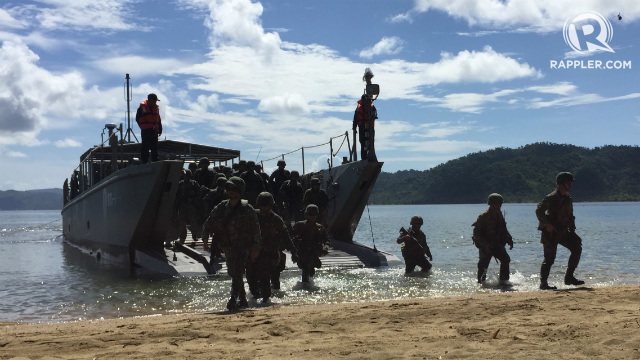
AURORA, Philippines – It was an odd command to hear as a landing craft utility boat carrying Filipino soldiers was about to dock onto the sandy shores of Casiguran town for military exercises between the Philippines and the United States.
"Lakad, wag kayong tumakbo (Walk, don't run)!" said a commander, one of the many Philippine Marines stationed aboard the BRP Tarlac.
There was no need to be on guard, after all.
The military drills in Casiguran, Aurora were meant to simulate a joint response to the aftermath of a catastrophic typhoon or earthquake – not a country invasion, as in the previous year.
On Monday, May 15, the two militaries staged a Humanitarian Aid and Disaster Response (HADR) exercise in the disaster-prone coastal town of Casiguran, one of the highlights in this year's Balikatan exercises.
The joint drills, a yearly tradition of the two allies, are aimed at strengthening coordination in times of distress.
But this year, the distress came months before the scheduled exercises, after Philippine President Rodrigo Duterte in October 2016 said there would be no war games during his term. He also threatened to "forget" an existing defense agreement that would expand American military presence in the Philippines.
Duterte was eventually convinced to let the Balikatan continue, but with major changes. The Balikatan this year does not include an exercise to counter an invader on Philippine shores – a potentially touchy issue given the dispute between the Philippines and China over the South China Sea (West Philippine Sea).
What downsizing?
Even if this year's exercises only involve two-thirds the American troops as last time, and only two Philippine area commands instead of 4, military and government officials from both countries insisted there was no downsizing at all.
Up to 2,600 American soldiers are in the Philippines for the Balikatan with more than 2,800 Filipino military men and women.
"I'd like to correct that impression. We have not downsized," said Brigadier General Restituto Padilla, spokesperson for the Armed Forces of the Philippines (AFP), in an interview on the sidelines of the disaster response exercise.
"Same thing. There was no direction to downsize. Nobody told us that there had to be fewer people, there had to be smaller exercises," echoed US Marines Brigadier General John Jansen.
A Philippine government official insisted the same thing.
"Did we downsize?" quipped the Philippine foreign department's Cesar Ramboanga, executive director of the Presidential Commission on the Visiting Forces Agreement, when asked in a separate chance interview.
He added: "Of course, this year we're stressing the importance of humanitarian assistance and disaster response, so we adjust to that. You don't just dump all the troops there."
Disaster response exercises were also held in Eastern Samar, Isabela, Cagayan, and Fort Magsaysay in Nueva Ecija. In Casiguran, American troops conducted first aid seminars for locals as well.
Duterte has promised to forge an "independent foreign policy" that sees the country moving away from the US and closer to China and Russia. As the Balikatan exercises were taking place, Duterte was in China for the forum promoting the Asian powerhouse's massive economic plan.
"What we do as a military is always dictated by guidance from our political leaders and we comply with that, and I believe the US can also speak the same way," explained Padilla, expounding on the 2017 Balikatan setup.
Ramboanga downplayed any effect Duterte's rhetoric against the US may have on the long-standing relationship between the two countries.
"That's the president. So we have to adjust to our new president because he declared that we'd have an independent foreign policy. And it's very acceptable among Filipinos, isn't it?"
http://www.rappler.com/nation/169944-no-bells-whistles-philippines-united-states-balikatan-duterte-foreign-policy
Despite the Duterte administration's shift in foreign policy, officials deny the military exercises with the United States were downsized
BALIKATAN. Philippine Marines alight from a landing craft utility boat onto the shores of Casiguran, Aurora. Photo by Bea Cupin/Rappler
AURORA, Philippines – It was an odd command to hear as a landing craft utility boat carrying Filipino soldiers was about to dock onto the sandy shores of Casiguran town for military exercises between the Philippines and the United States.
"Lakad, wag kayong tumakbo (Walk, don't run)!" said a commander, one of the many Philippine Marines stationed aboard the BRP Tarlac.
There was no need to be on guard, after all.
The military drills in Casiguran, Aurora were meant to simulate a joint response to the aftermath of a catastrophic typhoon or earthquake – not a country invasion, as in the previous year.
On Monday, May 15, the two militaries staged a Humanitarian Aid and Disaster Response (HADR) exercise in the disaster-prone coastal town of Casiguran, one of the highlights in this year's Balikatan exercises.
The joint drills, a yearly tradition of the two allies, are aimed at strengthening coordination in times of distress.
But this year, the distress came months before the scheduled exercises, after Philippine President Rodrigo Duterte in October 2016 said there would be no war games during his term. He also threatened to "forget" an existing defense agreement that would expand American military presence in the Philippines.
Duterte was eventually convinced to let the Balikatan continue, but with major changes. The Balikatan this year does not include an exercise to counter an invader on Philippine shores – a potentially touchy issue given the dispute between the Philippines and China over the South China Sea (West Philippine Sea).
What downsizing?
Even if this year's exercises only involve two-thirds the American troops as last time, and only two Philippine area commands instead of 4, military and government officials from both countries insisted there was no downsizing at all.
Up to 2,600 American soldiers are in the Philippines for the Balikatan with more than 2,800 Filipino military men and women.
"I'd like to correct that impression. We have not downsized," said Brigadier General Restituto Padilla, spokesperson for the Armed Forces of the Philippines (AFP), in an interview on the sidelines of the disaster response exercise.
"Same thing. There was no direction to downsize. Nobody told us that there had to be fewer people, there had to be smaller exercises," echoed US Marines Brigadier General John Jansen.
A Philippine government official insisted the same thing.
"Did we downsize?" quipped the Philippine foreign department's Cesar Ramboanga, executive director of the Presidential Commission on the Visiting Forces Agreement, when asked in a separate chance interview.
He added: "Of course, this year we're stressing the importance of humanitarian assistance and disaster response, so we adjust to that. You don't just dump all the troops there."
Disaster response exercises were also held in Eastern Samar, Isabela, Cagayan, and Fort Magsaysay in Nueva Ecija. In Casiguran, American troops conducted first aid seminars for locals as well.
Duterte has promised to forge an "independent foreign policy" that sees the country moving away from the US and closer to China and Russia. As the Balikatan exercises were taking place, Duterte was in China for the forum promoting the Asian powerhouse's massive economic plan.
"What we do as a military is always dictated by guidance from our political leaders and we comply with that, and I believe the US can also speak the same way," explained Padilla, expounding on the 2017 Balikatan setup.
Ramboanga downplayed any effect Duterte's rhetoric against the US may have on the long-standing relationship between the two countries.
"That's the president. So we have to adjust to our new president because he declared that we'd have an independent foreign policy. And it's very acceptable among Filipinos, isn't it?"
http://www.rappler.com/nation/169944-no-bells-whistles-philippines-united-states-balikatan-duterte-foreign-policy
Bohol free of Abu Sayyaf terrorists – military
From Rappler (May 16): Bohol free of Abu Sayyaf terrorists – military
(UPDATED) Security forces kill two remaining Abu Sayyaf bandits in Bohol, the last of the daring gang of local terrorists that sailed from Sulu to take foreign hostages
(UPDATED) – Bohol's nightmare is over.
The two remaining Abu Sayyaf bandits in Bohol were killed on Monday, May 15, in a chase that followed their foiled attempt to take a resident hostage.
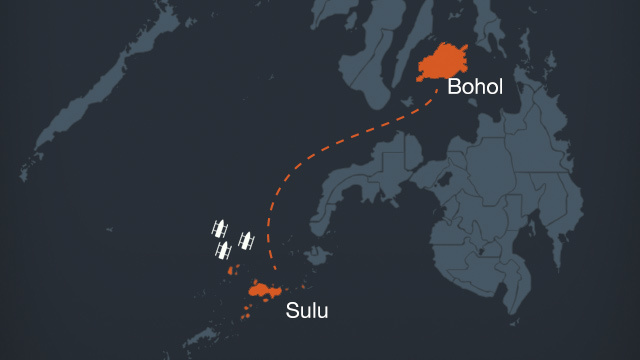
"All the Abu Sayyaf Group members who landed in Bohol province aboard 3 bancas in early April 2017 were all neutralized. Bohol is now cleared of Abu Sayyaf Group elements," said Brigadier General Restituto Padilla, spokesman of the Armed Forces of the Philippines (AFP).
They were the last of the daring gang of 11 Abu Sayyaf bandits who escaped military operations in Sulu a month ago and planned to launch a Holy Week attack in Bohol, a world famous tourist destination.
Their plans were foiled by the police and the military. (READ: Bad or good intel: 5 questions on Abu Sayyaf presence in Bohol)
Earlier on Monday, the two Abu Sayyaf bandits identified as Abu Ubayda and Abu Asis were able to take a hostage. But a police report said they were forced to release the unnamed civilian when the military found their trail.
"The remaining two ASG members in Bohol were spotted at Barangay Cahayag [in] Panggangan Island, Bohol. [They] initially took hostage a resident of said barangay but later left the hostage and commandeered a motorcycle upon sensing army troops are nearing," stated the report.
The two bandits parted ways when they approached a police checkpoint, the report added. Residents who spotted the outsiders alerted the police. A chase ensued, leading to the firefight that killed Ubanda early afternoon on Monday and Asis later in the afternoon.
Among those killed in the first salvo of operations in Bohol last month was Muamar Askali, a subleader of the Abu Sayyaf Group who also served as its spokesman. He was among those killed in clashes with government forces in Bohol. (READ: ASG leader behind foreigners' kidnap killed in Bohol)
http://www.rappler.com/nation/169923-abu-sayyaf-terrorist-killed-bohol
(UPDATED) Security forces kill two remaining Abu Sayyaf bandits in Bohol, the last of the daring gang of local terrorists that sailed from Sulu to take foreign hostages
(UPDATED) – Bohol's nightmare is over.
The two remaining Abu Sayyaf bandits in Bohol were killed on Monday, May 15, in a chase that followed their foiled attempt to take a resident hostage.
"All the Abu Sayyaf Group members who landed in Bohol province aboard 3 bancas in early April 2017 were all neutralized. Bohol is now cleared of Abu Sayyaf Group elements," said Brigadier General Restituto Padilla, spokesman of the Armed Forces of the Philippines (AFP).
They were the last of the daring gang of 11 Abu Sayyaf bandits who escaped military operations in Sulu a month ago and planned to launch a Holy Week attack in Bohol, a world famous tourist destination.
Their plans were foiled by the police and the military. (READ: Bad or good intel: 5 questions on Abu Sayyaf presence in Bohol)
Earlier on Monday, the two Abu Sayyaf bandits identified as Abu Ubayda and Abu Asis were able to take a hostage. But a police report said they were forced to release the unnamed civilian when the military found their trail.
"The remaining two ASG members in Bohol were spotted at Barangay Cahayag [in] Panggangan Island, Bohol. [They] initially took hostage a resident of said barangay but later left the hostage and commandeered a motorcycle upon sensing army troops are nearing," stated the report.
The two bandits parted ways when they approached a police checkpoint, the report added. Residents who spotted the outsiders alerted the police. A chase ensued, leading to the firefight that killed Ubanda early afternoon on Monday and Asis later in the afternoon.
Among those killed in the first salvo of operations in Bohol last month was Muamar Askali, a subleader of the Abu Sayyaf Group who also served as its spokesman. He was among those killed in clashes with government forces in Bohol. (READ: ASG leader behind foreigners' kidnap killed in Bohol)
http://www.rappler.com/nation/169923-abu-sayyaf-terrorist-killed-bohol
Subscribe to:
Posts (Atom)