From the Philippine News Agency (Oct 25): Conflict monitoring system covers more provinces in Mindanao
A conflict monitoring system developed by non-government organization International Alert Philippines now covers more provinces in Mindanao, enabling a more comprehensive analysis of conflict and better formulation of interventions and development plans.
Conflict Alert, launched Tuesday, covers the 15 provinces in the Autonomous Region in Muslim Mindanao (ARMM), Davao Region and Caraga, as well as Cotabato and Isabela cities, which are located within the ARMM but are not administered by it. It is the only existing tracker of violent conflict at the subnational level in the Philippines.
“These regions are major sites of rebellion and insurgency, criminal violence, and shadow economy-based conflicts. With this new system, we can generate the evidence to check the causes and costs, and trends and directions of violent conflict in these three regions. This will greatly help in policy making, development planning and peace-building for these areas,” said Francisco J. Lara Jr., country manager of International Alert Philippines.
Conflict Alert combines two previously separate monitoring systems and databases: the Bangsamoro Conflict Monitoring System (BCMS) and the Southern and Eastern Mindanao Conflict Database (SEMCD).
The BCMS, launched in 2013, covered the ARMM and Cotabato and Isabela cities. It pioneered systematic conflict monitoring but its analysis was bounded by its geographic reach. The SEMCD, launched in 2015, extended the analysis to the Davao and Caraga regions.
Conflict Alert is funded by the Korea Trust Fund for Economic and Peace-Building Transitions, the World Bank, the Australian Department of Foreign Affairs and Trade, and the Royal Norwegian Government.
2011-2015 panel data from the ARMM, Davao Region and Cotabato and Isabela cities can be downloaded from the Conflict Alert website, www.conflictalert.info. Data from Caraga are now being encoded into the database.
The 2011-2015 data show that most of the conflicts in the ARMM are related to the shadow (or informal) economies, in particular, the illicit trade in illegal weapons and drugs. In the Davao Region, most violence stems from common crimes, in particular, robbery, alcohol intoxication and community-level disputes over properties.
While conflicts due to shadow activities and violence from common crimes are more numerous, the conflict deaths they cause are less compared to conflicts arising from political issues such as rebellion or tied to identity such as clan feuds or rido. Any developmental, law enforcement, or peace-building initiatives and priorities must primarily take this into consideration rather than the level of conflict incidence per se.
To underscore the importance of settling political conflict, the data show there were more conflict deaths in the ARMM, host to a variety of rebel and other armed groups, than in the Davao Region in the 2011-2015 period.
The deadliest province was Maguindanao, where clashes involving the separatist Bangsamoro Islamic Freedom Fighters had claimed many lives especially in 2014 and 2015. The number of deaths could have been higher had not the ceasefire agreement between the Moro Islamic Liberation Front and the government continued to hold despite the Mamasapano tragedy in January 2015.
Meanwhile, Sulu has overtaken Basilan in terms of conflict deaths as government forces bore down on the Abu Sayyaf based in the province.
In the Davao Region, Compostela Valley and Davao del Sur posted the highest conflict deaths. Many were due to political conflict related to the communist insurgency.
Evidence has shown how conflict has evolved into an urban phenomenon. In the ARMM, conflicts are concentrated in cities such as Cotabato and Marawi and in large towns such as Parang, while in the Davao Region, these are in the cities of Tagum, Digos and Panabo, and in the big towns such as Nabunturan. The type of conflicts that predominate in urban centers are common crimes and shadow economy-related conflicts.
The Conflict Alert findings have several policy implications.
One, a political settlement in the form of a law that establishes the Bangsamoro has gained expediency to address the huge human costs (or conflict deaths) from political conflict, as well as growing threats from extremist groups.
Two, a final political settlement with the Communist Party of the Philippines-New People’s Army-New Democratic Front has become imperative, especially as it will have knock-on effects on the scale of violence associated with resource capture or inter- and intra-lumad violence.
Three, peace-building initiatives targeting crime, violence and instability in the cities and towns must be given prominence and the same emphasis given to rebellion and political contestation. Criminal activity easily intertwines with shadow enterprises such as the illegal weapons and drugs trades, presenting serious threats to peace and stability.
And four, peace-building organizations must invest in research, conflict monitoring, and peace-building advocacy and action in the major cities and municipalities of Mindanao.
http://www.pna.gov.ph/index.php?idn=1&sid=&nid=1&rid=934361

Tuesday, October 25, 2016

Soon-to-be acquired frigates from SK, a smaller version of Incheon class
From the Philippine News Agency (Oct 25): Soon-to-be acquired frigates from SK, a smaller version of Incheon class
Hyundai Heavy Industries (HHI), the winner of the Philippine missile firing frigate program, said the two ships they will supply are a smaller version of their Incheon class.
The latter are the most-up-to date coastal defense frigates of the South Korean Navy and programmed to replace ageing fleet of Pohang-class corvettes and Ulsan-class frigates, and take over multi-role operations such as coast patrol, anti-submarine warfare and transport support.
In a statement Monday, the South Korean shipbuilder said the Filipino frigates will be constructed using good marine standard under naval rule from Lloyd Register, classification society.
Defense Secretary Delfin Lorenzana and HHI officials formally signed the contract for the ships at the Philippine Navy headquarters, Naval Station Jose Andrada, Roxas Boulevard, Manila last October 24.
As background, the Notice of Award was approved, issued and was duly conformed by HHI on Sept. 13 with the amount of USD336,912,000 or PHP15,744,571,584.
The 107 meter frigates, which are expected to weigh 2,600 gross tons, to be propelled with CODAD (combined diesel and diesel) propulsion system with maximum speed of 25 knots can cover a 4,500 nautical miles range at cruising speed of 15 knots.
These ships will inherit the enhanced survivability, seakeeping and maneuvering capability of her mother ship operable up to Sea State 5.
It will be armed with missiles, torpedo, guns and sensors controlled by the latest combat management system are capable of conducting anti-air warfare, anti-surface warfare, anti-submarine warfare and electronic warfare.
The frigates are scheduled to be handed starting from 2020.
http://www.pna.gov.ph/index.php?idn=1&sid=&nid=1&rid=934418
Hyundai Heavy Industries (HHI), the winner of the Philippine missile firing frigate program, said the two ships they will supply are a smaller version of their Incheon class.
The latter are the most-up-to date coastal defense frigates of the South Korean Navy and programmed to replace ageing fleet of Pohang-class corvettes and Ulsan-class frigates, and take over multi-role operations such as coast patrol, anti-submarine warfare and transport support.
In a statement Monday, the South Korean shipbuilder said the Filipino frigates will be constructed using good marine standard under naval rule from Lloyd Register, classification society.
Defense Secretary Delfin Lorenzana and HHI officials formally signed the contract for the ships at the Philippine Navy headquarters, Naval Station Jose Andrada, Roxas Boulevard, Manila last October 24.
As background, the Notice of Award was approved, issued and was duly conformed by HHI on Sept. 13 with the amount of USD336,912,000 or PHP15,744,571,584.
The 107 meter frigates, which are expected to weigh 2,600 gross tons, to be propelled with CODAD (combined diesel and diesel) propulsion system with maximum speed of 25 knots can cover a 4,500 nautical miles range at cruising speed of 15 knots.
These ships will inherit the enhanced survivability, seakeeping and maneuvering capability of her mother ship operable up to Sea State 5.
It will be armed with missiles, torpedo, guns and sensors controlled by the latest combat management system are capable of conducting anti-air warfare, anti-surface warfare, anti-submarine warfare and electronic warfare.
The frigates are scheduled to be handed starting from 2020.
http://www.pna.gov.ph/index.php?idn=1&sid=&nid=1&rid=934418
CA junks MR of 8 Navy men charged in Pestaño murder case
From the Philippine News Agency (Oct 25): CA junks MR of 8 Navy men charged in Pestaño murder case
The Court of Appeals denied the motion for reconsideration filed by eight of the 10 Philippine Navy personnel seeking to nullify the arrest warrants issued against them by the Manila City Regional Trial Court (RTC) in connection with the murder of Ensign Philip Pestaño in 1995.
“The Court denies the petitioners’ motion for reconsideration absent valid legal basis to modify, reverse, and set aside the decision,” the CA said in a two-page resolution penned by Associate Justice Nina Antonio-Valenzuela, the former Special Sixth Division.
The appellate court also said that petitioners failed to present new arguments that would warrant the reversal of its decision issued on April 29, 2016.
In the said decision, the CA did not give credence to the claim of the accused that there was no probable cause for the issuance of an arrest warrant against them because the evidence of the case shows that the petitioners were not guilty of murder.
The CA pointed out that at the stage of determining probable cause for the issuance of a warrant of arrest, a judge is not yet tasked to review in detail the evidence submitted during the preliminary investigation.
The appellate court did not give merit to the claim of the petitioners that Manila RTC Judge Josefina Siscar committed grave abuse of discretion in issuing directing the issuance of a warrant of arrest against them last July 23, 2013.
The petitioners argued that Judge Siscar’s verdict was not based on the evidence submitted at the preliminary investigation but on the resolution of the investigating officer and on the memorandum of the Office that conducted the preliminary investigation.
“As we stated in the decision of April 29, 2016, the respondent judge based her finding of probable cause and issued the corresponding warrant of arrest after personally examining the records of the case,” the CA stressed.
“At the stage in the proceedings before the RTC, the respondent judge’s duty was to determine mere probability (and not certainty) of the guilt of the petitioners,” it added.
Among the Navy personnel issued with arrest warrants were Retired Navy Capt. Ricardo Ordoñez, Cmdr. Reynaldo Lopez, Lt. Cmdr. Luidegar Casis, Lt. Cmdr. Alfrederick Alba, Lt. Cmdr. Joselito Colico, Hospital Man 2 Welmenio Aquino, Machinery Repairman 1st class Sandy Miranda, and Petty Officer 2nd Class Mil Leonor Igcasan.
Retired PO1 Carlito Amoroso and retired Lt. Cmdr. Ruben Roque, who were among the accused in the murder of Pestano, were not among those who filed the appeal before the CA.
The CA had earlier affirmed its decision allowing the Manila RTC to proceed with the trial of the murder case filed against the Navy officers.
It also directed the transfer of the accused navy officers from the military custody to the Manila City jail.
http://www.pna.gov.ph/index.php?idn=1&sid=&nid=1&rid=934441
The Court of Appeals denied the motion for reconsideration filed by eight of the 10 Philippine Navy personnel seeking to nullify the arrest warrants issued against them by the Manila City Regional Trial Court (RTC) in connection with the murder of Ensign Philip Pestaño in 1995.
“The Court denies the petitioners’ motion for reconsideration absent valid legal basis to modify, reverse, and set aside the decision,” the CA said in a two-page resolution penned by Associate Justice Nina Antonio-Valenzuela, the former Special Sixth Division.
The appellate court also said that petitioners failed to present new arguments that would warrant the reversal of its decision issued on April 29, 2016.
In the said decision, the CA did not give credence to the claim of the accused that there was no probable cause for the issuance of an arrest warrant against them because the evidence of the case shows that the petitioners were not guilty of murder.
The CA pointed out that at the stage of determining probable cause for the issuance of a warrant of arrest, a judge is not yet tasked to review in detail the evidence submitted during the preliminary investigation.
The appellate court did not give merit to the claim of the petitioners that Manila RTC Judge Josefina Siscar committed grave abuse of discretion in issuing directing the issuance of a warrant of arrest against them last July 23, 2013.
The petitioners argued that Judge Siscar’s verdict was not based on the evidence submitted at the preliminary investigation but on the resolution of the investigating officer and on the memorandum of the Office that conducted the preliminary investigation.
“As we stated in the decision of April 29, 2016, the respondent judge based her finding of probable cause and issued the corresponding warrant of arrest after personally examining the records of the case,” the CA stressed.
“At the stage in the proceedings before the RTC, the respondent judge’s duty was to determine mere probability (and not certainty) of the guilt of the petitioners,” it added.
Among the Navy personnel issued with arrest warrants were Retired Navy Capt. Ricardo Ordoñez, Cmdr. Reynaldo Lopez, Lt. Cmdr. Luidegar Casis, Lt. Cmdr. Alfrederick Alba, Lt. Cmdr. Joselito Colico, Hospital Man 2 Welmenio Aquino, Machinery Repairman 1st class Sandy Miranda, and Petty Officer 2nd Class Mil Leonor Igcasan.
Retired PO1 Carlito Amoroso and retired Lt. Cmdr. Ruben Roque, who were among the accused in the murder of Pestano, were not among those who filed the appeal before the CA.
The CA had earlier affirmed its decision allowing the Manila RTC to proceed with the trial of the murder case filed against the Navy officers.
It also directed the transfer of the accused navy officers from the military custody to the Manila City jail.
http://www.pna.gov.ph/index.php?idn=1&sid=&nid=1&rid=934441
BBL essential in transition to federalism, says former negotiator to MILF talks
From InterAksyon (Oct 25): BBL essential in transition to federalism, says former negotiator to MILF talks

Former chief government negotiator Miriam Coronel-Ferrer (file)
Congress should pass the proposed Bangsamoro Basic Law to help stabilize Mindanao as the country prepares to transition to federalism through Charter change, the former chief government negotiator to peace talks with the Moro Islamic Liberation Front said.
Miriam Coronel Ferrer, under whose watch the Comprehensive Agreement on the Bangsamoro was reached, said the Duterte administration is on the right track in continuing efforts to pass the BBL ahead of Charter change, but cautioned against allowing the process to take too long.
“It is very important because the non-peace and war situation is a potential for instability and also, you cannot continue with all the other programs that are part of the agreement, the important aspects of which are the socio-economic development and the decommissioning of weapons and combatants,” she said in an interview.
“However, there is the danger that the process will take so long, in fact, to be overtaken by Charter change process and be sidelined by other political developments, so to that extent there is great concern,” she added.
Ferrer said peace advocates, especially in Mindanao, believe the process could be speeded up if Congress immediately passes the proposed BBL, so that the CAB can be implemented and continue to bring peace and development to conflict-affected areas in Central Mindanao.
“This is the concern of many groups, that the pace is a bit slow. Unless we move the process fast enough, then they should probably start rethinking having to rewrite a draft that will take several months to finish and go straight to Congress and work it out there,” she said.
Maguindanao Representative Sandra Sema has re-filed the BBL at the House. The measure was not passed by the 16th Congress. Currently, the measure is still pending at the committee level.
The BBL will allow the creation of the Bangsamoro homeland, seen as a more politically-empowered entity, to replace the current Autonomous Region in Muslim Mindanao.
Ferrer urged President Rodrigo Duterte to put his foot down on the immediate passage of the BBL.
“You need the President to say to go this way rather than go to the longer route again and maybe you need an agreement between the MILF and the government to rethink the process that they have already set out because that process is too long, you might lose people to more radical extreme groups in the meantime and you might also create more instabilities that you need now,” she explained.
Ferrer said the Bangsamoro people want to see how the Charter change process will involve them, especially on the issue of federalism.
“They are not against changing the Constitution in principle, but in the process, they want to see it as a process that really involved them … they want to see how much of it will be something that they can own,” she said.
http://www.interaksyon.com/article/133650/bbl-essential-in-transition-to-federalism-says-former-negotiator-to-milf-talks
Former chief government negotiator Miriam Coronel-Ferrer (file)
Congress should pass the proposed Bangsamoro Basic Law to help stabilize Mindanao as the country prepares to transition to federalism through Charter change, the former chief government negotiator to peace talks with the Moro Islamic Liberation Front said.
Miriam Coronel Ferrer, under whose watch the Comprehensive Agreement on the Bangsamoro was reached, said the Duterte administration is on the right track in continuing efforts to pass the BBL ahead of Charter change, but cautioned against allowing the process to take too long.
“It is very important because the non-peace and war situation is a potential for instability and also, you cannot continue with all the other programs that are part of the agreement, the important aspects of which are the socio-economic development and the decommissioning of weapons and combatants,” she said in an interview.
“However, there is the danger that the process will take so long, in fact, to be overtaken by Charter change process and be sidelined by other political developments, so to that extent there is great concern,” she added.
Ferrer said peace advocates, especially in Mindanao, believe the process could be speeded up if Congress immediately passes the proposed BBL, so that the CAB can be implemented and continue to bring peace and development to conflict-affected areas in Central Mindanao.
“This is the concern of many groups, that the pace is a bit slow. Unless we move the process fast enough, then they should probably start rethinking having to rewrite a draft that will take several months to finish and go straight to Congress and work it out there,” she said.
Maguindanao Representative Sandra Sema has re-filed the BBL at the House. The measure was not passed by the 16th Congress. Currently, the measure is still pending at the committee level.
The BBL will allow the creation of the Bangsamoro homeland, seen as a more politically-empowered entity, to replace the current Autonomous Region in Muslim Mindanao.
Ferrer urged President Rodrigo Duterte to put his foot down on the immediate passage of the BBL.
“You need the President to say to go this way rather than go to the longer route again and maybe you need an agreement between the MILF and the government to rethink the process that they have already set out because that process is too long, you might lose people to more radical extreme groups in the meantime and you might also create more instabilities that you need now,” she explained.
Ferrer said the Bangsamoro people want to see how the Charter change process will involve them, especially on the issue of federalism.
“They are not against changing the Constitution in principle, but in the process, they want to see it as a process that really involved them … they want to see how much of it will be something that they can own,” she said.
http://www.interaksyon.com/article/133650/bbl-essential-in-transition-to-federalism-says-former-negotiator-to-milf-talks
Korean couple in Philippines missing 6 months
From Korea JoonAng Daily (Oct 25): Korean couple in Philippines missing 6 months
A Korean married couple living in the Philippines has been missing since April, according to the Ministry of Foreign Affairs here Monday.
The elderly couple was last seen on April 23 at around 8 a.m., when they took a ship leaving from Samar Island. The ministry said the couple had lived in Mindanao, in the southern Philippines, for about a year. No further details on the pair were revealed.
As soon as the disappearance of the married couple was reported, the ministry said it began tracing their whereabouts in cooperation with the Korean Embassy in the Philippines and local police and Coast Guard.
Korea currently has a travel ban on some parts of Mindanao due to safety concerns following several violent crimes against its nationals in the region.
The Korean government last November implemented the travel ban on regions in Mindanao, including Zamboanga and Sulu, after a 74-year-old Korean man surnamed Hong was found dead in October, nearly 10 months after being kidnapped for ransom by the Islamist terrorist group Abu Sayyaf in Zamboanga in January 2015.
Earlier this month, three middle-aged Koreans were found dead in a sugarcane field in the rural town of Bacolor, northwest of Manila, with gunshot wounds to their heads. Six Koreans were killed in the Philippines this year. Last year, 11 Koreans were killed in the country. Some 88,000 Koreans live in the Philippines.
http://koreajoongangdaily.joins.com/news/article/article.aspx?aid=3025307&%3Bcloc=joongangdaily%7Chome%7Cnewslist1
A Korean married couple living in the Philippines has been missing since April, according to the Ministry of Foreign Affairs here Monday.
The elderly couple was last seen on April 23 at around 8 a.m., when they took a ship leaving from Samar Island. The ministry said the couple had lived in Mindanao, in the southern Philippines, for about a year. No further details on the pair were revealed.
As soon as the disappearance of the married couple was reported, the ministry said it began tracing their whereabouts in cooperation with the Korean Embassy in the Philippines and local police and Coast Guard.
Korea currently has a travel ban on some parts of Mindanao due to safety concerns following several violent crimes against its nationals in the region.
The Korean government last November implemented the travel ban on regions in Mindanao, including Zamboanga and Sulu, after a 74-year-old Korean man surnamed Hong was found dead in October, nearly 10 months after being kidnapped for ransom by the Islamist terrorist group Abu Sayyaf in Zamboanga in January 2015.
Earlier this month, three middle-aged Koreans were found dead in a sugarcane field in the rural town of Bacolor, northwest of Manila, with gunshot wounds to their heads. Six Koreans were killed in the Philippines this year. Last year, 11 Koreans were killed in the country. Some 88,000 Koreans live in the Philippines.
http://koreajoongangdaily.joins.com/news/article/article.aspx?aid=3025307&%3Bcloc=joongangdaily%7Chome%7Cnewslist1
Despite Duterte Pronouncement - 'About a hundred' US soldiers still in Mindanao —Amb. Goldberg
From GMA News (Oct 25): Despite Duterte Pronouncement - 'About a hundred' US soldiers still in Mindanao —Amb. Goldberg
American soldiers are still in Mindanao, though in a significantly reduced number, despite pronouncements from President Rodrigo Duterte opposing their presence there.
In a television interview on Tuesday, outgoing US Ambassador Philip Goldberg said the number of US soldiers currently in Mindanao is "far reduced," and the Philippine government has yet to formally request for further reduction.
"We have about a hundred, few soldiers helping to counterterrorism. That is far reduced from what it has been over the years since 2002 when our special operations task force was here," he said.
"That task force ended and in its place, we have advisers and others who are continuing to help the AFP (Armed Forces of the Philippines) in their efforts," Goldberg added.
Defense Secretary Delfin Lorenzana earlier said the number of US soldiers in Mindanao has been slashed to 107 from about 600 from five to 10 years ago. They are currently stationed in Camp Navarro in Zamboanga City.
Lorenzana said the bulk of the US servicemen's job involves managing their assets in Zamboanga City.
New intrusions
Apart from the Abu Sayyaf, the US government would continue helping the Philippines fight off other terrorist groups threatening the region, said Goldberg.
"We're not just dealing with the Abu Sayyaf but groups from the region like Jemaah Islamiya. We’ve seen increasing efforts by ISIS to become involved. This is our international efforts and one which we can work together very well so we want to help. It's in both our interest to do so," he said.
Goldberg said the US government is particularly concerned with "new intrusions" of "other groups that want to take advantage of open space in the South of the Philippines... so we want to continue doing that."
Duterte
Goldberg also reiterated the US Embassy's earlier statement about Duterte's recent rhetoric favoring China over US causing "uncertainties." He said such statements make US efforts to support the Philippines "quite difficult to do."
"[We] want to know, are we going to have exercises? Are we going to do the things that we do to help create interoperability between our troops, to help the Philippines as it devices better techniques and humanitarian assistance and disaster relief, as it increases its ability to do maritime security?" the ambassador said.
Duterte has openly voiced his opposition to the yearly US-Philippine military exercises, saying the one scheduled in October would be the last under his term. During his recent visit to China, he announced a military and economic split between the two countries, although he later clarified that this does not mean diplomatic ties would also be severed.
Duterte has also opposed joint patrols between US and Philippine forces, although Lorenzana had earlier said the US and the Philippines do not conduct joint patrols but only "passing exercises" in the Philippines' Exclusive Economic Zone (EEZ) in South China Sea.
http://www.gmanetwork.com/news/story/586328/news/nation/about-a-hundred-us-soldiers-still-in-mindanao-amb-goldberg
American soldiers are still in Mindanao, though in a significantly reduced number, despite pronouncements from President Rodrigo Duterte opposing their presence there.
In a television interview on Tuesday, outgoing US Ambassador Philip Goldberg said the number of US soldiers currently in Mindanao is "far reduced," and the Philippine government has yet to formally request for further reduction.
"We have about a hundred, few soldiers helping to counterterrorism. That is far reduced from what it has been over the years since 2002 when our special operations task force was here," he said.
"That task force ended and in its place, we have advisers and others who are continuing to help the AFP (Armed Forces of the Philippines) in their efforts," Goldberg added.
Defense Secretary Delfin Lorenzana earlier said the number of US soldiers in Mindanao has been slashed to 107 from about 600 from five to 10 years ago. They are currently stationed in Camp Navarro in Zamboanga City.
Lorenzana said the bulk of the US servicemen's job involves managing their assets in Zamboanga City.
New intrusions
Apart from the Abu Sayyaf, the US government would continue helping the Philippines fight off other terrorist groups threatening the region, said Goldberg.
"We're not just dealing with the Abu Sayyaf but groups from the region like Jemaah Islamiya. We’ve seen increasing efforts by ISIS to become involved. This is our international efforts and one which we can work together very well so we want to help. It's in both our interest to do so," he said.
Goldberg said the US government is particularly concerned with "new intrusions" of "other groups that want to take advantage of open space in the South of the Philippines... so we want to continue doing that."
Duterte
Goldberg also reiterated the US Embassy's earlier statement about Duterte's recent rhetoric favoring China over US causing "uncertainties." He said such statements make US efforts to support the Philippines "quite difficult to do."
"[We] want to know, are we going to have exercises? Are we going to do the things that we do to help create interoperability between our troops, to help the Philippines as it devices better techniques and humanitarian assistance and disaster relief, as it increases its ability to do maritime security?" the ambassador said.
Duterte has openly voiced his opposition to the yearly US-Philippine military exercises, saying the one scheduled in October would be the last under his term. During his recent visit to China, he announced a military and economic split between the two countries, although he later clarified that this does not mean diplomatic ties would also be severed.
Duterte has also opposed joint patrols between US and Philippine forces, although Lorenzana had earlier said the US and the Philippines do not conduct joint patrols but only "passing exercises" in the Philippines' Exclusive Economic Zone (EEZ) in South China Sea.
http://www.gmanetwork.com/news/story/586328/news/nation/about-a-hundred-us-soldiers-still-in-mindanao-amb-goldberg
New batch of US troops already in Mindanao – military
From the Philippine Daily Inquirer (Oct 25): New batch of US troops already in Mindanao – military

ZAMBOANGA MISSION: Some 50 US soldiers on formation witness the ceremonial folding of the flag of the Joint Special Operations Task Force Philippines at the Western Mindanao Command grandstand in Zamboanga City in this photo taken in February 2015. President Duterte has said American forces are magnets of terrorist attacks in Mindanao and should eventually leave. (JULIE ALIPALA/INQUIRER MINDANAO)
US troops are staying despite President Rodrigo Duterte’s pronouncement that they should go and leave Mindanao.
Lt. Gen. Mayoralgo dela Cruz, the Western Mindanao Command commander, said while it was true that some US soldiers left a few weeks ago, they were immediately replaced by new ones.
“These are normal rotation. Those who have left were US Marines and they were replaced by US Army soldiers. Definitely, the Marines will bring back their own equipment,” he said
U.S. forces are still present here and “there are 107 (of them),” according to Dela Cruz.
“All of them are still here,” he added.
The US troops maintain a small camp inside the Westmincom headquarters here and have been training their Filipino counterparts on such skills as humanitarian and medical evacuation, including mobile treatment of wounded soldiers.
Dela Cruz said there has been no directive for the pullout of US troops yet.
“If there is an order (for them) to withdraw, the first ones to know are those in Manila,” he said.
In September, Duterte said US special forces “have to go” because their presence have complicated things in Mindanao and the situation would just “get more tense” if they remained.
“They have to (leave) Mindanao. There are many (Americans) there,” he said.
“The statement reflects PRRD’s new direction towards coursing an independent foreign policy. He has made reference to the unrecognized, unrepented and un-atoned for massacre at Bud Dajo in Sulu by the Americans; hence our continued connection with West is the real reason for the ‘Islamic’ threat in Mindanao,” Communication Secretary Ernesto Abella said in a statement.
In October 2014, the Makabayan bloc filed a bill in Congress, which sought the abrogation of the Visiting Forces Agreement, taking into account alleged violations made by US forces. These included the shooting of farmer Buyong-Buyong Isnijal in Tuburan, Basilan, in 2002, allegedly by American soldier Reggie Lane; the shooting of Arsid Baharon in Barangay San Roque in Zamboanga City on June 21, 2004 by an American soldier, who was never identified, among others.
Edgar Araojo, a political science professor at the Western Mindanao State University who was very vocal against the US presence in Zamboanga City, said since the presence of “US soldiers here is covered by Edca, their pull-out becomes circuitous, a legal circus.”
“If pull out is imminent, it won’t economically, militarily (have an) impact on Zamboanga City as (their) absence won’t be missed (at all). Life goes on, the Abu Sayyaf goes on, smuggling goes on,” Araojo said.
The presence of the US troops in Mindanao is covered by the Visiting Forces Agreement and the Enhanced Defense Cooperation Agreement (EDCA) that both the Philippines and the US have signed over the years. While President Duterte has announced his new foreign policy direction, he has not filed any formal notice with the US government to signify that he will soon enforce his statements.
http://globalnation.inquirer.net/147847/new-batch-of-us-troops-already-in-mindanao-military
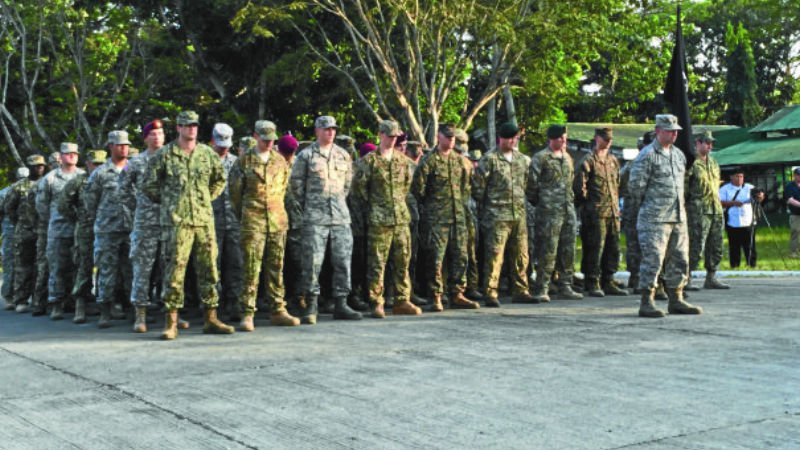
ZAMBOANGA MISSION: Some 50 US soldiers on formation witness the ceremonial folding of the flag of the Joint Special Operations Task Force Philippines at the Western Mindanao Command grandstand in Zamboanga City in this photo taken in February 2015. President Duterte has said American forces are magnets of terrorist attacks in Mindanao and should eventually leave. (JULIE ALIPALA/INQUIRER MINDANAO)
US troops are staying despite President Rodrigo Duterte’s pronouncement that they should go and leave Mindanao.
Lt. Gen. Mayoralgo dela Cruz, the Western Mindanao Command commander, said while it was true that some US soldiers left a few weeks ago, they were immediately replaced by new ones.
“These are normal rotation. Those who have left were US Marines and they were replaced by US Army soldiers. Definitely, the Marines will bring back their own equipment,” he said
U.S. forces are still present here and “there are 107 (of them),” according to Dela Cruz.
“All of them are still here,” he added.
The US troops maintain a small camp inside the Westmincom headquarters here and have been training their Filipino counterparts on such skills as humanitarian and medical evacuation, including mobile treatment of wounded soldiers.
Dela Cruz said there has been no directive for the pullout of US troops yet.
“If there is an order (for them) to withdraw, the first ones to know are those in Manila,” he said.
In September, Duterte said US special forces “have to go” because their presence have complicated things in Mindanao and the situation would just “get more tense” if they remained.
“They have to (leave) Mindanao. There are many (Americans) there,” he said.
“The statement reflects PRRD’s new direction towards coursing an independent foreign policy. He has made reference to the unrecognized, unrepented and un-atoned for massacre at Bud Dajo in Sulu by the Americans; hence our continued connection with West is the real reason for the ‘Islamic’ threat in Mindanao,” Communication Secretary Ernesto Abella said in a statement.
In October 2014, the Makabayan bloc filed a bill in Congress, which sought the abrogation of the Visiting Forces Agreement, taking into account alleged violations made by US forces. These included the shooting of farmer Buyong-Buyong Isnijal in Tuburan, Basilan, in 2002, allegedly by American soldier Reggie Lane; the shooting of Arsid Baharon in Barangay San Roque in Zamboanga City on June 21, 2004 by an American soldier, who was never identified, among others.
Edgar Araojo, a political science professor at the Western Mindanao State University who was very vocal against the US presence in Zamboanga City, said since the presence of “US soldiers here is covered by Edca, their pull-out becomes circuitous, a legal circus.”
“If pull out is imminent, it won’t economically, militarily (have an) impact on Zamboanga City as (their) absence won’t be missed (at all). Life goes on, the Abu Sayyaf goes on, smuggling goes on,” Araojo said.
The presence of the US troops in Mindanao is covered by the Visiting Forces Agreement and the Enhanced Defense Cooperation Agreement (EDCA) that both the Philippines and the US have signed over the years. While President Duterte has announced his new foreign policy direction, he has not filed any formal notice with the US government to signify that he will soon enforce his statements.
http://globalnation.inquirer.net/147847/new-batch-of-us-troops-already-in-mindanao-military
Boy, 10, among 32 Abus who surrendered
From the Philippine Daily Inquirer (Oct 25): Boy, 10, among 32 Abus who surrendered
Thirty-two members of the Abu Sayyaf terror group surrendered to the military on Monday.
They included a 10-year-old boy, identified only as Tony, who said he could shoot an M4 Carbine assault rifle. Tony surrendered with his elder brother Halid and nine others.
Their faction of 11 was led by Moton Indama, a cousin of Abu Sayyaf leader Furuji Indama.
Moton had about 30 followers but only the 11 surrendered because “they were afraid to join me. They were afraid that after surrendering, we will all be killed,” he said.
Tony, who lost his parents in a military operation, said another older brother opted not to surrender.
http://newsinfo.inquirer.net/831517/boy-10-among-32-abus-who-surrendered
Thirty-two members of the Abu Sayyaf terror group surrendered to the military on Monday.
They included a 10-year-old boy, identified only as Tony, who said he could shoot an M4 Carbine assault rifle. Tony surrendered with his elder brother Halid and nine others.
Their faction of 11 was led by Moton Indama, a cousin of Abu Sayyaf leader Furuji Indama.
Moton had about 30 followers but only the 11 surrendered because “they were afraid to join me. They were afraid that after surrendering, we will all be killed,” he said.
Tony, who lost his parents in a military operation, said another older brother opted not to surrender.
http://newsinfo.inquirer.net/831517/boy-10-among-32-abus-who-surrendered
Family of Cebuano seaman kidnapped by Abu Sayyaf seek Duterte's help
From InterAksyon (Oct 25): Family of Cebuano seaman kidnapped by Abu Sayyaf seek Duterte's help
The family of a Cebuano seaman kidnapped by the Abu Sayyaf from a South Korean vessel in Tawi-Tawi has asked President Rodrigo Duterte to ensure his safe release.
Glenn Alindajao, 30, a master mariner, and the Korean captain of the Dongbang Giant 2 were reported seized by 10 gunmen last Thursday.
“Mr. President, I appeal for your help because we can’t do this on our own. This is too much for us,” Alindajao’s mother Pablita said.
Pablita said an hour before the kidnapping, her son texted her to ask if she was okay.
“Glen is a good son. He texted me ‘Mama lablab (I love you) Mama.’ As his mother, this pains me so much,” she said.
The Alindajao family is from Barangay Lahug, Cebu City.
The ship on which Glenn Alindajao worked was on its way to South Korea from Australia when it was boarded by gunmen.
The Alindajao family said the latest information from Glenn’s agency was that the ship had reached Manila.
http://www.interaksyon.com/article/133656/family-of-cebuano-seaman-kidnapped-by-abu-sayyaf-seek-dutertes-help
The family of a Cebuano seaman kidnapped by the Abu Sayyaf from a South Korean vessel in Tawi-Tawi has asked President Rodrigo Duterte to ensure his safe release.
Glenn Alindajao, 30, a master mariner, and the Korean captain of the Dongbang Giant 2 were reported seized by 10 gunmen last Thursday.
“Mr. President, I appeal for your help because we can’t do this on our own. This is too much for us,” Alindajao’s mother Pablita said.
Pablita said an hour before the kidnapping, her son texted her to ask if she was okay.
“Glen is a good son. He texted me ‘Mama lablab (I love you) Mama.’ As his mother, this pains me so much,” she said.
The Alindajao family is from Barangay Lahug, Cebu City.
The ship on which Glenn Alindajao worked was on its way to South Korea from Australia when it was boarded by gunmen.
The Alindajao family said the latest information from Glenn’s agency was that the ship had reached Manila.
http://www.interaksyon.com/article/133656/family-of-cebuano-seaman-kidnapped-by-abu-sayyaf-seek-dutertes-help
White House looks to ride out Duterte storm
From ABS-CBN (Oct 25): White House looks to ride out Duterte storm
President Barack Obama has only a handful of months left in office, but facing the shock loss of a pivotal Asian ally in the Philippines, his White House is playing a long game.
Filipino President Rodrigo Duterte says a lot of things. Most notably, the 71-year-old has told Obama to "go to hell."
This week he declared decades of US-Filipino ties over, although he later qualified that remark.
"We haven't heard any specifics" said White House spokesman Josh Earnest, "but those comments are creating unnecessary uncertainty in our relationship."
On the face of it, Duterte's casual desecration of a 65-year-old military alliance and his eager embrace of China are blows for US influence and for Obama's "pivot to Asia."
The United States risks losing presence and access to ports and bases in the heart of the South China Sea -- a contested geopolitical hotspot.
Under Duterte's predecessor Benigno Aquino, China and the Philippines were at loggerheads over the contested economically vital waterway -- to the point that senior US officials worried about being dragged into a war with China.
But since Duterte took office in June, he has suspended joint US-Philippine patrols and threatened an end to joint military exercises.
A split would have regional ramifications. Duterte's sinophile turn could further split the ASEAN regional bloc, which Washington has cultivated as a counter to Beijing's designs on dominance.
China's hardline territorial claims and confrontational stance had given Washington the upper hand.
"The region was in many ways coming to the realization that China is not a reliable long term partner," said Lyle Morris of the Rand Corporation.
But Beijing is picking off cash-strapped ASEAN members like Cambodia and drawing them into its orbit with vast infrastructure spending.
Duterte's recent visit to Beijing -- the provocative setting for comments on dissolving US relations, bagged him billions of dollars in deals.
"A key motivator driving the Philippine president to mend fences with China is economic," said Murray Hiebert of CSIS.
The souring with Washington could also hit counterterrorism operations against the Abu Sayyaf Group, which has been linked to Al-Qaeda and has carried out bombings, murder and kidnapping.
ECHOES OF ESTRADA?
In its response, the White House has been wary of one lesson of Duterte's whole political career -- from mayor of Davao to president of the republic -- he has a short temper.
Officials have limited public chastisements, particularly over Duterte's war on crime, which has claimed about 3,700 lives in less than four months and raised fears about mass extrajudicial killings.
"He's very very sensitive to criticism," said Rand's Morris "So any time we do -- like with the extrajudicial killings -- he gets really really upset and that forces him to make decisions that might not be in the best interest of the Philippines."
Instead, the White House has largely been content to weather the storm as best it can and stress the relationship is bigger than Duterte.
As officials tweet about events around "Filipino American History Month" they point out that day-to-day contacts have little changed since Duterte came to office.
For all Duterte's bluster, he has not followed through.
Even some Philippine officials admit they are as befuddled by Duterte's intentions as their counterparts in Washington.
Many believe that his ability to carry out his "separation" may be limited by his own politics and popular opinion.
He would have to secure legislative support to withdraw from the mutual defense treaty, which underpins the relationship.
There is little sign that support is there. Despite being former US colonial subjects, Filipinos are overwhelmingly pro-American.
Within the armed forces -- particularly the Navy and Airforce -- there is already deep unease about his pivot to China.
In some quarters Duterte is being compared to Joseph Estrada -- the populist former president who was ousted in 2001 amid mass protests.
JOBS, JOBS, JOBS
The Obama administration has begun to gently push back against the most egregious insults and actions.
It cancelled a planned meeting with Duterte in Laos and has warned ominously about "uncertainty" in corporate board rooms.
Aside from the war on drugs and America's perfidy, Duterte's favored topic of conversation is the economy.
Here, the United States has some leverage.
It is the second largest foreign direct investor to the Philippines -- after the British Virgin Islands, an off-shore tax haven -- according to Santander bank.
US-Philippines Trade ties date all the way back to 1797, when "the Astrea" was the first US vessel to return from the Philippines, loaded with indigo, hemp, spices and sugar.
Ultimately, that history and America's trading clout may provide Obama -- and his successor -- with a port in this storm.
http://news.abs-cbn.com/news/10/25/16/white-house-looks-to-ride-out-duterte-storm
President Barack Obama has only a handful of months left in office, but facing the shock loss of a pivotal Asian ally in the Philippines, his White House is playing a long game.
Filipino President Rodrigo Duterte says a lot of things. Most notably, the 71-year-old has told Obama to "go to hell."
This week he declared decades of US-Filipino ties over, although he later qualified that remark.
"We haven't heard any specifics" said White House spokesman Josh Earnest, "but those comments are creating unnecessary uncertainty in our relationship."
On the face of it, Duterte's casual desecration of a 65-year-old military alliance and his eager embrace of China are blows for US influence and for Obama's "pivot to Asia."
The United States risks losing presence and access to ports and bases in the heart of the South China Sea -- a contested geopolitical hotspot.
Under Duterte's predecessor Benigno Aquino, China and the Philippines were at loggerheads over the contested economically vital waterway -- to the point that senior US officials worried about being dragged into a war with China.
But since Duterte took office in June, he has suspended joint US-Philippine patrols and threatened an end to joint military exercises.
A split would have regional ramifications. Duterte's sinophile turn could further split the ASEAN regional bloc, which Washington has cultivated as a counter to Beijing's designs on dominance.
China's hardline territorial claims and confrontational stance had given Washington the upper hand.
"The region was in many ways coming to the realization that China is not a reliable long term partner," said Lyle Morris of the Rand Corporation.
But Beijing is picking off cash-strapped ASEAN members like Cambodia and drawing them into its orbit with vast infrastructure spending.
Duterte's recent visit to Beijing -- the provocative setting for comments on dissolving US relations, bagged him billions of dollars in deals.
"A key motivator driving the Philippine president to mend fences with China is economic," said Murray Hiebert of CSIS.
The souring with Washington could also hit counterterrorism operations against the Abu Sayyaf Group, which has been linked to Al-Qaeda and has carried out bombings, murder and kidnapping.
ECHOES OF ESTRADA?
In its response, the White House has been wary of one lesson of Duterte's whole political career -- from mayor of Davao to president of the republic -- he has a short temper.
Officials have limited public chastisements, particularly over Duterte's war on crime, which has claimed about 3,700 lives in less than four months and raised fears about mass extrajudicial killings.
"He's very very sensitive to criticism," said Rand's Morris "So any time we do -- like with the extrajudicial killings -- he gets really really upset and that forces him to make decisions that might not be in the best interest of the Philippines."
Instead, the White House has largely been content to weather the storm as best it can and stress the relationship is bigger than Duterte.
As officials tweet about events around "Filipino American History Month" they point out that day-to-day contacts have little changed since Duterte came to office.
For all Duterte's bluster, he has not followed through.
Even some Philippine officials admit they are as befuddled by Duterte's intentions as their counterparts in Washington.
Many believe that his ability to carry out his "separation" may be limited by his own politics and popular opinion.
He would have to secure legislative support to withdraw from the mutual defense treaty, which underpins the relationship.
There is little sign that support is there. Despite being former US colonial subjects, Filipinos are overwhelmingly pro-American.
Within the armed forces -- particularly the Navy and Airforce -- there is already deep unease about his pivot to China.
In some quarters Duterte is being compared to Joseph Estrada -- the populist former president who was ousted in 2001 amid mass protests.
JOBS, JOBS, JOBS
The Obama administration has begun to gently push back against the most egregious insults and actions.
It cancelled a planned meeting with Duterte in Laos and has warned ominously about "uncertainty" in corporate board rooms.
Aside from the war on drugs and America's perfidy, Duterte's favored topic of conversation is the economy.
Here, the United States has some leverage.
It is the second largest foreign direct investor to the Philippines -- after the British Virgin Islands, an off-shore tax haven -- according to Santander bank.
US-Philippines Trade ties date all the way back to 1797, when "the Astrea" was the first US vessel to return from the Philippines, loaded with indigo, hemp, spices and sugar.
Ultimately, that history and America's trading clout may provide Obama -- and his successor -- with a port in this storm.
http://news.abs-cbn.com/news/10/25/16/white-house-looks-to-ride-out-duterte-storm
Report reveals links of pro-IS groups in Mindanao with Indonesia, Malaysia
From the Jakarta Post (Oct 25): Report reveals links of pro-IS groups in Mindanao with Indonesia, Malaysia
A newly released report reveals support for the Islamic State (IS) radical movement has deepened among extremists in maritime Southeast Asia, rendering it paramount for law enforcement agencies in the region to have expertise on groups just outside their own borders. A better understanding of developments in Mindanao is particularly urgent, it further says.
The Institute for Policy Analysis of Conflict (IPAC) report entitled “Pro-[IS] Groups in Mindanao and their Links to Indonesia and Malaysia” examines four pro-[IS] groups in Mindanao and how each has links to operatives from other countries in the region.
They comprise the Basilan-based faction of the Abu Sayyaf Group (ASG), Ansarul Khilafa Philippines (AKP), the Maute group in Lanao del Sur, and Bangsamoro Islamic Freedom Fighters (BIFF).
Each has fighters, instructors or funding at different times from Indonesia or Malaysia and in turn has provided refuge, training sites, combat experience or arms, the report says.
“Over the last two years, [IS] has provided a new basis for cooperation among extremists in the region,” IPAC director Sidney Jones said on Tuesday.
“That cooperation could take on a new importance as [IS] losses in the Middle East increase, and the incentive to undertake violence elsewhere rises.”
The report explores the history of Indonesia-Malaysia links to each of the four Philippine organizations, showing how ties going back more than a decade to shared prison experience or fighting in the communal conflicts that erupted in Indonesia in 1999-2000 have come back into play in support of IS.
The report explains there is some evidence that the Maute group and the AKP have been able to use the appeal of the IS brand to attract university students. "The more extremists in Mindanao can attract educated and computer-savvy cadres, the greater the likelihood of cross-regional contact," the report stated.
The report further says more fighters could also be attracted to the Philippines as the jihad of choice as IS gets pushed back in Syria and Iraq.
“As getting to Syria becomes increasingly difficult for Southeast Asian fighters, Mindanao may be the next best option,” Jones said. “The difference is that it’s easier to get home.”
http://www.thejakartapost.com/news/2016/10/25/report-reveals-links-of-pro-is-groups-in-mindanao-with-indonesia-malaysia.html
A newly released report reveals support for the Islamic State (IS) radical movement has deepened among extremists in maritime Southeast Asia, rendering it paramount for law enforcement agencies in the region to have expertise on groups just outside their own borders. A better understanding of developments in Mindanao is particularly urgent, it further says.
The Institute for Policy Analysis of Conflict (IPAC) report entitled “Pro-[IS] Groups in Mindanao and their Links to Indonesia and Malaysia” examines four pro-[IS] groups in Mindanao and how each has links to operatives from other countries in the region.
They comprise the Basilan-based faction of the Abu Sayyaf Group (ASG), Ansarul Khilafa Philippines (AKP), the Maute group in Lanao del Sur, and Bangsamoro Islamic Freedom Fighters (BIFF).
Each has fighters, instructors or funding at different times from Indonesia or Malaysia and in turn has provided refuge, training sites, combat experience or arms, the report says.
“Over the last two years, [IS] has provided a new basis for cooperation among extremists in the region,” IPAC director Sidney Jones said on Tuesday.
“That cooperation could take on a new importance as [IS] losses in the Middle East increase, and the incentive to undertake violence elsewhere rises.”
The report explores the history of Indonesia-Malaysia links to each of the four Philippine organizations, showing how ties going back more than a decade to shared prison experience or fighting in the communal conflicts that erupted in Indonesia in 1999-2000 have come back into play in support of IS.
The report explains there is some evidence that the Maute group and the AKP have been able to use the appeal of the IS brand to attract university students. "The more extremists in Mindanao can attract educated and computer-savvy cadres, the greater the likelihood of cross-regional contact," the report stated.
The report further says more fighters could also be attracted to the Philippines as the jihad of choice as IS gets pushed back in Syria and Iraq.
“As getting to Syria becomes increasingly difficult for Southeast Asian fighters, Mindanao may be the next best option,” Jones said. “The difference is that it’s easier to get home.”
http://www.thejakartapost.com/news/2016/10/25/report-reveals-links-of-pro-is-groups-in-mindanao-with-indonesia-malaysia.html
IPAC: Pro-ISIS Groups in Mindanao and Their Links to Indonesia and Malaysia
From the Institute of Policy Analysis of Conflict (IPAC) (Oct 25): Pro-ISIS Groups in Mindanao and Their Links to Indonesia and Malaysia
For a full PDF copy of the report go to the following URL:
file:///C:/Users/Norm/AppData/Local/Microsoft/Windows/INetCache/IE/CW8515TZ/IPAC_Report_33.pdf
Support for ISIS has deepened cooperation among extremists in maritime Southeast Asia, making it more important than ever for law enforcement agencies to have expertise on groups outside their own borders. A better understanding of developments in Mindanao is particularly urgent.
Pro-ISIS Groups in Mindanao and Their Links to Indonesia and Malaysia, the latest report from the Institute for Policy Analysis of Conflict (IPAC), examines four pro-ISIS groups in Mindanao and how each has links to operatives from other countries in the region: the Basilan-based faction of the Abu Sayyaf Group (ASG); Ansarul Khilafa Philippines (AKP); the Maute group in Lanao del Sur; and Bangsamoro Islamic Freedom Fighters (BIFF). Each has had fighters, instructors or funding at different times from Indonesia or Malaysia and in turn has provided refuge, training sites, combat experience or arms.
“Over the last two years, ISIS has provided a new basis for cooperation among extremists in the region,“ says Sidney Jones, IPAC director. “That cooperation could take on a new importance as ISIS losses in the Middle East increase and the incentive to undertake violence elsewhere rises.”
The report explores the history of Indonesia-Malaysia links to each of the four Philippine organizations, showing how ties going back more than a decade to a shared prison experience or fighting in the communal conflicts that erupted in Indonesia in 1999-2000 have come back into play in support of ISIS.
There is some evidence that the Maute group and the AKP have been able to use the appeal of the ISIS brand to attract university students. The more extremists in Mindanao can attract educated and computer-savvy cadres, the greater the likelihood of cross-regional contact.
More fighters could also be attracted to the Philippines as the jihad of choice as ISIS gets pushed back in Syria and Iraq. “As getting to Syria becomes increasingly difficult for Southeast Asian fighters, Mindanao may be the next best option,” says Jones. “The difference is that it’s easier to get home.”
http://www.understandingconflict.org/en/conflict/read/56/Pro-ISIS-Groups-in-Mindanao-and-Their-Links-to-Indonesia-and-Malaysia
For a full PDF copy of the report go to the following URL:
file:///C:/Users/Norm/AppData/Local/Microsoft/Windows/INetCache/IE/CW8515TZ/IPAC_Report_33.pdf
Support for ISIS has deepened cooperation among extremists in maritime Southeast Asia, making it more important than ever for law enforcement agencies to have expertise on groups outside their own borders. A better understanding of developments in Mindanao is particularly urgent.
Pro-ISIS Groups in Mindanao and Their Links to Indonesia and Malaysia, the latest report from the Institute for Policy Analysis of Conflict (IPAC), examines four pro-ISIS groups in Mindanao and how each has links to operatives from other countries in the region: the Basilan-based faction of the Abu Sayyaf Group (ASG); Ansarul Khilafa Philippines (AKP); the Maute group in Lanao del Sur; and Bangsamoro Islamic Freedom Fighters (BIFF). Each has had fighters, instructors or funding at different times from Indonesia or Malaysia and in turn has provided refuge, training sites, combat experience or arms.
“Over the last two years, ISIS has provided a new basis for cooperation among extremists in the region,“ says Sidney Jones, IPAC director. “That cooperation could take on a new importance as ISIS losses in the Middle East increase and the incentive to undertake violence elsewhere rises.”
The report explores the history of Indonesia-Malaysia links to each of the four Philippine organizations, showing how ties going back more than a decade to a shared prison experience or fighting in the communal conflicts that erupted in Indonesia in 1999-2000 have come back into play in support of ISIS.
There is some evidence that the Maute group and the AKP have been able to use the appeal of the ISIS brand to attract university students. The more extremists in Mindanao can attract educated and computer-savvy cadres, the greater the likelihood of cross-regional contact.
More fighters could also be attracted to the Philippines as the jihad of choice as ISIS gets pushed back in Syria and Iraq. “As getting to Syria becomes increasingly difficult for Southeast Asian fighters, Mindanao may be the next best option,” says Jones. “The difference is that it’s easier to get home.”
http://www.understandingconflict.org/en/conflict/read/56/Pro-ISIS-Groups-in-Mindanao-and-Their-Links-to-Indonesia-and-Malaysia
4 PH terror groups link up with ISIS fighters in region
From Rappler (Oct 25): 4 PH terror groups link up with ISIS fighters in region
A Jakarta-based think tank warns of 'cross-border extremist operations,' citing the Davao City bombing in September as proof of these linkages in Southeast Asia
A Jakarta-based think tank warned of "more deadly violence" in the Philippines after it traced direct links between 4 pro-Islamic State (ISIS) groups in Mindanao and extremists in neighboring Indonesia and Malaysia.
"While it has not been formally declared as a province or wilayat, ISIS has endorsed an Abu Sayyaf leader, Isnilon Hapilon, as amir for Southeast Asia, and Southeast Asians in Syria have pledged their loyalty to him," the report added.
International Alert data shows the BIFF is responsible for at least 463 deaths, ASG for at least 482 deaths and the Maute Group for at least 86 deaths.
The same data links Indonesian-led Jemaah Islamiyah to at least 10 deaths in 2015.
Mindanao: 'Next best option'
"A workable peace with the MILF remains an important barrier to the spread of extremism," said IPAC.
"Peacebuilding and development actors must develop effective peacebuilding strategies that address the links between multiple causes of violence ot prevent the morphing of conflict causes," said Lara.
http://www.rappler.com/nation/150261-philippines-terrorism-isis-southeast-asia
A Jakarta-based think tank warns of 'cross-border extremist operations,' citing the Davao City bombing in September as proof of these linkages in Southeast Asia
A Jakarta-based think tank warned of "more deadly violence" in the Philippines after it traced direct links between 4 pro-Islamic State (ISIS) groups in Mindanao and extremists in neighboring Indonesia and Malaysia.
ISIS setbacks in the Middle East – where the international terrorist group wants to establish a caliphate – could divert fighters in the region from Syria to the southern Philippines, according to the Institute for Policy Analysis of Confict (IPAC) in the report “Pro-ISIS Groups in Mindanao and Their Links to Indonesia and Malaysia.”
The report was released Tuesday, October 25. It was based on interviews, trial documents, and other primary source material. (Read the full report here.)
"The Philippines is important because as far as the ISIS leadership is concerned, it is the extension of the caliphate in the region," according to the report. (READ: ISIS to declare a province in Mindanao?)
The report showed how the following groups received funding or training from ISIS-linked "operatives" in Indonesia and Malaysia, and in turn provided refuge or supported activities of their counterparts.
- The Abu Sayyaf Group (ASG) faction in Basilan has been joined by a small faction of fighters from Malaysia
- The Ansarul Khilafa Philippines (AKP) has strategists from Indonesia and links with Syria
- The Maute group based in Lanao del Sur has a leader married to a like-minded Indonesian
- The Bangsamoro Islamic Freedom Fighters (BIFF), the splinter group of the Moro Islamic Liberation Front (MILF), based in Maguindanao has been coddling Southeast Asian fugitives
"It means that more deadly violence in the Philippines involving alliances of pro-ISIS groups is a matter of when, not if. It may also increase the possibility of cross-border extremist operations," the report added.
The report said that the ties of the members of the Filipino terrorist groups to their Indonesia and Malaysian counterparts go back more than a decade. Some of them have fought together in conflicts that erupted in the region while others have been in prison together.
Davao City bombing
The IPAC report supports investigations by Rappler executive editor Maria Ressa on the links of local terrorists groups to foreign jihadists. (READ: Who is beind the Davao bombing?)
IPAC said the September 2, 2016 bombing of the night market in Davao City is a "case in point" of the linkages. (READ: Defense Chief: 3 Davao bombing suspects arrested)
"Basilan has provided the example of the transformation of the urban terrorist group into a pro-ISIS group being trained by a Moroccan, assisted by Malaysians and almost certainly funded from outside. The AKP shows us the importance of prison bonds forged in Malaysia, Indonesia and the Philippines and how easily those bonds extend into Syria," the report said.
"Omar Maute’s own family ties to Bekasi, fluency in Indonesian and knowledge of social media may have given him a wider international network than the Philippines government has even begun to suspect," the report added.
The military and the police have arrested 3 suspects. Defense Secretary Delfin Lorenza described them as "students of Marwan," referring to the late Malaysian bombmaker Zulkilfi bin Hir who was the target of a controversial police operation in Mamasapano, Maguindanao, in January 2015.
Spike in activities of extremists
A separate report by Philippine-based conflict monitoring group International Alert shows a spike in violent incidents associated with these extremist groups in the past 5 years, resulting in hundreds of deaths.
"The data shows the number of incidence of violence that are related to these different groups – the Maute Group, Ansarul Khilafa, the BIFF and the ASG. It indicates a spike in violence associated to these groups contrast to their activites in previous years. The years 2014 and 2015 have been particularly virulent," said Francisco Lara, country manager of International Alert.
The same data links Indonesian-led Jemaah Islamiyah to at least 10 deaths in 2015.
Mindanao: 'Next best option'
IPAC director Sydney Jones said extremists find Mindanao as the "next best option" to establish a caliphate as it becomes harder for them to go to Syria.
“Over the last two years, ISIS has provided a new basis for cooperation among extremists in the region.... That cooperation could take on a new importance as ISIS losses in the Middle East increase and the incentive to undertake violence elsewhere rises," Jones said.
“As getting to Syria becomes increasingly difficult for Southeast Asian fighters, Mindanao may be the next best option.... The difference is that it’s easier to get home,” Jones added.
The ISIS brand has allowed the terrorist groups to recruit university students. "There is some evidence that the Maute group and the AKP have been able to use the appeal of the ISIS brand to attract university students. The more extremists in Mindanao can attract educated and computer-savvy cadres, the greater the likelihood of cross-regional contact." the report said.
Both IPAC and International Alert highlighted the importance of completing the peace proces with the MILF to address the threats in Mindanao.
"Peacebuilding and development actors must develop effective peacebuilding strategies that address the links between multiple causes of violence ot prevent the morphing of conflict causes," said Lara.
http://www.rappler.com/nation/150261-philippines-terrorism-isis-southeast-asia
Army captures Malaysian terror suspect in Basilan
From the Philippine Star (Oct 25): Army captures Malaysian terror suspect in Basilan
BASILAN, Philippines -- The military has confirmed that a Malaysian terrorist aiding the Abu Sayyaf Group was arrested recently.
BASILAN, Philippines -- The military has confirmed that a Malaysian terrorist aiding the Abu Sayyaf Group was arrested recently.
Col. Cirilo Donato, commander of the Army's 104th Infantry Brigade, said the Malaysian militant member was captured early this month at the port of Maluso town while trying to slip back into Malaysia.
Donato did not name the suspect, who is in the custody of military intelligence.
He said the suspect was tracked down with tips from civilians who saw him in a former Abu Sayyaf camp in Barangay Baguindan, Tipo-Tipo that the military captured in August.
“When he was arrested, it seemed he was about to leave the country because he was seen in the area where there were motorboats plying the southern backdoor in Maluso,” Donato said.
He said the military is checking if the suspect may have been training the Abu Sayyaf to make bombs because he was caught with materials for Improvised Explosive Devices.
Donato said the Malaysian militant was also seen during the encounters in Barangay Baguindan. He was reportedly armed and bearing the ‘shahada’ flag of the Islamic State.
The military is verifying the reported presence of two Saudi nationals believed to be hiding with the Abu Sayyaf in Basilan. Donato said there are persistent reports about the two but no solid evidence.
Meanwhile, the military believes senior Abu Sayyaf leader Isnilon Hapilon is running out of places to hide in Basilan after 32 Abu Sayyaf members surrendered to authorities.
Lt. Gen. Mayoralgo dela Cruz, Western Mindanao Command (Westmincom) commander, said Hapilon, who pledged allegiance to the ISIS has not been able to leave Basilan due to the intense operations in nearby Sulu province.
“The surrender of the Abu Sayyaf members is good because it makes Hapilon’s area smaller,” Dela Cruz said.
Hapilon, who is the remaining leader of the four most notorious Abu Sayyaf heads wanted by the US government for kidnapping and killing of American citizens, has remained elusive since 2000.
No Abu Sayyaf in Central Visayas – police
From the Cebu Daily News (Oct 25): No Abu Sayyaf in Central Visayas – police

Police distributed pictures of a certain Alhabsi Misaya, who allegedly lead a group of six Abu Sayyaf members in a trip to Cebu over the weekend to different malls and establishments for the public to be on the lookout for (Brigada Benjie Talisic).
The Police Regional Office in Central Visayas (PRO-7) has cleared the region of the presence of the bandit group Abu Sayyaf, a day after issuing an alert.
“Upon validation, we found out that they are not here. A verification we conducted yielded negative results,” said Supt. Julian Entoma, chief of the Regional Intelligence Group, on Tuesday morning.
He said they did not have any intention to scare people and based their pronouncements on the information relayed by the police at the Zamboanga Peninsula based in Zamboanga City.
“Just because they are not here does not mean we should be complacent. We should be vigilant at all times,” he said.
Entoma on Monday called on the public to be vigilant after receiving intelligence reports on the presence of six members of the Abu Sayyaf group led by Commander Alhabsi Misaya in Cebu over the weekend.
The same information was received by the Armed Forces’ Central Command in Cebu City.http://cebudailynews.inquirer.net/109771/no-abu-sayyaf-in-central-visayas-police
Police distributed pictures of a certain Alhabsi Misaya, who allegedly lead a group of six Abu Sayyaf members in a trip to Cebu over the weekend to different malls and establishments for the public to be on the lookout for (Brigada Benjie Talisic).
The Police Regional Office in Central Visayas (PRO-7) has cleared the region of the presence of the bandit group Abu Sayyaf, a day after issuing an alert.
“Upon validation, we found out that they are not here. A verification we conducted yielded negative results,” said Supt. Julian Entoma, chief of the Regional Intelligence Group, on Tuesday morning.
He said they did not have any intention to scare people and based their pronouncements on the information relayed by the police at the Zamboanga Peninsula based in Zamboanga City.
“Just because they are not here does not mean we should be complacent. We should be vigilant at all times,” he said.
Entoma on Monday called on the public to be vigilant after receiving intelligence reports on the presence of six members of the Abu Sayyaf group led by Commander Alhabsi Misaya in Cebu over the weekend.
The same information was received by the Armed Forces’ Central Command in Cebu City.http://cebudailynews.inquirer.net/109771/no-abu-sayyaf-in-central-visayas-police
Subscribe to:
Posts (Atom)