From InterAksyon (Sep 20): ‘There will be another explosion, believe me’ - Duterte
President Rodrigo Duterte said another terrorist attack is likely in Mindanao or other parts of the country.
“There will be another explosion, believe me,” Duterte said before a meeting Monday with the victims of the September 2 bombing of the Roxas night market that killed 15 persons and injured 69 others.
The President met with the survivors and victims of the Davao blast to extend assistance to them.
Duterte gave over P10 million from the President’s social fund -- P250,000 each to the families of the fatalities and P250,000 to each of the 18 victims still recuperating in the hospital, and P100,000 to wounded victim already discharged from hospital.
Duterte said young terrorists who identify themselves with the Islamic State still remember the atrocities of the past such as the 1906 Bud Dajo massacre carried out by American soldiers, a recurring theme recently in his tirades against US criticism of his human rights record.
“The young don’t belong to any organization, they are identified with the ISIS. They have sworn allegiance already to the ISIS,” he said.
He pointed out that, while atrocities like Bud Dajo may have happened decades ago, "to the Moro, it just happened yesterday. So puputok ito ng puputok (this will blow up and blow up).”
He said he expected the Davao explosion because of the all-out offensive he ordered against the Abu Sayyaf.
"I knew na puputok dito. Nu’ng bakbakan na sa Sulu, alam ko (I knew there would be an explosion here. When fighting broke out in Sulu, I knew). No need to be Maute (group member), an Abu Sayyaf,” he said.
The Maute group is based in Lanao del Sur, the Abu Sayyaf in Basilan and Sulu.
Talking to the victims of the bombing and their families, Duterte said they could seek assistance from his daughter, Mayor Sara Duterte-Carpio, for their medical needs in what “would be a never-ending cycle of expense.”
The city government has given the victims a total of P4.5 million in cash assistance.
http://interaksyon.com/article/132583/there-will-be-another-explosion-believe-me---duterte

Monday, September 19, 2016

Call for Filipino Muslims to unite against Abu Sayyaf
From Anadolu Agency (Sep 19): Call for Filipino Muslims to unite against Abu Sayyaf
Governor promises development of Muslim region to conflict-affected residents of village where troops overran militant camp

Governor promises development of Muslim region to conflict-affected residents of village where troops overran militant camp
The governor of an autonomous Muslim region in the Philippines’ troubled south has called on residents to reject a militant group that has pledged allegiance to Daesh and to unite in defending peace and development in the area.
Mujiv Hataman of the Autonomous Region in Muslim Mindanao (ARMM) gave a speech Monday before thousands of conflict-affected residents in the island province of Basilan, where troops overran an Abu Sayyaf camp in Baguindan village of Tipo-Tipo town last month.
"I call on all my brothers and sisters in Islam not to hear them, they are the biggest traitor of Islam who kidnap-for-ransom, behead and bomb innocent people and their activities really wreaked havoc in our peaceful communities," he said.
Alongside heavily armed military personnel and pro-government militiamen, Hataman launched a monthly "People's Day in Basilan" during his visit to mark the restoration of government authority in the re-captured area.
Health and social welfare officials from ARMM joined employees of the provincial government in providing thousands of locals -- mostly evacuees -- with free services such as medical consultation and check-ups, while also distributing hygiene kits and food supplies.
"It's about time for this place [Baguindan] to receive various programs and projects from the government," Hataman said, vowing to sponsor development in conflict-affected areas.
"Baguindan is for Baguindan. Baguindan is for the people here, not for ISIS [Daesh] which is alien or foreign. We are here to protect the people," he stressed.
Hataman's visit to Baguindan came amid continuing military operations in Basilan and the neighboring island province of Sulu against the Abu Sayyaf, which is still holding captive at least 11 foreign hostages and several Filipinos.
Basilan, an impoverished island of about 400,000 people, has long been a stronghold of the group.
Since 1991, the Abu Sayyaf -- armed with mostly improvised explosive devices, mortars and automatic rifles -- has carried out bombings, kidnappings, assassinations and extortions in a self-determined fight for an independent province in the Philippines.
It is notorious for beheading victims after ransoms have failed to be paid for their release.
The Abu Sayyaf is among two militant groups in the south who have pledged allegiance to Daesh, prompting fears during the stalling of a peace process between the government and the country's biggest Moro group, the Moro Islamic Liberation Front, that it could make inroads in a region torn by decades of armed conflict.
TO EVADE TROOPS Abu Sayyaf has splintered into smaller groups –AFP
From GMA News (Sep 19): TO EVADE TROOPS Abu Sayyaf has splintered into smaller groups –AFP
A military official on Monday said the Abu Sayyaf has splintered into smaller groups to avoid the offensives being staged by government troops.
“The groups have separated into smaller groups and many of the kidnap victims are held by the smaller groups, and we hope to bring fruition to our efforts by a more intense and more focused operation that is still in the offing,” said Armed Forces of the Philippines (AFP) spokesperson Brig. Gen. Restituto Padilla.
He said they are not giving their men any timeline, but expect that the other kidnap victims being held by Abu Sayyaf will be released soon.
“We're doing our best to bring resolution to this problem that we face in relation to this group. Now as a result of this increasing pressure, we believe that the release of the kidnap victims still in their hands will come in due time one after the other,” he said.
At least six hostages have been released by the Abu Sayyaf in the last two days.
On Saturday, they released to the Moro National Liberation Front four hostages— Norwegian Kjartan Sekkingstad and three Indonesian sailors.
Two more hostages—two Filipinos—were released on Sunday night.
Padilla said there were still 16 hostages in the hands of Abu Sayyaf.
“There remains 12 foreign hostages in the hands of the Abu Aayyaf. The locals, there are four locals also in their hands,” he said.
Asked on the condition of the hostages, the military spokesperson believed they were in good health.
“Based on our monitoring and our feedback from the field, we believe that most of these hostages are still in good condition and that’s what we are aiming to accomplish, to rescue them or recover them safely,” Padilla said.
He thanked the MNLF, a former rebel group that signed a peace agreement with the government in 1996, for its help in the release of the hostages and cooperation in the conduct of operations to avoid misencounters.
“The government, as you may well know, has also sought the assistance of the MNLF regarding this issue. We’d also like to extend our appreciation to the MNLF because of our request for them to keep away from areas of operation where the AFP is dominantly engaged with the ASG,” he said.
“So yun po ay pasasalamat din namin sa kanila at sa kanilang kooperasyon, naiiwasan po natin na magkaroon ng hindi inaasahang sagupaan sa hanay nila,” Padilla added.
http://www.gmanetwork.com/news/story/581955/news/nation/abu-sayyaf-has-splintered-into-smaller-groups-afp
A military official on Monday said the Abu Sayyaf has splintered into smaller groups to avoid the offensives being staged by government troops.
“The groups have separated into smaller groups and many of the kidnap victims are held by the smaller groups, and we hope to bring fruition to our efforts by a more intense and more focused operation that is still in the offing,” said Armed Forces of the Philippines (AFP) spokesperson Brig. Gen. Restituto Padilla.
He said they are not giving their men any timeline, but expect that the other kidnap victims being held by Abu Sayyaf will be released soon.
“We're doing our best to bring resolution to this problem that we face in relation to this group. Now as a result of this increasing pressure, we believe that the release of the kidnap victims still in their hands will come in due time one after the other,” he said.
At least six hostages have been released by the Abu Sayyaf in the last two days.
On Saturday, they released to the Moro National Liberation Front four hostages— Norwegian Kjartan Sekkingstad and three Indonesian sailors.
Two more hostages—two Filipinos—were released on Sunday night.
Padilla said there were still 16 hostages in the hands of Abu Sayyaf.
“There remains 12 foreign hostages in the hands of the Abu Aayyaf. The locals, there are four locals also in their hands,” he said.
Asked on the condition of the hostages, the military spokesperson believed they were in good health.
“Based on our monitoring and our feedback from the field, we believe that most of these hostages are still in good condition and that’s what we are aiming to accomplish, to rescue them or recover them safely,” Padilla said.
He thanked the MNLF, a former rebel group that signed a peace agreement with the government in 1996, for its help in the release of the hostages and cooperation in the conduct of operations to avoid misencounters.
“The government, as you may well know, has also sought the assistance of the MNLF regarding this issue. We’d also like to extend our appreciation to the MNLF because of our request for them to keep away from areas of operation where the AFP is dominantly engaged with the ASG,” he said.
“So yun po ay pasasalamat din namin sa kanila at sa kanilang kooperasyon, naiiwasan po natin na magkaroon ng hindi inaasahang sagupaan sa hanay nila,” Padilla added.
http://www.gmanetwork.com/news/story/581955/news/nation/abu-sayyaf-has-splintered-into-smaller-groups-afp
MNLF seen as key to safe release of Abu Sayyaf captives
From the Philippine Daily Inquirer (Sep 19): MNLF seen as key to safe release of Abu Sayyaf captives

Released Norwegian hostage Kjartan Sekkingstad, front row left, poses with Moro National Liberation Front Chairman Nur Misuari, front row second right, after being turned over by ransom-seeking Abu Sayyaf extremists in Indanan township on Jolo island in southern Philippines Sunday, Sept. 18, 2016. Sekkingstad, who was kidnapped last year along with two Canadians and a Filipino, was released Saturday and was turned over Sunday to Misuari, who in turn turned him over to Presidential adviser Jesus Dureza. (AP Photo/Nickee Butlangan)
Both the Indonesian government and the Philippine military recognized the big role of the Moro National Liberation Front (MNLF) in Saturday’s release of four kidnap victims — a Norwegian and three Indonesian fishermen.
Indonesian Defense Minister Ryanmizard Ryancudu told reporters here, on Sunday night, that they were grateful for the help extended by the MNLF to secure their people safely from the Abu Sayyaf.
“We appreciate the assistance of the MNLF. They know very well the terrain, they are very professional and they know what to do, that is why we need the assistance of the MNLF,” Ryancudu said in Bahasa.
Lt. Gen. Mayoralgo dela Cruz, chief of Western Mindanao Command, agreed.
“The MNLF knows the terrain. They know some of the people from the Abu Sayyaf, and they have their own ways of dealing with the Abu Sayyaf,” Dela Cruz said.
But Dela Cruz also said President Duterte’s directive to destroy the bandit group resulted in efforts involving military, police, local government and even the MNLF to rescue and secure safely the hostages.
“As we all know, the forefront in this endeavor is the President’s directive to really go after this group,” he said, adding that at least 16 battalions of government troops have been deployed in Sulu.
“In fact, some of the civilian populace are giving us information and this is to our advantage, and hopefully in the coming days, this support will reduce and degrade the Abu Sayyaf into an insignificant level,” Dela Cruz added.
Samsula Adju, spokesperson of the MNLF in Sulu, said it was Tahil Sali, MNLF Vice Chair for Political Affairs, who worked hard for the release of hostages.
Adju sad Sali was authorized by MNLF chair Nur Misuari to negotiate with the Abu Sayyaf leader Raddulan Sahiron for the safe release of Norwegian Kjartan Sekkingstad, who was freed on Saturday.
Sekkingstad on Sunday thanked “Misuari and his finest men who released me yesterday afternoon.”
The MNLF said no ransom was paid in exchange for Sekkingstad’s freedom.
“As far as I know, no ransom was paid in pursuant to the MNLF’s adherence of no ransom policy,” Adju told the Philippine Daily Inquirer by phone.
Muammar Askali alias Abu Rami, who claimed to be the spokesperson of the Abu Sayyaf, earlier said P30 million was paid as ransom.
After the release of Sekkingstad and the three Indonesian fishermen and two Filipino kidnap victims were also freed on Sunday.
Maj. Filemon Tan Jr., spokesperson of Western Mindanao Command, said sustained military operations led to the freeing of Daniela Taruc and Levy Gonzales in Panglima Estino town in Sulu on Sunday night.
The victims, sub-contractors of a Telecom company, who were kidnapped in Patikul town on August 6, were recovered by a resident, Tan said.
http://globalnation.inquirer.net/145110/mnlf-seen-as-key-to-safe-release-of-abu-sayyaf-captives
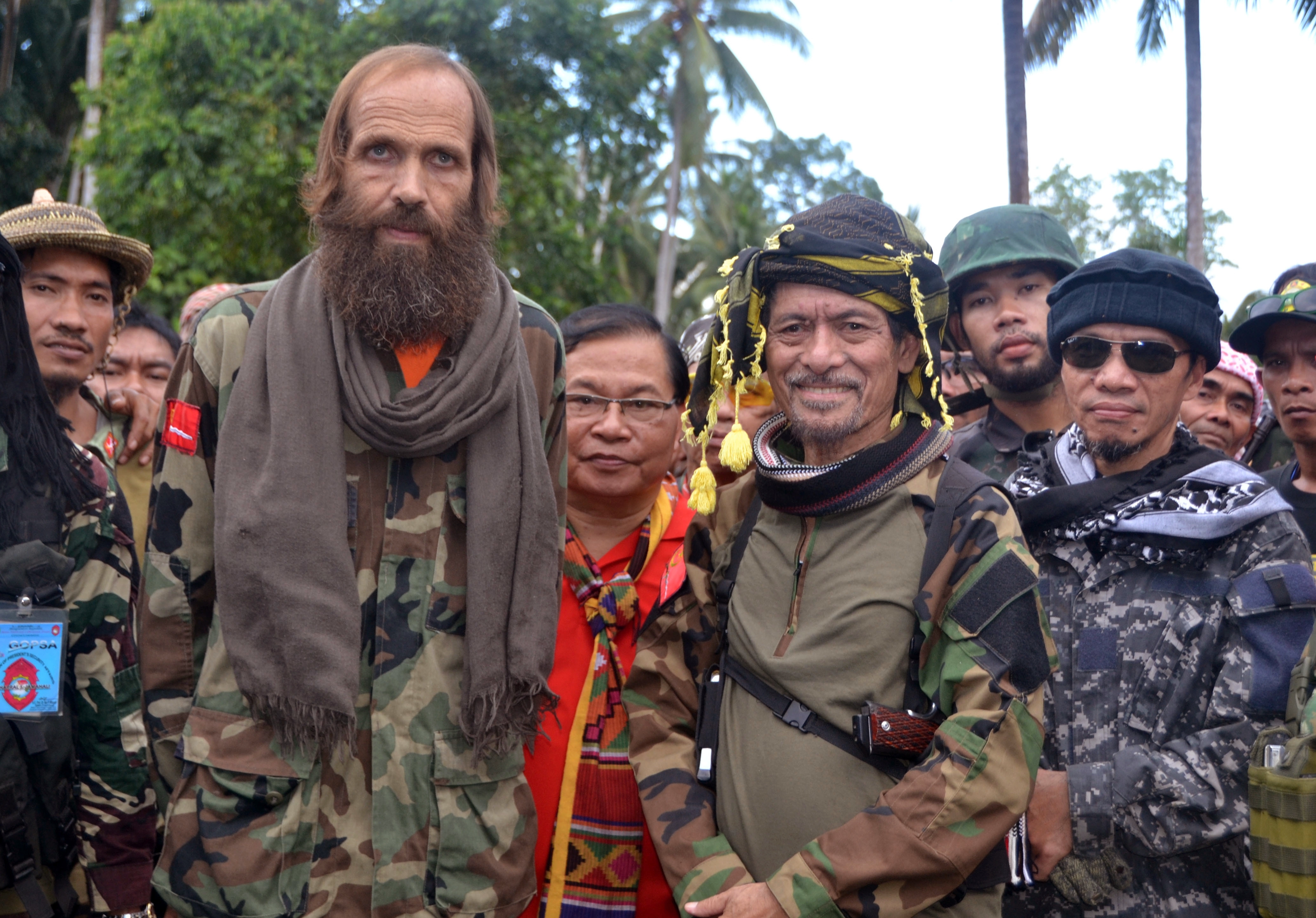
Released Norwegian hostage Kjartan Sekkingstad, front row left, poses with Moro National Liberation Front Chairman Nur Misuari, front row second right, after being turned over by ransom-seeking Abu Sayyaf extremists in Indanan township on Jolo island in southern Philippines Sunday, Sept. 18, 2016. Sekkingstad, who was kidnapped last year along with two Canadians and a Filipino, was released Saturday and was turned over Sunday to Misuari, who in turn turned him over to Presidential adviser Jesus Dureza. (AP Photo/Nickee Butlangan)
Both the Indonesian government and the Philippine military recognized the big role of the Moro National Liberation Front (MNLF) in Saturday’s release of four kidnap victims — a Norwegian and three Indonesian fishermen.
Indonesian Defense Minister Ryanmizard Ryancudu told reporters here, on Sunday night, that they were grateful for the help extended by the MNLF to secure their people safely from the Abu Sayyaf.
“We appreciate the assistance of the MNLF. They know very well the terrain, they are very professional and they know what to do, that is why we need the assistance of the MNLF,” Ryancudu said in Bahasa.
Lt. Gen. Mayoralgo dela Cruz, chief of Western Mindanao Command, agreed.
“The MNLF knows the terrain. They know some of the people from the Abu Sayyaf, and they have their own ways of dealing with the Abu Sayyaf,” Dela Cruz said.
But Dela Cruz also said President Duterte’s directive to destroy the bandit group resulted in efforts involving military, police, local government and even the MNLF to rescue and secure safely the hostages.
“As we all know, the forefront in this endeavor is the President’s directive to really go after this group,” he said, adding that at least 16 battalions of government troops have been deployed in Sulu.
“In fact, some of the civilian populace are giving us information and this is to our advantage, and hopefully in the coming days, this support will reduce and degrade the Abu Sayyaf into an insignificant level,” Dela Cruz added.
Samsula Adju, spokesperson of the MNLF in Sulu, said it was Tahil Sali, MNLF Vice Chair for Political Affairs, who worked hard for the release of hostages.
Adju sad Sali was authorized by MNLF chair Nur Misuari to negotiate with the Abu Sayyaf leader Raddulan Sahiron for the safe release of Norwegian Kjartan Sekkingstad, who was freed on Saturday.
Sekkingstad on Sunday thanked “Misuari and his finest men who released me yesterday afternoon.”
The MNLF said no ransom was paid in exchange for Sekkingstad’s freedom.
“As far as I know, no ransom was paid in pursuant to the MNLF’s adherence of no ransom policy,” Adju told the Philippine Daily Inquirer by phone.
Muammar Askali alias Abu Rami, who claimed to be the spokesperson of the Abu Sayyaf, earlier said P30 million was paid as ransom.
After the release of Sekkingstad and the three Indonesian fishermen and two Filipino kidnap victims were also freed on Sunday.
Maj. Filemon Tan Jr., spokesperson of Western Mindanao Command, said sustained military operations led to the freeing of Daniela Taruc and Levy Gonzales in Panglima Estino town in Sulu on Sunday night.
The victims, sub-contractors of a Telecom company, who were kidnapped in Patikul town on August 6, were recovered by a resident, Tan said.
http://globalnation.inquirer.net/145110/mnlf-seen-as-key-to-safe-release-of-abu-sayyaf-captives
Indonesia expects Abu Sayyaf to release another sailor
From Anadolu Agency (Sep 19): Indonesia expects Abu Sayyaf to release another sailor
After militants in south Philippines free 3 Indonesians, negotiator says another national expected to be released

A negotiator revealed Monday that Indonesia expects a militant group based in the Philippines’ troubled south to free another one of its nationals following the release of three fishermen over the weekend.
After militants in south Philippines free 3 Indonesians, negotiator says another national expected to be released
A negotiator revealed Monday that Indonesia expects a militant group based in the Philippines’ troubled south to free another one of its nationals following the release of three fishermen over the weekend.
Retired Maj. Gen. Kivlan Zein was quoted by detik.com as saying, "a hostage will be freed today… Hopefully there will be no obstacles."
He identified the hostage as a captain seized from a boat off the eastern Malaysian state of Sabah in early August.
Over the weekend, the Abu Sayyaf freed Norwegian Kjartan Sekkingstad, who was kidnapped from a resort on the island of Samal in September 2015 alongside two Canadians who were beheaded earlier this year.
It later released three Indonesian fishermen -- who were abducted off Sabah in mid-July -- and all four men were hosted Saturday night by the Moro National Liberation Front (MNLF) rebel group’s fugitive founder, Nur Misuari.
The MNLF, which is engaged in a peace process with the Philippines government, has been facilitating negotiations for the release of hostages held by the Abu Sayyaf, which is believed to still be holding captive at least 11 foreigners and three Filipinos.
Indonesia’s defense minister, who had been visiting the southern Philippines for negotiations when the fishermen were freed, told reporters upon his return to Jakarta on Sunday night that one more hostage would be released.
“Philippine troops keep coordinating with the MNLF," Ryamizard Ryacudu was quoted as saying by kompas.com, describing the rebel group as having a dominant role in rescue operations due to their knowledge of the field and Abu Sayyaf hideouts.
He reiterated that the captives had been freed purely due to pressure from the Philippines military and MNLF forces, insisting that no ransom had been paid despite reports stating otherwise.
The minister added that the three fishermen had been handed over to Indonesian representatives Sunday and would return to their home country in the near future.
At least five Indonesians are believed to still remain in the captivity of the Abu Sayyaf, which released two Filipinos late Sunday night.
Since 1991, the group -- armed with mostly improvised explosive devices, mortars and automatic rifles -- has carried out bombings, kidnappings, assassinations and extortion in a self-determined fight for an independent province in the Philippines.
It is one of two militant groups in the south to have pledged allegiance to Daesh, prompting fears during the stalling of a peace process between the government and MNLF-breakaway group the Moro Islamic Liberation Front that it could make inroads in a region torn by decades of armed conflict.
Philippine Militancy in the Spotlight with Freed Norwegian Hostage
From The Diplomat (Sep 20): Philippine Militancy in the Spotlight with Freed Norwegian Hostage
Abu Sayyaf finally releases another captive.
Abu Sayyaf has finally freed Norwegian hostage Kjartan Sekkingstad after a year in captivity and three Indonesian fishermen amid reports that ransoms worth more than $2 million were paid to the outlawed group.
Governments often insist that ransoms will not be paid in such instances. But inducements and intervention from Manila appear to have succeeded where foreign policy has not, which Ottawa discovered in recent months with the beheadings of two Canadian hostages, Robert Hall and John Ridsdel.
They were killed in April and June after deadlines for ransom payments, reportedly worth up to $1.3 million, lapsed.
Their plight was particularly tragic with recently elected Prime Minister Justin Trudeau naively touting the virtues of his government, which refused to deal with the Abu Sayyaf, a terrorist group with a sworn allegiance to Islamic State.
Those sentiments were echoed by Norwegian Prime Minister Erna Solberg, who told the NTB national news agency that “Norwegian officials had not participated in any payment of ransom or made any concessions in the matter.”
Despite this, the Philippines Star said it was told by sources that Sekkingstad’s family and friends from Norway had raised a ransom payment and Norway Ambassador Erik Forner had apparently flown to Davao in anticipation of Sekkingstad’s release.
“I would like to reiterate that the government maintains the no-ransom policy,” Presidential Communications Secretary Martin Andanar told government radio.
“Now, if a third party or the family gives ransom, we do not know,” he said.
The release of Sekkingstad and Indonesians – Lorence Koten, Theo Doros Kofong, and Emanuel Arakian – will likely be seen as a victory for Philippine President Rodrigo Duterte.
Duterte has shocked governments abroad and the Catholic Church and civil society at home with his use of extrajudicial killings to bring the illicit drug trade under control. More 3,500 people have been killed in just ten weeks since his election.
However, three weeks ago, Duterte said he would shift his deadly focus onto the Abu Sayyaf, insurgents he once admired, demanding their elimination after they “started slaughtering people like chickens”.
Duterte’s orders were plain and simple: “Kill them, destroy them”.
Sekkingstad told journalist that he, Hall and Ridsdel had been treated as slaves by the Abu Sayyaf and were often dodging bullets by attacking government forces. He said Abu Sayyaf numbers had peaked at around 300.
They were kidnapped about a year ago near Davao, where Duterte once served as mayor, along with Filipina Marites Flor. She was released in June after witnessing the grisly killings of Hall and Ridsdel.
The Abu Sayyaf has attempted to portray itself as an Islamic militancy group with pretensions of establishing a caliphate within Southeast Asia, not unlike the Islamic State in the Middle East.
However, their kidnap and ransom policies have earned them comparisons with thugs and bandits, which operate in the Southern Philippines with impunity.
Abductions have become commonplace since then-Abu Sayyaf leader Galib Andang, also known as Commander Robot, began ordering the kidnapping of foreign tourists from the deluded safety of tourist resorts across the Sulu Sea in East Malaysia in the 1990s.
At best, they are a low-grade terrorist outfit with a preference for soft targets, like tourists.
The release of the three Indonesians was aided by the Moro Islamic Liberation front (MILF), which is currently in peace negotiations with Manila. But the whereabouts of Dutch hostage Ewold Horn remains unknown.
Authorities have also indicated that Abu Sayyaf has attempted to spread its wings following the demise of al-Qaeda affiliate Jemaah Islamiyah and its even nastier offshoot Jemaah Ansharut Tauhid, responsible for a string of deadly bombings across Indonesia.
Both groups had shared hideouts and operations with Abu Sayyaf throughout much of the 2000s but most of their former members are either dead or in jail.
http://thediplomat.com/2016/09/philippine-militancy-in-the-spotlight-with-freed-norwegian-hostage/
Abu Sayyaf finally releases another captive.
Abu Sayyaf has finally freed Norwegian hostage Kjartan Sekkingstad after a year in captivity and three Indonesian fishermen amid reports that ransoms worth more than $2 million were paid to the outlawed group.
Governments often insist that ransoms will not be paid in such instances. But inducements and intervention from Manila appear to have succeeded where foreign policy has not, which Ottawa discovered in recent months with the beheadings of two Canadian hostages, Robert Hall and John Ridsdel.
They were killed in April and June after deadlines for ransom payments, reportedly worth up to $1.3 million, lapsed.
Their plight was particularly tragic with recently elected Prime Minister Justin Trudeau naively touting the virtues of his government, which refused to deal with the Abu Sayyaf, a terrorist group with a sworn allegiance to Islamic State.
Those sentiments were echoed by Norwegian Prime Minister Erna Solberg, who told the NTB national news agency that “Norwegian officials had not participated in any payment of ransom or made any concessions in the matter.”
Despite this, the Philippines Star said it was told by sources that Sekkingstad’s family and friends from Norway had raised a ransom payment and Norway Ambassador Erik Forner had apparently flown to Davao in anticipation of Sekkingstad’s release.
“I would like to reiterate that the government maintains the no-ransom policy,” Presidential Communications Secretary Martin Andanar told government radio.
“Now, if a third party or the family gives ransom, we do not know,” he said.
The release of Sekkingstad and Indonesians – Lorence Koten, Theo Doros Kofong, and Emanuel Arakian – will likely be seen as a victory for Philippine President Rodrigo Duterte.
Duterte has shocked governments abroad and the Catholic Church and civil society at home with his use of extrajudicial killings to bring the illicit drug trade under control. More 3,500 people have been killed in just ten weeks since his election.
However, three weeks ago, Duterte said he would shift his deadly focus onto the Abu Sayyaf, insurgents he once admired, demanding their elimination after they “started slaughtering people like chickens”.
Duterte’s orders were plain and simple: “Kill them, destroy them”.
Sekkingstad told journalist that he, Hall and Ridsdel had been treated as slaves by the Abu Sayyaf and were often dodging bullets by attacking government forces. He said Abu Sayyaf numbers had peaked at around 300.
They were kidnapped about a year ago near Davao, where Duterte once served as mayor, along with Filipina Marites Flor. She was released in June after witnessing the grisly killings of Hall and Ridsdel.
The Abu Sayyaf has attempted to portray itself as an Islamic militancy group with pretensions of establishing a caliphate within Southeast Asia, not unlike the Islamic State in the Middle East.
However, their kidnap and ransom policies have earned them comparisons with thugs and bandits, which operate in the Southern Philippines with impunity.
Abductions have become commonplace since then-Abu Sayyaf leader Galib Andang, also known as Commander Robot, began ordering the kidnapping of foreign tourists from the deluded safety of tourist resorts across the Sulu Sea in East Malaysia in the 1990s.
At best, they are a low-grade terrorist outfit with a preference for soft targets, like tourists.
The release of the three Indonesians was aided by the Moro Islamic Liberation front (MILF), which is currently in peace negotiations with Manila. But the whereabouts of Dutch hostage Ewold Horn remains unknown.
Authorities have also indicated that Abu Sayyaf has attempted to spread its wings following the demise of al-Qaeda affiliate Jemaah Islamiyah and its even nastier offshoot Jemaah Ansharut Tauhid, responsible for a string of deadly bombings across Indonesia.
Both groups had shared hideouts and operations with Abu Sayyaf throughout much of the 2000s but most of their former members are either dead or in jail.
http://thediplomat.com/2016/09/philippine-militancy-in-the-spotlight-with-freed-norwegian-hostage/
DND, AFP: Abu Sayyaf feeling the pressure
From CNN Philippines (Sep 20): DND, AFP: Abu Sayyaf feeling the pressure

Since President Rodrigo Duterte assumed office in June this year, eleven kidnap victims of the Abu Sayyaf have been released. Defense officials say the terrorist group may be feeling the impact of relentless military operations which intensified more than three weeks ago in Jolo, Sulu.
The latest to be freed this weekend were Norwegian national Kjartan Sekkingstad, and Indonesian captives Lorence Koten, Theorus Kopong, and Emanuel Arakain. Two Filipinos, Levi Gonzales and Daniela Taruc, were also released.
READ: Abu Sayyaf frees two other kidnap victims
Some 7,000 soldiers have been deployed in the Sulu province. The Armed Forces of the Philippines (AFP) explains that with the government's indefinite ceasefire with communist rebels, this has allowed them to concentrate on operations against the Abu Sayyaf.
READ: Freed Norwegian hostage Sekkingstad thanks Duterte
"Mula nung magdagdag tayo ng five battalions nitong nakaraang linggo at nag-umpisa yung all-out offensive natin medyo nagulo sila doon at kaysa masagasaan sila ng tropa at mawala kanilang hostages, eh binigay na lang nila," said Defense Secretary Delfin Lorenzana.
[Translation: Since we added five batallions last week and started the all-out offensive, they got rattled and decided to give up their hostages rather than fight with our troops.]
Based on the Armed Forces of the Philippines' validation, as of last month Abu Sayyaf fighters now just number to 481. While they may still have many local 'sympathizers,' the AFP sees this number to further decrease.
AFP Spokesman B/Gen. Restituto Padilla said, "An indication or clear proof of the pressure they're experiencing is that they don't want to engage our troops anymore, they have broken down into smaller groups, not wanting to fight." With this, Padilla hopes more hostages would be released.
The Abu Sayyaf is believed to be still holding 16 hostages.
Lorenzana would neither confirm nor deny reports that ransom was paid for the recent release of kidnap victims although President Duterte himself said last month that up to ₱50-million was paid for Sekkingstad. Padilla said if there were ransom negotiations between the Abu Sayyaf and their hostages' families, this was beyond the AFP's control. He says some families find ways to directly deal with the kidnappers, and give in to ransom demands out of fear for the lives of their loved ones held captive.
Padilla reiterates the government's 'no ransom' policy. He also explains this is important to financially disable the Abu Sayyaf since some of their leaders insist in keeping the hostages for money. Padilla says they use the money to buy the sympathy and loyalty of local residents, as well as to strenghten their ranks, "Nagiging pera-pera ito, 'yun ang naging problema. Ginagamit nila iyan (ransom) pambili ng armas para lumakas sila, ginagamit din nila para maka-recruit kasi meron din silang sign-up fee na tinatawag."
[Translation: It all boils down to money, and that becomes the problem. They use the ransom to buy arms and become stronger. They also use it to recruit members because they have something called a sign-up fee.]
While it may be too early to claim gains in the war against terrorism, the AFP would rather look at it as one step towards peace, especially since the Moro National Liberation Front, and its leader Nur Misuari have been actively helping out to secure the Abu Sayyaf's kidnap victims. Misuari had even requested the DND to suspend offensives.
Lorenzana said he has already informed Misuari that he cannot grant the MNLF leader's request, and if ever he can only order the suspension of military operations in specific areas where the MNLF is negotiating the release of hostages.
Duterte has been in talks with Misuari, as part of his efforts to pursue peace in Mindanao. The President said he does not want the police to implement the arrest warrant against Misuari who is facing rebellion charges for the 2013 Zamboanga siege.
http://cnnphilippines.com/news/2016/09/20/department-of-national-defense-armed-forces-of-the-philippines-abu-sayyaf-pressure.html
Since President Rodrigo Duterte assumed office in June this year, eleven kidnap victims of the Abu Sayyaf have been released. Defense officials say the terrorist group may be feeling the impact of relentless military operations which intensified more than three weeks ago in Jolo, Sulu.
The latest to be freed this weekend were Norwegian national Kjartan Sekkingstad, and Indonesian captives Lorence Koten, Theorus Kopong, and Emanuel Arakain. Two Filipinos, Levi Gonzales and Daniela Taruc, were also released.
READ: Abu Sayyaf frees two other kidnap victims
Some 7,000 soldiers have been deployed in the Sulu province. The Armed Forces of the Philippines (AFP) explains that with the government's indefinite ceasefire with communist rebels, this has allowed them to concentrate on operations against the Abu Sayyaf.
READ: Freed Norwegian hostage Sekkingstad thanks Duterte
"Mula nung magdagdag tayo ng five battalions nitong nakaraang linggo at nag-umpisa yung all-out offensive natin medyo nagulo sila doon at kaysa masagasaan sila ng tropa at mawala kanilang hostages, eh binigay na lang nila," said Defense Secretary Delfin Lorenzana.
[Translation: Since we added five batallions last week and started the all-out offensive, they got rattled and decided to give up their hostages rather than fight with our troops.]
Based on the Armed Forces of the Philippines' validation, as of last month Abu Sayyaf fighters now just number to 481. While they may still have many local 'sympathizers,' the AFP sees this number to further decrease.
AFP Spokesman B/Gen. Restituto Padilla said, "An indication or clear proof of the pressure they're experiencing is that they don't want to engage our troops anymore, they have broken down into smaller groups, not wanting to fight." With this, Padilla hopes more hostages would be released.
The Abu Sayyaf is believed to be still holding 16 hostages.
Lorenzana would neither confirm nor deny reports that ransom was paid for the recent release of kidnap victims although President Duterte himself said last month that up to ₱50-million was paid for Sekkingstad. Padilla said if there were ransom negotiations between the Abu Sayyaf and their hostages' families, this was beyond the AFP's control. He says some families find ways to directly deal with the kidnappers, and give in to ransom demands out of fear for the lives of their loved ones held captive.
Padilla reiterates the government's 'no ransom' policy. He also explains this is important to financially disable the Abu Sayyaf since some of their leaders insist in keeping the hostages for money. Padilla says they use the money to buy the sympathy and loyalty of local residents, as well as to strenghten their ranks, "Nagiging pera-pera ito, 'yun ang naging problema. Ginagamit nila iyan (ransom) pambili ng armas para lumakas sila, ginagamit din nila para maka-recruit kasi meron din silang sign-up fee na tinatawag."
[Translation: It all boils down to money, and that becomes the problem. They use the ransom to buy arms and become stronger. They also use it to recruit members because they have something called a sign-up fee.]
While it may be too early to claim gains in the war against terrorism, the AFP would rather look at it as one step towards peace, especially since the Moro National Liberation Front, and its leader Nur Misuari have been actively helping out to secure the Abu Sayyaf's kidnap victims. Misuari had even requested the DND to suspend offensives.
Lorenzana said he has already informed Misuari that he cannot grant the MNLF leader's request, and if ever he can only order the suspension of military operations in specific areas where the MNLF is negotiating the release of hostages.
Duterte has been in talks with Misuari, as part of his efforts to pursue peace in Mindanao. The President said he does not want the police to implement the arrest warrant against Misuari who is facing rebellion charges for the 2013 Zamboanga siege.
http://cnnphilippines.com/news/2016/09/20/department-of-national-defense-armed-forces-of-the-philippines-abu-sayyaf-pressure.html
Davao activists commemorate 25th year of US bases rejection
From the often pro-CPP online publication the Davao Today (Sep 16): Davao activists commemorate 25th year of US bases rejection

“We have all been witness to the long list of violations that have not even been tackled here in our country,” said Sheena Duazo, regional secretary general of Bayan. Duazo cited the cases of Michael Meiring, who accidently exploded a bomb inside the Evergreen Hotel but was whisked off by suspected FBI agents from the hospital where he was being treated and the case of Nicole, “a Davaoeña who was raped by a US soldier in Subic.”
“Remember Jennifer Laude, who was murdered by US Marine Scott Pemberton in Olongapo and Gregan Cardeño, a Filipino Bahasa interpreter who died inside a US base in Marawi City,” Duazo added.
On September 16, 1991, 12 senators voted to reject the RP-US Bases Treaty of 1991. The 12 were former Senators Agapito “Butz” Aquino, Joseph Estrada, Teofisto Guingona Jr, Sotero Laurel II, Ernesto Maceda Jr, Orlando Mercado, Aquilino Pimentel Jr, Rene Saguisag, Jovito Salonga, Wigberto Tañada, Victor Ziga, and Juan Ponce Enrile.
The group also expressed hopes that Duterte’s pronouncements of an “independent foreign policy” would lead to the eventual scrapping of the Visiting Forces Agreement and the Enhanced Defense Cooperation Agreement, calling the agreements an “unequal relationship” and inimical to national sovereignty.
“In spite of the senate decision that spurned the presence of US bases 25 years ago, we now have these executive agreements signed by previous administrations that have given the US military the legal means to stay encamped in the Philippines, such as the Visiting Forces Agreement and the Enhanced Defense Cooperation Agreement,” Duazo said.
The VFA restored the presence of American soldiers in Philippine soil through Senate ratification on May 27, 1999, and the EDCA is an executive agreement signed by former president Benigno Aquino III on July 26, 2016 thereby not needing the ratification of the senate.
“It is totally outrageous to let foreign military troops, who are almost invulnerable to Philippine laws and commanded by it’s own country’s interests, to set foot and perform operations in our nation. And to think we are seeing this complete trampling of our national sovereignty ever since we proclaimed independence,” League of Filipino Students spokesperson Abdul Rauf Sissay said.
The group also expressed hopes that Duterte’s pronouncements of an independent foreign policy would lead to the eventual scrapping of the Visiting Forces Agreement and the Enhanced Defense Cooperation Agreement, calling the agreements an “unequal relationship” and inimical to national sovereignty.
“We now have these agreements signed by the previous administrations that have given the US military the legal means to stay in the Philippines,” Duazo said.
The VFA restored the presence of American soldiers in Philippine soil through Senate ratification on May 27, 1999, and the EDCA is an executive agreement signed by former president Benigno Aquino III on July 26, 2016.
“It is totally outrageous to let foreign military troops, who are almost invulnerable to Philippine laws and commanded by it’s own country’s interests, to set foot and perform operations in our nation. And to think we are seeing this complete trampling of our national sovereignty ever since we proclaimed independence,” League of Filipino Students spokesperson Abdul Rauf Sissay said.
http://davaotoday.com/main/politics/davao-activists-commemorate-25th-year-of-us-bases-rejection/
JUNK VFA, EDCA. Activists led by the Bagong Alyansang Makabayan Southern Mindanao Region and the League of Filipino Students hold a protest action in San Pedro street, Davao City to urge President Rodrigo Duterte to pursue his plan of an independent foreign policy in commemoration of the 25th anniversary of the Philippine Senate’s rejection of the new treaty for the Subic Bay Naval Station and end to US military presence Friday,September 16. The groups called on Pres. Duterte to scrap the Visiting Forces Administration and the Enhanced Defense Cooperation Agreement. (Paulo C. Rizal/davaotoday.com)
Activists here commemorated the 25th year since 12 Senators voted to reject the RP-US Bases treaty of 1991 by protesting alleged human rights violations committed by United States military and called for the termination of the agreements that allow the presence of American soldiers in Philippine territory.
“Remember Jennifer Laude, who was murdered by US Marine Scott Pemberton in Olongapo and Gregan Cardeño, a Filipino Bahasa interpreter who died inside a US base in Marawi City,” Duazo added.
On September 16, 1991, 12 senators voted to reject the RP-US Bases Treaty of 1991. The 12 were former Senators Agapito “Butz” Aquino, Joseph Estrada, Teofisto Guingona Jr, Sotero Laurel II, Ernesto Maceda Jr, Orlando Mercado, Aquilino Pimentel Jr, Rene Saguisag, Jovito Salonga, Wigberto Tañada, Victor Ziga, and Juan Ponce Enrile.
The group also expressed hopes that Duterte’s pronouncements of an “independent foreign policy” would lead to the eventual scrapping of the Visiting Forces Agreement and the Enhanced Defense Cooperation Agreement, calling the agreements an “unequal relationship” and inimical to national sovereignty.
“In spite of the senate decision that spurned the presence of US bases 25 years ago, we now have these executive agreements signed by previous administrations that have given the US military the legal means to stay encamped in the Philippines, such as the Visiting Forces Agreement and the Enhanced Defense Cooperation Agreement,” Duazo said.
The VFA restored the presence of American soldiers in Philippine soil through Senate ratification on May 27, 1999, and the EDCA is an executive agreement signed by former president Benigno Aquino III on July 26, 2016 thereby not needing the ratification of the senate.
“It is totally outrageous to let foreign military troops, who are almost invulnerable to Philippine laws and commanded by it’s own country’s interests, to set foot and perform operations in our nation. And to think we are seeing this complete trampling of our national sovereignty ever since we proclaimed independence,” League of Filipino Students spokesperson Abdul Rauf Sissay said.
The group also expressed hopes that Duterte’s pronouncements of an independent foreign policy would lead to the eventual scrapping of the Visiting Forces Agreement and the Enhanced Defense Cooperation Agreement, calling the agreements an “unequal relationship” and inimical to national sovereignty.
“We now have these agreements signed by the previous administrations that have given the US military the legal means to stay in the Philippines,” Duazo said.
The VFA restored the presence of American soldiers in Philippine soil through Senate ratification on May 27, 1999, and the EDCA is an executive agreement signed by former president Benigno Aquino III on July 26, 2016.
“It is totally outrageous to let foreign military troops, who are almost invulnerable to Philippine laws and commanded by it’s own country’s interests, to set foot and perform operations in our nation. And to think we are seeing this complete trampling of our national sovereignty ever since we proclaimed independence,” League of Filipino Students spokesperson Abdul Rauf Sissay said.
http://davaotoday.com/main/politics/davao-activists-commemorate-25th-year-of-us-bases-rejection/
Abu Sayyaf got ransom for Norwegian’s release: analysts
From InterAksyon (Sep 20): Abu Sayyaf got ransom for Norwegian’s release: analysts

Presidential peace adviser Jesus Dureza arrives in Davao City Sunday after getting custody of Norwegian Kjartan Sekkingstad (in back), freed by the Abu Sayyaf Group on Saturday. The Norwegian was first brought to MNLF founder Nur Misuari. PHOTO BY GEM AVANCENA, NEWS5-DAVAO
A notorious kidnapping-for-ransom gang in the strife-torn southern Philippines enjoyed another lucrative payday when it released a Norwegian hostage after a year in captivity, analysts said Monday.
A bearded and bedraggled Kjartan Sekkingstad was released Saturday on a remote southern island after what analysts said was almost certainly a payment in the thousands of dollars after the Abu Sayyaf demanded millions.
The Philippine and Norwegian governments have denied paying ransom for the release of Sekkingstad, while highlighting their efforts to secure his freedom after the kidnappers had beheaded two of his fellow hostages, both Canadian.
Security analysts said the Abu Sayyaf would never release a hostage without ransom.
"There was a ransom payment negotiated by intermediaries of the family with diplomatic help. My information is P30 million ($625,000) was paid," said Rodolfo Mendoza, senior analyst of Manila-based Philippine Institute for Peace, Violence and Terrorism Research.
"Hostage-taking is the Abu Sayyaf's fund-raising activity," Mendoza, a former police general, told AFP.
Sekkingstad's brother Odd Kåre Sekkingstad declined to comment when asked by AFP about reports of a ransom.
His sibling was abducted by the Abu Sayyaf from a tourist resort in September 2015, alongside a Filipina who has been freed, and the two Canadians who were beheaded in April and June.
Philippine authorities have said the Norwegian was freed due to a military offensive which President Rodrigo Duterte ordered against the militants, and with the help of a separate Muslim rebel group holding peace talks with the government.
Duterte himself had said last month that P50 million ($1 million) had been paid for Sekkingstad's release.
"The Norwegian, that's already paid," Duterte told reporters.
"I don't know (where the money came from), maybe my bank," he said in jest when asked who paid the ransom.
Zachary Abuza, a Southeast Asian security expert at the National War College in the United States, told AFP there was no doubt ransom was paid.
"The (Abu Sayyaf) did not release him out of the goodness of their hearts...
governments have to deny paying ransoms, as it incentivizes more hostage-taking. But often governments will use third parties."
The payment would allow Abu Sayyaf to buy more guns through the black market, Abuza added.
The Abu Sayyaf, blamed for the nation's worst terror attacks, is a loose network of militants formed in the 1990s with seed money from Osama bin Laden's Al-Qaeda network.
Based in remote Muslim-populated southern Mindanao islands of the mainly Catholic Philippines and listed by the US as a terrorist organization, some of its leaders have since pledged allegiance to the Islamic State group.
In 2014, the Abu Sayyaf boasted of receiving P250 million for two German hostages it freed after six months in captivity.
In 2013, the militants also released an Australian ex-soldier after holding him for 15 months, with a local politician who acted as a negotiator saying ransom was paid.
http://interaksyon.com/article/132577/abu-sayyaf-got-ransom-for-norwegians-release-analysts
Presidential peace adviser Jesus Dureza arrives in Davao City Sunday after getting custody of Norwegian Kjartan Sekkingstad (in back), freed by the Abu Sayyaf Group on Saturday. The Norwegian was first brought to MNLF founder Nur Misuari. PHOTO BY GEM AVANCENA, NEWS5-DAVAO
A notorious kidnapping-for-ransom gang in the strife-torn southern Philippines enjoyed another lucrative payday when it released a Norwegian hostage after a year in captivity, analysts said Monday.
A bearded and bedraggled Kjartan Sekkingstad was released Saturday on a remote southern island after what analysts said was almost certainly a payment in the thousands of dollars after the Abu Sayyaf demanded millions.
The Philippine and Norwegian governments have denied paying ransom for the release of Sekkingstad, while highlighting their efforts to secure his freedom after the kidnappers had beheaded two of his fellow hostages, both Canadian.
Security analysts said the Abu Sayyaf would never release a hostage without ransom.
"There was a ransom payment negotiated by intermediaries of the family with diplomatic help. My information is P30 million ($625,000) was paid," said Rodolfo Mendoza, senior analyst of Manila-based Philippine Institute for Peace, Violence and Terrorism Research.
"Hostage-taking is the Abu Sayyaf's fund-raising activity," Mendoza, a former police general, told AFP.
Sekkingstad's brother Odd Kåre Sekkingstad declined to comment when asked by AFP about reports of a ransom.
His sibling was abducted by the Abu Sayyaf from a tourist resort in September 2015, alongside a Filipina who has been freed, and the two Canadians who were beheaded in April and June.
Philippine authorities have said the Norwegian was freed due to a military offensive which President Rodrigo Duterte ordered against the militants, and with the help of a separate Muslim rebel group holding peace talks with the government.
Duterte himself had said last month that P50 million ($1 million) had been paid for Sekkingstad's release.
"The Norwegian, that's already paid," Duterte told reporters.
"I don't know (where the money came from), maybe my bank," he said in jest when asked who paid the ransom.
Zachary Abuza, a Southeast Asian security expert at the National War College in the United States, told AFP there was no doubt ransom was paid.
"The (Abu Sayyaf) did not release him out of the goodness of their hearts...
governments have to deny paying ransoms, as it incentivizes more hostage-taking. But often governments will use third parties."
The payment would allow Abu Sayyaf to buy more guns through the black market, Abuza added.
The Abu Sayyaf, blamed for the nation's worst terror attacks, is a loose network of militants formed in the 1990s with seed money from Osama bin Laden's Al-Qaeda network.
Based in remote Muslim-populated southern Mindanao islands of the mainly Catholic Philippines and listed by the US as a terrorist organization, some of its leaders have since pledged allegiance to the Islamic State group.
In 2014, the Abu Sayyaf boasted of receiving P250 million for two German hostages it freed after six months in captivity.
In 2013, the militants also released an Australian ex-soldier after holding him for 15 months, with a local politician who acted as a negotiator saying ransom was paid.
http://interaksyon.com/article/132577/abu-sayyaf-got-ransom-for-norwegians-release-analysts
NPA rebels bring 6 rifles in their surrender to army
From the Mindanao Times (Sep 19): NPA rebels bring 6 rifles in their surrender to army
FIVE MEMBERS of the New People’s Army surrendered to the 75th Infantry Battalion, bringing along with them six M16 rifles, in Barangay St. Christine, Lianga, Surigao del Sur at around 3:30 p.m. on Saturday.
Capt. Joe Patrick Martinez, spokesperson of 4th Infantry Division, said the five NPAs (names are not given for security reasons) are former members of the Komiteng Rebolusyonaryo sa Munisipalidad- KRM (municipal revolutionary committee) established by the CPP-NPA in the outlaying localities of the said town.
“The NPAs chose to go back after they have decided to heed the government’s sincere effort to unite the country,” Martinez said.
In his statement, Lt. Col. Harold S. Akaz, commanding Officer of 75IB, is grateful for the rebels’ decision as he assured ample support so they could resume their lives.
“We are happy that all of you will finally enjoy living a peaceful life with your families and we will facilitate all the support that shall be given to you to help you reintegrate in your respective communities,” he added.
Maj. Gen. Benjamin R. Madrigal Jr., commander of 4th Infantry Division, also wished the surrenderees luck.
“We in the Armed Forces are truly grateful to your decision in giving what is best for our Country — the dream of achieving lasting peace that every Filipinos deserve,” he said.” We welcome those who may wish or decide to immediately experience peace and be with their families.”
The five will be given support under the Comprehensive Local Integration Program (CLIP) of the provincial government of Surigao del Sur.
Misuari wants a halt in anti-Sayyaf ops in Sulu
From the Mindanao Examiner (Sep 19): Misuari wants a halt in anti-Sayyaf ops in Sulu
Philippines Defense chief Delfin Lorenzana said Monday a former rebel chieftain – wanted by authorities for the 2013 deadly attacks in Zamboanga City – is asking for a halt in military offensives against the Abu Sayyaf in the southern Sulu province to allow peaceful negotiations for the safe release of a dozen hostages still in the hands of the notorious group tied to Islamic State.
http://mindanaoexaminer.com/misuari-wants-a-halt-in-anti-sayyaf-ops-in-sulu/
Philippines Defense chief Delfin Lorenzana said Monday a former rebel chieftain – wanted by authorities for the 2013 deadly attacks in Zamboanga City – is asking for a halt in military offensives against the Abu Sayyaf in the southern Sulu province to allow peaceful negotiations for the safe release of a dozen hostages still in the hands of the notorious group tied to Islamic State.
He said Nur Misuari, chieftain of the Moro National
Liberation Front, relayed this message for him through Presidential peace adviser
Jesus Dureza.
Lorenzana said he will not allow a total halt in the
operations against the Abu Sayyaf, but he would let local military
commanders to decide on a localize truce to pave the way for peaceful
negotiations by Misuari to the Abu Sayyaf.
He said among the hostages are Malaysians tugboat crew
members kidnapped in Sabah ,
Malaysia
The Abu Sayyaf recently freed Norwegian Kjartan Sekkingstad
and three Indonesian tugboat crew members Teo Kopong, Lorenz Koten and
Emmanuel in Sulu following negotiations by Misuari. Army reports said some
P30 million were paid to the Abu Sayyaf and P30 million more for the Indonesian
hostages to buy out their liberty.
Abu Sayyaf militants also released a Filipino
couple, Levy Gonzales – a telecommunication technician working for Power
City Corporation – and his pregnant wife Daniela Taruc in the village
called Tiptipon in Panglima Sugala town in Sulu, one of 5 provinces under the
Autonomous Region in Muslim Mindanao.
The couple was spotted late Sunday by a civilian walking in
the village and immediately informed authorities upon learning they were freed
by the Abu Sayyaf. They were later brought to an army base in Jolo town
where Western Mindanao Command officials were quick to say that the release was
the result of the on-going military operations against the Abu Sayyaf, the same
claims they made following the release of the Norwegian and Indonesian
hostages.
It was unknown whether Gonzales’ company or their family
paid ransoms to the Abu Sayyaf in exchange for their freedom. The duo was
kidnapped in August 6 along with their driver Shariff Julhasan Abirin in
Timpook village in Patikul town. There was no information on the fate of Abirin
or whether he had been freed or not. The Abu Sayyaf previously demanded P1
million for the safe release of the hostages.
Basilan operations
Security forces are also operating against the Abu Sayyaf in
Basilan province where troops captured a stronghold of the militant group in
the village of Baguindan
Governor Mujiv Hataman, of the Autonomous Region in Muslim
Mindanao, led the government and military officials in the handover of the Abu
Sayyaf camp to civilian authorities and spearheaded a humanitarian and medical
mission in the area.
Hataman was also quoted by a television report as saying
that foreign members of the Islamic State are being coddled by the Abu Sayyaf
in Basilan. He said the foreign jihadists, including a Malaysian and Jamaican
bomb experts, were training the Abu Sayyaf in the manufacture of improvised
explosives.
Speaking to hundreds of residents, Hataman – accompanied by
his wife, Representative Djalia Turabin and his deputy governor, Haroun Lucman
– called on civilians to support the government’s peace efforts and called for
unity in achieving long lasting peace.
“It’s about time for this place –Baguindan – to receive
various programs and projects from the government. Ang Baguindan ay para sa
Baguindan. Nandito kami para protektahan ang mga tao dito,” he said.
The town’s mayor, Arcam Istarul, also pledged his support to
the military and thanked the soldiers for liberating the village from the Abu
Sayyaf. He said more than 1500 families in the area benefited from the
humanitarian mission.
http://mindanaoexaminer.com/misuari-wants-a-halt-in-anti-sayyaf-ops-in-sulu/
Dela Rosa flies to Colombia for conference on terrorism, drugs
From the Philippine News Agency (Sep 19): Dela Rosa flies to Colombia for conference on terrorism, drugs
http://www.pna.gov.ph/index.php?idn=1&sid=&nid=1&rid=924366
Philippine National Police (PNP) chief Director General
Ronald "Bato" Dela Rosa led a three-man PNP delegation to the
"Counter-terrorism and Counter-narcotics Exchange Conference" in
Bogota, Colombia organized by the United States Department of State.
Police Deputy Director General Francisco Uyami, Jr. has been
designated as PNP Officer-in-Charge (OIC) during the absence of Dela Rosa
effective Sept. 19-23, 2016.
The PNP delegation left the Philippines
High in the agenda of the conference are regional issues and
concerns on emerging terrorist threats, including narco-terrorism and
transnational drug trafficking.
The other members of the PNP delegation are Police Director
Fernando Mendez, Jr., PNP Director for Personnel and Records Management (DPRM),
and Senior Supt. Alden Delvo, Senior Executive Assistant.
Police Chief Supt. Wilson Caubat was designated OIC of the
DPRM during Mendez' absence.
The Office of Regional Affairs of the Embassy of the United States
The PNP delegation will return on Saturday.
http://www.pna.gov.ph/index.php?idn=1&sid=&nid=1&rid=924366
Government, NDF peace panels to draw up formal bilateral truce in next Oslo talks
From the Philippine News Agency (Sep 19): Government, NDF peace panels to draw up formal bilateral truce in next Oslo talks
http://www.pna.gov.ph/index.php?idn=&sid=&nid=&rid=924299
The government and the National Democratic Front (NDF) of
the Communist Party of the Philippines
are expected to draw up the final bilateral ceasefire in the next round of the
peace negotiations in Oslo ,
Norway
Lawyer Angela Librado, a member of the GRP panel, said the
final bilateral ceasefire is one of the major items during the next Oslo
President Rodrigo Duterte re-imposed ceasefire on August 22
and this was reciprocated by the NDF at the close of the resumption of talks
last August 26.
Librado explained a unified ceasefire agreement is necessary
so that they can come up with deadlines. “We gave ourselves 60 days to draft
(the bilateral truce),” Librado said during Monday’s Kapehan sa Dabaw at SM
Davao Annex.
Librado said the unified ceasefire agreement is crucial
because it enables both parties to go around and seek consultations on the
substantive agenda, one of which is the socioeconomic reforms.
Librado is optimistic both panels will achieve the bilateral
ceasefire during the second round of talks.
“Both committees are trying to unify respective draft and
discuss the ceasefire agreement shortly before the Oslo
Both panels are still to discuss the details of the
socio-economic reforms; political and constitutional reforms; and end of
hostilities and disposition of forces; the amnesty proclamation; joint
monitoring committees; further releases of detained NDF personnel; and the
modality and mechanics of the ceasefire.
At the resumption of peace talks last August, both panels
reached agreements on six major agenda. They reaffirmed all previously signed
agreements between the GRP and the NDF that were started by The Hague Joint
Declaration in 1992 and proceeded by the Joint Agreement on Safety and Immunity
Guarantees (JASIG) in 1996 and the Comprehensive Agreement on Respect of Human
Rights And International Humanitarian Law (CARHRIHL) in 1998 which were all
signed under the administration of President Fidel Ramos.
The panels also agreed to reconstitute the JASIG list after
the first document was corrupted. The encrypted list will contain the photos
and identities of NDF consultants who are still underground and will be immune
to arrest while the peace process is ongoing.
The government will issue documents of acknowledgement for
the NDF consultants still in hiding and for the 54 “publicly known NDF
personalities.”
The negotiating parties agreed to accelerate the peace
negotiations and set timelines for the completion of the remaining substantive
agenda.
Meanwhile, another crucial agenda is on the release of
political prisoners. Librado said there are two things that government is
looking into: the cases of 434 detainees in different detention centers around
the country and situation of the 100 detainees, who have reached senior years
and those who are sickly.
President Duterte has ordered the release of 22 detained NDF
consultants to fulfill a campaign promise to hold peace negotiations with the
communist movement. Most of them were able to join the Oslo
http://www.pna.gov.ph/index.php?idn=&sid=&nid=&rid=924299
Gov't projects to pour in former Abu Sayyaf camp in Basilan town
From the Philippine News Agency (Sep 19): Gov't projects to pour in former Abu Sayyaf camp in Basilan town
http://www.pna.gov.ph/index.php?idn=2&sid=&nid=2&rid=924109
TIPO-TIPO, Basilan –- Gov. Mujiv Hataman of
the Autonomous Region in Muslim Mindanao (ARMM) witnessed the turnover ceremony
marking the restoration of government authority in the former stronghold of the
Abu Sayyaf Group (ASG) in Barangay Baguindan here on Sunday.
Hataman called for unity in achieving long lasting peace as
he spoke to hundreds of residents present in the event.
"It's about time for this place (Barangay Baguindan) to
receive various programs and projects from the government," Hataman said
as he vowed to pour projects in Barangay Baguindan.
"Ang Baguindan ay para sa Baguindan. Nandito kami para
protektahan ang mga tao dito (Baguindan is for Baguindan. We are here to
protect the people)," he added.
Mayor Arcam Istarul expressed gratitude to the government
and security forces, who neutralized the lawless elements in their area.
"We will help the people of Baguindan through
livelihood projects," Istarul said.
"Mabayah kami sanyang lahat kami (We want our place to
be a peaceful one)," Bisahari Hantian, Baguindan barangay chairperson said
in Yakan, the local dialect.
Saida Abubakar, 57, a resident of the Baguindan, said they
are glad the government never forgot them throughout the ordeal.
"Sana
Lt. Col. Ernest John Jadloc, Army's 74th Infantry Battalion
(IB) commander, said the camp was seized after a month of offensive against the
ASG brigands by joint forces of his battalion, 18th IB, 64th IB, Scout Rangers,
and Special Forces.
Jadloc said the offensive was also meant to bring back government
authority and social services in areas occupied by the ASG brigands.
The ARMM regional government and the provincial government
conducted a People's Day to provide free services such as medical consultation
and check-ups, along with the distribution of hygiene kits.
Present during the event were ARMM Regional Vice-Gov. Haroun
Alrashid Lucman Jr., Anak Mindanao partylist Rep. Sitti Djalia Turabin-Hataman,
and other ARMM, military and police officials.
ARMM's Humanitarian Emergency Action Response Team
(ARMM-HEART) also distributed relief packs to 1,574 families in Barangay
Baguindan and Barangay Silangkum and in the nearby town of Al-Barka
http://www.pna.gov.ph/index.php?idn=2&sid=&nid=2&rid=924109
RDC to drumbeat peace, dev’t in far-flung Samar communities
From the Philippine News Agency (Sep 19): RDC to drumbeat peace, dev’t in far-flung Samar communities
http://www.pna.gov.ph/index.php?idn=2&sid=&nid=2&rid=924113
The Regional Development Council (RDC) will hold peace and
development caravans in previously rebel-infested towns of Lapinig, Northern Samar and Motiong Samar on Sept. 29 in a bid to
attain lasting peace in far-flung communities.
Department of Budget and Management Regional Director Imelda
Laceras, chair of the RDC’s development administration committee, said they
will push for the caravans that kicked off last year, to continue.
“This is to support the peace agenda of the Duterte
administration, underscoring the need to accelerate the implementation of peace
accords with communist insurgents, socio economic development in
conflict-affected areas and build a culture of peace and conflict sensitivity
to uplift socio-economic development,” Laceras said.
The RDC recently endorsed a resolution enjoining the
participation of all RDC Eastern Visayas members in the upcoming caravans.
The one-day activity will include delivery of messages from
top officials of the Office of the Presidential Adviser on the Peace Process
(OPAPP) and executives of other agencies, and focus group discussion with
sectoral groups to identify areas for engagement for peace and development
efforts.
Officials will also turnover the Payapa at Masaganang
Pamayanan (PAMANA) projects, delivery of services by different government
agencies and partners, peace story telling for children, and boodle fight.
“The service caravan will take a festive mood to celebrate
partnerships and drumbeat the broader spaces for engagements for peace and
development under the current peace agenda,” Laceras added.
“Achieving peace remains a challenge in some areas Eastern Visayas ” due to limited access to basic services
and economic development, slow dispensation of justice, poor governance and
deteriorating moral values of communities.”
Specific venues for this year’s caravans are the town center
in Lapinig and Calapi village in Motiong. Lapinig is 238 kilometers from
Tacloban, the regional capital while is Motiong is 84 kilometers away from this
city.
The RDC held its first peace and development caravans on
July 29, 2015 in Lawaan village in Paranas, Samar .
Other caravans last year were also conducted in Las Navas in Northern Samar,
Jipapad in Eastern Samar, and Jaro in Leyte .
http://www.pna.gov.ph/index.php?idn=2&sid=&nid=2&rid=924113
Subscribe to:
Posts (Atom)