Sunday, July 10, 2016

AFP chief awards medals to soldiers

From the Sun Star-Zamboanga (Jul 10): AFP chief awards medals to soldiers


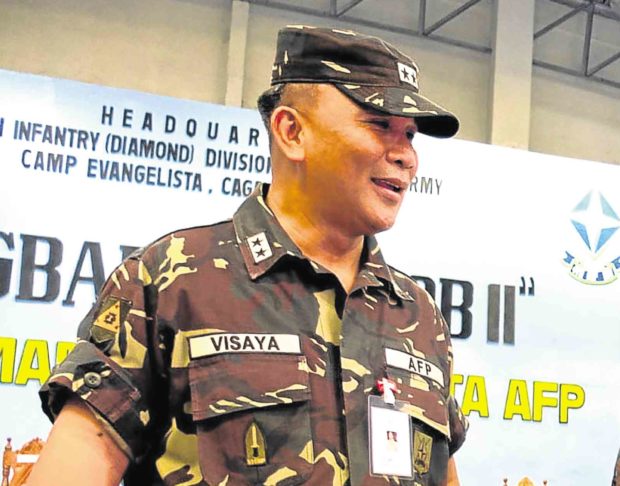
ZAMBOANGA. Westmincom photo handout shows AFP Chief of Staff Ricardo Visaya pins a medal to a wounded soldier at Cam Navarro General Hospital. (Bong Garcia)

FIVE soldiers who were wounded in the latest clash with the Abu Sayyaf bandits have received medals for gallantry in action.

General Ricardo Visaya, Armed Forces chief-of-staff, personally pinned the medals when he visited them on Saturday at Camp Navarro General Hospital in this city.

Lieutenant General Mayoralgo Dela Cruz, Western Mindanao Command (Westmincom) chief, assisted Visaya in the awarding of medals to the soldiers.

Awarded Wounded Personnel Medal (WPM) were the following: Corporal Ian Dexter Gavina, Corporal Rambo Balnawi, Private First Class Radel Gumban, Private First Class Christian Naganag, and Private First Class Bernie Joe Nagoy.

They were wounded in an intense fighting against 150 Abu Sayyaf bandits led by one-armed leader Radulan Sahiron and sub-leader Hadjan Sawajaan last Thursday in Patikul, Sulu.

Intelligence report showed that nine Abu Sayyaf bandits were killed while 13 wounded when the troops pounded them with artillery.

Visaya visited Westmincom to get first hand information of the ongoing focus military operations against the Abu Sayyaf bandits in the provinces of Sulu and Basilan.

"I am here now to see how Westmincom implemented our plans (against the ASG)," Visaya said, who met with key officers of Westmincom.

He said the troops were directed to ensure the safety of the hostages as they were ordered to continuously pursue the Abu Sayyaf bandits.

The Abu Sayyaf bandits are still holding captives nine foreigners and three Filipinos in the province of Sulu. The foreigners included a Dutchman birdwatcher, a Norwegian and seven Indonesian sailors.

Visaya said the focus military operation against the Abu Sayyaf bandits has no time frame.

http://www.sunstar.com.ph/zamboanga/local-news/2016/07/10/afp-chief-awards-medals-soldiers-484503

AFP chief cites Rody order: Rescue hostages, get Abus

From the Philippine Daily Inquirer (Jul 11): AFP chief cites Rody order: Rescue hostages, get Abus

ricardo_visaya

President Duterte has ordered the military to rescue Norwegian Kjartan Sekkingstad and all other kidnap victims still held by the Abu Sayyaf—and then exterminate the group.

Armed Forces of the Philippines (AFP) Chief of Staff Gen. Ricardo Visaya said here on Saturday the President “asked us to exert all efforts to rescue the Norwegian and the other victims.”

Mr. Duterte, he said, ordered him to use all available resources, logistics and manpower to secure the hostages—numbering over a dozen including 10 foreigners—and eradicate the Abu Sayyaf.
 
On Friday, Mr. Duterte said he did not consider the Abu Sayyaf a criminal group,  but a band of people who had been pushed to the wall by circumstances.
 
“That’s why I am not including Abu Sayyaf [activities] in criminality. You’ve never heard me say [they are] criminal(s). It is a different setup there because these are guys who were driven to desperation,” the President had said during the recent Eid al-Fitr celebration in Davao City.
 
Duterte said he knew all about the situation “from Nur to the ARMM.”

“There was no sufficient semblance of governance and that was why they were pushed to the wall,” he said. “Then they became radicalized. ”

Visaya said the details of the rescue effort were confidential and no deadline had been set for the extermination of the Abu Sayyaf.

 ‘There’s no IS here’

As for fears the Islamic State (IS) international terror group had reached Mindanao, Visaya said this was not so.

He said the IS did not exist in Basilan or any part of the Autonomous Region in Muslim Mindanao and any claims were based on rumors and had not been validated.

“As far as we are concerned, this is raw information. We need to evaluate this information, but as of now there is no IS here,” he said.

He admitted, however, that what there were in the ARMM were groups claiming to support IS. Visaya once served as a Philippine Army brigade commander in Basilan.

Earlier, former Ungkaya Pukan (Basilan) Mayor Joel Maturan said IS existed in Basilan and its members had merged with the local Abu Sayyaf. He cited instances when black flags similar to the ones exhibited by IS in the Middle East had been seized in the province.

But like Visaya, ARMM Gov. Mujiv Hataman dismissed claims IS had arrived in Basilan.

“There may be IS-inspired groups. For example, Isnilon Hapilon was seen in a video pledging allegiance to IS,”  Hataman, a native of Basilan, said.

http://newsinfo.inquirer.net/795300/afp-chief-cites-rody-order-rescue-hostages-get-abus

Q&A: Landmark ruling on South China Sea

From the Stars and Stripes (Jul 10): Q&A: Landmark ruling on South China Sea

South China Sea

This May 11, 2015, file photo, shows land reclamation of Mischief Reef in the Spratly Islands in the South China Sea. A landmark ruling on an arbitration case filed by the Philippines that seeks to strike down China's expansive territorial claims in the South China Sea will be a test for international law and world powers. China, which demands one-on-one talks to resolve the disputes, has boycotted the case and vowed to ignore the verdict, which will be handed down Tuesday, July 12, 2016, by the U.N. tribunal in The Hague.  Ritchie B. Tongo/Pool Photo via AP, File

A landmark ruling on an arbitration case filed by the Philippines that seeks to strike down China's expansive territorial claims in the South China Sea will be a test for international law and world powers. China, which demands one-on-one talks to resolve the disputes, has boycotted the case and vowed to ignore the verdict, which will be handed down Tuesday by the U.N. tribunal in The Hague.
Some questions and answers about the case:
___
Q: WHAT'S THE CASE ABOUT?

A: After years of diplomatic negotiations ended nowhere, the Philippines brought its dispute with China to international arbitration in January 2013, despite Beijing's warnings of a diplomatic and economic backlash.

China wants to negotiate directly with the Philippines and each of the four other claimants in an arrangement that would give it leverage for its sheer size and influence. Beijing has steadfastly opposed bringing the disputes to an international arena, which could provide the U.S. a chance to intervene.

The Philippines asked a tribunal of five arbitrators to declare as invalid China's vast claims, known as nine-dash lines for the dashes that demarcate virtually all of the South China Sea as Chinese territory, under the United Nation Convention on the Law of the Seas, or UNCLOS. China and the Philippines are among more than 160 signatories of the 1982 convention, regarded as the constitution that governs and stipulates the rights of countries in using the world's oceans.

With China's sprawling claims, the Philippines stands to lose a huge chunk of off-shore territory, said Antonio Carpio, an associate Supreme Court justice who has made extensive studies on the conflicts. "This Chinese aggression is the gravest external threat to the Philippines since World War II," he said.

The Philippines also asked the tribunal to classify whether a number of disputed areas are islands, low-tide coral outcrops or submerged banks to determine the stretch of territorial waters they are entitled to under the convention. It also wants China to be declared in violation of the convention for carrying out fishing and construction activities that breached the Philippines' maritime rights. The convention does not deal with sovereignty questions, which the Philippine government says it did not raise.
___
Q: HOW DID IT START?

A: Although the disputes have simmered for decades, they gradually escalated under former Philippine President Benigno Aquino III and culminated in 2012 when China took effective control of the disputed Scarborough Shoal after a tense standoff.

U.S. officials brokered an arrangement for Philippine government vessels and larger Chinese maritime surveillance ships to simultaneously withdraw from the tiny shoal, a deal which Aquino said he followed. Chinese ships never left.

Chinese coast guard ships also surrounded another disputed area, the Second Thomas Shoal, which has been guarded by Filipino marines on board a grounded rusty warship. The Chinese coast guard has tried to block Philippine vessels from bringing food, water, medicines and other supplies to the marines, sparking dangerous cat-and-mouse chases at high seas.

The Philippines said it had no other choice but to elevate the dispute to international arbitration.
___
Q: WILL THE ARBITRATION CHANGE ANYTHING?

A: Any ruling will be final and legally binding on China and the Philippines. China's decision to ignore the case and the arbitration tribunal's lack of enforcement mechanism, however, have blunted the Philippines' move.

Former Philippine Foreign Secretary Albert del Rosario, who spearheaded the filing of the complaint against China, said that a favorable ruling on any of the 15 issues raised by the Philippines, especially the demand to declare China's claims invalid under UNCLOS, would be a major blow to Beijing and a moral victory that could be harnessed by the Philippines to its advantage.

The Philippines, Filipino diplomats said, could work with Washington and other countries to demand Chinese compliance in diplomatic forums worldwide, including before the United Nations.

If it doesn't comply, China risks being seen as a rogue nation at a time it expands its political and economic influence on the world stage.

Carpio painted a dire picture if the tribunal fails to rule on the validity of China's sprawling claims, saying Beijing would enforce its nine-dash territorial lines as its national boundary. The U.S. military would intensify its patrols to promote freedom of navigation, China would try to push the Americans back and the claimants engage in an arms race.

"The only defense of coastal states will be to acquire warships, warplanes and anti-ship missiles," Carpio said. "Tensions will increase. It will be a turmoil in the South China Sea."
___
Q: WHY DID CHINA REFUSE TO TAKE PART IN THE CASE?

A: China has argued that the tribunal does not have jurisdiction to handle the Philippine case, because it says it involves sovereignty issues, which are outside the tribunal's legal purview. While masking its case as an effort to clarify maritime rights under the U.N. convention, the Philippines is actually trying to undermine China's "indisputable sovereignty," according to Chinese officials.

They ask, for example, how the Philippines can say that China's claims are excessive without first determining Beijing's territorial limits.

China also regards the disputes as a purely Asian problem that outsiders like the U.S. have no right to meddle in.

Philippine officials say China refused to join the arbitration knowing that the historical basis it cites for its territorial claims has long ceased to be recognized under modern-day treaties like the UNCLOS.
___
Q: WHAT ARE OTHER COUNTRIES SAYING ABOUT IT?

A: Countries have generally taken a position on the arbitration case depending on whether they're aligned with the U.S. or China.

The diplomatic tug-of-war has put smaller countries and regional blocs in a dilemma, including the Association of Southeast Asian Nations, whose four member states are claimants.

A Philippine push for the 10-nation bloc to issue a joint statement calling for China to respect Tuesday's ruling has stalled with Cambodia and Laos backing the Chinese position. Besides the Philippines and Vietnam, Malaysia, Indonesia and Singapore have also been wary of China.

The regional group has a bedrock principle of deciding by consensus, meaning just one member state can stall any group effort.

The U.S., Britain and the rest of the EU support the arbitration.

China claims support of some 40-60 nations, including many landlocked African nations and Pacific islands where Beijing has economic clout.

http://www.stripes.com/news/pacific/q-a-landmark-ruling-on-south-china-sea-1.418397

Meet Fil-Am Rear Admiral Bette Bolivar

From Rappler (Jul 9): Meet Fil-Am Rear Admiral Bette Bolivar

It is hard work, not gender, according to Bolivar, that has been a factor in her success

COMMANDER. Rear Admiral Bette Bolivar, the first female Filipino-American official of the United States Armed Forces, talks about the role of women in peace and security and disaster response efforts. Photo by Rhaydz B. Barcia

COMMANDER. Rear Admiral Bette Bolivar, the first female Filipino-American official of the United States Armed Forces, talks about the role of women in peace and security and disaster response efforts. Photo by Rhaydz B. Barcia

Women play a major role not only in protecting peace and security, but in disaster response and mitigation too, Rear Admiral Bette Bolivar, the first female Filipino-American commander of the US Navy’s Northwest Region, said.

During the Pacific Partnership 2016 held here, Bolivar said, “Women are the most important in peace and security, and disaster response…It’s amazing how we build and foster a strong relationship with the Philippines in terms of outreach and improving humanitarian assistance and disaster relief.”

Pacific Partnership is an annual deployment of forces from the Pacific Fleet of the US Navy, in cooperation with regional governments and military forces, along with humanitarian and non-governmental organizations.

Born in Hawaii and raised in a traditional Filipino family by parents Ted Sereno Bolivar, a US Navy sailor from Nabua, Camarines Sur, and Virginia Dolor Bolivar from Pangasinan, Bette Bolivar set foot in her native region for the first time.

Bolivar is a graduate of the United States Naval Academy and has been serving in the US Armed Forces for 31 years after graduating from the naval academy 35 years ago.
Her prowess was tested in the battlefield before she was given a sensitive position in the US Navy.

Bolivar said her assignment in Afghanistan has been the most fulfilling so far in her military journey.

“My tour in Afghanistan is the most rewarding in my military career. It’s a great experience. If I’ll be asked to go back I’ll never hesitate to do so. No goal is unachievable. Set a goal and believe in yourself,” she said.

From her headquarters alone, she has command over more than 100 military and civilian people. The island of Guam has a 6,000-strong military.

Her post in the US military is a product of hard work, she said. Credit is given where it is due in the US Navy and she is thankful for the opportunity given her to serve her country and support her family.

It is hard work, not gender, according to Bolivar, that has been a factor in her success.
“Here in the military we’re recognized for what we do, how we work, and that’s how we got promoted. It’s not that I’m smarter or better, I’m just blessed to be surrounded with supportive teams and family to get me to where I am now,” Bolivar said.

She urged her fellow women to be strong and determined in pursuing their dreams and goals.

http://www.rappler.com/nation/139194-bette-bolivar-us-navy-pacific-partnership-2016

CHEAT SHEET: What you need to know about PH-China case

From Rappler (Jul 11): CHEAT SHEET: What you need to know about PH-China case

To help you navigate the issues better, Rappler compiles key stories revolving around the Philippines' case against China over the West Philippine Sea

HISTORIC CASE. The Philippine delegation presents its arguments against China before an arbitral tribunal in The Hague, Netherlands, in November 2015. Photo from the Permanent Court of Arbitration

HISTORIC CASE. The Philippine delegation presents its arguments against China before an arbitral tribunal in The Hague, Netherlands, in November 2015. Photo from the Permanent Court of Arbitration

The Permanent Court of Arbitration in The Hague, Netherlands, is set to announce a historic ruling on the Philippines' case against China over the West Philippine Sea (South China Sea) on Tuesday, July 12.

What do you need to know about Manila's case against Beijing?
 
To help you navigate the issues better, Rappler compiled key stories revolving around the Philippines' case against China in The Hague. You may click the titles in orange, which will lead you to the story pages.
 
We begin our compilation with articles in April 2012, when a standoff between Philippine and Chinese vessels in the disputed Panatag Shoal (Scarborough Shoal) brought Philippine-China relations to its lowest point in history.
 
We end with stories days before the tribunal in The Hague issues its ruling, now under the administration of President Rodrigo Duterte.
 
We have divided the stories below into 3 categories: explainers, Thought Leaders pieces, and timeline articles.
 
Bookmark and refresh this page for updates.
 
EXPLAINERS
 
 
Who owns Panatag Shoal? It depends, based on position papers released by the Philippine and Chinese governments.
 
 
China calls Panatag Shoal an island to benefit its territorial claims, an expert says.
 
 
China sees then president Benigno Aquino III as "provocative" and his predecessor, Gloria Macapagal Arroyo, as "receptive," according to the International Crisis Group.
 
 
Then president Benigno Aquino III orders the use of the name "West Philippine Sea" in a move to popularize the name and eventually urge the world to adopt it.
 
 
"A handful of marines living on a World War II-era ship that is grounded on a remote, tiny reef is the Philippines' last line of defense" in the West Philippine Sea, Agence France-Presse reports.
 
 
Senior Associate Justice Antonio Carpio of the Philippine Supreme Court uses China's favorite pieces of evidence – its ancient maps – against the Asian giant itself.
 
 
Maritime law expert Jay Batongbacal says the legal track "has always been not enough" to settle the West Philippine Sea dispute.
 
 
Legal and foreign affairs experts say the outcome of the Philippines' arbitration case is uncertain, and Manila must work harder on diplomatic and military tracks.
 
 
The Philippine fisheries bureau says China's reclamation in 5 reefs in the Spratlys has buried 311 hectares of coral reefs – 5 times the size of Rizal Park in Manila.
 
 
Rappler talks to Antonio Carpio, senior associate justice of the Philippine Supreme Court, about how the Philippines will fare against China in the two countries' maritime dispute over the West Philippine Sea.
 
 
The Philippines pursues its case in The Hague with a practical issue at stake: the Philippines' right to fish in the West Philippine Sea.
 
 
In a nutshell, Rappler explains the Philippines' 5 arguments in its historic case against China over the West Philippine Sea.
 
 
Rappler profiles Paul Reichler, the Philippines’ chief counsel in its case against China over the West Philippine Sea.
 
 
Was it a mistake to involve the US in the Scarborough Shoal standoff? Rappler gets the inside story to understand how the Philippines decided to file its historic case against China.
 
 
In the West Philippine Sea, China is building artificial islands the size of nearly 1,800 soccer fields combined.
 
 
Rappler looks back at then president Benigno Aquino III’s decision to file a historic case against China over the West Philippine Sea
 
 
Most of China's 8 public supporters come from Africa, a continent to which China has pledged billions of dollars in aid.
 
THOUGHT LEADERS
 
 
"China’s rulers today have transformed China into the imperialistic hegemon that Deng Xiaoping asked the Chinese people and the world to fight and overthrow," writes Senior Associate Justice Antonio Carpio of the Philippine Supreme Court.
 
 
"The world is watching. It's the next step in the geopolitical calculus of power that includes the world's hot spots from Crimea, Syria and the South China Sea," Maria Ressa says.
 
 
"By unanimously voting in favor of exercising jurisdiction on the Philippines' case, the Arbitral Tribunal effectively rejected Beijing's efforts to sabotage Manila's laudable legal effort," Richard Javad Heydarian explains.
 
 
"Freedom of navigation is a cardinal principle of the US and it is the key reason why Washington would fight for the idea in the South China Sea or anywhere else in the world’s oceans," Rene Pastor writes.
 
 
"The Duterte administration should be very careful in any prospective bilateral negotiation in the future, which is indispensable but should be unconditional," says Richard Javad Heydarian.
 
 
"We need to be clear about the risks and why they may matter," Prashanth Parameswaran says.
 
 
"What is at stake is not only regional security in Asia, which has been heavily undermined by the increased militarization of territorial disputes, but also shared access to global commons in accordance to modern international law," explains Richard Javad Heydarian.
 
TIMELINE PIECES
 
 
The Philippine Navy monitors 10 Chinese ships stationed at Panatag Shoal (Scarborough Shoal) in the West Philippine Sea.
 
 
Rappler recounts the months after the standoff in Panatag Shoal, and explains the significance of this uninhabited rocky outcrop.
 
 
The Philippines files a historic arbitration case against China over the West Philippine Sea.
 
 
The Philippine Department of Foreign Affairs issues a point-by-point refutation of China’s claims.
 
 
China moves to stop the Philippines from filing its written pleading on its case over the West Philippine Sea, sources say.
 
 
Two Chinese ships harass a Philippine vessel a day before the Philippines submits its historic pleading against China over the West Philippine Sea.
 
 
The Philippines submits a 4,000-page pleading, called a memorial, to an arbitral tribunal at the Permanent Court of Arbitration in The Hague.
 
 
The Philippines releases photos to prove China's island-building activities in the West Philippine Sea.
 
 
The tribunal handling the Philippines' case orders China to respond to the Philippines’ memorial not later than December 15, 2014.
 
 
China releases a position paper a week before the December 15 deadline for its response to the Philippines' memorial.
 
 
The Philippines wants a "status quo ante" ruling in its case against China, so it would tear down its developments in the disputed West Philippine Sea.
 
 
China has reclaimed from the West Philippine Sea a total of 383 hectares in 7 of its occupied reefs there, aerial photos show.
 
 
This is China's toughest claim: The arbitral tribunal at The Hague, Netherlands, has no right to hear the Philippines' case.
 
 
The Philippines comes out in full force on the first day of its oral hearings in The Hague, The Netherlands, over its historic case against China over the West Philippine Sea.
 
 
In a round one victory for the Philippines, a United Nations-backed arbitral tribunal at The Hague, in the Netherlands, unanimously decides it has the right to hear Manila’s historic case against Beijing over the West Philippine Sea.
 
 
This is the oral hearing on the merits of the arbitration case filed by the Philippines against China over the West Philippine Sea.
 
 
Led by Philippine Foreign Secretary Albert del Rosario, the Philippines' powerhouse team against China returns to The Hague to defend Manila's historic case against Beijing over the West Philippine Sea.
 
 
The Permanent Court of Arbitration says that "there will be no in-person meeting or ceremony for the rendering of the award."
 
 
President Rodrigo Duterte says he will not "flaunt" a possible ruling against China in a historic case filed by the Philippines over the West Philippine Sea.
 
 
The Philippines is willing to share natural resources with China in contested West Philippine Sea areas even if it wins its case, Philippine Foreign Secretary Perfecto Yasay Jr says
 
 
For the second time during his first full week in office, Philippine Foreign Secretary Perfecto Yasay Jr finds the need to clarify his statement on China regarding the disputed West Philippine Sea.
 

International Terrorism Developments:IS territory shrinks 12 percent since start of 2016: IHS

From InterAksyon (Jul 11): IS territory shrinks 12 percent since start of 2016: IHS

The Islamic State group lost 12 percent of the territory it holds in Iraq and Syria in the first half of 2016, according to an analysis by research group IHS.

The analysis published Sunday says the jihadist group, which proclaimed its self-styled "caliphate" in the two countries in 2014, is continuing to lose ground after a string of setbacks last year.

"In 2015, the Islamic State's caliphate shrunk by 12,800 square kilometres to 78,000 square kilometres, a net loss of 14 percent," IHS said.

"In the first six months of 2016, that territory shrunk again by 12 percent. As of July 4, 2016, the Islamic State controls roughly 68,300 square kilometres in Iraq and Syria."

In Syria, IS is under pressure from regime troops backed by Russian forces, an Arab-Kurdish alliance backed by a US-led coalition, and rebel forces.

In Iraq, coalition-backed security forces, working with pro-government militia groups, have dealt the jihadists a series of defeats.

IS forces are currently under siege in the Syrian town of Manbij, which lies on their main supply route between Syria and Turkey.

In March the jihadists were routed from the ancient Syrian city of Palmyra and in June from the Iraqi city of Fallujah.

In 2015, the group lost Tal Abyad, a key border post on the Syrian-Turkish border, as well as the Iraqi city of Ramadi.

In May the Pentagon said that IS had lost some 45 percent of the territory it held in Iraq and between 16 and 20 percent of its territory in Syria.

The IHS report did not include percentages by country.

IHS senior analyst Columb Strack said the losses were likely to mean IS would redouble its attempts at "mass casualty attacks".

"As the Islamic State's caliphate shrinks and it becomes increasingly clear that its governance project is failing, the group is reprioritising insurgency," he said.

"We unfortunately expect an increase in mass casualty attacks and sabotage of economic infrastructure, across Iraq and Syria, and further afield, including Europe."

IS has also seen its revenues drop, from around $80 million a month in mid-2015 to $56 million a month by March 2016, according to IHS.

"This figure has probably continued to decrease since March by at least another 35 percent," said Ludovico Carlino, another senior analyst at IHS.

"Combined with the military setbacks on the ground, this is having an impact on the internal cohesion of the group as indicated by a marked increase in defections and desertions since January," he added.

Facing territorial losses and pressure, IS on Wednesday issued a video describing the "organisation of the caliphate" in which it claimed control of 35 "wilayat" or provinces, including 19 in Syria and Iraq.

http://interaksyon.com/article/130189/is-territory-shrinks-12-percent-since-start-of-2016-ihs

International Terrorism Developments: Bin Laden's son threatens revenge for father's assassination: monitor

From InterAksyon (Jul 10): Bin Laden's son threatens revenge for father's assassination: monitor


Newspaper headlines and clippings are posted on a wall inside a staff office at the White House in Washington May 2, 2011, the morning after U.S. President Barack Obama announced the death of Osama bin Laden. REUTERS/JASON REED

The son of slain al Qaeda leader Osama bin Laden has threatened revenge against the United States for assassinating his father, according to an audio message posted online.

Hamza bin Laden promised to continue the global militant group's fight against the United States and its allies in the 21-minute speech entitled "We Are All Osama," according to the SITE Intelligence Group.

"We will continue striking you and targeting you in your country and abroad in response to your oppression of the people of Palestine, Afghanistan, Syria, Iraq, Yemen, Somalia and the rest of the Muslim lands that did not survive your oppression," Hamza said.

"As for the revenge by the Islamic nation for Sheikh Osama, may Allah have mercy on him, it is not revenge for Osama the person but it is revenge for those who defended Islam."

Osama bin Laden was killed at his Pakistani hideout by US commandos in 2011 in a major blow to the militant group which carried out the Sept. 11, 2001 attacks.

Documents recovered from bin Laden's compound and published by the United States last year alleged that his aides tried to reunite the militant leader with Hamza, who had been held under house arrest in Iran.

Hamza, now in his mid-twenties, was at his father's side in Afghanistan before the 9/11 attacks and spent time with him in Pakistan after the US-led invasion pushed much of al Qaeda's senior leadership there, according to the Brookings Institution.

Introduced by the organization's new chief Ayman al-Zawahiri in an audio message last year, Hamza provides a younger voice for the group whose aging leaders have struggled to inspire militants around the world galvanized by Islamic State.

"Hamza provides a new face for al Qaeda, one that directly connects to the group's founder. He is an articulate and dangerous enemy," according to Bruce Riedel of Brookings.

http://interaksyon.com/article/130186/bin-ladens-son-threatens-revenge-for-fathers-assassination-monitor

US anti-war leader lauds Duterte for noting US role in ME crisis

From InterAksyon (Jul 10): US anti-war leader lauds Duterte for noting US role in ME crisis

For linking the origins of Mindanao's conflict to the crisis spawned by US intervention in the Middle East through its campaign against terrorism, President Rodrigo Duterte has drawn praise from a leading US anti-war activist.

"It is not that the Middle East is exporting terrorism in America. America imported terrorism," Duterte said on Friday to an audience of Muslim Filipinos during the Mindanao Hariraya Eid'l Fit'r 2016 celebration in Davao City.

Duterte cited the March 2003 US invasion of Iraq and the toppling of Saddam Hussein as an example of war and destabilization.

The anti-war activist also noted the US' intervention in Libya and Syria, and its ironic role in practically encouraging the very forces that now threaten to Balkanize the region.

“Thank you, President Duterte, for having the courage to tell the truth,” Chicago-based Joe Iosbaker of the United National Anti-War Coalition (UNAC) said in a statement shared with media by the International Coalition for Human Rights in the Philippines (ICHRP), which is holding a conference in the Philippines from July 16 to 24.

"It is indisputable the US government created Al Qaeda, created the Islamic State of Iraq and Syria (ISIS),” Iosbaker continued.

“Osama bin Laden was trained by the Central Intelligence Agency (CIA) in Afghanistan. Al Qaeda in Syria was provided training and weapons by the US to wage a war against the legitimate government in Damascus. Turkey, a US puppet, has facilitated ISIS flow of weapons and recruits in Syria. Saudi Arabia, a US puppet, armed Al Qaeda in Iraq, and they armed Al Qaeda and ISIS in Syria. If the US did not want Al Qaeda and ISIS to get this support, they could have ordered their puppets to stop. The order never came,” he added.

The Bush administration had in 2002 declared the Philippines' South the so-called “Second Front” of the Global War on Terror, alleging that groups such as the Abu Sayyaf and Jemaah Islamiyah have links to Al Qaeda and ISIS.

He pointed out that Moro groups in Mindanao still pursue an armed struggle for self-determination and to keep out corporate interests from the mineral- and oil-rich territory.

The Philippine Statistics Authority said 11 of the 20 poorest provinces in the Philippines are in Mindanao, with the highest poverty incidence in the Bangsamoro territories.

Iosbaker is among over 100 US activists attending a conference in Davao City sponsored by the International Coalition for Human Rights in the Philippines (ICHRP) from July 16 to 24.

He will join a fact-finding mission to Zamboanga City, where the US has stationed its special forces for 13 years as part of the Global War on Terror.

In Iosbaker's view, “The US invasion of the Middle East and continuing military presence there is about US control over the world’s largest oil deposits and other minerals. It’s the same in Mindanao, home to over $1 trillion worth of untapped minerals and oil, making the Philippines the 5th most mineral-rich region in the world.”

Iosbaker continued: "Just like the Filipino people, the American people want peace and genuine development in the Philippines. Right now, at the root of the socio-economic crisis and unrest in the country is impoverishment resulting from US economic policies and militarism, funded by US tax dollars.”

Finally, Iosbaker hailed Duterte’s push to resume formal peace talks with the National Democratic Front of the Philippines (NDF), which has waged an insurgency for four decades. "Americans don’t want our tax dollars funding crisis and bloodshed in the Philippines," Iosbaker said.

http://interaksyon.com/article/130183/us-anti-war-leader-lauds-duterte-for-noting-us-role-in-me-crisis

Yasay: Sharing of West PH Sea will be in accordance with UNCLOS ruling

From InterAksyon (Jul 9): Yasay: Sharing of West PH Sea will be in accordance with UNCLOS ruling


Foreign Affairs Secretary Perfecto Yasay clarified his previous statement on the planned joint exploration with China over the contested West Philippine Sea, elaborating that he meant the sharing of resources could be possible "in the near future" but in "accordance with the UNCLOS".

His statement was issued after he declared in a forum that the Philippines is ready to negotiate with China on joint exploration of oil and fishery resources in the disputed sea, which drew flak among netizens.

"What I said is we have to wait for the ruling and study and dissect its implication," Yasay said in a statement released on Saturday morning.

He pointed out that, since the ruling, expected on July 12, Tuesday, will not cover issues of "sovereignty and delimitation", it would be possible that some claimant countries will be open for joint of exploration.

"As the ruling will not address sovereignty and delimitation, it is possible that, at some time in the future, claimant countries might consider entering into arrangements, such as joint exploration and utilization of resources in disputed areas that do not prejudice the parties' claims and delimitation of boundaries in accordance with UNCLOS (United Nation Convention on the Law of the Sea)," Yasay explained.

UNCLOS is a binding agreement signed by nine-member of the Association of the Southeast Asian Nations, including China, where countries have exclusive maritime rights to explore and exploit resources within it 200 nautical miles economic exclusive zone (EEZ)

Yasay also hinted that the Permanent Court of Arbitration does not have "any enforcement power" for a plan of shared resources.

"Since the PCA does not have any enforcement powers, any overlapping claims awarded can be best implemented by negotiating for an agreement with other claimants that could possibly include the joint exploration and utilization of the resources in the disputed area," Yasay said.

The Philippines' move for arbitration, under the presidency of Benigno Aquino III and filed in January 2013, urged the United Nations to invalidate China's controversial so-called nine-dash line policy, a horse-shaped line found in ancient Chinese maps supposedly showing Beijing's claimed territory in the West Philippine Sea.

http://interaksyon.com/article/130154/yasay-sharing-of-west-ph-sea-will-be-in-accordance-with-unclos-ruling

Hague tribunal to rule in tense South China Sea row on Tuesday

From InterAksyo  (Jul 10): Hague tribunal to rule in tense South China Sea row on Tuesday

THE HAGUE, Netherlands - An international tribunal will hand down a ruling on Tuesday in an increasingly bitter dispute over the South China Sea, in a closely-watched case that risks ratcheting up tensions in Southeast Asia.

The Permanent Court of Arbitration (PCA) -- the world's oldest international arbitration tribunal -- will issue a written decision at 11:00 a.m. (0900 GMT) after the Philippines challenged China's claim over much of the strategic waterway.

Manila lodged the suit against Beijing in 2013, saying after 17 years of negotiations it had exhausted all other political and diplomatic avenues.

Angered by the move, Beijing refused to participate, adding it would not comply with the ruling by a tribunal with "no jurisdiction" over the issue.

Legal experts agree that after three years of deliberations, two hearings, and nearly 4,000 pages of evidence, the court in The Hague is likely to find in Manila's favor -- in a decision with far-reaching ramifications.

"An award from the tribunal that rejects some of China's more dubious claims would provide support for the mainstream views of other states in the region," Cecily Rose, assistant law professor of Public International Law at Leiden University, told AFP.

"China is bound to comply with the award.

"But should it refuse to do so, the tribunal has no enforcement mechanism to which it can turn," Rose said.

Military tensions

The judgment comes against the backdrop of frequent military brushes between China and its Asian neighbors the Philippines, Vietnam, Malaysia, Brunei, and Taiwan, which ring the waters believed to hold untapped oil and gas reserves.

The tensions have also alarmed the United States which has key defence treaties with many regional allies, and in a show of strength last week sent warships to patrol close to some of the reefs and islands claimed by China.

Washington on Friday "urged both parties to comply with the ruling and urge all claimants to avoid provocative actions or statements."

"Whatever the outcome, the case will not contribute to improved relations between China and other claimants in the South China Sea," Frans-Paul van der Putten, a senior researcher at the Clingendael think-tank, told AFP.

Newly-elected Philippine President Rodrigo Duterte said he was optimistic of a favorable ruling, but offered to hold conciliatory talks with China. And he vowed he would not "taunt or flaunt" any favorable ruling.

Philippine Foreign Secretary Perfecto Yasay, also in a softening of Manila's stance, said Friday the country was willing to share natural resources with China.

But China's state-run media said Friday Beijing will not take "a single step back" in the waterway.

The Asian economic and military powerhouse claims most of the South China Sea, even waters approaching neighboring countries, as its sovereign territory, basing its arguments on Chinese maps dating back to the 1940s marked with a so-called "nine-dash line."

Expert Joris Larik from The Hague Institute for Global Justice think-tank pointed out that Manila is aiming to "pierce" the nine-dash line, adding: "China's position and credibility will be weakened if the arbitral panel finds against it."

But Chinese President Xi Jinping said Beijing was "not afraid of trouble" and state-run media urged China to prepare for "military confrontation" in the waters.

China launched drills in the sea on Friday, state media reported, with the navy carrying out combat exercises with live missiles according to the PLA Daily, the military's official newspaper.

No 'historic' claim

Manila stresses it is not asking the court to resolve sovereignty or delimit boundaries, but is seeking decisions on some key points.

Referring to the UN Convention on the Law of the Sea, Manila contends the "nine-dash" line has no basis under international law and Beijing has no "historic" claim to the waters.

Manila has further argued that Beijing violated the convention by preventing it from exercising its fishing and exploration rights and that Chinese fishing boats have irreversibly damaged coral reefs.

The Philippine government also says some of the "islands" claimed by Beijing are merely rocks, and not entitled to a "territorial sea" or an exclusive economic zone.

Tensions between China and its neighbors in the sea have at times flared into open conflict including in 1988 when Vietnam and China fought a naval battle on Johnson Reef in the Spratly Islands which killed about 70 Vietnamese.

The sea's shipping lanes connect East Asia with Europe and the Middle East, and over $5 trillion (4.5 trillion euros) in ship-borne trade passes through them annually.

http://interaksyon.com/article/130168/hague-tribunal-to-rule-in-tense-south-china-sea-row-on-tuesday

Gunmen seized 3 Indon sailors anew off Sabah

From the Mindanao Examiner (Jul 10): Gunmen seized 3 Indon sailors anew off Sabah

Five gunmen have seized three Indonesian crew members in the eastern Malaysian state of Sabah just off the southern Filipino province of Tawi-Tawi, reports said on Sunday.

Reports said the armed men were on a speedboat when they intercepted Saturday night the tugboat and abducted the three out of the 7 crewmen. It was unknown whether the abductors were members of the Abu Sayyaf or not, but according to reports some the gunmen spoke Malay and Tausug, a dialect spoken in the provinces of Tawi-Tawi, Sulu and Basilan, all in the Muslim autonomous region.

There was no immediate confirmation from Philippine authorities on the latest abduction, but this occurred near where Abu Sayyaf militants had kidnapped 7 other Indonesian tugboat crew members on June 29.

The tugboat Charles – owned by PT Rusianto Brothers – was heading to Samarinda in East Kalimantan following a trip from the Philippines when gunmen on speedboats intercepted it and seized Ferry Arifin, the skipper; M. Mahbrur Dahri, Edi Suryono, Ismail, M.Nasir, M.Sofyan and Robin Piter. The Abu Sayyaf is demanding 20 million ringgits for the safe release of the hostages.

The Abu Sayyaf previously kidnapped 14 Indonesian tugboat crewmembers in separate attacks at sea and brought them to Sulu province and eventually released through the intercession of the Moro National Liberation Front. It has beheaded a Malaysian man and two Canadian hostages in Sulu, one of 5 provinces under the Muslim autonomous region in Mindanao.

The Abu Sayyaf is still holding a Dutchman, a Norwegian and a Japanese man, including 3 Filipinos.

http://mindanaoexaminer.com/gunmen-seized-3-indon-sailors-anew-off-sabah/

Indon, Malaysian jihadists set up IS base in Basilan province

From the Mindanao Examiner (Jul 9): Indon, Malaysian jihadists set up IS base in Basilan province


Army soldiers patrol Zamboanga City in southern Philippines near Basilan province where security forces are battling Abu Sayyaf militants who pledged allegiance with the Islamic State. (Mindanao Examiner Photo)

Indonesian and Malaysian militants have joined the Abu Sayyaf group in fighting Filipino security forces in the southern province of Basilan in the Muslim autonomous region, reports said.

Abu Sayyaf chieftain Isnilon Hapilon in Basilan province is now the leader of the Islamic State’s new battalion in the Philippines, the Katibah Al-Muhajir or the “Battalion of Migrants” made of mostly of Indonesian and Malaysian jihadists.

Malaysian media also quoted Singapore-based terrorism expert Dr. Rohan Gunaratna as saying that the new battalion in Basilan was set up due to difficulties faced by IS recruits in going to Syria and Iraq.

“Now we have seen that in the Philippines, IS has created Katibah Al-Muhajir, the Battalion of Migrants. They are (made up of) Malaysians and Indonesians,” he was quoted as saying by the New Straits Times. “There are about 10 Malaysians (there now),” he added, citing intelligence on the new battalion.

Just last month, IS released a propaganda video told its supporters in Southeast Asia to head to the Philippines instead if they found it hard to go to Syria and Iraq.

“The Philippines can be a very important launching pad to reach Indonesia, Malaysia and Singapore because southern Philippines is very centrally located,” Gunaratna said, noting that regional militants have already changed their focus to the new battalion base instead of IS’s base in Syria and Iraq.

There was no immediate confirmation from the Philippine military about new IS battalion, but security forces had previously killed several foreign jihadists in Basilan, the base of the Abu Sayyaf in southern Philippines, just several nautical miles south of Zamboanga City.

IS base in Basilan

But in January this year, the regional newspaper Mindanao Examiner had reported that Basilan province has become the bastion of power of the Abu Sayyaf after it pledged allegiance to the caliph of the Islamic and named Hapilon as its new chieftain.

In a propaganda video released by the Abu Sayyaf late last year, more than two dozen gunmen – including child warriors – led by Hapilon were seen hiking in the hinterlands of Basilan while chanting the “Dawlah Islamiyah (Islamic State)” after which they recited an Arabic script of bayah or pledge of allegiance.

Hapilon, alias Abu Abdullah, took over Abu Sayyaf founder Abdurajak Abubakar Janjalani who was slain in a police shootout in Basilan in December 1998.

The Abu Sayyaf evolved to a notorious group known for having carried out kidnappings, bombings and other criminal activities in southern Philippines. The US government has offered a $5 million bounty for Hapilon’s head – dead or alive.

In the video, Hapilon was shown with Abu Harith Al-Filibbieni, who is reported to be deputy commander of the al-Ansar Infantry Division of the IS, and Mohd Najib Husen (Hussein), alias Abu Annas Al Muhajir, a division head of the Ansar al-Sharia of the IS.

The militants explained in the video that they had previously done the bayah, but did it again in front of their new leaders. It was unknown when the video was recorded, but it was released just after the military’s Western Mindanao Command in Zamboanga City claimed in December that Husen was killed during offensive operations against the Abu Sayyaf in the troubled province of Basilan.

Husen was with other Malaysian jihadists – Mahmud Ahmad, Muhammad Joraimee Awang Raimee, Amin Baco and Jeknal Adil – who fled to southern Philippines reportedly to recruit militants and send them to “Dar al-Harb (place of war),” referring to Syria and Iraq, where the ISIS established its own caliphate state.

The Abu Sayyaf hoisted a black flag similar to those being used by the Khilafah Islamiyah Movement and other hard-line radical jihadist groups like the Boko Haram in Africa.

IS-affiliates in Lanao, Maguindanao

In Maguindanao and Lanao del Sur provinces, which is also part of the Muslim autonomous region, the radical Bangsamoro Islamic Freedom Fighters and the Ansarul Khilafah also pledged allegiance to the ISIS. Radical militants in Indonesia and Malaysia, including the Southeast Asian terror group Jema’ah Islamiyah had also done the same.

The jihadists also released a video of the IS’s Alhayat Media Center which shows the Philippines as among countries in Southeast Asia they were planning to expand its “Khilafah (caliphate).”

The Abu Sayyaf is now using the Daesh flag and also the Khilafah Islamiyah Movement and other radical groups in Lanao del Sur, also in the Muslim autonomous region where local militants of the Ghuraba (Strangers) – both the Ghuraba and Khilafah Islamiyah Movement are headed by a leader called Humam Abdul Najid, who was implicated in the 2013 Cagayan de Oro City bombings.

In October 2014, the jihadists Ghuraba had claimed that they established the Khilafah after courting other radical jihadists in the South to vow their allegiance to the Muslims’ caliph al-Baghdadi.

The Ghuraba is reportedly harboring foreign militants, including an agent of the Jama’at al-Tawhid wal-Jihad, a group believed to be the original name of now infamous international threat group IS. The Khilafah Islamiyah Movement and Ghuraba militants declared jihad or holy war in February 1, 2013 following a deadly against security forces in Marawi City.

Sporadic fighting between security and Abu Sayyaf forces since early this week was also reported in Basilan and Sulu province, also in the Muslim region where militants had beheaded a Malaysian and two Canadian hostages, and is threatening to execute a kidnapped Norwegian man.


http://mindanaoexaminer.com/indon-malaysian-jihadists-set-up-is-base-in-basilan-province/

Four US electronic warfare aircraft wrap up mission to Philippines

From Update.Ph (Jul 9): Four US electronic warfare aircraft wrap up mission to Philippines

The second deployment of the United States Air Contingent to the Philippine has recently completed training alongside the Armed Forces of the Philippines for routine operational missions that enhance regional maritime domain awareness. The said deployment consisted of four electronic warfare aircraft EA-18G Grolwers from US Navy Electronic Attack Squadron (VAQ) 138 expeditionary detchment.

“Following its arrival June 15, 2016, VAQ 138 conducted a 15-day mission with supporting units from across the Department of Defense, providing an opportunity for US service members to reinforce the historically strong relationship with the Filipino people. Subject matter expert (SME) exchanges were held June 27-29 to provide an exchange of tactics and procedures that boost interoperability in future missions,” US Pacific Air Forces said July 8.

“The focus of the SME exchanges was to provide insight for our Filipino partners into how the U.S. military conducts operations at home and downrange,” said US Navy Cmdr. Aaron Tabor, the VAQ 138 commanding officer. “This allows them to see what has worked for us and potentially apply it to their existing military procedures.”

Philippine Air Force-First Air Division commander Major General Raul del Rosario said “doing these exercises and the [prior] coordination is preparing for the implementation of this type of operation, if needed.”

“I hope that we can improve the way our countries do things in the future and be more specific in the shared goals that we hope to achieve together,” del Rosario said.
The VAQ 138 detachment was redeployed to Misawa Air Base in Japan to resume a previously scheduled deployment to the western Pacific.

The first temporary Air Contingent here in April was comprised of five U.S. Air Force A-10C Thunderbolt aircraft, three HH-60G Pave Hawk helicopters and approximately 200 personnel deployed from multiple Pacific Air Forces units.

http://www.update.ph/2016/07/four-us-electronic-warfare-aircraft-complete-mission-to-philippines/7234

Aerial view of warships joining RIMPAC 2016

From Update.Ph (Jul 10): Aerial view of warships joining RIMPAC 2016

US Navy photo

From five nations, this year’s iteration of Rim of the Pacific have grown into twenty-six participating countries. Aerial shots released, July 9, by the United States Pacific Command (US PACOM) show ships moored at Joint Base Pearl Harbor-Hickam for the said multi-national naval war games.

Twenty-six nations, more than 40 ships and submarines, more than 200 aircraft, and 25,000 personnel are participating in RIMPAC 2016 which started June 30 and will end August 4, in and around the Hawaiian Islands and Southern California.

Australia, Brazil, Brunei, Canada, Chile, Colombia, Denmark, France, Germany, India, Indonesia, Italy, Japan, Malaysia, Mexico, Netherlands, New Zealand, Norway, People’s Republic of China, Peru, the Republic of Korea, the Republic of the Philippines, Singapore, Thailand, Tonga, the United Kingdom and the United States forces are RIMPAC 2016 participants.

Hosted by US Pacific Fleet, RIMPAC 2016 is led by US Vice Admiral Nora Tyson, commander of the US 3rd Fleet (C3F), who will serve as the Combined Task Force (CTF) Commander. Royal Canadian Navy Rear Admiral Scott Bishop will serve as deputy commander of the CTF, and Japan Maritime Self Defense Force Rear Admiral Koji Manabe as the vice commander. Other key leaders of the multinational force will include Commodore Malcolm Wise of the Royal Australian Navy, who will command the maritime component; Brigadier General Blaise Frawley of the Royal Canadian Air Force, who will command the air component; and the amphibious task force will be led by Royal New Zealand Navy Commodore James Gilmour.

“The maritime environment is too large for any one nation to protect. Exercises like RIMPAC provide an environment to strengthen regional partnerships and improve multinational interoperability,” Vice Admiral Nora Tyson said.

US Navy photo
US Navy photo

http://www.update.ph/2016/07/aerial-view-of-warships-joining-rimpac-2016/7261

US maintains powerful military presence in WPS, increases operations tempo

From Update.Ph (Jul 10): US maintains powerful military presence in WPS, increases operations tempo

USS Ronald Reagan

The United States is using a whole-of-government approach to address the problems in South China Sea (West Philippine Sea) and the Asia-Pacific. Deputy Assistant Secretary of Defense for East Asia Abraham M. Denmar said at a joint hearing of two subcommittees of the House Armed Services Committee, last week, that the Defense Department is working with the State Department and others to ensure peace and stability.

Denmark said the Pentagon is working along with four lines of effort in the South China Sea. The first is military presence. He said the United States has a credible, powerful capability in the region that creates stability and provides the space for diplomacy.

“We’ve increased our military presence and we’re ensuring our presence is geographically distributed, operationally resilient and politically sustainable,” he added.

The second line of effort is an increase in the tempo of military operations in the region, he told the panel. Exercises with partner nations, freedom of navigation exercises and presence operations which mean US Department of Defense continues to fly, sail and operate “wherever international law allows so that others can do the same,” Denmark said.

The Pentagon is also working with partner nations to enhance their capabilities and capacity, particularly through work with the Association of Southeast Asian Nations, Denmark said.

“Finally, we are engaging China directly to reduce risk… We seek to keep lines of communication with Beijing open and improve our cooperation in areas of mutual interest and to speak candidly and constructively when we disagree,” he said.

http://www.update.ph/2016/07/us-maintains-powerful-military-presence-in-wps-increases-operations-tempo/7266