From GMA News (May 18): Russia eyes military, anti-terror ties with PHL under Duterte
The Philippines and Russia are expected to start their military and anti-terrorism cooperation under the administration of incoming president Davao City Mayor Rodrigo Duterte, the Russian ambassador indicated to reporters on Wednesday night.
Duterte and Ambassador Igor Khovaev met on Wednesday.
The country's next president earlier in the week also met with the ambassadors from China, Japan and Israel.
"It is time to promote our military cooperation.... We have a great potential for cooperation in the field, in the struggle against terrorism and other challenges and threats to security and sustainable development," Khovaev said in a chance interview at a Davao City hotel.
Khovaev said terrorist groups such as the Abu Sayyaf and ISIS were mentioned during his meeting with Duterte.
He said Russia was willing to work closely with Philippines by sharing their knowledge on terrorism.
"Both Russia and the Philippines suffered a lot from terrorists. Terrorists are a common threat to all of us. It is not possible to eradicate, to eliminate terrorism alone. All of us should combine our efforts. And we discussed the subject in this way," Khovaev said.
"We have a full mutual understanding in this respect. Russia of course has a lot more experience in this field," he added.
"We are open to share our experience. We are open to share our information. We are open for close partnership in this field," Khovaev said.
From Benar News (May 18): Indonesia: Ex-Hostage Recounts 36 Days in Abu Sayyaf Custody
Bayu Oktavianto sits in front of his house in Central Java, May 17, 2016.
The 11 men who boarded the Indonesian tugboat Brahma 12 in southern Philippine waters on that Saturday afternoon in late March wore Filipino military uniforms, sailor Bayu Oktavianto told BenarNews.
He and his crewmates soon realized that they were not dealing with Philippine soldiers, but with members of the Abu Sayyaf Group, an Islamic militant group based in the southern Philippines.
“Once they boarded our ship, they immediately tied us with ropes as they had only five pairs of handcuffs,” Bayu, a 23-year-old resident of Central Java province said as he recounted his 36-day ordeal along with nine shipmates in the custody of Abu Sayyaf, a group reputed for taking foreigners hostage and killing some of their captives.
Abu Sayyaf took the 10 Indonesian sailors hostage in the waters of Tawi-Tawi province on March 26 and freed them on May 1. During that period, however, the group executed a Canadian hostage, 68-year-old John Ridsel, after it said that its ransom demands had not been met.
Taken to an island
Bayu showed no fear as he sat at his home in Mendak, Central Java, telling the story of his captivity.
On the afternoon of March 26, Mahmud, a shipmate from Kalimantan province, suggested to the others that they all claim to be married with children and that the non-Muslims in their group try to pass themselves off as Muslims, said Bayu who is single.
At first the militants did not believe that the Indonesians were all Muslims, and made each of them recite two sentences of syahadat, the Muslim creed. Three of the crew members who were Christians, Peter Barahama, Peti Alvarez and Julian Philips, could not pass the test.
“Initially they just wanted to take three of us, but we agreed that if they wanted to get us, they would have to take all of us,” Bayu said.
By his account the kidnappers used the tugboat to take the crew to an unidentified island, arriving at about 2 a.m. the next day. The Brahma 12 was left floating in the sea without the crew, after all valuables were taken.
On the island, dozens of men armed with weapons and who wore military uniforms were waiting. Bayu said he saw hundreds of militants dressed in fatigues and talking in Indonesian, Malay, English and Tagalog.
‘We were not their target’
One of the militants told them that they should not have been taken hostage, according to Bayu.
“But since they already had snatched the 10 crew members, they needed to complete the mission,” he said.
Dozens of bamboo houses with roofs made of coconut leaves were hidden in the island’s forest. Bayu and the others were confined to a long building with several rooms, including bathrooms.
He said he saw no women, children or other prisoners.
While in captivity, the crew sat as militants guarded them. They ate once or twice a day.
“When the food was ready, we were called to join them,” Bayu said.
Sometimes their captors threatened them by sticking a gun to their faces, but there was no physical abuse. In fact, the handcuffs and ropes were removed and militants told them they would be released someday.
“The reason is because we are Indonesians. Their Quran teacher is from Indonesia and we were not their target,” said Bayu, who believes that some of the militants were fellow Indonesians.
The militants were diligent in conducting the five-time daily prayers and spending much of their time reading the Quran, he recalled. He and his colleagues were invited to join in the prayers and attend Quran lessons.
“I usually was not on time in performing salat. Now I do it on time and I read the Quran too,” said Bayu.
Freedom
Later on during his captivity, a bespectacled bald man met Bayu and his colleagues to tell them they soon would be released. That night, a member of the Abu Sayyaf also said that a ransom would be paid soon.
The next morning, May 1, all 10 crew members were taken to the island of Sulu where the militants told them they were free.
“One of them told me that we had to leave immediately. If we are one minute late, we could die,” Bayu said, recalling how he saw several militants carrying sacks which, he believed, contained ransom money.
A waiting truck delivered the 10 to the home of the governor of Sulu, Abdusakur Tan, where they were instructed to shower and change clothes before being fed. The 10 men were famished, and chose to eat first.
After greeting the sailors in Jakarta following their release, Indonesian Foreign Minister Retno Marsudi said the government had paid no ransom to secure the release. She said that their freedom had been secured through diplomatic efforts.
Coordinating Minister for Political, Law and Security Affairs, Luhut Binsar Pandjaitan told reporters that the government remained committed to not paying ransoms for hostages.
On April 19, the tugboat’s owner had agreed to pay for their release, but has since not commented on whether it paid the 50 million Philippine pesos (U.S. $1.07 million) demanded by Abu Sayyaf.
On May 11, the day the Indonesian government announced that four other Indonesian sailors had been freed from captivity by another armed group in the southern Philippines, Retno declined to give details about their release.
As for Bayu, he is savoring his regained freedom but said he planned to return to his job as a sailor after celebrating the Muslim holiday of Eid al-Fitr on July 6.
His mother, Rahayu, said that she would let her son return to the sea despite concerns about his safety.
“Any kind of work definitely has its own risk,” she told BenarNews.
From Bloomberg (May 18): Two Chinese Fighters Intercept U.S. Plane Over South China Sea
** Encounter in international airspace could further strain ties
** American plane forced to descend to avoid collision, AP says
Two Chinese fighters jets intercepted a U.S. surveillance plane over international waters of the disputed South China Sea, an action that could strain already fraught relations between the U.S. and China.
The incident occurred Tuesday, when two Chinese “tactical aircraft” intercepted in an “unsafe” manner a U.S. surveillance plane on a routine patrol, the Pentagon said in a statement. The encounter is reminiscent of an incident in August 2014, when a Chinese fighter jet flew within 20 feet of a U.S. P-8 Poseidon aircraft flying near China’s southern Hainan Island, home to a Chinese naval and submarine base.
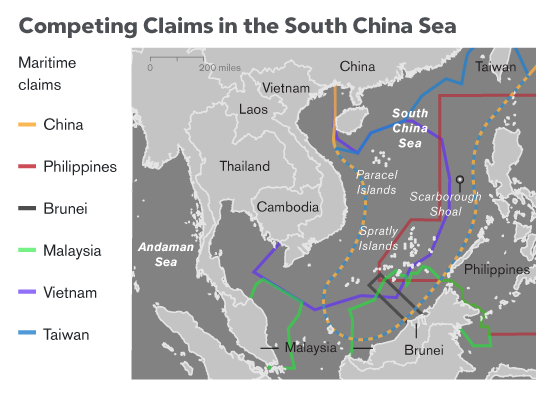
Bloomberg Visual Data: The Face Off in the South China Sea
This week’s intercept occurred in the northern part of the sea, south of Hong Kong, and the two Chinese J-11 jets came within about 50 feet (15 meters) of the U.S. EP-3 Aries reconnaissance plane, the Associated Press reported, citing an unidentified unofficial. The pilot was forced to descend a couple of hundred feet, the AP said.
Tensions between the U.S. and China are running high in the lead-up to a decision expected by mid-year from an international tribunal over China’s claims to more than 80 percent of the South China Sea.
The U.S. is not a claimant but has positioned itself as the champion of freedom of navigation in the area, which hosts more than $5 trillion of trade a year.
From the Interpreter (May 19): US claims unsafe intercept by Chinese jets
In light of the news that Chinese fighters conducted what the Pentagon calls an 'unsafe intercept' of one of its reconnaissance aircraft flying over the South China Sea on Tuesday (according to the US, the Chinese jets flew within 50 ft of the the American plane, forcing it to descend), it is worth revisiting an Interpreter piece by eminent American security analyst Bonnie Glaser from September last year on the then-newly agreed US-China accord on 'Rules of Behavior for Safety of Air-to-Air Encounters.'
It was an agreement which was supposed to put a stop to these kinds of incidents. Here's one interesting extract from Glaser's piece:
Especially noteworthy is the section that establishes responsibilities for aircraft when an intercept takes place. According to the agreement, the aircraft commander initiating the intercept should maintain safe separation while the operator of the aircraft being intercepted should avoid reckless maneuvers. The distance between aircraft that constitutes safe separation is not spelled out; rather it is dependent on circumstances. While this is sensible, it leaves split-second decisions up to the discretion of Chinese fighter pilots, who often lack experience.
It's important to note that we so far only have the American version of what occurred on this occasion. The Chinese statement will no doubt differ.
Speaking of aerial shows of strength, the Pentagon has just released more footage of Russian fighter-bombers and helicopters buzzing a US Navy destroyer in the Baltic Sea on 11 and 12 April.
From the Manila Bulletin (May 18): Chinese jets conduct ‘unsafe’ intercept of US spy plane: Pentagon
Two Chinese fighters have conducted an “unsafe” intercept of a US spy plane in international air space over the South China Sea, the Pentagon said Wednesday.
“The Department of Defense is reviewing a May 17 intercept of a US maritime patrol reconnaissance aircraft by two tactical aircraft from the People’s Republic of China,” Pentagon spokesman Major Jamie Davis said in a statement.
“Initial reports characterized the incident as unsafe,” he added, without giving additional details.
Tensions between China and the United States are high in the South China Sea, where Beijing has been building islets into military bases and is asserting sovereignty over large parts of the critical waterway.
Regional neighbors such as Vietnam and the Philippines have rival claims and the United States says China’s assertions have no basis in law.
Much to Beijing’s chagrin, the US military has conducted several “freedom of navigation” operations, in which planes or ships pass within a 12-nautical-mile buffer around the Chinese installations.
The intercept comes after the Pentagon and China had worked to reduce the risk of mishaps “by improved dialogue at multiple levels.”
“Over the past year, DoD has seen improvements in PRC actions, flying in a safe and professional manner,” Davis said.
“DoD is addressing the (intercept) through the appropriate diplomatic and military channels.”
From the Philippine Daily Inquirer (May 19): Fight to the death: 1-star officer is new PNP chief
"THE ROCK’ Chief Supt. Ronald dela Rosa is called “Bato” (the Rock) for his solid build. JAYMEE T. GAMIL The police officer nicknamed “Rock” strode in front of media cameras on Wednesday, chewing gum and declaring total war on drugs.
“This will be a fight to the death,” said Chief. Supt. Ronald “Bato” dela Rosa, chosen by incoming President Rodrigo Duterte as his director general of the 120,000-strong Philippine National Police.
“So, to the drug lords out there, get ready because I will run you over,” he said.
The barrel-chested Dela Rosa likewise vowed to clean up the PNP ranks of scalawags.
“For police officers who are involved in drugs, get out now. The government is paying you to capture drug personalities, but you also get paid by drug lords? You’re pushing your luck. I will cut off your luck,” he warned.
Christopher Go, Duterte’s executive assistant, confirmed to reporters in Davao City that Dela Rosa had been selected by the presumptive President-elect to replace Director General Ricardo Marquez, who earlier announced he would turn in his resignation as PNP chief upon Duterte’s assumption of the presidency on June 30.
Walks the talk
Like his patron, Dela Rosa cusses, talks tough and walks the talk.
Following news reports that he would head the police hierarchy, Dela Rosa appeared at Camp Crame on Wednesday and talked to the media at the lobby of the PNP headquarters building.
The 54-year-old said he would do his best to carry out Duterte’s vow to stamp out criminality in three to six months of his presidency—the centerpiece of Duterte’s campaign platform that swept him to an unprecedented landslide vote in the May 9 elections.
Officials said the drug problem affected 65 percent of the nation’s barangays, while 95 percent of barangays in Metro Manila were grappling with drug abuse. ‘We will bury you’
Asked for a message to criminals, Dela Rosa said, “We will not only crush you, we will bury you.”
He gave this assurance in the same tough manner the cuss-spouting Duterte would: “Kakayanin natin. Hindi naman pwede—(expletive) pa-chief PNP chief PNP ka tapos hindi mo kakayanin. Dapat kayanin mo. (We’ll bear it … You can’t be PNP chief and not bear it. You should.)”
But Dela Rosa turned humble when asked for a message to the public: “I hope I won’t fail you. To all Filipinos, we will do all we can, even if it will cost our lives.”
The similarity in mannerisms between Dela Rosa and Duterte comes as no surprise. The officer has always been upfront that Duterte has been a great influence in his career.
“He’s a leader with big balls. He’s not one to run away from problems. He will not leave you behind, he has a big heart and will really take care of you,” Dela Rosa said of his boss.
Summary killings
Asked about his position on summary killings, a charge that has hounded Duterte’s leadership, Dela Rosa played coy, simply replying: “Ayoko niyan (I don’t want that).”
While careful not to preempt Duterte’s official announcement of his appointment, Dela Rosa nevertheless confirmed Duterte had already spoken to him about the post as early as Sunday evening.
Dela Rosa said Marquez, his upperclassman by four years at the Philippine Military Academy (PMA), had talked to him, advising him to “start acting like the father of the organization.”
“Maybe the upperclassmen think I will remove them to replace them with my 1986 classmates, but that shouldn’t be what the father of the organization will do. There should be no favorite sons. You should treat them equally, according to merits.Whoever we’ll see can help in three to six months, that should be who we should give positions to,” Dela Rosa said.
His appointment—from one star to four—would effectively bypass his upperclassmen who are now senior officers in the PNP command group and Directorial Staff, including Director Generoso Cerbo Jr. of the 1984 PMA class, currently chief of the PNP Directorate for Intelligence.
The Rock
As of April 30, there are 19 police officials with the rank of director (two star); 105 with the rank of chief superintendent, one star.
Dela Rosa explained his nickname “Bato” comes from the Davao del Sur barangay he hailed from. But he said he also earned the moniker upon graduation from the Scout Ranger course “because my body was rock-hard.”
These days, the officer sports a skinhead, muscles bulging out of his uniform. He draws comparison to American actor and wrestler Dwayne Johnson whose ring name is “The Rock.”
Days before the elections, Dela Rosa, currently head of the PNP Human Resource and Doctrine Development, courted controversy and earned an administrative investigation for his Facebook posts in which he was suspected of displaying partisanship for Duterte.
A post on May 1, in which he vowed that the Camp Crame-based Reactionary Standby Support Force, which he then led, would “crush” those who would cheat and cause trouble during the polls.
In another post in March, Dela Rosa greeted Duterte on his birthday, and called him “the greatest leader on earth.”
Dela Rosa served as Davao City police chief from 2011 to 2013. He is known to be hardworking.
Drugless society
He was largely credited for the drastic reduction in the volume of shabu in the city when he implemented “Oplan Tukhang (Tuktok-Hangyo),” which saw police authorities knocking on the doors of suspected drug pushers and asking them to stop. Several suspected drug pushers were allegedly killed during the operation.
“I would have wanted to accomplish a drugless society where there is zero drug use but this is almost impossible,” Dela Rosa said.
Dela Rosa was also the police chief when three suspected kidnappers of a Quezon City-based Chinese businesswoman were killed during a shootout in Davao City in July 2013.
From the Philippine Daily Inquirer (May 19): Top Reds’ wives also longing for home
LONGING TO COME HOME After 30 years of living in exile in The Netherlands, Juliet de Lima and husband, Communist Party of the Philippines founder JoseMaria Sison, look forward to returning home. PHOTO FROM NDF WEBSITE For the wives of top leaders of the Communist Party of the Philippines (CPP), the biggest plus in a Duterte presidency—and its promise of peace talks with the CPP—is the prospect of coming home after 30 years of exile in The Netherlands.
“I miss most our relatives and friends, the food and the sights and sounds of places we were familiar with,” Juliet de Lima-Sison told the Inquirer in an online interview on Wednesday.
Juliet Sison and her husband, CPP founder Jose Maria Sison, went into exile after the 1986 Edsa People Power Revolution that ousted strongman President Ferdinand Marcos and settled in Utrecht, The Netherlands.Consuelo “Coni” Ledesma, wife of National Democratic Front of the Philippines (NDFP) peace panel chair Luis Jalandoni, was as elated and said she hoped she would be coming home for good this time.
“The Philippines is home, and even if we’re able to return more often now than before, every time we return, I still experience the joy and happiness of returning,” Ledesma said in a separate online interview.
Presumptive President-elect Rodrigo Duterte said he would allow Sison, his former college professor, and other exiled communist leaders to return to the country for the resumption of peace talks.
Juliet Sison, who chairs the NDFP Reciprocal Working Committee on Social and Economic Reforms, promised that the NDFP panel would work hard with representatives of the Duterte administration in forging a peace agreement.
“It appears that [Duterte] has the political will and should be encouraged to take initiatives in advancing the peace negotiations,” she said.
She added that her husband, the chief political consultant of the NDFP, was also looking forward to the prospect of coming home and “meeting with representatives of [Duterte] and to … drafting papers in connection with the peace negotiations.”
In an earlier interview, Jose Maria Sison said he and Duterte were planning to meet somewhere in Europe before the latter assumes office on June 30.
Coni Ledesma said that already, her husband was updating himself on news about the Philippines through the Internet.
“We sleep late to get the morning news from the Philippines. And once in a while, a telephone call in the middle of the night means an interview from a Philippine radio station,” she said.
From the Philippine Daily Inquirer (May 19): Joma also extends welcome to ‘rejectionists’
COMING HOME Jose Maria Sison, founding chair of the Communist Party of the Philippines, is expected to return to the Philippines under a Duterte presidency after nearly 30 years of exile in The Netherlands. CONTRIBUTED PHOTO Communist Party of the Philippines (CPP) founder Jose Maria Sison said the move toward reconciliation would extend not only to the government, through the incoming administration of presumptive President-elect Rodrigo Duterte, but also to those who broke away from the CPP in the 1990s.
“The government of national unity, peace and development proposed by the NDFP (National Democratic Front of the Philippines) is inclusive,” Sison said, in reply to an online interview question on whether his move toward reconciliation also extended to his former comrades identified with the CPP’s “rejectionist” (RJ) faction.
RJ and RA rift “Past differences can be overcome by current resolutions which are good and forward-looking toward a better and brighter social system,” said the CPP founder now based in Utrecht, The Netherlands.
Sison did not elaborate.
In the early 1990s, the CPP and its armed wing, the New People’s Army, were rocked by differences over strategy and tactics that caused serious division among the party’s top leadership and its members and allied groups.
Those who challenged Sison’s leadership were called “rejectionists,” or RJ, while those who stayed with the CPP founder were called “reaffirmists,” or RA. The rift led to the killing of several known leaders from both factions.
The reaffirmists of Sison wanted to continue its main tactic of protracted people’s war, while the rejectionists led by workers’ leader Filemon “Popoy” Lagman clamored for armed insurrection in the cities to grab power.
Lagman had critiqued Sison’s book “Philippine Society and Revolution” and argued that Philippine society was capitalist in a backward and underdeveloped way, rather than being semifeudal and semicolonial as Sison had contended.
Lagman believed that a workers-led revolution in the city must be waged to dismantle capitalism, rather than a protracted people’s war from the countryside.
The RJ groups and some NDFP leaders later declared autonomy from the CCP, resulting in a split that decimated the number of the party’s supporters and fighters.
From the Philippine Daily Inquirer (May 19): Peace talks back to square one
Federalism will render BBL ‘moot,’ says Duterte pick for Speaker All peace talks with Moro rebels in Mindanao are “back to square one” under the Rodrigo Duterte administration, according to newly elected Davao del Norte Rep. Pantaleon Alvarez, who is tipped to be the next Speaker.
“There’s no more need” for a Bangsamoro Basic Law (BBL), the Mindanao lawmaker said in an interview with the Inquirer.
He said the Comprehensive Agreement on the Bangsamoro, which the government signed in 2014 with the Moro Islamic Liberation Front (MILF) to be fleshed out with enabling legislation in the form of the BBL, had also been rendered moot by the new government and its plan to federalize the political system.
“That’s moot already. There’s no point to it anymore,” Alvarez said.
When asked to clarify if he meant all peace agreements with the MILF and the Moro National Liberation Front of Nur Misuari, he said: “Yes… Everything is back to square one.”
BBL ‘unnecessary’
Alvarez said the federal system of government, as espoused by Duterte’s campaign and which he would pursue as the next leader of the House of Representatives, would fix the Mindanao problem, making it unnecessary to enact a separate law.
Under a federal government, Mindanao would function as a self-governing state with its leaders enjoying more powers and resources.
Alvarez would not discuss in detail how Congress would go about amending the 1987 Constitution, or how leaders would muster the absolute three-fourths majority needed to accomplish this in each of the two legislative chambers.
He only said the legislative part of this process should happen in the first three years.
“By midterm elections, that should be submitted for a referendum. Before the end of his term, we should be in transition, and, hopefully when he steps down, we have a new form of government,” he said.
Alvarez said the lawmakers should take the cue from Duterte and the mandate he received from the people.
He argued that Duterte was elected on the strength of his campaign promises, including the shift to a federal system similar to that of the United States and Malaysia.
Ending insurgency
He expressed optimism that the outgoing Davao mayor would be able to end the war in Mindanao.
“I’m very confident Mayor Duterte can do it. He can end insurgency because he understands the real issues,” he said. “Mayor Duterte has a good relationship with the rebels.”
Asked to explain why BBL was not passed, Alvarez said the government and MILF peace negotiators were at fault for not clearing it with Congress first.
“They negotiated but there was no public hearing. There was nothing on the ground.
That’s why there were vehement objections in the House of Representatives,” he said.
Alvarez was at one point a leader of One People Mindanao, a group advocating for Mindanao’s complete independence.
“We espoused Mindanao independence out of frustration with government. Our advocacy was for the secession of the Mindanao republic,” he said.
From the often pro-Communist Party of the Philippines (CPP) online publication the Davao Today (May 18): Accelerated peace talks with Duterte possible – NDF official
(Davaotoday.com file photo)
The emissary of the National Democratic Front said there is a possibility of an accelerated peace negotiations between the NDF and the government under President-elect Rodrigo Duterte.
In an interview with Davao Today on Wednesday, May 18 NDF spokesman Fidel Agcaoili said the substantive agenda on the peace process are “sequential”, but while they are discussing a substantive agenda, working groups on other agenda may start their discussion.
The four substantive agenda of the formal peace negotiations between the government and the NDF include human rights and international humanitarian law, socio-economic reforms, political and constitutional reforms, and the end of hostilities and disposition of forces.
With an accelerated peace negotiations, reciprocal working committees on the socio-economic reforms may meet and work on an agreement, while the working groups for the political and constitutional reforms and the reciprocal working committees on end of hostilities and disposition of forces may also start their discussions and draft agreements.
“It can be done simultaneously,” Agcaoili said.
He said they have already presented this possibility in previous administrations and will reiterate their position to Duterte. Agcaoili said this was initially discussed during Duterte and Communist Party of the Philippines founder Prof. Jose Maria Sison’s Skype conversation.
Duterte and Sison also talked about the possible agreement on ceasefire, release of the political prisoners, and the possible return of Sison, the exiled Party leader.
Agcaoili, who met with Duterte early morning on Tuesday, said Sison and Duterte’s meeting would probably take time even after Duterte’s proclamation on June 30.
However, he said Duterte has already planned on sending the government’s emissary to talk about ceasefire and the general amnesty to be given to all political prisoners.
“That would be easier, the president has the right to declare a general amnesty, not just pardon,” said Agcaoili.
Agcaoili said this would give a chance for the NDF consultants to perform their functions in the peace negotiations and start the processing of the necessary documents.
Human rights group Karapatan said there are 18 NDF peace consultants out of the 543 documented political prisoners in the country. Also, 88 political prisoners need proper medical treatment and 48 are elderly.
“Majority, if not all, of the political prisoners were detained based on trumped-up criminal charges against them, violating their rights under the GPH-NDFP Comprehensive Agreement on the Respect for Human Rights and International Humanitarian Law (CARHRIHL) and the Joint Agreement on Safety and Immunity Guarantees (JASIG),” said Cristina Palabay, Karapatan secretary general.
‘NDF confident with gov’t negotiator’
Agcaoili also said that they welcome the appointment of Rep. Silvestre Bello III as the government’s negotiator with the NDF.
“Maganda ang naging karanasan ng NDF kay Bebot Bello sa pag-uusap. Sa panahon niya, nagkaroon kami ng maraming agreements na napirmahan, 10 agreements (The NDF had a good experience with Bebot Bello in the negotiations. During his stint as negotiator we signed 10 agreements),” said Agcaoili.
Duterte during his press conference on Monday, May 16 named Bello as the government’s chief negotiator for the NDF.
The peace talks between the NDF and the government was stalled since 2011.
The government panel blamed the CPP, NPA, and NDF for the delay.
Meanwhile, the NDF said Aquino is “insincere” in resuming the peace talks.
The NPA has celebrated its 47th year last March 29, 2016. The NDF said under Pres. Aquino’ administration, the NPA operates to more than 2,500 barrios presently, from 1,850. The guerrilla forces, they said, covers more than 200 municipalities in 20 provinces in Mindanao.
Communist Party of the Philippines (CPP) propaganda statement posted to the National Democratic Front (NDF) Website (May 17): CPP open to Duterte offer based on principles and policies
Information Bureau | Communist Party of the PhilippinesPress Release | May 17, 2016
The Communist Party of the Philippines (CPP) acknowledges the public offer made yesterday by incoming GRP president Rodrigo Duterte for the CPP to head at least four GRP agencies. The CPP said it looks forward to forging an alliance for national unity, peace and development with the Duterte government based on clearly stipulated principles and policies of national sovereignty and social justice.
In meeting the press yesterday, Duterte said the CPP can be given four cabinet posts to head the Department of Agrarian Reform, the Department of Environment and Natural Resources, the Department of Social Work and Development and the Department of Labor and Employment.
“We view the offer of key cabinet positions made by presumptive president Duterte as an acknowledgement of the strength and political standing of the CPP and revolutionary forces, its effective representation of the interests of workers, peasants, minorities and the broad masses as well as its work in protecting the environment,” said the CPP.
“The CPP and the revolutionary forces welcome the possibility of joining presumptive president Duterte in an alliance government, whether in the form of assigning cabinet positions to the CPP or its endorsees or some other more radical form of unity government which the maverick new president might be open to consider,” said the CPP.
“While the CPP is not averse to being assigned cabinet positions under certain conditions, incoming president Duterte knows fully well that what is more important to the revolutionary forces are the necessary changes in the policies and programs that govern these departments and the entire government,” it elaborated.
“A u-turn in the neoliberal policies of the past three decades, to say the least, must be carried out,” said the CPP.
“For instance, a DOLE secretary can only effectively serve the interests of the labor sector when there are laws prohibiting contractualization, promoting unions, establishing a national wage system and substantially raising wages to decent levels.”
“A DAR secretary will only be able to serve the interests of the peasant masses when there is a genuine land reform program that upholds the social justice tenet of free distribution of land to the tillers and which prohibit landlords, plantations and contract-growers from grabbing and monopolizing lands.”
“An alliance or coalition between the Duterte regime and the CPP and revolutionary forces can be realized on the basis of such principles as national sovereignty and social justice, which are questions at the core of the current armed conflict,” said the CPP. “This include, among others, the need for genuine land reform, industrialization and economic development, jobs, ending US troop presence and many others.”
The CPP added: “We anticipate the public offer made yesterday by presumptive president Duterte for the CPP to join his cabinet to be followed through with a more thorough discussion of policies through peace negotiations with the NDFP which is an excellent opportunity to discuss the socio-economic issues confronting the people.”
“The CPP further encourages the presumptive president to engage in discussions with workers, peasants and other mass-based organizations to enable him to listen to their grievances and see the urgent need to address their situation with substantial changes in policy.”
Posted to the Moro Islamic Liberation Front Website (May 18): Bangsamoro groups urge PNoy to veto new “halal bill”
Civil society organizations in Bangsamoro areas are asking Pres. Benigno S. Aquino III to veto the “Philippine Halal Export Development and Promotion Act of 2015” which is now already waiting for his signature.
Abdullah Salik, Jr. of the Federation of Bangsamoro Civil Society Organization (FBCSO) said in an interview that they are surprised and worried by the proposed law.
“It just came to our knowledge very recently that the House of Representatives and Senate have already approved on final reading House Bill 6347 and Senate Bill 2831, respectively, and the consolidated version of the proposed law is now with the Office of the President,” said Salik who leads the 117-member organizations.
Essentially, the federation is opposing the utter disregard of the proposed law for the religious significance of halal regulation to the daily lives of Muslims all over the world.
“This draft law is only concerned with the commercial and export aspects of regulation and does not care about the over-all and direct connection of halal regulation to the lives of Muslims,”Salik noted.
Moreover, Salik explained that the law, when approved by the President, would divest the National Commission on Muslim Filipinos (NCMF) of its regulatory powers over halal matters to the Department of Trade and Industry (DTI).
NCMF, the only agency for Muslim affairs in the country, would be stripped of its power to accredit halal certification bodies and in setting national halal standards.
“Imagine, NCMF would have no hands in accreditation and formulating standards because DTI through a Philippine Accreditation Bureau would be responsible for it and that the NCMF is not included in the Philippine National Standards for Halal. Only Department of Agriculture, Department of Health and DTI would sit in the latter agency,” Salik emphasized.
Salik also said that the proposed law would also run contrary to the Framework Agreement on the Bangsamoro (FAB) particularly Part III, item number 4 thereof which states the Bangsamoro Basic Law may provide for the power of the Bangsamoro Government to accredit halal-certifying bodies in the Bangsamoro.
“Hindi pa nga naitatayo ang Bangsamoro government ay inaalisan na ito ng kapangyarihan (The prospective Bangsamoro government is already being deprived of powers.), “ Salik lamented.
He expressed hope that Pres. Aquino would realize the negative effects of House Bill 6347 and Senate Bill 2831 and eventually veto the same.
He also appealed to Bangsamoro individuals and organizations to raise their objections to this proposed law.
Posted to the Moro Islamic Liberation Front Website (May 19): ‘Pursue education, you’re the next leaders’: IMT tells Bangsamoro youth
The International Monitoring Team (IMT) Head of Mission urged the Bangsamoro youth to pursue education considering that they will become the future leaders of the Bangsamoro people during the IMT courtesy meeting with the Southern Mindanao Front (SMF) Command of the Bangsamoro Islamic Armed Forces (BIAF) held at Barangay Daliao, Maasim, Sarangani Province on May 5, 2016.
To prepare for their leadership role in the future, IMT Head of Mission Malaysian MajGen Datu Zamrose Bin Mohammad Zain, stressed “The new generation of Bangsamoro should strive in acquiring education,” during the short program attended by SMF Commander Al-haj Jordan, 104th and 107th BIAF Base Commanders, their subordinates, and forces and community members.
Zain, who heads the 11th batch of the IMT for a peacekeeping mission in Mindanao in support to the peace negotiation between Government of the Philippines (GPH) and Moro Islamic Liberation Front (MILF), noted that the leaders of Bangsamoro people today are old.
The chief of the peacekeeping mission also suggested to the audiences to “vote for peace” emphasizing the importance to choosing candidates that can help in the on-going peace process.
Speaking in local vernacular in his message, Al-haj Jordan, thanked the international peace monitors for their noble duty of helping to keep peace on the ground that creates a conducive atmosphere for the two parties to talk.
“Their sacrifices to help in the peace process are of big help in our quest for lasting peace and development in our homeland,” he told audiences.
Comprised of contingents from Malaysia, Indonesia, Brunei and Japan, the IMT has the task to monitor the upholding of ceasefire agreement between the GPH and MILF.
The peace monitors have been engaging with the Local Monitoring Team and the Coordinating Committee on the Cessation of Hostilities in the ceasefire monitoring efforts.
Observers noted the remarkable reduction of armed encounter incidents between the government troops and MILF combatants since the ceasefire mechanism has been in place.
Zain was joined by the members of the IMT Team Site 4 based in General Santos City. He brought a medical team led by Malaysian Doctor Ariq bin Abdullah to provide free consultation and medicines for the ailing children and adult constituents of Barangay Daliao and nearby villages.
From the Philippine Information Agency (May 18): 36 troop carrier, 4 military ambulance dagdag pwersa sa mga kasundaluhan ng 7ID
FORT RAMON MAGSAYSAY, Nueva Ecija -- Nasa 36 na mga bagong troop carrier at apat na yunit na military ambulance ang tinanggap ng Army 7th Infantry Division o 7ID bilang karagdagang pwersa sa pagbabantay ng kapayapaan.
Ayon kay 7ID Commander Major General Angelito De Leon, ito ay bahagi pa din sa isinusulong na Modernization Program at Transformation Roadmap ng Hukbong Sandatahang Lakas ng Pilipinas.
Maliban sa mga makabagong sasakyan ay nauna na ding natanggap ng mga yunit ng Hukbong Katihan ang mga kagamitang pandigma gaya ng R4 na mas makabago kumapara sa dating ginagamit na M16 rifle.
Dagdag pa ni De Leon, hindi lamang Army ang nakikinabang sa programang modernisasyon ng pamahalaan kundi maging ang mga kasamahan sa Navy at Air Force.
Kagaya aniya ang pagdating sa bansa ng kauna-unahang strategic vessel ng Navy na maaaring gawing alternate command at control vessel gayundin ang dalawang FA 50 Lead-in Fighter Jets ng Air Force.
Ang mga bagay na ito ay patunay na ang pamahalaan at ang liderato ng Hukbong Sandatahang Lakas ng Pilipinas ay pinahahalagahan at pinangangalagaan ang mga kasundaluhan.
Malaking bahagi aniya ang mga kagamitang ito sa combat operation ng bawat yunit na nasasakupan pati na ang pagtulong sa mga nangangailangan lalo sa panahon ng kalamidad at tuwing may emergency.
Kaya’t ang naging paalala sa mga kabaro ay pakaingatan at ayusin ang paggamit nito, akuin ang pagmamayari upang mapakinabangan ng mahabang panahon.
Ngunit ang pinakamahalaga aniya ay magsimula ang modernisasyon o pagbabago sa sarili sa pagiging makabagong sundalo tungo sa inaaasam at maipagmamalaking world class Philippine Army.
From the Philippine Information Agency (May 19): RPOC to launch Caraga Roadmap for Peace in Butuan
BUTUAN CITY – The Regional Peace and Order Council (RPOC) with the Department of the Interior and Local Government (DILG) Caraga as the head secretariat will be launching the region’s Caraga Roadmap for Peace on May 24, 2016 at the Robinsons Place, this city.
According to DILG Caraga regional director Lilibeth Famacion, with the RPOC Caraga’s efforts in upholding peace and order in the region, the Caraga Roadmap for Peace was crafted with the active participation and support of the council members and partners.
“The roadmap, the first of its kind of document and Caraga as the first to come up with such, serves as the blueprint of the RPOC towards achievement of peace and development and fulfillment of human security in the region,” highlighted Famacion.
The Regional Peace and Order Council (RPOC) plays a vital role in maintaining the peace and order situation in every region of the country.