Wednesday, May 18, 2016

Ronald dela Rosa named Duterte's PNP chief

From Rappler (May 18): Ronald dela Rosa named Duterte's PNP chief

Duterte entrusts the PNP with the former Davao City police chief who was sacked for a pro-Duterte Facebook post during election season

File photo of Ronald dela Rosa courtesy of Karlos Manlupig

File photo of Ronald dela Rosa courtesy of Karlos Manlupig

The Philippine National Police (PNP) chief of Rodrigo Duterte's administration will be Police Chief Superintendent Ronald "Bato" Dela Rosa.

The president-elect's executive assistant Bong Go confirmed to reporters on Wednesday, May 18, that Duterte has chosen Dela Rosa.

Initially, he was choosing from among 3 names: Dela Rosa; Chief Superintendent Ramon Apolinario, Mimaropa police officer-in-charge; and Sr. Supt. Rene Aspera, chief of staff of the PNP Anti-Kidnapping Group.

Dela Rosa was told of his appointment earlier but refused to go on the record until Duterte's camp made the announcement. (READ: Duterte's 'Bato': Who is Ronald dela Rosa?)

Dela Rosa, who Duterte calls "Bato" – after the barangay where he comes from in Davao del Sur – served as Davao City police chief, leading Oplan TukHang (Tuktok-Hangyo), an anti-drug operation in which police would knock on the doors of suspected drug addicts or drug dealers to warn them of consequences if they did not reform.

Duterte has called Bato a trustworthy and diligent worker.

Dela Rosa, meanwhile, has said the Davao City mayor was a great influence in his career.

In his birthday greeting to Duterte posted on Facebook, Dela Rosa said, “I never feared to enforce the law and prevent crimes because you are always there watching my back. To the greatest leader on Earth, Mayor RRD, happy birthday Sir!”

His perceived loyalty to Duterte got him into some trouble when he was sacked for a supposedly pro-Duterte Facebook post in which he warned against cheating during the May 9 elections.

A 1986 graduate of the PMA and native of Santa Cruz, Davao del Sur, he is considered junior for the position of PNP chief, but the classes ahead of him, in particular Class 1984, are identified with erstwhile presidential candidate Manuel "Mar" Roxas II. (Roxas is an "adopted" member of PMA Class 1984.)
 

Coming home? Joma wants release of political prisoners, ceasefire first

From Rappler (May 18): Coming home? Joma wants release of political prisoners, ceasefire first

CPP founding chairman Jose Maria Sison says, 'Mark my words, if political prisoners are released and there's a mutual ceasefire, I will come home'

OPEN. Exiled communist leader Jose Maria "Joma" Sison says the future of the Left is bright under the Duterte administration. File photo by Rappler

Release of political prisoners. Agreement on a mutual ceasefire. These are the "inseparable twins" Communist Party of the Philippines (CPP) founding chairman Jose Maria "Joma" Sison wants before he returns home from 30 years of exile in the Netherlands.

“Mark my words, if political prisoners are released and there's a mutual ceasefire, I will come home,” Sison said during an interview on Rappler Talk on Tuesday, May 17. “The release of all political prisoners and mutual ceasefire are inseparable twins,” he emphasized.

Sison said the release of political prisoners is “an obligation” of government and in compliance with existing agreements such as the Comprehensive Agreement on Respect for Human Rights and International Humanitarian Law “which prohibits trumping up charges of common crime” against people affiliated with the New People's Army (NPA) or rebellion.

Duterte's camp said they are ready to discuss the terms of reference of a mutual ceasefire, after which they can discuss the release of political detainees.

In an interview on dzMM Wednesday, May 18, National Democratic Front (NDF) of the Philippines chairperson Luis Jalandoni said there are 543 political prisoners at present, 88 of them sick and elderly, 18 of them NDF peace consultants, and 3 sentenced to life imprisonment.

Among those in prison are alleged CPP chief Benito Tiamzon and wife Wilma who were arrested in March 2014. The sickly couple was arrested in Cebu over standing warrants of arrest for crimes against humanity, including murder, multiple murder, and frustrated murder charges. The CPP maintained these are trumped up charges.

Sison said Duterte and his appointed peace negotiator Silvestre "Bebot" Bello III have already said that they will respect existing agreements.

“If we are after a common and something good for the entire Filipino people such as a just and lasting peace so we can unite and develop the country, I think liberating political prisoners is a small matter,” he said.

“Duterte has a strong character and he’s a lawyer so he knows the legal basis of the release," Sison added.

The Davao City mayor is known for his deep ties with the CPP-NDF and the NPA. As local chief executive, he put Left-leaning candidates in his city council and even allowed a hero's burial and a funeral march for NPA leader Leonardo Pitao or Kumander Parago.

Political prisoners

The openness of the Duterte administration to the Left became more apparent when it offered to appoint nominees from the Left to 4 departments: the Department of Agrarian Reform (DAR), Department of Environment and Natural Resources (DENR), Department of Social Welfare and Development (DSWD), and the Department of Labor and Employment (DOLE). (READ: Duterte to Left: 4 departments yours)

Sison welcomed the offer from his former student whom he described as having “a generous spirit in comparison with the Aquino-Cojuangco greedy kind of family.” He also said the Cabinet appointees to the 4 departments that were offered need not be communists but can be patriotic and progressive people.

“Accepting the post by patriotic and progressive people who may not necessarily be communists could be seen as promoting the peace negotiation,” he said.

The network now has a committee to vet “people-oriented, competent, honest, and diligent” nominees, according to the current chief political consultant of the NDF.
But while the recent pronouncement of Sison's former student is a sign that he, as a president, "is willing to accommodate the Left," the further involvement of the CPP should go through the peace talks.

“These must be laid through the peace negotiations,” Sison explained. “There are things that need to be done for the NDF to be very active in cooperating.”

“After the peace negotiations, when there's also a full-fledged government of unity, peace, and development where communists and simply anti-imperialists can openly participate, I think there would be an allotment of spaces for a broad range of people,” he added.

The NDF is looking to the incoming government to prioritize social-economic reforms – specifically genuine land reform – along with political and constitutional reforms, and national industrialization.

Reforms before disarm

Sison, however, emphasized that the NPA is not planning to lay down their arms in the next few months. The armed group is “more than willing” to continue with the stalled peace negotiations under the Duterte administration – eventually leading to a permanent mutual ceasefire.

“The problem, if a revolutionary movement is in a hurry to disarm itself before reforms are carried out, those in power will just dismiss the revolutionary movement later on,” he said.

The eventual peace and ceasefire between the communist rebels and the Philippine government is not so far-fetched anymore, Sison said, because Duterte's appointed officials – Jesus Dureza and Bello – already worked effectively in the past. (READ: Duterte, Joma on Skype: Ceasefire if Davao mayor becomes president)

"We also welcome the appointment of Jess Dureza as peace adviser and Bebot Bello as chief negotiator with NDFP,” Sison said. He was referrring to Jesus Dureza and Silvestre Bello III who are not newcomers to the peace process.

Dureza was the Presidential Adviser on the Peace Process under the administration of Gloria Macapagal Arroyo, while Bello participated in the government's peace negotiations from the time of President Corazon Aquino up to the time of Arroyo.
“What's good with the new government is that it is harnessing people who we already negotiated with so successfully so it’s good to have them again on the other side of the table,” he explained. “They know how to defend the interest of their own government and at the same time, they recognize what's reasonable between the Manila government and the NDFP,” Sison said.

The appointment of the two officials who “are not obsessed with trying to trip the NDF and push them over the cliff” is a welcome change, he added.

After all, Sison said that the common point of reference is the interest of the people and “not the game of outwitting the other side.”

Under a Duterte presidency, Sison said he sees a "bright future" for the Left.


http://www.rappler.com/nation/133479-joma-sison-release-political-prisoners-ceasefire

Duterte's 'Bato': Who is Ronald dela Rosa?

From Rappler (May 19): Duterte's 'Bato': Who is Ronald dela Rosa?

An operations guy, Chief Superintendent Ronald 'Bato' dela Rosa, incoming president Rodrigo Duterte's choice for top cop, brings with him local and field experience

'PRESUMPTIVE' PNP CHIEF. Dela Rosa, incoming president Rodrigo Duterte's pick to head the PNP, entertains calls inside his office in Camp Crame. Bea Cupin/Rappler

'PRESUMPTIVE' PNP CHIEF. Dela Rosa, incoming president Rodrigo Duterte's pick to head the PNP, entertains calls inside his office in Camp Crame. Bea Cupin/Rappler

Chief Superintendent Ronald “Bato” dela Rosa is not used to getting attention. He recalled a time when he could walk around the streets of Davao City or even Camp Crame in Quezon City and elicit only the customary hello – if he’s lucky.

Things have changed the past few days, the 54-year-old one-star general told Rappler.

People – even those inside moving vehicles – stop their tracks to take a selfie with or say hello to Dela Rosa, president-elect Rodrigo Duterte’s choice to head the 160,000-strong Philippine National Police (PNP).

Duterte’s executive assistant Bong Go made the official announcement on Wednesday, May 18: the former Davao City police chief takes over the entire PNP at the same time that his “mentor,” the longtime Davao mayor, takes on his biggest role yet as president and commander-in-chief.

Dela Rosa has a daunting task. One of Duterte’s key campaign promises is to eradicate – or “suppress” – crime in 3-6 months.

The Davao experience

Marching orders to run after criminals are nothing new to Dela Rosa, who was Davao City police chief from January 2012 to October 2013, spanning the terms of Duterte’s daughter Sara and Duterte himself.

One of his key missions then, Dela Rosa told Rappler, was to stop the use and sale of illegal drugs in the city. Oplan TukHang (Tuktok-Hangyo) saw the Davao police going door-to-door, knocking on the homes of known drug dealers and users.

Tuktok in Bisaya literally means “to knock” while hangyo means “request.”

Cops would warn drug dealers and users to reform – or else.

“It worked,” a beaming Dela Rosa recalled, noting that drugs went down by at least 60% because of the operation.

PMA 86. Ronald dela Rosa, then a fresh graduate from the prestigious Philippine Military Academy. Photo from Dela Rosa's Facebook page


PMA 86. Ronald dela Rosa, then a fresh graduate from the prestigious Philippine Military Academy. Photo from Dela Rosa's Facebook page
 
But the task will be harder a hundredfold at a national scale. While Davao City was home to almost 1.5 million people when Dela Rosa was its city director, the entire PNP is tasked with safeguarding over 100 million Filipinos.

The mayor and his choice cop

Davao in 1986 is where Dela Rosa and Duterte’s paths crossed.

Dela Rosa, then a young lieutenant of the now-defunct Philippine Constabulary in Davao, entered the force when Duterte was appointed acting vice mayor of the city in the aftermath of the EDSA People Power Revolution that toppled the Marcos dictatorship.

The two grew close, with Duterte even standing as principal sponsor when Dela Rosa got married.

The personal ties got the one-star police general in hot water days before the election day on May 9. Tasked to command the PNP-reactionary standby support force at Camp Crame, Dela Rosa was sacked a week before the polls after he went public with his sentiments in favor of the presidential candidate.

In a public post on his Facebook page tagging known Duterte supporters, he wrote: "Those who will cheat and will manipulate this May 9 elections, be warned! We will crush you!"

In a previous post, Dela Rosa had nothing but warm words for his ninong.
You have been the greatest influence in my career. I never feared to enforce the law and prevent crimes because you are...
Posted by Ronald Dela Rosa on Monday, March 28, 2016 “I never feared to enforce the law and prevent crimes because you are always there watching my back. To the greatest leader on Earth, Mayor RRD, happy birthday Sir!” he wrote.

The president-elect has referred to Dela Rosa as trustworthy and intelligent.

Decades of working with Duterte, Dela Rosa told Rappler, means that sometimes, he doesn’t even need verbal instructions from the Davao mayor.

Their level of understanding is almost telephathic, according to the police general.
Dela Rosa describes Duterte as a boss who is “hands on” but doesn’t micromanage. Details of police operations are minor – it’s the results that Duterte is always after.

Marquez resigning?

While Dela Rosa’s pending appointment did not surprise Camp Crame officials, it has raised some eyebrows.

His taking on the highest post in the police force means his upperclassmen – from the Philippine Military Academy classes of 1983, 1984 and 1984 – will miss their chance at the PNP’s top post.

Born on January 21, 1962, Dela Rosa is set to retire in 2018, when he reaches the mandatory retirement age of 56.

Assuming he begins his stint by July 2016, Dela Rosa would serve as PNP chief for at least 1 and a half years.

His term would be a little longer than current PNP chief Director General Ricardo Marquez's 12-month stint, but shorter than that of President Benigno Aquino III's favorite cop, sacked PNP chief Alan Purisima.

Purisima was appointed chief of the PNP in late 2013 and was not set to retire until November 2015, which meant an almost 2-year-old term. But Purisima was suspended in December 2014 and later, dismissed by the Ombudsman over a supposedly shady deal in Camp Crame.

Current PNP chief Marquez is set to retire in August 2016 yet, but the 4-star general had earlier said he would hand in his courtesy resignation to whoever wins the presidency. Sources indicate Duterte is inclined to accept Marquez’ resignation.

While his relatively longer term will give a chance for him to see the completion of projects and programs through, it's Dela Rosa's first 6 months as PNP chief that will grab the most attention, given Duterte's campaign promise.

Probing Mamasapano

Aside from his ties to the incoming president, the Santa Cruz, Davao del Sur native brings with him decades of experience in various Mindanao or Davao-based posts.

Dela Rosa rose up the ranks from battalion commander, head of regional units, until he was assigned provincial director of Compostela Valley and later, Davao del Sur before being appointed city director of Davao City. He has a doctorate in Development Administration from the University of Southeastern Philippines.

Prior to his current post as Executive Officer of the Directorate for Human Resource and Doctrine Development at Camp Crame, Dela Rosa held different posts in the PNP’s Intelligence Group from October 2013 to November 2015.

MAMASAPANO PROBE. Dela Rosa with other members of the BOI and the OAT during a visit to Mamasapano, Maguindanao. Photo from Dela Rosa's Facebook page


PROBE. Dela Rosa with other members of the BOI and the OAT during a visit to Mamasapano, Maguindanao. Photo from Dela Rosa's Facebook page
 
Dela Rosa was also among the officers tasked to probe the controversial clash between armed rebels and members of the PNP Special Action Force (SAF) in Mamasapano, Maguindanao.

As a member of the Board of Inquiry – Operational Audit Team for the bloody Mamasapano incident, Dela Rosa helped draft the report that would pinpoint President Aquino, sacked PNP chief Purisima, and former SAF chief Getulio NapeƱas’ blunders in the lead-up to the clash.

The Mamasapano clash is one of the bloodiest one-day operations in PNP history and the worst crisis to hit Aquino in the last phase of his administration. It is an incident that any police boss, especially one who took part in investigating it, would avoid repeating.

http://www.rappler.com/nation/133519-ronald-dela-rosa-duterte-pnp-chief

Duterte, Obama briefly talk on South China Sea issue in a 5-minute phone call

From the Philippine News Agency (May 18): Duterte, Obama briefly talk on South China Sea issue in a 5-minute phone call

Presumptive President-elect Rodrigo Duterte and United States President Barak Obama briefly touched the South China Sea issue during in five-minute phone conversation on late Tuesday night.

This was confirmed by Duterte's Executive Assistant Christopher Lawrence Go, who said it was a brief overseas call from the US president at 11:15 p.m. Tuesday.

Go said Mr. Obama called to congratulate Duterte for leading the Philippine elections on May 9.

He said the South China Sea issue was briefly mentioned and he heard the mayor telling Mr. Obama he is hoping for a favorable result of the case filed by the Philippine government before the United Nations arbitral tribunal.

Go said the mayor told Mr. Obama he is for the peaceful resolution of the Philippines' claim of the South China Sea.

During the campaign, Duterte expressed full support to the case now pending in The Hague questioning China's occupation of areas in the West Philippine Sea that the Philippines considers its territory. He is hopeful for a favorable ruling for the Philippines.

The mayor believes the Philippines should continue to work closely with other countries towards finding a solution to the issue. However, if this multi-lateral approach proves to be inadequate to resolve the issue, he is willing to explore other options including directly talking with China.

Duterte further believes that any military conflict involving the Philippines over the West Philippine Sea should not happen as it will derail Philippine economic growth.

Meanwhile, according to Go, Duterte was greatly honored by Mr. Obama's call.

"I am very much honored Mr. President," Go quoted the mayor telling Mr. Obama.

Go said both leaders were on a relax mood laughing at times during the conversation.

In a CNN Philippines report shared on Facebook, a senior White House aide Ben Rhodes said Washington wanted to know the priorities of the Philippines' incoming administration and hoped "to build on progress made with the last administration.

http://www.pna.gov.ph/index.php?idn=2&sid=&nid=2&rid=886437

SLP-PAMANA livelihood projects awarded to three Surigao del Sur villages

From the Philippine News Agency (May 18): SLP-PAMANA livelihood projects awarded to three Surigao del Sur villages

Three villages of a coastal municipality in Surigao del Sur were made recipients of various projects by the Department of Social Welfare and Development (DSWD) through the Sustainable Livelihood Program (SLP), which a series of turnover ceremonies of Payapa At Masaganang Pamayanan (PAMANA) projects were recently conducted, for the said villages all of Lianga town in Surigao del Sur.

In an information sent by Ms. Eunice G. Montaos, Regional Information Officer, DSWD Field Office (Caraga) to the various media outlets here, said that three SLP Associations from the different barangays availed of the financial assistance amounting to Php 300,000 each through DSWD-SLP Pamana Project.

With the said funding, a mobile rice mill and pre and post-harvest equipment had been bought and a concrete solar dryer had been constructed.

Thirty-six PAMANA grantees of Brgy. Payasan Association received their most awaited mobile rice mill. The said barangay is the second barangay in the municipality with a largest land area for rice production. The grantees believed that such equipment seemed economically viable.

For the additional materials needed for the operation, the barangay local government unit (BLGU) will provide the tent, containers and other suitable supplies for the business operation.

With rice production as one of the source of livelihood, the 46 grantees of another village Brgy. Anibongan SLP Association agreed to choose pre and post-harvest equipment.

The use of the facilities and equipment is also open to non-members thereby earning more income from its rentals.

The BLGU of Anibongan provided the lot by the storage room is solely intended for the safekeeping of the aforementioned PAMANA Project.

The group also agreed to engage in “Bigasan Ng Bayan,” business after a year of operation.

The 56 members of Manyayay PAMANA People Association agreed to use their financial assistance for the construction of their long-awaited solar dryer.

The place known for its abundant dried seaweed production, dried seaweed is in demand to the local market of Lianga and even for import.

Aspiring to finish the construction earlier than expected, the community steered into “Bayanihan,” both members and non-members worked hand-in-hand, making the expense for labor free of charge.

Because the group was able to save the fee for labor, the area of the solar dryer has been increased to 450 square meters.

After a year of operation, the group envisions to venture on other businesses that engages in seaweed production to ensure sustainable livelihood.

PAMANA is the national government convergence program that expects development interventions to isolated hard to reach and conflict-affected communities, ensuring that they are not left behind. It has a number of national line agencies or implementing partners and one of those is the DSWD.

On the other hand, SLP is a program that provides identified poor families the appropriate income-generating opportunities through micro-enterprise or employment to help improve their level of economic sufficiency.

http://www.pna.gov.ph/index.php?idn=2&sid=&nid=2&rid=886467

AFP beefs up security in Tawi-Tawi

From the Philippine News Agency (May 18): AFP beefs up security in Tawi-Tawi

Zamboanga City --The Armed Forces of the Philippines (AFP) is redeploying a battalion of marine troops to beef up the coastal security in the province of Tawi-Tawi.

Maj. Filemon Tan Jr., Western Mindano Command (Westmincom) spokesman, on Wednesday said the Marine Battalion Landing Team-9 (MBLT-9) will be pulled out from this city and will be deployed in Tawi-Tawi.

Tan said the MBLT-9 troops will depart this city following the send-off ceremony on Thursday (May 19) to be held at the headquarters of the Naval Forces Western Mindanao (Navforwem) in this city.

Tan stressed the deployment of the MBLT-9 troops to Tawi-Tawi is just a preemptive move of Westmincom citing there is no security threat in that province.

“Okay naman sa Tawi-Tawi kaya lang preemptive yong ginagawa natin. Bago may mangyari, dapat may puwersa na doon,” he added.

He said the deployment of the MBLT-9 to Tawi-Tawi is in accordance to the military doctrine that the marines should be based in islands or near the shorelines.

He said the Army’s 21st Infantry Battalion (IB) will replace the MBLT-9 in this city.

The AFP has deployed marine troops to help improve the peace and order situation in this city since the infamous 21-day siege in September 2013.

The first to be deployed here was the MBLT-1, which was later replaced by the MBLT-9.

Tan said the 21st IB troops will be deployed in all the areas that will be vacated by the MBLT-9 troops.

http://www.pna.gov.ph/index.php?idn=2&sid=&nid=2&rid=886473

PN to acquire 600 rounds of 155mm HE

From the Philippine News Agency (May 18): PN to acquire 600 rounds of 155mm HE

The Philippine Navy (PN) is allocating the sum of PHP39 million for the acquisition of 600 rounds of high-explosive 155mm munition.

The munition is for the use of the Philippine Marine Corps, a specialized force, under the operational control and supervision of the PN.

Both the PMC and Philippine Army are in the process of acquiring 12 units of 155mm towed howitzers.

Winning bidders are required to deliver the items within 240 calendar days.

Pre-bid conference is scheduled on May 25, 1:00 p.m. at the PN Hall of Justice, NJAG, Naval Station Jose Francisco, Fort Bonifacio, Taguig City.

http://www.pna.gov.ph/index.php?idn=1&sid=&nid=1&rid=886371

Duterte’s proposed amnesty to all political prisoners should be prudent – senators

From the Philippine News Agency (May 18): Duterte’s proposed amnesty to all political prisoners should be prudent – senators

The senators on Wednesday advised presumptive President Rodrigo Duterte to be very prudent with his plans to grant amnesty to all political prisoners and give at least four cabinet positions to the communist rebels.

”While there is reason to be hopeful that the proposals to give the CPP/NPA at least four cabinet positions and amnesty to political prisoners would lead to the end of the decades old insurgency, we should be very prudent and very deliberate in our approach,” Senator Antonio Trillanes IV told the Senate media.

Trillanes, a former Navy officer who led failed military mutinies during the time of former President Gloria Macapagal-Arroyo, said Jose Maria ‘Joma’ Sison should be asked if the Communist Party of the Philippines (CPP) founder would really give up his communist aspirations.

Would the political detainees to be given amnesty, like the Tiamsons, be swearing an oath of allegiance to our government and permanently lay down their arms?” the senator asked.

Trillanes stressed that the “generous offer” of Duterte to the communist rebels should require laying down of arms and oath of allegiance to the Philippine government.

”Otherwise, Joma Sison and the communists might take advantage of this and use this freedom, power and influence to actually strengthen their forces to pursue their cause,” he said.

Panfilo Lacson, one of the top 12 senators to be proclaimed by the Commission on Elections on Thursday, agreed with Trillanes.

”The issue of the CPP/NPA/NDF not laying down their arms and abandoning their armed struggle to overthrow the duly constituted authority with the objective of taking over the government may have to be resolved first before they formally assume office,” Lacson said.

Lacson, also a former police official, said Duterte’s plans to grant amnesty to all political prisoners would require “some legal nuances.”

”Every peace process especially with a five-decade old insurgency problem should start with good faith and goodwill. Nevertheless, we must look at this move with guarded optimism,” Lacson said.

For one, most of the cases involving the political prisoners are pending with the different courts and therefore, under the jurisdiction of a co-equal branch of government which is the judiciary,” he added.

For his part, Senate deputy minority leader Sen. Vicente Sotto III said Duterte would have his prerogative to appoint members of his cabinet based on trust and confidence.

But that just half of the story. The other half is the Commission on Appointments. Will they be confirmed? I do not know,” Sotto said.

Lacson said all the Cabinet secretaries have to pass the scrutiny of the Commission on Appointments “under the principle of check and balance.”

Having said that, those who would be appointed have to take their oath office and they must swear to protect and defend the Constitution of the Republic of the Philippines,” Lacson said.

http://www.pna.gov.ph/index.php?idn=1&sid=&nid=1&rid=886440

PAF acquiring PHP16.8-M worth of S-76 helicopter parts

From the Philippine News Agency (May 18): PAF acquiring PHP16.8-M worth of S-76 helicopter parts

The Philippine Air Force (PAF) is looking for bidders capable of supplying spare parts needed for the repair and maintenance of one of its Sikorsky S-76 medium utility helicopters.

Budget for this project is placed at PHP16,879,059.80. Pre-bid conference is on Friday, 9:00 a.m. at the PAF Procurement Center Conference Room, Villamor Air Base, Pasay City.

Opening of bids is on June 2, 9:00 a.m. at the same venue.

The S-76 features twin turbo-shaft engines, four-bladed main and tail rotors and retractable landing gear.

The PAF is known to operate between three to six S-76 in its inventory.

http://www.pna.gov.ph/index.php?idn=1&sid=&nid=1&rid=886488

Communists not giving up arms in Duterte’s regime

From the often pro-Communist Party of the Philippines Davao Today (May 17): Communists not giving up arms in Duterte’s regime

Despite identifying themselves with president-elect Rodrigo Duterte on several issues, the Communist Party of the Philippines (CPP) said it they will not be laying down their arms in the time of his government.

“There will be no honeymoon with the Duterte regime,” the CPP said in a statement on Sunday, May 15.

CPP’s guerilla war against the state is the longest in Southeast Asia. During the campaign period, they described Duterte as the “most open” candidate for cooperation, but said they will intensify the people’s war.

The New People’s Army (NPA) “must continue to carry out the tasks set forth by the CPP Central Committee to intensify the people’s war by launching more frequent tactical offensives and seizing more arms from the enemy,” the party said.

NPA is the armed wing of the CPP.

Reds to continue opposing anti-people, pro-imperialist policies

It added that while they would engage Duterte in the peace negotiations, “the revolutionary forces will continue to relentlessly advance the people’s armed resistance and democratic mass struggles.”

“While open to cooperation and alliance, they must relentlessly criticize and oppose any and all anti-people and pro-imperialist policy and measure,” it said.

A day after the CPP released its statement, presumptive President Rodrigo Duterte offered cabinet posts to the CPP, including the Department of Agrarian Reform, Department of Labor and Employment, Department of Social Welfare and Development and the Department of Environment and Natural Resources.

While adamant on their plan to continue the armed struggle, the CPP has praised Duterte’s victory, describing it as a “resounding rejection” of the administration of President Benigno Aquino III.

“Duterte strongly attacked the Aquino regime and presented himself as an anti-thesis of the oligarchic and cacique rule, keenly aware of the Filipino people’s profound hatred of the Aquino regime and its six years of corruption, mendacity, puppetry and wholesale failure to address the needs of the Filipino people,” it said.

In April, Duterte and CPP founder Jose Maria Sison agreed to a resumption of the stalled peace negotiations between the NDFP and the government.

Duterte has repeatedly claimed during his speeches that he will be the country’s first “Left president” and has classified himself as a socialist.

But the CPP warned of repercussions as it “will not sit well among the more rabid defenders of US military intervention, hegemonism and counter-insurgency dogma.”

Peace negotiations

Meanwhile, the CPP said among the first steps Duterte’s administration should carry out would be the release of all detained NDFP consultants, and the facilitation of their travel to a neutral territory for negotiations.

The CPP said both Duterte and Sison “can forge a plan for accelerated peace negotiations with the aim of forging comprehensive agreements addressing the substantive issues in a matter of a few months.”

The CPP clarified that they are open to consider proposals for a mutual ceasefire during the period of the peace negotiations, but that they expect Duterte to “recognize and uphold all standing agreements signed by the NDFP and the GRP over the past 20 years.”

These agreements would include The Hague Joint Declaration of 1992 which has served as framework and anchor of the negotiations; the Joint Agreement on Safety and Immunity Guarantees (JASIG); the Comprehensive Agreement on Respect for Human Rights and International Humanitarian Law (CARHRIHL) of 1998.

Duterte considering release of political prisoners
Duterte, in a press conference on Monday, May 16 said he may consider releasing all political prisoners “as part of confidence building.”

“I will call a truce and maybe consider releasing all political prisoners as part of confidence building,” he told the media.

Challenges under Duterte

Meanwhile, the CPP said Duterte can undo Pres. Aquino’s “puppetry to the US” by immediately notifying the US government of his intent to abrogate the Enhanced Defense Cooperation Agreement (EDCA).  It also added that Duterte should end the Visiting Forces Agreement, the Mutual Logistics Support Agreement and the Status of Forces Agreement, as well as the Mutual Defense Treaty of 1951.

“He can immediately send home US Ambassador Goldberg for interference in Philippine internal affairs and ask that the US government send a replacement,” the CPP said.

Arrest big fishes, Duterte told

The Central Committee of the CPP also challenged Duterte to prioritize the big criminals.

“The small-fry criminals will disappear without their big fish protectors and sharks up high in the bureaucracy and military and police organization,” it said.

The CPP also challenged him to carry out the arrest and prosecution of outgoing President Aquino and Budget Secretary Florencio Abad.

The CPP said the biggest drug lords and criminal syndicates continue to expand their operations under the protection of the top generals of the AFP and PNP.

“To address the widespread drug trade, Duterte will have to risk subjecting the top echelons of the military and police to a major shakedown to weed out, charge and punish the criminals. Street-level drug pushers and users must be rehabilitated through employment and by establishing centers for medical and psychological rehabilitation from drug abuse,”  it added.

http://davaotoday.com/main/politics/communists-not-giving-up-arms-in-dutertes-regime/

General amnesty for Reds

From the Philippine Daily Inquirer (May 18): General amnesty for Reds

Duterte informed Makabayan bloc of plan

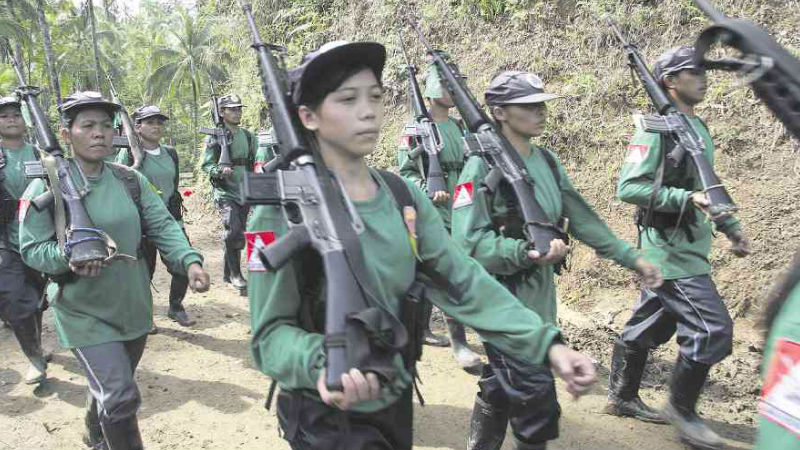
MARCHING INTO GOVERNMENT?  Armed guerrillas from the communist New People’s Army mark the rebel group’s founding anniversary in this file photo taken in 2009. Presumptive President-elect Rodrigo Duterte has said that he will offer Cabinet positions to some leaders of the communist group. DENNIS JAY SANTOS/INQUIRER MINDANAO

MARCHING INTO GOVERNMENT? Armed guerrillas from the communist New People’s Army mark the rebel group’s founding anniversary in this file photo taken in 2009. Presumptive President-elect Rodrigo Duterte has said that he will offer Cabinet positions to some leaders of the communist group. DENNIS JAY SANTOS/INQUIRER MINDANAO
Presumptive President-elect Rodrigo Duterte is considering granting a general amnesty to all political prisoners as a first step toward ending a communist insurgency that has torn the nation apart for over half a century.

Bayan Muna Rep. Carlos Zarate said Duterte revealed his plan during a meeting with an emissary of the National Democratic Front of the Philippines (NDFP) and members of the Makabayan bloc in the House of Representatives late Monday in a bid to restart stalled peace talks under the Aquino administration.

In his first news conference following the May 9 elections, Duterte said, “If I am satisfied that we are dealing in good faith, I will consider releasing all political prisoners.”

Human rights group Karapatan said it had documented at least 543 political  prisoners—18 of whom were NDFP  consultants. Of the number, 88 are suffering from various illnesses while 48 are elderly.

The most prominent prisoners are Communist Party of the Philippines (CPP) chair Benito Tiamzon and wife Wilma who were arrested in March last year.

Zarate said that Duterte had thought of releasing all the political  prisoners in one big wave rather than doing it in batches.

The NDFP emissary, who requested anonymity, said that the meeting with  Duterte on Monday bolstered confidence in his incoming administration and raised not only the possibility of a ceasefire but also a chance to hammer out a final peace agreement.

Asked how the communist movement would respond if the Duterte administration declared a ceasefire, the NDFP official said that the communist-led New People’s Army would reciprocate.

He said one of the possibilities would be for communist  guerrillas, while keeping their arms, would temporarily cease all military operations.

The NDFP official said that another option was for both parties to reposition  all their forces to avoid hostilities during the ceasefire and the  negotiations.

“But vital in this is the creation of a ceasefire monitoring committee to  ensure that the ceasefire agreement is being observed,” he  said.

From a peak strength of over 20,000, the NPA is now down to 4,000 men under arms, according to the military.

In the Hague Joint Declaration in 1992, both parties agreed to tackle  substantive agenda including human rights and international humanitarian  law, socioeconomic reforms, political and constitutional reforms, end of  hostilities and disposition of forces.

In March 1998, both parties signed the Comprehensive Agreement on Respect  for Human Rights and International Humanitarian Law.

The government and the NDFP panels have already formulated their drafts for  the Comprehensive Agreement on Socioeconomic Reforms but the  process has not made any progress after the talks hit a snag.

The NDFP official said his side was prepared to meet with Duterte’s team  to start talking about the reform program.

However, the NDFP official said that it would be important for the  resumption of the talks if both Duterte and NDFP chief political consultant  Jose Maria Sison, 77, founding CPP chair who has been living in exile in The Netherlands for three decades, would meet first.

“The meeting between them is not a precondition but it would help hasten  the process of the talks,” he said.

The communist insurgency has claimed more than 30,000 lives since the 1960s.

President Aquino revived the on-again-off-again peace talks soon after taking office in 2010. Talks collapsed three years later after the government accused the communist negotiators of insincerity.

http://newsinfo.inquirer.net/786114/general-amnesty-for-reds

'THANKS BUT...' | Reds to name nominees but say change in govt policies more important than posts

From InterAksyon (May 18): 'THANKS BUT...' | Reds to name nominees but say change in govt policies more important than posts


Communist rebels acknowledged presumptive president Rodrigo Duterte’s offer of four Cabinet positions but said he “knows fully well that what is more important to the revolutionary forces are the necessary changes in the policies and programs that govern these departments and the entire government."

Meanwhile, an interview with radio station dzMM, Luis Jalandoni, chief negotiator of the National Democratic Front, said Wednesday they would enter into peace talks with Duterte and ask him to add four of their political allies to his cabinet.

The Communist Party of the Philippines said in a statement that it viewed the offer of the agrarian reform, environment, social welfare and labor portfolios “an acknowledgement of the strength and political standing of the CPP and revolutionary forces, its effective representation of the interests of workers, peasants, minorities and the broad masses as well as its work in protecting the environment."

The Netherlands-based Jalandoni said the rebels were expected to shortly exchange delegation visits with the Duterte camp "as part of the process for preparing the resumption of peace talks" as well as to iron out terms of cooperation.

Both Jalandoni and CPP founder Jose Ma. Sison said no guerrillas would actually serve in Duterte's cabinet prior to reaching a political settlement, when the insurgents hoped to lay down arms and join a coalition government.

"We have relayed to president-elect Duterte that (guerrilla) personnel themselves would not be taking up government posts, but we will recommend a list of qualified, competent and dedicated persons that could fill the posts," Jalandoni said.

At the same time, the leading organ of revolutionary forces that have been waging an armed struggle to establish a socialist state for almost half a century, waxed optimistic about the prospects of negotiating peace with the incoming administration.

The CPP said it “looks forward to forging an alliance for national unity, peace and development with the Duterte government based on clearly stipulated principles and policies of national sovereignty and social justice.”

Jalandoni also told dzMM the rebels would consider a ceasefire and would ask the Duterte government to release 543 political prisoners.

And beyond this, it welcomed “the possibility of joining presumptive president Duterte in an alliance government, whether in the form of assigning cabinet positions to the CPP or its endorsees or some other more radical form of unity government which the maverick new president might be open to consider."

For all these to be possible, however, the CPP stressed that “a U-turn in the neoliberal policies of the past three decades, to say the least, must be carried out."

"These include, among others, the need for genuine land reform, industrialization and economic development, jobs, ending US troop presence and many others," it said.

At any rate, the CPP said Duterte should follow up his offer “with a more thorough discussion of policies through peace negotiations with the (National Democratic Front of the Philippines) which is an excellent opportunity to discuss the socio-economic issues confronting the people."

It also urged him to “engage in discussions with workers, peasants and other mass-based organizations to enable him to listen to their grievances and see the urgent need to address their situation with substantial changes in policy."

Earlier, the CPP’s central committee, while welcoming the possible resumption of peace talks and an alliance with the incoming government, said its forces “must relentlessly criticize and oppose any and all anti-people and pro-imperialist policy and measure.”

“There will be no honeymoon with the Duterte regime,” it declared.

At the same time, it said the New People’s Army “must continue to carry out the tasks set forth by the CPP central committee to intensify the people’s war by launching more frequent tactical offensives and seizing more arms from the enemy.”

http://interaksyon.com/article/127926/thanks-but--reds-say-change-in-govt-policies-programs-more-important-than-posts

Fate of 19 Lahad Datu intrusion accused to be decided June 20

From the Malay Mail Online (May 17): Fate of 19 Lahad Datu intrusion accused to be decided June 20

 The High Court here today tentatively fixed June 20 to decide on the fate of 19 accused in the Lahad Datu intrusion case.

Justice Stephen Chung tentatively fixed the date after the defence closed its case today, having called 20 witnesses over 24 days since Feb 25.

He also fixed June 10 for hearing of submissions by both parties.

The prosecution began its case on Jan 6, 2014 with 30 individuals — 27 Filipinos and three local men — accused of various offences linked to the armed intrusion at Kampung Tanduo in Lahad Datu in February 2013.

The prosecution had called 166 witnesses over 239 days of proceeding which ended on Jan 5.

On Feb 5, Chung ordered 19 of the 30 accused to enter their defence after finding that the prosecution had succeeded in establishing a prima facie case.

However, on Feb 23-24, nine of the 19 chose to plead guilty but the judge reserved sentencing after the defence closed its case.

Four of the nine each had two charges brought against them — waging war against the Yang di-Pertuan Agong and being members of a terrorist group — but only pleaded guilty to being members of a terrorist group.

Meanwhile, the prosecution and defence debated on whether it was admissable to tender an affidavit of a prosecution witness as evidence in the defence trial today.

Philippine Notary Public and lawyer Takahiro Kenjie Cinco Aman said on May 3 this year, he received a request from a woman to notarise the affidavit at his office in Manila.

Counsel Datuk N Sivananthan said according to Sections 74 and 78 of the Evidence Act 1950, an affidavit that bore the seal of a notary public could be tendered as evidence.

However, deputy public prosecutor Mohd Dusuki Mokhtar contended that the affidavit did not fulfil Section 424 (1) (d) of the Criminal Procedure Code as the affidavit was not sworn before an officer exercising consular functions on behalf of the Malaysian government in the Philippines.

He also noted that under Malaysian law, affidavits were private documents.

Chung ruled that the affidavit of the prosecution witness, who was identified as PW165, was not admissable to be tendered as evidence.

He also said he was unaware that the witness, who was given protection, had been deported back to the Philippines.

 “This affidavit comes as a surprise. The defence had chosen not to call PW165 to substantiate the affidavit,” he said.

Thirteen Filipinos, including a woman, and a local had entered their defence in the High Court that sat at the Sabah Prison Department, for offences allegedly committed between Feb 12 and April 10, 2013.

Some of the accused are facing one to multiple charges of being members of a terrorist group and waging war against the Yang di-Pertuan Agong.

Others are alleged to have wilfully harboured individuals they knew to be members of a terrorist group, or solicited or gave support to a terrorist group. — Bernama

http://www.themalaymailonline.com/malaysia/article/fate-of-19-lahad-datu-intrusion-accused-to-be-decided-june-20

Benham Rise: Philippines's ‘new territory’

From the Philippine Star (May 18): Benham Rise: Philippines's ‘new territory’


Divers touch and collect data on benthic life from the bottom of Benham Rise, a new Philippine territory off the eastern coast of Aurora province. File photo/Benham Rise Program

The Philippines has gained a “new territory” through the United Nations Convention on the Law of the Sea (UNCLOS)’s ruling on the 13 million-hectare Benham Rise.

Situated about 250 kilometers east of Dinapigue, Isabela, the region also known as Benham Plateau has untapped natural resources and is said to be wider than Luzon, Samar and Leyte combined.

Until 2012, this seismically active underwater region and extinct volcanic ridge had not been included as part of the archipelago, despite the Philippines being the only country within 200 nautical miles of the plateau.

Historical data sourced from Wikipedia show that the plateau is named after American admiral and geologist Andrew Benham. It was first mapped in 1933, long before it was to be acknowledged as part of the Philippine continental shelf.

Eventually, on April 8, 2001, in compliance with the requirements of UNCLOS, the Philippines lodged a partial territorial claim on the vast, largely unexplored territory with the UN Commission on the Limits of the Continental Shelf (UNCLCS).

In April 2009, the Philippines went further by lodging a full territorial claim that Benham Rise was part of its continental shelf and territory.

The Philippine claim was embodied in Republic Act No. 9522 or the Archipelagic Baselines Law.

The UN, through UNCLOS, finally recognized and officially approved the Philippine claim on the territory on April 12, 2012.

The awarding of Benham Rise to the Philippines brought to 43 million hectares the total land area of the country – from 30 million hectares.

Benham Rise has been part of ancient Filipino culture.  Ancient Catanduanes (Bicol region, to Benham’s south) people fished and roamed the area long before colonial times, Wikipedia noted.

In recent years, several scientific surveys have been conducted on Benham Rise.
The Philippine government has also been exploring the possibility of mapping new gas fields on the ridge.

Aside from the expansion of territory, the Philippines will also benefit from mineral and gas deposits in the region.

Initial research findings have shown that there are massive mineral and gas deposits in the plateau. Furthermore, solidified methane was found during mapping operations. Hence, the region is believed to have vast oil deposits.

Sen. Juan Edgardo Angara has said the underwater region in the Philippine Sea “is a good alternative for the Malampaya gas fields.”

Two years ago, a government-funded exploration and survey were conducted at Benham Bank, the plateau’s shallowest part about 50 meters deep, on the research vessel of the Department of Agriculture-Bureau of Fisheries and Aquatic Resources (DA-BFAR).

The program, billed “Exploration, Mapping and Assessment of Deep Water Areas,” was funded by the Los BaƱos-based Department of Science and Technology-Philippine Council for Agriculture, Aquatic and Natural Resources Research and Development (DOST-PCAARRD). It was headed by Cesar Villanoy with Carlos Primo David and Hildie Maria Nacorda as project leaders.

The program is being implemented by the University of the Philippines Diliman-Marine Science Institute, UPD-National Institute of Geological Sciences and UPLB-School of Environmental Science and Management.

A collaboration among UP Diliman, UPLB and DA-BFAR, the program was backstopped by scientists, researchers and seasoned dive specialists from UP Mindanao, UP Baguio, Xavier University and Ateneo de Manila University and from the local diving industry.

The pioneering research project initiated the assessment of the benthic marine biological features and resources of the Benham Bank seamount, contributing to efforts to document deep-water biodiversity in the Philippines.

“Knowledge about these features and resources may also be linked to the productivity of the Benham Rise region, where fishing activities have been known to occur even before the country was awarded the claim,” Villanoy and Ma. Adela Corpuz said in a joint report.

Results of the survey, they added, include identification of four species of Halimeda and 15 genera of associated epiphytic algae and corals.

“These data and other related scientific information will input to the knowledge/status of the Philippine deep sea biodiversity, resource planning and management,” Villanoy and Corpuz said.

The exploration of Benham Rise is one of the many researches and development institutions on aquatic concerns supported by DOST-PCAARRD.

http://www.philstar.com/headlines/2016/05/18/1584439/benham-rise-philippiness-new-territory

Challenge China ‘expansionism’ over disputed islands, Duterte told

From the Philippine Daily Inquirer (May 18): Challenge China ‘expansionism’ over disputed islands, Duterte told

The administration of presumptive President-elect Rodrigo Duterte must continue to challenge the “expansionism” of China over the West Philippine Sea (South China Sea), a think tank has said.

The ADR Institute for International Studies (ADRi) said the pending arbitration case on China’s claims over our disputed islands should be “a major policy decision that the next President must address.”

READ: Global protest set at UN against China ‘expansionism’

“While Asia recognizes that China has long been an important force for economic prosperity and security in the region, there is resistance when Beijing becomes overzealous in asserting this dominance,” said ADRi President Dindo Manhit in a statement released Tuesday.

Ernie Bower, chairman of the Center for Strategic and International Studies Southeast Asian Studies, said countries in the Asian region expect China to participate in “regional rule-making.”

“What China’s Asian neighbors want is a China that feels secure, is prosperous economically, and actively participates in regional rule-making,” said Bower.

However, he said countries in the Asia fear that China may feel the need “to change the rules around security and economic norms” in the said region.

READ: Expert unmasks China strategy of ‘creeping expansion’

“China will be an influential and positive force for economic prosperity, regional security, and peace if it takes time to listen to its neighbors and partners. That is an outcome the rest of the world has a great interest in promoting” said Bower.

While we continue to assert our territorial claims in the West Philippine Sea, Manhit said the government must commit to a “development diplomacy.”

Manhit said “it is possible to challenge China’s expansionism while conducting the routine mandates of the foreign service, like helping our OFWs (overseas Filipino workers), as well as pursuing economic security by promoting trade and investment.”

Manhit said the Philippine Foreign Service should be recalibrated to include political and economic reporting, trade promotion, and negotiation and pushing for the passage of the National Security Act.
http://globalnation.inquirer.net/139516/challenge-china-expansionism-disputed-islands-duterte-told