Thursday, January 21, 2016

IN PHOTOS: Red God Defenders

From Rappler (Jan 20): IN PHOTOS: Red God Defenders

Members of a newly-formed armed Christian group in Mindanao have come out in public to show their strong opposition against attacks by ISIS-inspired organizations in their communities

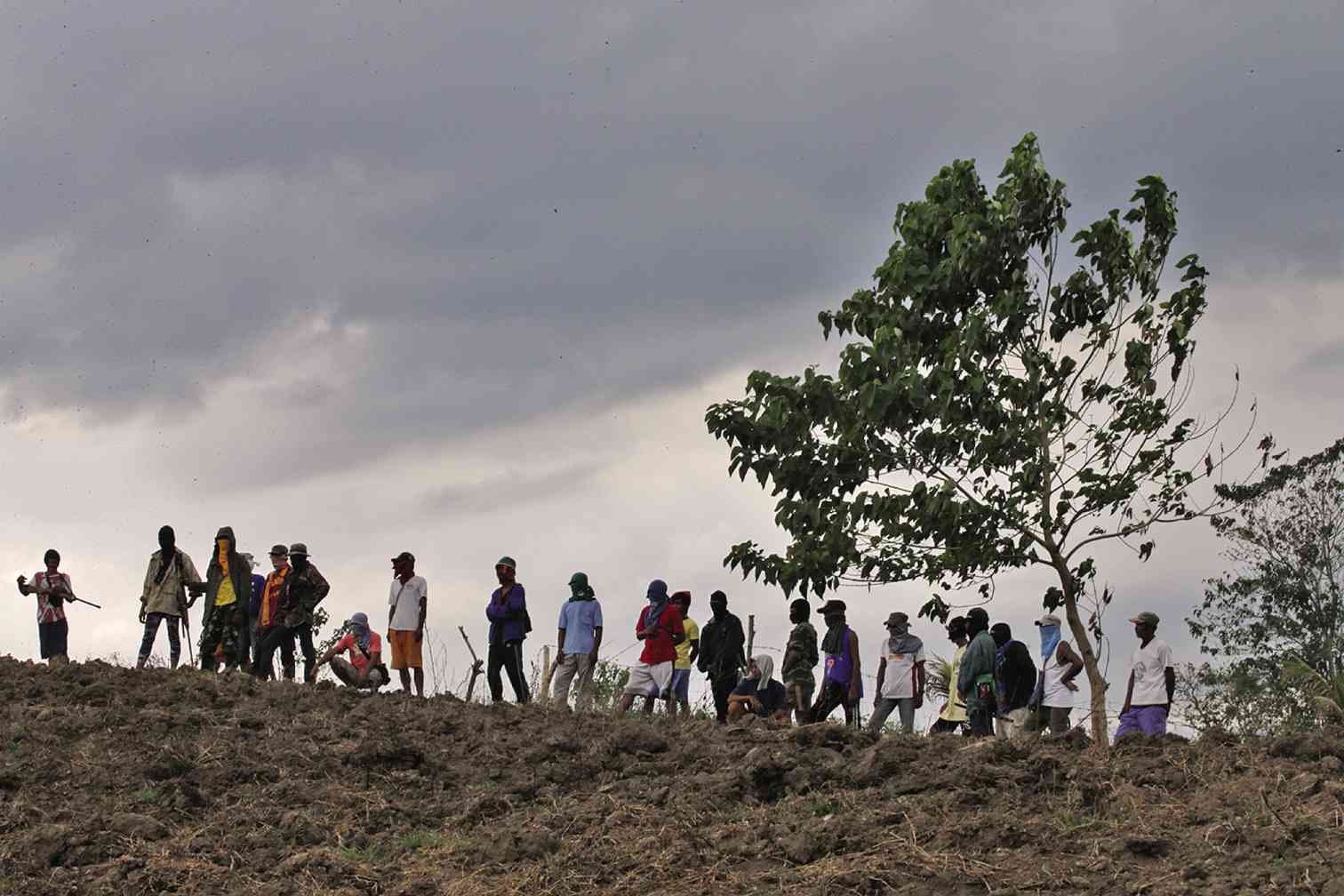
Members of armed Christian group calling themselves Red God Defenders set on fire a replica of Islamic State of Iraq and Syria flag during a gathering Tuesday, January 19, 2016 somewhere in the mountains of Central Mindanao in the southern Philippines to show their strong opposition over attacks against civilians as well plans of Islamic terror Organization of putting up their own province in the restive south.

CENTRAL MINDANAO, Philippines – Concerned citizens have banded themselves into a group they call "Red God Defenders," whose primary goal is to protect their lands, families, and people from attacks by the Bangsamoro Islamic Freedom Fighters (BIFF), a splinter group of the Moro Islamic Liberation Front (MILF).

DEFENDERS. Members of the Red God Defenders after their gathering Tuesday, January 19, 2016, somewhere in Central Mindanao. All photos by Jeoffrey Maitem/Rappler

DEFENDERS. Members of the Red God Defenders after their gathering Tuesday, January 19, 2016, somewhere in Central Mindanao. All photos by Jeoffrey Maitem/Rappler

The group's spokesman, Brother Asiong, said they were forced to arm themselves as they were being attacked by lawless elements even if they were just civilians working on their farmlands.

"Lawless elements will harass us if the military is gone. At least we can defend ourselves," he said.

ARMED. A Red God Defender soldier with an AK-47 rifle obtained from the MILF.

ARMED. A Red God Defender soldier with an AK-47 rifle obtained from the MILF.

READY TO PROTECT. Apart from usual guns and rifles, they are also armed with swords.

READY TO PROTECT. Apart from usual guns and rifles, they are also armed with swords.

ON GUARD. A Red God Defender member checks the perimeter for lawless elements near their village.

ON GUARD. A Red God Defender member checks the perimeter for lawless elements near their village.

The group had been fighting for their rights over lands which the government had already given them. Their security situation, said Asiong, only became complicated with the presence of the BIFF.
 
He clarified that their weapons did not come from political officials or groups. They acquired bought them from some "moles" in the MILF.

PRAY OVER. A leader prays over members of the group during the gathering.

PRAY OVER. A leader prays over members of the group during the gathering.

Since the 1970s, Asiong said more than 60 people from their side have been killed by rebels.

READY. A Red God Defender member waits for the start of their weekly meeting.

READY. A Red God Defender member waits for the start of their weekly meeting.

http://www.rappler.com/nation/119635-in-photos-red-god-defenders

Marcelino entitled to presumption of innocence —Navy spokesman

From GMA News (Jan 21): Marcelino entitled to presumption of innocence —Navy spokesman

Marine Colonel Ferdinand Marcelino is still entitled to the constitutional presumption of innocence, the spokesman for the Philippine Navy said on Thursday afternoon.
 
Col. Edgard Arevalo, Navy spokesperson on Col. Marcelino’s case: We will go through the investigation process. http://www.gmanetwork.com/radio/streaming       
Col. Edgard Arevalo, Navy spokesperson: Entitled pa rin siya (Col. Ferdinand Marcelino) sa presumption of innocence.

Colonel Edgard Arevalo, nonetheless, told radio station dzBB that the Navy was a professional organization.

"We do not condone any illegal activity among our members," Arevalo told radio anchors Orly Trinidad and Glenn Juego.

"Justice will be served," he added.

According to Arevalo, Marcelino was still at his post at the Navy Candidate Officer Pool in Zambales as late as 7 p.m. on Wednesday night.

Marcelino on Thursday morning reportedly informed his superior officer that he went to Manila to come to the aid of a former subordinate.

A former agent of the Philippine Drug Enforcement Agency, Marcelino was arrested by PDEA agents in a raid that netted 63 kilos of suspected shabu from a safehouse in Sta. Cruz, Manila on Thursday.

Marcelino claimed innocence, saying that he was also at the scene as part of an an anti-drug operation.

"This is an operation ... nagkasalubong lang yan e ... alam ng tropa yan," Marcelino told reporters.
 
"Puntahan ninyo ako doon sa PDEA.... I am invoking my right to give.... na ipaliwanag ito. Bakit ayaw nila akong bigyan ng pagkakataong magpaliwanag," he added.

Former PDEA chief Dionisio Santiago who worked with Marcelino at the anti-drug agency vouched for Marcelino's character but added that he would have to defer to the findings of further investigation.

"Tingnan natin kung siya's bida o kontra-bida," Santiago told dzBB.
 
 http://www.gmanetwork.com/news/story/552123/news/metro/marcelino-entitled-to-presumption-of-innocence-navy-spokesman

New Philippine Coast Guard commandant takes oath

From GMA New (Jan 21): New Philippine Coast Guard commandant takes oath

Rear Admiral William Melad took his oath Thursday as the 26th commandant of the Philipine Coast Guard before Transportation Secretary Joseph Emilio Abaya.

President Benigno Aquino III approved Melad's appointment vice Admiral Rodolfo Isorena who retired last October.

Melad had served in an acting capacity prior to Thursday. Melad is a member of the Philippine Military Academy "Matikas" Class of 1983. 

http://www.gmanetwork.com/news/story/552127/news/nation/new-philippine-coast-guard-commandant-takes-oath

Search for jihadists stepped up

From The Standard (Jan 21): Search for jihadists stepped up

AFTER increased terror activity in Indonesia and Malaysia, the military said on Wednesday it would step up its search for four Indonesian jihadists who are believed to be seeking refuge with local extremists.

Military sources, who asked not to be identified, identified the four as Arsyad Sagoni, 43; Suwito Tujimon, 23, Anuar Yancong, 27; and Amir Nanggi, 43, all Buginese Indonesians who fled Sulawesi after Jakarta cracked down on Islamic militants with apparent links to international terror group IS.

The source said the military had already known of the presence of the four Indonesians in Mindanao even before Indonesian militant Sucipto Ibrahim Ali, alias Abdul Fatah, was killed in a clash with soldiers in Sultan Kudarat last November.


The military said at that time that Sucipto is known to be a member of the Mujahidin Indonesia Timur and slipped into the country with other foreigners and are now hiding with members of Ansar al-Khilafah Philippines, a new group of jihadists in Mindanao.

But the military insisted that the presence of these foreign jihadists in Mindanao did not mean that the terror group Islamic State of Iraq and Syria had already established a presence in the country.

“Our intelligence community has not reported the presence of ISIS in the region, although the military and police are not taking chances,” said Capt. Patrick Martinez, spokesperson of the army’s 4th Infantry Division in Cagayan de Oro.

He said that the military and police have stepped up intelligence gathering in the region to check on terror groups, particularly ISIS members.

Martinez, however, said that the military is also appealing to the civilian populace to be on guard against suspicious groups or activities in their areas.

The military would immediately respond to any form of threat that might evolve with the presence of suspected terror groups in any part of Northern Mindanao, he said.

The military’s 4ID covers the 10 provinces and about 12 cities, including the port capital city of Cagayan De Oro in Northern Mindanao.

On Tuesday, Armed Forces Chief of Staff Hernando Irriberi himself confirmed that the military is looking for nine foreign terrorists, among them five Malaysian jihadists, who are believed to be hiding with extremists in Mindanao.

The Malaysians were identified as University Malaya lecturer Mahmud bin Ahmad, former Selayang Municipal Council employee Muhammad Joraimee Bin Awang Raimee, Mohammad Amin Baco and Jeknal bin Adil.

Malaysian authorities had asked government officials to tracked the whereabouts of their wanted compatriots who sought sanctuary in Mindanao shortly after IS had recruited them to join the Islamic militant group.

Meanwhile, a leading academician at the Western Mindanao State University said the government should not discount the possibility that ISIS or an ISIS-stirred group might set-up a “base” in Mindanao.

Professor Eddie Ladja, dean of WMSU’s College of Asian and Islamic Studies, said Mindanao is vulnerable to possible infiltration of foreign terrorist because of the loose security in the region and the porosity of the country’s borders with Malaysia and Indonesia.

Ladja suggested that the government properly addressed the pressing issue of terrorism in order to deter the potential said these issues should be addressed properly by the government to prevent the possible growth along with setting-up of bases of foreign terrorist in the country.

http://thestandard.com.ph/news/-main-stories/top-stories/197321/search-for-jihadists-stepped-up.html

Abu Sayyaf man who surrendered to AFP was a gov’t soldier, says rido drove him to banditry

From the Philippine Daily Inquirer (Jan 21): Abu Sayyaf man who surrendered to AFP was a gov’t soldier, says rido drove him to banditry
ISABELA CITY, Basilan – Sulaiman Kasaran was once a soldier of government but for the past five years, he, his sons and nephews were Abu Sayyaf bandits and fugitives.

“It all started from a misunderstanding with the Mallatin family that developed into a rido. Mallatin was close to the military and we were (eventually) categorized as Abu Sayyaf. We had no choice then but to side with the group of Nurhassan Jamiri,” Sulaiman, 65, said.

But life with the Abu Sayyaf as Abu Jaid was not the thing he dreamed of for himself and his three children, Sulaiman admitted. He wanted to be free to move around and give them real education.

Besides, he fought for the government as a soldier under the 30th Infantry Battalion although he was subsequently removed for having been absent without leave (awol).

On Monday and Tuesday, Sulaiman and his three sons and three nephews finally yielded to the military in Barangay Camalig in Ungkaya Pukan town.

The surrender of the Kasarans, the first such act by any Abu Sayyaf member, did not come easy.

In October 2014, Col. Enerito Lebeco, commander of the 18th Infantry Battalion, sought them out and tried to convince them to return to the fold of the law.

“I reviewed their backgrounds. If we want peace, we have to touch base and see face to face these people perceived as lawless.  After talking to them, I realized that some of them were forced to support the other side because of rido,” Lebeco said as he recounted how he started the negotiations.

He said Sulaiman’s family was embroiled in a bloody feud with the family of Moro Islamic Liberation Front (MILF) commander Umbong Mallatin.

That feud drove all of the Kasaran clan members to join the Abu Sayyaf as they felt the bandit group could protect them, Lebeco said.

But over the years, the elderly Kasarans died one after another because of clashes with government troops.

Lebeco said only Sulaiman remained of the elderly Kasarans.

The negotiations for the surrender of Sulaiman and his kin struck a positive chord when Mallating recently died of an unspecified illness, he said.

Sulaiman recounted that Lebeco came to them “un-escorted, wearing shirts and shorts and unarmed.”

“We saw in his face sincerity,” he said.

Sulaiman said he later agreed to surrender, and on Monday and Tuesday, he and his kin came out of their hiding places and yielded to the military. They also surrendered seven assorted firearms, including six high-powered assault rifles and grenade launchers.

Maj. Gen. Gerardo Barrientos Jr., commander of the Army’s 1st Infantry Division, said the surrender was “a clear victory for the people of Basilan who yearn for peace and desire to live lawfully and peacefully.”

It was also the first time for Abu Sayyaf members to surrender, he said.

Asked if any of the Kasarans were facing cases in court, Barrientos said he knew of nothing so far.

Based on military profiling, the Kasarans had undergone training on improvised explosives device, Islamic radicalism and military tactics. They were closely associated with the group of Jamiri, Furuji Indama and Isnilon Hapilon – who were hardened Abu sayyaf leaders involved in various attacks in Basilan.

Col. Rolando Joselito Bautista, commander of the Army’s 104th Infantry Brigade, said that the surrender of the Kasarans proved that talking peace with the Abu Sayyaf could produce results.
He said he expressed hope that more bandits would surrender in the future.

As this developed, Gov. Jum Akbar said the provincial government handed forms of assistance to Sulaiman and his three children, Marwin, Derwin and Halid; and his nephews, Hadzmin Kuluman Kasaran alias Ammin, Faisal Laudmin Kasaran alias Issa and Ballie, and Salman Najallon Kasaran alias Sat and Mhanz.

Sulaiman said the assistance they got would be spent on the education of his children and the purchase of farm implements.

http://newsinfo.inquirer.net/757704/abu-sayyaf-man-who-surrendered-to-afp-was-a-govt-soldier-says-rido-drove-him-to-banditry

How did Islamic State establish a franchise in southeast Asia?

From The Telegraph (Jan 21): How did Islamic State establish a franchise in southeast Asia?

Islamic State terrorists now pose a threat – not only in Indonesia, the largest Muslim democracy in the world, but also across southeast Asia more generally and even Australia

The bomb attack on 14 January in Jakarta, which killed 7 people – modelled on the Paris attack in November 2015, but without the same impact in terms of creating fear, panic and death – demonstrated the threat that Islamic State of Iraq and the Levant (Isil) now poses not only in Indonesia, the largest Muslim democracy in the world, but also to southeast Asia more generally and even Australia.

The attack on the Sarinah shopping centre in the upmarket district of Menteng last week was the first in the Indonesian capital since July 2009 when the surviving remnant of the violent wing of Jemaah Islamiyah (JI), al-Qaeda’s south-east Asian franchise, bombed the Marriott and Ritz Carlton hotels a few blocks away from the latest incident.
 
Islamic state in southeast Asia
 
Islamic State has now replaced JI as the source of regional violent Islamism. More importantly, Isil has inherited its regional structure, its ideology, and its strategy from JI. Significantly, Abu Bakr Bashir, the ‘emir’ of JI, currently serving a sentence for treason in Cipijang jail, pledged allegiance to Isil in 2014. Yet until last week it had seemed that the former al-Qaeda linked franchises in southeast Asia, which included not only JI, but Abu Sayyaf in the Philippines and the Kumpulan Mujahideen Malaysia, had been decapitated and the curtain closed on this particular theatre of global salafist jihadism.
 
However, although the first generation leadership of JI, which had coordinated the Bali bombings in 2002, had either been eliminated or imprisoned by 2009, its ideology and its networks remained in place. It now appears that this previously dormant structure has reawakened.
 
Indonesian radical Muslim cleric Abu Bakar Bashir greets supporters inside a courtroom following the first day of an appeal hearing in Cilacap, Central Java province, January 12, 2016
 
Abu Bakr Bashir  Photo: Reuters
 
The evolution of a Southeast Asian terror network

Historically, JI evolved as an al-Qaeda linked grouping in southeast Asia in the course of the 1990s. Founded by Indonesian salafists Bashir and Abu Sangkar in Johor, Malaysia, after they fled the authoritarian but nationalist Indonesian New Order regime, JI, like Isil, drew together former Mujahideen who had fought in Afghanistan from across the region.
 
The evolving jihadist network linked Indonesian Islamists alienated from the New Order, like Riduan Isamuddin (aka Hambali) with Malaysian salafists disillusioned with both the Malaysia’s Islamic party, Parti Islam Se-Malaysia, and the ruling United Malay Nationalist Organisation’s (UMNO) failure to impose sharia law in the multiethnic state, and with Abu Sayyaf founded by returning Moro fighters in Muslim majority southern Philippines.
 
After the collapse of the New Order, in 1998, JI’s core leadership returned to Solo in Central Java whence it continued both recruitment and consciousness raising activities. The Bali bomber Imam Samudra was a graduate of this programme as is the current coordinator of Islamic State in southeast Asia, Bahrun Naim. By 2000, the network had direct links to al-Qaeda and the September 2001 Trade Center bombings through Khalid Sheikh Mohammed.
 
 
Khalid Sheikh Mohammed
 
Khalid Sheikh Mohammed  Photo: AP
 
JI’s ambition like that of Isil was to coordinate the various Islamist struggles in southeast Asia into a coherent movement to create a Southeast Asian caliphate or Darul Islam Nusantara. The strategy draws essentially localised, separatist struggles in southeast Asia into an evolving, but loose network of transnational jihadism. Jemaah Islamiyah evolved as a regional network constituted through kin groups, marital alliances, cliques and radical pesantren (religious schools) between 1985 and 2000.
Isil takes over the network

Isil has evidently inherited both the structure and the salafist theo-political vision strategically conceived in terms of regional and transnational networks.
 
Southeast Asian recruits to Isil and returning fighters reinforce the linkages. In its Southeast Asian manifestation, we can trace this ideal, if not the strategy, back to the Darul Islam movement in Indonesia that dates from the struggle against the Dutch colonial power in the 1940s and subsequently adumbrated by the influence of Muslim Brotherhood ideologists like Sayeed Qutb.
In fact long before the end of the Soviet occupation of Afghanistan, which is often seen as the first intimation of an Islamist internationale, pan-Islamist thinkers in southeast Asia ’like those in the Middle East’ conceived resistance to jahiliyya (the state of ignorance) as a single, unified global struggle that transcended local, state and regional concerns.
 
The story of al-Qaeda, and now Isil, is essentially how a transnational movement aligns itself with local militant groups with country-specific grievances to increase their global reach and influence. Jemaah Islamiyah – and now Isil – provide a case study of how regional groupings come to share an ideology and a strategy whilst at the same time sustaining their own distinctive character, structure and practice.
ASEAN’s ambiguity

After 9/11 and especially after Bali, Indonesian, Malaysian Singaporean and Australian governments that had previously dismissed a coordinated Islamist threat in southeast Asia took the JI and Abu Sayyaf threat seriously. In particular collaboration with Australian Federal Police and US intelligence enabled the new Indonesian counter-terrorist police, Densus 88, to kill or imprison the core leadership of JI. Elsewhere, the Malaysian and Singaporean authorities undermined JI’s structures in their respective countries.
 
 
The wreckage of the Sari nightclub following the 2002 Bali bombings
 
This notwithstanding, one common factor is that the countries where JI and now Isil have proliferated, all belong to the Association of Southeast Asian Nations (ASEAN). ASEAN has consistently failed to develop a coordinated counterterror policing response to the regional protagonists of transnational Islamism. As a consequence, with the rise of Islamic State and the development of its recruitment and grooming strategies online, it is calculated that IS has recruited close to 1000 fighters from southeast Asia, many of whom have evidently returned to open a new front in the region.
 
Thus, whilst JIs structure in the 1990s consisted of an ‘emir’ presiding over a governing council (Markaz), which oversaw four regional spheres of operation or Mantiqi, Isil has, by contrast, expanded its outreach activities across Southeast Asia and formed a Katibah Nusantara (Malay fighting force), which operates both across Iraq and Syria and in southeast Asia.

Consequently, in January 2016, two Malaysian suicide bombers killed 30 people in Syria. Meanwhile, over the past year Malaysian authorities have foiled at least four attempts to bomb public buildings and kidnap politicians and Malay Chinese businessmen in a country where ethno-religious politics have become increasingly vitriolic since the 2014 election, which the UMNO ruling party won in a campaign riddled by corruption and electoral fraud. At the same time, in the southern Philippines a revived Abu Sayyaf has reopened training camps for regional jihadists and pledged allegiance to Islamic State.

Whilst Jakarta was the site of the most recent regional manifestation of global salafist jihadism, other capitals in the region are by no means immune.

Singapore’s Lee Hsien Loong observed in 2015 that southeast Asia had become a ‘key recruitment centre for Islamic state’ and the terror threat was ‘no longer over there it is here’. Somewhat problematically, from Lee’s perspective, ASEAN, which Singapore, Thailand Indonesia, Malaysia and the Philippines jointly founded in 1967 to promote regional stability, lacks both a shared understanding of regional security and a coordinated approach to dismantling transnational terrorism. Meanwhile, Isil exploits the idea of an integrated Islamic region to promote its version of a ‘far caliphate’ in Southeast Asia.

[David Martin Jones is Visiting Professor in the Department of War Studies, King’s College London.
 
M.L.R. Smith is Professor of Strategic Theory in the Department of War Studies, King’s College London.]


Pension hike for military and police hits snag

From the Business World (Jan 20): Pension hike for military and police hits snag

IT’S a rough ride, thus far, for the inclusion of the pension hike for retired military and police in the proposed law mandating a new round of salary hikes for government workers.
House Speaker Feliciano R. Belmonte, Jr. said a separate law is needed to fund the Senate proposal to include the increase in pension for uniformed personnel.
 
“Remember that the basic SSL (Salary Standardization Law 2015) is included in the GAA (General Appropriations Act) 2016,” Mr. Belmonte said in a statement on Wednesday.

“If the Senate will add to it, that will be another law,” he said.

According to Mr. Belmonte’s statement, the budget for the coverage of military and police retirees was not included in the P57.9 billion appropriation for the original SSL bill endorsed by the Department of Budget and Management (DBM).
 
The P57.9 billion budget has been included in the GAA of 2016, the statement said.

In a separate text message, House Majority Leader Neptali M. Gonzales II said Mr. Belmonte “might be referring to a supplemental budget.”

Mr. Gonzales said the 2016 national budget does not provide funds for the indexation of retirement benefits for military and police officers, “which according to DBM will amount to P19 billion for this year alone.”
Both chambers have already approved on third and final reading the measure modifying the compensation and position classification of civilian personnel and the base pay schedule for military and other uniformed personnel.

The Senate’s version includes the indexation of the said retirement benefits.

The Senate and House will meet on Jan. 27 to agree on one version of the measure.

The four-year SSL 4 would cover 1.53 million state employees and would cost P225.82 billion.

The compensation package is composed of a salary increase, a midyear 14th-month pay, and an enhanced performance-based bonus system.

Asked how the two chambers will reconcile their differences, Mr. Gonzales said, “It was the Senate which restored the indexation that created this problem, sila dapat magsabi kung saan kukunin pera [they should be able to say where we can get the money].”

Sought for comment, Senator Antonio F. Trillanes IV, Senate Civil Service, Government Reorganization and Professional Regulation committee chair, said in a text message: “I respect the opinion of the Speaker but we will still push for it. The negotiations are ongoing right now to resolve the impasse.”

“It will be included in the 2017 budget as back pay,” he also said.

“Let us remember that the AFP (Armed Forces of the Philippines), PNP (Philippine National Police) retirees have earned that increase through the sacrifices they made when they were still in the active service,” Mr. Trillanes noted further.

“While our countrymen were living their lives quietly, a soldier is stationed in some distant rebel-infested area just to keep them safe,” he added.

Mr. Belmonte said the Senate and the House “are determined that the bill passes both houses.”

“The SSL 2015 is something the senators and we know we have to pass. In the interest of employees,” he said.
 

Filipino protesters plan second trip to disputed Spratly islands

From the Malaya Mail Online (Jan 21): Filipino protesters plan second trip to disputed Spratly islands

Filipino protesters plan a second trip to disputed islands in the South China Sea, this time staying a month, a spokeswoman said today, after China flew a planeload of tourists to an artificial island it has built in the area.

China claims almost the entire energy-rich South China Sea, where about US$5 trillion (RM22 trillion) worth of ship-borne trade passes each year. Brunei, Malaysia, the Philippines, Taiwan and Vietnam also have claims.

Last week, Beijing allowed in its first group of tourists, most of them family of soldiers stationed on man-made Fiery Cross in the Spratly Islands, as it began test flights on the 3,000-metre (10,000-ft) runway.

 “China is now doing what we actually did last month when we landed on Pagasa (Thitu) island,” said Vera Joy Ban-eg, spokeswoman for the Kalayaan Atin Ito (Freedom This is Ours) group.

 In December, about 50 Filipino protesters, mostly students, made a three-day boat trip to Thitu, one of nine outcrops or islands occupied by the Philippines.

 “In April, we will make another voyage to our islands. This time, we will spend a month to visit all the islands we occupy in the Spratlys. We are encouraging all patriotic Filipinos to join us and fight for our territory.”

 The protesters said Filipino fishermen could no longer use their traditional fishing grounds because large Chinese coast guard ships were driving them away.

They criticise the Philippine government for not doing anything to stop Chinese fishermen from harvesting giant clams and collecting fish with dynamite and cyanide fishing.

 “China has established firm and effective control of the South China Sea,” Ban-eg said. 

http://www.themalaymailonline.com/world/article/filipino-protesters-plan-second-trip-to-disputed-spratly-islands

AFP declares Dinagat Islands as insurgency-free province

From the Philippine Information Agency (Jan 20): AFP declares Dinagat Islands as insurgency-free province

SAN JOSE, Dinagat Islands – The province of Dinagat Islands was recently declared as insurgency-free province by the Armed Forces of the Philippines (AFP).

The announcement was sealed by the signing of the Memorandum of Agreement (MOA) declaring the province of Dinagat Islands as Insurgency-Free Province.

As a premise, the province has never been influenced by the Communist Party of the Philippines-New Peoples Army-National Democratic Front (CNN) as its politico-military structure does not exist and the insurgency group has ceased or never existed or no records of terroristic or NPA-initiated violent incidents for the past five years.

Likewise, lawless criminal activities have come to a very manageable level which the Philippine National Police (PNP) can ably address.

With this declaration, the provincial government will build confidence among the capitalists or investors to create an environment that is conducive to socio-economic, political and cultural development – free of CNN influence.

Along with the celebration is the conferment of Plaque of Leadership Award to governor Glenda Ecleo for having exemplarily led the province in peace and order efforts being the chairperson of the Provincial Peace and Order Council (PPOC). .

http://news.pia.gov.ph/article/view/2731453253795/afp-declares-dinagat-islands-as-insurgency-free-province

Once an NPA stronghold, now a model of peace, development

From the Manila Bulletin (Jan 20): Once an NPA stronghold, now a model of peace, development

A former stronghold of the New People’s Army (NPA), armed wing of the Communist Party of the Philippines (CPP), has been transformed into a land of promise and hope, rebuilt through the collaboration of various agencies in a classic example of local teamwork or “bayanihan.”

Different agencies of the government, particularly the Philippine National Police (PNP) and Armed Forces of the Philippines (AFP), have joined hands in making the village of Lantad, the acknowledged stronghold in Mindanao of the NPA for decades, an economically viable community.

Through the agencies’ “bayanihan” effort, in cooperation with the local folk, Lantad in Balingasag town, Misamis Oriental is now considered a progressive highland village in Northern Mindanao.

This was disclosed during a meeting with key stakeholders and officials of the PNP and AFP) in Cagayan de Oro City last week.
It was noted that immense improvement in the delivery of basic services, the provision of livelihood opportunities and education for the youth has yielded positive results in Lantad.

Bayanihan activities in 2015 included second peace caravan with a theme, “Nagkahiusang Nasud alang sa Kalinaw” (One Nation for Peace), in Lianga and Marihatag towns, both in Surigao del Sur and in Loreto, Agusan del Sur.

The electrification project in Lantad, dubbed as “Light for Peace,” also signaled the entry of electricity in the area which enhanced the productivity, information and education infrastructure for its residents.

http://www.mb.com.ph/once-an-npa-stronghold-now-a-model-of-peace-development/

Bishops decry militarization, mining; push gov’t peace talks with NDF

From the often pro-CPP Davao Today (Jan 19): Bishops decry militarization, mining; push gov’t peace talks with NDF

Bishops of the Iglesia Filipina Independiente from South Central Luzon believed that mining, militarization in Lumad communities and the stalled peace talks between the government of the Philippines and the National Democratic Front of the Philippines are the reasons why the killings of indigenous peoples in Mindanao continue.

In a press conference Monday at a church compound here, IFI Obispo Maximo (Supreme Bishop) Ephraim Fajutagana said IFI priests in Mindanao are responding to problems besetting the Lumads.

I am very sad, and [I] condemn the abuses by paramilitary groups and the Armed Forces of the Philippines (AFP) as these are barbaric and an un-Christian way of treating people,” Fajutagana said.

Criticizing traditional politicians, he said, “most politicians nowadays are saying that they are with the poor, with the children, but what they should have done, especially those in the Senate and Congress is to scrap the Mining Act of 1995.”

Fajutagana said the existing militarization and red tagging of Lumad communities have resulted to the mass evacuation in different areas in Mindanao.

Some 40,000 indigenous peoples in Mindanao have evacuated their communities due to military encampment and rights abuses from the state forces.

Fajutagana said, “it is not only the lumads who are being killed and red-tagged, even the bishops are also being targeted.”

“We only shout for justice and love for the people, and those are the reasons why we are being targeted,” he added.

The IFI said it is has a relief and legal support program for the Lumads in Mindanao called “Kapit Bisig”. It aims to help the IPs by providing medical, food, and legal aid to some lumad leaders who are facing trumped up charges.

IFI priest, Father Jonash Joyohoy, project coordinator, said that it has been a long time that their church has been helping on advancing the rights of the Lumads.

He said that Kapit Bisig is “a way of showing our solidarity with the Lumads.”

Fajutagana said they do not have the financial capability to provide the Lumads all their needs.

He said that they are also inviting other non-government organizations to join in the call to support the IPs.

Fajutagana added they will be having dialogues with the state forces as they continue their call
for the two parties, GPH and NDF, to resume the stalled peace talks.

http://davaotoday.com/main/politics/bishops-decry-militarization-mining-push-govt-peace-talks-with-ndf/

Palace concerned over Chinese visitors in Kagitingan Reef

From the Philippine Star (Jan 21): Palace concerned over Chinese visitors in Kagitingan Reef


A Chinese plane lands on the new airport of Fiery Cross (Kagitingan) Reef in the West Philippine Sea. Sina

MalacaƱang has expressed concern over the arrival of Chinese visitors at a Manila-claimed reef in the West Philippine Sea.

Last week, the first Chinese visitors arrived at China's newly built airport at the Fiery Cross (Kagitingan) Reef.

"Hindi lang naman Pilipinas, kundi ang maraming bansa ang nagpahayag na ng kanilang pagkabahala sa mga kaganapang iyan," Communications Secretary Herminio Coloma said.

The visitors, composed of wives and children of soldiers and officers on the island, arrived a week after China conducted test flights in the area.

Coloma stressed the importance of upholding the Declaration on the Conduct of Parties in the South China Sea and the principles of freedom of navigation and overflight in the region.

"'Yan ang pinagbabatayan ng posisyon ng ating bansa at ‘yung ating patuloy na pagtataguyod sa mapayapang at madiplomatikong resolusyon ng mga disputes regarding maritime entitlements in the West Philippines Sea," Coloma said.

The Philippines earlier filed a protest against China's test flights on Kagitingan Reef, which elevated tensions and anxiety in the region.

China said that the test flights were conducted to determine if the airport met the standards for civil aviation.

http://www.philstar.com/headlines/2016/01/21/1544867/palace-concerned-over-chinese-visitors-kagitingan-reef

Of General Intel Interest: China publicizes landing drills near Taiwan after elections

From the Philippine Star (Jan 21): China publicizes landing drills near Taiwan after elections

Chinese forces recently held live-fire landing exercises along the coast opposite Taiwan, the military's official television channel said Thursday, days after the self-governing island elected an independence-leaning president.

CCTV7 said the drills were staged by the 31st Group Army based in Xiamen near the Taiwanese-held island of Kinmen, considered one of the People's Liberation Army's "frontline" units for any action regarding Taiwan. It said only that the exercises were held "recently" without giving an exact date.

Equipment used in the drills included long-range rockets, self-propelled howitzers, amphibious tanks and helicopters, the channel said. No details on the numbers of troops or equipment were given.

The Defense Ministry did not immediately say whether the drills were related to Saturday's election that was won by Tsai Ing-wen of the Democratic Progressive Party.

China routinely says its exercises are planned well in advance and not timed to respond to specific events.

However, noting the units involved and the physical similarity of the exercise area to parts of Taiwan's coastline, the popular Sina Military website said that "given the certain amount of risk the two sides are facing today, the hypothetical target of the 31st Group Army's exercises might be those 'Taiwan independence' separatist forces."
 
The 31st Group Army is one of three army groups within the Nanjing Military District that has primary responsibility for eventualities involving Taiwan, which China considers a breakaway province to be reunited with by force if necessary.

During the 1950s, sections of the army took part in the shelling of forces on Kinmen in a continuation of the Chinese civil war that forced Chiang Kai-shek's forces to shift his Nationalist government to Taiwan in 1949. Units of the army also joined in military drills and missile tests in 1995 and 1996 aimed at intimidating Taiwanese into voting for pro-unification candidates in the island's first direct presidential election.

That attempt at intimidation ultimately backfired as defiant voters re-elected Lee Teng-hui and the U.S. Navy stationed two aircraft battle groups into waters near Taiwan.

Tsai has refused to endorse Beijing's "one-China principle," which states that the island and the mainland are part of the same Chinese nation. However, she has also pledged to maintain the status-quo, keep open channels of communication and not to provoke China.

http://www.philstar.com/world/2016/01/21/1544955/china-publicizes-landing-drills-near-taiwan-after-elections

‘Red God’ troops vow to fight BIFF

From the Philippine Daily Inquirer (Jan 21): ‘Red God’ troops vow to fight BIFF

DARK CLOUDS hover over the gathering of an armed Christian group calling itself ā€œRed God Soldiersā€ and claiming to be a defense force set up to protect civilian communities against attacks by members of the Bangsamoro Islamic Liberation Front (BIFF). JEOFFREY MAITEM / INQUIRER MINDANAO

DARK CLOUDS hover over the gathering of an armed Christian group calling itself “Red God Soldiers” and claiming to be a defense force set up to protect civilian communities against attacks by members of the Bangsamoro Islamic Liberation Front (BIFF). JEOFFREY MAITEM / INQUIRER MINDANAO
SOMEWHERE IN CENTRAL MINDANAO—An armed group of a little more than 300 Christian settlers in this part of Mindanao has announced its presence and mission to defend communities that are steadily taking combat positions against Moro renegades and turning a struggle to be left alone in peace to a violent one.

The armed group is betraying very few clues about its membership or its leaders, but has taken the name “Red God Soldiers.”

At a gathering in a hinterland area here, the militiamen burned a replica of a black Islamic State of Iraq and Syria (ISIS) flag, a gesture that tends to show who the armed group’s sworn enemies are—members of the Bangsamoro Islamic Freedom Fighters (BIFF), a renegade group that broke off from the Moro Islamic Liberation Front (MILF) over peace talks with the government.

Members of Red God raised their assault rifles as they burned the ISIS flag replica.

Their enemy, BIFF, has been held responsible for a spate of deadly attacks on civilian communities in Maguindanao and Sultan Kudarat in December, which killed at least 11 people.

‘Brother Asiong’

A Red God leader, who called himself “Brother Asiong” and said he spoke for the group, said members of Red God have grown tired of BIFF and would no longer cower in fear of the renegade Moro rebels.

Asiong said residents of communities being threatened by BIFF would have to stand up and fight for themselves because the military is not always there to defend them.

“We are always under attack even if we are just working in our farms,” said Asiong.

“We are forced to arm ourselves. We don’t want to die without doing something,” he told a group of reporters.

Asked where their firearms come from, Asiong said some of the weapons are from rogue members of the MILF, who have been selling their guns.

He also said the existence of the group is no secret to authorities.

“The military knows about our existence and we are not violating any law because we carry our weapons only within our community … not outside,” he said.

Land feuds

Asiong also urged President Aquino to help Christian communities deal with land feuds often with Moro neighbors, which he said got worse when BIFF joined the fray.

He said land claims made by Christian settlers are legitimate and supported by documents.
“But now the rebels (BIFF) want to take them (lands) back,” said Asiong.

He said, though, that Red God is different from the “Ilaga,” or “Tadtad,” which became notorious in the 1970s and 1980s for many cases of human rights violations in their fight against communist and Moro guerrillas.

Asiong said unlike the Ilaga, Red God forces would not stray from their communities and are on a defensive stance.
http://newsinfo.inquirer.net/757326/red-god-troops-vow-to-fight-biff

Rappler Talk: The rise of ISIS in PH and Southeast Asia

From Rappler (Jan 21): Rappler Talk: The rise of ISIS in PH and Southeast Asia
 

Why is it important for ISIS to have a province in the region?


Rappler talked to Sidney Jones, head of think tank group Institute for Policy Analysis Of Conflict (IPAC).

ISIS filled the past year with a steady wave of attacks, beginning with a deadly assault against journalists in France. It was followed by assaults in Tunisia and the downing of a civilian aircraft in Egypt. The jihadist group targeted France again in November, killing over 100 innocent people in a series of well-coordinated attacks in Paris.

On January 14, the group targeted the heart of Jakarta, Indonesia. At least 7 died from the blasts that rocked a major business hub.

A video released on January 4 also shows terrorist groups from the Southern Philippines pledging allegiance to ISIS leader Abu Bakr al-Baghdadi. Terror experts say this is the last of 5 steps before the declaration of a province or a vilaya.

How will these events steer ISIS' growth outside Iraq fand Syria? Why is it important for the group to create another province in Southeast Asia?

Watch the interview here.

http://www.rappler.com/nation/119691-rappler-talk-isis-ph-southeast-asia-sidney-jones