From the Philippine News Agency (Aug 23): DND: No trouble seen in WPS
The Department of National Defense (DND) is not anticipating any war or trouble in the West Philippine Sea, its spokesperson said Thursday.
DND spokesperson Arsenio Andolong, however, said the DND and the Armed Forces of the Philippines remain committed to defending the country's sovereignty.
"We do not foresee any war with China at the moment, particulary in the West Philippine Sea, however the DND and AFP will always defend our sovereignty at all cost," Andolong said.
"We are ready to carry out mandate, however, we will do so with whatever resources we have on hand, if that would be enough well and good, if it's not we will leave it to chance but as I said we do not foresee any trouble," he added.
Despite this challenge, Andolong said that the military will continue its patrols in the West Philippine Sea.
"Basta tayo tuloy tuloy (continuous) ang patrol, regardless if we are challenged or not, because that is the mandate of the AFP," he added.
In a speech during a gathering of Visayas mayors in Cebu City Tuesday, President Rodrigo R. Duterte earlier said trouble could erupt should China attempt to unilaterally exploit resources in the West Philippine Sea.
http://www.pna.gov.ph/articles/1045775

Friday, August 24, 2018

Russia, S. Korea among top candidates for PH submarine project
From the Philippine News Agency (Aug 23): Russia, S. Korea among top candidates for PH submarine project
Russia and South Korea are among the top candidates to supply diesel-electric submarines to the Philippines, Defense Secretary Delfin Lorenzana said late Wednesday.
Lorenzana said he met with Russian Defense Minister Sergey Shoygu last August 21 at the Army Forum and Exhibition.
The following day, Lorenzana also met with Deputy Minister Colonel General Alexander Fomin at the Ministry of Defense building and talked for 20 minutes.
He left for Moscow last Aug. 16 and will return to the country on Friday (August 24).
"Napag-usapan namin ang (We spoke about) military-to-military relations, palitan ng mga sundalo sa (exchange of soldiers for) military training, port visits of (Philippine) Navy ships to Vladivostok, participation in military exercises," he said in a text message to reporters.
And while discussions took place, the Russian defense officials are aware that the Philippines is still looking for submarines suppliers.
"There are discussions. But they know that we are shopping and has yet to decide where to buy," Lorenzana added. On this matter, Russia and South Korea remains among the top candidates.
"(South) Korea is a candidate too. But the Russian-made (Kilo-class diesel-electric submarine) is better and more expensive," the defense chief said.
South Korea is offering Chang Bogo class diesel-electric submarine, a variant of the German type 209 submersible craft, which has a displacement of 1,200 to 1,400 gross tons, length of 56 to 61 meters, and range of 11,000 nautical miles. It can be armed with a variety of torpedoes.
When asked which of the two is the more preferred supplier, Lorenzana said the country is still looking for a more affordable platform.
Earlier, he said Russia is willing to provide advanced versions of its Kilo-class submarines to the Philippines through "soft loans" but clarified that the country is still looking for other sources.
Kilo-class submarines have a surface displacement of 2,350 tons, and a length of 73.8 meters, and is capable of speeds up 17 to 20 knots and can be armed with a variety of torpedoes, missiles and naval mines. It has a cruising range of 6,000 to 7,500 nautical miles.
http://www.pna.gov.ph/articles/1045736
Russia and South Korea are among the top candidates to supply diesel-electric submarines to the Philippines, Defense Secretary Delfin Lorenzana said late Wednesday.
Lorenzana said he met with Russian Defense Minister Sergey Shoygu last August 21 at the Army Forum and Exhibition.
The following day, Lorenzana also met with Deputy Minister Colonel General Alexander Fomin at the Ministry of Defense building and talked for 20 minutes.
He left for Moscow last Aug. 16 and will return to the country on Friday (August 24).
"Napag-usapan namin ang (We spoke about) military-to-military relations, palitan ng mga sundalo sa (exchange of soldiers for) military training, port visits of (Philippine) Navy ships to Vladivostok, participation in military exercises," he said in a text message to reporters.
And while discussions took place, the Russian defense officials are aware that the Philippines is still looking for submarines suppliers.
"There are discussions. But they know that we are shopping and has yet to decide where to buy," Lorenzana added. On this matter, Russia and South Korea remains among the top candidates.
"(South) Korea is a candidate too. But the Russian-made (Kilo-class diesel-electric submarine) is better and more expensive," the defense chief said.
South Korea is offering Chang Bogo class diesel-electric submarine, a variant of the German type 209 submersible craft, which has a displacement of 1,200 to 1,400 gross tons, length of 56 to 61 meters, and range of 11,000 nautical miles. It can be armed with a variety of torpedoes.
When asked which of the two is the more preferred supplier, Lorenzana said the country is still looking for a more affordable platform.
Earlier, he said Russia is willing to provide advanced versions of its Kilo-class submarines to the Philippines through "soft loans" but clarified that the country is still looking for other sources.
Kilo-class submarines have a surface displacement of 2,350 tons, and a length of 73.8 meters, and is capable of speeds up 17 to 20 knots and can be armed with a variety of torpedoes, missiles and naval mines. It has a cruising range of 6,000 to 7,500 nautical miles.
http://www.pna.gov.ph/articles/1045736
Palace concerned over possible entry of nuclear power in WPS
From the Philippine News Agency (Aug 23): Palace concerned over possible entry of nuclear power in WPS
Malacañang on Thursday expressed concern over Pentagon’s report that China may bring nuclear power in the disputed West Philippine Sea.
"We're concerned about the entry of any and all nuclear weapons into the Philippine territory because our Constitution provides that we are a nuclear-free zone,” Presidential Spokesperson Harry Roque said when asked for comment during a Palace press briefing.
Roque said even an Association of Southeast Asian Nations (ASEAN) treaty declared that the whole ASEAN should be a nuclear-free zone.
He said the nuclear-free policy should be observed by all countries.
“We are concerned about the possibility that any foreign power, be it America, Russia, China may bring nuclear warheads into our territory and into ASEAN which is declared as nuclear-free zone,” he said.
Roque, however, said it is not for the Philippines to verify the “US observation”.
“That is a US observation. We are not in a position to verify that. As you correctly said, it is even in the nature of speculation. It is a possibility, according to the American sources. So we leave it at that,” he said.
China has denied the US report which it called “total disregard of facts, makes presumptuous and irresponsible comments on China’s national defense development”.
“China stays committed to a peaceful development path and follows a national defense policy that is defensive in nature,” China’s Foreign Ministry spokesperson Lu Kang said in a press statement on August 18.
“It is always a builder of world peace, contributor to global development and defender of international order,” he added.
The Chinese official said their national defense development aims to safeguard its national independence, sovereignty and territorial integrity, “which is the lawful rights for a sovereign state to exercise”.
http://www.pna.gov.ph/articles/1045790
Malacañang on Thursday expressed concern over Pentagon’s report that China may bring nuclear power in the disputed West Philippine Sea.
"We're concerned about the entry of any and all nuclear weapons into the Philippine territory because our Constitution provides that we are a nuclear-free zone,” Presidential Spokesperson Harry Roque said when asked for comment during a Palace press briefing.
Roque said even an Association of Southeast Asian Nations (ASEAN) treaty declared that the whole ASEAN should be a nuclear-free zone.
He said the nuclear-free policy should be observed by all countries.
“We are concerned about the possibility that any foreign power, be it America, Russia, China may bring nuclear warheads into our territory and into ASEAN which is declared as nuclear-free zone,” he said.
Roque, however, said it is not for the Philippines to verify the “US observation”.
“That is a US observation. We are not in a position to verify that. As you correctly said, it is even in the nature of speculation. It is a possibility, according to the American sources. So we leave it at that,” he said.
China has denied the US report which it called “total disregard of facts, makes presumptuous and irresponsible comments on China’s national defense development”.
“China stays committed to a peaceful development path and follows a national defense policy that is defensive in nature,” China’s Foreign Ministry spokesperson Lu Kang said in a press statement on August 18.
“It is always a builder of world peace, contributor to global development and defender of international order,” he added.
The Chinese official said their national defense development aims to safeguard its national independence, sovereignty and territorial integrity, “which is the lawful rights for a sovereign state to exercise”.
http://www.pna.gov.ph/articles/1045790
PRRD remains firm on position in WPS: Palace
From the Philippine News Agency (Aug 23): PRRD remains firm on position in WPS: Palace
President Rodrigo Duterte has never changed his position to settle the West Philippine Sea (WPS) dispute through diplomatic means without giving up an inch of the Philippine territory, Malacañang said on Thursday.
Presidential Spokesperson Harry Roque made this statement in response to Duterte’s previous remark that trouble could erupt if China would attempt to unilaterally exploit resources, particularly oil, in the WPS.
“He has never changed his tune. He has been consistent,” Roque told a Palace press briefing.
“Nothing. Because what we’re discussing is joint exploration, and he warned against unilateral exploration,” he replied when asked if the remark would affect the joint exploration talks between the Philippines and China.
Roque, an international law expert, said the Philippines will continue to pursue cooperation on areas where the two countries can agree upon while maintaining the status quo “on areas that we cannot agree upon.”
“It’s just that there’s no point, there’s no point openly picking up a fight with China because that’s counterproductive,” he said, adding that the resolution of the actual territorial dispute in the WPS “will not happen soon.”
Philippine-Chinese relations have improved a lot after Duterte decided to temporarily shelve an international arbitration court’s decision nullifying China’s nine-dash line map that covers nearly the whole of WPS or South China Sea.
Duterte made the decision to give way to friendly and peaceful dialogues aimed at resolving both contentious and non-contentious issues.
He, however, told Xi that he would raise again the Permanent Court of Arbitration (PCA) ruling before his term expires in 2022.
http://www.pna.gov.ph/articles/1045826
President Rodrigo Duterte has never changed his position to settle the West Philippine Sea (WPS) dispute through diplomatic means without giving up an inch of the Philippine territory, Malacañang said on Thursday.
Presidential Spokesperson Harry Roque made this statement in response to Duterte’s previous remark that trouble could erupt if China would attempt to unilaterally exploit resources, particularly oil, in the WPS.
“He has never changed his tune. He has been consistent,” Roque told a Palace press briefing.
“Nothing. Because what we’re discussing is joint exploration, and he warned against unilateral exploration,” he replied when asked if the remark would affect the joint exploration talks between the Philippines and China.
Roque, an international law expert, said the Philippines will continue to pursue cooperation on areas where the two countries can agree upon while maintaining the status quo “on areas that we cannot agree upon.”
“It’s just that there’s no point, there’s no point openly picking up a fight with China because that’s counterproductive,” he said, adding that the resolution of the actual territorial dispute in the WPS “will not happen soon.”
Philippine-Chinese relations have improved a lot after Duterte decided to temporarily shelve an international arbitration court’s decision nullifying China’s nine-dash line map that covers nearly the whole of WPS or South China Sea.
Duterte made the decision to give way to friendly and peaceful dialogues aimed at resolving both contentious and non-contentious issues.
He, however, told Xi that he would raise again the Permanent Court of Arbitration (PCA) ruling before his term expires in 2022.
http://www.pna.gov.ph/articles/1045826
Interoperability a factor in acquiring major naval systems: Navy chief
From the Philippine News Agency (Aug 24): Interoperability a factor in acquiring major naval systems: Navy chief

Philippine Navy Flag-Officer-in-Command Vice Admiral Robert Empedrad (PNA file photo
When acquiring major naval systems like submarines, interoperability is always a key factor, Philippine Navy (PN) Flag-Officer-in-Command Vice Admiral Robert Empedrad said.
"Interoperability is a very important factor (in the) acquisition (or) upgrade. 'Pag bumili tayo (When we buy equipment, we must ensure that) we come up with (the necessary) technical specifications (that will) make sure that the interoperability with our (ships) will be taken into consideration," Empedrad said Wednesday.
In the case of the submarines that the government plans to acquire, the Navy chief said the installation of equipment that would allow it to coordinate and communicate with other Navy assets would be a priority.
"We can include (that in) our specifications. 'Yung communication (equipment that will be installed) will be coming from a proponent (supplier) that we already have in our inventory," Empedrad said.
Having this capability would ensure that there is no "miscalculation" among the submarines and other PN ships, he pointed out.
He reiterated that it is high time for the Philippines to have submarines in its fleet to beef up its capability to defend the country's vast maritime territories.
Earlier, Empedrad said government-to-government procurement is the best way to acquire submarines for the Navy.
He said Russians are proposing a "soft-loan" for their Kilo-class diesel-electric submarines. Despite the offer, however, Empedrad said nothing is final.
Aside from Russia, Germany and South Korea have also expressed interest to participate in the Navy's submarine acquisition program, he added.
http://www.pna.gov.ph/articles/1045856
Philippine Navy Flag-Officer-in-Command Vice Admiral Robert Empedrad (PNA file photo
When acquiring major naval systems like submarines, interoperability is always a key factor, Philippine Navy (PN) Flag-Officer-in-Command Vice Admiral Robert Empedrad said.
"Interoperability is a very important factor (in the) acquisition (or) upgrade. 'Pag bumili tayo (When we buy equipment, we must ensure that) we come up with (the necessary) technical specifications (that will) make sure that the interoperability with our (ships) will be taken into consideration," Empedrad said Wednesday.
In the case of the submarines that the government plans to acquire, the Navy chief said the installation of equipment that would allow it to coordinate and communicate with other Navy assets would be a priority.
"We can include (that in) our specifications. 'Yung communication (equipment that will be installed) will be coming from a proponent (supplier) that we already have in our inventory," Empedrad said.
Having this capability would ensure that there is no "miscalculation" among the submarines and other PN ships, he pointed out.
He reiterated that it is high time for the Philippines to have submarines in its fleet to beef up its capability to defend the country's vast maritime territories.
Earlier, Empedrad said government-to-government procurement is the best way to acquire submarines for the Navy.
He said Russians are proposing a "soft-loan" for their Kilo-class diesel-electric submarines. Despite the offer, however, Empedrad said nothing is final.
Aside from Russia, Germany and South Korea have also expressed interest to participate in the Navy's submarine acquisition program, he added.
http://www.pna.gov.ph/articles/1045856
1st PH RIMPAC naval contingent to be feted
From the Philippine News Agency (Aug 24): 1st PH RIMPAC naval contingent to be feted
The Philippine Navy (PN) will welcome next week its first ever contingent to the biennial "Rim of the Pacific" (RIMPAC) naval exercises held in Honolulu, Hawaii from late June to August.
The PN contingent consists of 700 sailors and marines aboard the strategic sealift vessel BRP Davao Del Sur (LD-602) and frigate BRP Andres Bonifacio (FF-17).
In a message Thursday, Navy spokesperson Commander Jonathan Zata said the arrival ceremony for the ships and personnel will take place at Pier 13, Manila South Harbor at 9 a.m. on Monday (Aug. 27), which coincides with the country's celebration of National Heroes Day.
Zata said Defense Secretary Delfin Lorenzana is expected to grace the event as guest of honor and welcome the returning PN personnel.
"The PN will render a fitting arrival ceremony for the returning 700-man contingent aboard BRP Davao Del Sur and BRP Andres Bonifacio from a historic and successful participation in RIMPAC Exercise 2018 in Honolulu, Hawaii," Zata said.
RIMPAC 2018 began on June 27 and ended August 2. Aside from the two ships and personnel, the Navy also deployed an AgustaWestland AW-109 naval helicopter.
The PN naval assets have participated in several RIMPAC exercises, which include helicopter cross-decking, live-fire exercises, special operations training, ground-air integration, and replenishment-at-sea, among others.
Zata said the PN's participation to RIMPAC 2018 is the Philippines’ commitment in promoting multilateral cooperation and strengthen relationship and cooperation among participating navies of the world.
http://www.pna.gov.ph/articles/1045852
The Philippine Navy (PN) will welcome next week its first ever contingent to the biennial "Rim of the Pacific" (RIMPAC) naval exercises held in Honolulu, Hawaii from late June to August.
The PN contingent consists of 700 sailors and marines aboard the strategic sealift vessel BRP Davao Del Sur (LD-602) and frigate BRP Andres Bonifacio (FF-17).
In a message Thursday, Navy spokesperson Commander Jonathan Zata said the arrival ceremony for the ships and personnel will take place at Pier 13, Manila South Harbor at 9 a.m. on Monday (Aug. 27), which coincides with the country's celebration of National Heroes Day.
Zata said Defense Secretary Delfin Lorenzana is expected to grace the event as guest of honor and welcome the returning PN personnel.
"The PN will render a fitting arrival ceremony for the returning 700-man contingent aboard BRP Davao Del Sur and BRP Andres Bonifacio from a historic and successful participation in RIMPAC Exercise 2018 in Honolulu, Hawaii," Zata said.
RIMPAC 2018 began on June 27 and ended August 2. Aside from the two ships and personnel, the Navy also deployed an AgustaWestland AW-109 naval helicopter.
The PN naval assets have participated in several RIMPAC exercises, which include helicopter cross-decking, live-fire exercises, special operations training, ground-air integration, and replenishment-at-sea, among others.
Zata said the PN's participation to RIMPAC 2018 is the Philippines’ commitment in promoting multilateral cooperation and strengthen relationship and cooperation among participating navies of the world.
http://www.pna.gov.ph/articles/1045852
Thursday, August 23, 2018
US officials ask to meet Duterte on purchase of military equipment
From the Philippine Star (Aug 23): US officials ask to meet Duterte on purchase of military equipment
United States (US) officials have asked President Duterte for a meeting on the Philippine armed forces' modernization program while Defense Secretary Delfin Lorenzana is in Russia to check out military equipment.
Duterte revealed yesterday that US State Secretary Mike Pompeo, Commerce Secretary Wilbur Ross, and Defense Secretary James Mathis have written a letter asking him to meet with them to talk about ways to strengthen the security and trade cooperation between Manila and Washington.
Related Stories
Russia ready to provide Philippine Navy with submarines
‘Procurement of Russian submarines unhealthy for Philippine-US alliance’
The officials also highlighted the track record of the US as a defense supplier and enumerated the capabilities of the equipment it supplied to the Philippines.
The President said he was willing to meet with the officials but challenged them to prove that they are acting in good faith.
He noted that some US lawmakers blocked the sale of firearms to the Philippine National Police because of human rights concerns.
"I would like to remind America all of them...how sure (are they) that I will be able to get what I bought?" Duterte said, noting that the purchase can be hampered by lawmakers who are against it.
Duterte also claimed that three of the six refurbished helicopters sold by the US to the Philippines had crashed.
"It's very important to me. I owe it to my soldier. We bought six helicopters. They said, they're refurbished, they were used by NATO (North Atlantic Treaty Organization). Apparently, they were overused," the President said.
"Three of the helicopters crashed, killing all my soldiers...now you are talking about procurement. Prove to me first that you are in utter good faith but I do not want to communicate with them," he added.
The letter, which was read by Duterte during the 12th anniversary of the Davao-based Armed Forces Eastern Mindanao Command, said the US-Philippine alliance is "an enduring partnership built on shared history and values"
"This special relationship will only grow stronger by increasing our dialogue and cooperation especially on security cooperation and trade. At the same time, we understand your country's need for certainly when considering the selecting technology for the defense and security of the Filipino people," the letter read.
"We are writing you to reaffirm this administration's strongest support for your effort to modernize the Armed Forces of the Philippines, and our commitment to continue to work with your Congress to support these strategic endeavors," it added.
The officials then told Duterte that the US is a "peerless supplier" of state of the art technology "with a proven track record." They cited the precision-guided munitions used during the operations in Marawi.
"We know, however, that our nations can do even more to integrate our economic and security concern. Especially we hope to partner in all the significant defense procurement of our mutual benefit including through the Lockheed Martin's F-16 multi-roll fighter platform, and your attack helicopter platform among other US systems," the officials said in their letter.
"We hope you share our view that our nation, selection of US partners for this future defense procurement, is mutually advantageous and strategically important way to strengthen and deepen the steadfast bonds," they added.
Duterte said he would debate with the officials to clarify things during the meeting, which he said would not be held in the US.
"There will never be a time I would go to America," he said.
Duterte discussed the letter while Philippine security officials led by Lorenzana are in Russia to shop for helicopters, submarines and other equipment. The visit also aims to explore ways to boost the defense cooperation between Manila and Moscow.
Duterte went on to enumerate a litany of atrocities during the Philippine-American War including the military operations in Balangiga that left thousands of Filipinos dead.
"It's hard to say we are friends. We are friends but remember we are friends because you made us a colony years ago...It was not a friendship agreed upon mutually satifying... It was a friendship imposed on us," the President said.
Duterte then reiterated his demand for the US to return the Balangiga bells, which were seized by American forces in 1901 as a war trophy.
"If the Balangiga bells are not returned, we don't have anything to talk about," he said.
"Just because it was 100 years so it is erased? And you still have the bells with you? The memory still haunts everybody here because it was taken with blood and lives," he added.
https://www.philstar.com/headlines/2018/08/23/1845242/us-officials-ask-meet-duterte-purchase-military-equipment
Duterte revealed yesterday that US State Secretary Mike Pompeo, Commerce Secretary Wilbur Ross, and Defense Secretary James Mathis have written a letter asking him to meet with them to talk about ways to strengthen the security and trade cooperation between Manila and Washington.
Related Stories
Russia ready to provide Philippine Navy with submarines
‘Procurement of Russian submarines unhealthy for Philippine-US alliance’
The officials also highlighted the track record of the US as a defense supplier and enumerated the capabilities of the equipment it supplied to the Philippines.
The President said he was willing to meet with the officials but challenged them to prove that they are acting in good faith.
He noted that some US lawmakers blocked the sale of firearms to the Philippine National Police because of human rights concerns.
"I would like to remind America all of them...how sure (are they) that I will be able to get what I bought?" Duterte said, noting that the purchase can be hampered by lawmakers who are against it.
Duterte also claimed that three of the six refurbished helicopters sold by the US to the Philippines had crashed.
"It's very important to me. I owe it to my soldier. We bought six helicopters. They said, they're refurbished, they were used by NATO (North Atlantic Treaty Organization). Apparently, they were overused," the President said.
"Three of the helicopters crashed, killing all my soldiers...now you are talking about procurement. Prove to me first that you are in utter good faith but I do not want to communicate with them," he added.
The letter, which was read by Duterte during the 12th anniversary of the Davao-based Armed Forces Eastern Mindanao Command, said the US-Philippine alliance is "an enduring partnership built on shared history and values"
"This special relationship will only grow stronger by increasing our dialogue and cooperation especially on security cooperation and trade. At the same time, we understand your country's need for certainly when considering the selecting technology for the defense and security of the Filipino people," the letter read.
"We are writing you to reaffirm this administration's strongest support for your effort to modernize the Armed Forces of the Philippines, and our commitment to continue to work with your Congress to support these strategic endeavors," it added.
The officials then told Duterte that the US is a "peerless supplier" of state of the art technology "with a proven track record." They cited the precision-guided munitions used during the operations in Marawi.
"We know, however, that our nations can do even more to integrate our economic and security concern. Especially we hope to partner in all the significant defense procurement of our mutual benefit including through the Lockheed Martin's F-16 multi-roll fighter platform, and your attack helicopter platform among other US systems," the officials said in their letter.
"We hope you share our view that our nation, selection of US partners for this future defense procurement, is mutually advantageous and strategically important way to strengthen and deepen the steadfast bonds," they added.
Duterte said he would debate with the officials to clarify things during the meeting, which he said would not be held in the US.
"There will never be a time I would go to America," he said.
Duterte discussed the letter while Philippine security officials led by Lorenzana are in Russia to shop for helicopters, submarines and other equipment. The visit also aims to explore ways to boost the defense cooperation between Manila and Moscow.
Duterte went on to enumerate a litany of atrocities during the Philippine-American War including the military operations in Balangiga that left thousands of Filipinos dead.
"It's hard to say we are friends. We are friends but remember we are friends because you made us a colony years ago...It was not a friendship agreed upon mutually satifying... It was a friendship imposed on us," the President said.
Duterte then reiterated his demand for the US to return the Balangiga bells, which were seized by American forces in 1901 as a war trophy.
"If the Balangiga bells are not returned, we don't have anything to talk about," he said.
"Just because it was 100 years so it is erased? And you still have the bells with you? The memory still haunts everybody here because it was taken with blood and lives," he added.
https://www.philstar.com/headlines/2018/08/23/1845242/us-officials-ask-meet-duterte-purchase-military-equipment
Violent Piracy in Southeast Asia – A Feature of the Past?
From Security Boulevard (Aug 23): Violent Piracy in Southeast Asia – A Feature of the Past?
ReCaap’s July 2018 Monthly Report recorded not only a year-on-year decline in piracy incidents for January to July compared to 2017, but also a significant reduction in the number of violent incidents. ReCaap recorded no ‘Category 1’ incidents between January and July. ‘Category 1’ incidents are defined as those with a large number of perpetrators armed with guns and knives who are likely to harm crew and seek to hijack a vessel or steal its cargo.
In 2018 ReCaap also recorded the lowest number of ‘Category 2’ incidents during the January to July period of any year since 2009; ‘Category 2’ incidents being those where pirates are armed with knives and machetes, and are likely to threaten crew and steal vessel property.
NYA MarTrack™ data corroborates ReCaap’s findings. It shows a significant reduction in the number of hijacking incidents and attacks on vessels since 2015: in 2015 and 2016 a combined total of 50 incidents were record on MarTrack, whereas in 2017 and 2018 to date, the figure is 16.
SHIP FUEL THEFT GANGS AND ABU SAYYAF GROUP
In 2015 the high level of attacks on vessels and attempted hijackings in southeast Asia was primarily driven by two elements: the Islamist militant Abu Sayyaf group (ASG) and criminal syndicates involved in the illegal ship fuel trade. Incidents of cargo fuel / oil siphoning in the region were significantly high in 2014 and 2015 with at least 27 incidents recorded by authorities over the two years.
Typically, a pirate boarding team associated with criminal syndicates would board an oil / fuel-carrying tanker, take the crew hostage, then sail the hijacked vessel to a pre-arranged point where an unregistered ‘phantom’ tanker would take on the cargo. Vessels were normally targeted en route from the South China Sea to the Singapore Strait. It is unusual for vessels to be hijacked for longer than 48 hours, at which point the vessel and crew are typically released unharmed. Normally the criminal syndicates would have ‘insiders’ working for regional maritime authorities or in the shipping industry who would facilitate the operation by providing crucial intelligence.
However, after September 2015 there was a significant drop in the frequency of these incidents. In 2015 and 2016 the dramatic drop in the price of crude oil made fuel theft a less profitable activity. In 2018 to date, no incidents of ship fuel cargo theft hijackings have been recorded on MarTrack in the region, showing the overall decline in perpetrators’ activity in the area.
The other threat actor primarily responsible for hijacks and attacks in Southeast Asia, ASG, greatly expanded its maritime operations during 2016. From their heartlands in the southwest Philippines, they would mainly target slow moving vessels with low freeboards around the Sibutu passage and to the north and south of the Sulu archipelago. Rather than stealing vessel cargo, ASG’s main motivation was (and still is) to kidnap crewmembers and hold them on land for ransom.
In 2016 and 2017 a combined total of 29 hijackings and attacks targeting vessels around the Sulu archipelago were recorded on MarTrack. Whilst ASG were not responsible for all these, the militant group was the principal actor responsible for the dramatic increase in maritime violence in 2016 and 2017. By contrast, in 2014 and 2015 there were only seven hijackings and attacks in the wider area extending from the Sulu archipelago north towards the Palawan Island.
However, after mid-2017 ASG suffered setbacks which impacted its maritime kidnap operations. Many ASG operatives based in the eastern Sulu archipelago took part in the Siege of Marawi (May to October 2017), along with other Islamist militants, in which they fought against the Filipino military. Notably, just under a thousand Islamist militants from different factions – including the ASG’s leader Isnilon Hapilon – were killed in the Marawi siege.
Additionally, in April 2017 Filipino security forces killed three senior ASG leaders including Alhabsy Misaya, whose faction was responsible for kidnapping many of the Indonesian and Malaysian sailors at sea in 2016. Muamar Askali (alias Abu Rami), also killed in April 2017, was one of ASG’s principal maritime operations commanders and his death reportedly left a ‘leadership vacuum’. MarTrack data for 2018 to date shows there were only five recorded hijackings or attacks around the Sulu archipelago – indicating ASG’s degraded maritime operations.
OUTLOOK
Given the decline in fuel cargo theft hijackings since late 2015 and the current threat environment in the region, the frequency of such incidents is likely to remain low in the short term. However, the rise in oil prices this year could make cargo-theft hijackings more attractive again to criminal syndicates. If the oil price continues to increase, then it is probable attempted attacks on vulnerable vessels (low speed / low freeboard vessels with predictable routes) en route to the Singapore Strait will resume.
The ASG remains a capable threat actor around the Sulu archipelago, as their operations are enabled by the challenging geography of the area including multiple scattered islands and vast, difficult to patrol maritime areas. In its July 2018 report ReCaap reiterated that “Although there was no actual incident of abduction of crew in the Sulu-Celebes seas…during January-July 2018, the threat…still remains.” Furthermore, Filipino intelligence sent out alerts in July, April and January of this year, alerting seafarers that ASG militants in the Sulu archipelago and off Sabah, Malaysia continued to harbour the intent to carry out maritime kidnap for ransom operations. However, the lack of successful hijackings and reduced number of attacks by the group in 2018 suggests a weakened capability and a possible change of strategy.
HOW NYA CAN HELP
NYA24’s team of analysts produce a weekly Maritime Security Report that records and details global piracy incidents, helping stakeholders in the maritime sector stay on top of global piracy trends. NYA24 in London constantly monitors for maritime security incidents and sends immediate alerts to clients once information about significant incidents has been verified. Clients’ vessels can also be directly contacted to ensure they are aware of recent attacks and take necessary precautions. Additionally, NYA’s crisis response team have also helped clients resolve kidnapping incidents, as well as other crisis scenarios, in the region. Speak to us if you would like to find out more about the services we offer.
Please do not hesitate to reach out to us to discuss your requirements: Contact us by phone or email:
EMEA: Tel: +44 207 291 7700 or by email
AMERICAS: Tel: +1 646 722 4248 or by email
APAC: Tel: +65 640 806 35 or by email
The post Violent Piracy in Southeast Asia – A Feature of the Past? appeared first on NYA.
ReCaap’s July 2018 Monthly Report recorded not only a year-on-year decline in piracy incidents for January to July compared to 2017, but also a significant reduction in the number of violent incidents. ReCaap recorded no ‘Category 1’ incidents between January and July. ‘Category 1’ incidents are defined as those with a large number of perpetrators armed with guns and knives who are likely to harm crew and seek to hijack a vessel or steal its cargo.
In 2018 ReCaap also recorded the lowest number of ‘Category 2’ incidents during the January to July period of any year since 2009; ‘Category 2’ incidents being those where pirates are armed with knives and machetes, and are likely to threaten crew and steal vessel property.
NYA MarTrack™ data corroborates ReCaap’s findings. It shows a significant reduction in the number of hijacking incidents and attacks on vessels since 2015: in 2015 and 2016 a combined total of 50 incidents were record on MarTrack, whereas in 2017 and 2018 to date, the figure is 16.
SHIP FUEL THEFT GANGS AND ABU SAYYAF GROUP
In 2015 the high level of attacks on vessels and attempted hijackings in southeast Asia was primarily driven by two elements: the Islamist militant Abu Sayyaf group (ASG) and criminal syndicates involved in the illegal ship fuel trade. Incidents of cargo fuel / oil siphoning in the region were significantly high in 2014 and 2015 with at least 27 incidents recorded by authorities over the two years.
Typically, a pirate boarding team associated with criminal syndicates would board an oil / fuel-carrying tanker, take the crew hostage, then sail the hijacked vessel to a pre-arranged point where an unregistered ‘phantom’ tanker would take on the cargo. Vessels were normally targeted en route from the South China Sea to the Singapore Strait. It is unusual for vessels to be hijacked for longer than 48 hours, at which point the vessel and crew are typically released unharmed. Normally the criminal syndicates would have ‘insiders’ working for regional maritime authorities or in the shipping industry who would facilitate the operation by providing crucial intelligence.
However, after September 2015 there was a significant drop in the frequency of these incidents. In 2015 and 2016 the dramatic drop in the price of crude oil made fuel theft a less profitable activity. In 2018 to date, no incidents of ship fuel cargo theft hijackings have been recorded on MarTrack in the region, showing the overall decline in perpetrators’ activity in the area.
The other threat actor primarily responsible for hijacks and attacks in Southeast Asia, ASG, greatly expanded its maritime operations during 2016. From their heartlands in the southwest Philippines, they would mainly target slow moving vessels with low freeboards around the Sibutu passage and to the north and south of the Sulu archipelago. Rather than stealing vessel cargo, ASG’s main motivation was (and still is) to kidnap crewmembers and hold them on land for ransom.
In 2016 and 2017 a combined total of 29 hijackings and attacks targeting vessels around the Sulu archipelago were recorded on MarTrack. Whilst ASG were not responsible for all these, the militant group was the principal actor responsible for the dramatic increase in maritime violence in 2016 and 2017. By contrast, in 2014 and 2015 there were only seven hijackings and attacks in the wider area extending from the Sulu archipelago north towards the Palawan Island.
However, after mid-2017 ASG suffered setbacks which impacted its maritime kidnap operations. Many ASG operatives based in the eastern Sulu archipelago took part in the Siege of Marawi (May to October 2017), along with other Islamist militants, in which they fought against the Filipino military. Notably, just under a thousand Islamist militants from different factions – including the ASG’s leader Isnilon Hapilon – were killed in the Marawi siege.
Additionally, in April 2017 Filipino security forces killed three senior ASG leaders including Alhabsy Misaya, whose faction was responsible for kidnapping many of the Indonesian and Malaysian sailors at sea in 2016. Muamar Askali (alias Abu Rami), also killed in April 2017, was one of ASG’s principal maritime operations commanders and his death reportedly left a ‘leadership vacuum’. MarTrack data for 2018 to date shows there were only five recorded hijackings or attacks around the Sulu archipelago – indicating ASG’s degraded maritime operations.
OUTLOOK
Given the decline in fuel cargo theft hijackings since late 2015 and the current threat environment in the region, the frequency of such incidents is likely to remain low in the short term. However, the rise in oil prices this year could make cargo-theft hijackings more attractive again to criminal syndicates. If the oil price continues to increase, then it is probable attempted attacks on vulnerable vessels (low speed / low freeboard vessels with predictable routes) en route to the Singapore Strait will resume.
The ASG remains a capable threat actor around the Sulu archipelago, as their operations are enabled by the challenging geography of the area including multiple scattered islands and vast, difficult to patrol maritime areas. In its July 2018 report ReCaap reiterated that “Although there was no actual incident of abduction of crew in the Sulu-Celebes seas…during January-July 2018, the threat…still remains.” Furthermore, Filipino intelligence sent out alerts in July, April and January of this year, alerting seafarers that ASG militants in the Sulu archipelago and off Sabah, Malaysia continued to harbour the intent to carry out maritime kidnap for ransom operations. However, the lack of successful hijackings and reduced number of attacks by the group in 2018 suggests a weakened capability and a possible change of strategy.
HOW NYA CAN HELP
NYA24’s team of analysts produce a weekly Maritime Security Report that records and details global piracy incidents, helping stakeholders in the maritime sector stay on top of global piracy trends. NYA24 in London constantly monitors for maritime security incidents and sends immediate alerts to clients once information about significant incidents has been verified. Clients’ vessels can also be directly contacted to ensure they are aware of recent attacks and take necessary precautions. Additionally, NYA’s crisis response team have also helped clients resolve kidnapping incidents, as well as other crisis scenarios, in the region. Speak to us if you would like to find out more about the services we offer.
Please do not hesitate to reach out to us to discuss your requirements: Contact us by phone or email:
EMEA: Tel: +44 207 291 7700 or by email
AMERICAS: Tel: +1 646 722 4248 or by email
APAC: Tel: +65 640 806 35 or by email
The post Violent Piracy in Southeast Asia – A Feature of the Past? appeared first on NYA.
Two Abu Sayyaf terrorists captured amid sustained military ops in Sulu, Basilan
From the Manila Bulletin (Aug 22): Two Abu Sayyaf terrorists captured amid sustained military ops in Sulu, Basilan
The Armed Forces of the Philippines-Western Mindanao Command (AFP-WestMinCom) on Wednesday announced the recent capture of two armed individuals believed to be affiliated with Abu Sayyaf Group sub-leader Furuji Indama during a clearing operation in Ungkaya Pukan, Basilan.

AFP LOGO
In a statement, the AFP Western Mindanao Command identified the captured individuals as Vilyamin Garamun and Geramun Dahocoh. Seized from their possession were one Carbine and one M1 Garand rifle and ammunition.
It was learned that troops from the Alpha Company of the 18th Infantry Battalion were conducting clearing operations in sitio Pusong-Pusong, Barangay Camamburingan, Ungkaya Pukan, Basilan Province, on Saturday (August 18, 2018), when it led to the capture of Garamun and Dahocoh.
Meanwhile, troops of the 1st Scout Ranger Battalion led by Major John Reysanti Aling encountered about 30 Abu Sayyaf Group members under ASG sub-leader Mujer Yada in barangay Tugas, Patikul, Sulu, at around 3.p.m. Tuesday (August 21, 2018).
Likewise, troops of the 5th Scout Ranger Battalion encountered another group of Abu Sayyaf in Barangay Latih, Patikul, Sulu at around 9:05 a.m. the same day.
“The Western Mindanao Command is committed to sustain its operations against the Abu Sayyaf Group in Sulu and Basilan. We will not falter until the last bandit will be neutralized,” said Lieutenant General Arnel B. Dela Vega of the Western Mindanao Command.
“With the support of the local chief executives, stakeholders, and the community, our campaign against terrorism will soon bear the fruit of lasting peace and prosperity not only in Sulu and Basilan but the entire Western Mindanao,” he added.
He said the military will continue to intensify the conduct of sustained military operations against the Abu Sayyaf members who continue to create chaos in the provinces of Sulu and Basilan.
https://news.mb.com.ph/2018/08/22/two-abu-sayyaf-terrorists-captured-amid-sustained-military-ops-in-sulu-basilan/
The Armed Forces of the Philippines-Western Mindanao Command (AFP-WestMinCom) on Wednesday announced the recent capture of two armed individuals believed to be affiliated with Abu Sayyaf Group sub-leader Furuji Indama during a clearing operation in Ungkaya Pukan, Basilan.
AFP LOGO
In a statement, the AFP Western Mindanao Command identified the captured individuals as Vilyamin Garamun and Geramun Dahocoh. Seized from their possession were one Carbine and one M1 Garand rifle and ammunition.
It was learned that troops from the Alpha Company of the 18th Infantry Battalion were conducting clearing operations in sitio Pusong-Pusong, Barangay Camamburingan, Ungkaya Pukan, Basilan Province, on Saturday (August 18, 2018), when it led to the capture of Garamun and Dahocoh.
Meanwhile, troops of the 1st Scout Ranger Battalion led by Major John Reysanti Aling encountered about 30 Abu Sayyaf Group members under ASG sub-leader Mujer Yada in barangay Tugas, Patikul, Sulu, at around 3.p.m. Tuesday (August 21, 2018).
Likewise, troops of the 5th Scout Ranger Battalion encountered another group of Abu Sayyaf in Barangay Latih, Patikul, Sulu at around 9:05 a.m. the same day.
“The Western Mindanao Command is committed to sustain its operations against the Abu Sayyaf Group in Sulu and Basilan. We will not falter until the last bandit will be neutralized,” said Lieutenant General Arnel B. Dela Vega of the Western Mindanao Command.
“With the support of the local chief executives, stakeholders, and the community, our campaign against terrorism will soon bear the fruit of lasting peace and prosperity not only in Sulu and Basilan but the entire Western Mindanao,” he added.
He said the military will continue to intensify the conduct of sustained military operations against the Abu Sayyaf members who continue to create chaos in the provinces of Sulu and Basilan.
https://news.mb.com.ph/2018/08/22/two-abu-sayyaf-terrorists-captured-amid-sustained-military-ops-in-sulu-basilan/
Alleged Abu Sayyaf member nabbed in Zamboanga City
From ABS-CBN (Aug 23): Alleged Abu Sayyaf member nabbed in Zamboanga City
A suspected member of the Abu Sayyaf Group was arrested Thursday afternoon in Zamboanga City.
Authorities identified the suspect as Nasir Daud.
Police said an informant tipped them on the presence of the suspect who went to the Hall of Justice to get a clearance.
Daud is facing charges of kidnapping and serious illegal detention with ransom. A warrant for his arrest was issued by the Zamboanga City Regional Trial Court Branch 16 in June 2004.
He is one of the suspects in the kidnapping of a businessman in Barangay Pasonanca in January 2004.
Daud was brought to Zamboanga City Police Station 11 for proper documentation.
http://news.abs-cbn.com/news/08/24/18/alleged-abu-sayyaf-member-nabbed-in-zamboanga-city
A suspected member of the Abu Sayyaf Group was arrested Thursday afternoon in Zamboanga City.
Authorities identified the suspect as Nasir Daud.
Police said an informant tipped them on the presence of the suspect who went to the Hall of Justice to get a clearance.
Daud is facing charges of kidnapping and serious illegal detention with ransom. A warrant for his arrest was issued by the Zamboanga City Regional Trial Court Branch 16 in June 2004.
He is one of the suspects in the kidnapping of a businessman in Barangay Pasonanca in January 2004.
Daud was brought to Zamboanga City Police Station 11 for proper documentation.
http://news.abs-cbn.com/news/08/24/18/alleged-abu-sayyaf-member-nabbed-in-zamboanga-city
Abu Sayyaf bandit dead, 20 soldiers wounded in Sulu clash
From ABS-CBN (Aug 23): Abu Sayyaf bandit dead, 20 soldiers wounded in Sulu clash
An Abu Sayyaf bandit was killed while 20 soldiers were wounded in a clash in Patikul town, Sulu, Thursday morning.
According to the Western Mindanao Command, troops from the Philippine Army's 41st Infantry Battalion encountered more than 40 armed members of the Abu Sayyaf group in the village of Langhub.
The gun battle lasted for a few minutes leaving one bandit, identified as Alpata Abdurasa, dead. Some 20 soldiers were wounded, mostly sustaining shrapnel wounds from an M203 grenade launcher and two sustaining gunshot wounds.
The military said it believes there could be more casualties on the side of the terrorist group, as blood stains were spotted in the encounter site.
The wounded soldiers were immediately brought to the Camp Teodulfo Bautista Station Hospital for medical attention.
http://news.abs-cbn.com/news/08/23/18/abu-sayyaf-bandit-dead-20-soldiers-wounded-in-sulu-clash
An Abu Sayyaf bandit was killed while 20 soldiers were wounded in a clash in Patikul town, Sulu, Thursday morning.
According to the Western Mindanao Command, troops from the Philippine Army's 41st Infantry Battalion encountered more than 40 armed members of the Abu Sayyaf group in the village of Langhub.
The gun battle lasted for a few minutes leaving one bandit, identified as Alpata Abdurasa, dead. Some 20 soldiers were wounded, mostly sustaining shrapnel wounds from an M203 grenade launcher and two sustaining gunshot wounds.
The military said it believes there could be more casualties on the side of the terrorist group, as blood stains were spotted in the encounter site.
The wounded soldiers were immediately brought to the Camp Teodulfo Bautista Station Hospital for medical attention.
http://news.abs-cbn.com/news/08/23/18/abu-sayyaf-bandit-dead-20-soldiers-wounded-in-sulu-clash
2 ex-NPAs killed by former comrades, North Cotabato police say
From Philippine Star (Aug 23): 2 ex-NPAs killed by former comrades, North Cotabato police say

This file photo shows firearms that former NPA rebels turned over the Army in Sultan Kudarat province in 2017.
NORTH COTABATO, Philippines — Rebels executed late Wednesday a couple who surrendered early this year and entered an amnesty program for former members of the New People's Army, police said.
According to provincial police, Felix Abaniel, 50, and his wife Teresita, 51, were killed on the spot when NPAs barged into their house in Barangay Singkatulan, Makilala and opened fire with assault rifles.
There is strong NPA presence in Makilala town in North Cotabato from whose residents rebels periodically collect food and protection money.
According to provincial police, Felix Abaniel, 50, and his wife Teresita, 51, were killed on the spot when NPAs barged into their house in Barangay Singkatulan, Makilala and opened fire with assault rifles.
There is strong NPA presence in Makilala town in North Cotabato from whose residents rebels periodically collect food and protection money.
Superintendent Bernard Tayong, spokesman of the North Cotabato provincial police, said Thursday that residents of Barangay Singkatulan have confirmed that the two were killed by NPAs.
Abenial and his wife had both reported receiving death threats from their former companions in the NPA.
The NPA in North Cotabato has executed no fewer than 20 former comrades in the past 12 months.
Abenial and his wife had both reported receiving death threats from their former companions in the NPA.
The NPA in North Cotabato has executed no fewer than 20 former comrades in the past 12 months.
Joma Sison says military can’t defeat Reds even under martial law, dictatorship
From GMA News (Aug 23): Joma Sison says military can’t defeat Reds even under martial law, dictatorship
Communist Party of the Philippines (CPP) founding chairman Jose Maria Sison on Thursday claimed government forces will still be incapable of "destroying" his group even if President Rodrigo Duterte were to place the country under martial law or a dictatorship.
In a statement, the communist leader stressed that their revolutionary forces have been operating on a national scale, while government forces are "overstretched" across the country.
"The enemy forces do not have the precise knowledge and capability to attack and destroy the revolutionary forces all at once even under martial law and fascist dictatorship," Sison said, noting that the CPP and its armed wing, the New People's Army, operate through "clandestine and countryside basing."
"Meanwhile, the guerrilla fronts in Luzon and the Visayas have even better opportunities for launching and winning offensives against the overstretched 21 maneuver battalions that are deployed against them," Sison added.
Sison said NPA forces are capable of carrying out tactical offensive against "more vulnerable" enemy positions, adding that the military supposedly does not have enough strength to launch attacks against the rebels.
"The enemy armed forces does not have enough armed strength to concentrate on and destroy the party and the people´s army in any region, without those in other regions launching offensives to relieve their comrades in the region under attack," he said.
"When the NPA forces in certain regions are under enemy attack, those in other regions can intensify their own offensives and win battles," Sison said.
As of posting time, GMA News Online is still trying to reach the military for comment on Sison's remarks.
The formal resumption of peace talks was supposed to proceed on June 28 in Norway, but did not push through after President Rodrigo Duterte said he wanted more public consultations first before returning to the negotiating table.
In July, Duterte said he was ready for another 50 years of war with the communist groups, stressing that the latter only wanted "power sharing and coalition government."
Presidential Spokesperson Harry Roque Jr. said local government units may pursue localized peace negotiations with rebels provided that "they do not concede any aspect of governance and pursuant to guidelines to be agreed upon by the Cabinet cluster on security."
However, the CPP, as well as local revolutionary groups, had rejected the idea.
http://www.gmanetwork.com/news/news/nation/665279/joma-sison-says-military-can-t-defeat-communists-even-under-martial-law-dictatorship/story/
Communist Party of the Philippines (CPP) founding chairman Jose Maria Sison on Thursday claimed government forces will still be incapable of "destroying" his group even if President Rodrigo Duterte were to place the country under martial law or a dictatorship.
In a statement, the communist leader stressed that their revolutionary forces have been operating on a national scale, while government forces are "overstretched" across the country.
"The enemy forces do not have the precise knowledge and capability to attack and destroy the revolutionary forces all at once even under martial law and fascist dictatorship," Sison said, noting that the CPP and its armed wing, the New People's Army, operate through "clandestine and countryside basing."
"Meanwhile, the guerrilla fronts in Luzon and the Visayas have even better opportunities for launching and winning offensives against the overstretched 21 maneuver battalions that are deployed against them," Sison added.
Sison said NPA forces are capable of carrying out tactical offensive against "more vulnerable" enemy positions, adding that the military supposedly does not have enough strength to launch attacks against the rebels.
"The enemy armed forces does not have enough armed strength to concentrate on and destroy the party and the people´s army in any region, without those in other regions launching offensives to relieve their comrades in the region under attack," he said.
"When the NPA forces in certain regions are under enemy attack, those in other regions can intensify their own offensives and win battles," Sison said.
As of posting time, GMA News Online is still trying to reach the military for comment on Sison's remarks.
The formal resumption of peace talks was supposed to proceed on June 28 in Norway, but did not push through after President Rodrigo Duterte said he wanted more public consultations first before returning to the negotiating table.
In July, Duterte said he was ready for another 50 years of war with the communist groups, stressing that the latter only wanted "power sharing and coalition government."
Presidential Spokesperson Harry Roque Jr. said local government units may pursue localized peace negotiations with rebels provided that "they do not concede any aspect of governance and pursuant to guidelines to be agreed upon by the Cabinet cluster on security."
However, the CPP, as well as local revolutionary groups, had rejected the idea.
http://www.gmanetwork.com/news/news/nation/665279/joma-sison-says-military-can-t-defeat-communists-even-under-martial-law-dictatorship/story/
NPA instructor surrenders to military in Compostela Valley
From Politiko Mindanao (Aug 21): NPA instructor surrenders to military in Compostela Valley

A suspected leader and instructor of the communist New People’s Army (NPA) has surrendered to the military in Compostela Valley, an official said Tuesday.
Lt. Col. Palmer M. Parungao of the Amy’s 66th Infantry Battalion (IB) said that Fernando D. Lobiano, alias Jay/Jaya, was left by his comrades when they scampered to escape after the government troops conducted recently an operation in Purok 8, Barangay Gabi, Compostela town Monday.
He said Lobiano was the political instructor and designated commander of the newly organized Expedition Platoon of Section Committee 15 of the Sub-Regional Committee 1, Southern Mindanao Regional Committee.
Lobiano was visiting his family when the soldiers were able to monitor the rebels’ presence with the help of the former mass organization members, he said.
Sensing that he was about to be caught, Parungao said Lobiano surrendered to the military and asked that he be brought to Compostela Valley Gov. Tyron Uy, who also accepted his surrender.
Lobiano, 42, had been with the NPA since 1995.
Parungao said that Lobiano’s surrender has brought great demoralization in the NPA ranks.
“We expect that more of the members of the expedition platoon will come back to the better part of the society,” he said.
http://mindanao.politics.com.ph/npa-instructor-surrenders-to-military-in-compostela-valley/
A suspected leader and instructor of the communist New People’s Army (NPA) has surrendered to the military in Compostela Valley, an official said Tuesday.
Lt. Col. Palmer M. Parungao of the Amy’s 66th Infantry Battalion (IB) said that Fernando D. Lobiano, alias Jay/Jaya, was left by his comrades when they scampered to escape after the government troops conducted recently an operation in Purok 8, Barangay Gabi, Compostela town Monday.
He said Lobiano was the political instructor and designated commander of the newly organized Expedition Platoon of Section Committee 15 of the Sub-Regional Committee 1, Southern Mindanao Regional Committee.
Lobiano was visiting his family when the soldiers were able to monitor the rebels’ presence with the help of the former mass organization members, he said.
Sensing that he was about to be caught, Parungao said Lobiano surrendered to the military and asked that he be brought to Compostela Valley Gov. Tyron Uy, who also accepted his surrender.
Lobiano, 42, had been with the NPA since 1995.
Parungao said that Lobiano’s surrender has brought great demoralization in the NPA ranks.
“We expect that more of the members of the expedition platoon will come back to the better part of the society,” he said.
http://mindanao.politics.com.ph/npa-instructor-surrenders-to-military-in-compostela-valley/
‘People are fed up with NPA rebels’
From the Panay News (Aug 22): ‘People are fed up with NPA rebels’
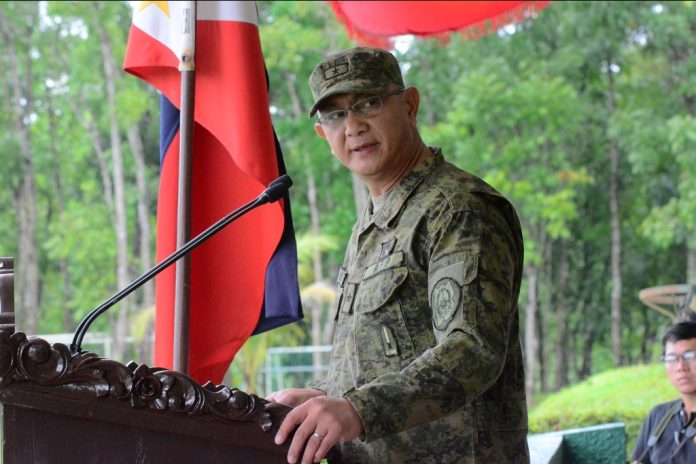
‘RESIST NPA EXTORTION.’ “Giving in to the rebels’ extortion demands means feeding them and taking part in their criminal activities,” says Major General Dinoh Dolina, commander of the Philippine Army’s 3rd Infantry Division based in Jamindan, Capiz. People are getting tired of supporting the New People’s Army in Panay Island, he says. IAN PAUL CORDERO/PN
ILOILO City – People are getting tired of supporting the New People’s Army (NPA) in Panay Island, according to the Philippine Army.
Proof: Information from civilians helped the police and military track down the seven rebels killed in Barangay Atabay, San Jose, Antique on Aug. 15, according to the Army’s 3rd Infantry Division (3ID).
“The tip-off from the civilian populace resulted to the successful neutralization of these terrorists,” said Major General Dinoh Dolina, 3ID commander.
He dismissed as propaganda the NPA’s claim that what happened in Barangay Atabay was not an encounter but a massacre of seven sleeping people.
That civilians themselves were offering information to the authorities about rebels showed that “people are already fed up with the NPA,” said Dolina.
He urged civilians to resist the NPA’s extortion activities.
“Giving in to their demands means feeding their wants and taking part in their criminal activities,” said Dolina.
According to the police and military, the seven killed rebels were members of the NPA’s taxation group.
“The only way to stop the extortion is by not giving in to their demands. This will make the rebels irrelevant forever,” said Dolina.
The general dismissed as a lie the claim of NPA-Panay’s Coronacion Chiva Waling-Waling Command spokesperson Julio Montana that the so-called recoveries in Barangay Atabay – guns, ammunitions and extortion letters, among others – were “planted.”
“How can we plant all those recoveries? Ka Julio and his comrades are known for fabricating lies, especially in situations like this,” said Dolina.
Joint police and military forces that operated against the seven rebels reported to have seized the following: three hand grenades, two .40mm ammunitions, two rifle grenades, a homemade single-shot 12-gauge shotgun, two homemade .38 revolvers, a homemade KJ9 pistol, three magazines for KJ9, and two empty magazines of an undetermined gun.
Also seized were two laptops (MacBook Pro and Lenovo), a netbook, 22 analog mobile phones, seven Android phones, five tablet computers, and Canon DSLR camera, five Canon DSLR spare batteries, two pocket WiFis, a power bank, three SD cards, a thumb drive, 22 assorted SIM cards, three transistor radios, four disposable lighters, four wristwatches, 14 assorted mobile phone chargers, four headsets, a keyboard, assorted wires, and a bolo.
Addressing Montana, Dolina said, “The public is well aware of the lies being perpetuated by your organization. After you made ridiculous statements in some local media entities, you became a laughing stock. Take time to read the public’s comments on the social media sites of these media entities.”
Meanwhile, according to human rights group Panay Alliance Karapatan, all the seven killed rebels had gunshot wounds on the head.
This indicated that the seven were most probably sleeping when they were peppered with bullets, said Reylan Vergara, secretary general of the rights group.
The gunshot wounds on the heads and chests appeared to be “finishing shots”, added Vergara.
According to Karapatan, what happened was a “massacre” and a violation of the international humanitarian law.
“NPA or not, they had rights. These should have been respected,” said Vergara.
Senior Inspector Norby Escobar, information officer of the Antique Police Provincial Office, insisted that what happened was a legitimate operation.
“We have witnesses,” he said.
Escobar also said documents recovered proved the casualties and their group were collecting revolutionary taxes.
https://www.panaynews.net/people-are-fed-up-with-npa-rebels/
‘RESIST NPA EXTORTION.’ “Giving in to the rebels’ extortion demands means feeding them and taking part in their criminal activities,” says Major General Dinoh Dolina, commander of the Philippine Army’s 3rd Infantry Division based in Jamindan, Capiz. People are getting tired of supporting the New People’s Army in Panay Island, he says. IAN PAUL CORDERO/PN
ILOILO City – People are getting tired of supporting the New People’s Army (NPA) in Panay Island, according to the Philippine Army.
Proof: Information from civilians helped the police and military track down the seven rebels killed in Barangay Atabay, San Jose, Antique on Aug. 15, according to the Army’s 3rd Infantry Division (3ID).
“The tip-off from the civilian populace resulted to the successful neutralization of these terrorists,” said Major General Dinoh Dolina, 3ID commander.
He dismissed as propaganda the NPA’s claim that what happened in Barangay Atabay was not an encounter but a massacre of seven sleeping people.
That civilians themselves were offering information to the authorities about rebels showed that “people are already fed up with the NPA,” said Dolina.
He urged civilians to resist the NPA’s extortion activities.
“Giving in to their demands means feeding their wants and taking part in their criminal activities,” said Dolina.
According to the police and military, the seven killed rebels were members of the NPA’s taxation group.
“The only way to stop the extortion is by not giving in to their demands. This will make the rebels irrelevant forever,” said Dolina.
The general dismissed as a lie the claim of NPA-Panay’s Coronacion Chiva Waling-Waling Command spokesperson Julio Montana that the so-called recoveries in Barangay Atabay – guns, ammunitions and extortion letters, among others – were “planted.”
“How can we plant all those recoveries? Ka Julio and his comrades are known for fabricating lies, especially in situations like this,” said Dolina.
Joint police and military forces that operated against the seven rebels reported to have seized the following: three hand grenades, two .40mm ammunitions, two rifle grenades, a homemade single-shot 12-gauge shotgun, two homemade .38 revolvers, a homemade KJ9 pistol, three magazines for KJ9, and two empty magazines of an undetermined gun.
Also seized were two laptops (MacBook Pro and Lenovo), a netbook, 22 analog mobile phones, seven Android phones, five tablet computers, and Canon DSLR camera, five Canon DSLR spare batteries, two pocket WiFis, a power bank, three SD cards, a thumb drive, 22 assorted SIM cards, three transistor radios, four disposable lighters, four wristwatches, 14 assorted mobile phone chargers, four headsets, a keyboard, assorted wires, and a bolo.
Addressing Montana, Dolina said, “The public is well aware of the lies being perpetuated by your organization. After you made ridiculous statements in some local media entities, you became a laughing stock. Take time to read the public’s comments on the social media sites of these media entities.”
Meanwhile, according to human rights group Panay Alliance Karapatan, all the seven killed rebels had gunshot wounds on the head.
This indicated that the seven were most probably sleeping when they were peppered with bullets, said Reylan Vergara, secretary general of the rights group.
The gunshot wounds on the heads and chests appeared to be “finishing shots”, added Vergara.
According to Karapatan, what happened was a “massacre” and a violation of the international humanitarian law.
“NPA or not, they had rights. These should have been respected,” said Vergara.
Senior Inspector Norby Escobar, information officer of the Antique Police Provincial Office, insisted that what happened was a legitimate operation.
“We have witnesses,” he said.
Escobar also said documents recovered proved the casualties and their group were collecting revolutionary taxes.
https://www.panaynews.net/people-are-fed-up-with-npa-rebels/
Subscribe to:
Posts (Atom)