Friday, June 22, 2018

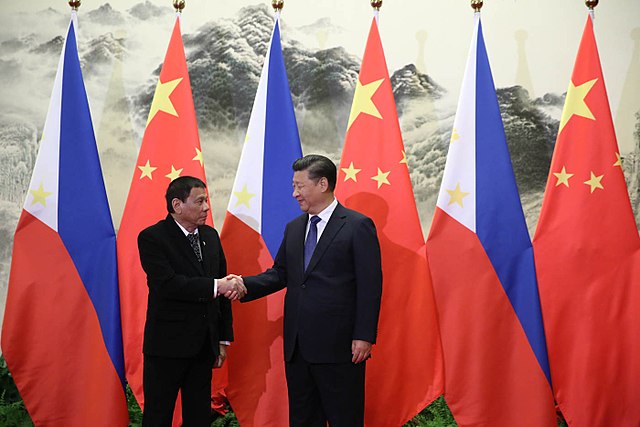
National security in the Philippines under Duterte: pragmatic partnerships beyond the noise

From the Australian Strategic Policy Institute (ASPI) The Strategist (Jun 20): National security in the Philippines under Duterte: pragmatic partnerships beyond the noise


In May 2016, Rodrigo Duterte, the long-term mayor of Davao City, won a resounding victory in the Philippines national presidential election. He has since set in train a highly populist agenda that has seen internal security and stability as the main priority of his tenure.

My new report for ASPI—National security in the Philippines under Duterte: Shooting from the hip or pragmatic partnerships beyond the noise?—released today, looks at how Duterte has gone about securing his internal objectives and diversifying and rebalancing the country’s external alignments.

On assuming the presidency, Duterte ordered the army to prioritise the neutralisation of the Islamic State–affiliated Abu Sayyaf Group (ASG) within a year, reiterating that mandate in the wake of the protracted 2017 Marawi crisis. He flooded the south with thousands of troops, requested the deployment of an additional 20,000 soldiers to safeguard areas where there were continuing threats, and declared an extended state of martial law across Mindanao.

These measures have been relatively successful. More than 350 militants were eliminated in 2017, and their ability to operate out of traditional strongholds in the south has been effectively degraded.

Duterte also sought to capitalise on ties he’d made with the left when he was mayor to bring an end to the protracted insurgency of the New People’s Army (NPA). His approach was conciliatory, and he quickly entered into four rounds of peace talks with the rebel movement.

Despite that promising start, little progress has been made in concluding a final deal. In November 2017, Duterte formally terminated all talks with the NPA. That was seen as an ominous development, possibly presaging the wholesale abandonment of the peace process. However, in April 2018, the president directed his cabinet to resume negotiations with the communist movement. How this will play out in terms of sealing a lasting settlement remains to be seen.

In March 2016, a surge of high-profile hijackings hit the tri-border area (TBA) between the Philippines, Indonesia and Malaysia in the Sulu and Celebes seas. Although no party has explicitly taken responsibility for the attacks, most commentators believe criminal elements within the ASG were the main culprits. Duterte mobilised specialist units from the army to destroy the group’s strongholds in Sulu and deployed the coast guard to intercept suspected pirate vessels. He also moved to collaborate with Indonesia and Malaysia in instituting a trilateral regime of maritime domain awareness in the TBA.

This combined unilateral and collective approach has resulted in a significant drop in attacks in the TBA. That said, there’s little room for complacency. The resilience of the ASG, combined with the size and archipelagic nature of the area to be monitored, means that the TBA will remain a potential maritime crime hotspot for the foreseeable future.

On the domestic front, one of Duterte’s main election pledges was to initiate an aggressive response to the Philippines’ growing drug problem. Not only did he promise that 100,000 dealers, addicts and traffickers would be eliminated, he also offered bonuses to the police for every criminal body they delivered. By the end of 2017, 4,000 had died at the hands of law enforcement and another 8,000 had been murdered by unknown assailants.

The global community has reacted with alarm at these figures and the apparent impunity with which the drug war is being conducted in the Philippines. In February 2018, the International Criminal Court opened a preliminary judicial inquiry into whether Manila’s policies warranted a full investigation of known human rights abuses.

Certainly, there are grounds to question the morality and utility of Duterte’s drug war. However, it’s important to note that his administration’s counter-narcotics strategy includes more nuanced strands of demand reduction and rehabilitation support. These underreported initiatives reflect a somewhat more coherent approach to dealing with the illicit drug trade and are more in line with the policies of governments in the West.

Duterte’s foreign policy has focused on configuring the Philippines’ external relations to maximise the time and space he has to pursue his domestic security priorities. To that end, he has embarked on two parallel courses of action. The first is resolving outstanding disputes with Beijing in the South China Sea in an effort to remove what was a key source of international distraction during the Aquino presidency. The second is adopting an ‘independent’ foreign policy that lessens the Philippines’ dependence on the United States while improving relations with China and other non-traditional partners such as Russia.

Despite this seemingly revolutionary stance on foreign affairs, it’s clear that his administration continues to view Washington—rather than Beijing or Moscow—as the ultimate security guarantor in Southeast Asia. Nearly two years into the Duterte presidency, there’s considerable continuity in American–Filipino relations. All the treaty foundations of the bilateral alliance remain intact. The two countries continue to conduct regular joint training exercises. And while some military engagements have been cancelled, new ones have been initiated in their place.

Rather than adopting an independent foreign policy, Manila appears to be moving more towards an ‘interdependent’ stance in its external relations, maintaining relationships with traditional partners (the US) while seeking to diversify ties with new powers (China and Russia). Although that may not have been Duterte’s original intent, it’s largely consistent with the postures of past presidents and is certainly the approach that would seem best for the Philippines’ national security today.


[Peter Chalk is an independent international security analyst based in Phoenix, Arizona. He acts as a subject matter expert on maritime security for the Naval Postgraduate School in Monterey, California. Image courtesy Philippine Government via Wikimedia Commons.]

Order amid chaos: tracing the roots of Basilan’s recent outbreak of peace

From the Australian Strategic Policy Institute (ASPI) The Strategist (Jun 21): Order amid chaos: tracing the roots of Basilan’s recent outbreak of peace


In April 2016, in Basilan, Islamic militants gathered to mount an attack on the Armed Forces of the Philippines. The attack they launched killed 18 soldiers and injured more than 50 others.

The small island of Basilan, a member of the Sulu Archipelago that stretches southwest off Mindanao in the southern Philippines, had long been the origin of many of Abu Sayyaf’s top leaders. But the assault entrenched Basilan’s reputation as the stronghold of Abu Sayyaf, a group composed of multiple loose networks, some of which have declared allegiance to the Islamic State of Iraq and Syria (ISIS).

But in mid-2016 the various forms of violence that once beset Basilan began to subside, and since then there’s been a relative outbreak of peace. With the efforts to reconstruct Marawi following the five-month siege by ISIS-inspired groups, it’s prudent to investigate the circumstances that led to Basilan’s stabilisation and whether it be can replicated in other parts of the Philippines that are struggling with endemic violence.

Abu Sayyaf had exploited the insurgent violence, pervasive criminality and constant feuding between familial clans to entrench itself in the politics of Basilan. Using a cocktail of violent threats and political inducements, the group convinced numerous local governments around Basilan to provide it with sanctuary. Contrary to popular perception, Abu Sayyaf didn’t prey on the absence of government in Basilan; instead, it corrupted the government from the inside.

Basilan’s violence began to recede after Jim Hataman became the new provincial governor following the May 2016 elections. He prioritised quelling violence, informing mayors and village heads from across Basilan that they would be held accountable if Abu Sayyaf was found to be operating in their jurisdictions.

This strategy had been tried before, but the Philippine electoral system confers only limited power on provincial governors to control their mayors. Those mayors, while technically reporting to the governors, are selected by voters in local elections. Previously, mayors were often more scared to defy the demands of Abu Sayyaf than the instructions of their toothless governors.

But circumstances had bestowed on Hataman an unusual amount of political power. His ally and brother, Mujiv, was the regional governor, which gave their family unmatched power over the government budgets on which mayors relied. The family had reached a détente to end their longstanding rivalry with the Akbar clan, allowing Hataman to govern without being dogged by constant political infighting. Rightly or wrongly, many local mayors believed that martial law provided Hataman with the power to summarily fire them, rendering them more likely to obey his directions.

With his newfound political power, Hataman hatched a plan to rid Basilan of Abu Sayyaf. It focused on depriving the group of the sanctuary and resources that had until then been provided by Basilan’s community leaders.

Few local leaders had ideological sympathy for Abu Sayyaf’s extremist views. But in the remote regions of Basilan, they were allowing the group to operate—mostly because they were afraid that if they refused they would be its next victims. Making these leaders feel sufficiently safe to defy Abu Sayyaf’s demands was the critical first step for the Hataman plan.

Basilan’s rugged terrain and modest resources made it impracticable to provide every local leader with round-the-clock government security. So Hataman decided on an alternative: allow them to develop their own security teams. Private militias had been common in Basilan. They were a source of prestige in a culture that values warriors and armed strength and in a system in which weapons are used to win elections.

Hataman believed that these local militias, which had long being a source of violence, could become a tool for stability. By conferring on them the status of ‘peacekeeping action teams’, he made it possible for them to be trained by the Philippine armed forces and police. With this change, local leaders felt increasingly safe to defy Abu Sayyaf’s demands, secure in the knowledge that they would be protected by their own more legitimate, more capable militias.

With Abu Sayyaf already on the back foot, and many of its leaders moving to mainland Mindanao, Hataman capitalised by mobilising Basilan’s society. Muslim religious leaders, who had been scared of violent reprisals, now felt safe enough to publicly denounce Abu Sayyaf. The business sector, long crippled by pervasive extortion, threw its support behind the Hataman plan.

With violence decreasing, the provincial government was able to expand public services into the remote regions that had once been Abu Sayyaf’s stronghold. The government’s action also signalled that it was committed to and capable of providing services to the population, which bolstered its legitimacy.

Nothing guarantees that the drop in violence in Basilan will continue. On the contrary: the concentration of power will dissipate and martial law will hopefully end. But Basilan’s stabilisation gives insights into how to reduce the levels of violence in other parts of Mindanao.

Extremist groups grow strong when they infiltrate and co-opt local governments and leaders. Convincing those leaders to side with the forces of peace rather than violence is essential. In Basilan, this didn’t involve changing their ideology because few supported the extremist ideas of Abu Sayyaf.

Some felt it was in their political interests to maintain cordial relations with the group, and many gave it sanctuary simply because they were too scared to refuse. In short, ridding Basilan of Abu Sayyaf wasn’t about changing the ideology of local leaders as much as changing their incentives.

Basilan still suffers from far too much violence, and creating a more permanent peace is a generational challenge. Reconstructing the infrastructure and social fabric of Marawi is a similar challenge. But Basilan’s recent stabilisation demonstrates that provincial governments endowed with sufficient political power and sustained political commitment can, at least temporarily, reduce violence.
Author


[Alexander Douglas is a project manager at the Centre for Humanitarian Dialogue. Image courtesy Dr A. Hugentobler via Wikimedia Commons.]

Trust as anti-terror tool: Civilian leader urges closer dialogue to wipe out Maute

From ABS-CBN (Jun 21): Trust as anti-terror tool: Civilian leader urges closer dialogue to wipe out Maute


The government needs to meet with locals to weed out the remaining members of the Islamic State-inspired Maute group, a leader of a civil society organization said Thursday.
Samira Gutoc-Tomawis of the Ranao Rescue Team said military action without proper communication may be sending inconsistent messages to displaced residents of Lanao del Sur, especially with the airstrike in Tubayawan town falling after Eid al-Fitr.
"When are we going to just learn the lesson that 20 years of Abu Sayyaf, hindi mauubos because sa bakbakan lang. It has to be a legislation, an institution, people reporting, and people will report if they trust their institutions," she told ANC.

Thousands of people have already been displaced as state troops continue to hunt down the remaining members of the terrorists who were also behind the siege of Marawi City last year.
Among the evacuees were 387 families in Tubaran, 573 in Binidayan, 355 in Pagayawan, 350 in Bayang, 22 in Marogong, 21 in Ganassi, and 9 in Calanogas.

Gutoc said evacuees are in need of water, food, and other basic needs.

http://news.abs-cbn.com/news/06/21/18/trust-as-anti-terror-tool-civilian-leader-urges-closer-dialogue-to-wipe-out-maute

Lawmaker bares terrorists using fake passports

From the Gulf Today (Jun 21): Lawmaker bares terrorists using fake passports

A Moro lawmaker disclosed that foreign terrorists, mainly Indonesian nationals, have succeeded in obtaining fake Philippine passports that enabled them to participate in the siege of Marawi City in Mindanao in May 2017.

Congressman Zajid Mangudadatu of Maguindanao cited intelligence reports showing that, as a result, more and more Indonesian militants holding such fake passports have been entering the country through the port city of General Santos on their way to Maguindanao and Sultan Kudarat.

The same reports showed that aside from their involvement in the Marawi siege, the Indonesians were also training members of local terror groups in the production of improvised bombs.


“It is likely that the foreigners have trained especially the Moro youths who, in turn, are destroying the image of our Muslim brothers in the country,” Mangudadatu pointed out in Filipino.

Earlier, the military confirmed intelligence agents were looking into reports of the reported involvement of foreign militants, particularly from Malaysia and Indonesia, in the Marawi City siege on May 23, 2017 that prompted President Rodrigo “Rody” Duterte to declare martial law over the whole of troubled Mindanao.

The military said the foreigners fought side by side during the siege with members of the Abu Sayyaf and Maute Group that had pledged allegiance to the Daesh in the Middle East.

In particular, regional and Filipino security experts said they have also established the link of the Abu Sayyaf to the global Al Qaeda terror network through the Indonesia-based Jemaah Islamiyah militants.

Last week, Lieutenant Colonel Romeo Brawner, the regional military spokesman, said government forces launched an operation against remnants of the Maute Group in the town of Tubaran, Lanao del Sur, who have been recruiting mostly Moro youths.

The operation which is still continuing, Brawner said, has been highlighted by co-ordinated air strikes and artillery fire to help government forces on the ground, who were reported to have killed at least five of the terrorists.

In their recruitment activities, the terrorists have been offering to the Moro youths arms and money, part of the huge loot they have seized during the Marawi siege, the military said.

http://www.gulftoday.ae/portal/099caa33-3768-4894-a0d2-888893ef03c1.aspx

P6-M reward offered for Maute leader's arrest

From ABS-CBN (Jun 22): P6-M reward offered for Maute leader's arrest
 

Authorities doubled the reward for the capture of Maute leader Abu Dar to P6 million. They hope this will speed up the terror leader's capture and end violent clashes in Lanao del Sur. - The World Tonight, ANC, June 21, 2018

http://news.abs-cbn.com/video/news/06/22/18/p6-m-reward-offered-for-maute-leaders-arrest

DSWD DROMIC Report #2 on the Armed Conflict in North Cotabato and Maguindanao as of 18 June 2018, 6PM

From the Relief Web (Jun 21): DSWD DROMIC Report #2 on the Armed Conflict in North Cotabato and Maguindanao as of 18 June 2018, 6PM

Published on 18 Jun 2018 View Original
 

SUMMARY

On 29 May 2018, at 1:00AM, military operations were conducted against the Bangsamoro Islamic Freedom Fighters (BIFF) near the boundary of Pikit, North Cotabato and Pagalungan, Maguindanao. This resulted in the massive evacuation of affected families.
  1. Status of Affected Families/ Persons
6,710 families or 32,685 persons were affected by the armed conflict (see Table 1).

https://reliefweb.int/report/philippines/dswd-dromic-report-2-armed-conflict-north-cotabato-and-maguindanao-18-june-2018

Maguindanao town execs turn over loose guns to Army

From the Philippine News Agency (Jun 22): Maguindanao town execs turn over loose guns to Army


The second batch of surrendered firearms by civilians in Datu Piang, Maguindanao, on Thursday (June 21). Last April 7, the town also yielded 16 loose firearms to the militray in support to the government's disarmament program. (Photo by 6ID)

CAMP SIONGCO, Maguindanao – Town officials of Datu Piang on Thursday turned over anew 10 more high-powered firearms to the military as it vowed to collect more unlicensed guns in support of President Rodrigo Duterte’s campaign against loose firearms.

Mayor Genuine Kamaong led Datu Piang officials in turning over 10 assorted high-power guns to Lieutenant Colonel Alvin Iyog, Army’s 2nd Mechanized Infantry Battalion commander, and Brigadier General Deosdado Carreon, Army’s 601st Infantry Brigade commander.

The firearms, which include two 60mm mortar, 4 M79 grenade launchers, a .50-caliber Barrett sniper rifle, two 9mm pistols, and one 12-gauge shotgun, were voluntarily surrendered by civilians to the local government unit, Kamaong said.


Capt. Arvin John Encinas, speaking for the Army's 6th Infantry Division (ID), said the turnover ceremonies took place during the town’s Peace and Order Council and Anti-Drug Abuse Council meeting held at the municipal gymnasium.

“We will sustain our campaign against loose firearms in partnership with the local government Units,” Carreon said after receiving the firearms during the ceremony.

It was the second time Datu Piang execs turned over unlicensed guns to the Army; the first being in April 7 in which town officials also surrendered 16 loose firearms.

Brigadier General Cirilito Sobejana, 6th ID commander, commended the efforts of Kamaong in pushing for the collection of loose guns from civilians.

“The continuous turn over of firearms is a clear manifestation of the sincere support of the civilians against loose firearms, as this will help prevent crimes and other acts of violence,” Sobejana said.

http://www.pna.gov.ph/articles/1039104

Manhunt on vs. NPA after N. Cotabato blast hurt 6 soldiers

From the Philippine News Agency (Jun 22): Manhunt on vs. NPA after N. Cotabato blast hurt 6 soldiers

CAMP SIONGCO, Maguindanao – The Army’s 19th Infantry Battalion has launched a manhunt against a band of communist New Peoples Army (NPA) rebels responsible for the roadside bombing in North Cotabato on Thursday that injured six soldiers, including an Army lieutenant.

Lt. Colonel Randy Llunar, 19th IB commander, said military operation is ongoing as of posting time in the hinterlands of Magpet, an upland town in North Cotabato considered a hotbed for communist insurgency.


Llunar said the soldiers were returning to the provincial capitol from a medical mission at a far-flung village at past 1 p.m. when the bomb, believed to be a landmine, exploded on a dirt road in Purok 1 Barangay Doles, Magpet.

Injured were 2nd Lt. Rustine Barco, Corporals Ronnie Gutierrez, Roldan Parcon, Shanon Obaldo, Privates first class Rolando Bublao and Dennis Andol. They were rushed to Madonna Hospital in Kidapawan City following the incident.

Llunar said after the blast, the rebels positioned on both sides of the provincial road opened fire, triggering a brief firefight. He said the town police, led by Senior Insp. Jose Mari Molina, immediately put up chokepoints as reinforcement for the soldiers.

North Cotabato Governor Emmylou Mendoza condemned the incident.

"The provincial government of North Cotabato strongly condemns this terroristic attack on the medical team whose only purpose is to deliver basic social services to the people," Mendoza said.

http://www.pna.gov.ph/articles/1039108

DBM to evaluate acquisition of AFP modernization projects

From the Philippine News Agency (Jun 22): DBM to evaluate acquisition of AFP modernization projects

While stressing that the list of equipment it wants for Horizon Two of the Revised Armed Forces of the Philippines Modernization Program is final, it is still up to the Department of Budget and Management (DBM) to evaluate and decide which platform to acquire first, a defense department official said Thursday.

Department of National Defense (DND) spokesperson Arsenio Andolong said the list of equipment will still be evaluated by the DBM, which will then locate the possible source of funding and prioritize the acquisition of the platform.


The DND, if needed, can also reduce the number of equipment it has shortlisted for Horizon Two, to comply with the PHP300 billion stipulated for the procurement of military equipment scheduled for 2018 to 2022.

Horizon One was implemented from 2013 to 2017 and resulted in the acquisition of the three Del Pilar-class frigates, 12 FA-50PH light-lift interim fighters, two strategic sealift vessels, to name a few. Horizon Three is slated for 2023 up to 2028.

"In the case of (diesel-electric) submarines, we can get just one or two, if needed, and for the multi-role fighters, we don't need to get the whole squadron (12 aircraft). We can just get six, we can comply with the budget," Andolong said in Filipino.

Equipment slated for acquisition during Horizon Two are towed and self-propelled howitzers, multiple launch rocket systems, armored recovery vehicles, five support vehicles, tactical radios, ground mobility equipment (light, medium, heavy), individual weapons, crew-served weapons, and night-fighting equipment for the Army; multi-role fighters, radar systems, and light and medium lift aircraft.

Also to be acquired are heavy lift helicopters, unmanned aerial vehicles, helicopters (attack and combat utility), special mission and long-range patrol aircraft for the Air Force; frigates, corvettes, submarines, amphibious assault vehicles, anti-submarine helicopters, attack crafts, medium lift helicopters, and multi-role vessels for the Navy.

Also being eyed are combat engineer, force protection, explosive ordnance disposal, chemical biological radiological nuclear, humanitarian assistance and disaster relief and medical equipment.

 http://www.pna.gov.ph/articles/1039125

Esperon meets US counterpart, reaffirms PH-US security alliance

From the Philippine News Agency (Jun 22): Esperon meets US counterpart, reaffirms PH-US security alliance


PH-US TIES. National Security Adviser Hermogenes Esperon, Jr. shakes hands with US Secretary of State Mike Pompeo during their meeting in Washington, D.C. on June 22, 2018 (Philippine Time). (Photo courtesy of DFA-Office of Public Diplomacy) 
 
National Security Adviser Hermogenes Esperon, Jr., for the first time on Friday (Philippine Time), met with his American counterpart John Bolton, the Philippine Embassy in Washington, D.C. said.

During the meeting, the two officials reaffirmed both countries' commitment to their security alliance. Esperon, for his part, expressed Manila’s gratitude for the assistance Washington extended during the 2017 siege in Marawi City and its commitment to contribute to the rehabilitation of the city.

Among others, Esperon discussed with Bolton issues related to terrorism and other regional security concerns, such as the situation in the South China Sea and the Korean Peninsula.


According to a statement from Philippine Ambassador to the United States Jose Manuel Romualdez, this served as an "opportunity" to discuss how the two countries could further strengthen their security alliance.

The meeting was the first time Bolton, who once served as US Permanent Representative to the United Nations, had with Filipino officials since his appointment as National Security Adviser by President Donald Trump in April.

With Romualdez and Esperon was Foreign Affairs Secretary Alan Peter Cayetano, who likewise met with his US counterpart Mike Pompeo.

Romualdez said the two foreign ministers had an "open and cordial interaction" at the State Department.

"We are optimistic this would reinforce the ties that bind the relations between our two countries and peoples,” the envoy said, adding the meeting gave Cayetano the opportunity to discuss the Duterte administration’s independent foreign policy.

http://www.pna.gov.ph/articles/1039136

FVR recalls Pinoy soldiers’ heroism during Korean War

From the Philippine News Agency (Jun 22): FVR recalls Pinoy soldiers’ heroism during Korean War

On the occasion of the 68th anniversary of the Korean War on Monday (June 25), former president Fidel V. Ramos, a veteran of the Korean War, recalled the bravery and heroism of the Filipino soldiers who fought against all odds the combined Chinese and North Korean forces.

The Philippines was the first Asian country to responded to the urgent call by the United Nations Security Council (UNSC), which was then headed by Gen. Carlos P. Romulo, to send combat troops to help the beleaguered South Korean nation stave off a communist invasion.

The Korean War broke out on June 25, 1950, five years after World War II ended.

Although barely recovering from the ravages of the Second World War, then president Elpidio Quirino got the approval from Congress to send to Korea a 7,500-man Philippine Expeditionary Forces to Korea (PEFTOK) for combat duty.

PEFTOK veterans will commemorate the 68th anniversary of the Korean War at the Philippine-Korean Memorial in Fort Bonifacio in Taguig City on Sunday.

Ramos said PEFTOK has invited President Rodrigo R. Duterte as the guest of honor and speaker during the occasion.

It was during the Korean War that Filipinos displayed anew their combat proficiency, particularly in the Battle of Yultong and the Battle of Eerie Hill, to name just two as PEFTOK troops had figured in numerous fighting during the war.

In the Battle of Yultong, the 10th Battalion Combat Team (BCT), commanded by Col. Dionisio Ojeda, fought the highly superior 44th Division of the Chinese Army during two days of fierce fighting on April 22-23, 1951.

At the height of the fighting, the Filipinos got trapped and lost contact with the outside world.

Nevertheless, the Filipinos held their ground and valiantly fought the Chinese in a fierce and bloody fighting that allowed the US 3rd Infantry Division to withdraw from the area.

It was during the Battle of Yultong that the Filipinos were hailed for their extraordinary bravery in combat, reminiscent of World War II.

Ramos was then a second lieutenant and a fresh graduate of the US West Point in 1950 when he volunteered for combat duty when the Korean War broke out. His unit was the 20th BCT.

In his diary, Ramos recalled his exploits, particularly during the fierce Battle of Eerie Hill. He led a 44-man team that assaulted the strategic plateau occupied by Chinese troops.

As destiny had it, Ramos was later elected as the 12th President of the Republic of the Philippines in 1992.

The 20th BCT was one of the five combat battalions of the PEFTOK sent by Quirino when the Korean War erupted. The other four were the 2nd, 10th, 14th and 19th that saw extensive combat during the Korean War.

The two greatest battles during the Korean War, where Filipino troops proved their gallantry in combat as they did during the Second World War, were the battle of Yultong Bridge and the assault on the strategic Eerie Hill near Chorwon, South Korea.

Ramos volunteered to fight in Korea, together with 364 of his classmates at West Point.

A total of 21 countries, including the Philippines, responded to the appeal of the beleaguered South Korean government for help when South Korea was invaded by North Korea and communist Chinese forces.

Among the five combat battalions, it was the 10th BCT that accounted for the most number of battles, particularly the Battle of Yultong where the Filipinos stood their ground despite being outnumbered.

It was in May 21, 1952 when Ramos was ordered to attack Eerie Hill, which was occupied by heavily entrenched communist Chinese troops.

In an interview, then Major Felizardo Tanabe, 20th BCT operations officer, said that “the mission was a necessary risk as Eerie Hill prevented the United Nations forces from advancing without suffering heavy casualties.

The Chinese enjoyed a vantage strategic position, which afforded them to observe all moving objects in the surrounding plains below.”

Eerie Hill’s landscape is comparable to the plains of Central Luzon where the imposing Mount Arayat is located. But unlike Mount Arayat, Eerie Hill’s configuration is much smaller.

Nevertheless, whoever occupied the strategic hill controlled the roadways down the slopes and the connecting arterial roads spread over a one-mile radius.

Col. Salvador Abcede, 20th BCT commander, ordered Tanabe to organize a team for the assault on Eerie Hill.

Abcede’s order was loud and clear: “The observation post and the bunkers must be destroyed.”

Eerie Hill had been previously assaulted by Abcede and his men nine times, killing more than a hundred communist troopers. The Chinese, however, withstood the attacks.

Capturing Eerie Hill was the obsession of Abcede and ordered Lt. Ramos to see to it that the strategic area would be captured.

An elaborate plan was prepared in the attack on Eerie Hill, including air support and artillery fire.

The night before the assault, they prayed fervently to God for protection.

Swapping shoes with amputees

Jump-off time was before daybreak of May 21, 1952. The assault team was up at dawn to do a final check on their weapons, the M1 Garand rifles, Browning Automatic Rifles (BAR), two .30-caliber machine guns, grenades, bayonets and other equipment.

Ramos had grouped his men into four units: a 13-man sniper team led by Sgt. Cipriano Drapeza; a scout team of 10, headed by Corporal Jose Palis; and a forward observer and rifle teams led by 2nd Lt. Cosme Acoste.

The platoon had one radio operator, one messenger and one medical aid man.

At exactly 4:07 a.m., the platoon moved towards its objective under cover of darkness.

To avoid detection, Ramos and his men crawled for two hours through rice paddies, occasionally tipping their canteens to quench their thirst. The reconnaissance platoon reached an irrigation ditch some 400 meters from the top of Eerie Hill.

Under the tactical plan, seven F-86 Sabre jet fighter-bombers of the US Air Force dropped napalm bombs on the heavily fortified enemy forces.

During the bombing run, Ramos radioed the BCT headquarters to start the artillery bombardment.

Through binoculars, he spotted an entangled stack of blasted barbed wire and decided his troops would assault that part of the hill. He radioed his headquarters to cease firing their artillery.

Ramos and his men moved in quickly firing their guns as close-quarter fighting erupted. The Chinese retreated but kept on firing. At that point, the Filipino soldiers were unstoppable as they gained the upper hand of the fighting.

The Ministry of National Defense of Korea says in its historical account of the Eerie Hill assault:

“From 0700 to 720, Lieutenant Ramos’s four teams (scout, rifle, sniper and forward observer), moved and maneuvered up to the crest of the Hill. As soon as the assault teams reached the barbed wire entanglements of Eerie at 0710, two tanks lifted their fire.”

During the initial stage of the fighting, the 11-man scout team headed by Palis went into action. Heavy exchange of gunfire erupted. Grenades exploded all over the place. As the riflemen kept firing, Palis and two of his men ran toward bunker No. 2, dropped several grenades and fired their guns, killing four Chinese.

Enemy troops occupying bunker No. 3 retaliated. At this point, Ramos joined Palis. Grenades exploded on their right flank, on the left and in front of them. One Filipino soldier was hit.

Hitting the ground on all fours, two of Ramos’ men suddenly dashed toward the bunker and exploded a grenade.

Two enemy troopers got out of the bunker but Ramos, who was just 4 meters away, opened fire, and killed them instantly. As his reflexes heightened, Ramos rolled away and poised to fire again at any incoming enemy but there was none.

Then Palis told Ramos that they were running out of grenades. Ramos immediately ordered his two-man demolition team to move in and blast bunkers 2 and 3.

Then as Ramos and his men were clearing the bunkers, Chinese troops occupying a connecting trench some 200 meters away opened fire at them. They dived for cover as fighting broke out anew, this time against Chinese troopers occupying bunker number 4 .

Two Chinese tried to hurl a grenade at Ramos’ group but they were cut down by bullets before they could throw their hand grenades.

Close-range fighting ensued, including hand-to-hand combat using bayonet. The Filipinos prevailed as the remaining Chinese soldiers retreated hastily. Ramos again requested for artillery fire to make sure the area was clear of hostile forces.

The assault lasted for two hours and mission accomplished.

Of the 44 men led by Lt. Ramos, only one was wounded while the Chinese suffered 16 dead.

The gallantry of the Filipino soldiers had earned praises from the United Nations forces who watched the deadly combat from a distance using binoculars. Two American battalions also watched the fighting from a distance.

For Ramos, it was his first hill and first kill, a soldier’s trek “to hell and back.”

The exploits of the Filipino soldiers’ bravery in combat during World War II, including Bataan and the Bessang Pass episodes, Korean War and a book on the Vietnam War entitled, “Warriors for Peace”, written by this reporter, have been properly documented in various books published by the Philippine Veterans Affairs Office currently headed by retired Lt. Gen. Ernesto G. Carolina, a Mindanao War veteran himself, for the present generation and the generation yet unborn for them to appreciate the gallantry of their forebears in defense of freedom and democracy.

http://www.pna.gov.ph/articles/1039126

AFP belittles Joma's ouster threats vs. Duterte

From the Philippine News Agency (Jun 22): AFP belittles Joma's ouster threats vs. Duterte

The military is not keen on taking seriously Communist Party of the Philippines (CPP) founder Jose Maria Sison's claims that the New People's Army (NPA) guerillas are now ready to oust President Rodrigo Duterte following the latter's decision to suspend informal peace talks with the rebels, pending a three-month review of all previous agreements.

"There have been peace talks after another that have failed in the past. And each time, they were trying to oust the President -- but never came close enough to at least unsettle a Commander-in-Chief," Armed Forces of the Philippines (AFP) spokesperson, Col. Edgard Arevalo, said in a message to reporters Friday.

Arevalo added that Sison's threats seemed to be unfounded as NPA guerillas and their supporters continue to surrender to government forces in record numbers for the past few months.

"We do not know where Mr. Sison derives his temerity to make such a threat when members of the terrorist NPA continue to surrender in droves in the face of the AFP’s tactical, intelligence, and civil-military operations that enjoy the support of the Filipino people," he said.

Arevalo also assured the public that it is supporting all efforts to attain just and lasting peace.

Last week, Presidential Adviser on the Peace Process Jesus Dureza announced that the government is not yet ready to resume formal peace talks with the CPP set in Oslo, Norway on June 28-30 to allow the public to engage more in the peace process.

http://www.pna.gov.ph/articles/1039183

DWDD: SCREENED | 23IB accepts Candidate Soldier (CS) Applicants

From DWDD AFP Civil Relations Service Radio Website (Jun 22): SCREENED  |  23IB accepts Candidate Soldier (CS) Applicants

JAMBOREE SITE, Purok-6, Brgy Alubihid, Buenavista, Agusan del Norte (DWDD) – On June 19, 2018, soldiers of the 23rd Infantry “Masigasig” Battalion facilitated the conduct of pre-screening board and evaluated their requirements needed for AFPSAT Examination on 21-22 June 2018 at Hqs 15RCDG, Barangay Bancasi, Butuan City for the regular applicants of Candidate Soldier (CS), Officer Preparatory Course (OPC) and Officer Candidate Course (OCC) held at Headquarters 23IB at Jamboree Site, Brgy Alubihid, Buenavista, Agusan del Norte.


The applicants came from the different conflict-affected barangays were the Community Support Program (CSP) Teams of 23IB are currently immersed. 23IB / MCAG

http://dwdd.com.ph/2018/06/22/screened-23ib-accepts-candidate-soldier-cs-applicants/

DWDD: BETTER LIFE | 36IB and DILG SDS facilitates E-CLIP orientation of former rebels

From DWDD AFP Civil Relations Service Radio Website (Jun 22): BETTER LIFE  |  36IB and DILG SDS facilitates E-CLIP orientation of former rebels


TAGO, Surigao Del Sur (DWDD) – The Department of the Interior and Local Government (DILG) in partnership w/ the provincial government of Surigao del Sur & 36th Infantry “Valor” Battalion held an Orientation for the Enhanced-Comprehensive Local Integration Program (E-CLIP) cum CLIP Enrolment held at the 36th IB Headquarters at Barangay Dayoan, Tago, Surigao del Sur.

The DILG Surigao Sur presented the overview of the E-CLIP that includes its composition, functions, and the flow of enrollment process. While the Provincial Social Welfare and Development Office (PSWDO), Office of the Provincial Agriculturist (OPAg) & Techncial Education and Skills Development Agency (TESDA) gave updates, priority intervention programs, projects & activities that could benefit the former rebels. 36IB / MCAG 


http://dwdd.com.ph/2018/06/22/better-life-36ib-and-dilg-sds-facilitates-e-clip-orientation-of-former-rebels/

DWDD: VOLUNTARY SURRENDERED | Campaign vs loose firearms continues to step up in Datu Piang

From DWDD AFP Civil Relations Service Radio Website (Jun 22): VOLUNTARY SURRENDERED  |  Campaign vs loose firearms continues to step up in Datu Piang

CAMP GEN GONZALO SIONGCO, Awang, Datu Odin Sinsuat, Maguindanao – The campaign of the government against proliferation of loose firearms has continued to step up in Datu Piang town of Maguindanao province.


10 more loose firearms were voluntarily surrendered this morning, June 21, 2018, to 2nd Mechanized Infantry Battalion Commander Alvin G. Iyog and 601st Infantry Brigade Commander Brig. Gen. Deosdado C. Carreon.

The firearms were turned-over during the town’s Peace and Order Council and Anti-Drug Abuse Council meeting held at the municipal gymnasium led by Datu Piang Mayor Genuine P. Kamaong.


Among those firearms were two 60mm mortar, 4 M79 grenade launchers, 1 caliber .50 Barret, two 9mm pistol, one 12-gauge shotgun.

Mayor Kamaong expressed his gratitude for the cooperation of his Barangay Captains to support the government’s campaign against loose firearms.

“We will sustain our campaign against loose firearms in partnership with the Local Government Units,” Brigadier General Carreon said.


“The continuous turn-over of firearms is a clear manifestation of the sincere support of the civilians against loose firearms as this will help prevent crimes and other acts of violence,” 6th Infantry Division Commander Brigadier General Cirilito E. Sobejana said.

Datu Piang town also surrendered 16 loose firearms last April 7 to the Army. 6DPAO / MCAG

http://dwdd.com.ph/2018/06/22/voluntary-surrendered-campaign-vs-loose-firearms-continues-to-step-up-in-datu-piang/