Friday, September 22, 2017

Duterte claims Parojinog among Maute funders in Marawi attack

From GMA News Online (Sep 22): Duterte claims Parojinog among Maute funders in Marawi attack


President Rodrigo Duterte on Thursday linked slain Ozamiz City Mayor Reynaldo Parojinog to the crisis in Marawi City.

“This is the matrix. That is part of the discovery of the military. Parojinog, the mayor killed by the police during a raid,” he said in a report by Jun Veneracion on GMA News TV's State of the Nation Address.

Duterte made the claim as he showed a piece of paper with Parojinog’s name on it.

He said that aside from Parojinog, politicians in Central Mindanao and drug lords funded the pro-ISIS Maute group's attack on Marawi on May 23.

Duterte previously said that the illegal drug trade funded the Marawi crisis.

The crisis in Marawi City began after authorities tried to serve arrest warrants on members of the Maute Group, which ended up controlling key installations in the city. Later that day, Duterte placed Mindanao under martial law, and government forces remain in battle against the Maute Group.

Parojinog, his wife Susan, his brother Provincial Board Member Octavio, and cousin Daryl were among 16 people killed in an alleged shootout during a predawn raid last July 30.

http://www.gmanetwork.com/news/news/nation/626744/duterte-claims-parojinog-among-maute-funders-in-marawi-attack/story/

Several Asian countries pertrubed by reports of citizens joining the Maute-ISIS group

From UNTV News and Rescue (Sep 21): Several Asian countries pertrubed by reports of citizens joining the Maute-ISIS group


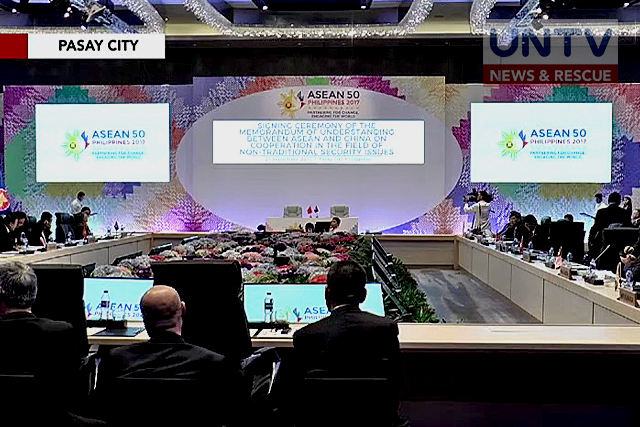
Association of Southeast Asian Nations (ASEAN) Ministerial Meeting

Association of Southeast Asian Nations (ASEAN) Ministerial Meeting on Transnational Crime Chairman Catalino Cuy confirmed that some Malaysian and Indonesian nationals have been fighting for the Maute terror group.

Cuy said that even China, one of the most powerful countries in Asia, has also expressed concern.

“Even China expressed concern that there might be Chinese nationals already in Marawi and they are worried that afterwards the situation is resolved in Marawi, they might find another place and go back to their respective countries,” said Department of the Interior and Local Government (DILG) OIC Usec. Catalino Cuy.

This caused concern among member states of the Association of Southeast Asian Nations (ASEAN) that some of their nationals might have also been joining the Maute-ISIS terrorists.

The Philippines jointly patrols with Indonesia and Malaysia to strictly monitor the individuals entering and exiting the three southeast Asian countries.

Representatives of all ASEAN nations agree to conduct similar activities in their respective jurisdictions to address and prevent terrorism.

“So they are considering joint patrols in common borders in other areas of ASEAN countries,” said Cuy.

Each member of ASEAN acknowledges that Southeast Asia is one of the targets of violent extremists. The leaders of these nations vow to not allow terrorists from wreaking havoc in their respective countries and to closely coordinate with each other to address the complex problem at the soonest possible time.

https://www.untvweb.com/news/several-asian-countries-pertrubed-by-reports-of-citizens-joining-the-maute-isis-group/

Gov’t tracing source of Maute terror funds — Duterte

From the Manila Bulletin (Sep 22): Gov’t tracing source of Maute terror funds — Duterte

President Rodrigo Duterte has revealed that the government is tracing the source of the terror funds and weapons acquired by the Maute group to stage a rebellion in Marawi.


Duterte makes fifth visit to Marawi City on National Day of Protest
(Bong Go / MANILA BULLETIN)

He said they have traced some bank transactions between the groups and foreign donors.

But the President still wondered why the Maute rebels still have many weapons to sustain the fighting in Marawi.

“Let me ask you a question, we are in the third month, how come the Maute brothers and the terrorists were able to stockpile so much ordnance and bullets and ammunition and IEDs? Saan nila kinuha yun?” he asked.

“But we now have a good picture of what happened in Marawi,” he added.

The President earlier said the conflict in Marawi is almost over but ruled out any victory celebration. He said there was no need to celebrate the end of the fighting out of respect for the many people who were killed.

http://news.mb.com.ph/2017/09/22/govt-tracing-source-of-maute-terror-funds-duterte/

Maute tried but failed to recruit MSU faculty, students, says school president

From the Manila Times (Sep 22): Maute tried but failed to recruit MSU faculty, students, says school president

THE Maute extremist group tried but failed to recruit students and professors from the Mindanao State University (MSU) main campus in Marawi months before it seized the city, its president, Dr. Habib Macaayong, said.

Macaayong was responding to Sen. Juan Edgardo “Sonny” Angara who asked him to confirm reports that Maute and ISIS (Islamic State of Syria and Iran) were able to recruit not only child warriors but also from among the students and sometimes professors of MSU.

“Is that true?” Angara asked Macaayong during the Senate hearing on the proposed budget of state universities and colleges (SUCs) on Thursday.

Macaayong denied that MSU faculty and students were recruited.

“As to recruitment among students, it’s not true. Although we overheard that the Maute has been recruiting outside MSU,” Macaayong said.

Angara, however, pressed on.

“Nag-attempt ba sila magrecruit kasi magkaibang bagay ‘yun eh (Did they attempt to recruit because those are different things)?” Angara asked.

“Nag-attempt pero di sila nakapasok ng MSU (They made the attempt but they were not able to enter MSU),” Macaayong admitted.

Angara asked again.

“They were not able to enter but were they to able recruit students from MSU? What about professors? Did they join the group?” Macaayong said, “No.”

“Are you sure?” the senator asked the MSU president.

Macaayong said, “Yah. In coordination with the military, they are giving us classified information.”

Angara said, “Okay. That’s good to hear.”

The Manila Times later asked Macaayong the reason why the Maute failed to convince MSU students to join them.
“You know MSU students are intellectuals,” he said.

“They cannot be motivated with this kind (of advocacy) if the purpose is destroying human, destroying property. They do not participate in that,” Macaayong said.

“Ang nare- recruit lang ng Maute eh ‘yung nasa outskirts, mga pobre na walang magawa. Pero, sa MSU they were not able to recruit anyone (The Maute managed to recruit the poor ones in the outskirts of Lanao del Sur),” he said.

Macaayong said MSU would offer masteral and doctoral degrees in peace and development and “in order to proliferate people who can control extremism and giving to education to these people.”

“And then we want that all students in all academic programs of the Mindanao State University to take three units of peace studies in the university so that they will grow as peaceful citizens, they will cooperate in the promotion of peace,” he added.

There are 11 MSU campuses in Mindanao, but the main campus is in Marawi City, the capital of Lanao del Sur.)

http://www.manilatimes.net/maute-tried-failed-recruit-msu-faculty-students-says-school-president/352125/

9 NPAs killed in Ecija clash with Army

From the Manila Times (Sep 20): 9 NPAs killed in Ecija clash with Army

AT least nine communist New People’s Army (NPA) rebels were killed while an Army soldier was wounded in an encounter at Caranglan town, Nueva Ecija on Wednesday morning.

Caranglan town police identified the wounded soldier only as Corporal Buenavista of the 84th Infantry Battalion (84IB) under the 71st Infantry Division (71ID) of the Philippine Army.

The fatalities on the rebel side were identified as Joel Manangan alias Ka Razul, while three were only identified as “Gian,” “Bunso” and “Asok.” The five others were unidentified.

Their bodies were brought to the Caranglan military camp.

Police said the firefight, which started at 7 a.m. on Wednesday, happened in the remote sub-village of Barat in Barangay Burgos and lasted for about three hours.

Forty-three soldiers from the 84IB and 71ID of the Military Intelligence Company carried out the intelligence-driven combat operations against more than 30 communist rebels under Manangan.

Authorities said at least nine high-powered firearms were recovered from the rebels including an AK47, M14, two M653, five M16 rifles and an M203 grenade launcher. Eight backpacks with documents pertaining to NPA operations were recovered along with the slain rebels.

A belated intelligence report said the NPA rebels could have been part of the dispersed group which recently staged an attack against government troops in the upland town of Kasibu in the nearby province of Nueva Vizcaya on September 1.

At least four Army soldiers died during the attack.

Meanwhile, NPA rebels killed a Citizens Armed Forces Geographical Unit (Cafgu) member in Arakan, North Cotabato on Tuesday, three days after the fatal ambush of an off-duty soldier in nearby Matalam town.

Senior Supt. Jonathan Tangonan, North Cotabato police director, identified the victim as Jeffrey Bitonio. He was riding a motorcycle on his way home from their detachment in Barangay Anapolon when NPA guerillas, positioned on one side of the road, opened fire with assault rifles killing him instantly.

The gunmen immediately fled to the hinterlands northwest of the village.

On Saturday, Private 1st Class Jimmy Marcelo of the Army’s 39th Infantry Battalion was ambushed and killed by the communist group in nearby Matalam town. The Army man was also riding a motorcycle en route to Matalam town proper from their detachment when attacked by the rebels armed with assault rifles.

http://www.manilatimes.net/9-npas-killed-ecija-clash-army/351735/

6 NPA rebels surrender in Samar

From the Manila Times (Sep 20): 6 NPA rebels surrender in Samar

Six members of the New People’s Army (NPA) based in Northern Samar have surrendered with their firearms to live a normal life, ending their armed struggle for years.

Army Capt. Federico Morales, Philippine Army civil military operations chief and spokesman for the 803rd Infantry Brigade, based in Camp Somoroy here told The Manila Times that they withheld the identities of the six who surrendered from different municipalities here because the surrenderers fear for their lives.

“Their comrades in the mountains might look for them and kill them, you know surrendering is considered a mortal sin by the NPA,” Rosales said.

The six rebels personally appeared at the headquarters of the 20th and 43rd Infantry Battalions based in Las Navas and Palapag towns with their firearms.

Valente Bajet, provincial director of the Department of the Interior and Local Government, said the former rebels will receive a corresponding amount for every firearm surrendered as well as P50,000 for livelihood assistance and P7,000 as aid while under custody in the camp.

http://www.manilatimes.net/6-npa-rebels-surrender-samar/351724/

MNLF ready to fight Daesh in Marawi, says Nur Misuari in conversation with Arab News

From Arab News (Sep 22): MNLF ready to fight Daesh in Marawi, says Nur Misuari in conversation with Arab News


Moro National Liberation Front leader Nur Misuari (AN Photo)

Nur Misuari, the founder and leader of the Moro National Liberation Front (MNLF), has broken his silence in an exclusive conversation with Arab News, in which he rejected the charges filed against him in a Philippines anti-graft court.

 In his first interaction with media since the charges were filed against him, Misuari talked exclusively to Arab News in Davao City. He claimed the case was brought against him by people out to sabotage his participation in the Mindanao peace process.

 Arrest warrants were issued by the Sandiganbayan (special appellate court) on Aug. 31 for Misuari and four others in two counts of graft and two counts of malversation for the allegedly anomalous purchase of educational materials when he was the governor of the Autonomous Region in Muslim Mindanao (ARMM).

 Misuari acquired bail on Tuesday for what he termed as “trumped-up cases aimed to discredit” him, stressing he was not involved in the alleged multimillion-peso fake education projects. He said the alleged purchase took place after he was forced to end his term in office — which ran from 1996 to 2001 — and escape to Sabah, the East Malaysian state on the island of Borneo. Misuari left the Philippines when he was accused of staging a rebellion against the government, and he claims there was an attempt to assassinate him at that time.

 Misuari said that one of the providers of the purchased materials, to whom he referred as “Lolit,” told his lawyer, Bong Percasio, that the payment for the project was made when Farouk Hussein sat at the helm of the ARMM after Misuari left.

 He stressed the need for further investigation into the case.

“The problem here is that some people play dirty. They know that it’s just a matter of time and we can probably conclude our talks with the government,” said Misuari, who was engaged by Philippine President Rodrigo Duterte to participate in the ongoing peace process between the government and Muslim separatists.

 Misuari said he was told “these wayward elements in our society, who are serving as puppets of the former Philippine colonial government (referring to the previous administration) and who also have links with Malaysia, spoke to some people in the Office of the President.”

He quoted these elements as saying: “Misuari has to be put in a legal quagmire so he cannot assume authority here,” and added, “Some of these people are still serving as tentacles of the former government of the Philippines.”

Amid these alleged attempts to remove him from the picture, Misuari still expressed an optimistic view of the peace process under the Duterte administration.

“With this president, probably, it is a different thing,” he said. “The president, being from Mindanao, I think he understands us much better than the previous ones. The other (administrations), they were just pulling our legs, conspiring with Malaysia.”

According to Misuari, he will complete half a century as a revolutionary on March 18 next year.

“I told the president that I do hope before the end of this half-century, we can consolidate the (peace) agreement. Otherwise we just have to continue. We cannot stop halfway through,” he stated.


At the outbreak of the Marawi siege, Misuari expressed the MNLF’s readiness to deal with the Daesh-backed Maute Group. Misuari offered to deploy MNLF fighters to help defeat the terrorist group, saying they saw the Marawi crisis as an opportunity for them to show their mettle in helping the government restore peace in Mindanao.

“I told the president... there’s no need to employ tanks, bombers, cannons, mortars. We will deal with it hand-to-hand...” Misuari said, adding that he wanted to prevent the destruction of Marawi’s infrastructure.

 Asked what could happen in the event that the talks fall through, he replied: “Well, the logic of failure is war.”

http://www.arabnews.com/node/1165321/world

Islamists lure youngsters in the Philippines with payments, promise of paradise

From the Marianas Variety (Sep 22): Islamists lure youngsters in the Philippines with payments, promise of paradise

When he saw his commander holding the severed head of one of his neighbors, teenage Islamist fighter Jalil knew it was time to escape from Marawi City.

Churches and homes had been ransacked, people had been shot or taken hostage, and now Philippines government troops, planes and helicopters were pounding the Islamic State loyalists who had taken over large parts of the town on May 23.


A teenager who fought alongside Islamic-state linked militants in Marawi City, speaks to Reuters during an interview in the southern Philippines on July 11, 2017 after fleeing the fighting. REUTERS

Six days into the occupation, 17-year-old Jalil said he came across a crowd of fellow fighters led by rebel chief Abdullah Maute, including a boy who looked about 10. They were cheering the beheading of a Christian from Jalil’s neighborhood who was accused of being a spy.

“Abdullah Maute was holding a man’s head, he was shouting ‘Allahu akbar’ (God is Greatest),” said Jalil, who spoke on condition his identity was not revealed to protect him from reprisals. “They chanted with him. At that point, I realized I had to get away. I wanted no part in this.”

Jalil’s story could not be independently verified. Authorities have placed him in protective custody and say he has helped identify militants fighting in Marawi.

Jalil is one of hundreds of Muslim youths lured by Islamic State followers in Mindanao, a poverty-plagued southern island of the Philippines that governments in Southeast Asia fear could become a regional stronghold for the ultra-radical group as it loses territory in Syria and Iraq.

Rommel Banlaoi, executive director of the Philippine Institute for Peace, Violence and Terrorism Research, says foreign recruiters have been active in Mindanao for years but Islamic State’s powerful propaganda and the rise of the local Maute clan of militants have brought a surge in followers.

“The recruitment is now happening very, very rapidly,” said Banlaoi, who monitors mobilization in Mindanao via informants and police interrogation reports of militants. “They’re very sophisticated. They are serious community organizers and serious recruiters.”

Schools, madrassas (Islamic schools) and even day-care centers with extremist leanings have been identified as recruiting grounds.

Authorities are working with religious teachers to keep radical ideas out of mosques and off curriculums, according to army spokesman Col. Romeo Brawner. But provincial leaders and some military officers say the efforts are weak, partly because militants have plenty of money to reel youths into their ranks.

Jalil said his involvement began when he was 11 at a mosque in Piagapo, a rustic municipality 20 km (12 miles) from Marawi, where an imam convinced him to join 40 youngsters at a training camp in return for meals and 15,000 pesos ($294) per month.

He underwent daily weapons and combat training, and teachings from the Koran. He was expelled from the program after only three months, he said, when he revealed details about his network during a mock interrogation.

Jalil heard nothing from his recruiters for six years, but the day before the Marawi siege began, there was a knock at his door. Outside was a teenager, and behind him a pickup truck with 10 other youngsters on board.

“I knew them, they were my classmates in training,” he said. “They told me ‘you’re now back in service.’”

The ubiquitous villages with tattered mosques, wooden homes and dirt-track roads carved into the jungles and mountains of Mindanao are fertile ground for recruiting unschooled youngsters and turning them into militants in camps far off the radar.

The army discovered one such training ground in Piagapo, after a three-day battle that killed 36 Maute fighters, among them foreigners and an imam. That was one month before the Marawi siege.

Reuters spoke to two teenagers from that camp, who said they were lured by promises of money, marriage and paradise after death.

They spoke on condition their full identities be withheld because authorities were not aware of their involvement, which they said ceased when the imam was killed. Their accounts could not be independently verified.

“We were trained how to evade checkpoints. We were trained how to ambush, to move silently,” said 18-year-old Abdul, who described how he and others learned to dismantle rifles, make bombs and engage in hand-to-hand combat.

Faisal, 19, said the imam held Koran classes in small jungle huts, while foreigners, whose nationalities he did not know, trained them to fight non-believers.

“The imam told us we would be rewarded with marriage to any beautiful girl we want,” he said.

The government says poor and uneducated males like Abdul and Faisal are easy prey in the Autonomous Region of Muslim Mindanao, which comprises five of Mindanao’s 27 provinces.

In 2015-2016, the ARMM had the lowest secondary-school enrolment and the highest dropout rate, according to the education ministry, with just 32.4 percent of ARMM youth in school compared to the national average of 68 percent.

Nearly half of ARMM families live in poverty, under the government’s monthly income threshold of 9,064 pesos ($177), according to official data, compared to the national average of 16.5 percent. In Lanao del Sur, where Marawi is located, 66.3 percent of families live in poverty.

But not all targets are poor, rural and uneducated.

Urban youth and students are also on the radar of recruiters who have infiltrated schools and universities and mastered social media, both to spread propaganda and to spot candidates for radicalization among Mindanao Muslims, known as Moros.

Prime targets, said Banlaoi, are those posting on social media about economic and social exclusion, or historical injustice. A hot topic is the separatist Moro Islamic Liberation Front’s peace deal with the government, which promised to make ARMM a self-governing region called Bangsamoro (nation of Moros) but has been dogged by delays, breakdowns and mistrust.

Mohagher Iqbal, the MILF’s top negotiator, said extremists exploit disillusionment with the Bangsamoro plan and promote violence by teaching only selected verses of the Koran.

“We monitor them, but because the recruitment is so secretive, we cannot manage to do everything,” he told Reuters.

Banlaoi said extremists had access to technology used in the Middle East by Islamic State to track chatter on platforms like Facebook and Telegram, find suitable candidates and probe their friend networks. These recruiters included Indonesians and Malaysian militants who were “very persistent.”

The government’s fight is as much about winning hearts and minds among the Bangsamoro people as it is the battle for Marawi that has now ground on for nearly four months.

Militants try to sway public opinion with slick videos celebrating their triumph over “crusaders” they say are destroying Muslim homes and businesses in Marawi with artillery and air strikes.

The military says its focus groups have shown some displaced Marawi children “idolize” the militants. It has sent female soldiers to counsel children in evacuation camps and identify those already radicalized.

Jalil, the teen fighter said he was at first inspired by the rousing speeches of Abdullah Maute and his brother, Omarkhayam. But he was appalled by the bloodletting that ensued.

“I can’t forget what I saw. Every street corner there were dead bodies, Christians and Muslims,” he said.

On the night of the execution he witnesses, Jalil abandoned his post guarding a bridge and rode a motorcycle for 50 km (31 miles) to evade army checkpoints. He turned himself in to police two weeks later.

A former military intelligence officer who has tracked the Maute clan said the military under-estimated them as a “ragtag group.” But the Mautes have demonstrated a capacity to regroup and, thanks to deep pockets and the respect they command among local youth, would probably strengthen after Marawi is retaken by “filling vacancies” left by hundreds of dead fighters.

The worst-case scenario, the officer said, was if the Maute brothers survive. “Recruitment will be massive,” he said. “There are lots of students idolizing them.”

http://www.mvariety.com/regional-news/98732-islamists-lure-youngsters-in-the-philippines-with-payments-promise-of-paradise

Philippines Muslim Leader Hopes to See Autonomy Law by Year End

From Albawaba (Sep 21): Philippines Muslim Leader Hopes to See Autonomy Law by Year End

Al Haj Murad Ebrahim, chairman of the Moro Islamic Liberation Front (MILF) (AFP/File Photo)

Al Haj Murad Ebrahim, chairman of the Moro Islamic Liberation Front (MILF) (AFP/File Photo)

  • Al Haj Murad Ebrahim, chairman of the Moro Islamic Liberation Front (MILF) has called to pass a law granting autonomy to a southern Muslim region.
  • The region would include the Muslim-majority provinces of Basilan, Lanao del Sur, Maguindanao, Sulu, and Tawi-Tawi.
  • President Rodrigo Duterte has expressed his support for the law.
  • The bill will be submitted to Congress next week.

One of the Philippines’ leading Muslim figures has called on lawmakers to pass a law that would grant autonomy to a southern Muslim region.
 
Al Haj Murad Ebrahim, chairman of the Moro Islamic Liberation Front (MILF), told Anadolu Agency in an exclusive interview that the Bangsamoro Basic Law would provide a framework for including all groups living in the proposed region.

The law, the latest draft of which was submitted to the presidency in August, is expected to be passed by the end of the year, Murad said.

The legislation envisages the basic structure of government for the Bangsamoro Autonomous Region and emerged from a 2014 peace deal between the government and MILF, then the largest Muslim rebel group in the country.

The region would include the Muslim-majority provinces of Basilan, Lanao del Sur, Maguindanao, Sulu, and Tawi-Tawi, as well as some cities outside these areas, and replace the Autonomous Region in Muslim Mindanao.

President Rodrigo Duterte has voiced his support for the law, which will set a precedent for a federal model to be pushed out across the country.

Asked about the likelihood of the draft law being ratified by Congress, Murad said there was “a good chance”.

He added: “Because the president is very influential for the Congress. Now he is very popular among the people also.”

The Philippine Star newspaper reported Thursday that the bill would be submitted to Congress next week.
Reformed draft

“We will file the bill for the BBL [Bangsamoro Basic Law] submitted by the BTC [Bangsamoro Transition Commission] next week,” House Majority Leader Rodolfo Farinas said.

Murad said the draft legislation had been reformed since it was first presented in September 2014.

“We have also improved the BBL,” he said. “We have included the interests of other groups like the MNLF [Moro National Liberation Front], as well as the Christian settlers and the other indigenous people in the area. It is now more comprehensive.”

MILF was formed from a split with MNLF in the late 1970s.

Explaining the process for creating an autonomous administration in Bangsamoro, Murad said a transitional authority would be established to usher in greater political and economic powers.

“After the approval of the Congress, we have to conduct the ratification,” he said. “After the ratification, we will set up a transition government. This will be led by the MILF and other sectors also will be involved.”

Other groups had responded in a “positive” way to being included in the administration, he added.

“We tried to involve other sectors to the process, yes. The transition mechanism, according to the roadmap, will be within three years.”

Previous efforts to pass the legislation fell apart following the “Mamasapano operation” when 44 police commandos were killed in January 2015 after they entered MILF territory unannounced in a bid to arrest a Malaysian terrorist known as Marwan.

Turkey has been heavily involved in the Bangsamoro peace process. A Turkish diplomat heads the decommissioning process and the country is a member of an international contact group, alongside the U.K., Saudi Arabia, and Japan.

Military commander

“Turkey is also influential in the rehabilitation and development programs,” Murad said.

Murad, who was a military commander in MNLF before joining MILF in the early 1980s to help it surpass the rival group, also spoke about the four-month siege in Marawi City.

The siege has seen MILF assist government forces in trying to oust pro-Daesh militants who launched an attack on the capital of Lanao del Sur on May 23.

The fighting has cemented MILF’s opposition to violent radicalism in the Philippines.

Using an alternative acronym for Daesh, Murad said: “Actually, no-one benefited from this incident. Muslims, the government, even ISIS did not benefit this.

“Ultimately, they had to live in that area. Marawi is totally destroyed.”

He added: “Now the insurgency is almost finished. Only a little area, which includes an ISIS-influenced area, is left.”

Murad said the battle, which has seen large parts of the city reduced to rubble, was prolonged because “the government and the people did not expect an attack on Marawi.”

More than 200,000 have been displaced in the fighting, he added.

“We are trying to help these people re-participate with humanitarian aid. The government and international NGOs like IHH from Turkey are also providing aid.”
 

Cops kill rebel in Zambo Sibugay clash

From GMA News Online (Sep 21): Cops kill rebel in Zambo Sibugay clash

A suspected member of a rebel group in Mindanao was killed in an encounter with police forces in Naga town in Zamboanga Sibugay province on Wednesday.

GMA News stringer Ellen Cerbo-Ajijul reported Thursday that members of the Zamboang Sibugay Provincial Public Safety Company responded to a call from a resident of Baragay Mamagon in Naga over sightings of armed men.

Authorities caught up with a group of seven armed men in Sitio Panjang, resulting in a 10-minute firefight that left one of them, identified as Moner Jikiri Timbol, 44, dead.

Initial police information indicated that the armed men belongs to Abdusalam Group, linked to the Abu Sayyaf Group.

Also, police records show that Timbol has a standing warrant of arrest for murder.

Six of the men were able to escape and are now subjects of a manhunt operation, police said.

Recovered from the encounter site were cal.-45 hand gun, live ammunition, and a mobile phone.

http://www.gmanetwork.com/news/news/regions/626613/cops-kill-muslim-rebel-in-zambo-sibugay-clash/story/

9 Red rebels killed in encounter

From the Gulf Today (Sep 22): 9 Red rebels killed in encounter

A senior leader of the Communist New People’s Army (NPA) and eight of his comrades were slain in a two-hour fierce firefight with government forces in Nueva Ecija province, the military reported on Thursday.

Lieutenant Colonel Isagani Nato, the spokesman of the military’s Northern Luzon Command, identified the slain leader as Joey Manangan alias Ka Razul who headed the NPA forces operating in the provinces of Nueva Ecija, Nueva Vizcaya and Pangasinan.

Nato said the encounter which lasted for two hours from 8 am to 10 am on Wednesday, occurred in a remote “barangay” (village) in the town of Carranglan, Nueva Ecija.

“The villagers reported the presence of armed men in their community. The soldiers went to the area and that’s when the firefight started, “ Nato said, adding the soldiers confiscated assorted heavy weapons including a grenade launcher as well as improvised bombs from the scene.

The military noted the nine slain NPAs represented the biggest casualty suffered by the rebels since President Rodrigo “Rody” Duterte ordered the suspension of the peace talks between the government and the insurgents in May.

The NPA, with about 4,000 members, is the armed component of the Communist Party of the Philippines that has been waging a Maoist-style insurgency against the government for close to 50 years.
In Malacanang Palace, Secretary Ernesto Abella, the presidential spokesman, on Thursday noted that Duterte has reached out to the Maoists by initiating the resumption of peace talks.
 

NDF says Duterte’s escalating HRVs push people to join NPA

From the oftentimes pro-CPP online publication the Davao Today (Sep 21): NDF says Duterte’s escalating HRVs push people to join NPA


To defeat the “fascist” Duterte-US regime, the National Democratic Front of the Philippines in Southern Mindanao vowed to recruit more amid the Martial Law declaration in Mindanao.

Rubi Del Mundo, spokesperson of NDFP-SMR, said that President Rodrigo Duterte’s Martial Law declaration in Mindanao is pushing the people in Davao region “to fight in the face of escalating toll of human rights violations committed by the government and paramilitary forces.”

“Duterte’s copycat dictatorial rule will trigger the massive recruitment of young idealistic peasants, workers and petty-bourgeois into the NPA and the underground revolutionary movement and fight the hated regime,” Del Mundo said.

The NDFP-SMR issued a statement on Thursday, September 21 marking the 45th anniversary of the Martial Law as thousands marched the city’s major thoroughfares to condemn the extra-legal killings under the Duterte administration.

Since May this year, at least 68 cases of human rights violations were documented, according to Del Mundo. Del Mundo said these human rights violations were perpetrated by the military, paramilitary and police forces against the indigenous peoples and Moro.

“High in the list of the US-Duterte war machinery in the region are the peasants, Lumad and the Moro people, whom Duterte himself has repeatedly chastised, bullied and threatened with wanton bombing and cold-murder,” Del Mundo pointed out.

The NDF spokesperson also scored the President’s statement of the so-called “Mindanao faction” of the communist rebels in Davao region.

“The claims are preposterous and clear vain machinations to polarize the revolutionary forces. Duterte is already exposed as a devious tyrant and a chief puppet of US imperialism in the country,” Del Mundo said.

http://davaotoday.com/main/politics/ndf-says-dutertes-escalating-hrvs-push-people-to-join-npa/

Maute members burning Marawi buildings to throw soldiers off-track –military

From GMA News (Sep 22): Maute members burning Marawi buildings to throw soldiers off-track –military

[Video report]

The remaining Maute terrorists in Marawi City are burning buildings and other structures to throw government troops off their tracks, according to a report on News To Go on Friday.

An exclusive video shown in the report shows thick smoke emanating from still-burning buildings, effectively obscuring the position of the bandits who continue to exchange fire with the troops.

The military said the four-month battle to retake Marawi City from the ISIS-inspired group is drawing to a close.

The report said government soldiers are now firing 105-mm long-range weapons directly at enemy lines and are dropping bombs around the main battle area as they double their efforts the flush out the remaining members of the terrorist group.

Officials are also working double time to recover more hostages after the successful rescue of the Catholic priest Fr. Chito Soganub, who has been taken hostage by the Maute group during the early days of their attack on the city.

Up to 300 buildings in Marawi City have yet to be cleared as of Tuesday afternoon, the military said.

The fighting, which started on May 23, prompted President Rodrigo Duterte to declare martial law over the entire Mindanao island group.

More than 360,000 of the city’s inhabitants have been displaced whereas almost 800 people, mostly terrorists, have been killed as of September 17.

http://www.gmanetwork.com/news/news/nation/626790/maute-members-burning-marawi-buildings-to-throw-soldiers-off-track-military/story/?top_picks&order=3

Economic managers to submit military pension bill under GSIS

From the Business World (Sep 21): Economic managers to submit military pension bill under GSIS

Diokno

Department of Budget and Management Secretary Benjamin Diokno answers questions from the media during a briefing at the Malacanan Palace on January 03, 2016. -- KJ ROSALES/PHILIPPINE STAR

ECONOMIC MANAGERS will send to Congress by this year a proposal that will transfer the military pension scheme to state-run Government Service Insurance System (GSIS).

Budget Secretary Benjamin E. Diokno told reporters yesterday “We will submit a draft (bill) before the end of the year” that will enable GSIS to handle troop’s pensions.

He added that they will also determine where to get the needed P7 trillion as seed fund.

Mr. Diokno said the bill will mandate new recruits to contribute to their own pension, to be in the hands of GSIS, adding that “right now, they are not paying anything…for their contribution in the pension fund….So they will have to contribute.”

The P7 trillion for the military’s pension is an initial estimate and “is not final,” Mr. Diokno said. “It may be higher than P7 trillion, I don’t think it’s lower….This is a work in progress and we are in the middle of addressing this monumental problem during the term of the President.”

The Bureau of the Treasury, together with the GSIS, is currently conducting actuarial work for estimating the overall liability.

The Budget secretary said payments for military pension account for P90 billion — or about two-thirds of the Department of National Defense’s P134.29-billion budget this year, and which could double if not addressed, he noted.

Mr. Diokno said they are looking into selling the Bases Conversion and Development Authority properties to partially fund the required amount.

“We’ll identify some assets that will pay for the P7 trillion. If that isn’t enough, then we will pay through the budget. But it needs to be over time. That is our future liabilities so it’s not an annual one-time settlement.

http://bworldonline.com/economic-managers-submit-military-pension-bill-gsis/

US military drone disrupts Zamboanga airport operations

From the Business World (Sep 22): US military drone disrupts Zamboanga airport operations

US military drone disrupts Zamboanga airport operations

THREE COMMERCIAL flights at the Zamboanga International Airport (ZIA) were affected Wednesday night as the Civil Aviation Authority of the Philippines (CAAP) ordered the temporary closure of the runway after a US military drone used for supplying intelligence information to Filipino soldiers lost contact with its operator. Mohammad Naga S. Rascal, ZIA manager, said the closure lasted for about four hours starting at 6 p.m. “We declared for a closure of our runway because of a problem (the missing drone) and for the safety of the flying public,” Mr. Rascal said. The US military drone was recovered about 10 p.m. and the runway was thereafter reopened. The closure delayed the arrival of two flights while one airline canceled the scheduled service to the city that day. — Albert F. Arcilla

http://bworldonline.com/us-military-drone-disrupts-zamboanga-airport-operations/