Monday, February 27, 2017

NPA rebels try to regain lost strength in Bataan, Pampanga

From the Manila Bulletin (Feb 27): NPA rebels try to regain lost strength in Bataan, Pampanga

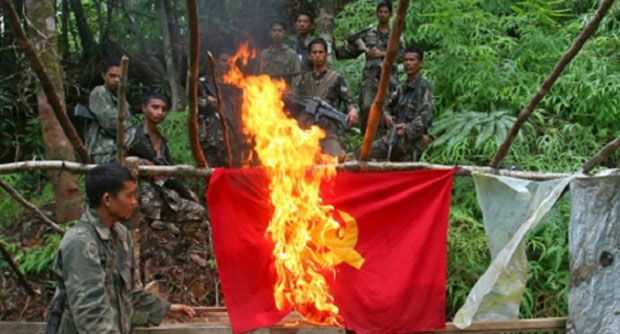
The New People’s Army (NPA) rebels were trying to regain their lost strength in the industrial province of Bataan, but government troopers have vowed to foil it.

The army leadership has assured that they will not allow the resurgence of NPA rebels in this province and nearby Pampanga.

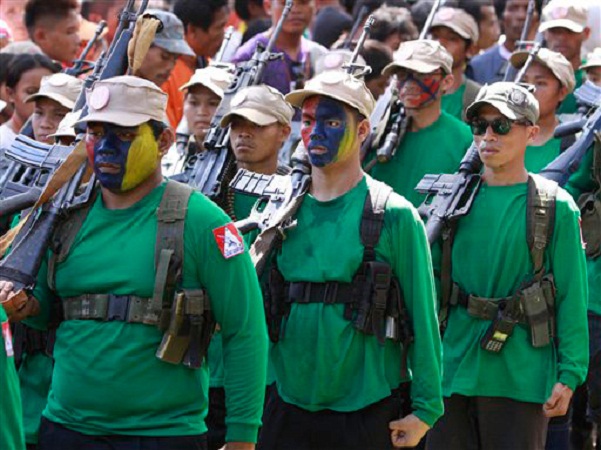
Determination is etched on the face of this New People’s Army (NPA) combatant in a show of force by the communist rebels during a news conference held at a guerilla encampment in the Sierra Madre mountains, November 23. (AP | Manila Bulletin)
 
Determination is etched on the face of this New People’s Army (NPA) combatant in a show of force by the communist rebels during a news conference held at a guerilla encampment in the Sierra Madre mountains, November 23. (AP | Manila Bulletin)

During the recent Peace and Order Council (POC) meeting held inside the 1Bataan Headquarters in Orani, Bataan, Col. Ramil Anoyo, Commanding Officer of the army’s 48th infantry battalion, said that the rebels were trying to encroach Bataan and neighboring Pampanga in their bid to regain their strength in these two provinces in Central Luzon

Col. Anoyo’s action came in the wake of reported three sightings in Pag asa, Orani town last February 13, where eight armed men were seen roaming around the forested area.

On February 8, another sightings of three armed men were also reported in Bilolo, Orion town while last January 12, two armed men were also sighted in Maligaya, Dinalupihan town.

But Anoyo said that they will continue to conduct operations against the rebels “in order to preserve an environment inhospitable to the armed threat that will compel them (NPA) to abandon their armed struggle.”

Anoyo said however that these sightings were subjected to validation since Bataan had been declared by the army leadership free of insurgents.

Gov. Abet Garcia, Chairman of POC, thanked the army as he offered support for the soldiers to maintain an atmosphere of peace in this industrial province.

The governor wanted to preserve the peaceful environment of Bataan, now becoming one of the preferred investments place in the region with the pouring in of various investors-local and foreign.

To prevent the rebels from encroaching Bataan, Anoyo said that they will put up another army detachment in Dinalupihan town to ensure that the rebels cannot against infiltrate Bataan, once their (rebels) bailiwick in late 80s.

http://news.mb.com.ph/2017/02/27/npa-rebels-try-to-regain-lost-strength-in-bataan-pampanga/

NPA rebel killed in Lian clash; LGUs eye localized peace

From the Manila Bulletin (Feb 27): NPA rebel killed in Lian clash; LGUs eye localized peace

Lian, Batangas — While local initiatives are rolling in several provinces and localities to establish sustained peace in areas infested by New People’s Army (NPA), a clash between government troops and the communist guerrillas broke out yesterday in Batangas resulting in the death of one rebel.
 
Army Colonel Arnulfo Marcelo Burgos, commander of the 202nd Brigade, said the encounter took place in Barangay Lumanag, Lian, Batangas around 3 a.m. yesterday.
 
Batangas Police Provincial Office (PPO) Director Leopoldo Cabanag said operatives of the 730th Combat Group of the Philippine Air Force (AFP), led by Staff Sergeant Eduardo Ocampo, traded fire with around 20 NPA rebels for about 15 minutes, ending in the retreat of the rebels and the death of one of their comrades.
 
Major General Rhoderick Parayno, 2nd Infantry Division commander of the Philippine Army, said the identity of the slain rebel was still unknown, but government troops collected three rebel firearms left at the scene of the battle – an M16 armalite rifle, an M14 rifle, and a Garand rifle.

Lost strength
As in Batangas, NPA rebels are trying to regain their lost strength in Bataan and Pampanga, but the military is confident this will not happen.

Addressing the recent Peace and Order Council (POC) meeting at the One Bataann Headquarters in Bataan, Colonel Ramil Anoyo, commanding officer of the army’s 48th infantry battalion, said they are not giving the rebels an inch.

Anoyo said a bid by the rebels to encroach Bataan last week had been foiled and that only a few of them have been roaming around and are being monitored.

3 Reds surrender

In Ilocos Sur, the army’s 18th Infantry Battalion (18IB) based in Sta. Cruz town has gained ground in its initiative to bring rebels back into the fold of the law.

Yesterday, Lt. Col. Eugenio Julio C. Osias IV, commander of the 18IB, said three NPA rebels have surrendered – “Ka Lumen,” a medic of the NPA, and one “Ka Fera,” both from the NPA’s Kilusang Larangang Guerilya (KLG)-Montes, and a “Ka Ren,” from the NPA’s SPP South Central command.

Localized peace

In the Bondoc Peninsula, Quezon Provincial Board Member Dominique Reyes is drafting a resolution seeking for a local peace initiative between the NPA and the provincial government.
 
Reyes, chairman of the POC, told The Manila Bulletin that he believes the local NPA rebels, particularly those moving in his district, are quite amenable to establishing peace for the welfare of the communities.

The challenge, he said is for talks between the NPA leadership in the locality and local government leaders, with the guidance of Quezon Governor David C. Suarez, and the cooperation of the military and police.
 

NPA attacks power plant, burns down trucks in Bukidnon

From the Rappler News Briefs Section (Feb 27): NPA attacks power plant, burns down trucks in Bukidnon

BUKIDNON – The New People's Army (NPA) attacked two private companies in Bukidnon on Saturday, February 25.

The first attack was on the construction compound of the proposed 10.6 megawatt Pulanai Hydroelectric Power Plant at Zone 11, Hangaron, Barangay Lumbayao. They confiscated the cellular phones of workers, and ordered them to leave the compound. They then planted some improvised explosive devices inside the compound.

On the same evening, another NPA group burned down two spray trucks owned by the Davco Agri Venture Corporation of Barangay Merganiran, Quezon, Bukidnon. A police investigation showed the company refused to give in to NPA extortion attempts.

http://www.rappler.com/nation/162664-news-briefs-philippines-february-27-2017

PAF-NPA battles intensify

From Tempo (Feb 28): PAF-NPA battles intensify

An armed guerilla member of the New People’s Army (NPA) was killed during a 15-minute firefight between rebels and the 730th Combat group of the Philippine Air Force (PAF) yesterday here.

The gunfight started after authorities acted on a report regarding the presence of an armed group said to be conduting extortion activities.

The rebels almost immediately opened fire when they saw the approaching troops.
In Davao del Norte, two suspected NPA members guerrillas were killed following an encounter against government soldiers in Asuncion town.
 Army Captain Ryan Batchar, 10th Infantry Division Public Affairs Office chief said soldiers from the 60th IB engaged around 20 NPA rebels belonging to Guerrilla Front 33 in a 40-minute firefight at Sitio Alungan, Brgy Sangayen in Asuncion.

Two dead bodies of unidentified NPA rebels and two AK-47 rifles were recovered in the said area after the encounter.

In Bukidnon, armed wing of the Communist Party of the Philippines (CPP) simultaneously attacked two private companies in Bukidnon on Sunday.

Sunday afternoon, about 15 fully-armed NPAs entered the compound of the proposed site for the 10.6 megawatt Pulanai Hydroelectric Power Plant in Valencia City while another NPA group burned down two spray trucks owned by Davco Agri Venture Corporation (DAVCO).

http://tempo.com.ph/2017/02/28/paf-npa-battles-intensify/

2 suspected NPA fighters slain in Davao del Norte clash

From the Sun Star-Bacolod (Feb 28): 2 suspected NPA fighters slain in Davao del Norte clash


NEGROS. Police cordons the area where a drug suspect was shot to death by suspected New People’s Army rebels in Barangay Montilla, Moises Padilla town Monday. (Moises Padilla MPS Photo)
A NEWLY-IDENTIFIED drug personality was gunned down by suspected members of the New People’s Army (NPA) at Sitio Balonggay, Barangay Montilla in Moises Padilla, Negros Occidental around 3:20 p.m., Monday.
 
Senior Inspector Alan Reloj, chief of Moises Padilla Municipal Police Station, identified the fatality as Dante Bajala, 27, a laborer and a habal-habal (motorcycle-for-hire) driver.
 
Bajala was sitting outside his house with some friends when five unidentified men arrived and told his companions to stay away, and fired at him.
 
He was able to run for a few meters, but he fell down and died. He sustained gunshot wounds on his chest and hands.
 
Investigators recovered 20 fired bullets of two different short firearms. Reloj said it took them an hour to respond since he decided to ask for assistance from the Philippine Army first for the conduct of thorough inspection as residents believed the assailants were NPA members.
 
They heard the suspects shouting “NPA ni, re-route kamo alagyan” (We are the NPA, find alternative routes), Aside from the five assailants, there were also 25 armed men who surrounded the area and fired at Bajala’s house, Reloj said.
 
He added that they are eyeing grudge as the motive since the victim has previous police records, including the alleged killing of two persons three years ago.
 
It could also be related to illegal drugs as the victim’s brother was already subjected to Oplan Tokhang earlier, Reloj added. Investigation is ongoing.

http://www.sunstar.com.ph/bacolod/local-news/2017/02/28/drug-suspect-shot-dead-negros-occidental-528294

2 suspected NPA fighters slain in Davao del Norte clash

From InterAksyon (Feb 28): 2 suspected NPA fighters slain in Davao del Norte clash


Government forces killed two suspected fighters of the New People’s Army in a clash in Asuncion town, Davao del Norte Monday morning, police said.

Chief Inspector Andrea Dela Cerna, chief information officer of the Davao regional police, reported to Camp Crame that a joint patrol with the military chanced on an armed band in Barangay Sangayen around 10:03 a.m. Monday, triggering a 40-minute firefight.

When the gunmen withdrew, the patrol found the bodies of the slain rebels along with two AK47 assault rifles, mobile phones, and backpacks.

http://interaksyon.com/article/137354/2-suspected-npa-fighters-slain-in-davao-del-norte-clash

Army, NPA clash rages on in Misamis Oriental

From the Philippine Daily Inquirer (Feb 28): Army, NPA clash rages on in Misamis Oriental


INQUIRER FILE PHOTO
INQUIRER FILE PHOTO
 
Classes in public elementary schools in two villages in Misamis Oriental were suspended as a firefight between Army soldiers and New People’s Army (NPA) rebels that began Monday continued on Tuesday.

Provincial information officer Nicole Managbanag said they received information from school administrations in Barangays Matampa in Salay town and in Guinalaban in Sugbongcogon that students were advised not attend classes due to the fighting.

Managbanag said teachers in the two barangay were told by village officials not to hold classes early Tuesday morning.

Gerrymae Pasco, local disaster risk reduction and management officer, said no word has reached their office if residents have moved out of their homes in Matampa and Guinalaban.

“They (villagers) have not evacuated yet as the encounter is still far away, but they could already hear gunshots in the distance,” Pasco said.

She said the provincial government has already prepared food packs, stored in a warehouse, in case the people in the two villages evacuate.

Capt. Joe Patrick Martinez, spokesperson of the 4th Infantry Division, earlier said the military launched pursuit operations against the rebels following an encounter on Monday in Barangay Kaulayanan, Sugbongcogon, where a soldier was killed.
 

Answers on kidnappings in the Philippines

From the Philippine Daily Inquirer (Feb 28): Answers on kidnappings in the Philippines

Abu Sayyaf (INQUIRER FILE PHOTO)
Abu Sayyaf. INQUIRER FILE PHOTO
 
Islamic militants in the southern Philippines beheaded an elderly German yachtsman on Sunday after their ransom demands were not met, authorities said Monday.

The murder of Jurgen Kantner was the latest attributed to the Abu Sayyaf, a kidnap-for-ransom gang that is believed to have earned millions of dollars through its grisly business since the 1990s.

Here are five questions and answers about kidnappings in the southern Philippines:

Who is doing it?

The Abu Sayyaf is a radical offshoot of a Muslim separatist insurgency that has claimed more than 120,000 lives in the south of the mainly Catholic Philippines since the 1970s.

The group was established in the 1990s with funds from a relative of former Al-Qaeda leader Osama bin Laden, although its key leaders have since switched allegiance to the rival Islamic State of Iraq and Syria (ISIS) group.

The Abu Sayyaf’s strongholds are the relatively small Muslim-populated islands of Jolo and Basilan in the far south of the Philippines.

It has only about 400 armed followers, according to the latest military estimate, but when members are killed in military battles it can easily restock from the largely supportive local communities.

Who is getting kidnapped?

The Abu Sayyaf has been involved in the kidnapping of hundreds of people since the 1990s, according to security analysts.

Using fast boats, the militants raid resorts, coastal communities and port areas in the southern and western Philippines, sometimes travelling hundreds of kilometers from their strongholds and as far as Malaysia’s Sabah state.

Many of its highest-profile targets have been foreign tourists staying at beach resorts.

In recent years the Abu Sayyaf has heavily expanded operations into the waters around the southern Philippines, abducting Indonesian, Vietnamese, Korean and Malaysian sailors on fishing vessels and cargo barges.

While their biggest paychecks come from kidnapping foreigners, locals such as businesspeople and schoolteachers are also frequently abducted then ransomed for smaller amounts.

Currently the Abu Sayyaf is holding six Vietnamese, five Malaysians, seven Indonesians, a Dutchman and seven locals, according to the military.

How lucrative is the business?

A single kidnapping can literally earn millions.

The Abu Sayyaf claimed it had received all of the more than $5 million ransom it demanded for a German couple abducted off their yacht in 2014 and released after six months. It posted a video on YouTube of the cash.

Defense Secretary Delfin Lorenzana said this month companies that employed two Indonesian sailors paid a ransom of 20 million pesos ($400,000) for their release.

What’s been done to stop them?
From 2002-2014, the US deployed special forces to train and provide intelligence to Filipino troops, which led to the killing or arrest of many Abu Sayyaf leaders.

US assistance was scaled back after the Pentagon concluded the group, originally with about 1,000 fighters, had lost the ability to launch international attacks.

Shortly after taking office last year, President Rodrigo Duterte launched a military offensive to “destroy” the Abu Sayyaf. But, like his predecessors who also waged assaults that claimed dozens of soldiers’ lives, Duterte has so far failed.

Why are they so resilient?
Mastery of the terrain in the mountainous and jungle-clad Jolo and Basilan islands, as well as support from the local communities, enables them to fend off military assaults.

The huge ransoms also allow them to buy more weapons and pay off local communities.

Perhaps most importantly, local authorities and security forces who should be trying to stop them are also involved.

“Rogue elements of the police, military, village officials or higher officials are involved,” Rommel Banlaoi, chair of the Philippine Institute for Peace, Violence and Terrorism Research, told AFP.

“It’s really organized crime.”

http://newsinfo.inquirer.net/876133/answers-on-kidnappings-in-the-philippines
 

Grumblings in the military bared as Duterte woos Reds

From the Philippine Daily Inquirer (Feb 27): Grumblings in the military bared as Duterte woos Reds

President Duterte’s alliance with the communist leaders has caused “grumblings” within the Armed Forces of the Philippines, but the discontent was not enough for the military to oust its Commander in Chief, a former rebel officer-turned-party-list congressman said on Sunday.

While clarifying that he does not speak for the military, Magdalo Rep. Gary Alejano said “the AFP knows Mr. Duterte’s relationship with the Left.”

Alejano said the President had given several concessions to the Communist Party of the Philippines to revive the stalled peace talks, including the release of several high profile communist leaders.

e also noted that throughout the peace talks, Mr. Duterte had been trying to win the military over. It was an “unusual courtship” by the President himself, that includes promises of higher salaries and pension hikes to raffling off firearms at several military camp visits.

“The President is confused over his (strategy) because he wants to please everybody, but you can’t do that,” Alejano said.

Alejano warned that while there was no ouster moves against the President, “there is always a breaking point,” referring to issues that could still come out against Mr. Duterte aside from allegations of corruption and human rights violations.

“I told myself before I will never join any attempt to overthrow the President but I ended up joining two because the situation had become untenable,” he said.

Alejano, then a Marine junior officer, along with now Sen. Antonio Trillanes IV, led nearly 300 officers and men in two coup attempts in 2003 and 2007.


http://newsinfo.inquirer.net/875606/grumblings-in-the-military-bared-as-duterte-woos-reds

3 NPA rebels yield in Ilocos Sur

From the Philippine Daily Inquirer (Feb 27): 3 NPA rebels yield in Ilocos Sur

New People's Army  AP FILE PHOTO

New People’s Army AP FILE PHOTO

Three members of the New People’s Army, one of them a woman, have surrendered to the military in Ilocos Sur, the Philippine Army’s 7th Infantry Division said on Monday (Feb. 27).
 
Lt. Col. Eugenio Julio Osias IV, head of the division’s 81st Infantry Battalion based in Ilocos Sur, identified them only by their aliases “Ka Lumen,” “Ka Ren” and “Ka Fera” for security reasons.

In a statement, Osias said two of them served as medics in the guerilla front “Montes” while another was a regular fighter in an armed propaganda unit in the south central part of the province.

He said the three rebels placed themselves under military custody sometime between January and Feb. 24.

According to Osias, the rebels gave up out of dismay over the lifting of the unilateral ceasefire by the NPA, the armed wing of the Communist Party of the Philippines.

The Armed Forces of the Philippines, the NPA said, has militarized communities during the peace negotiations.

The Philippine government pulled out of the peace talks due to what it called NPA offensives in Mindanao.
 

AFP denies troops disgruntled over alleged failure to double salaries

From Update.Ph (Feb 27): AFP denies troops disgruntled over alleged failure to double salaries

The Armed Forces of the Philippines (AFP) on Monday vehemently denied that some of its members are disgruntled due to the government’s ” “unfulfilled promise to double their salaries”. “There are no disgruntled members of the military over the so-called ‘unfulfilled promise to double their salaries’,” AFP public affairs office chief Col. Edgard Arevalo said.

Earlier, Magdalo Partylist Rep. Gary Lejano claimed that some members of the AFP are disappointed with the alleged failure of President Rodrigo Duterte to fulfill his promise to double their salaries.

“While we give due respect to the good Representative from the Magdalo Partylist, we say that the morale of the soldiers, airmen, sailors and marines is high.They take exception to the claim of displeasure,” Arevalo added.

“In the first place, the AFP personnel were given a raise in their take home pays without them even asking for it. To be given a raise therefore is a privilege,” the AFP official pointed out.

And on the matter of salary increase not being given yet in full as promised; and the intricacies of budgeting, among other issues, have been properly explained to every AFP personnel, he disclosed.

“And they understood. May we reiterate that your soldiers, airmen, sailors and marines are happily serving the nation and fellow Filipinos motivated by honor, service, and patriotism — and not only by mere financial remuneration,” Arevalo concluded.

 http://www.update.ph/2017/02/afp-denies-troops-disgruntled-over-alleged-failure-to-double-salaries/14916

Brand new FA-50PH jets conduct test flight to Davao City

From Update.Ph (Feb 27): Brand new FA-50PH jets conduct test flight to Davao City

The two just arrived FA-50PH “Fighting Eagle” jets from South Korea have conducted test flight to Davao City from Pampanga Friday, February 24 minutes before 12 noon, said in a report by SunStar Davao. These jets first arrived in country at Clark Airbase, Pampanga on February 22.

The said aircraft, FA-50PH 005 and 006, are the fifth and sixth of twelve ordered aircraft from Korean Aerospace Industries (KAI). Remaining six FA-50PHs are expected to be delivered this year.
When accepted for Air Force service, 005 and 006 will join the 7th Tactical Fighter Squadron of the Air Defense Wing of Philippine Air Force based at Basa Air Base in Pampanga.

The Fighting Eagles are acting as country’s interim fighter at the same time lead-in fighter trainer aircraft, until the Air Force gets enough experience of operating fast jet assets and budget to fund the acquisition of more capable fighter aircraft.
–– ADVERTISEMENT ––

The FA-50PHs has a top speed of Mach 1.5 or one and a half times the speed of sound and is capable of being fitted air-to-air missiles, including the AIM-9 “Sidewinder” air-to-air and heat-seeking missiles aside from light automatic cannons.

http://www.update.ph/2017/02/brand-new-fa-50ph-jets-conduct-test-flight-to-davao-city/14925

FA-50PH jet fighters bombard ASG camp in Basilan

From Update.Ph (Feb 27): FA-50PH jet fighters bombard ASG camp in Basilan

Government forces, using FA-50PH jet fighters and artillery units, bombarded an Abu Sayyaf Group (ASG) camp in Al Barka town, Basilan Monday early morning. The strike, which took place 2:57 a.m., targeted an ASG camp in Barangay Macalang of the said town, said 1st Infantry Division public affairs office Major Richard Enciso.

The attack took place as the military intensified its rescue efforts for hostages still in the clutches of the terrorists.

Enciso said the ASG camp is headed by Furuji Indama and Nurhassan Jamiri. Following ground units reported finding blood trails in the bombarded camp.

Pursuit operations are still ongoing, he added.

Monday’s operation came as the military continued rescue operations for kidnap victims being held by the ASG in nearby Sulu.

On Sunday, the military said it received information that one of the hostages, German Jurgen Kantner, had been beheaded due to the failure of his government to pay the bandits’ PHP30 million ransom demand.

Armed Forces of the Philippines (AFP) spokesperson Brig. Gen. Restituto Padilla said information is still being validated as no real evidence of the execution has been discovered so far.

http://www.update.ph/2017/02/fa-50ph-jet-fighters-bombard-asg-camp-in-basilan/14958

Driven away from Scarborough Shoal, Filipino fishermen now train in China

From Rappler (Feb 27): Driven away from Scarborough Shoal, Filipino fishermen now train in China

Outside the diplomatic arena, China’s decision to explore a different approach and strategy in dealing with Filipino fishermen appears to be shaky

This photo taken on June 16, 2016 shows a fishing vessel anchored at the South China Sea off the town of Infanta in Pangasinan province, as they wait for their fishing expedition to Scarborough Shoal. Ted Aljibe/AFP/File

This photo taken on June 16, 2016 shows a fishing vessel anchored at the South China Sea off the town of Infanta in Pangasinan province, as they wait for their fishing expedition to Scarborough Shoal. Ted Aljibe/AFP/File

Leonardo Cuaresma, leader of a fisherfolk organization in Masinloc, Zambales, spent the beginning of 2017 surveying the fishing sites in the province of Guangdong in China, at one point even riding a Chinese coastguard ship along with 15 other Filipino fishermen.

This is the very same ship which at mere sight, had raised fear among members of Cuaresma’s organization, some of whom were attacked with water cannons by the Chinese coastguard in January 2014.

This incident, among others, signaled the growing tension between China and the Philippines over the maritime dispute in the West Philippine Sea or South China Sea, where Panatag Shoal, (also called Bajo de Masinloc and Scarborough Shoal) lies. The two have claimed ownership over the resource-rich area.

But in January 2017, Cuaresma and other Filipino fishermen who ventured in the disputed waters of Panatag Shoal and Spratly Islands in Palawan (5 participants hailed from Region III or Central Luzon and 11 others came from Region IV-B where Palawan is) – were not sent away by this ship; it instead took them to fishing havens in China to expose them to Beijing’s fisheries technology.

“We rode in the ship of [the] maritime coastguard. From the shoreline up to 200 nautical miles, [you can see] fish cages,” Cuaresma, the leader of Nilalamo A Asosyanon Nin Maninilay Ha Babalin Masinloc (NAMBM Inc) or Federated Association of Fisherfolk in Masinloc, said.

It was a gesture of goodwill, one that could not be expected from China 4 years ago, when the Philippines lodged a case against the military and economic behemoth before an arbitral tribunal at the Permanent Court of Arbitration. The Philippines said China’s nine-dash line is an invalid basis for its maritime claim over the West Philippine Sea.

In July 2016, the Philippines won; China did not recognize the ruling.

In spite of this, President Rodrigo Duterte moved to develop warmer ties with Beijing partly because Manila could not match China’s military might. It was also a consequence of his decision to veer away from the United States, the Philippines’ longstanding ally.

The Philippines, along with the 9 other member-states of the Association of Southeast Asian Nations, 3 of which are also claimants of parts of the South China Sea (Vietnam, Malaysia and Brunei) now aim to finalize a framework for the Code of Conduct over the area by June. This was announced on February 21 as ASEAN foreign ministers held a meeting in Boracay.

But outside the diplomatic arena, China’s decision to explore a different approach and strategy in dealing with Filipino fishermen appears to be shaky. They sent Filipino fishermen to an educational trip and mentioned possible investments.

But here’s the catch – Cuaresma said they cannot adopt China’s techniques to increase fish production.

'Not so good'

The apprehension stems from what they saw in China’s waters.

“Not so good. The water in the river is not good. Malabo (murky). Because of the fishpond,” Cuaresma said.

“In China, they cannot protect their marine resources. They don’t have any corals, sea grass. Too much activities,” he added.

Cuaresma and his companions were flown to China in the second week of January to attend a workshop on the Sino-Filipino Fishery Training Exchange. The goal is for Filipino fishermen to learn how China increased its fish production.

The workshop was announced in December 2016 when Liu Xinzhong, deputy director of the Fisheries Administration of the Chinese Ministry of Agriculture went to Masinloc to discuss the provision of modern technology, equipment, and financial assistance to fishermen.

Cuaresma and his group met officials from the South China Sea Fisheries Research Institute in the Chinese Academy of Fishery Sciences and the National Agricultural Science and Technology Park in Guangdong. They were taught about aquaculture, or fish farming and marine culture, one of the methods of aquaculture which uses fish cages.

Cuaresma said, however, that these are not appropriate for the waters of Masinloc because they require the proliferation of fish cages. “Puro burak gawa ng fish cages, may sediments,” he said. (A lot of mire because of the fish cages, there were sediments.)

The Fisheries Code of the Philippines or Republic Act No. 8550 states that “not over 10 percent of the suitable water surface area of all lakes and rivers shall be allotted for aquaculture purposes like fish pens, fish cages and fish traps.”

Masinloc also bars the construction of additional fish cages. “Our friend in China likes fish cages [but] our municipality has a resolution that only the existing fish cages can operate in our municipality, municipal waters,” Medel Murata, the municipal environment and natural resources officer, said.

Murata said fish cages cause siltation especially during summer as well as algal bloom. The algae covers or swamps the corals, killing them; hence they have prohibited the establishment of more fish cages because, he said, the number of coral reefs in Masinloc has dwindled.

He added that he is worried about the proliferation of fish cages because they may drive the fisherfolk in Masinloc out of business. “If this multiplies in our coastal or in our marine water, there’s no area for small fishers.”

Cuaresma said if the Chinese float financial investments or assistance for the fishermen in Masinloc, he and his 1,000-member organization cannot accept these if they will require the use of fish cages.

“Our reaction – tanggapin pera (accept the money) but not regarding marine o aquaculture. The fishermen here in our country [are] really concerned about the environment. If people have their marine culture we cannot allow that..di siya applicable sa aming katubigan (it's not applicable to our waters),” he said.

The Bureau of Fisheries and Aquatic Resources, which attended the workshop, along with the fishermen and the Palawan Council for Sustainable Development, held the same view that Chinese technology is not fit for Philippine waters.

“The group appreciates the technologies but concern for the environment was considered if ever the technologies were adopted in the Philippines,” Willy Cruz from BFAR Region III said.

“Aquaculture technologies without the use of formulated feeds is considered. Only high value feeds using trash fish like the sardines of Zamboanga is prioritized.”

We tried to get the side of the Chinese government about the issues raised by Cuaresma and BFAR. We emailed the South China Sea Fisheries Research Institute in the Chinese Academy of Fishery Sciences, the National Agricultural Science and Technology Park, Liu Xinzhong, deputy director of the Fisheries Administration of the Chinese Ministry of Agriculture and the Chinese embassy but have not gotten any response as of posting.

Up to the government

During their one-week training in China, Cuaresma said there had been no mention of the territorial tiff over the West Philippine Sea.

The Filipino fishermen did not inquire if they can fish again in the lagoon in Bajo de Masinloc – which, they said, is teeming with fish – and not just in the waters surrounding it. Neither did the Chinese make any reference to the issue.

But it was the big elephant in the room.

Aside from environmental concerns, Cuaresma wanted to know if there are tradeoffs to China’s sudden show and offer of friendship.

He said even if the Chinese pour investments or opportunities for them to earn money, such as possibly having Chinese companies buy their fish, this will not be enough compensation for what the fishermen in Masinloc stand to lose if the Chinese government continues to forbid them from fishing in Bajo de Masinloc.

“Sa tingin ko, sariling pananaw, hindi yun ang dahilan, offer nila sa min yun, di yun ang kapalit lang ng mawawala sa amin. Ginagawa nila sa min pambu-bully lang,” he said. (I think, my personal view is, that is not the reason, they're ofering that to us in exchange for what we will lose. They're just bullying us.)

Unknown to Cuaresma and his group, however, the prohibition to fish in the lagoon in Bajo de Masinloc had the approval of the Philippine government.

President Rodrigo Duterte said in November 2016 he would issue an executive order declaring Panatag Shoal a marine sanctuary, turning it into a no-fish zone.

Cuaresma said they will stand firm and not accept any assistance from the Chinese if this again, will mean that they will have to use fish cages and if this will lead to the banning of Filipino fishermen from Bajo de Masinloc.

But he said if the national government says they should say yes, they will have no choice but to comply.

“What the government decides, we will follow them. [But] for me, [there’s] no trust [for the Chinese].”

http://www.rappler.com/nation/162647-panatag-scarborough-shoal-filipino-fishermen-training-china

Filipino Abu Sayyaf hostage freed

From Rappler (Feb 28): Filipino Abu Sayyaf hostage freed

Ricson Romoc is freed and gets the chance to reunite with his father, who was also abducted and released by the Abu Sayyaf


 The Abu Sayyaf freed kidnap victim Ricson Romoc on Monday, February 27.

Ricson is the son of an earlier released captive – his father, Elmer Romoc. He was released by the Abu Sayyaf in the vicinity of Barangay Anuling, Patikul, Sulu, Capt. Jo-Ann Petinglay, spokesperson of the Western Mindanao Command, confirmed.

Ricson was fetched by Ging Hayudini, Barangay charimen of Anuling, and subsequently brought to Jolo airport on a pickup owned by the chairman.

He then boarded a private aircraft owned by Governor Abdul Sakur Tan and departed on the same date.

The family of the victim allegedly paid a P3 million ransom demand for his safe release.

Ricson's father, Elmer Ybañez Romoc, was released by the Abu Sayyaf group at an undisclosed location in Jolo, Sulu back in November of 2016.

The Romocs were abducted by members of the Abu Sayyaf Group in Barangay Kulisap, Payao, Zamboanga Sibugay, on August 5, 2016.

http://www.rappler.com/nation/162762-filipino-abu-sayyaf-hostage-freed