From Update.Ph (Nov 22): US, Philippines armed forces release joint statement
Below is the Joint Statement of the Armed Forces of the Philippines (AFP) and United States Pacific Command after the Mutual Defense Board and Security Engagement Board (MDB-SEB) meeting held today at AFP headquarters in Camp Emilio Aguinaldo.
The Mutual Defense Board and Security Engagement Board (MDB-SEB) met on 22 November 2016 at the General Headquarters of the Armed Forces of the Philippines at Camp General Emilio Aguinaldo in Quezon City.
The successful completion of the MDB-SEB ensures continued, robust relations between the U.S. and Philippine militaries.
This highlights the enduring commitment of both countries to the U.S.-Philippine alliance.
We look forward to continued, close cooperation in areas central to both our national and security interests including humanitarian assistance and disaster relief, counterterrorism, cyber security, and maritime security.
The board was jointly presided by co-chairs General Ricardo R. Visaya, Chief of Staff, Armed Forces of the Philippines and Admiral Harry B. Harris, Jr., Commander, U.S. Pacific Command.
They were joined and supported by various standing committees and participating agencies of both governments.
http://www.update.ph/2016/11/us-philippines-armed-forces-release-joint-statement/11262

Tuesday, November 22, 2016

8th ID, AGAPE conduct series of 'Bayanihan' activities in E. Samar
From the Philippine News Agency (Nov 23): 8th ID, AGAPE conduct series of 'Bayanihan' activities in E. Samar
The Catbalogan-based 8th Infantry Division, together with partner government agencies and nongovernmental organizations, has intensified its "bayanihan" activities in its areas of operation in an effort to help bring development and end socioeconomic problems in the countryside.
Commander of the 8th Infantry Division, Brig. Gen. Raul Farnacio, in a statement Wednesday, said the division, in partnership with the AGAPE Rural Health Program, provided basic services in Agsaman, Poblacion and Cagmanaba, all in Jipapad town, Eastern Samar.
These services included medical and dental assistance, free medicine, free haircuts, film-viewing and the distribution of slippers, clothes and reading glasses to marginalized persons in these communities.
The NGO, AGAPE, consists of Christian volunteers from Asia and the US whose mission is to help those who could not afford to meet their medication and basic needs.
The people of Jipapad benefited from 1,078 medical check-ups with free medicine; 78 tooth extractions; 30 haircuts; 330 reading glasses; and 340 pairs of slippers.
“This is the time to be united in our desire to address the poverty problem of the region. Let’s help build a peaceful and developed Eastern Visayas," Farnacio added.
http://www.pna.gov.ph/index.php?idn=1&sid=&nid=1&rid=942525
The Catbalogan-based 8th Infantry Division, together with partner government agencies and nongovernmental organizations, has intensified its "bayanihan" activities in its areas of operation in an effort to help bring development and end socioeconomic problems in the countryside.
Commander of the 8th Infantry Division, Brig. Gen. Raul Farnacio, in a statement Wednesday, said the division, in partnership with the AGAPE Rural Health Program, provided basic services in Agsaman, Poblacion and Cagmanaba, all in Jipapad town, Eastern Samar.
These services included medical and dental assistance, free medicine, free haircuts, film-viewing and the distribution of slippers, clothes and reading glasses to marginalized persons in these communities.
The NGO, AGAPE, consists of Christian volunteers from Asia and the US whose mission is to help those who could not afford to meet their medication and basic needs.
The people of Jipapad benefited from 1,078 medical check-ups with free medicine; 78 tooth extractions; 30 haircuts; 330 reading glasses; and 340 pairs of slippers.
“This is the time to be united in our desire to address the poverty problem of the region. Let’s help build a peaceful and developed Eastern Visayas," Farnacio added.
http://www.pna.gov.ph/index.php?idn=1&sid=&nid=1&rid=942525
AFP conducts medical, dental mission in support of PHL NCC celebrations
From the Philippine News Agency (Nov 23): AFP conducts medical, dental mission in support of PHL NCC celebrations
In line with its community development mission, the Armed Forces of the Philippines (AFP) conducted a medical and dental mission Tuesday as part of the country's observance of National Children's Congress (NCC).
“The AFP supports these kinds of activities for the youth. It is important that we give recognition to our children and encourage quality education and learning to all our Filipino youth,” said AFP chief-of-staff Gen. Ricardo Visaya.
Marginalized children are the primary beneficiaries of the AFP medical and dental mission which was held at the AFP Theater in Camp Aguinaldo, Quezon City.
The five-day event culminated in an “Araw ng Kabataan” which gathered 900 children beneficiaries of the "Pantawid Pamilyang Pilipino Program" of the Department of Social Welfare and Development (DSWD) across the 87 provinces of the Philippines, and also 200 participants from partner organizations, and sponsors.
NCC in the Philippines started on Nov. 18 and ended on the 22nd. The lead agency for the week-long celebration is the DSWD under Secretary Judy Taguiwalo
“We hope that through the medical and dental mission, the AFP will be able to show its unwavering support to other government organizations such as the DSWD in advancing the welfare of the youth and in making them ready to lead the country in the future,” Visaya said.
This year's NCC has the theme “Isulong: Kalidad na edukasyon para sa lahat ng bata.”
The annual activity aims to engage the youth with different activities to pool exemplary "Pantawid Pamilya" children beneficiaries and equip them with the essential knowledge on the program and to support children’s rights as well.
http://www.pna.gov.ph/index.php?idn=1&sid=&nid=1&rid=942539
In line with its community development mission, the Armed Forces of the Philippines (AFP) conducted a medical and dental mission Tuesday as part of the country's observance of National Children's Congress (NCC).
“The AFP supports these kinds of activities for the youth. It is important that we give recognition to our children and encourage quality education and learning to all our Filipino youth,” said AFP chief-of-staff Gen. Ricardo Visaya.
Marginalized children are the primary beneficiaries of the AFP medical and dental mission which was held at the AFP Theater in Camp Aguinaldo, Quezon City.
The five-day event culminated in an “Araw ng Kabataan” which gathered 900 children beneficiaries of the "Pantawid Pamilyang Pilipino Program" of the Department of Social Welfare and Development (DSWD) across the 87 provinces of the Philippines, and also 200 participants from partner organizations, and sponsors.
NCC in the Philippines started on Nov. 18 and ended on the 22nd. The lead agency for the week-long celebration is the DSWD under Secretary Judy Taguiwalo
“We hope that through the medical and dental mission, the AFP will be able to show its unwavering support to other government organizations such as the DSWD in advancing the welfare of the youth and in making them ready to lead the country in the future,” Visaya said.
This year's NCC has the theme “Isulong: Kalidad na edukasyon para sa lahat ng bata.”
The annual activity aims to engage the youth with different activities to pool exemplary "Pantawid Pamilya" children beneficiaries and equip them with the essential knowledge on the program and to support children’s rights as well.
http://www.pna.gov.ph/index.php?idn=1&sid=&nid=1&rid=942539
AFP, PNP ink MOA to intensify anti-illegal drug campaign in Caraga
From the Philippine Information Agency (Nov 23): AFP, PNP ink MOA to intensify anti-illegal drug campaign in Caraga
During the regular Joint Peace and Security Coordinating Committee (JPSCC) - Region 13 meeting held at the Police Regional Office-13 here, the 4th Infantry (Diamond) Division, Philippine Army (PA) and Philippine National Police (PNP) signed on Monday the memorandum of agreement (MOA) for collaboration procedures on anti-illegal drug operations in Caraga region.
The said MOA is aimed to attain the following objectives: carry out President Rodrigo Duterte’s order to stop and eliminate drugs within three to six months; enhance coordination/cooperation between the PNP and AFP in case build-up and investigation of suspected persons involved in illegal drugs; minimize the ingress and egress of high value targets and illegal drug paraphernalia; and synchronize effort of government and strengthen its position in bringing target drug personalities and offenders to justice among others.
Based on the MOA, the PNP takes the lead role in any operation on implementation of Pulis at Sundalo: Kabalikat Laban sa Droga Project known as “Double Barrel,” and takes the lead role in the investigation/processing of scene of the crime; and other law enforcement operations against illegal drugs.
Meanwhile, the Philippine Army shall provide support to law enforcement operations; assist the PNP in the implementation of Project Double Barrel which include the execution of the five stages of Project TokHang – collection and validation of information stage, coordination stage, house to house visitation stage, processing and documentation stage, and monitoring and evaluation stage.
“The 4ID, Philippine Army shall maximize its efforts and extend full cooperation and support to the PNP in all phases of operations of the project to ensure that Caraga region will be able to sustain peace and order and soon become a drug-free region,” underlined MGen. Benjamin R. Madrigal Jr., 4ID commander.
http://news.pia.gov.ph/article/view/2041479881194/afp-pnp-ink-moa-to-intensify-anti-illegal-drug-campaign-in-caraga
During the regular Joint Peace and Security Coordinating Committee (JPSCC) - Region 13 meeting held at the Police Regional Office-13 here, the 4th Infantry (Diamond) Division, Philippine Army (PA) and Philippine National Police (PNP) signed on Monday the memorandum of agreement (MOA) for collaboration procedures on anti-illegal drug operations in Caraga region.
The said MOA is aimed to attain the following objectives: carry out President Rodrigo Duterte’s order to stop and eliminate drugs within three to six months; enhance coordination/cooperation between the PNP and AFP in case build-up and investigation of suspected persons involved in illegal drugs; minimize the ingress and egress of high value targets and illegal drug paraphernalia; and synchronize effort of government and strengthen its position in bringing target drug personalities and offenders to justice among others.
Based on the MOA, the PNP takes the lead role in any operation on implementation of Pulis at Sundalo: Kabalikat Laban sa Droga Project known as “Double Barrel,” and takes the lead role in the investigation/processing of scene of the crime; and other law enforcement operations against illegal drugs.
Meanwhile, the Philippine Army shall provide support to law enforcement operations; assist the PNP in the implementation of Project Double Barrel which include the execution of the five stages of Project TokHang – collection and validation of information stage, coordination stage, house to house visitation stage, processing and documentation stage, and monitoring and evaluation stage.
“The 4ID, Philippine Army shall maximize its efforts and extend full cooperation and support to the PNP in all phases of operations of the project to ensure that Caraga region will be able to sustain peace and order and soon become a drug-free region,” underlined MGen. Benjamin R. Madrigal Jr., 4ID commander.
http://news.pia.gov.ph/article/view/2041479881194/afp-pnp-ink-moa-to-intensify-anti-illegal-drug-campaign-in-caraga
U.S. Embassy in the Philippines inaugurates health facilities in Samar
From the Philippine Information Agency (Nov 23): U.S. Embassy in the Philippines inaugurates health facilities in Samar
The U.S. Embassy in the Philippines’ United States Agency for International Development (USAID) Office of Health Deputy Chief Bryn Sakagawa led the inauguration of the newly constructed birthing and Tuberculosis Directly Observed Treatment Short-Course (TB-DOTS) facilities in Calbiga Rural Health Unit in Samar.
Samar Provincial Board Member Fe Arcales extended her gratitude on behalf of Samar citizens.
“This facility will increase access to health programs and boost the morale of health personnel,” she said.
Additionally USAID provided medical equipment and communication materials on family planning, maternal and child health, and TB. The TB-DOTS structures are among 12 health facilities constructed by USAID to restore access to health services across Typhoon Yolanda-affected areas.
To date, the U.S. government has provided $143 million to help the Philippines respond to, and recover from, the devastating effects of Typhoon Yolanda. “The U.S. government is a partner of the Philippines, including the communities in Leyte and Samar, in making building improvements after Typhoon Yolanda,” said Sakagawa.
USAID is also constructing 310 classrooms, 30 agriculture-fishery support facilities, and more than 1,000 sari-sari stores, and restoring livelihood activities through the provision of equipment and training to 3,000 farmers, 7,000 fishermen and women, and 1,400 micro, small and medium entrepreneurs.
The United States Agency for International Development is the lead U.S. government agency that works to end extreme global poverty and enable resilient, democratic societies to realize their potential. In the Philippines, USAID partners with the national government to create a more stable, prosperous and well-governed nation. (US Embassy Manila)
http://news.pia.gov.ph/article/view/1141479801245/u-s-embassy-in-the-philippines-inaugurates-health-facilities-in-samar
The U.S. Embassy in the Philippines’ United States Agency for International Development (USAID) Office of Health Deputy Chief Bryn Sakagawa led the inauguration of the newly constructed birthing and Tuberculosis Directly Observed Treatment Short-Course (TB-DOTS) facilities in Calbiga Rural Health Unit in Samar.
Samar Provincial Board Member Fe Arcales extended her gratitude on behalf of Samar citizens.
“This facility will increase access to health programs and boost the morale of health personnel,” she said.
Additionally USAID provided medical equipment and communication materials on family planning, maternal and child health, and TB. The TB-DOTS structures are among 12 health facilities constructed by USAID to restore access to health services across Typhoon Yolanda-affected areas.
To date, the U.S. government has provided $143 million to help the Philippines respond to, and recover from, the devastating effects of Typhoon Yolanda. “The U.S. government is a partner of the Philippines, including the communities in Leyte and Samar, in making building improvements after Typhoon Yolanda,” said Sakagawa.
USAID is also constructing 310 classrooms, 30 agriculture-fishery support facilities, and more than 1,000 sari-sari stores, and restoring livelihood activities through the provision of equipment and training to 3,000 farmers, 7,000 fishermen and women, and 1,400 micro, small and medium entrepreneurs.
The United States Agency for International Development is the lead U.S. government agency that works to end extreme global poverty and enable resilient, democratic societies to realize their potential. In the Philippines, USAID partners with the national government to create a more stable, prosperous and well-governed nation. (US Embassy Manila)
http://news.pia.gov.ph/article/view/1141479801245/u-s-embassy-in-the-philippines-inaugurates-health-facilities-in-samar
Patrol car damaged as IED goes off in Maguindanao town
From the Philippine Daily Inquirer (Nov 23): Patrol car damaged as IED goes off in Maguindanao town
SHARIFF AGUAK, Maguindanao—A patrol car of the Datu Odin Sinsuat town police was damaged when an improvised explosive device (IED) went off along the national highway here on Tuesday evening.
None of the patrol car’s passengers were injured in the explosion set off by still unidentified men near the headquarters of the Army’s Mechanized Infantry Brigade in Barangay (village) Satan here.
Inspector Rasul Pandulo, the Maguindanao police spokesperson, said the IED—fashioned from powder explosives and packed with nails—was set off around 9 p.m.
No one has claimed responsibility for the roadside bombing incident, Pandulo said.
In recent days, bombs also went off along the Maguindanao portion of the Cotabato-General Santos City.
The Bangsamoro Islamic Freedom Fighters had owned up to some of the explosions.
http://newsinfo.inquirer.net/847084/patrol-car-damaged-as-ied-goes-off-in-maguindanao-town
SHARIFF AGUAK, Maguindanao—A patrol car of the Datu Odin Sinsuat town police was damaged when an improvised explosive device (IED) went off along the national highway here on Tuesday evening.
None of the patrol car’s passengers were injured in the explosion set off by still unidentified men near the headquarters of the Army’s Mechanized Infantry Brigade in Barangay (village) Satan here.
Inspector Rasul Pandulo, the Maguindanao police spokesperson, said the IED—fashioned from powder explosives and packed with nails—was set off around 9 p.m.
No one has claimed responsibility for the roadside bombing incident, Pandulo said.
In recent days, bombs also went off along the Maguindanao portion of the Cotabato-General Santos City.
The Bangsamoro Islamic Freedom Fighters had owned up to some of the explosions.
http://newsinfo.inquirer.net/847084/patrol-car-damaged-as-ied-goes-off-in-maguindanao-town
Abu Sayyaf attacks Japanese cargo ship in Sulu Sea
From the Manila Times (Nov 22): Abu Sayyaf attacks Japanese cargo ship in Sulu Sea
Suspected Abu Sayyaf bandits attacked a Japanese cargo ship in the Sulu Sea near Tawi-Tawi province, belated reports on Tuesday said.
The Regional Cooperation Agreement on Combating Piracy and Armed Robbery against Ships in Asia (ReCAAP) reported that the bulk carrier Kumiai Shagang thwarted the November 20 attack and continued its voyage from Port Hedland in Australia to Qingdao in China.
The Sulu Sea in the southwestern area of the Philippines is separated from the South China Sea in the northwest by Palawan and from the Celebes Sea in the southeast by the Sulu Archipelago.
The cargo ship is owned by Southern Pacific Holding and managed by Kumiai Senpaku.
According to the regional piracy watchdog ReCAAP, the ship’s crew took anti-piracy measures and successfully prevented boarding by the perpetrators.
It also said that since March this year, there have been 11 incidents in the area and most of these were claimed by the Abu Sayyaf.
At least 44 crew have been abducted this year off Sabah in Malaysia and the Abu Sayyaf is still holding over a dozen kidnapped Malaysian, Indonesian and Vietnamese sailors, including a German boater Jurgen Kantner.
There was no immediate statement from the military’s Western Mindanao Command in Zamboanga City as to the reported recent attack.
http://www.manilatimes.net/abu-sayyaf-attacks-japanese-cargo-ship-sulu-sea/297855/
Suspected Abu Sayyaf bandits attacked a Japanese cargo ship in the Sulu Sea near Tawi-Tawi province, belated reports on Tuesday said.
The Regional Cooperation Agreement on Combating Piracy and Armed Robbery against Ships in Asia (ReCAAP) reported that the bulk carrier Kumiai Shagang thwarted the November 20 attack and continued its voyage from Port Hedland in Australia to Qingdao in China.
The Sulu Sea in the southwestern area of the Philippines is separated from the South China Sea in the northwest by Palawan and from the Celebes Sea in the southeast by the Sulu Archipelago.
The cargo ship is owned by Southern Pacific Holding and managed by Kumiai Senpaku.
According to the regional piracy watchdog ReCAAP, the ship’s crew took anti-piracy measures and successfully prevented boarding by the perpetrators.
It also said that since March this year, there have been 11 incidents in the area and most of these were claimed by the Abu Sayyaf.
At least 44 crew have been abducted this year off Sabah in Malaysia and the Abu Sayyaf is still holding over a dozen kidnapped Malaysian, Indonesian and Vietnamese sailors, including a German boater Jurgen Kantner.
There was no immediate statement from the military’s Western Mindanao Command in Zamboanga City as to the reported recent attack.
http://www.manilatimes.net/abu-sayyaf-attacks-japanese-cargo-ship-sulu-sea/297855/
6 Abu Sayyaf men wanted by both Philippines, Malaysia
From Anadolu Agency (Nov 22): 6 Abu Sayyaf men wanted by both Philippines, Malaysia
Men named with 17 others in connection with kidnapping cases in the seas off eastern Sabah, Malaysia

Men named with 17 others in connection with kidnapping cases in the seas off eastern Sabah, Malaysia
Philippines authorities have confirmed that six men named by Malaysian authorities on suspicion of orchestrating kidnappings in waters between the two countries are also wanted by Manila.
The men -- suspected of being members of the Daesh-linked Abu Sayyaf -- have been named with 17 others by Kuala Lumpur in connection with kidnapping cases in the seas off eastern Sabah, Malaysia.
“They and 15 others are being pursued by Philippine law enforcement and military authorities in the hinterlands of Sulu and Basilan provinces,” a statement from the Philippines embassy in Kuala Lumpur said Tuesday.
"Philippines authorities welcome any information from their Malaysian counterparts that would lead to the arrest of these wanted individuals."
During a visit to Malaysia in November, Philippines President Rodrigo Duterte said that he would work closely with Malaysia counterpart Najib Razak to solve kidnapping incidents in the Sulu-Sulawesi Seas.
On Monday, the Philippines’ military confirmed that its air and naval forces are scouring the country’s troubled south after two more Indonesian fishermen were kidnapped off eastern Malaysia.
According to reports, the abduction was carried out by Abu Sayyaf members on a speedboat who later fled the scene.
The Abu Sayyaf is believed to be holding around 17 foreigners -- including five Malaysians -- and several Filipinos on the island of Sulu.
The military has blamed the group for the recent abduction of six sailors from a Vietnamese-flagged vessel off nearby Basilan island as well as a German man -- whose partner was shot dead -- from a yacht off Sulu.
Police and military reports released in the Philippines late last month stated that the Abu Sayyaf had shifted its priorities from abducting foreigners and businesspeople on the mainland to foreign-flagged tugboats and their crews -- many of them Malaysian and Indonesian nationals -- in local shipping lanes.
The reports also revealed that the group made around 353 million pesos ($7.3 million) from kidnap-for-ransom activities in the first six months of this year.
Since 1991, the group -- armed with mostly improvised explosive devices, mortars and automatic rifles -- has carried out bombings, kidnappings, assassinations and extortions in a self-determined fight for an independent province in the Philippines.
It is one of two militant groups in the south who have pledged allegiance to Daesh, prompting fears during the stalling of a peace process between the government and the country's one-time largest Moro rebel group that it could make inroads in a region torn by decades of armed conflict.
German hostage pleads for help
From the Philippine Daily Inquirer (Nov 23): German hostage pleads for help
Sayyaf bandits on Tuesday briefly circulated a video online, showing German hostage Juergen Kantner pleading for help.
In the video, which circulated briefly on Facebook, Kantner pleaded with the Philippine and German governments to help raise his ransom.
The voice of Abu Sayyaf spokesperson Muammar Askali, also known as Abu Rami, could be heard in the background, ordering Kantner to speak.
“I need your help,” Kantner said. “From the Philippine government and German government to bring P500,000.”
Askali also asked the captive to write his name and address, saying, “We will give him a chance to contact his family, but we observed he is not giving us the correct details.”
He said Kantner earlier claimed he was Kantner Jurgen, who worked in Heizung Gaver.
“He said he was never kidnapped, and that he was not the person kidnapped in Somalia in 2008,” Askali said, referring to an earlier report by Agence France-Presse that said Kantner was kidnapped by Somali pirates in 2008.

“We hate lying. If we found this German citizen lying to us, we will not have second thoughts about hurting him. We monitor online news,” Askali warned.
The Abu Sayyaf said it would call local and foreign news organizations to announce the deadline for the ransom.
Kantner and his wife, Sabine Merz, were abducted on Nov. 5, when the Abu Sayyaf chanced upon them onboard their yacht, cruising the waters of Tanjong Luuk Pisuk in Sabah.
Askali earlier claimed they killed Merz when she tried to shoot them when they reached the waters of Tawi-Tawi.
On Nov. 6, villagers reported finding the body of a woman lying beside a shotgun on board a light blue yacht with the German flag off Laparan Island in Sulu, said Maj. Filemon Tan Jr. spokesperson for the Western Mindanao Command.
Tan said the body had gunshot wounds and bruises.
He said the passports of Kantner and Merz were found on the yacht. The picture in Merz’s passport appeared to match the dead woman, he said.
http://newsinfo.inquirer.net/846963/german-hostage-pleads-for-help
Sayyaf bandits on Tuesday briefly circulated a video online, showing German hostage Juergen Kantner pleading for help.
In the video, which circulated briefly on Facebook, Kantner pleaded with the Philippine and German governments to help raise his ransom.
The voice of Abu Sayyaf spokesperson Muammar Askali, also known as Abu Rami, could be heard in the background, ordering Kantner to speak.
“I need your help,” Kantner said. “From the Philippine government and German government to bring P500,000.”
P5-M ransom
But the bandits quickly corrected him, saying the ransom was P5 million.Askali also asked the captive to write his name and address, saying, “We will give him a chance to contact his family, but we observed he is not giving us the correct details.”
He said Kantner earlier claimed he was Kantner Jurgen, who worked in Heizung Gaver.
“He said he was never kidnapped, and that he was not the person kidnapped in Somalia in 2008,” Askali said, referring to an earlier report by Agence France-Presse that said Kantner was kidnapped by Somali pirates in 2008.
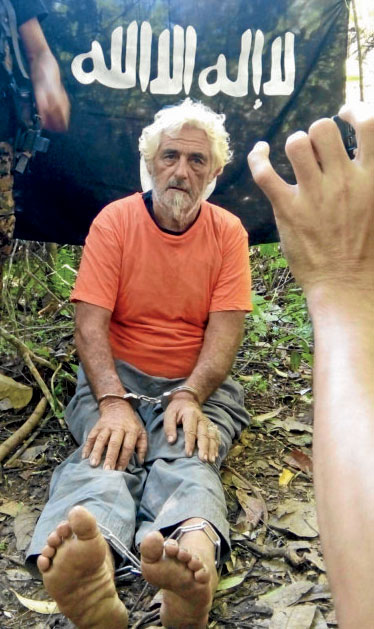
Juergen Kantner in Abu Sayyaf video
“We hate lying. If we found this German citizen lying to us, we will not have second thoughts about hurting him. We monitor online news,” Askali warned.
Message for German gov’t
Addressing the German government, Askali said: “We hold your citizen captive and it is permitted in Islam to take his blood and life.”The Abu Sayyaf said it would call local and foreign news organizations to announce the deadline for the ransom.
Kantner and his wife, Sabine Merz, were abducted on Nov. 5, when the Abu Sayyaf chanced upon them onboard their yacht, cruising the waters of Tanjong Luuk Pisuk in Sabah.
Askali earlier claimed they killed Merz when she tried to shoot them when they reached the waters of Tawi-Tawi.
On Nov. 6, villagers reported finding the body of a woman lying beside a shotgun on board a light blue yacht with the German flag off Laparan Island in Sulu, said Maj. Filemon Tan Jr. spokesperson for the Western Mindanao Command.
Tan said the body had gunshot wounds and bruises.
He said the passports of Kantner and Merz were found on the yacht. The picture in Merz’s passport appeared to match the dead woman, he said.
http://newsinfo.inquirer.net/846963/german-hostage-pleads-for-help
Forget Trump and China, piracy in the Sulu Sea is a fresh threat to Asia trade
From CNBC (Nov 22): Forget Trump and China, piracy in the Sulu Sea is a fresh threat to Asia trade
Southeast Asia is grappling with rampant maritime piracy that, if left unchecked, could threaten trade and bolster terror networks in the region.
This year has seen a growing number of hijackings in the Sulu Sea, located between the Philippines and the island of Borneo. Around $40 billion worth of cargo passes through the area annually, with around $700-800 million in Indonesian coal exports going to the Philippines.

Southeast Asia is grappling with rampant maritime piracy that, if left unchecked, could threaten trade and bolster terror networks in the region.
This year has seen a growing number of hijackings in the Sulu Sea, located between the Philippines and the island of Borneo. Around $40 billion worth of cargo passes through the area annually, with around $700-800 million in Indonesian coal exports going to the Philippines.
H. Christoph / ullstein bild / Getty Images Philippine marines keep a look out for pirates in the Sulu Sea.
Two German citizens were attacked—one was abducted and the other killed—earlier this month while sailing their yacht near Sabah, a Malaysian state in Borneo. And over the weekend, two Indonesian fishermen were abducted in two separate incidents off Sabah. In October, a South Korean ship was seized, with its captain and Philippine crewmember also taken hostage.
Militant group Abu Sayyaf is believed to be responsible for the violence, according to the Philippine military.
Based in the southern Philippine province of Mindanao, Abu Sayyaf has increasingly taken to maritime kidnappings for ransom payments, which brought in nearly $7.3 million so far this year, the Associated Press reported last month, citing a Philippine government report. One of Abu Sayyaf's goals is to establish an independent state based on Shariah law in Mindanao and preserve its ethnic Moro community.
The onslaughts are a mixture of opportunistic and calculated crime, explained Zachary Abuza, a professor specializing in Southeast Asian security issues at the National War College. Abu Sayyaf can score a quick payoff through kidnappings and use the funds to finance broader terror operations, he said.
That modus operandi is symbolic of the wider trends in global piracy. A report by IHS Markit earlier this month found that while the number of piracy attacks around the world have generally decreased, kidnapping had become more common. The seas around the Philippines were the most pirated, followed by Nigeria and India, the report said.
Based in the southern Philippine province of Mindanao, Abu Sayyaf has increasingly taken to maritime kidnappings for ransom payments, which brought in nearly $7.3 million so far this year, the Associated Press reported last month, citing a Philippine government report. One of Abu Sayyaf's goals is to establish an independent state based on Shariah law in Mindanao and preserve its ethnic Moro community.
The onslaughts are a mixture of opportunistic and calculated crime, explained Zachary Abuza, a professor specializing in Southeast Asian security issues at the National War College. Abu Sayyaf can score a quick payoff through kidnappings and use the funds to finance broader terror operations, he said.
That modus operandi is symbolic of the wider trends in global piracy. A report by IHS Markit earlier this month found that while the number of piracy attacks around the world have generally decreased, kidnapping had become more common. The seas around the Philippines were the most pirated, followed by Nigeria and India, the report said.

Groups such as Abu Sayyaf are targeting small vessels, such as fishing trawlers or tugboats pulling coal barges that lack security forces, Abuza said, noting that October's hijacking of the large Korean vessel was a rarity.
Earlier this year, Indonesia enforced a moratorium on coal shipments to the Philippines but the resulting economic damage saw Jakarta reverse course. Tugboats and barges remain banned from entering Philippine waters, but larger cargo ships holding capacity of over 500 tonnes are allowed to resume trade since smaller ships were more at risk, the Transportation Ministry said on October 30.
"This (piracy) poses a real problem for regional trade. As the Chinese economy slows down, intra-regional trade becomes all the more urgent ... It also opens a can of legal worms that hasn't been previously been wrestled with in Southeast Asia," Abuza noted.
Kuala Lumpur, Jakarta and Manila vowed to cooperate to fight the epidemic through measures such as joint maritime and air patrol at the 10th ASEAN Defense Ministers Meeting in Laos this past weekend, with Malaysia warning that the Sulu Sea should not become the "new Somalia."
However, none of the three nations are strong at maritime policing or naval capability, Abuza flagged. "The Philippines is by far weakest link in these three and the security situation in Mindanao is deteriorating, not improving."
Moreover, the situation looked set to exacerbate given current politics in the U.S. and Philippines, he added.
U.S. President-elect Donald Trump and President Rodrigo Duterte are both looking to reduce America's military presence in the Philippines, with Duterte even looking to eject the roughly 100 U.S. special operative forces in Mindanao.
http://www.cnbc.com/2016/11/22/forget-trump-china-sulu-sea-piracy-is-threat-to-asia-trade.html
Earlier this year, Indonesia enforced a moratorium on coal shipments to the Philippines but the resulting economic damage saw Jakarta reverse course. Tugboats and barges remain banned from entering Philippine waters, but larger cargo ships holding capacity of over 500 tonnes are allowed to resume trade since smaller ships were more at risk, the Transportation Ministry said on October 30.
"This (piracy) poses a real problem for regional trade. As the Chinese economy slows down, intra-regional trade becomes all the more urgent ... It also opens a can of legal worms that hasn't been previously been wrestled with in Southeast Asia," Abuza noted.
Kuala Lumpur, Jakarta and Manila vowed to cooperate to fight the epidemic through measures such as joint maritime and air patrol at the 10th ASEAN Defense Ministers Meeting in Laos this past weekend, with Malaysia warning that the Sulu Sea should not become the "new Somalia."
However, none of the three nations are strong at maritime policing or naval capability, Abuza flagged. "The Philippines is by far weakest link in these three and the security situation in Mindanao is deteriorating, not improving."
Moreover, the situation looked set to exacerbate given current politics in the U.S. and Philippines, he added.
U.S. President-elect Donald Trump and President Rodrigo Duterte are both looking to reduce America's military presence in the Philippines, with Duterte even looking to eject the roughly 100 U.S. special operative forces in Mindanao.
http://www.cnbc.com/2016/11/22/forget-trump-china-sulu-sea-piracy-is-threat-to-asia-trade.html
Sulu Army commander promoted, not sacked
From the Philippine Daily Inquirer (Nov 23): Sulu Army commander promoted, not sacked
The Philippine military has dismissed reports that Joint Task Force Sulu Commander Brig. Gen. Arnel de la Vega has been sacked for failing to stop the Abu Sayyaf group from its kidnapping activities despite a massive military operation in the south.
Military spokesperson Col. Edgar Arevalo said De la Vega was in fact taking the spot of Maj. Gen. Rodolfo Santiago, who retired on Monday as commandant of the Command and General Staff College (CGSC) of the Armed Forces of the Philippines after 38 years of service.
De la Vega spent just four months as joint task force head, during which there has been an increase in Abu Sayyaf kidnappings despite a massive military build up to combat the extremist group in the south.
De la Vega was a member of Philippine Military Academy Class ’85 while Santiago belonged to Class ’82.
Santiago also served as the Deputy Commander of the Communications, Electronic and Information Service of the AFP. He was also the Assistant Deputy Chief of Staff for Civil Military Operations and Chief of Staff of the defunct National Development Support Command.
http://newsinfo.inquirer.net/846995/sulu-army-commander-promoted-not-sacked
The Philippine military has dismissed reports that Joint Task Force Sulu Commander Brig. Gen. Arnel de la Vega has been sacked for failing to stop the Abu Sayyaf group from its kidnapping activities despite a massive military operation in the south.
Military spokesperson Col. Edgar Arevalo said De la Vega was in fact taking the spot of Maj. Gen. Rodolfo Santiago, who retired on Monday as commandant of the Command and General Staff College (CGSC) of the Armed Forces of the Philippines after 38 years of service.
De la Vega spent just four months as joint task force head, during which there has been an increase in Abu Sayyaf kidnappings despite a massive military build up to combat the extremist group in the south.
De la Vega was a member of Philippine Military Academy Class ’85 while Santiago belonged to Class ’82.
http://newsinfo.inquirer.net/846995/sulu-army-commander-promoted-not-sacked
Capesize Bulk Carrier Attacked by Suspected Militants in Sulu Sea
From gCaptain Daily Newsletter (Nov 22): Capesize Bulk Carrier Attacked by Suspected Militants in Sulu Sea

A Japanese-owned bulk carrier was able to thwart an attack on Sunday in the Sulu Sea off the Philippines marking the latest incident in an area where the Islamist militant group Abu Sayyaf has been kidnapping crews for ransom.
According to incident report from the ReCAAP Information Sharing Centre, the Japanese bulk carrier Kumiai Shagang was “attacked by pirates or militants”” on November 20 in Sulu Sea, north of Tawi-Tawi Island in the Philippines. “The bulk carrier thwarted attack by anti- pirates maneuvering, vessel continued voyage from Port Hedland, Australia to Qingdao, China,” the ReCAAP report said.
AIS data on Tuesday showed the 179,000 dwt capesize bulk carrier continuing its voyage to Qingdao.
With this latest attack, ReCAAP has expressed “deep concern” over the uptick in crew abductions since March and the apparent shift towards vessels of larger tonnage.
“The ReCAAP ISC is deeply concerned about the situation of abduction of crew from ships while underway in the Sulu-Celebes Sea and eastern Sabah region. Since March 2016, there has been 11 incidents with nine actual incidents and two attempted incidents occurred in the area. Most of the incidents are claimed by the terrorist group of the Philippines Abu Sayyaf Group (ASG). 44 crew were abducted and 11 crew among them are still in captive.
“Since October 2016, the perpetrators have begun to target ships of larger tonnage (Dong Bang Giant 2, Royal 16, Southern Falcon and Kumiai Shagang). Nonetheless, the latest attempted incidents of Southern Falcon and Kumiai Shagang show the vigilance of the crew and effective activation of anti-piracy measures had successfully prevented boarding by the perpetrators.”
In late October, Indonesia resumed some coal shipments to the Philippines following a months-long halt after a string of hijackings by suspected members of Abu Sayyaf, based in the southern Philippines, in which several Indonesian sailors were taken hostage.
https://gcaptain.com/capesize-bulk-carrier-attacked-by-suspected-militants-in-sulu-sea/
A Japanese-owned bulk carrier was able to thwart an attack on Sunday in the Sulu Sea off the Philippines marking the latest incident in an area where the Islamist militant group Abu Sayyaf has been kidnapping crews for ransom.
According to incident report from the ReCAAP Information Sharing Centre, the Japanese bulk carrier Kumiai Shagang was “attacked by pirates or militants”” on November 20 in Sulu Sea, north of Tawi-Tawi Island in the Philippines. “The bulk carrier thwarted attack by anti- pirates maneuvering, vessel continued voyage from Port Hedland, Australia to Qingdao, China,” the ReCAAP report said.
AIS data on Tuesday showed the 179,000 dwt capesize bulk carrier continuing its voyage to Qingdao.
With this latest attack, ReCAAP has expressed “deep concern” over the uptick in crew abductions since March and the apparent shift towards vessels of larger tonnage.
“The ReCAAP ISC is deeply concerned about the situation of abduction of crew from ships while underway in the Sulu-Celebes Sea and eastern Sabah region. Since March 2016, there has been 11 incidents with nine actual incidents and two attempted incidents occurred in the area. Most of the incidents are claimed by the terrorist group of the Philippines Abu Sayyaf Group (ASG). 44 crew were abducted and 11 crew among them are still in captive.
“Since October 2016, the perpetrators have begun to target ships of larger tonnage (Dong Bang Giant 2, Royal 16, Southern Falcon and Kumiai Shagang). Nonetheless, the latest attempted incidents of Southern Falcon and Kumiai Shagang show the vigilance of the crew and effective activation of anti-piracy measures had successfully prevented boarding by the perpetrators.”
In late October, Indonesia resumed some coal shipments to the Philippines following a months-long halt after a string of hijackings by suspected members of Abu Sayyaf, based in the southern Philippines, in which several Indonesian sailors were taken hostage.
https://gcaptain.com/capesize-bulk-carrier-attacked-by-suspected-militants-in-sulu-sea/
ReCAAP: Abu Sayyaf Now Targeting Merchant Ships
From the Maritime Executive (Nov 22): ReCAAP: Abu Sayyaf Now Targeting Merchant Ships

On Monday, the piracy reporting center ReCAAP ISC warned that Abu Sayyaf militants are increasingly targeting larger merchant vessels in the Sulu Sea.
Over the course of this year, Abu Sayyaf has abducted nearly four dozen seafarers. Many of the crew have already been returned to their families, and Philippine media reports suggest that Abu Sayyaf has earned millions in ransom payments for their release – an important source of income for the long-running terrorist organization.
As of November 22, Abu Sayyaf is believed to be holding 22 individuals captive, including two Westerners.
The majority of the kidnapping attacks have targeted slow-moving tugs and trawlers, which are vulnerable due to their slow speed and low freeboard.
However, Abu Sayyaf militants (or attackers suspected of belonging to the group) have recently targeted merchant vessels for the first time, with four boardings or attempted boardings of large ships since the start of October.
Two crewmembers, one Korean and one Philippine national, were abducted from the heavy lift ship Dong Bang Giant 2 off Tawi Tawi on October 20. Six Vietnamese crew members (most of them officers) were taken from the freighter Royal 16 off Basilan on November 11. The chemical tanker Southern Falcon and the bulker Kumiai Shagang both repulsed attackers before they could board; the attempted hijacking of the Shagang occured on November 20, and had not been previously reported.
ReCAAP advises slow moving ships to re-route around the Sulu-Celebes Sea region altogether, and suggests that all other traffic should maintain vigilance and report suspicious vessels to authorities.
Attacks on smaller vessels continue. The captain and chief mate were kidnapped from a Malaysian trawler off Sabah on Saturday, according to the Armed Forces of the Philippines. Indonesian authorities suggested that they had been taken to the Abu Sayyaf stronghold of Sulu.
http://maritime-executive.com/article/recaap-abu-sayyaf-now-targeting-merchant-ships
On Monday, the piracy reporting center ReCAAP ISC warned that Abu Sayyaf militants are increasingly targeting larger merchant vessels in the Sulu Sea.
Over the course of this year, Abu Sayyaf has abducted nearly four dozen seafarers. Many of the crew have already been returned to their families, and Philippine media reports suggest that Abu Sayyaf has earned millions in ransom payments for their release – an important source of income for the long-running terrorist organization.
As of November 22, Abu Sayyaf is believed to be holding 22 individuals captive, including two Westerners.
The majority of the kidnapping attacks have targeted slow-moving tugs and trawlers, which are vulnerable due to their slow speed and low freeboard.
However, Abu Sayyaf militants (or attackers suspected of belonging to the group) have recently targeted merchant vessels for the first time, with four boardings or attempted boardings of large ships since the start of October.
Two crewmembers, one Korean and one Philippine national, were abducted from the heavy lift ship Dong Bang Giant 2 off Tawi Tawi on October 20. Six Vietnamese crew members (most of them officers) were taken from the freighter Royal 16 off Basilan on November 11. The chemical tanker Southern Falcon and the bulker Kumiai Shagang both repulsed attackers before they could board; the attempted hijacking of the Shagang occured on November 20, and had not been previously reported.
ReCAAP advises slow moving ships to re-route around the Sulu-Celebes Sea region altogether, and suggests that all other traffic should maintain vigilance and report suspicious vessels to authorities.
Attacks on smaller vessels continue. The captain and chief mate were kidnapped from a Malaysian trawler off Sabah on Saturday, according to the Armed Forces of the Philippines. Indonesian authorities suggested that they had been taken to the Abu Sayyaf stronghold of Sulu.
http://maritime-executive.com/article/recaap-abu-sayyaf-now-targeting-merchant-ships
‘Masses calling for end to ceasefire over military abuses’ - Northern Mindanao Reds
From InterAksyon (Nov 22): ‘Masses calling for end to ceasefire over military abuses’ - Northern Mindanao Reds
The unilateral ceasefires declared by the government and National Democratic Front of the Philippines are in danger of unraveling in Northern Mindanao as communities targeted by military operations call for an end to the suspension of hostilities, communist rebels in the region warned Tuesday.
“The masses are calling for an end to the ceasefire because they continue to be targets of enemy operations,” the New People’s Army North-Central Mindanao Region command said in a statement from its spokesman, Ka Allan Juanito.
The government and the rebels declared their separate ceasefires in August to pave the way for the resumption of formal peace negotiations. However, efforts to forge an indefinite bilateral ceasefire promised by the two sides appear to have hit snags lately, in part over the continued detention of more than 400 political prisoners.
Over the last two months, accusations of military violations of the government ceasefire have also been raised by rebel units, human rights groups and mass organizations, notably in northern and southern Luzon and other regions in Mindanao.
Most of the complaints accuse military units of conducting counterinsurgency operations in the guise of civil-military and so-called “peace and development” projects, although in the Caraga region, two peasant leaders actively involved in anti-mining campaigns have been murdered. There have also been reports of government troops harassing and, in one case in Bulacan, arresting and charging activists in the guise of the anti-drug campaign “Oplan Tokhang.”
In the statement, written in Bisaya, Juanito said units of the Army’s 4th Infantry Division as well as the police’s 13th Regional Public Safety Battalion have been operating in 78 villages in 22 towns and four cities of Agusan del Norte, Agusan del Sur, Misamis Oriental and Bukidnon.
As in other regions, Juanito said government forces used “Tokhang,” civic action missions and other pretexts to “search villages, illegally investigate residents and ransack homes,” staying in communities between three days to three weeks, particularly those where, Juanito claimed village councils were “pressured” to “request” military protection.
“In some communities where the masses fund the courage to ask the soldiers what their real intentions were since there is supposed to be a ceasefire with the NPA, the soldiers reply: ‘Only (President Rodrigo Duterte) and the NPA have a ceasefire, we don’t care’,” Juanito said.
On November 16, he said, in Barangay Plaridel, Claveria town in Misamis Oriental, farmers whose homes were demolished allegedly to pave the way for the expansion of a plantation of the Del Monte Corp. were offered help by an officer of the 58th Infantry Battalion to reclaim the land.
However, he said, the farmers were taken to the battalion’s headquarters in Barangay Migbanday “and made to sign a logbook essentially indicating their surrender” and “told that they would be assisted to claim the land they farmed and lived on only if they promised the soldiers that they would no longer joil rallies.”
Later, Juanito claimed, the military announced the “surrender” of rebels.
The rebel spokesman acknowledged that “our hands are tied and we can do nothing” against the alleged military harassment of communities because of the ceasefire.
However, he warned, “if the enemy do not stop their operations, there is a great possibility that sooner or later the NPA and the soldiers may be trading bullets.”
http://interaksyon.com/article/134542/masses-calling-for-end-to-ceasefire-over-military-abuses---northern-mindanao-reds
http://interaksyon.com/article/134542/masses-calling-for-end-to-ceasefire-over-military-abuses---northern-mindanao-reds
The unilateral ceasefires declared by the government and National Democratic Front of the Philippines are in danger of unraveling in Northern Mindanao as communities targeted by military operations call for an end to the suspension of hostilities, communist rebels in the region warned Tuesday.
“The masses are calling for an end to the ceasefire because they continue to be targets of enemy operations,” the New People’s Army North-Central Mindanao Region command said in a statement from its spokesman, Ka Allan Juanito.
The government and the rebels declared their separate ceasefires in August to pave the way for the resumption of formal peace negotiations. However, efforts to forge an indefinite bilateral ceasefire promised by the two sides appear to have hit snags lately, in part over the continued detention of more than 400 political prisoners.
Over the last two months, accusations of military violations of the government ceasefire have also been raised by rebel units, human rights groups and mass organizations, notably in northern and southern Luzon and other regions in Mindanao.
Most of the complaints accuse military units of conducting counterinsurgency operations in the guise of civil-military and so-called “peace and development” projects, although in the Caraga region, two peasant leaders actively involved in anti-mining campaigns have been murdered. There have also been reports of government troops harassing and, in one case in Bulacan, arresting and charging activists in the guise of the anti-drug campaign “Oplan Tokhang.”
In the statement, written in Bisaya, Juanito said units of the Army’s 4th Infantry Division as well as the police’s 13th Regional Public Safety Battalion have been operating in 78 villages in 22 towns and four cities of Agusan del Norte, Agusan del Sur, Misamis Oriental and Bukidnon.
As in other regions, Juanito said government forces used “Tokhang,” civic action missions and other pretexts to “search villages, illegally investigate residents and ransack homes,” staying in communities between three days to three weeks, particularly those where, Juanito claimed village councils were “pressured” to “request” military protection.
“In some communities where the masses fund the courage to ask the soldiers what their real intentions were since there is supposed to be a ceasefire with the NPA, the soldiers reply: ‘Only (President Rodrigo Duterte) and the NPA have a ceasefire, we don’t care’,” Juanito said.
On November 16, he said, in Barangay Plaridel, Claveria town in Misamis Oriental, farmers whose homes were demolished allegedly to pave the way for the expansion of a plantation of the Del Monte Corp. were offered help by an officer of the 58th Infantry Battalion to reclaim the land.
However, he said, the farmers were taken to the battalion’s headquarters in Barangay Migbanday “and made to sign a logbook essentially indicating their surrender” and “told that they would be assisted to claim the land they farmed and lived on only if they promised the soldiers that they would no longer joil rallies.”
Later, Juanito claimed, the military announced the “surrender” of rebels.
The rebel spokesman acknowledged that “our hands are tied and we can do nothing” against the alleged military harassment of communities because of the ceasefire.
However, he warned, “if the enemy do not stop their operations, there is a great possibility that sooner or later the NPA and the soldiers may be trading bullets.”
http://interaksyon.com/article/134542/masses-calling-for-end-to-ceasefire-over-military-abuses---northern-mindanao-reds
http://interaksyon.com/article/134542/masses-calling-for-end-to-ceasefire-over-military-abuses---northern-mindanao-reds
Special Forces soldier, 4 BIFF bandits dead in anti-drug operation
From the Philippine Star (Nov 22): Special Forces soldier, 4 BIFF bandits dead in anti-drug operation

Army personnel secured the town center of Talitay while anti-narcotics agents searched for drugs in the house of Mayor Muntasir Sabal early Friday. Facebook/Nhor Gayak/ Brigada FM Cotabato, file
Five people were killed, among them a Special Forces operator, in an encounter Monday between government forces and gunmen coddling followers of Talitay Mayor Muntassir Sabal, who is wanted for alleged involvement in the narcotics trade.
Army personnel secured the town center of Talitay while anti-narcotics agents searched for drugs in the house of Mayor Muntasir Sabal early Friday. Facebook/Nhor Gayak/ Brigada FM Cotabato, file
Five people were killed, among them a Special Forces operator, in an encounter Monday between government forces and gunmen coddling followers of Talitay Mayor Muntassir Sabal, who is wanted for alleged involvement in the narcotics trade.
SSgt Giovanni Perez Olimpo, was firing an M-60 machinegun at while standing unprotected on an Australian-made airboat slithering across a marsh when he was hit by bullets in the middle torso.
“He died serving his country, helping the government carry on its anti-narcotics campaign,” said Maj. Gen. Carlito Galvez, Jr., commander of the Army’s 6th Infantry Division.
The 6th ID operates in Maguindanao’s Talitay town, a major transshipment point for shabu.
Barangay officials said four gunmen, identified as Kamir, Bitol, Ubaida and Omar, were killed in the firefight.
The Bangsamoro Islamic Freedom Fighters was quick to announce that its guerillas were responsible for Olimpo's death.
Local officials in Talitay said there was no truth to claims by the outlawed group, whose commanders are known drug traffickers, that three airboats carrying SF soldiers, each costing more than P2 million, were destroyed in the firefight.
Police intelligence sources said there are rumors spreading that BIFF gunmen are coddling the followers of Sabal, from whose house in Talitay combined police, agents of the Philippine Drug Enforcement Agency and soldiers found shabu and unlicensed guns last Friday.
President Rodrigo Duterte had earlier tagged Sabal and his brother, Abdulwahab, as “narco-politicians,” both listed in Malacañang roster of drug traffickers in the country.
Abdulwahab has been detained since October in connection with his alleged involvement in the large-scale distribution of shabu in Maguindanao and nearby central Mindanao provinces.
Barangay officials in Talitay, whose mayor, Sabal, has been missing for two months now, said Olimpo was among a team of Army combatants verifying the alleged presence of a makeshift shabu manufacturing facility in a marsh northeast of the municipality.
The 6th ID has been running after drug traffickers in Talitay town since Friday, an extensive operation that started with the search for drugs and firearms at Sabal's house in the town center.
The anti-narcotics operations are closely coordinated with the ceasefire committee of the Moro Islamic Liberation Front, according to Tokz Upham, the MILF’s principal ceasefire monitor.
Three BIFF bandits were reportedly wounded in Monday’s skirmishes in Talitay.
One of the wounded bandits was identified as Tasil, who sustained shrapnel wounds when a 40-mm shoulder-fired grenade exploded near where he was.
Subscribe to:
Posts (Atom)