Monday, September 19, 2016

BRP Tarlac operational despite collision damage

From the Philippine News Agency (Sep 20): BRP Tarlac operational despite collision damage

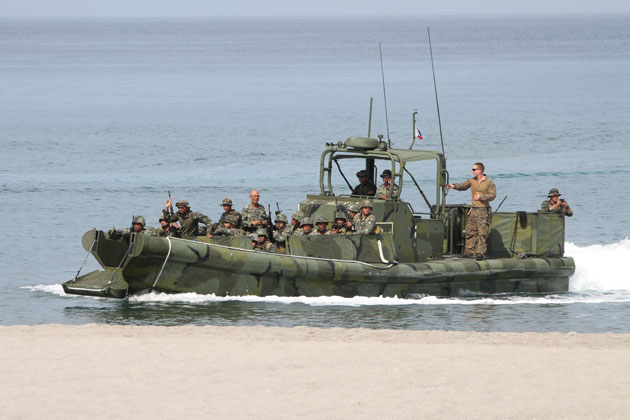
The BRP Tarlac, the Philippine Navy's (PN) largest and newest warship, remains operational despite sustaining minor dents and scratches due to collision with an oil tanker off Zamboanga City on Monday night.

This was disclosed by PN spokesperson Capt. Lued Lincuna in a message to reporters Tuesday.

"LD-601 (BRP Tarlac) is involved in the ongoing operations against the Abu Sayyaf (where) she serves as command-and-control for Fleet-Marine component. She incurred minor dents on her starboard (right) side because of the incident and it will not affect her role in said operations," he added.

Since the damage is only minor, Lincuna said repair will take place during BRP Tarlac's scheduled "deploy, sustain, repair and training" cycle.

He added that the ship can do all roles with no trouble at all.

"Investigation by the Philippine Coast Guard Station is ongoing to determine the circumstances of the collision," Lincuna said.

Rear Adm. Jorge Amba, Naval Forces Western Mindanao (NFWM) commander, disclosed the incident occurred around 7:47 p.m. Monday, 1000 yards south of the Ensign Majini Pier at Naval Station Romulo Espaldon, this city.

Amba said BRP-Tarlac was anchored in the area when the foreign tanker ship, M/T Tosca, bumped the Navy boat.

Amba said no one was hurt among crew members while BRP-Tarlac sustained minor damage in her right forward bulwark and side ramp.

BRP Tarlac was rammed by the M/T Tosca, a Liberian-flagged tanker, crewed by 21 Filipinos and Ukrainians.

The merchant ship is skippered by Capt. Dominador Tanguas and is headed for Bintulo, Malaysia at the time of the collision.

"Investigation by the Philippine Coast Guard Station is ongoing to determine the circumstances of the collision," Lincuna said.

BRP Tarlac was commissioned during short ceremonies at Pier 13, Manila South Harbor last June 1.

She arrived in the Philippines last May 14 after a five-day journey from PT PAL (Persero)'s shipyard in Surabaya which started on May 9.

The Philippines has two orders of SSV with the Indonesian shipbuilder worth PHP3.8 billion.

She was formally presented to the public at Pier 13, Manila South Harbor last May 16.

BRP Tarlac was assigned to the Philippine Fleet's Sealift Amphibious Force.

The ship has an overall length of 120 meters,breadth of 21 meters, draft of five meters and carry a payload of 2,800 tons.

She has a cruising speed of 13 knots and maximum speed of 16 knots and a minimum operating range of 7,500 nautical miles.

Her sister-ship is expected to be delivered by May 2017. The ship has a complement of 121 officers and enlisted personnel.

She can carry 500 troops, two rigid-hull inflatable boats, two landing craft units and three helicopters.

http://www.pna.gov.ph/index.php?idn=&sid=&nid=&rid=924468

ADAS 2016: Proposed hike in Philippine defence budget

From Shepard Media-Defense Notes-ADAS 2016 (Sep 19): ADAS 2016: Proposed hike in Philippine defence budget

ADAS 2016: Proposed hike in Philippine defence budget

The Philippine government proposes to increase the budget of both the Philippine National Police (PNP) and the Armed Forces of the Philippines (AFP). Their allocations are slated to rise 24.6% and 15% respectively in 2017 compared to last year.

If the 2017 budget is approved by the bicameral legislature later this year, the AFP’s funding will rise to PHP130.6 billion (US$2.8 billion). The figures were published by the Department of Budget and Management (DMB) on 15 August.

However, it is quite possible that this figure might be pruned by the budget ratification process.

The increases are ostensibly due to the administration’s war against crime, drugs and terrorism. At the same time, the AFP needs to boost its maritime security capability, particularly in the South China Sea where China has aggressively reclaimed islands and built military bases.

The lion’s share of the budget will go to the Philippine Army with PHP56.88 billion. The Philippine Navy (PN) will receive PHP20.59 billion and the Philippine Air Force (PAF) PHP18.9 billion.

Personnel expenses (PHP31.4 billion) make up a significant share of the AFP budget.

Some PHP25 billion will go to an equipment modernisation programme ‘to give our soldiers more weapons and equipment’, according to President Rodrigo Duterte in his budget speech.

This would make it the second year in a row that this level of funding for equipment has been achieved, with the goal of fulfilling a five-year plan to invest PHP82 billion on modernisation.

High on the wish list are two surveillance aircraft and six close air support planes for the PAF that could be employed to fight terrorists in Mindanao in the far south of the country. The country is also on the verge of signing a contract for two new frigates for the PN with Hyundai Heavy Industries in South Korea.

Considerable funds also need to be set aside for future instalments to pay for 12 FA-50 light fighters ordered from Korea Aerospace Industries in South Korea. The first pair of aircraft are already in service.

The Government Arsenal, which makes ammunition and refurbishes weapons, will also benefit from PHP1.21 billion of funding.

The AFP has been attempting to transform its focus onto external territorial defence of the Philippines, but a recent resurgence of fighting in the southern Philippines is diverting attention and resources.

https://www.shephardmedia.com/news/defence-notes/adas-2016-proposed-hike-philippine-defence-budget/

Philippines chooses Turkish NVGs

From Shepard Media-Asia Defense and Security Show News (Aug 26): Philippines chooses Turkish NVGs

Philippines chooses Turkish NVGs

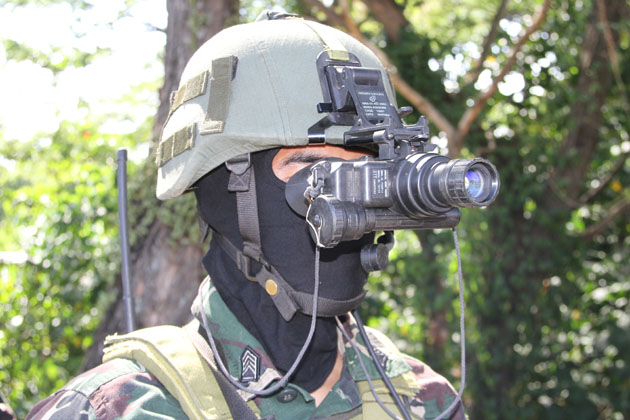
The Philippine Army is set to procure equipment from Aselsan of Turkey to meet a long-standing requirement for helmet-mounted/weapon-mounted monocular night vision devices, weapon-mounted infrared aiming devices and laser zeroing devices.

A notice to proceed was issued by the Philippines in July and first deliveries could commence in the second quarter of 2017. Most devices will be delivered to the army’s Special Operations Command (SOCOM).

With its offer of PHP712.069 million ($15.4 million), Aselsan was declared the lowest bidder back in January for this project seeking 4,464 sets of night vision devices. The Turkish bid came in considerably lower than the approved budget of PHP1.116 billion.

Aselsan is represented by local company System Nomics Philippines for this deal.

Deliveries should be completed in late 2017 or early 2018, depending on when the letter of credit is issued. All equipment is due to be delivered within six months of contract signature.

It is unclear what particular products Aselsan offered to the Philippine Army, but the company does make the A100 monocular that weighs 320g and offers a 40ยบ field of view and 1x magnification.

The night vision requirement dates back to March 2015 and major players such as Nightline, Exelis (now Harris Corporation) and Elbit Systems are believed to have put in bids.

These new systems will allow Philippine soldiers to fight more effectively at night and in low-light conditions. Special forces personnel previously told Shephard that terrorist groups such as Abu Sayyaf are often better equipped than government forces in terms of weapons and night vision goggles.

Older night vision equipment currently used by SOCOM (e.g. the AN/PVS-7 as pictured above) is likely to be passed down to regular infantry units once the new devices are inducted.

The Philippines has previously acquired military equipment from Turkey, most notably in the form of a limited number of FNSS ACV 15 tracked vehicles in APC and recovery configurations.

https://www.shephardmedia.com/news/landwarfareintl/philippines-chooses-turkish-nvgs/

AFP reshuffles 3 key military posts

From the Manila Times (Sep 19): AFP reshuffles 3 key military posts

THREE key posts at the Armed Forces of the Philippines were reshuffled after the recent retirement of a military official, an AFP official announced on Monday.

Brig. Gen. Restituto Padilla, AFP spokesman, said Brig. Gen. Noel Clement has been appointed as the new AFP chief for operations or J3.

Clement was formerly assigned in Mindanao and used to be the commandant of cadets at the Philippine Military Academy (PMA).

He replaced Maj. Gen. Carlito Galvez Jr., who was named commander of the Philippine Army’s 6th Infantry Division vice Maj. Gen. Edmundo Pangilinan, who was appointed as Army vice commander.

Pangilinan replaced Maj. Gen. Demothesenes Santillan, who bowed out of the service recently after reaching the mandatory retirement age of 56.

Clement, a member of the PMA Class of 1985, was among the military officials implicated in the 2007 abduction of activist Jonas Burgos, son of the late press freedom icon Joe Burgos.

Then a lieutenant colonel, he was the commander of the Army’s 56th Infantry Battalion when Burgos went missing.

Padilla said Clement has been cleared on the issue, citing his promotion and his rank’s confirmation.

“He’s been posted to various positions of major responsibility and there was never any issue at that, so there is no reason to hold him from holding this office because he was able to hold on to those [other]offices previously,” Padilla said.

http://www.manilatimes.net/afp-reshuffles-3-key-military-posts/286769/

Army officer once linked to Jonas Burgos kidnapping is new AFP deputy chief of staff for ops

From GMA News (Sep 19): Army officer once linked to Jonas Burgos kidnapping is new AFP deputy chief of staff for ops

A senior Army officer who was once linked to the kidnapping and disappearance of activist Jonas Burgos has been designated as the new deputy chief of staff for operations (J3) of the Armed Forces of the Philippines.

Brig. Gen. Noel Clement replaced Maj. Gen. Carlito Galvez, who is now the commander of the Maguindanao-based 6th Infantry Division of the Philippine Army. Clement assumed his new post Friday last week.

"He is well-qualified to work and be the J3, not only because of his extensive experience in operational matters being an Army officer, but also his previous stint at the [office of the] J3 itself," said AFP spokesman Brig. Gen. Restituto Padilla of Clement, his classmate at the Philippine Military Academy class of 1985.

Clement had previously served at the office of the AFP deputy chief of staff for operations as a staff officer.

He was linked to the April 2007 disappearance of Burgos, who was last seen at a restaurant in a Quezon City mall, when he was commander of the 56th Infantry Battalion in Bulacan.

Clement, then a lieutenant colonel, was among those investigated by the PNP’s Criminal Investigation and Detection Group for the kidnapping.

Most of them, however, were cleared for lack of evidence. Padilla, meanwhile, expressed confidence that the Burgos issue would not hound Clement in his new position.

"He's been posted to various positions of major responsibility and there was never any issue at that," he said.

"So there is no reason to hold him from holding this office because he was able to hold on to those [assignments] previously." 

http://www.gmanetwork.com/news/story/581942/news/nation/army-officer-once-linked-to-jonas-burgos-kidnapping-is-new-afp-deputy-chief-of-staff-for-ops

M'sapano general promoted

From The Standard (Sep 20): M'sapano general promoted

A CONTROVERSIAL general of the infamous Mamasapano massacre has been promoted barely two months before his mandatory retirement.

Just recently, Maj. Gen. Edmundo Pangilinan was designated Army vice commander after the mandatory retirement of Maj. Gen. Rodolfo Demosthenes Santillan. Both officers are members of the Class of 1983 in the Philippine Military Academy.

Pangilinan, commander of the Army’s 6th Infantry Division before he was designated to his new position, is set to retire in less than two months when he reaches the age of 56.

Pangilinan became controversial when he refused to order his men to fire 155mm and 105mm Howitzer canons on the Moro rebels’ positions, which could have minimized the casualties of the members of the  Police’s Special Action Force in Mamasapano, Maguindanao.

The clash between the Moros and the SAF men resulted in the death of 44 SAF commandos.

A source says when Pangilinan retires, he will be replaced by 1st Infantry Division commander Maj. Gen. Gerardo Abarientos, who is also a member of the PMA Class of 1983.

Pangilinan was replaced by Maj. Gen. Charlie Galvez, former deputy chief of staff for Operations or J3 and a member of the PMA Class of 1985.

Brig. Gen. Noel Clement, also a member of the PMA Class of 1985, was designated J3.

Clement also became controversial after he was linked to the abduction of activist Jonas Burgos, who remains missing.

http://thestandard.com.ph/news/-main-stories/top-stories/216672/m-sapano-general-promoted.html

PHP38.9-M allocated for repairs of engine assembly of PAF C-130 aircraft

From the Philippine News Agency (Sep 20): PHP38.9-M allocated for repairs of engine assembly of PAF C-130 aircraft

The Philippine Air Force (PAF) has allocated a total of PHP38,965,000 for the acquisition of spare parts and services needed for the repairs of the engine assembly of one of its Lockheed C-130 "Hercules" cargo aircraft.

Pre-bid conference is scheduled on Friday, 9:00 a.m. at the PAF Procurement Center Conference Room, Villamor Air Base, Pasay City.

The PAF currently four C-130 in its service. Another is slated for delivery this October.

C-130s are the primary cargo and troop transport carriers of the PAF.

http://www.pna.gov.ph/index.php?idn=1&sid=&nid=1&rid=924452

Liberian-registered tanker, PN vessel collide off Zamboanga City

From the Philippine News Agency (Sep 20): Liberian-registered tanker, PN vessel collide off Zamboanga City

CAMP NAVARRO, Zamboanga City – The BRP-Tarlac sustained minor damage after a foreign vessel collided with the Philippine Navy boat off this city, a top military official disclosed Tuesday.

Rear Adm. Jorge Amba, Naval Forces Western Mindanao (NFWM) commander, disclosed the incident occurred around 7:47 a.m. Tuesday, 1000 yards south of the Ensign Majini Pier at Naval Station Romulo Espaldon, this city.

Amba said BRP-Tarlac was anchored in the area when the foreign tanker ship, MT Tosca, bumped the Navy boat.

Amba said no one was hurt among crew members while BRP-Tarlac sustained minor damage in her right forward bulwark and side ramp.

BRP-Tarlac (LD-601) is the lead ship of her class of the Philippine Navy landing platform.

Purchased in Indonesia, BRP-Tarlac was commissioned into the service with the Philippine Navy on June 1, this year.

Amba said investigation by the Philippine Coast Guard (PCG) is ongoing to determine the circumstances of the collision.

MT TASCO, which is skippered by Dominador Tanguas Jr., is a Liberian-registered ship with 21 Filipinos and a Ukranian crew.

The tanker ship is sailing to Bintulo, Malaysia when it collided with BRP-Tarlac.

http://www.pna.gov.ph/index.php?idn=&sid=&nid=&rid=924464

International vessel collides with PHL Navy's BRP Tarlac

From GMA News (Sep 20): International vessel collides with PHL Navy's BRP Tarlac

A Liberian-registered merchant tanker on Monday night collided with a Philippine Navy vessel in Zamboanga City.

The Philippine Navy said merchant tanker Tasco, with Filipino and Ukranian crew, collided with BRP Tarlac while the naval ship was anchored 1,000 yards south of Ensign Majini Pier at Naval Station Romulo Espaldon at around 7:46 p.m.

Rear Admiral Jorge Amba, commander of Naval Forces Western Mindanao, said no one was hurt among the crew members, but the naval vessel sustained a minor damage in the right forward bulwark and side ramp.

Philippine Coast Guard Zamboanga Station commander, Lt. Junior Grade Jimmy Berbo, said guardsmen have been sent to the area to investigate.

The merchant tanker, meanwhile, was prevented from leaving pending the investigation.

The tanker was headed to Bintulo, Malaysia when the incident happened.

BRP Tarlac arrived is the first ever strategic sealift vessel of the Philippine Navy. It was recently acquired by the Philippine government as part of a P3.87-billion two-vessel contract entered into with Indonesian shipbuilder PT Pal Persero.

The naval vessel is leading the naval blockade against the Abu Sayyaf Group in Mindanao.

It serves as the command and control ship of the Philippine Navy in its operations against the bandits.

http://www.gmanetwork.com/news/story/582002/news/regions/international-vessel-collides-with-phl-navy-s-brp-tarlac

Editorial: Money and Misuari

Editorial posted to the Philippine Daily Inquirer (Sep 20): Editorial: Money and Misuari

Sekkingstad

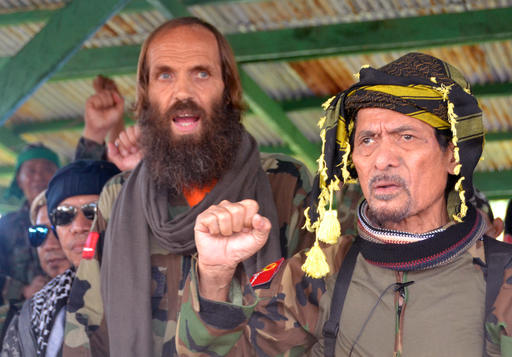
Released Norwegian hostage Kjartan Sekkingstad, second right, stands next to Moro National Liberation Front Chairman Nur Misuari, right, after being turned over by ransom-seeking Abu Sayyaf extremists in Indanan township on Jolo island in southern Philippines Sunday, Sept. 18, 2016. Sekkingstad, who was kidnapped last year along with two Canadians and a Filipino, was released Saturday and was turned over Sunday to Misuari, who in turn turned him over to Presidential adviser Jesus Dureza. AP FILE PHOTO
THAT NORWEGIAN hostage Kjartan Sekkingstad has regained his freedom is cause for cheer. His harrowing experience at the hands of the bandit group Abu Sayyaf—which had kidnapped him in September 2015 in Samal, Davao, along with Filipino Marites Flor and Canadians Robert Hall and John Ridsdel—was unmistakably etched on his gaunt, frail appearance when he was first seen after his release.

What he went through in his yearlong captivity was “devastating,” said Sekkingstad. “We were treated like slaves”—subjected to constant threats of beheading, forced to lug around the bandits’ belongings as they were hustled from one area of Sulu to another to evade military operations, and generally kept in a state of terror and bewilderment over their fate. He also witnessed something unspeakable—the beheading of Ridsdel and Hall, whose grisly deaths were even recorded and posted online by the Abu Sayyaf.

That the Norwegian didn’t suffer the same horrific fate is reportedly because P100 million was paid for his release—not by the Philippine government, but by his family and friends in Norway. President Duterte himself let slip a month ago that some P50 million had been paid to the bandits for the release of their captives; in the wake of Sekkingstad’s freedom, that admission was nowhere mentioned in the statement of the Palace, which merely reiterated the official position that “the government maintains the no-ransom policy.”

But, “if a third party or the family gives ransom, we don’t know,” said Presidential Communications Secretary Martin Andanar—a disclaimer issued straight-faced despite Mr. Duterte publicly disclosing, however inadvertently, that he did know about ransom being paid early on. So while Sekkingstad’s release is a much welcome development, the circumstances surrounding it beg for some answers about the administration’s stance toward the Abu Sayyaf—and, just as crucial, about the people with whom the administration is willing to work in order to secure the kidnap victims’ freedom.

The other startling news about Sekkingstad has to do with the person who received him after he was released: Nur Misuari, head of the Moro National Liberation Front. The President personally thanked Misuari for his role in securing Sekkingstad’s release, but the narrative isn’t as cut-and-dried as it seems. Misuari apparently wanted to milk the event for the favorable mileage it could give him. It is said that after receiving Sekkingstad, Misuari delayed his release to the authorities, keeping the Norwegian in his base in Patikul because he wanted to personally deliver the freed captive to the President—or, failing that, at least make an appearance at the airport in Jolo where media cameras would capture him as the helpful local overlord instrumental in obtaining the prisoner’s freedom.

Misuari, it should be said, remains the object of an outstanding warrant of arrest for instigating the 2013 siege of Zamboanga City, which left at least 300 people dead, over 120,000 residents displaced, and vast tracts of property damaged. Misuari fled to and lived as a fugitive in Malaysia, but in January he slipped back into the country, reportedly to lead a general assembly of the MNLF in Sulu that was attended by some 2,000 of its members. That sense of impunity was further strengthened when Mr. Duterte came to power in June and forthwith ordered a stop to the pursuit of Misuari so peace talks could be held between the government and the MNLF.

Misuari’s role in Sekkingstad’s release, whatever it is, further solidifies his rehabilitation in this administration’s eyes; he’s relevant again and, given his behavior following the Norwegian’s release, apparently hasn’t lost his yearning for the limelight. And Mr. Duterte’s administration appears willing to indulge him.

Presidential Peace Adviser Jesus Dureza made no mention of Misuari’s behavior and blamed bad weather for the delay in Sekkingstad’s presentation to the President, his waiting kin, and the Norwegian ambassador in Davao.

Three Indonesian fishermen held by the Abu Sayyaf were also released at about the same time as Sekkingstad. The military said it was the result of intensified operations against the group. But reports said ransom was, as usual, paid—an unspecified amount, but no doubt significant enough to empower this band of thugs to commit more acts of terror.
http://opinion.inquirer.net/97493/money-and-misuari

‘There will be another explosion, believe me’ - Duterte

From InterAksyon (Sep 20): ‘There will be another explosion, believe me’ - Duterte

President Rodrigo Duterte said another terrorist attack is likely in Mindanao or other parts of the country.

“There will be another explosion, believe me,” Duterte said before a meeting Monday with the victims of the September 2 bombing of the Roxas night market that killed 15 persons and injured 69 others.

The President met with the survivors and victims of the Davao blast to extend assistance to them.

Duterte gave over P10 million from the President’s social fund -- P250,000 each to the families of the fatalities and P250,000 to each of the 18 victims still recuperating in the hospital, and P100,000 to wounded victim already discharged from hospital.

Duterte said young terrorists who identify themselves with the Islamic State still remember the atrocities of the past such as the 1906 Bud Dajo massacre carried out by American soldiers, a recurring theme recently in his tirades against US criticism of his human rights record.

“The young don’t belong to any organization, they are identified with the ISIS. They have sworn allegiance already to the ISIS,” he said.

He pointed out that, while atrocities like Bud Dajo may have happened decades ago, "to the Moro, it just happened yesterday. So puputok ito ng puputok (this will blow up and blow up).”

He said he expected the Davao explosion because of the all-out offensive he ordered against the Abu Sayyaf.

"I knew na puputok dito. Nu’ng bakbakan na sa Sulu, alam ko (I knew there would be an explosion here. When fighting broke out in Sulu, I knew). No need to be Maute (group member), an Abu Sayyaf,” he said.

The Maute group is based in Lanao del Sur, the Abu Sayyaf in Basilan and Sulu.
Talking to the victims of the bombing and their families, Duterte said they could seek assistance from his daughter, Mayor Sara Duterte-Carpio, for their medical needs in what “would be a never-ending cycle of expense.”

The city government has given the victims a total of P4.5 million in cash assistance.

http://interaksyon.com/article/132583/there-will-be-another-explosion-believe-me---duterte

Call for Filipino Muslims to unite against Abu Sayyaf

From Anadolu Agency (Sep 19): Call for Filipino Muslims to unite against Abu Sayyaf

Governor promises development of Muslim region to conflict-affected residents of village where troops overran militant camp

Call for Filipino Muslims to unite against Abu Sayyaf

The governor of an autonomous Muslim region in the Philippines’ troubled south has called on residents to reject a militant group that has pledged allegiance to Daesh and to unite in defending peace and development in the area.
 
Mujiv Hataman of the Autonomous Region in Muslim Mindanao (ARMM) gave a speech Monday before thousands of conflict-affected residents in the island province of Basilan, where troops overran an Abu Sayyaf camp in Baguindan village of Tipo-Tipo town last month.
 
"I call on all my brothers and sisters in Islam not to hear them, they are the biggest traitor of Islam who kidnap-for-ransom, behead and bomb innocent people and their activities really wreaked havoc in our peaceful communities," he said.
 
Alongside heavily armed military personnel and pro-government militiamen, Hataman launched a monthly "People's Day in Basilan" during his visit to mark the restoration of government authority in the re-captured area.
 
Health and social welfare officials from ARMM joined employees of the provincial government in providing thousands of locals -- mostly evacuees -- with free services such as medical consultation and check-ups, while also distributing hygiene kits and food supplies.
 
"It's about time for this place [Baguindan] to receive various programs and projects from the government," Hataman said, vowing to sponsor development in conflict-affected areas.
 
"Baguindan is for Baguindan. Baguindan is for the people here, not for ISIS [Daesh] which is alien or foreign. We are here to protect the people," he stressed.
 
Hataman's visit to Baguindan came amid continuing military operations in Basilan and the neighboring island province of Sulu against the Abu Sayyaf, which is still holding captive at least 11 foreign hostages and several Filipinos.
 
Basilan, an impoverished island of about 400,000 people, has long been a stronghold of the group.
 
Since 1991, the Abu Sayyaf -- armed with mostly improvised explosive devices, mortars and automatic rifles -- has carried out bombings, kidnappings, assassinations and extortions in a self-determined fight for an independent province in the Philippines.
 
It is notorious for beheading victims after ransoms have failed to be paid for their release.
 
The Abu Sayyaf is among two militant groups in the south who have pledged allegiance to Daesh, prompting fears during the stalling of a peace process between the government and the country's biggest Moro group, the Moro Islamic Liberation Front, that it could make inroads in a region torn by decades of armed conflict.
 

TO EVADE TROOPS Abu Sayyaf has splintered into smaller groups –AFP

From GMA News (Sep 19): TO EVADE TROOPS Abu Sayyaf has splintered into smaller groups –AFP

A military official on Monday said the Abu Sayyaf has splintered into smaller groups to avoid the offensives being staged by government troops.

“The groups have separated into smaller groups and many of the kidnap victims are held by the smaller groups, and we hope to bring fruition to our efforts by a more intense and more focused operation that is still in the offing,” said Armed Forces of the Philippines (AFP) spokesperson Brig. Gen. Restituto Padilla.

He said they are not giving their men any timeline, but expect that the other kidnap victims being held by Abu Sayyaf will be released soon.

“We're doing our best to bring resolution to this problem that we face in relation to this group. Now as a result of this increasing pressure, we believe that the release of the kidnap victims still in their hands will come in due time one after the other,” he said.

At least six hostages have been released by the Abu Sayyaf in the last two days.

On Saturday, they released to the Moro National Liberation Front four hostages— Norwegian Kjartan Sekkingstad and three Indonesian sailors.

Two more hostages—two Filipinos—were released on Sunday night.

Padilla said there were still 16 hostages in the hands of Abu Sayyaf.

“There remains 12 foreign hostages in the hands of the Abu Aayyaf. The locals, there are four locals also in their hands,” he said.

Asked on the condition of the hostages, the military spokesperson believed they were in good health.

“Based on our monitoring and our feedback from the field, we believe that most of these hostages are still in good condition and that’s what we are aiming to accomplish, to rescue them or recover them safely,” Padilla said.

He thanked the MNLF, a former rebel group that signed a peace agreement with the government in 1996, for its help in the release of the hostages and cooperation in the conduct of operations to avoid misencounters.

“The government, as you may well know, has also sought the assistance of the MNLF regarding this issue. We’d also like to extend our appreciation to the MNLF because of our request for them to keep away from areas of operation where the AFP is dominantly engaged with the ASG,” he said.

“So yun po ay pasasalamat din namin sa kanila at sa kanilang kooperasyon, naiiwasan po natin na magkaroon ng hindi inaasahang sagupaan sa hanay nila,” Padilla added. 

http://www.gmanetwork.com/news/story/581955/news/nation/abu-sayyaf-has-splintered-into-smaller-groups-afp

MNLF seen as key to safe release of Abu Sayyaf captives

From the Philippine Daily Inquirer (Sep 19): MNLF seen as key to safe release of Abu Sayyaf captives
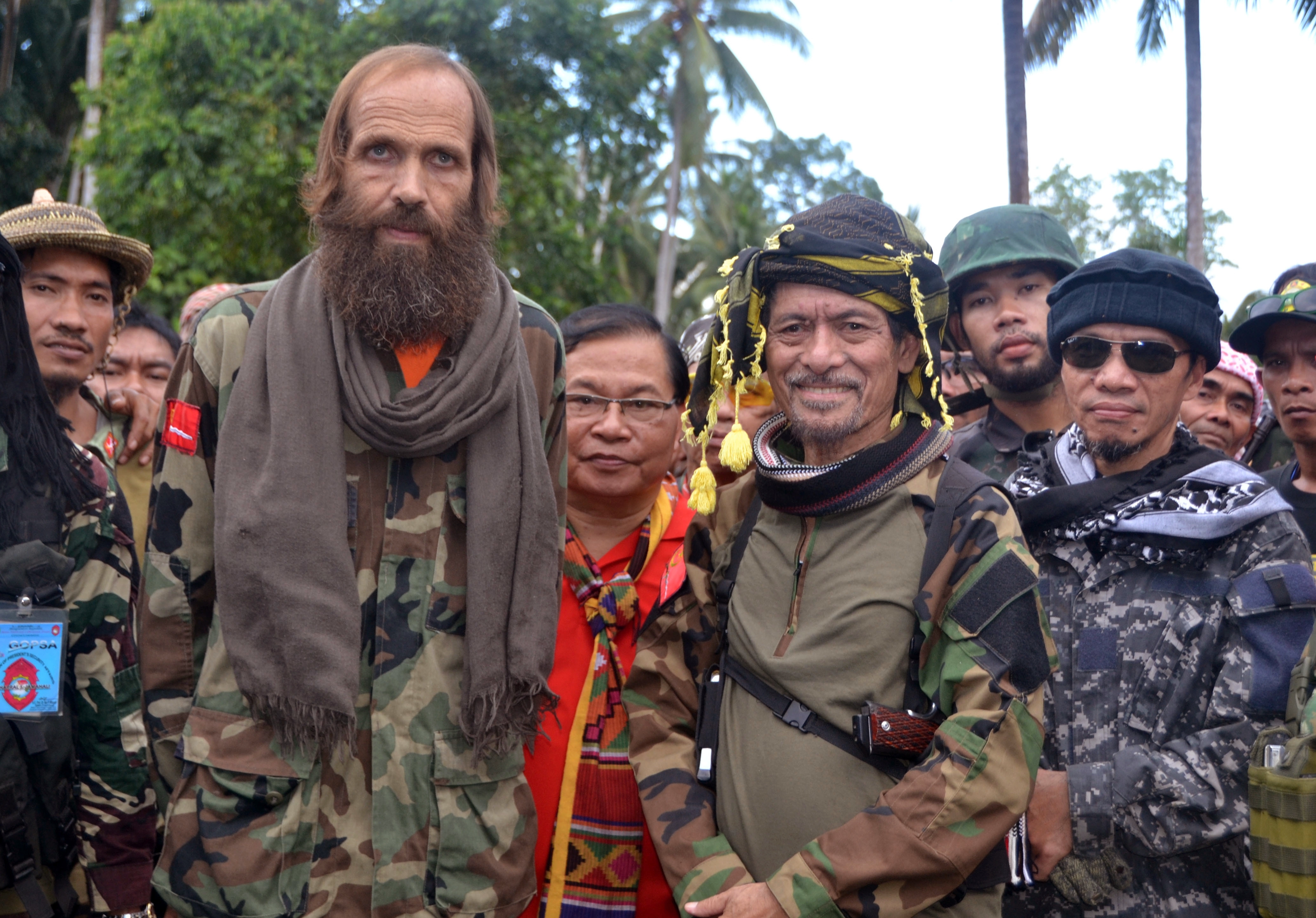
Released Norwegian hostage Kjartan Sekkingstad, front row left, poses with Moro National Liberation Front Chairman Nur Misuari, front row second right, after being turned over by ransom-seeking Abu Sayyaf extremists in Indanan township on Jolo island in southern Philippines Sunday, Sept. 18, 2016. Sekkingstad, who was kidnapped last year along with two Canadians and a Filipino, was released Saturday and was turned over Sunday to Misuari, who in turn turned him over to Presidential adviser Jesus Dureza. (AP Photo/Nickee Butlangan)

Released Norwegian hostage Kjartan Sekkingstad, front row left, poses with Moro National Liberation Front Chairman Nur Misuari, front row second right, after being turned over by ransom-seeking Abu Sayyaf extremists in Indanan township on Jolo island in southern Philippines Sunday, Sept. 18, 2016. Sekkingstad, who was kidnapped last year along with two Canadians and a Filipino, was released Saturday and was turned over Sunday to Misuari, who in turn turned him over to Presidential adviser Jesus Dureza. (AP Photo/Nickee Butlangan)
Both the Indonesian government and the Philippine military recognized the big role of the Moro National Liberation Front (MNLF) in Saturday’s release of four kidnap victims — a Norwegian and three Indonesian fishermen.

Indonesian Defense Minister Ryanmizard Ryancudu told reporters here, on Sunday night, that they were grateful for the help extended by the MNLF to secure their people safely from the Abu Sayyaf.

“We appreciate the assistance of the MNLF. They know very well the terrain, they are very professional and they know what to do, that is why we need the assistance of the MNLF,” Ryancudu said in Bahasa.

Lt. Gen. Mayoralgo dela Cruz, chief of Western Mindanao Command, agreed.

“The MNLF knows the terrain. They know some of the people from the Abu Sayyaf, and they have their own ways of dealing with the Abu Sayyaf,” Dela Cruz said.

But Dela Cruz also said President Duterte’s directive to destroy the bandit group resulted in efforts involving military, police, local government and even the MNLF to rescue and secure safely the hostages.

“As we all know, the forefront in this endeavor is the President’s directive to really go after this group,” he said, adding that at least 16 battalions of government troops have been deployed in Sulu.

“In fact, some of the civilian populace are giving us information and this is to our advantage, and hopefully in the coming days, this support will reduce and degrade the Abu Sayyaf into an insignificant level,” Dela Cruz added.

Samsula Adju, spokesperson of the MNLF in Sulu, said it was Tahil Sali, MNLF Vice Chair for Political Affairs, who worked hard for the release of hostages.

Adju sad Sali was authorized by MNLF chair Nur Misuari to negotiate with the Abu Sayyaf leader Raddulan Sahiron for the safe release of Norwegian Kjartan Sekkingstad, who was freed on Saturday.

Sekkingstad on Sunday thanked “Misuari and his finest men who released me yesterday afternoon.”

The MNLF said no ransom was paid in exchange for Sekkingstad’s freedom.

“As far as I know, no ransom was paid in pursuant to the MNLF’s adherence of no ransom policy,” Adju told the Philippine Daily Inquirer by phone.

Muammar Askali alias Abu Rami, who claimed to be the spokesperson of the Abu Sayyaf, earlier said P30 million was paid as ransom.

After the release of Sekkingstad and the three Indonesian fishermen and two Filipino kidnap victims were also freed on Sunday.

Maj. Filemon Tan Jr., spokesperson of Western Mindanao Command, said sustained military operations led to the freeing of Daniela Taruc and Levy Gonzales in Panglima Estino town in Sulu on Sunday night.

The victims, sub-contractors of a Telecom company, who were kidnapped in Patikul town on August 6, were recovered by a resident, Tan said. 
http://globalnation.inquirer.net/145110/mnlf-seen-as-key-to-safe-release-of-abu-sayyaf-captives

Indonesia expects Abu Sayyaf to release another sailor

From Anadolu Agency (Sep 19): Indonesia expects Abu Sayyaf to release another sailor

After militants in south Philippines free 3 Indonesians, negotiator says another national expected to be released

Indonesia expects Abu Sayyaf to release another sailor

A negotiator revealed Monday that Indonesia expects a militant group based in the Philippines’ troubled south to free another one of its nationals following the release of three fishermen over the weekend.

Retired Maj. Gen. Kivlan Zein was quoted by detik.com as saying, "a hostage will be freed today… Hopefully there will be no obstacles."
 
He identified the hostage as a captain seized from a boat off the eastern Malaysian state of Sabah in early August.
 
Over the weekend, the Abu Sayyaf freed Norwegian Kjartan Sekkingstad, who was kidnapped from a resort on the island of Samal in September 2015 alongside two Canadians who were beheaded earlier this year.
 
It later released three Indonesian fishermen -- who were abducted off Sabah in mid-July -- and all four men were hosted Saturday night by the Moro National Liberation Front (MNLF) rebel group’s fugitive founder, Nur Misuari.
 
The MNLF, which is engaged in a peace process with the Philippines government, has been facilitating negotiations for the release of hostages held by the Abu Sayyaf, which is believed to still be holding captive at least 11 foreigners and three Filipinos.
 
Indonesia’s defense minister, who had been visiting the southern Philippines for negotiations when the fishermen were freed, told reporters upon his return to Jakarta on Sunday night that one more hostage would be released.
 
“Philippine troops keep coordinating with the MNLF," Ryamizard Ryacudu was quoted as saying by kompas.com, describing the rebel group as having a dominant role in rescue operations due to their knowledge of the field and Abu Sayyaf hideouts.
 
He reiterated that the captives had been freed purely due to pressure from the Philippines military and MNLF forces, insisting that no ransom had been paid despite reports stating otherwise.
 
The minister added that the three fishermen had been handed over to Indonesian representatives Sunday and would return to their home country in the near future.
 
At least five Indonesians are believed to still remain in the captivity of the Abu Sayyaf, which released two Filipinos late Sunday night.
 
Since 1991, the group -- armed with mostly improvised explosive devices, mortars and automatic rifles -- has carried out bombings, kidnappings, assassinations and extortion in a self-determined fight for an independent province in the Philippines.
 
It is one of two militant groups in the south to have pledged allegiance to Daesh, prompting fears during the stalling of a peace process between the government and MNLF-breakaway group the Moro Islamic Liberation Front that it could make inroads in a region torn by decades of armed conflict.