From Links: The International Journal of Socialist Renewal (May 30):
Philippine Left facing a Duterte-CPP Coalition Government?, plus Duterte, a socio-political outcome
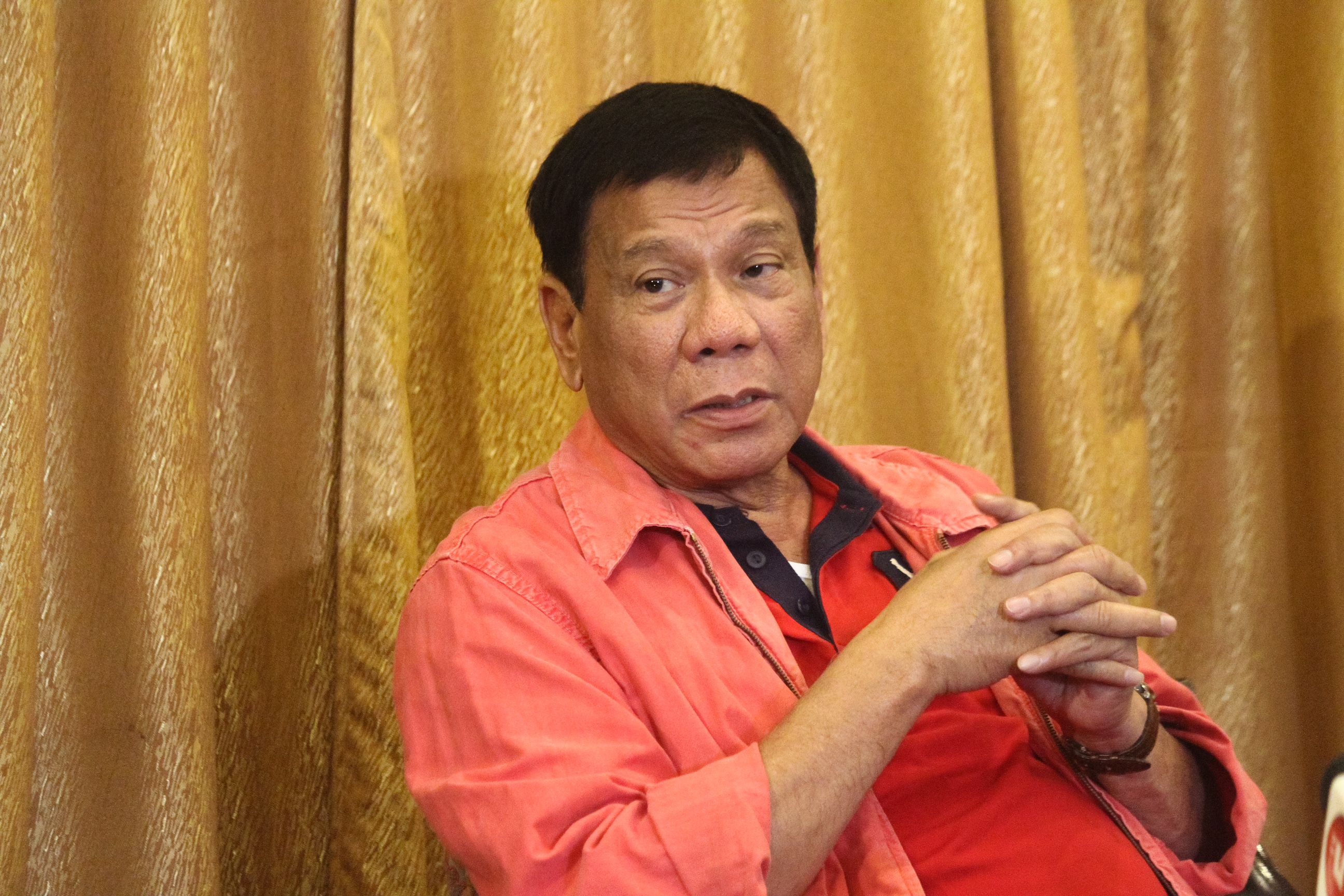
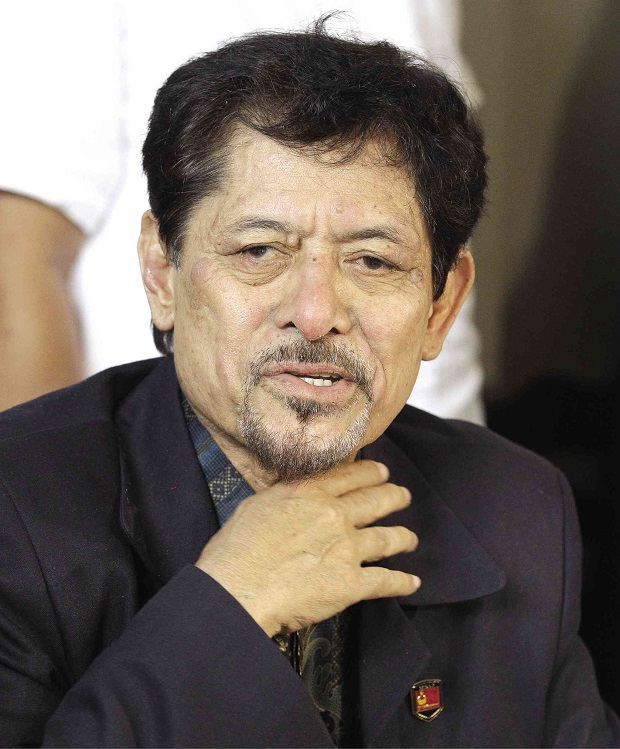
On coming to power, newly elected Philippines president Rodrigo Duterte (left) originally offered cabinet posts to the Communist Party of the Philippines (CPP), headed by Jose Maria Sison (right). The move only intensified debate on the Left surrounding Duterte's rise and what it means for politics in the Philippines. As part of bring this debates to an international audience Links International Journal of Socialist Renewal is publishing below a May 15 CPP Central Committee resolution outlining its position - "Prospects under a Duterte presidency" -, along with some introductory comments by Reihana Mohideen from the Party of the Labouring Masses (PLM). We are also publishing an update version of article by Sarah Raymundo, vice-chairperson of the Philippine Anti-Imperialist Studies: "Duterte, a socio-political outcome".
Prospects under a Duterte presidency
Introduction by
Reihana Mohideen
May 30, 2016 --
Links International Journal of Socialist Renewal -- An extremely interesting and challenging political situation has opened up for the Philippine Left. Plans are underway by the newly elected President Rodrigo Duterte to establish a government with CPP participation and move forward with peace talks to resolve the five-decade long armed struggle conducted by the New Peoples Army. The May 9 national elections saw the former mayor of Davao City, Rodrigo Duterte, elected as president. Duterte is considered to be a political maverick and an outsider to the traditional oligarchy that has ruled the Philippines since the ‘Edsa revolution’ that overthrew the Marcos dictatorship in 1986. Duterte is a former student of the CPP founding Chair Jose Maria Sison and is a long-time ally of the CPP-NPA, since he became a local official in the Davao City government, in the late 1980s.
The CPP has proposed a list of candidates to head up four key ministries: labor, social welfare, agrarian reform, as well as energy and the environment (combined in one department). Key leaders of the CPP-National Democratic Front, who have been living in self-declared exile in the Netherlands, have now returned to Manila to negotiate the arrangements. Jose Maria Sison is expected to return to the Philippines after Duterte formally assumes the presidency. Duterte has declared that he will set in place security arrangements for Sison’s safety. He has also promised to release imprisoned CPP leaders, including leaders of the New Peoples Army.
The CPP has called for the establishment of a ‘government of national unity, peace and development’ and the CPP Central Committee has issued a statement outlining its position. The statement analyses the Duterte presidency as a continuation of elite rule in the Philippines and is seemingly contradictory, given the CPP’s agreement to participate in and form a coalition government with Duterte: “The Communist Party of the Philippines (CPP) and all revolutionary forces take stock of the significance of the rise of Davao Mayor Rodrigo Duterte as chief political representative of the ruling classes and head of the reactionary client-state and its consequences in advancing the national democratic revolution through people’s war”. The statement outlines the program for such a government of ‘national unity’, which is against neoliberalism and based on the historic demands of the mass movement: “Duterte must repudiate the neoliberal thrusts of liberalization, privatization, deregulation and denationalization of the previous regimes. Advancing land reform and national industrialization will generate jobs and end the need for such palliatives as the conditional cash transfer (4Ps) that only perpetuate the people’s poverty and smokescreen the deterioration of public social services. … The Duterte regime must heed the demand of workers and employees for a national minimum wage and the abolition of the regionalization of wages. He must end contractualization and take back his earlier statements against unions and workers rights. Without their unions, workers have nothing to defend themselves against attacks on wages.”
See full statement is published below.
The CPP analysis of the class-character of the Duterte presidency is in line with the position of PLM.
See PLM analysis prior to the elections
here.
Joma Sison has also indicated that he is open to unity with Left forces outside the CPP: “Past differences can be overcome by current resolutions which are good and forward-looking toward a better and brighter social system”. The newspaper report quoting Sison refers to the “rejectionists” forces, specifically the forces led by Felimon ‘Popoy’ Lagman, who disagreed with the CPP military strategy of ‘protracted people war’, which led to a split with the Manila Rizal Regional Committee declaring ‘autonomy’ from the party in 1993. Popoy Lagman was brutally assassinated in 2001, the first leader of the left to be killed under the regime of Gloria Macapagal Arroyo, by unidentified goons of the military.
Partido Lakas ng Masa-PLM Chair Sonny Melencio has welcomed Sison’s statement: “This is a welcome statement from CPP founding chair Jose Ma. Sison. … I have long believed that the RA-RJ divide, which happened 23 years ago, that is a very long time in politics, can be overcome by political unity, not so much by ideological homogeneity. Ideological unity can be a process of discussion and clarification as the class struggle unfolds. On the government of national unity, its objectives of peace and development can only be founded on the interests of and justice for the masses. This is where the unity of the Left and progressive forces is crucial – it is to ensure that such a program can be achieved and implemented, whichever direction the political storm surges during the coming administration.” (RA are the ‘reaffirmists’ of the strategy of protracted peoples war; RJ are the ‘rejectionists’ of the strategy of protracted peoples war.) PLM was instrumental in forging a unity ticket of seven senate candidates, including Neri Colmenares of the Makabayan bloc (aligned with the CPP) and Walden Bello, former leader of Akbayan in Congress. Both Colmenares and Bello attended and spoke at various gatherings and assemblies of PLM and its allied organisations.
The CPP statement is not so much addressed to Duterte, as to the masses who support Duterte. The statement presents a program for how a Duterte regime can genuinely advance people’s aspirations for change. In this sense, this is also a program that can scrape away the layers of posturing that Duterte has projected in his campaign. If the CPP confronts a Duterte regime that fails or refuses to heed this program, then it will be better to turn its call for a government of national unity, into a broad popular movement that mobilizes the masses and fights for a national program against neoliberal-elite rule.
Reihana Mohideen is a member of the PLM's national council.
* * *
By
Central Committee, Communist Party of the Philippines
May 15, 2016 --
Links International Journal of Socialist Renewal reposted from
National Democratic Front of the Philippines -- The Communist Party of the Philippines (CPP) and all revolutionary forces take stock of the significance of the rise of Davao Mayor Rodrigo Duterte as chief political representative of the ruling classes and head of the reactionary client-state and its consequences in advancing the national democratic revolution through people’s war.
I. Significance of Duterte’s election as president
The election of Davao City Mayor Rodrigo Duterte as next president of the Government of the Republic of the Philippines (GRP) is a resounding rejection of Aquino’s claims of “good governance”, “inclusive growth” and “tuwid na daan.” He routed the ruling regime’s fund-rich and politically-favored candidate Mar Roxas.
Duterte strongly attacked the Aquino regime and presented himself as an anti-thesis of the oligarchic and cacique rule, keenly aware of the Filipino people’s profound hatred for the Aquino regime and its six years of corruption, mendacity, puppetry and wholesale failure to address the needs of the Filipino people.
By drawing broad support, large crowds and social media drumbeating, Duterte succeeded in preempting the plans of the US-Aquino regime to use the automated counting system to steal the elections from him. Still, there are strong indications that election results were manipulated to boost Roxas’ votes, favor Aquino’s vice-presidential and senatorial candidates, as well as to prevent progressive partylist groups from gaining more seats in parliament.
With election-related assassinations, vote-buying, use of public funds, party-switching, automated fraud and so on, the recent reactionary elections is as dirty and rotten than before, contrary to insistent claims that elections were democratic, clean and credible.
Duterte’s rise to the presidency is a reflection of the deepening and aggravating crisis of the semicolonial and semifeudal system. He was able to draw broad support from the people because he presented himself as sympathetic to their discontent and deep desire to put an end to the oppressive and rotten ruling system.
Duterte’s election also reflects the deepening factional strife among the ruling classes. He polarized the political elite with his cuss-filled bluster.
In running his election campaign, he relied on the strength of contributions by big business and political groups, kingmakers, religious sects, military cliques and other interest groups in his presidential campaign kitty, in exchange for economic and political favors come payback time. He spent billions to fund his media and advertising campaign, as well as his technology-supported social media campaign.
Duterte and his allies advocate federalism criticizing scant national attention and resources, slow delivery of services and failure to develop the local economies. Such a proposal is a reflection of the demand of the ruling classes to further divvy up the country’s resources among the ruling elite.
Certain sections of the political elite support Duterte in the hope of pushing his anti-crime crusade to justify the establishment of a police state. They seek the imposition of more draconian measures to suppress workers’ democratic rights and people’s human rights to more effectively carry out the exploitation and plunder of the country’s human and natural resources.
With Duterte set to become GRP president, for the first time, the Philippine client-state is to be headed by one who is not completely beholden to the US imperialists. Duterte has railed against the US and the US CIA for whisking away its agent Michael Meiring who accidentally exploded the improvised bomb he was preparing inside a Davao hotel during the height of the 2003 US terror bombings in Mindanao. He has opposed the use of the Davao airport as a base for US drone operations and has spoken disfavorably against the Enhanced Defense Cooperation Agreement (EDCA). Duterte has slammed the current US and Australian ambassadors for political meddling after recently making comments about his tasteless rape joke.
On the other hand, the rest of the political elite are largely pro-US and favor US dominance and military presence. The CIA and US military and its local agents continue to hold sway over most aspects of the ruling state, especially the AFP. Duterte himself is appointing pro-US and pro-IMF/WB officials to head his economic team. The US also continues to hold dominant sway in the Philippine congress, the Supreme Court, the GRP economic policy and finance agencies, media and cultural organizations.
If Duterte seriously and vigorously pursues his promise to eradicate criminality, especially widespread drug trade within three to six months, he will likely drive a wedge deep into the ranks of military and police generals and bureaucrat capitalists who are protectors, operators and associates of criminal syndicates.
He has bared his intention of declaring a ceasefire as one of his first acts as president in order to boost peace negotiations with the National Democratic Front of the Philippines (NDFP), as well as with various groups representing the Moro people. He has been shown respect and has even flaunted his friendship with the revolutionary forces to the chagrin of the militarists who seek only the suppression of the people’s resistance.
Duterte has styled himself a maverick, an anti-establishment politico and a “socialist” and claims he will be the country’s first “Left president.” Duterte’s avowal of being a socialist, his anti-US fulminations, openness to develop relations with China and enthusiasm for peace negotiations with the revolutionary forces will not sit well among the more rabid defenders of US military intervention, hegemonism and counterinsurgency dogma.
II. Prospects of accelerated peace negotiations with the Duterte regime
After 15 years of stalled NDFP-GRP peace negotiations, the Filipino people are highly desirous of progress in efforts to attain a negotiated political settlement of the long-running civil war.
Certain progressive aspects in Duterte’s discourse, his recognition of both the political legitimacy and armed political strength of the revolutionary movement and his history of cooperation with the revolutionary forces in Mindanao, make possible the acceleration of peace negotiations.
The CPP and revolutionary forces welcomes Duterte’s plan to seriously pursue the NDFP-GRP peace negotiations as well as his plan to visit The Netherlands in order to personally meet NDFP senior political consultant Prof. Jose Ma. Sison and the Utrecht-based NDFP peace panel.
The CPP fully supports the NDFP proposal, put forward by Prof. Jose Ma. Sison, to pursue NDFP-GRP peace negotiations under the Duterte government with the aim of forging an agreement to establish a government of national unity, peace and development.
Duterte and Prof. Sison can forge a plan for accelerated peace negotiations with the aim of forging comprehensive agreements addressing the substantive issues in a matter of a few months. The CPP and NPA are open to consider proposals for a mutual ceasefire during the definite period of peace negotiations.
The revolutionary forces expect Duterte to recognize and uphold all standing agreements signed by the NDFP and the GRP over the past 20 years, including The Hague Joint Declaration of 1992 which has served as framework and anchor of the negotiations; the Joint Agreement on Safety and Immunity Guarantees (JASIG); the Comprehensive Agreement on Respect for Human Rights and International Humanitarian Law (CARHRIHL) of 1998; and so on.
Necessarily, among the first measures that need to be carried out by the Duterte regime to boost peace negotiations would be the release all detained NDFP consultants and facilitation of their travel to a neutral territory where negotiations can be conducted. They were treacherously arrested in violation of earlier agreements and made to suffer unjust prolonged imprisonment.
III. Challenge for significant reforms under Duterte
Duterte’s rhetoric has raised high the people’s expectations for substantial and accelerated reforms.
As an avowed opponent of US meddling, Duterte has the unique opportunity to end the 70 year chain of US puppet governments since the 1946 Roxas regime.
He can undo Aquino’s legacy of national humiliation for having served as a pawn in the US “Asia pivot” strategy by allowing the US to restore its military bases and maintain permanent presence of its warships, jetfighters, drones and interventionist troops.
To countervail Aquino’s puppetry, he must withdraw his stand to let the EDCA stand. He must immediately notifiy the US government of his intent to abrogate the EDCA which was signed as an executive agreement in April 2014. He must rescind the EDCA-sanctioned use of five AFP camps as US military bases and facilities.
He can serve the US notice to end the unequal Visiting Forces Agreement (VFA), the Mutual Logistics Support Agreement (MLSA) and the Status of Forces Agreement (SOFA) as well as the Mutual Defense Treaty of 1951, the parent agreement and source of all military iniquities.
He can immediately send home US Ambassador Goldberg for interference in Philippine internal affairs.
Duterte can be the first Philippine president to pursue an independent foreign policy, one that is not beholden to and dependent on the US. Towards this, Duterte must condemn US war-mongering and US-China saber-rattling and oppose militarization of the territorial sea by the US and Chinese military forces. He must disallow the US military to use the Philippines as base for its interventionism. If he does, he is bound to be the Philippines’ first world-class president who stood for Philippine sovereignty and prevented the military buildup in the region.
He must oppose the US demand to effect charter change to remove the remaining restrictions against foreign ownership as requirement for Philippine integration into the Trans-Pacific Partnership, dubbed as the “dirtiest deal ever”.
Corollarily, he can pursue a policy of developing mutually-beneficial economic and trade relations with China with an aim of ending economic and trade dependence on the US. He can pursue a policy of engaging China in bilateral talks to peacefully resolve the South China Sea conflict and oppose US military presence in the area. He can take advantage of the availability of low-interest funds from China’s Asian International Infrastructure Bank (AIIB) to support the development of local industry and manufacturing.
Duterte can choose to forge agreements with oil producing countries such as Venezuela, Russia or Iran for state centralized procurement of cheap oil which has been a non-option so far because of the US-defined Philippine foreign policy.
As an ardent anti-crime and anti-corruption advocate, the challenge is for Duterte to prioritize the biggest criminals. The small-fry criminals will disappear without their big fish protectors and sharks up high in the bureaucracy and military and police organization.
He can immediately carry out the arrest and swift prosecution of Benigno Aquino III, Florencio Abad and the biggest criminal perpetrators of the trillion-peso DAP swindle and prevent them from leaving the country. He must follow-through with the prosecution of Gloria Macapagal-Arroyo and ensure that she is held criminally responsible for the anomalous ZTE broadband deal and other corruption cases, including fraud in the 2004 elections.
The biggest drug lords and criminal syndicates continue to expand their operations under the protection of the top generals of the AFP and PNP. To address the widespread drug trade, Duterte will have to risk subjecting the top echelons of the military and police to a major shakedown to weed out, charge and punish the criminals. Street-level drug pushers and users must be rehabilitated through employment and by establishing centers for medical and psychological rehabilitation from drug abuse.
Duterte has rightly declared his plan to prioritize agriculture, education and health. He must immediately address the urgent needs of the toiling masses of workers and peasants.
To develop agriculture, Duterte is challenged to heed the clamor for genuine land reform which is both an urgent economic and social justice measure. Genuine land reform is the free distribution of land to the peasant tillers and producers. The fake land reform of the past 30 years was a burdensome real estate transaction where peasants were made to pay for the land that they have already earned through years of feudal exactions.
Duterte must cancel all unpaid amortization as well as absorb loans where land titles were collateralized under the prenda system. He can work with peasant organizations to effect genuine land distribution of Hacienda Luisita, as well as Hacienda Dolores and many other feudal land holdings. He can put an immediate stop to the widespread land-use conversion of farmlands and privatization of public lands that have resulted widespread eviction of peasants and national minorities from their lands.
As an economic policy, genuine land reform can unleash the productive potentials of the peasant masses as land owners and expand the local market for manufactured commodities.
A correlated national industrialization policy must be geared, among others, towards the mechanization of agriculture in order to boost food production and processing to ensure sufficient supply of low-priced rice, poultry, meat and vegetables. Irrigation facilities must be expanded and funded for the free use of the peasant producers.
Duterte has declared he is not much of an economist and said he will listen to the experts. Unfortunately, the supposed experts he is set to appoint are technocrats and big businessmen who excel at neoliberal economic policies and serve foreign big capitalists, and not at promoting domestic economic growth and production. They advocate the economics of “attracting foreign investments” and “easing restrictions” as sought by the US and foreign big capitalists.
In framing economic policies, Duterte should listen first to the workers and peasants, rather than big business and technocrats who advocate the same failed economic policy of more than half a century. This is decisive. Failure to do so will, in the end, prove his regime to have been simply part of the neoliberal continuum.
To aim for rapid Philippine independent economic modernization with balanced and integrated development of heavy, medium and light industries, Duterte must repudiate the neoliberal thrusts of liberalization, privatization, deregulation and denationalization of the previous regimes. Advancing land reform and national industrialization will generate jobs and end the need for such palliatives as the conditional cash transfer (4Ps) that only perpetuate the people’s poverty and smokescreen the deterioration of public social services.
The Duterte regime must heed the demand of workers and employees for a national minimum wage and the abolition of the regionalization of wages. He must end contractualization and take back his earlier statements against unions and workers rights. Without their unions, workers have nothing to defend themselves against attacks on wages.
In education, Duterte is challenged to scrap the K-12 program which generalizes technical and vocational education to produce cheap contractual labor for export and for export-oriented semi-manufacturing. He must reverse the policy of state abandonment of education and uphold state policy of providing free education for all.
He can push for the integration of education with independent economic modernization through the promotion of research and development in the fields of agricultural production, energy generation, manufacturing, computer technology, new materials and others. To leave a lasting legacy of patriotism, he must gear education to a patriotic cultural renewal by rewriting history from the point of view of the Filipino people instead of its colonial subjugators.
In public health, Duterte is challenged to revoke the policy of privatization of public hospitals and uphold the state policy of providing free public health care for all. He can end the Philhealth milking cow system of private health insurance and instead ensure that everyone is given access to free health care.
He must deliver the basic social services demanded by the people and recast the national budget to allot sufficient funds for education, health, housing and such.
Furthermore, Duterte must cancel Aquino’s highly questionable PPP contracts, including the MRT Cavite extension, which gives the Ayalas, Cojuangcos, Consunjis, Pangilinans and other big bourgeois compradors undue advantage in using state funds and state-guaranteed loans and government assured profits.
In the field of human rights, Duterte must effect the release from prison of close to six hundred political prisoners who continue to suffer from detention, mostly peasants and workers, who are facing trumped-up charges. Duterte can effect their release from prison as a boost to his government’s effort to uphold human rights and as a turn back on his endorsement of vigilante killings.
He must pave the way for the return of the Lumad evacuees by ordering the pull-out of the operating troops of the AFP from their schools, communities and land and allow the people to re-open their community-run schools. He must heed the demand for justice of the Lumad people and recognize their all-encompassing rights as a national minority people, as well as those of other minority groups.
He must undertake steps to punish all violators of human rights of the past thirty years. He must put a stop to extra-judicial killings. He must heed the demand to put an end to the US-instigated Oplan Bayanihan “counterinsurgency” operations and militarization of the countryside.
IV. Challenges to the Filipino people and the revolutionary movement
While engaging the Duterte regime in peace negotiations and possible alliance in order to advance the national and democratic aspirations of the Filipino people, the revolutionary forces will continue to relentlessly advance the people’s armed resistance and democratic mass struggles. While open to cooperation and alliance, they must relentlessly criticize and oppose any and all anti-people and pro-imperialist policy and measure. There will be no honeymoon with the Duterte regime.
While incoming GRP President Duterte has displayed progressive aspects, the revolutionary forces are also aware that he is mainly a part of the ruling class political elite.
For the past four decades, he has served the system as a bureaucrat and implemented its laws and policies. He has worked with foreign and local big capitalists, plantation owners and big landlords who expect returns under his regime. The masses of workers, peasants and farm workers in Davao City have long-suffered from the oppressive and exploitative conditions in the big plantations and export-oriented contract-growing businesses.
In his policy pronouncements, Duterte has yet to declare a clear deviation from the dominant neoliberal economic thinking which has brought about grave hardships to the Filipino people for more than three decades.
Indeed, world history has seen the rise of anti-US leaders in US-dominated countries under certain conditions. In recent years, Venezuela’s Hugo Chavez (1999-2013) and Bolivia’s Evo Morales (2006-present) have stood militantly to defend their country’s right to self-determination.
Their anti-imperialism allowed their government to free large amounts of resources such as land and oil from foreign control and accrue these to the people in the form of increasing state subsidies for education and public health. On the other hand, while clearly benefiting from their government’s anti-imperialism and increasing resources for the delivery of social and economic services, the broad masses of workers and peasants continued to suffer from oppression and exploitation because foreign big capitalists and landlords remained dominant in other fields of the economy and state power.
The worsening conditions of the semicolonial and semifeudal system, the deepening factional strife among the ruling classes, the prolonged recession of the US and the rise of China as a competing imperialist power are among the prevailing conditions where we find the rise of political maverick Rodrigo Duterte as GRP president.
The Filipino people and their revolutionary forces keenly look forward to the possibility of forging an alliance with the Duterte regime within a framework for national unity, peace and development. Duterte’s mettle is about to be tested. Will he walk his talk and take on the opportunity to stand up against US imperialism? Or will his bombast end up as empty rhetoric?
Duterte must heed the people’s mounting clamor for land, jobs, wage increases, free education, public health and housing, reduction in the price of commodities, defense of Philippine sovereignty against US intervention, defense of national patrimony and economic progress and modernization, an end to corruption and crime in the bureaucracy, military and the police.
If he fails or refuses to heed the people’s clamor, he is bound to end up a mere historical anomaly and suffer the same fate as the Estrada regime.
The Filipino people are ever ready to intensify the people’s war to advance the revolution and mass struggles to amplify their democratic demands.
The New People’s Army must continue to carry out the tasks set forth by the CPP Central Committee to intensify the people’s war by launching more frequent tactical offensives and seizing more arms from the enemy.
Armed with a strategic and historical point-of-view, the Filipino proletariat and people know fully well that only a people’s democratic revolution can decisively and thoroughly end imperialist and local big bourgeois comprador and landlord rule by overthrowing its armed state.
By intensifying their struggles, the Filipino people are bound to attain more and more victories in the years to come. The people’s war is set to press forward under the Duterte regime.
Duterte, a socio-political outcome
By
Sarah Raymundo
May 30, 2016 --
Links International Journal of Socialist Renewal -- As early as the night of May 7, the presidential race no longer seemed an unintelligible, aimless exercise. Not for Rodrigo Duterte’s supporters and those who witnessed their huge numbers. Of course the “decent” ones complained, “how stupid, how crass, how unintelligent, how strange! You must not vote for him.” These expressions came with a strong warning about the end of the world with Rodrigo Duterte in Malacañang. But such advice was no longer theirs to give. But they weren’t just tripping. They were sowing fear to give the Liberal Party and its Daang Matuwid a way out of the unspeakable horrors it inflicted upon the majority.
Still a puzzle?
Duterte’s miting de avance speech made it clear that nobody is supposed to be left in peace. His rage was far bigger than the biggest that I have mustered for a rotten system that has been heavily guarded by the Aquino regime for six years. It seemed that way to me. His demeanor was an intrusion that had me retreating into silence. It was a kind of situation that compelled me to say something friendly and compassionate as though someone was dying right before my very eyes.
Almost three months ago, I met an old Lumad woman in Valencia, Bukidnon selling woven bands made of native leaves. I bought as many as my surplus money can afford to bring home and give away. In the car, as I was inspecting them one by one, I realized that almost 3/4 of the bands bear the name “Duterte.”
Not a single band ever reached Manila. It was a conscious effort on my part. But the Duterte bands facilitated my interaction with farmers, young and old, and habal-habal drivers I mingled with in that area. They believed in him unreservedly. And at that point, the sociologist in me noted the significance of the inexplicable.
Something new?
Is change really coming? From how the ruling elite and US Imperialism have conceded to a Duterte victory, it seems that Duterte and the Duterte vote (which was supposed to be for change) have taken in a modification, quite different from their initial projection, what with the release of his 8-point economic program for the Philippines. The so-called Duterte vote needs clarification. It is less the actual votes or the act of voting for Duterte than the Duterte camp’s efforts at constructing and disseminating what Digong “stands for.”
Nothing is new in terms of the mechanisms that brought about a Duterte win. But what about Duterte, the “oppositional force”? Duterte, the “real deal”? Duterte who challenged the dominance of the Aquino regime’s Matuwid Na Daan?
The Duterte campaign was one of the most grounded and smart of all political advertisements in the Post-Marcos era. It began with the drama of an able Mayor, whose folksy and unconventional approach to leadership was strange to Manila’s pundits, declaring that he would not run for president despite calls from PDP-Laban party to do so, then finally agreeing before the deadline for candidate substitution.
For the laboring poor, who live in a chronic state of emergency, Digong’s projected attributes as a strong man with a soft spot for the protesting poor of Mindanao may have been all too familiar yet fresh at the same time. Familiar in the sense that acts of solidarity in places too far from Manila’s elites and elite wannabes are unmistakably folksy and characterized by blunt banter, of which Digong is an expert. Needless to say, he often goes too far. Digong was and perhaps remains to be a fresh option. It is the kind of fresh that combines hazard and idiosyncrasy.After all, the fatal state of affairs under the Aquino regime can have many people believe that we might be able to live with both things—hazard and idiosyncrasy—simultaneously.
The more progressive believers and political gamblers wanted that image projected by the Digong campaign team in Malacañang so bad. Doesn’t the selling of ‘the image’ nowhere more pertinent than in politics? But does this mean that people have been duped yet again? Is this a suggestion that Digong voters merely fell for the Duterte ad campaign? Are they stupid? No.
It means that at this socio-political juncture, where neoliberal solutions are not working to solve the crisis of the global capitalist system, a client state of the US such as the GPH needs a binding figure who might be able to tame the red zones that blaze with communist fire in Mindanao. The state needs a head whose maverick ways might clinch gains for US interests in Mindanao by having that peace talks with the Bangsamoro, once and for all, snap into place.
After all, Duterte is not for a ruleless system. Those who crave order are likely to be attracted to the kind of social order that Digong has established in Davao. With the pork barrel scam, DAP, Mamasapano, EDCA, Jennifer Laude, West Philippine Sea Conflict, MRT-LRT crisis, Yolanda, SAF44, Mary Jane, Kentex, Kidapawan, the Duterte campaign has been able to present Mayor Digong as the most capable figure to break the catastrophic spell of things brought to the nation by the US Aquino regime. “Spell” because it is with utter deception that the state leads us all into thinking that the consequences of its neoliberal policies are catastrophes that befall a nation. They are, in truth, class offensives inflicted upon the people by a filipino elite entangled with US imperialism, which has enabled it to hijack the local state apparatus.
Of course, Duterte is neither the culmination of Philippine politics nor a mutant. For how can anything new emerge out of an unchanged system? To understand Duterte, and the victory of his party and supporters, it is necessary to view the phenomenon as a sociopolitical outcome.
Regime change and new buzzwords for governance cohere with national-statist models that maintain neoliberal systems. Clearly, regime change in this context is a necessary modification in governance to maintain the role of the state in defining sociopolitical decisions to be made for society. The mode of economic activity, which largely defines people’s social lives, is a function of sociopolitical decisions made by certain people who are in control of the state. These people belong to a social class whose interests have long been legitimized by all existing social institutions that comprise the state.
A newly-elected set of national leaders are the new guardians legitimized by free elections. The neoliberal socioeconomic mode rests on the reinforcement of “democracy” framed within free elections and free market policies. It is a democracy that is absolutely shaped by the objective existence of the monopoly of property and political power since its establishment by US imperialism in the post-war period. Thus, when we talk about the ruling class, we are invariably talking about that class of Filipino families who collaborated with Spanish colonialism and US imperialism. The local elite’s partnership with the latter continues, and it is what makes plutocractic power, or the economic elite’s control over politics and economic objectivity.
The partnership between US imperialism and the local ruling elite makes Philippine society an economic objectivity. It exists to consolidate the imperialist control over Philippine economy through free elections of local elites to seats of power. Free election provides protection not only to local elite’s property but more importantly, to the imperial interest for profit accumulation through plunder of resources and exploitation of labor.
The consequential left, the national economy, and Duterte
The reference to the consequential left pertains to my particular bias to an analysis of social and political forces in Philippine society. It is an analysis that departs from “center-left coalitions” a group that easily bleeds into the “democratic left” and its post-something theory of the economy and politics. These leftist groupings are focused on NGO work and/or reformism through parliamentary struggle.
The “work within” mode of changing Philippine society has first and foremost abandoned the class struggle for assimilation into the political establishment. With this shift in political engagement, the Left that holds fast to class struggle through agrarian revolution, mass base building and armed revolution is deemed as outmoded and terroristic. I was not exempted from this US imperialist-sponsored propaganda, which was quite strong especially in the 90s.
But digging deeper into the national democratic movement toward socialism has been about seeing the peasant struggle made up of landless farmers and farmworkers in haciendas and agribusiness in a progressive trajectory. It is a movement where sons, daughters, mothers, fathers, brothers, sisters, husbands, and wives of desaparecidos and slain human rights defenders become themselves staunch human rights defenders and activist leaders.
It is a movement where public school teachers unionize for salaries and benefits and stand up against a curriculum that is completely detached from genuine national development (read: K-12). It is a movement where the most advanced of our youth is able to articulate how education has a necessary dimension beyond the training of young people for work. They go beyond the correct analysis that the educational system is a mechanism for the ideological legitimacy of states. They dare in the struggle for national liberation, the people’s war.
Meanwhile, the state remains to be an agency either for the monopoly of wealth of a few elite families or the redistribution of resources to the basic sectors of society. At this point, the state has to deal with the market. Neoliberal economics (which really is an ideology rather than a scientific study of the economy), has succeeded in universalizing the market as an entity. When in actuality, the market is a partial entity that relevantly relates to the interests of banks and multinational corporations. But the basic question about the hegemony of the market is not an economic but a political question. The question of maintaining neoliberal policies amidst crisis is not for the free market to answer but ultimately, for state policies to resolve.
Will Duterte heed the call for comprehensive social and economic reforms? Because only by doing so can he prove his sincerity about negotiating peace with revolutionary islamic and communist forces. Will Duterte change the rules in economic regulations and get rid of the fatal policies oriented toward the global market? In his eventual directing at defining economic and social activities, will Duterte establish new parameters for intervention?
This is how the consequential left views the state as a lever for progressive reforms. Yet it understands, too, the historical process that links third world formations to their imperialist masters. This process has established neoliberal statism, a political-economic order renewed through electoral politics.
In other words, the consolidation of a politics attuned to the interests of capitalist world economy is founded on US imperialist style of exporting democracy to what it identifies as “authoritarian/dictatorial regimes” or in the electoral process. Will Duterte embrace the bankrupt neoliberal doctrine and have the whole nation sink deeper into crisis in order to gain points from international banks and multinational corporations? The latter will easily win him the support of the local military who follows from its real commander-in-chief, the US State Department.
The price of integration into “world class global politics” is high. But not as noble as the people’s clamor for change. Against the partial and unofficial tally, the media-hype over Digong’s presumptive presidency, and even his eventual confirmation as president of the republic on June 30: Not so fast! A “Duterte win” has yet to unfold.
The author is a member of the faculty of the Center for International Studies, University of the Philippines-Diliman. She is the vice-chairperson of the Philippine Anti-Imperialist Studies (PAIS) and the Chairperson of the Philippines-Venezuela Bolivarian Friendship Association. Her regular column, Blood Rush, where an earlier version of this article first appeared, is at bulatlat.org.
http://links.org.au/node/4705