Monday, February 15, 2016

Marcelino appears anew at DOJ probe

From the Philippine News Agency (Feb 15): Marcelino appears anew at DOJ probe

Philippine Marines Lt. Col. Ferdinand L. Marcelino appeared again on Monday before the Department of Justice (DOJ) investigation on the drug charges filed against him and another suspect.

Marcelino is the former director of the Philippine Drug Enforcement Agency-Special Enforcement Division (PDEA-SED) who was arrested in a drug bust operation in Sta. Cruz, Manila last January 21.

He appeared during the preliminary investigation, together with his co-respondent Yan Yi Shou, a former PDEA interpreter.

During the hearing, the Philippine National Police Anti-Illegal Drugs Group (PNP-AIDG) submitted its reply on the counter-affidavit of Yan.

The PNP-AIDG presented a certificate to prove that Yan was neither an action agent nor an interpreter of the PDEA.

They also cited the failure of Yan to present document to support his defense that their presence during the conduct of the drug-bust operation of the PDEA in Sta. Cruz, Manila was part of a legitimate operation.

The DOJ set the next hearing on Feb. 26, 2016 wherein the camp of Marcelino and Yan is expected to submit their rejoinder in connection with the complaint for violation of Republic Act No. 9165, or the "Comprehensive Dangerous Drugs Act of 2002", filed against them.

http://www.pna.gov.ph/index.php?idn=1&sid=&nid=1&rid=857204

PNoy carries Bangsamoro peace process agenda to ASEAN-US Summit

From the Philippine News Agency (Feb 15): PNoy carries Bangsamoro peace process agenda to ASEAN-US Summit

President Benigno S. Aquino III has reiterated his commitment to the peace process in Mindanao, declaring in a statement prior to his departure for the Association of Southeast Asian Nations-United States (ASEAN-US) summit in California that he would discuss the Bangsamoro peace process and the shelved Bangsamoro Basic Law (BBL) with his fellow leaders.

“Ito na nga po ang pinakahuling ASEAN Summit na dadaluhan ko bilang Pangulo ng Pilipinas. Ito na rin ang pinakahuling pagkakataon na maibabahagi ko sa kapwa nating mga pinuno ng ASEAN ang paninindigan natin sa ating prosesong pangkapayapaan, na siya nating ambag sa pagtugon sa isyu ng extremism at kawalan ng stabilidad ( This is indeed the last ASEAN Summit that I will attend as the President of the Philippines. This is also the last time that I can share with my fellow ASEAN leaders our resolve to this peace process, that is our contribution in responding to the issues of extremism and lack of stability),” said Aquino.

US President Barack Obama will be hosting the 10 ASEAN leaders at the Rancho Mirage in Sunnylands, California. The aim of the meeting is to further strengthen and improve the Joint Strategic Partnership between ASEAN nations and America.

The last ASEAN-US summit was held in Kuala Lumpur, Malaysia in November 2015. This will be the first time that the meet will be conducted on US soil.

Among others, Aquino is expected to attend the summit’s Retreat Session 2 “Protecting Peace, Prosperity, and Security in the Asia-Pacific”.

Focusing on the BBL, Aquino stressed the importance of the BBL in achieving peace and development in the Philippine south.

“Naudlot man ang panukalang Bangsamoro Basic Law sa ating Kongreso, di nagbabago ang ating posisyon ukol sa BBL: Ito pa rin pinakatamang landas tungo sa kapayapaan at kaunlaran para sa Mindanao (Even though our Congress failed to pass the proposed Bangsamoro Basic Law, our position on the BBL remains: It is still the most appropriate path toward peace and development in Mindanao).”

“Sa ating pagpupulong, ilalatag natin ang mga kongkretong hakbang na ating ipapatupad sa kabila ng pagkakabinbin ng BBL (In our meeting, we will outline concrete steps that we will implement despite the non-passage of the BBL),” he added.

Both the House of Representatives and the Senate went on recess last Feb. 5 till after the national and local elections without passing the proposed measure that would have replaced the current Autonomous Region in Muslim Mindanao (ARMM) with a parliamentary regional government with more political and fiscal autonomy.

As early as the signing of the Comprehensive Agreement on the Bangsamoro (CAB) in March 27, 2014, President Aquino already pinned high hopes on the BBL. “The Bangsamoro shall form a perimeter of vigilance against the spread of extremism; it shall act as a bridge of moderation among the great faiths of the various constituencies in ASEAN,” he declared then.

“As the Bangsamoro matures, it shall serve as the gateway to trade, investment, and cultural exchanges within the Brunei Darussalam-Indonesia-Malaysia-Philippines East ASEAN Growth Area and its environs—igniting a virtuous cycle of security, development, and equitable progress for the peoples of the entire region,” the President declared at the CAB signing.

In a recently concluded two-day special meeting (Feb. 10 to 11) held in Kuala Lumpur Malaysia, the Government of the Philippines (GPH) and the Moro Islamic Liberation Front (MILF) reiterated their continued commitment to the peace process despite the non-passage of the BBL.

This was also echoed by the representatives of the various peace structures and mechanisms of the Bangsamoro peace process.

“The two Parties reaffirmed their commitment to stay the course of peace. They shall sustain the existing peace infrastructure. This infrastructure is fundamental in keeping the peace on the ground and supporting the implementation of the CAB. It is important that it remains functional for the next administration to carry forward the implementation of the agreements,” said the panels in a joint statement after the meeting.

Under the CAB, the implementation of certain provisions would move alongside legislative developments in the BBL. For instance, the decommissioning of MILF weapons and combatants and the transformation of MILF camps into productive, peaceful communities will only be completed once the BBL has been passed and the Bangsamoro regional government has been established.

Although the non-passage of the BBL has adversely affected the timeline of establishing the Bangsamoro entity, both parties agreed that the means forward is the early passage of the landmark measure in the next administration and 17th Congress.

http://www.pna.gov.ph/index.php?idn=1&sid=&nid=1&rid=857291

75IB chief mourns fallen soldier

From the Philippine Information Agency (Feb 15): 75IB chief mourns fallen soldier

TANDAG CITY, Surigao del Sur – Commanding officer Lt. Col. Haron Akaz of 75th Infantry Battalion, 402nd Brigade, Phil. Army based in Bislig City expressed his grief over the untimely and unxpected passing of one his soldiers who was killed in an encounter with New People’s Army (NPA) rebels around 11:30 p.m., Feb. 12 in Brgy. Sta. Fe, Tagbina, Surigao del Sur. An NPA rebel was also killed during the incident, it was learned.

”We are saddened that one of our brothers paid the ultimate sacrifice for protecting the locals of Tagbina town. Likewise, we are also saddened that another NPA was killed because of their futile struggle and wrong idealism,” said Akaz.

Pursuit operations have continued against the 10 fully armed NPA guerillas who fled after a five-minute firefight at the compound of Sumitomo Fruits Corp. (SUMIFRO) Farm in brgy. Sta. Fe. The government troops recovered one improvised explosive device (IED) with blasting cap and detonating chord and one caliber .45 pistol from the NPA. Extortion letters and some subversive documents were also discovered from the killed rebel.

The latest encounter between the government troops and NPA bandits in the said town was the result of the reports from the concerned civilians who reported to the 75th IB that the NPAs threatened to burn the equipment of SUMIFRO if they do not give extortion money to them.

“We condemn the NPA for their extortion activities. They should put an end to these kind terrorist activities especially that their victims are innocent hardworking farmers and lumads," he said.

“It is very evident that this terrorist group (NPA) does not abide by the Comprehensive Agreement in Respect to Human Rights and International Humanitarian Law (CARHIHL) for their continuous manufacture and use of IEDs," Akaz added.

Meanwhile, earlier on the same day another report received that the newly deployed troops under the 16th IB led by Lt. Col. Andres Ferrer while conducting security patrol at the vicinity of Mabahin-Matho Complex of Cortes town this province reportedly encountered an undetermined number of fully armed men. The said incident resulted to the recovery of an IED with one blasting cap while it is believed that several NPAs were wounded and killed after the government troops  discovered several blood stains from the NPAs’ position.

http://news.pia.gov.ph/article/view/1741455500930/75ib-chief-mourns-fallen-soldier

Women in Combat: Both Spoilers and Enablers of Peace

From The Diplomat (Feb 15): Women in Combat: Both Spoilers and Enablers of Peace (By

Popular distortions often applied to women’s functions in war can obstruct the peace process.

There are several myths about women’s roles in conflict, beginning with the fallacy that women do not often play significant roles as combatants, auxiliary personnel, or as peace spoilers. In fact, in several countries, Myanmar and the Philippines among them, the popular distortions so often applied to women’s functions in war can obstruct the peace process and deepen the conflict.

One myth is that women passively follow men into conflict. In contrast, two recent case studies on women fighting in the Kachin resistance movement in Myanmar and women in the Moro Islamic Liberation Front (MILF) and the Moro National Liberation Front (MNLF) in the Philippines found that women are very active decision-makers.

Overlapping identities as members of minority religious, ethnic and/or lower class or caste groups, together with their traditional exclusion from political decision-making, often fuels their decisions to adopt roles as combatants, provocateurs, intelligence operatives and informants. As one woman combatant, fighting for the Kachin Independence organization (KIO) explains:

“I am connected to the KIO as a mother organization. It’s more emotionally connected, like not officially connected, not like you have to go and do training… it’s more about being emotionally involved, an awareness of being an ethnic minority, and that we are an oppressed people.”

These examples, from Myanmar’s Kachin State and the Philippine’s Bangsamoro region also demonstrate that while men engaged in the conflict as auxiliary personnel such as doctors and nurses, in preparing and transporting meals or in communications and in fundraising are mostly seen as soldiers, women undertaking the same functions are simply seen as civilians supporting the war effort. Bangsamoro women join rebel movements not as civilians supporting the war, but because they see themselves as defending their communities from unjust actions by security forces and preserving their Muslim identity.

However, women in conflict are then expected to lay down their arms once the men have agreed on the terms. Historically, this is nothing new. But there are clear risks emerging from trivializing women’s roles in conflict and by treating them as invisible during the reintegration phase.

In Bangsamoro, women in Moro National Liberation Front working as auxiliary personnel have not been included in the combatant quotas for post-conflict security force, putting at risk their reintegration or normalization.

Norma Mohamad Amiril, who left the movement prior to the 1996 peace agreement, was not given an integration slot, unlike her husband and brother who were able to use their prior positions as local commanders. Women excluded from meaningful employment after the fighting have the potential to resume their roles as combatants or peace spoilers as the motivations leading them to take up arms in the first place re-surface.

In both the Kachin and Bangsomoro conflicts, once trained in combat, traditional gender roles often prevent women from taking up combat positions, even though the evidence suggests that women can and have been highly effective in combat. However, in Kachin and Bangsamoro, women’s combat experience within armed resistance has never been recognized, let alone valued.

When men are absent from communities during conflict, this frees up space for women to move into community leadership positions. However, with the impressive exception of Rwanda, where women made up more than 70 percent of the post-genocide population, this space has often receded after the conflict, when governance structures revert back to their traditionally gendered roles. 

“During this conflict and the last one, women take the role of community leader,” according to one community activist interviewed in Myanmar in 2014.

“For a long time… many women have been village leader. But when the conflict is over then men come and take the role: women come back to [the] kitchen.”

However, the spaces created for women to engage with governance institutions and adopt leadership positions, builds confidence and creates networks through which alliances build, according to another Kachin community activist. 

“But during the first war, women organized relief aid, organized local people and people from abroad, Kachin people from abroad and from China… And in government controlled areas [too].”

“At that time we women don’t know about women issue, women rights, we don’t know, but now the situation has changed. We mobilize women. We are giving awareness-rising of gender issue, women’s rights. So now women have woken up. Women know.”

Indeed women’s capacities to use gender as the binding identity in overcoming deep-seated and long lasting distrust and hatred resulting from religious and ethnic tensions has been detailed in previous studies in the Asia-Pacific. And women have demonstrated success in case studies in mobilizing both women and men in rebuilding war-affected communities and establishing peace.

In Bangsamoro, Giobay Diocolano typifies this success. A member of the Moro National Liberation Front (MNLF) for 12 years, she left during the 1986 ceasefire when its members were no longer in danger of arrest. Giobay returned to college, gained her degree and built a career in organizing cooperatives.

She was appointed head of the Katabanga Foundation, an NGO organized by ex-MNLF combatants choosing to become peace and development advocates. The predominantly male ex-combatant group decided to appoint her as chair mainly because she was a woman.

“When we males lead this group, we will go nowhere…but if you speak, we all believe you.”

Under Giobay’s leadership, the Katabanga Foundation has thrived, working with the Philippine government in rebuilding war-devastated communities. Even in the face of local resistance to women’s leadership and the corruption she frequently deals with, Giobay is driven by the same motivations that led her to take up arms in the first place. A commitment to the Bangsamoro cause and to gender equality, that is, that men and women can work together in building peace.

The October 2015 review of the United Nations Security Council Resolution 1325 on Women, Peace and Security noted that in spite of the progress made, women still bear the brunt of the harmful effects of conflict and remain under-represented in conflict prevention, peace-making and peace building.

[Rosalie Arcala Hall is a Professor of Political Science at the University of the Philippines Visayas. Julian Smith is a senior advisor on democracy and diversity at the International Institute for Democracy and Electoral Assistance. The examples mentioned in this article comes from the book Women in Conflict and Peace.]

http://thediplomat.com/2016/02/women-in-combat-both-spoilers-and-enablers-of-peace/

In Philippines, reports of extremists pledging allegiance to IS spark fear

From Channel News Asia  (Feb 15): In Philippines, reports of extremists pledging allegiance to IS spark fear

Four extremist groups have reportedly banded together to pledge allegiance to Islamic State and security analysts have warned that these movements should not be ignored.        
ZAMBOANGA: Against the backdrop of a spate of terrorist attacks in Europe and Asia, there are now fears that extremists in the southern Philippines have banded together to pledge their allegiance to the terror group Islamic State (IS).
The Bangsamoro Islamic Freedom Fighters (BIFF) and Abu Sayyaf were two of the biggest groups in the Philippines who recently announced they would join forces with IS.
"That period of the last quarter of 2013 and first quarter of 2014 - we have estimated that this was the period when several Philippine militant organisations like the Abu Sayyaf, the BIFF, the JIS embedded in Sulu and Zamboanga peninsula in central Mindanao started to prepare for the eventuality of taking their oath of allegiance,” said Rodolfo Mendoza, a terrorism expert at the Philippine Institute for Peace, Violence and Terrorism Research.
A video released in November had purportedly showed the merger of four Philippine militant groups holding an IS flag and pledging their allegiance to the militant group.

Zulkifli bin Abdu l Hir, also known as Marwan, was a notorious but elusive member of Asia-wide terrorist group, Jemaah Islamiyah. He was reportedly among the four militants who were actively recruiting Filipino Muslims for IS.

Just a year ago, Marwan was killed in a botched operation led by the Philiipine police in Zamboanga. The operation also killed 44 Special Armed Forces soldiers.

Last year, there have also been several attacks by smaller rebel groups in the name of IS across Mindanao.
A former mayor of a town on the island of Basilan, western Mindanao, said there are reports of active recruitment in local mosques and schools. "They give guns, fee, and money. The fee is 30,000 to 50,000 (pesos) (US$630 to US$1,050) per person,” said the mayor, who did not want to be named.
So far, the Philippine government and the military has denied any presence of IS.
However, security analysts have warned that these movements should not be ignored, especially given the history of the Philippines.

The Sulu archipelago in Western Mindanao, which is a strategic bridge linking the Philippines, and Malaysia, used to be a training ground for foreign terrorists, including those who went on to become part of the September 11 and Bali bombings.

Said Maria Ressa, CEO of Rappler: "ISIS is grafting onto the same extremist networks, which Jemaah Islamiyah had in the past. Jemaah Islamiyah actually used the Philippines not just as a theatre of operations but largely as a training ground and Indonesia, which has the world largest Muslim population became the theatre of operations. We’re seeing the same thing being to take shape now."

According to Mr Mendoza, the main issue holding the extremist groups back from becoming official members and launching an IS caliphate in Southeast Asia is their disunity.

http://www.channelnewsasia.com/news/asiapacific/in-philippines-reports-of/2514294.html

Joma Sison talks about former student Duterte, other candidates

From the Philippine Daily Inquirer (Feb 14): Joma Sison talks about former student Duterte, other candidates


“He has many nice things to say about me and I also have many nice things to say about him,” Jose Maria “Joma” Sison, the exiled founder of the Communist Party of the Philippines (CPP) said of Davao City Mayor Rodrigo Duterte, in a two-hour interview with the Inquirer in December.

In the end, however, Sison said he “wouldn’t gamble” and say that Duterte, his former student at the Lyceum University, is “the best President the Philippines can have since Marcos.”

Duterte, said the 77-year-old Utrecht-based CPP leader, has often been misinterpreted because of his jokes.

“For example, (when) a reporter asked, ‘Is it true you killed 700 people?’ (He answered) ‘No. It’s 1,700.’ He makes sarcastic remarks,” Sison said. “But Duterte’s a lawyer. You call that [reductio ad absurdum]. If you presume that the accusation is unbelievable, give a more preposterous answer.”

Added Sison: “Duterte is careful. If a police arrests a carnapper or a kidnapper from Bulacan and he asks Duterte what to do, he would say, ‘Kill him if you want to.’ That way, no one would say that he gave the order to kill.”

But even Sison admitted that the tough-talking mayor has flip-flopped in his stated support for the New People’s Army (NPA), the armed partisans of the CPP.

Loose mouth

“He said that when he becomes President, the NPA will have one foot in Malacañang … But he has also said that he wants the NPA to be disarmed, otherwise they will have to fight,” Sison said, adding that the armed group will lay down its arms only when it signs a mutually satisfactory agreement with the government.

Duterte, the communist leader said, has a “loose mouth,” evident when he cursed Pope Francis because of Manila’s traffic, and told media that putting up his girlfriends in boarding houses showed that he was not corrupt.

READ: Duterte ‘curses’ at Pope Francis, Lacierda fires back

Despite that, he has “strength of character,” Sison said, referring to Duterte’s rejection of the US proposal to make Davao City a base for its drone operations.

Sison, who has spent almost three decades in exile in the Netherlands as a legally recognized political refugee, spends his every waking moment looking toward his homeland, and making sure he remains updated on its political scene.

Optimistic

The chief political consultant of the National Democratic Front (NDF) appeared sprightly despite being hard of hearing and having just had a cataract operation. Laughing easily at what he described was the absurdity of Philippine politics, he lightly pounded the table to stress a point as he discussed the peace process, the upcoming national elections, climate change and the plight of lumads in Mindanao.
Sison said he is still optimistic that he can return to the Philippines, “as long as the next President is good (matino), … the likes of Duterte or (Sen. Grace) Poe.”

The chances of him going home would be high if the next President is willing to negotiate with the NDF, Sison said, adding however that it’s easier and safer to conduct peace negotiations abroad, on neutral ground.

Sison initially declined to talk about this year’s presidential candidates, saying that the NDF “cannot support anyone” since it is a revolutionary organization fighting against the ruling system.

He admitted however that the results of the elections would have a major impact on the peace negotiations between the Philippine government and the NDF, the political arm of the CPP, which has been waging Asia’s longest running insurgency.

Sison, who refused to reveal his preferred presidential candidate lest it be interpreted as an endorsement, eventually shared his thoughts on the five aspirants, and how they would fare as President and future partner in the peace talks with the NDF.

Liberal Party standard-bearer Mar Roxas would most likely be a “copy cat” to President Benigno Aquino III, though “he might be more intelligent than Noynoy,” the CPP founder said.

Quality of debate

“When (he gets) the power, we don’t know if he will try to differentiate himself from Noynoy,” Sison said.

While he expressed no interest on questions about Roxas’ Wharton degree nor in the possibility of TV host Korina Sanchez becoming first lady, Sison zeroed in on the ongoing squabble between Duterte and the former interior secretary, “an indication of the low quality of debate,” he said.

Sison added that Roxas’ attempts to identify himself with the poor—by portraying himself in campaign advertisements as carrying sacks of rice or driving a sidecar—only put him in a bad light.

The CPP leader has kinder words for Vice President Jejomar Binay, whom he described as a former activist. This, he said, can result in something good as long as Binay does not aspire for wealth.

“If he is really a nationalist, an anti-imperialist … and he has ambition, within 6 years the Philippines will see development,” he predicted.

At the same time, he cautioned Binay against pursuing development alongside cronyism, as in the case of the late strongman Ferdinand Marcos who became extremely rich using dummies.

READ: Anybody but Marcos as Duterte’s Vice President—Joma Sison

Sison pointed out that while accusations of corruption have negatively affected Binay’s rating, the rating also revealed that he has a big and stable following “in any weather.”

Uphill fight

For being a partner of the progressive party-list bloc Makabayan, Sen. Grace Poe “is ahead of all the other candidates,” the exiled leader said.

But, he cautioned, “it’s easy to say that you are for national sovereignty and territorial integrity, though when it comes to details it would be different.”

Sison acknowledged as well that Poe faces an uphill fight because of the disqualification cases filed against her, which the Supreme Court still had to rule on.
He did not have much to say about Sen. Miriam Defensor-Santiago, except that the feisty senator would be among those left should Poe and Duterte be out of the picture.

But she “does not have the organization and everybody suspects that she has not yet overcome her health problems,” Sison said of the senator who chose Sen. Bongbong Marcos, the son of the former dictator, as her running mate.
http://newsinfo.inquirer.net/764641/joma-sison-talks-about-former-student-duterte-other-candidates

AFP scuttles NPA attacks in Surigao del Sur

From the Manila Bulletin (Feb 13): AFP scuttles NPA attacks in Surigao del Sur

Butuan City – Military officials reported yesterday that undetermined number of New People’s Army (NPA) rebels were either wounded or killed when a fierce gun battle erupted Friday afternoon between government forces and communist insurgents at Mabahin-Matho Complex, in Cortes town, Surigao del Sur.

First Lieut. Karl Jan S. Devaras, commander of the 41st Civil-Military Operations (Magkahiusa) Company of the 4th CMO Battallion, said the encounter pre-empted a supposed plan by NPA rebels to conduct attacks on the  Carmen Municipal Police Station (MPS) and Civilian Armed Forces Geographical Unit (CAFGU) Patrol Base in Carmen town, Surigao del Sur.


The rebels were believed to be from the Sandatahang Platung Pampropaganda 3 (SPP 3) guerrilla-Front Committee 30 (GFC 13) of the Northeastern Mindanao Regional Committee (NEMRC) under a certain “Commander Nico”,  Devaras said.

Outgunned and outnumbered the rebels retreated scampered in different directions after the 15-minute fire fight, the 41st CMO company commander said.
 
“Several NPAs were killed or wounded after the newly arrived troops under the 402nd Infantry (Stingers) Brigade found several blood stains from the NPA’s position during the gun battle,” Devaras said.

Government troops also discovered bomb materials, including blasting caps for an improvised explosive device (IED).

No one was hurt on the government side in the gun battle, Devaras added.

The encounter erupted after civilians tipped off the military about the presence of NPA rebels, who were allegedly conducting extortion activities in their community, and planning to attack government installations, Devaras said.

Based on an intelligence report, the running NPA group was planning to attack the Carmen MPS and CAFGU Patrol Bases in Carmen town, he added.

Meanwhile, Lt. Col. Andres F. Ferrer, the commanding officer of the 16th Infantry (Maglilingkod) Battalion (16th IB) which has arrived to augment the forces in Surigao del Sur, condemned the NPA for its continued manufacture and use of IED’s.

“It just manifests that the NPA does not abide with the Comprehensive Agreement in Respect to Human Rights and International Humanitarian Law (CARHRIHL),” he said.

http://www.mb.com.ph/afp-scuttles-npa-attacks-in-surigao-del-sur/

Malabors linked to rebel threat vs Montilla supporters

From the Sun Star-Bacolod (Feb 13): Malabors linked to rebel threat vs Montilla supporters

The family of the late Fifth District Board Member Renato Malabor has been linked to the rebel threat against a village chief, who is a supporter of Isabela Mayor Enrique Montilla III.

The house of Mansablay village head Aurelio Tolero was ransacked by alleged members of the New People’s Army (NPA) on February 11. At least 60 men were believed to have arrived in the village.

This is not the first incident involving the NPA allegedly harassing barangay captains in the town.

The house of San Agustin barangay captain Agapito Euraoba was also ransacked by rebels on January 23. The incident was reported to the police only Friday.

Both village chiefs are supporters of Montilla, who is seeking reelection in the May 9 elections against the late board member’s brother, Vice Mayor Francis Malabor.

Tolero said he was told by his wife, who was in their house when the rebels came, that the group said they do not want Montilla to win in the elections.

He added that he does not want to accuse anybody, but has started to think deeply about what had happened.

Tolero said the number one council member of their village is the wife of Vice Mayor Malabor.

If anything happens to him, the vice mayor’s wife will take his place, he added.
Malabor could not be reached for a comment as of press time.

Tolero believed that the groups, who are after him, were not NPA rebels.

He cannot recall any wrongdoing for the NPA rebels to go after him, he said.

Tolero was on his way home when he learned that armed men entered his house, and decided to postpone going home.

He said his family members were traumatized by the incident, and they are considering seeking refuge in the Poblacion. He is also asking for protection from authorities.

For his part, Montilla is appealing for sobriety.

The mayor said he believes the army and the police are on top of the situation.

NPA not behind attack?

A day after the Mansablay incident, the Philippine Army and the Philippine National Police sent augmentation forces to Isabela town.

Colonel Francisco Delfin, commander of the 303rd Infantry Brigade based in Murcia town, and Senior Superintendent William Señoron, officer-in-charge of Negros Occidental Police Provincial Office, doubted that the NPA can muster such number without being detected.

Delfin and Señoron, in separate interviews, said they cannot conclude that the attack was perpetrated by rebels as they are also looking at private armed groups as suspects.

Delfin said a platoon of soldiers has been deployed in Isabela town, adding that troopers are conducting pursuit operations against the armed men.

Señoron said a company of policemen was also assigned to the town.

Chief Inspector Anthony Grande, town police chief, said that 60 suspected rebels arrived in Barangay Mansablay. He initially said there were 80, based on earlier reports.

Grande said that 15 armed NPA ransacked Tolero’s house while 30 of them set up a blocking force.

Jail Officer 1 Christopher Venus, a personnel of Bureau of Jail Management and Penology of San Carlos City, who was on his way home to Barangay Cansalongon, was flagged down by the rebels and then took his .9 mm service firearm.

Grande said they are still investigating if the attacks on the houses of the two village chiefs were perpetrated by the same armed group.

Aside from the two incidents, there was also a strafing incident at Hacienda Bacan, Barangay Guintubhan on Wednesday, and the night before Tolero’s house was ransacked.

The police recovered 26 bullet shells of .9mm caliber pistol from the makeshift watchmen outpost in the farm being disputed by agrarian reform beneficiaries and the Malabors, Grande said.

Despite the series of incidents, Señoron said the town cannot be declared as an election watchlist area pending the police investigation.

Señoron said they are also looking at the possibility that there is a group that trying to create a scenario of violence so authorities will be pressured to declare the locality as an area of concern.

http://www.sunstar.com.ph/bacolod/local-news/2016/02/13/malabors-linked-rebel-threat-vs-montilla-supporters-457075

Palace: PH not a safe haven for terrorists

From the Manila Bulletin (Feb 13): Palace: PH not a safe haven for terrorists

Malacañang allayed fears yesterday that the Philippines will become a safe haven for terrorists, as it stressed the commitment of both the Philippine government and the Moro Islamic Liberation Front (MILF) to peace, despite the non-passage of the Bangsamoro Basic Law (BBL).
 
The Palace was reacting to an article by a member of the United States (US) Army Special Forces, stating that “the relationship between the government of the Philippines and the Moro Islamic Liberation Front has the potential to create many of the same difficulties on the Philippine island of Central Mindanao.”
 
“The most disturbing result of this Filipino policy has been the transformation of Central Mindanao into a safe-haven for members of various terrorist organizations,” Anthony DeChristopher wrote in theblaze.com.
 
 Presidential Communications Development and Strategic Planning Office (PCDSPO) Undersecretary Manuel Quezon III, however, said the article was “premature” and “alarmist.”
 
 “I believe it would be premature and it’s alarmist. Let’s concentrate on the commitment of our partners in the peace process,” Quezon said.
 
Quezon cited the meeting held earlier this week between the Philippine government panel and the MILF in Kuala Lumpur, Malaysia.
 
“There is a pledge to maintain the commitment to the peace process and to wait until 2017,” he said.
 
The two parties had agreed to renew the mandate of the Ad Hoc Joint Action Group until March 31, 2017.
 
“Ibig sabihin, bibigyan ng breathing room ang peace process para sa susunod na administrasyon (It means the next administration will be given a breathing room for the peace process),” Quezon said. “I believe that’s a sign that should make everyone feel confident and positive,” he added.
 

Army, partners initiate livelihood training in Northern Samar

From the Philippine News Agency (Feb 15): Army, partners initiate livelihood training in Northern Samar

CATUBIG, Northern Samar -- A community-based skills training program initiated by the Philippine Army’s 20th Infantry Battalion, Technical Education and Skills Development Authority (TESDA) and local government unit of Las Navas, in this province is now benefitting 128 residents.

Various livelihood activities were launched following the training culmination last January 29 at the Las Navas Agro-Industrial School in Las Navas town.

These include livestock and poultry production, swine raising, vegetable planting, sewing, bread and pastry making, and motorcycle engine repair

Some 128 local beneficiaries from the towns of Catubig and Las Navas, Northern Samar successfully completed the training requirements for National Certification Level II.

The beneficiaries received “Pangkabuhayan Starter Tool Kits” during their graduation as a jump-start to uplift their livelihood and economic condition.

They extended appreciation for the soldier’s best initiatives on poverty alleviation.

“We cannot always wait for what the government can provide us, rather, we can better help others by teaching them how to fish. In this way, the attainment of success and resolution of social issues will be resolved,” said 20th IB commander Lt. Col. Hilarion Palma.

The military has vowed to get closer to the hearts of people in Northern Samar as the bring all the government programs, which is “anchored on a people-centered, comprehensive and sustainable approach toward the attainment of their core purpose in serving the people and securing the land.”

http://www.pna.gov.ph/index.php?idn=2&sid=&nid=2&rid=857185

6th ID soldiers give flowers, token and gifts to churchgoers on Heart's Day

From the Philippine News Agency (Feb  15): 6th ID soldiers give flowers, token and gifts to churchgoers on Heart's Day

Soldiers who could not celebrate Valentine's Day with their loved ones back home have other way of celebration Sunday, officials said today.

On heart's day, men and women soldiers went out of their way, proceeded to the Cotabato Cathedral and offered flowers, bouquets, tokens and smiles to persons they do not know personally.  Capt. Joan Petinglay, 6th Infantry Division spokesperson, said on orders of Maj. Gen. Edmundo Pangilinan, 6th ID chief, for soldiers "to spread love in simple but meaningful way" while still performing their duties as peacekeepers. The soldiers, armed with red roses, tokens in a form of hearts, and sporting smiles greeted Churchgoers at the Immaculate Conception Cathedral in downtown Cotabato City.  "Give love and gets love in return," Petinglay said, explaining why the soldiers chose this kind of celebration. With the theme “Pusong Handog ng Kampilan para sa Mamamayan,” soldiers in complete uniform braved the scorching sun to give flowers, balloons and candies to churchgoers as they emerged from the Catholic Church. The 6th ID, in a statement, said the activity simply aimed to spread the spirit of love to the community they are serving. Surprised to see soldiers in complete uniform milling around the Church entrance, Aling Solima Vergara was reluctant at first, thinking something was wrong. She was surprised when a male soldier approached and offered her flowers then kissed her hands. Residents and Churchgoers, initially expressed surprise to see men in uniform just outside the cathedral on Valentine’s Day.  “It was an act of giving importance and appreciation to the mothers, the wives and the daughters who inspired and nurtured love in our families," a soldier who asked not to be named, said.

About 200 men and women, children and elderly (including men) were given the simple gifts and flowers, including Monsignor Antonio Pueyo, the mass celebrator on Sunday.

http://www.pna.gov.ph/index.php?idn=2&sid=&nid=2&rid=857068

Sunday, February 14, 2016

President Aquino vows to keep PHL's stand on peace process in his US trip

From the Philippine News Agency (Feb 15): President Aquino vows to keep PHL's stand on peace process in his US trip

President Benigno S. Aquino III has vowed to further solidify the Philippines' stand for the peace process during his attendance in the two-day ASEAN-US Leaders' Summit in the United States this week.

The Summit, to be held in Sunnylands, California, aims to strengthen the cooperation among the members of the Association of Southeast Asian Nations and the US.

In his departure speech on Monday, the Chief Executive said that in his last attendance in the Summit as President, he will be sharing again his resolve for the peace process, which is the country's contribution on the issue of extremism and lack of stability.

"Naudlot man ang panukalang Bangsamoro Basic Law sa ating Kongreso, di nagbabago ang ating posisyon ukol sa BBL: Ito pa rin ang pinakatamang landas tungo sa kapayapaan at kaunlaran para sa Mindanao," he said.

Approval of the proposed BBL has faced difficulties in both houses of Congress. The Senate cannot move for its approval without the House of Representatives' prior thumbs up.

The 16th Congress has until June 30 to approve the measure but with sessions currently on recess and will resume only on May 23, some lawmakers have cast doubts on the BBL's success within the current administration.

Meanwhile, President Aquino is also scheduled to speak before the Los Angeles World Affairs Council (LAWAC), which he said is an honor since his father, former Senator Benigno S. Aquino Jr., also served as its speaker in 1981.

He is also set to meet with representatives of Disney, and with this the Chief Executive is very optimistic on its impact on the country's economy in the future.

"Ang mensahe nga natin sa lahat ng negosyanteng nakakausap natin: Sulit na sulit na ngayong tumaya sa Pilipino; sama-sama nating itulak pa ang malaking pagbabago sa ekonomiya at kalakhang bansa," he said.

The President is scheduled to return to the country on Friday.

http://www.pna.gov.ph/index.php?idn=&sid=&nid=&rid=857149

MILF: Editorial -- BBL is not dead

Editorial posted to the MILF Website (Feb 15): Editorial -- BBL is not dead

The Bangsamoro Basic Law (BBL) is not dead --- and will never die, contrary to what Senate Minority Leader Juan Ponce Enrile said recently. Or to say the least, the fundamental elements of the Comprehensive Agreement on the Bangsamoro (CAB) will not die. They are the heart and soul of the struggle of the Moros for right to self-determination. No law or not anyone can extinguish them. We will continue to assert them and tell government not to continue to renege on their obligations contained in signed agreements.

It is unfortunate or fortunate that Enrile would not be around to continue to deny Moros their fair share of powers and resources in a genuine autonomous entity. He is already too old and would no longer be part of the next Senate.  We do not know whether he can still be made accountable for his bloody role during Martial Law where thousands upon thousands of Moros died in series of massacres. He was then martial law administrator and subsequently defence secretary. His hands are full of Moro blood!

We thought that even for the last remaining few years of his life, he would temper his thesis that Moros, if given the opportunity, would secede from this country. It is an outdated idea that does not fare well in the 21st century or in matured democracies such as in Canada, the United Kingdom, Italy, Switzerland, and Finland. But it seems he never changed.

Is his idea more to secure this country from dismemberment or something innate? It is a fact that he was the only senator who wanted to continue interpellating Senator Bong Bong Marcos, who is the main sponsor of the Basic Law for the Bangsamoro Autonomous Region (BLBAR).

Former President Fidel Ramos was also part of the Martial Law infrastructure. But he had the courage --- and openness --- to sign the GRP-MNLF Final Agreement of 1996 and granted autonomy, no matter how limited, to the Moros. Indeed, it is a prelude to greatness or already greatness itself.

In spite of all these, we still do not burn our bridges completely with Enrile.  In fact, many Moro voters voted for his son when he ran for the Senate in 2010. It is not our policy to burn bridges with anyone or group. If we cannot agree on certain matters, we just leave them that way. Man has the capacity to change or not to change. Let history handles them.
http://www.luwaran.com/home/index.php/editorial/25-january-16-23/554-bbl-is-not-dead

US: We’ll use only PH bases under Edca

From the Philippine Daily Inquirer (Feb 15): US: We’ll use only PH bases under Edca

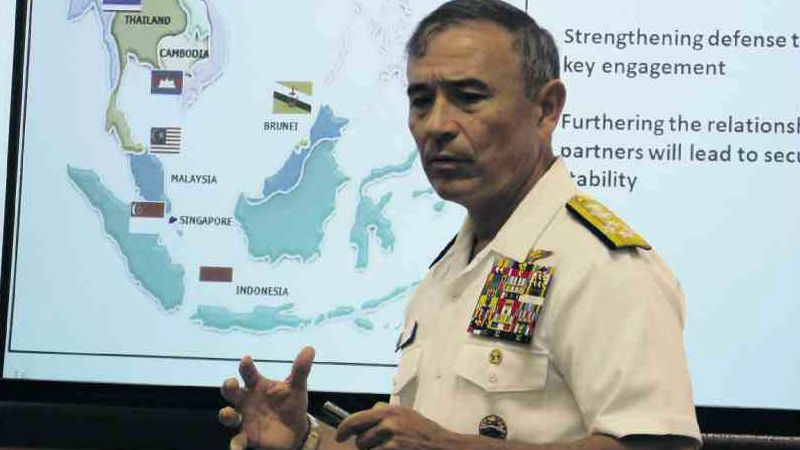
 Admiral Harry Harris, Jr,  US Pacific Command chief, briefs Southeast Asian journalists about the US forces' engagements in the Pacific.  Photo by Nina Calleja

Admiral Harry Harris Jr., US Pacific Command chief, briefs Southeast Asian journalists about the US forces’ engagements in the Pacific. Photo by Nina Calleja

CAMP H.M. SMITH, Honolulu—The United States has no plans of building American military bases in the Philippines even with the Enhanced Defense Cooperation Agreement (Edca) between the two countries, according to the commander of US forces in the Pacific.

“[The Edca] is an agreement between the US and [the] Philippines [that] will allow us to use some Philippine bases and allow us to improve infrastructure at those bases. It is not about [establishing] new American bases, it is about using Philippine bases,” Adm. Harry Harris Jr., chief of the US Pacific Command (Pacom), told reporters at a recent briefing here.

Constitutional

“This will help the Armed Forces of the Philippines, but it will also help us. It is for our mutual benefit,” Harris said.

Last month, Philippine military officials said that five military airfields, two naval bases and a jungle training camp had been offered to the United States. These were Basa Air Base in Pampanga province, Camp Antonio Bautista and a naval base in Palawan province, Clark Air Base in Pampanga, and Lumbia Airfield in Cagayan de Oro City.

“Infrastructure improvements to Philippine bases would enhance support capabilities for a rotational presence of US forces and assets,” US Air Force Capt. Cody Chiles, spokesperson for Pacom, said when asked for details of the improvements plan.

Importance of Asean

In a presentation to journalists ahead of US President Barack Obama’s meeting with the leaders of the 10-member Association of Southeast Nations (Asean) at Rancho Mirage, in Sunnylands Estate in California, Harris explained why the South China Sea and Asean, including the Philippines, were important to the United States.

“Southeast Asia is at the heart of the Asia-Pacific region and is the central pillar to [the] US rebalance to the Pacific,” Harris said, referring to Obama’s strategy of shifting the US defense focus from the Middle East to Asia.

“The leadership of Asean as a whole is key to the rules-based international order in the whole region,” he said, explaining why the United States continues to strengthen its defense ties with Asia-Pacific countries, five of which—the Philippines, Japan, South Korea, Thailand and Australia—are already its treaty allies.

The United States carries out annual joint military maneuvers with those countries, exercises that Harris called “investments for a reason.”

“They improve our interoperability. They improve our relationships. And they improve our readiness,” he explained.

Challenges for US

The United States faces challenges in the region, Harris said.

“We see an assertive China, a resurging Russia. There is a thousand miles of Russian coastline in the Asia-Pacific region, which includes strategic nuclear and submarine bases,” he said.

“There is a proliferation of weapons of mass destruction, that is North Korea, although five countries in Asia-Pacific are nuclear-capable,” he added.

The United States is leading the global opposition to North Korea’s nuclear ambitions and it is championing freedom of navigation to counter China’s claim to almost all of the 3.5-million-square-kilometer South China Sea.

To bolster that claim, China has built artificial islands on seven reefs in the Spratly archipelago that could be used for military purposes, raising tensions with rival claimants to territory in the South China Sea—Brunei, Malaysia, the Philippines, Vietnam and Taiwan.

The seven artificial islands are within the exclusive economic zone of the Philippines, which has taken the dispute to the United Nations Permanent Court of Arbitration in The Hague for resolution. A decision is expected by June.

Analysts said a more constant and increased US military presence in the Philippines through the Edca would slow down China’s expansion in the South China Sea.

Aquino to raise China issue

President Aquino may be expected to raise China’s expansionism at the Sunnylands summit, according to Presidential Communications Secretary Herminio Coloma Jr.
Mr. Aquino “has always represented the Philippines’ position on the importance of ensuring freedom of navigation and overflight” in the South China Sea, as well as adherence to international law in resolving disputes in the strategic waterway, Coloma said in Manila on Sunday.

The President leaves for the summit today, accompanied by Foreign Secretary Albert del Rosario and some Cabinet officials.

On Wednesday, Del Rosario disclosed a proposal for the rival claimants in the South China Sea to meet on the sidelines of the summit, but it was uncertain if the leaders’ schedules would allow for it.

Strategic partners

Obama proposed the summit during the third US-Asean meeting in Kuala Lumpur in November last year, following the decision of the leaders to elevate their relations to the strategic-partner level.

In a statement issued in December last year, the US government said the summit aimed to provide leaders a forum to strengthen cooperation under the new US-Asean strategic partnership on political, economic and security issues.

Briefing reporters in Malacañang last week, Assistant Foreign Secretary Hellen Barber-de la Vega said it would be the first meeting between Asean and the United States as strategic partners.

The summit aims to “explore how Asean and the [United States], after elevating their relations to the strategic-partner level, can work more effectively together and especially now with the establishment of the Asean Community,” De la Vega said.

http://globalnation.inquirer.net/136499/us-well-use-only-ph-bases-under-edca

Joint US-Phl patrols in disputed seas welcomed

From the Philippine Star (Feb 14): Joint US-Phl patrols in disputed seas welcomed               

Filipino businessmen and fishermen welcome the planned joint maritime patrols of Filipino and American troops in the West Philippine Sea, which United States Ambassador Philip Goldberg announced earlier.

China occupied and built artificial islands in Kagitingan, Mabini, Gaven, Cuarteron, Burgos, Subi and Panganiban reefs, further compromising freedom of navigation in the areas that belong to the Philippines.

A number of businessmen engaged in fishing admitted that their vessels have steered away from the fish-rich region due to prevailing security concerns.

One of the businessmen told The STAR he would only allow his fleet to resume operations in the Spratlys if there is an assurance that the region is safe from China’s bullying.

http://www.philstar.com/headlines/2016/02/14/1552859/joint-us-phl-patrols-disputed-seas-welcomed