Monday, December 22, 2014

DILG hastens closure pact with RPA-ABB

From the Visayan Daily Star (Dec 23): DILG hastens closure pact with RPA-ABB

Undersecretary   Austere   Panadero of the Interior and Local Government met yesterday with Negros Occidental Gov. Alfredo Marañon Jr. to discuss the settlement sites for Revolutionary Proletarian Army-Alex Boncayao Brigade members as a final step to the government's signing of a closure agreement with the group.
 
The national government is in a hurry to see closure, Marañon said.
 
However, it is important that a proper settlement area is found to ensure the success of the agreement, he said.
 
The governor stressed the need for the settlement area to have good facilities, access to schools, roads, electricity, and other amenities.
 
The Office of the Presidential Adviser on the Peace Process had identified settlement sites within the Northern Negros Natural Park in San Carlos and Cadiz cities that the provincial government objected to for being in areas that should be protected from encroachment, Provincial Planning and Development Office coordinator Ma. Lina Sanogal said.
 
That is why a study of alternative sites, which could include private lands to be purchased, has been undertaken, she said.
 
Unlike remote areas in the NNNP, these alternative sites could be closer to already existing roads, schools and other infrastructure, she said.
 
The alternative settlement sites are needed for the closure agreement to be signed, she said.
 

PH Navy seeks military aid from Japan

From ABS-CBN (Dec 22): PH Navy seeks military aid from Japan

The Philippine Navy is seeking Japan’s assistance to boost security over its maritime territory.

Navy vice commander and Navy Modernization Board chairman Rear Admiral Caesar Taccad said a list of equipment that will be requested from Japan is currently being prepared.

This comes on the heels of Japan’s decision early this year to reinterpret its Constitution and allow the military to exercise a right to
“collective self-defense.”

This move gained criticisms, especially from China, which has been in a tug-of-war with Japan over the East China Sea.

"We need enough vessels to patrol those maritime areas. So the list would probably include patrol vessels and (other) vessels that we can use for HADR (humanitarian assistance and disaster relief) for government-support activity,” Taccad said.

Both the Philippines and China have insisted on jurisdiction over areas in the resource-rich South China Sea or West Philippine Sea. The other claimants are Vietnam, Taiwan, Malaysia, and Brunei.

Navy spokesman Col. Edgardo Arevalo said: "We in the Philippine Navy are the ones preparing the list and seeks Japan's benevolence."

"The list is comprised mostly of HADR equipment like logistics, transport ships, and sea planes, among other capacity-building equipment," he added.

http://www.abs-cbnnews.com/nation/12/22/14/ph-navy-seeks-military-aid-japan

DND set to issue notice of award for eight amphibious assault vehicles

From Ang Malaya (Dec 22): DND set to issue notice of award for eight amphibious assault vehicles

Department of National Defense is set to issue to the sole eligible bidder – South Korea’s Samsung Techwin – Notice of Award for eight brand-new amphibious assault vehicles for Philippine Marine Corps of Philippine Navy.

“The vehicles will be utilized to land the surface assault elements of the landing force and their equipment in a single lift from the assault shipping during amphibious operations to inland objectives and to conduct mechanized operations and related combat support missions in subsequent operations ashore,” says Navy Vice-commander Rear Admiral Caesar Taccad as reported by state-run news agency.

The said acquisition project has a budget of 2.5 billion pesos. Samsung Techwin presented an offer with 76 million pesos lower than the approved budget.

“Similarly for humanitarian assistance disaster relief operations for devastated areas, having the capability of beaching during ship-to-shore movement of troops and cargoes,” Taccad added.

Complete delivery of units is within 910 calendar days from effectivity of contract.

http://www.angmalaya.net/nation/2014/12/22/6853-dnd-set-to-issue-notice-of-award-for-eight-amphibious-assault-vehicles

Philippine Navy commissioning brand-new sealifts, frigates in next four years

From Ang Malaya (Dec 22): Philippine Navy commissioning brand-new sealifts, frigates in next four years

The Philippine Navy is set to commission two strategic sealift vessels, two state-of-the-art frigates from 2016 to 2018. With the arrival of these major acquisitions not less than five navy vessels which are uneconomically advisable to be repaired will be decommissioned.

The two strategic sealift vessels are being built by Indonesian PT PAL and the first unit will be delivered during the second quarter of 2016. “These ships can be used for military and non-military operations such as humanitarian assistance and disaster relief missions, sealift, logistics, rescue operations or as a floating government center platform,” says Rear Admiral Caesar Taccad.

These strategic sealift vessels are designed to carry two 10-ton helicopters on deck and one 10-ton chopper on hangar.

While the contract for the two brand new frigates is expected to be awarded early next year. Philippine Navy expects these warships to be delivered in three years time – from 2017 to 2018.

http://www.angmalaya.net/nation/2014/12/22/6860-philippine-navy-commissioning-brand-new-sealifts-frigates-in-next-four-years

Philippine Navy capability upgrades – 2014 review

From Ang Malaya (Dec 22): Philippine Navy capability upgrades – 2014 review

Year twenty-fourteen has been good to Philippine Navy and to the entire Armed Forces of the Philippines in terms of capability upgrades.

In November, 5000 out of more than 27 thousand units of 5.56mm M-4 assault rifles were distributed to Marines. “The M-4s augmented with 5,000 units of close combat optics, a battery red-dot type aiming device that enhance the target acquisition speed of ground troops,” Rear Admiral Caesar Taccad said, the state-run news agency reports.

Two Hundred Twenty units of 7.62mm general purpose machine guns were also delivered for the Philippine Marine Corps. “This weapon primarily provides multi-role automatic fire support weapon to Marine infantry squads and fire-teams, especially the Force Recon teams and Special Operations platoons,” Taccad explained.

Also this year, explosive ordnance disposal (EOD) helmets, visors, suits and other EOD accessories were delivered.

Moreover, three AW-109 helicopters were commissioned with two units deployed to two Del Pilar-class frigates for enhanced maritime air patrol and surveillance capabilities. While additional two AW-109, armed version, are expected to arrive early of 2015.

“All of these efforts at enhancing capacity and building capability serve to bring the institution closer to realizing the vision of a strong and credible Navy that the Philippines, as a maritime nation, can be proud of,” Taccad noted.

Indonesia’s PT PAL bagged the contract, also this year, to supply two Makassar-class LPDs to act as the navy’s strategic sealift vessels. Delivery of the first unit is expected on the second quarter of 2016, while second delivery is set on 2017.

Some projects which are underway are the acquisition of two long-range patrol aircraft, two anti-submarine helis, six 155mm gun tubes with ammunition, eight amphibious assault vehicles and two state-of-the-art frigates.

http://www.angmalaya.net/nation/2014/12/22/6866-philippine-navy-capability-upgrades-2014-review

China secretly established an air defense identification zone in South China Sea

From Ang Malaya (Dec 23): China secretly established an air defense identification zone in South China Sea

China secretly established an air defense identification zone in South China Sea unlike the establishment of ADIZ in East China Sea last year which was announced, says Kanwa Defense Review – a Chinese military magazine based in Canada.

“China secretly set up an air defense identification zone (ADIZ) over the disputed South China Sea before the incident in August where a PLA Navy Air Force’s J-11 fighter intercepted a US P-8 patrol aircraft, according to Kanwa Defense Review,” WantChinaTimes.com reports.

China has no information to offer regarding the said establishment of ADIZ in South China Sea.

“I have no information to offer. I’d like to restate that it is within a country’s sovereignty to decide whether to establish an air defense identification zone or not, meanwhile all sort of factors should be taken into account. Currently, peace and stability in the South China Sea is guaranteed,” Chinese Foreign Ministry Spokesperson Hua Chunying said.

http://www.angmalaya.net/world/2014/12/23/6883-china-secretly-established-an-air-defense-identification-zone-in-south-china-sea

The shopping list: Status of PH military's modernization

From Rappler (Dec 23): The shopping list: Status of PH military's modernization

2015 is the year of the Philippine Air Force. Fighter jets for the West Philippine Sea defense and more air assets are to be delivered.

 INSPECTION. President Benigno S. Aquino III tours the F-50 on Friday, December 12, 2014, before leaving Korea, at the sidelines of the 25th ASEAN-Republic of Korea Commemorative Summit. Photo by Ryan Lim/Malacañang Photo Bureau
INSPECTION. President Benigno S. Aquino III tours the F-50 on Friday, December 12, 2014, before leaving Korea, at the sidelines of the 25th ASEAN-Republic of Korea Commemorative Summit. Photo by Ryan Lim/Malacañang Photo Bureau

The Philippine defense department has been on a shopping spree in the past few years with its P90-billion (US$2 billion)* budget for military modernization in the wake of China's aggressiveness in the West Philippine Sea (South China Sea).

In 2015, the shopping bags are arriving.
 
It's going to be the year of the Philippine Air Force, which will see delivery of two of the much awaited FA-50 fighter jets that will bring the ill-equipped air force back to the supersonic age a decade since it retired the last of its US-designed F-5 fighters in 2005. (READ: PH Air Force a joke no more, gets fighter jets)
 
In his visit to South Korea middle of December, President Benigno Aquino III inspected a sample unit of the Lead-in Fighter Trainer (LIFT) that is also classified by many as a figher jet because of its minimum fighter capabilities. Its design is derived largely from the US F-16.
 
ADAS 2014: A model of the FA-50 at the Asian Defense and Security exhibit in Manila. Rappler photo
 
Bell 412 combat utility helicopters from Canadian Commercial Corporation
 
AW109 Power attack helicopters. Photo from AgustaWestland
 
Aquino said the FA-50 jets will primarily allow the Air Force to make faster trips to West Philippine Sea areas where reports need to be verified. The Air Force Nomads and the Navy Islanders take about 9 hours to make a round trip from the Palawan-based Western Command to any point in the disputed waters.
 
Delivery is expected in the 3rd quarter of 2015 after the manufacturer, the Korea Airspace Industries, committed to deliver them earlier than the December 2015 schedule. Air Force pilots are leaving for South Korea in March to train with the Korean Air Force on how to fly and maintain them.
 
Delivery of the 12 fighter jets will be completed by 2017.
 
More air assets, radars
 
It's not all. The Philippine Air Force is waiting for the delivery of 3 medium-lift and two light-lift aircraft.
 
Air Force spokesperson Lieutenant Colonel Enrico Canaya said they are the counterparts of the Fokker and Nomad planes, respectively, that will allow inter-island transport of cargo and personnel.
 
Eight Bell 412 combat utility helicopters from Canadian Commercial Corporation and 8 AW109 Power attack helicopters are also arriving for counter-insurgency campaigns and humanitarian assistance and disaster response operations, Canaya confirmed.
 
In the pipeline, but have no clear delivery schedules are two long-range patrol aircraft, 2 C-130 cargo planes from the US, and an Air Defense Surveillance System that will allow the country to detect, identify, any possible intrusions in its airspace.
 
The Philippine military has for decades focused on its army to respond to insurgencies and Muslim rebellions.
 
China's threat means it's time for the Air Force and the Navy to get the long delayed attention, while the Army is pressured to finally make these threats irrelevant.
 
"It is imperative for the AFP to develop its territorial defense capability. It is important that we adjust our defense structures and synchronize our systems and processes in order to shape an Armed Force capable of providing a credible defense posture," Armed Forces Chief General Gregorio Catapang said during the AFP's 79th anniversary celebration last week.
 
Catapang, who belongs to the Army, has said that the future AFP chief should come from the Air Force or Navy.
 
Navy: Frigates and submarines
 
The Philippine Navy's capabilities got a boost after acquiring two US coast guard ships – BRP Gregorio Del Pilar in 2011 and BRP Ramon Alcaraz in 2013. These 40-year-old hand-me-down ships are the Navy's most capable warships, tasked to patrol the West Philippine Sea in tandem with two brand new naval helicopters that arrived December 2013. (READ: State of PH Navy modernization" 'Golden days will return')
 
These warships have also become the training ground for Navy sailors before the arrival of the brand new and more sophisticated ships that will be delivered between 2016 and 2018.
 
"They (Del Pilar and Alcaraz) are new means for training and skill-building that will prepare them for the procurement of modern equipment. The shift from internal to external defense will be realized through these vessels," said Navy vice commander Rear Admiral Caesar Taccad.
 
PATROLS. The BRP Gregorio Del Pilar photographed inside Ulugan Bay in Palawan, located at the mouth of the West Philippine Sea. Rappler photo
 
The Navy has a 3-step approach in handling tension in the West Philippine Sea: maritime situational awareness, maritime operations, and maritime cooperation.
 
The Philippines has filed an international arbitration case against China. But security experts are concerned that even if the country wins the case, it will not have the capability to enforce it. (READ: PH lawyer: China 'felt pressured' to respond)

The more sophisticated assets will seek to address this concern. At present, the Philippine military is largely only able to monitor what is happening in the disputed waters. The arrival of the new assets will improve maritime operations and deterrence capability. 
 
The Navy's frigates project is the big-ticket item in the AFP modernization program other than the fighter jets. Two frigates are currently in the final stage of bidding and 6 makers are expected to participate in the last pre-bid conference on January 8.
 
Illustration of the frigates
 
Illustration of the anti-submarine helicopter
 
Illustration of the Strategic Sealift Vessel (SSV)
 
The frigates will look like Del Pilar and Alcaraz but its weapons will set it apart. It will have anti-air, anti-surface, anti-submarine, anti-electronic warfare capabilities.
 
The frigates will work in tandem with two anti-submarine helicopters, which will serve as force multipliers and can interdict subsurface operations. The Navy is aiming to sign contracts for the frigates and anti-submarine helicopters early 2015, while delivery for both are expected in 3 to 4 years.
 
Deterrence

Taccad said the goal is not to match capabilities of China and other neighbors. The new assets are meant to improve the country's deterrence capabilities by letting intruders know that the Philippines will be able to respond if necessary.

In the next decade, Taccad said the Navy wants to also acquire submarines to further improve its deterrence capability.

Finally, maritime cooperation refers to the alliances with foreign militaries including US which co-signed the Enhanced Defense Cooperation Agreement in April 2014. The Supreme Court decision on the constitutionality of the agreement is expected early 2015.

The other major Navy assets in the pipeline are the two strategic sealift vessels (SSV), the Missile capable fast military assault craft, and an amphibious landing vehicle for ship-to-shore movement. 
 
The SSV project was awarded to an Indonesian company. The first ship will be delivered in 2016. The government is yet to complete bidding for the two other items.

The SSV will have two landing craft utility and ribcage. This vesel can be used for military and non-military operations like humanitarian assistance and disaster response. It can accommodate 500 troops and a hundred crew.
 
The Navy will also restore and enhance an old vessel, BRP Artemio Ricarte, and acquire several weapons.
Army: Counting on peace talks to succeed
 
While the Navy and the Air Force are focused on territorial defense, the Army is pressured to make internal threats irrelevant so the Armed Forces is not sidelined anymore by occasional eruption of deadly clashes in the countryside.
 
The strategy is a combination of peace talks and military operations. Troops have been issued brand new M4 Caliber 5.56mm to replace their old M-16 rifles. Next year, 28 armored vehicles are also arriving.
 
AFP ANNIVERSARY: President Benigno Aquino III and former President Fidel Ramos join the AFP top brass during the AFP's 79th anniversary celebration. Malacañang photo
 
The government is confident that peace talks with the Moro Islamic Liberation Front (MILF) will be completed and bring an end to violence in Mindanao.
A new hope for peace talks with the National Democratic Front (NDF) also emerged which, at the very least, can reduce violent attacks from the New People's Army (NPA). In a gesture of good faith, the NPA committed to release soon 8 soldiers and cops they earlier declared as Prisoners of War.
 
The Philippine military has also launched law enforcement operations against the Abu Sayyaf in Sulu and Basilan, where their membership largely come from, to secure the release of several hostages.
 
AFP 79th anniversary celebration
 
The Army is also realizing its role during disasters. Catapang said this should be the focus of the Army once the threat groups are addressed.
 
Many of the assets acquired by the Air Force and the Navy are also suitable for HADR operations including the medium and light lift aircraft and the SSV.
 
Three horizons of modernization
 
The P90-billion modernization program is the "first horizon," a new buzzword in the military, as it eyes the second phase of modernization.
 
Taccad said discussions for the second horizon have started. "The events in the West Philippine Sea did give some urgency to the acquisition of these assets. It has always been urgent to us but the because of the events, it became urgent to the Filipinos and to the country," said Taccad.
 
But Aquino is stepping down in 2016. What happens to the second horizon and the third will depend on his successor.
 

Philippine military breaks own truce in South, says NPA rebels

From the Mindanao Examiner BlogSpot site (Dec 23): Philippine military breaks own truce in South, says NPA rebels


Filipino communist insurgents on Monday have accused the military of breaking its own unilateral truce following continued operations against the New People’s Army in southern Philippines.

Simon Santiago, a rebel spokesman, said combat forces under the Eastern Mindanao Command have launched offensive operations in several areas in Davao City, Davao Oriental, Compostela Valley, North Cotabato and Agusan del Sur.

“The continued troops deployment, build-up and hamletting in those areas belie the claim made by the US-Aquino regime in declaring a ceasefire during the traditional Christmas season. The presence of the troops in these areas does not appear to be risk-free, undisruptive or inoffensive, but comprises actual offensive manoeuvres within and in the periphery of guerrilla territories.”

“Their blatant occupation of civilian areas while supposedly in suspended military operations is highly provocative and increases the risk of armed engagements with the Red fighters amid civilian-populated areas,” he said.

Santiago said government troops were also using civilians as cover in their daily activities in many of those areas

“The continued operation of Special Operations Team or so-called peace and development teams (of the military) violates and makes a mockery of the US-Aquino regime’s own version of ceasefire.  AFP troops who are operating in civilian areas either underhandedly or blatantly are on offensive combat operations and, except for those who are inside their detachments and outposts, shall be treated as legitimate targets by the NPA,” he said.

He said the rebel forces under Southern Mindanao Regional Command remain on “active defensive mode” as it abides with the Communist Party of the Philippines’ designated truce on December 24, 2014 until December 26, and from December 31 to January 1, 2015.

Santiago said the NPA truce is also in effect during the papal visit in the Philippines on January 15 to 19, 2015.

“The continued provocation and deception made by the AFP troops while pretending to be on a truce make it even more imperative for the Red fighters to launch tactical offensives against these fascist troops anytime and anywhere while firmly adhering to the letter and spirit of the CPP’s ceasefire declaration,” he said.

There was no immediate statement from the Eastern Mindanao Command.
The NPA has been fighting for many decades now for the establishment of a Maoist state in the country.

http://www.mindanaoexaminer.net/2014/12/philippine-military-breaks-own-truce-in.html

OPAPP confirms BIFF invitation to Bangsamoro Basic Law hearings (Abu Sayyaf not invited)

From the Zamboanga Today (Dec 22): OPAPP confirms BIFF invitation to Bangsamoro Basic Law hearings (Abu Sayyaf not invited)

The Ad Hoc Committee on the Bangsamoro has invited representatives of the Bangsamoro Islamic Freedom Fighters (BIFF) to provide inputs on the pending Bangsamoro Basic Law.

This was confirmed by Office of the Presidential Assistant on the Peace Process Undersecretary Atty. Yusuf (Joe) Lorena during a hearing on the proposed BBL at a local hotel in Zamboanga city last Saturday.
 
Lorena however discounts the possiblity of any participation by the Abu Sayyaf group in the continuing discussions on BBL, a group considered by the government to wholly focus on violence in attaining its objectives.
 
The BIFF, on the other hand, was described by Lorena as a large organization composed of radicals and moderates, adding that it is the group of moderates that the government is inviting to participate in discussions relative to the proposed BBL.
 
“If the moderates want to participate, it will be very good for us,” said Lorena.
 
He said that the committee directed the invitation however to the BIFF group in general and was not addressed to any specific leader in the community.
 
“We have friends who have knowledge of the communities,” Lorena said.
 
The manner on how the invitation was delivered was different from that on how the Committee invited members of the Moro National Liberation Front to the discussion, which was said to have been delivered personally in Cotabato city.
 
Lorena said that the invitation to the two sectors is part of government’s efforts to engage these groups in discussions relative to the proposed Bangsamoro Basic Law.
 

South Koreans leaving behind grateful nation

From the Philippine Daily Inquirer (Dec 21): South Koreans leaving behind grateful nation

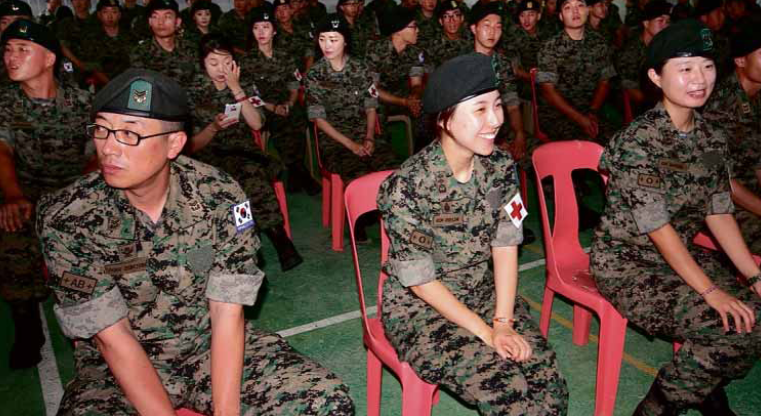
THE SUNSHINE TROOPS The 296-strong Korean Araw joint contingent who helped in the rehabilitation and reconstruction of “Yolanda”-ravaged communities in Leyte prepare to go back home after a year of deployment.

THE SUNSHINE TROOPS The 296-strong Korean Araw joint contingent who helped in the rehabilitation and reconstruction of “Yolanda”-ravaged communities in Leyte prepare to go back home after a year of deployment. DANNY PETILLA
PALO, Leyte—A few days before Christmas last year, Col. Lee Chulwon was preparing for the holidays with his family in his native Seoul.

But instead of spending the holidays with his family, Lee, on orders from his government, embarked on South Korea’s largest peacetime humanitarian mission ever: help its close ally the Philippines recover from the destruction brought by Supertyphoon “Yolanda” (international name: Haiyan).

Like the good soldier that he is, Lee bid his family goodbye, packed his bags and found himself surveying the near apocalyptic wasteland that was Tacloban City, this town and nearby Tanauan town where more than 7,000 perished during the storm.

As Filipinos faced their bleakest Christmas in years, 540 South Korean troops led by Lee who arrived in two six-month deployments prepared for South Korea’s biggest and longest international campaign that came in the wake of history’s strongest storm ever to hit land.

As the ravages of Yolanda started burning news wires and the Internet around the world, a curious thought crossed Lee’s mind.

Philippine training

“I had a feeling she (South Korean President Park Geun-hye) would send me,” Lee said through an interpreter.

Lee graduated from an officers’ course at the Joint Command and Staffs College in Camp Aguinaldo in 1998, which made him a natural choice for Park for the Philippine mission.

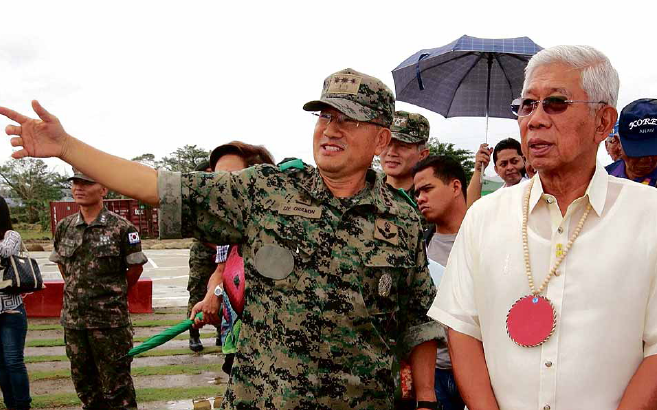
HEAD OF MISSION LEYTE Col. Lee Chulwon, head of the Korean Araw joint contingent,welcomes Defense Secretary Voltaire Gazmin to the Korean Memorial Park at Barangay Candahug in Palo town.
HEAD OF MISSION LEYTE Col. Lee Chulwon, head of the Korean Araw joint contingent,welcomes Defense Secretary Voltaire Gazmin to the Korean Memorial Park at Barangay Candahug in Palo town. DANNY PETILLA

When Lee—a decorated 30-year veteran—landed in this town on Dec. 4 last year to do reconnaissance mapping, he could not believe his eyes.

“It was a war zone like no other,” said Lee, who saw action in two major conflicts: the civil war in East Timor in 2000 and the war in Iraq in 2004.

A Presbyterian Christian, the 52-year-old Lee admitted he prayed for strength and divine guidance after seeing the overwhelming devastation.

“It was not very encouraging to be a Filipino in those days,” he said.

Acting on official request of assistance from the Philippine government, the South Korean joint military contingent known as Araw, a word coined by Lee himself, arrived in Cebu province on Dec. 28. The troops—and tons of heavy equipment aboard two of the Korean Navy’s landing ship tanks—were in Leyte province the next day.

While it was winter in their homeland, the Korean soldiers, mostly in their early 20s, were thrust into Leyte’s humid weather, but made their presence immediately felt by clearing tons of debris to make roads passable again, fumigating dirt-laden communities— and by burying the corpses of more than 1,400 people who died in the storm.

“I can’t say we did the dirty work. But that’s part of the territory,” Lee said.

Precious gift

From Jan. 3 until Nov. 27 this year, the Araw contingent rebuilt 67 buildings, including 37 schools and eight hospitals and four houses of Filipino war veterans who fought in the Korean War from 1950 to 1953.

Their medical mission treated 41,000 patients and their soup kitchens fed 62,000 people.

“What a precious gift their presence here has become to us,” said Korean War veteran Domingo C. Teves Sr., 89. His damaged house in Tacloban City was rebuilt by the Araw forces.

“Where will we be without our Korean friends,” said Erwin Ocana, mayor of Tolosa town where the Koreans rebuilt eight schoolhouses and seven other government facilities.

But like babies demanding to suckle from the same milk bottle, the mayors at one time were clamoring for use of the South Koreans’ heavy equipment.

No stranger to the intractable terrain of local politics and turf wars, Lee met these kinks head on.

Personal account

“We took the bull by the horns with honesty rather than with petty tricks,” Lee wrote in his book “Repaying Sacrifices of Blood with Sweat Drops.”

Published by Tacloban-based printer Tres Marias, the 309-page book is a personal account of Lee’s yearlong experience as head of Araw.

In his book, Lee expressed his frustrations at some of the organizational problems he ran into, like the habitual tardiness of local mayors that often derailed official events.

“I was sad to notice the lack of respect for the concept of time by some leading people of society,” Lee wrote.

Officials at the Korean public affairs office said it was a dig at Palo Mayor Remedios Loreto Petilla, matriarch of the powerful Petilla political dynasty in this province, who makes members of civil organizations, the military and the clergy wait for hours during various public functions.

“We are here investing heavily in your reconstruction, and your mayor (Petilla) forces us to wait for hours, that is not right,” a Korean officer close to Lee said.

In his book, Lee also disclosed how he sent home three young conscripts for getting drunk and ending up in the local massage parlor in Tacloban. The ironic twist is that the Koreans were led by a Filipino soldier.

“It pained me to have to cut short their duties, but I was left with no choice,” Lee wrote.

Asian laggard

An ardent student of history, Lee is mystified by the Philippines’ falling behind its neighbors. An Asian economic powerhouse in the 1960s next only to Japan, the Philippines has lagged behind other economies in the region (39th in 2013 gross domestic product [GDP], at $272 billion) even with rising economic growth, while South Korea, economically backward in 1962, has vaulted to the top (14th in GDP in 2013 with $1.22 trillion).

Lee said he learned some of the reasons from his assignment here.

“I thought there was some small behavioral aspect that was blocking and obstructing the growth of the Philippines, which has great potential,” Lee said.

But nobody was talking about any negatives during the Araw mission completion ceremony at their camp in Candahug village here on Dec. 12.

“Let it be known that the Filipino people will forever be indebted to you,” said Armed Forces of the Philippines Chief of Staff Gen. Gregorio Pio Catapang Jr.

“Lives were relived and friendships forged by our soldiers of peace here,” said Korean Ambassador to the Philippines Hyuk Lee during the same ceremony where Korea—home to 54,000 Filipino migrant workers—pledged to assist the Philippines even after its troops’ departure.

Heavy equipment donated

During the ceremony, the Korean government turned over P200 million worth of excavators, forklifts, dump trucks, tractors, payloaders and backhoes—the same equipment that its troops used during the typhoon cleanup—to the AFP.

“Technically, only our bodies are departing,” Lee said with a laugh.

“Lee is a good friend, a sincere and passionate leader. I will miss him,” said Mayor Pelagio Tecson Jr., whose town, Tanauan, made Lee an adopted citizen.

But what inspired Lee during his work here was the smiles on children’s faces. Their smiles reminded him of his own children, whom he had not seen for almost a year.

Lee said his absence forced him to miss important events in his three children’s lives, like graduations and the debut of his oldest daughter, Si-ah, 25, a famous actress back in Seoul, as the love interest of South Korean superstar Rain in the TV series “You’re Too Adorable For Me” on Korean Broadcasting System on Dec. 13.

But there were Lee’s other loved ones as well—his wife, Sungsook Jung, 51, daughter Ju-ah, a 24-year-old Christian pastor, and his only son, Janggi, 20, with whom he would love to be reunited now that his deployment was over.

Home for Christmas

Like the rest of his 296 troops who would be leaving the Philippines on Sunday aboard two Korean Air planes bound for their homeland, Lee was eager to be with his family on Christmas Day.

“Christmas with my family? Now, that is a treat I’m looking forward to,” he said.
http://newsinfo.inquirer.net/658385/south-koreans-leaving-behind-grateful-nation

AFP steps up security at Pemberton detention facility

From the Philippine Star (Dec 21): AFP steps up security at Pemberton detention facility


The Olongapo police released yesterday the mug shots and fingerprints of US Marine Joseph Scott Pemberton, who has been charged with murder in the death of transgender Jeffrey ‘Jennifer’ Laude.

The Armed Forces of the Philippines (AFP) has increased security around the US-controlled facility where Marine Lance Corporal Joseph Scott Pemberton is detained for the death of Filipino transgender Jeffrey “Jennifer” Laude.

More Filipino soldiers are guarding the two gated entrances leading to the compound of the Joint United States Military Advisory Group (JUSMAG) at Camp Aguinaldo, where the refurbished 20-foot shipping container housing Pemberton is located.

Another team of soldiers, apparently acting as reserve security force, is also manning their post in a nearby shaded area in the facility.

Since Thursday night, there were monitored activities of Filipino and US military personnel inside and outside the JUSMAG facility.

This was after the Olongapo City Regional Trial Court issued a warrant of arrest for Permberton and ordered him arraigned the following day for the murder case filed against him by prosecutors in connection with the death of Laude.

The US government delivered the warrant of arrest to Pemberton and in compliance with the court’s directive, it brought the American suspect out of JUSMAG at 4:30 a.m. Friday for his arraignment in Olongapo.

No visit to Pemberton

US Ambassador Philip Golberg has not visited Pemberton.

“No. I have no reason to (visit Pemberton),” Goldberg said in response to a question on ANC television last Thursday.

Golberg explained that while the US did not waive its “formal legal custody” of Pemberton, the US is keeping custody because of its obligation to service members under the Visiting Forces Agreement (VFA).

http://www.philstar.com/headlines/2014/12/21/1405036/afp-steps-security-pemberton-detention-facility

Philippine Navy to acquire 2 missile-armed frigates, 2 anti-submarine helicopters next year

From the Philippine News Agency (Dec 23): Philippine Navy to acquire 2 missile-armed frigates, 2 anti-submarine helicopters next year

The Philippine Navy said the contract for the acquisition of two missile-armed frigates and two anti-submarine helicopters will be signed and awarded to qualified proponents early next year.

This was announced Tuesday by chief of naval staff for logistic, Capt. Alberto Carlos.

"For the frigate and the anti-submarine helicopters, we are looking at signing the contract by early next year," he said.

He added that both assets will be working in tandem together, giving the Philippine Navy a much needed punch in securing the country's vast territorial waters.

Carlos said he expects these assets to be delivered within three to four years as building brand-new ships and helicopters require a lengthy process.

The country is allocating Php18 billion for its two missile-armed frigates which can also perform anti-air, anti-submarine, and anti-surface missions.

Another Php5.4 billion is allocated for the two anti-submarine helicopters.

Both projects are currently undergoing the bidding process.

http://www.pna.gov.ph/index.php?idn=1&sid=&nid=1&rid=718771

AFP units on alert for NPA founding anniversary this Dec.26

From the Philippine News Agency (Dec 23): AFP units on alert for NPA founding anniversary this Dec.26

The Armed Forces of the Philippines (AFP) announced that all its forces will be on alert for the coming 46th founding anniversary of the New People's Army (NPA) this coming Dec. 26.

This was announced by Col. Restituto Padilla, AFP spokesperson, Tuesday.

He made this statement when asked what the military will do this coming Dec. 26.

"Well, the AFP will be on alert but will not launch any kind of offensive operation and again the AFP and the government looks hopefully, is hopeful that they (NPAs) reconsider renouncing their armed struggle and instead join the mainstream (and) participate in the political system without the arms and help bring about a much more peaceful and progressive Philippines for the betterment of all our citizens," he added.

Earlier, the AFP has declared a suspension of military offensive starting midnight Dec. 19 and will end on midnight Jan. 19.

And when asked on whether the NPAs are still relevant at this stage, Padilla said the numbers of the rebels have been greatly reduced through the years.

"I think there is a clear realization among the population that we need peace, we need to secure our countryside and renounce violence because for as long as these problems continue, the progress is impeded, and progress which is supposed to be for the benefit of the big bulk of our citizenry," the AFP spokesperson said.

Padilla estimates the number of rebels still active across the country at around 4,000.

He added that end of the rebel movement will come once their leaders and followers realized that their struggle is not going anywhere.

http://www.pna.gov.ph/index.php?idn=1&sid=&nid=1&rid=718876

300-strong 'Araw' Contingent departs Monday

From the Philippine News Agency (Dec 23): 300-strong 'Araw' Contingent departs Monday

The 300-strong South Korean military unit, fondly called the "Araw" Contingent, formally left Monday after 359 days of humanitarian missions in "Yolanda" battered areas in the Eastern Visayas.

The group departed from Brig. Gen. Benito N. Ebuen Air Base (formally Mactan Air Base), Cebu at 11: 40 a.m.

They boarded a chartered Korean Airline Boeing 747 back to South Korea.

A simple but very meaningful send-off ceremony was led by Major Gen. Eusaquito P. Manalo, 2nd Air Division commander and Ki-seog Lee, the Korean Consul General in Cebu.

It was highlighted with Philippine Air Force dependents and children giving flowers and bidding farewell to the South Korean soldiers as a symbol of gratitude.

“We Repaid Your Sacrifices of Blood with Our Sweat Drops," was the motto of the “Araw” Contingent from the Republic of Korea Armed Forces Joint Support Group which arrived in Tacloban City last Dec. 28.

The “Araw” Contingent was led by Col. Chul Won Lee and established their camp in Palo, Leyte.

Their mission was to conduct humanitarian activities in support to the relief and rehabilitation effort in the province of Leyte.

The “Araw” Contingent was able to conduct infrastructure rehabilitation, rescue of abandoned vehicles, distribution of water supplies, clearing of typhoon debris, region based medical and dental aid, region-based fumigation, feeding programs, movie showing, distribution of relief goods, donating of books and granting of scholarships.

The group also facilitated a vocational training center, established an Agricultural Leadership Institute, Korean language classes, and the construction of a memorial park.

Moreover, the Filipino war veterans during the Korean War were also given special treatment by rehabilitating their houses, giving of medical services, and granting of scholarships to their dependents.

These accomplishments were made in the municipalities of Tanauan and Palo, Leyte to include Tacloban City.

All-in-all, there were 37 Educational facilities rehabilitated, 25 Public facilities rehabilitated, and 40,000 patients treated for medical and dental services.

The commitment of the Republic of Korea to help the Filipinos who were victims of Typhoon “Glenda” was deeply rooted in the sacrifices of our Filipino soldiers from the Philippine Expeditionary Forces to Korea (PEFTOK) who fought and died alongside Korean soldiers during the Korean War in the 1950s.

Also, while in Leyte, the “Araw” Contingent exerted effort to locate Filipino Korean War Veterans to honor them.For all these, The Filipino nation, especially the people of Leyte will be forever grateful.

http://www.pna.gov.ph/index.php?idn=1&sid=&nid=1&rid=718886

Military men face stiff sanctions if caught firing weapons during New Year's Eve revelry --AFP

From the Philippine News Agency (Dec 23): Military men face stiff sanctions if caught firing weapons during New Year's Eve revelry --AFP
 
Strict penalties await military personnel who will be found to have indiscriminately fired their service weapons during the coming New Year's Eve revelry, Armed Forces of the Philippines (AFP) spokesperson Col. Resituto Padilla said Tuesday.

"If a soldier is found to have indiscriminately fired his weapon (during his trial), he can be separated from the service and lose all his benefits," he added.

Padilla also said that superiors or commanding officers of erring troopers will also be made answerable to the chain-of-command.

With this development, unit commanders are required to inspect the firearm and ammunition load of all of their personnel, as well as shortly after the New Year's Eve revelry, to determine if these were illegally expended or fired.

http://www.pna.gov.ph/index.php?idn=1&sid=&nid=1&rid=718890