
Thursday, March 2, 2023

Army: Two Quezon towns now ‘insurgency-free’
From the Philippine Daily Inquirer (Mar 2, 2023): Army: Two Quezon towns now ‘insurgency-free’ (By: John Eric Mendoza)

INQUIRER FILE PHOTO
MANILA, Philippines — Quezon towns General Nakar and Infanta have been declared as free from the presence of the communist New People’s Army, the Philippine Army said on Thursday.
The local governments of General Nakar and Infanta on Monday held a ceremonial signing in General Nakar Municipal Hall and Infanta Municipal Covered Court, respectively, attended by key officials.
The programs included signing a “pledge of commitment” as well as the redeclaration of the Communist Party of the Philippines, its armed wing NPA, and political wing National Democratic Front as persona non grata in the said towns.
“These milestones are a testament to the effectiveness of the continuous and focused localized peace engagement efforts with our key stakeholders and security partners in the area,” said Second Infantry Division Commander Roberto Capulong in a statement.
“We will continue to relentlessly work to sustain our gains and extend our peace efforts to other areas still affected by insurgency,” Capulong added.
Earlier this year, also declared insurgency-free in Quezon Province are the municipalities of Alabat, Unisan, Gumaca, San Narciso, Perez and Quezon. — Kimberly D. Albaño, trainee
https://newsinfo.inquirer.net/1737477/two-quezon-towns-declared-to-be-free-from-npa
VISCOM says it is gaining ground against CPP-NPA
From the Cebu Daily News (Mar 3, 2023): VISCOM says it is gaining ground against CPP-NPA (By: Pegeen Maisie M. Sararaña)

Here are some of the seized firearms and other documents from the alleged rebels during an armed encounter with the government troops last March 1, 2023 in Barangay Carabalan, Himamaylan City in Negros Occidental. | VISCOM photo
CEBU CITY, Philippines — The Visayas Command (VISCOM) said it continues to gain ground in its fight against the Communist Party of the Philippines – New People’s Army (CPP-NPA) after it reported neutralizing four alleged rebels during an armed encounter in Barangay Carabalan, Himamaylan City in Negros Occidental last March 1, 2023.
Lieutenant General Benedict Arevalo, VISCOM commander, said that the armed encounter was between the 94th Infantry Battalion and the alleged terrorists. This encounter resulted to the death of four alleged rebels and recovery of six firearms, which includes two M16 rifles; two M203 grenade launchers attached to the M16 rifles, and two AK47 assault rifles.
Aside from these firearms, Arevalo said that the government troops also allegedly recovered several ‘war materials,’ including nine backpacks containing personal belongings and subversive documents.
For the month of February, Arevalo said that a total of 28 alleged rebels were already neutralized during their operations against insurgency in Visayas. Of the 28 individuals, five were killed, one was apprehended, while 22 others surrendered.
At least 22 firearms were also confiscated within the same period.
Arevalo appeals to those a few remaining alleged rebels to surrender.
“Heed the call of our government for genuine peace and reconciliation. Lay down your arms and return to the folds of the law while you still can, for we will never stop and we will never back down in our efforts in pursuing those who threaten the safety and well-being of our people,” Arevalo said.
https://cebudailynews.inquirer.net/491607/viscom-says-it-is-gaining-ground-against-cpp-npa
2 more Quezon towns declared insurgency-free
From the Philippine Star (Mar 3, 2023): 2 more Quezon towns declared insurgency-free (By Ed Amoroso)
CAMP VICENTE LIM, Laguna, Philippines — Nine towns in Quezon province are now free of communist rebels after two were recently added to the list.Nakar and Infanta were declared insurgency-free on Tuesday after no incident of harassment and terrorist attacks were reported in the past several years, Col. Ledon Monte, Quezon police director, said.
The police, military, concerned local government executives and officials of the Department of the Interior and Local Government signed a memorandum of understanding declaring stable internal peace and security in the two towns.
Monte also cited the surrender of New People’s Army rebels who benefited from the Enhanced Comprehensive Local Integration Program or E-CLIP.
Macalelon, Gumaca, Unisan, Perez, Quezon, Alabat and San Narciso had earlier been declared free of communist rebels.
https://www.philstar.com/nation/2023/03/03/2248839/2-more-quezon-towns-declared-insurgency-free
4 NPA rebels killed in Himamaylan clash
From Palawan News (Mar 3, 2023): 4 NPA rebels killed in Himamaylan clash (By DOMINIQUE GABRIEL G. BAÑAGA)

Photo courtesy of Mike Gonzalez (https://commons.wikimedia.org/wiki/User:TheCoffee)
BACOLOD City – Four New People’s Army (NPA) rebels were killed in a gun battle with troops of the Philippine Army’s 94th Infantry Battalion (94IB) in Barangay Carabalan, Himamaylan City, Negros Occidental on Wednesday, March 1.
The rebel fatalities were yet to be identified.
Two 94IB soldiers were wounded but were reported to be in stable condition.
Colonel Orlando Edralin, commander of the 303rd Infantry Brigade (303IBde), called on the NPA rebels who were wounded to surrender.
He said they received information that many of the rebels involved in Barangay Carabalan clash were injured.
It is possible, Edralin said, that Army troops mopping up the encounter site could recover more dead rebels.
Government forces recovered from the encounter site two M16 assault rifles with M203 grenade launchers, two AK-47 assault rifles, four M203 grenade launcher ammunition, assorted ammunition, four bandoliers, a fragmentation grenade, assorted magazines for M16 and AK-47, nine backpacks, a compass, and two flashlights.
Also recovered were food and medical supplies, as well as subversive documents.
Meanwhile, 181 families fled their homes due to the clash. They are currently staying at the multipurpose gym in Barangay Carabalan.
The Himamaylan City Social Welfare and Development Office sent relief supplies to the evacuees.
As of this writing, the Philippine Army has yet to allow the residents to return to their homes.
https://www.panaynews.net/4-npa-rebels-killed-in-himamaylan-clash/
Extortion letters recovered from encounter site
From the Visayan Daily Star (Mar 3, 2023): Extortion letters recovered from encounter site (By GILBERT P. BAYORAN)
Army soldiers have recovered numerous copies of rebels’ extortion letters at the encounter site in Brgy, Carabalan, Himamaylan City, Negros Occidental.The letters contained demands to impose what the rebels refer as “revolutionary tax” or “permit to operate fee” on businesses, especially in rural areas where they have a strong presence, a statement issued by the 94th Infantry Battalion said.
Lt. Col. Van Donald Almonte, 94IB commander, said “this tax is an essential source of funding for the group’s activities, including their armed struggle against the government.”
Almonte added that the CPP-NPA justifies the tax as a means of levying fees from businesses that operate within their “territorial jurisdiction.”
The encounter on Wednesday claimed the lives of four suspected NPA rebels, whose identities have yet to be established by the Philippine Army, and the recovery of assorted high powered firearms and explosives, among other items.
Almonte called on the public to immediately report any rebel extortion activities.
The encounter also caused the temporary dislocation of 181 families residing in five remote sitios of Brgy. Carabalan, Himamaylan City, who are now staying at the evacuation center of the barangay.
Capt. Eduardo Rarugal, 94IB Civil Military Operations Officer, reported that Mayor Raymundo Tongson, who immediately sent food packs to the displaced families, also conducted series of psycho-social talks to help the evacuees lessen their worries and fears of the eventualities that occurred in their locality.
Gov. Eugenio Jose Lacson and Col. Orlando Edralin, 303rd Infantry Brigade commander, reiterated their calls for the NPA remnants to surrender, before it is too late for them.
https://visayandailystar.com/extortion-letters-recovered-from-encounter-site/
Army looking for recruits
From the Mindanao Times (Mar 2, 2023): Army looking for recruits (By RHODA GRACE SARON)
THE ARMY Recruitment Office Mindanao encouraged all young professionals who want to serve the country to enter the Candidate Officer Cadet Course (COCC) of the Philippine Army.Speaking during the AFP-PNP Press Corps Southern Mindanao media briefing on Wednesday, March 1, Master Sgt. Teofilo Cinches, of the Recruitment Office Mindanao Branch Non-commissioned officer l, said that the Philippine Army would have a recruit examination in the city this March 7 at the University of Southeastern Philippines.
“There is a quota of 800 individuals for Army Officers across the country where the first half of them will start training this coming June and the rest this December,” Cinches said.
He added that when anyone enters to become an officer candidate, he will have a monthly salary of P45,556; when he becomes a 2nd Lieutenant, he will receive a salary of P51,879.
Interested applicants can attend its pre-screening schedules from March 4 to 6 at the Army Reservist Office at SIR New Matina, University of Mindanao and USeP.
He added that interested applicants could visit the Army Recruitment Office Mindanao Facebook Page for other details.
https://mindanaotimes.com.ph/2023/03/02/army-looking-for-recruits/
DFA: PH crafting guidelines on WPS joint patrols
From the Philippine News Agency (Mar 2, 2023): DFA: PH crafting guidelines on WPS joint patrols (By Joyce Ann L. Rocamora)
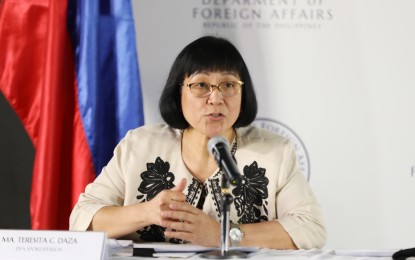
Foreign Affairs spokesperson Ma. Teresita Daza (File photo)
MANILA – The Philippine government is crafting the guidelines on joint patrols in the West Philippine Sea (WPS), the Department of Foreign Affairs confirmed Thursday.
“GPH (Government of the Philippines) is in the process of crafting guidelines for the conduct of combined maritime activities in the WPS, including joint patrols,” Foreign Affairs spokesperson Ma. Teresita Daza told reporters in a text message.
Daza said operational details and the possibility of including other countries would be discussed in the Mutual Defense Board and Security Engagement Board meetings between Manila and Washington DC.
The statement came following an Inquirer report quoting Australian Ambassador to the Philippines HK Yu as saying that “conversation on the joint patrols with the US, Philippines and Japan in international waters are ongoing”.
The Japanese Embassy in Manila days before said Tokyo would “explore the possibility of cooperating with partners to reinforce Maritime Domain Awareness and the maritime law enforcement in the Indo-Pacific” but there are no discussions yet on the activity.
The US, Australia and Japan were among the first countries to voice concern over the recent lasing incident in the Ayungin Shoal involving the Chinese Coast Guard and the Philippine Coast Guard.
Amid increasing Chinese activities at the West Philippine Sea, the three separately called for peace and stability, and the respect for international law in the vital waterway.
Last month, Foreign Affairs Secretary Enrique Manalo confirmed that there were “daily incidents” of harassment or land reclamation that had been depriving the Philippines of use of its exclusive economic zone in the West Philippine Sea.
https://www.pna.gov.ph/articles/1196472
DND: EDCA meant to boost PH defense capabilities, not for war
From the Philippine News Agency (Mar 3, 2023): DND: EDCA meant to boost PH defense capabilities, not for war (By Priam Nepomuceno)

US Department of Defense Secretary Lloyd Austin III (left) and Department of National Defense Secretary Carlito Galvez Jr. (right) (PNA file photo by Joey Razon)
MANILA – The Philippines' Enhanced Defense Cooperation Agreement (EDCA) with the United States is aimed at improving the country's defensive capabilities and is not meant for war.
In a statement Thursday night, Department of National Defense (DND) Secretary Carlito Galvez Jr. emphasized that the bilateral agreement does not seek to interfere with the domestic affairs of other nations.
"The geopolitical situation is becoming more precarious by the day. Our projects under EDCA and our other defense partnerships are not intended for aggression. We are not preparing for war, rather we are aiming to develop our defense capabilities against eventualities and threats to our security," he added.
Galvez also stressed that projects under EDCA are geared towards enhancing facility readiness of the Armed Forces of the Philippines (AFP) as part of its modernization efforts to speed up external defense development.
"As the Commander-in-Chief, President Ferdinand R. Marcos Jr. directed the AFP recently, we are shifting our focus towards territorial defense, especially in the West Philippine Sea (WPS),” the DND chief added.
Previous military engagements and exercises with Philippines allies used to focus on internal security operations. "Now, we are eyeing to strengthen our abilities to respond to external threats that may arise along our border-areas,” Galvez said.
He also added that the DND is aiming to achieve an optimal number and locations of the EDCA sites to maximize their coverage of the Philippine archipelago.
“We understand the apprehensions expressed by our local chief executives about EDCA and our bilateral exercises. However, we must consider the volatile situation in which we operate and not view our country in isolation,” Galvez added.
“The Philippines straddles a crucial location in the Pacific, and we have seaboards to the north, south, east and west. All of these must be monitored and protected," he said.
Last month, the DND announced that Manila and Washington D.C. agreed to designate four new EDCA "agreed locations".
EDCA, along with the Visiting Forces Agreement, operationalizes the 1951 PH-US Mutual Defense Treaty (MDT). It was signed in 2014 but its implementation was delayed due to various reasons.
“EDCA was met with legal challenges, but the Supreme Court eventually upheld its constitutionality in 2016. Coupled with other technical issues, which have since been resolved, and the restrictions brought by the pandemic, the implementation of the projects under EDCA was delayed for many years,” Galvez explained.
He also added that the identification of new sites for additional EDCA "Agreed Locations" is actually long overdue. Meanwhile, the Department of Foreign Affairs (DFA) shared that projects under EDCA are being prioritized and funded by the US side.
"To date, the United States has allotted and committed a total of USD82.68 million to complete all of these projects," DFA Secretary Enrique A. Manalo said during the Senate Committee Hearing on Foreign Relations on March 1.
"These new EDCA locations will allow more rapid response for humanitarian and climate-related disasters in the Philippines, as well as respond to other shared challenges," he added.
Galvez also noted that undertaking projects under EDCA is one of the DND and AFP’s various efforts to prepare for contingencies in the domestic and regional spheres.
These include responding to natural disasters and calamities, evacuating Filipino citizens in the region whenever needed, undertaking search and rescue operations, and defending against invasion.
“The MDT is founded on the principle of peace and promotion of regional stability. These underpin our activities and projects under EDCA,” Galvez pointed out.
“As a nation, we renounce war as a foreign policy. However, we are committed to exhaust all available means and the resources available to us to defend our national interests,” he added.
The DND chief also emphasized that the Philippines continues to forge ties not only with the United States, but also with friends, allies and like-minded nations.
“While we are further deepening and seeking ways to modernize our long-standing alliance with the US, we are pursuing engagements with many other like-minded nations. We are hopeful for the continued support of the Filipino people in these endeavors," Galvez said.
https://www.pna.gov.ph/articles/1196528
4 NPA rebels killed in Negros Occidental clash
From the Philippine News Agency (Mar 2, 2023): 4 NPA rebels killed in Negros Occidental clash (By Nanette Guadalquiver)

CASUALTIES. The bodies of the four New People's Army rebels who died in a clash with troops from the Philippine Army's 94th Infantry Battalion in Barangay Carabalan, Himamaylan City, Negros Occidental on Wednesday (March 1, 2023). The soldiers also recovered high-powered firearms during the clearing operation. (Photo courtesy of 3rd Infantry Division, Philippine Army)
BACOLOD CITY – The Philippine Army has declared another victory in its anti-insurgency operation in central Negros with the death of four Communist Party of the Philippines-New People's Army (CPP-NPA) rebels during an encounter in Barangay Carabalan in Himamaylan, Negros Occidental on Wednesday.
In a statement on Thursday, the 3rd Infantry Division headed by Brig. Gen. Marion Sison said the NPA "suffered a huge debacle" in the latest clash, which came five months after a series of encounters took place in the same village.
"We will not allow you to continue harming our people. Expect relentless and intensified military operations in the coming days and weeks," said Sison, stressing that government forces are determined to protect Negrenses from the atrocities of the NPA.
On Wednesday morning, troops of the 94th Infantry Battalion (94IB) engaged around 20 communist rebels in a 20-minute firefight, which injured a soldier and claimed the lives of four NPA fighters, who were not yet identified as of Thursday afternoon.
The troops responded to the reported presence of armed men who were asking for food and supplies from the villagers.
During the clearing operation, the troops recovered two M16 rifles attached to M203 grenade launchers, two AK47 assault rifles, a hand grenade, four rounds of M203 grenade launcher ammunition, four M16 magazines, seven AK47 magazines, and assorted ammunition.
Other items included backpacks, a compass, two flashlights, food items, personal belongings, subversive documents and a stack of extortion letters.
"We laud the collaboration of the 94IB with the local populace that resulted in a major setback for the CPP-NPA in Negros," Sison said.
He urged the remaining NPA rebels to surrender peacefully.
"Regain your future and avoid death like what happened to your comrades during an encounter in Barangay Carabalan," he added.
The clash displaced at least 181 families in five sitios, who were evacuated to the village covered court.
https://www.pna.gov.ph/articles/1196455
Wednesday, March 1, 2023
Opinion: Grayzone tactics: A maritime insurgency in the South China Sea?
Opinion piece posted to Rappler (Mar 2, 2023): [OPINION] Grayzone tactics: A maritime insurgency in the South China Sea? (By ROMMEL JUDE G. ONG)

'Xi Jinping's insurgency has a flaw, and it can be overcome if the region works together'
Grayzone operations is integral to the Chinese Communist Party’s maritime strategy in the South China Sea; and it continues to defy any political, naval, or legal solution. Former Associate Chief Justice Antonio Carpio’s points at the risk, if this remains unaddressed:
“ At stake is the survival of the legal order enshrined in the 1945 UN Charter, that no state shall use armed force to settle a dispute with another state but must use only peaceful means to settle such dispute…. [We]must prevent China from overturning this fundamental principle, [otherwise], we will go back to the ‘might is right’ order that prevailed before.”
Hunter Stires of the US Naval War College, depicts grayzone tactics as a “maritime insurgency,” involving:
“[a] campaign to undermine and ultimately overturn the prevailing regime of international law that governs the conduct of maritime activity in the South China Sea. [It…] is a ‘battle of legal regimes,’ a political contest of wills that manifests itself in a duel between two competing systems of authority—the U.S.-underwritten system of the free sea, versus the Chinese vision of a closed, Sinocentric, and unfree sea.”
Revisiting David Galula’s scholarly work, entitled “Counterinsurgency Warfare: Theory and Practice,” an insurgency is:
“…a protracted struggle conducted methodically, step by step, in order to attain specific intermediate objectives leading to the overthrow of the existing order.”
Given this, Xi Jinping’s “China Dream” emerges as a “global insurgency” with an ambiguous end-goal; waged now, but culminating in 2049 during the CCP’s 100th anniversary. Xi’s various policies and programs, would likely be synchronized through his Global Development Initiative, and Global Security Initiative. Galula further posits on the dynamics between “insurgents” and “counterinsurgents” (in our case referring to the CCP and like-minded democracies):
“…[promoting] disorder is the legitimate objective of the insurgents. It helps to disrupt the economy, …to produce discontent; …undermine the strength and authority of the counterinsurgents. [It] is cheap to create, and hard to prevent.”
Towards this end, China arose from the post-Nixon years as the global supply chain’s hub, established the Asian Infrastructure Investment Bank, entrenched itself in the United Nations, infiltrated the digital world through TikTok, and, lobbied for the adoption of Huawei’s 5G network. All these were to supplant the West’s influence in the geo-political arena; the global economy; among international institutions; in space, cyber, and technology; and, in the cognitive domain. Galula further warned that:
“[once]the insurgents has succeeded in acquiring geographical bases, he becomes ipso facto a strong promoter of order within his own area, in order to show the difference between the effectiveness of his rule and the inadequacy of his opponents.”
He was prescient. In the South China Sea, it has eight occupied isles and features within the Spratly’s Island Group, and maintains bases in Hainan and the Paracels. It enabled its navy, coast guard, and fisheries militia to coerce adjacent coastal states, including the Philippines, using its domestic laws to justify encroachment within our EEZ.
The CCP desires the acquiescence of Southeast Asia as modern day tributary-states. Over time, it successfully drove a wedge among ASEAN member-states, employed influence operations to coopt the its political and economic elites, and tried to use the ASEAN-China Code of Conduct negotiations to oust the US from the region. Galula warned of the impact on the “people”(referring to Southeast Asia):
“… [if] the insurgents manages to disassociate people from counterinsurgents, to control it physically, to get its active support, he will win the war because, in the final analysis, the exercise of political power depends on the tacit or explicit agreement of the population, or at worst, on its submissiveness.”
The tendency to hedge relations with the US and China, underscores the efficacy of the latter’s sharp power in compelling ASEAN to submit. In our case, Duterte’s “appeasement policy” allowed China to challenge the exercise of sovereignty and sovereign rights within our own waters. However, this will not convert Southeast Asia into “firm believers” of Xi’ dream. Galula elucidates:
“The first basic need for an insurgent is an attractive cause, [in which]the insurgents has a formidable, if intangible, asset that he can progressively transform into a concrete strength..”
Here lies the dream’s weakness: its benefits China exclusively, no “rallying cause” for Southeast Asia, and living in a “surveillance state” holds no attraction at all. Xi’s insurgency has a flaw, and it can be overcome if the region works together. – Rappler.com
[Rear Admiral Rommel Jude Ong (Ret.) is currently Professor of Praxis at Ateneo School of Government. He was formerly the Vice Commander of the Philippine Navy.]
https://www.rappler.com/voices/thought-leaders/opinion-grayzone-tactics-maritime-insurgency-south-china-sea/
US, Philippine marines team up to bolster littoral warfare skills
From Defense News (Feb 28, 2023): US, Philippine marines team up to bolster littoral warfare skills (By Megan Eckstein)

Marine Barracks Washington hosted an honors ceremony, during which the U.S. Marine Corps commandant welcomed his Philippine counterpart. (Gunnery Sgt. Brian Rust/U.S. Marine Corps)
WASHINGTON — The commandant of the Philippine Marine Corps will tour several U.S. Marine Corps locations with his American counterpart this week, as both services adapt their approaches to defending and fighting from Pacific islands.
The U.S. Marine Corps in March 2022 stood up its 3rd Marine Littoral Regiment, the first of several planned units specifically designed to operate as a stand-in force. These forces would constantly move around the South China Sea and other contested bodies of water, providing a regular presence and intelligence capability while ready to jump into action if tension with China turns into conflict.
The Philippine Marine Corps is similarly growing its territorial defense capability, after spending more than 50 years focused on domestic counterinsurgency operations. The service is now tasked with fending off Chinese aggression at sea and fishing fleet incursions into Philippine territorial waters.
U.S. Marine Corps Commandant Gen. David Berger and Philippine Marine Corps Commandant Maj. Gen. Charlton Sean M. Gaerlan believe they can learn from each other. Following a short honor ceremony at the former’s house at Marine Barracks Washington, the two generals told Defense News they swapped lessons learned in September, back when Berger visited Manila.
They are committed to deepening that cooperation during this visit, with Gaerlan heading to Marine Corps Base Quantico in Virginia, a hub for training, doctrine development and experimentation. He expressed particular interested in a visit to the Marines’ Training and Education Command.
“We really have to change our organizational structure and the way we employ forces. That’s why we have just stood up the Coastal Defense Regiment,” he said, also noting the recent creation of the Service Support Regiment and the renaming of the Combat Support Brigade.
“For now, our training, education and doctrine is just a center, it’s more of just a school. We’re trying to expand to have it [on] a larger scale so that we can train and educate our marines in the new missions that they will be able to conduct in the future,” Gaerlan added.
The generals will also visit Marine Corps Base Camp Pendleton and Marine Corps Recruit Depot San Diego in California.

U.S. Marine Corps Commandant Gen. David Berger is received in an honor ceremony with Philippine Marine Corps Commandant Maj. Gen. Charlton Sean M. Gaerlan in Manila, Philippines, on Sept. 5, 2022. (Sgt. Kathryn Adams/U.S. Marine Corps)
Berger said his 3rd Marine Littoral Regiment and the U.S. Marines overall have a lot they can learn from their Philippine counterparts. For starters, he said, the Philippine force is comfortable operating in a jungle environment, far from desert conditions in which the Marines operated for two decades.
“They also understand logistics. Because they’re an archipelagic country, by nature they have to resupply … over great distances,” Berger said.
Joking that he had seen more boats in the Philippines than in the rest of the world combined, the commandant said he had much to learn about mobility around islands and beaches.
“They move comfortably between pieces of land and through the water because this is just natural for them. But for us, the [3rd Marine] Littoral Regiment, this is what they have to learn to do. So we’re learning from them: how do you maneuver, how do you move your forces between islands comfortably.”
As both forces develop their new skill sets, Gaerlan said it was important to do so in a complementary and interoperable way.
Because the two nations have a mutual defense treaty, “it’s our obligation as Marines to train with each other so we can have interoperability. And we’re not discounting the possibility that something might happen. And if something happens, we’re ready because if we don’t have that interoperability with our Marines, then it would be even more difficult during war or conflict,” he said.
In addition to being treaty allies, the two nations signed an enhanced defense cooperation agreement in April 2014, identifying five Philippine military bases where the two nations could pre-position supplies for humanitarian assistance and disaster relief missions. In February, four more bases were added to the list, increasing the number of locations U.S. Marines can train and stage gear.
[Megan Eckstein is the naval warfare reporter at Defense News. She has covered military news since 2009, with a focus on U.S. Navy and Marine Corps operations, acquisition programs and budgets. She has reported from four geographic fleets and is happiest when she’s filing stories from a ship. Megan is a University of Maryland alumna.]
https://www.defensenews.com/naval/2023/02/28/us-philippine-marines-team-up-to-bolster-littoral-warfare-skills/
https://www.defensenews.com/naval/2023/02/28/us-philippine-marines-team-up-to-bolster-littoral-warfare-skills/
PH Navy gets upgraded shipyard from Israeli firm
From the Philippine News Agency (Mar 2, 2023): PH Navy gets upgraded shipyard from Israeli firm (By Priam Nepomuceno)

(Photo courtesy of Philippine Navy Modernization Office)
MANILA – The Philippine Navy (PN)'s capability to build its own warships, particularly the small and hard-hitting fast-attack interdictor craft missile (FAIC-M), got a needed boost after Israel Shipyards Ltd. transferred the documents and keys of a newly-refurbished shipyard to its possession on Tuesday.
Navy spokesperson Capt. Benjo Negranza, in a statement Wednesday night, said the upgraded shipyard is located at Naval Station Pascual Ledesma in Cavite City.
The turnover was presided over by Naval Sea Systems Command head Commodore Mac Raul Racacho.
Negranza said the documents and keys were transferred by Israel Shipyards Ltd. marketing director Noam Katsav as part of the FAIC-M acquisition project.
The Navy's FAIC-Ms are the BRP Nestor Acero (PG-901) and BRP Lolinato To-Ong (PG-902), also known as the Acero-class patrol boats.
Seven more of these vessels are expected to be delivered within the next two years.
The documents and the keys of the refurbished shipyard were received by the head of the PN's naval shipyard for initial operation and sustainment, Navy Capt. Nestor Galindo.
"The newly-refurbished naval shipyard will facilitate the local construction of the three FAIC-M vessels, which will form part of the fleet of PN’s Acero-class patrol gunboats. Its formal handover ceremony is lined up this May as part of the Navy’s pre-anniversary activities," Negranza said.
He added that this is a significant milestone for the ship-building capability of the PN and at the time boosts the country’s Self-Reliant Defense Posture Program (SRDP), one of the current 10-point agenda of the Department of National Defense.
The 32-meter long FAIC-Ms are high-speed vessels equipped with quick intercept ability, remote stabilized weapons, and short-range missiles that are capable of delivering precision strikes against larger hostiles and high-value targets on land and sea.
Four of the FAIC-Ms will be armed with non-line-of-sight (NLOS) missiles with pinpoint accuracy and a range of 25 kilometers while the other five will be armed with Typhoon-mounted 30mm main cannons and .50 caliber heavy machine guns.
The acquisition of these FAIC-Ms is among the 2019 projects approved by former President Rodrigo Duterte under the Horizon 2 List of the Armed Forces of the Philippines Modernization Program.
The notice of award for the FAIC-M project, worth around PHP10 billion, was issued on January 5, 2021.
These are expected to replace PN’s medium-sized patrol craft.
Once deliveries of the FAIC-Ms are completed, these vessels can interdict surface threats and launch NLOS missiles safely using the surrounding littoral areas as maneuver space and cover.
Earlier, PN chief Vice Admiral Toribio Adaci Jr. said the Navy is planning to acquire at least 15 more Israel-made Shaldag Mark V missile boats, which are the basis of its Acero-class patrol gunboats.
He said the additional Acero-class gunboats would help them to meet their requirements in "patrolling the seas of the country".
Adaci also said the FAIC-Ms will be assigned to the Littoral Combat Force.
https://www.pna.gov.ph/articles/1196413
Governor leads opposition to expanded US access to Philippine military sites
Posted to Radio Free Asia (Mar 1, 2023): Governor leads opposition to expanded US access to Philippine military sites (By Jason Gutierrez for BenarNews)
'Please do not ram into our throats what is unacceptable to us,' Cagayan Gov. Manuel Mamba says.
Amphibious Assault Vehicles carrying U.S. and Philippine troops head toward the beach during Kamandag 6, a joint military exercise in Zambales province, northwest of Manila, Oct. 7, 2022.
Basilio Sepe/BenarNews
A Philippine governor whose province is believed to be among four new locations chosen to host U.S. troops at military bases did not hold back in stating his opposition to the reported decision, during testimony before the Senate on Wednesday.
Filipino defense and security officials also testified at the hearing but they all refused to reveal the names of the locations of the bases when grilled with questions about them.
During his testimony Gov. Manuel Mamba of Cagayan, a province at the northern tip of Luzon island that directly faces Taiwan, said he believed his jurisdiction had been selected under a newly expanded bilateral military deal with the United States but that he had not been notified.
“Please do not ram into our throats what is not acceptable to us,” Mamba told the Senate Foreign Relations Committee hearing chaired by Sen. Imee Marcos, the sister of President Ferdinand Marcos Jr.
Cagayan in the past had hosted large-scale joint military training exercises, said Mamba who argued that if China attacked Taiwan, his province would be directly affected if American troops were deployed there.
He said he had told off American diplomats, including defense attachés from the U.S. Embassy who visited him when he previously opposed live-fire joint military exercises in his province. Mamba claimed they had dangled possible investments in Cagayan, but that he stood his ground.
“We will have sleepless nights. We are the closest and we would be hit in case that happens,” Mamba said, referring to a feared Chinese invasion of Taiwan, which Beijing considers a renegade province.
As governor, Mamba said he was looking out for the welfare of the people of Cagayan, and that should only rest on commerce and trade.
“We do not want to be an enemy to any country, nor do we want to be used to threaten any country. We will defend the Philippines from any enemy even with sticks and stones, but we will not be fodder to a fight that is not our own,” Mamba testified.
“Solutions to regional tensions will only end badly for us not involved in this show of might between two superpowers. The only military forces we want in Cagayan are members of the Armed Forces of the Philippines,” he said.
When Imee Marcos asked Defense Secretary Carlito Galvez Jr. whether rising tensions in the Taiwan Strait were the key reason for why the four additional bases would be located in the northern Philippines, he responded: “I cannot categorically answer the question.”
Sen. Marcos said she echoed Mamba’s sentiments because other local government units had told her that they were also not consulted. The Marcos clan is from the northern Ilocos region, which is also in northern Luzon.
The Philippines once hosted the largest American bases in Southeast Asia until they were shut down when their lease was not extended in the early 1990s.
Still, the country remains a strategic location for U.S. interests, including the free flow of trade and commerce in the contested South China Sea.
Cagayan is a relatively short distance from Taiwan, which hosts some 150,000 Filipino migrants, the third largest contingent of foreigners there.
Both Taiwan and the Philippines also have overlapping claims in the South China Sea, along with China, Malaysia, Vietnam and Brunei.
Trapped between two superpowers
The flurry of discussions about U.S. basing here comes amid fears that China could attack Taiwan in the next few years. One American general recently predicted that war was likely to break out in 2025.
The new bases available to Washington fall under the Enhanced Defense Cooperation Agreement, signed in 2014 as a supplement to the Visiting Forces Agreement. Signed in 1999, the VFA is a bilateral pact providing legal cover for large-scale joint military exercises between the U.S. and Philippines.
Analysts had said that allowing the Americans greater access to more military facilities in the Philippines was likely in preparation for a potential invasion of Taiwan by China.
During the same hearing on Wednesday, Sen. Risa Hontiveros, a lawmaker from the opposition, hit out at China for its repeated aggression against its smaller neighbors, including the Philippines.
While she said that support by the international community was welcome, Manila now finds itself trapped between two superpowers.
“Let me just emphasize that we should not allow ourselves to be trapped in between two warring powers, the two hegemons – the U.S. and China – but instead focus our efforts on building multilateral partnerships that could provide for joint patrols and training of our troops,” she said.
“A broader coalition is a better coalition.”
[BenarNews is an RFA-affiliated news organization.]
https://www.rfa.org/english/news/southchinasea/us-philippine-opposition-03012023053959.html
Philippines discussing security cooperation with Singapore, Vietnam
From the Philippine Star (Mar 2, 2023): Philippines discussing security cooperation with Singapore, Vietnam (Paolo Romero)

This handout photo taken on February 21, 2023 and received from the National Task Force for the West Philippine Sea (NTF-WPS) on February 22 shows suspected Chinese maritime militia vessels anchored off a disputed shoal in the Spratly Island group in the South China Sea. China claims sovereignty over almost the entire South China Sea, through which trillions of dollars in trade passes annually, and has ignored an international court ruling that its claims have no legal basis. Handout / National Task Force for the West Philippine Sea / AFP
MANILA, Philippines — Amid tensions in the West Philippine Sea, the Philippines is working on expanding defense and security cooperation with other countries in the region, particularly Singapore and Vietnam, Foreign Affairs Secretary Enrique Manalo told a Senate inquiry yesterday.
He said this strategy of multilateral cooperation in security is why the Philippines entered into talks with Japan on enhancing defense cooperation.
“I see that is the approach we’re taking now, multilateral, which is cooperation, not only in terms of it’s a multi but even tripartite with a number of our partners. It’s already been stated at the last visit of the President’s visit to Japan,” Manalo said.
He said there is an opportunity to build up not just military cooperation, but also economic and other areas of cooperation to enhance security.
“That’s being done with Australia. We’re also very much in touch now with Australia,” said Manalo. “And in terms of ASEAN (Association of Southeast Asian) partners, we’re also in touch with Singapore.”
He added that Vietnam is also being eyed for discussions on security cooperation.
“We will also embark on discussions with Vietnam and other countries in the region, all with the intention of trying to increase our security not only in terms of military and defense, but also through economic security,” the DFA secretary told senators.
EDCA to boost capacities
Manalo told the Senate that the implementation of the Enhanced Defense Cooperation Agreement (EDCA) between the Philippines and the United States was meant to boost their “collective capacities” in addressing “shared security threats.”
He and Defense Senior Undersecretary Carlito Galvez Jr., officer-in-charge of the Department of National Defense (DND), defended the EDCA before the Senate foreign relations committee, chaired by Sen. Imee Marcos.
Manalo described the EDCA, which is meant to support combined exercises and interoperability of militaries of both countries through the establishment of mutually agreed logistics hubs in military camps, as a key pillar of the Philippine-US security alliance.
“The full implementation of the EDCA will make our alliance more resilient and will accelerate modernization of our joint of our military capabilities,” Manalo said.
The EDCA is intended to supplement the 1951 Mutual Defense Treaty (MDT) and 1999 Visiting Forces Agreement (VFA), especially in developing the two countries’ “individual and collective capacities in addressing security threats.”
The committee held the hearing a month after the Philippine and US governments announced four new EDCA sites that news reports indicate are all located in northern Luzon.
Both sides had initially agreed to 21 locations, of which five have been put up while nine are in various stages of completion, Maj. Gen. Jeffrey Hechanova, Armed Forces deputy chief of staff for plans, told the panel.
Officials said the US government will put up facilities for the deployment and storage of defense equipment, supplies and material in the EDCA sites that would facilitate joint activities, such as training exercises and humanitarian assistance and disaster response (HADR).
“These new types of locations will allow more rapid response for humanitarian and climate related disasters in the Philippines as well as respond to other shared challenges,” Manalo said.
Why Northern Luzon
Marcos asked why the locations are all in Northern Luzon, which she said apparently belies the claim of officials of both sides that they could help protect the country’s sovereignty, particularly in the West Philippine Sea.
A more plausible reason, she said, is that the new EDCA sites could be intended by the US to be used as bases or staging ground in the event of a conflict in Taiwan, which China considers as a renegade province.
“What is the main consideration for choosing the locations? Is it really disaster assistance? Is it West Philippine Sea or something else?” Marcos asked Galvez, who replied that they could serve as “contingency on the defense of the country, so that we can have some sort of collective defense.”
Galvez said the sites are still under negotiations and they are not necessarily all located in Northern Luzon.
Sen. Risa Hontiveros cited China’s “consistent provocations” and that Beijing’s “utter disrespect is an affront to our sovereign rights” in the West Philippine Sea.
She thanked the US, Japan, Australia, Canada and Germany for asking Beijing to abide by the United Nations Convention on the Law of the Sea.
“However, despite her belligerence, we have always believed in exhausting all political and diplomatic means available so we can assert our rights and stand our ground, while maintaining relative peace in the region,” Hontiveros said.
“This means we must not depend only on the help of our former colonizer, the US, but instead, exhaust all ways to have security arrangements with the wider international community that are more than willing to support our cause,” she said.
Cagayan Gov. Manuel Mamba, whose province is reportedly the location of one of the new EDCA sites, lamented there was no consultation with his constituents on the matter.
Senate Minority Leader Aquilino Pimentel III cautioned officials against entering into agreements that end up having the Philippines caught between the US and China.
Senate President Juan Miguel Zubiri, however, said he fully supports the EDCA and enjoined his skeptical colleagues to visit the country’s dilapidated installations and fishing communities in the West Philippine Sea that are subjected to harassment from Chinese coast guard and militia vessels.
Sen. Francis Tolentino, vice chairman of the panel, said there must be a fusion of effort and goals of the DFA and the DND, “a convergence of military, economic, diplomatic and geopolitical needs.”
Sen. Ronald dela Rosa said Washington should set the record straight on its intention for EDCA, adding the government should not allow the Philippines to be used by the US for its own interests in the region.
“America should clarify that they are not here to use the Philippines in advancing their own interest, particularly in making the country a launchpad in the event China invaded Taiwan,” Dela Rosa, who was guest at yesterday’s Kapihan sa Manila Bay forum, said. – Cecille Suerte Felipe
https://www.philstar.com/headlines/2023/03/02/2248664/philippines-discussing-security-cooperation-singapore-vietnam
Subscribe to:
Posts (Atom)