Wednesday, April 25, 2018

'My son is not an NPA,' says mother of teenager killed in Davao clash

From Rappler (Apr 25): 'My son is not an NPA,' says mother of teenager killed in Davao clash

Eastmincom admits it erred in the spelling of the name of the boy, but insists he was indeed an NPA child soldier
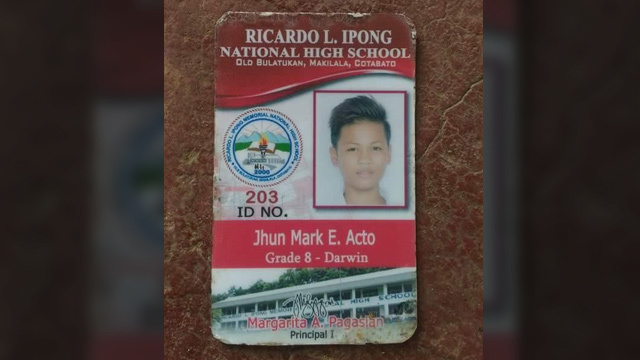
NPA FIGHTER. The school ID of slain teenager Jhun Mark E. Acto. He was in Grade 8. Photo from Karapatan

NPA FIGHTER. The school ID of slain teenager Jhun Mark E. Acto. He was in Grade 8. Photo from Karapatan

DAVAO CITY, Philippines – The mother a slain boy denied the claims of the Eastern Mindanao Command (Eastmincom) of the Armed Forces of the Philippines that her son was a guerrila fighter.

Eastmincom had
earlier reported that 15-year-old Rondi Ondo was killed in an encounter between the government forces and the New People's Army (NPA) fighters in Davao del Sur on April 21, Saturday.

The military command report claimed that the so-called child soldier's body was recovered "after the encounter with an M16 rifle and clad in black NPA uniform."

Also killed in that clash was Julito Pueblas, whom the military report identified as a high-ranking rebel leader.

But the child was neither an NPA member, nor named Rondi Ondo, based on the statements of his mother and the human rights group Karapatan - Southern Mindanao Region.

"There is no truth to the military's claim," said Jay Apiag, Karapatan SMR secretary-general.

The child's name was actually Jhun Mark Acto, contrary to the statement by the Eastmincom.

Rappler and another journalist in Davao City ran a fact-check to verify the military's claim. They were able to get in touch with Acto's mother on April 23 and interviewed her on the phone.

Maritess Acto (not Ando as earlier reported), the mother, said the military "is trying to (make it) appear that my son was an NPA (killed in the firefight) " when he was shot by a sniper.

At around noon of April 21, she said her son was out in the coconut fields with his uncle and cousin at Barangay Astorga in Astorga, Sta. Cruz.

Eastmincom's spokesperson, Maj. Ezra Balagtey, admitted Wednesday, April 25, that they were wrong about the child's name. The military however, maintained that Acto was an NPA fighter.

"In the first place, why is he at the (site of the) encounter," Balagtey told Rappler.

Maritess Acto said she was informed by the military through a phone call that her son was killed in what they called an encounter. The mother said at that time she was in their hometown Makilala, Cotabato province. Jhun Mark, meanwhile, was in Davao del Sur with his aunt "to earn some money to be used for his schooling in June," according to a Davao Today report.

Karapatan also sent Rappler a photograph of the child's school identification card, showing that he was a student of Ricardo L. Ipong National High School in Makilala.

It was the human rights group that got in touch with Maritess Acto on the day they learned the military came out with a statement identifying her son as an NPA fighter.

"Their recent allegations are mere proof that they are a factory of fiction," Apiag added.

 https://www.rappler.com/nation/201052-my-son-not-npa-says-mother-of-boy-killed-davao

PNP preparing intel-driven 'Oplan' vs terrorism

From Rappler (Apr 24): PNP preparing intel-driven 'Oplan' vs terrorism


The Oplan is confidential as publishing will predictably compromise the counterterrorism operations it organizes

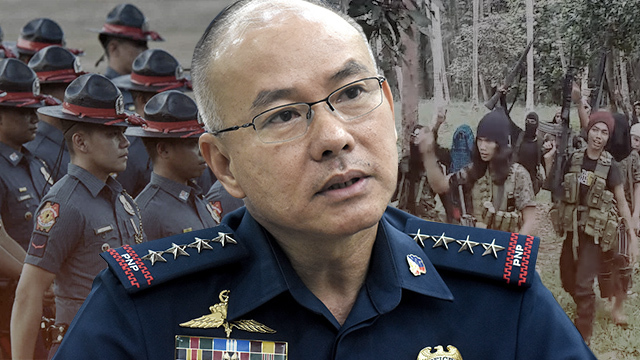
COUNTERTERROR PLAN. PNP chief Oscar Albayalde says they've been busy preparing a campaign plan against terrorism

COUNTERTERROR PLAN. PNP chief Oscar Albayalde says they've been busy preparing a campaign plan against terrorism

The Philippine National Police (PNP) is now preparing a blueprint to fight terrorism in the country, and according to PNP chief Director General Oscar Albayalde, it will be intelligence-driven.

"Actually it's (counterterrorism plan) being developed now. Number one is we really have to improve on it (counterterrorism efforts). Most of the time we rely so much [upon] the Armed Forces of the Philippines and of course our foreign counterparts," Albayalde told Rappler in an exclusive Camp Crame interview broadcast on Tuesday, April 24.


"We really have to improve on this. We have to train people on this, because this is quite new to the PNP," Albayalde admitted.

Why this matters: Once the plan is finished, Filipinos can expect cops to be more aggressive and organized in monitoring suspected terrorists in the country, with the aim of preventing attacks rather than preparing for only the time they strike.

"You can counter terrorism basically by countering it by intelligence. You can prevent it from happening really...You can only prevent those attacks through intelligence," stressing the importance of clean intelligence work.

Talks of preparing a counterterrorism police "Oplan" (campaign plan) have been going around inside Camp Crame as early as when the Marawi siege erupted in May 2017, prompting the PNP's top officials to re-evaluate their current case-to-case approach of investigating terror suspects.

The Oplan is confidential, according to Albayalde, as publishing it would predictably compromise the counterterrorism operations it organizes.

What we know is that the plan will also facilitate closer relations with police forces of other countries. "Terrorism is a global issue," Albayalde explained during the interview.

https://www.rappler.com/nation/200964-pnp-preparing-intel-driven-oplan-vs-terrorism-police-chief-albayalde

Top NPA rebel, 2 others held in Sarangani clash

From the Philippine Daily Inquirer (Apr 24): Top NPA rebel, 2 others held in Sarangani clash
Government security forces captured three suspected communist rebels, including a ranking leader, during clashes in Sarangani province on Monday and Tuesday, the military reported.

Major Ezra Balagtey, spokesperson of the Eastern Mindanao Command based in Davao City, said Pablito Torno, also known as Jebjeb, a vice commander of the New People’s Army (NPA) unit operating in the province, was arrested during Monday’s firefight in Sitio Salbuyan, Barangay Amsipit in Maasim town.


Torno was wounded and was rushed by soldiers to a hospital in General Santos City, Balagtey said, quoting a report from Lt. Col. Jones Brisal Otida, commander of the 27th Infantry Battalion.

Balagtey said on Tuesday, two more rebels were captured in an encounter, this time in Malapatan town.

Lt. Col. Marion Ancao, commander of the 73rd Infantry Battalion, said his men were verifying reports about the presence of NPA rebels in Sitio Bagyan in Barangay Upper Suyan when the firefight took place.

Ancao said the rebels fled and left behind two of their comrades, later identified as Sarah Balabang and Bactira Masalon.
Seized from the captured rebels were an M16 and a Carbine rifle.

http://newsinfo.inquirer.net/984929/top-npa-rebel-2-others-held-in-sarangani-clash

4 officers promoted, 15 receive medals

From the Sun Star-Zamboanga (Apr 25): 4 officers promoted, 15 receive medals

THE Police Regional Office (PRO)-Zamboanga Peninsula have promoted four senior officers to the next higher rank and awarded “Medalya ng Kagalingan (Medal of Merit)” to 15 policemen.

Chief Superintendent Billy Beltran, PRO-Zamboanga Peninsula director, spearheaded the donning of ranks and oath-taking of the promoted officers as well as the awarding of medals held after the flag ceremony Monday at Camp Abendan in Zamboanga City.

Chief Superintendent Edwin De Ocampo, deputy regional director for administration, and Senior Superintendent Narciso Verdadero, deputy regional director for operations, assisted Beltran during the ceremony.

Promoted from Chief Inspectors to Superintendents were: Superintendent Joseph Maulad of Zamboanga Del Norte Provincial Police Office; Superintendent Edilberto Alvarez of Zamboanga City Police Office (ZCPO); Superintendent Edwin Verson of Zamboanga Sibugay Provincial Police Office; and Superintendent Homer Dumalag of Zamboanga Del Sur Provincial Police Office.  

The awardees of Medalya ng Kagalingan are: Senior Inspector Julius Dao-an; Police Officer (PO) 3 Larry Balasabas; PO3 Adonis Atilano; PO1 Ivan Araneta; and, PO1 Al-jahad Hadjiri, all of the Police Station 2 of ZCPO in recognition for the neutralization of two bandits named Isabelo Tarroza and Alexander Delos Reyes and the arrest of other criminal gang, Nesser De Leon, during law enforcement operation on April 19 in Curuan village.

They also recovered of Garand Rifle, KG9, Rifle Grenades and several magazines and ammunition.

Senior Inspector Sonny Boy Perez, SPO1 Merkan Idris, PO3 Jayton Lagdameo, PO1 Khalid Faizal Barahim and PO1 Kenneth Glenn Jacoba, all of Isabela City Police Station, were cited for the arrest of Abu Sayyaf Group (ASG) member Tanjil Alim Pangamdas during a law enforcement operation on April 10, 2018.

Pangamdas has standing warrant of arrest as he is facing charges for kidnapping and serious illegal detention.

He was arrested in a hospital while seeking medication after he figured in a vehicular accident.

Chief Inspector Oscar Buenaobra, Chief Inspector Norbert Velonza, Senior Inspector Felixberto Lelina, Inspector Marjan Sali, and Inspector Alexander Raupan, all of Police Regional Office 9, were awarded for the neutralization of Anwar Ansang gun-for-hire group members namely as Suad Esmail and Moamer Fermin on April 20, 2018 in Sitio Balaisan in the village of East Migpulao, Dinas, Zamboanga del Sur.

Esmail and Fermin were listed as the Top 2 and Top3 most wanted persons in Dinas, respectively.

Chief Inspector Jade Mandi, Senior Inspector Nijam Salim, SPO2 Kemjie Edao, PO3 Dominic Dalena, and PO1 Keymen Edao, all of Zamboanga Del Sur Provincial Police Office, awarded for the arrest of alleged contract killers namely as Marcos Isong, Gilbert Bualat and Renato Fuentevilla.

Beltran congratulated the awardees for a job well-done citing they should be emulated by other policemen.

http://www.sunstar.com.ph/article/1609009/Zamboanga/Local-News/4-officers-promoted-15-receive-medals

New Funding for Mindanao Trust Fund to Strengthen Peace and Development in Southern Philippines

From Modern Diplomacy (Apr 24): New Funding for Mindanao Trust Fund to Strengthen Peace and Development in Southern Philippines


Efforts to bring peace and progress in Mindanao were reaffirmed today following the signing of a new agreement that will build more socioeconomic infrastructure and improve literacy in conflict affected areas.

The new Program Partnership Agreement signed by the Bangsamoro Development Agency (BDA) – the development arm of the Moro Islamic Liberation Front (MILF) – and humanitarian organization Community and Family Services International (CFSI) entrusts the two parties to implement the USD 3.2 million grant with financing from the Mindanao Trust Fund for Reconstruction and Development (MTF).

The Spanish Agency for International Development Cooperation (AECID) also provided complementary funding amounting to 1 million euro to support similar activities.

“This new partnership agreement strengthens Normalization under the Comprehensive Agreement on the Bangsamoro. It will help improve the quality of life of people in conflict-affected areas through community participation and the pursuit of sustainable livelihood within a peaceful, deliberative society,” said Secretary Jesus Dureza, Presidential Adviser on the Peace Process. “For four years, we have been reaching out to our fellow Filipinos in the south, touching lives and taking ‘peace by piece’ steps towards a developed Bangsamoro.”

Established in 2006 with support from development partners including the Australia, Canada, European Union, Sweden, New Zealand, and the United States, and administered by the World Bank, the MTF consolidates international development assistance for the socioeconomic recovery of conflict-affected communities in Mindanao and seeks to build confidence in the normalization process with the MILF.
From 2006 to 2017, development partners have provided PHP 1.4 billion (USD 28.9 million) to the program. Within this period, results delivered by the MTF-Reconstruction and Development Project include 573 projects that improved infrastructure, strengthen livelihoods and functional literacy in 315 conflict-affected communities across 75 municipalities. Nearly 650,000 people now benefit from clean water, better roads, and more post-harvest facilities and access to farming and fishing equipment.

“The support of the Philippine government and development partners towards projects that strengthen the Bangsamoro’s capacities to improve their socioeconomic conditions reinforce people’s trust on the Bangsamoro peace process and the passage of the Bangsamoro Basic Law,” said MILF Peace Implementing Panel Chair Mohagher Iqbal.

The project also supported activities to improve livelihoods, infrastructure, and basic literacy in the Six Acknowledged MILF Camps: Camps Abubakar, Omar, Rajamuda, Badre, Bushra, and Bilal. The decision of Secretary Dureza of OPAPP, the MILF, and development partners to further intensify these efforts through the MTF highlight the partners’ commitment to peace and development in Mindanao.

“Greater economic opportunity and access to basic services foster hope in conflict-affected areas, which can build understanding and collaboration among community members. The World Bank is committed to supporting efforts that enhance the prospects for peace in Mindanao,” said Mara K. Warwick, World Bank Country Director for Brunei, Malaysia, Philippines and Thailand.

“Australia is a longstanding supporter of peace and development in Mindanao, and is proud to be a partner for change in the second phase of the Mindanao Trust Fund,” said Australian Ambassador Amanda Gorely. “As the first phase has already shown, the socio-economic infrastructure and literacy projects it will provide can have a remarkable impact for communities in Muslim Mindanao.”

“One of the biggest challenges for development policies is to tackle the most vulnerable communities affected by multiple conflicts and threats; to not leave them behind. This complex aim needs joint resources from national and international stakeholders following a sound local leadership. MTF has acted as a valuable driver of such efforts,” said Juan Pita, General Coordinator of AECID.

The MTF has a steering committee that oversees the implementation and evaluation of the program. It is chaired by OPAPP, BDA, and the World Bank, which also serves as the trust fund secretariat.

https://moderndiplomacy.eu/2018/04/24/new-funding-for-mindanao-trust-fund-to-strengthen-peace-and-development-in-southern-philippines/

Tuesday, April 24, 2018

Soldier killed, another wounded in Army-NPA clash in Cagayan province

From the Philippine Daily Inquirer (Apr 24): Soldier killed, another wounded in Army-NPA clash in Cagayan province

An Army soldier was killed while another was wounded during a Tuesday morning (April 24) clash with suspected New People’s Army rebels (NPA) in a remote village in Rizal town, Cagayan province.

The soldier, a corporal, died while he and colleague were being evacuated for medical treatment, said Lt. Col. Camilo Saddam, commander of the Army’s 17th Infantry Battalion. The slain soldier’s identity has been withheld pending notification of his family.


An army unit reportedly clashed with about 25 armed men. The soldiers were conducting foot patrols in Masi village when they encountered the armed group at 7:45 a.m.

“Our troops injured the rebels during the 10-minute firefight, as evidenced by trails of blood at the clash site.

 Unfortunately, they also got two of our men,” Saddam said.

The Army believes the unit fought with members of the NPA’s Danilo Ben Command, which operates in Kalinga province and Cagayan.

The wounded soldier has been transferred to the Cagayan Valley Medical Center here.

http://newsinfo.inquirer.net/984958/soldier-killed-another-wounded-in-army-npa-clash-in-cagayan-province

Army troops, NPAs clash in Cagayan

From the Manila Bulletin (Apr 23): Army troops, NPAs clash in Cagayan

Government troops clash against Communist New People’s Army Terrorists (CNTs) in Cagayan over the weekend, resulting in the seizure of firearms and other items.


Cagayab De Oro (Grabbed from Google Maps | Manila Bulletin)
A report coming from Armed Forces of the Philippines-Northern Luzon Command (AFP-NoLCom), disclosed that troops under the Army’s 17th Infantry Battalion (17IB) of the Joint Task Force “Tala” under the 7th Infantry Division (7ID) were on patrol operations at Sitio Tallat, Barangay Masi, Rizal, Cagayan, when it encountered more or less 30 NPA fighters at 6:30 a.m.

The firefight lasted for about 45 minutes wherein the NPAs withdrew toward the northeast direction.


The incident also resulted in the on-site recovery of one improvised Cal .2, one Icom Radio, three jungle packs, four improvised explosive devices (IEDs), including one 12-volt Motolite battery and wires, medicine pack, and subversive documents.

NoLCom spokesman Lt. Col. Isagani Nato, said the encounter took place as a response to the information provided by the residents on the presence of armed group in their barangay.

He said the informants are the locals who were fed up with atrocities perpetrated by the NPAs in the area, as well as those who fall victims of their terror acts.

“NoLCom will continue to conduct focused military operations in its area of responsibility to make the communist terrorist group insignificant, allowing developments in NPA-affected areas in Northern and Central Luzon, in cooperation with the populace, civil society organizations and the local government units,” he said.

https://news.mb.com.ph/2018/04/23/army-troops-npas-clash-in-cagayan/

Bulatlat: Revolutionary group marks its 45th year

From the pro-Communist Party of the Philippines online propaganda publication Bulatlat (Apr 24): Revolutionary group marks its 45th year

As the National Democratic Front of the Philippines (NDFP) celebrates its 45th founding anniversary today, April 24, members of different allied undergorund revolutionary organizations of the NDFP staged a lightning rally at the intersection of EDSA and Aurora Boulevard in Quezon City on April 23, Monday. They called on the Government of the Philippines to return to the negotiating table and address the roots of the armed conflict.


Photos and text by JHUN DANTES
http://bulatlat.com/main/2018/04/24/revolutionary-group-mark-45th-founding-anniversary/

TF Davao told to aim for zero terror attack in next decade

From the Sun Star-Davao (Apr 24): TF Davao told to aim for zero terror attack in next decade


DAVAO. Mayor Sara Z. Duterte-Carpio greets top military officials of the region during the 10th anniversary of Task Force Davao in Sta. Ana Pier, Davao City, on April 24, 2018. (Mark Perandos)

DAVAO City Mayor Sara Duterte-Carpio challenged the Task Force Davao to achieve zero terror incident in the city for the next 10 years.

“Ang pinakadako nga challenge nako sa ilaha is 10 years nga walay incident even more years nga walay incident nga mahitabo diri sa siyudad sa Davao,” Duterte-Carpio said during TFD's 15th anniversary Tuesday, April 24, at its headquarters at Sta. Ana Pier. (My biggest challenge for Task Force Davao is 10 years and even more years of zero incident here in Davao.)

She congratulated and commended the efforts of the TF Davao troopers.

“Allow me to give my commendation for your anti-terrorism that has proven to be very dynamic and responsive throughout the years. While there have been countless challenges, I could say that the past 15 years have seen more successes in capturing and fighting against and apprehending criminals and terrorist,” Duterte-Carpio said.

TF Davao's anniversary was centered on the theme, “Kinse ka tuig nga matinud-anong nag-alagad sa mga Dabawenyo (15 years of faithfully serving Dabawenyos).”

The task force was activated in 2003 following the twin bombing incidents at the Davao airport and Sasa Wharf. Duterte-Carpio said over the years, TFD has become a source of pride for Dabawenyos.

“Task Force Davao has been soaring to great heights in keeping Davao safe and secure. The city is beyond appreciative of your passion and work. A major factor of what Davao now is attributable to all your efforts and hard work, that is always my message when I come here,” she said.

She added that Dabawenyos are lucky because there were no abuse complaints filed against any Task Force Davao personnel that were recorded in the city.

She also lauded TFD as it only received less complaints on the performance of their duty and urged them to continue with their good performance to achieve zero complaints about their work and service.

The city mayor also acknowledged TFD’s participation during rescue, relief and evacuation and security operation that “empowered the city to stand tall, united and resilient.”

Meanwhile, TFD commander Colonel Nicolas Mempin thanked various stakeholders for their support to the accomplishment of TFD mission and vowed to perform their duty beyond what's expected.

“Task Force Davao continuous to live by its mandate by securing Davao City from terrorist threats and supporting its duly constituted authorities in all its development programs to all Dabawenyos,” he said.

He added that the legacy of previous commanders like former TFD commander Brigadier General Erwin Bernard Neri inspired them to work harder to be at par if not surpass the accomplishments in making Dabawenyo proud of Task Force Davao.

Mempin also said that aside from the routine checkpoint operations and security patrol for the year, Task Force Davao has significantly contributed to the apprehension of Cayamora Maute, father of the slain Abdullah Maute, the leader of terrorist Maute group, last June 6, 2017. The elder Maute later died in detention.

They also have recorded several apprehensions in terms of illegal drugs, implementation of area security during various events in Davao City and Martial Law implementation in Mindanao.

http://www.sunstar.com.ph/article/1611535/Davao/Local-News/TF-Davao-told-to-aim-for-zero-terror-attack-in-next-decade

AFP seeks higher public awareness of maritime issues

From the Philippine Star (Apr 24): AFP seeks higher public awareness of maritime issues

The Armed Forces of the Philippines (AFP) is working on increasing public awareness of maritime issues, including the country’s territorial dispute with some of its neighbors, particularly China.

The military’s Northern Luzon Command (Nolcom) based in Camp Aquino, Tarlac City hopes to achieve this initially through spearheading a forum on the issue – together with other agencies and stakeholders – in Lingayen, Pangasinan tomorrow.

Nolcom public information office chief Lt. Col. Isagani Nato said resource speakers will discuss developments in the West Philippine Sea and South China Sea issue as well as efforts being made to safeguard the country’s territorial waters and exclusive economic zone.


He explained that Nolcom’s area of operation covers the biggest maritime area in the country – West Philippine Sea where Bajo de Masinloc or Panatag Shoal is located, Luzon Strait in the area of Batanes Islands and Philippine Rise off Casiguran, Aurora.

“Being responsible for protecting the biggest maritime area in the country, Nolcom finds it necessary to involve all stakeholders to contribute to the overall effort of securing the Northern Maritime Frontier,” Nato said yesterday.

“Thus, collaboration and integration of efforts is paramount to achieve desired common goals,” he added.

“With its core purpose, Nolcom will continue to advance peace and development, fight for our people’s rights and threats to peace, development and security, and protect our sovereign territory,” he said.

The United States and Philippines armed forces, meanwhile, will conduct “subject matter expert exchanges” at various military installations throughout the Philippines beginning tomorrow until May 4.

In a statement, the US Pacific Air Forces Public Affairs said American and Filipino airmen are set to participate in exchanges that will cover command and control tactics and humanitarian assistance and disaster relief responses.

 The US participation in the event is upon the invitation of the Philippine government, the statement said.

As part of the program, the US will send HH-60G Pave Hawk helicopters and airmen from units across the Pacific to Clark Air Base and Mactan-Benito Ebuen Air Base in the Philippines.

“The exchange is the sixth iteration of the US-Philippine Air Contingent established by US Pacific Command and executed by Headquarters Pacific Air Forces,” the statement read.

The first US-Philippine Air Contingent was in April 2016.

https://www.philstar.com/headlines/2018/04/24/1808883/afp-seeks-higher-public-awareness-maritime-issues

New AFP chief vows to weed out corrupt officers

From the Philippine Daily Inquirer (Apr 24): New AFP chief vows to weed out corrupt officers


 Lt. Gen. Carlito Galvez (File photo by FRANCES MANGOSING / INQUIRER.net)

Newly-installed Armed Forces of the Philippines (AFP) chief of staff Lt. Gen. Carlito Galvez vowed to weed out corrupt officers in the military.

“The President has zero tolerance for corruption. We will have no fear of relieving people who are mediocre and full of anomalies. We will keep the AFP clean, I will not hesitate to relieve any commander who will be tainted with corruption,” Galvez was quoted as saying in his speech at his first flag-raising ceremony as AFP chief on Monday.

The new AFP chief ordered the office of the Inspector General to investigate reported anomalies in the use of resources “to ensure judicious use of funds and proper management of government assets.”

He also told military personnel and civilian employees in attendance that while he is “strict” with erring officers, he might also give awards and cash incentives to deserving personnel.

The new AFP chief said he is also keen on promoting officers and enlisted personnel who are excelling in their respective positions.

Plaques of recognition and cash incentives starting from P10,000 await top performing officers, enlisted personnel and civilian employees who will be selected on a quarterly basis.


The Deputy Chief of Staff for Personnel had been tasked to craft the necessary deliberations.

“I am results-oriented. We must be outputs-oriented as we value teamwork and meritocracy. Be righteous. Be perfect, because any mistake may mean the lives of the people we have sworn to serve and protect; and the lives of our very own soldiers,” Galvez said.

The new AFP chief also echoed the order of President Rodigo Duterte to expedite the processing of contracts related to the AFP Modernization Program.

“The President is pushing us to make our modernization move forward, we need to choose people who can deliver results for our modernization,” he said.

http://newsinfo.inquirer.net/984878/new-afp-chief-vows-to-weed-out-corrupt-officers-afp-galvez-corruption-military

Could Militants in the Philippines Make a Comeback?

From Stratfor (Apr 24): Could Militants in the Philippines Make a Comeback? (By Ben West
Global Security Analyst, Stratfor)
 
Highlights
  • Militant attacks, piracy and kidnapping continue to threaten the southern Philippines six months after the end of fighting in Marawi City.
  • Although that threat has diminished, slow movement on the political front gives the threat more time and space to grow.
  • Regional interconnectedness means that militant safe havens in the southern Philippines will continue to pose a threat to Malaysia and Indonesia.
Six months have passed since the Armed Forces of the Philippines officially wrapped up operations against Islamic State-aligned militants who had occupied Marawi City on the southern island of Mindanao. Liberating the southern provincial capital yielded a significant peace dividend for the Philippine government. President Rodrigo Duterte continues to enjoy high popularity in the southern Philippines, local Moro leaders continue to support security forces in keeping the jihadist militant threat at bay, and despite anti-U.S. rhetoric emanating from Manila, cooperation with the United States on security matters has continued to grow. But the militant threat in the southern Philippines lingers, and underlying grievances driving the militancy remain largely unaddressed. At some point, the goodwill generated by the militants' defeat in Marawi City is going to run out, and the tenuous peace currently presiding over Mindanao will be tested over the next few months.

Many of the security trends that were playing out in October 2016 as security forces were eliminating the final militants in Marawi City remain in place. With the disintegration of the Maute group during the battle of Marawi City, the Bangsamoro Islamic Freedom Fighters (BIFF) have continued to be Mindinao's most active militant group with Islamic State ties. Its activity is concentrated in Maguindanao province, situated between Davao and Cotabato City. The group, with an estimated 200 to 300 members, has carried out regular attacks against security forces. On March 11, Philippine troops killed scores of BIFF fighters, but 10 days later, the militants responded with an attack on a police station. Despite military defeats and other setbacks, BIFF continues to pose a threat in Maguindanao and surrounding provinces. Despite its preference to operate in more rural areas, its proximity to urban centers like Davao and Cotabato City means that an attack against those cities cannot be ruled out.
The Big Picture
Philippine forces chased away the last of the Islamic State-linked militants who had seized Marawi City in October, but the jihadists have continued to linger on Mindinao and could potentially rebuild. The more time and space that the militants are given to regroup in the southern Philippines, the greater threat they will pose to neighboring Malaysia and Indonesia.
A map showing the militant landscape in the southern Philippines
According to the Armed Forces of the Philippines, remnants of the Maute group are re-forming farther north in Lanao del Sur, in the rural areas outside Marawi City. What those militants lack in numbers — their strength is estimated to be around 200 fighters — they make up for in resources. Abu Dar, a militant who survived the Marawi City siege to succeed Isnilon Hapilon as leader of the Islamic State in the Philippines, reportedly escaped the siege with tens of millions of dollars worth of cash, gold and jewelry looted from the city. Abu Dar is thought to be using the riches to recruit young, disenfranchised fighters to join the jihadist cause and pick up where the Maute group left off. Malaysian authorities, however, have a different take, claiming that one of its citizens, Mohd Amin Baco, is the leader of the Islamic State in the Philippines. Regardless, reports of militant activity around Marawi City are scarce, suggesting that if militants are regrouping, they are doing so cautiously.

The Philippines is also home to the militant group Abu Sayyaf, which stretches out along the Sulu Archipelago. Its members continue to harass security forces at about the same rate as they did before and during the Marawi City siege: however, the Abu Sayyaf gangs that ran maritime piracy operations under the Islamic State flag have been largely unsuccessful over the past 12 months, at least compared to their activities in 2016 and 2017. Abu Sayyaf pirates captured dozens of hostages in 17 successful attacks on maritime targets from April 2016- April 2017. Since then, the groups have not managed any successful attacks. In large part, an increase in naval patrols by the Philippines, Malaysia, Indonesia, Singapore and Australia can be credited for thwarting their attempts. Response times to distress calls are now measured in minutes instead of hours, and patrols have even managed to pick up on preoperational surveillance runs, stopping attacks before they even happen. But pirates in the area continue to pursue attacks, and sooner or later, they will be successful again. Shipping interests, resorts and other commercial interests in the Sulu and Celebes Sea region would be well advised to continue to guard against the threat of kidnappings.

Barriers to Success

There are a couple of political challenges ahead for Manila as it strives to fulfill its the promises to establish an autonomous region in the area most affected by the Marawi City siege and, at the same time, rebuild Marawi City. The Bangsamoro Basic Law (BBL) has been touted as the framework for undermining jihadist grievances in the southern Philippines by handing over more control to local Muslim leaders. Local leaders, supported by their communities, have repeatedly sought such authority, and since taking office, Duterte has promised to grant it to them.

But despite optimism that the Marawi City siege would finally attract enough political support to push the law through Congress, the Philippine Senate has missed deadline after deadline since October, threatening to undermine the Muslim leaders who have called for peace, and bolstering the jihadists who espouse that independence is the only option and autonomy under the Philippine government is a false promise. As of now, the Senate is aiming to pass the BBL by early June — around the time of the first anniversary of the May 23 attack on Marawi City that kicked off the five-month-long siege. Duterte, however, appears to be less optimistic about that timeline and is talking about passing it by the end of the year. Symbolically, commemorating the first anniversary of the attack on Marawi City without further progress on the BBL will be awkward; but if the legislation has not passed by the first anniversary of the end of the siege in October, it will severely test the local support Manilla and Duterte have enjoyed so far.
Eradicating militancy — or containing it, at the very least — is integral to the security of the southern Philippines. However, the potential for spillover into the rest of Southeast Asia raises serious concerns.
 
As national and local leaders struggle to rebuild a political arrangement to address the long-term militant threat in the southern Philippines, Marawi City is undergoing a much more literal reconstruction. Manila has approved more than $300 million to rebuild the city and, as anticipated, the specifics around the reconstruction are causing strife. Five Chinese firms are among the consortium involved in the reconstruction, a point that has led to a measure of protest by residents who are only now finally starting to return home. Not only does Chinese involvement raise concerns about reconstruction funds benefitting foreign instead of local interests, cooperation with China tends to inflame nationalist sentiments in the Philippines. The involvement of China — despite it being among the Philippines' largest trading partners and home to the kinds of engineering and construction companies capable of such projects — will create its own political issues. Public backlash against yet another plan for Marawi City has centered on the Philippine military's plans to build a base within the city limits — a move that locals fear would make them a target for further attacks but which the military sees as critical to securing the area. Large reconstruction projects are bound to miss deadlines, run over budgets and offend local sensibilities. If those pressures build on top of a stalled deal for political autonomy, the popular backlash would be potentially more damaging than the improvised bombs and small arms wielded by guerilla jihadist groups.

Are Militancies Contagious?

Finally, what transpires in the southern Philippines over the course of the year will affect the jihadist threat in the rest of southeast Asia. For at least the past two years, the southern Philippines have been the most permissive environment for Southeast Asian militant operations. As militants were planning and carrying out their attack on Marawi City, Indonesian and Malaysian security forces were at work dismantling other extremist groups such as Mujahidin Indonesia Timur and disrupting plots linked back to Muhammad Wanndy Jedi before he was killed in Syria. Their success against Islamic State supporters, coupled with the failure of Philippines security forces to dislodge militant groups from Mindanao, helped draw hundreds of foreign fighters into the Marawi City fight. For militants from Indonesia and Malaysia, attacks at home proved too difficult and travel to Iraq and Syria too harrowing — but jihadist networks were more than capable of smuggling fighters from Malaysia's Sabah and Indonesia's Kalimantan provinces into the southern Philippines. As Malaysian and Indonesian authorities continue to disrupt militant plots, they are finding that most schemes have some link back to the Philippines, either in the form of weapons, training, personnel or planning. As long as jihadism simmers in the Philippines, it will continue to pose a terrorist risk to the broader region.

As 2018 wears on, it will be important to watch for signs of increased threats from the southern Philippines. A more active threat in Maguindanao, either in the form of an urban attack or successful raid on security forces would be signs of a stronger BIFF. Likewise, increased aggression from the remnants of the (allegedly) wealthy militant survivors of the Marawi City siege farther north would be an indicator that security forces are struggling to keep them from regrouping. Further piracy activity in the Sulu and Celebes seas, including an eventual successful attack or a kidnapping that draws more attention is likely. Stability in the southern Philippines will also be closely tied to the progress of both the BBL and the rebuilding efforts in Marawi City. While all of these developments are, of course, integral to the security of the southern Philippines, the security situation there will have spillover potential into the rest of Southeast Asia as well. A pacified Mindanao will reduce the threat in Malaysia and Indonesia, while a resurgent militant threat will put more pressure on neighboring security forces to contain it.

https://worldview.stratfor.com/article/jihadist-militants-southern-philippines-comeback-marawi-duterte

AFP condemns NPA for continued use of minors in armed struggle

From the Manila Bulletin (Apr 24): AFP condemns NPA for continued use of minors in armed struggle

The commander of the Armed Forces of the Philippines-Eastern Mindanao Command (AFP-EastMinCom) expressed sadness and condemned the New People’s Army (NPA) for their continued use of minors in their armed struggle.


Lt. General Benjamin Madrigal (PIA / MANILA BULLETIN)

In a statement, Lt. Gen. Benjamin Madrigal Jr. said its sad to note that despite the worldwide call to spare children in armed struggle, the NPA terrorists continued to arm and use them.

“We condemn this practice in strongest term and challenge the NPA terrorists to spare them. Let children be children, and allow them to play, learn, enjoy and experience the beauty of being a child and spare them from indoctrinating hatred and violence,” Madrigal said.

Madrigal made the comment as authorities have already established the identity of the body of a young man who was killed during an encounter in Barangay Astorga, Sta. Cruz, Davao del Sur on Saturday.

The identification process was made by the Philippine National Police-Scene of the Crime Operatives (PNP-SOCO), Municipal Social Welfare Office of Sta. Cruz, Davao Del Sur, and the military.

According to the report made by Lt. Col. Rhojun Rosales, commander of the Army’s 39th Infantry Battalion, the fatality was identified as 15-year-old Rondi Ondo, from Sitio Tombo, Barangay Old Bulatukan, Makilala, North Cotabato.

He was identified by his mother Marissa A. Ondo at a Funeral Parlor in Sta. Cruz, Davao Del Sur during a public identification.

Ondo’s cadaver was recovered after the encounter with an M16 rifle and clad in black NPA uniform.

Meanwhile, Rosales facilitated the transportation of the body of Ondo and the communist leader identified as Julito Pueblas alias Taghoy, 62, from Sitio Pangayasan, Brgy. Kisante to their respective families and barangay officials of Kisante and Old Bulatukan, respectively, on April 22.

On the other hand, Jessa Lumana who was seized in the encounter site was already detained at Sta. Cruz Municipal Police Station to face criminal charges.

https://news.mb.com.ph/2018/04/24/afp-condemns-npa-for-continued-use-of-minors-in-armed-struggle/

Factsheet: Chinas Territorial Stratagem - Extending Military Range & Influence through Reclamation & Occupation of the Spratly Waters, South China Sea

From the Small Wars Journal (Apr 24): Factsheet: Chinas Territorial Stratagem - Extending Military Range & Influence through Reclamation & Occupation of the Spratly Waters, South China Sea (By S.A. Cavanagh)

Summary
 
China’s Aggressive Move to Occupy the Spratly regional waters through Reclamation has proved an effective stratagem, for projection of political, economic and military power.  The Hague has ruled China has no traditional claims to the disputed region and the Spratlys are “rocks not islands.” China continues to reclaim and militarize several strategic islands (reefs) and occupies them. The United States, French and British navies exercise freedom of navigation near the new islands, as China warns it will use military force to defend new territorial claims. China has tactically and strategically extended its military “range and influence” with navel bases, airstrips, radar, communications, missile installations and shelters. China has bet on reclamation and occupation and won.
 
China SCS
 
Visual: Author S.A. Cavanagh
 
Why is China Building Artificial Islands in the Spratly Region?
 
China believes it has legitimate claim over the disputed waters because it was the first to discover them. 
China declares it was the earliest to explore, name, develop and administer various islands in the South China Seas. (CNN, 2016)
 
The South China Seas are strategically important, 30% of the worlds shipping trade filter through the region and there are 5 other countries (Taiwan, Malaysia, Vietnam, Philippines & Brunei) that have claims to the area. (Vox, 2017)
 
The South China Sea is rich in natural resources.  There are an estimated 11 billion barrels of oil, 109 trillion cubic feet of natural gas and 10% of the world’s fisheries. (Vox, 2017)
 
Establishing territorial claims in the South China Sea will allow China to project political, economic and military power, influence freedom of navigation and harvest rich natural resources.
 
Taiwan first occupied an island in the Spratlys after World War II, and the Philippines, Vietnam and Malaysia followed suit, and all have built outposts and airstrips on their claimed territory. (CNN, 2016)
 
China has denied it would militarize the islands it has built, claiming use is for; navigational aids and weather stations.  China has since turned the islands into navel and air force bases with hardened infrastructure. 
 
China has looked at the farthest ranges of aircraft and communications equipment.  From a strategic standpoint this allows China to reach beyond those limits and extend the range of their power and influence.  In 2012, China claimed Scarborough shoal, located in the north of the South China Sea. If China manages to turn Scarborough shoal into a militarized island, it will assert influence over the entire South China Sea. (newsweek.com, 2017)
 
According to assistant professor, Richard Haydarian of De La Salle University in Manila; China is aiming to expand its military footprint which creates irreversible facts on the ground placing China in a position to use military force to defend its new territorial claims. Essentially China is telling everybody it is here to stay and not leaving.  (SCMP.com, 2018)
 
Environmental Impact of Chinas Man Made Islands in Spratly Waters
 
Construction of the islands has required massive dredging operations.  According to The Hague in 2016 China has caused irreparable harm to marine environments through the destruction of coral reefs which is against international law.  (newsweek.com, 2017)
 
Can China Build Legal Islands in the Spratly Waters?
 
China a member of ASEAN, agreed not to develop any of the reefs or island in the Spratly region of the South China Sea. Further China agreed to talks to negotiate who has rights over the disputed waters and islands. (news.com.au, 2018)
 
In 2013, the Philippines filed a case with the Permanent Court of Arbitration in The Hague, seeking a ruling on its right to exploit the South China Sea waters within the exclusive economic zone of the islands and reefs it occupies in the South China Sea. The court found in favour of the Philippines. (CNN, 2016)
 
The Hague has rejected Chinas claims to the South China Sea, and refute the seas are part of Chinas historic fishing waters.  The Hague also says that the Spratly Islands are “rocks and not islands” and there fore no country has jurisdiction. (newsweek.com, 2017) 
 
Freedom of Navigation Operations-Countering China in the South China Sea
 
The US Navy conducted freedom of navigation operations within 12 nautical miles of Mischief reef on two occasions in early 2018, to the dismay of China. 
 
The US conducts routine and regular freedom of navigation operations in the past; it will continue to do so in the future according to a spokesperson for the US Navy Pacific Fleet. (Reuters, 2018)
 
China feels that the US is escalating tensions in the region unnecessarily.  The US is concerned China is restricting free nautical movement. US Navel forces patrolling these waters have been warned that China will protect its sovereign claims to the waters. (Reuters, 2018)  
 
The French regularly sail freedom of navigation operations in the South China Sea in a low key manner.  The UK has intentions of conducting freedom of navigation operations in the region, and the UK and France as permanent members of the UN Security council will likely plan joint navel, freedom of navigation operations. (The Maritime Executive, 2018)
 
Summary
 
China has hardened its stance on territorial claims to the South China Sea.  Chinas investment in reclamation of islands has given it leverage through presence and military occupation.  Legitimate or not, China is now established in the region, allowing effective projection of influence, power and military range.  Chinas stratagem for control of the South China Sea through reclamation and occupation has proved remarkably effective. 
 
Resources
 
Hunt, K. (2016, August 2) Showdown in the South China Sea: How Did We Get Here? CNN. Retrieved from https://www.cnn.com/2015/10/28/asia/china-south-china-sea-disputes-explainer/index.html
 
Ellis, S. (2017, February 17) Why China is building islands in the South China Sea. VOX. Retrieved from https://www.vox.com/videos/2017/2/17/14642818/china-south-china-sea-us-islands
 
Ross, E. (2017, March 29) How and Why China is Building Island in the South China Sea. Newsweek. Retrieved from http://www.newsweek.com/china-south-china-sea-islands-build-military-territory-expand-575161
 
Zhou, L. (2018, February 21) Diplomacy and Defence-Aerial Photos Point to New Chinese Signal Hub in the Heart of the South China Sea. South China Morning Post. Retrieved from http://www.scmp.com/news/china/diplomacy-defence/article/2133678/aerial-photos-point-new-chinese-signals-hub-heart-south    
 
Seidel, J. (2018, February 7) Photos Reveal Chinas South China Sea Island Fortresses are Complete. NEWS.com.au. Retrieved from http://www.news.com.au/technology/innovation/photos-reveal-chinas-south-china-sea-island-fortresses-are-complete/news-story/776e1a695fb41ccb7e47a436594c1530
 
Ali, I., Blanchard, B. (2018, March 23) Exclusive: US Warship Sails Near Disputed South China Sea Island Officials Say. Reuters. Retrieved from https://www.reuters.com/article/us-usa-china-southchinasea/exclusive-u-s-warship-sails-near-disputed-south-china-sea-island-officials-say-idUSKBN1GZ0VY
 
Joshi, S., Graham, E. (2018, February 21) The Maritime Executive-Joint Freedom of Navigation Patrols in the South China Sea. The Maritime Executive. Retrieved from https://www.maritime-executive.com/editorials/joint-freedom-of-navigation-patrols-in-the-south-china-sea#gs.lY_8ivA

[S.A. Cavanagh is an independent analyst.  Mr Cavanagh served in the Canadian regular forces as an Infantryman.  He holds Diplomas from Humber and Loyalist Colleges and education Certificates from Humber and Durham Colleges.]

http://smallwarsjournal.com/jrnl/art/factsheet-chinas-territorial-stratagem-extending-military-range-influence-through
 

Can military chief end communist insurgency?

From Malaya Business Insight (Apr 24): Can military chief end communist insurgency?

NEW Armed Forces chief Gen. Carlito Galvez Jr. is focused on ending the communist insurgency and terrorism problems but a security official doubts it can be done by December when Galvez reaches the mandatory retirement age of 56.

“Decisively end insurgency, put and end to violent extremism,” AFP spokesman Brig. Gen. Bienvenido Datuin on the thrust of Galvez who assumed the highest military post on Wednesday last week.

The security official, speaking on condition of anonymity, said the insurgency problem, which is about five decades old, may last for another five to 10 years. He cited the government’s decision in 2016 to release communist leaders, who are serving as consultants of the National Democratic Front of the Philippines, so they can participate in the peace negotiations which President Duterte cancelled in November last year.

Right now, they are free. They will always be there organizing,” the official said, referring to Benito Tiamzon, his wife Wilma Austria, Allan Jazmines, and Tirso Alcantara, among others.

“You have to get the core group. Unless you get the core group, whatever you do, they won’t surrender... The leadership is providing the leadership, the rest are just palliative,” the official said.

He noted that in other poor and injustice-plagued countries, there are is insurgency because there are no cadres. “You have to arrest the… cadres... There are 30 plus to 40 (of them),” he said of the core group members.

He said the core group includes Jose Maria Sison, founder of the Communist Party of the Philippines, who has been on self-exile in the Netherlands since the 1980s.

On the terrorism problem, the official he is anticipating the problem to last “several years” more because the government in general is slow in going after the resources of terrorist groups and its members.

He noted that the military filed a forfeiture case against Maute members before the Anti-Money Laundering Council as early as three years ago but said “it is only now this is being realized.”

“It will take years,” said the source when asked when the military can finally end the terrorism problem.

The Maute group was responsible for the five-month armed conflict in Marawi City last year. They looted banks and other institutions of millions during their occupation of parts of the city, and were reported to have taken some of the money out of the city on their escape.

As to how the problem should be solved, he said: “This requires a holistic approach, economic. You have to address their livelihood… the legal problem. There are many loopholes on the legal side.”

“There is also the social. You have to seek the cooperation of the Muslim religious sector... I always believe Islam is a religion of peace but the problem is there are religious extremists,” he said.

Datuin has said the military intends to end the communist insurgency and terrorist problems “through vigorous implementation” of a support program under the Development Support and Security Plan Bayanihan.

The DSSP Plan Bayanihan is the military’s blueprint in winning the peace in the countryside. The campaign plan was implemented at the start of 2017, replacing the Internal Peace and Security Plan Bayanihan of the previous administration.

Datuin said Galvez is also focused safeguarding the country’s territorial waters, supporting law enforcement agencies in the fight against illegal drugs and criminality, and promoting transparency, good governance and fighting against corruption in the ranks.

Former AFP chief Eduardo Año, now officer-in-charge of the interior department, vowed to defeat or reduce the NPA strength from around 4,100 men to less than 1,000. This was in July 2015 when he became Army chief. In October last year, Año said he wanted the communists defeated by end of this year.

Recently retired AFP chief Rey Leonardo Guerrero targeted to reduce the NPA strength of about 3,700 men by half at the end of this year.

http://www.malaya.com.ph/business-news/news/can-military-chief-end-communist-insurgency