From DWDD AFP Civil Relations Service Radio Website (Sep 15): CAPABILITY DEVELOPMENT | RP-US Kamandag Exercise 2017
MARINE BARRACKS RUDIARDO BROWN, Fort Andres Bonifacio, Taguig City (DWDD) – The Armed Forces of the Philippine and United States Armed Forces is set to conduct capability development and counter-terrorism exercise this coming October 2, 10 and 11, 2017.
The RP- US KAMANDAG Exercise 2017 will have its Opening Ceremony on October 2, 2017 at the Marine Base Rudiardo Brown in Fort Andres Bonifacio, Taguig City.
The bilateral exercise will focus on capability development objectives for Humanitarian Assistance and Disaster Response (HADR) and counter terrorism (CT).
Activities also include the dedication of ENCAP Buildings on October 10, 2017 at Casiguran, Aurora Province. PIO PMC/MCAG
http://dwdd.com.ph/2017/09/15/capability-development-rp-us-kamandag-exercise-2017/

Thursday, September 14, 2017


MILF to assist in Marawi rehabilitation
From the Manila Bulletin (Sep 13): MILF to assist in Marawi rehabilitation
The Moro Islamic Liberation Front (MILF) is considering extending its assistance in the rehabilitation of Marawi City.
In a statement, MILF Peace Implementing Panel Chair Mohagher Iqbal said: “We are looking at a role that the MILF can play, a modest role.”
“The MILF is a modest organization so we can only share something based on our capability,” Iqbal said without disclosing what kind of assistance they will provide for the rehabilitation of the war-torn city.
In the early part of the crisis, the MILF has assisted the government in establishing a peace corridor and relief operations.
The peace corridor was utilized to help rescue civilians trapped in the city.
Iqbal said the cooperation between the MILF and the government helped create safe passages from Marawi to Iligan City and Malabang, Lanao del Sur.
“The corridor was also utilized to safely deliver relief services for the displaced residents,” he said.
The peace corridor tapped volunteers from the MILF and the Coordinating Committee on the Cessation of Hostiles (MILF-CCCH) which works with the Office of the Presidential Adviser on the Peace Process.
Iqbal added that the United Bangsamoro Humanitarian Assistance (UBHA), chaired by the Bangsamoro Development Agency, was also created to collect and deliver at least R2-million worth of food and non-food items to internally displaced residents in Marawi City, Iligan City and other parts of the province.
http://news.mb.com.ph/2017/09/13/milf-to-assist-in-marawi-rehabilitation/
Davao City mayor forms committee for localized talks with NPA rebels
From the Business Mirror (Sep 13): Davao City mayor forms committee for localized talks with NPA rebels
The city mayor here announced she has created a committee to pursue localized talks with the revolutionary Left.
Mayor Sara Duterte-Carpio announced the creation of the Davao City Local Peace Committee, or the DC Peace, during her State of the City Address on Tuesday.
She said this is “the city government’s initiative to address issues and concerns that involve the insurgents in the city”.
The DC Peace would be the city government’s negotiating arm in any likelihood of talks with the New People’s Army (NPA).
“Because it is the obligation of your duly-elected public officials to pursue just and lasting peace for the city, we have created the Davao City Local Peace Committee, with the objective and the function to manage the localized peace talks with the New People’s Army operating within the area of responsibility of Davao City,” Duterte-Carpio said.
She identified the members as Maria Luisa Bermudo of the City Social Services and Development Office; Elisa Lapina of the City Legal Office; Jessielito Areja, barangay captain of Barangay Malabog; and Catholic Archbishop Romulo Valles of Davao City.
Her office was still searching for any candidate to head the committee and wanted the chairman to come from the private sector.
The committee would last only until November next year “if there would be no significant development and movement in the localized peace process”.
If the committee failed to serve its purpose, Duterte-Carpio said her administration would “still pursue other options to attain just and lasting peace in the city”.
She added the only condition she had was to talk with “even those not from the city but have been operating under rebel groups here”.
“They are not necessarily residents because we understand that some of them come from other provinces. But the talks is only for groups that are in Davao City,” she said.
Duterte-Carpio earlier tendered a possible holding of local talks coming after her father, President Duterte, canceled the talks in February. On the same month, the regional operations command of the NPA responded to Duterte’s tender, saying it was also interested in the talks.
Rigoberto Sanchez, its spokesman, said it would suspend for a few hours the NPA operations when the talks are held and to order “any NPA camp in National Democratic Front territories in Davao City and nearby areas to host the talks with Mayor Duterte at a mutually agreed time and date”.
Sanchez said in a statement the NPA would be ready to discuss with the mayor “any matter that she would like to take up with the revolutionary movement, the duties and responsibilities of the people’s democratic government, the role of the NPA, the on-going all-out war of the AFP and the GRP-NDFP peace negotiations.”
https://businessmirror.com.ph/davao-city-mayor-forms-committee-for-localized-talks-with-npa-rebels/
Raw bomb components found in Naga City
From the Philippine Daily Inquirer (Sep 14): Raw bomb components found in Naga City
A probe has been launched by police after a tip from a resident led to the discovery of components for the making of an improvised explosive device (IED) was found near a house of a suspect believed to be connected with the New People’s Army (NPA) on Wednesday or three days before the culmination of the Feast of Our Lady of Peñafrancia this coming Saturday.
Senior Supt. Jonathan Panganiban, police city director, said the police intelligence group got the information from a neighbor of the suspected owner of the IED raw materials who revealed he was making a bomb in a drinking session last week.
Panganiban identified the alleged owner of the bomb components found in a grassy area near his house as Dominador Alcantara, 57, of Zone 2 Manggapo-gapo St., Barangay (village) Concepcion Pequeña, Naga City.
He said police found three bottles of Solo Ginebra filled with gasoline, assorted nails and broken pieces of glass and two pieces of live ammunition for caliber .45 pistol on the grassy area.
Police operatives also found a “computerized letter containing subversive details addressed to Ka Domeng and Ka Josephine coming from Ka Benny,” Panganiban said.
He said a team of Scene of Crime Operatives (SOCO) that searched the house of Alcantara also recovered a .22 caliber revolver loaded with six live bullets, one locally-made gun and a plastic bag filled with fertilizer.
He said Alcantara is now under the custody of the police while continuing investigation is being undertaken.
http://newsinfo.inquirer.net/930588/raw-bomb-components-found-in-naga-city
‘NPA leader’ charged with rebellion
From the Sun Star-Bacolod (Sep 14): ‘NPA leader’ charged with rebellion
THE police filed a charge of rebellion against a suspected high-ranking official of the New People’s Army (NPA) who was arrested after an encounter between government troops and rebels in Candoni, Negros Occidental last September 9.
Mercedita Flores was charged on September 11 in relation to Republic Act 10591 or Comprehensive Firearms and Ammunition Regulation Act.
Flores was arrested at her house in Barangay Gatuslao after police received information that the reinforcement of rebels who engaged in a firefight with troopers of Philippine National Police-Special Action Force (PNP-SAF) had coffee with her.
Police recovered from her residence a long firearm.
While the SAF and the Philippine Army were conducting internal security operations in the village on September 9, armed men fired at government forces that injured a policeman. Government forces recovered two long firearms, medicine kits, subversive documents, and personal belongings.
http://www.sunstar.com.ph/bacolod/local-news/2017/09/14/npa-leader-charged-rebellion-564081
http://www.sunstar.com.ph/bacolod/local-news/2017/09/14/npa-leader-charged-rebellion-564081
Malaysia foils Islamic State terror plot to attack places of worship
From Channel News Asia (Sep14): Malaysia foils Islamic State terror plot to attack places of worship
Malaysian police have arrested a 21-year-old Islamic State (IS)-linked suspect who received orders from Syria to launch attacks on non-Muslims and their places of worship.
The unemployed man was nabbed during a sting operation conducted in Perak, Selangor and Melaka on Sep 8-10.
He "received instructions from a Malaysian Daesh (or IS) member in Syria to buy a pistol, a M-16 rifle, an AK-47 rifle and hand grenades from a neighbouring country with the aim of launching attacks on non-Muslims and their places of worship”, said Malaysian Inspector-General of Police Mohamad Fuzi Harun in a statement.
No details on the places of worship were provided.
The man joined IS earlier this year. He also received instructions from Malaysian fugitive Mahmud Ahmad of the pro-IS faction of the Abu Sayyaf Group and a Saudi Arabia IS bomb expert on how to assemble improvised explosive devices (IEDs).
“Following that (instructions), the suspect tried three times to assemble IEDs,” said Fuzi.
Police seized chemicals used to assemble the devices in his house.
A 38-year-old man was also arrested for planning to join IS in southern Philippines and a militant group in Rakhine state Myanmar, according to Fuzi.
“The suspect actively printed and distributed (IS) flags to promote the group’s struggles,” he added.
The operation also resulted in the arrest of a third person, a bus driver aged 41, who was planning to join IS in Syria at the end of this year.
http://www.channelnewsasia.com/news/asiapacific/malaysia-foils-islamic-state-terror-plot-to-attack-places-of-9215224
Three suspected militants nabbed in three states
From The Star Online (Sep 14): Three suspected militants nabbed in three states

Three suspected Islamic State (IS) militants who also have links to the Abu Sayyaf and Al-Qaeda have been detained following raids in three states.
The suspects, all Malaysians, were picked up by the Bukit Aman Special Branch Counter Terrorism Division in Perak, Selangor and Melaka between Sept 8 and Sept 10.
Inspector-General of Police Tan Sri Mohamad Fuzi Harun said the first suspect, a 21-year-old man, was detained in Bagan Serai, Perak on Sept 8.
"We believe he has sworn allegiance to IS and has been active with the terror group since early this year.
"He also has connections to Al-Qaeda and Abu Sayyaf Group (ASG)," he said in a statement on Thursday.
The suspect had also admitted to receiving guidance from Dr Mahmud Ahmad and a Saudi Arabian bomb expert to produce Improvised Explosive Devices (IED) on a large scale, the IGP added.
"He has tried to make the bomb three times. He also received orders from a Malaysian IS militant in Syria to purchase a pistol, M-16 and AK-47 rifles along with a hand grenade from a neighbouring country to launch attacks on non-Muslim places of worship," he said adding that bomb-making chemicals were seized at the suspect's house.
The second suspect - a 38-year -old Cendol seller- was arrested on Sept 10 for producing IS flags and promoting the terror group's struggle.
"He also planned to join the IS faction in southern Philippines and in Rakhine, Myanmar," he said.
The country's top cop said the last suspect - a 41-year-old bus driver - was arrested in Petaling Jaya on Sept 10 for planning to join IS in Syria later this year.
All suspects were detained under the Security Offences Act (Special Measures) 2012 (Sosma).
http://www.thestar.com.my/news/nation/2017/09/14/three-suspected-militants-nabbed-in-three-states/
Philippines - Complex Emergency Fact Sheet #1, Fiscal Year (FY) 2017
Posted to the Relief Web (Sep 13): Philippines - Complex Emergency Fact Sheet #1, Fiscal Year (FY) 2017
KEY DEVELOPMENTS
Report from US Agency for International Development
Published on 13 Sep 2017


HIGHLIGHTS
- Conflict displaces approximately 360,000 people from Marawi and surrounding areas
- USG announces $14.3 million for the Philippines, including $3 million in humanitarian assistance
- USAID partners launch interventions to meet IDPs’ urgent humanitarian needs
- Escalated fighting since May 23 between the Armed Forces of the Philippines (AFP) and armed groups affiliated with the Islamic State of Iraq and Syria (ISIS) in Marawi—the capital city of Lanao del Sur Province in the Autonomous Region in Muslim Mindanao— has resulted in at least 45 civilian casualties and generated significant population displacement and humanitarian needs.
- As of early September, nearly 360,000 people remained displaced from Marawi and surrounding areas, according to the Government of the Philippines (GPH) Department of Social Welfare and Development (DSWD). Nearly 90 percent of internally displaced persons (IDPs) are sheltering in Lanao del Sur and neighboring Lanao del Norte Province in the Northern Mindanao Region. Priority humanitarian needs of displaced populations include food, health, protection, shelter, and water, sanitation and hygiene (WASH) assistance, according to the GPH and relief agencies.
- On September 5, U.S. Ambassador to the Philippines Sung Kim announced a U.S.
Government (USG) contribution of $14.3 million to assist conflict-affected communities in Marawi and surrounding areas. The total includes $3 million in humanitarian assistance from USAID/OFDA and $11.3 million in recovery assistance from USAID/Philippines. - USAID/OFDA is supporting UN and non-governmental-organization (NGO) partners to respond to displaced populations’ immediate humanitarian needs, improve the logistics capacity of the GPH, and enhance emergency response coordination.
Is Marawi a Harbinger of Chaos to Come?
From The Diplomat (Sep 13): Is Marawi a Harbinger of Chaos to Come? (By Mark Davis Madarang Pablo)
To avert the next Marawi Manila needs to make moves toward a more comprehensive security framework.
The so-called liberation of Marawi — now running past 100 days — is entering its final stage, and the Armed Forces of the Philippines (AFP) is about to wage its “one big battle” to neutralize the remaining Islamic State-inspired militants holed up in the battered city. According to the AFP, there are still 50-60 terrorists left and close quarters combat is already confined to 500 square meters within the city. Meanwhile, the Philippine Air Force (PAF) FA-50 planes continue to provide air support to the advancing troops by bombing high-rise defensive positions. To prevent further influx of local and foreign militants, the AFP is intensifying its interception operations over land and sea: members of the Philippine Army (PA) were able to arrest suspected militants who were en route to reinforce their beleaguered comrades while the Philippine Navy (PN), working hand-in-hand with its Indonesian and Malaysian counterparts, officially launched the trilateral agreement on joint patrols to disrupt the flow of armed elements along the country’s porous southern borders.
Arguably, the tide of war is turning in favor of the Philippine security forces, albeit at a high human and material cost. Based on reports by Philippine authorities, 136 soldiers and 620 enemies were killed on the eve of Eid al-Adha. Furthermore, more than 400,000 people have been displaced since the eruption of the conflict. The NDRRMC Operations Center reported that 5,055 families (27,335 persons) stay in 89 evacuation centers while 98,846 families (442,981 persons) live with relatives and friends. Among these, Department of Health Secretary Paulyn Ubial said that 40 home-based Marawi evacuees already died. Department of National Defense Secretary Delfin Lorenzana also said that the war has already bled Php 3 billion ($58.8 million) from government coffers.
Marawi as the Harbinger of More Chaos?
Notwithstanding the Philippine military’s widely anticipated Pyrrhic victory over the ISIS-inspired militants, darker clouds could be seen on the horizon. The Office of the Solicitor General (OSG) disclosed that there are still 20 active terror cells in the country working closely with the Maute-Abu Sayyaf-Bangsamoro Islamic Freedom Fighters (BIFF) tripartite alliance in Marawi together with one more ISIS-linked group, the Ansarul Khilafah Philippines (AKP). Given the tightened security around Marawi, members of these terror cells may opt to capture other nearby vulnerable cities and villages in Mindanao or launch terror attacks (i.e. bombing of government and/or commercial establishments) in distant megacities such as Metro Manila, Cebu, or Davao to break the concentration of forces and undermine the morale of troops in Marawi as well as sow fear and discord among the general public.
Furthermore, formal counterterrorism cooperation between the Philippines and the United States, through Joint Special Operations Task Force-Philippines (JSOTFP) has remained deactivated since 2015. This paved way to a shift — or in other words, a downscaling — in U.S. involvement with counterterrorism operations in the Philippines from advising and assisting Filipino troops down to the tactical level to merely providing advice and assistance at the operational and strategic levels of command. In addition, President Rodrigo Duterte’s ambivalence toward the United States in pursuit of closer trade, commercial, and defense ties with China and Russia continues to cast doubt over the strategic utility of the annual Balikatan Exercises in the overall counterterrorism thrust given the heightened risk of further reduction of American (and other foreign allied) troops assisting the Filipino forces. Furthermore, Oliver Ward reports that U.S. Non-Proliferation, Anti-Terrorism, Demining and Related Programs (NADR) funding for Philippine counterinsurgency operations shrank from $6.1 million in 2015 to $3.6 million in 2017. Unless the JSOTFP is reactivated, the Balikatan Exercises re-expanded, and U.S. NADR funding increased, the overall extent of Washington’s (as well as Japan’s and Australia’s) provision of material, financial, technical, logistical, and intelligence support to Manila’s counterterrorism efforts will remain limited at a critical juncture when ISIS is eyeing at Mindanao as its primary operational base in Southeast Asia.
The proliferation of ISIS terror cells beyond the country’s borders is a cause of serious concern as well: TNI Chief Gatot Nurmantyo admitted that there are already ISIS sleeper cells in all Indonesian provinces, except Papua. Malaysian Inspector General of Police Khalid Abu Bakar discovered the presence of a new ISIS extremist cell that intended to transform Sabah into a transit point for sending more ISIS members to the Philippines. Then another cell of ISIS militants based in the state of Kelantan has been found to be smuggling weapons from southern Thailand into Malaysia to prepare for terror attacks in Malaysia and abroad. Lastly, Malaysian police counterterrorism division head Ayob Khan Mydin Pitchay told reporters that Myanmar is likely to be the target of ISIS terror attack (and possibly, even the new incubator for ISIS militancy) in light of the alleged persecution of Muslim Rohingya in Rakhine state. Worryingly, these sporadic ISIS terror cells are likely to exploit the constellation of factors, namely growing traffic of returning battle-hardened jihadists from Iraq and Syria, domestic political turmoil, weak regulative mechanisms in cyberspace, and obscurity of anti-terror laws in host countries, in order to boost their regional presence and influence, improve their coordination, and enhance their guerrilla strategies and tactics in modern urban warfare.
Toward Comprehensive Security
While it is laudable for the Philippine defense and security establishment to devote its energies to quelling the remaining ISIS-inspired terrorists in Marawi, it is equally important for it to take a more proactive approach in crippling the terror network, infrastructure, and lifeline of other militant groups before they conduct another Marawi-style territorial occupation or launch other terroristic activities. With the Philippine military’s latest anti-terror campaign plan, the Development Support and Security Plan (DSSP) Kapayapaan, already in effect, the AFP ought to effectively carry out a full-spectrum counterterrorism response, which includes: enhancement of intelligence-gathering operations, disruption of flow of funds and ammunition, interception of suspected terrorists, countering of ISIS online propaganda, and sustainment of surgical strikes in order to deny the terrorists safe haven in Mindanao with the least possible civilian casualties and property damages.
In order to facilitate the implementation such actions, the Duterte administration should prioritize the passage of the proposed National Security Act. This shall empower the Philippine president through the National Security Council (NSC) and aided by the Anti-Terrorism Council (ATC) to gain more effective command and control over the AFP as well as other law enforcement agencies, i.e. Philippine National Police (PNP) and the Philippine Coast Guard (PCG) in the fight against terrorism, and bestow upon him greater flexibility and autonomy to forge defense and security agreements with government and non-government stakeholders both locally and internationally.
In addition, given that the AFP has been extensively engaged in jungle warfare and is relatively new to ISIS-style modern urban warfare, it is imperative for the Philippine military to strengthen its defense ties with countries that have relatively well-established doctrines, operational concepts, strategies, tactics, and facilities for that purpose. Hence, it may opt to reactivate the JSOTFP and re-expand the Balikatan Exercises in order for the U.S. as well as Japanese and Australian governments to be able to provide more extensive material, technical, logistical, and intelligence support to Filipino troops on tactical, operational, and strategic levels of command. To facilitate institutional learning in modern urban warfare against ISIS-inspired militants, the AFP may also opt to consider entering into formal cooperation with other countries with relatively rich corpus of knowledge and experience in counterterrorism, such as Singapore and Israel.
Furthermore, the proliferation of multinational ISIS terror cells within the Philippines’ borders and across its neighboring countries in Southeast Asia necessitates the Philippine government to carefully reexamine Article XVIII Section 25 of the 1987 Constitution — which imposes legal and constitutional restrictions to the entry of foreign troops — and adopt needed adjustments for the future Federal Constitution. In line with this, the Philippine government should openly discuss with its ASEAN counterparts the possibility of putting more flesh to the bones of ASEAN commitment to comprehensive security by reviewing the 2001 ASEAN Declaration on Joint Action to Counter Terrorism framework as well as liberalizing the interpretation of “non-interference” — the fifth principle in the ASEAN Charter, which could well become a legal, political and normative obstacle to regionalizing the ISIS terror threat and adopting a more coordinated, effective, and expedient counterterrorist response at the regional level. These radical steps will then enable special units of the AFP as well as the PNP and PCG to upgrade their mode of conducting anti-terror operations with fellow ASEAN militaries and law enforcement agencies from mere intelligence sharing and joint maritime patrols to joint combat operations through the creation and deployment of a fully capable joint multinational force upon formal request of the Philippine government or any other ASEAN member-state in distress.
Resolving the Bangsamoro Question
From a strategic perspective, the AFP should not lose sight of the deeper security, governance, and development issues that are likely to perpetuate conditions for another territorial takeover or terror attack by ISIS-inspired militants in the Philippines. Given that the ISIS threat in Mindanao is deeply intertwined with the Moro Question and the ongoing contestation for the future social, political, and economic order of the Bangsamoro, the AFP should fully support the painstaking efforts of the Moro National Liberation Front (MNLF) and the Moro Islamic Liberation Front (MILF), the two largest Moro insurgent groups in Mindanao, to harmonize their respective peace agreements — the 1976 Tripoli Peace Agreement, the 1996 Jakarta Peace Agreement, and the 2014 Comprehensive Agreement on the Bangsamoro — within the framework of the Bangsamoro Coordination Forum (BCF).
Most importantly, the AFP should fully support the passage of the Bangsamoro Basic Law (BBL) deemed as the enduring political solution to the decades-old Moro insurgency. Working hand-in-hand with other government agencies, business community, civil society groups, and other stakeholders in accordance with the Peace and Development Roadmap of the Duterte Administration, the AFP should assist in establishing peace and order, building strong institutions of governance, and bringing opportunities for socio-economic empowerment in the region. By addressing the structural causes of radicalization and violent extremism in Mindanao, one could delegitimize Islamic State’s distorted vision of an Islamic Caliphate, deny ISIS-inspired militants a rallying cause, and hence, prevent another city or village from descending into another Marawi.
[Mark Davis Madarang Pablo is Senior Research Associate, Security and East Asia Affairs Program at Stratbase – Albert del Rosario Institute, an independent strategic research organization based in Makati City, Philippines.]
https://thediplomat.com/2017/09/is-marawi-a-harbinger-of-chaos-to-come/
AFP opens bidding for buying 28,450 rounds for 105mm Howitzer with Fuze
From the Manila Bulletin (Sep 11): AFP opens bidding for buying 28,450 rounds for 105mm Howitzer with Fuze
The Armed Forces of the Philippines (AFP) through the Philippine Army Bids and Awards Committee (PABAC) has opened the bidding for the procurement of 28,450 rounds for 105mm Howitzer with Fuze.

(Photo by pixabay)
The approved budget for the contract is P853,500,000.
In an interview, Army spokesman Lt. Col. Rey Tiongson said the Pre-Bid Conference (PBC) is slated at 1:30 p.m. Wednesday (September 13, 2017) while the Receipt and Opening of Bid Envelopes (ROBE) will be held at 9 a.m. Wednesday (September 27, 2017).
The price of bid documents which is nonrefundable is P75,000.
Tiongson said the Bidding Documents shall be available at the office of PABAC Secretariat in Fort Bonifacio, Taguig City.
Tiongson said the procurement of munitions is a regular operational requirement procedures undertaken by the military.
“The procurement is based on the projected requirements (of the Army) and of course we have or we need to maintain our (needs),” Tiongson said.
Tiongson said aside from Marawi where fighting is currently happening against Maute terrorists, artillery units which has 105mm Howitzers are also deployed in various parts of the country.
“Ginagamit natin siya (We use this) normally in our operations to soften the ground, to illuminate the ground and to destroy targets. Ito iyung pinaka parang gamit na gamit na (this has been used extensively),” Tiongson said.
When asked if they are running low on 105mm due to the Marawi operations, Tiongson said no.
“No, no. We just need to maintain the basic loads of our artillery units as well the reserve ammunitions,” he said.
http://news.mb.com.ph/2017/09/11/afp-opens-bidding-for-buying-28450-rounds-for-105mm-howitzer-with-fuze/
The Armed Forces of the Philippines (AFP) through the Philippine Army Bids and Awards Committee (PABAC) has opened the bidding for the procurement of 28,450 rounds for 105mm Howitzer with Fuze.
(Photo by pixabay)
The approved budget for the contract is P853,500,000.
In an interview, Army spokesman Lt. Col. Rey Tiongson said the Pre-Bid Conference (PBC) is slated at 1:30 p.m. Wednesday (September 13, 2017) while the Receipt and Opening of Bid Envelopes (ROBE) will be held at 9 a.m. Wednesday (September 27, 2017).
The price of bid documents which is nonrefundable is P75,000.
Tiongson said the Bidding Documents shall be available at the office of PABAC Secretariat in Fort Bonifacio, Taguig City.
Tiongson said the procurement of munitions is a regular operational requirement procedures undertaken by the military.
“The procurement is based on the projected requirements (of the Army) and of course we have or we need to maintain our (needs),” Tiongson said.
Tiongson said aside from Marawi where fighting is currently happening against Maute terrorists, artillery units which has 105mm Howitzers are also deployed in various parts of the country.
“Ginagamit natin siya (We use this) normally in our operations to soften the ground, to illuminate the ground and to destroy targets. Ito iyung pinaka parang gamit na gamit na (this has been used extensively),” Tiongson said.
When asked if they are running low on 105mm due to the Marawi operations, Tiongson said no.
“No, no. We just need to maintain the basic loads of our artillery units as well the reserve ammunitions,” he said.
http://news.mb.com.ph/2017/09/11/afp-opens-bidding-for-buying-28450-rounds-for-105mm-howitzer-with-fuze/
What Will Australia’s New Military Terror Aid to the Philippines Look Like?
From The Diplomat (Sep 12): What Will Australia’s New Military Terror Aid to the Philippines Look Like?
Though details remain to be worked out, the general shape of Canberra’s deepening security role is becoming increasingly clearer.
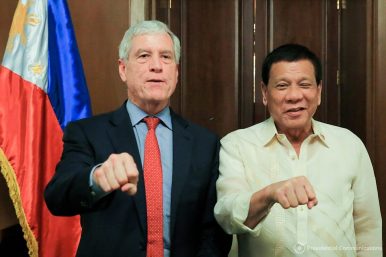
Image Credit: Presidential Communications Office
On Friday, Australian Defense Minister Marise Payne indicated that Australia and the Philippines were making progress in discussions that would see Canberra play a greater military role in assisting Philippine forces in their ongoing battle against Islamic State fighters in the southern city of Marawi. Though such discussions are by no means new and specifics are yet to be worked out, it is nonetheless the latest sign of the defense cooperation between the two countries in this realm.
As I have noted before, Australia and the Philippines have long had a strong relationship that extends into the defense realm, with security ties, including not just regular interactions like exchanges and exercises but capacity-building in areas ranging from maritime security to counterterrorism, as well as assistance with respect to the peace process in the southern Philippines.
Though the emergence of President Rodrigo Duterte has no doubt complicated things somewhat, the Marawi crisis in particular has reinforced the importance of the bilateral defense relationship (See: “Battle for Marawi Exposes Philippines’ Military Intelligence Crisis”). Australia, along with a few other states, has already offered various forms of support to the Armed Forces of the Philippines (AFP), including AP-3C Orion military planes to help with surveillance in Marawi (See: “Singapore Gives Philippines Military Aid to Fight Islamic State Threat”).
But the hype over the past few weeks had been around whether Australia might further boost direct military assistance to the Philippines, including through the approval of some sort of “advising, assisting, and training” role that Australian Foreign Minister Julie Bishop had publicly talked about.
As I noted then, such a role would certainly be a more robust one since, if conceptualized along the lines of Australia’s assistance in Iraq which Bishop had referred to, it would involve not just Australian equipment or expertise – be it in terms of intelligence, aircraft, or urban warfare training – but Australian personnel being directly embedded with Philippine counterparts on the ground (See: “New Australia Military Terror Aid for the Philippines?”).
On September 8, following a meeting between Philippine Defense Secretary Delfin Lorenzana and visiting Australian Defense Minister Marise Payne, the two officials disclosed a little bit more detail publicly about what they had in mind.
Payne said that what she discussed with Lorenzana was for a small Australian Defense Force team that could provide some specialized training to the AFP. Though few other specifics were provided, she said that those would be unveiled after further discussions with other actors in both countries.
Unsurprisingly, Lorenzana once again went out of his way to clarify that the nature of Australia’s support would likely be in terms of training in areas like intelligence sharing, rather than a more combat role. He specifically clarified that Australian forces would likely be staying within Philippine military bases rather than directly joining counterterrorism operations, adding that “it will not look good” if Australian troops were involved in actual combat.
The sensitivities involved in such a growing security role for Australia in the Philippines are well known. As I have detailed before, this is not purely a strategic or technical issue but one that would have to consider public sentiment – both in the Philippines, where suspicions of sovereignty violations are not uncommon, and in Australia itself, where fears of “creeping militarization” still exist – and the context of the Duterte era, where an outburst from the president or greater scrutiny on rights.
https://thediplomat.com/2017/09/what-will-australias-new-military-terror-aid-to-the-philippines-look-like/
Though details remain to be worked out, the general shape of Canberra’s deepening security role is becoming increasingly clearer.
Image Credit: Presidential Communications Office
On Friday, Australian Defense Minister Marise Payne indicated that Australia and the Philippines were making progress in discussions that would see Canberra play a greater military role in assisting Philippine forces in their ongoing battle against Islamic State fighters in the southern city of Marawi. Though such discussions are by no means new and specifics are yet to be worked out, it is nonetheless the latest sign of the defense cooperation between the two countries in this realm.
As I have noted before, Australia and the Philippines have long had a strong relationship that extends into the defense realm, with security ties, including not just regular interactions like exchanges and exercises but capacity-building in areas ranging from maritime security to counterterrorism, as well as assistance with respect to the peace process in the southern Philippines.
Though the emergence of President Rodrigo Duterte has no doubt complicated things somewhat, the Marawi crisis in particular has reinforced the importance of the bilateral defense relationship (See: “Battle for Marawi Exposes Philippines’ Military Intelligence Crisis”). Australia, along with a few other states, has already offered various forms of support to the Armed Forces of the Philippines (AFP), including AP-3C Orion military planes to help with surveillance in Marawi (See: “Singapore Gives Philippines Military Aid to Fight Islamic State Threat”).
But the hype over the past few weeks had been around whether Australia might further boost direct military assistance to the Philippines, including through the approval of some sort of “advising, assisting, and training” role that Australian Foreign Minister Julie Bishop had publicly talked about.
As I noted then, such a role would certainly be a more robust one since, if conceptualized along the lines of Australia’s assistance in Iraq which Bishop had referred to, it would involve not just Australian equipment or expertise – be it in terms of intelligence, aircraft, or urban warfare training – but Australian personnel being directly embedded with Philippine counterparts on the ground (See: “New Australia Military Terror Aid for the Philippines?”).
On September 8, following a meeting between Philippine Defense Secretary Delfin Lorenzana and visiting Australian Defense Minister Marise Payne, the two officials disclosed a little bit more detail publicly about what they had in mind.
Payne said that what she discussed with Lorenzana was for a small Australian Defense Force team that could provide some specialized training to the AFP. Though few other specifics were provided, she said that those would be unveiled after further discussions with other actors in both countries.
Unsurprisingly, Lorenzana once again went out of his way to clarify that the nature of Australia’s support would likely be in terms of training in areas like intelligence sharing, rather than a more combat role. He specifically clarified that Australian forces would likely be staying within Philippine military bases rather than directly joining counterterrorism operations, adding that “it will not look good” if Australian troops were involved in actual combat.
The sensitivities involved in such a growing security role for Australia in the Philippines are well known. As I have detailed before, this is not purely a strategic or technical issue but one that would have to consider public sentiment – both in the Philippines, where suspicions of sovereignty violations are not uncommon, and in Australia itself, where fears of “creeping militarization” still exist – and the context of the Duterte era, where an outburst from the president or greater scrutiny on rights.
https://thediplomat.com/2017/09/what-will-australias-new-military-terror-aid-to-the-philippines-look-like/
Wednesday, September 13, 2017
Bulatlat: Lakbayan 2017 | Groups say Moro discrimination, Islamophobia worsened by Duterte’s martial law
From the pro-CPP/NDF online propaganda publication Bulatlat (Sep 12): Lakbayan 2017 | Groups say Moro discrimination, Islamophobia worsened by Duterte’s martial law

Sandugo leaders burn a mock US flag before the discussion on Islamophobia at the Lakbayan camp on Sept. 10 (Photo by Kilab Multimedia)
Forced out of their homes in Marawi City, Filipino Muslims, specially the Meranaw (Maranao), are now subjected to a suffering worse than losing their properties: the discrimination and Islamophobia aggravated by the declaration of martial law in Mindanao.
Since the Marawi siege began, President Duterte, who claims to have Meranaw blood, has turned his ire on fellow Meranaws whom he claimed have allowed the extremists to stockpile arms in the city.
Sandugo, the national minorities alliance, in turn, denounced Duterte for having “stoked” Islamophobia and discrimination, as he toes the line of the US War on Terror, which raises the spectre of terrorism and spreads antagonism against Muslims who are portrayed as enemies. They said the President equates the Moro struggle for the right to self-determination to terrorism, and in the same stroke, uses this to justify US military presence in the country.
Islamophobia, the “fear of Islam,” has stirred prejudice and baseless anger against Muslims, specially with Christian chauvinism deeply ingrained among non-Muslim Filipinos. But such “fear” is transformed into attacks against Muslims, mostly from state security agents engaged in military operations.
Muslims, specially those from Marawi, are now generally suspected as “terrorists,” amid the government’s military offensive against the extremist group Dawlah Islamiya, led by brothers Omar and Abdullah Maute. Called “Maute group” by government, the name has now stuck to mean “Muslim terrorist.”
Cases of human rights violations, such as illegal arrests, torture and detention, enforced disappearance and extrajudicial killings were documented among Muslim residents and evacuees caught by soldiers amid in the conflict and suspected as “Maute.” Military checkpoints in Mindanao were also specially strict on Muslims.
“We condemn the Dawlah Islamiya in Marawi, but the US-Duterte regime is a bigger terrorist,” said Jerome Succor Aba, Sandugo spokesperson. On Sept. 10, the group held a forum on Islamophobia at sitio Sandugo, the Lakbayan camp at the Equine Stud Farm in the University of the Philippines, Diliman, Quezon City.
Aba said President Duterte not only continued the policies of the preceding administrations, but even outdid them, with the destruction of Marawi City due to government airstrikes and artillery bombardment. Ironically, Aba said Duterte claimed to be sympathetic to the Moro people’s struggle, but had ended up ordering the siege which turned the Islamic city of Marawi into a wasteland.
Discrimination
Other forms of discrimination against Muslims range from subjecting them to stricter security check, denying them employment or residence, name-calling, cyberbullying, or worse, subjecting them to questioning and attacks based on mere suspicion.
Islamophobia can take the form of an irrational anger at Muslims, and at Islamic symbols and places of worship, such as masjids.
Dr. Potre Dirampatan-Diampuan, of the United Religions Initiative (URI), cited the case of her daughter who evacuated to Cagayan de Oro, and was offered by her friend to stay in their subdivision. But the paranoid residents petitioned against them, and even asked the police and the National Bureau of Investigation to step in. Instead of warmly accommodating the displaced Meranaw family, Diampuan lamented that they were even subjected to interrogation and threats.
Diampuan, who is URI’s regional coordinator for Southeast Asia and the Pacific, said Muslim women, who showcase their faith with the hijab, or headscarf, suffer discrimination more than men because they are easily identified as Muslims. There were cases that female Muslim students were barred entry to a school, unless they remove their hijab. Many were also subjected to cyberbullying, and to bullying in school.
She also cited how people in other places, such as in Iligan City, now appear wary of Meranaws from Marawi. She said they used to be all accommodating, specially to market patrons. But all these changed since the start of government siege in Marawi.
The facilitator of the Sandugo forum, Kamaruddin Bin Alawi Mohammad of the University of the Philippines, recalled that he was rejected when he was applying for a call center job. He said his application was “redflagged” only because his surname had “Bin” and that his record showed he once studied in Basilan.
Equating Islam with terrorism
“As long as the US War on Terror goes on, the attacks and portrayal of Muslims as terrorists will continue, specially under Duterte, with his fascist direction towards dictatorship,” said Amirah Lidasan of the Moro-Christian People’s Alliance (MCPA). She said that Muslims civilians bear the brunt of the “anti-terror operations.”

(Photo courtesy of Lito Ocampo)
Lidasan recalled how hundreds of Muslims were arrested in Basilan in the Sulu peninsula at the onset of the US War on Terror in 2001, following the 9-11 terror attacks in New York. Until before the Marawi siege, the military used to tag suspects as “Abu Sayyaf Group” or ASG. Now suspects are tagged as “Maute.”
This has since led to the entry of US troops and the joint military exercises or Balikatan with Philippine troops, supposedly to strengthen the fight against global terror. Massive military operations were repeatedly launched against the ASG in Sulu, as the Philippines was considered the “Second Front” in the anti-terror war.
Lidasan cited that a number of US military installation were put up in Mindanao, including one inside Camp Ranao in Marawi city, supposedly “to thwart terrorism;” but after more than a decade of joint exercises, and in spite the American military presence, the extremist group has taken a foothold in the city.
Although barred from joining combat operations, US troops have been sighted in various military offensives, including in the botched operation in Mamasapano where among the slain Special Action Force men was believed to be a Caucasian.
UP Manila professor Dr. Roland Simbulan said in many conflicts around the world, many extremist groups started out as “tools of the US,” and were created by the Central Intelligence Agency to weaken the regimes of independent leaders.
In the Philippines, Simbulan said the bandit ASG was created by the Philippine Constabulary intelligence officials to ruin the image of revolutionary Moro groups, the Moro Islamic Liberation Front and the Moro National Liberation Front. The ASG was meant to divide the revolutionary forces and inflict damage on their communities. Most of all, it was later used to justify the presence of US military troops in the country.
A common enemy
Aba said Muslims were the first to condemn extremist groups, such as the Dawlah Islamiya, because it is civilians who usually bear the brunt of government offensives. Councils of ulama Muslim scholars have condemned the Dawlah as “haram” or un-Islamic, and launched education campaigns against them.
He added that many communities in Mindanao are also fighting off extremism by keeping them out of their communities, specially in the areas where the New People’s Army is present.
Aba said Sandugo was formed to foster unity, particularly, between Moros and indigenous peoples. In effect, their cooperation serves to address Islamophobia and discrimination.
“We have a common enemy, a common issue and a common struggle,” Aba said during the forum.
https://mail.google.com/mail/u/0/?tab=wm#inbox/15e763239c91ea5f
Forced out of their homes in Marawi City, Filipino Muslims, specially the Meranaw (Maranao), are now subjected to a suffering worse than losing their properties: the discrimination and Islamophobia aggravated by the declaration of martial law in Mindanao.
Since the Marawi siege began, President Duterte, who claims to have Meranaw blood, has turned his ire on fellow Meranaws whom he claimed have allowed the extremists to stockpile arms in the city.
Sandugo, the national minorities alliance, in turn, denounced Duterte for having “stoked” Islamophobia and discrimination, as he toes the line of the US War on Terror, which raises the spectre of terrorism and spreads antagonism against Muslims who are portrayed as enemies. They said the President equates the Moro struggle for the right to self-determination to terrorism, and in the same stroke, uses this to justify US military presence in the country.
Islamophobia, the “fear of Islam,” has stirred prejudice and baseless anger against Muslims, specially with Christian chauvinism deeply ingrained among non-Muslim Filipinos. But such “fear” is transformed into attacks against Muslims, mostly from state security agents engaged in military operations.
Muslims, specially those from Marawi, are now generally suspected as “terrorists,” amid the government’s military offensive against the extremist group Dawlah Islamiya, led by brothers Omar and Abdullah Maute. Called “Maute group” by government, the name has now stuck to mean “Muslim terrorist.”
Cases of human rights violations, such as illegal arrests, torture and detention, enforced disappearance and extrajudicial killings were documented among Muslim residents and evacuees caught by soldiers amid in the conflict and suspected as “Maute.” Military checkpoints in Mindanao were also specially strict on Muslims.
“We condemn the Dawlah Islamiya in Marawi, but the US-Duterte regime is a bigger terrorist,” said Jerome Succor Aba, Sandugo spokesperson. On Sept. 10, the group held a forum on Islamophobia at sitio Sandugo, the Lakbayan camp at the Equine Stud Farm in the University of the Philippines, Diliman, Quezon City.
Aba said President Duterte not only continued the policies of the preceding administrations, but even outdid them, with the destruction of Marawi City due to government airstrikes and artillery bombardment. Ironically, Aba said Duterte claimed to be sympathetic to the Moro people’s struggle, but had ended up ordering the siege which turned the Islamic city of Marawi into a wasteland.
Discrimination
Other forms of discrimination against Muslims range from subjecting them to stricter security check, denying them employment or residence, name-calling, cyberbullying, or worse, subjecting them to questioning and attacks based on mere suspicion.
Islamophobia can take the form of an irrational anger at Muslims, and at Islamic symbols and places of worship, such as masjids.
Dr. Potre Dirampatan-Diampuan, of the United Religions Initiative (URI), cited the case of her daughter who evacuated to Cagayan de Oro, and was offered by her friend to stay in their subdivision. But the paranoid residents petitioned against them, and even asked the police and the National Bureau of Investigation to step in. Instead of warmly accommodating the displaced Meranaw family, Diampuan lamented that they were even subjected to interrogation and threats.
Diampuan, who is URI’s regional coordinator for Southeast Asia and the Pacific, said Muslim women, who showcase their faith with the hijab, or headscarf, suffer discrimination more than men because they are easily identified as Muslims. There were cases that female Muslim students were barred entry to a school, unless they remove their hijab. Many were also subjected to cyberbullying, and to bullying in school.
She also cited how people in other places, such as in Iligan City, now appear wary of Meranaws from Marawi. She said they used to be all accommodating, specially to market patrons. But all these changed since the start of government siege in Marawi.
The facilitator of the Sandugo forum, Kamaruddin Bin Alawi Mohammad of the University of the Philippines, recalled that he was rejected when he was applying for a call center job. He said his application was “redflagged” only because his surname had “Bin” and that his record showed he once studied in Basilan.
Equating Islam with terrorism
“As long as the US War on Terror goes on, the attacks and portrayal of Muslims as terrorists will continue, specially under Duterte, with his fascist direction towards dictatorship,” said Amirah Lidasan of the Moro-Christian People’s Alliance (MCPA). She said that Muslims civilians bear the brunt of the “anti-terror operations.”
(Photo courtesy of Lito Ocampo)
Lidasan recalled how hundreds of Muslims were arrested in Basilan in the Sulu peninsula at the onset of the US War on Terror in 2001, following the 9-11 terror attacks in New York. Until before the Marawi siege, the military used to tag suspects as “Abu Sayyaf Group” or ASG. Now suspects are tagged as “Maute.”
This has since led to the entry of US troops and the joint military exercises or Balikatan with Philippine troops, supposedly to strengthen the fight against global terror. Massive military operations were repeatedly launched against the ASG in Sulu, as the Philippines was considered the “Second Front” in the anti-terror war.
Lidasan cited that a number of US military installation were put up in Mindanao, including one inside Camp Ranao in Marawi city, supposedly “to thwart terrorism;” but after more than a decade of joint exercises, and in spite the American military presence, the extremist group has taken a foothold in the city.
Although barred from joining combat operations, US troops have been sighted in various military offensives, including in the botched operation in Mamasapano where among the slain Special Action Force men was believed to be a Caucasian.
UP Manila professor Dr. Roland Simbulan said in many conflicts around the world, many extremist groups started out as “tools of the US,” and were created by the Central Intelligence Agency to weaken the regimes of independent leaders.
In the Philippines, Simbulan said the bandit ASG was created by the Philippine Constabulary intelligence officials to ruin the image of revolutionary Moro groups, the Moro Islamic Liberation Front and the Moro National Liberation Front. The ASG was meant to divide the revolutionary forces and inflict damage on their communities. Most of all, it was later used to justify the presence of US military troops in the country.
A common enemy
Aba said Muslims were the first to condemn extremist groups, such as the Dawlah Islamiya, because it is civilians who usually bear the brunt of government offensives. Councils of ulama Muslim scholars have condemned the Dawlah as “haram” or un-Islamic, and launched education campaigns against them.
He added that many communities in Mindanao are also fighting off extremism by keeping them out of their communities, specially in the areas where the New People’s Army is present.
Aba said Sandugo was formed to foster unity, particularly, between Moros and indigenous peoples. In effect, their cooperation serves to address Islamophobia and discrimination.
“We have a common enemy, a common issue and a common struggle,” Aba said during the forum.
https://mail.google.com/mail/u/0/?tab=wm#inbox/15e763239c91ea5f
Maute terrorists fire at ‘safe zones’ to counter airstrikes
From GMA News (Sep 13): Maute terrorists fire at ‘safe zones’ to counter airstrikes
The number of terrorist stray bullets hitting buildings in supposedly safe areas peaks every time the military conducts airstrikes on enemy enclaves in Marawi City.
Citing military sources, dzBB's Benjie Liwanag reporting from Marawi said Wednesday that holdover pro-ISIS Maute terrorists retaliate by firing randomly at areas in the city declared as safe zones during air raids.
Liwanag quoted Colonel Romeo Brawner, Joint Task Force Marawi deputy commander, as saying that remaining enemy forces become so desperate during airstrikes.
"Sinasabayan ng Maute ang airstrikes at ito ang dahilan kung bakit maraming mga ligaw na bala ang tumatama sa safe zones," Brawner was quoted as saying.
According to Brawner, two civilians have been killed by stray bullets from enemy fire, and that seven soldiers have been wounded, including the one who was inside Camp Ranao.
Meanwhile, Brawner also said that the issuance of permits to some residents to visit their homes has been suspended, following the wounding by a stray bullet of an employee of the Autonomous Region in Muslim Mindanao.
Stray bullet hit the ARMM employee while inside the Mindanao State University (MSU)-Marawi campus, which is considered safe zone among other areas in the city.
Meanwhile, Brawner cautioned those who were able to secure "visit permits" to avoid wandering into open areas and advised them to seek cover inside buildings in designated safe zones.
In a separate report, Liwanag also said the ISIS-inspired group has started employing a new strategy to combat government troops.
According to the report, Maute members were covering themselves in dirt and hiding underneath pile of soil with only half of their faces exposed.
This strategy allowed the group to shoot at soldiers undetected.
Aside from hiding underneath the ground, the Maute group has also been using improvised explosive devices, the report said.
The Marawi siege has been going on months after government troops captured Abu Sayyaf leader Isnilon Hapilon in a raid in Marawi City. President Rodrigo Duterte had also declared Martial Law in Mindanao.
http://www.gmanetwork.com/news/news/nation/625636/maute-terrorists-fire-at-safe-zones-to-counter-airstrikes/story/
Philippines works to contain, finish extremists in Mindanao
From Nikkei Asian Review (Sep 14): Philippines works to contain, finish extremists in Mindanao
Neighbors on alert to keep Islamic State-linked militants from spilling out

A Philippine soldier stands guard in front of damaged buildings in Marawi on Sept. 4. © Reuters
MANILA/SINGAPORE -- As Philippine President Rodrigo Duterte's forces fight to regain control over Marawi, where more than 850 people have died since extremist militants took the city in May, he also faces the challenge of preventing the violence from spilling into other regions in and outside the country.
Duterte pledged to continue fully supporting government troops in Marawi on Monday during his fourth trip to the southern city since the conflict began. He spent about an hour and a half thanking soldiers and police.
The Maute group, an extremist organization linked to the Islamic State group, occupied the Marawi city hall and other areas May 23. Duterte responded by placing the entire island of Mindanao under martial law, as well as deploying tens of thousands of soldiers and conducting air raids against the militants.
Government forces have intensified their offensive against the Maute since late August. An intense gunfight Tuesday lasted for about 30 minutes. Since May, 660 insurgents have been killed, as have 145 soldiers and 45 civilians.
About 40 militants are holding out across roughly 200,000 sq. meters with around 30 civilian hostages, the Philippine military said.
International effort
Duterte says the fighting is in its final stages. However, the president noted Sept. 1 that though he previously considered lifting martial law before the Dec. 31 end date, he now might extend it in order to wipe out IS-linked extremists at home and to prevent the violence from spreading.

Philippine President Rodrigo Duterte, center, speaks after visiting wounded soldiers who fought against insurgents of the Maute group, who have taken over large parts of Marawi city, at a military camp in Cagayan De Oro, Philippines, on June 11. © Reuters
Indonesian and Malaysian militants have joined the Maute group. Duterte wants to meet with Indonesian President Joko Widodo and Malaysian Prime Minister Najib Razak to discuss further trilateral security cooperation beyond their joint maritime patrols.
Other countries have extended military assistance to the Philippines as well. The U.S. said Monday that it deployed the Gray Eagle surveillance drone to Mindanao, in addition to the other unmanned aircraft and two patrol planes it previously sent. Australia sent troops to the Philippines on Friday and said it would help train Philippine forces. China on Sept. 5 requested joint drills.
With Manila hosting the Association of Southeast Asian Nations summit and related meetings in November, continued conflict in Mindanao could hurt the country's diplomatic profile as well as foreign investment.
Stemming the tide
Meanwhile, neighboring nations remain vigilant against extremists spilling across their borders from Marawi. Malaysian police detained 19 people in July and August, alleging terrorist activities. Eleven of them were foreigners, including members of IS and the Philippine-based Abu Sayyaf group. Some of them reportedly were planning attacks on the Southeast Asian Games and festivities for Malaysia's independence day.
Singapore's Ministry of Home Affairs said Thursday that it made two terrorism-related arrests. A 34-year-old man was detained, accused of trying to join IS and another extremist group in the Philippines as well as influence friends to support such militants. A 23-year-old woman was alleged to have contacted several IS fighters. Both were Singaporean nationals.
Singapore previously has foiled terrorist plots against key business districts and resorts. Southeast Asian countries, knowing a successful strike in a major urban area likely will result in massive casualties, are maintaining close contact to try to prevent terrorist attacks.
But the recent flood of Rohingya Muslims fleeing violence in Myanmar has raised additional concerns. Neighboring countries have called on Myanmar to resolve the conflict as quickly as possible, as a protracted refugee crisis could create an opening for extremist groups to expand their influence in the region.
Neighbors on alert to keep Islamic State-linked militants from spilling out
A Philippine soldier stands guard in front of damaged buildings in Marawi on Sept. 4. © Reuters
MANILA/SINGAPORE -- As Philippine President Rodrigo Duterte's forces fight to regain control over Marawi, where more than 850 people have died since extremist militants took the city in May, he also faces the challenge of preventing the violence from spilling into other regions in and outside the country.
Duterte pledged to continue fully supporting government troops in Marawi on Monday during his fourth trip to the southern city since the conflict began. He spent about an hour and a half thanking soldiers and police.
The Maute group, an extremist organization linked to the Islamic State group, occupied the Marawi city hall and other areas May 23. Duterte responded by placing the entire island of Mindanao under martial law, as well as deploying tens of thousands of soldiers and conducting air raids against the militants.
Government forces have intensified their offensive against the Maute since late August. An intense gunfight Tuesday lasted for about 30 minutes. Since May, 660 insurgents have been killed, as have 145 soldiers and 45 civilians.
About 40 militants are holding out across roughly 200,000 sq. meters with around 30 civilian hostages, the Philippine military said.
International effort
Duterte says the fighting is in its final stages. However, the president noted Sept. 1 that though he previously considered lifting martial law before the Dec. 31 end date, he now might extend it in order to wipe out IS-linked extremists at home and to prevent the violence from spreading.
Philippine President Rodrigo Duterte, center, speaks after visiting wounded soldiers who fought against insurgents of the Maute group, who have taken over large parts of Marawi city, at a military camp in Cagayan De Oro, Philippines, on June 11. © Reuters
Indonesian and Malaysian militants have joined the Maute group. Duterte wants to meet with Indonesian President Joko Widodo and Malaysian Prime Minister Najib Razak to discuss further trilateral security cooperation beyond their joint maritime patrols.
Other countries have extended military assistance to the Philippines as well. The U.S. said Monday that it deployed the Gray Eagle surveillance drone to Mindanao, in addition to the other unmanned aircraft and two patrol planes it previously sent. Australia sent troops to the Philippines on Friday and said it would help train Philippine forces. China on Sept. 5 requested joint drills.
With Manila hosting the Association of Southeast Asian Nations summit and related meetings in November, continued conflict in Mindanao could hurt the country's diplomatic profile as well as foreign investment.
Stemming the tide
Meanwhile, neighboring nations remain vigilant against extremists spilling across their borders from Marawi. Malaysian police detained 19 people in July and August, alleging terrorist activities. Eleven of them were foreigners, including members of IS and the Philippine-based Abu Sayyaf group. Some of them reportedly were planning attacks on the Southeast Asian Games and festivities for Malaysia's independence day.
Singapore's Ministry of Home Affairs said Thursday that it made two terrorism-related arrests. A 34-year-old man was detained, accused of trying to join IS and another extremist group in the Philippines as well as influence friends to support such militants. A 23-year-old woman was alleged to have contacted several IS fighters. Both were Singaporean nationals.
Singapore previously has foiled terrorist plots against key business districts and resorts. Southeast Asian countries, knowing a successful strike in a major urban area likely will result in massive casualties, are maintaining close contact to try to prevent terrorist attacks.
But the recent flood of Rohingya Muslims fleeing violence in Myanmar has raised additional concerns. Neighboring countries have called on Myanmar to resolve the conflict as quickly as possible, as a protracted refugee crisis could create an opening for extremist groups to expand their influence in the region.
Tough resistance from Maute affiliate raises Islamic State’s profile in Philippines
From the Washington Times (Sep 13): Tough resistance from Maute affiliate raises Islamic State’s profile in Philippines
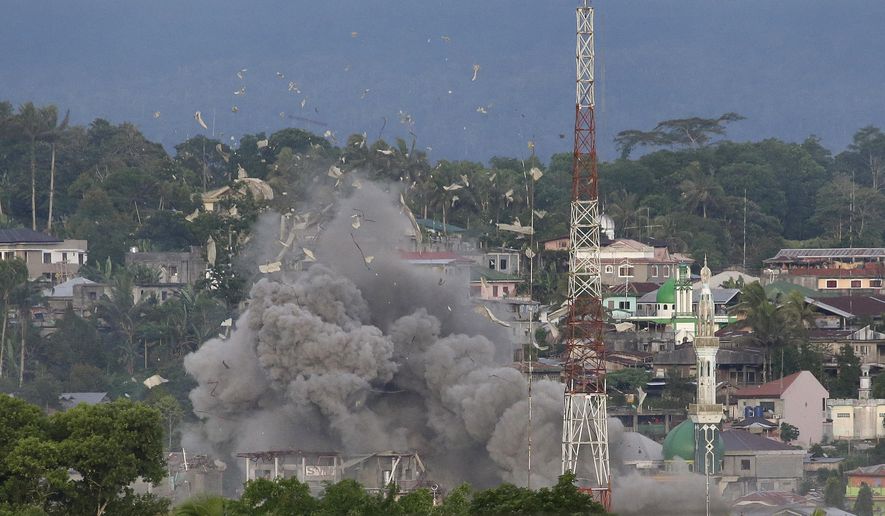
Islamic State claimed over the weekend that its Philippine affiliate, known as the Maute group, killed 50 troops as government forces launched a massive offensive to drive militants out of Marawi. (Associated Press/File)
A Southeast Asian faction of the Islamic State is putting up an unexpectedly tough fight in the face of unrelenting military pressure from U.S.-backed counterterrorism forces in the Philippines, three months after the extremists stunned the region by seizing control of a major city in the southern part of the country.
Philippine military officials said this week that the five dozen or so militants still holding out in Marawi have begun putting out “feelers” on ending their resistance, but the terrorist group’s ability to hold out so long is reigniting concerns that the Islamic State will look to the Pacific to re-establish its self-proclaimed caliphate as it is pushed out of its strongholds in the Middle East.
Islamic State claimed over the weekend that its Philippine affiliate, known as the Maute group, killed 50 troops as government forces launched a massive offensive to drive militants out of Marawi. It was some of the heaviest fighting since the group took control of the city, 64 miles south of the provincial capital of Cagayan de Oro.
The enemy force is decreasing day by day and ending the crisis is only a matter of time, Brig. Gen. Rolando Bautista, commander of the troops in Marawi, told reporters this week.
Although the fighting may be winding down, the ferocity and duration of resistance put up by Islamic State forces trying to hold this city of 200,000 people have led analysts to consider that the terrorist group may be stronger than previously thought in the region.
“Notwithstanding the Philippine military’s widely anticipated Pyrrhic victory over the ISIS-inspired militants, darker clouds [can] be seen on the horizon,” Mark Davis Madarang Pablo, an analyst at the Philippines-based Albert del Rosario Institute, wrote Wednesday in The Diplomat. The analyst noted that the government lists 20 active terrorist cells allied to the Islamist force leading the Marawi resistance.
http://www.washingtontimes.com/news/2017/sep/13/isis-affiliate-maute-a-tough-foe-for-philippines-u/
Islamic State claimed over the weekend that its Philippine affiliate, known as the Maute group, killed 50 troops as government forces launched a massive offensive to drive militants out of Marawi. (Associated Press/File)
A Southeast Asian faction of the Islamic State is putting up an unexpectedly tough fight in the face of unrelenting military pressure from U.S.-backed counterterrorism forces in the Philippines, three months after the extremists stunned the region by seizing control of a major city in the southern part of the country.
Philippine military officials said this week that the five dozen or so militants still holding out in Marawi have begun putting out “feelers” on ending their resistance, but the terrorist group’s ability to hold out so long is reigniting concerns that the Islamic State will look to the Pacific to re-establish its self-proclaimed caliphate as it is pushed out of its strongholds in the Middle East.
Islamic State claimed over the weekend that its Philippine affiliate, known as the Maute group, killed 50 troops as government forces launched a massive offensive to drive militants out of Marawi. It was some of the heaviest fighting since the group took control of the city, 64 miles south of the provincial capital of Cagayan de Oro.
Although the fighting may be winding down, the ferocity and duration of resistance put up by Islamic State forces trying to hold this city of 200,000 people have led analysts to consider that the terrorist group may be stronger than previously thought in the region.
“Notwithstanding the Philippine military’s widely anticipated Pyrrhic victory over the ISIS-inspired militants, darker clouds [can] be seen on the horizon,” Mark Davis Madarang Pablo, an analyst at the Philippines-based Albert del Rosario Institute, wrote Wednesday in The Diplomat. The analyst noted that the government lists 20 active terrorist cells allied to the Islamist force leading the Marawi resistance.
http://www.washingtontimes.com/news/2017/sep/13/isis-affiliate-maute-a-tough-foe-for-philippines-u/
Subscribe to:
Posts (Atom)