Saturday, July 22, 2017

Winning the war with IS in the Philippines, but losing the peace

From The Economist (Jul 20): Winning the war with IS in the Philippines, but losing the peace
 
The army is close to recapturing a militant-infested provincial capital
 

THE Philippine army has been fighting for two full months to take back control of the southern city of Marawi from a violent and determined coalition of jihadist groups. The battle for Marawi, a mainly Muslim city of 200,000 with a lush lakeside setting and a proud sense of its culture, erupted when the government got word that Isnilon Hapilon was hiding there. Mr Hapilon, a leader of a notorious kidnap-for-ransom gang, Abu Sayyaf, pledged allegiance to Islamic State (IS) three years ago. In return, IS declared him the “emir” of the Philippine province of its caliphate. When the armed forces went to arrest him, up to 700 fighters emerged out of nowhere and, in the name of IS, seized the city. Ominously, foreign fighters and even veterans of Mosul are thought to be involved, including militants from Chechnya, Indonesia, Malaysia and Saudi Arabia.

The army has fought back hard, claiming to have killed 411 combatants. Its spokesman, Brigadier-General Restituto Padilla, now talks of “mopping up”, with the remaining insurgents penned into an area of a square kilometre, encompassing the commercial district. But the militants do not scruple to use human shields—dozens of civilians have already died, and 300 are thought still to be trapped. That limits the army’s room for manoeuvre.

The army, too, has taken losses: nearly 100 soldiers killed and over 850 wounded out of a force of about 3,000. In Marawi this week it was clear the battle was far from over, with new units arriving in the city and helicopter gunships flying in for an afternoon attack, the thump of their rotors briefly drowning out the rattle of machineguns and the snap of sniper fire.

The outcome is not in doubt. But President Rodrigo Duterte’s recent predictions of a swift victory were far from the mark. Meanwhile, evacuees languish in their tens of thousands in dirty camps. A growing number realise they have no home to return to—much of the city has been flattened.

The Philippines has had its share of conflict, particularly in Mindanao, a poor and restive southern island that is home to most Filipino Muslims. But this is the heaviest urban fighting since the second world war. Marawi came as a shock. Whenever one or other of a welter of bandit groups declared an IS affiliation, the authorities had tended to dismiss it as boastful self-branding.
 
The Maute group is a case in point. It is based in Lanao del Sur, the province of which Marawi is the capital. Even after it pledged allegiance to IS in 2015, many mistook it for a low-grade family mafia, with links to Marawi’s former mayor, Solitario Ali, whom Mr Duterte has denounced as a drug lord.

Yet both Omar Maute (said by the army to be dead) and his brother, Abdullah, had studied in the Middle East. They had links with jihadists in Indonesia. At home, they even recruited from among faculty and students at Mindanao State University in Marawi. The Maute group put up over half the fighters who seized Marawi, all the while advertising its role on social media. All this suggests unusual sophistication and strength.
 
Mr Hapilon is now thought to be injured and sheltering in Marawi’s biggest mosque (which the army is reluctant to attack, fearing a propaganda disaster). Abdullah Maute still seems to be in Marawi too, while his parents have been caught trying to escape. Some hope this will prove to be the end of the Maute gang and of Mr Hapilon.
 
Perhaps. But their propaganda is already painting the city’s destruction as the army’s fault. The dead jihadists leave behind orphans to be fed a diet of revenge. The pestilent, overcrowded prisons of the Philippines and Indonesia will continue as prime recruiting grounds for extremism. Meanwhile, that the Mautes, Abu Sayyaf and two smaller groups were able together to seize a medium-sized city shows how IS ideology can unite disparate groups to devastating effect. That IS is nearing its end in the Middle East should not be misconstrued. The wilds of Mindanao offer a destination for retreating jihadists. For young South-East Asian extremists, says Sidney Jones of the Institute for Policy Analysis of Conflict in Jakarta, Marawi “has put the Philippines on the map”.
 
Mindanao’s the time

And so Mr Duterte will not lack reasons to extend the 60-day imposition of martial law in Mindanao that is about to expire. He suggests keeping it till the end of the year, but some allies argue for five years, till the end of his term. More will become clear in his annual state of the nation address on July 24th. The army says martial law makes it easier to conduct house-to-house searches and seize weapons. It insists it has no wish to govern—suspects are handed over to civilian courts. But opposition politicians and civil-society groups say martial law undermines accountability in a region desperately short of it—and raises questions about the long-term intentions of Mr Duterte, an avowed authoritarian.

Martial law will surely complicate the broader “peace process” in Mindanao. In 1996 the government struck a deal with Muslim separatists to create an autonomous region in the Muslim-majority areas of the island; it broke down five years later. In 2014 a similar deal was struck with the Moro Islamic Liberation Front (MILF), the region’s main insurgent group. As a measure of its commitment to peace, the MILF has been working to get humanitarian supplies to Marawi’s residents and to broker the release of civilians still stuck in the battle zone.

Mr Duterte supports autonomy, but has muddied the process with vague proposals on federalism. Meanwhile, the MILF’s inability to head off the fighting in Marawi, even though many of its members have relatives in the Maute group, has undermined its authority. Some of the MILF’s younger members are said to be disaffected with its ageing leadership. When the battle for Marawi ends, the war for hearts and minds begins.
 
[This article appeared in the Asia section of the print edition under the headline "Mosul in Mindanao"]

https://www.economist.com/news/asia/21725287-army-close-recapturing-militant-infested-provincial-capital-winning-war

Abu Sayyaf member dead, soldier wounded in Sulu clash

From the Sun Star-Zamboanga (Jul 20): Abu Sayyaf member dead, soldier wounded in Sulu clash

AN ABU Sayyaf Group (ASG) member was killed while a soldier was wounded in a clash in the province of Sulu, the military said on Thursday, July 20.

The Joint Task Force Sulu (JTFS) said the clash occurred around 6:50 a.m., Thursday, at Sitio Kabbon Latih in the village of Latih, Patikul town.

The JTFS said the troops were on focused military operations when they clashed with a group of bandits.

The bandits who figured in the clash were followers of Abu Sayyaf sub-leaders Jamiri Jaong Jawhari alias Amah Bers, Basaron Arok, and Amah Ollah.

The bandits fled to different directions.

The troops recovered the remains of a slain Abu Sayyaf bandit and three high-powered firearms at the clash site.

The JTFS withheld the identity of the wounded soldier except in saying he belongs to the Army’s 21st Infantry Battalion.

The task force said the focused military operations continue in a bid to rescue the hostages in the island province of Sulu.

The Abu Sayyaf bandits are still holding captives 24 hostages, including 16 foreigners.
 

2 missing after Abu Sayyaf rebels torch Basilan sawmill

From the Philippine Daily Inquirer (Jul 21): 2 missing after Abu Sayyaf rebels torch Basilan sawmill
Two persons went missing when Abu Sayyaf gunmen stormed a sawmill in Maluso, Basilan on Thursday, authorities said Friday.

Maluso Mayor Hanie Bud told the Inquirer that Dodong Divinagracia, 50; and his son, Ily, 25, were manning the sawmill when Abu Sayyaf gunmen came and set the place on fire.

“We are waiting for updates as the military and barangay (village) officials concerned are still in the area,” Bud said.

Supt. Nickson Muksan, the Basilan police chief, said a civilian had reported that the gunmen included Abu Sayyaf members Pasil Bayali and a certain Otoh Dobol and that the Divinagracias were taken as hostages.

http://newsinfo.inquirer.net/915831/2-missing-after-abu-sayyaf-rebels-torch-basilan-sawmill

Army foils BIFF attacks in Maguindanao towns

From the Manila Times (Jul 20): Army foils BIFF attacks in Maguindanao towns

Government forces on Wednesday night aborted simultaneous planned attacks of the Bangsamoro Islamic Freedom Fighters (BIFF) in Maguindanao towns, officials said.

Captain Arvin Encinas, spokesman forthe Army’s 6th Infantry Division, confirmed to The Manila Times that the BIFF planned to carry out attacks in Datu Salibo and Sharief Aguak towns on Wednesday evening at about 9 p.m.

The plan, however, was repelled after residents and local government units tipped off authorities about the BIFF plot.

“We already received information from local communities that the BIFF was planning simultaneous attacks… We were able to repel it,” Encinas said.

No one was hurt in ensuing clashes that lasted 10 minutes.

Encinas described the Wednesday evening incidents as “encounters” because “the troops were able to fire first before the attackers,” denying reports from the terrorist Islamic State (IS) that the government troops were ambushed.

IS supporters, in a Telegram channel on Thursday morning, claimed responsibility for the attack.

“Soldiers of the Cross were ambushed by the fighters of the Islamic State in Sharif Aguak and Datu Salibo, Maguindanao around 9 p.m. yesterday [Wednesday] evening,” the militants said through Amaq News Agency, a propaganda arm of the IS.

http://www.manilatimes.net/army-foils-biff-attacks-maguindanao-towns/339561/

NPA claims death of Revolutionary Proletarian Army commander

From the Sun Star-Bacolod (Jul 20): NPA claims death of Revolutionary Proletarian Army commander 
THE New People’s Army (NPA) under the Roselyn Pelle Command (RPC) claimed the death of 35-year-old Charlie Buli-Buli, a commander of Revolutionary Proletarian Army-Alex Boncayao Brigade (RPA-ABB) in Don Salvador Benedicto, Negros Occidental.

RPC spokesperson Ka Cecil Estrella, in a press release dated July 17, said they killed Buli-Buli as they believed that he initiated murder cases and land grabbing activities.

Estrella said Buli-Buli also threatened small farmers and was involved in a gun-for-hire group that protects the alleged illegal logging activities of a politician.

Buli-Buli was also behind the hold-up incident in San Carlos City in 2005, the NPA leader said.

Last July 8, Buli-Buli was shot to death by nine unidentified men at Sitio Agbalasyang, Barangay Bago on the way to his farm, with his 14-year-old nephew.

Buli-Buli died on the spot while his nephew was unharmed.

Police recovered 13 fired bullets of M16 rifle, two cartridges of M203, and a cartridge of .9mm caliber.
 

Reds defy Duterte, kill 7 in another attack

From the Philippine Daily Inquirer (Jul 22): Reds defy Duterte, kill 7 in another attack


 FIGHTING MOOD President Duterte in combat gear during his visit to Marawi City on Thursday. —AFP

Seven people were killed as communist New People’s Army (NPA) rebels staged more attacks in Negros Oriental province on Friday, a day after President Duterte said he had lost interest in peace talks with the communist insurgency.

“I do not want to talk peace,” Mr. Duterte told troops late Thursday when he visited a military camp in Marawi City, about 3 kilometers from where soldiers were battling Maute group rebels.

Automatic gunfire and artillery shelling were heard during his four-hour visit, which was kept secret for security reasons. He distributed watches, supplies and equipment.

“After you finish here, after you decimate the fools there, we will reorient. It’ll be the NPA next,” said the President, who was dressed in a camouflage uniform and combat boots.

“Because they already owe us a lot. I no longer want to talk with them. They killed many of my soldiers and police, even those who just went to the market,” he said.

The rebels responded with the attack in Guihulngan City, killing one civilian and six policemen, including the city’s police chief, Supt. Arnel Arpon.

Also killed were SPO2 Mecasio Tabilon, SPO1 Jesael Ancheta, PO2 Alvin Paul Bulandres, PO2 Alfredo Dunque, SPO2 Chavic Agosto and a still unidentified civilian, police said.

SPO4 Jerome Delara, PO2 Jorie Maribao, PO3 Jordan Balderas and two others were wounded in the ambush at Barangay Magsaysay in Guihulngan.

Arpon and his men were responding to the report of Guihulngan City Councilor Edison Delarita that he was ambushed along with his driver and two others.

NPA plans

Senior Insp. Armilyn Vargas of the Negros Island regional police said Delarita was among four people targeted for liquidation by the NPA.
The NPA was also planning to attack the police station in Guihulngan as well as those in Himamaylan and Kabankalan in adjacent Negros Occidental, Vargas said.

But Col. Eliezer LosaƱes, commander of the 303rd Infantry Brigade pursuing the NPA rebels, said he believed the real NPA targets were the police and their stations.

Maj. Gen. Jon Aying, 3rd Infantry Division commander, said the Guihulngan attack was staged only hours after the 62nd Infantry Battalion battled NPA rebels in Calatrava, Negros Occidental province.

NPA ‘atrocities’

Defense Secretary Delfin Lorenzana described the recent series of attacks by the NPA as “atrocities” staged despite ongoing peace talks.

Lorenzana cited the NPA attacks in Gumaca, Quezon province, where they burned equipment owned by government contractors; the killing of a policeman in Bukidnon; the landmine blasts in Quirino province where six soldiers were hurt; the destruction of plantations in Surigao del Sur; the killing of soldiers buying food in a Palawan market; and the attack on members of the Presidential Security Group (PSG) in North Cotabato.

“We are all for peace. Who doesn’t want peace for our country?” Lorenzana asked.

“[But] we can only talk about peace when both sides mean what they say,” he said. “The treacherous communist-terrorist NPA has once again shown their utter lack of empathy [with] our suffering countrymen.”

While government peace negotiators have tried to show sincerity and integrity during the talks, Lorenzana said the National Democratic Front of the Philippines, the umbrella organization of the communist movement, “reciprocated [with] double talk and treachery.”

Collective decision

Presidential Adviser on the Peace Process Jesus Dureza said the attacks were the main reason the government decided to cancel informal talks set for the weekend in the Netherlands.

“I called up our third party facilitator in Norway. This is the group that supports some of the expenses and I explained we won’t pursue with the back-channel talks in the meantime,” he said.

Dureza said it was the government’s collective decision to postpone the informal talks until “the atmosphere is conducive for the peace talks.”

Dureza said “the incident in Arakan, North Cotabato, has a great impact [because] the PSG doesn’t usually engage the NPAs” and yet they were attacked.

Joma: Digong ‘buang’

Communist Party of the Philippines (CPP) founder Jose Maria Sison, however, said Mr. Duterte’s decision to cancel the informal talks showed the President had “gone mad.”

“It’s really hard to talk with a lunatic who takes pride in extrajudicial killings,” Sison said in an online interview on Friday.

“There can be no peace negotiations if there is no armed struggle and no challenge in combat, especially if the other side is drunk with power and thinks he can just order revolutionaries to surrender,” Sison said.

Esperon: Joma ‘obsessed’

On Thursday, Sison claimed Mr. Duterte was only using the communist insurgency as a pretext to extend and expand martial law because of the President’s “obsession with martial law and mass murder.”

But National Security Adviser Hermogenes Esperon dismissed Sison’s remark and suggested it was Sison who was obsessed with “armed struggle.”

“If you are the leading advocate of federalism which distributes power to the regions, are you obsessed with power and martial law?” Esperon said.

“[President Duterte] even apologized to the people of Marawi and to the people who have been inconvenienced. I think he is obsessed with good governance. He is obsessed with developing Mindanao. He’s obsessed with serving the people,” he said.

“Can we say that of Mr. Joma Sison?” Esperon asked. “Maybe Joma Sison also has an obsession. Is he obsessed with armed struggle? I don’t know. But, of course, there is democratic space for the good professor.”

The President himself seemed piqued by the public bashing he had been getting from Sison, who used to be his professor at the Lyceum of the Philippines.

Hundred year war

“You got that right, 100 percent,” Mr. Duterte said of Sison’s earlier remark that he was bullying people. “I bully people who want to overthrow the government. That is my job.”

“I believe you, Mr. Sison. You are right. We should stop talking because you are wasting our time,” Duterte said in a speech in Davao City hours after the Guihulngan attacks.

“The war that you are talking about has been here the last 50 years. Let’s renew it for another 50 years. Let the Filipino sacrifice, the poor, the lumad. Let them die,” Duterte said.

“Let us renew the fighting for another 50 years. Anyway, all of us will not see the light of day on this revolution of yours,” he said.

Mr. Duterte repeated a claim he made months ago that “Sison is dying. He has trouble in his stomach and the Norwegian government doesn’t want to pay the hospital.”

“He won’t last long, but who will be left behind? You,” he said, addressing Mindanao tribesmen who have joined the communist rebellion.

http://newsinfo.inquirer.net/915956/reds-defy-duterte-kill-7-in-another-attack

IS terrorists guarding P1.4-B loot in Marawi

From the Philippine Daily Inquirer (Jul 22): IS terrorists guarding P1.4-B loot in Marawi


NATIONAL SECURITY ADVISER HERMOGENES ESPERON. INQUIRER PHOTO/JOAN BONDOC

Islamic State (IS)-inspired terrorists holed up in Marawi are guarding around P1.4 billion in cash and jewelry looted from the city, a government official said on Friday.

The official, who asked not to be identified because he was not allowed to speak on the matter, said government security forces learned that the Maute and Abu Sayyaf terrorists in the city were guarding 70 bags of loot, each worth around P20 million.

“They’re not leaving because they have 70 bags from looting [and the loot] is about P20 million per bag,” the official said.

“We have a video of that,” he added.

Hostages forced to loot
Lt. Col. Jo-Ar Herrera, spokesperson for the Army’s 1st Infantry Division and Joint Task Force Marawi, said earlier this month that the terrorists had forced hostages to convert to Islam, take up arms against government forces, serve as sex slaves and loot millions of pesos in cash, firearms, ammunition, gold and jewelry from houses and business establishments in Marawi.

Herrera said at least 10 hostages who had escaped separately from their captors disclosed the looting the terrorists forced them to undertake.

“They believe that the amount of cash and valuable items looted could be worth more [than P500 million], as there were several other groups being forced by terrorists to loot and steal for them,” he said.

The stolen items were stored in a mosque, “received by designated Maute members who were keeping a list for accounting,” he added.

The terrorists, who stormed Marawi on May 23 to establish an enclave for the Middle East-based IS jihadist group in Southeast Asia, are believed to be holding around 100 hostages, including a Catholic priest.

Cornered

Government forces have pushed the terrorists into a box in the city center, where the gunmen have split into small groups and holed up in houses and high-rise buildings, the military said.

National Security Adviser Hermogenes Esperon Jr. said on Friday that the military expected to retake Marawi “in a few more days.”

He said there were around 70 remaining terrorists who controlled around 600 houses and buildings concentrated in three villages in the city center.

Esperon said the military, which had around 7,000 soldiers in the battle zone, was recapturing 40 to 50 houses and buildings a day.

“I would say the area is now constricted to three barangays, it’s about 49 hectares. We used to have the main battle area in 12 barangays. But now, it’s in only three barangays,” Esperon said.

“But this is where we have the built-up area, the center of the poblacion of Marawi. And so, we expect a slower advance. But nonetheless, our troops are determined and they have learned so much from the past experiences,” he added.

Esperon said the terrorists who attacked the city originally numbered more than 660, including 20 foreign fighters.

“Of course, that number has been reduced. We would admit some have escaped. We are not certain of the 70 remaining but that is the estimate of our snipers,” he said.
http://newsinfo.inquirer.net/915973/is-terrorists-guarding-p1-4-b-loot-in-marawi

Via Telegram, Western Union: How ISIS in Syria funded Marawi terrorists

From Rappler (Jul 22): Via Telegram, Western Union: How ISIS in Syria funded Marawi terrorists

A report from the Institute for Policy Analysis of Conflict details how funds are transferred from the Middle East to the Philippines, and how foreign fighters are recruited to join the siege

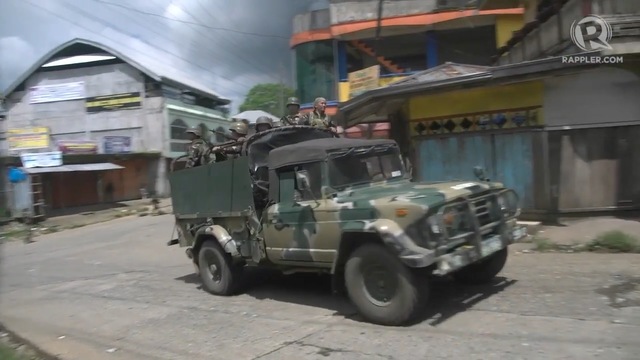
CONFLICT. A Philippine Marines armoured personnel carrier speeds away in Marawi on the southern island of Mindanao on May 30, 2017, as fighting rages on the eighth day. AFP PHOTO / TED ALJIBE

CONFLICT. A Philippine Marines armoured personnel carrier speeds away in Marawi on the southern island of Mindanao on May 30, 2017, as fighting rages on the eighth day. AFP PHOTO / TED ALJIBE

MANILA, Philippines – In January 2017, an Indonesian terrorist named Achmad Supriyanto alias Damar, a member of the extremist group Jamaah Ansharud Daulah (JAD), was contacted by a Malaysian professor named Dr Mahmud Ahmad. Damar had done a short training course in Basilan in Western Mindanao 8 months prior. 
 
Dr. Mahmud asked Damar’s help to get funds from Syria to the Philippines.
 
He then gave Damar, who was based in Banten, Indonesia, an account to contact via messaging app Telegram. The person instructed him to go to East Java in Indonesia, and once there, gave him another person to contact via Telegram.
 
Damar followed instructions. He went to the town told to him via Telegram, where he met a man he did not know. The man gave him an envelope with $10,000 or about P500,000
 
Similar instructions were given to Damar by Dr. Mahmud in February, which resulted in a $25,000 cash release. In March, Damar was asked to contact an operative in Syria directly. The operative, Munawar, gave him instructions via Telegram to pick up $20,000 from another Indonesian town.
Every single time, Dr. Mahmud asked Damar to send the money to different recipients in the Philippines via Western Union.
 
Foreign cash
 
Damar’s account was revealed by Jakarta-based Institute for Policy Analysis of Conflict (IPAC), in a report released on Friday, July 21, titled “Marawi, the ‘East Asia Wilayah’ and Indonesia.” (READ: Marawi inspired, strengthened pro-ISIS fighters in region – report)
 
It's not clear how IPAC got hold of Damar's account of what happened – whether in an interview with him or interrogation reports.
 
Indonesia arrested Damar in March 2017. In May, another man was nabbed, Rohman Septriyanto, who took Damar's place as the cash pick-up point person.

The report said that the arrested Indonesians “explained how the Malaysian arranged for funds to be sent from Syria through Indonesia and then on to the Philippines through Western Union.” The disclosures were made before the May 23 attack on Marawi, IPAC said.
 
The report added that the money transfers from Syria through Indonesia to the Philippines, “were likely used for the preparation of the Marawi attack.”
 
But it also raised the concern of other transfers from Indonesia to other countries that are still unknown.
 
All this indicates that the command structure in Marawi, which refers to itself as the East Asia Wilayah, received funding from ISIS in Syria – although the amount is unclear.
 
“According to the Philippines armed forces commander, ISIS channeled $600,000 through Dr. Mahmud, but he provided no details,” the report said.
 
IPAC also said that Dr. Mahmud was the main facilitator of ISIS funding for Marawi operations to be laundered through Indonesia. His whereabouts remain unknown.
 
On May 23, clashes between the military and local pro-ISIS terrorist groups Abu Sayyaf and the Maute Group, erupted in the capital of Lanao del Sur province. This, after the military moved to hunt down Abu Sayyaf leader Isnilon Hapilon, who had been spotted in the city.

The military said the raid served to foil a terror plan to seize Marawi City. As of July 10, 2017, the fighting, which continues to this day, has claimed the lives of more than 500 people, including soldiers and cops, rebels, and civilians.

The siege prompted Philippine President Rodrigo Duterte to declare martial law in Mindanao, which is supposed to lapse on Saturday, July 22.

But on Saturday, the Senate and the House will hold a special session to tackle Duterte's request to extend martial law in his home region up to December this year.

Local funding
 
Aside from ISIS funds, there were also local funds funneled to Marawi, the report said, citing P80 million or $1.5 million cash and checks found in a Marawi house by soldiers. (READ: Maute Group waves ISIS black flag on Marawi streets)
 
But there’s another source of funding often overlooked, that the report points out: funding from local families.
 
The report said that the youth that were recruited by pro-ISIS fighters in Marawi “were reportedly devout youth from well-off families with the ability to contribute substantially to the cause.”
 
“Pro-ISIS groups also reportedly raised funds through supporters working at Muslim charities and dakwah centres, though not necessarily with knowledge or approval of the organisations involved,” the report added.
 
The report also noted that Duterte "accused the Mautes of raising funds through illegal drug-dealing but without offering evidence."
 
Foreign fighters
 
It was not just funding that pro-ISIS fighters sought from foreign supporters, but fighters as well.
Around early May, calls for Indonesians to come to the Philippines were explicit, according to the report.
 
"If you find it difficult to go to Sham [greater Syria] because of cost and security concerns, why not try the Philippines? Truly, our brothers in the Philippines are awaiting your arrival, why are you so slow in answering their call?" the report quoted one call for support. (READ: ISIS to followers in SE Asia: 'Go to the Philippines')
 
Another one said, "Does it make sense that we have a neighbor being attacked by a swarm of criminals, but we aim for a further neighbor rather than one closer by? We give more importance to the further neighbor and make the closer one lower priority? Brothers, this is not to demean efforts to emigrate to Sham, but to advise those of you who are still in the land of kafir but have not yet set out on your journey: if you find it hard to get to Syria, strengthen the ranks in the Philippines."
 
The report claimed that two main ISIS networks in Indonesia – some from JAD, and others from a smaller group called al-Hawariyun – eventually joined the fighting in Mindanao and sent about 20 fighters to the Marawi front.
 
All foreign fighters wanting to join the fighting in Marawi were also said to have first gone through Dr Mahmud. (READ: Regional intel: ISIS fighters in Mindanao triple PH's estimate)
 
The report warned that once these Marawi veterans return to their home countries, through their links through Dr Mahmud and to Syria, they could “not only train Indonesia’s extremist to a higher level of competence but become the instruments for the implementation of a regional ISIS strategy.”
 
“The risks won’t end when the military declares victory,” said Sidney Jones, IPAC director.
 
“Indonesia and Malaysia will face new threats in the form of returning fighters from Mindanao, and the Philippines will have a host of smaller dispersed cells with the capacity for both violence and indoctrination.”
 

Marawi inspired, strengthened pro-ISIS fighters in region – report

From Rappler (Jul 21): Marawi inspired, strengthened pro-ISIS fighters in region – report

The Institute for Policy Analysis of Conflict says the Marawi conflict has long-term repercussions for extremism in Southeast Asia, including greater cooperation among extremists, and more violent attacks


The Marawi conflict has changed the face of terrorism in the region and will have long-term repercussions for extremism in Southeast Asia.

This is one of the findings of the Jakarta-based Institute for Policy Analysis of Conflict (IPAC), in a report released on Friday, July 21, titled “Marawi, the ‘East Asia Wilayah’ and Indonesia.”

The report said that the success of pro-ISIS fighters in occupying an entire Philippine city for an extended amount of time has inspired violence in other places in the region.

It said this could lead to a higher risk of violent attacks in other Philippine cities and in Indonesia and Malaysia; greater cooperation among Southeast Asian extremists; and new leadership for Indonesian and Malaysian pro-ISIS cells from among returning fighters from Marawi.

“The risks won’t end when the military declares victory. Indonesia and Malaysia will face new threats in the form of returning fighters from Mindanao, and the Philippines will have a host of smaller dispersed cells with the capacity for both violence and indoctrination,” said IPAC director Sidney Jones.

The report also said that Southeast Asian ISIS supporters in Turkey, Syria, and Iraq, may see the Philippines as an attractive alternative as ISIS is pushed back in the Middle East.

“The initial photographs from Marawi released over social media as the ISIS assault began – smiling fighters hold guns aloft on trucks – seemed to have the same impact as the iconic ISIS victory photos from Mosul in 2014. They generated a shared sense of triumph and strengthened the desire of ISIS supporters in the region to join the battle,” the report said.

Marawi, said IPAC, has "defied all expectations of when it would end" and "has lifted the prestige of the Philippine fighters in the eyes of ISIS central," although it has not yet earned them the coveted status of wilayah or province of Islamic State.

"It has inspired young extremists from around the region to want to join. In Indonesia, it has helped unite two feuding streams of the pro-ISIS movement, inspired 'lone wolf' attacks and caused soul-searching among would-be terrorists about why they cannot manage to do anything as spectacular."

The attack of terrorists in Marawi prompted Philippine President Rodrigo Duterte to declare martial law in the entire Mindanao region for 60 days since the clashes started on May 23. He has also asked the Philippine Congress to extend the imposition of martial law to 5 more months, or until the end of the year.

Cooperation crucial

IPAC said that given the increased threat, it is crucial for improved cooperation in the region – and that there is no room for distrust, which inhibits information-sharing. It urged for a better integrated watchlist of terrorist suspects as a quick fix that can be implemented immediately.

Another would be a sort of crash course on the terror groups in the region.

“The cross-regional aspects of the Marawi siege underscore the need for Southeast Asia countries to develop more systematic expertise on each other’s extremist networks, so that Philippine police and military know the difference between JAD and JI, Indonesians know the difference between the Abu Sayyaf kidnappers and the Abu Sayyaf pro-ISIS factions and Malaysians know the differences among the various Darul Islam factions, including the ones that extend into Sabah,” the report said.

“It would be worth thinking about a series of short courses, building on real case studies of cross-border extremism, which would involve officials from all 3 countries but in small classes where useful discussions could take place. One concrete outcome to aim for would be an up-to-date and more detailed mapping of transnational extremist networks, with particular attention to the role of women.”

It also emphasized the need for the Philippine government to take good care of the Marawi evacuees and to help them rebuild the city, to ensure the area will not be a more fertile ground for extremist recruitment.

http://www.rappler.com/world/regions/asia-pacific/176261-marawi-isis-southeast-asia

How pro-ISIS fighters recruited Filipino youth for Marawi siege

From Rappler (Jul 22): How pro-ISIS fighters recruited Filipino youth for Marawi siege

Through messaging app Telegram, and by targeting university campuses in Mindanao, pro-ISIS fighters successfully convince Muslim youth to join their ranks in Marawi and contribute financially to the cause

DESTRUCTION. Smoke rises after aerial bombings by Philippine Air Force planes on Islamist militant positions in Marawi, on June 6, 2017.
AFP PHOTO / NOEL CELIS

DESTRUCTION. Smoke rises after aerial bombings by Philippine Air Force planes on Islamist militant positions in Marawi, on June 6, 2017. AFP PHOTO / NOEL CELIS

The fighting in Marawi continues to rage on two months since it began on May 23, fueled by loyal pro-ISIS followers who are ready to die for their cause.
 
Among those fighting alongside local pro-ISIS terrorist groups Abu Sayyaf and the Maute Group are foreign fighters from the region – an estimated 20 from Indonesia – and local Muslim youth.
 
In a report titled “Marawi, the ‘East Asia Wilayah’ and Indonesia" released by Jakarta-based Institute for Policy Analysis of Conflict on Friday, July 2, IPAC describes how Muslim youth in Mindanao were recruited to engage in fighting. (READ: Marawi inspired, strengthened pro-ISIS fighters in region – report)
 
“Throughout 2016, recruitment in the name of ISIS reportedly took place across university campuses in Mindanao, including through Muslim student associations and their alumni at Catholic institutions as well as at state universities and polytechnic institutes,” the report said, citing an interview with a senior military officer in Cotabato in October 2016.
 
The report said that anger at the “alleged brutality and corruption of Philippine security services was reportedly a common theme.”
 
To recruit the youth, pro-ISIS fighters used social media, and in one posting on Telegram, they tried to appeal to the youth for a state that:
  • Implements Shariah
  • Implements Jizya
  • Implements Hudud
  • Abolishes borders
  • Not participant in UN
  • Not participant in world financial system
  • Fights Israel and world superpowers
  • Frees the prisoners
  • Bans musical instruments
  • Bans adultery
  • Bans drugs and alcohol
  • Enforces good business practices
  • Has a gold standard currency
  • Bans public shirk [idolatry]
  • Destroys idols
  • Levels graves
  • Removes usury banks
  • Destroys nationalism and racism
  • ban smoke confiscated [sic]
It is the same messaging used to recruit their counterparts from other parts of the world.
 
In the Philippines, “many of those recruited were reportedly devout youth from well-off families with the ability to contribute substantially to the cause,” the report said.
 
Once won over, new recruits were asked to take the oath of loyalty and instructed to open a bank account, according to the report. (READ: Via Telegram, Western Union: How ISIS in Syria funded Marawi terrorists)
 
An ATM card would then be given to the treasurer of the local cell, who often holds more than one ATM card at a given time.
 
Social media
 
On Tuesday, May 23, clashes between the military and local pro-ISIS terrorist groups Abu Sayyaf and the Maute Group, erupted in the capital of Lanao del Sur province. This, after the military moved to hunt down Abu Sayyaf leader Isnilon Hapilon, who had been spotted in the city.
 
The military said the raid served to foil a terror plan to seize Marawi City. Ongoing fighting has claimed the lives of military, rebels, and civilians, and prompted Philippine President Rodrigo Duterte to declare martial law in Mindanao.
 
The report added that the ongoing fighting in Marawi continued to inspire others, as they documented their successes on social media, specifically Telegram. (READ: Maute Group waves ISIS black flag on Marawi streets)
 
“As with other ISIS-inspired or directed operations, one of the immediate imperatives of the ISIS coalition was to document and post its triumphal takeover of Marawi on ISIS media,” the report said.
Below is a sample conversation on Telegram when Marawi was first attacked by pro-ISIS fighters.
 
According to the report, the names used on Telegram have been altered but the postings are written as it in the following conversation:
Non-Filipino: Have they taken the city Marawi?
Maute fighter: Assalamualaikum [then in Tagalog:] My brothers/sisters in the Caliphate here in Lanao del Sur, let's unite to raise the flag of tawheed in the Philippines
Non-Filipino: Translation?
Maute fighter: We did taken the city
Non-Filipino: Is that confirmed via Amaaq?
Maute fighter: No not yet. But inshaallah our brother and sister will declare it. […]
Non-Filipino: How big is the city? Like big as the city of Kirkuk?
Maute fighter: Not so big. We burned the school created by the americans.
Non-Filipino: Isnt those old photos from yesterday?
Maute fighter: Update #ISRANAO #PHILIPPINES Assalamualaikum our brothers in the front line are busy fighting the taghut and murtadeen in Marawi City. As of 6am Manila time, 11 taghut soldiers are wounded. 3 of them died.
Pakistani participant: #BREAKING: #Islamic State overruns #Marawi city in #Philippines and raises the #Islamic state flag in the central of the city...
Maute fighter: DAWLATUL ISLAM !!!!!!
Speaker 3: Khilafah troops patrolling on streets of marawi city..philippines!
They continued to update their followers as they moved forward, adding that the Philippine military “ran like pigs with their filthy blood mixed with the dead bodies of their comrades.” A Maute fighter also claimed they were fighting alongside fighters from Brunei, China, Malaysia, Indonesia, and Japan.
Maute fighter: We are now in the heart of the islamic city of Marawi.
Non-Filipino: What happen to the army? They run?
Maute fighter: They run like pigs with their filthy blood mix with the dead bodies of their comrades.
Speaker 3: Alhamdulillah
Non-Filipino: I’m waiting if Amaaq gonna report this
Speaker 3: He will report soon inshallah.
Maute fighter: We occupied the western part of the city. We burned the american established school named Dansalan College midnight around 9pm.
Speaker 4: Alhamdulillah...go on, brothers mujahidin. Allah with you all. Any other asean countries join Philippines Crusaders to fight against IS?
Maute fighter: Yes! china,malaysia,indonesia,japan..
Speaker 4: Brunei?
Non-Filipino: I watch tv, Brunei send as peacekeeper under kuffur PBB [Indonesian abbreviation for the United Nations] banner
Maute fighter: Yes Brunei.
Non-Filipino: Yes I saw last year in the local newspaper Brunei, Sweden, asean countries on mission under PBB in Mindanao...
Speaker 3: Here we go, Hijrah to Philippines
Speaker 4: Door is opening...
Speaker 3: We are coming
Speaker 4: Good idea; all the enemy's look at Iraq and Suria
Eventually, Amaq, ISIS' propaganda news outlet announced that ISIS had attacked Marawi, and since then, a steady stream of reports were posted from and about Marawi. (READ: ISIS to followers in SE Asia: 'Go to the Philippines')
“Through the Telegram groups, Filipino jihadis were creating an international constituency, with their reports from the field translated instantly into English, Tagalog, Arabic, Turkish, German and Indonesian,” the report said.
 
“The outpouring of information and support showed how much the Marawi jihad had infused individual extremists in the region with a new sense of purpose and how much jihadis around the world were reinforcing them with praise and encouragement.”
 
Despite their constant reporting on Telegram though, there were some concerns and warnings from administrators to be careful about revealing sensitive information – since it was impossible to know who the other group participants were for sure.
 

2 ASG men killed in Sulu encounter

From the Manila Times (Jul 21): 2 ASG men killed in Sulu encounter

TWO Abu Sayyaf Group (ASG) members were killed while a soldier was wounded after military troops encountered about 30 fully-armed bandits in Patikul, Sulu on Thursday while on rescue operation for kidnap victims, the commander of Joint Task Force Sulu said on Friday.

In a text message sent to reporters, Brig. Gen. Cirilito Sobejana said the fighting took place at about 6 a.m. on Thursday in Sitio Tubig Kawas, Barangay Bungkaong.

The wounded soldier was not immediately identified except that he belongs to the Philippine Army’s 21st Infantry Battalion.
The task force operatives were out to rescue four construction workers earlier abducted by the terrorist band, including other local and foreign tourists being held by the ASG.

Government security forces recovered only one dead bandit, saying two others were wounded during the firefight.

The task force recovered five firearms from the terrorists including one machine gun, two M16 rifles and two M203 grenade launchers, including several rounds of ammunition.

Sobejana said based on information they received, the members of the ASG were under sub-leaders Jamiri Jaong Jawhari and Basaron Awok.

http://www.manilatimes.net/2-asg-men-killed-sulu-encounter/339704/

2 Abu Sayyaf members killed in Sulu firefight

From ABS-CBN (Jul 21): 2 Abu Sayyaf members killed in Sulu firefight

Two members of terror group Abu Sayyaf were killed while a soldier was wounded in clashes in Patikul, Sulu Thursday.

Abu Sayyaf members Benajir Intag and Bassal Mahalli were killed in a firefight at Barangay Bungkaong, Patikul, at around 6:25 a.m.

Intag’s body was recovered by troops along with 5 high-powered firearms, cellphones and other personal belongings.

Brigadier General Cirilito Sobejana, commander of Joint Task Force Sulu meanwhile said the wounded soldier was already stable.

http://news.abs-cbn.com/news/07/21/17/2-abu-sayyaf-members-killed-in-sulu-firefight

Gov’t troops kill 4, arrest 2 in Western Mindanao

From Business World (Jul 22): Gov’t troops kill 4, arrest 2 in Western Mindanao

GOVERNMENT forces successfully neutralized six enemies and seized eight firearms in Western Mindanao within the past three days, authorities said.

Last Thursday, troops of the 21st Infantry Battalion heavily engaged the Abu Sayyaf bandits while on focused military operations in Barangay Bungkaong, Patikul, Sulu. The encounter resulted in the death of two members of the Abu Sayyaf Group (ASG) named Benajir Intag, whose body was recovered on site, and Bassal Mahalli.

Troops also seized five high-powered firearms, which include one (1) K3 squad automatic weapon, one (1) M16A1 Colt with M203 attached, and one (1) M653 Elisco with M203 attached.

Two cellphones, three solar panels, and 8 backpacks containing assorted food and personal belongings were also found by the troops in the temporary resting area of the ASG members.

“One of our soldiers was wounded and was immediately extricated by the responding troops to be given medical attention,” said Brig. Gen. Cirilito Sobejana, Joint Task Force Sulu commander. “He is now on stable condition and is already recuperating,” he added.

As of this report, 285 ASG members were neutralized in the entire Western Mindanao. Of the total number, 112 were killed, 103 surrendered to troops, and 70 were apprehended.

Meanwhile, last Tuesday, two communist rebels were killed, six were wounded, and another one was arrested by the elements of the 44th Infantry Battalion and the Municipal Police Station following the series of armed engagements in Sindangan, Zamboanga del Norte. They have also recovered ammunition, explosive devices, and subversive documents.

Also on Tuesday, combined forces of the Joint Task Force Central -- 57th Infantry Battalion and 2nd Mechanized Infantry Battalion -- were able to apprehend two lawless elements, during the conduct of a law enforcement support operations in Maguindanao.

Among those apprehended include Menta B. Umpan, a suspected Bangsamoro Islamic Freedom Fighters (BIFF) member and a certain Tolks Lakim, a lawless element at Lower Meta Village, Datu Unsay.

In his report to Western Mindanao Command (WESMINCOM), Brig. Gen. Arnel Dela Vega said that the troops were able to recover 3 high-powered firearms that include one (1) M16 rifle, one (1) M653 and one (1) M16 A1 rifle.

Lt. Gen. Carlito G. Galvez, Jr, commander of WESMINCOM, congratulated the armed forces “for their persistence in going after these threat groups and persons within their respective areas of operation.”

“Truly, our troops are very eager to make sacrifices in order to ensure that the people they serve will have a peaceful community,” Mr. Galvez said, adding, “I enjoin all our soldiers to continue the fight. Surely, our Commander-in-Chief (President Rodrigo R. Duterte) will be with us all the way in this given mission of liberating not just Marawi but the entire country from any form of threat.”

http://www.bworldonline.com/content.php?section=Nation&title=gov&8217t-troops-kill-4-arrest-2-in-western-mindanao&id=148630

ISIS Leaders in Syria Funded Philippine Militants Before Marawi Takeover

From Newsweek (Jul 21): ISIS Leaders in Syria Funded Philippine Militants Before Marawi Takeover

The leadership of the Islamic State militant group (ISIS) in Syria funded militants in the Philippines to the tune of thousands of dollars before their lightning takeover of the southern city of Marawi in May, according to a new report.

Philippine militants with the Maute group and some from the Abu Sayyaf group swept into Marawi, on the southern island of Mindanao, and two months later the battles are ongoing. The clashes have left hundreds of Islamist fighters dead and forced others to flee, but Philippine President Rodrigo Duterte said this week that as many as 220 fighters remain in the city.

The battle for Marawi represents the most significant capture of Asian territory by an ISIS-linked group, and the most notable since ISIS seized the Libyan central coastal city of Sirte in mid-2015.

The report, published Thursday by the Jakarta-based Institute for Policy Analysis of Conflict, details new evidence of extensive contact between a Malaysian militant, Dr. Mahmud Ahmad—one of the leaders of ISIS’s East Asia wilayah, or province—and ISIS central command in Syria over the past year. The purpose of the meetings was to funnel money and fighters in a bid to grab territory from Philippine forces.

Ahmad sent ISIS money through Indonesia and used fighters from the outlawed Indonesian militant group Jamaah Ansharut Daulah (JAD), which the U.S. has designated as an extremist organization. The funding came in payments of tens of thousands of U.S. dollars via Western Union transfers in what amounts to direct support from ISIS.

Isnilon Hapilon, the leader of the Abu Sayyaf militant group—the radical Islamist ally of the Maute group—is leading the battle for Marawi. The Abu Sayyaf group, known for taking hostages to raise funds to boost its aim of creating a de facto Islamic state in the southern Philippines, has pledged allegiance to ISIS and has beheaded several Western nationals, including two Canadian men and a German man, in the last year.

Despite the ISIS support, most of the militants’ money likely came from local donations, and its recruiting was also mostly local, the report found. But the payments demonstrate how ISIS still had the ability to fund its affiliates around the world, even after severe losses in Iraq and Syria.

Marawi

A Filipino soldier lies on a mattress in a combat area as government troops continue their assault against insurgents from the Maute group in Marawi city, Philippines, on July 1. Reuters/Jorge Silva

The report says the funding that allowed for such an emboldened seizure of one of the country’s cities could lead to a greater problem with extremism in Southeast Asia, particularly in the Philippines, Malaysia and Indonesia, where ISIS-inspired attacks or plots have taken place or been dismantled in recent years. The fear now for security services in Asia is that the various Asian militants waging the battle against Philippine forces in Marawi will return home with greater battlefield experience and expertise to wage jihad in their own countries.

“The risks won’t end when the military declares victory,” Sidney Jones, IPAC director, said in the report. “Indonesia and Malaysia will face new threats in the form of returning fighters from Mindanao, and the Philippines will have a host of smaller dispersed cells with the capacity for both violence and indoctrination.”

The report calls for greater cooperation between Malaysia, Indonesia and the Philippines in combating extremism, and says the Philippines should be leading the way in supporting Marawi residents who have been displaced. It also recommends reconstructing the city so that ill feeling among the population does not make the area “even more fertile ground for extremist recruitment.”

The report based its findings on messages on the encrypted messaging platform Telegram, interviews with associates of militants in the Philippines and visits to Mindanao.
http://www.newsweek.com/isis-leaders-syria-funded-philippines-militants-ahead-city-takeover-640096

2 Maute suspects arrested, charged

From the Manila Bulletin (Jul 21): 2 Maute suspects arrested, charged

Two more suspected members of the Maute terrorist group have been arrested and charged with rebellion.

Department of Justice (DOJ) Undersecretary Erickson Balmes identified the two members of the terrorist group as Araji Samindih and Umad Harun.

Balmes indicated the two were “arrested in Tawi Tawi in possession of explosives and were actually involved in the firefights in Marawi.”

He said the two suspected terrorists were taken and subjected to inquest proceedings Thursday afternoon in Cagayan de Oro City.

http://news.mb.com.ph/2017/07/21/2-maute-suspects-arrested-charged/