Thursday, June 29, 2017

MNLF forms anti-kidnap and anti-terror task force

From the Manila Bulletin (Jun 29): MNLF forms anti-kidnap and anti-terror task force

The Moro National Liberation Front (MNLF) has created an Anti-Kidnapping and Anti-Terrorism Task Force composed of well-trained combatants who will help the government go after kidnappers and terrorists operating in Sulu province.

About 1,500 members of the Moro National Liberation Front (MNLF) from all over Mindanao are expected to converge on Saturday, July 1, at the main headquarters of the MNLF in Indanan, Sulu for the formal launching of the task force.

MNLF Central Committee deputy secretary general for military affairs Abuamri Taddik said the front has initially readied one battalion of MNLF combatants for the task force in Sulu but later grew this to four companies of MNLF combatants.

A company of MNLF is composed of about 130 combatants, and a battalion is composed of about 700 MNLF combatants and officers, Taddik explained.

“Initially, we will create four companies of MNLF for the task force and they will be deployed in the troubled towns of Talipao, Parang, Indanan and Patikul in Sulu,” he said.

He said these are the four towns in Sulu known which are known as havens for kidnappers and terrorists, most of them members of the Abu Sayyaf Group (ASG) with links to the Islamic State of Iraq and Syria (ISIS).

He further said the creation of the task force in Sulu is aimed at making Sulu province peaceful and not a dumping ground for kidnapped victims.

Abdul Sahrin, MNLF central committee secretary general said the MNLF decided to form the task force to help the government in its peace building efforts.

“We want to use this battalion of MNLF combatants to help the government neutralize kidnappers and terrorists in Sulu province. Dahil ito ang malaking problema sa komunidad (This is the biggest problem facing our community),” Sahrin said.

“We want to help the Duterte government in its peace effort as we also want to bring back the peace and tranquility of Sulu as experienced by the people in the ’60s,” Sahrin added.

Sahrin also explained that before the MNLF combatants engage the terrorists, they will first talk to them and to their relatives about their activities and will ask them to stop or face the consequences.

“We will exhaust every effort by means of advising them, and if they will insist (on doing) what we do not like them to do, we are going to use our force,” Sahrin said.
 

Member of pro-IS Ansar al Khilafah arrested in General Santos City

From the Philippine Daily Inquirer (Jun 28): Member of pro-IS Ansar al Khilafah arrested in General Santos City

Mindanao police arrested a suspected member of the pro-Islamic State Ansar al Khilafah Philippines (AKP) during an operation in General Santos City on Tuesday.

Senior Supt. Maximo Layugan, the General Santos police chief, said Abdulazis Mangambit alias Ram-ram Tungan was among those included in the Arrest Order No. 2 issued by Defense Secretary Delfin Lorenzana, the Martial Law administrator.

Mangambit, who was arrested in Barangay Calumpang here, was among AKP members involved in grenade attacks in Maasim and Kiamba towns in Sarangani province a few years ago, Layugan said.
Mangambit was still undergoing interrogation, Layugan added.

http://newsinfo.inquirer.net/909479/member-of-pro-is-ansar-al-khilafah-arrested-in-general-santos-city

NPA rebel surrenders

Sun Star-Bacolod (Jun 29): NPA rebel surrenders

AMID the atrocities perpetrated by the New People’s Army (NPA) in Negros Island in recent weeks, one of their comrades surrendered to government troopers on Tuesday, June 27.
 
The Philippine Army refused to disclose though the identity of the surrenderer due to his request and for security reasons.
 
Captain Eduardo Precioso, public information officer of the Army’s 303rd Infantry Brigade based in Murcia town, said Wednesday, June 28, that they are still verifying if the rebel holds a critical position in the NPA and if he has involvement in the atrocities.
 
He said the surrender of the rebel was facilitated by the 3rd Civil Military Operations Battalion of the 3rd Infantry Division based in Jamindan, Capiz.
 
Precioso also said the NPA rebel surrendered his firearm. He added that the surrenderer will be enrolled in the Comprehensive Local Integration Program (Clip) of Negros Occidental for rebels who will abandon the armed struggle and will return to the fold of the law.
 
“Part of the support program offered by the Provincial Government is the P300,000 cash assistance,” he added. Precioso appealed to the other NPA rebels to surrender to the government and avail themselves of the community integration programs.
 
In March this year, Governor Alfredo MaraƱon Jr. said the Provincial Government will give a maximum of P300,000 for every rebel who will surrender to the authorities.
 
The rebel returnee can get as much as P300,000 if he/she will also surrender high-powered firearms. If none, the surrenderer could get P100,000.
 
Clip, a program of the National Government, is a collaborative effort of the Provincial Government and the Philippine Army aimed at providing psycho-social and socio-economic security to former rebels to guide them to become productive members of the society.
 

8,000 rounds of ammo seized in Oro

From the Sun Star-Cagayan de Oro (Jun 29): 8,000 rounds of ammo seized in Oro

AUTHORITIES has seized some 8,000 rounds of high-powered ammunition at a garage of a cargo forwarding office in Barangay Camaman-an, Cagayan de Oro City.

Police said the ammunition, placed inside the eight boxes consisting 6,000 pieces of 5.56mm for M16 rifle and 2,000 others of 30 caliber, were confiscated last Friday, June 23.

Chief Inspector Ariel Philip Pontillas, head of the city intelligence unit (CIU) of Cocpo, said the items arrived in the city last April, a month before the Marawi siege.

Pontillas said based on the information from the intelligence community, the ammunition were supposed to be delivered to Marawi City.

  Pontillas said the items were not declared in the transaction details. "Naka declare sa details is mga electric wires. Itong mga bala wala na declare sa documents. Wala pud consignee kung kinsa magkuha," Pontillas said.

"During sa operation, naay nakita nga karton in plain view nga partly open unya ang atong K9 sniffing dog milingkod indicating nga naay presence sa nitrate," Pontillas added.

Pontillas declined to identify the forwarder but said the transactions and how it came to the company would still be investigated.

"Ang information nato nga naay mga bala nga dugay na nga naka-stock sa usa ka cargo forwarder sa CDO and sa information nga niabot sa ato it will be brought to Marawi City. We don't know aha gamiton," Pontillas said.

Pontillas said the officials of the cargo forwarder have been coordinating with the investigation whom the former said were also alarmed of the unclaimed items.

The CIU operatives have tried to locate the suspected person who would claim the ammunition but the latter was found to have surrendered to the Martial Law Special Action Group (MLSAG) on Monday, June 27.

"Nag conduct tayo ng hot pursuit and we are trying to locate the suspected person nga modawat pero it turned out nga na-identify na nato pero nag surrender na siya sa MLSAG," Pontillas said.

Pontillas withheld the identity of the person who claimed to be a taxi driver in the city and was supposed to be the 'middle man' ordered by a supposed 'Muslim' man to pick up the items.

"Basin nahadlok `tong person of interest busa nag-surrender kung baga blind daw siya kay gisugo ra daw siya didto unya ipa-pick up sa iya sa usa ka Muslim," Pontillas said.

"He is using fictitious name pero nakuha namo real name niya. Nag case build up tayo for possible filing of the case," Pontillas added.

Authorities are looking at the possible criminal liabilities and the charges to be filed against the supposed middle man including the cargo forwarder.

The seized ammunition are now in Cocpo’s custody. Pontillas also said they would also look whether the ammunition came from the Philippine Arsenal or elsewhere.

"We are still looking on that kay nakita nato armscor man," Pontillas said.

 http://www.sunstar.com.ph/cagayan-de-oro/local-news/2017/06/29/8000-rounds-ammo-seized-oro-550129

Centcom chief criticizes NPA attacks amid Marawi crisis

From the Sun Star-Cebu (Jun 28): Centcom chief criticizes NPA attacks amid Marawi crisis


LIEUTENANT General Oscar Lactao, chief of the Armed Forces of the Philippines' Central Command. (Screenshot from the video interview by Kevin A. Lagunda)
 
LIEUTENANT General Oscar Lactao, chief of the Armed Forces of the Philippines' Central Command (Centcom), said communist rebels are bringing more trouble amid the crisis in Marawi City.
 
Instead of helping the people affected by the crisis, Lactao said the New People's Army (NPA), Communist Party of the Philippines (CPP) and National Democratic Front (NDF) brought more trouble by launching attacks in other parts of the country.
 
"Napansin ko itong NPA, CPP and NDF instead na makipagtulungan sa ating kababayan, nagdadagdag pa sila ng gulo (What I noticed with NPA, CPP and NDF is instead of helping our citizens, they are adding more chaos)," Lactao said, citing the attack by suspected NPA members at the police station of Maasin town in Iloilo on June 18.
 
 "If they are really sincere that they are for a better Philippines, wag na muna silang manggulo. Tumulong na lang sila (They shouldn't bring trouble. They should help.) It's better if they refrain from doing these things since peace talks are ongoing," the commander added.
 
[Video: LTG Lactao interview]
 
Lactao expressed hope that the ongoing Marawi crisis, which started last May 23, will be over soon.
 
On June 22, two sugarcane planters died in an ambush believed to be perpetrated by the members of the NPA in Barangay Minapasuk, Calatrava, Negros Occidental. The two planters succumbed to gunshot wounds.
 
 "Our leaders said it will be over soon. We can see that the resistance is going down," he said.
 
The death toll in Marawi crisis has reached 387 as of Monday, June 26, 2017, as the troops press against Maute terror group.

Opinion/Analysis: Terrorism is necessarily rooted in religion and is international in character (Part 3)

From the Manila Times (Jun 29): Terrorism is necessarily rooted in religion and is international in character (Part 3) By Margarita “Tingting” Cojuangco

Part 3 of a series

WHILE the Philippines has not been formally declared as a province or wilayat, the Islamic State of Iraq and Syria (IS) has endorsed the Isnilon Hapilon of the Abu Sayyaf Group in Basilan as emir for Southeast Asia. Southeast Asians in Syria have pledged their loyalty to him.

The Philippines is important because as far as the IS leadership is concerned, it is the extension of the international caliphate in-the-making in the region.

The Abu Sayyaf is loyal to IS and the ASG in Basilan respects Hapilon as the declared emir of the IS command, which they call Daulah Islamiyah, or the Moro Islamic State. The term amir (or emir) was first used to refer to Hashim Salamat as head and commander of the MILF in the 1970s.

Hapilon travels to different Philippine destinations, including to the Maute group’s IS-Ranao in Butig, Lanao del Sur, which is under his domain. After Hapilon was named emir for the Philippines by IS general emir Abu Bakr al Baghdadi in April 2016, the Mautes began using the name IS-Ranao to indicate a division of the new as-yet-undeclared province of IS – the BIFF became IS-Maguindanao and Hapilon’s territory was called IS-Basilan.

The Bangsamoro Islamic Freedom Fighters (BIFF) pledged allegiance to IS in 2017. There are reports that most of the sniper rifles used by the Maute group in the siege of Marawi came from the BIFF in Maguindanao.

Omarkhayam Romato Maute studied at Egypt’s al-Azhar University. After graduation in 2009, Omar went to Bekasi, outside Jakarta, to a non-jihadi boarding school, where he taught for a while before returning to Lanao del Sur. He is fluent in Bahasa and Arabic.

His brother, Abdullah, studied in Jordan and is reported to have extensive ties in the Middle East.

The Maute group began the training unit set up by Marwan around 2011 or earlier. By 2012, it had become the Khilafah Islamiyah Movement (KIM). The use of “KIM” as a name is in honor Ustadz Sanusi, the Indonesian from Central Java who reportedly became a mentor to the Maute brothers. Sanusi was based in Lanao for six years until his death in a police operation at the Mindanao State University on November 2, 2012.

The Maute group claimed to have bombed a Cagayan de Oro bistro on July 26,2013, that killed six people, and the Davao market on September 2, 2016, in collaboration with Ansarul Khalifa Philippines (AKP). The bombing was ordered by Hapilon.

The AKP is led by Mohammad Jaafar Maguid Ansarul Khilafah alias Tokboy, based in Sarangani and Sultan Kudarat province with ties in Indonesia and Syria. He joined IS as Abu Sharifa. Tokboy was a member of the MILF’s Special Operations Group (SOG) and the 105th base command under Ameril Umbra Kato. After the collapse of peace talks with the government in 2008, Tokboy left the MILF and started recruiting students from General Santos, Cotabato and Lanao del Norte universities. He and his men were responsible for an attack in August 2008 in Maasim, Sarangani. Tokboy’s important IS connections are Saifullah Ibrahim and Mohammed Reza Kiram.

On February 20, 2016, the military began an 11-day offensive after the Maute fighters attacked the Army’s 51st Infantry Battalion. In the initial attack, two soldiers and six attackers were killed. Among the casualties was an Indonesian identified as Mohammad Muktar. BIFF fighters reportedly supported the Mautes. When it was over, the military claimed to have killed 54 terrorists. Finally in 2017, the Armed Forces of the Philippines launched an attack on the Mautes. The Maute have shown an ability to clash with the police and military. The Institute for Policy Analysis of Conflict (IPAC) suggests that their organization is larger and more organized.

Osama Bin Laden’s 1996 fatawa focused on US interventionism globally; his 1998 fatawa advocated violent response to eliminate US presence and its allies. The World Islamic Front statement of February 2, 1998 which asserted the international character of terrorism and its rootedness in Islamic doctrine were strategic in the intensification of terrorist activities and attacks worldwide.

Consequently, in the Philippines, Afghan veterans like Muklos Yunos of Sawir, Masui, Lanao del Sur, of the MILF Special Operations Group (SOG), worked with the JI for the planning and execution of bombings in Manila on Rizal Day 2000, General Santos City, Davao airport, and Zamboanga City.

Insep Murjaman alias Riduan Isamuddin of West Java, Indonesia, better known by the nom de guerre, Hambali, was an Afghan veteran and former military leader of the Jemaah Islamiyah. A Muslim cleric, Hambali was No. 2 in the JI hierarchy. He arrived in Manila on December 16, 2000, to plan the simultaneous attacks in Metro Manila financed by the MILF through Muklos. He checked out the United States Embassy. As Bin Laden’s lieutenant for Southeast Asia, Hambali was often described as “the Osama bin Laden of Southeast Asia.” As JI chief of operations, he coordinated all terrorist activities in Southeast Asia.

(To be continued)

http://www.manilatimes.net/terrorism-necessarily-rooted-religion-international-character-3/335456/

Opinion/Analysis: Terrorism is necessarily rooted in religion and is international in character (Part 2)

From the Manila Times (Jun 28): Terrorism is necessarily rooted in religion and is international in character (Part 2) By Margarita “Tingting” Cojuangco

Part 2 of a series
IN 1999, Osama bin Laden left Saudi Arabia and settled in Sudan, whose ruler Hassan Al-Turabi shared Bin Laden’s dream of establishing a purist Islamic state. Pressure from the Saudis and the Americans made Sudanese authorities force Bin Laden out of Sudan. Bin Laden relocated to the Afghan city of Jalalabad and declared war against the United States. In 1998, he reunited with Annan el Zwahiri and announced a new coalition “The International Islamic Front for Jihad against Crusaders and Jews.”

Osama bin Laden authored two fatawa (declaration of war) in the late 1990s. The first was published in August 1996 and the second in February 1998. At the time, Bin Laden was not a wanted man in any country except his native Saudi Arabia, and was not yet known as the leader of the international terrorist organization al-Qaida. Therefore, these fatawa received relatively little attention until after the August 1998 bombings of the US embassies in two East African cities, for which bin Laden was indicted. The indictment mentioned the first fatawa, and claims that Khalid al-Fawwaz of Bin Laden’s Advice and Reformation Committee in London, participated in its communication to the press.

Al-Qaida claimed authorship of the bombings of the US embassies in Nairobi, Kenya, and Dar es Salaam, Tanzania, and all of a sudden Bin Laden was propelled to international status. Two hundred twenty-four Americans were killed and 4,000 were wounded. US President Bill Clinton sent 900 FBI operatives to East Africa and a series of manhunts for Bin Laden took place. Twenty terrorists were arrested.

After the bombings of the United States embassies in East Africa in 1998, Osama bin Laden and Abu Zubaida called key allies and asked them to set up alternative training camps, Hasan Hattab in Algeria and Hashim Salamat in the Philippines. Soon after, the Moro Islamic Liberation Front (MILF) set up camps in Maguindanao.

Al-Faruq, a Kuwaiti of Iraqui descent and an Afghan veteran and senior operative of al-Qaida, obtained the help of Indonesian allies. Camp Hodeibia, the first camp for foreigners within the MILF enclave was initially created for the Indonesian Islamic Liberation Front only. The group was later known as Jemaah Islamiyah. He told his Indonesian interrogators he “helped establish Camp Hodeibia in Moroland in 1994 by the order of Abdullah Sungkar.” It was Abdullah Sungkar who met with Osama bin Laden in Afghanistan and offered al-Qaida the loyalty of his Jemaah Islamiyah network.

Ustadz Hashim Salamat, the religious and determined librarian of Maguindanao, founded the MILF. In 1960, he sent Filipino Muslim students to Lahore, Pakistan, and some proceeded to Middle Eastern schools. They banded together, unified by common feelings concerning the “usurpation of their legitimate and inalienable rights to freedom and self-determination by a dominantly Catholic nation”.

In the 1980s, Salamat sent around 600 fighters and Islam converts to join the annual pilgrimage to Mecca, or as overseas contract workers; their ultimate destination was Lahore, Pakistan, where they met and joined madrassas that taught them the concepts of jihad. About 360 were transferred to a military camp in Afghanistan.

In 1982, Hashim Salamat was officially put in charge of selecting the Muslims to join Bin Laden’s recruitment organization “MAK,” meaning Maktab al-Khidamat aka Afghan Services, to raise funds and recruit foreign mujaheddin for Afghanistan. The Institute for Policy Analysis of Conflict (IPAC) shows that Hashim Salamat chose men who had field commander status in1986.

In 1999, Salamat looked for the possibility of organizing training camps for MILF volunteers in Afghanistan in agreement with al-Qaida.

An Afghan war veteran and a mujaheddin, Abdurajak Janjalani, returned from Afghanistan and founded the Abu Sayaf Group (ASG) in 1990. Janjalani had obtained a scholarship from the Saudi Arabian government in 1981 through the help of Mohamad Jamal Khadifa, Bin Laden’s brother-in-law. Janjalani was sent to Ummu I-Qura in Mecca where he studied Islamic jurisprudence for three years.

As an Afghan commander, Abdurajak Janjalani had befriended Abdur Rab Rasul Sayaaf, a religious scholar after whom the Abu Sayyaf was named. It was during this period when Janjalani was influenced by Middle East-Sunni jihadist ideology based on the commitment to the renewal of an ummah (one Islamic family worldwide), by returning to Islam’s fundamentalist roots, deeply ingrained in advocacy of the jihad in defense of the faith and the establishment of Allah’s sovereignty, through the revival of the Caliphate going back to the fourth successor of the Prophet Muhammad, Ali al-Rashidun.

When Janjalani returned home to Basilan in 1990 he renewed his friendship with Wahab Akbar, another Afghan-trained mujaheddin who eventually became governor of Basilan. The alleged misuse of ASG funds by Akbar made them part ways.

Abdurajak Janjalani strengthened the Abu Sayyaf’s relationship with foreign jihadis, particularly members of the Jemaah Islamiyah from Indonesia and its affiliate in Malaysia, Kumpulan Mujahidin Malaysia (KMM). The Malaysian terrorist Marwan was a KMM member. Another Malaysian, Amin Baco, who was also being hunted with Basit Usman and Marwan by the SAF 44 in that tragic operation in Mamasapano in 2015, worked with Philippine IS and ASG under Hapilon. The Abu Sayyaf Group teamed up with militant Muslim converts, the Rajah Solaiman Movement, operating out of Luzon. That alliance produced the deadly Superferry bombing of February 2004 that took 116 lives.

(To be continued)

http://www.manilatimes.net/terrorism-necessarily-rooted-religion-international-character-2/335265/

Opinion/Analysis: Terrorism is necessarily rooted in religion and is international in character (Part 1)

From the Manila Times (Jun 29): Terrorism is necessarily rooted in religion and is international in character (Part 1) By Margarita “Tingting” Cojuangco

[Margarita “Tingting” Cojuangco has had a long and varied career as a politician, government official, civic worker and scholar of Philippine history. She is known for her work among Muslim communities and was involved in the peace talks with the Moro National Liberation Front. She contributed this piece on how Filipino jihadists became involved in the creation of a Islamic State in the Philippines, which will be serialized in succeeding issues of the Manila Times.]

MY visit to the Bureau of Corrections Maximum Security Compound on October 25, 2016, gave me the opportunity to interview three “violent extremist offenders” (VEOs), the politically correct and acceptable term for terrorists, under Philippine law. Pressured by the United States government, the Philippine government approved the Human Security Act, the country’s anti-terrorism law.

Terrorists are labeled VEOs in the Philippines because to be legally called terrorist, one must have: a) committed a violation of the Revised Penal Code; b) caused widespread panic or fear; and 3) asked for ransom or any demand from the government.

Otherwise, “if the accusation is not proven, the government must pay the acquitted person P500,000 a day from the day of detention until released,” which is unfair to the government, making me wonder why Congress approved that law.

There are 700 Muslims that have been detained at the Bilibid for nearly a decade. They were radicalized by Ahmad Faisal alias Zulkifli, alias Donny Ofracio, a Jemaah Islamiyah bomb instructor and cleric. Thus, it would seem that the Bilibid is the safest haven for these VEOs.

Zulkifli, an Indonesian, was a bomb instructor. A Jemaah Islamiyah (JI) member, he enrolled at the famous Pondok Ngruki in Solo, Central Java, founded by Abu Sungkar and Ba’Ashir. In 1996, Zulkifli made bombs at Camp Hudaibiyah, the exclusive Indonesian camp within the territory of the secessionist Moro Islamic Liberation Front (MILF), behind its Camp Abubakar headquarters. He revealed that the “JI presence in Mindanao was primarily an international jihad cooperation in mid-2000 between al-Qaida, the MILF and Jemaah Islamiyah”. When the government declared an all-out war against the MILF in 2000, these Indonesians fought for the MILF, their fellow Muslims.

On the same day of my Bureau of Corrections interview on October 25, 2016, I saw Hector Janjalani, the third brother of Abdurajak Janjalani, the founder of the Abu Sayyaf. I had firstmet Hector at the Basilan State College when he was in second year high school. He told me that Nur Misuari had visited their family in Tabuk, Isabela, Basilan, where they subsisted on the income derived from a small coconut farm. Abdurajak Janjalani, after participating in the Afghanistan war as a mujaheddin, became a preacher. He declined to join Nur Misuari.

Majority of the Philippine jihadists who became involved in the creation of an Islamic State and Caliphate in the Philippines were part of the Southeast Asian jihadists who had fought with their Muslim brothers in Afghanistan against the Soviet invasion.

Four-way alliance

 In 1980, the United States believed that an invasion in Afghanistan could drive out the Soviets from the eastern hemisphere and agreed to a four-way alliance: The United States and China would provide training and strategic intelligence. The Saudis would provide money and recruitment of mujaheddin. The Pakistanis would provide access to their territory and their intelligence service. The war lasted 10 years. Osama bin Laden, the founder of al-Qaida, brought to Afghanistan mujaheddin from the Middle East, to which he included Filipino Muslims. He financed, recruited, transported and trained Sunni Islamic extremists to establish a pan-Islamic Caliphate worldwide.

Until his death, Bin Laden maintained that jihadists should focus primarily on attacking what he termed the far enemies—the United States and its “European crusader allies.” This reminded me of the World War 2 attack on the Americans who made insulting references to the kamikaze pilots. Three hundred fifty kamikaze pilots constituted the first “intelligent” missiles used in warfare no different from the suicide bombers of 9/11 who attacked the Twin Towers of the World Trade Center in Manhattan!

The result of Islamic radical instructions for worldwide Afghan guerillas led to the founding of al-Qaida in 1988 by their mentor-financier, Bin Laden. An interview with Commander Rey Lopez (Philippine Military Academy, 1992) reveals that Bin Laden was recruited by the Central Intelligence Agency (CIA). When America no longer found Bin Laden useful, they dropped him. Bin Laden, feeling forsaken, organized his own militant movement in the US and allied Muslim states. Estimates show that as many as 2,500 fighters received combat training in the Afghan and Pakistani training camps of Bin Laden where radical Islamic, psychological and moral indoctrination, military training and guerilla tactics were taught.

Afghan resistance fighters

Rey Lopez and I discussed that the heroism of Afghan resistance fighters should never be underestimated. They were rock-hard and fanatical. The returning fighters drew these conclusions: Islamic countries were not by nature weak and could win wars, because they defended themselves and Muslim interests in Afghanistan. They could sacrifice fighting with their brother Muslims for an Islamic State against Marxism.

Within a few short, dramatic months Afghanistan was catapulted into the center of the intensified Cold War between the Soviet Union and the US. The Afghan mujaheddin were to become the US-backed, anti-Soviet shock troops. But for the Afghans the Soviet attempt to subdue these Muslims and their time-honored religion and replace Islam with an alien ideology and social system was anathema. The Muslim jihad took on a new momentum as the US, China and Arab states poured in money and arms supplies to the Islamic mujaheddins. Out of this conflict 1.5 million Afghan lives were lost and only ended when Soviet troops withdrew from Afghanistan in 1989. From it would emerge a second generation mujaheddin who called themselves Taliban (or for the students of Islam).

(To be continued)

http://www.manilatimes.net/terrorism-necessarily-rooted-religion-international-character/335058/

Non-Maranao groups complicate Maute, emissary talks – Adiong

From CNN Philippines (Jun 28): Non-Maranao groups complicate Maute, emissary talks – Adiong


Emissaries' attempts to negotiate the release of civilians are hampered by other terror groups "supported by foreign fighters," a crisis management official said Wednesday.

The presence of non-Maranao among the gunmen who have been sowing terror in Marawi City since May 23 are complicating the negotiations, said Provincial Crisis Management Committee spokesperson Zia Alonto Adiong on CNN Philippines' The Source.

"What happened to Marawi is actually an attack made my two groups, the Abu Sayyaf and the Daulah Islamiyah, also supported by foreign fighters," Adiong said. The Maranao are the dominant ethnic group in Lanao del Sur, of which Marawi City is the capital.

"So makikita natin [we see] why Marawi City or some of the emissaries are having difficulty in discussing the possibility of rescuing trapped civilians. It's because there are groups there that are not Maranaos," he added.

The Daulah Islamiyah, or the IS (Islamic State)-Ranao, is the other name claimed by the Maute Group, say experts studying terror groups in Southeast Asia.

Eight emissaries, who are respected Muslim figures from Marawi, spoke to Maute group on Sunday in an effort to free the remaining hostages and trapped civilians. Joint Task Force Marawi spokesperson Lt. Col. Jo-Ar Herrera said that there are still "more or less 100 hostages in ground zero."

There was an "adverse reaction" to the idea of surrender, said Assistant Secretary Dickson Hermoso of the Office of the Presidential Adviser on the Peace Process (OPAPP).

Related: Emissaries, Maute talk reaches deadlock – peace adviser

The ensuing crisis which is now on its sixth week prompted President Rodrigo Duterte to declare martial law in Mindanao. The fighting has since left over 300 dead and more than 240,000 displaced.

The military also estimated that there were 40 foreign fighters from Indonesia, Malaysia, Saudi Arabia and Yemen who joined the Maute, warning that the number could increase. The Bureau of Immigration has since beefed up security around Philippine borders.

Malacanang Palace and the military have since clarified that they did not sanction such talks, saying they do not negotiate with terrorists.

Related: No negotiations with terrorists – Palace on Maute-hostage swap

Adiong said the talks were a civilian effort in partnership with OPAPP and the Moro Islamic Liberation Front.

"I think nagpe-play din doon ang role ng family dynamics – at the same time, essentially yung importance at ang influence doon ng mga elders [Family dynamics plays a role – so does the influence of the elders]," said Adiong of Maranao culture.

"So it's only a matter of tapping the perfect person to do the liaising in order to at least secure [an] agreement or a go signal to allow trapped residents to be rescued," he added.

The Maute's hold of Marawi is down to four barangays.


Tribal differences may have come into play in what the military believes is division among members of the terrorist group as government forces close in on them.

Related: There's divisiveness among Maute group leaders

Joint Task Force Marawi spokesperson Lt. Col. Jo-Ar Herrera also expounded on infighting among terrorists on Monday. He said that Maranaos who were lured with money and who worked with terrorists were now regretting their decisions because they "did not foresee" the extent of the damage.

"The Maute brothers are Maranao. There is a huge clamor among the constituents of Maranao - traditional leaders, religious leaders - convincing these people to get out... to surrender. Because they are not only destroying Marawi City, but they are also destroying the heritage, the culture, and the next generations of Maranao people," said Herrera also on The Source.

"So kung makikita mo doon, ang talagang na-iinvolve doon, they are Maguindanaoan, Tausug, Yakan-they're not from here. So they don't care kung anong mangyari dito sa Marawi City," he added. [Translation: If you look closely, those who are involved (in the Marawi crisis) are Maguindanaoan, Tausug, Yakan – they're not from here. So they don't care what happens to Marawi City.]

The Abu Sayyaf is primarily based in southwestern Mindanao, where the Muslim population is composed of other tribal groups like the Badjao, Tausug, and Yakan.

Even as the talks were not sanctioned by government, Herrera said that they are cooperating with the envoys on details of their negotiation.

"Right now we are still collaborating with them kung ano ba talaga ang napag-usapan [with regard to what they talked about]," said Herrera. "But as I mentioned, our focus here is to continue our job, to conduct combat clearing operations and... neutralize the remaining [members of the] terrorist group."

Abu Sayyaf leader and supposed ISIS-appointed emir for Southeast Asia Isnilon Hapilon was also reported to have escaped Marawi.

Related: Isnilon Hapilon believed to be out of Marawi

But this was denied Wednesday by Armed Forces of the Philippines spokesman Brigadier General Restituto Padilla.

"Hangga't hindi po kami nakakakuha ng katibayan, atin pong sisikapin na kunin itong mga patibay na 'to. Pero kung saka-sakali pong totoo ito na siya po ay wala na diyan, ito po'y nagpapatibay na naduwag na siya (Until we get confirmation, we will continue to verify this. If it is true that he left, it just proves his cowardice)," said Padilla.

Padilla added that if Hapilon, who has a 10 million-peso bounty on his head for his capture, has indeed fled, it reflected the weakening of the Maute gunmen's resolve.

"It was an act of cowardice if he abandoned his fellow terrorists from inside. And showing that he fled from the battle and left many more of his companions inside would not sit well and may be indicative of an infighting that is occurring among them," he added.
http://cnnphilippines.com/news/2017/06/28/asg-foreigners-maute-emissary-talks.html

5 Big Danger Zones To Avoid In The Philippines

From Forbes (Jun 28): 5 Big Danger Zones To Avoid In The Philippines


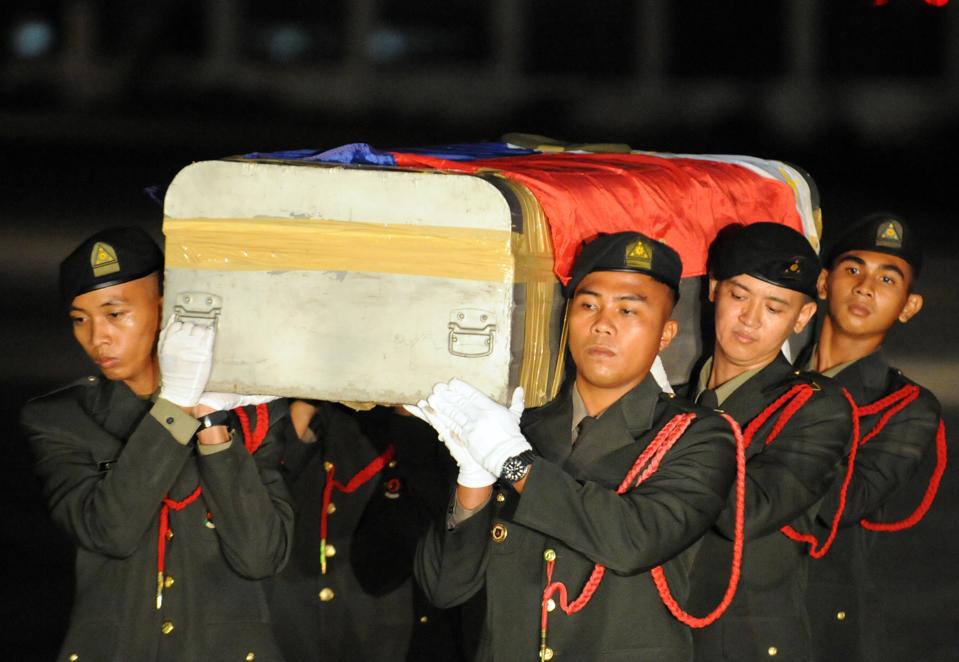
Philippine military personnel carry a coffin bearing one of the 19 soldiers killed in an ambush by Moro Islamic Liberation Front (MILF) rebels on October 19, shortly after arriving at a military base in Manila on October 21, 2011. (TED ALJIBE/AFP/Getty Images)

A Philippine military spokesman said last week the armed forces were gaining a "foothold" after a month-old war in Marawi city. That's in the southland where Muslim militants have been violently agitating for more than 50 years for a measure of autonomy in the majority Catholic nation. But now Philippine President Rodrigo Duterte concedes the fighting might last a while. The four-year-old Maute Group, which has pledged allegiance to the Islamic State and is described locally as a terrorist organization, is still hiding armed militants in the city, government officials suspect.
The country's most dangerous spots, most of which are to be avoided if possible, are: 

1. Marawi: Reports from the front lines explain why to avoid this hilly, lakeside city. Troops that opened fire in this spot on Mindanao island May 23 have killed at least 275 militants. More than 60 troops have also died and most of the city’s 200,000 inhabitants have fled. Much of the city's commercial district is rubble now, leaving few places to live for locals or otherwise. Marawi isn’t the only place where a traveler might get injured or killed. Four other spots in the Philippines could bring the same fate. They are:


MARAWI CITY, PHILIPPINES - JUNE 03: Residents who escaped from the inner city being sieged by militants are transported to safer grounds, on June 3, 2017 in Marawi City, southern Philippines. (Photo by Jes Aznar/Getty Images) 
2. Jolo province: This island in the Sulu Sea berths Abu Sayyaf, a group of Muslim rebels known for kidnapping tourists for ransom. The 400-strong group uses Jolo as a base because local officials and the public cooperate with the kidnappings in exchange for cuts of the ransom, scholars say. Access to the sea allows speedboats to get away fast with victims, says Eduardo Araral, an associate professor at the National University of Singapore’s public policy school. Like a lot of tourists, these two travel writers went with 14 escorts from the Marines when visiting the safest of Jolo’s 19 municipalities.

3. Basilan province: Abu Sayyaf uses this island near Jolo for some of what the government calls “lairs.” In 2001, five hostages including two Americans died in one of the country’s worst Abu Sayyaf incidents. Enough of the group’s followers hang out in Basilan that Philippine President Rodrigo Duterte has directed much of his firepower there, killing two as recently as last month. The provincial seat Isabela is regarded as passably safe but little else is, Philippine travel writers say. A lot of tourists visit the province only with security personnel.


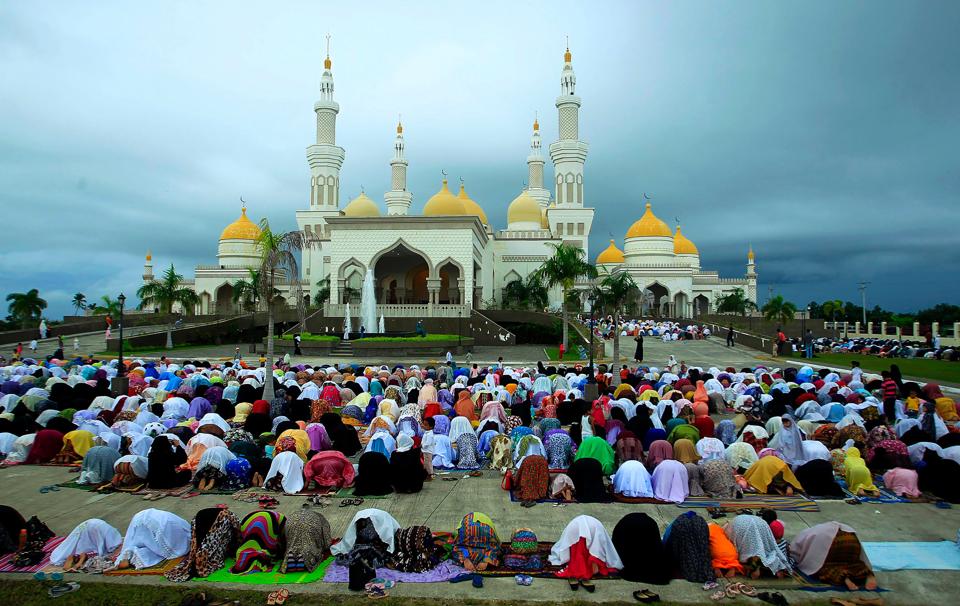
Filipino Muslims participate in morning prayers as they celebrate Eid al-Fitr at the Sultan Hassanal Bolkiah Grand Mosque in the Philippine city of Cotabato (MARK NAVALES/AFP/Getty Images)

4. Cotabato province: This tract of Mindanao, where Muslims have fought for decades to get autonomy and resources, doesn’t constantly generate violence. Its chief rebel group the Moro Islamic Liberation Front signed a peace deal with the government in 2014 and the two sides are working now toward an autonomy-sharing deal. But sometimes things still go wrong. In 2015, 43 commandos died in an unexpected fight with the liberation front. Last week an armed breakaway group called the Bangsamoro Islamic Freedom Fighters laid siege to a community and provoked a gunfight with local guards. A civilian could easily get caught in the crossfire.

5. Metro Manila. Outside western Mindanao and the Sulu Sea provinces, most of the Philippines is relatively safe. But as in lots of countries, parts of the capital Manila and adjacent Quezon City show up on some Asia-wide lists of the most dangerous cities. A lot of the 12.8-million population metro area is safe, too, and crime reports in Quezon City declined from 2014 to 2015. But travelers can still get mixed up in bar fights and kidnappings. The wise caution against exploring dark alleys or flashing valuables.

https://www.forbes.com/sites/ralphjennings/2017/06/28/5-danger-spots-to-avoid-in-the-philippines/#348783a15dcd

‘Abu Sayyaf chief not capable of new attack’

From the Manila Times (Jun 29): ‘Abu Sayyaf chief not capable of new attack’

THE Armed Forces of the Philippines (AFP) assured the public on Wednesday that Abu Sayyaf leader Isnilon Hapilon, the wanted terrorist said to be the chieftain of the Islamic State (IS) in Southeast Asia, was no longer capable of launching terror attacks outside Marawi City.

“We don’t believe that he (Hapilon) still has the capability to launch any hostile attack,” AFP spokesman Brig. Gen. Restituto Padilla Jr. told reporters during the “Mindanao Hour” news briefing in MalacaƱang.

Padilla made the assurance following reports that Hapilon may have escaped from conflict-torn Marawi City, where government troops are locked in battle with Maute group terrorists attempting to establish an IS province.

“There have been significant developments in the past weeks [in Marawi City]. And his capacity to sow terror on the scale we observed in Marawi, he could not do that anymore,” he said.

The military official emphasized that Hapilon’s alleged escape had yet to be “validated,” as it could be disinformation meant to lower the military’s guard.

“It’s an act of cowardice, if he abandoned his fellow terrorists from inside. And showing that he fled from the battle and left many more of his companions inside would not sit well and may be indicative of infighting that is occurring among them,” Padilla said.

The AFP however said it was “safer to assume that the enemies we’re looking for are still there.”

“That is where we’re working at and that is where our focus is, until such time we have sufficient proof to say otherwise,” Padilla said.

“It is important that he be caught dead or alive and it is in the interest of our country [because]he’s been wanted for a long time,” he added.

The Abu Sayyaf leader was indicted in the United States for his alleged involvement in the kidnapping of three Americans in the Philippines in 2001. The US government has placed a $5-million bounty on his head.

Hapilon was the target of government security forces in an entrapment launched on May 23, but the attempt to arrest him was foiled as they engaged in a firefight with Islamist armed men.

Fighting among government troops and extremists in Marawi City forced President Rodrigo Duterte to declare martial rule in Mindanao.

http://www.manilatimes.net/abu-sayyaf-chief-not-capable-new-attack/335470/

Duterte admits: I have cousins who joined Maute group

From the often pro-CPP online publication the Davao Today (Jun 28): Duterte admits: I have cousins who joined Maute group


President Rodrigo Duterte during the 119th anniversary celebration of the Philippine Navy held at the Sasa Wharf in Davao City last May 31, 2017. (Paulo C. Rizal/davaotoday.com)

President Rodrigo Duterte said he has relatives who joined the Maute group who launched an attack in Marawi City a month ago which prompted him to place Mindanao under Martial Law.

During his speech at the dinner hosted in MalacaƱan in celebration of Eid’l Fitr Tuesday night Duterte said a cousin of him even died in the city.

“May mga pinsan ako nandoon sa Maute, aba kala ninyo. Because they were there, a cousin of mine died. Nagpunta sila doon, isang truck (I have cousins there with the Maute. They went there on a truck),” he said.

Duterte said it’s one reason why he is not happy with his declaration of Martial Law.

He also said he does not even talk about the issue even with the members of his Cabinet.

“Kaya I do not even want to talk about it. Maski kami diyan sa Cabinet kasi nasasaktan ako,” Duterte said.

Duterte said if what the local terror groups who attacked Marawi did an uprising similar to the rebellion of the Moro Islamic Liberation Front and the Moro National Liberation Front he would even considered talking with them.

“I can endure a war with you and I can even plead peace with you. I won’t have any problem and I will understand why we are fighting and killing each other,” he said.

However, he said what happened in Marawi is caused by a “fractured ideology”.

“All that they want is to kill and destroy. Paano tayo mabubuhay niyan? (How will we live?)” he said.

Speaking before government officials and Muslim leaders, Duterte vowed to rehabilitate Marawi City.

He said he will look for funding for the “long-term” rehabilitation of the war-torn city.

The government has already allocated P20 billion for the rehabilitation of Marawi.

China has already donated on Tuesday P15 million which will augment the relief and rehabilitation efforts of the social welfare and health departments.

The check was presented to Duterte by Chinese Ambassador Zhao Jianhua.

Duterte is the first Philippine president who hails from Mindanao. He also said his mother has Maranao roots.

http://davaotoday.com/main/politics/duterte-admits-i-have-cousins-who-joined-maute-group/

MILF offers to broker gov't talks with Maute

From ABS-CBN (Jun 28): MILF offers to broker gov't talks with Maute


With its planned Bangsamoro government on the line, the Moro Islamic Liberation Front (MILF) has offered to broker negotiations with the Maute group to end weeks of bloody clashes in Marawi City, its chairman Murad Ebrahim said Wednesday.

At the very least, Murad said the MILF was willing to open communication lines with brothers Omar and Abdullah Maute, who used to be part of his group before they were radicalized abroad.

"Maybe if the President will permit us to talk to them, then we are ready," Murad told ABS-CBN.

"We have declared in principle to the President that we would help him in any way so this situation in Marawi could be resolved as soon as possible."

The MILF, the biggest Muslim rebel organization in the country, made the offer during the Eid al-Fitr celebration hosted by Duterte in MalacaƱang Tuesday night.

Murad said the MILF would not ask anything in return like an assurance that the Bangsamoro Basic Law would be passed soon.

"I think unnecessary," he said. "(The offer) is just to be able to help na mawakasan na itong problema sa (to end the problem in) Marawi because yung suffering ng mga tao ang very concerned kami."

The MILF-led Bangsamoro Transition Commission was supposed to submit to the president Wednesday a new draft BBL, which would create a new Bangsamoro territory in the southern Philippines.

But Duterte opted to wait for Senate President Aquilino "Koko" Pimentel III and House Speaker Pantaleon Alvarez.

Murad said the relationship between the Maute brothers and some MILF officials remained "cordial" even after the siblings left the organization.

The brothers are the first cousins of a wife of the late MILF vice chairman Alim Abdul Aziz Mimbantas, he said.

Murad said the MILF was able to speak with the Mautes again as part of the group that entered the war zone during a humanitarian ceasefire on Sunday.

The Maute group released five hostages but rejected appeals to free Catholic priest Chito Suganob.

The group's plan to establish a "wilayat" (province) in Mindanao under an ISIS caliphate runs counter to the new Bangsamoro territory espoused by the MILF.

http://news.abs-cbn.com/news/06/28/17/milf-offers-to-broker-govt-talks-with-maute

Philippine Military Says 17 Mutilated Civilian Bodies Found in Marawi

From the New York Times (Jun 28): Philippine Military Says 17 Mutilated Civilian Bodies Found in Marawi


Government troops heading into the conflict zone against Abu Sayyaf and Maute militant fighters in Marawi, Philippines, on Wednesday. Credit Jorge Silva/Reuters       

The Philippine military said on Wednesday that troops had found the mutilated bodies of 17 civilians in the besieged southern city of Marawi, where government forces have been struggling to dislodge militants who have entrenched themselves for the last month.

The bodies were recovered Wednesday while troops and police officers conducted clearing operations near Gadungan, a devastated section of the city. The discovery came more than a month after Islamic State-inspired gunmen with the Abu Sayyaf and Maute militant groups overran Marawi, a city of 200,000.

“The recovered cadavers are believed to be among those civilians who were helplessly murdered by the Maute and Abu Sayyaf terrorists,” said Brig. Gen. Rolando Bautista of the Philippine Army. “This is a manifestation of their brutality. They killed these innocent civilians in cold blood.”

The grisly discovery came as government troops were struggling to retake the city from the Islamist militants, whose numbers are believed to have dwindled to between 150 and 200 fighters.

The recovered bodies brought the death toll in more than a month of fighting to 44 civilians, 71 soldiers and police officers and 299 militants, the military said.

The militants are believed to be holding dozens of hostages who officials say are being used as human shields, including a Roman Catholic priest. The military said Tuesday that the gunmen also forced the hostages to convert to Islam and marry some of them for use as sex slaves.

The fighting began on May 23, when the police and the military tried to arrest the leader of an Abu Sayyaf faction, Isnilon Hapilon, said to be the leader of the Philippine branch of the Islamic State.

The attempt was thwarted by fighters from Abu Sayyaf and Maute, backed by militants from elsewhere in Southeast Asia and the Middle East, who then went on a rampage in Marawi, a predominantly Muslim city in the mostly Catholic Philippines.


A truck carrying bodies in Marawi on Wednesday. The Philippine military said that troops had found the mutilated bodies of 17 civilians in the city. Credit Jorge Silva/Reuters

The government has struggled in its efforts to dislodge the enemy fighters, who are believed to be heavily armed and hiding in trenches and bombed-out homes and mosques.

Restituto Padilla, a military spokesman, said Wednesday that the government was observing a “no negotiation policy” amid earlier reports that one of the leaders of the Maute group, Abdullah Maute, was willing to free the priest in exchange for the release of his parents, who were captured earlier.

Mr. Hapilon is believed to be holed up in Marawi, although recent unconfirmed intelligence reports suggest he may have fled the area.

Mr. Padilla said that Mr. Hapilon must be caught “dead or alive.”

“As to the hostages, we’re not negotiating at this point,” he added. “We know the mind-set of these people. We know how they think. So regardless of negotiations or not, they may end up killing them anyway.”

President Rodrigo Duterte on Tuesday night also revealed that he had relatives who had joined the militants in Marawi.

“I have cousins who joined the Maute,” Mr. Duterte said at a dinner in Manila to mark the Muslim holiday of Eid al-Fitr. “Because they were there, a cousin of mine died. They went there, a truckload of them.”
At the dinner, he discussed knowing about how the militants were stockpiling arms and were fortifying positions in Marawi before he decided to declare martial law. The declaration of martial law came shortly after the military attacked the militants, only to be met with fierce resistance.

He said his presidential guards knew about his relatives joining the militants’ cause and asked him about it, to which he said he replied, “They are my cousins. Let them be.”

He said they may have joined the militants “for the sake of adventure.”

https://www.nytimes.com/2017/06/28/world/asia/philippines-marawi-civilians-bodies-isis-duterte.html

Cops raid home of ex-Marawi mayor charged with Mautes, seize more guns

From InterAksyon (Jun 28): Cops raid home of ex-Marawi mayor charged with Mautes, seize more guns


The house of ex-Marawi Mayor Salic in Magsaysay town, Misamis Oriental, which police raided. HANDOUT PRO-10

The Police Regional Office in Northern Mindanao (PRO-10) raided early Wednesday morning the house of former Marawi mayor Fahad ‘Pre’ Salic in Misamis Oriental, who was earlier charged in connection with the Marawi siege, and seized various guns and ammunition, among others.

Police Superintendent Lemuel Gonda, police regional spokesperson, said elements of the Regional Public Safety Battalion (RPSB) and the Martial Law-Special Action Group (ML-SAG) served the search warrant at Salic’s house in Purok 3, barangay Consuelo, in Magsaysay town.

Salic violated Republic Act 10591 or the Comprehensive Law on Firearms and Ammunition, according to Gonda.

Police recovered from the search: 1 MK2 fragmentation grenade, 2 rifle grenades, 1 40mm cartridge, 30 rounds of 5.56mm live ammo, 6 pieces of non-electrical blasting cap, 1 customized electric switch, 1 pilot valve attached to a jack connector, one 9-volt energizer battery, and 2 packs of an undetermined gray powder.

The search was conducted in the presence of Mario Militares and Neil Estoque, both barangay councilmen, a media man, and a certain Angelita Sulla, the house caretaker, according to Gonda.

Earlier, authorities arrested Salic in Misamis Oriental on the basis of a list of personalities to be arrested for the Maute group’s rampage in Marawi. that began May 23. The list was embodied in Department Order No. 2 issued by Defense Secretary Delfin Lorenzana.

Upon Salic’s arrest, the authorities had seized four M203 grenades, an M16 rifle with 29 bullets and three M16 magazines.

Salic last week was charged with rebellion by prosecutors, along with the mother and alleged financier-recruiter of the Maute brothers, Farhana Maute.

Salic was arrested because his name appeared in some documents seized from one of the Mautes’ hideouts captured by the military in Marawi.

http://www.interaksyon.com/cops-raid-home-of-ex-marawi-mayor-charged-with-mautes-seize-more-guns/