From the Philippine News Agency (May 29): Navy arrest 14, seize illegal lumber in Maguindanao
The Philippine Navy has arrested 14 persons for transporting illegally cut lumbers in the coast of Maguindanao Sunday, police reported on Monday.
A navy patrol boat providing sea support to government forces pursuing Islamist in Marawi City intercepted the motorboat off the coast of Matanog, Maguindanao loaded with 93 pieces of cut lumber without pertinent documents.
"The suspects and the forest product were turned over to us by the Navy for proper disposition," said Chief Inspector Erwin Tabora, Parang town police chief. Tabora said the suspects were apprehended between the border of Parang and Matanog towns.
Tabora identified the suspects as Damz Anday 18; Ali Dima 20; Bryan de Ocampo 23; Ato Dima 27; John Camad 27; Sawal Buisan 58 and eight minors, all residents of Lugay-Lugay, Cotabato City.
Tabora said the suspects were on board a motorized banca from Picong, Lanao del Sur en route to Cotabato City when accosted.
Tabora said the forest products will be turned over to Department of Environment and Natural Resources (DENR) in the Autonomous Region in Muslim Mindanao (ARMM).
The Navy was deployed off the coast of Maguindanao and Lanao del Sur to prevent jihadist Maute Group and Abu Sayyaf from fleeing Lanao Sur and Marawi City.
http://www.pna.gov.ph/articles/991709

Sunday, May 28, 2017

Retired Analyst Posts Intermittant for Next Few Days
Our daughter-in-law just gave birth to our second grandchild, a boy. We were at the hospital on Friday/Saturday and the next several days will be spent visiting and helping out with the new arrival. Posts to this blog with be intermittent for the next couple of days.
Best regards,
Retired Analyst
Best regards,
Retired Analyst
Marawi retrieves bodies on streets amid air strikes
From Rappler (May 28): Marawi retrieves bodies on streets amid air strikes
The Lanao del Sur crisis management committee says 2,000 civilians remain trapped in areas controlled by terrorists
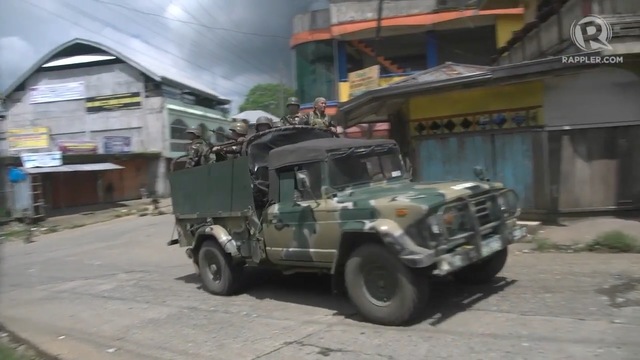
MILITARY OPERATIONS. The Armed Forces of the Philippines continues operations against terrorists in Marawi City, Lanao del Sur.
Cops on Sunday, May 28, entered ground zero of military clashes with local terrorist groups to finally retrieve dead bodies on the streets.
The military earlier said the terrorists have killed 19 civilians in Marawi City, Lanao del Sur.
Among the bodies recovered were those of 3 women and a child, said Al Sayyeed Alonto, who joined the retrieval operations in Barangay Basak Malutlut. (READ: 80% of Marawi evacuated, gov't vows 'maximum power')
It signals the beginning of attempts by Marawi City to get a semblance of normalcy even as clashes continue for the 6th straight day. The fighting erupted last Tuesday, May 23, prompting President Rodrigo Duterte to declare martial law in the entire Mindanao.
There is division of labor, according to the Armed Forces of the Philippines (AFP). The AFP continues operations against the terrorists, police-assisted local government units (LGUs) lead the retrieval of bodies, volunteers rescue families trapped in combat zones, and so on.
"Right now, the LGUs are the ones collecting dead bodies of civilians. Sa amin naka-focus pa rin kami sa (We're still focusing on) military operations pertaining to clearing and security operations," said Lieutenant Colonel Jo-Ar Herrera, military spokesman on the Marawi crisis.
The retrieval operations come after 8 bodies were found in a ditch near a security checkpoint on Sunday morning. It is unclear if these 8 were included in the military's count of civilian deaths.
Trapped civilians
Herrera also said over 200 civilians trapped inside the combat zone have been "rescued" from their homes.
But 2,000 others remain trapped in areas controlled by the terrorists, according to Zia Alonto Adiong, spokesman for the Lanao del Sur crisis management committee.
"They have been sending us text messages, calling our hotline, requesting us to send rescue teams but we cannot simply go to areas which are inaccessible to us," Adiong told Agence France-Presse.
"They want to leave. They are afraid for their safety. Some are running out of food to eat. They fear they will be hit by bullets, by air strikes," he said.
Surgical air strikes
Air strikes had resumed on Sunday afternoon. The attack choppers could be seen from the provincial capitol.
Herrera said they are surgical attacks targeting fortifications of the local terrorist groups.
"We are still using surgical air strikes dahil mayroon pa rin silang mga (because they still have) fortifications. They are occupying buildings. They are using sniper rifles to inflict casualty on government forces," he said.
http://www.rappler.com/nation/171198-marawi-retrieval-dead-bodies-military-air-strikes
The Lanao del Sur crisis management committee says 2,000 civilians remain trapped in areas controlled by terrorists
MILITARY OPERATIONS. The Armed Forces of the Philippines continues operations against terrorists in Marawi City, Lanao del Sur.
Cops on Sunday, May 28, entered ground zero of military clashes with local terrorist groups to finally retrieve dead bodies on the streets.
The military earlier said the terrorists have killed 19 civilians in Marawi City, Lanao del Sur.
Among the bodies recovered were those of 3 women and a child, said Al Sayyeed Alonto, who joined the retrieval operations in Barangay Basak Malutlut. (READ: 80% of Marawi evacuated, gov't vows 'maximum power')
It signals the beginning of attempts by Marawi City to get a semblance of normalcy even as clashes continue for the 6th straight day. The fighting erupted last Tuesday, May 23, prompting President Rodrigo Duterte to declare martial law in the entire Mindanao.
There is division of labor, according to the Armed Forces of the Philippines (AFP). The AFP continues operations against the terrorists, police-assisted local government units (LGUs) lead the retrieval of bodies, volunteers rescue families trapped in combat zones, and so on.
"Right now, the LGUs are the ones collecting dead bodies of civilians. Sa amin naka-focus pa rin kami sa (We're still focusing on) military operations pertaining to clearing and security operations," said Lieutenant Colonel Jo-Ar Herrera, military spokesman on the Marawi crisis.
The retrieval operations come after 8 bodies were found in a ditch near a security checkpoint on Sunday morning. It is unclear if these 8 were included in the military's count of civilian deaths.
Trapped civilians
Herrera also said over 200 civilians trapped inside the combat zone have been "rescued" from their homes.
But 2,000 others remain trapped in areas controlled by the terrorists, according to Zia Alonto Adiong, spokesman for the Lanao del Sur crisis management committee.
"They have been sending us text messages, calling our hotline, requesting us to send rescue teams but we cannot simply go to areas which are inaccessible to us," Adiong told Agence France-Presse.
"They want to leave. They are afraid for their safety. Some are running out of food to eat. They fear they will be hit by bullets, by air strikes," he said.
Surgical air strikes
Air strikes had resumed on Sunday afternoon. The attack choppers could be seen from the provincial capitol.
Herrera said they are surgical attacks targeting fortifications of the local terrorist groups.
"We are still using surgical air strikes dahil mayroon pa rin silang mga (because they still have) fortifications. They are occupying buildings. They are using sniper rifles to inflict casualty on government forces," he said.
http://www.rappler.com/nation/171198-marawi-retrieval-dead-bodies-military-air-strikes
COMMENTARY: Addressing challenges posed by the Abu Sayyaf Group (9): Islamic Framework for Development
From MindaNews (May 28): COMMENTARY: Addressing challenges posed by the Abu Sayyaf Group (9): Islamic Framework for Development
Ninth of 10 parts
28 May 2017
In undertaking any development interventions in the areas impacted by the Abu Sayyaf and its affiliated groups, the writer suggests that consideration be given to formulating these interventions within a faith-based framework. Given the nature of the Islamic faith and the manner in which it permeates all aspects of life of its adherents, it is believed that this approach will endow greater significance and meaning to the interventions being proposed.
The writer is neither a Muslim nor do I have any pretensions to being a scholar of Islam, but I have learned a bit about the Islamic faith from my “brothers” and the people I have dealt with over the years to have developed a deep respect for Islam.

The first thing that impresses one about the Islamic faith is how the faith impacts every aspect of the faithful Muslim’s life. True, in any religion this is supposed to be the case, but one sees it most clearly in the lives of Muslims. I have noted, for example, among my “brothers” the recitation of a silent prayer, “Bismillahir Rahmanir Raheem” (In the name of Allah, the Beneficent, the Merciful), before stepping out of the house in the morning or before any other significant actions during the day, aside from the mandatory prayers throughout the day (Salat). As Askari et al. expressed it,
“There is a command from the Prophet that every activity must begin in the name of Allah, lest it remain incomplete. Profound in its simplicity, this rule is a mechanism of transforming to sacred, as if through an alchemical process, even the most apparently trival and mundane action.” (Hossein Askari, Zamir Iqbal, Nourredine Krichene, Abbas Mirakhor, “Understanding Development in an Islamic Framework”, Islamic Economic Studies, Vol. 22 No. 1, May 2014.)
Because of this writer’s business and development background, one of the aspects of the Islamic faith that I find most impressive is its economic, finance and development philosophy. Again, reminding the reader that the writer is no “expert” on the subject, following are some aspects of this philosophy which are building blocks of the Islamic framework on development:
“The Prophet is constantly reminded in the Qur’an that the crucial aspect of his own mission, and that of the prophets before him, is to establish justice….this means creating a balanced society that avoids extremes of wealth and poverty, a society in which all understand that wealth is a blessing afforded by the Creator for the sole purpose of providing support for the life of all members of society….Islam ordains that what is left after one has reached a modest living standard must be returned to the less able members of society as an act of redeeming their rights….while Islam ordains hard work, the development of the earth and natural resources provided by the Creator, and the use of proceeds for the satisfaction of the needs of all humans, it prohibits the concentration of output in the hands of a few”. (Askari, Iqbal, Krichene and Mirakhor.)
These are but a few of the elements of an Islamic framework for development. They would appear to build a system that addresses many of the ills of today’s economic systems, particularly the ever-present (and widening) gap between the very few wealthy families and the growing masses of the poor, a gap which appears to be impossible to bridge given conventional economic prescriptions. The World Bank and the Islamic Development Bank have noted that the richest 10 per cent of the world’s population holds 86 per cent of the world’s wealth while just 1 per cent of the world’s population owns close to 50 per cent of the world’s wealth. (World Bank Group and Islamic Development Bank, “The Islamic Perspective on Development and Shared Prosperity”, IslamicFinance.com, February 26, 2017, http://www.islamicfinance.com/2017/02/islamic-perspective-development-shared-prosperity/.)
Tawheed, Khalifa, Amanah
The writer is involved with a group that is helping an MNLF community in the Zamboanga Peninsula undertake development projects in its area. One of the first steps taken was to design an orientation program for the community which would adopt an Islamic framework within which to appreciate the development interventions being planned. Prior to the initiation of various livelihood projects, community leaders underwent a seminar which focused on a review of key Islamic principles and their linkage with development activities. These principles consist of:
Yusuf Morales provides another framework for development. Morales essentially uses a matrix which considers, first, the Maqasid al-Shariah or the Objectives of the Shariah and secondly the Hukm Shar’I or the Rules of Divine Law.
The Maqasid al-Shariah are essentially five – the preservation, protection and promotion of:
Furthermore, the Hukm Shar’I enables one to analyze the contents of a particular program. A livelihood project could have certain elements that are haraam, such as the production of tuba or an alcoholic drink from a coconut production project, versus the production of virgin coconut oil or other products from the so-called “Tree of Life”.
An interesting project undertaken some ten years ago, implemented through the assistance of the US Agency for International Development (USAID), was the Philippine Environmental Governance Project (EcoGov) which focused on Islamic principles on environmental preservation and protection. The project was implemented in 130 local government units in Western Mindanao with the objective of helping these LGUs incorporate forest and forestland management, coastal resource management and urban environmental management into their ecological governance programs. The project was structured within an Islamic framework based on the Qur’an, the Sunnah and Hadith. A major output of the project was the production of a handbook entitled “Al Khalifa (The Steward): What Every Muslim Needs to Know about His Role in Environmental Governance”. The handbook laid out the principles of Khalifa or “Man as God’s steward and trustee on earth”, Tawheed or “the Concept of Oneness in Islam”, and Akhira or “the Concept of Accountability”, and discussed how these all applied in promoting environmental governance among Muslims. (A copy of the handbook can be found at pdf.usaid.gov/pdf_docs/pnadl915.doc or could be googled at EcoGov Al-Khalifa.)
Consideration should be given to adopting a faith-based approach to any development or livelihood/poverty-alleviation programs/projects which would be undertaken. This approach could be discussed with village elders and religious leaders to determine if they would agree that it would be useful to adopt and would instill a greater sense of meaning for and responsibility in program/project participants. Moreover, they could design their own framework appropriate to the circumstances obtaining in their particular areas and the types of programs being introduced, under the guidance of their religious leaders.
LAST PART TOMORROW: The Role of Religious Leaders
[Vic M. Taylor, originally from Cebu, has been involved in various peace and development activities in Mindanao, particularly in Basilan-Sulu-Tawi-Tawi (BaSulTa) in the different positions he has held in government and the private sector over the last 50 years.
He started as an instructor at the Notre Dame of Jolo College after his graduation from the Ateneo de Manila University in the late 1960s. Subsequently, he oversaw the Rehabilitation and Development Program for Muslim Mindanao during the early years of martial law under the Office of the President.
Within the last 16 years and upon the request of the families of some kidnap victims, Mr. Taylor assisted these families to help secure the safe release of five victims from the ASG.
Recently, he has been working with a private group that is assisting a community of the Moro National Liberation Front in the Zamboanga peninsula in bringing development projects to their area.
This series is a revised version of a paper written by the author for the Mackenzie Institute, a Canadian security think tank, in light of the execution of two Canadian hostages by the Abu Sayyaf last year]
http://www.mindanews.com/mindaviews/2017/05/commentary-addressing-challenges-posed-by-the-abu-sayyaf-group-9-islamic-framework-for-development/
Ninth of 10 parts
28 May 2017
In undertaking any development interventions in the areas impacted by the Abu Sayyaf and its affiliated groups, the writer suggests that consideration be given to formulating these interventions within a faith-based framework. Given the nature of the Islamic faith and the manner in which it permeates all aspects of life of its adherents, it is believed that this approach will endow greater significance and meaning to the interventions being proposed.
The writer is neither a Muslim nor do I have any pretensions to being a scholar of Islam, but I have learned a bit about the Islamic faith from my “brothers” and the people I have dealt with over the years to have developed a deep respect for Islam.
The first thing that impresses one about the Islamic faith is how the faith impacts every aspect of the faithful Muslim’s life. True, in any religion this is supposed to be the case, but one sees it most clearly in the lives of Muslims. I have noted, for example, among my “brothers” the recitation of a silent prayer, “Bismillahir Rahmanir Raheem” (In the name of Allah, the Beneficent, the Merciful), before stepping out of the house in the morning or before any other significant actions during the day, aside from the mandatory prayers throughout the day (Salat). As Askari et al. expressed it,
“There is a command from the Prophet that every activity must begin in the name of Allah, lest it remain incomplete. Profound in its simplicity, this rule is a mechanism of transforming to sacred, as if through an alchemical process, even the most apparently trival and mundane action.” (Hossein Askari, Zamir Iqbal, Nourredine Krichene, Abbas Mirakhor, “Understanding Development in an Islamic Framework”, Islamic Economic Studies, Vol. 22 No. 1, May 2014.)
Because of this writer’s business and development background, one of the aspects of the Islamic faith that I find most impressive is its economic, finance and development philosophy. Again, reminding the reader that the writer is no “expert” on the subject, following are some aspects of this philosophy which are building blocks of the Islamic framework on development:
- The Oneness of the Creator and of all creation. It is from the Creator that all resources and goodness flows.
- The dignity of man, “the crowning achievement of the creation, for whose individual and collective development everything else has been created”. (Askari, Iqbal, Krichene and Mirakhor.)
- Man as agent-trustee, Khalifa, vicegerent of the Creator, Allah, on earth, given the responsibility to steward the resources on earth for the betterment of all mankind and the glory of the Creator.
- Social justice, as the objective of development under Islam, ensuring that all persons are given the opportunity to achieve the fullness of their capabilities.
- To achieve this, Islam has instituted redistributive mechanisms such as the Zakat, the Sadaqah, and the Waqf, so that those who have more than they need share with those who are unable to meet their basic needs, to enable the latter to grow with dignity and develop the gifts that the Creator has endowed them with.
“The Prophet is constantly reminded in the Qur’an that the crucial aspect of his own mission, and that of the prophets before him, is to establish justice….this means creating a balanced society that avoids extremes of wealth and poverty, a society in which all understand that wealth is a blessing afforded by the Creator for the sole purpose of providing support for the life of all members of society….Islam ordains that what is left after one has reached a modest living standard must be returned to the less able members of society as an act of redeeming their rights….while Islam ordains hard work, the development of the earth and natural resources provided by the Creator, and the use of proceeds for the satisfaction of the needs of all humans, it prohibits the concentration of output in the hands of a few”. (Askari, Iqbal, Krichene and Mirakhor.)
These are but a few of the elements of an Islamic framework for development. They would appear to build a system that addresses many of the ills of today’s economic systems, particularly the ever-present (and widening) gap between the very few wealthy families and the growing masses of the poor, a gap which appears to be impossible to bridge given conventional economic prescriptions. The World Bank and the Islamic Development Bank have noted that the richest 10 per cent of the world’s population holds 86 per cent of the world’s wealth while just 1 per cent of the world’s population owns close to 50 per cent of the world’s wealth. (World Bank Group and Islamic Development Bank, “The Islamic Perspective on Development and Shared Prosperity”, IslamicFinance.com, February 26, 2017, http://www.islamicfinance.com/2017/02/islamic-perspective-development-shared-prosperity/.)
Tawheed, Khalifa, Amanah
The writer is involved with a group that is helping an MNLF community in the Zamboanga Peninsula undertake development projects in its area. One of the first steps taken was to design an orientation program for the community which would adopt an Islamic framework within which to appreciate the development interventions being planned. Prior to the initiation of various livelihood projects, community leaders underwent a seminar which focused on a review of key Islamic principles and their linkage with development activities. These principles consist of:
- Tawheed – the Oneness of Allah and the recognition that everything in the universe flows from Allah;
- Khalifa – Man as the Vicegerent of Allah in this world and the Steward of all resources found herein;
- Amanah – the Trust bestowed by Allah on man as Vicegerent in this world and the responsibilities that emanate from this Trust;
- Islamic principles of leadership and how these would apply to running a development or livelihood project;
- Accountability of each and every person first to Allah and second to his fellow-man for all tasks he/she is responsible for.
Yusuf Morales provides another framework for development. Morales essentially uses a matrix which considers, first, the Maqasid al-Shariah or the Objectives of the Shariah and secondly the Hukm Shar’I or the Rules of Divine Law.
The Maqasid al-Shariah are essentially five – the preservation, protection and promotion of:
- Faith or religion – since after all, our life on this earthly plane is but a journey to our final destination, the afterlife, and our faith is what will guide us there.
- Life – it is through our life on earth that we are able to do good for our fellow-man and give glory and thanks to the Creator. This applies as well to all things that protect and promote our health such as a healthy environment.
- Intellect or mind – it is by developing our mind that we are able to develop our full capabilities as human beings.
- Progeny or offspring – after all we have brought them into this world and it is our responsibility to ensure their growth, welfare and development.
- Property and wealth – needless to say, to be able to live a decent life one needs resources to support both oneself and one’s family.
- Wajib – mandatory, undertaking such an action will be rewarded, failing to do so or violating the rule will result in punishment.
- Sunnah – recommendatory, undertaking the action will be rewarded, failing to do so will not however merit punishment.
- Haraam — prohibited, undertaking the action will be punished, avoiding it will be rewarded.
- Makruh –– detested but not forbidden, undertaking the action is not punished but avoiding it is praised.
- Jaiz or Mubah – neutral, neither reward nor punishment accrues to the person who undertakes this action. (See Yusuf Morales, “A Community Development Paradigm Looking from a Shariah Maqasid Framework and the Millenium Development Goals”, https://papers.ssrn.com/so13/papers.cfm?abstract_id=2686034.)
Furthermore, the Hukm Shar’I enables one to analyze the contents of a particular program. A livelihood project could have certain elements that are haraam, such as the production of tuba or an alcoholic drink from a coconut production project, versus the production of virgin coconut oil or other products from the so-called “Tree of Life”.
An interesting project undertaken some ten years ago, implemented through the assistance of the US Agency for International Development (USAID), was the Philippine Environmental Governance Project (EcoGov) which focused on Islamic principles on environmental preservation and protection. The project was implemented in 130 local government units in Western Mindanao with the objective of helping these LGUs incorporate forest and forestland management, coastal resource management and urban environmental management into their ecological governance programs. The project was structured within an Islamic framework based on the Qur’an, the Sunnah and Hadith. A major output of the project was the production of a handbook entitled “Al Khalifa (The Steward): What Every Muslim Needs to Know about His Role in Environmental Governance”. The handbook laid out the principles of Khalifa or “Man as God’s steward and trustee on earth”, Tawheed or “the Concept of Oneness in Islam”, and Akhira or “the Concept of Accountability”, and discussed how these all applied in promoting environmental governance among Muslims. (A copy of the handbook can be found at pdf.usaid.gov/pdf_docs/pnadl915.doc or could be googled at EcoGov Al-Khalifa.)
Consideration should be given to adopting a faith-based approach to any development or livelihood/poverty-alleviation programs/projects which would be undertaken. This approach could be discussed with village elders and religious leaders to determine if they would agree that it would be useful to adopt and would instill a greater sense of meaning for and responsibility in program/project participants. Moreover, they could design their own framework appropriate to the circumstances obtaining in their particular areas and the types of programs being introduced, under the guidance of their religious leaders.
LAST PART TOMORROW: The Role of Religious Leaders
[Vic M. Taylor, originally from Cebu, has been involved in various peace and development activities in Mindanao, particularly in Basilan-Sulu-Tawi-Tawi (BaSulTa) in the different positions he has held in government and the private sector over the last 50 years.
He started as an instructor at the Notre Dame of Jolo College after his graduation from the Ateneo de Manila University in the late 1960s. Subsequently, he oversaw the Rehabilitation and Development Program for Muslim Mindanao during the early years of martial law under the Office of the President.
Within the last 16 years and upon the request of the families of some kidnap victims, Mr. Taylor assisted these families to help secure the safe release of five victims from the ASG.
Recently, he has been working with a private group that is assisting a community of the Moro National Liberation Front in the Zamboanga peninsula in bringing development projects to their area.
This series is a revised version of a paper written by the author for the Mackenzie Institute, a Canadian security think tank, in light of the execution of two Canadian hostages by the Abu Sayyaf last year]
http://www.mindanews.com/mindaviews/2017/05/commentary-addressing-challenges-posed-by-the-abu-sayyaf-group-9-islamic-framework-for-development/
COMMENTARY: Addressing challenges posed by the Abu Sayyaf Group (8): Community Support
From MindaNews (May 27): COMMENTARY: Addressing challenges posed by the Abu Sayyaf Group (8): Community Support
Eighth of 10 parts
27 May 2017
So far in this series, we have looked at factors which this writer believes should be considered in addressing the situation of violence brought about by the Abu Sayyaf, in particular, and by extension, other militant groups. The last three articles in this series will discuss certain approaches which this writer believes would be helpful to adopt in whatever interventions are planned to be undertaken to address this situation.
Any intervention in society which aims to succeed over the long term must have the support of the community or its targeted beneficiaries. Of course there are programs whose sponsors are interested only in short-term outcomes, such as projects sponsored by politicians shortly before a political contest or election is to take place. In such a case, the sponsors are really not interested what happens to the projects after they have achieved their own objectives, e.g., winning an electoral contest and capturing a political position with all the financial benefits and power that come along with it. But if one is aiming to bring about radical change in society – the kind of change required for an end to violence and the institution of a condition of long-term peace – the support of the members of that society, the acceptance of the goals and the means by which to achieve them, is essential.[1]
This is a principle accepted even by militants. Jason Burke, a British journalist who has written extensively on Islamic extremism, for example, cites the concern expressed in 2005 by the senior leadership of Al Qaeda regarding the brutal methods employed by the “Emir of Al Qaeda for Jihad Organization in the Land of Two Rivers” (or Al Queda in Iraq), Abu Musab al-Zarqawi.[2] Burke recounts how
“Bin Laden’s deputy, al-Zawahiri, and others within the organization repeatedly wrote to the leader of their Iraqi affiliate to remind him of the importance of maintaining good relations with local communities and encourage him, for the moment at least, to put any battle with the Shia on hold. Al-Zawahiri invoked his own experience in Egypt and spoke of how ‘popular support is a decisive factor between victory and defeat [for] in [its] absence, the Islamic mujahed movement would be crushed in the shadows, far from the masses who are distracted or fearful….Others reminded the Jordanian of what happened in the early 1990s in Algeria, where the militant campaign to create an Islamic state had imploded in a welter of indiscriminate violence directed largely at civilians. ‘Their enemy did not defeat them…They destroyed themselves with their own hands by their alienation of the population with their lack of reason…oppression, deviance and ruthlessness,’ wrote Atiyah Abd al-Rahman, a senior Libyan extremist based in Pakistan who had spent time in Algeria.”[3]
It is believed that the Philippine Government accepts this principle as well. However, the way it is implemented by government agencies, in the author’s view, should be carefully considered. To begin with, it is inevitable that government authorities are to a large extent constrained to working through the government bureaucracy and channels, and therefore any “community consultations” or interactions are, more often than not, consultations with local government officials (Governors, Mayors, Barangay Chairmen) or done through them. Unfortunately, there often is the tendency for these elected officials to reflect not necessarily the views of the masses of their constituents but rather – if one has to be brutally frank – views that promote their own political ends and favor their political supporters.
Moreover, there sometimes is the tendency on the part of governmental and political authorities to try and manage the outcomes of any “consultations” undertaken. One often goes into these discussions with preconceived notions of what the situation is and what the outputs should be at the end. There should be a deliberate effort on the part of government functionaries who are tasked to interact with communities to truly listen to what other people have to say and try and see things from the perspective of their constituents.
Furthermore, there also often is the tendency on the part of people in authority to assume that they know what people need and what the solutions are to the problems of society. And because they are in authority and have access to resources, more often than not it is their pre-identified policies, programs and projects which materialize, irrespective of whether they actually address the real needs or not.
What is more – and this applies not just to Philippine governmental authorities but even to donor institutions, whether local or foreign – because of the pressure to show results, to account for funds allocated and to justify requests for new budgetary allocations (often increased from previous years), there is the tendency to “fast-track” project implementation, to show concrete results as quickly as possible, leaving beneficiary communities effectively as passive bystanders and recipients of the largesse of the project sponsors.
The author recalls a project showcased by a Philippine Marines battalion in the municipality of Patikul, one of the main areas of operation of the ASG in Sulu, in 2006. This was a water supply project built by the soldiers for the community, consisting of water tanks and a three-kilometer long pipeline, bringing the water down from the source to service households along the route. It was an impressive project, clearly well-intentioned, well built, clean, technically well planned, but within a year the Marines sounded out an NGO to help them get the community to take care of the project. It had been built for the community, not with the community, and it suffered from neglect by the community and even deliberate efforts to sabotage it.
As recounted in an earlier article in this series, the same thing was experienced by the US Special Operations Forces that were working in Sulu in 2009. We earlier described the lament of Sgt. Justin Richmond of the JSOTF-P regarding the death of two US soldiers, killed as a result of a roadside IED explosion, and why, despite the thousands of dollars poured into projects for the people in the area, no one had bothered to warn them of the impending disaster.
For several years between 2006 and 2010, this writer lived with a family in kilometer 4, Indanan municipality, whenever I visited Sulu. Right beside the house was a US-AID funded deep well and water storage tank which, during the five-year period that I frequented Sulu, was not operational. The community did not know why the system had not been activated but it is probable that that project had been listed as another “accomplishment” of the funding agency.
Every serious community development practitioner knows that a critical phase of any planned social intervention is the “social preparation” phase. This is the initial phase of the intervention when the program facilitators work with the community to try and draw from them their perspectives on their situation and what they believe are the specific interventions needed. It is during this phase that the community, through open dialogue, begins to understand the broader context of their situation, the underlying causes and, if handled properly, begins to realize that much of the power to address their condition lies within their hands. This can lead to very surprising results.
The writer was involved some ten years ago with a group that worked with several communities in the province of Sulu to address the dire situation of potable water supply. At that time, national government data showed that only 27% of the population of the province had access to clean water. However, based on actual surveys undertaken by the project team, it was discovered that of the close to 200 water sources tested for potability, 92% were contaminated with fecal coliform.[4] The project team thus worked very closely with one community to explore with them their appreciation of the water supply situation.
The community shared how they identified and developed their existing water sources. With the help of the project team, they learned how certain daily activities which they took for granted impacted the quality of their water and the health of their family members. They also learned how to make certain devices which would enable them to identify potential sources of water and even how to analyze the quality of their water.
As a result of their interaction with the project team and their newfound knowledge and skills, the community became more confident, open and vocal. Their confidence in their new-found strength spilled over beyond the project and led them to engage with their local chief executive on other matters more openly and directly. It came to a point where the chief executive of the municipality, who had initially enthusiastically encouraged and supported the project, began to feel that his authority was being challenged. In fact at one point he asked the project team leader, “Unu na in nahinang niyo ha raayat ko? Maytah biyahan na sila magbissara kakoh?” (“What have you done to my people? Why are they speaking to me like this now?”)
To gain community support, one must be willing to work with the community on its terms and to help the community discover their strengths. In dealing with the community with openness, one generally will find a greater responsiveness on the part of the community and a willingness to establish a relationship of mutual support, even though there may initially be some hesitation to open up, particularly if the facilitators are not well-known to or trusted by the community. If handled properly, the interaction will eventually develop into a relationship based on mutual respect.
The responses one gets when one deals openly with a community and shows respect for their views are refreshingly frank. In a research undertaken in 2013 as part of the security sector reform program, to determine whether the responsibility for internal security could be transferred from the AFP to the PNP, consultations were held with community leaders in Patikul, generally considered to be the nerve center of the ASG in Sulu.
When asked about the conflict in their area, one of the participants, for example, described a difficulty that they were encountering:
“Under the 9th Marine Battalion, the marines set a perimeter of one kilometer from the highway where local residents from the barangay were allowed to move. Going beyond the boundary means that you will be apprehended or even shot at. The problem was that the Provincial SWD (Social Welfare Department) came only once to distribute food (about three kilos of rice, half kilo sugar, canned goods, noodles, etc.). They never came back. As we were away from our farms, many took the risk to go to their farms to get food. That was why many people were arrested for the violation, because of hunger.”
When asked how conflicts were settled within their community, participants described how they went about this.
“Internal and smaller conflicts are managed and settled by our elders without the intervention of higher authorities. We have our traditional way of addressing conflicts based on our old system of governing our community affairs. Sadly, it is no longer honored by our present set of government leaders.”
“Today, local conflicts are rare, and they are mediated by the elders immediately. Even as we depend on our barangay officials, they would always request the presence of our elders especially on mediation between two warring groups.”
When asked how they viewed their government leaders, several of the participants expressed the following views:
“No one from among our government leaders come to visit our place to address our concerns. If ever they did, they were not effective in resolving the local conflicts.”
“As far as we know, our local government leaders set aside our situation and do not take appropriate action or intervention to resolve the problems.”
When asked whether they felt that the PNP could take over the security concerns of their community, participants expressed the following views:
“The community is not ready for the police to replace the military because even in the town of Jolo, the PNP forces cannot perform their duty well. They can only catch the dead body but never the suspect.”
“Our local policemen are all manipulated by the politicians. We doubt if they can truly manage the peace and order situation.”[5]
These types of responses were elicited because the study team leader, a Tagalog from Manila who nevertheless had many years of experience working in Sulu (and BaSulTa as a whole), wisely chose a facilitator who was respected by the community. The facilitator was a former militant himself who however eventually decided to focus his energies to helping his community and set up a cooperative which has now become quite successful in bringing livelihood to his village-mates. The study team leader did not even appear at the consultations so as not to inhibit the free expression of views by the participants.
This, then, should be a key approach taken by any effort to address the problem of violence and the seeming absence of law and order in the areas where the ASG operate: interacting with the affected communities, exerting efforts to understand the situation from their perspective, and working jointly with them to address the situation. If one demonstrates an openness to the community and a willingness to listen to and act on their views and recommendations, showing true respect for their perspectives, the greater are the chances that they will take the lead to manage their own situation, enhancing the chances that a condition of sustainable peace can be attained.
TOMORROW: Islamic Framework for Development
[Vic M. Taylor, originally from Cebu, has been involved in various peace and development activities in Mindanao, particularly in Basilan-Sulu-Tawi-Tawi (BaSulTa) in the different positions he has held in government and the private sector over the last 50 years.
He started as an instructor at the Notre Dame of Jolo College after his graduation from the Ateneo de Manila University in the late 1960s. Subsequently, he oversaw the Rehabilitation and Development Program for Muslim Mindanao during the early years of martial law under the Office of the President.
Within the last 16 years and upon the request of the families of some kidnap victims, Mr. Taylor assisted these families to help secure the safe release of five victims from the ASG.
Recently, he has been working with a private group that is assisting a community of the Moro National Liberation Front in the Zamboanga peninsula in bringing development projects to their area.
This series is a revised version of a paper written by the author for the Mackenzie Institute, a Canadian security think tank, in light of the execution of two Canadian hostages by the Abu Sayyaf last year]
[1] My former colleague in Jolo, now retired Professor of History Rudy Rodil, has reminded me that as we focus on the immediate community that is the subject of the interventions, there is the larger community of the Philippine Republic that likewise needs to understand what is going on and whose support is equally important.
[2] Joby Warrick, “Maniac who created ISIS: His medieval barbarity was too much even for Al Qaedda. Now a chilling new book charts the rise and fall of the ‘Slaughter Sheikh’”, Mail Online, September 27, 2015, www.dailymail.co.uk/news/article-3250181/Maniac-created-ISIS-medieval-babarity-Al-Qaeda-chilling-new-book-charts-bloody-rise-fall-Slaughter-Sheik.html.
[3] Jason Burke, “The New Threat: The Past, Present and Future of Islamic Militancy”, (New York: The New Press, 2015), pages 67-68.
[4] John Ong et al., “Water for Peace”, (unpublished report on a water project undertaken in the province of Sulu, funded by the Japan International Cooperation Agency and the Assissi Development Foundation Inc,, 2009).
[5] All quotations from study notes provided by the Study Team Leader, Milet Mendoza. The writer thanks Milet for sharing these notes and her valuable insights on grassroots interactions.
http://www.mindanews.com/mindaviews/2017/05/commentary-addressing-challenges-posed-by-the-abu-sayyaf-group-8-community-support/
Eighth of 10 parts
27 May 2017
So far in this series, we have looked at factors which this writer believes should be considered in addressing the situation of violence brought about by the Abu Sayyaf, in particular, and by extension, other militant groups. The last three articles in this series will discuss certain approaches which this writer believes would be helpful to adopt in whatever interventions are planned to be undertaken to address this situation.
Any intervention in society which aims to succeed over the long term must have the support of the community or its targeted beneficiaries. Of course there are programs whose sponsors are interested only in short-term outcomes, such as projects sponsored by politicians shortly before a political contest or election is to take place. In such a case, the sponsors are really not interested what happens to the projects after they have achieved their own objectives, e.g., winning an electoral contest and capturing a political position with all the financial benefits and power that come along with it. But if one is aiming to bring about radical change in society – the kind of change required for an end to violence and the institution of a condition of long-term peace – the support of the members of that society, the acceptance of the goals and the means by which to achieve them, is essential.[1]
This is a principle accepted even by militants. Jason Burke, a British journalist who has written extensively on Islamic extremism, for example, cites the concern expressed in 2005 by the senior leadership of Al Qaeda regarding the brutal methods employed by the “Emir of Al Qaeda for Jihad Organization in the Land of Two Rivers” (or Al Queda in Iraq), Abu Musab al-Zarqawi.[2] Burke recounts how
“Bin Laden’s deputy, al-Zawahiri, and others within the organization repeatedly wrote to the leader of their Iraqi affiliate to remind him of the importance of maintaining good relations with local communities and encourage him, for the moment at least, to put any battle with the Shia on hold. Al-Zawahiri invoked his own experience in Egypt and spoke of how ‘popular support is a decisive factor between victory and defeat [for] in [its] absence, the Islamic mujahed movement would be crushed in the shadows, far from the masses who are distracted or fearful….Others reminded the Jordanian of what happened in the early 1990s in Algeria, where the militant campaign to create an Islamic state had imploded in a welter of indiscriminate violence directed largely at civilians. ‘Their enemy did not defeat them…They destroyed themselves with their own hands by their alienation of the population with their lack of reason…oppression, deviance and ruthlessness,’ wrote Atiyah Abd al-Rahman, a senior Libyan extremist based in Pakistan who had spent time in Algeria.”[3]
It is believed that the Philippine Government accepts this principle as well. However, the way it is implemented by government agencies, in the author’s view, should be carefully considered. To begin with, it is inevitable that government authorities are to a large extent constrained to working through the government bureaucracy and channels, and therefore any “community consultations” or interactions are, more often than not, consultations with local government officials (Governors, Mayors, Barangay Chairmen) or done through them. Unfortunately, there often is the tendency for these elected officials to reflect not necessarily the views of the masses of their constituents but rather – if one has to be brutally frank – views that promote their own political ends and favor their political supporters.
Moreover, there sometimes is the tendency on the part of governmental and political authorities to try and manage the outcomes of any “consultations” undertaken. One often goes into these discussions with preconceived notions of what the situation is and what the outputs should be at the end. There should be a deliberate effort on the part of government functionaries who are tasked to interact with communities to truly listen to what other people have to say and try and see things from the perspective of their constituents.
Furthermore, there also often is the tendency on the part of people in authority to assume that they know what people need and what the solutions are to the problems of society. And because they are in authority and have access to resources, more often than not it is their pre-identified policies, programs and projects which materialize, irrespective of whether they actually address the real needs or not.
What is more – and this applies not just to Philippine governmental authorities but even to donor institutions, whether local or foreign – because of the pressure to show results, to account for funds allocated and to justify requests for new budgetary allocations (often increased from previous years), there is the tendency to “fast-track” project implementation, to show concrete results as quickly as possible, leaving beneficiary communities effectively as passive bystanders and recipients of the largesse of the project sponsors.
The author recalls a project showcased by a Philippine Marines battalion in the municipality of Patikul, one of the main areas of operation of the ASG in Sulu, in 2006. This was a water supply project built by the soldiers for the community, consisting of water tanks and a three-kilometer long pipeline, bringing the water down from the source to service households along the route. It was an impressive project, clearly well-intentioned, well built, clean, technically well planned, but within a year the Marines sounded out an NGO to help them get the community to take care of the project. It had been built for the community, not with the community, and it suffered from neglect by the community and even deliberate efforts to sabotage it.
As recounted in an earlier article in this series, the same thing was experienced by the US Special Operations Forces that were working in Sulu in 2009. We earlier described the lament of Sgt. Justin Richmond of the JSOTF-P regarding the death of two US soldiers, killed as a result of a roadside IED explosion, and why, despite the thousands of dollars poured into projects for the people in the area, no one had bothered to warn them of the impending disaster.
For several years between 2006 and 2010, this writer lived with a family in kilometer 4, Indanan municipality, whenever I visited Sulu. Right beside the house was a US-AID funded deep well and water storage tank which, during the five-year period that I frequented Sulu, was not operational. The community did not know why the system had not been activated but it is probable that that project had been listed as another “accomplishment” of the funding agency.
Every serious community development practitioner knows that a critical phase of any planned social intervention is the “social preparation” phase. This is the initial phase of the intervention when the program facilitators work with the community to try and draw from them their perspectives on their situation and what they believe are the specific interventions needed. It is during this phase that the community, through open dialogue, begins to understand the broader context of their situation, the underlying causes and, if handled properly, begins to realize that much of the power to address their condition lies within their hands. This can lead to very surprising results.
The writer was involved some ten years ago with a group that worked with several communities in the province of Sulu to address the dire situation of potable water supply. At that time, national government data showed that only 27% of the population of the province had access to clean water. However, based on actual surveys undertaken by the project team, it was discovered that of the close to 200 water sources tested for potability, 92% were contaminated with fecal coliform.[4] The project team thus worked very closely with one community to explore with them their appreciation of the water supply situation.
The community shared how they identified and developed their existing water sources. With the help of the project team, they learned how certain daily activities which they took for granted impacted the quality of their water and the health of their family members. They also learned how to make certain devices which would enable them to identify potential sources of water and even how to analyze the quality of their water.
As a result of their interaction with the project team and their newfound knowledge and skills, the community became more confident, open and vocal. Their confidence in their new-found strength spilled over beyond the project and led them to engage with their local chief executive on other matters more openly and directly. It came to a point where the chief executive of the municipality, who had initially enthusiastically encouraged and supported the project, began to feel that his authority was being challenged. In fact at one point he asked the project team leader, “Unu na in nahinang niyo ha raayat ko? Maytah biyahan na sila magbissara kakoh?” (“What have you done to my people? Why are they speaking to me like this now?”)
To gain community support, one must be willing to work with the community on its terms and to help the community discover their strengths. In dealing with the community with openness, one generally will find a greater responsiveness on the part of the community and a willingness to establish a relationship of mutual support, even though there may initially be some hesitation to open up, particularly if the facilitators are not well-known to or trusted by the community. If handled properly, the interaction will eventually develop into a relationship based on mutual respect.
The responses one gets when one deals openly with a community and shows respect for their views are refreshingly frank. In a research undertaken in 2013 as part of the security sector reform program, to determine whether the responsibility for internal security could be transferred from the AFP to the PNP, consultations were held with community leaders in Patikul, generally considered to be the nerve center of the ASG in Sulu.
When asked about the conflict in their area, one of the participants, for example, described a difficulty that they were encountering:
“Under the 9th Marine Battalion, the marines set a perimeter of one kilometer from the highway where local residents from the barangay were allowed to move. Going beyond the boundary means that you will be apprehended or even shot at. The problem was that the Provincial SWD (Social Welfare Department) came only once to distribute food (about three kilos of rice, half kilo sugar, canned goods, noodles, etc.). They never came back. As we were away from our farms, many took the risk to go to their farms to get food. That was why many people were arrested for the violation, because of hunger.”
When asked how conflicts were settled within their community, participants described how they went about this.
“Internal and smaller conflicts are managed and settled by our elders without the intervention of higher authorities. We have our traditional way of addressing conflicts based on our old system of governing our community affairs. Sadly, it is no longer honored by our present set of government leaders.”
“Today, local conflicts are rare, and they are mediated by the elders immediately. Even as we depend on our barangay officials, they would always request the presence of our elders especially on mediation between two warring groups.”
When asked how they viewed their government leaders, several of the participants expressed the following views:
“No one from among our government leaders come to visit our place to address our concerns. If ever they did, they were not effective in resolving the local conflicts.”
“As far as we know, our local government leaders set aside our situation and do not take appropriate action or intervention to resolve the problems.”
When asked whether they felt that the PNP could take over the security concerns of their community, participants expressed the following views:
“The community is not ready for the police to replace the military because even in the town of Jolo, the PNP forces cannot perform their duty well. They can only catch the dead body but never the suspect.”
“Our local policemen are all manipulated by the politicians. We doubt if they can truly manage the peace and order situation.”[5]
These types of responses were elicited because the study team leader, a Tagalog from Manila who nevertheless had many years of experience working in Sulu (and BaSulTa as a whole), wisely chose a facilitator who was respected by the community. The facilitator was a former militant himself who however eventually decided to focus his energies to helping his community and set up a cooperative which has now become quite successful in bringing livelihood to his village-mates. The study team leader did not even appear at the consultations so as not to inhibit the free expression of views by the participants.
This, then, should be a key approach taken by any effort to address the problem of violence and the seeming absence of law and order in the areas where the ASG operate: interacting with the affected communities, exerting efforts to understand the situation from their perspective, and working jointly with them to address the situation. If one demonstrates an openness to the community and a willingness to listen to and act on their views and recommendations, showing true respect for their perspectives, the greater are the chances that they will take the lead to manage their own situation, enhancing the chances that a condition of sustainable peace can be attained.
TOMORROW: Islamic Framework for Development
[Vic M. Taylor, originally from Cebu, has been involved in various peace and development activities in Mindanao, particularly in Basilan-Sulu-Tawi-Tawi (BaSulTa) in the different positions he has held in government and the private sector over the last 50 years.
He started as an instructor at the Notre Dame of Jolo College after his graduation from the Ateneo de Manila University in the late 1960s. Subsequently, he oversaw the Rehabilitation and Development Program for Muslim Mindanao during the early years of martial law under the Office of the President.
Within the last 16 years and upon the request of the families of some kidnap victims, Mr. Taylor assisted these families to help secure the safe release of five victims from the ASG.
Recently, he has been working with a private group that is assisting a community of the Moro National Liberation Front in the Zamboanga peninsula in bringing development projects to their area.
This series is a revised version of a paper written by the author for the Mackenzie Institute, a Canadian security think tank, in light of the execution of two Canadian hostages by the Abu Sayyaf last year]
[1] My former colleague in Jolo, now retired Professor of History Rudy Rodil, has reminded me that as we focus on the immediate community that is the subject of the interventions, there is the larger community of the Philippine Republic that likewise needs to understand what is going on and whose support is equally important.
[2] Joby Warrick, “Maniac who created ISIS: His medieval barbarity was too much even for Al Qaedda. Now a chilling new book charts the rise and fall of the ‘Slaughter Sheikh’”, Mail Online, September 27, 2015, www.dailymail.co.uk/news/article-3250181/Maniac-created-ISIS-medieval-babarity-Al-Qaeda-chilling-new-book-charts-bloody-rise-fall-Slaughter-Sheik.html.
[3] Jason Burke, “The New Threat: The Past, Present and Future of Islamic Militancy”, (New York: The New Press, 2015), pages 67-68.
[4] John Ong et al., “Water for Peace”, (unpublished report on a water project undertaken in the province of Sulu, funded by the Japan International Cooperation Agency and the Assissi Development Foundation Inc,, 2009).
[5] All quotations from study notes provided by the Study Team Leader, Milet Mendoza. The writer thanks Milet for sharing these notes and her valuable insights on grassroots interactions.
http://www.mindanews.com/mindaviews/2017/05/commentary-addressing-challenges-posed-by-the-abu-sayyaf-group-8-community-support/
COMMENTARY: Addressing challenges posed by the Abu Sayyaf Group (7): Collusion with the Abu Sayyaf
From MindaNews (May 26): COMMENTARY: Addressing challenges posed by the Abu Sayyaf Group (7): Collusion with the Abu Sayyaf
Seventh of 10 parts
26 May 2017
Whenever lengthy discussions of the Abu Sayyaf are undertaken, the matter of the possible collusion of persons in authority, whether they be military or police personnel or local government officials, with the ASG inevitably comes up. Let us take a look at each of these in turn.
Military/Police Involvement
One bombshell that came out of the recent ASG incursion into Bohol was the arrest of a senior police official who was in the process of attempting to rescue one of the ASG members who had survived the initial encounters with the security agencies pursuing them. This official claimed that she was actually trying to penetrate the ASG in order to learn what their plans were, but this was denied by the Director-General of the PNP who said no such infiltration plan had been sanctioned by the organization.
In June of 2016, the Mayor of the town of Jolo, Mayor Hussein Amin, alleged that some military personnel were getting a share of ransom payments being made in exchange for information and, by implication, protection. Amin, who was formerly a Congressman, cited an investigation undertaken by Congress at the time he was a member, during which it was determined that the chief of military intelligence in Sulu at that time had benefited from the ransom paid for the release of a doctor who had been kidnapped in that province. Amin asked that these allegations of collusion by some military personnel be investigated.[1]
Mayor Amin’s accusation is not without precedent. One of the theories aired about the Abu Sayyaf during its early days was that it was a creation of the Philippine military, intended to disrupt the negotiations which were ongoing at the time between the Philippine Government and the MNLF. In fact, the ASG was constrained to issue a statement in 1994 to categorically deny that it was a creation of the AFP.[2]
It also came out during the early years of the ASG that Edwin Angeles, Abdurajak Janjalani’s right-hand man and chief of operations of the ASG, was actually an undercover agent of the PNP and the AFP. Despite attempts by some ASG commanders like Radulan Sahiron and even ASG co-founder Wahab Akbar to get rid of Angeles – even threatening to kill him – Janjalani defended Angeles and kept him within the organization until Angeles left on his own when it became clear his life was in danger if he stayed any longer.
There were a number of incidents which seemed to show how the AFP was aiding the ASG. There was, for example, the Tumahubong kidnapping incident in Basilan in March 2000 wherein some 50 students and schoolteachers were kidnapped by the Abu Sayyaf. In a book written by journalist Jose Torres, several of the survivors recounted how they as a group, along with their ASG captors, passed by military checkpoints without being stopped or questioned despite the fact that an intensive manhunt had supposedly been launched for them. Another incident was recounted by one of the female schoolteachers who had been detained in an area near where the top-ranking ASG leaders were staying. The schoolteacher described how, on several occasions, she overheard Abu Sabaya talking on his cellphone and two-way radio asking what time it was expected that their camp would be attacked the following day. As a result, the group evacuated the camp before the attacks took place and were therefore able to evade the pursuing government forces.[3]
“ ‘There was no mystery. The bandits knew exactly when to move and when the military would attack. They were always informed ahead of time,’ Marissa says. During the 2000 kidnapping, for instance, the bandits and their hostages left Camp Abdurazzak midnight of April 29. Bombs rained on the bandits’ lair on April 30, and later that day the military overran the camp.”[4]
Another baffling incident occurred in the course of the Dos Palmas kidnapping incident of 2001. After the kidnap victims – 17 Filipinos and 3 Americans – were brought to Basilan from the resort island of Dos Palmas in Palawan, the ASG band entered the city of Lamitan and took over the Dr. Jose Torres Memorial Hospital. The hospital was quickly surrounded by government troops and police personnel, with snipers on rooftops and helicopter gunships flying over. Unexpectedly, soldiers who were guarding a back gate of the hospital were called for a “briefing” late in the afternoon, and it was through this back gate that the ASG and their hostages escaped.[5]
Sometime within the last three years, the author was asked by the family of a kidnap victim to assist them in assessing how best to secure the victim’s release. In the course of working with the victim’s family, it came to light that the negotiator on the part of the ASG had indicated that should they come to an agreement on the ransom to be paid, they would want the exchange to be coursed through a particular military unit which the ASG specified, because they had already dealt with that unit in a previous kidnapping case in which the exchange was effected successfully. While this did not necessarily mean that there was collusion between that military unit and the ASG, the very fact that a military unit was identified by the ASG as their desired conduit for payment of ransom was, to say the least, surprising.
LGUs
There has been less documentation of incidents indicating possible collusion of LGU officials with the ASG.
One of the cases documented involves the Lamitan siege cited earier. In a news report filed by Arlyn de la Cruz, a journalist known to have had close ties with key leaders of the ASG during the early 2000s, de la Cruz states that the linkage with the military which resulted in the escape of the ASG band with their hostages from the Dr. Jose Torres Memorial Hospital in Lamitan was facilitated by a top ranking local government official of Basilan. De la Cruz’s account was based on a telephone interview she conducted with Abu Sabaya. As per Sabaya, it was the LGU official who worked it out with the military commanders directing operations that troops be redeployed so that an escape route could be provided for the ASG. When asked by de la Cruz why he did this, Sabaya is supposed to have replied, “Isn’t it obvious? Money was the reason. That official’s greedy.”[6]
De La Cruz also reported in the same article that at the hearings conducted in Lamitan by the Defense Committee of the House of Representatives, Fr. Cirilo Nacorda, Lamitan Parish priest, and local residents “testified that local government officials in the province were protecting the Abu Sayyaf. Basilan Gov. Wahab Akbar was one of those mentioned by some of the witnesses.”[7]
Very recently, the Sulu-based NGO Save Sulu Movement (SSM) issued a statement claiming that local government officials in the province were protecting the Abu Sayyaf in exchange for “a lion’s share of ransom money”.[8] In its statement the SSM said that it had “repeatedly informed authorities that the reason the ASG (Abu Sayyaf) is still active and even growing is because it is enjoying the protection of local officials.”[9] The SSM also said that the ASG was being supplied weapons by “local politicians who can easily smuggle firearms or purchase it from the military itself.”[10]
The statement further said that former AFP Chief of Staff Ricardo Visaya had stated that LGU officials from governors, vice-governors to Barangay heads were protecting the ASG. The SSM lamented why, if the authorities were aware of the protection being provided, “no village chief, mayor or governor…had been arrested or charged with ‘actually receiving ransom money in the guise of negotiations.’ ‘If the connivance is no secret to the Armed Forces of the Philippines and the Philippine National Police, what have they done to stop it?’ the group said.”[11]
Last year, reports circulated in Sulu that a Barangay Chairperson was found with P6 million out of a P30 million ransom payment that had been made for the release of a kidnap victim. The. amount apparently had been deducted by the Barangay official before the payment reached the kidnap band. It is generally known that it is an accepted practice within the “industry” for persons through whom ransom payments pass to “take a little something” for their efforts at facilitating and delivering the payment.
This writer’s own personal experience involved Basilan some ten years ago where I assisted a Crisis Management Committee working for the release of two hostages. Having received reports that the group which had kidnapped the victims had been to a particular barangay, police officials went to interview the barangay officials who claimed that the reports were untrue and that the kidnappers and hostages had not been to their area. Later on, however, it was learned that contrary to the earlier denial, the kidnappers had been in that barangay and that some of the barangay officials were in fact related to the leaders of the kidnap band.
It is also common knowledge that barangays where the kidnap gangs are based or which they frequent and where they hide their hostages, often are provided a share of ransom payments collected, both as a gesture of thanks for the assistance provided as well as to ensure that sanctuary and protection will continue to be provided in the future. More often than not, the leaders of the kidnap bands have blood ties with the leaders and the residents of these villages.
Assessment
It is difficult and unfair to outrightly brand an entire organization or institution on the basis of the actions of a number of individuals from within that group. On the other hand, it must be admitted that it would not be surprising if there were in fact individuals within the organization or institution that undertook practices that violated the principles that their institutions stand for. In such a case it is incumbent upon the leadership of the group to cleanse their ranks and ensure that principles of service are upheld. Where collusion is clearly determined to have taken place, severe punitive actions should be taken to deliver the message that such betrayals of public trust will not be tolerated. In short, military, police and civilian government officials found to be aiding and/or protecting the Abu Sayyaf should be identified and dealt with severely.
What needs to be watched out for, moreover, is whether attitudes in the civilian or security agencies have evolved to such a point where certain practices which normally would be considered taboo have in fact become accepted, where in fact these become the new norm – as in the case of “facilitators” taking a cut of ransom payments – and people no longer see anything wrong with these practices. In such a case one could say that the cancer has spread to a near terminal stage and radical surgery – possibly even amputation — is required if the institution and the body politic which looks to this institution to protect it are to be saved.
TOMORROW: Community Support
[Vic M. Taylor, originally from Cebu, has been involved in various peace and development activities in Mindanao, particularly in Basilan-Sulu-Tawi-Tawi (BaSulTa) in the different positions he has held in government and the private sector over the last 50 years.
He started as an instructor at the Notre Dame of Jolo College after his graduation from the Ateneo de Manila University in the late 1960s. Subsequently, he oversaw the Rehabilitation and Development Program for Muslim Mindanao during the early years of martial law under the Office of the President.
Within the last 16 years and upon the request of the families of some kidnap victims, Mr. Taylor assisted these families to help secure the safe release of five victims from the ASG.
Recently, he has been working with a private group that is assisting a community of the Moro National Liberation Front in the Zamboanga peninsula in bringing development projects to their area.
This series is a revised version of a paper written by the author for the Mackenzie Institute, a Canadian security think tank, in light of the execution of two Canadian hostages by the Abu Sayyaf last year]
[1] RJ Rosalado, “Jolo mayor: Some military officers in bed with Abus for ransom”, ABS-CBN News, June 17, 2016, news.abs-cbn.com/nation/regions/06/17/16/jolo-mayor-some-military-officers-in-bed-with-abus-for-ransom.
[2] Samuel K. Tan, “The Juma’a Abu Sayyaf”, The Muslim South and Beyond”, (Quezon City: University of the Philippines Press, 2010), page 139.
[3] Jose Torres, “Into the Mountain: Hostaged by the Abu Sayyaf”, (Quezon City: Claretian Publications, 2001), pages 147-148.
[4] Ibid.
[5] Pekka Mykkanen, “Greed of Philippines Army elements may be a security hazard for U.S. troops”, Helsingin Sanomat, February 5, 2002,
web.archive.org/web/20020214214344/http://www.helsinki-hs.net/news.asp?id=20020205IE2.
[6] Arlyn de la Cruz, “We Paid Official to Escape, Says Abu Sayyaf Leader”, Inquirer News Service, August 30, 2001, http://stevenwarran-backstage.blogspot.ca/2012/09/we-paid-official-to-escape-says-abu.html,
[7] Ibid.
[8] Julie S. Alipala, “Sulu execs conniving with Abus”, Inquirer.Net, May 12, 2017, http://newsinfo.inquirer.net/896219/sulu-execs-conniving-with-abus.
[9] Ibid.
[10] Ibid.
[11] Ibid.
http://www.mindanews.com/mindaviews/2017/05/commentary-addressing-challenges-posed-by-the-abu-sayyaf-group-7-collusion-with-the-abu-sayyaf/
Seventh of 10 parts
26 May 2017
Whenever lengthy discussions of the Abu Sayyaf are undertaken, the matter of the possible collusion of persons in authority, whether they be military or police personnel or local government officials, with the ASG inevitably comes up. Let us take a look at each of these in turn.
Military/Police Involvement
One bombshell that came out of the recent ASG incursion into Bohol was the arrest of a senior police official who was in the process of attempting to rescue one of the ASG members who had survived the initial encounters with the security agencies pursuing them. This official claimed that she was actually trying to penetrate the ASG in order to learn what their plans were, but this was denied by the Director-General of the PNP who said no such infiltration plan had been sanctioned by the organization.
In June of 2016, the Mayor of the town of Jolo, Mayor Hussein Amin, alleged that some military personnel were getting a share of ransom payments being made in exchange for information and, by implication, protection. Amin, who was formerly a Congressman, cited an investigation undertaken by Congress at the time he was a member, during which it was determined that the chief of military intelligence in Sulu at that time had benefited from the ransom paid for the release of a doctor who had been kidnapped in that province. Amin asked that these allegations of collusion by some military personnel be investigated.[1]
Mayor Amin’s accusation is not without precedent. One of the theories aired about the Abu Sayyaf during its early days was that it was a creation of the Philippine military, intended to disrupt the negotiations which were ongoing at the time between the Philippine Government and the MNLF. In fact, the ASG was constrained to issue a statement in 1994 to categorically deny that it was a creation of the AFP.[2]
It also came out during the early years of the ASG that Edwin Angeles, Abdurajak Janjalani’s right-hand man and chief of operations of the ASG, was actually an undercover agent of the PNP and the AFP. Despite attempts by some ASG commanders like Radulan Sahiron and even ASG co-founder Wahab Akbar to get rid of Angeles – even threatening to kill him – Janjalani defended Angeles and kept him within the organization until Angeles left on his own when it became clear his life was in danger if he stayed any longer.
There were a number of incidents which seemed to show how the AFP was aiding the ASG. There was, for example, the Tumahubong kidnapping incident in Basilan in March 2000 wherein some 50 students and schoolteachers were kidnapped by the Abu Sayyaf. In a book written by journalist Jose Torres, several of the survivors recounted how they as a group, along with their ASG captors, passed by military checkpoints without being stopped or questioned despite the fact that an intensive manhunt had supposedly been launched for them. Another incident was recounted by one of the female schoolteachers who had been detained in an area near where the top-ranking ASG leaders were staying. The schoolteacher described how, on several occasions, she overheard Abu Sabaya talking on his cellphone and two-way radio asking what time it was expected that their camp would be attacked the following day. As a result, the group evacuated the camp before the attacks took place and were therefore able to evade the pursuing government forces.[3]
“ ‘There was no mystery. The bandits knew exactly when to move and when the military would attack. They were always informed ahead of time,’ Marissa says. During the 2000 kidnapping, for instance, the bandits and their hostages left Camp Abdurazzak midnight of April 29. Bombs rained on the bandits’ lair on April 30, and later that day the military overran the camp.”[4]
Another baffling incident occurred in the course of the Dos Palmas kidnapping incident of 2001. After the kidnap victims – 17 Filipinos and 3 Americans – were brought to Basilan from the resort island of Dos Palmas in Palawan, the ASG band entered the city of Lamitan and took over the Dr. Jose Torres Memorial Hospital. The hospital was quickly surrounded by government troops and police personnel, with snipers on rooftops and helicopter gunships flying over. Unexpectedly, soldiers who were guarding a back gate of the hospital were called for a “briefing” late in the afternoon, and it was through this back gate that the ASG and their hostages escaped.[5]
Sometime within the last three years, the author was asked by the family of a kidnap victim to assist them in assessing how best to secure the victim’s release. In the course of working with the victim’s family, it came to light that the negotiator on the part of the ASG had indicated that should they come to an agreement on the ransom to be paid, they would want the exchange to be coursed through a particular military unit which the ASG specified, because they had already dealt with that unit in a previous kidnapping case in which the exchange was effected successfully. While this did not necessarily mean that there was collusion between that military unit and the ASG, the very fact that a military unit was identified by the ASG as their desired conduit for payment of ransom was, to say the least, surprising.
LGUs
There has been less documentation of incidents indicating possible collusion of LGU officials with the ASG.
One of the cases documented involves the Lamitan siege cited earier. In a news report filed by Arlyn de la Cruz, a journalist known to have had close ties with key leaders of the ASG during the early 2000s, de la Cruz states that the linkage with the military which resulted in the escape of the ASG band with their hostages from the Dr. Jose Torres Memorial Hospital in Lamitan was facilitated by a top ranking local government official of Basilan. De la Cruz’s account was based on a telephone interview she conducted with Abu Sabaya. As per Sabaya, it was the LGU official who worked it out with the military commanders directing operations that troops be redeployed so that an escape route could be provided for the ASG. When asked by de la Cruz why he did this, Sabaya is supposed to have replied, “Isn’t it obvious? Money was the reason. That official’s greedy.”[6]
De La Cruz also reported in the same article that at the hearings conducted in Lamitan by the Defense Committee of the House of Representatives, Fr. Cirilo Nacorda, Lamitan Parish priest, and local residents “testified that local government officials in the province were protecting the Abu Sayyaf. Basilan Gov. Wahab Akbar was one of those mentioned by some of the witnesses.”[7]
Very recently, the Sulu-based NGO Save Sulu Movement (SSM) issued a statement claiming that local government officials in the province were protecting the Abu Sayyaf in exchange for “a lion’s share of ransom money”.[8] In its statement the SSM said that it had “repeatedly informed authorities that the reason the ASG (Abu Sayyaf) is still active and even growing is because it is enjoying the protection of local officials.”[9] The SSM also said that the ASG was being supplied weapons by “local politicians who can easily smuggle firearms or purchase it from the military itself.”[10]
The statement further said that former AFP Chief of Staff Ricardo Visaya had stated that LGU officials from governors, vice-governors to Barangay heads were protecting the ASG. The SSM lamented why, if the authorities were aware of the protection being provided, “no village chief, mayor or governor…had been arrested or charged with ‘actually receiving ransom money in the guise of negotiations.’ ‘If the connivance is no secret to the Armed Forces of the Philippines and the Philippine National Police, what have they done to stop it?’ the group said.”[11]
Last year, reports circulated in Sulu that a Barangay Chairperson was found with P6 million out of a P30 million ransom payment that had been made for the release of a kidnap victim. The. amount apparently had been deducted by the Barangay official before the payment reached the kidnap band. It is generally known that it is an accepted practice within the “industry” for persons through whom ransom payments pass to “take a little something” for their efforts at facilitating and delivering the payment.
This writer’s own personal experience involved Basilan some ten years ago where I assisted a Crisis Management Committee working for the release of two hostages. Having received reports that the group which had kidnapped the victims had been to a particular barangay, police officials went to interview the barangay officials who claimed that the reports were untrue and that the kidnappers and hostages had not been to their area. Later on, however, it was learned that contrary to the earlier denial, the kidnappers had been in that barangay and that some of the barangay officials were in fact related to the leaders of the kidnap band.
It is also common knowledge that barangays where the kidnap gangs are based or which they frequent and where they hide their hostages, often are provided a share of ransom payments collected, both as a gesture of thanks for the assistance provided as well as to ensure that sanctuary and protection will continue to be provided in the future. More often than not, the leaders of the kidnap bands have blood ties with the leaders and the residents of these villages.
Assessment
It is difficult and unfair to outrightly brand an entire organization or institution on the basis of the actions of a number of individuals from within that group. On the other hand, it must be admitted that it would not be surprising if there were in fact individuals within the organization or institution that undertook practices that violated the principles that their institutions stand for. In such a case it is incumbent upon the leadership of the group to cleanse their ranks and ensure that principles of service are upheld. Where collusion is clearly determined to have taken place, severe punitive actions should be taken to deliver the message that such betrayals of public trust will not be tolerated. In short, military, police and civilian government officials found to be aiding and/or protecting the Abu Sayyaf should be identified and dealt with severely.
What needs to be watched out for, moreover, is whether attitudes in the civilian or security agencies have evolved to such a point where certain practices which normally would be considered taboo have in fact become accepted, where in fact these become the new norm – as in the case of “facilitators” taking a cut of ransom payments – and people no longer see anything wrong with these practices. In such a case one could say that the cancer has spread to a near terminal stage and radical surgery – possibly even amputation — is required if the institution and the body politic which looks to this institution to protect it are to be saved.
TOMORROW: Community Support
[Vic M. Taylor, originally from Cebu, has been involved in various peace and development activities in Mindanao, particularly in Basilan-Sulu-Tawi-Tawi (BaSulTa) in the different positions he has held in government and the private sector over the last 50 years.
He started as an instructor at the Notre Dame of Jolo College after his graduation from the Ateneo de Manila University in the late 1960s. Subsequently, he oversaw the Rehabilitation and Development Program for Muslim Mindanao during the early years of martial law under the Office of the President.
Within the last 16 years and upon the request of the families of some kidnap victims, Mr. Taylor assisted these families to help secure the safe release of five victims from the ASG.
Recently, he has been working with a private group that is assisting a community of the Moro National Liberation Front in the Zamboanga peninsula in bringing development projects to their area.
This series is a revised version of a paper written by the author for the Mackenzie Institute, a Canadian security think tank, in light of the execution of two Canadian hostages by the Abu Sayyaf last year]
[1] RJ Rosalado, “Jolo mayor: Some military officers in bed with Abus for ransom”, ABS-CBN News, June 17, 2016, news.abs-cbn.com/nation/regions/06/17/16/jolo-mayor-some-military-officers-in-bed-with-abus-for-ransom.
[2] Samuel K. Tan, “The Juma’a Abu Sayyaf”, The Muslim South and Beyond”, (Quezon City: University of the Philippines Press, 2010), page 139.
[3] Jose Torres, “Into the Mountain: Hostaged by the Abu Sayyaf”, (Quezon City: Claretian Publications, 2001), pages 147-148.
[4] Ibid.
[5] Pekka Mykkanen, “Greed of Philippines Army elements may be a security hazard for U.S. troops”, Helsingin Sanomat, February 5, 2002,
web.archive.org/web/20020214214344/http://www.helsinki-hs.net/news.asp?id=20020205IE2.
[6] Arlyn de la Cruz, “We Paid Official to Escape, Says Abu Sayyaf Leader”, Inquirer News Service, August 30, 2001, http://stevenwarran-backstage.blogspot.ca/2012/09/we-paid-official-to-escape-says-abu.html,
[7] Ibid.
[8] Julie S. Alipala, “Sulu execs conniving with Abus”, Inquirer.Net, May 12, 2017, http://newsinfo.inquirer.net/896219/sulu-execs-conniving-with-abus.
[9] Ibid.
[10] Ibid.
[11] Ibid.
http://www.mindanews.com/mindaviews/2017/05/commentary-addressing-challenges-posed-by-the-abu-sayyaf-group-7-collusion-with-the-abu-sayyaf/
4 Sayyaf militants yield in Basilan province
From the Mindanao Examiner (May 28): 4 Sayyaf militants yield in Basilan province
Four alleged Abu Sayyaf militants surrendered to the military in Basilan, one of 5 provinces in the Muslim autonomous region in southern Philippines, officials announced on Sunday.
Officials said the four – Usman Mussa, Balie Kasaran, Sadar Kasaran and Sarwin Kasaran – also yielded two M16 automatic rifles and an M1 rifle when they surrendered over the weekend to the 18th Infantry Battalion in Al-Barka town.
They were reportedly followers of Abu Sayyaf leader Nurhassan Jamiri, according to Captain Jo-ann Petinglay, a military spokeswoman. She said just recently, three militants also surrendered to a military task force in Tawi-Tawi, also in the autonomous region. And handed over two automatic rifles to Joint Task Force Tawi-Tawi.
The trio – Angki Haradja, Nickson Jalil, and Asil Sainuddin – were followers of slain Abu Sayyaf leader Aljine Mundok, alias Ninok Sappari. The militants were involved in the 2015 killing of Nixon Tarsum, brother of Vice Mayor Adjuwanda Tarsum, of Patikul town in Sulu province.
Petinglay said a total of 64 militants had surrendered to the military in Basilan, Sulu and Tawi-Tawi since January this year, but most of them were also released by the Western Mindanao Command because no warrants had been released by the courts against them despite their involvement in heinous crimes.
http://mindanaoexaminer.com/4-sayyaf-militants-yield-in-basilan-province/
Four alleged Abu Sayyaf militants surrendered to the military in Basilan, one of 5 provinces in the Muslim autonomous region in southern Philippines, officials announced on Sunday.
Officials said the four – Usman Mussa, Balie Kasaran, Sadar Kasaran and Sarwin Kasaran – also yielded two M16 automatic rifles and an M1 rifle when they surrendered over the weekend to the 18th Infantry Battalion in Al-Barka town.
They were reportedly followers of Abu Sayyaf leader Nurhassan Jamiri, according to Captain Jo-ann Petinglay, a military spokeswoman. She said just recently, three militants also surrendered to a military task force in Tawi-Tawi, also in the autonomous region. And handed over two automatic rifles to Joint Task Force Tawi-Tawi.
The trio – Angki Haradja, Nickson Jalil, and Asil Sainuddin – were followers of slain Abu Sayyaf leader Aljine Mundok, alias Ninok Sappari. The militants were involved in the 2015 killing of Nixon Tarsum, brother of Vice Mayor Adjuwanda Tarsum, of Patikul town in Sulu province.
Petinglay said a total of 64 militants had surrendered to the military in Basilan, Sulu and Tawi-Tawi since January this year, but most of them were also released by the Western Mindanao Command because no warrants had been released by the courts against them despite their involvement in heinous crimes.
http://mindanaoexaminer.com/4-sayyaf-militants-yield-in-basilan-province/
Civilian casualties mounting in Philippine city as ISIS fighting rages on
From the Mindanao Examiner (May 28): Civilian casualties mounting in Philippine city as ISIS fighting rages on
The number of civilian casualties killed in fierce fighting between security forces and ISIS fighters continue to climb up as more bodies were found Sunday on a village in Marawi City in the southern Philippine province of Lanao del Sur.
At least corpses had been discovered under a bridge in Matampay village. They were believed executed by jihadists after soldiers found a cardboard with the word “munafiq” among the pile of dead bodies.
In Islam, munafiq means “hypocrite,” described in the Quran as outward Muslims who were secretly unsympathetic to the cause of Muslims and actively sought to undermine the Muslim community. The hypocrisy itself is called nifaq.
More than two dozen decomposing bodies of civilians had been found elsewhere in Marawi after ISIS fighters killed them since the start of the siege of May 23. Photos posted on Facebook also showed a child alongside a man and a woman as among the dead.
Sporadic clashes continued in the Islamic City, now a virtual ghost town, after tens of thousands of people fled their homes and sought safe refuge in nearby cities of Iligan and Cagayan de Oro where Christian residents offered free foods and bottled water along the roads to terrified refugees.
Governor Mujiv Hataman, of the Muslim autonomous region, has already mobilized huge groups of social workers to feed and assist those who fled Marawi. The Department of Social Welfare and Development also sent 10,000 food packs for refugees in Iligan City.
The military now said over 50 militants, including foreign fighters, had been killed since the start of the violence, but at least 13 soldiers and two policemen also perished in street battles with more than four dozens injured. It was unclear how the military counted the ISIS casualties with troops failing to recover bodies of slain militants.
There were also reports that many of the jihadists managed to escape from the military assault, although some of the hardened fighters and snipers were left behind to hold back advancing army soldiers. A military tank was also destroyed in the battle and ISIS militants in black robes even posed on top of the armored vehicle.
Many houses were also destroyed by aerial bombings carried out by military planes on suspected hiding places of ISIS fighters. But it was not immediately known whether the air strikes had killed or injured civilians, although security officials said most of the assaults was so-called “surgical” to minimize “collateral damage” or civilian casualties.
While the military is battling the militants, ISIS propaganda also continue in social media with supporters and agitators using false identities urging Muslims to join in the fight and defend Marawi from the “infidels,” but there were also anger among those affected by clashes and blamed the Maute group for their situation now. However, little can be heard from imam or preachers, although many ulama or scholars condemned the attack.
ISIS has already threatened ulama and their families for condemning the militants and for participating in a recent anti-terrorism summit organized by Hataman in Cotabato City. Prompted by the threats, Hataman said they would hold more such forums in the region to combat violence and extremism.
“To those who have Ulama relatives, warn your parents, brothers, and children not to attend the said summit because if something happens to them along the way or in the end, don’t tell us you were not warned,” a statement released by the Dawlah Islamiya or Islamic State said.
Hataman has said Islamic scholars can “contribute largely to the advocacy against terrorism by educating people about the true teachings of Islam, most especially on the principles of justice, compassion, peace, and harmony.”
http://mindanaoexaminer.com/civilian-casualties-mounting-in-philippine-city-as-isis-fighting-rages-on/
The number of civilian casualties killed in fierce fighting between security forces and ISIS fighters continue to climb up as more bodies were found Sunday on a village in Marawi City in the southern Philippine province of Lanao del Sur.
At least corpses had been discovered under a bridge in Matampay village. They were believed executed by jihadists after soldiers found a cardboard with the word “munafiq” among the pile of dead bodies.
In Islam, munafiq means “hypocrite,” described in the Quran as outward Muslims who were secretly unsympathetic to the cause of Muslims and actively sought to undermine the Muslim community. The hypocrisy itself is called nifaq.
More than two dozen decomposing bodies of civilians had been found elsewhere in Marawi after ISIS fighters killed them since the start of the siege of May 23. Photos posted on Facebook also showed a child alongside a man and a woman as among the dead.
Sporadic clashes continued in the Islamic City, now a virtual ghost town, after tens of thousands of people fled their homes and sought safe refuge in nearby cities of Iligan and Cagayan de Oro where Christian residents offered free foods and bottled water along the roads to terrified refugees.
Governor Mujiv Hataman, of the Muslim autonomous region, has already mobilized huge groups of social workers to feed and assist those who fled Marawi. The Department of Social Welfare and Development also sent 10,000 food packs for refugees in Iligan City.
The military now said over 50 militants, including foreign fighters, had been killed since the start of the violence, but at least 13 soldiers and two policemen also perished in street battles with more than four dozens injured. It was unclear how the military counted the ISIS casualties with troops failing to recover bodies of slain militants.
There were also reports that many of the jihadists managed to escape from the military assault, although some of the hardened fighters and snipers were left behind to hold back advancing army soldiers. A military tank was also destroyed in the battle and ISIS militants in black robes even posed on top of the armored vehicle.
Many houses were also destroyed by aerial bombings carried out by military planes on suspected hiding places of ISIS fighters. But it was not immediately known whether the air strikes had killed or injured civilians, although security officials said most of the assaults was so-called “surgical” to minimize “collateral damage” or civilian casualties.
While the military is battling the militants, ISIS propaganda also continue in social media with supporters and agitators using false identities urging Muslims to join in the fight and defend Marawi from the “infidels,” but there were also anger among those affected by clashes and blamed the Maute group for their situation now. However, little can be heard from imam or preachers, although many ulama or scholars condemned the attack.
ISIS has already threatened ulama and their families for condemning the militants and for participating in a recent anti-terrorism summit organized by Hataman in Cotabato City. Prompted by the threats, Hataman said they would hold more such forums in the region to combat violence and extremism.
“To those who have Ulama relatives, warn your parents, brothers, and children not to attend the said summit because if something happens to them along the way or in the end, don’t tell us you were not warned,” a statement released by the Dawlah Islamiya or Islamic State said.
Hataman has said Islamic scholars can “contribute largely to the advocacy against terrorism by educating people about the true teachings of Islam, most especially on the principles of justice, compassion, peace, and harmony.”
http://mindanaoexaminer.com/civilian-casualties-mounting-in-philippine-city-as-isis-fighting-rages-on/
73IB troops engage NPAs in DavSur town
From the Philippine Information Agency (May 27): 73IB troops engage NPAs in DavSur town
Troops from 73rd Infantry Battalion encountered members of New People’s Army in the afternoon of May 26, 2017 at Sitio Bulol Lumot, Brgy Kimlawis, Kiblawan, Davao del Sur.
At about 03:15 in the afternoon, while conducting patrol, the 1st Platoon of Alpha Company, 73IB led by 2Lt Jerson Sanchez engaged in a firefight with more or less ten NPA terrorists.
After 30 minutes of intense exchange of fires, the NPA withdrew towards the provincial boundaries of Davao del Sur and Sultan Kudarat.
No soldier was hurt while it is believed that the enemy suffered casualties as evidenced by the bloodstains in the site of encounter.
Left by fleeing NPA terrorists were one (1) landmine (Improvised Explosive Device) with trappings and other war materials including backpacks and subversive documents.
Troops of 73IB are now in pursuit operation.
“We will not hesitate to use legitimate force if deemed necessary in order to suppress and repel any NPA deeds. We are not letting our guards down as the NPA are still harassing the peaceful lives of the residences in the upland,” said 73IB Commander Lt Col Marion Angcao. (73IB)
http://news.pia.gov.ph/article/view/1561495858206/73ib-troops-engage-npas-in-davsur-town
Troops from 73rd Infantry Battalion encountered members of New People’s Army in the afternoon of May 26, 2017 at Sitio Bulol Lumot, Brgy Kimlawis, Kiblawan, Davao del Sur.
At about 03:15 in the afternoon, while conducting patrol, the 1st Platoon of Alpha Company, 73IB led by 2Lt Jerson Sanchez engaged in a firefight with more or less ten NPA terrorists.
After 30 minutes of intense exchange of fires, the NPA withdrew towards the provincial boundaries of Davao del Sur and Sultan Kudarat.
No soldier was hurt while it is believed that the enemy suffered casualties as evidenced by the bloodstains in the site of encounter.
Left by fleeing NPA terrorists were one (1) landmine (Improvised Explosive Device) with trappings and other war materials including backpacks and subversive documents.
Troops of 73IB are now in pursuit operation.
“We will not hesitate to use legitimate force if deemed necessary in order to suppress and repel any NPA deeds. We are not letting our guards down as the NPA are still harassing the peaceful lives of the residences in the upland,” said 73IB Commander Lt Col Marion Angcao. (73IB)
http://news.pia.gov.ph/article/view/1561495858206/73ib-troops-engage-npas-in-davsur-town
8 dead bodies found in outskirts of Marawi City
From the Philippine News Agency (May 28): 8 dead bodies found in outskirts of Marawi City
Eight bakery workers were found dead by government forces pursuing terrorists Maute and Abu Sayyaf Group in the outskirts of Marawi City, police and military authorities said on Sunday.
The decomposing remains of eight men were found in a canal beside the road leading to Marawi City at about 6 a.m. Sunday, a police report received by police regional office for the Autonomous Region in Muslim Mindanao (PNP-ARMM) here showed.
Police and military forces have been conducting house-to-house clearing operations and aerial strikes to clear the city of Maute and Abu Sayyaf fighting groups who terrorized the city on May 23.
"The all-male victims' hands were tied with rope and had bullet wounds," a report from Lanao del Sur provincial police office said.
The identities of the victims were not immediately available as of posting but they were identified by residents as "bakery workers."
On Saturday, the Western Mindanao command, in a statement, said there is no civilian casualty in air strikes in Marawi City.
Lt. Gen. Carlito Galvez, Westmincom chief, said the aerial strikes were surgical and receive precise information from ground troops before launching air to ground strikes.
Government forces have been pursuing about 50 heavily armed terrorists who attacked the city to raise ISIS flags.
http://www.pna.gov.ph/articles/991541
Eight bakery workers were found dead by government forces pursuing terrorists Maute and Abu Sayyaf Group in the outskirts of Marawi City, police and military authorities said on Sunday.
The decomposing remains of eight men were found in a canal beside the road leading to Marawi City at about 6 a.m. Sunday, a police report received by police regional office for the Autonomous Region in Muslim Mindanao (PNP-ARMM) here showed.
Police and military forces have been conducting house-to-house clearing operations and aerial strikes to clear the city of Maute and Abu Sayyaf fighting groups who terrorized the city on May 23.
"The all-male victims' hands were tied with rope and had bullet wounds," a report from Lanao del Sur provincial police office said.
The identities of the victims were not immediately available as of posting but they were identified by residents as "bakery workers."
On Saturday, the Western Mindanao command, in a statement, said there is no civilian casualty in air strikes in Marawi City.
Lt. Gen. Carlito Galvez, Westmincom chief, said the aerial strikes were surgical and receive precise information from ground troops before launching air to ground strikes.
Government forces have been pursuing about 50 heavily armed terrorists who attacked the city to raise ISIS flags.
http://www.pna.gov.ph/articles/991541
Permits to carry firearms in Mindanao suspended
From the Philippine News Agency (May 28): Permits to carry firearms in Mindanao suspended
The permits to carry firearm outside the residence have been suspended owing to the implementation of martial law in Mindanao, a Philippine National Police (PNP) official here said Sunday.
Chief Inspector Andrea G. Dela Cerna, Police Regional Office (PRO-XI) spokesperson, said the suspension of permits to carry firearm is one of the “Do's and Don'ts" covering the declaration of military rule in the island.
Dela Cerna also reminded that the writ of habeas corpus is also suspended, especially on cases pertaining to rebellion or terrorism.
Dela Cerna also said the right to form public assembly, such as protest or rallies against the government, will be curtailed and the leaders or organizers of the groups will be arrested if caught making public nuisance.
"However, all police units are advised to strictly observe human rights in operations and should be in accordance with the standard police operational procedure," Dela Cerna said.
The official said the PRO-XI has been coordinating with the Armed Forces of the Philippines (AFP) in all their operations.
Dela Cerna discouraged the public from traveling to avoid hassles brought by traffic due to the checkpoints conducted by the PNP and the AFP.
http://www.pna.gov.ph/articles/991559
The permits to carry firearm outside the residence have been suspended owing to the implementation of martial law in Mindanao, a Philippine National Police (PNP) official here said Sunday.
Chief Inspector Andrea G. Dela Cerna, Police Regional Office (PRO-XI) spokesperson, said the suspension of permits to carry firearm is one of the “Do's and Don'ts" covering the declaration of military rule in the island.
Dela Cerna also reminded that the writ of habeas corpus is also suspended, especially on cases pertaining to rebellion or terrorism.
Dela Cerna also said the right to form public assembly, such as protest or rallies against the government, will be curtailed and the leaders or organizers of the groups will be arrested if caught making public nuisance.
"However, all police units are advised to strictly observe human rights in operations and should be in accordance with the standard police operational procedure," Dela Cerna said.
The official said the PRO-XI has been coordinating with the Armed Forces of the Philippines (AFP) in all their operations.
Dela Cerna discouraged the public from traveling to avoid hassles brought by traffic due to the checkpoints conducted by the PNP and the AFP.
http://www.pna.gov.ph/articles/991559
Aid command, coordination center for victims of Marawi City clash set-up in Iligan City - OCD
From the Philippine News Agency (May 28): Aid command, coordination center for victims of Marawi City clash set-up in Iligan City - OCD
To expedite the release of aid to families displaced by the heavy fighting by government forces and Maute Group terrorists in Marawi City, the Office of Civil Defense (OCD) together with various National Disaster Risk Reduction and Management Council (NDRRMC) member agencies have established an inter-agency regional command and coordination center in Iligan City.
The center will be managed by inter-agency focal persons from the response clusters of the Autonomous Region in Muslim Mindanao and Region 10.
It's goal is to provide a centralized provision of assistance to address the evolving crisis situation in Marawi City and other areas in Mindanao.
In a meeting conducted Saturday, efforts on the provision of relief including medical assistance and psychosocial support were discussed.
"Civil protection is paramount in situations like this. In every hazard may it be natural or human-induced, we are committed to serving our nation by protecting the communities," NDRRMC Executive Director and Civil Defense Administrator Undersecretary Ricardo B. Jalad said.
OCD is pushing for the Amendatory Bill on RA 10121 or the Philippine DRRM Law elevating the Agency towards enhanced Civil Defense and DRRM frameworks.
"As OCD has always advocated, Civil Defense and Civil Protection are all encompassing and cover the entire spectrum of prevention/mitigation, preparedess, response and recovery/rehabilitation," Civil Defense Administrator for Administration Assistant Secretary Kristoffer James E. Purisima said.
"Steadfast on our mandate, we will continue to improve our frameworks, policies, and protocols to serve our nation better towards a more resilient Philippines," he added.
http://www.pna.gov.ph/articles/991525
To expedite the release of aid to families displaced by the heavy fighting by government forces and Maute Group terrorists in Marawi City, the Office of Civil Defense (OCD) together with various National Disaster Risk Reduction and Management Council (NDRRMC) member agencies have established an inter-agency regional command and coordination center in Iligan City.
The center will be managed by inter-agency focal persons from the response clusters of the Autonomous Region in Muslim Mindanao and Region 10.
It's goal is to provide a centralized provision of assistance to address the evolving crisis situation in Marawi City and other areas in Mindanao.
In a meeting conducted Saturday, efforts on the provision of relief including medical assistance and psychosocial support were discussed.
"Civil protection is paramount in situations like this. In every hazard may it be natural or human-induced, we are committed to serving our nation by protecting the communities," NDRRMC Executive Director and Civil Defense Administrator Undersecretary Ricardo B. Jalad said.
OCD is pushing for the Amendatory Bill on RA 10121 or the Philippine DRRM Law elevating the Agency towards enhanced Civil Defense and DRRM frameworks.
"As OCD has always advocated, Civil Defense and Civil Protection are all encompassing and cover the entire spectrum of prevention/mitigation, preparedess, response and recovery/rehabilitation," Civil Defense Administrator for Administration Assistant Secretary Kristoffer James E. Purisima said.
"Steadfast on our mandate, we will continue to improve our frameworks, policies, and protocols to serve our nation better towards a more resilient Philippines," he added.
http://www.pna.gov.ph/articles/991525
DND allocates PHP5.9B for 2 long-range patrol aircraft
From the Philippine News Agency (May 28): DND allocates PHP5.9B for 2 long-range patrol aircraft
The Department of National Defense (DND) is allocating the sum of PHP5,976,000,000 for the acquisition of two long-range patrol aircraft.
The budget, which will be sourced from the Armed Forces of the Philippines (AFP) Modernization Act Trust Fund, also includes the sensors, sensors integration, mission support facilities and integrated logistics support package.
Winning bidders must deliver the aircraft and its associated systems within 1,035 calendar days from the Notice to Proceed.
They must also have completed, within the last ten years from the date of submission and receipt of bids, a contract similar to the project.
Pre-bid conference is slated for June 16, 10 a.m. at the DND Awards Conference Room, Basement, DND Building, Camp Aguinaldo, Quezon City.
While submission and opening of bids is on June 30, 10 a.m. at the same venue.
http://www.pna.gov.ph/articles/991534
The Department of National Defense (DND) is allocating the sum of PHP5,976,000,000 for the acquisition of two long-range patrol aircraft.
The budget, which will be sourced from the Armed Forces of the Philippines (AFP) Modernization Act Trust Fund, also includes the sensors, sensors integration, mission support facilities and integrated logistics support package.
Winning bidders must deliver the aircraft and its associated systems within 1,035 calendar days from the Notice to Proceed.
They must also have completed, within the last ten years from the date of submission and receipt of bids, a contract similar to the project.
Pre-bid conference is slated for June 16, 10 a.m. at the DND Awards Conference Room, Basement, DND Building, Camp Aguinaldo, Quezon City.
While submission and opening of bids is on June 30, 10 a.m. at the same venue.
http://www.pna.gov.ph/articles/991534
61 terrorists killed so far in ongoing Marawi City operations — AFP
From the Philippine News Agency (May 28): 61 terrorists killed so far in ongoing Marawi City operations — AFP
The Armed Forces of the Philippines (AFP) announced that its units, aimed at dislodging Maute Group terrorists in Marawi City, Lanao City, has so far killed 61 militants.
This was disclosed by AFP spokesperson Brig. Gen. Restituto Padilla in a message to the PNA Sunday.
Figures are as of May 23 to 26, he added.
Of the 61 slain Maute Group members, 42 are confirmed through body count with the other 19 being reported by witnesses.
Government losses as of this posting are 11 troopers dead along with four police officers and 39 others wounded.
Civilians executed by the terrorists are placed at 19 as of this time.
"The AFP focus continues on safely clearing Marawi of terrorist elements still holed up within pockets of the city. Priority of ongoing military action is likewise aimed at aiding residents who are still trapped in the city's interiors. Significantly, we have successfully rescued and assisted 124 trapped civilian residents since the start of the operations," Padilla stressed.
Precision airstrikes and artillery fire will likewise continue at specific targets to hasten the clearing operations, the AFP spokesperson added.
Troops on the ground also recovered 24 high-powered firearms during the last 24 hours of military operations.
"The AFP and the PNP also belies reports of checkpoints being conducted by uniformed elements without badges or identifications. Checkpoints follow strict protocols and are strictly complied with. These reports if true, may be of unauthorized armed elements and should be discretely documented and reported. We have issued orders to our forces to ascertain these reports and deal with it," Padilla pointed out.
"Our forces are working overtime to hasten the restoration of the rule of law and Marawi's return to normalcy. We can only do this if we have the full cooperation of our citizens in these affected areas. We count on everyone to unite as one nation and do their patriotic duty for the restoration of peace in our country," he further disclosed.
http://www.pna.gov.ph/articles/991613
The Armed Forces of the Philippines (AFP) announced that its units, aimed at dislodging Maute Group terrorists in Marawi City, Lanao City, has so far killed 61 militants.
This was disclosed by AFP spokesperson Brig. Gen. Restituto Padilla in a message to the PNA Sunday.
Figures are as of May 23 to 26, he added.
Of the 61 slain Maute Group members, 42 are confirmed through body count with the other 19 being reported by witnesses.
Government losses as of this posting are 11 troopers dead along with four police officers and 39 others wounded.
Civilians executed by the terrorists are placed at 19 as of this time.
"The AFP focus continues on safely clearing Marawi of terrorist elements still holed up within pockets of the city. Priority of ongoing military action is likewise aimed at aiding residents who are still trapped in the city's interiors. Significantly, we have successfully rescued and assisted 124 trapped civilian residents since the start of the operations," Padilla stressed.
Precision airstrikes and artillery fire will likewise continue at specific targets to hasten the clearing operations, the AFP spokesperson added.
Troops on the ground also recovered 24 high-powered firearms during the last 24 hours of military operations.
"The AFP and the PNP also belies reports of checkpoints being conducted by uniformed elements without badges or identifications. Checkpoints follow strict protocols and are strictly complied with. These reports if true, may be of unauthorized armed elements and should be discretely documented and reported. We have issued orders to our forces to ascertain these reports and deal with it," Padilla pointed out.
"Our forces are working overtime to hasten the restoration of the rule of law and Marawi's return to normalcy. We can only do this if we have the full cooperation of our citizens in these affected areas. We count on everyone to unite as one nation and do their patriotic duty for the restoration of peace in our country," he further disclosed.
http://www.pna.gov.ph/articles/991613
42,000 people internally displaced amid ongoing military operations in Marawi
From GMA News (May 28): 42,000 people internally displaced amid ongoing military operations in Marawi
At least 42,000 people have been displaced by the ongoing military operations against the Maute group in Marawi City.
In a report on Sunday, the ARMM Crisis Management Committee said that a total of 42,142 people have been displaced as of 5 p.m. Saturday.
The number includes 30,602 people or 6,299 families staying in evacuation center and 11,540 "home-based internally-displaced persons."
The ARMM Crisis Management Committee also reported that a total of 2,279 people remained "stranded" in 25 villages in Marawi City.
An undetermined number of the Maute group took siege of Marawi City on Tuesday, burning several buildings and killing civilians.
The attack prompted President Rodrigo Duterte to place the entire Mindanao under martial law.
Military and police operations are ongoing to clear the city of Maute group members.
Blocking forces in entry and exit points of the city have been deployed to prevent the Maute group members from escaping.
http://www.gmanetwork.com/news/news/regions/612402/42-000-people-internally-displaced-amid-ongoing-military-operations-in-marawi/story/
At least 42,000 people have been displaced by the ongoing military operations against the Maute group in Marawi City.
In a report on Sunday, the ARMM Crisis Management Committee said that a total of 42,142 people have been displaced as of 5 p.m. Saturday.
The number includes 30,602 people or 6,299 families staying in evacuation center and 11,540 "home-based internally-displaced persons."
The ARMM Crisis Management Committee also reported that a total of 2,279 people remained "stranded" in 25 villages in Marawi City.
An undetermined number of the Maute group took siege of Marawi City on Tuesday, burning several buildings and killing civilians.
The attack prompted President Rodrigo Duterte to place the entire Mindanao under martial law.
Military and police operations are ongoing to clear the city of Maute group members.
Blocking forces in entry and exit points of the city have been deployed to prevent the Maute group members from escaping.
http://www.gmanetwork.com/news/news/regions/612402/42-000-people-internally-displaced-amid-ongoing-military-operations-in-marawi/story/
Subscribe to:
Posts (Atom)