Wednesday, November 30, 2016

Police arrest suspect in foiled bombing near U.S. Embassy

From CNN Philippines (Nov 30): Police arrest suspect in foiled bombing near U.S. Embassy


Bulacan police confirmed the arrest of the suspect who left the improvised explosive device (IED) near the U.S. Embassy on Monday.

Police said the suspect, Rayson Kilala Sacdal, also known as Rashid Kilala, was arrested in a an operation in Bulacan at around 9:30 a.m. Wednesday.

Another suspect is also now under police custody.

The arrest comes a day after Philippine National Police Chief Director General Ronald Dela Rosa released the computerized facial composite of the suspect.

The bomb was discovered early Monday morning by a streetsweeper.

The police earlier said the IED found near the U.S. Embassy was similar in design to the bomb used in an explosion in Davao in September that killed 15 people.

http://cnnphilippines.com/news/2016/11/30/US-Embassy-foiled-bombing-suspect-arrest.html

Duterte to Muslims: Help me bring peace to Mindanao

From CNN Philippines (Nov 30): Duterte to Muslims: Help me bring peace to Mindanao

Lumbayanague, Lanao del Sur — Not even an ambush on his security men which raised concerns over his own safety could make the Commander-in-Chief call off his trip Wednesday to a war zone.

In fact, President Rodrigo Duterte even wanted to go right into the town center of Butig, where government forces have been engaged in a firefight with the Maute terror group for almost a week now.

"Alam mo [You know], I really wanted to go to where the structures of government were destroyed and occupied," Duterte said in remarks to troops in Butig.

Read: Military offensive vs. Maute group continues

The President's chopper landed at high noon in an open field here in this town of Lumbayanague, less than 10 kilometers from the battleground.

After a briefing on the situation in Butig, the President told his ground commanders: do what you need to do and carry on.

While speaking to his men, President Duterte also reached out to the people he called his brother and sister Moros.

It's an appeal he's reiterated a number of times - pleas for help to bring peace to this part of Mindanao, by working with him to help put an end to terror groups such as the Maute.

"I am pleading to my Moro brothers and sisters: please help us. We will build a nation," Duterte said.

In exchange for their support, he offered to restore the barter trade. "If you want I will restore the barter trade. I will open Zamboanga again. Walang problema iyan [That's no problem]," he said.

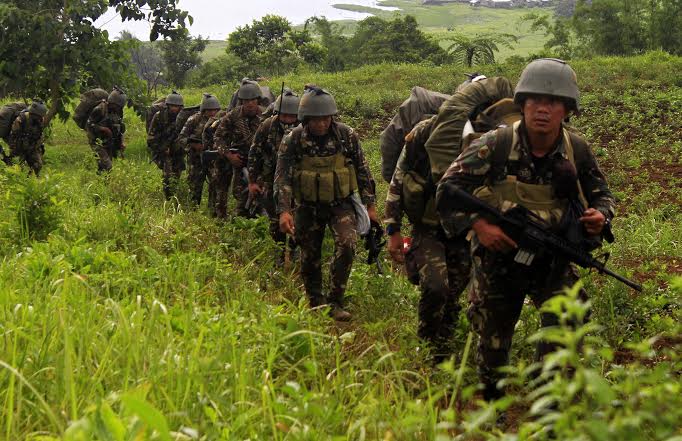
The President's visit comes as the military regains control of most parts of the town center of Butig, which the Maute group occupied on November 24.

Read: Maute group holds Lanao town under siege

But even as he called for a peaceful resolution to the conflict in Mindanao, he issued a stern warning if his appeal falls on deaf ears. 

"Ayaw kong makipag-away sa inyo. Ayaw kong makipagpatayan but please do not force my hand kasi may limit ho naman ang problema na ito," the President said. [I don't want to fight with you. I don't want to fight to the death. But please do not force my hand because our problems also have their limit.]

"I cannot be forever travelling here every month para lang makipag-usap at pagtalikod ko patayan na naman [...just to dialogue and when I turn my back, the killings start again]," he added.

"There has to be a timeline. It could be forever. It could be during my term. It could be beyond my term. But there is certain limit. And when that limit comes, I'll have to deal with you harshly," President Duterte said.

"Please do not force my hand into it. I do not want it. Pati ang droga because when the time comes it's going to be a war against terrorism and drugs. And I would tell you now: I will be harsh as harsh I can ever be," he added.

In a chance interview, we asked the President what he meant by being harsh.

He simply said, making decisions out of anger, which he pointed out, he wants to avoid doing.

Military spokesmen say that troops have driven away the bulk of the Maute force and have taken control of about 90 percent of Butig's poblacion.

The ISIS flag which was raised over some structures have been taken down.

Clearing operations continue even as troops pursue fleeing Maute members.

http://cnnphilippines.com/regional/2016/11/30/rodrigo-duterte-muslims-help-me-bring-peace-to-Mindanao.html

Former rebels benefit in CLIP

From the Philippine Information Agency (Nov 29): Former rebels benefit in CLIP

Two former members of New People’s Army (NPA) who surrendered to 58th Infantry Battalion received a total of P166,000 fire arm cost remuneration from the Comprehensive Local Integration Program (CLIP) of the Province of Misamis Oriental on 28 November 2016 at Provincial Training Center, Cagayan de Oro City.

In a simple awarding ceremony, Sanggunian Panlalawigan Board Member Gerardo Sabal III handed the checks to the former rebels.

He was assisted by Provincial Director Edward P Bhagwani, Department of Interior and Local Government (DILG); Emelia P Andea, head, Provincial Social Welfare and Development Office (PSWDO); Col Eric C Vinoya, 403rd Infantry Brigade commander; and Ltc Francis P Carandang, 58th IB commander.

Aside from the cost remuneration of their fire arms, the awardees also received their immediate cash assistance worth P15,000 each last 28 July 2016 at the Office of the DILG Misamis Oriental.

Director Bhagwani said the implementation of CLIP, in partnership with the local government units (LGUs), the Armed Forces of the Philippines (AFP), Philippine National Police (PNP), Department of Social Welfare and Development (DSWD) and civil society organizations (CSOs), demonstrates the commitment of the government to pursue lasting peace and development amid the stalled peace talks with the National Democratic Front of the Philippines (NDFP).

CLIP is being spearheaded by the DILG as part of the government's peace and development efforts across the country.

The rebels laying down of firearms and becoming part of a peaceful society will have a corresponding assistance in bringing back to their normal lives. (58IB/PA)

http://news.pia.gov.ph/article/view/1461480432432/former-rebels-benefit-in-clip

Poverty, despair breed new generation of Philippine rebels

Posted to the Stars and Stripes (Nov 28): Poverty, despair breed new generation of Philippine rebels

SIERRA MADRE MOUNTAINS, Philippines — In the late-night hours and amid the chirp of crickets, Katryn welcomed a huddle of exhausted Filipino journalists in cheerful spirits like she was home. "Coffee?" she asked with a comforting smile.

Comrade Katryn is her nom de guerre, however, and for her, home is a rebel encampment concealed in the rain-soaked wilderness of the Philippines' Sierra Madre Mountains. The 24-year-old walked away from her family two years ago to join one of the world's longest-raging Marxist rebellions.

Mostly in their 20s and 30s, a few dozen New People's Army guerrillas lugged M16 rifles and grenade launchers on a plateau where red hammer-and-sickle flags adorned a makeshift hall. Most wore mud-stained boots while cooking over wood fires or guarding the peripheries of the encampment, just 3 kilometers (1.8 miles) from the nearest army camp.

They're part of a new generation of Maoist fighters who reflect the resiliency and constraints of an insurgency that has dragged on for nearly half a century through six Philippine presidencies while Cold War-era communist insurgencies across much of the world have faded into memory. They are driven by some of the same things as their predecessors, including crushing poverty, despair, government misrule and the abysmal inequality that has long plagued Philippine society.

"The New People's Army has no other recruiter but the state itself," a young rebel, Comrade May, told The Associated Press.

She joined the rebellion two years ago after her fiance died of kidney failure because his family was too poor to afford the expensive dialysis treatment. A lowly paid factory worker, May couldn't do anything. Government hospitals overwhelmed by swarms of indigent patients failed to give him immediate care.

"His family gave up and reserved the remaining money for his coffin," said May, who now serves as a rebel medic for fellow guerrillas and destitute villagers beyond the government's reach.

Katryn came from a middle-class family that could afford a car, a house and education. She wanted to become a journalist, but got profoundly disaffected by a government and laws she said could not protect the working class, including her father, who lost his job as an engineer for joining a trade union.
I
n this Nov. 23, 2016 photo, a woman New People's Army guerrilla with face painted to conceal her identity holds her firearm inside a makeshift shelter at their rebel encampment tucked in the harsh wilderness of the Sierra Madre mountains, southeast of Manila, Philippines. Young Filipino rebels represent a new generation of Maoist fighters, who reflect the resiliency and constraints of an insurgency that has dragged on for nearly half a century through six Philippine presidencies. Crushing poverty, despair, government misrule and the abysmal inequality that has long plagued Philippine society were their best recruiter, according to the guerrillas.
Aaron Favila/AP
           
She said she went underground as a left-wing activist and bid goodbye to her father, her mother, who was a former teacher, and a life of modest comforts. "It was difficult. I cried," she said.

Now adjusted to rebel life, Katryn said she'll stay for good. She agreed to face news cameras with just a dash of red and blue paint — the colors of the revolution — to camouflage her identity.

The rebellion's longevity is best personified by Jaime Padilla, or Comrade Diego, who was introduced as the new rebel commander and spokesman in a region that has seen the ebb and flow of the insurgency. Now 69, he took up arms when then-dictator Ferdinand Marcos declared martial law in 1972, largely to quell the spreading communist insurrection that began four years earlier.

Donning a newly designed ceremonial khaki uniform topped by a Mao cap, the folksy rebel leader with a ready smile gave an upbeat assessment of the rebellion. The military, however, says it has largely beaten back the guerrillas in most of the provinces south of Manila where Padilla's rebel forces have had a presence.

Battle setbacks, surrenders and infighting have weakened the rebel group, which is blacklisted as a terrorist organization by the United States. A confidential Philippine government assessment obtained by the AP says the guerrillas had declined to 3,800 fighters with more than 4,500 firearms in the first half of the year, with about 700 of the country's 42,000 villages affected by the insurgency.

The insurgent group "remains as a threat to national security due to its stance of not abandoning the armed struggle," the report said.

"It's true that the armed struggle has gone through ups and downs, that's a part of history," Padilla told the AP. But he added that the rebellion "will not disappear because of the fundamental needs of the people. The problems have persisted, and that's the platform of the rebellion."

Founded in 1968, the rebels' communist party has held peace talks with six Philippine presidents, including Rodrigo Duterte, whose rise to power in June sparked rebel optimism due to his searing anti-U.S. rhetoric, populist pro-poor stance and appointments of at least two left-wing Cabinet members. Both sides declared separate and indefinite cease-fires in August.

http://www.stripes.com/news/pacific/poverty-despair-breed-new-generation-of-philippine-rebels-1.441622

PHL ranks 12th among 20 nations with highest impact of terrorism -- report

From BusinessWorld (Nov 30): PHL ranks 12th among 20 nations with highest impact of terrorism -- report

THE Philippines ranked 12th among the top 20 countries with the highest impact of terrorism, according to this year’s Global Terrorism Index (GTI) by the Institute for Economics and Peace.
GTI is based on data from the Global Terrorism Database that is “collected and collated by the National Consortium for the Study of Terrorism and Responses to Terrorism (START), a Department of Homeland Security Centre of Excellence led by the University of Maryland.” the report said. The database has codified more than 150,000 terrorist incidents from 163 nations from 2000 to 2015.

“The GTI scores the impact of terrorism based on the number of terrorist incidents in the past five years, fatalities from these attacks, injuries and damage to property,” the report said, adding that, with a maximum possible score of 10, total number of terrorism incidents has a base weight of 1, injuries a base of 0.5, property damage between 0-3 depending on severity, and fatalities a weight of 3, the highest among the indicators.
 
With a GTI score of 7.098 out of 10, the Philippines ranked twelfth among the nations most affected by terrorism, with a 0.071 change in score between 2015 and 2016.
 
The Philippines is behind Libya at No. 10 and Ukraine at No. 11. The top five countries are Iraq (9.96), Afghanistan (9.444), Nigeria (9.314), Pakistan (8.613), and Syria (8.587). Thailand at No. 15 is the only other Southeast Asian country among the top 20 nations.

In the case of the Philippines, the study noted that despite the high number of terrorist attacks in 2015, it resulted in comparatively little fatalities.
 
“Of the 487 attacks in 2015, 300 of these attacks or 62% did not cause any fatalities,” the report said.

“However, terrorist activity is at historically high levels. 2015 was the second deadliest year with the second most attacks since 2000. The worst year for terrorism in the Philippines was in 2013, with over 100 people killed in assassinations coinciding with the general election,” the report also said.

2013 was also a notable year for the three-week siege of Zamboanga City by elements of the Moro National Liberation Front.
 
“Violence has continued in the Philippines in Mindanao, with one in five deaths occurring in either the provinces of Cotabato or Maguindanao in the Autonomous Region in Muslim Mindanao,” the report said.

A pie chart on the “spread of attacks around the world, 2015” shows the Philippines having 4% of the pie.

Private citizens, the police, the military, and governments are listed in the report as the top terrorist targets. “The majority of attacks on government occurred in Afghanistan, Iraq, the Philippines, Pakistan and India,” the report said.


Click to enlarge

Editorial: ‘Unequal treaties’ pose big problem for negotiators

Editorial from the Manila Bulletin (Nov 30): Editorial: ‘Unequal treaties’ pose big problem for negotiators

1

The government and the Communist Party of the Philippines (CPP) hope to conclude their peace talks as quickly as possible and implement it “while he (President Duterte) is still the president of the country,” Presidential Adviser on the Peace Process Jesus Dureza said last Friday at a forum with European ambassadors.

We had been hoping that peace with the CPP, its military arm New People’s Army (NPA), and its political arm National Democratic Front of the Philippines (NDFP) was only months away, with the seeming closeness and conviviality seen in Malacanang’s inviting former CPP detainees to dinner and the opening of peace talks in Oslo, Norway, within weeks of the new start of the new administration.

Now it seems no agreement can be expected any time soon. The hope is that agreement will come while Duterte is President of the country, in other words within the next six years.

There are indeed some very critical issues that separate the two sides. At a forum in Baguio City, Luis Jalandoni, senior adviser to the NDFP negotiating panel, said that at the next peace talks to be held on January 18-25 in Rome, Italy, the NDFP will demand the abrogation of what it called unequal treaties with the United States, like the Visiting Forces Agreement (VFA) and the Enhanced Defense Cooperation Agreement (EDCA).

There are other issues on tap in the coming talks, discussions on economic reforms, recognition of ancestral domains, land reform, and national industrialization.

Even before these basic issues are taken up, the two parties will have to agree on terms of a bilateral ceasefire and the NDFP has accused the Philippine military of violating the ceasefires declared separately by the two sides.

But it is the demand for abrogation of PH-US ties now in force, ties with a history that goes back over a hundred years to the coming of US military power to these islands, that poses the biggest roadblock to peace with the CPP-NPA-NDFP group. President Duterte has expressed some critical opinions against the US, but he has also declared he intends to respect all treaties the Philippines has signed with all nations.

In the face of the NDFP adviser’s statement that they will demand the abrogation of existing treaties with the US, we see a much longer road ahead of us. But we must remain hopeful that in the coming months and years, our negotiators may yet find a formula that they can agree on, so that a problem that has long defied solution for decades will finally be solved.

http://news.mb.com.ph/2016/11/30/unequal-treaties-pose-big-problem-for-negotiators/

Opinion: The ideological bankruptcy of the Communist Party and its fronts

Opinion piece by Roberto D. Tiglao in the Manila Times (Nov 30): The ideological bankruptcy of the Communist Party and its fronts

THE mobilization by the Communist Party of the Philippines and its organizations against the burial of strongman Ferdinand Marcos at the Libingan ng mga Bayani highlights the utter ideological and intellectual bankruptcy of what was once the vanguard of radical thought and social movements in the Philippines.

Aren’t there any other urgent issues in Philippine class society—especially since the working class have become more impoverished in the last 20 years, as almost elsewhere in the world—more important for the Left to devote itself to, other than the place of burial of a man who fell from power 30 years ago, and died 27 years ago?

ADVERTISEMENT
x
US socialist leader Bernie Sanders—who lost to Hillary Clinton in the nomination for the Democratic Party’s presidential candidate—is even more radical than the CPP, campaigning for free college education. By contrast, the CPP through the National Democratic Front has demanded in the peace talks only for free education at ”the primary and secondary levels,” with free college education only “eventually.”

The demonization of Marcos by the communists since the party’s establishment in 1969, to the extent of undertaking the Plaza Miranda carnage of 1971 and blaming it on him, was of course a necessary strategy that was extremely successful. Filipinos have been deeply anti-communist because of the Catholic Church that was outraged at its atheism (the Lady of Fatima’s “Third Secret” was the conversion of godless Russia!) and of course because of US cultural hegemony during the Cold War.

By portraying itself as the vanguard against, and even the only armed opposition to the “fascist dictator,” the CPP recruited thousands of educated, idealistic youth and even clerics, who saw themselves as fighting an Asian reincarnation of Hitler. Jose Ma.Sison, the CPP founder and diabolical propagandist, wisely chose to shift the student uprising’s most dominant slogan from his pre-marital law, more Marxist “Down with the US-Marcos regime” to “Marcos, Hitler, Dictator, Tuta”, which our comrades from the slums of Tondo formulated and popularized. Its vitriolic anti-Marcos stance convinced elites whom he had called “oligarchs” and suppressed, to pour massive financial resources to the CPP and is NPA.

But that was 40 years ago.

UNIFORM OR COSTUME? Left, NPA “Melito Glor Command” spokesman “Ka Diego”. Right, model in website selling “Revolutionary Guard” costumes.

UNIFORM OR COSTUME? Left, NPA “Melito Glor Command” spokesman “Ka Diego”. Right, model in website selling “Revolutionary Guard” costumes.
 
What value?

 What tactical and strategic value is it for the CPP and the NPA to mobilize resources and personnel—even its veteran cadres like Bonifacio Ilagan and SaturOcampo—to oppose Marcos’ burial at the Libingan? If it is to prevent the dictator’s son Ferdinand, Jr., from running for president in 2022, wouldn’t another Marcos be better to rouse the masses for revolution?

Shouldn’t they just let the Yellow Cultists expend their anger, since they think it was Marcos who killed the husband of their saint Cory? The anti-Marcos elites have been back in power and have expanded their wealth: They wouldn’t give the time of day now to the CPP and NPA leaders to whom they had given funds in the 1970s. Do they naively think that they can recruit into armed revolution millennials who have suddenly found it retro chic to join anti-Marcos demonstrators?

Is it because the communists have been doing the same thing, and ranting against Marcos for nearly five decades, that they can’t stop? But isn’t that one definition of mental illness?

Why, the CPP and NPA might even expand its ranks among the huge (nine million) Ilokano speakers in the country who undoubtedly continue to see Marcos as the Great Ilokano. Ilokanos may even prove vital to the Revolution, as many of them inhabit the northern mountain ranges, so ideal for establishing revolutionary bases.

Doesn’t Ocampo and Ilagan have better things to do, such as campaign for the total end to the big Filipino capitalists’ practice of denying the working class benefits due them by employing them only on a contract basis (the so-called “endo” system)?

Rather than ranting against Marcos’ burial, shouldn’t Ocampo use his popularity and devote himself to leading the labor movement, which has been totally co-opted by capitalists ever since the firebrand PopoyLagman was assassinated in 2001, allegedly by another communist faction? Other than anti-Marcos rants, have you ever heard Ocampo champion causes dear to the poor and workingmen’s hearts?

From my experience in the 1970s overseeing demonstrations, it costs (adjusted for today’s prices) at least P300,000 to organize a respectable street rally, including the placards and the now ubiquitous dump truck used as a stage and the public address system. Shouldn’t the urban-based communists use this kind of money to organize soup kitchens in our vast slum areas, as American and European Marxists do?

An Associated Press photo for a recent article on the NPA, of Southern Luzon “MelitoGlor Command” spokesman “Ka Diego,” says a thousand words. For a moment I thought the photo was the wrong one, a colorized picture of a People’s Liberation Army officer, that a sloppy editor had used.

Very serious-looking, the NPA spokesman wears a uniform—without a speck of mud and neatly ironed—of Mao’s Red Guard in the 1960s, complete with the Mao cap and red patch on his collar. You see this in China now: young Chinese making fun of that era. There are even restaurants in Beijing with their waiters and waitresses dressed in Red Guard suits.

“Ka Diego” believing he is a Red Guard or a PLA solder perfectly personifies the CPP and the NPA: time-warped in the 1970s, believing the Revolution will be next month.

The CPP’s bankruptcy is due partly to the fact that our society has achieved many of what the CPP/NPA had fought for since the 1970s, not necessarily through its army though: The fall of Marcos, the kicking out of the US military base, agrarian reform, and (but not because of them) the exodus of US firms out of the country—and into Singapore, Malaysia and Thailand. It has even succeeded in making Mao’s “masses” a part of the Filipino language: masa.

Land reform—an issue that has prodded peasants to the communist cause here and in China in the 1930s and 1940s—had seemed impossible in this country where landlords have controlled the state apparatus for two centuries.

Yet as of 2013, the latest year for which the agrarian reform department has data, out of 7.8 million hectares of land that is to be “land-reformed,” government had distributed 88 percent, or 6.9 million hectares. The quintessence of landlord resistance, Hacienda Luisita’s fake corporatization scheme, was demolished by the Supreme Court, even as the Aquino clan retaliated by removing Chief Justice Renato Corona form his post.

And if the agrarian reform program falters and collapses, who should be blamed? The communist cadre and former Anakpawis representative Rafael Mariano, whom President Duterte appointed as agrarian reform secretary. Has Mariano uttered a single word that the agrarian reform program is designed to fail, has he complained about landlord interference? No.

Sison in 1970 in his Philippine Society and Revolution, the CPP/NPA bible, plagiarized Mao and claimed that he would capture power through his peasant army encircling the cities one by one, just as the Chinese Great Leader did.

Nearly half a century after the NPA was established, and after thousands of urban-raised students tried to be guerrillas and died in some forgotten jungles, the NPA hasn’t captured a single municipality, not even the remotest one in the country. The NPA doesn’t have a single Red Base. The guerilla bases it boasts about are merely areas where they camp for months, but which are abandoned as soon as an Army platoon undertakes search-and-destroy operations.

DID KA DIEGO ORDER FROM HERE? E-store announcing discounts for Red Guard costume..
DID KA DIEGO ORDER FROM HERE? E-store announcing discounts for Red Guard costume.

Out of touch

 Many of the CPP’s leadership such as Sison have lived for three decades in the Netherlands enjoying the comforts of a once-colonial power. Others like chairman Benito Tiamzon have been living in some remote jungle distant from mainstream society. Urban cadres have lived 7/24 in urban safehouses for decades, movingwithin their own leftwing subcultures in which they talk only to their own kind. The CPP has failed to keep in touch with the times, to innovate new forms of struggle for the proletariat. Because of these, they are virtual ideological hermits out of touch with modern society.

It wasn’t even the CPP that led the campaign against endo.It has been nowhere in urban poor struggles, and labor militancy has been at its lowest point ever.

A glaring case of the CPP’s bankruptcy involves one of its purported demands for socio-economic reforms it claims government has to agree to for a peace settlement.

The CPP’s draft for a Comprehensive Agreement on Social and Economic Reforms states: “The Parties agree to break the dominance of foreign monopoly capitalists …over the means of production and the economy, mainly through expropriation of foreign-monopoly and big-comprador assets…The Parties agree to undertake the expropriation and nationalization of the direct investments and other profit-making assets of US, Japanese and other foreign monopoly capitalists in vital and strategic industries.”

Yet with such radical statements, has any CPP representative said anything remotely pointing out and protesting the control by the Indonesian tycoon Anthoni Salim and Singtel of our telecom industry? Of Salim’s monopoly of electricity distribution in 36 cities and 75 municipalities, including Metro Manila? Of this Suharto crony’s monopoly of water distribution in 17 cities and municipalities that comprise the West Zone of the Metropolitan Manila area? Are they so out of touch with reality that they haven’t heard that Salim is now the biggest infrastructure-based magnate in the country?

For the CPP/NPA not to know these facts is just one of the many indications of the communists ideological and intellectual bankruptcy.

Or maybe they’re just smarter and more pragmatic. Is there basis to the rumor that the telcos,like most big businesses operating in remote areas, have been paying “revolutionary taxes” so their cell-sites which are spread all over the country in remote areas won’t be scorched by the NPA, as several had been in the 1990s?

tiglao.manilatimes@gmail.com
Facebook: Rigoberto Tiglao AND Bobi Tiglao

http://www.manilatimes.net/ideological-bankruptcy-communist-party-fronts/299132/

4ID presents newly acquired mobile computer lab for remote communities

From the Philippine Information Agency (Nov 29): 4ID presents newly acquired mobile computer lab for remote communities

The 4th Infantry Division introduced its newly acquired Mobile Computer Laboratory (MCL) from the Philippine Army headquarters during the ceremonial blessing held at the 4ID Grandstand today, November 28, 2016.

The Mobile Computer Laboratory is one of the products of the Civil-Military Operations Group of Philippine Army (CMOG) through the Pinoy Batang Bayani (PBB) Program with the Tuloy Foundation, Inc. (TFI) that started last June 2013 with the intent to reach the marginalized sectors/communities, especially the Out-of-School Youth (OSY) and Indigenous Peoples (IPs).

The Computer Laboratory is placed in a 40-footer fully-air conditioned container van installed with 21 high technology computers, gadgets, and other equipment intended for Basic Computer Literacy learning worth P4Million.

During the ceremonial blessing, Msgr Rey S. Monsanto of the Archdiocese of Cagayan de Oro City and at the same time member of the 4th Infantry Division Multi-Sector Advisory Board lauded the said initiative by the Philippine Army.

In his message, he said “I am happy that the Philippine Army is entering a different kind of war and that is the war against illiteracy. We are happy that you are taking part in this kind of Bayanihan effort with the stakeholders especially in bringing all the services that are intended to help improve the lives of our people in every community. May God bless every soldier of the Philippine Army who became blessing to every Filipinos."

For his part, MGen Benjamin R Madrigal Jr, 4ID commander said “We would like to thank the "Tuloy Foundation" for this big project. This equipment and technology is intended to support our units in delivering the most basic of educational service to far flung communities thru our Bayanihan Teams."

Addressed to the stakeholders present during the event, Madrigal urged to help them improve lives and help shape the future.

“Let us all do our fair share through our respective social responsibility programs and help improve the literacy level of our children in our area,” MGen Madrigal said.

The activity was also attended by the Indigenous Peoples belonging to Higaonon tribe from Region 10. (4ID/PA)

http://news.pia.gov.ph/article/view/1461480432491/4id-presents-newly-acquired-mobile-computer-lab-for-remote-communities

Rody visit to Russia to enhance defense cooperation

From the Philippine Star (Nov 30): Rody visit to Russia to enhance defense cooperation


Khovaev

President Duterte is scheduled to visit Russia in March or April next year, Foreign Affairs Secretary Perfecto Yasay Jr. said yesterday.

Yasay said Duterte’s visit is not to establish a military alliance with Moscow as earlier reports said. He stressed the Philippines’ military alliance is only with the United States.

Yasay said Duterte’s visit to Russia will focus on defense cooperation in terms of exchange of information, the fight against terrorism, war against drugs and enforcement capability.

“These are areas that we can discuss and promote between the Philippines and Russia,” he said.
 
“The President has declared we will only have one military alliance and that is with the United States. We have our Mutual Defense Treaty which the President said he will respect, together with all of the support agreements,” Yasay said in an interview on CNN Philippines.

Russian Ambassador Igor Khovaev said the state visit could be held in the spring or summer next year, given that President Duterte “does not like cold weather.”

He said Duterte’s visit is expected to further open trade relations between the two countries in many fields, including defense, agriculture, labor exports, telecommunications and infrastructure.

Khovaev also commended the independent foreign policy being pursued by Duterte.

He added Russia will be a reliable partner and friend of the Philippines.

Khovaev, however, stressed Russia will not pursue any closed military alliance with any Asian country, including the Philippines, despite offering arms and weapons to interested parties.

He said Russia will not tolerate interference from any third party country in the pursuance of stronger relationship with the Philippines.

“No third country should interfere in the relationship of Russia and the Philippines just as we have no intention to influence the relationship of the Philippines and its traditional partners. But all of these are interconnected,” he said.

Khovaev said Russia has a long-term strategic position in the Asia-Pacific region, which he described as an “indispensable precondition” in the development of their country.

He said the aim is to establish a “new architecture of security in the region.”

Khovaev said they are ready to supply military equipment and engage in the transfer of relevant technologies to any state without “political conditionality.”

He added they will not use potential military supplies to put political pressure on the sovereign affairs of their partners, just as Russia does not tolerate any interference on theirs.

Khovaev gave assurance that Russia will not conduct joint patrols with any country on disputed areas in the South China Sea given its “very clear position” that it will not take sides in territorial disputes.

He also refused to comment on the issues of human rights violations of Duterte’s campaign against illegal drugs. He only wished success in the campaign.

Khovaev also underscored the potential of Philippine-Russia relations, which is expected to flourish with the establishment of the Joint Commission on Trade and Economic Cooperation, signed by the two countries last year.

The commission already has listed several Russian companies that are willing to invest in the Philippine market, he added.

Laying the predicate

Yasay will leave on Saturday for Moscow.

“I’ll be going there to plan out the details to make sure that the meeting will happen in the near future. We’re shooting for March or April next year,” he said.

Yasay said he will be with Defense Secretary Delfin Lorenzana to lay the basis for a successful and fruitful meeting between Duterte and Russian President Vladimir Putin.

Lorenzana confirmed he would be going to Russia next week.

He said his travel to Moscow will center on defense and cooperation talks with his Russian counterpart.

http://www.philstar.com/headlines/2016/11/30/1648913/rody-visit-russia-enhance-defense-cooperation

GRP: 50 to 70 prisoners, 5-7 NDF consultants to be freed before December 10

From the often pro-CPP Davao Today (Nov 30): GRP: 50 to 70 prisoners, 5-7 NDF consultants to be freed before December 10

bello_1

GRP negotiating panel chair and Labor Secretary Silvestre Bello III announces in a press conference in Davao City on Wednesday, Nov. 30 that there will be 50 to 70 political detainees to be freed before December 10. (Zea Io Ming C. Capistrano/davaotoday.com)
 
Government chief negotiator Silvestre Bello III vowed to release some 50-70 political prisoners before the international human rights day on December 10, as he extended his condolences to the family of Bernabe Ocasla, one of the 400 political prisoners who recently died of a heart attack.
 
In a press conference at the Royal Mandaya Hotel here Wednesday, Bello said Ocasla’s death is a “sad development.”

“We would have wanted to have allowed him freedom before namatay siya, pero ito ang nangyari, so what we can only do is to extend our sympathies to them and the family,” Bello said.

Progressive organizations said the government is accountable for Ocasla’s death. The Samahan ng mga Ex-Detainees Laban sa Detensyon at Aresto, said Ocasla should have been released along with more than a hundred ailing political prisoners as soon as President Rodrigo Duterte assumed office.

Fr. Dionito Cabillas, SELDA spokesperson said Ocasla’s death is “the tragic result of the government’s deliberate delays and excuses in the release of political prisoners.”

Not easy 

However, the government official said the release of the political prisoners still needs to undergo judicial process.

“Kung yung pagpapalaya ay nasa Presidente lang, andali-dali sabihin yan, palayain mo na yan, and I’m sure he will in his power. Kaya lang may proseso yan eh, judicial process na dadaan sa husgado which take some time (If the release of the prisoners would only require the President’s order, it is easy to say ‘release them’, and I’m sure he will in his power. However, there is a judicial process which needs to pass through the court which take some time),” Bello said.

He said he keeps telling National Democratic Front of the Philippines peace panel negotiator Fidel Agcaoili to “be patient because we have to undergo a process.”

“The desire and the will of the president to release some of your political prisoners is there, hindi nakakalimutan ng ating pangulo yun (the President does not forget about it),” he said.

50-70 detainees to be released 

Bello also said that the government will possibly release around 50 to 70 political prisoners, including five to seven NDF consultants before December 10.

“Maybe before December 10 we will have the release of about 50-70 detainees on humanitarian grounds. There are also five to seven consultants to be released by pardon because they are consultants in the peace process,” said Bello.

But for Health Action for Human Rights, Ocasla’s death should be the last under the Duterte administration.

Dr. Geneve R. Reyes of the HAHR said Ocasla complained of constant headaches, episodes of blurring of vision and high blood pressure during his detention at the Jose Reyes Memorial Medical Center.

The 66-year old prisoner spent nine years in prison for charges of multiple murder. He died on Monday afternoon after three days in comatose.

“Although the slow justice system in the country would render anyone in his situation hopeless, he and many detainees found hope in President Duterte’s promise of releasing political prisoners and pursuing the peace talks with the NDFP,” Reyes said.

Reyes added: “The death of Ocasla, though the first under his administration, should also be the last.”
Bello said the third round of peace talks would resume on January 18 to 25 in Rome, Italy.

http://davaotoday.com/main/politics/grp-50-to-70-prisoners-5-7-ndf-consultants-to-be-freed-before-december-10/

http://davaotoday.com/main/politics/grp-50-to-70-prisoners-5-7-ndf-consultants-to-be-freed-before-december-10/

AFP: 85% of Butig, Lanao Sur recovered; 61 Maute men killed

From the Philippine Daily Inquirer (Nov 30): AFP: 85% of Butig, Lanao Sur recovered; 61 Maute men killed

Soldiers from the 103rd Brigade of the Philippine Army, are in hot pursuit of the Maute criminal group n Butig town in Lanao del Sur on Wedenesday, June 1, 2016.  (Photo by : Richel V. Umel, Inquirer Mindanao)


In this June 2016 file photo, soldiers from the 103rd Brigade of the Philippine Army, are in hot pursuit of the Maute criminal group n Butig town in Lanao del Sur . (Photo by : Richel V. Umel, Inquirer Mindanao)

The military has “recovered” 85 to 90 percent of Butig town, Lanao del Sur, from the hands of the Maute group, a military spokesperson said Wednesday.

Major Felimon Tan, the spokesperson of the Western Mindanao Command based in Zamboanga City, said in a text message that since Thursday last week, 61 Maute gang men have been killed as troops have been inching forward into central Butig. Twelve other Maute group members were wounded, he said.

Tan said 35 soldiers have been injured since the fighting began.
 
http://newsinfo.inquirer.net/849294/afp-85-of-butig-lanao-sur-recovered-61-maute-men-killed

Gov’t troops retake Butig’s old municipal building from Maute Group

From GMA News (Nov 30): Gov’t troops retake Butig’s old municipal building from Maute Group

Government forces on Wednesday recovered from the Maute local terrorist group the old municipal building of Butig in Lanao del Sur.

“Armed Forces of the Philippines chief of staff General Ricardo Visaya expresses his elation that our troops have successfully retaken the old municipal hall of Butig,” Col. Edgard Arevalo, public affairs office chief of the Armed Forces of the Philippines (AFP), said.

AFP Western Command spokesperson Major Filemon Tan, meanwhile, said troops have been able to take back 85 percent to 90 percent of the Poblacion of Butig occupied by the Maute Group in the past six days.

GMA News’ Jun Veneracion reported earlier that the military has been able to recover a Madrasah or Arabic school and a national high school.

Tan said that at least 61 members of the Maute Group have been killed and 12 more wounded in the ongoing operations.

On the part of soldiers, 35 have been wounded.

Arevalo, meanwhile, said they need the support and cooperation of Butig's residents to fully defeat the Maute Group.

“We exhort them to be vigilant and resist the influence of terrorists and lawless groups,” he said.

http://www.gmanetwork.com/news/story/590720/news/regions/gov-t-troops-retake-butig-s-old-municipal-building-from-maute-group

Indonesia Maritime Threat Assessment

From MarineLink (Nov 29): Indonesia Maritime Threat Assessment 

Militant group Abu Sayyaf (ASG) has conducted frequent kidnap for ransom attacks in the Sulu and Celebes Seas since March 2016, says a report by Protection Vessels International Ltd.
 
Islamic State-affiliated ASG has successfully extracted millions of dollars' worth of ransom payments for individual releases and has decapitated several hostages when ransom demands have not been met.
 
In November, ASG shifted towards targeting commercial vessels and successfully abducted six crew members from a bulk carrier.
 
Armed robberies have grown increasingly violent in Indonesian waters in 2016 with robbers assaulting crew members who attempt to stop them.
 
The Sulu and Celebes Seas off the eastern coast of the island of Borneo have seen a significant spike in hijackings and kidnappings for ransom since March 2016. Philippine Islamist group ASG, which is based in the Jolo and Basilan islands of the Sulu Sea, has claimed the majority of the attacks.
 
Masked gunmen have typically targeted slow-moving tugs and fishing boats although in recent weeks they have demonstrated the capability to successfully kidnap crew from underway commercial vessels between Borneo and the Philippines, heightening the risk to global shipping in the region. 
 
On 10 November, 10 gunmen boarded a Vietnam-flagged bulk carrier, Royal 16, 8.3 nm southeast of Coco Island in the Basilan Strait, and kidnapped six crew members including the master and chief mate. 
 
In November, the group also kidnapped a German national and killed another on a yacht off Sulu, and has also launched failed attacks against a chemical tanker off Sibutu Island and a bulk carrier northwest of Cap Island, indicating a sustained threat to commercial vessels. Vessels have managed to deter attacks through a combination of vessel hardening measures and evasive manoeuvres.
 
Maritime authorities in the region have been slow to respond to the attacks and have failed to secure the Sulu and Celebes Seas, despite repeated pledges to cooperate more closely and conduct joint patrols, leaving the waters vulnerable to future attacks. 
 
Even basic measures such as allowing Indonesian, Malaysian and Philippine maritime forces to pursue suspected criminals into each other's waters were only agreed in August, months after the attacks first began in March. The abductions in the region look set to continue for the foreseeable future as ASG is under persistent pressure to gain ransom funds to finance its battles with Philippine government forces.
 
More generally, violent robberies against vessels off Indonesia have increased since the second quarter of 2016, after a lull in reported incidents in the first three months of the year. 
 
While in the majority of incidents robbers have been easily deterred there has been a notable increase in violent incidents with assailants holding crew hostage at gunpoint while equipment and ship's stores have been stolen. Robbers have typically targeted vessels anchored at Dumai and Batam anchorages, although there is also precedent for underway vessels to be targeted.
 

MILF: BTC will have new chairman: Iqbal

Posted to the Moro Islamic Liberation Front Website (Nov 30): BTC will have new chairman: Iqbal


Mohagher Iqbal, Chair of the MILF Implementing Peace Panel said during the Bangsamoro CSO Leaders Consultation-Workshops on Mindanao Peace Process organized by the Consortium of Bangsamoro Civil Society (CBCS) with support from the Japan International Cooperation Agency (JICA) held in Davao City from November 21-25, 2016, that the reconstituted Bangsamoro Transition Commission (BTC) will have a new chairman, also from the Moro Islamic Liberation Front (MILF)  as he will focus his attention to the implementation process of the GPH-MILF Comprehensive Agreement on the Bangsamoro (CAB).

“I am no longer head of the BTC”, Iqbal disclosed during the presentation of his topic, “Updates on Peace Process, Opportunities and Challenges” under the Duterte Administration.

Iqbal however, refused to name the new chairman pending the signing of the appointments of the commissioners that will compose the BTC, from the GPH and the MILF by Pres. Rodrigo Duterte.

The reconstituted Executive Order No.08 amending further the EO No. 120 and was further amended by EO No. 187 was signed by President Duterte in Malacañan Palace on November 7, 2016.

The BTC will be composed of 21 members, 11 from the MILF and 10 from the government which will include the MNLF Muslimen Sema faction, indigenous peoples, the sultanates, etc.

Iqbal also told the participants that there are three tracks in the mode of engagement in implementation. “The implementation phase have three tracks, the first track is Security Aspect, second is Normalization Process, and the third track is Enactment of the BBL”, Iqbal explained.

Under the first track he said is maintaining the ceasefire with the presence of International Monitoring Team (IMT), Coordination Committee on the Cessation of Hostilities (CCCH), Ad-hook Joint Action Group (AHJAG) including the campaign against kidnaping and drugs.

“In the second phase of implementation is the decommissioning of MILF forces and weapons but it is parallel to the passage of the BBL’, Iqbal said. He further said that the Security Aspect and Normalization Process is bilateral agreement between the government and MILF.

The third phase is unilateral to the government. “The MILF is not participating the process; it is internal to the government to pass the BBL in Congress,” he said. Iqbal said that the only indirect participation of the MILF is through the BTC.

On the issue of federalism, Iqbal said: “It is a matter of questions of sequence, we welcome and support the federalism but the BBL should be passed first.”

“Federalism could solve the entire problems of peoples in the country while the BBL can solve the Bangsamoro question on Right to Self-Determination”, Iqbal added.

http://www.luwaran.com/index.php/news/22-davao-region/980-btc-will-have-new-chairman-iqbal

MILF: Peace advocacy on Bangsamoro should reach larger Filipino audiences: Academe

Posted to the Moro Islamic Liberation Front Website (Nov 30): Peace advocacy on Bangsamoro should reach larger Filipino audiences: Academe


In order to gain more support for the Bangsamoro quest for self-determination, a Moro university professor urged the Bangsamoro Civil Society Organization (CSO) leaders to heighten the peace advocacy works reaching out larger Filipino audiences.

“There is a need to reach out to larger Filipino audiences who still hold biases and animosities towards the Bangsamoro people,” said Professor Rufa C. Guiam of Mindanao State University-General Santos during the Bangsamoro CSO Leaders Consultation & Workshop on Mindanao Peace Process held at Davao City on November 21-25, 2016.

Guiam noted there is less understanding on the Bangsamoro history and issues since “those are not taught in schools.”

She told the consultation delegates to exert more efforts to pitch the grassroots peace initiatives which usually do not reach the national level.

Guiam was one of the key facilitators of the consultation workshop attended by representatives from peace advocates groups, academe, Ulama, media, youth, and line agencies coming from mainland Mindanao and the island provinces.

“What we need is to promote wide awareness with the peace process,” Guiam said. “We want to radiate that enthusiasm and commitment with people who do not have belief on what we do,” she added.

The activity provided an opportunity for the Bangsamoro CSO leaders to craft their plan to push for the passage of an enabling law to be crafted by the expanded Bangsamoro Transition Commission (BTC) which will provide the establishment of the desired Bangsamoro autonomous political entity.

The draft law will be forwarded to the Philippine Congress for its passage. During the stint of President Noynoy Aquino, the original members of the BTC drafted the Bangsamoro Basic Law and (BBL), an enabling law submitted to Congress and Senate.  However the lawmakers failed to pass the BBL.

The drafting of BBL by the BTC and its passage by the Philippine Congress are stipulated in the Comprehensive Agreement on the Bangsamoro (CAB), a peace accord signed by the Government of the Philippines (GPH) and Moro Islamic Liberation Front (MILF) in 2014 after more than 17 years of peace negotiations.

Guiam said the CSOs should have a united movement to push the passage of the enabling law and be actively engaged in strong lobbying in the two Chambers of Congress.

She said advocacy on CAB-BBL, media campaign to support the peace process and study sessions with policy makers should involve the CSOs.

The university professor further suggested to the audiences that there should be identified CSO representatives that will participate “in case there is a TWG at the Congress.”

The activity, organized by the Consortium of Bangsamoro Civil Society with the support of Japan International Cooperation Agency, was aimed to build solidarity and consensus among Moro leaders in pursuing lasting peace in Mindanao.

http://www.luwaran.com/index.php/news/22-davao-region/981-peace-advocacy-on-bangsamoro-should-reach-larger-filipino-audiences-academe

http://www.luwaran.com/index.php/news/22-davao-region/981-peace-advocacy-on-bangsamoro-should-reach-larger-filipino-audiences-academe