From the Philippine News Agency (Oct 20): President Duterte, Xi agree to pursue bilateral talks to settle WPS dispute
Chinese Vice Foreign Minister Liu Zhenmin announced on Thursday that Philippine President Rodrigo Duterte and Chinese President Xi Jinping have agreed that the two countries will return to track of dialogue and consultation to settle dispute in the West Philippine Sea or South China Sea.
”The two sides agreed that they will come back to what they have agreed five years ago that is to pursue bilateral dialogue and consultation in seeking proper settlement of the South China Sea issue,” the Chinese foreign official said in a press conference in Beijing.
”This in itself signifies a new stage of maritime cooperation between the two countries. China is ready for discussions with our friends in the Philippines on maritime cooperation and cooperation in many other areas,” he added.
Liu said the details will be further discussed by the responsible authorities of both countries after the ongoing state visit of President Duterte in China.
”Both sides agreed that the South China Sea issue is not the sum total of the bilateral relations between the two countries,” he said.
The Chinese foreign official said the two heads of state did not tackle the Scarborough Shoal or Huangyan Island but “they did talk about the cooperation in fishery.”
”They agreed that the two countries will strengthen fishery cooperation in the South China Sea and also cooperation in terms of fishery products, industries,” Liu said.
”China will support the Philippines in developing aqua-culture, fishery products processing so as to help deliver a better life for the fishermen of the Philippines,” he added.
Liu said the two sides will have a more exchange of views on the fishery cooperation and China will make proper arrangements.
”In one word, in this visit bilateral relations have fully recovered and two countries will return to track of dialogue and consultation to address maritime issues,” he said.
http://www.pna.gov.ph/index.php?idn=1&sid=&nid=1&rid=933232

Friday, October 21, 2016

Thursday, October 20, 2016
CPP calls for probe on violent protest dispersal at US Embassy
From the Philippine News Agency (Oct 20): CPP calls for probe on violent protest dispersal at US Embassy

Police and protesters clash during a violent protest outside the US Embassy in Manila on Oct. 19. A police van rammed into protesters, leaving several bloodied. AP
The Communist Party of the Philippines (CPP) on Wednesday condemned the violent dispersal of protesters in front of the United States Embassy in Manila, which left several rallyists injured.
Calling for an investigation of the incident, the CPP said the government should put to task the police officers behind the violent dispersal, which saw a police vehicle running over the protesters.
“That the successive dispersals were carried out with such viciousness reveal the deep-seated hostility against the people and patriotic forces of those police and military officers who ordered the dispersals. These officers must be immediately identified, investigated and put to task,” it added.
Militant leader Renato Reyes said at least 10 were injured while others were arrested following the dispersal.
Metro Manila police chief Supt. Oscar Albayalde said the protesters were “trying to flip over the police car.”
“The violent dispersal is a direct violation of the Comprehensive Agreement on Respect for Human Rights and International Humanitarian Law (CARHRIHL). The CPP urges the negotiating panel of the NDFP to raise the matter of the violent dispersal with their GRP counterparts.”
“The CPP supports the demand of the peasants and minority groups for an immediate end to the military occupation of their communities,” the statement added. http://globalnation.inquirer.net/147137/cpp-calls-for-probe-on-violent-protest-dispersal-at-us-embassy
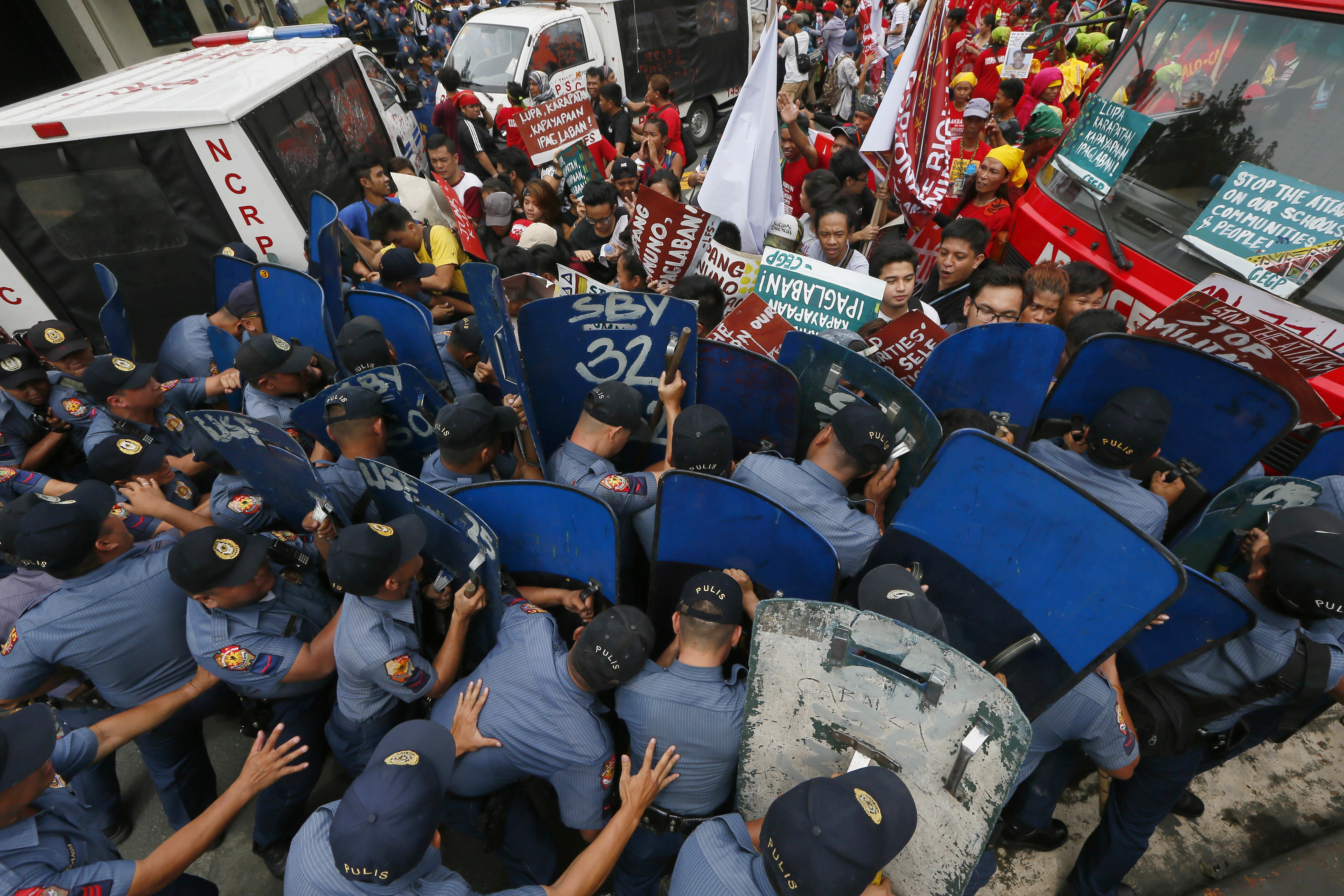
Police and protesters clash during a violent protest outside the US Embassy in Manila on Oct. 19. A police van rammed into protesters, leaving several bloodied. AP
The Communist Party of the Philippines (CPP) on Wednesday condemned the violent dispersal of protesters in front of the United States Embassy in Manila, which left several rallyists injured.
Calling for an investigation of the incident, the CPP said the government should put to task the police officers behind the violent dispersal, which saw a police vehicle running over the protesters.
WATCH: Police van runs over protesters at anti-US rally
“The CPP holds the leadership of the Philippine National Police, the Armed Forces of the Philippines and officials of the Duterte government responsible for the violent affront against the people’s democratic rights to demonstrate and seek redress,” the CPP said in a statement.“That the successive dispersals were carried out with such viciousness reveal the deep-seated hostility against the people and patriotic forces of those police and military officers who ordered the dispersals. These officers must be immediately identified, investigated and put to task,” it added.
Militant leader Renato Reyes said at least 10 were injured while others were arrested following the dispersal.
Metro Manila police chief Supt. Oscar Albayalde said the protesters were “trying to flip over the police car.”
READ: Police deny running over protesters at US Embassy
Amid a peace negotiation with the Duterte administration, the CPP also called on the National Democratic Front of the Philippines (NDFP) to bring up the incident to the government’s negotiating panel.“The violent dispersal is a direct violation of the Comprehensive Agreement on Respect for Human Rights and International Humanitarian Law (CARHRIHL). The CPP urges the negotiating panel of the NDFP to raise the matter of the violent dispersal with their GRP counterparts.”
“The CPP supports the demand of the peasants and minority groups for an immediate end to the military occupation of their communities,” the statement added. http://globalnation.inquirer.net/147137/cpp-calls-for-probe-on-violent-protest-dispersal-at-us-embassy
PAF’s attack squadron to relocate in Cagayan De Oro City
From the Philippine News Agency (Oct 20): PAF’s attack squadron to relocate in Cagayan De Oro City
Preparations are underway for the relocation of the Philippine Air Force (PAF) attack squadron to the Lumbia Airport here, an official said Thursday.
Vice Mayor Rainier Joaquin Uy said the PAF top brass paid a call at the City Hall here to inform the city government of the PAF’s ongoing “site and development” at the Lumbia Airport here.
He said the PAF 15th Strike Wing, currently based at Sangley Point in Cavite, with a complement of about 1,100 personnel, would be relocated to Cagayan De Oro City after the site development of Lumbia is over.
According to Uy, the Department of National Defense (DND) has allocated a PHP 987, 768, 845.44 million for the “Phase 1 – Site Development and Construction of Billeting Facilities for the relocation of the 15th Strike Wing.”
Uy did not disclose the scheduled completion of the site development and the construction of the billeting facilities for the PAF personnel.
The 15th Strike Wing, the PAF’s primary attack squadron, has a newly acquired AW-109 attack helicopter gunship, OV 10 attack planes, MG -520 attack helicopter gunship, and SF-260 ground attack aircraft.
Uy said the relocation of the PAF strike squadron in the Lumbia Airport along with over 1,000 personnel would perk economic activity in the area.
The Lumbia Airport once served as the commercial airport of Cagayan De Oro City, which was closed following the operation of the Laguindingan Airport in Misamis Oriental.
The 500-hectare airport was not utilized as the headquarters of the PAF’s Tactical Operation Group (TOG) in Northern Mindanao.
http://www.pna.gov.ph/index.php?idn=2&sid=&nid=2&rid=933066
Preparations are underway for the relocation of the Philippine Air Force (PAF) attack squadron to the Lumbia Airport here, an official said Thursday.
Vice Mayor Rainier Joaquin Uy said the PAF top brass paid a call at the City Hall here to inform the city government of the PAF’s ongoing “site and development” at the Lumbia Airport here.
He said the PAF 15th Strike Wing, currently based at Sangley Point in Cavite, with a complement of about 1,100 personnel, would be relocated to Cagayan De Oro City after the site development of Lumbia is over.
According to Uy, the Department of National Defense (DND) has allocated a PHP 987, 768, 845.44 million for the “Phase 1 – Site Development and Construction of Billeting Facilities for the relocation of the 15th Strike Wing.”
Uy did not disclose the scheduled completion of the site development and the construction of the billeting facilities for the PAF personnel.
The 15th Strike Wing, the PAF’s primary attack squadron, has a newly acquired AW-109 attack helicopter gunship, OV 10 attack planes, MG -520 attack helicopter gunship, and SF-260 ground attack aircraft.
Uy said the relocation of the PAF strike squadron in the Lumbia Airport along with over 1,000 personnel would perk economic activity in the area.
The Lumbia Airport once served as the commercial airport of Cagayan De Oro City, which was closed following the operation of the Laguindingan Airport in Misamis Oriental.
The 500-hectare airport was not utilized as the headquarters of the PAF’s Tactical Operation Group (TOG) in Northern Mindanao.
http://www.pna.gov.ph/index.php?idn=2&sid=&nid=2&rid=933066
‘We were provoked’ – cops at US Embassy
From the Philippine Daily Inquirer (Oct 20): ‘We were provoked’ – cops at US Embassy
Jerome Succor, head of the Sandugo, one of the groups that participated in the protest, said 15 of their members were rushed to the Philippine General Hospital after the encounter.
He added that 13 more members – nine men and four women – were arrested and brought to the MPD’s general assignment section.
Succor said they have received information that the 13 would be charged with vandalism, malicious mischief, resisting arrest, direct assault, and illegal assembly.
Pedrozo said that aside from hitting cops, the protesters also destroyed four police mobile cars.
The police and the protesters had different accounts of what happened.
The militants’ march started about 10 a.m.
In a media advisory sent October 18, the day Duterte left for China, the group said “thousands of Moro and indigenous people will march to the US Embassy…from Kalaw corner Taft to Roxas Boulevard as they support Duterte’s independent foreign policy.”
“Tribal folks will wear their traditional attire as they will destroy a mock US flag using their traditional weapons before burning the flag,” the advisory read.
Senior Superintendent Pedrozo said the police observed maximum tolerance for the protesters but the militants were “unruly” and “violent” and they “provoked the cops.”
The police said the protesters pushed and physically hurt the cops officially stationed there in an effort to go near the embassy walls. Pedrozo pegged the number of militants at 700.
“This was the first time they were able to go near the embassy walls. That alone will show you that maximum tolerance was enforced,” he said.
“But getting near the embassy was not enough for them,” said Pedrozo. “They sprayed the walls with graffiti, and painted police uniform. Why did they have to paint the uniform?”
A scuffle eventually ensued. The militants were hit with wooden sticks. Police drove a van back and forth, and used water canons to disperse them.
Cops and protesters ended up hitting each other. The melee ended about 2 p.m. at the MPD headquarters.
Succor said that during the march, protesters were able to go past traditionally stationed cops at the US Embassy.
“Nagtulakan kami (We pushed each other). There was resistance as cops prevented us from going near the embassy but we were not hurt,” Succor said.
When they got close the embassy gates and walls, they vandalized its walls by painting graffiti. They also sprayed paint on the cops’ uniforms.
“We wanted to show defiance against the United States government domination in the Philippines. This is defiance against EDCA (Enhanced Defense Cooperation Agreement) and their security measures in the country,” Succor told the Philippine Daily Inquirer.
EDCA refers to the Enhanced Defense Cooperation Agreement between the US and the Philippines as a way to counter China’s illegal occupation of Philippine territories in the West Philippine Sea.
Succor said they had two speakers left before ending the program when additional police forces arrived at the area. Then, a “violent dispersal” ensued, he said.
Succor estimated rally participants at 3,000. “Tear gas and water canons were used against us. Police also drove its car back and forth to disperse us,” he said.
In a statement, the Communist Party of the Philippines “strongly condemned the violent dispersal of the demonstration.”
“Today’s violent dispersal follows a similar violent dispersal yesterday in front of Camp Aguinaldo, the national headquarters of the Armed Forces of the Philippines,” the statement said.
CPP said 29 were arrested during the rally at the US Embassy. Senior Superintendent Pedrozo of the Manila Police said 15 were arrested. Succor of Sandugo said only 13 of their members were detained.
http://newsinfo.inquirer.net/827704/we-were-provoked-cops-at-us-embassy
[Video report]
Some 50 policemen and protesters were hurt on Wednesday, after they clashed in front of the US Embassy in Manila, during a demonstration supporting President Duterte’s independent foreign policy.
Senior Supt. Marcelino Pedrozo, deputy director for operations of the Manila Police District, said 40 cops were wounded after militants “provoked” them into a physical confrontation at the protest site.
The participants included Moros and Lumads from Mindanao.
Some 50 policemen and protesters were hurt on Wednesday, after they clashed in front of the US Embassy in Manila, during a demonstration supporting President Duterte’s independent foreign policy.
Senior Supt. Marcelino Pedrozo, deputy director for operations of the Manila Police District, said 40 cops were wounded after militants “provoked” them into a physical confrontation at the protest site.
The participants included Moros and Lumads from Mindanao.
Jerome Succor, head of the Sandugo, one of the groups that participated in the protest, said 15 of their members were rushed to the Philippine General Hospital after the encounter.
He added that 13 more members – nine men and four women – were arrested and brought to the MPD’s general assignment section.
Succor said they have received information that the 13 would be charged with vandalism, malicious mischief, resisting arrest, direct assault, and illegal assembly.
Pedrozo said that aside from hitting cops, the protesters also destroyed four police mobile cars.
The police and the protesters had different accounts of what happened.
The militants’ march started about 10 a.m.
In a media advisory sent October 18, the day Duterte left for China, the group said “thousands of Moro and indigenous people will march to the US Embassy…from Kalaw corner Taft to Roxas Boulevard as they support Duterte’s independent foreign policy.”
“Tribal folks will wear their traditional attire as they will destroy a mock US flag using their traditional weapons before burning the flag,” the advisory read.
Senior Superintendent Pedrozo said the police observed maximum tolerance for the protesters but the militants were “unruly” and “violent” and they “provoked the cops.”
The police said the protesters pushed and physically hurt the cops officially stationed there in an effort to go near the embassy walls. Pedrozo pegged the number of militants at 700.
“This was the first time they were able to go near the embassy walls. That alone will show you that maximum tolerance was enforced,” he said.
“But getting near the embassy was not enough for them,” said Pedrozo. “They sprayed the walls with graffiti, and painted police uniform. Why did they have to paint the uniform?”
A scuffle eventually ensued. The militants were hit with wooden sticks. Police drove a van back and forth, and used water canons to disperse them.
Cops and protesters ended up hitting each other. The melee ended about 2 p.m. at the MPD headquarters.
Succor said that during the march, protesters were able to go past traditionally stationed cops at the US Embassy.
“Nagtulakan kami (We pushed each other). There was resistance as cops prevented us from going near the embassy but we were not hurt,” Succor said.
When they got close the embassy gates and walls, they vandalized its walls by painting graffiti. They also sprayed paint on the cops’ uniforms.
“We wanted to show defiance against the United States government domination in the Philippines. This is defiance against EDCA (Enhanced Defense Cooperation Agreement) and their security measures in the country,” Succor told the Philippine Daily Inquirer.
EDCA refers to the Enhanced Defense Cooperation Agreement between the US and the Philippines as a way to counter China’s illegal occupation of Philippine territories in the West Philippine Sea.
Succor said they had two speakers left before ending the program when additional police forces arrived at the area. Then, a “violent dispersal” ensued, he said.
Succor estimated rally participants at 3,000. “Tear gas and water canons were used against us. Police also drove its car back and forth to disperse us,” he said.
In a statement, the Communist Party of the Philippines “strongly condemned the violent dispersal of the demonstration.”
“Today’s violent dispersal follows a similar violent dispersal yesterday in front of Camp Aguinaldo, the national headquarters of the Armed Forces of the Philippines,” the statement said.
CPP said 29 were arrested during the rally at the US Embassy. Senior Superintendent Pedrozo of the Manila Police said 15 were arrested. Succor of Sandugo said only 13 of their members were detained.
http://newsinfo.inquirer.net/827704/we-were-provoked-cops-at-us-embassy
US army official reaffirms ties with PHL in Leyte Gulf Landing celebration
From the Philippine News Agency (Oct 20): US army official reaffirms ties with PHL in Leyte Gulf Landing celebration
An army official who represented the United States in the 72nd Leyte Gulf Landing celebration said Thursday he is confident that strong ties with the Philippines will be sustained as his country never “wavered” in its commitment to Filipinos since World War II.
Col. Kevin Wolfla, US Army attaché of the US embassy in Manila, said the two countries will stand “shoulder to shoulder to face the future”.
“Our relationship with the Philippines is broad and our alliance is one of our most enduring and important relationship in the Asia-Pacific region. It is a cornerstone of stability for over 70 years,” Wolfla said in his speech during the event in this town celebrating the end of Japanese invasion on Oct. 20, 1944.
Despite President Rodrigo Duterte’s “time to say goodbye” remarks to the US in his state visit to China, Wolfla said he is “proud and humbled to represent the US commemorating shared sacrifices during World War II”.
“I am reminded that today gives us the chance to renew and strengthen the bond that tied us together as partners who know the joy of freedom and are willing to serve together to guarantee that freedom and prosperity for ourselves and for future generations,” the US army official said.
In an interview after the commemorative program, the US official declined to comment on the President’s pronouncement, but assured that the Philippines will remain his country’s ally.
Earlier, President Duterte suspended the joint US-Philippine patrols in the South China Sea, and has threatened an end to joint military exercises.
“To this day, we still have commitment to our friends in the Philippines. It is built on shared sacrifices for democracy and human rights and strong people to people and societal ties,” Wolfla added.
Leyte Governor Leopoldo Dominico Petilla, who repeatedly thanked the US for its role in the Philippines' liberation and massive assistance of the US government after super typhoon Yolanda, declined to comment on the President’s statement against the Western country.
“I think the President is just expanding options on trade... He is entitled to his opinion and we have to respect that, being in a democratic country,” Petilla said.
The governor’s mother, Palo town Mayor Remedios Petilla assured that US officials will always be invited in future Leyte Gulf Landing celebrations.
“The President just ended the military exercises, but Americans will continue to be here,” she added.
Officials and embassy officials from Allied Forces gathered for the 72nd Leyte Gulf Landing at the Macarthur Landing Memorial National Park.
On Oct. 20, 1944, Gen. Douglas Mac Arthur, at the head of the largest US fleet of transport and warships, and accompanied by then Commonwealth president Sergio Osmeña and Gen. Carlos P. Romulo, landed at Red Beach of this town to reclaim the Philippines from the Japanese.
History tells that the largest naval battle in the Pacific and the second battle of the Philippine Sea against Japanese invaders was fought and won in Leyte.
The battle was a great victory; it effectively destroyed the Japanese fleet and opened the way for the recovery of all the islands. Luzon was invaded in January 1945 and Manila was taken in February.
On July 5, 1945, MacArthur announced, “All the Philippines are now liberated.” The Japanese had suffered more than 425,000 dead during the battle.
http://www.pna.gov.ph/index.php?idn=2&sid=&nid=2&rid=933049
An army official who represented the United States in the 72nd Leyte Gulf Landing celebration said Thursday he is confident that strong ties with the Philippines will be sustained as his country never “wavered” in its commitment to Filipinos since World War II.
Col. Kevin Wolfla, US Army attaché of the US embassy in Manila, said the two countries will stand “shoulder to shoulder to face the future”.
“Our relationship with the Philippines is broad and our alliance is one of our most enduring and important relationship in the Asia-Pacific region. It is a cornerstone of stability for over 70 years,” Wolfla said in his speech during the event in this town celebrating the end of Japanese invasion on Oct. 20, 1944.
Despite President Rodrigo Duterte’s “time to say goodbye” remarks to the US in his state visit to China, Wolfla said he is “proud and humbled to represent the US commemorating shared sacrifices during World War II”.
“I am reminded that today gives us the chance to renew and strengthen the bond that tied us together as partners who know the joy of freedom and are willing to serve together to guarantee that freedom and prosperity for ourselves and for future generations,” the US army official said.
In an interview after the commemorative program, the US official declined to comment on the President’s pronouncement, but assured that the Philippines will remain his country’s ally.
Earlier, President Duterte suspended the joint US-Philippine patrols in the South China Sea, and has threatened an end to joint military exercises.
“To this day, we still have commitment to our friends in the Philippines. It is built on shared sacrifices for democracy and human rights and strong people to people and societal ties,” Wolfla added.
Leyte Governor Leopoldo Dominico Petilla, who repeatedly thanked the US for its role in the Philippines' liberation and massive assistance of the US government after super typhoon Yolanda, declined to comment on the President’s statement against the Western country.
“I think the President is just expanding options on trade... He is entitled to his opinion and we have to respect that, being in a democratic country,” Petilla said.
The governor’s mother, Palo town Mayor Remedios Petilla assured that US officials will always be invited in future Leyte Gulf Landing celebrations.
“The President just ended the military exercises, but Americans will continue to be here,” she added.
Officials and embassy officials from Allied Forces gathered for the 72nd Leyte Gulf Landing at the Macarthur Landing Memorial National Park.
On Oct. 20, 1944, Gen. Douglas Mac Arthur, at the head of the largest US fleet of transport and warships, and accompanied by then Commonwealth president Sergio Osmeña and Gen. Carlos P. Romulo, landed at Red Beach of this town to reclaim the Philippines from the Japanese.
History tells that the largest naval battle in the Pacific and the second battle of the Philippine Sea against Japanese invaders was fought and won in Leyte.
The battle was a great victory; it effectively destroyed the Japanese fleet and opened the way for the recovery of all the islands. Luzon was invaded in January 1945 and Manila was taken in February.
On July 5, 1945, MacArthur announced, “All the Philippines are now liberated.” The Japanese had suffered more than 425,000 dead during the battle.
http://www.pna.gov.ph/index.php?idn=2&sid=&nid=2&rid=933049
Duterte always loved communists – except when he was killing them
From the South China Morning Post (Oct 20): Duterte always loved communists – except when he was killing them
When Washington Post correspondent Keith Richburg paid a call on Davao City police chief Franco Calida in 1987, he found himself following a trail of blood up the wooden stairs to the Philippine Constabulary colonel’s second floor…

Demonstrators march to the House of Representatives to show their support for Philippine President Rodrigo Duterte ahead of his State of the Nation Address in July. Duterte used the address to announce a unilateral ceasefire with communist rebels who are waging one of Asia's longest insurgencies, and urged them to reciprocate. Photo: AFP
When Washington Post correspondent Keith Richburg paid a call on Davao City police chief Franco Calida in 1987, he found himself following a trail of blood up the wooden stairs to the Philippine Constabulary colonel’s second floor…
Demonstrators march to the House of Representatives to show their support for Philippine President Rodrigo Duterte ahead of his State of the Nation Address in July. Duterte used the address to announce a unilateral ceasefire with communist rebels who are waging one of Asia's longest insurgencies, and urged them to reciprocate. Photo: AFP
When Washington Post correspondent Keith Richburg paid a call on Davao City police chief Franco Calida in 1987, he found himself following a trail of blood up the wooden stairs to the Philippine Constabulary colonel’s second floor office.
There, piled up like cordwood outside the office door were the bodies of suspected members of the New People’s Army (NPA) – the armed wing of the Communist Party of the Philippines – who had been killed the night before by a rag-tag vigilante force known as Alsa Masa, formed to end a communist campaign of terror unleashed on the Philippines’ third largest city.
The city’s mayor then was Rodrigo Duterte, now the hugely controversial president of the Philippines, who appears to be following the same brutal playbook in his obsessive campaign to wipe out the country’s drug trade – with Calida’s younger brother, Jose, as his solicitor-general.

Not that extrajudicial killings are new to the Philippines. Easily the most chilling interview I ever did was with Rolando Abadilla, President Ferdinand Marcos’ chief enforcer, whose name will forever be linked to “salvaging” – the word used to describe the murders of leftists and other political rivals during that period.
Duterte embraced the Alsa Masa when he became mayor in early 1988, but looking back now it seems a strange paradox for a leader who proudly calls himself a socialist and has long links to the Communist Party of the Philippines (CPP).

Indeed, it is this which makes him very different from the oligarchs and the old elite, who for all of the country’s democratic trappings continue to perpetuate an age-old Latino-style feudal system locked in place by paternalism and generations of largesse.
It is also his background as a student activist during Marcos’ rule, which explains the strength of his anti-US rhetoric, calling President Barrack Obama a “son of a whore” and threatening to downgrade Manila’s previously close relations with Washington.
For the president of a country that has always idolised the US, that alone must have guaranteed him a warm welcome on his state visit to Beijing on Tuesday, with Chinese officials saying it will “help increase political mutual trust and strengthen pragmatic cooperation”.
 But while Duterte still has a 70 per cent approval rating in the polls, mostly because of his draconian law-and-order policy, Filipinos are not nearly as comfortable with the way he appears to be alienating the country’s former colonial master – or his perceived swing to the left.
 The president appointed two CPP nominees, university professor Judy Taguiwalo and leftist politician Rafael Mariano, as respective secretaries of social welfare and reform as part of his efforts to draw the CPP into the ongoing Oslo peace talks to end the 47-year-old communist rebellion in the Philippines.
The two 100-strong delegations have made little progress since they began talking in August, with the CPP’s National Democratic Front (NDF) insisting on agrarian reform, national industralisation and strengthened labour rights, among other demands, as the basis for a settlement.
 Former classmates recall that he strongly opposed speaking English in class, advocating instead the use of Tagalog and local dialects to underline his nationalist credentials.
As a newly minted lawyer, Duterte was not a member of the CPP or the NDF, but he was known to arrange meetings between foreign journalists and communist leaders in the early 1980s when the CPP was in full flower.
By the time he was elected mayor of Davao city in early 1988, roving bands of Alsa Masa vigilantes, mostly criminals and NPA turn-coats, had already racked up a heavy death toll of suspected NPA operatives, claiming to have killed 104 in March 1987 alone.
Law and order was always a Duterte priority, however, so it may have been no coincidence that when he was reappointed mayor in 2001 – after a two-year stint in Congress – the now-moribund Alsa Masa was replaced by the Davao Death Squad (DDS).
In the years that followed, the DDS was implicated in 1,400 vigilante-style executions of mostly petty criminals. The resultant improvement in public security led to stronger economic growth, which in turn increased Duterte’s popularity.
 The then-mayor never appears to have held the US in high regard, but what only fuelled those sentiments was an incident in May 2002 when the US embassy allegedly helped in the escape of an American responsible for a mysterious explosion in a Davao hotel room.
There, piled up like cordwood outside the office door were the bodies of suspected members of the New People’s Army (NPA) – the armed wing of the Communist Party of the Philippines – who had been killed the night before by a rag-tag vigilante force known as Alsa Masa, formed to end a communist campaign of terror unleashed on the Philippines’ third largest city.
Why Duterte’s leaving behind his jet ski on his trip to China
Two years later, as a correspondent for the Far Eastern Economic Review, I could still make out the stains as I climbed those same stairs to interview Calida about the remarkable success of the Alsa Masa death squads in loosening the NPA’s dangerous grip on Davao and its sprawling suburbs.The city’s mayor then was Rodrigo Duterte, now the hugely controversial president of the Philippines, who appears to be following the same brutal playbook in his obsessive campaign to wipe out the country’s drug trade – with Calida’s younger brother, Jose, as his solicitor-general.

Rodrigo Duterte, when he was Davao City mayor, with Mike Umpa, a suspected drug dealer, in 2004. Photo: AFP
Not that extrajudicial killings are new to the Philippines. Easily the most chilling interview I ever did was with Rolando Abadilla, President Ferdinand Marcos’ chief enforcer, whose name will forever be linked to “salvaging” – the word used to describe the murders of leftists and other political rivals during that period.
Duterte embraced the Alsa Masa when he became mayor in early 1988, but looking back now it seems a strange paradox for a leader who proudly calls himself a socialist and has long links to the Communist Party of the Philippines (CPP).
Clarita Alia, 62, who lost four sons to what she and human rights groups believe were death squads, shows pictures of her sons at home in Davao City. Rights groups accuse Duterte of organising or tolerating vigilante squads that have killed more than 1,000 people since the 1980s. Photo: AFP
Indeed, it is this which makes him very different from the oligarchs and the old elite, who for all of the country’s democratic trappings continue to perpetuate an age-old Latino-style feudal system locked in place by paternalism and generations of largesse.
It is also his background as a student activist during Marcos’ rule, which explains the strength of his anti-US rhetoric, calling President Barrack Obama a “son of a whore” and threatening to downgrade Manila’s previously close relations with Washington.
Supporters take selfies with Philippine President Rodrigo Duterte. Duterte has a 70 per cent approval rating. Photo: AFP
Americans in Philippines are jittery as China-bound Duterte rails against United States
Only recently, business leaders called on Duterte to remove so-called “communists” from his administration, claiming they were more fixated on spreading their ideology than doing their jobs. It is believed they were alluding to Labour Secretary Silvestre Bello III and his undersecretary, former militant labour leader Joel Maglunsod, both of whom have pushed for a 125 peso hike in the minimum wage.
Philippines communist rebel leader Benito Tiamzon is escorted by armed policemen back to his vehicle after attending a bail hearing with his wife Wilma at a court in Manila in August. The pair are consultants on the peace negotiating panel. Photo: AFP
The two 100-strong delegations have made little progress since they began talking in August, with the CPP’s National Democratic Front (NDF) insisting on agrarian reform, national industralisation and strengthened labour rights, among other demands, as the basis for a settlement.
Playing the US against China may prove a smart move for Rodrigo Duterte
The son of a provincial governor, Duterte grew up with strong nationalistic sentiments which became more pronounced during his university years when he studied political science under Jose Maria Sison, 77, the CPP’s founder who has lived in the Netherlands since 1986 and calls the president his friend.
Jose Maria Sison, the CPP’s founder who has lived in the Netherlands since 1986 and calls President Duterte his friend.. Photo: Reuters
As a newly minted lawyer, Duterte was not a member of the CPP or the NDF, but he was known to arrange meetings between foreign journalists and communist leaders in the early 1980s when the CPP was in full flower.
By the time he was elected mayor of Davao city in early 1988, roving bands of Alsa Masa vigilantes, mostly criminals and NPA turn-coats, had already racked up a heavy death toll of suspected NPA operatives, claiming to have killed 104 in March 1987 alone.
All of a sudden, Filipinos matter
Duterte’s motives in supporting and funding the Alsa Masa may have been very different from Calida’s. Former NDF supporters believe he may have actually been supporting the CPP central committee in its purge of urban revolutionaries who had deviated from the party’s Maoist line.Law and order was always a Duterte priority, however, so it may have been no coincidence that when he was reappointed mayor in 2001 – after a two-year stint in Congress – the now-moribund Alsa Masa was replaced by the Davao Death Squad (DDS).
In the years that followed, the DDS was implicated in 1,400 vigilante-style executions of mostly petty criminals. The resultant improvement in public security led to stronger economic growth, which in turn increased Duterte’s popularity.
The dead body of an alleged drug dealer gunned down by unidentified men in Manila. Philippine President Rodrigo Duterte has defended his threat to kill criminals as ‘perfect’ and vowed no let-up in his war on crime. Photo: AFP
While the Obama administration has sharply criticised Duterte’s latest killing spree, as have the United Nations and other Western governments, it has wisely avoided being drawn into a more damaging slanging match. But it can hardly have been happy to see the CPP now praising Duterte for his anti-US rhetoric, saying “the situation now exists for the forging of a patriotic alliance between his anti-US regime and the revolutionary and patriotic forces”.
[John McBeth is a former Far Eastern Economic Review correspondent and author of Reporter: Forty Years Covering Asia]
ARMM takes steps to settle Muslim clan wars
From the Philippine News Agency (Oct 20): ARMM takes steps to settle Muslim clan wars
Officials of the Autonomous Region in Muslim Mindanao (ARMM) on Thursday commenced efforts to intensify settlement of clan wars and family feud in the region.
The Regional Reconciliation and Unification Commission of the Autonomous Region in Muslim Mindanao (RRUC-ARMM) is holding a three-day conference on ‘rido’ settlement which started today and would last until Friday.
"Rido" is a Moro term which means bloody family feud involving Moro families.
It aims to aims generate insights and recommendations from different stakeholders that could help resolve rido-related problems in the region.
In attendance during the opening day are representatives from local government units, line agencies, civil society organizations, government security forces, and revolutionary groups specifically the Moro Islamic Liberation Front (MILF) and Moro National Liberation Front (MNLF).
These groups have different data on "rido" and have different approaches in settling clan conflicts.
While one area has unique approaches, Romeo Sema, chairman of RRUC-ARMM, stressed there is a need for a better way to settle family conflicts.
“We want to have a consolidated data on the number of rido cases and we aim to have coordinative mechanisms to settle these ridos,” Sema told reporters.
He also noted that the regional government will be able to have a complete look at the rido situation in the ARMM and that RRUC, being an advisory body to the regional governor, will be able to recommend policy-related solutions to this problem.
The book ‘Rido: Clan Feuding and Conflict Management in Mindanao’ written by Wilfredo Magno Torres III defined rido as a conflict characterized by sporadic outburst of retaliatory violence between families and kinship groups as well as between communities.
According to Abdulbasit Benito, RRUC-ARMM executive director, clan war causes problems not only between conflicting families but in the community as well.
“Rido causes much suffering, numerous casualties, destruction of properties, and it cripples the economy and displaces the community,” Benito said.
Data from RRUC-ARMM showed there were 269 cases of rido in the ARMM from 2012 until October 2016. However, the police in ARMM said there were only 209 recorded cases during the same period.
Benito said the main causes of rido are election-related conflicts, land ownership conflicts, crimes against chastity, personal grudge and theft.
Benito added that even jesting, suspicion, and mere misunderstanding could also cause rido.
Both Sema and Benito believed continuous dialogues will help fast tract peaceful settlement of clan wars in ARMM provinces of Maguindanao, Lanao del Sur, Basilan, Sulu and Tawi-Tawi.
“We will continue working with these actors to help settle rido and prevent it from recurring,” Sema said.
http://www.pna.gov.ph/index.php?idn=&sid=&nid=&rid=933051
Officials of the Autonomous Region in Muslim Mindanao (ARMM) on Thursday commenced efforts to intensify settlement of clan wars and family feud in the region.
The Regional Reconciliation and Unification Commission of the Autonomous Region in Muslim Mindanao (RRUC-ARMM) is holding a three-day conference on ‘rido’ settlement which started today and would last until Friday.
"Rido" is a Moro term which means bloody family feud involving Moro families.
It aims to aims generate insights and recommendations from different stakeholders that could help resolve rido-related problems in the region.
In attendance during the opening day are representatives from local government units, line agencies, civil society organizations, government security forces, and revolutionary groups specifically the Moro Islamic Liberation Front (MILF) and Moro National Liberation Front (MNLF).
These groups have different data on "rido" and have different approaches in settling clan conflicts.
While one area has unique approaches, Romeo Sema, chairman of RRUC-ARMM, stressed there is a need for a better way to settle family conflicts.
“We want to have a consolidated data on the number of rido cases and we aim to have coordinative mechanisms to settle these ridos,” Sema told reporters.
He also noted that the regional government will be able to have a complete look at the rido situation in the ARMM and that RRUC, being an advisory body to the regional governor, will be able to recommend policy-related solutions to this problem.
The book ‘Rido: Clan Feuding and Conflict Management in Mindanao’ written by Wilfredo Magno Torres III defined rido as a conflict characterized by sporadic outburst of retaliatory violence between families and kinship groups as well as between communities.
According to Abdulbasit Benito, RRUC-ARMM executive director, clan war causes problems not only between conflicting families but in the community as well.
“Rido causes much suffering, numerous casualties, destruction of properties, and it cripples the economy and displaces the community,” Benito said.
Data from RRUC-ARMM showed there were 269 cases of rido in the ARMM from 2012 until October 2016. However, the police in ARMM said there were only 209 recorded cases during the same period.
Benito said the main causes of rido are election-related conflicts, land ownership conflicts, crimes against chastity, personal grudge and theft.
Benito added that even jesting, suspicion, and mere misunderstanding could also cause rido.
Both Sema and Benito believed continuous dialogues will help fast tract peaceful settlement of clan wars in ARMM provinces of Maguindanao, Lanao del Sur, Basilan, Sulu and Tawi-Tawi.
“We will continue working with these actors to help settle rido and prevent it from recurring,” Sema said.
http://www.pna.gov.ph/index.php?idn=&sid=&nid=&rid=933051
Federalism? Bangsamoro law first, MILF tells Duterte
From Rappler (Oct 19): Federalism? Bangsamoro law first, MILF tells Duterte
The MILF awaits the passage of the Bangsamoro Basic Law. 'Then the prospective Bangsamoro government shall serve as template of a Philippine federal state.'

FEDERALISM FORUM. MILF Central Committee member Ahmed Amer reads the speech of MILF chairman Al Haj Murad Ebrahim. Rappler photo
As Congress begins deliberations on charter change, the Moro Islamic Liberation Front (MILF) said the plan to shift from a unitary government to a federal system should not affect President Rodrigo Duterte's commitment to push for a law that will create a Bangsamoro region in Mindanao.
"The implementation of the CAB (Comprehensive Agreement on the Bangsamoro), particularly its political track, which means the passage of the stalled Bangsamoro Basic Law (BBL), must precede the shift from unitary to federal form of government," said MILF chairman Al Haj Murad Ebrahim.
"MILF holds on to the pronounced commitment of President Duterte to implement the CAB first with the passage of the BBL, and then the prospective Bangsamoro government shall serve as template of a Philippine federal state," Ebrahim added.
Ebrahim, who is in Uzbekistan for an Organization of Islamic Conference (OIC) meeting, was the expected keynote speaker at the forum Global Autonomy, Governance and Federalism 2016 in Makati on Wednesday, October 19. His signed speech was instead read by MILF Central Committee member Akmad Amer.
The Muslim rebel group in the Philippines is awaiting the passage of a law that will create a Bangsamoro region in Mindanao, an implementation of a peace agreement signed in March 2014.
Amer said a draft executive order creating the body that will draft the new law has been submitted to Malacañang and is awaiting Duterte's signature. It expands the membership of the Bangsamoro Transition Council (BTC) that drafted the BBL under the Aquino administration, from 15 to 21, to allow the government to include representatives from other groups.
The administration of President Benigno Aquino III failed to pass the law following public outrage sparked by the bloody encounter between government forces and the MILF and private armed groups in MILF territory in Mamasapano, Maguindanao, in January 2015.
Critics of the proposed BBL claimed some of its provisions give too much independence to the proposed Bangsamoro region and are thus unconstitutional.
During the campaign, Duterte said the country should shift to a federal form of government which is believed to address, among others, concerns over the BBL. The House of Representatives committee on constitutional amendments has convened to discuss proposals.
The MILF said it supports federalism because it will strengthen the CAB, but it cannot replace it. Ebrahim said the MILF "clings to the CAB as the solution to the centuries-old Bangsamoro problem."
"While federalism is generally good for the entire Philippines, we should not lose sight of the uniqueness of the Bangsamoro situation. It is only this region, and I do not mean it to be just the administrative one, that continously asserted and fought for its right to self-determination," Ebrahim said.
Duterte said the proposed BBL will be revised to address constitutional concerns. But the MILF said it is up to the Supreme Court to declare if provisions in the BBL are unconstitutional.
Unconstitutional provisions, if any, could be addressed later through constitutional amendments.
Duterte said he also wants the new law to be "inclusive" to address the concerns of other groups such as the Moro National Liberation Front (MNLF), whose members protested that the new peace deal with the MILF disregards its 1996 agreement with the Philippine government and Tripoli Agreement. (READ: Past peace pacts haunt BBL)
The MILF is an MNLF breakaway group that protested the Tripoli Agreement. MILF has since become the dominant Muslim rebel group.
Ebrahim said the OIC, particularly the Bangsamoro Coordinating Forum, is the "rightful body to initiate and undertake the convergence" because it is the "main entity that faciliated the agreeements."
"The MILF is very hopeful that under President Duterte the BBL would pass Congress. As fellow Mindanaoan, he understands deeply the struggle of the Bangsamoro against historic injustices. In his veins still run the blood of a Moro, and so we have no doubt that he would be instrumental in finally putting a closure to the age-old conflict in the Bangsmoroo," Ebrahim said.
http://www.rappler.com/nation/149619-federalism-bangsamoro-moro-islamic-liberation-front
The MILF awaits the passage of the Bangsamoro Basic Law. 'Then the prospective Bangsamoro government shall serve as template of a Philippine federal state.'
FEDERALISM FORUM. MILF Central Committee member Ahmed Amer reads the speech of MILF chairman Al Haj Murad Ebrahim. Rappler photo
As Congress begins deliberations on charter change, the Moro Islamic Liberation Front (MILF) said the plan to shift from a unitary government to a federal system should not affect President Rodrigo Duterte's commitment to push for a law that will create a Bangsamoro region in Mindanao.
"The implementation of the CAB (Comprehensive Agreement on the Bangsamoro), particularly its political track, which means the passage of the stalled Bangsamoro Basic Law (BBL), must precede the shift from unitary to federal form of government," said MILF chairman Al Haj Murad Ebrahim.
"MILF holds on to the pronounced commitment of President Duterte to implement the CAB first with the passage of the BBL, and then the prospective Bangsamoro government shall serve as template of a Philippine federal state," Ebrahim added.
Ebrahim, who is in Uzbekistan for an Organization of Islamic Conference (OIC) meeting, was the expected keynote speaker at the forum Global Autonomy, Governance and Federalism 2016 in Makati on Wednesday, October 19. His signed speech was instead read by MILF Central Committee member Akmad Amer.
The Muslim rebel group in the Philippines is awaiting the passage of a law that will create a Bangsamoro region in Mindanao, an implementation of a peace agreement signed in March 2014.
Amer said a draft executive order creating the body that will draft the new law has been submitted to Malacañang and is awaiting Duterte's signature. It expands the membership of the Bangsamoro Transition Council (BTC) that drafted the BBL under the Aquino administration, from 15 to 21, to allow the government to include representatives from other groups.
The administration of President Benigno Aquino III failed to pass the law following public outrage sparked by the bloody encounter between government forces and the MILF and private armed groups in MILF territory in Mamasapano, Maguindanao, in January 2015.
Critics of the proposed BBL claimed some of its provisions give too much independence to the proposed Bangsamoro region and are thus unconstitutional.
During the campaign, Duterte said the country should shift to a federal form of government which is believed to address, among others, concerns over the BBL. The House of Representatives committee on constitutional amendments has convened to discuss proposals.
The MILF said it supports federalism because it will strengthen the CAB, but it cannot replace it. Ebrahim said the MILF "clings to the CAB as the solution to the centuries-old Bangsamoro problem."
"While federalism is generally good for the entire Philippines, we should not lose sight of the uniqueness of the Bangsamoro situation. It is only this region, and I do not mean it to be just the administrative one, that continously asserted and fought for its right to self-determination," Ebrahim said.
Duterte said the proposed BBL will be revised to address constitutional concerns. But the MILF said it is up to the Supreme Court to declare if provisions in the BBL are unconstitutional.
Unconstitutional provisions, if any, could be addressed later through constitutional amendments.
Duterte said he also wants the new law to be "inclusive" to address the concerns of other groups such as the Moro National Liberation Front (MNLF), whose members protested that the new peace deal with the MILF disregards its 1996 agreement with the Philippine government and Tripoli Agreement. (READ: Past peace pacts haunt BBL)
The MILF is an MNLF breakaway group that protested the Tripoli Agreement. MILF has since become the dominant Muslim rebel group.
Ebrahim said the OIC, particularly the Bangsamoro Coordinating Forum, is the "rightful body to initiate and undertake the convergence" because it is the "main entity that faciliated the agreeements."
"The MILF is very hopeful that under President Duterte the BBL would pass Congress. As fellow Mindanaoan, he understands deeply the struggle of the Bangsamoro against historic injustices. In his veins still run the blood of a Moro, and so we have no doubt that he would be instrumental in finally putting a closure to the age-old conflict in the Bangsmoroo," Ebrahim said.
http://www.rappler.com/nation/149619-federalism-bangsamoro-moro-islamic-liberation-front
Philippine authorities have not confirmed bomb expert's nationality - IGP
From Astro Awani (Oct 17): Philippine authorities have not confirmed bomb expert's nationality - IGP

KHALID: Malaysia is still waiting for information on the man known as 'Mohamad Amin'
KUALA LUMPUR: The Philippine authorities have not yet confirmed the nationality of a man, believed to be Malaysian, before he could launch a bomb attack on the neighbouring country.
Inspector-General of Police Tan Sri Khalid Abu Bakar, when contacted, said Malaysia was still waiting for information on the man known as Mohamad Amin.
Last Oct 8, Philippine police foiled an attempted bomb attack in Manila, the Philippine capital, in a special operation in Quezon City, Metro Manila, by arresting Mohamad Amin at 4am.
Mohamad Amin, a bomb-making expert, is among the militants wanted by the Philippine government which has offered 600,000 pesos (over RM51,600) who could assist in nabbing him.
Also arrested in the operation were the owner of the house where Mohamad Amin stayed, Bilal Taalam, and Adnan Malangkis while eight other tenants were also detained for investigation.
Philippine police believe that the three men are linked to the Abu Sayyaf militant group in Sulu.
http://english.astroawani.com/malaysia-news/philippine-authorities-have-not-confirmed-bomb-experts-nationality-igp-119653
KHALID: Malaysia is still waiting for information on the man known as 'Mohamad Amin'
KUALA LUMPUR: The Philippine authorities have not yet confirmed the nationality of a man, believed to be Malaysian, before he could launch a bomb attack on the neighbouring country.
Inspector-General of Police Tan Sri Khalid Abu Bakar, when contacted, said Malaysia was still waiting for information on the man known as Mohamad Amin.
Last Oct 8, Philippine police foiled an attempted bomb attack in Manila, the Philippine capital, in a special operation in Quezon City, Metro Manila, by arresting Mohamad Amin at 4am.
Mohamad Amin, a bomb-making expert, is among the militants wanted by the Philippine government which has offered 600,000 pesos (over RM51,600) who could assist in nabbing him.
Also arrested in the operation were the owner of the house where Mohamad Amin stayed, Bilal Taalam, and Adnan Malangkis while eight other tenants were also detained for investigation.
Philippine police believe that the three men are linked to the Abu Sayyaf militant group in Sulu.
http://english.astroawani.com/malaysia-news/philippine-authorities-have-not-confirmed-bomb-experts-nationality-igp-119653
House probe on violent dispersal outside US embassy sought
From the Philippine News Agency (Oct 20): House probe on violent dispersal outside US embassy sought
The Makabayan bloc in the House of Representatives on Thursday sought a legislative inquiry on the violent dispersal of protesters, including indigenous peoples, in front of the United States Embassy in Manila on Wednesday.
In House Resolution 487, the seven-member bloc also urged the lower chamber to condemn the violent dispersal as it infringes on people’s rights to peaceably assemble and air their grievances.
The lawmakers noted in the resolution that the demonstrators were dispersed violently under the orders of Sr. Supt. Marcelino Pedrozo, deputy director for operations of the Manila Police District.
”What was more revolting, however, was the use of a police mobile car like a battering ram that repeatedly ran over the protesters, thus, resulting to more serious injuries on several people, including women,” the resolution read.
The lawmakers identified PO3 Franklin Kho as the one who reportedly drove the police van that rammed through the protesting crowd.
According to the resolution, 11 protesters were injured and hospitalized after the vehicle incident.
The Makabayan bloc is composed of Bayan Muna Partylist Rep. Carlos Zarate, ACT Teachers Partylist Reps. Antonio Tinio and France Castro, Gabriela Partylist Reps. Emmi de Jesus and Arlene Brosas, Anakpawis Partylist Rep. Ariel Casilao, and Kabataan Partylist Rep. Sarah Elago.
http://www.pna.gov.ph/index.php?idn=1&sid=&nid=1&rid=933044
The Makabayan bloc in the House of Representatives on Thursday sought a legislative inquiry on the violent dispersal of protesters, including indigenous peoples, in front of the United States Embassy in Manila on Wednesday.
In House Resolution 487, the seven-member bloc also urged the lower chamber to condemn the violent dispersal as it infringes on people’s rights to peaceably assemble and air their grievances.
The lawmakers noted in the resolution that the demonstrators were dispersed violently under the orders of Sr. Supt. Marcelino Pedrozo, deputy director for operations of the Manila Police District.
”What was more revolting, however, was the use of a police mobile car like a battering ram that repeatedly ran over the protesters, thus, resulting to more serious injuries on several people, including women,” the resolution read.
The lawmakers identified PO3 Franklin Kho as the one who reportedly drove the police van that rammed through the protesting crowd.
According to the resolution, 11 protesters were injured and hospitalized after the vehicle incident.
The Makabayan bloc is composed of Bayan Muna Partylist Rep. Carlos Zarate, ACT Teachers Partylist Reps. Antonio Tinio and France Castro, Gabriela Partylist Reps. Emmi de Jesus and Arlene Brosas, Anakpawis Partylist Rep. Ariel Casilao, and Kabataan Partylist Rep. Sarah Elago.
http://www.pna.gov.ph/index.php?idn=1&sid=&nid=1&rid=933044
Abu Sayyaf member with P600,000 bounty nabbed in Basilan
From the Philippine News Agency (Oct 19): Abu Sayyaf member with P600,000 bounty nabbed in Basilan
With Super typhoon "Lawin" now starting to pound Northern and Central Luzon, the Philippine Navy (PN) on Wednesday announced that all its units are now on alert.
This is to facilitate the deployment of Navy ships and personnel for humanitarian assistance and disaster relief (HADR) missions, PN spokesperson Capt. Lued Lincuna said in message to the PNA.
"In northern parts of the country, some teams are already deployed where 'Lawin' is expected to hit," he added.
Areas in the track of "Lawin" are Regions I, II, III, and the Cordillera Autonomous Region.
And when asked what floating assets are available for disaster relief work, Lincuna said all naval assets assigned to Naval Forces North are now taking shelter in order to ensure personnel and equipment safety.
"But once the weather clears, they will conduct HADR operations," he added.
As this develops, the PN spokesperson said that they have BRP Bacolod City (LC-550) on stand-by off Sangley Point, Cavite.
Once "Lawin" clears, Lincuna said the ship would immediately leave for Batanes with 10 tons of relief goods and disaster relief personnel.
http://www.pna.gov.ph/index.php?idn=1&sid=&nid=1&rid=932788
With Super typhoon "Lawin" now starting to pound Northern and Central Luzon, the Philippine Navy (PN) on Wednesday announced that all its units are now on alert.
This is to facilitate the deployment of Navy ships and personnel for humanitarian assistance and disaster relief (HADR) missions, PN spokesperson Capt. Lued Lincuna said in message to the PNA.
"In northern parts of the country, some teams are already deployed where 'Lawin' is expected to hit," he added.
Areas in the track of "Lawin" are Regions I, II, III, and the Cordillera Autonomous Region.
And when asked what floating assets are available for disaster relief work, Lincuna said all naval assets assigned to Naval Forces North are now taking shelter in order to ensure personnel and equipment safety.
"But once the weather clears, they will conduct HADR operations," he added.
As this develops, the PN spokesperson said that they have BRP Bacolod City (LC-550) on stand-by off Sangley Point, Cavite.
Once "Lawin" clears, Lincuna said the ship would immediately leave for Batanes with 10 tons of relief goods and disaster relief personnel.
http://www.pna.gov.ph/index.php?idn=1&sid=&nid=1&rid=932788
Abu Sayyaf member with P600,000 bounty nabbed in Basilan
From GMA News (Oct 20): Abu Sayyaf member with P600,000 bounty nabbed in Basilan
An Abu Sayyaf member with a P600,000 bounty on his head was arrested Wednesday by government security forces in a manhunt operation in Maluso, Basilan.
A news release from the police Criminal Investigation and Detection Group on Thursday said Ibrahim Akbar, also known as Ustadz Atti Lintogan, Ustadz Atti, or Ustadz Namir, was arrested by virtue of an arrest warrant.
Akbar is facing charges of multiple murder with multiple frustrated murder.
CIDG Region 9 chief Senior Superintendent Anthony Aberin said Akbar was involved in a bombing attack in Kidapawan City in 2006, and the abduction of Spanish priest Bernardo Blanco in 1993. He was also allegedly involved in a firefight against military troops in 1982 in Basilan.
Elements of the Philippine Army, Philippine National Police Special Action Force, and Maluso Municipal Police joined the CIDG in the manhunt operation.
The Abu Sayyaf is a loosely organized band of Islamic fundamentalists operating in Basilan and Sulu and is known to conduct bombing and kidnapping activities.
Meanwhile, the CIDG served four search warrants against against two members of a criminal group on Thursday morning in Maghayag, Zamboanga Del Sur.
Authorities identified the suspects as Julie Monsanto Lato and Rodrigo Monsanto Lato Jr., both alleged members of the Lato Gun-for-Hire Group.
The suspects will face charges in violation the Comprehensive Firearms and Ammunition Regulation Act and Illegal Possession of Explosives for possessing a hand grenade, shotgun, one caliber .45 pistol, magazines, and assorted ammunition.
http://www.gmanetwork.com/news/story/585751/news/regions/abu-sayyaf-member-with-p600-000-bounty-nabbed-in-basilan
An Abu Sayyaf member with a P600,000 bounty on his head was arrested Wednesday by government security forces in a manhunt operation in Maluso, Basilan.
A news release from the police Criminal Investigation and Detection Group on Thursday said Ibrahim Akbar, also known as Ustadz Atti Lintogan, Ustadz Atti, or Ustadz Namir, was arrested by virtue of an arrest warrant.
Akbar is facing charges of multiple murder with multiple frustrated murder.
CIDG Region 9 chief Senior Superintendent Anthony Aberin said Akbar was involved in a bombing attack in Kidapawan City in 2006, and the abduction of Spanish priest Bernardo Blanco in 1993. He was also allegedly involved in a firefight against military troops in 1982 in Basilan.
Elements of the Philippine Army, Philippine National Police Special Action Force, and Maluso Municipal Police joined the CIDG in the manhunt operation.
The Abu Sayyaf is a loosely organized band of Islamic fundamentalists operating in Basilan and Sulu and is known to conduct bombing and kidnapping activities.
Meanwhile, the CIDG served four search warrants against against two members of a criminal group on Thursday morning in Maghayag, Zamboanga Del Sur.
Authorities identified the suspects as Julie Monsanto Lato and Rodrigo Monsanto Lato Jr., both alleged members of the Lato Gun-for-Hire Group.
The suspects will face charges in violation the Comprehensive Firearms and Ammunition Regulation Act and Illegal Possession of Explosives for possessing a hand grenade, shotgun, one caliber .45 pistol, magazines, and assorted ammunition.
http://www.gmanetwork.com/news/story/585751/news/regions/abu-sayyaf-member-with-p600-000-bounty-nabbed-in-basilan
Abu Sayyaf bandit disguises as soldier, apprehended
From Sun Star-Zamboanga (Oct 19): Abu Sayyaf bandit disguises as soldier, apprehended
MILITARY troops have apprehended a member of the Abu Sayyaf Group (ASG) who tried to disguise as a soldier in the province of Sulu.
Brigadier General Arnel dela Vega, Joint Task Force Sulu commander, identified the arrested Abu Sayyaf bandit as Pauji Asgari, who was caught dressed in military camouflage uniform.
Dela Vega said Asgari was apprehended by the Army's 41st Infantry Battalion troops around 5 a.m. Tuesday in the municipality of Talipao, Sulu.
Dela Vega said the troops seized from Asgari's possession an M-16 rifle with ammunition, electric cords, combat pack, mobile phone, hammock and a motorcycle.
He said Asgari was arrested after concerned residents informed them about the bandit's presence in Talipao.
Dela Vega said he suspects that Asgari is among the bandits who splintered from the ASG to evade the pursuing government troops.
"The success of the apprehension is due to the cooperation of local residents," he added.
He said the arrested bandit was brought to Camp Bautista Hospital for medical checkup and psycho-social processing and was formally turned over Wednesday to the police in Jolo, Sulu.
The focused military operation resulted in the rescue and recovery of 16 hostages. Twelve others remain in captivity.
The remaining hostages include five Malaysians, four Filipinos, two Indonesians, and one Dutchman.
http://www.sunstar.com.ph/zamboanga/local-news/2016/10/19/abu-sayyaf-bandit-disguises-soldier-apprehended-504521
MILITARY troops have apprehended a member of the Abu Sayyaf Group (ASG) who tried to disguise as a soldier in the province of Sulu.
Brigadier General Arnel dela Vega, Joint Task Force Sulu commander, identified the arrested Abu Sayyaf bandit as Pauji Asgari, who was caught dressed in military camouflage uniform.
Dela Vega said Asgari was apprehended by the Army's 41st Infantry Battalion troops around 5 a.m. Tuesday in the municipality of Talipao, Sulu.
Dela Vega said the troops seized from Asgari's possession an M-16 rifle with ammunition, electric cords, combat pack, mobile phone, hammock and a motorcycle.
He said Asgari was arrested after concerned residents informed them about the bandit's presence in Talipao.
Dela Vega said he suspects that Asgari is among the bandits who splintered from the ASG to evade the pursuing government troops.
"The success of the apprehension is due to the cooperation of local residents," he added.
He said the arrested bandit was brought to Camp Bautista Hospital for medical checkup and psycho-social processing and was formally turned over Wednesday to the police in Jolo, Sulu.
The focused military operation resulted in the rescue and recovery of 16 hostages. Twelve others remain in captivity.
The remaining hostages include five Malaysians, four Filipinos, two Indonesians, and one Dutchman.
http://www.sunstar.com.ph/zamboanga/local-news/2016/10/19/abu-sayyaf-bandit-disguises-soldier-apprehended-504521
Drug suspect linked to Abu Sayyaf—intel
From The Standard (Oct 20): Drug suspect linked to Abu Sayyaf—intel
INTELLIGENCE reports have confirmed the link of an arrested drug suspect in Quezon City to the Abu Sayyaf Group, an official said Wednesday.
Sr. Supt. Guillermo Lorenzo Eleazar of the Quezon City Police District said Juraid Sahiddun, who was arrested as a maintainer of a shabu den at the Culiat Salaam compound on Sept. 16, had been using different names to hide his criminal records in Basilan.
He made his statement even as the military said 12 local and foreign hostages of the Abu Sayyaf Group were still waiting to be rescued in Sulu.
The military also said a suspected member of the Abu Sayyaf was arrested in Talipao town on Tuesday. Sahiddun, or Sahibul Sailani or Juraid Sahibul, was involved in the mass abduction of 15 Golden Harvest Coconut Plantation workers in Tairan, Lantawan, Basilan in June 2001 at the height of the Dos Palmas kidnapping incident, Eleazar said.
He said he was also involved in the series of encounters and ambuscades against pursuing military forces and the planting of several land mines in a road network in Tipo-Tipo, Basilan, to blow up armored vehicles.
He said the suspect and other members of the Abu Sayyaf were put under surveillance after they took refuge with relatives and friends in Metro Manila.
Sahibul has a standing warrant of arrest for his involvement in the Tairan abduction in 2001.
He is facing drug charges before the Quezon City Regional Trial Court.
On Sept. 16, authorities raided the Salaam compound that led to the arrest of 145 drug suspects including Sahiddun. Rio N. Araja and Florante S. Solmerin.
http://thestandard.com.ph/news/-main-stories/top-stories/219290/drug-suspect-linked-to-abu-sayyaf-intel.html
INTELLIGENCE reports have confirmed the link of an arrested drug suspect in Quezon City to the Abu Sayyaf Group, an official said Wednesday.
Sr. Supt. Guillermo Lorenzo Eleazar of the Quezon City Police District said Juraid Sahiddun, who was arrested as a maintainer of a shabu den at the Culiat Salaam compound on Sept. 16, had been using different names to hide his criminal records in Basilan.
He made his statement even as the military said 12 local and foreign hostages of the Abu Sayyaf Group were still waiting to be rescued in Sulu.
The military also said a suspected member of the Abu Sayyaf was arrested in Talipao town on Tuesday. Sahiddun, or Sahibul Sailani or Juraid Sahibul, was involved in the mass abduction of 15 Golden Harvest Coconut Plantation workers in Tairan, Lantawan, Basilan in June 2001 at the height of the Dos Palmas kidnapping incident, Eleazar said.
He said he was also involved in the series of encounters and ambuscades against pursuing military forces and the planting of several land mines in a road network in Tipo-Tipo, Basilan, to blow up armored vehicles.
He said the suspect and other members of the Abu Sayyaf were put under surveillance after they took refuge with relatives and friends in Metro Manila.
Sahibul has a standing warrant of arrest for his involvement in the Tairan abduction in 2001.
He is facing drug charges before the Quezon City Regional Trial Court.
On Sept. 16, authorities raided the Salaam compound that led to the arrest of 145 drug suspects including Sahiddun. Rio N. Araja and Florante S. Solmerin.
http://thestandard.com.ph/news/-main-stories/top-stories/219290/drug-suspect-linked-to-abu-sayyaf-intel.html
PNP-CIDG nabs ASG member with PHP600K reward
From the Philippine News Agency (Oct 20): PNP-CIDG nabs ASG member with PHP600K reward
The Philippine National Police-Criminal Investigation and Detection Group (PNP-CIDG) has arrested a member of the Abu Sayyaf Group (ASG) with a PHP600,000 reward for his head.
Combined elements of the 9RCIDG, Philippine Army, PNP-Special Action Force and Maluso police arrested Ibrahim Akbar during a manhunt operation in Barangay Townsite, Maluso, Basilan on Wednesday.
By virtue of an arrest warrant, Ibrahim Akbar, alias "Ustadz Atti Lintongan" or "Ustadz Atti" or "Ustadz Namir", was arrested for the case of multiple murder with multiple frustrated murder.
In his report to CIDG officer-in-charge Chief. Supt. Eliseo Rasco, 9RCIDG Director Senior Supt. Anthony Aberin said that Akbar was involved in the 2006 bombing incident in Kidapawan.
Aberin added that the said ASG member was also involved in the abduction of Father Blanco in 1993 and the firefight against the Armed Forces of the Philippines (AFP) troops in 1982 in Maluso, Basilan.
Akbar has a joint Department of National Defense-Department of Interior and Local Government (DND-DILG) monetary reward amounting to PHP600,000 for his neutralization.
Likewise, four search warrants were implemented by the same CIDG unit, together with the Zamboanga del Sur provincial police and Mahayag police against two members of a criminal group on Thursday in Purok Palayan, Barangay San Isidro, Maghayag, Zamboanga del Sur.
The suspects who were identified as Julie Monsanto Lato and Rodrigo Monsanto Lato, Jr., both members of the "Lato Gun-for-Hire Group", were caught in possession and control of a hand grenade, a shotgun, one calibre .45 pistol, magazines and assorted ammunition.
Cases for violations of Republic Act No. 10591, or the "Comprehensive Firearms and Ammunition Regulation Act", and RA 9516, or illegal possession of explosives, are being prepared for filing against the suspects.
http://www.pna.gov.ph/index.php?idn=1&sid=&nid=1&rid=933026
The Philippine National Police-Criminal Investigation and Detection Group (PNP-CIDG) has arrested a member of the Abu Sayyaf Group (ASG) with a PHP600,000 reward for his head.
Combined elements of the 9RCIDG, Philippine Army, PNP-Special Action Force and Maluso police arrested Ibrahim Akbar during a manhunt operation in Barangay Townsite, Maluso, Basilan on Wednesday.
By virtue of an arrest warrant, Ibrahim Akbar, alias "Ustadz Atti Lintongan" or "Ustadz Atti" or "Ustadz Namir", was arrested for the case of multiple murder with multiple frustrated murder.
In his report to CIDG officer-in-charge Chief. Supt. Eliseo Rasco, 9RCIDG Director Senior Supt. Anthony Aberin said that Akbar was involved in the 2006 bombing incident in Kidapawan.
Aberin added that the said ASG member was also involved in the abduction of Father Blanco in 1993 and the firefight against the Armed Forces of the Philippines (AFP) troops in 1982 in Maluso, Basilan.
Akbar has a joint Department of National Defense-Department of Interior and Local Government (DND-DILG) monetary reward amounting to PHP600,000 for his neutralization.
Likewise, four search warrants were implemented by the same CIDG unit, together with the Zamboanga del Sur provincial police and Mahayag police against two members of a criminal group on Thursday in Purok Palayan, Barangay San Isidro, Maghayag, Zamboanga del Sur.
The suspects who were identified as Julie Monsanto Lato and Rodrigo Monsanto Lato, Jr., both members of the "Lato Gun-for-Hire Group", were caught in possession and control of a hand grenade, a shotgun, one calibre .45 pistol, magazines and assorted ammunition.
Cases for violations of Republic Act No. 10591, or the "Comprehensive Firearms and Ammunition Regulation Act", and RA 9516, or illegal possession of explosives, are being prepared for filing against the suspects.
http://www.pna.gov.ph/index.php?idn=1&sid=&nid=1&rid=933026
Subscribe to:
Posts (Atom)