Tuesday, August 30, 2016

AFP: Intel units on Heightened Alert vs ASG diversions in NCR, Davao, Cebu

From InterAksyon (Aug 31): AFP: Intel units on Heightened Alert vs ASG diversions in NCR, Davao, Cebu


AFP Spokesman Brig. Gen. Restituto Padilla. Photographed by Kaye Imson, News5

The various intelligence arms of the government's security and law enforcement agencies are on Heightened Alert status for possible diversionary attacks by the Abu Sayyaf, as the government continues to pound the terrorist group's lairs in the South, Armed Forces of the Philippines spokesman Brig. Gen. Restituto Padilla said Wednesday.

This, Padilla, pointed out, is part of the preparedness posture of the government in the wake of the ongoing intensified pursuit of the Abu Sayyaf Group (ASG) particularly in Sulu, that has exacted a toll of at least 15 soldiers dead, so far. The government said 30 of the terrorists have been slain.

The ASG last week decapitated yet another of its hostages after the ransom demand deadline was not met by the family of the victim.

Padilla, in an interview on radio dzMM Wednesday morning, said all relevant intelligence operatives in the various security and law enforcement units are inter-operating in coordinated mode regarding the situation: "Hindi tayo nagpapahinga. Heightened Alert ang mga intelligence agencies (We are not resting in this.
Intelligence agencies are all on Heightened Alert), sharing information across all units. This has been going on for quite a while, it's part of our standard operating security protocols."

http://interaksyon.com/article/131959/afp-intel-establishment-on-heightened-alert-status-vs-possible-asg-diversions-in-ncr-davao-cebu

Family grieves after Abu Sayyaf member said Army soldier was beheaded

From GMA News (Aug 31): Family grieves after Abu Sayyaf member said Army soldier was beheaded

Relatives of an Army soldier are grieving after receiving a message from an alleged member of the Abu Sayyaf Group that he was beheaded, a report on News To Go on Wednesday said.

The alleged ASG member sent a text message to the family of Private First Class Jison Falcasantos and said he was beheaded because his troop entered their territory.

Falcasantos' mother, who is in Zamboanga City, said her son's cellphone was used by the alleged ASG member in sending her the text message.

The ASG member then issued a threat and said she will also be beheaded.

Falcasantos was among the soldiers killed in Patikul, Sulu on Monday during an armed encounter with ASG.

The clash occurred at 4:30 p.m. in Sitio Kan Jalul in Brgy. Maligay, said Marine Col. Edgard Arevalo, chief of the Public Affairs Office of the Armed Forces of the Philippines.

The government troops from the Philippine Army's 35th Infantry Battalion and 21st Infantry Battalion faced "more or less 120 heavily armed terrorists" during the gunfight, Arevalo added.

Only son

Falcasantos is the third of seven children in his family, and the only son.
He has been helping support his family financially.

Falcasantos' family appealed to President Rodrigo Duterte for help in seeking justice.

‘Propaganda’

The AFP, meanwhile, denied that a government soldier was beheaded by the ASG

It said reports of decapitation are just propaganda of the rebel group.

http://www.gmanetwork.com/news/story/579566/news/regions/family-grieves-after-abu-sayyaf-member-said-army-soldier-was-beheaded

Duterte: Nur Misuari eyeing meeting in Kuala Lumpur

From GMA News (Aug 31): Duterte: Nur Misuari eyeing meeting in Kuala Lumpur

President Rodrigo Duterte revealed on Wednesday that he has already spoken with Moro National Liberation Front (MNLF) founding chairman Nur Misuari Tuesday night.

Speaking before repatriated overseas Filipino workers from Saudi Arabia at the Ninoy Aquino International Airport, Duterte said Misuari suggested to meet in Kuala Lumpur, Malaysia for the peace talks.

Misuari has a standing arrest warrant for the Zamboanga City siege in 2013.

Duterte disclosed his phone conversation with Misuari after speaking about the ongoing clearing operations against Abu Sayyaf, which resulted in the deaths of 15 soldiers.

The military said at least 30 Abu Sayyaf terrorists were also killed in separate clashes in Sulu.

http://www.gmanetwork.com/news/story/579575/news/nation/duterte-nur-misuari-eyeing-meeting-in-kuala-lumpur

Duterte to supervise Manobos’ return to Surigao Sur – priest

From the Philippine Daily Inquirer (Aug 29): Duterte to supervise Manobos’ return to Surigao Sur – priest

SAN FRANCISCO, Agusan del Sur – President Duterte is expected to personally supervise the planned return of the more than 3,000 Manobo evacuees to their homes in Lianga town in Surigao del Sur on Sept. 2.

Bishop Modesto Villasanta of the United Church of Christ of the Philippines, convenor of Friends of the Lumad in Caraga, said he was hopeful that the President would make good his commitment to be in Tandag City on that day based on what they discussed in their meeting in Malacañang on Aug. 15.

“The President himself had assured us during our meeting that he will personally supervise the safe return of the lumad (indigenous people) back to their communities,” Villasanta said.

The scheduled homecoming of the displaced lumads will happen exactly a year and a day after they were forced to leave their communities when members of the paramilitary group Magahat-Bagani killed three lumad leaders in the village of Diatagon town on Sept. 1, 2015.

Col. Isidro Purisima, commanding officer of the 75th Infantry Battalion, has assured all parties concerned that his troops will pull out from their Army camp in Sitio Han-ayan once the Manobos notify the Army on the exact date of their return.

Purisima said the Army would just assist the residents upon their return and would turn over Sitio (subvillage) Han-ayan to ensure their safety and show them that the military has not damaged any of their properties.

“Even before, we are ready to assist them. This is our mandate to protect the civilians from any harm,” he said.

The Army official said they would discuss the details of the turnover and military pullout in Han-ayan during their meeting with the representatives of the lumad, including Villasanta, on Tuesday.

He denied claims from Malahutayong Pakigbisog sa mga Sumusunod (Persevering Struggle for the Next Generation) or the Mapasu, an indigenous peoples’ organization, that his men had ransacked the houses and damaged the facilities of the lumad school Alternative Learning Center for Agriculture and Livelihood Development (Alcadev).

“There is no truth to that. In fact, we guarded Han-ayan from anybody who would infiltrate the community while the residents were away,” Purisima said.

But Mapasu said members of the group that visited the site on August 24 were “enraged upon seeing the large military camps in our communities in Kilometer 9 and Han-ayan.” The ocular inspection in 11 communities was initiated by the provincial government.

“Our hearts were crushed upon seeing our houses damaged, our once productive farms covered with weeds and our schools rendered unusable,” Mapasu said in a statement.

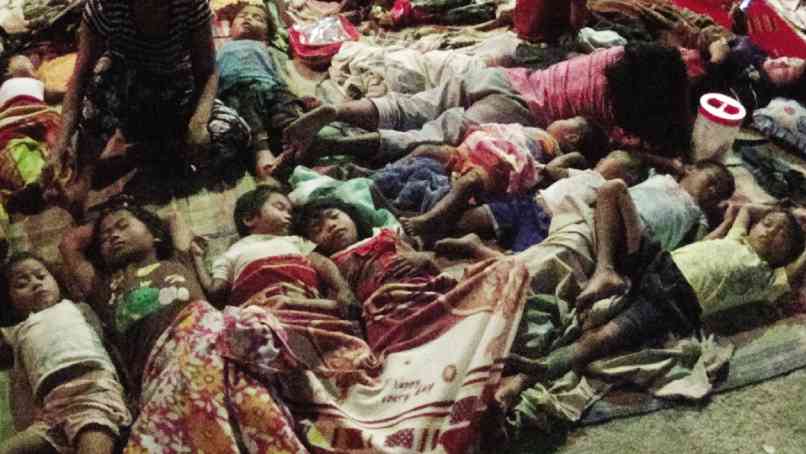
IN AN IMAGE as haunting as the tales of horror it portrays, children of the Manobo tribe in Surigao del Sur  sleep on the ground in a gymnasium converted into a shelter after their families fled a series of armed attacks, killings and arson in their communities being blamed on a militia. PHOTO FROM KARAPATAN-CARAGA

In this Oct. 31, 2014 file photo, children of the Manobo tribe in Surigao del Sur sleep on the ground in a gymnasium converted into a shelter after their families fled a series of armed attacks, killings and arson in their communities.  A group of militiamen has been blamed for the attacks. (PHOTO FROM KARAPATAN-CARAGA)

The lumads left their homes last year after three lumad leaders, Dionel Campus; Emerito Samarca, administrator of the Alternative Learning Center for Agriculture and Livelihood Development (Alcadev); and Juvello “Bello” Sinzo were shot and killed by the Magahat-Bagani militiamen in Han-ayan.

Mapasu’s strong opposition to the entry of logging and mining companies in Lianga might have drawn the ire of the Magahat-Bagani militiamen, an armed anti-communist group led by Datu Calpet Egua. The military has also branded Mapasu as a communist front.

Then Gov. Johnny Pimentel said the Magahat-Bagani was created by the military, an accusation that the Armed Forces of the Philippines had denied.

Almost a year after the killings, no suspect has been arrested, even as the government dangled a P3.6-million bounty for the heads of suspected militia leaders Bobby and Loloy Tejero and Margarito Layno.

http://newsinfo.inquirer.net/810800/duterte-to-supervise-manobos-return-to-surigao-sur-priest

NPA to AFP: Do not undermine ‘historic’ peace talks

From the often pro-CPP online publication the Davao Today (Aug 29): NPA to AFP: Do not undermine ‘historic’ peace talks

Both negotiating panels of the Government of the Philippines and the National Democratic Front expressed optimism on the resumption of the formal talks which opened on Monday, August 22, in Oslo, Norway. (Photo by Kodao Productions)

Both negotiating panels of the Government of the Philippines and the National Democratic Front expressed optimism on the resumption of the formal talks which opened on Monday, August 22, in Oslo, Norway. (Photo by Kodao Productions)
 
The New People’s Army slammed the Armed Forces of the Philippines for maintaining their presence in areas believed to be stronghold of the communist rebels.
 
In a press statement on Saturday, August 27, the armed-wing of the Communist Party of the Philippines perceived such move as an attempt to undermine the ongoing peace talks between the National Democratic Front of the Philippines (NDFP) and the Government of the Republic of the Philippines (GRP).

“The presence and operations of the AFP in rural communities undermine the credibility of the Duterte government among the people as it projects an image of disunity within the GRP or refusal of the AFP to abide by the order of its commander-in-chief,” the NPA said.

The NPA has identified 20 civilian communities across the country where the state security forces believed to maintain their presence.

These communities are in Kalinga, Isabela, Abra, Aurora, Nueva Ecija, Batangas, Quezon, Camarines Norte, Camarines Sur, Albay, Sorsogon, Northern Samar, Western Samar, Negros Occidental, Agusan del Norte, Agusan del Sur, Surigao del Sur, Davao del Norte, Bukidnon and Compostela Valley.

Their presence in the rural communities could endanger the ceasefire declarations separately issued by GRP President Duterte and the CPP, the group warned.

The communist rebels claimed that military troops have encamped in public places such as “barangay centers, occupying barangay halls, community schools and day care centers, senior citizen centers and other civilian structures.”

Military troops have also set-up detachments within civilian communities, the NPA said. They also asserted that AFP are conducting “psywar, surveillance and search and combat operations against the NPA.”

With this, the communist rebels has urged the Communist Party of the Philippines to strongly criticize the Armed Forces of the Philippines (AFP).

The NPA’s statement came as the NDFP and GRP ended the five-day peace talks on Friday, August 26. As a gesture of goodwill, the NPA has released seven prisoners-of-war in Surigao and Compostela Valley.

“In light of GRP President’s call, we anticipate him to be sympathetic to the plight of the peasants and Lumad and see the urgency of ordering the withdrawal of AFP troops from civilian communities,” the NPA said.

On the other hand, Armed Forces of the Philippines, said that a long-term ceasefire will help them bring the Peace and Development Outreach Programs in the civilian communities.

“Now that a ceasefire with the CPP-NPA is in effect, we expect that the implementation of the government’s peace and development programs in the countryside will be able to proceed much faster providing the much needed services to even the remotest barangay,” Army commander Lt. Gen Rey Leonardo B. Guerrero said during the 10th year anniversary of the Eastern Mindanao Command here on Friday, August 26.

Guerrero has attributed the success implementation of the PDOP in far-fung communities through the effective “convergence” of local government units and agencies, organizations, civil society organizations and the security sector and management groups.

http://davaotoday.com/main/politics/npa-to-afp-do-not-undermine-historic-peace-talks/

PNP releases mugshots of escaped terror suspects

From the Sun Star-Cagayan de Oro (Aug 30): PNP releases mugshots of escaped terror suspects


WANTED. Four of the eight members of the ISIS-inspired Maute Group who escaped from the Lanao del Sur Provincial Jail in Marawi City. The terror suspects escaped after some 50 of their cohorts stormed the jail at about 5:40 p.m. on Saturday, August 27. (PNP PHOTOS

OFFICIAL of the Police Regional Office (PRO) in Northern Mindanao is urging the public to report any information on the eight alleged members of a local terror group who escaped from the Lanao del Sur Provincial Jail in Marawi City, on Saturday afternoon, August 27.

Police Superintendent Surki Sereñas, PRO-Northern Mindanao spokesperson, said state security forces are conducting hot pursuit operations against the eight fugitives affiliated with the Isis-inspired Maute Group who were sprung from jail by some 50 other group members around 5:40 p.m., on Saturday, August 27.

Sereñas released mugshots of the eight, identified as Hashim Balawag Maute, Abdul Jabbar Tominaman Macabading, Jamil Batoa Amerul, Muhammad Sianodin Mulo, Omar Khalil, Hafidah Romato Maute, Norhanna Maute and Nasifa Pundug.

He also identified the 15 other escapees: Alawiya Mimbisa, Daud Basari, Saidamin Malna, Muamar Mocsir, Asnawi Manabilang, Danny Abdul Wahab Manabilang, PFC Harry Gamelo, Cardawi Batugan, Aradine Manambilang, Rafsan Macaumbos Salik, Alinor Macaundas, Akil Binong, Rayan Dipatuan Alug, Hasim Bantuas Amatonding, and Abulais Sarangani.

Sereñas said the group is also known to be using eight vehicles: a Mitsubishi Montero (UCI 725), a black Isuzu Dmax (NIR 518), Toyota Innova with temporary plate 130102, and five Toyota Fortuners with plate numbers TQL 601, UIO 713, TDQ 440, TQB 689 and TOD 531.

PRO-Northern Mindanao regional director Chief Superintendent Noel Constantino has ordered all PNP units to intensify and strengthen the conduct of checkpoints and intelligence monitoring to thwart the entry of the Maute group in the region.

"These escapees pose serious threat to public safety and must be prevented from sowing further terror. Rest assured your PNP is doing our best in coordination with the AFP and other government agencies to neutralize this terror group in this part of Mindanao," Constantino said.

Lanao del Sur provincial director Police Senior Superintendent Agustine Tello likewise said they have received reports that the fugitives and their cohorts have already rejoined the bigger group based in Butig town after they reportedly crossed Lake Lanao.

Tello also belied reports that the PNP supposedly received a warning a day before the raid not to interfere as the Maute group considers only the military as its target.

"So far wala pa kaming na receive peru hindi talaga pwede yan. Once they have violated the law they (Maute group) will always be the target of police and military operations and they have to answer for their unlawful act,” Tello said.

Army Colonel Roseller Murillo of the Army's 103rd Brigade said they are prepared to assist the police recapture the fugitives.

"We have done our part and after the inquest proceedings in the court it was then under the police authority and jurisdiction and suspects were turned-over to the Provincial Jaill," Murillo said.

"The military is always prepared to assist the PNP in the manhunt operations against the 23 escapees particularly the Maute local terrorist group,” Murillo said.

http://www.sunstar.com.ph/cagayan-de-oro/local-news/2016/08/30/pnp-releases-mugshots-escaped-terror-suspects-494531

President Duterte honors wounded-in-action soldiers at Palace dinner

From the Manila Bulletin (Aug 30): President Duterte honors wounded-in-action soldiers at Palace dinner

President Rodrigo Duterte hosted a dinner at Malacañang to honor modern-day heroes — the wounded-in-action soldiers – in line with the commemoration of the National Heroes Day.


The selected 64 soldiers invited to the banquet were soldiers that were wounded while performing their duties against groups such as the Abu Sayaff and the New People’s Army (NPA) in Western and Central Mindanao.

The Commander-In-Chief re-assured the soldiers that their welfare will be taken cared of under his presidency and that financial support will continue on for the wounded soldiers. The President also promised promotions for the country’s fighters.

“My presidency will take care of you. Wala kayo dapat alalahanin,” the President said.

The head of state also reported that P4.6 billion pesos allotted for the widows and retired soldiers was already released.

President Duterte encouraged the soldiers to rebuild their lives not only for themselves but for the betterment of the nation.

“Do not be too sentimental about it because there is life after being wounded,” said the President.


(Video from RTVM)

http://www.mb.com.ph/president-duterte-honors-wounded-in-action-soldiers-at-palace-dinner/

Battles ongoing between Philippines army and Abu Sayyaf

From Anadolu Agency (Aug 30): Battles ongoing between Philippines army and Abu Sayyaf

Day after 15 gov't troops die in fierce gunfight, soldiers again battling heavily-armed Abu Sayyaf unit in country's south

Battles ongoing between Philippines army and Abu Sayyaf

One day after 15 government soldiers were killed, two of them beheaded, by a Daesh-linked group in the southern Philippines, heavy fighting between the two have resumed.
 
 Army soldiers of the Philippines army's 21st Infantry Battalion are reported to again be battling a heavily-armed Abu Sayyaf unit, led by sub-leader Jamiri Jawong Jauhari, in the Abu Sayyaf stronghold of Patikul.
 
In a news briefing Tuesday afternoon, Western Mindanao Command spokesman Major Filemon Tan Jr. emphasized that since Aug. 26 efforts to eradicate the group have intensified, with the Abu Sayyaf suffering heavy losses of its own.
 
"The number of killed Abu Sayyaf bandits is already 30 while 11 others [have been] injured. On the government side, we suffered 15 killed in action and 29 others wounded," Tan told defense reporters in a press briefing at Camp Navarro, Upper Calarian, Zamboanga City.
 
"So the total number of deaths on both sides is 45, and 40 others including our troops and Abu Sayyaf were injured since Friday fighting."
 
Tan reflected on the deaths of the 15, which occurred Monday -- Philippines National Heroes Day -- in a fierce gunbattle in Patikul, less than 10 kilometers (6.2 miles) from Jolo, the capital of southern Sulu province.
 
"Our forces fought gallantly, the firefight was intense and our troops sacrificed their lives to give the next generation the peace and security they truly deserve," Tan said. 
 
"We will mourn the loss of our brothers, but it will not dampen the fighting spirit of our troops. The momentum is on our side and we will continue this fight until we accomplish the mission."
 
He warned that whoever blocks troops or helps the Abu Sayyaf would be dealt with severely.
 
"What you see is just the tip of the iceberg - more troops, more equipment and more firepower will be committed to destroy the Abu Sayyaf. It is just a matter of time," said Tan.
 
Meanwhile, Joint Task Force Sulu Commander Brig. Gen, Arnel de la Vega said in a statement that intense fighting has been ongoing in Sulu since 1.50 p.m. (0550GMT) Monday.
 
The 15 soldiers were reported to have died at 4.30 p.m. in the village of Maligay in Sulu.
 
"In a fierce ongoing armed encounter, two ASG [Abu Sayyaf] members were killed and a number of them severely wounded as they withdrew southeast," Lobos said.
 
The security forces suffered zero casualties, he added.
 
Tan placed the total Abu Sayyaf fighters in Sulu and Tawi-Tawi at 481, but added that the military does not have exact figures on how many sympathizers, supporters or "operatives recruited through dubious means" the group has.
 
Since 1991, the Abu Sayyaf -- armed with mostly improvised explosive devices, mortars and automatic rifles -- has carried out bombings, kidnappings, assassinations and extortion in a self-determined fight for an independent province in the Philippines.
 
It is among two militant groups in the south who have pledged allegiance to Daesh, prompting fears during the stalling of a peace process between the government and the country's biggest Moro group that it could make inroads in a region torn by decades of armed conflict.
 

US, Japan conduct anti-submarine warfare exercise in Philippine Sea

From Update.Ph (Aug 30): US, Japan conduct anti-submarine warfare exercise in Philippine Sea

The United States Navy and Japan Maritime Self-Defense Force (JMDSF) have conducted anti-submarine warfare exercise in Philippine Sea August 22-26. The said exercise is called Ship Anti-Submarine Warfare Readiness Effectiveness Measuring (SHAREM) program.

SHAREM is a series of events focused on anti-submarine warfare procedures and tactics designed to measure how effectively surface ships and aircraft can detect and track submarines, the US Navy said.

US Navy guided-missile destroyers USS Decatur (DDG 73) and USS Spruance (DDG 111), a Los Angeles-class nuclear submarine, Japanese Akizuki-class destroyer JS Teruzuki (DDG 116), an Oyashio-class diesel-electric submarine participated in the exercise.

“SHAREM was an exceptional opportunity to improve our anti-submarine warfare skills and work alongside our Japanese allies,” said Lt. j.g. Sean Quirk, anti-submarine warfare officer, Destroyer Squadron (CDS) 31. “These unique exercises improve our bilateral capabilities, making us a stronger combined force to deter any adversary.”

The US Navy said Decatur and Spruance, along with USS Momsen (DDG 92) and the embarked “Devil Fish” and “Warbirds” detachments of Helicopter Strike Squadron (HSM) 49 are part of the 3rd Fleet Pacific Surface Action Group (PAC SAG), led by CDS 31 and operating under Commander, U.S. 3rd Fleet, as demonstrating the “3rd Fleet Forward” concept.

http://www.update.ph/2016/08/us-japan-conduct-anti-submarine-warfare-exercise-in-philippine-sea/8873

Harpoon missile-armed US littoral combat ship deployed to Western Pacific

From Update.Ph (Aug 30): Harpoon missile-armed US littoral combat ship deployed to Western Pacific

USS Coronado launches a Harpoon Block 1C missile for the first time during exercise Rim of the Pacific. US Navy photo

USS Coronado launches a Harpoon Block 1C missile for the first time during exercise Rim of the Pacific. US Navy photo

After participating in the exercise Rim of the Pacific 2016, United States Navy Independence-class littoral combat ship USS Coronado (LCS 4) departed Joint Base Pearl Harbor-Hickam August 26 to continue its independent deployment to the Western Pacific, US Navy 7th Fleet’s area of operations.

During the RIMPAC 2016, USS Coronado successfully launched a Harpoon Block 1C missile July 19.

“The firing of the Harpoon missile from Coronado represented the first time over-the-horizon (OTH) missile technology has been introduced to the littoral combat ship class,” the US Navy said.

“Throughout deployment I expect a total team effort culminating with a safe and successful deployment characterized by smart execution, conspicuous professionalism, rigorous preparation, and the completion of all assigned operational tasking,” said Cmdr. Scott Larson, commanding officer of Coronado and LCS Crew 204.

USS Coronado is assigned to 3rd Fleet. While deployed to 7th Fleet, Coronado will conduct routine patrols, port visits and exercises with regional navies. Among the interactions Coronado is scheduled are exercise Kakadu in Australia and Deep Sabre in Singapore.

http://www.update.ph/2016/08/harpoon-missile-armed-us-littoral-combat-ship-deployed-to-western-pacific/8877

Coast Guard Special Operations Group starts training

From Update.Ph (Aug 30): Coast Guard Special Operations Group starts training

Coast Guard photo

The Philippine Coast Guard Special Operations Group has commenced training of fifty seven (57) candidates. The Coast Guard Special Operations Course (CGSOC) Class 25-2016 was convened August 26.

The CGSOC is a rigorous course conducted by the Coast Guard Special Operations Group for aspirants to become physically and mentally fit. “The candidates must be in excellent physical condition to last the grueling first phase of the course which is the motivation phase,” the Coast Guard said.

“The course is a battle of the body and mind wherein candidates must fully embrace that any goal is worth pursuing and have to struggle to surpass pain and discomfort in order to develop their attitudes as best rescuers,” it added. “Candidates must also push their bodies and minds so that they meet adversity with braveness and strength to become efficient special operators.”

The training is divided into four phases: Motivation Phase which includes Physical Conditioning and Hell Week; SCUBA Phase which covers Occupational SCUBA and Technical Diving; Tactics Phase covering Hydrographical Reconnaissance, Demolition, Air to Ground Operations, Small Unit Tactics, and Marksmanship; and Non-Academic which covers Physical Training and Development, Aptitude, and Peer Rating.

http://www.update.ph/2016/08/coast-guard-special-operations-group-starts-training/8888

Norwegian facilitator 'cautiously optimistic' about PH, NDF talks

From Rappler (Aug 30): Norwegian facilitator 'cautiously optimistic' about PH, NDF talks

Ambassador Elisabeth Slattum brings her experience from the successful Columbian peace talks to the Philippine peace process   

FACILITATOR. Norwegian envoy Elisabeth Slattum assumed the role as facilitator of Philippine peace talks in 2014 and was behind an aborted attempt to revive it in 2015. Photo by Edwin Espejo/OPAPP

FACILITATOR. Norwegian envoy Elisabeth Slattum assumed the role as facilitator of Philippine peace talks in 2014 and was behind an aborted attempt to revive it in 2015. Photo by Edwin Espejo/OPAPP

Norwegian Ambassador Elisabeth Slattum sat down with both panels from the Philippine government and the National Democratic Front (NDF) August 22-27 as facilitator of the negotiations that led to a historic joint statement on the resumption of talks and indefinite ceasefire.

Slattum is an experienced facilitator who was part of the initial secret negotiations between the Colombia government and FARC rebels, which resulted in the recently announced historic peace deal.

She assumed the role as facilitator of Philippine peace talks in 2014 and was behind an aborted attempt to revive it in 2015. (READ: Talks with Reds casualty of Mamasapano, too)

The recently concluded talks in Oslo was only the first of what is hoped to be several rounds of talks that the Philippine government aims to complete within a year.

Rappler's Carmela Fonbuena interviewed Slattum in Oslo to assess the prospects of ending Asia's longest running communist insurgency.

What is the role of Norway in the peace talks between the Philippine government and the communist rebels?

In general, when we are facilitating a peace process, we have our role as facilitator at the table which includes what goes on on the table and all the logistics of it. We host meetings, not only formal meetings like this, but also informal meetings and informal dialogues between the parties if there is a crisis or if the parties leave the table and they are too proud maybe to take the initiative to talk again. It’s good that a third party can invite them to come back to try to address the issues that made them separate in the first place. It is often easier for them to say yes to the facilitator than say yes to each other if there is a deep wound or there is a deep crisis.

Talks have collapsed too many times between the Philippine government and the communist rebels. What has kept Norway going?

We were asked by the parties to be the facilitator in 2001. For Norway, in our work on peace processes, we have a very long term mindset. We know that peace processes are marathons and not sprints. We believe that if there’s a chance, even if it’s not very big, that the parties can reach an agreement, we want to contribute to that happening. That risk is worth taking. That is our mindset especially when people ask us how much money do you spend on this. It takes a lot of resources but, in our view, conflict is one of the most important obstacles to development and it leads to so much human suffering. We believe that the money that we can spend on trying to prevent or solve conflict is money well spent.

CLOSED DOORS. Ambassador Elisabeth Slattum inside closed-door panel to panel meetings in Oslo. Photo by Edwin Espejo/OPAPP

CLOSED DOORS. Ambassador Elisabeth Slattum inside closed-door panel to panel meetings in Oslo. Photo by Edwin Espejo/OPAPP
How was it sitting down with negotiators of the warring parties?

The parties have conducted these peace talks with great dignity. I’m very impressed with the way that they’ve conducted their peace talks. They’ve shown a great amount of respect for each other, but they have also been constructive and solution oriented even when discussing very difficult matters. This is something that not only makes our job much easier. It gives great hope for the talks.

Norwegian foreign minister Borge Brende called them 'the most kind and the most warm negotiators.'

You can definitely feel that there is a great amount of trust between the parties. It is obvious there have been informal talks on the sidelines and that there has been prior contact between parties. You can feel that in the room because things are going really smoothly at the table. That helped, definitely. They seem to almost like each other.
For enemies in an armed conflict, it is rare to find that kind of constructiveness and mutual respect.

Did the friendly relationship between the two parties surprise you?

It is true that the parties are very able to often get along well in a human level but when it comes to substance, it doesn’t mean that they necessarily agree or reach an agreement. This time around they were very solution oriented. I think that the trust that they built between themselves definitely helped. In general, sometimes you might have to differentiate between the human level and the actual substantive level. They are definitely negotiators primarily.

What did you do when there were heated exchanges in the negotiating table?

I cannot comment on what goes on inside the room.

Are you optimistic that this time the talks will be successful?

I would say I’m cautiously optimistic. I think this joint statement was unprecedented and historic. It’s a very promising start, but at the same time we have very difficult issues ahead. I’m very happy that the parties have been able to tackle some of the procedural issues that have been blocking the peace process for a long time, and I’m very glad that parties will now be able to address substantive issues.

GREAT START. The Philippine government and the National Democratic Front signed on August 26, 2016 a joint statement on resumption of talks and indefinite ceasefires. Photo by Edwin Espejo/OPAPP

GREAT START. The Philippine government and the National Democratic Front signed on August 26, 2016 a joint statement on resumption of talks and indefinite ceasefires. Photo by Edwin Espejo/OPAPP

Norway also facilitated the historic peace deal between the Colombian government and the FARC rebels.

The Colombian peace talks, the secret phase or the very informal phase, started in 2011. I was part of the team from Norway that facilitated the talks between the FARC guerrilla and the government in the secret phase and also in the formal phase until I started this job [in 2014]. It’s so great. We are extremely happy. Finally, after 5 years of of talks we finally have a peace. They had almost continuous talks. FARC lived in Cuba all those years and the government negotiators traveled forth and back between Colombia and Cuba. They had very frequent meetings to address the root causes of conflict.

Can you compare the two peace talks?

We’ll see how. This is just the start [of the Philippine peace talks]. We haven’t really started discussions on substance. We don’t have a framework yet. We’ll have to see, I think. But there seems to be right now a similar level of commitment especially from the President’s side.

The President is always a big factor?

Oh, very much. Both sides need to have that strong decisiveness, determination and commitment. There will always be crisis and reasons to walk out, but you need that commitment to stay at the table. This is what we will see also in this peace process: If that commitment is so strong that no matter what happens on the ground, the parties will not leave the table.

In the Colombian peace process, in the beginning of the secret talks, the leader of the FARC was murdered. He was killed by the military. We thought maybe that was it. It was not going anywhere. But FARC returned to the table, and today we have a peace agreement. It's the same with the government. A general was kidnapped and they reacted very strongly, but they did never leave the table. So you need that level of commitment.

No matter how desperate, you don't give up.

You need that patience and determination, but you also need a willingness to take risks because there are a lot of stakes in peace proceses. Both sides will probably have to make decisions that might not be popular in all sectors of society, but it is important to be able to take those risks.

http://www.rappler.com/nation/144481-norway-envoy-cautiously-optimistic-philippines-talks

Soldiers told: Don't be 'too optimistic' about Duterte's salary hike vow

From Rappler (Aug 30): Soldiers told: Don't be 'too optimistic' about Duterte's salary hike vow

Defense Secretary Delfin Lorenzana has been telling troops to 'hope for the best' but to expect complications before the fulfillment of Duterte's promised pay hike   

DUTERTE'S PROMISES. President Rodrigo Duterte does the fist gesture with uniformed personnel of the 2nd Infantry Division at Camp Capinpin in Tanay, Rizal on August 24. Photo by Toto Lozano/PPD

DUTERTE'S PROMISES. President Rodrigo Duterte does the fist gesture with uniformed personnel of the 2nd Infantry Division at Camp Capinpin in Tanay, Rizal on August 24. Photo by Toto Lozano/PPD
 
While President Rodrigo Duterte has been telling soldiers to expect their salaries to be doubled by this December, Defense Secretary Delfin Lorenzana has also been telling troops not to be "too optimistic" about this promise.
 
"Inannounce ko na 'yan sa tropa na do not be too optimistic kasi depende naman 'yan," Lorenzana told reporters on Monday, August 29, during a chance interview. (I announced to troops not to be too optimistic because it is dependent on many things.)

"Although the promise of the President is good, but sometimes the realities of the purse, parang ikaw tatay ka, nangako ka pero wala palang pera, 'Anak, puwede maghintay-hintay ka lang nang sandali?'" added the defense secretary. (You are like a father, you made a promise but it turns out there is no money yet, 'My child, can you wait a little bit?)

Duterte, in his recent military camp visits, has been assuring soldiers that there will be an incremental increase in their salaries in August and a doubling of their salaries by December. (READ: Why has Duterte visited 14 military camps in less than a month?)

But Budget Secretary Benjamin Diokno told the Senate that there will be no increase in salaries in August.

However, Diokno said P39.5 billion has been allotted for the salary hike of military and police in the proposed 2017 national budget.

Lorenzana also said it will be Diokno who will determine if there are enough funds for Duterte's promises to the military.

"It depends on Secretary Diokno because if there is no money, we will wait for next year," he said in a mix of English and Filipino.
 
The defense chief said he has told soldiers to steel themselves should something happen to prevent Duterte from fulfilling his vow.
 
But he gave his assurances that, sooner or later, the President will make good on his promises.
 
"I told them to hope for the best but expect some aberya (complications) along the way. Pero mangyayari 'yan, kung hindi ngayon, next year (But it will happen, if not now, next year)," said Lorenzana.

http://www.rappler.com/nation/144631-duterte-military-salary-increase-optimistic-lorenzana

'Ultimate sacrifice': The 15 soldiers killed in clashes vs Abu Sayyaf

From Rappler (Aug 30): 'Ultimate sacrifice': The 15 soldiers killed in clashes vs Abu Sayyaf

'Much as every soldier, sailor, marine, or airman knows that laying down one's life is all part and parcel of their job, we in the AFP vow to pursue this battle to conclusion'


Fifteen Army soldiers died on Monday, August 29, during a series of clashes against members of the Abu Sayyaf Group (ASG) in Patikul, Sulu.

According to the Armed Forces of the Philippines (AFP), soldiers from the 21st and 35th infantry battalions encountered at least 120 heavily armed members of the ASG in Barangay Maligay in Patikul town at around 4:30 pm.

They are:

2LT Ernan P Gusto, 33, M, Isabela
SSgt Ruel A Catubay, 39, M, Zamboanga Sibugay
Sgt Jay Erwin L Almohallas, 38, M, Lanao del Norte
Cpl Omar M Raddulan, 41, M, Lanao del Norte
Cpl Ronald M Galoniga, 33, M, Lanao del Norte
Cpl Elid S Ismael, 49, M, Jolo, Sulu
Cpl Salik H Mandangan, 31, M, Lanao del Norte
Pfc Nestor C Bacaling, 26, S, Lanao del Norte
Pfc Jison B Falcasantos, 28, S, Zamboanga City
Pfc Gerald A Yubal, 29, S, Zamboanga Sibugay
Pfc Dhendo A Dujo, 32, M, Zambaonga Sibugay
Pfc Roselito A Arnoco, 29, S, Zamboanga del Sur
Pfc Glend C Resma, 24, S, North Cotabato
Pfc Rogelio D Vincoy, 28, M, Zamboanga del Norte
Pvt Jonas A Lumayan, 23, S, Zamboanga del Sur

Ten other soldiers were wounded during the encounter, part of the military’s efforts to eliminate the ASG.

“As we gaze at the national flag that flies at half-mast anew, soldiers knew that one too many hero among them has again offered his life – that others may live,” AFP Chief of Staff General Ricardo Visaya said of the 15.

He added: “Much as every soldier, sailor, marine, or airman knows that laying down one's life is all part and parcel of their job, we in the AFP vow to pursue this battle to conclusion.”

President Rodrigo Duterte had earlier ordered the AFP to “destroy” the ASG, following reports that the group had beheaded another of its hostages. Earlier in April and June, the kidnappers beheaded two Canadian hostages.

The Abu Sayyaf, whose leaders have pledged allegiance to ISIS, is behind the spate of kidnappings in Western Mindanao in the last two decades. The group is believed to be holding a Norweigan, a Dutch bird-watcher, and 4 Filipinos, seized in separate raids.

“My orders to the police and armed forces against enemies of the state: seek them out in their lairs and destroy them... The Abu Sayyaf, destroy them, period,” Duterte said.

Visaya said the military will not stop “until we rid our country of the menace this ASG brings to the world.” The AFP general ordered field commanders to “keep the pressure on the enemy until they wear out.”

“Just ensure they won't be able to leave the island and we will be triumphant in the end,” he said.

http://www.rappler.com/nation/144640-afp-15-soldiers-killed-abu-sayyaf

80% of housing for military, police at Bulacan site left unoccupied

From Rappler (Aug 30): 80% of housing for military, police at Bulacan site left unoccupied

IDLE. Thousands of idle NHA houses were found in Bocaue, Bulacan. Photo from the Office of the Vice President

IDLE. Thousands of idle NHA houses were found in Bocaue, Bulacan. Photo from the Office of the Vice President

Thousands of housing units in Bocaue, Bulacan that were intended for police and military personnel were found to be idle.

During Vice President Leni Robredo's visit to the National Housing Authority (NHA) project for members of the Armed Forces of the Philippines (AFP) and Philippine National Police (PNP), she found that only 800 out of 4,000 units are occupied since most of the beneficiaries are on field assignments.

The housing facilities were built for soldiers and policemen earning lower salaries. (READ: Robredo: Gov't must build over 2,600 homes a day to beat backlog)

Robredo, who also chairs the Housing and Urban Development Coordinating Council (HUDCC), earlier mentioned that she found several housing projects for the PNP and the AFP that were not maximized like the ones in her home province, Camarines Sur.

Aside from unused units, occupants complained of the lack of utilities at the Bocaue site.

"This is just one of the areas I visited. And it seems the problems are all the same – lack of available jobs, poor utilities. The condition is very unfortunate," Robredo said.

The Vice President also relayed what one of the families told her during their consultation. "[Each] house costs P140,000 but there are a lot of problems like walls cracking so they spent 3 times more for the cost of repair," she said in Filipino.

Master plan

Robredo earlier ordered the inventory of necessary housing data for the HUDCC to craft a comprehensive housing plan in consultation with stakeholders such as private firms and marginalized sectors.

The HUDCC will conduct strategic planning on Thursday, September 1, with the goal of shifting its mindset from simply building homes to creating livable communities. (READ: VP Robredo pushes for creation of housing department)

Robredo, who has consulted with several communities and stakeholders in her two months in office, said they will use the feedback to create their master plan.

One key issue, said the housing chief, is the lack of jobs in resettlement areas, which are usually in provinces near Metro Manila.

Robredo said they will aim to make housing sites in-city so not to uproot people from their livelihood. But she is also looking into connecting the prospective occupants who are unemployed to the contractors of socialized housing projects, like in Thailand.

"Kaya iyong walang trabaho, puwedeng sila na ang workforce eh. Gaya ngayon, a few days ago kausap ko iyong asosasyon ng mga nasa socialized housing, sabi nila up daw ngayon iyong real estate business at kulang sila ng mga trabahador," the Vice President said. (Those unemployed can be the workforce. A few days ago, I spoke with an association involved in socialized housing and they mentioned that the real estate business is booming and they need laborers.)

"Why not [source from] us, right? We have to do an inventory of skills. If the unemployed ones lack the skills, then they should be trained in that field," she added.

Robredo clarified that the proposed training would not entail additional budget for the HUDCC as she sees it as a partnership with other government agencies such as the Technical Education and Skills Development Authority (TESDA) and the Department of Social Welfare and Development (DSWD).

http://www.rappler.com/nation/144665-bocaue-bulacan-housing-military-police-unoccupied-hudcc-robredo