Sunday, June 19, 2016

No PH-China talks on sea row in 2 yrs

From the Philippine Daily Inquirer (Jun 20): No PH-China talks on sea row in 2 yrs

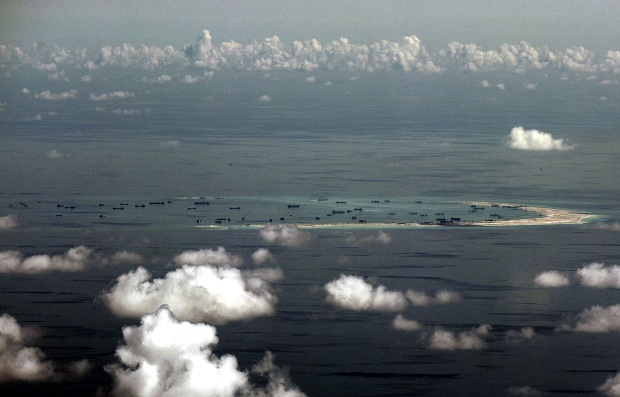
China South China Sea


AP FILE PHOTO

FORMER Foreign Secretary Albert del Rosario on Friday said President-elect Rodrigo Duterte had given  assurance that there would be no bilateral talks with China to resolve the territorial dispute in the South China Sea in the next two years.

Supreme Court Associate Justice Antonio Carpio also said the Philippine panel in the arbitration proceedings against China had received the same assurance from Duterte.

Del Rosario led the Philippine panel that argued the country’s case against China in the United Nations Permanent Court of Arbitration in The Hague.

Carpio, who has done an extensive study on the territorial dispute between China and the Philippines in the South China Sea, was an observer in the proceedings.

The Philippines has asked the UN tribunal to invalidate China’s claim to almost all of the 3.5-million-square-kilometer South China Sea and demanded its right to exploit resources in waters within its 370-km exclusive economic zone, recognized under the United Nations Convention on the Law of the Sea, be respected.

China has refused to take part in the proceedings, saying it will not abide by any ruling of the court.

The court is expected to hand down its decision by July 7.

In a television interview on June 10, incoming Foreign Secretary Perfecto Yasay said bilateral negotiations with China were necessary, as the UN court had no powers to enforce its rulings.

“We feel that the ruling will require bilateral talks with China, then by all means let’s pursue that. Let’s not drop that possibility,” Yasay said.

In an interview with the Inquirer on June 3, Yasay said bilateral negotiations were “always the way to go in so far as resolving this conflict is concerned.”

“Even if we get a favorable judgment from the arbitral tribunal, there might be some questions of enforcement or implementation of this decision, [because] the court does not have an enforcement capability,” he said.

The arbitration panel has asked the incoming administration to wait for the tribunal’s decision before moving for talks with China.

“I don’t think [Duterte] would go bilateral,” Del Rosario said in an interview after attending the Trident Defense and Security Forum at Solaire Resorts in Pasay City on Friday.

“We talked already and the [incoming] President said he [would] wait for developments over a two-year period and, if nothing happens, he would go bilateral,” Del Rosario said.

Carpio, a guest speaker at the forum, said the Philippines had “convinced the world to support us that the arbitration is the way to go.”

“So we will wait for the tribunal and we will decide [what measures to take to have the ruling enforced],” he said.

In his presentation at the security forum, Carpio said the Philippines would need to take legal and diplomatic tacks, including elevating the case to the United Nations itself, to have the ruling enforced.

“There is no world policeman to enforce the ruling of the arbitration [court], but we are not helpless,” he said.

Once China moved a gas platform to Recto Bank (Reed Bank), a reef in the Spratly archipelago claimed by the Philippines, Carpio said Manila could file a lawsuit against Beijing where the Chinese have assets, like Canada and the United States.

With a favorable ruling from the arbitration court, the Philippines can win the suit in Canada and seize the assets of China’s national oil company in Canada as payment for the gas that China will get from Recto Bank, he said.

http://globalnation.inquirer.net/140288/no-ph-china-talks-on-sea-row-in-2-yrs

Of general/regional interest: Navy warships to trade some speed for firepower, armor

From the Philippine Daily Inquirer (Jun 20): Navy warships to trade some speed for firepower, armor

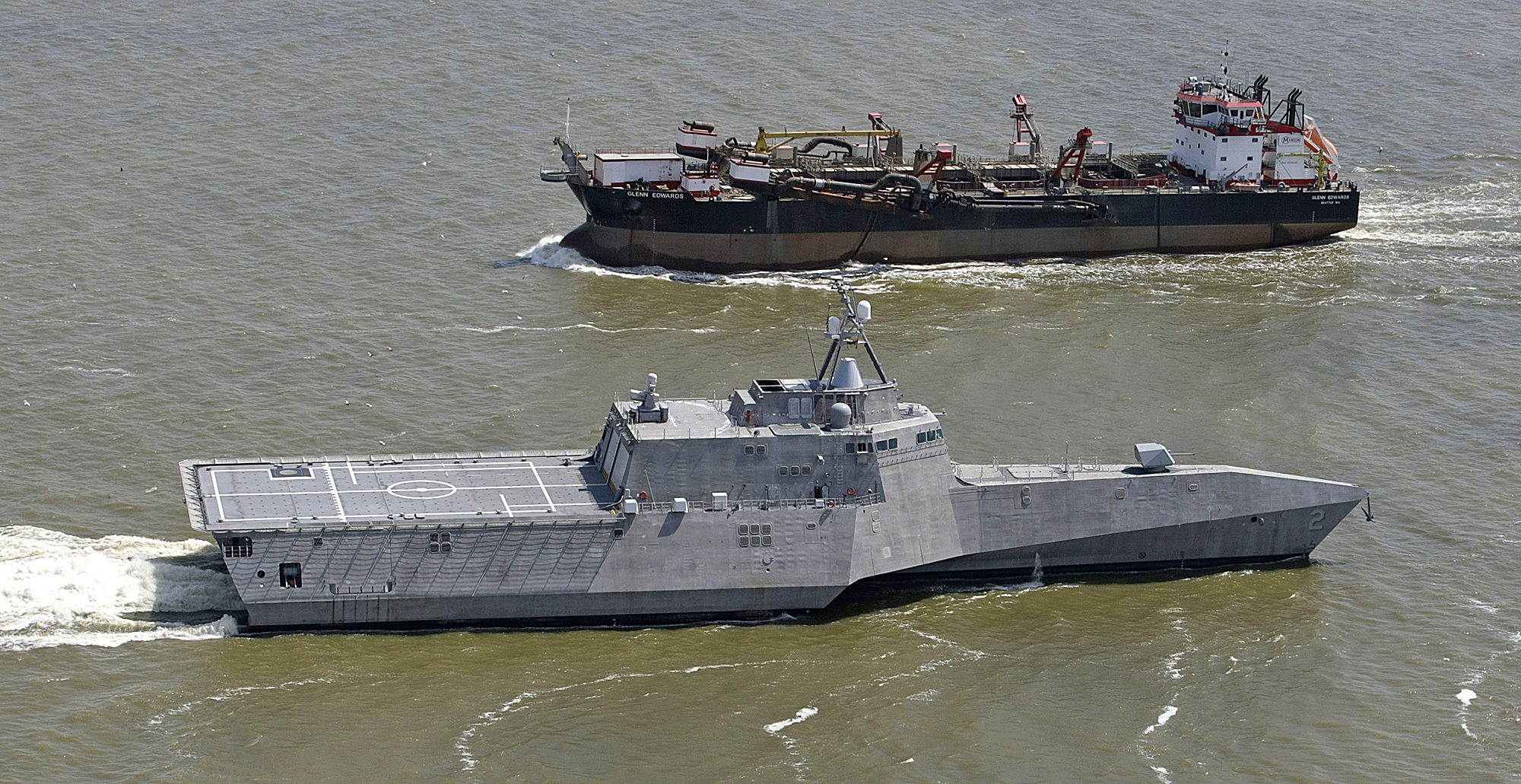
FILE - In this March 24, 2010, file photo, the littoral combat ship USS Independence, foreground, passes another vessel as it makes its way south through the waters of Mobile Bay, Ala. The Navy spent hundreds of millions of taxpayer dollars to fulfill its need for speed with the fast and agile warships like the Independence. The gee-whiz factor of the ships, designed to meet unconventional threats and to operate in shallow coastal waters, has been overshadowed by concerns over costs and survivability during combat. (G.M. Andrews/AL.com via AP)  MAGS OUT; MANDATORY CREDIT

In this March 24, 2010, file photo, the littoral combat ship USS Independence, foreground, passes another vessel as it makes its way south through the waters of Mobile Bay, Alabama. The Navy spent hundreds of millions of taxpayer dollars to fulfill its need for speed with the fast and agile warships like the Independence. The gee-whiz factor of the ships, designed to meet unconventional threats and to operate in shallow coastal waters, has been overshadowed by concerns over costs and survivability during combat. GM ANDREWS / AL.com / AP

The Navy spent hundreds of millions of taxpayer dollars to fulfill its need for speed with a new class of fast and agile warships capable of zipping along at highway speeds.
It turns out speed is overrated.

The Navy has learned lessons from the light-and-speedy littoral combat ships: Upcoming ships will trade some speed in favor of more weapons and heavier armor.

Rear Adm. Peter Fanta, director of surface warfare, said the goal is to increase the offensive punch of all warships from the biggest to the smallest. For the littoral combat ship, that’ll begin with the installation of over-the-horizon missiles this summer.

“Each ship that I now have — I have to make more lethal because I cannot build ships fast enough, or enough of them,” Fanta told The Associated Press.

Two versions of the warships were sped into production to meet the Navy’s goal of an affordable, fast ship to operate in shallow coastal — or littoral — waters.

The ships, which are capable of topping 50 mph, utilize steerable waterjets instead of propellers and rudders to operate in shallow water.

They also are built to be equipped with swappable mission modules for surface warfare, anti-submarine duty or mine removal. That’s in contrast to larger, multi-mission ships like the 610-foot Michael Monsoor, a Zumwalt-class destroyer christened Saturday at Bath Iron Works.

But the gee-whiz factor was overshadowed by concerns over growing costs — the latest versions cost $482 million to $563 million apiece — along with criticism by the General Accounting Office that the warships were too lightly armed and too lightly armored.

Two high-profile breakdowns, in December and January, raised additional questions about reliability: The USS Milwaukee had to be towed 40 miles to a naval base in Virginia, while the USS Fort Worth was sidelined in Singapore.

Fanta said the Navy is learning from the initial deployments and incorporating changes into a new version which will be called a frigate. The Navy also intends to zero in on one design either next year or the following year, leading to cost savings.

The Freedom class with a steel monohull is built in Marinette, Wisconsin, while the tri-hulled, aluminum Independence class is built in Mobile, Alabama.

Both were rushed into production to deal with unconventional post-Cold War threats including swarm boats and pirates. But the threats have changed again with China flexing its muscle in the South China Sea and Russia reasserting its naval presence.

Despite growing pains, Fanta sees the warships as being made more capable through heavier armor plating and shock mounting to make them sturdier, along with additional weapons.

The first over-the-horizon missile capable of hitting targets more than 50 miles away is to be installed this summer and it will be followed by tests of a second missile variant this fall, he said. Some of the capabilities will be fitted onto existing ships, about two dozen of which are either in the fleet, under construction or under contract. Eventually, the Navy plans to build 40 of them.

The resulting ship will be slightly slower and heavier, but the weapons will make enemies keep their distance, he said.

It’s unclear how much speed will be lost because of the added weight.

“We acknowledge that there will be trade-offs in speed based on additional weight to support increased capabilities. That number will be defined further as the ship’s design continues to mature,” said Ensign Marc Rockwellpate, a Navy spokesman.

Loren Thompson from the Lexington Institute said it makes sense to place less emphasis on speed. “You can’t outrun a missile,” he said. http://newsinfo.inquirer.net/791455/navy-warships-to-trade-some-speed-for-firepower-armor

DWDD: USLS MERCY | US Navy Hospital Ship to visit Legazpi City

From DWDD AFP Civil Relations Service Radio Website (Jun 17): USLS MERCY | US Navy Hospital Ship to visit Legazpi City


A United States Navy hospital ship is set to arrive in Legazpi City on June 27.

According to thew Philippine Navy, the USLS Marcy, a state-of-the-art US Navy ship equipped with advanced medical facility and equipment will arrive here for a joint humanitarian program of the US Navy and the Philippine Naval Forces in Southern Luzon from June 27 to July 11.

The US Navy hospital personnel has set for treatment 4,000 local patients for the scheduled medical mission, which will be done aboard the ship.

Navy officials also clarified that this is a humanitarian program, under the Pacific Partnership program, and is very much different from the Baliktaran Exercses which is a joint military exercise,” Alejandro said.

They added that the humanitarian program, would consist of a medical mission, civil-relation activity, training and subject matter exchange between the two naval forces, which is part of the Philippine-U.S. Mutual Defense Agreement.

The USLS Marcy hospital ship last visited the Philippines in 2013 where they extend humanitartian assistance to thousands of victims affected by super typhoon Yolanda.

http://dwdd.com.ph/2015/usls-mercy-us-navy-hospital-ship-to-visit-legazpi-city/

MILF: Editorial -- Public consultations on BBL already sufficient

Editorial posted to the Moro Islamic Liberation Front Website (Jun 16): Editorial -- Public consultations on BBL already sufficient

In democracy, sovereignty resides in the people, and thus any major decision that affects their lives especially in legislation requires a consultation with them. One such piece of legislation is the proposed Bangsamoro Basic Law (BBL) which will serve, if enacted into law, as the basic law for the Bangsamoro political entity that it seeks to establish.

But consultations for this proposed law have already been virtually over.  All what should be done is to revisit or use the inputs of these consultations or hearings, in the case of Congress, to fast-track the legislative roadmap or process. Or better still, to refine them to ensure the smooth flow of the process and ensure the early passage of the BBL in Congress.

Consultations have been sufficiently done by pushers or stakeholders of peace in Mindanao notably the government and MILF peace panels, the Office of the Presidential Adviser on the Peace Process (OPAPP), the Bangsamoro Transition Commission (BTC), non-government organizations (NGOs) or civil society organizations (CSOs), and religious, educational, and business institutions. For instance, the Mindanao Civil Society Organizations for the Peace Process (MCSOPP), in a tie-up with the BTC, had conducted 625 consultations throughout the country especially in Mindanao from 2014 to 2015. There were other CSOs like the Initiatives for International Dialogue (IID) and its allied networks such as the Mindanao Peaceweavers (MPW) which have also conducted similar consultations. This is not to include those undertaken by the BTC or members thereof, which brought them to many parts of Mindanao especially Tawi-Tawi, Sulu, Basilan, Lanao, Maguindanao, and Marawi City, Isabela City, and Cotabato City. Many of the provisions of the BBL were culled from inputs from these consultations. The Senate and Lower House of Congress have also conducted numerous hearings. The BBL had been with them for more than a year when it was formally submitted to them during a ceremony in MalacaƱang Palace on September 10, 2014.

Any consultation asking the same people or repeating the same issues will only slow down, if not stifle, the legislative process. More seriously, if those to be asked are those who harbour strong anti-Moro prejudices, biases, hatred, the outcome is already predicted.

We are not saying, however, that President-elect Rodrigo Duterte has ever thought of this thing, or by any member of his inner circle especially OPAPP Secretary-nominee, Jesus Dureza. None of it is in our mind. Duterte had solemnly pledged during the presidential campaign in May this year that he would solve the “legitimate grievances” of the Bangsamoro people; and “nothing,” he said further, “can satisfy them except by passing the BBL.”

We hold on to this promise, as sacred, and we believe in him! All his close friends for years whom we talked to attested to his loyalty to friendship and once he commits he fulfils.

If ever we want this said, it is because of our earnest desire to remind all and sundry that if we are to proceed to solve the Bangsamoro Question or Problem, the single-point agenda of the GPH-MILF peace process, agreed by the Parties when they agreed to talk peace in 1997, then they have to start from where they stopped. In this case, they should commence or proceed immediately to implementation mode, because the CAB which contains the political solution to the Bangsamoro Question or Problem had already been signed as early as March 2014. The implementation mode has two tracks, but linked with each other: the refiling or passage of the BBL and the normalization process, which encompasses many tracks. For one, decommissioning of MILF weapons and combatants will not move if the BBL does not move in the legislature. This is the agreement of the Parties.

Finally, to re-stress, consultations on ways to craft the best BBL compliant to the Comprehensive Agreement on the Bangsamoro (CAB) will still happen, but the purpose is to hasten and enrich the process and not to forestall it.

http://www.luwaran.com/home/index.php/editorial/25-january-16-23/775-public-consultations-on-bbl-already-sufficient

MILF: UN representative visits MILF leadership at Camp, Darapanan

Posted to the Moro Islamic Liberation Front Website (Jun 14): UN representative visits MILF leadership at Camp, Darapanan


Monday, June 13--- Mr. Ola Almgren, UN Resident Coordinator, accompanied by Mr. Chetan Kumar, Peace and Development Advisor, UN Manila and Mr. Winston Camarinas, UNDP-Cotabato paid courtesy call to Moro Islamic Liberation Front (MILF) Chairman Murad Ebrahim and members of the Central Committee.

Almgren, as he himself said, came with eagerness to hear from Chairman Murad his perspectives pertaining to MILF statement released two days ago. He mentioned that it is to be noted that before the MILF press release (June 11) came out, peoples’ perception of BBL uncertainty is widely manifested.

In response to Mr. Almgren’s queries, Chairman Murad related his recent travel to Europe upon the invitation of the European Union wherein they observed that wherever they go, similar question is always ask to them: “What will happen now that new administration is coming.”

He also said, “Until now we are not yet certain of what will be the policy of the new administration, or how their approach would be, but there is an optimism it will continue with the peace process.  Gauging from their pronouncements during the campaign period and even after the elections, there is consistency that they will continue with the peace process.”

Furthermore Chairman Murad said, “For the MILF, basically the peace process is already in the implementing stage, and in this implementing stage we are facing more challenges. Along with the implementation stage, the road map is important to be followed.”

He pointed out, “If we create another road map, it will complicate the situation.  In a lengthy discussion with Organization of Islamic Cooperation (OIC), generally, they too, agree to support the Road Map.”

“On the issue of transitional government, we see no major obstacle in the participation of the MNLF where a provision in the transition says ‘MILF lead’, meaning it’s not all MILF, but the MILF will be the majority,” he said.

“For us we will welcome other groups in the transitional government and the central government can also appoint/recommend their representative. For us, inclusiveness has a way, not necessarily abrogating the Road Map,” Chairman Murad continued saying in response to Mr. Almgren’s query.

He added, “As far as the socio-economic development is concerned, that is all along part of the Normalization process.”

“Working with the international community, working with OIC, will bring the peace process more conducive,” Chairman Murad underscored.

“In the discussions with EU, we emphasized that we continue engagement with international community as we see that the more we need international community during the implementation period,” he told the delegation from the U.N.

“The MILF will continue to assert that all gains of the peace shall be protected. We are trying to have an open line of communication with the incoming administration. We are hoping that he (President-elect Duterte) will understand the situation,” the MILF leader said.

Mr. Almgren thanked Chairman Murad for the very extensive answers he got. He was also briefed on the mechanics of the Bangsamoro Coordination Forum (BCF).

The MILF head said that they are not opposed to federalism, for it is the people who will ultimately decide.

“However, since the problem in Mindanao has some peculiarities, it does not mean it can totally address the problem, but federalism will address it more easily,” Chairman Murad explained.

In President –elect Duterte’s statement during their presidential debate, he said that BBL can be used as template or maybe it can serve as a model.

In the conclusion of the meeting, Almgren thanked and congratulated the MILF for its participation and support to the UNICEF’S program on banning child soldiers, wherein Central Committee member Edward Guerra is the focal person for the campaign against recruitment of child soldiers.

He was also very thankful for the support afforded to UN’s personnel in all their programs, and engagements in the area.

Almgren expressed to continue and will always see, how they can help in finally achieving true peace in Mindanao.

http://www.luwaran.com/home/index.php/news/20-central-mindanao/774-un-representative-visits-milf-leadership-at-camp-darapanan

MILF: GPH Peace Panel Chair Ferrer visits Basilan

Posted to the Moro Islamic Liberation Front Website (Jun 19): GPH Peace Panel Chair Ferrer visits Basilan


GPH Peace Panel Chair Prof. Miriam Coronel-Ferrer visited Isabela and Lamitan City, Basilan on May 16, 2016 for a turn-over of a Day Care Center at Baas, Lamitan City and One Unit of Ambulance at Ediborah P. Yap Memorial Hospital, all in Lamitan City.  Both are under the Sajahatra Bangsamoro Program.  He also met with recipients of Sajahatra Bangsamoro Scholarship Program at Basilan State College (BSC) in Isabela City.

At 10AM, Prof. Ferrer led the cutting of ribbon for the turn-over of a Day Care Center to the People’s Organization in Barangay Baas in the presence of community leaders and residents as well as members of her delegation.

In her key note message, Prof. Ferrer reminded the residents about the signing of the Framework Agreement on the Bangsamoro (FAB)  in 2012 and said, “After the signing of the agreement dapat maramdaman ang mamayan lalong lalo na ang mamamayang Bangsamoro ang dividends of peace kung saan nailunsad na rin ang Sajahatra Bangsamoro”.

“Ang ibig sabihin kung bakit tayo mag peace negotiation para naman maiba ang kabuhayan at mabawasan ang kahirapan, hindi na dumaan sa giyera at maiba naman ang kabuhayan ng mamamayan. Itong Day Care center hindi lang para sa MILF, para naman sa lahat ng kabataang Bangsamoro. Tapos na ang termino ni PNoy.  Ang ating layunin ay tuloy-tuloy ang kapayapaan at marating ang kaginhawaan. Madali ang mag giyera kay sa kapayapaan dapat hindi mainip, lahat tayo ay mahinahon at dapat mag usap-usap”, Ferrer also said in Tagalog.

After the turn-over of the day care center, the convoy of Prof. Ferrer proceeded to Ediborah P. Yap Memorial Hospital in the city proper for the ceremonial turn-over of one unit of ambulance.
According to Dr. Alfonso L. Bravo Jr., Chief of Ediborah P. Yap Memorial Hospital, “Unfortunately we cannot conduct actual turn-over as the ambulance is still in Manila for a processing of its registration and I do not want to have it transported unless the registration documents are complete”.

At 1:00PM, the group of Prof. Ferrer proceeded to BSC to meet with recipients of Sajahatra Bangsamoro Scholarship Program. There are more or less 80 recipients enrolled at BSC, half of them attended the short program.

Prof. Ferrer’s message in the three activities centered on the peace process and encouraged the audience to ask questions about the peace process.

Alnur Ambula, one of the students asked, “Patapos napos na ang termino ni PNoy at si Mayor Duterte na ang papalit, tuloy pa ba ang negosasyon? Prof. Ferrer replied in a positive saying that Mr. Jess Dureza sent a message when they were in Kuala Lumpur last May 29-30 that the new administration will continue the peace process at malayo na ang narating na dapat itutuloy”.

At around 3PM, Prof. Ferrer and her entourage departed for Zamboanga City.

http://www.luwaran.com/home/index.php/news/73-westhern-mindanao/776-gph-peace-panel-chair-ferrer-visits-basilan

Policemen injured in Calbayog encounter

From Rappler (Jun 19): Policemen injured in Calbayog encounter

Two police officers are injured in an encounter with a private armed group in a remote and mountainous area of Calbayog City


Two police officers were injured in an encounter with a private armed group (PAG) early Saturday morning, June 18, in a remote and mountainous area of Sitio Puso, Barangay Tapae, Calbayog City.

Police regional director Chief Superintendent Jose Erwin Villacorte told Rappler that the tracker team, led by Senior Inspector Zalde Cagampang, encountered around 20 members of a PAG believed to be led by Jimmy Managaysay.

Villacorte said the police team endured the heavy firefight that lasted for more than 20 minutes, wounding Inspector Kim Oribillo and Inspector Alexander Alfonso. The PAG managed to withdraw, although blood stains were seen along the group's escape route.

One KG-9 semiautomatic with a magazine was recovered by the police from the scene.

The wounded police officers were immediately brought to St Camillus Hospital in Calbayog City.

Terrorizing locals

With or without elections, Samar has been dealing with armed conflict between warring members of PAGs.

The Managaysay group is one of the armed groups active in Samar, and police intelligence reports indicate that Jimmy Managaysay, the leader of the group, is linked to a politician in Samar.

PAGs are believed to be maintained by some politicians in Samar, and are said to have full control of some villages in the province.

They are allegedly responsible for torture, abduction, and terrorizing ordinary civilians, particularly farmers. Some farmers in remote villages reportedly flee from their homes, even moving to Manila, as they fear for their safety.

Police records showed that Managaysay's group is suspected to be behind the killings of Sonny Regulacion and 4 of his family members in Barangay Victory, Calbayog City last September.

Regulacion was a known political leader of Calbayog Mayor Ronald Aquino, who is a close political ally of Interior Secretary Mel Senen Sarmiento, who hails from this city.

Villacorte admitted there is no quick fix to bring about stability and peace in Samar.

The PNP director of Eastern Visayas is calling on all local officials in Samar to help end the violence, and to ensure culpability for past abuses.

http://www.rappler.com/nation/136923-calbayog-police-injured-encounter-private-armed-group

US aircraft carriers start drills off Philippines

From Rappler (Jun 19): US aircraft carriers start drills off Philippines

The operation marks America's continued presence in the Asia-Pacific as China expands its maritime strength and engages in massive island building activities in disputed waters

FULL FORCE. The Nimitz-class aircraft carriers USS John C. Stennis (CVN 74), left, and USS Ronald Reagan (CVN 76) conduct dual aircraft carrier strike group operations in the US 7th Fleet area of operations in support of security and stability in the Indo-Asia-Pacific. US Navy photo by Mass Communication Specialist 3rd Class Jake Greenberg

FULL FORCE. The Nimitz-class aircraft carriers USS John C. Stennis (CVN 74), left, and USS Ronald Reagan (CVN 76) conduct dual aircraft carrier strike group operations in the US 7th Fleet area of operations in support of security and stability in the Indo-Asia-Pacific. US Navy photo by Mass Communication Specialist 3rd Class Jake Greenberg

Two US aircraft carriers have started exercises in the Philippine Sea, defense officials said Sunday, June 19, as Washington's close ally Manila faces growing pressure from Beijing in the South China Sea (West Philippine Sea).

The US Pacific Command said the USS John C. Stennis and USS Ronald Reagan, among the world's largest warships, began conducting air defense drills, sea surveillance, and long range strikes on Saturday, June 18.

The command said the operations marked America's continued presence in the Asia-Pacific as China expands its maritime strength and engages in massive island building activities in disputed waters.

"No other Navy can concentrate this much combat power on one sea...It was truly impressive," said US Rear Admiral Marcus Hitchcock, carrier strike group commander.

US Defense Secretary Ashton Carter visited the Stennis in April as it sailed off the Philippines near the disputed area where China has expanded islets and reefs into islands capable of supporting airfields and other installations.

The Philippines has been improving its defense ties with the US, its longtime treaty ally and former colonial ruler, to help boost the ability of one of Asia's weakest armed forces.

The US exercises synchronized the activities of over 12,000 sailors, 140 aircraft, 6 combatants, and the two carriers, said Hitchcock.

The command said the drills were meant to promote freedom of navigation and overflight in the region's airspace and waters.

"(This) has been a great opportunity for us to train on how we would operate multiple carrier strike groups in a contested environment," said US Rear Admiral John Alexander, another carrier strike group commander.

The US Navy said it has been conducting dual carrier strike group operations for several years in the Philippine Sea, the South China Sea, and the East China Sea, where China has a separate dispute with Japan over small islands.

Philippine defense department spokesman Peter Galvez said the exercises showed that the US was "resolute" in fulfilling its often repeated "ironclad commitment" to defend the Philippines.

"We welcome the strong cooperation and partnership we have with our friends and allies ... in light of (the dispute) where our legitimate rights have been overstepped," he told Agence France-Presse.

The Philippines is awaiting a ruling from an international arbitration tribunal against China's claims to most of the South China Sea.

Vietnam, Malaysia, Brunei, and Taiwan also have overlapping claims to the strategic waterway, through which pass some of the world's most active shipping lanes.

http://www.rappler.com/world/regions/asia-pacific/136946-us-aircraft-carriers-start-drills-philippine-sea

'Moro Convention' eyed to craft new Bangsamoro law

From Rappler (Jun 20): 'Moro Convention' eyed to craft new Bangsamoro law

[Video: "Moro Convention" eyed for Bangsamoro law under Duterte]

The process for the 'historic' Moro Convention begins soon after President-elect Rodrigo Duterte takes office on June 30

'SON OF MINDANAO.' In a rare move, President-elect Rodrigo Duterte meets with MNLF chairman Abul Khayr Alonto (to Duterte's right) and MILF chairman Murad Ebrahim (left) at Hotel Elena in Davao City on June 17, 2016. Photo courtesy of Bong Go

Muslim rebels plan to gather hundreds of stakeholders in Manila or Davao City in a weeks-long "Moro Convention" that aims to craft a new proposed law to end decades of conflict in the southern Philippines.

In a news conference on Sunday evening, June 19, Moro National Liberation Front (MNLF) chairman Abul Khayr Alonto said the proposed Moro Convention will include members of the MNLF and its rival group, the Moro Islamic Liberation Front (MILF).
 
"The MILF and MNLF will be there as members, and they will be talking as a Bangsamoro. No more fronts. It's already the future of the Bangsamoro," Alonto said.
 
Asked when the Moro Convention will happen, he said they "will start talking about it" as early as July, after President-elect Rodrigo Duterte takes office on June 30.
 
Alonto said the Moro Convention will be historic "in the sense that we are meeting now to craft a law."
 
This output is seen as a new version of the Bangsamoro Basic Law (BBL), which aimed to create a more powerful Muslim region in the southern Philippines.
 
Through the BBL, advocates hoped to end 4 decades of conflict that has killed at least 150,000 people and forced 3.5 million others out of their homes. (Watch more in the video below)
 
[Animation Video: War Came to Mindanao]

The BBL, however, languished in Congress after a botched police operation in Mamasapano, Maguindanao, killed 67 people and was blamed on the MILF. Under the Aquino administration, the MILF was engaged in a peace process with the Philippine government.
 
Hope 'revived' under Duterte
 
In the case of the Moro Convention, Alonto said stakeholders will consult Muslim communities about their output, which they will eventually submit to Duterte.
 
Duterte, the first president from Mindanao, can possibly endorse their output to Congress as a new Bangsamoro law.
 
On the previously proposed BBL, Alonto explained that if the Mamasapano incident didn't happen, the BBL "could have been a very good law that even President-elect Duterte will adopt and will continue to implement."
 
"The BBL could have very well put an end to that war in Mindanao," he said of the proposed law that was pushed by the MILF.
 
Alonto said the difference of the new Moro Convention is that "it represents all the fronts."
 
He said the Moro Convention "is, in fact, a collective effort of the Moro Islamic Liberation Front and the Moro National Liberation Front."
 
Alonto bared his proposal two days after Duterte met with leaders of the MILF and MNLF in Davao City.
 
Alonto said the Bangsamoro lost hope after the Mamasapano incident derailed the BBL.
 
"But we are here because that hope once again is revived and resuscitated because of the election not only of a true son of Mindanao but a brother, by blood – Rodrigo Roa Duterte, the president-elect of the Philippines, the first Mindanaoan president," the MNLF chairman said.
 

MILF, MNLF to draft new BBL, seek Duterte's support

From InterAksyon (Jun 19): MILF, MNLF to draft new BBL, seek Duterte's support


InterAksyon file photo of MNLF chairman Abul Khayr Alonto

Two of the country's top Muslim rebel groups will push for the creation of a new version of the Bangsamoro Basic Law (BBL) that they expect will pave the way for a lasting peace in conflict-ridden Mindanao. 

Outgoing President Benigno Aquino III lobbied for the passage of the BBL but failed to muster enough support from Congress until it adjourned last February in preparation for the election campaign.

The BBL, borne out of the peace agreement signed by the government and the Moro Islamic Liberation Front (MILF) in 2014, seeks "to establish the new Bangsamoro political entity and provide for its basic structure of government, in recognition of the aspirations of the Bangsamoro people."

On Sunday, MILF and Moro National Liberation Front (MNLF) leaders said they would draft a new law seeking wider autonomy for the Bangsamoro. They said they would start drafting it after the month-long fast for Ramadan in July this year. 

MNLF chairman Abul Khayr Alonto told reporters in Davao City that a Moro convention would be held for the drafting of the law and that the groups "will work hard to convice" incoming President Rodrigo Duterte to support the draft.

MILF and MNLF leaders expect that the draft will bring "lasting peace to this country," and "will be acceptable also to the country," according to Alonto.

He said the MILF and the MNLF "will be moving around Bangsamoro communities" to present the draft.

Alonto said he was optimistic that the draft would "provide a final resolution to the Mindanao conflict."

He said he was also hoping that they would get the "support of the international community," for this undertaking, particularly the Organization on Islamic Cooperation and Malaysia.

Last Friday, MILF and MNL leaders met with Duterte in Davao City and backed the incoming chief executive's plan to change the country's form of government from unilateral to federal.

“A federal system could very well put in place a government of transparency and accountability, and effectively address the peace and order problems, including drug trafficking and kidnap for ransom,” Alonto told reporters after the meeting held at Hotel Elena.

MILF vice chair for political affairs Ghazali Jaafar said the purpose of their meeting with Duterte "is to unify the position of the Bangsamoro leaders by way of convergence, to resolve those concerns that have been addressed separately."

http://interaksyon.com/article/129257/milf-mnlf-to-draft-new-bbl-seek-dutertes-support

2 U.S. warships begin drills, surveillance in PH as China expands maritime power

From InterAksyon (Jun 19): 2 U.S. warships begin drills, surveillance in PH as China expands maritime power


Reuters file photo of USS Ronald Reagan

Two US aircraft carriers have started exercises in the Philippine Sea, defense officials said Sunday, as Washington's close ally Manila faces growing pressure from Beijing in the South China Sea.

The US Pacific Command said the USS John C. Stennis and USS Ronald Reagan, among the world's largest warships, began conducting air defense drills, sea surveillance, and long range strikes on Saturday.

The command said the operations marked America's continued presence in the Asia-Pacific as China expands its maritime strength and engages in massive island building activities in disputed waters.

"No other Navy can concentrate this much combat power on one sea... It was truly impressive," said US Rear Admiral Marcus Hitchcock, carrier strike group commander.

US Defense Secretary Ashton Carter visited the Stennis in April as it sailed off the Philippines near the disputed area where China has expanded islets and reefs into islands capable of supporting airfields and other installations.

The Philippines has been improving its defense ties with the US, its longtime treaty ally and former colonial ruler, to help boost the ability of one of Asia's weakest armed forces.

The US exercises synchronized the activities of over 12,000 sailors, 140 aircraft, six combatants and the two carriers, said Hitchcock.

The command said the drills were meant to promote freedom of navigation and overflight in the region's airspace and waters.

"(This) has been a great opportunity for us to train on how we would operate multiple carrier strike groups in a contested environment," said US Rear Admiral John Alexander, another carrier strike group commander.

The US Navy said it has been conducting dual carrier strike group operations for several years in the Philippine Sea, the South China Sea and the East China Sea, where China has a separate dispute with Japan over small islands.

Philippine defense department spokesman Peter Galvez said the exercises showed that the US was "resolute" in fulfilling its often repeated "ironclad commitment" to defend the Philippines.

"We welcome the strong cooperation and partnership we have with our friends and allies ... in light of (the dispute) where our legitimate rights have been overstepped," he told AFP.

The Philippines is awaiting a ruling from an international arbitration tribunal against China's claims to most of the South China Sea.

Vietnam, Malaysia, Brunei and Taiwan also have overlapping claims to the strategic waterway, through which pass some of the world's most active shipping lanes.

http://interaksyon.com/article/129248/2-u-s--warships-begin-drills-surveillance-in-ph-as-china-expands-maritime-power

One-on-one meeting: Duterte and Murad talk peace

From MindaNews (Jun 19): One-on-one meeting: Duterte and Murad talk peace

President-elect Rodrigo Duterte met with leaders of the Moro National Liberation Front (MNLF) and Moro Islamic Liberation Front (MILF) late Friday night to discuss peace under his administration but held a separate one-on-one meeting with MILF chair Al Haj Murad Ebrahim afterwards.

Duterte met with Datu Abul Khayr Alonto of Lanao del Sur, chair of a faction of the MNLF and the MILF delegation led by chair Murad at Jacky’s Restocafe in Hotel Elena.

“The group pledged their support and cooperation to the new government and (to) move forward (in) the peace process,” Christopher Lawrence “Bong” Go, Duterte’s Executive Assistant told MindaNews.

“One-on-one sila ni Murad,” said Go, who will be incoming Special Assistant and chief of the Presidential Management Staff.

President-elect Rodrigo Duterte and Moro Islamic Liberation Front (MILF) chair Al Haj Murad Ebrahim spent around 20 minutes to talk peace during a one-on-one meeting Friday night at Hotel Elena in Davao City. Photo contributed to MindaNews

President-elect Rodrigo Duterte and Moro Islamic Liberation Front (MILF) chair Al Haj Murad Ebrahim spent around 20 minutes to talk peace during a one-on-one meeting Friday night at Hotel Elena in Davao City. Photo contributed to MindaNews

He said the Duterte-Murad conversation, which he estimated at 20 minutes, took place after the group meeting.

Go, who was in the group meeting, declined to give other details. Murad could not be reached for comment but MindaNews sources who were present said the rest of the delegation left the function room to allow the two leaders to talk but returned later to formally close the meeting.

It was the first meeting between the 67-year old Murad and the 71-year old Duterte, who visited the MILF’s Camp Darapanan in Sultan Kudarat, Maguindanao on February 27 en route to his campaign rally in Cotabato City. Murad was out of the country then and he was received by 1st vice chair Ghazali Jaafar and members of the Central Committee. Two more attempts for a one-on-one meeting before the elections did not push through.

MILF chair Al Haj Murad Ebrahim amd President-elect Rodrigo Duterte shake hands at the end of their 20-minute one-one-one talk. Photo by KIWI BULACLAC / Davao City Mayor's Office

MILF chair Al Haj Murad Ebrahim amd President-elect Rodrigo Duterte shake hands at the end of their 20-minute one-one-one talk. Photo by KIWI BULACLAC / Davao City Mayor’s Office

“Maganda ang nangyari. Very productive,” said a source privy to what Duterte and Murad talked about, but declined to provide details.

Expectedly, the fate of the Bangsamoro Basic Law (BBL) was raised and the source said the discussion was “very positive.”

The 16th Congress under the Aquino administration failed to pass the BBL that would have paved the way for the establishment of the Bangsamoro, the new autonomous political entity that would have replaced the Autonomous Region in Muslim Mindanao (ARMM).

The BBL’s passage is crucial in the peace process as it is tied up with the decommissioning of MILF weapons and combatants, as well as the gradual redeployment of the military from the “former conflict areas” during the normalization phase.

Earlier, Davao del Norte Rep. Pantaleon Alvarez, Jr., Duterte’s choice for Speaker of the House of Representatives, told reporters in Manila that there was “no more need” for a BBL in view of the plan to amend the 1987 Constitution to shift to a federal system of government.

“Template”
Duterte during the campaign repeatedly said his administration would correct the historical injustices against the Moro people.

In his February visit to the MILF’s Camp Darapanan, Duterte spoke about his plan to have the Constitution amended to allow for the shift from the Presidential system to a federal form but “if it takes time, and if only to defuse tension, in my government I will convince Congress to pass the BBL then make it as a template for federal states.”

Ghazali Jaafar, 1st Vice Chair of the Moro Islamic Liberation Front (right) introduces the other members of the MILF Central Committee to presidential candidate and Davao City mayor Rodrigo Duterte during his visit in Camp Darapanan, Sultan Kudarat town in Maguindanao on February 27, 2016. MindaNews photo by TOTO LOZANO G

hazali Jaafar, 1st Vice Chair of the Moro Islamic Liberation Front (right) introduces the other members of the MILF Central Committee to presidential candidate and Davao City mayor Rodrigo Duterte during his visit in Camp Darapanan, Sultan Kudarat town in Maguindanao on February 27, 2016. MindaNews photo by TOTO LOZANO

At the Cotabato City plaza, the lone Presidential candidate from Mindanao stressed the need to correct historical injustices committed against the Moro people and vowed that under his administration, “we will try to go federalism. Yang Bagsamoro sa mapa ngayon, wag nang galawin yan. Gawin na lang nating example na makopya sa lahat. Ang mangyayari nito, uunahin ko na lang pakiusapan ko ang Congress na we will pass the BBL (The Bangsamoro on the map now, let’s not touch that anymore. Let’s make it an example for the rest to copy. I will immediately ask Congress to pass the BBL).

He said he will also tell MNLF founding chair Nur Misuari “kopyahin na lang natin sila para sa Mindanao at buong Pilipinas” (let’s copy that in Mindanao and in the rest of the Philippines”).

Misuari, whom Duterte considers a friend, is founding chair of the MNLF with whom government signed a Final Peace Agreement in 1996 and whose implementation has yet to be fully completed.

In the last Presidential Debate in April, Duterte said “nothing will appease the Moro people if you do not give them the BBL.”

Asked in a press conference at the “Malacanang of the South” in Panacan on March 31 for clarification on his campaign promise and Alvarez’ plan on the BBL, Duterte replied: “Federalism would recognize the territory you are in now… What Alvarez meant was that we will not adopt the BBL to the exclusion of others… I’m willing to let go of the configuration now, yung boundaries nila, okay ra. But we have to reconfigure the others also. What’s sauce for the gander is sauce for the goose. Liberally construed it means kasali ka in a bigger network, yung federalism. So it will not stand out as a BBL law, it could stand out as a part of a federal set-up. Yun ang ibig sabihin. I’m sure he could not have misconstrued that thing.”

The Comprehensive Agreement on the Bangsamoro (CAB) signed by government and the MILF on March 27, 2014provides, among others, for the passage of a BBL to pave the way for the creation of a Bangsamoro.

In a statement on June 11, Murad said the MILF “maintains its position that a CAB-based Bangsamoro Basic Law needs to be immediately passed into law, not only because it is part of the implementation of the signed agreements, but also because it effectively addresses the peculiarities unique to the Bangsamoro that are not necessarily found in other prospective federal states.”

He also cited Duterte’s earlier statements regarding making the BBL a possible template for federalism.

“Brother talking with brother”
Duterte’s meeting with the group on Friday night covered a broad range of concerns such as achieving peace under the Duterte administration, the BBL, the need for a unified approach among the Moro fronts, the shift to federalism, illegal drugs, kidnap-for-ransom.

BROTHERS ALL. President-elect Rodrigo Duterte listens as Datu Abul Khayr Alonto (right) of Lanao del Sur, chair of a faction the Moro National Liberation Front (MNLF) expounds on an issue during a ā€œprivate meetingā€ late Friday night at Jacky’s RestocafĆ© in Hotel Elena, Lanang, Davao City. To the left of Duterte are Al Haj Murad Ebrahim, chair of the Moro Islamic Liberation Front, 1st vice chair Ghazali Jaafar and Sammy Al Mansour, chief of staff of the MILF’s Bangsamoro Islamic Armed Forces. Photo by KIWI BULACLAC / Davao City Mayor’s Office

BROTHERS ALL. President-elect Rodrigo Duterte listens as Datu Abul Khayr Alonto (right) of Lanao del Sur, chair of a faction the Moro National Liberation Front (MNLF) expounds on an issue during a “private meeting” late Friday night at Jacky’s RestocafĆ© in Hotel Elena, Lanang, Davao City. To the left of Duterte are Al Haj Murad Ebrahim, chair of the Moro Islamic Liberation Front, 1st vice chair Ghazali Jaafar and Sammy Al Mansour, chief of staff of the MILF’s Bangsamoro Islamic Armed Forces. Photo by KIWI BULACLAC / Davao City Mayor’s Office

Alonto, who was vice chair to Misuari in the early days of the MNLF and who surfaced as MNLF chair in 2014, referred to their meeting with Duterte as a talk of brothers. “Brother talking with brother,” he said.

Alonto told ABS-CBN News Channel that the Moro fronts expressed the support of the Bangsamoro people to Duterte as “true son of Mindanao and is a good brother from Mindanao.” He said they took Duterte’s victory at the polls “as a referendum” that the Filipino people are “willing to shift to the federal system of government which could very well have the Bangsamoro government fit well in that system.”

Asked by ANC if Duterte gave a timeline for the passage of the BBL, Alonto replied “that will be coming from his office after his oath-taking. “

BROTHER TO BROTHER. President-elect Rodrigo Duterte poses for a souvenir photo with Moro Islamic Liberation Front (MILF) chair Al Haj Murad Ebrahim (to his right) and Datu Abul Khayr Alonto (to his left), chair of a faction of the Moro National Liberation Front (MNLF) after a ā€œprivate meetingā€ late Friday night at Jacky’s Restocafe in Hotel Elena, Lanang, Davao City. Photo by KIWI BULACLAC / Davao City Mayor’s Office

BROTHER TO BROTHER. President-elect Rodrigo Duterte poses for a souvenir photo with Moro Islamic Liberation Front (MILF) chair Al Haj Murad Ebrahim (to his right) and Datu Abul Khayr Alonto (to his left), chair of a faction of the Moro National Liberation Front (MNLF) after a “private meeting” late Friday night at Jacky’s Restocafe in Hotel Elena, Lanang, Davao City. Photo by KIWI BULACLAC / Davao City Mayor’s Office

He said there will be an “all-comprehensive agreement and position to be presented by the Moro community through the leaders of the MILF and with support of the MNLF (that will be) submitted in due time.”

Returning Presidential Adviser on the Peace Process Jesus Dureza, who was not in Friday’s meeting because he was still on his way home from Oslo, Norway after a successful two-day informal talks with the National Democratic Front, told MindaNews on May 30 that he will conduct consultations with various sectors on the Bangsamoro peace roadmap.

Inclusive
“It will have to be inclusive of all Moro fronts,” Dureza said, referring to the MILF and MNLF.

He said he is optimistic of the outcome of the unity talks brokered by the Organization of the Islamic Cooperation (OIC) in 2010 which led to an agreement between the MNLF and the MILF leaders that eventually led to the creation of the Bangsamoro Coordination Forum (BCF).

Only the MNLF under Alonto was represented in Friday’s meeting but the factions under Misuari, Muslimin Sema and several others, were not.

Misuari’s spokesperson Randolph Parcasio told MindaNews on Saturday that Duterte was going to meet with Misuari in Sulu “in due time.”

Sema told MindaNews also on Saturday that they are waiting for the OIC to convene the but “we are talking with the MILF on the issue of convergence of all signed agreements with the GPH under one autonomy law hinged on the 1976 Tripoli Agreement and 1996 Final Peace Agreement without abandoning the (MILF’s) CAB.” He said he hopes this would be tackled in the next BCF meeting.

Sema had earlier proposed a quadripartite talks involving the government, MNLF, MILF and the OIC “and under the present circumstance with the federalist thrust of President Duterte, the quadripartite talks will fit in well.”

http://www.mindanews.com/peace-process/2016/06/19/one-on-one-meeting-duterte-and-murad-talk-peace/

2016 TOPS to be formally presented Monday

From the Philippine News Agency (Jun 19): 2016 TOPS to be formally presented Monday

The Metrobank Foundation, Inc. (MBFI) and the Rotary Club of Makati Metro (RCMM) will officially announce the winners of the 2016 Search for The Outstanding Philippine Soldiers (TOPS) Monday.

Winners will be named in a press conference to be held at the Commissioned Officers Club, Camp Aguinaldo, Quezon City.

This year's TOPS will be presented to acting AFP chief-of-staff Lt. Gen. Glorioso V. Miranda and other top brass officials of the AFP during the flag raising ceremony.

This year’s awardees consist of four commissioned officers and six enlisted personnel from the Philippine Army, Philippine Navy, Philippine Air Force, and Technical and Administrative Services of the Armed Forces of the Philippines.

Each winner will receive a PHP500,000 cash prize and a trophy from the MBFI.

Now on its 17th year, TOPS honors the valor, gallantry, and self-sacrifice demonstrated by the men and women of the AFP in partnership with the RCMM.

 http://www.pna.gov.ph/index.php?idn=1&sid=&nid=1&rid=896520

PAF in the market for C-295M APG spares

From the Philippine News Agency (Jun 19): PAF in the market for C-295M APG spares

The Philippine Air Force (PAF) is allocating the sum of PHP6,309,358 for the acquisition of spare parts needed for the maintenance of the APG systems of its brand-new Airbus Military C-295M medium transport aircraft.

Bid submission and opening is on July 7, 9:00 a.m. at the PAF Procurement Center Conference Room, Villamor Air Base, Pasay City, said Air Force bids and awards committee chair Brig. Gen. Nicolas Parilla.

The PAF has three C-295 aircraft in its inventory. All three are assigned to the 220th Airlift Wing which is based in Mactan, Cebu. All three planes are worth PHP5.3 billion.

The 220th Airlift Wing of the PAF will operate and maintain the above-mentioned aircraft.

The PAF uses the medium lift aircraft for tactical and medium airlift requirements, and are essential to internal security operations in ferrying personnel and logistical requirements of different line/combat units to any part of the country.

The timely deployment of troops and supplies is vital to ensure the success of any military operations.

The Airbus Military C-295 is a new generation, very robust and reliable, highly versatile tactical airlifter able to carry up to nine tonnes of payload or up to 71 personnel, at a maximum cruise speed of 260 kt /480 km/h.

Fitted with a retractable landing gear and a pressurized cabin, it can cruise at altitudes up to 25,000 ft, while retaining remarkable short take-off & landing (STOL) performance from unprepared short, soft and rough airstrips, as well as low level flight characteristics.

http://www.pna.gov.ph/index.php?idn=1&sid=&nid=1&rid=896521

CPP/NDF: Promote anti-US imperialist nationalism and struggles under the Duterte regime

Communist Party of the Philippines (CPP) propaganda statement posted to the National Democratic (NDF) Website (Jun 12): Promote anti-US imperialist nationalism and struggles under the Duterte regime

Communist Party of the Philippines
June 12, 2016

We mark today the 118th anniversary of the June 12 declaration of false independence by Gen. Emilio Aguinaldo who presented himself a traitor and US stooge when he proclaimed the nascent Philippine Republic to be under the protection of the US government.

Aquinaldo’s declaration marked the end of 300 years of Spanish colonialism but merely presaged what would be another era of colonial subjugation, this time under the US imperialists.

The superior military might of the US will ultimately conquer the relatively poorly-armed revolutionary forces of the Katipunan in the Filipino-American war of 1900-1913. The US will establish more than four decades of US colonial rule until 1946 and subsequently perpetuate a plunderous neocolonial rule of the Philippines through a chain of US puppets from Manuel Roxas to Benigno Aquino III.

In marking this year’s June 12, the Filipino people are keenly aware of the favorable conditions and broad possibilities for promoting anti-US imperialist Philippine nationalism and advancing the struggle for national freedom with the non-US puppet incoming Duterte regime.

An avowed “Leftist”, Duterte is set to be the first president of the Philippine client-state who is not beholden to US imperialism.

His rise to the presidency is starkly significant after six years of all-out puppetry by the outgoing Aquino regime which allowed the US imperialists to fortify its military foothold in the country by expanding military presence on the pretext of defending against China encroachments and by re-establishing US military bases through the Enhanced Defense Cooperation Agreement (EDCA).

As a Mindanaoan, Duterte has called for rewriting the history of Mindanao from the point-of-view of the people’s resistance against their subjugators and colonizers. The Filipino people can support Duterte in such an endeavor in order to highlight the courage and heroism of the Moro people and Lumads of Mindanao in their resistance against Spanish and US colonizers.

As president, Duterte can also initiate a rewriting of all history books in order to expose and erase all the lies promoted by the US imperialists through their miseducation of the Filipinos from the early days of US colonialism to the present.

History books written under the auspices and funding of US agencies have invariably downplayed the brutality of the US war to subjugate and ravage the country where 1.4 million Filipinos were killed in massacres, tortures and widespread impoverishment and disease.

The Filipino people must revisit their history and promote nationalism on the basis of their united resistance against colonialism and neocolonialism. They must vigorously oppose efforts by certain academics and bourgeois historians who seek to redefine Filipino nationalism as a product of colonialism and not as a tool in their struggle against colonialism.

These historians serve the interests of the US imperialists by justifying colonialism as a mere component of “globalization” conveniently omitting the grave injustice, oppression, exploitation and plunder, violence and abuses suffered by the Filipino people. They also seek to obscure the historical continuum between the present backward, agrarian and non-industrial system and the past history of colonial rule which shaped the social and economic system in accordance with monopoly capitalist interests.

The burgeoning alliance with the Duterte regime can also see cooperation in the field of promoting nationalism with a clear anti-imperialist content, not the shallow “national pride” being promoted by the corporate media. Duterte can work with the national democratic forces to develop anti-imperialist nationalism which in turn will help strengthen and consolidate his regime in its declared plan to pursue an independent foreign policy and as a country free from foreign bases, foreign military troops and their nuclear weapons.

The Filipino people must urge the Duterte regime to pursue the policy disallowing the presence and stationing of foreign military troops by calling for the abrogation of unequal military treaties such as the Mutual Defense Treaty of 1951, the Visiting Forces Agreement (VFA) and the EDCA.

The objective conditions of worsening crisis brought about by imperialist neo-liberal policies are pushing the Filipino people to develop a deep sense of anti-imperialism. For more than three decades now, the US imperialists have blunted the people’s anti-imperialism through control and manipulation of commercial media to project the US as a champion of “anti-terror” and “freedom” and justify US terrorism, acts of aggression, intervention, occupation and colonization.

The patriotic and revolutionary forces can further encourage the incoming Duterte regime to support efforts for a renaissance of nationalism through a rewriting of history from the point-of-view of the Filipino people’s resistance against colonialism and imperialism. Such an effort must be directed primarily at the Filipino youth who must be reconnected with the past in order to become effective motive forces in the pursuit to change the course of the people’s history.

http://www.philippinerevolution.net/statements/20160612_promote-anti-us-imperialist-nationalism-and-struggles-under-the-duterte-regime