Friday, June 17, 2016

Duterte camp optimistic in peace talks with communist rebels

From the Mindanao Examiner (Jun 17): Duterte camp optimistic in peace talks with communist rebels

 Communist leader Jose Maria Sison and Luis Jalandoni with Sec. Jesus Dureza and the members of the peace panels during a two-day meeting in Oslo, Norway. Dureza says peace talks will resume next month. (Courtesy of Sec. Jesus Dureza)

Communist leader Jose Maria Sison and Luis Jalandoni with Sec. Jesus Dureza and the members of the peace panels during a two-day meeting in Oslo, Norway. Dureza says peace talks will resume next month. (Courtesy of Sec. Jesus Dureza

13466067_1317670271594098_4068083463553193254_n

President-elect Rodrigo Duterte’s peace adviser Jesus Dureza expressed optimism on Friday that peace negotiations with communist rebels will resume smoothly next month.

“Four years after its breakdown and collapse, we are now on the threshold of a resumption of the stalled peace talks with the CPP-NPA-NDF,” Dureza said, referring to Communist Party of the Philippines, its armed wing the New People’s Army and the National Democratic Front of the Philippines, its political group.

Duterte sent Dureza, and Silvestre Bello III and Hernani Braganza to Oslo and met with their counterparts Luis Jalandoni, Fidel Agcaoili and Jose Maria Sison to discuss the resumption of stalled talks.

They also signed a joint agreement witnessed by Ambassador Elizabeth Slattum, the Special Envoy to the Philippine Peace Process of the Royal Norwegian Government which is facilitating the talks, according to Dureza.

He said the formal peace talks have been set in July in Oslo where both sides are expected to discuss the affirmation of previously signed agreement, the timeline of the talks, reconstitution of the Joint Agreement on Safety and Immunity Guarantees list, and amnesty proclamation for the release of all detained political prisoners and NDFP consultants and the mode of interim ceasefire, among others.

“Our signing of the Joint Statement in Oslo, Norway will usher in the formal re-start next month of what could be another renewed effort to end conflict and bring about that long elusive but cherished peace in the land,” Dureza said.

He said the two-day talks “encounter” in Oslo was a reunion of sorts of old friends on both sides of the negotiating table, but whose efforts in various times and climes in the past proved futile.

“Now, new sparks of the dawning Rodrigo Duterte presidency are re-igniting the peace landscape. After our 2-day Oslo parley, there is now evident optimism and trust. There is mutual enthusiasm and hope, not only amongst us negotiators across the table, but most significantly, among us all Filipinos, in whose behalf all these efforts are being done in the first place. Yet, the road ahead to trek is not that always smooth and easy,” Dureza said.

He said there will expectedly (sic) be “humps and bumps” along the way, “but there is a destination that we must all inevitably reach. Our new President is taking the decisive lead and has shown us the way. Let us all stay the course,” he added.

Government peace talks with the NPA collapsed in 2004 after rebels accused then President Gloria Arroyo of reneging on several agreements, among them the release of all political prisoners in the country and the removal of the terrorist tag on the Communist Party of the Philippines and its political wing, the National Democratic Front of the Philippines, and the NPA.

Arroyo also suspended the Joint Agreement on Safety and Immunity Guarantees after the peace talks failed.
 

Thursday, June 16, 2016

NPA Mindanao declares war on drugs but assures ‘due process’

From the Philippine Daily Inquirer (Jun 17): NPA Mindanao declares war on drugs but assures ‘due process’
The war on drugs declared by President-elect Rodrigo Duterte has drawn an ally that the incoming leader is no stranger to—communist guerrillas in Mindanao.

The New People’s Army (NPA) in Mindanao announced that it would take the war on drugs a notch higher to stop drug trafficking that had reached communities considered as guerrilla bases.

Efren Aksasato, spokesperson of the National Democratic Front of the Philippines in Far South Mindanao, said guerrillas would try drug lords and offenders in revolutionary courts and impose the penalty of death on those found guilty.

In an interview with the Inquirer at a guerrilla base, Aksasato said guerrillas, however, would respect the right to due process of drug suspects.

In his invectives-laden speech during a thanksgiving party for supporters in this city, Duterte offered cash rewards for dead drug lords and pushers and encouraged people to effect citizens’ arrests on suspected criminals and shoot the suspects dead if they had guns.

Aksasato said under the guerrillas’ revolutionary brand of justice, the accused would stand trial and be given the chance to defend themselves with the help of lawyers.

“But if the court will find them guilty beyond reasonable doubt, then they will definitely face death penalty,” said Aksasato. “There will be no exemptions.”

Aksasato said while guerrillas had yet to catch a big fish in the drug trade, they had taken into custody drug pushers and users in rebel territories.

The guerrilla spokesperson said among the penalties imposed on drug offenders arrested by guerrillas in the past was “community arrest” through which the offender would be closely watched by a “revolutionary council” and barred from leaving the village where he was arrested.

Another form of punishment being imposed on offenders, he said, was hard labor. The offenders, he said, “have to work for their community, including helping in the farms.”

Aksasato said some of the penalties might be considered light but this was because they were part of the guerrilla campaign to make communities aware of the dangers of illegal drugs.

The campaign, he said, had become effective in drawing the surrender of small-time pushers and users who sought NPA help to reform.

Among those currently being held by the NPA for an alleged drug offense is Chief Insp. Arnold Olgachena, police director of Governor Generoso town in Davao Oriental province.

Another rebel spokesperson, Rigoberto Sanchez of the NPA-Southern Mindanao region, said the capture of Olgachena was “a blow against the unholy alliance” of government and military officials in the province that allowed the drug trade to proliferate.

Sanchez said guerrilla units in Davao Oriental “have already gathered information from the ground regarding the festering illegal drug trade” there.

The flow of money from drugs, he said, had been traced to “political elites and ranking government forces.”

The NPA had offered to release Olgachena to Duterte but the incoming President told the guerrillas that the officer’s fate was in their hands and penalties, including hard labor, should be imposed should the guerrillas find Olgachena guilty in their court.

Aksasato, however, said the war on drugs needed a corollary effort to address poverty to be successful.

“We have to understand that the small pushers are doing it because they are poor and they need to bring food for their families,” Aksasato said.
http://newsinfo.inquirer.net/791101/npa-mindanao-declares-war-on-drugs-but-assures-due-process

Who got the money that Abu Sayyaf didn’t?

From the Free Malaysia Today (Jun 17): Who got the money that Abu Sayyaf didn’t?

It's easier to believe that ransom was paid than to buy the story about RM12 million being given to charity.

zahid-hamidi_culik_sabah_ringgit_600

Malaysians are obviously relieved that four Sarawakian sailors have been freed from the clutches of Abu Sayyaf. However, many must be appalled by the farcical way in which the authorities have tried to explain matters pertaining to the ransom demanded by the militants.

We have heard various versions of what has happened to the RM12 million that the families of the four raised from well wishers and the sale of their own assets.

First came an announcement from the families that they had passed the money to the Special Branch in Sandakan and that it was to be paid to the kidnappers.

The police initially did little to counter the families’ version of the story, but subsequently decided to make a vehement denial that a ransom was paid. Police officials insisted that the militants were pressured into freeing their hostages following a barter trade ban imposed by Malaysia on the Southern Philippines.

Note that this flew in the face of assertions by negotiators and Filipino authorities who have dealt with Abu Sayyaf that it would never release its hostages without a ransom payment.

And then, yesterday, we heard an explanation from Deputy Prime Minister Ahmad Zahid Hamidi in his classic obscure style.

Zahid said the RM12 million was not paid to the kidnappers, but would be passed to “legally and religiously sanctioned” organisations and agencies in the Philippines. He said these organisations, the names of which he could not disclose, were involved in welfare and various other legal activities.

He explained that this was in line with the government’s “pay no ransom” policy. He denied that the money was still with the police. When pressed further, he said he would get the police to release details surrounding the case to the public in due time.

The government probably thinks it deserves a pat on the back for a so-called charitable act that benefits foreign organisations, forgetting that the money was not its own, but came from well-wishing taxpayers and the families of the hostages.

If the government was feeling charitable, why didn’t it channel the money to local welfare bodies and organisations, which are seriously in need of funding? Why give Malaysian taxpayers’ money to foreign bodies? If the government was keeping to its policy of refusing to entertain ransom demands, why did it accept the money from the victims’ families in the first place? Why not ask them to donate it to charity?

The families’ version of what happened to the money is a lot more plausible. They did name the bank it was deposited into and even gave the date and time of the deposit.

And remember that the hostages, during a press conference after their release, knelt on the ground in a classic Chinese gesture of respect to people deserving of utmost gratitude, who in this case would be the donors. This reinforced the notion that they were not lying about the ransom being paid.

We await the detailed report from the police that Zahid ordered.

http://www.freemalaysiatoday.com/category/opinion/2016/06/17/who-got-the-money-that-abu-sayyaf-didnt/

Video: Are Abu Sayyaf inmates 'political prisoners'?

From ABS-CBN (Jun 16): Video: Are Abu Sayyaf inmates 'political prisoners'?


The National Democratic Front of the Philippines (NDFP) is expected to push for the release of all political prisoners upon the resumption of peace talks in July. But as this report tells us, over 80 alleged members of the Abu Sayyaf are included in the current list of political prisoners compiled by human rights group, Karapatan, for the NDFP. - The World Tonight, ANC, June 16, 2016

http://news.abs-cbn.com/video/focus/06/16/16/are-abu-sayyaf-inmates-political-prisoners

Claims Of Another 4 Malaysians Kidnapped Unconfirmed - IGP

From the Malaysian Digest (Jun 16): Claims Of Another 4 Malaysians Kidnapped Unconfirmed - IGP

KHALID: We are still awaiting confirmation from the Philippine authorities.


KHALID: We are still awaiting confirmation from the Philippine authorities

The claims that another four Malaysians have been kidnapped off Sulu waters this morning could not be confirmed yet.

Inspector-General of Police Tan Sri Khalid Abu Bakar said the police were still awaiting confirmation from Philippines authorities.
 
Philippines broadcaster ABS-CBN earlier today reported that gunmen have kidnapped four Malaysians from a ship off the east coast of Sabah, where Abu Sayyaf militants were known to operate.
 
"Whether or not they were seized by the Abu Sayyaf or brought to the Philippines, we have yet to confirm," Tan reportedly said.
 
Just last week, Abu Sayyaf militants had released four Malaysian sailors whom they held for more than two months.
 
The Abu Sayyaf, a loose network of Islamic militants, has earned millions of dollars from kidnappings in recent years.
 
Formed in the early 1990s, the Abu Sayyaf is a radical offshoot of a Muslim separatist insurgency in the south of the mainly Catholic Philippines.
 
The kidnap-for-ransom group regularly abduct foreigners and locals to extort money for their release.
 

Unconfirmed report of another Abu Sayyaf abduction fuels ransom rumours

From the Malay Mail Online (Jun 16): Unconfirmed report of another Abu Sayyaf abduction fuels ransom rumours

News of a possible fresh kidnapping incident by Abu Sayyaf militants here right after four Sarawakians hostages were freed this week have triggered a storm of rumours online that a handsome ransom was paid to the terrorist group.

The talk on social media has been that the hostages were ransomed, and that the money for their freedom is encouraging more kidnappings.

 “Easy money for them. Kidnap, get ransom, wait a week till it runs out then kidnap again. Millions for one job. When will it end?” said one Facebook user Alphy Alan.

Many shared similar sentiments of disbelief that the four who were abducted on April 1 were released from captivity without payment as Malaysian authorities have asserted, especially after news broke that the relatives of the Sarawakians had raised RM12 million and passed the sum to the police in Sandakan.

But Sabah police chief Datuk Abdul Rashid Harun urged the public not to speculate on unconfirmed news reports by the Philippines media that another four Malaysians have been snatched from the state and taken to the Sulu province this morning.

 “Please, let everyone calm down while we wait for the news to be verified without spreading any kind of rumours or speculations,” he told reporters here today after receiving Hari Raya donations from Putatan MP Datuk Marcus Mojigoh.

 “I have contacted my counterparts to verify the news. Let’s wait for confirmation,” he added.

Earlier today, Deputy Prime Minister Datuk Seri Ahmad Zahid Hamidi told reporters in Putrajaya that the RM12 million collected by the Sarawakians kin were given to Filipino welfare groups and not the Abu Sayyaf abductors.

He emphasised that the government does not recognise kidnap-for-ransom activities and would not use funds for such purposes.

Four brothers, Wong Teck Kang, 31, and Teck Chii, 29, their cousin Johnny Lau Jung Hien, 21 and Wong Hung Sing, 34, were kidnapped from a commercial barge, MV Massive 6, in the waters off Pulau Ligitan on April 1 while returning to Tawau, Sabah after sending a cargo of wood to Manila.

On the morning of June 8, they were taken to a boat and travelled to Sabah before reaching a jetty in Sandakan at 6am when the seven armed men who could speak Malay and English, told them they were safe.

http://www.themalaymailonline.com/malaysia/article/unconfirmed-report-of-another-abu-sayyaf-abduction-fuels-ransom-rumours

Cash, not caliphate, drives kidnappers in Philippines

From CBC News (Jun 16): CBC IN PHILIPPINES: Cash, not caliphate, drives kidnappers in Philippines

Abu Sayyaf are gangsters posing as religious fanatics, experts and military commander say

An image released by the Philippine National Police shows a top commander of the Abu Sayyaf extremist group, left, posing with comrades on Mindanao island in the southern Philippines.

An image released by the Philippine National Police shows a top commander of the Abu Sayyaf extremist group, left, posing with comrades on Mindanao island in the southern Philippines. (Philippine National Police/Associated Press)

The captors' video has all the markings of the now-familiar terror genre.
There are masked gunmen, handcuffed prisoners in orange shirts, a black flag with Arabic writing. There are threats to kill "infidels," and many references to Allah.

But for those responsible for beheading Canadian Robert Hall this week — a group called Abu Sayyaf — it's considered mostly a facade. They have become gangsters posing as religious fanatics, experts and military commanders say, using extortion to bankroll themselves.
They demanded more than $8-million for the release of Hall, and the same amount for the life of retired Canadian mining executive and journalist John Ridsdel in April. Sources say offers of more than $1 million were rejected as not enough.

Former Ontario premier Bob Rae, who advised Ridsdel's family during the ordeal, called the demands "ridiculous."

Robert Hall-Sekkingstad
 
The killing of Canadian Robert Hall, right, was confirmed this week. The whereabouts of Norwegian national Kjartan Sekkingstad, left, are not known. (Reuters)

The Hall family put out a statement saying, "The efforts to free Robert were vast and exhaustive." They also said they "wholeheartedly" support Ottawa's position not to pay ransom to kidnappers.

Both Hall and Ridsdel were beheaded less than an hour after the last deadline passed with no ransom delivered. Many here think that's a warning to other hostages and their families. That includes two people kidnapped at the same time as the Canadians, a Filipina woman and a Norwegian man.

John Ridsdel
 
Canadian John Ridsdel was killed by Abu Sayyaf gunmen in the Philippines in April. (@JBR10000/Twitter)
 
"What's the purpose? Just to get the money," says Col. Roy Trinidad, a former commander in the Philippines Special Forces who spent years going after Abu Sayyaf in the jungles of the south.

Indeed, more than half the Philippine military is stationed in that region, with thousands of troops specifically targeting Muslim extremists.

For 13 years the U.S. had its own special task force in the region, 600 American soldiers training and helping Philippine forces. Recently, they were joined by at least two members of Canada's elite Joint Task Force 2, sent as military advisers after Hall and Ridsdel were kidnapped. For all that, Abu Sayyaf has been pushed back but not defeated.

Trinidad
 
Col. Roy Trinidad, a former commander in the Philippines Special Forces, spent years going after Abu Sayyaf in the jungles of the south. (Saša Petricic/CBC)

Greed doesn't seem to have always been its driving motive. Abu Sayyaf ("Bearer of the Sword" in Arabic), started with solid credentials in the world of Muslim extremists.

Originally a violent offshoot of an independence movement for the impoverished islands in the south of the Philippines, it was funded by Osama bin Laden's brother-in- law, recognized by al-Qaeda, and led by jihadists fresh from Afghanistan. They wanted their own caliphate.

It had links to Jemaah Islamiyah, the Indonesian militant group responsible for the 2002 Bali bombings. And most recently, it switched allegiances with a vow of loyalty to ISIS and a nod of support from the Syrian-based terror flag-bearer.

Westerners are the most valuable

But Abu Sayyaf gradually learned that human lives have a high cash value, especially if those seized are Westerners.

One security consultant in the Philippines says an informal ransom list is about $10,000 for Filipinos, $100,000 for others in the region and at least $1 million for North Americans and Europeans.

"Of course, the foreigners have the capacity to pay," says Trinidad. "These bandits have been involved in kidnap for ransom because it is lucrative. They have turned their backs on the ideological struggle that they once espoused."

The ransoms demanded increased significantly in 2014 after a German couple was kidnapped from their yacht and released after an unprecedented amount was paid, reportedly as much as $5 million each.
Even as Hall and Ridsdell were seen begging for their lives, others were being quietly released after ransom deals were negotiated on their behalf.

Fourteen Indonesian sailors left the Philippines just days after Ridsdel's execution.
Still, some say the ransom inflation isn't just about greed on the part of Abu Sayyaf.

'Everybody has their finger in the pie'

Many others in the southern Philippines also get a cut, says Marc Singer, director of business intelligence for Pacific Strategies and Assessments, a Manila security consulting firm that has been involved in some hostage negotiations. That's part of the reason many in the local community support Abu Sayyaf.

"Everybody has their finger in the pie," says Singer.

"If ransom money goes down there, it's getting divided in all directions. You'd be surprised to find that the most senior Abu Sayyaf leader isn't making as much as some military types and some more senior politicians down there."

Ces Drilon
 
'You know, it's your life,' says Ces Drilon, a Filipina TV reporter kidnapped by Abu Sayyaf in 2008. (Saša Petricic/CBC)
 
Recently, a retired Italian priest and pizza restaurant owner in the Philippines was released after his family paid $600,000 in ransom, a relatively low amount. Singer says the key was that the family dealt directly with the kidnappers and cut out all government and military officials.

Ces Drilon knows all about the negotiations that can lead to success or failure, life or death.

The Filipina TV reporter was kidnapped by Abu Sayyaf in 2008. She remembers listening as her captors haggled on the phone over the price of her freedom, just minutes before the deadline.

"I was prepared. My prayers were for God to give me the grace to accept my death, if it happened," she says.

"But of course the idea of giving more money to these bandits, I felt ashamed in a way. You just make the problem worse. But … you know, it's your life."

Philippines map: Canadian hostage killed in 'heinous' act
 
Originally a violent offshoot of an independence movement for the impoverished islands in the south of the Philippines, Abu Sayyaf has become a group of gangsters posing as religious fanatics, experts and military commanders say. (Canadian Press)
 

Radical Islamist group in Philippines threatens beheading of hostages

From UPI (Jun 16): Radical Islamist group in Philippines threatens beheading of hostages


President-elect Rodrigo Duterte was elected president in a landslide this spring, and is due to take office on June 30. He has promised a crackdown on criminals, gangs, and Islamist terrorists. Photo courtesy of Malacañang Photo Bureau/Government of the Philippines

Incoming President Rodrigo Duterte is stepping up efforts to beat back the Islamic State-linked Abu Sayyaf after it threatened to behead a Filipino woman and Norwegian man if it does not receive a $13 million ransom.

Duterte's chief negotiator, Jesus Dureza, is talking directly with leaders of the militant group in an effort to free Kjarten Sekkingstad, a citizen of Norway, and Marites Flor of the Philippines. They have been held hostage since being abducted from a resort in the Philippines in September. The extremist group beheaded two others taken hostage at the same time -- Canadians Robert Hall and John Ridsdel.

"We will upload a new video soon for our new ultimatum. No ransom, another beheading," Abu Sayyaf spokesperson Abu Raami said Wednesday.

Abu Sayyaf leaders said Hall's beheading was intended to embarrass Duterte, who will take office on June 30. Duterte had promised Canadian Prime Minister Justin Trudeau an end to the beheadings after Ridsdel's death in April.

Incoming National Police Chief Robert Dela Rosa suggested martial law may be imposed in some areas, allowing the government to impose strict curfews and suspend civil rights.

http://www.upi.com/Top_News/World-News/2016/06/16/Radical-Islamist-group-in-Philippines-threatens-to-behead-Filipino-woman-Norwegian-man/5731466078215/

10 battalions hunt Abus in Sulu

From the Philippine Daily Inquirer (Jun 16): 10 battalions hunt Abus in Sulu

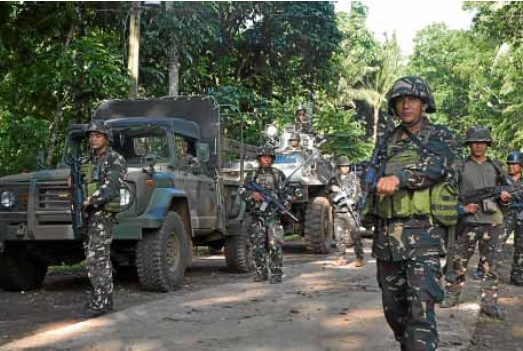
SULU OFFENSIVE Government soldiers patrol a highway during a search operation for the body of beheaded Canadian hostage Robert Hall in Indanan town, Sulu, on Tuesday. AFP

SULU OFFENSIVE Government soldiers patrol a highway during a search operation for the body of beheaded Canadian hostage Robert Hall in Indanan town, Sulu, on Tuesday. AFP

The military has deployed 10 battalions to “selected target areas” in Sulu province to go after the Abu Sayyaf kidnappers who beheaded two Canadian hostages in the last two months after failing to get their ransom demand.

Maj. Filemon Tan Jr., spokesperson for the Western Mindanao Command, said all resources from land, sea and air had been made available for the mission, which could involve some 5,000 troops belonging to the Marines, Army, Air Force and Navy, including their Special Forces.

“We have about 10 battalions, including Marines. Ten battalions of two brigades. All service commands are involved,” Tan said.

But he clarified that the operations would not be on a “wide scale,” but would focus on areas known to be supportive of the Abu Sayyaf.

“We will go to the communities known to provide refuge to bandits,” he said. “There are selected target areas. These bandits have relatives and they hide in the populace.”

On Monday, Abu Sayyaf bandits beheaded Canadian Robert Hall after the P600-million ransom money they had demanded was not delivered. Another Canadian, John Ridsdel, suffered the same fate on April 25.

The group is still holding hostage Filipino Maritess Flor and Norwegian Kjartan Sekkingstad.

All were kidnapped in an exclusive marina in Island Garden City of Samal in Davao del Norte province on Sept. 21 last year.

Police were checking “an intelligence advisory from the higher office” that four Malaysians were abducted by armed men in Sabah, Malaysia, on Wednesday night.

“So far, no confirmation,” Senior Supt. Joselito Salido, police director of Tawi-Tawi province, told the Inquirer by phone.

Tan refused to give the exact number of soldiers or the units deployed in Sulu, and where the operations would be.

“Just imagine our operation maps are filled with pins,” he said. Pins indicate deployment of troops on the ground.

Abu Raami, spokesperson for the Abu Sayyaf, said his group would make it hard for the government troops to locate them.

“We know the terrain,” he said in a phone interview on Thursday morning.

Raami said that every time a military aircraft would hover over them, “we run for cover, we put off all communications and we hide.”

On Wednesday, President Aquino visited Jolo, Sulu, to check on the operations of the military against the Abu Sayyaf.

Sulu Vice Gov. Abdusakur Tan said he chose to snub the President “because he is responsible why all these problems are besetting our place.”

Tan said Mr. Aquino did not consider his earlier recommendation to involve the communities in the campaign against the Abu Sayyaf. “Instead … he poured more troops and changed the police officers and replaced officers who were not functioning.”

On Mr. Aquino’s visit, Tan said: “Who do you think will listen to him? Coming down here when he has only 15 days left (as President).”

“That is what we call ‘too late to play a hero.’ Lives have been wasted, resources reportedly poured but we never saw it, never felt it,” said the vice governor.

In Manila, Sen. Bam Aquino said yesterday that it was time for the government to do all it could to crush the Abu Sayyaf in the wake of threats that it might behead another hostage if its ransom demand was not met.

Senator Aquino lamented that the Abu Sayyaf already wrought extensive damage on the country’s image, economy, tourism industry, and the way of the life in several areas in Mindanao.

“It is time to take the appropriate action to pulverize the bandit group at the earliest possible time,” he said.

“We support any action of the present government and the incoming administration of President-elect Duterte as long as it conforms with the law.”

http://newsinfo.inquirer.net/791074/10-battalions-hunt-abus-in-sulu

Group pickets CHR demanding justice for Paquibato killings

From the Mindanao Times (Jun 16): Group pickets CHR demanding justice for Paquibato killings

PROGRESSIVE group Karapatan yesterday held a lighting rally in front of the Commission on Human Rights office in the region to demand action on the recent killings in Paquibato District.
 
Jay Apiag, Karapatan spokesperson, said they were alarmed about the recent killings in the region.
 
“What is our government doing? The CHR is doing nothing while bodies are piling up,” Apriag said.
 
Around 20 demonstrators joined the protest.
 
The TIMES, meanwhile, tried to get the statement or reactions from the CRH-IX but the officer-in-charge and the public information officer of the agency were out of the office at that time.
 
Apiag cited the killing of a farmer in Paquibato district. On May 29, Segundo Jorolan, 52, of Barangay Mapula, Paquibato District was killed at Pasi-an, Purok B in Barangay Mapula, Paquibato.
 
Based on the investigation conducted by PO3 Noel Fajardo of Paquibato Police Precinct, Jorolan was feeding his chickens outside his house when someone arrived and shot him. Recovered from the crime scene were three fired cartridges of Carbine rifle, and a live ammunition from a .45 caliber pistol. Police are still investigating the case.
 
Moreover, Apiag has also questioned the efficiency of the CHR, which still has to release a resolution on the “Paquibato Massacre” a year after the tragedy.
 
On May 30, 2015, three people were killed when a volley of gunfire jolted people awake in a remote village in Purok 7, Barangay Paradise Embac in Paquibato District.
 
It was previously reported that 69th IB commander, Lt. Col. Rodney Intal, said that Datu Ruben Enlog, tribal leader and chair of Nagkapul, Ramil Enlog and Randy Carnasa were members of the New People’s Army and they were killed in a legitimate miliraty operation.
 
But Karapatan said the victims were farmers and killed when elements of 69th IB strafed the house of Aida Seisa. Seisa’s 12-year-old daughter was wounded during the attack while her husband and two other children were unharmed.
 
Seisa is a leader of Paquibato District Peasant Alliance and secretary general of Sabokahan, an organization Lumad women.
 

LIVESTREAM: Manila Defense and Security Symposium

From Rappler (Jun 16): LIVESTREAM: Manila Defense and Security Symposium

On Friday, Jun 17, Supreme Court Senior Associate Justice Antonio Carpio delivers a lecture on developments on the Philippines' historic case China over disputed waters

Supreme Court Senior Associate Justice Antonio Carpio is set to discuss the Philippines' maritime case against China during the Manila Defense and Security Symposium on Friday, June 17.

The symposium, organized by private nonprofit organization Trident Defense, will be held at the Forum, Solaire Resort, in Parañaque City starting 2 pm.

Participants from the private sector, government, diplomatic community, military, and the academe are expected to join the event.

Carpio will deliver a lecture and share developments on the Philippines' legal challenge over disputed territories in the West Philippine Sea (South China Sea).

In 2013, the Philippines filed a historic case against China, challenging before an international tribunal Beijing's so-called 9-dash line that virtually claimed the entire South China Sea.

The Philippines, meanwhile, is asserting that the disputed waters fall within its 200-nautical mile exclusive economic zone.

The Philippines is expecting the tribunal to issue its ruling this month.

Watch the livestream on Rappler.

http://www.rappler.com/nation/136665-livestream-south-china-sea-security-defense-antonio-carpio

China blamed for ASEAN U-turn on South China Sea

From InterAksyon (Jun 16): China blamed for ASEAN U-turn on South China Sea

Chinese pressure was blamed Thursday for a stunning diplomatic U-turn by Southeast Asian Nations that saw them retract a statement sounding alarm over Beijing's island building in the South China Sea.

The chaotic events at the end of a meeting of foreign ministers from China and the 10-member Association of Southeast Asian Nations (ASEAN) on Tuesday have led to allegations of bullying by Beijing.

The document, released by ASEAN member Malaysia and described as a joint statement from the bloc, warned developments in the hotly contested South China Sea could "undermine peace, security and stability".

The statement specified "land reclamation" as a source of tension, a clear reference to China's massive island building activities where it is trying to cement a claim to almost the whole sea.

But just hours later, Malaysia said the grouping was retracting the statement for "urgent amendments", but offered no reason. Various participants have since given conflicting explanations over what happened.

An ASEAN diplomat who was present at the meeting in the Chinese city of Kunming told AFP that China had put the screws on some Southeast Asian nations to get them to withdraw their support.

"The usual factor, pressure from China," said the diplomat, speaking on condition of anonymity, when asked why unity crumbled.

"I suspect the two countries that opposed the statement were Cambodia and Laos."

'Crude, arrogant'

Singapore's Straits Times newspaper also reported on Thursday that the joint statement was "scuttled by the Chinese, who lobbied its friends in the grouping to block" it.

"Malaysia releasing it was a manifestation of the extreme frustration of the original five ASEAN members plus Vietnam at the particularly crude and arrogant behaviour of the Chinese," the Straits Times reported an ASEAN official as saying.

The Philippines also said Thursday that there had originally been unanimous support within ASEAN for the strongly worded statement.

"By the time the meeting ended, there was an agreement among ASEAN foreign ministers. They agreed on the text of the ASEAN statement and they agreed it would be released," Philippine foreign affairs spokesman Charles Jose told reporters in Manila.

Jose said the statement was then retracted after the meeting had ended and most foreign ministers, including the Philippines' Jose Rene Almendras, had left the venue to start returning home.

Jose would not be drawn on whether Chinese lobbying was to blame, but insisted Malaysia's initial release had not been in error.

Asked why Malaysia gave the statement to the media, Jose said: "That was the point where there was consensus among ASEAN to have that statement. So by the time it was released, there was agreement."

Indonesia said on Wednesday the release -- titled "Media statement by the ASEAN foreign ministers" -- was issued by mistake, and that it was only meant to be a "media guideline".

China has responded to the controversy by insisting there had not been unanimous support for the original statement

"It is clear that if ASEAN wants to issue an official statement, such statement will be based on consensus," Chinese foreign ministry spokesman Lu Kang said on Wednesday.

ASEAN disunity

The events have been widely seen as another example of ASEAN's inability to present a united front toward China as it dramatically expands its presence in the waterway.

China claims nearly all of the sea -- home to some of the world's most important shipping routes and of vast military importance.

ASEAN members the Philippines, Vietnam, Malaysia and Brunei, as well as Taiwan, have competing claims to parts of the sea.

While the Philippines and Vietnam have been particularly critical, Laos and Cambodia have been generally regarded as preferring to side with their giant neighbor and benefactor.

In 2012, ASEAN foreign ministers failed to release a joint statement for the first time at the end of their annual gathering, with the Philippines blaming event host Cambodia for blocking criticism of China.

Laos this year has the rotating presidency of ASEAN, and will host a series of meetings over the coming months in which the South China Sea will inevitably be a hot talking point.

http://interaksyon.com/article/129135/china-blamed-for-asean-u-turn-on-south-china-sea

US deploys more fighter planes to PH for training stint, SCS access operations

From InterAksyon (Jun 16): US deploys more fighter planes to PH for training stint, SCS access operations


An EA-18G Growler attack aircraft is seen in file photo from the US Navy's Naval Air Systems Command site.

The United States Pacific Command (USPACOM) has deployed four airborne electronic attack aircraft to augment eight other air assets already stationed at Clark Air Base, according to a statement released Thursday by the US Embassy in Manila.

The US fighter planes have arrived in the Philippines for a training mission and operations to ensure access to the disputed South China Sea, the US Navy said Thursday.

The Philippines' longtime ally deployed the aircraft to train Filipino pilots as Manila remains locked in an increasingly tense maritime dispute with Beijing.

The US Navy made a veiled reference to so-called freedom of navigation operations in which Washington sends a ship or plane to pass by a Chinese-claimed island to reject its claims of sovereignty.

"Growler aircraft will support routine operations that enhance regional maritime domain awareness and assure access to the air and maritime domains in accordance with international law," the US Navy said in a statement, referring to the EA-18G Growler airborne electronic attack planes.

Clark hosts the headquarters of the 1st Division of the Philippine Air Force (PAF) based in Pampanga.

The air assets already there, before this latest deployment, as five A-10C Thunderbolt aircraft, and three HH-60G Pave Hawk helicopters.

“At the direction of the U.S. Pacific Commander, and with the approval of the Government of the Philippines, the United States stood up an Air Contingent in April 2016 to promote interoperability and US-Philippines security cooperation,” it said.

The announcement comes amid widespread expectation of a ruling soon by the Permanent Court of Arbitration (PCA) at The Hague on the case filed by Manila, challenging Beijing's unilateral imposition of its “9-dash line” that claims 90 percent of the disputed sea and overlaps the exclusive economic zone (EEZ) of the Philippines and other claimants Vietnam, Malaysia, Brunei and Taiwan.

The US Embassy said the new deployment is meant to enhance interoperability with the Armed Forces of the Philippines (AFP), which has newly acquired lead-in jet fighters FA-50 “Golden Eagle” from South Korea.

“As part of this contingent, the US Navy sent a detachment of EA-18G Growler airborne electronic attack aircraft to Clark Air Base on June 15, where it will train with Armed Forces of the Philippines (AFP) FA 50 aircraft pilots,” the Embassy said.

As part of the PAF’s program to modernize its aerial capability, the AFP has ordered 12 units of the lead-in jet fighters worth P18.9 billion from manufacturer Korean Aerospace, Inc. (KAI).

The deployed EA-18G Growlers contingent has 120 personnel assigned to the Naval Air Station Whidbey Island, Washington, in addition to the 200 personnel deployed for the A-10C Thunderbolt aircraft and Hawk helicopters contingent.

“In addition to these bilateral training missions, Growler aircraft will support routine operational missions that enhance regional maritime domain awareness,” the Embassy explained.

“The Armed Forces of the Philippines offered to host the US Air Contingent at Clark Air Base for the duration of their mission for the purposes of training the AFP’s FA 50 pilots and its support units for TDO, specifically on Maritime Security Operations. Clark Air Base is the home of the FA 50 and its pilots in training. Placing the U.S. Air Contingent at this base gives the AFP an opportunity to train with U.S. servicemen on Command, Control, Communications, Computers, Intelligence, Surveillance and Reconnaissance (C4ISR),” the embassy advisory added.

“The U.S. Air Contingent training with the AFP is part of the Mutual Defense Board Activities agreed upon by the Philippine and U.S. governments as part of Maritime Domain Awareness and the promotion of interoperability between both nations’ armed forces,” it further added.

The US deployments of aircraft and personnel in the country is part of the PH-US Enhanced Defense Cooperation Agreement (EDCA), widely seen as meant to blunt China’s aggressive military expansion that several countries say restrict the $5-trillion economic sea lanes.

China's reclamation spree has destroyed coral reefs inside the Kalayaan Island Group, a municipality of Palawan, by converting these features into artificial islands for military purposes.

http://interaksyon.com/article/129134/us-deploys-more-fighter-planes-to-ph-for-training-stint-scs-access-operations

WITH VIDEO | Incoming govt, NDFP end Oslo meet with joint statement, eye formal talks late July

From InterAksyon (Jun 16): WITH VIDEO | Incoming govt, NDFP end Oslo meet with joint statement, eye formal talks late July


Negotiators of the incoming Duterte administration and the National Democratic Front of the Philippines, with representatives of the Norwegian government, who engaged in informal talks on the resumption of formal peace negotiations, in Oslo. (photo from the Twitter account of Hernani Braganza)

(UPDATE 2 - 2:17 p.m.) Peace negotiators of the incoming administration President-elect Rodrigo Duterte and the National Democratic Front of the Philippines concluded informal talks in Oslo, Norway late Wednesday with a joint statement agreeing to resume formal talks in the third week of July.

The joint statement said the formal negotiations will be “conducted in accordance with previously signed agreements” with the incoming government panel promising to recommend to Duterte the release of more than 500 political prisoners, both those the NDFP has described as its “consultants” and, thus, covered by the Joint Agreement on Immunity and Security Guarantees, and the rest “based on humanitarian grounds.”

The statement was signed for the Duterte government by Silvestre Bello III, who will chair the incoming government panel, member Hernani Braganza, and incoming presidential peace adviser Jesus Dureza; for the NDFP by its chief negotiator Luis Jalandoni, peace panel member Fidel Agcaoili, and chief political consultant and Communist Party of the Philippines founder Jose Ma. Sison; and Ambassador Elisabeth Slattum, special envoy to the Philippine peace process of the Norwegian government, which hosted the talks and acts as third-party facilitator of the negotiations.


The joint statement signed in Oslo, Norway by peace negotiators of the incoming Duterte administration and the National Democratic Front of the Philippines (image from incoming peace adviser Jesus Dureza's Facebook page)

Both parties agreed to the following agenda when the formal talks resume:
  • Affirmation of previously signed agreements
  • Accelerated process for negotiations, including the timeline for the completion of the remaining substantive agenda for the talks: socio-economic reforms, political and constitutional reforms, and end of hostilities and disposition of forces
  • Reconstitution of the JASIG
  • Amnesty proclamation for the release of all detained political prisoners, subject to concurrence by Congress
  • Mode of interim ceasefire
VIDEO OF THE JOINT STATEMENT'S SIGNING POSTED BY INCOMING ANAKPAWIS REP. AYIK CASILAO, WHO WAS AN OBSERVER TO THE INFORMAL TALKS:


Among the key agreements the government and NDFP have signed in the course of the often-stalled peace talks are The Hague Joint Declaration, which lays down the framework and agenda for the negotiations, the Comprehensive Agreement on Respect for Human Rights and International Humanitarian Law, and the JASIG.

The JASIG, which protects the negotiators of both parties and their personnel from arrest and prosecution for the duration of the talks, has proven contentious with the NDFP demanding the release of several alleged rebel leaders it says are its consultants and therefore covered by the agreement and the governments of both President Benigno Aquino III and his predecessor, Gloria Macapagal-Arroyo, accusing the rebels of laying down preconditions and using the pact as a pretext to spring their comrades from jail.

Bayan Muna party-list Representative Carlos Isagani Zarate welcomed the results of the informal talks, lauding the “openness of both parties to jump start the long-stalled peace process, as well as their commitment to respect past agreements already signed.”
“The resumption of talks is a very welcome development, especially because the expiring Aquino administration had exhibited no genuine interest in resolving the state of unpeace in our country,” he said.

“Aside from jailing the leaders of the revolutionary movement, the Aquino government reneged past agreements and subjected the talks to a maze of roadblocks, resulting to an impasse. The peace talks was treated as a counterinsurgency measure, and shrugged off the legitimate grievances of the marginalized that has fueled one of the longest-running insurgencies in the world,” he added.

Incoming Kabataan party-list Representative Sarah Elago had a more cautious response.

Elago welcomed the imminent resumption of formal talks, saying the Oslo agreement “shows the sincerity of both parties to pursue just and lasting peace” in contrast to “the disastrous handling of the peace negotiation by the outgoing Aquino administration.”

But while saying they “have high hopes for the outcome of this new round of peace negotiations,” Elago said the youth “will remain vigilant and closely monitor the progress of the negotiations, noting that the outgoing Aquino administration … similarly signed a joint statement with the NDF back in 2011, but eventually reneged on honoring the pertinent points of the statement.”

http://interaksyon.com/article/129099/with-video--incoming-govt-ndfp-end-oslo-meet-with-joint-statement-eye-formal-talks-late-july

2 political prisoners released after Cavite court throws out charges - Karapatan

From InterAksyon (Jun 15): 2 political prisoners released after Cavite court throws out charges - Karapatan
                 
                  
A screen grab from a YouTube video shows political prisoners Adelberto Silva and his wife Sharon Cabusao while being interviewed at the Criminal Investigation and Detection Group detention center. (pinoyweekly.org/YouTube)
 
Two political prisoners were released Wednesday after the regional trial court in Bacoor, Cavite threw out the charges of illegal possession of firearms and explosives filed against them and one other, the human rights organization Karapatan said.

Karapatan said Bacoor RTC Branch 19 granted the motion to dismiss of Sharon Cabusao, Isidro de Lima and Adelberto Silva, describing the search and seizure on them as “unreasonable” and the evidence purportedly found on them the “proverbial fruit of the poisonous tree.”

Silva, who the military claimed was the secretary general of the Communist Party of the Philippines at the time of his arrest, his wife Cabusao, and De Lima were captured in Bacoor June 1 last year. Three rifle grenades, subversive documents, components for making improvised bombs and electronic devices were allegedly seized from them.

However, Karapatan secretary general Cristina Palabay said Silva remains detained at the Special Intensive Care Unit-1 of Camp Bagong Diwa, from where De Lima was released, because he still has pending murder, attempted murder and frustrated murder charges.

Cabusao was released from the Taguig City jail, Palabay added.

The National Democratic Front of the Philippines, which represents communist rebels in negotiations with the government, has been demanding the release of Silva, who it said is a consultant of its peace panel, like 18 other alleged rebel leaders in detention.

Karapatan said the dismissal of the case against the three detainees by the Bacoor court is the latest in which judges deemed the charges and evidence “fabricated” and the accused’s right to due process violated through illegal searches and seizures.

“Many other political prisoners face the same trumped-up criminal charges,” Karapatan said, citing the case of former University of the Philippines students Gerald Salonga and Guiller Cadano, who the group said “were illegally arrested, tortured and are still detained in Nueva Ecija” while facing illegal possession of firearms and explosives charges based on “sacks containing guns and explosives (that) were planted in the house where the two were staying while conducting research on the plight of the farmers in Carranglan.”

It also cited the case of alleged CPP leaders Benito and Wilma Tiamzon, who were arrested with five others in Cebu in 2014 and also charged with illegal firearms possession “when they only had their personal belongings and pet cats and dogs in their vehicles.”

Karapatan said there are 509 political prisoners in the country, “at least 297” of them “illegally arrested” during the term of President Benigno Aquino III.

http://interaksyon.com/article/129090/2-political-prisoners-released-after-cavite-court-throws-out-charges---karapatan