From InterAksyon (Apr 7): How to move peace talks with communist rebels? Govt wants agenda to include more than 'procedures'
As militant partylist lawmakers push for the resumption of talks with the National Democratic Front (NDF), the government's chief peace adviser said that the basis of negotiations should be more substantial, and not simply center on the communists' demand of releasing their jailed consultants.
"We don't want to start talks only to fail again so quickly. We don't want to restart talks on the same basis as before," Presidential Adviser on the Peace Process Teresita Quntos-Deles said.
Asked to expound on the basis of the talks, she said she was referring to "agenda na hindi mo naman kaya gawin tapus ang nangyayari nagiging ang pinag-uusapan procedural matters, the releases of Jasig (those agenda that you cannot do, and then what happens is we just talk about procedural matters -- the releases of consultants covered by the Joint Agreement on Safety and Immunity Guarantees)."
"If we will sit down and just talk about Jasig, it will not bring us anywhere, the people don't care about that, what they want is improvement," Deles said in an interview at the sidelines of the Symposium on Peace and Reconciliation Processes and Initiatives organized by the ASEAN Institute for Peace and Reconciliation (AIPR).
Backdoor talks
Deles said there are no formal talks ongoing, but added that "there are friends of the process that are exploring (backdoor talks)."
"There are overtures and there are overtures. We want to resume talks on the basis of doable and time-bound agenda," she added.
The Jasig was one of the agreements earlier signed by the government and the NDF which granted immunity to communist leaders engaged in peace talks.
NDF leaders had asserted that the arrest and continued detention of Benito and Wilma Tiamzon, alleged high-ranking leaders of the Communist Party of the Philippines (CPP), was illegal because the couple was covered by Jasig.
On Monday morning, Bayan Muna partylist Representatives Neri Colmenares and Carlos Zarate, and former congressman Satur Ocampo visited the couple in their detention cell in Camp Crame in Quezon City to see their condition.
Colmenares and Zarate earlier filed House Resolution 991 to investigate their arrest.
"We have already heard the side of the Armed Forces of the Philippines (AFP) and other arresting organizations, what we want to hear now is the side of the couple regarding their arrest and how would it affect the peace talks between the Government of the Republic of the Philippines (GPH) and the National Democratic Front of the Philippines (NDFP),” Colmenares said.
Zarate said the visit also gave them the opportunity to check on the condition of at least 12 other consultants, supposedly protected by Jasig, but have been held by the government.
"It is absurd that the Aquino administration is saying that it wants peace but it is rampantly violating agreements that would ensure the progress and fast tracking of the peace negotiations,” he said.
“They are killing and arresting those that are involved in the talks so how can peace be discussed,” Zarate added.
Ocampo, who was celebrating his 75th birthday Monday, shared a simple lunch of fish and vegetables with the political prisoners. A former political prisoner himself, Ocampo shared his experiences with the detainees.
“For the peace talks between the two parties to go full swing it would be best if the Aquino administration release all Jasig holders they have arrested and honor the previous agreements between the GPH and the NDFP,” Ocampo said.
http://www.interaksyon.com/article/84271/how-to-move-peace-talks-with-communist-rebels-govt-wants-agenda-to-include-more-than-procedures

Monday, April 7, 2014

Sunday, April 6, 2014
Editorial: Abu Sayyaf’s reminders
Editorial posted to the Philippine Daily Inquirer (Apr 7): Abu Sayyaf’s reminders
Last Wednesday, the Abu Sayyaf struck again. The bandit group, or one of the many gangs that occasionally or opportunistically form part of the kidnap-for-ransom enterprise, raided a diving resort in Semporna, Sabah.
The group, apparently led by Murphy Ambang Ladjia, also known as Haji Gulam, abducted a Chinese tourist from Shanghai and a Filipino woman, who is a member of the resort staff. According to both Philippine and Malaysian intelligence sources, the bandits and the abductees moved to Simunul, a small municipality in Tawi-Tawi some 145 kilometers from Semporna, and then to Jolo.
The raid and subsequent kidnapping bring back unwelcome memories of the Sipadan incident of 2000, when a group of Abu Sayyaf bandits led by the infamous Commander Robot raided another Malaysian resort; abducted 21 victims, mostly foreign tourists; and held them in Abu Sayyaf strongholds in the Philippines. The crisis took months to resolve, and gave the Abu Sayyaf the international notoriety it craved.
In the decade and a half since, the Abu Sayyaf has been the target of intense military operations, with considerable overt and covert support from US troops in the country, fighting what the American government believes is another front in the so-called war on terror. Its most senior or prominent leaders have either been killed, jailed or gone missing. And yet the bandit group remains a threat—in part because of the forbidding terrain in those parts of Basilan, Sulu and Tawi-Tawi where the Abu Sayyaf draws its support; in part because crime draws more support than religion or ideology.
When the Abu Sayyaf began, it purported to follow a political vision based on Islamic principles; all that has been forgotten, even by Abu Sayyaf members or recruits themselves, primarily because of the “success” of the Sipadan and then the Dos Palmas abductions. The ransom generated by these brazen raids ran into the millions of dollars, and some part of that money trickled down to the Abu Sayyaf’s supporters.
Business, in other words, is the simple reason why, from time to time, the Abu Sayyaf or some group using its name continues to emerge out of the shadows. And Sipadan is the business model.
It is for this reason that the raid on the Singamata Reef Resort in Semporna must be given the government’s highest priority. The last thing we need is another dramatic Sipadan-like incident which will validate the Abu Sayyaf business model with millions of dollars in additional revenue.
(To be sure, Malaysia has a decisive role to play too—something it has already acknowledged. Resort owners have been asked to improve their security measures, and the Eastern Sabah Security Command, a new structure set up in the wake of the incursion by Nur Misuari’s Moro National Liberation Front renegades into Lahad Datu, is facing a serious review.)
But the Semporna incident also reminds us of a much older era, before national boundaries were defined. Most Filipinos, even the millions who live in Mindanao, are accustomed to think of the great island of Mindanao and the archipelagos it hosts as the Philippine south—that is, as “below,” with Manila and dominant Luzon as “above.” And yet hundreds of years ago, Mindanao was understood as located in the northern reaches of a differently conceived territory.
As the Mindanao scholar Patricio Abinales wrote: “The essential error here is in accepting the Philippine frame as a ‘given’ …. Yet, if one stands on a hill in Cotabato and turns one’s back on Manila, one is drawn into an expanse in which the colonial Philippines was but a minor cog—the Southeast Asian trading zone Anthony Reid calls ‘The Lands below the Winds.’”
The Abu Sayyaf raid forces us to confront this forgotten truth. We should seek to remember, not in an attempt to revise Philippine history, but rather as part of a continuing effort to understand Philippine geography. The reason Abu Sayyaf bandits can sail into Sabah and then retreat to Sulu is, geography allows it; those of us accustomed to thinking of, say, Jolo as a thousand miles away from Aparri will receive and respond to the news of the latest hostage-taking as something happening in a remote place. Those who realize they still live in the Lands below the Winds know they are in the thick of it.
http://opinion.inquirer.net/73383/abu-sayyafs-reminders
Last Wednesday, the Abu Sayyaf struck again. The bandit group, or one of the many gangs that occasionally or opportunistically form part of the kidnap-for-ransom enterprise, raided a diving resort in Semporna, Sabah.
The group, apparently led by Murphy Ambang Ladjia, also known as Haji Gulam, abducted a Chinese tourist from Shanghai and a Filipino woman, who is a member of the resort staff. According to both Philippine and Malaysian intelligence sources, the bandits and the abductees moved to Simunul, a small municipality in Tawi-Tawi some 145 kilometers from Semporna, and then to Jolo.
The raid and subsequent kidnapping bring back unwelcome memories of the Sipadan incident of 2000, when a group of Abu Sayyaf bandits led by the infamous Commander Robot raided another Malaysian resort; abducted 21 victims, mostly foreign tourists; and held them in Abu Sayyaf strongholds in the Philippines. The crisis took months to resolve, and gave the Abu Sayyaf the international notoriety it craved.
In the decade and a half since, the Abu Sayyaf has been the target of intense military operations, with considerable overt and covert support from US troops in the country, fighting what the American government believes is another front in the so-called war on terror. Its most senior or prominent leaders have either been killed, jailed or gone missing. And yet the bandit group remains a threat—in part because of the forbidding terrain in those parts of Basilan, Sulu and Tawi-Tawi where the Abu Sayyaf draws its support; in part because crime draws more support than religion or ideology.
When the Abu Sayyaf began, it purported to follow a political vision based on Islamic principles; all that has been forgotten, even by Abu Sayyaf members or recruits themselves, primarily because of the “success” of the Sipadan and then the Dos Palmas abductions. The ransom generated by these brazen raids ran into the millions of dollars, and some part of that money trickled down to the Abu Sayyaf’s supporters.
Business, in other words, is the simple reason why, from time to time, the Abu Sayyaf or some group using its name continues to emerge out of the shadows. And Sipadan is the business model.
It is for this reason that the raid on the Singamata Reef Resort in Semporna must be given the government’s highest priority. The last thing we need is another dramatic Sipadan-like incident which will validate the Abu Sayyaf business model with millions of dollars in additional revenue.
(To be sure, Malaysia has a decisive role to play too—something it has already acknowledged. Resort owners have been asked to improve their security measures, and the Eastern Sabah Security Command, a new structure set up in the wake of the incursion by Nur Misuari’s Moro National Liberation Front renegades into Lahad Datu, is facing a serious review.)
But the Semporna incident also reminds us of a much older era, before national boundaries were defined. Most Filipinos, even the millions who live in Mindanao, are accustomed to think of the great island of Mindanao and the archipelagos it hosts as the Philippine south—that is, as “below,” with Manila and dominant Luzon as “above.” And yet hundreds of years ago, Mindanao was understood as located in the northern reaches of a differently conceived territory.
As the Mindanao scholar Patricio Abinales wrote: “The essential error here is in accepting the Philippine frame as a ‘given’ …. Yet, if one stands on a hill in Cotabato and turns one’s back on Manila, one is drawn into an expanse in which the colonial Philippines was but a minor cog—the Southeast Asian trading zone Anthony Reid calls ‘The Lands below the Winds.’”
The Abu Sayyaf raid forces us to confront this forgotten truth. We should seek to remember, not in an attempt to revise Philippine history, but rather as part of a continuing effort to understand Philippine geography. The reason Abu Sayyaf bandits can sail into Sabah and then retreat to Sulu is, geography allows it; those of us accustomed to thinking of, say, Jolo as a thousand miles away from Aparri will receive and respond to the news of the latest hostage-taking as something happening in a remote place. Those who realize they still live in the Lands below the Winds know they are in the thick of it.
http://opinion.inquirer.net/73383/abu-sayyafs-reminders
Gov’t peace deal with MILF founded on consultations – Ferrer
From the Philippine Daily Inquirer (Apr 6): Gov’t peace deal with MILF founded on consultations – Ferrer
The ultimate goal of the Philippine government in signing its historic peace deal with the Moro Islamic Liberation Front is to bring peace to the ordinary child in Mindanao, according to government chief negotiator, Miriam Coronel-Ferrer.
Questions have been raised on the constitutionality of the breakthrough Comprehensive Agreement on the Bangsamoro (CAB) because it creates a sub-state. Ferrer has been appearing in public forums to explain the agreement, urging Filipinos from all sectors to look at the big picture.
” … At the end of the day, the meaning of this (peace) process is what it is to the ordinary child in Mindanao. And that is a chance to go to school, a chance to have equal opportunity with other citizens of the Philippines. Not to be discriminated upon based on ethnicity or religion,” said Ferrer, peace panel chairman, who was here for a peace forum organized on April 4 by the Ateneo de Naga University Center for Good Governance.
“This is really what we’re after even though we do need to deal with all the legal and political implications and go through a lot of institutional processes. This is our goal,” she added.
She said one of the biggest issues raised against the Memorandum of Agreement on Ancestral Domain in 2008, when the Supreme Court struck down that agreement was the lack of consultation and transparency.
But Ferrer said there were consultations and transparency that led to the signing of CAB with MILF. “Every step of the way, that’s something that guided the whole process,” she said.
She said the whole process was trying to move one constituent group of society, from a position of demanding or fighting for independence, to the negotiation table about a peace settlement.
“After that kind of feel good event in Malacañang, the week after heto na yong mga (here come the) challenges,” Ferrer said.
Before the signing of the agreement last March 27, Ferrer and the peace panel members had a closed door meeting with President Aquino and 12 leaders of the central committee of MILF.
She said the President told them during the meeting to address the public’s “fear of the unknown.”
Ferrer said one approach in facing the challenges after the signing of CAB would be to go through the issues raised, “sort out what it is not and then move ahead to what it is and what it is all about.”
“…Of course, we first heard it’s unconstitutional. And again, that’s grabbing the headlines now with no other than Senator Miriam Defensor-Santiago, a constitutional expert, raising this question,” she said.
She acknowledged the numerous legal and technical issues but at the end of the day, the Philippine government, the MILF and the Filipino public must look into the core of the whole process to find solutions to the “underlying causes or grievances” that had propelled the Moro rebellion.
Ferrer said under the CAB, the country could remain as one together with the Bangsamoro, living peacefully, co-existing peacefully, and sharing the benefits of being one country together.
“I think it is very clear that what we are putting in place is not a separate entity. What we are putting in place is an arrangement that would allow (the Muslims) a unique place in our society. Because it’s the only place in the country where more than 90 percent of the population is Muslim,” she said.
Ferrer said the MILF has agreed to transform itself from an armed group into a movement that would join the mainstream society and participate in the institutions of that society. “They will put up their own political party.”
She cited many aspects of the agreement that have not been getting headline attention, among them were provisions in the “Annex on Normalization.”
Ferrer said the annexes contained various programs in economics, reconciliation, the process of transforming an armed group into a civilian movement, and the various organizations where the MILF could continue to pursue their aspirations.
She dismissed claims that the Bangsamoro would go the way of Kosovo, which seceded from Serbia and of Crimea from Ukraine.
Ferrer said the circumstances have been entirely different in the case of the Bangsamoro.
“Our process is entirely preserving our country. Preserving our unity with different constituent parties, at the same time recognizing distinct characteristics of a portion in the part of Mindanao where we find majority of the population as Muslim,” she said.
On the statement that the executive branch alone did not represent the Government of the Philippines (GPH), Ferrer said that it was very clear that the President, as the head of government, could enter into a peace agreement being the one representing the Philippines as a secular state.
“It is actually the obligation of the President to address peace and order issues in the country as commander-in-chief and chief executive,” she said.
CAB is not just an agreement between GPH and MILF but a comprehensive agreement for the whole Bangsamoro, according to Ferrer.
She added that nothing in the process would take away the power of the legislature and “it had been stated in the roadmap that it will pass through legislative process which only Congress could do.”
Ferrer said the agreement could not produce the Bangsamoro simply by signing but it has to go through the legislative process.
Anna Tarhata Basman, head of the legal panel dealing with the MILF, and Senen Bacani, member of the peace panel, shared with forum participants developments in the peace process after the signing of the peace deal on March 27.
The forum was attended by representatives from the local government units in the municipalities of Bula, Pamplona, Bombon, Pasacao, Sipocot, Calabanga, Cabusao and Naga City.
Also in attendance were Camarines Sur’s Provincial Board representative, civil society groups, religious orders, Naga College Foundation, Dominican School in Calabanga and a representative from the Office of the Presidential Adviser on the Peace Process. http://newsinfo.inquirer.net/592272/govt-peace-deal-with-milf-founded-on-consultations-ferrer
The ultimate goal of the Philippine government in signing its historic peace deal with the Moro Islamic Liberation Front is to bring peace to the ordinary child in Mindanao, according to government chief negotiator, Miriam Coronel-Ferrer.
Questions have been raised on the constitutionality of the breakthrough Comprehensive Agreement on the Bangsamoro (CAB) because it creates a sub-state. Ferrer has been appearing in public forums to explain the agreement, urging Filipinos from all sectors
to look at the big picture. ” … At the end of the day, the meaning of this (peace) process is what it is to the ordinary child in Mindanao. And that is a chance to go to school
, a chance to have equal opportunity with other citizens of the Philippines. Not to be discriminated upon based on ethnicity or religion,” said Ferrer, peace panel chairman, who was here for a peace forum organized on April 4 by the Ateneo de Naga University Center for Good Governance. “This is really what we’re after even though we do need to deal with all the legal and political implications and go through a lot of institutional processes. This is our goal,” she added.
She said one of the biggest issues raised against the Memorandum of Agreement on Ancestral Domain in 2008, when the Supreme Court struck down that agreement was the lack of consultation and transparency.
But Ferrer said there were consultations and transparency that led to the signing of CAB with MILF. “Every step of the way, that’s something that guided the whole process,” she said.
She said the whole process was trying to move one constituent group of society, from a position of demanding or fighting for independence, to the negotiation table about a peace settlement.
“After that kind of feel good event in Malacañang, the week after heto na yong mga (here come the) challenges,” Ferrer said.
Before the signing of the agreement last March 27, Ferrer and the peace panel members had a closed door meeting with President Aquino and 12 leaders of the central committee of MILF.
She said the President told them during the meeting to address the public’s “fear of the unknown.”
Ferrer said one approach in facing the challenges after the signing of CAB would be to go through the issues raised, “sort out what it is not and then move ahead
to what it is and what it is all about.” “…Of course, we first heard it’s unconstitutional. And again, that’s grabbing the headlines now with no other than Senator Miriam Defensor-Santiago, a constitutional expert, raising this question,” she said.
She acknowledged the numerous legal and technical issues but at the end of the day, the Philippine government, the MILF and the Filipino public must look into the core of the whole process to find solutions to the “underlying causes or grievances” that had propelled the Moro rebellion.
Ferrer said under the CAB, the country could remain as one together with the Bangsamoro, living peacefully, co-existing peacefully, and sharing the benefits of being one country together.
“I think it is very clear that what we are putting in place is not a separate entity. What we are putting in place is an arrangement that would allow (the Muslims) a unique place in our society. Because it’s the only place in the country where more than 90 percent of the population is Muslim,” she said.
Ferrer said the MILF has agreed to transform itself from an armed group into a movement that would join the mainstream society and participate in the institutions of that society. “They will put up their own political party.”
She cited many aspects of the agreement that have not been getting headline attention, among them were provisions in the “Annex on Normalization.”
Ferrer said the annexes contained various programs in economics, reconciliation, the process of transforming
an armed group into a civilian movement, and the various organizations where the MILF could continue to pursue their aspirations. She dismissed claims that the Bangsamoro would go the way of Kosovo, which seceded from Serbia and of Crimea from Ukraine.
Ferrer said the circumstances have been entirely different in the case of the Bangsamoro.
“Our process is entirely preserving our country. Preserving our unity with different constituent parties, at the same time recognizing distinct characteristics of a portion in the part of Mindanao where we find majority of the population as Muslim,” she said.
On the statement that the executive branch alone did not represent the Government of the Philippines (GPH), Ferrer said that it was very clear that the President, as the head of government, could enter into a peace agreement being the one representing the Philippines as a secular state.
“It is actually the obligation of the President to address peace and order issues in the country as commander-in-chief and chief executive,” she said.
CAB is not just an agreement between GPH and MILF but a comprehensive agreement for the whole Bangsamoro, according to Ferrer.
She added that nothing in the process would take away the power of the legislature and “it had been stated in the roadmap that it will pass through legislative process which only Congress could do.”
Ferrer said the agreement could not produce the Bangsamoro simply by signing but it has to go through the legislative process.
Anna Tarhata Basman, head of the legal panel dealing with the MILF, and Senen Bacani, member of the peace panel, shared with forum participants developments in the peace process after the signing of the peace deal on March 27.
The forum was attended by representatives from the local government units in the municipalities of Bula, Pamplona, Bombon, Pasacao, Sipocot, Calabanga, Cabusao and Naga City.
Also in attendance were Camarines Sur’s Provincial Board representative, civil society groups, religious orders, Naga College
Foundation, Dominican School in Calabanga and a representative from the Office of the Presidential Adviser on the Peace Process. http://newsinfo.inquirer.net/592272/govt-peace-deal-with-milf-founded-on-consultations-ferrer
Alumni unhappy with designation of PMA men as new PPSC, PNPA chiefs
From the Philippine Daily Inquirer (Apr 6): Alumni unhappy with designation of PMA men as new PPSC, PNPA chiefs
Talk about salted fried chickens.
Some graduates of the Philippine National Police Academy (PNPA) have expressed dismay over President Benigno Aquino III’s decision to replace two key officials running the affairs of the county’s premier police academy with alumni of the Philippine Military Academy (PMA).
“It’s appalling. What the President did was like rubbing salt to the wounds of PNPA alumni,” an active senior police official, who asked not to be named due to the sensitivity of the issue, told the Philippine Daily Inquirer.
“The President could have used the opportunity to appoint a PNPA alumni as director of the academy, one who understands the reforms needed to improve the education and training of the cadets,” he added.
Last week, Aquino designated retired PNP Deputy Director General Ricardo de Leon to replace Ruben Platon as president of the Philippine Public Safety College (PPSC), which had administrative supervision over the PNPA.
A member of PMA Class 1971, De Leon once served as president of the Mindanao State University and was known to have close ties with former President Gloria Macapagal Arroyo.
At the same time, the President also named Chief Supt. Armando Ramolete, of PMA Class 1982, to succeed the PNPA director, Chief Supt. Noel Constantino, whose six-month tour of duty in the police academy ended on April 3.
A senior Malacañang official, who agreed to talk on condition of anonymity, said Aquino decided to sack Platon and Constantino over their bickering in the media.
“The President was disappointed by the behavior of both Platon and Constantino. But he did not want to give an impression that he was favoring one of them so he decided to dismiss them both,” the Palace official said.
In his visit to Camp Crame last week, the Chief Executive made known his displeasure over the rift between Platon and Constantino, who was ordered relieved by Platon as PNPA director last year over differences on how to run the police academy.
Constantino, in return, accused Platon and other PPSC officials of irregularities and mismanagement of the PNPA resources.
Addressing a ceremony honoring outstanding policemen, the President said the two police officials were “acting like children,” reminding them of their responsibility to improve the quality of graduates of the PNPA and not to fight each other.
Admitting that he had been losing sleep over the two officials’ squabble, Aquino said: “They should be helping each other and correct the problem.”
Retired Chief Supt. Tomas Rentoy III, a member of the PNPA Alumni Association Inc., said the appointment of the two PMA alumni did not sit well with fellow graduates of the Silang, Cavite-based police academy.
“There are PNPA graduates who have the capabilities and are qualified to lead the PNPA. It seems like the PNP does not trust PNPA graduates,” Rentoy said in a mobile phone interview.
“That’s why we are calling on the President to designate a PNPA graduate to head the PNPA because we know the culture and practices in the academy which should be changed or retained,” he said.
Sought for comment, Senior Supt. Wilben Mayor, spokesman of PNP Director General Alan Purisima, defended the President’s decision, saying both De Leon and Ramolete were qualified for the positions given them.
“We do not consider the source of commissionhip of the officers in their appointment. It doesn’t matter if you’re a graduate of the PNPA or PMA,” Mayor argued.
“The more important thing is to ascertain who is the best qualified for the position. We should always look for the best interest of the PNPA as an institution. We should upgrade its level and make it a top-of-the-line (police academy).” http://newsinfo.inquirer.net/592237/alumni-unhappy-with-designation-of-pma-men-as-new-ppsc-pnpa-chiefs
Talk about salted fried chickens.
Some graduates of the Philippine National Police Academy (PNPA) have expressed dismay over President Benigno Aquino III’s decision to replace two key officials running the affairs of the county’s premier police academy with alumni of the Philippine Military Academy (PMA).
“It’s appalling. What the President did was like rubbing salt to the wounds of PNPA alumni,” an active senior police official, who asked not to be named due to the sensitivity of the issue, told the Philippine Daily Inquirer.
“The President could have used the opportunity to appoint a PNPA alumni as director of the academy, one who understands the reforms needed to improve the education and training of the cadets,” he added.
Last week, Aquino designated retired PNP Deputy Director General Ricardo de Leon to replace Ruben Platon as president of the Philippine Public Safety College (PPSC), which had administrative supervision over the PNPA.
A member of PMA Class 1971, De Leon once served as president of the Mindanao State University and was known to have close ties with former President Gloria Macapagal Arroyo.
At the same time, the President also named Chief Supt. Armando Ramolete, of PMA Class 1982, to succeed the PNPA director, Chief Supt. Noel Constantino, whose six-month tour of duty in the police academy ended on April 3.
A senior Malacañang official, who agreed to talk on condition of anonymity, said Aquino decided to sack Platon and Constantino over their bickering in the media.
“The President was disappointed by the behavior of both Platon and Constantino. But he did not want to give an impression that he was favoring one of them so he decided to dismiss them both,” the Palace official said.
In his visit to Camp Crame last week, the Chief Executive made known his displeasure over the rift between Platon and Constantino, who was ordered relieved by Platon as PNPA director last year over differences on how to run the police academy.
Constantino, in return, accused Platon and other PPSC officials of irregularities and mismanagement of the PNPA resources.
Addressing a ceremony honoring outstanding policemen, the President said the two police officials were “acting like children,” reminding them of their responsibility to improve the quality of graduates of the PNPA and not to fight each other.
Admitting that he had been losing sleep over the two officials’ squabble, Aquino said: “They should be helping each other and correct the problem.”
Retired Chief Supt. Tomas Rentoy III, a member of the PNPA Alumni Association Inc., said the appointment of the two PMA alumni did not sit well with fellow graduates of the Silang, Cavite-based police academy.
“There are PNPA graduates who have the capabilities and are qualified to lead the PNPA. It seems like the PNP does not trust PNPA graduates,” Rentoy said in a mobile phone interview.
“That’s why we are calling on the President to designate a PNPA graduate to head the PNPA because we know the culture and practices in the academy which should be changed or retained,” he said.
Sought for comment, Senior Supt. Wilben Mayor, spokesman of PNP Director General Alan Purisima, defended the President’s decision, saying both De Leon and Ramolete were qualified for the positions given them.
“We do not consider the source of commissionhip of the officers in their appointment. It doesn’t matter if you’re a graduate of the PNPA or PMA,” Mayor argued.
“The more important thing is to ascertain who is the best qualified for the position. We should always look for the best interest of the PNPA as an institution. We should upgrade its level and make it a top-of-the-line (police academy).” http://newsinfo.inquirer.net/592237/alumni-unhappy-with-designation-of-pma-men-as-new-ppsc-pnpa-chiefs
Mission possible to Ayungin Shoal: Get around China to revisit ‘LT 57’
From the Philippine Daily Inquirer (Apr 6): Mission possible to Ayungin Shoal: Get around China to revisit ‘LT 57’

AYUNGIN SHOAL, West Philippine Sea—Standing on the bridge of the AM700, our small resupply vessel, Navy Lt. (s.g.) Ferdinand Gato had his eyes on the looming image of a huge rusting ship here on Ayungin Shoal.
We were sailing on a shallow part of the shoal. The Chinese Coast Guard vessel that tried to block our way earlier was already behind us.
From the moment we began our 36-and-a-half-hour trip to Ayungin Shoal, Gato had a mantra: “We will get to 57, no matter what.”
His smile, as he repeatedly said this throughout our journey on the high seas, wasn’t so much an indication of confidence as of determination.
By “57,” Gato was referring to the BRP Sierra Madre, the dilapidated landing ship tank (LT 57) that has become the country’s symbol of sovereignty in the territory that is also being claimed by China.
Mischievous reply
It was run aground in 1999 as the Philippines’ reply to China’s seizure of the nearby Mischief Reef four years earlier.
But aside from bringing a fresh batch of Marine soldiers and months-long worth of food and other necessities, Gato’s trip was inadvertently a personal one, too.
The Sierra Madre had been his ship from 1993 to 1994, when, as a young Navy lieutenant, he knew the ship like the back of his hand. He was its gunnery and cargo officer. Ironically, he was also on top of making sure the ship was always spanking clean.
In the galley while waiting for the other journalists to have a boodle breakfast of fried rice and sardines on Sunday morning, Gato, nicknamed “Gats” in the military, said we were standing on top of the ship’s war room, its cargo area, as well as the hospital.
“Those are still the original plates of the cargo area,” he pointed to the floor.
Gato, 45, said his heart sank when he saw Sierra Madre that he and other Navy men tried to keep as pretty as they could when they were her crew.
“I went to my old cabin. I felt really sad. I could hardly look at the ship because of how old she has grown,” Gato said in Filipino.
He remembered the time when Navy men could still jog around the Sierra Madre. Now, one has to carefully tread its floors as one wrong step could send one crashing down its dirty hull.
Military workhorse
Gato told reporters that in the ’70s, the Sierra Madre was among the workhorses of the military while fighting the secessionist movement of the Moro National Liberation Front (MNLF).
When Gato was assigned to the ship, they transported as many as 2,000 soldiers from two battalions to Mindanao at the height of the war with the Moro Islamic Liberation Front (MILF).
Gato also said it was the Sierra Madre that brought hundreds of Vietnamese refugees to Palawan province from Bataan province.
Gato graduated with a degree in mechanical engineering and had applied for work at the Philippine Navy’s shipyard. Instead, his papers found their way to the Naval Officers Qualification Course Charlie. He became part of Class 127 and became an officer in 1992.
Ten years later, Gato left the military service to concentrate on his family. At some point, he dabbled in local politics in Puerto Princesa City but realized he didn’t have a future in it.
He returned to the service in 2011, as a reservist officer in active duty. Had he not resigned from the Armed Forces, he would have been a commander (lieutenant colonel) or even a captain (full colonel) by now.
Last-minute assignment
Gato’s assignment as the March 29 mission head was given to him at the last minute. But as the logistics officer of the Naval Forces West, he has monitored several missions to Ayungin Shoal. Simply put, he has been part of the team that studies all the missions, whether they failed or succeeded.
There have been several lessons learned, certainly. And Gato put them to good use by devising several strategies and tactics if and when the Chinese Coast Guard blocks the Philippine vessels on a resupply and rotational troop mission to Ayungin Shoal.
Gato, along with AM700 captain Lt. (j.g.) Sherwin Bulahan and his crew, outsmarted the huge Chinese Coast Guard vessel that declared we were in the “sea area under the jurisdiction of China” and that we were “conducting an illegal activity.”
Unfazed
Gato was unfazed by those statements. Firmly, he told the Chinese Coast Guard that we would proceed to resupply LT 57. At one point, he faced the Chinese ship and gestured toward the Sierra Madre, indicating we definitely would not be turning back.
Up close, the Sierra Madre still projects a certain kind of pride despite her sorry state, slightly listing to her portside.
She is one of the most important ships in the Philippine Navy fleet today, perhaps as important as the recently acquired warships, BRP Gregorio del Pilar and BRP Ramon Alcaraz.
Crucial mission
Old as she is, the Sierra Madre is performing perhaps the most important mission of her lifetime.
She was home to the Marine platoon led by 1st Lt. Mike Pelatora for a punishing 138 days.
When the AM700 slipped past the Chinese Coast Guard ship, Pelatora and his men jumped 40 feet into the waters of Ayungin Shoal from the Sierra Madre’s free board. They were just too happy.
They were supposed to have been picked up a week earlier, but the Chinese Coast Guard chased away the civilian Philippine vessel as it neared the shoal.
Two nights before the AM700 arrived, Pelotera and his men had been monitoring the vicinity, forgoing any decent sleep.
The Sierra Madre was on red alert on the eve of our arrival after they monitored seven Chinese Coast Guard vessels surrounding LT 57.
Pelotera admitted he and his men kept their expectations in check from the resupply mission headed by Gato. They did not want to be disappointed again, following the failed mission a week before.
Survival tricks
The trick to survive a five-month deployment in the middle of the West Philippine Sea was to keep everyone busy, Pelotera said. “We had to keep ourselves physically and mentally fit,” he said.
They fixed any part of the ship that they could, such as the all-important improvised hanging ladder by the ship’s fantail, especially so that the Sierra Madre’s entire lifeline had already been lost.
“We really worked on every room to make it habitable,” Pelotera, 30, said.
They couldn’t, however, have a haircut or shave their beards because their razors and scissors easily rusted in the salty air.
They put up a small chapel beside the entertainment area after some ghostly encounters on the Sierra Madre. It was, after all, a hospital ship where not a few people had died.
Pelotera said the eerie presence they felt on the ship lessened after they put the altar and had Bible studies at least twice a week.
Daily sightings
Every day, Pelotera and his men would report any sightings they had surrounding the Sierra Madre—from the different aircraft flying by to the ships that appear in the horizon.
They had to report every four hours.
Of course, there was time for rest as well. They have the ubiquitous “videoke” and a number of DVDs. They also had books and old newspapers to read. Well, over and over again.
Their entertainment area is on top of what used to be the cargo hatch of the ship.
Swimming is a pastime, but fishing is a routine to have something fresh to eat in place of the customary canned goods.
Part of the Sierra Madre’s main deck has been converted into the galley.
They sleep in the officers’ cabin where the toilet is located.
The important radio room, the only part of the Sierra Madre that the media were not allowed to take pictures of, is located in the 01 deck.
Gato explained that the 01 deck used to accommodate the commanding officer’s quarters. Atop was the Sierra Madre’s combat information center, the command center where “all the action happened,” Gato said.
It had the pilothouse, which has been converted into another sleeping quarters, the radar room and the sonar room, one of which is now the exercise area.
“The command center was also compartmentalized. Personnel in the radio room and the sonar room were not able to listen to each other so that no one would be rattled during combat,” Gato said.
The Sierra Madre is equipped with a twin barrel 40 millimeters in its bow and fantail.
‘Sacred’ rooster
When Pelotera and his men arrived at the Sierra Madre on Nov. 12 last year, one of them brought along a rooster they named “Sagrado” (sacred).
“Sagrado is the rooster’s name because it will remind us that we could never touch it no matter how much we were craving a chicken dish,” Pelotera said, chuckling.
On a serious note, Pelotera said Sagrado was their clock, crowing and waking them up at sunrise.
“We never missed a sunrise at Ayungin. Even the sunset. We just loved looking at them every single day. The sea, the sun, it’s so beautiful at Ayungin, we were like in paradise,” Pelotera said.
Almost a week after he returned on land, Pelotera told the Inquirer on the phone that there were moments when he actually missed the Sierra Madre.
He repeated what he had said days before, that he and his men would always be willing to be deployed to Ayungin Shoal because of the importance of the mission.
But nothing compares, too, to the joy brought by being with his wife, Jevelyn, and their 3-year-old son, Mike Jr.
Pelotera and his men are now on a two-week rest before their return to their Marine battalions.
As for Gato, it’s back to planning for the next mission to Ayungin Shoal. The fresh batch of Marines on the Sierra Madre is facing a tough time, with China expressing extreme disappointment with that incident on March 29 as well as the Philippines’ filing its memorial, or summary of arguments, on its protest before the International Tribunal of the Laws of the Seas (Itlos).
“China has been very assertive. They are very confident that Ayungin is theirs, that you are entering their territory,” Gato said.
But Gato and all the other officers and men tasked to guard the country’s territory are just as assertive and confident.
Just remember that day on the Philippine sea when a David outwitted a Goliath. http://globalnation.inquirer.net/101718/mission-possible-to-ayungin-shoal-get-around-china-to-revisit-lt-57
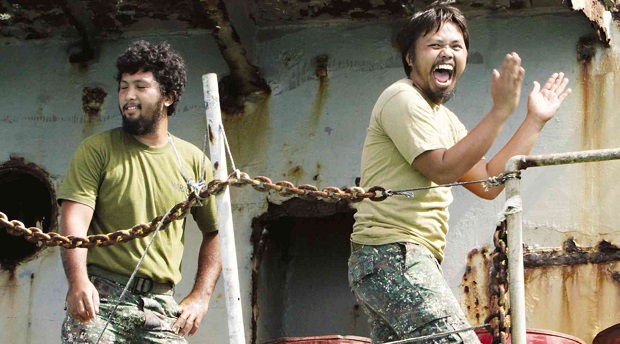
HOORAY. Marine Sgt. Rey Sarmiento (R) and Pfc. Ryan Esteban react when the PH supply ship arrives March 29, alongside BRP Sierra Madre, their home for 138 days. GRIG C. MONTEGRANDE
AYUNGIN SHOAL, West Philippine Sea—Standing on the bridge of the AM700, our small resupply vessel, Navy Lt. (s.g.) Ferdinand Gato had his eyes on the looming image of a huge rusting ship here on Ayungin Shoal.
We were sailing on a shallow part of the shoal. The Chinese Coast Guard vessel that tried to block our way earlier was already behind us.
From the moment we began our 36-and-a-half-hour trip to Ayungin Shoal, Gato had a mantra: “We will get to 57, no matter what.”
His smile, as he repeatedly said this throughout our journey on the high seas, wasn’t so much an indication of confidence as of determination.
By “57,” Gato was referring to the BRP Sierra Madre, the dilapidated landing ship tank (LT 57) that has become the country’s symbol of sovereignty in the territory that is also being claimed by China.
Mischievous reply
It was run aground in 1999 as the Philippines’ reply to China’s seizure of the nearby Mischief Reef four years earlier.
But aside from bringing a fresh batch of Marine soldiers and months-long worth of food and other necessities, Gato’s trip was inadvertently a personal one, too.
The Sierra Madre had been his ship from 1993 to 1994, when, as a young Navy lieutenant, he knew the ship like the back of his hand. He was its gunnery and cargo officer. Ironically, he was also on top of making sure the ship was always spanking clean.
In the galley while waiting for the other journalists to have a boodle breakfast of fried rice and sardines on Sunday morning, Gato, nicknamed “Gats” in the military, said we were standing on top of the ship’s war room, its cargo area, as well as the hospital.
“Those are still the original plates of the cargo area,” he pointed to the floor.
Gato, 45, said his heart sank when he saw Sierra Madre that he and other Navy men tried to keep as pretty as they could when they were her crew.
“I went to my old cabin. I felt really sad. I could hardly look at the ship because of how old she has grown,” Gato said in Filipino.
He remembered the time when Navy men could still jog around the Sierra Madre. Now, one has to carefully tread its floors as one wrong step could send one crashing down its dirty hull.
Military workhorse
Gato told reporters that in the ’70s, the Sierra Madre was among the workhorses of the military while fighting the secessionist movement of the Moro National Liberation Front (MNLF).
When Gato was assigned to the ship, they transported as many as 2,000 soldiers from two battalions to Mindanao at the height of the war with the Moro Islamic Liberation Front (MILF).
Gato also said it was the Sierra Madre that brought hundreds of Vietnamese refugees to Palawan province from Bataan province.
Gato graduated with a degree in mechanical engineering and had applied for work at the Philippine Navy’s shipyard. Instead, his papers found their way to the Naval Officers Qualification Course Charlie. He became part of Class 127 and became an officer in 1992.
Ten years later, Gato left the military service to concentrate on his family. At some point, he dabbled in local politics in Puerto Princesa City but realized he didn’t have a future in it.
He returned to the service in 2011, as a reservist officer in active duty. Had he not resigned from the Armed Forces, he would have been a commander (lieutenant colonel) or even a captain (full colonel) by now.
Last-minute assignment
Gato’s assignment as the March 29 mission head was given to him at the last minute. But as the logistics officer of the Naval Forces West, he has monitored several missions to Ayungin Shoal. Simply put, he has been part of the team that studies all the missions, whether they failed or succeeded.
There have been several lessons learned, certainly. And Gato put them to good use by devising several strategies and tactics if and when the Chinese Coast Guard blocks the Philippine vessels on a resupply and rotational troop mission to Ayungin Shoal.
Gato, along with AM700 captain Lt. (j.g.) Sherwin Bulahan and his crew, outsmarted the huge Chinese Coast Guard vessel that declared we were in the “sea area under the jurisdiction of China” and that we were “conducting an illegal activity.”
Unfazed
Gato was unfazed by those statements. Firmly, he told the Chinese Coast Guard that we would proceed to resupply LT 57. At one point, he faced the Chinese ship and gestured toward the Sierra Madre, indicating we definitely would not be turning back.
Up close, the Sierra Madre still projects a certain kind of pride despite her sorry state, slightly listing to her portside.
She is one of the most important ships in the Philippine Navy fleet today, perhaps as important as the recently acquired warships, BRP Gregorio del Pilar and BRP Ramon Alcaraz.
Crucial mission
Old as she is, the Sierra Madre is performing perhaps the most important mission of her lifetime.
She was home to the Marine platoon led by 1st Lt. Mike Pelatora for a punishing 138 days.
When the AM700 slipped past the Chinese Coast Guard ship, Pelatora and his men jumped 40 feet into the waters of Ayungin Shoal from the Sierra Madre’s free board. They were just too happy.
They were supposed to have been picked up a week earlier, but the Chinese Coast Guard chased away the civilian Philippine vessel as it neared the shoal.
Two nights before the AM700 arrived, Pelotera and his men had been monitoring the vicinity, forgoing any decent sleep.
The Sierra Madre was on red alert on the eve of our arrival after they monitored seven Chinese Coast Guard vessels surrounding LT 57.
Pelotera admitted he and his men kept their expectations in check from the resupply mission headed by Gato. They did not want to be disappointed again, following the failed mission a week before.
Survival tricks
The trick to survive a five-month deployment in the middle of the West Philippine Sea was to keep everyone busy, Pelotera said. “We had to keep ourselves physically and mentally fit,” he said.
They fixed any part of the ship that they could, such as the all-important improvised hanging ladder by the ship’s fantail, especially so that the Sierra Madre’s entire lifeline had already been lost.
“We really worked on every room to make it habitable,” Pelotera, 30, said.
They couldn’t, however, have a haircut or shave their beards because their razors and scissors easily rusted in the salty air.
They put up a small chapel beside the entertainment area after some ghostly encounters on the Sierra Madre. It was, after all, a hospital ship where not a few people had died.
Pelotera said the eerie presence they felt on the ship lessened after they put the altar and had Bible studies at least twice a week.
Daily sightings
Every day, Pelotera and his men would report any sightings they had surrounding the Sierra Madre—from the different aircraft flying by to the ships that appear in the horizon.
They had to report every four hours.
Of course, there was time for rest as well. They have the ubiquitous “videoke” and a number of DVDs. They also had books and old newspapers to read. Well, over and over again.
Their entertainment area is on top of what used to be the cargo hatch of the ship.
Swimming is a pastime, but fishing is a routine to have something fresh to eat in place of the customary canned goods.
Part of the Sierra Madre’s main deck has been converted into the galley.
They sleep in the officers’ cabin where the toilet is located.
The important radio room, the only part of the Sierra Madre that the media were not allowed to take pictures of, is located in the 01 deck.
Gato explained that the 01 deck used to accommodate the commanding officer’s quarters. Atop was the Sierra Madre’s combat information center, the command center where “all the action happened,” Gato said.
It had the pilothouse, which has been converted into another sleeping quarters, the radar room and the sonar room, one of which is now the exercise area.
“The command center was also compartmentalized. Personnel in the radio room and the sonar room were not able to listen to each other so that no one would be rattled during combat,” Gato said.
The Sierra Madre is equipped with a twin barrel 40 millimeters in its bow and fantail.
‘Sacred’ rooster
When Pelotera and his men arrived at the Sierra Madre on Nov. 12 last year, one of them brought along a rooster they named “Sagrado” (sacred).
“Sagrado is the rooster’s name because it will remind us that we could never touch it no matter how much we were craving a chicken dish,” Pelotera said, chuckling.
On a serious note, Pelotera said Sagrado was their clock, crowing and waking them up at sunrise.
“We never missed a sunrise at Ayungin. Even the sunset. We just loved looking at them every single day. The sea, the sun, it’s so beautiful at Ayungin, we were like in paradise,” Pelotera said.
Almost a week after he returned on land, Pelotera told the Inquirer on the phone that there were moments when he actually missed the Sierra Madre.
He repeated what he had said days before, that he and his men would always be willing to be deployed to Ayungin Shoal because of the importance of the mission.
But nothing compares, too, to the joy brought by being with his wife, Jevelyn, and their 3-year-old son, Mike Jr.
Pelotera and his men are now on a two-week rest before their return to their Marine battalions.
As for Gato, it’s back to planning for the next mission to Ayungin Shoal. The fresh batch of Marines on the Sierra Madre is facing a tough time, with China expressing extreme disappointment with that incident on March 29 as well as the Philippines’ filing its memorial, or summary of arguments, on its protest before the International Tribunal of the Laws of the Seas (Itlos).
“China has been very assertive. They are very confident that Ayungin is theirs, that you are entering their territory,” Gato said.
But Gato and all the other officers and men tasked to guard the country’s territory are just as assertive and confident.
Just remember that day on the Philippine sea when a David outwitted a Goliath. http://globalnation.inquirer.net/101718/mission-possible-to-ayungin-shoal-get-around-china-to-revisit-lt-57
ISAFP agent tagged in slay of 4 surrenders
From the Philippine Star (Apr 6): ISAFP agent tagged in slay of 4 surrenders
A civilian agent of the Intelligence Service of the Armed Forces of the Philippines (ISAFP), tagged as one of five men who allegedly killed four members of a family in Oriental Mindoro, has surrendered, police reported over the weekend.
Mark Anthony Flores gave himself up to Lt. Col. Ferdinand Marcelino of the Military Intelligence Group based in Camp Eldridge, Los Baños, Laguna, said Oriental Mindoro police director Senior Superintendent Ronaldo de Jesus.
Flores and four other men allegedly shot dead farmer Hector Saulong and his children Ricric, Stephanie and Prince Clarence at the family’s home in Barangay Labonan, Bonga-bong.
Hector’s wife, Josephine, survived the killing as she was in the bathroom when the suspects barged into their home.
De Jesus said Josephine identified Flores as one of the lookouts, along with a certain “Alex.”
He said police are looking into the possible connection between this week’s killing and the murder of Hector’s eldest son David in 2013.
De Jesus said Flores denied involvement in the killing although he admitted he and the victims are relatives.
Investigators initially eyed land dispute as the motive for the killing.
http://www.philstar.com/nation/2014/04/06/1309257/isafp-agent-tagged-slay-4-surrenders
A civilian agent of the Intelligence Service of the Armed Forces of the Philippines (ISAFP), tagged as one of five men who allegedly killed four members of a family in Oriental Mindoro, has surrendered, police reported over the weekend.
Mark Anthony Flores gave himself up to Lt. Col. Ferdinand Marcelino of the Military Intelligence Group based in Camp Eldridge, Los Baños, Laguna, said Oriental Mindoro police director Senior Superintendent Ronaldo de Jesus.
Flores and four other men allegedly shot dead farmer Hector Saulong and his children Ricric, Stephanie and Prince Clarence at the family’s home in Barangay Labonan, Bonga-bong.
Hector’s wife, Josephine, survived the killing as she was in the bathroom when the suspects barged into their home.
De Jesus said Josephine identified Flores as one of the lookouts, along with a certain “Alex.”
He said police are looking into the possible connection between this week’s killing and the murder of Hector’s eldest son David in 2013.
De Jesus said Flores denied involvement in the killing although he admitted he and the victims are relatives.
Investigators initially eyed land dispute as the motive for the killing.
http://www.philstar.com/nation/2014/04/06/1309257/isafp-agent-tagged-slay-4-surrenders
Army officer dies of heatstroke
From the Philippine Star (Apr 6): Army officer dies of heatstroke
An intelligence officer of the military was believed to have died from heatstroke as he was taking a jog inside an Army camp in Maguindanao Friday afternoon.
Despite attempts, military doctors failed to revive Maj. Amelito Boa after he collapsed at about 4:45 p.m. at the Camp Siongco in Awang town.
Boa, deputy chief for intelligence of the 6th Infantry Division, was immediately taken in for treatment as he collapsed near the Camp Siongco Hospital, said Army spokesman Lt. Col. Noel Detoyato.
“This is a sad news for us. The heat was too much out there,” Detoyato said.
http://www.philstar.com/nation/2014/04/06/1309255/army-officer-dies-heatstroke
An intelligence officer of the military was believed to have died from heatstroke as he was taking a jog inside an Army camp in Maguindanao Friday afternoon.
Despite attempts, military doctors failed to revive Maj. Amelito Boa after he collapsed at about 4:45 p.m. at the Camp Siongco in Awang town.
Boa, deputy chief for intelligence of the 6th Infantry Division, was immediately taken in for treatment as he collapsed near the Camp Siongco Hospital, said Army spokesman Lt. Col. Noel Detoyato.
“This is a sad news for us. The heat was too much out there,” Detoyato said.
http://www.philstar.com/nation/2014/04/06/1309255/army-officer-dies-heatstroke
P135-M spy gadgets trained on opponents
From the opposition newspaper the Daily Tribune (Apr 6): P135-M spy gadgets trained on opponents
INTELLIGENCE NETWORK CENTRALIZED UNDER DND
Part of the Aquino administration’s plan to create a vast integrated government intelligence network was the purchase of P135 million worth of high-end surveillance equipment comparable to those being used by the United States government but which will primarily be used to spy on critics of President Aquino, including the political opposition.
A source said the German-made technology gadgets unlike in the US which uses the gadgets to spy on potential terror threats, these will be used against targets of the Aquino administration who are key opposition leaders and their families.
A purchase request dated Oct. 26, 2011 for “Radio Frequency Test Equipment” had a Special Allotment Release Order (SARO) Number D-11-024613 as approved by the Department of Budget and Management (DBM), the source said.
The purchase did not undergo open bidding but was undertaken through a negotiated contract awarded to Germany-based electronic surveillance company Rohde & Schwarz with the items codenamed “Spectrum.”
Rohde and Schwarz is also a major supplier of surveillance equipment of the US government and has an office in Makati.
Rohde and Schwarz’s “Spectrum” portfolio is composed of portable analyzers and handheld monitoring receivers for the general purpose of signal investigation and scalar networking.
The Department of National Defense (DND) has a plan to create a new intelligence agency under it that will integrate the Intelligence Service of the Armed Forces of the Philippines (ISAFP).
ISAFP head Brig. Gen. Eduardo Año confirmed the forming of the new spy network based on a “planning guidance” issued by Defense Secretary Voltaire Gazmin. The aim of the creation of the new body would be a bigger intelligence organization, he said.
“The intelligence unit of the AFP will be part now of the whole defense department,” he said, noting that the new spy agency will be like that of the US Defense Intelligence Agency.
Año said the spy network will be up by 2015.
“These equipment are so high-end that even the most modern scramblers will not work against the units,” a source privy said of the state-of-the-art spy gadgets.
The technology can collect massive amounts of information from e-mails, social media posts, text messages and cellphones and cannot be deflected by existing counter-surveillance technology, the source said.
According to the source, unlike the US government, particularly the National Security Agency, that uses the same technology to spy on terrorist threats, the “confidential emergency purchase” of the “Spectrum” portfolio is intended for monitoring and eavesdropping missions to collect information and routinely spy on select opposition personalities and their family members, including minor children.
The source said the equipment are now being setup at the ISAFP Headquarters at Camp Aguinaldo and will be in full operation by June this year.
A team has already been formed to handle the monitoring operations with a senior civilian official overseeing it.
The source added with the government’s upgraded surveillance platform, one can only imagine what edge the snooping operations could give the Aquino Administration, especially with the 2016 presidential elections looming in the horizon.
“The breathtaking scope of spying is now being extended to political purposes other than national security,” the source said.
The source also revealed that the directive to spy on opposition leaders has demoralized military intelligence operatives.
“They thought this type of surveillance on the opposition would not happen anymore because of President Aquino. But people close to him, if not himself, wanted a repeat of what GMA (former President Gloria Macapagal Arroyo) did,” the source said.
In the 2004 elections, the military has become a silent accomplice of the Arroyo Administration’s surveillance program on its political opponents.
The “Hello, Garci” tapes shook the Arroyo administration and battered the entire armed forces, exposing the extent of the Malacanang’s hand in rigging the results of the 2004 Presidential elections.
In January 2014, the Department of National Defense (DND) announced its plans to create a new, expanded and cutting-edge national “spy” agency that will include the Intelligence Service of the Armed Forces of the Philippines (ISAFP).
The proposal is similar to the US Defense Intelligence Agency’s (DIA) role which encompasses the gathering and analysis of security-related foreign, domestic, political, economic, industrial, geographic, military and civilian intelligence data.
Heads of the intelligence service groups like NICA and ISAFP are personally handpicked by the President.
The source said the purchase of the snooping equipment was considered by the Aquino administration since June 2011 when the planning and negotiations phase started.
The DBM processed the special allotment release order (SARO) with validity until Dec. 31, 2012 in October 2011.
On Dec. 7, 2012, the submission of the initial bids by German supplier Rohde & Schwarz was made and in January 10, 2013, a request for revalidation of SARO was forwarded to the DBM.
A post qualification meeting with the suppliers were held in Munich, Germany on February 11, 2013 and on February 25, a post qualification report was presented.
In March 2013, the SARO (Fund Code 101) was revalidated prior to the issuance of a notice of agreement (NOA) in favor of Rohde and Schwarz.
The equipment was delivered in November last year and its full operations is planned anytime between June and August, the source said.
http://www.tribune.net.ph/headlines/p135-m-spy-gadgets-trained-on-opponents
INTELLIGENCE NETWORK CENTRALIZED UNDER DND
Part of the Aquino administration’s plan to create a vast integrated government intelligence network was the purchase of P135 million worth of high-end surveillance equipment comparable to those being used by the United States government but which will primarily be used to spy on critics of President Aquino, including the political opposition.
A source said the German-made technology gadgets unlike in the US which uses the gadgets to spy on potential terror threats, these will be used against targets of the Aquino administration who are key opposition leaders and their families.
A purchase request dated Oct. 26, 2011 for “Radio Frequency Test Equipment” had a Special Allotment Release Order (SARO) Number D-11-024613 as approved by the Department of Budget and Management (DBM), the source said.
The purchase did not undergo open bidding but was undertaken through a negotiated contract awarded to Germany-based electronic surveillance company Rohde & Schwarz with the items codenamed “Spectrum.”
Rohde and Schwarz is also a major supplier of surveillance equipment of the US government and has an office in Makati.
Rohde and Schwarz’s “Spectrum” portfolio is composed of portable analyzers and handheld monitoring receivers for the general purpose of signal investigation and scalar networking.
The Department of National Defense (DND) has a plan to create a new intelligence agency under it that will integrate the Intelligence Service of the Armed Forces of the Philippines (ISAFP).
ISAFP head Brig. Gen. Eduardo Año confirmed the forming of the new spy network based on a “planning guidance” issued by Defense Secretary Voltaire Gazmin. The aim of the creation of the new body would be a bigger intelligence organization, he said.
“The intelligence unit of the AFP will be part now of the whole defense department,” he said, noting that the new spy agency will be like that of the US Defense Intelligence Agency.
Año said the spy network will be up by 2015.
“These equipment are so high-end that even the most modern scramblers will not work against the units,” a source privy said of the state-of-the-art spy gadgets.
The technology can collect massive amounts of information from e-mails, social media posts, text messages and cellphones and cannot be deflected by existing counter-surveillance technology, the source said.
According to the source, unlike the US government, particularly the National Security Agency, that uses the same technology to spy on terrorist threats, the “confidential emergency purchase” of the “Spectrum” portfolio is intended for monitoring and eavesdropping missions to collect information and routinely spy on select opposition personalities and their family members, including minor children.
The source said the equipment are now being setup at the ISAFP Headquarters at Camp Aguinaldo and will be in full operation by June this year.
A team has already been formed to handle the monitoring operations with a senior civilian official overseeing it.
The source added with the government’s upgraded surveillance platform, one can only imagine what edge the snooping operations could give the Aquino Administration, especially with the 2016 presidential elections looming in the horizon.
“The breathtaking scope of spying is now being extended to political purposes other than national security,” the source said.
The source also revealed that the directive to spy on opposition leaders has demoralized military intelligence operatives.
“They thought this type of surveillance on the opposition would not happen anymore because of President Aquino. But people close to him, if not himself, wanted a repeat of what GMA (former President Gloria Macapagal Arroyo) did,” the source said.
In the 2004 elections, the military has become a silent accomplice of the Arroyo Administration’s surveillance program on its political opponents.
The “Hello, Garci” tapes shook the Arroyo administration and battered the entire armed forces, exposing the extent of the Malacanang’s hand in rigging the results of the 2004 Presidential elections.
In January 2014, the Department of National Defense (DND) announced its plans to create a new, expanded and cutting-edge national “spy” agency that will include the Intelligence Service of the Armed Forces of the Philippines (ISAFP).
The proposal is similar to the US Defense Intelligence Agency’s (DIA) role which encompasses the gathering and analysis of security-related foreign, domestic, political, economic, industrial, geographic, military and civilian intelligence data.
Heads of the intelligence service groups like NICA and ISAFP are personally handpicked by the President.
The source said the purchase of the snooping equipment was considered by the Aquino administration since June 2011 when the planning and negotiations phase started.
The DBM processed the special allotment release order (SARO) with validity until Dec. 31, 2012 in October 2011.
On Dec. 7, 2012, the submission of the initial bids by German supplier Rohde & Schwarz was made and in January 10, 2013, a request for revalidation of SARO was forwarded to the DBM.
A post qualification meeting with the suppliers were held in Munich, Germany on February 11, 2013 and on February 25, a post qualification report was presented.
In March 2013, the SARO (Fund Code 101) was revalidated prior to the issuance of a notice of agreement (NOA) in favor of Rohde and Schwarz.
The equipment was delivered in November last year and its full operations is planned anytime between June and August, the source said.
http://www.tribune.net.ph/headlines/p135-m-spy-gadgets-trained-on-opponents
NPA attacks public safety office in Quezon
From ABS-CBN (Apr 6): NPA attacks public safety office in Quezon
Members of the New People's Army (NPA) attacked an office of the Quezon Provincial Policce Public Safety Company in Barangay Kilib in Lucban, Quezon early Sunday morning.
According to Quezon police director Senior Supt. Genaro Ilagan, about 30 rebels attacked and fired at the office at around 5 a.m.
The exchange of gunfire lasted for 10 minutes before the rebels retreated and fled towards Barangay Pulang Lupa.
Policemen and soldiers immediately pursued the rebels.
Recovered from the scene were 12 slugs from an M-14 rifle, a bullet from an M-16 and M-203, a plastic bag containing personal items and food.
Checkpoints have been set up in Barangay Pulo in Mauban and in Barangay Talipan in Pagbilao to help in the search for the rebels.
There were no reported injured or killed in the encounter.
http://www.abs-cbnnews.com/nation/regions/04/06/14/npa-attacks-public-safety-office-quezon
Members of the New People's Army (NPA) attacked an office of the Quezon Provincial Policce Public Safety Company in Barangay Kilib in Lucban, Quezon early Sunday morning.
According to Quezon police director Senior Supt. Genaro Ilagan, about 30 rebels attacked and fired at the office at around 5 a.m.
The exchange of gunfire lasted for 10 minutes before the rebels retreated and fled towards Barangay Pulang Lupa.
Policemen and soldiers immediately pursued the rebels.
Recovered from the scene were 12 slugs from an M-14 rifle, a bullet from an M-16 and M-203, a plastic bag containing personal items and food.
Checkpoints have been set up in Barangay Pulo in Mauban and in Barangay Talipan in Pagbilao to help in the search for the rebels.
There were no reported injured or killed in the encounter.
http://www.abs-cbnnews.com/nation/regions/04/06/14/npa-attacks-public-safety-office-quezon
US defense chief warns China over territorial claims
From ABS-CBN (Apr 6): US defense chief warns China over territorial claims
(UPDATED) Pentagon chief Chuck Hagel on Sunday warned China against unilateral action to resolve territorial disputes with its neighbours, drawing a parallel with Russia's incursion in Ukraine as he announced two more warships would be sent to Japan.
Seeking to reassure Washington's long-time ally Japan, Hagel's remarks and promise of more missile defence ships came as Tokyo faces a tense row with Beijing over islands in the East China Sea.
"All nations deserve respect, no matter how large or how small," Hagel said during a visit to Tokyo.
"I think we're seeing some clear evidence of a lack of respect, and coercion and intimidation with ... what the Russians have done in Ukraine," he told a news conference with his Japanese counterpart, Itsunori Onodera.
Countries had to speak up and reject such a blatant violation of international law, said Hagel, referring to Russia's annexation of Ukraine's Crimean peninsula.
And in a veiled reference to China and its territorial arguments with Asian neighbours, Hagel said smaller countries had the same sovereign rights as larger states.
"You cannot go around and redefine boundaries, violate territorial integrity and sovereignty of nations by force, coercion and intimidation -- whether it's in small islands in the Pacific, or large nations in Europe," Hagel said.
"So I want to talk to our Chinese friends about this," said the defence secretary, who departs for Beijing on Monday.
US takes tougher line
His comments underscored a tougher line by the US government on China's approach to territorial claims in the South China Sea and the East China Sea, after some Southeast Asian countries accused Beijing of intimidatory tactics.
As "a great power," China has "great responsibilities," Hagel said.
A topic Hagel plans to raise with the Chinese this week is "respect for their neighbours," he said.
"Coercion, intimidation is a very deadly thing. It leads only to conflict," he said.
In Tokyo, Hagel unveiled plans to send two more Aegis missile defence warships to Japan by 2017, citing "Pyongyang's pattern of provocative and destabilising actions."
The US ships would join five missile defence vessels already stationed in the area, and were part of an American strategic "rebalance" to the Asia-Pacific, officials said.
Japan has deployed its own Aegis missile defence ship to the Sea of Japan (East Sea) in recent days, after North Korea last month test fired two medium-range ballistic missiles.
Tokyo has reportedly ordered its forces to destroy any North Korean ballistic missiles that pass through its airspace.
Hagel's announcement follows the deployment of a second early warning US radar to Japan, P-8 maritime surveillance aircraft and plans to bring unmanned Global Hawk drones to the country.
Although Hagel said the US ships were being sent to help counter the threat posed by North Korea, the move also carried symbolic weight amid Japan's tense stand-off with China over islets in the East China Sea.
Hagel reiterated that Washington stood by its mutual defence treaty with Japan, saying it applied to the disputed islands in the East China Sea, where Beijing and Tokyo are locked in a bitter argument.
"We take seriously American's treaty commitments, and we strongly oppose any unilateral coercive action that seeks to undermine Japan's administrative control," Hagel said.
The Pentagon chief, who is due to fly to China Monday for a three-day visit, called for "a peaceful resolution" of the disagreement and said "America has no stronger ally or better friend in this region than Japan."
Tokyo scrambled military aircraft last month after three Chinese planes flew near Japanese airspace, the latest confrontation in the East China Sea dispute.
The islands are administered by Japan, which calls them Senkaku Islands, but are referred to as the Diaoyu Islands by China.
Chinese ships and planes have been seen off the disputed islands numerous times since Japan nationalized them in September 2012, sometimes within the 12 nautical-mile territorial zone.
http://www.abs-cbnnews.com/focus/04/06/14/us-defense-chief-warns-china-over-territorial-claims
(UPDATED) Pentagon chief Chuck Hagel on Sunday warned China against unilateral action to resolve territorial disputes with its neighbours, drawing a parallel with Russia's incursion in Ukraine as he announced two more warships would be sent to Japan.
Seeking to reassure Washington's long-time ally Japan, Hagel's remarks and promise of more missile defence ships came as Tokyo faces a tense row with Beijing over islands in the East China Sea.
"All nations deserve respect, no matter how large or how small," Hagel said during a visit to Tokyo.
"I think we're seeing some clear evidence of a lack of respect, and coercion and intimidation with ... what the Russians have done in Ukraine," he told a news conference with his Japanese counterpart, Itsunori Onodera.
Countries had to speak up and reject such a blatant violation of international law, said Hagel, referring to Russia's annexation of Ukraine's Crimean peninsula.
And in a veiled reference to China and its territorial arguments with Asian neighbours, Hagel said smaller countries had the same sovereign rights as larger states.
"You cannot go around and redefine boundaries, violate territorial integrity and sovereignty of nations by force, coercion and intimidation -- whether it's in small islands in the Pacific, or large nations in Europe," Hagel said.
"So I want to talk to our Chinese friends about this," said the defence secretary, who departs for Beijing on Monday.
US takes tougher line
His comments underscored a tougher line by the US government on China's approach to territorial claims in the South China Sea and the East China Sea, after some Southeast Asian countries accused Beijing of intimidatory tactics.
As "a great power," China has "great responsibilities," Hagel said.
A topic Hagel plans to raise with the Chinese this week is "respect for their neighbours," he said.
"Coercion, intimidation is a very deadly thing. It leads only to conflict," he said.
In Tokyo, Hagel unveiled plans to send two more Aegis missile defence warships to Japan by 2017, citing "Pyongyang's pattern of provocative and destabilising actions."
The US ships would join five missile defence vessels already stationed in the area, and were part of an American strategic "rebalance" to the Asia-Pacific, officials said.
Japan has deployed its own Aegis missile defence ship to the Sea of Japan (East Sea) in recent days, after North Korea last month test fired two medium-range ballistic missiles.
Tokyo has reportedly ordered its forces to destroy any North Korean ballistic missiles that pass through its airspace.
Hagel's announcement follows the deployment of a second early warning US radar to Japan, P-8 maritime surveillance aircraft and plans to bring unmanned Global Hawk drones to the country.
Although Hagel said the US ships were being sent to help counter the threat posed by North Korea, the move also carried symbolic weight amid Japan's tense stand-off with China over islets in the East China Sea.
Hagel reiterated that Washington stood by its mutual defence treaty with Japan, saying it applied to the disputed islands in the East China Sea, where Beijing and Tokyo are locked in a bitter argument.
"We take seriously American's treaty commitments, and we strongly oppose any unilateral coercive action that seeks to undermine Japan's administrative control," Hagel said.
The Pentagon chief, who is due to fly to China Monday for a three-day visit, called for "a peaceful resolution" of the disagreement and said "America has no stronger ally or better friend in this region than Japan."
Tokyo scrambled military aircraft last month after three Chinese planes flew near Japanese airspace, the latest confrontation in the East China Sea dispute.
The islands are administered by Japan, which calls them Senkaku Islands, but are referred to as the Diaoyu Islands by China.
Chinese ships and planes have been seen off the disputed islands numerous times since Japan nationalized them in September 2012, sometimes within the 12 nautical-mile territorial zone.
http://www.abs-cbnnews.com/focus/04/06/14/us-defense-chief-warns-china-over-territorial-claims
Malaysia kidnappers telephone Chinese victim's family
From Rappler (Apr 6): Malaysia kidnappers telephone Chinese victim's family
(UPDATED) Sabah's Mohammad Mentek declined to comment whether the kidnappers had began ransom negotiations with the Chinese family
Kidnappers holding a Chinese tourist who was abducted from a resort onMalaysia 's Borneo island have made a phone call
to her family in China
http://www.rappler.com/world/regions/asia-pacific/china/54807-malaysia-kidnapping-chinese
(UPDATED) Sabah's Mohammad Mentek declined to comment whether the kidnappers had began ransom negotiations with the Chinese family
Kidnappers holding a Chinese tourist who was abducted from a resort on
He said the
gunmen have communicated with the family of Gao Huayuan, 29, whom Philippine
security forces believe is being held in Jolo island in Sulu in the southern Philippines
"They have
made telephone contact with her family," Mohammad Mentek, director-general
of the security command in the east of Malaysia 's
Sabah state, told Agence France-Presse. (READ:
Filipino, Chinese national abducted from Malaysian resort)
The Abu Sayyaf, a small band of militants infamous for kidnapping for ransom,
are the prime suspects in Wednesday's abductions of the Chinese
tourist and a Filipina resort worker, Marcy Dayawan, 40.
Mohammad said
that Malaysian authorities believe the 2 hostages are safe.
"We hope
they will be returned safely to their families as soon as possible," he said.
Mohammad declined
to comment whether the kidnappers had began ransom negotiations with the
Chinese family.
Philippine
authorities believe the kidnappers are affiliated with Abu Sayyaf
"sub-commander" Murphy Ambang Ladjia, who was involved in a spectacular
kidnapping of 21 people from another resort in Sabah – in the north of Borneo island – in 2000.
Twenty of those
hostages – many of whom were Europeans and other foreign tourists – were
released within 5 months, reportedly after hefty ransoms were paid.
A final Filipino
captive was held until 2003.
Mohammad said
security forces had strengthened their presence, with more sea patrols along
the coastal waters of Sabah which are a major
diving attraction for foreigners.
"But we are
not able to be everywhere all the time since our sea borders with the Philippines
PH scours
islands
The Philippine
military said on Sunday that troops were intensively searching remote southern
islands and surrounding waters for the two female hostages, although there have
been no sightings of them or other confirmation of their whereabouts.
The search
focused on the Basilan, Tawi-Tawi and Sulu islands in the country's far south
which are known hotbeds of the Abu Sayyaf, said regional military chief Lieutenant
General Rustico Guerrero.
He said a
"naval task force" had been "conducting extensive search and
naval blockades (of) suspected sea crafts" while ground troops had also
been deployed.
The military said
Abu Sayyaf gunmen aboard a speedboat were believed to have taken the women to
Simunul, Tawi-Tawi, and a day's boat ride across the border.
But Guerrero said
the search also covered the nearby Sulu archipelago as well as Basilan, in
whose jungles the Abu Sayyaf had taken hostages in the past.
"It takes a
lot of resources and effort to cover (the sea areas)," he said. "The
sea area is so huge and we have limitations."
Asked whether
there was any definitive indication that the gunmen and their hostages had
reached land, he said: "We have no confirmation."
Armed Forces of
the Philippines
The Abu Sayyaf
have only a few hundred gunmen but have been blamed for the worst terror
attacks in Philippine history, including bombings and kidnappings that have
often targeted foreigners or Christians.
The group was set
up in the 1990s, reportedly with seed money from Al-Qaeda mastermind Osama bin
Laden.
Last November,
suspected Abu Sayyaf gunmen kidnapped a Taiwanese couple holidaying in another Sabah resort.
The husband was
killed during the abduction.
His wife was
freed – after a ransom was believed to have been paid – after being held for 36
days on the main Jolo island in Sulu.
The Abu Sayyaf
are believed still to be holding other foreign hostages, including two European
bird-watchers abducted in Tawi-Tawi in February 2012.
http://www.rappler.com/world/regions/asia-pacific/china/54807-malaysia-kidnapping-chinese
1942 Fall of Bataan marked by surrender of American general, troops to Japanese colonel (Feature)
From the Philippine News Agency (Apr 6): 1942 Fall of Bataan marked by surrender of American general, troops to Japanese colonel (Feature)
American Gen. Edward King Jr. surrendered with a heavy heart his troops inBataan composed of Filipino and American soldiers to the
Japanese Imperial Army that marked the “Fall of Bataan” 72 years ago on April
9.
War records showed that whenBataan fell,
there were 74,800 Filipino and 10,500 American defenders belonging to the
United States Armed Forces in the Far East (USAFFE) who became prisoners of
war.
The surrender discussion between King, commander of USAFFE inBataan , with three senior officers and Japanese Col.
Motoo Nakayama, senior aide of Gen. Masaharu Homma, with another Japanese
officer, were captured in life-size monument from an old picture.
The surrender meeting on April 9, 1942 actually happened on the exact site near the oldBalanga
Elementary School
Mario Magat, executive director of the Bataan World War II Museum, said King initially offered the surrender in Lamao, Limay town but the Japanese refused it, asking for Gen. Jonathan Wainwright, who was the commander of the United States Forces in thePhilippines
"They held King and other seniors officers as hostages and brought them to Balanga," Magat said.
Prof. Ricardo Jose, in his book, “The Battle for Bataan,” said that because King was not the senior officer in the Philippines, the Japanese refused to accept the surrender of the whole Bataan force and instead accepted the surrender of each unit as they laid down their arms.
“The surrender was a long process that started in Lamao and ended in Balanga,” Magat said.
On why one of the American officers seemed to be so sad in the picture, Magat said that "surrendering was not an easy decision."
"They cannot do anything because the soldiers were sick, hungry and lacked armaments," the museum executive director said.
The museum that opened only in February this year is located adjacent to theSurrender Site Monument
http://www.pna.gov.ph/index.php?idn=10&sid=&nid=10&rid=632931
American Gen. Edward King Jr. surrendered with a heavy heart his troops in
War records showed that when
The surrender discussion between King, commander of USAFFE in
The surrender meeting on April 9, 1942 actually happened on the exact site near the old
Mario Magat, executive director of the Bataan World War II Museum, said King initially offered the surrender in Lamao, Limay town but the Japanese refused it, asking for Gen. Jonathan Wainwright, who was the commander of the United States Forces in the
"They held King and other seniors officers as hostages and brought them to Balanga," Magat said.
Prof. Ricardo Jose, in his book, “The Battle for Bataan,” said that because King was not the senior officer in the Philippines, the Japanese refused to accept the surrender of the whole Bataan force and instead accepted the surrender of each unit as they laid down their arms.
“The surrender was a long process that started in Lamao and ended in Balanga,” Magat said.
On why one of the American officers seemed to be so sad in the picture, Magat said that "surrendering was not an easy decision."
"They cannot do anything because the soldiers were sick, hungry and lacked armaments," the museum executive director said.
The museum that opened only in February this year is located adjacent to the
http://www.pna.gov.ph/index.php?idn=10&sid=&nid=10&rid=632931
Gov’t all set for PHL’s 72nd Araw ng Kagitingan celebration -- Palace
From the Philippine News Agency (Apr 6): Gov’t all set for PHL’s 72nd Araw ng Kagitingan celebration -- Palace
The government is all set for the country’s celebration of the 72nd Araw ng Kagitingan (Day of Valor) this coming Wednesday, April 9, Malacanang said Sunday.
Araw ng Kagitingan is a reminder of the heroism of both Filipino and American soldiers during World War II, which was shown when the Death March from Bataan toCamp
O’Donnell
Presidential Communications Operations Office (PCOO) Secretary Herminio Coloma Jr. in an interview on state-run dzRB Radyo ng Bayan, said that the celebration will be held at the Mount Samat National Shrine in Pilar,Bataan .
Coloma also said that those who were once part of the Death March will be honored during the event. Simultaneous celebrations of Araw ng Kagitingan will meanwhile be held in different parts of the country.
On another note, the PCOO chief said that the Philippine Veterans Affairs Office (PVAO) continues to improve delivering benefits for war veterans and their families.
He said that these benefits include those for old age disability, total administrative disability (TAD), death pension benefits, education, hospitalization, and burial assistance benefits, among others.
“One of the milestone achievements of PVAO for 2013 was the payment of total administrative disability arrears in the amount of P2.877-billion to 17,817 living World War II veterans covering the period 1994 to 2002,” Coloma said.
He said that the payment was charged against the pension gratuity fund of the 2013 General Appropriations Act. The payment of total administrative disability arrears materialized through the authority given by President Aquino last July 2013.
“This has brought the total payment for TAD arrears to P6.93-billion as of this date, which demonstrates the government’s resolve to deliver its commitment as mandated in Republic Act 7696,” he added.
For 2013, Coloma said that the PVAO delivered pensions amounting to P10.225-billion benefiting 199,000 pensioners, many of whom have one or more pension accounts.
http://www.pna.gov.ph/index.php?idn=1&sid=&nid=1&rid=632925
The government is all set for the country’s celebration of the 72nd Araw ng Kagitingan (Day of Valor) this coming Wednesday, April 9, Malacanang said Sunday.
Araw ng Kagitingan is a reminder of the heroism of both Filipino and American soldiers during World War II, which was shown when the Death March from Bataan to
Presidential Communications Operations Office (PCOO) Secretary Herminio Coloma Jr. in an interview on state-run dzRB Radyo ng Bayan, said that the celebration will be held at the Mount Samat National Shrine in Pilar,
Coloma also said that those who were once part of the Death March will be honored during the event. Simultaneous celebrations of Araw ng Kagitingan will meanwhile be held in different parts of the country.
On another note, the PCOO chief said that the Philippine Veterans Affairs Office (PVAO) continues to improve delivering benefits for war veterans and their families.
He said that these benefits include those for old age disability, total administrative disability (TAD), death pension benefits, education, hospitalization, and burial assistance benefits, among others.
“One of the milestone achievements of PVAO for 2013 was the payment of total administrative disability arrears in the amount of P2.877-billion to 17,817 living World War II veterans covering the period 1994 to 2002,” Coloma said.
He said that the payment was charged against the pension gratuity fund of the 2013 General Appropriations Act. The payment of total administrative disability arrears materialized through the authority given by President Aquino last July 2013.
“This has brought the total payment for TAD arrears to P6.93-billion as of this date, which demonstrates the government’s resolve to deliver its commitment as mandated in Republic Act 7696,” he added.
For 2013, Coloma said that the PVAO delivered pensions amounting to P10.225-billion benefiting 199,000 pensioners, many of whom have one or more pension accounts.
http://www.pna.gov.ph/index.php?idn=1&sid=&nid=1&rid=632925
Army detonates captured rebel landmine in Davao del Norte
From the Philippine News Agency (Apr 6): Army detonates captured rebel landmine in Davao del Norte
Explosive ordnance experts from the Army's 1003rd Infantry Brigade successfully detonated a captured New People's Army (NPA) landmine at its headquarters in Barangay New Visayas, Santo Tomas town, Davao del Norte.
Capt. Ernest Carolina, spokesperson of the 10th Infantry Division, the unit supervising the 1003rd Infantry Brigade, said on Sunday the detonation took place during the celebration of the “International Day for Mine Awareness and Assistance in Mine Action” last April 4.
Carolina
The objective of the activity was to dispose all improvised landmines in the custody of the 10th Infantry Division and to increase public awareness on landmines mines and their harmful effects.
During the program, PCBL was represented by their national coordinator Alfred Lubang, the FSD by project director Tony Fish, and the Armed Forces of thePhilippines
In the last few weeks, there had been an upsurge in the use of improvised landmines by the communist New People's Army (NPA).
Most notable of the recent incidents took place in Bansalan, Davao del Sur where civilian medical responders were hurt in the blast targeted to a Provincial Disaster Risk Reduction and Management Council (PDRRMC) ambulance by the rebels.
The incident was followed by a public clamor led by the provincial government for the NPA rebels to end the use of the potentially indiscriminate weapons.
Part 4, Article 4, Section 4 of the Comprehensive Agreement on Respect for Human Rights and International Humanitarian Law (CARHRIHL) signed by the Government of the Philippines and the National Democratic Front of the Philipines on March 16, 1998 stipulates that civilians should at all times be free from the danger of being subjected to landmines.
Per the record of the AFP’s Eastern Mindanao Command, there had been one civilian out of every five soldier casualties caused by NPA landmines in the region.
http://www.pna.gov.ph/index.php?idn=1&sid=&nid=1&rid=632864
Explosive ordnance experts from the Army's 1003rd Infantry Brigade successfully detonated a captured New People's Army (NPA) landmine at its headquarters in Barangay New Visayas, Santo Tomas town, Davao del Norte.
Capt. Ernest Carolina, spokesperson of the 10th Infantry Division, the unit supervising the 1003rd Infantry Brigade, said on Sunday the detonation took place during the celebration of the “International Day for Mine Awareness and Assistance in Mine Action” last April 4.
The objective of the activity was to dispose all improvised landmines in the custody of the 10th Infantry Division and to increase public awareness on landmines mines and their harmful effects.
During the program, PCBL was represented by their national coordinator Alfred Lubang, the FSD by project director Tony Fish, and the Armed Forces of the
In the last few weeks, there had been an upsurge in the use of improvised landmines by the communist New People's Army (NPA).
Most notable of the recent incidents took place in Bansalan, Davao del Sur where civilian medical responders were hurt in the blast targeted to a Provincial Disaster Risk Reduction and Management Council (PDRRMC) ambulance by the rebels.
The incident was followed by a public clamor led by the provincial government for the NPA rebels to end the use of the potentially indiscriminate weapons.
Part 4, Article 4, Section 4 of the Comprehensive Agreement on Respect for Human Rights and International Humanitarian Law (CARHRIHL) signed by the Government of the Philippines and the National Democratic Front of the Philipines on March 16, 1998 stipulates that civilians should at all times be free from the danger of being subjected to landmines.
Per the record of the AFP’s Eastern Mindanao Command, there had been one civilian out of every five soldier casualties caused by NPA landmines in the region.
http://www.pna.gov.ph/index.php?idn=1&sid=&nid=1&rid=632864
Search, blockade efforts concentrated off Basilan, Sulu and Tawi-Tawi
From the Philippine News Agency (Apr 6): Search, blockade efforts concentrated off Basilan, Sulu and Tawi-Tawi
The Western Mindanao Command on Sunday announced that its search-and-blockade efforts are being concentrated on the waters off Basilan, Sulu and Tawi-Tawi.
This efforts seek to retrieve the Chinese tourist and Filipino hotel staff abducted by suspected Abu Sayyaf Group (ASG) brigands at a Sabah diving resort last April 3, Western Mindanao Command head Lt. Gen. Rustico Guerrero disclosed.
He did not reveal any more details as their efforts are still ongoing.
"I cannot reveal (other) operational details," Guerrero stressed.
He added that they are still verifying reports that the ASG brigands have landed somewhere in Sulu or Tawi-Tawi.
"That (information) is from our own informants and some residents but we still have to confirm that," Guerrero stressed.
http://www.pna.gov.ph/index.php?idn=1&sid=&nid=1&rid=632943
The Western Mindanao Command on Sunday announced that its search-and-blockade efforts are being concentrated on the waters off Basilan, Sulu and Tawi-Tawi.
This efforts seek to retrieve the Chinese tourist and Filipino hotel staff abducted by suspected Abu Sayyaf Group (ASG) brigands at a Sabah diving resort last April 3, Western Mindanao Command head Lt. Gen. Rustico Guerrero disclosed.
He did not reveal any more details as their efforts are still ongoing.
"I cannot reveal (other) operational details," Guerrero stressed.
He added that they are still verifying reports that the ASG brigands have landed somewhere in Sulu or Tawi-Tawi.
"That (information) is from our own informants and some residents but we still have to confirm that," Guerrero stressed.
http://www.pna.gov.ph/index.php?idn=1&sid=&nid=1&rid=632943
Subscribe to:
Posts (Atom)