Tuesday, January 7, 2014

PA eyes increase in LRB size

From the Philippine News Agency (Jan 7): PA eyes increase in LRB size
 
After the Light Reaction Battalion (LRB) of the Philippine Army showed its efficiency during the so-called Zamboanga City siege last September, PA chief Lt. Gen. Noel Coballes said on Tuesday they are looking at the possibility of increasing the number of its companies to six.

Should this come into reality, the LRB will then become a Light Reaction Regiment.

At present, the LRB has three companies which consist of 120 officers and men each.

"We have seen the effectiveness of the Light Reaction companies during the Zamboanga City siege and we will use these units to fight off terror threats," Coballes said.

He added that the additional companies will be equipped with the most modern equipment and doctrines for urban warfare.

http://www.pna.gov.ph/index.php?idn=1&sid=&nid=1&rid=602550

Government serious in addressing causes of rebellion in Mindanao, says Palace

From the Philippine News Agency: Government serious in addressing causes of rebellion in Mindanao, says Palace

Malacanang said it remains committed to continue addressing the systemic and institutional causes of rebellion to once and for all attain a lasting peace in Mindanao.

In a press briefing in the Palace on Tuesday, Presidential Communications Operations Office Secretary Herminio Coloma Jr. said that the Aquino administration will continue to work to address the sentiments of the people, particularly in the Zamboanga Peninsula, where a bloody conflict happened last year.

Coloma was asked if the government is relieved with the alleged death of Moro National Liberation Front (MNLF) commander Habier Malik, considered as the bravest and fearsome warrior of the MNLF-Misuari faction.

“Ang tinitingnan po natin ay iyong kabuuan ng peace process, and we are looking at institutions or organizations, hindi lang naman sa mga indibidwal,” Coloma said.

“Kasi kung meron pa ring dahilan na mag-himagsik o mag-rebelde ang mga mamamayan ay hindi po ito affected ng buhay o pagkamatay ng iisang indibidwal lamang. We have to continue addressing the systemic and institutional causes that give rise to rebellion and to disgruntlement or dissatisfaction with government,” he added.

Coloma said that for the peace process to be effective, the government must pinpoint the sources of discontent among the people of Mindanao.

With regards to the case of MNLF chairman Nur Misuari, the Philippine government remains in pursuit of the MNLF leader after the court issued a warrant of arrest against him, he said.

The Zamboanga City standoff began on Sept. 9 last year when heavily armed insurgents from the Misuari faction arrived by boat from outlying islands of the city but were blocked by soldiers and policemen.

President Benigno S. Aquino III ordered an offensive after the rebels refused to surrender and free their hostages.

The MNLF signed an autonomy deal with the Philippine government in 1996, but the guerrillas aligned with Misuari did not lay down their arms and accused the government of reneging on a promise to develop Muslim regions.

http://www.pna.gov.ph/index.php?idn=1&sid=&nid=1&rid=602614

Army improves fire support capability with14 units of M-113

From the Philippine News Agency (Jan 7): Army improves fire support capability with14 units of M-113

The Philippine Army (PA) will be putting into service 14 M-113 "Bradley" APCs (armored personnel carriers) armed with 76mm cannons next year to improve its fire support capability.

Capt. Anthony Bacus, Army spokesperson, said the 76mm turrets of decommissioned Scorpion CVRT (combat vehicle reconnaissance tracked) will be installed on the M-113s, making the APCs speedy fire support vehicles.

"The turrets of decommissioned Scorpion CVTs will be installed on the M-113 platform and it will be fitted with modern fire control and thermal imaging equipment. Once it is completed, the 76mm cannon armed M-113s will be quite lethal," he added.

The M-113 is a fully tracked armored personnel carrier manufactured by BAE Systems.

The vehicle was first fielded by United States Army's mechanized infantry units in Vietnam in April 1962.

The PA is known to operate over 100 units of the M-113s.

The Scorpion CVRTs is classified as armored fighting vehicle or light tank and the Philippines is set to acquire 65 units.

Earlier, the Department of National Defense announced that it is acquiring 12 units of towed 155mm howitzers forP438,620,000.

This includes 240 rounds of 155mm HE (high explosive) and integrated logistics support.

http://www.pna.gov.ph/index.php?idn=1&sid=&nid=1&rid=602759

Tubbataha tells U.S. Embassy to 'actualize, not verbalize' settlement of coral damages

From the Philippine News Agency (Jan 7): Tubbataha tells U.S. Embassy to 'actualize, not verbalize' settlement of coral damages

In its continuing quest to seek settlement for damages caused on more than 2,000 square meters of corals in the Tubbataha Reefs Natural Park (TRNP) by the USS Guardian, Tubbataha Management Office (TMO) top executive Angelique Songco denied firmly Tuesday that it is not true that they did not communicate with the U.S. Government.

In an early morning local radio interview on the said day, the obviously perturbed TMO manager stated firmly that they immediately communicated with the U.S. government last April to seek for compensation for over 2,000 square meters of damaged corals that the minesweeper warship caused when it ran aground in Tubbataha.

“They know that we wrote to them early, and they replied to us two times, acknowledging the receipt of our letter,” Songco asserted.

Songco also maintained that their communication with the U.S. government is within the knowledge of the Department of Foreign Affairs (DFA) in the Philippines since they were furnished with copies.

They told us that what we did was out of protocol, but being superintendent of the marine park does not know international diplomacy course. Nonetheless, we acknowledged our mistake, and we furnished them copies that they acknowledged also. Meaning they know, but they’re just storytelling on this,” Songco added.

Songco furthered that particularly for this year, sadly, the funds that the TMO were able to save from donors, supporters and patrons for the maintenance of the marine park, have been depleted to rehabilitate the park.

“The funds that we’ve saved from years back, those we kept for rainy days and for the next few years, are now already on their end. And we are getting anxious and nervous,” she said, adding they spent big amounts to complete the assessment, including that of the damages caused by F/V Min Long Yu.

The US$ 1.5 million the TMO is trying to collect are miniscule to be considered for the U.S. government, said Songco.

“The amount is probably little to them, but it means the world to us, to Tubbataha to maintain its protection,” she said.

Songco said that U.S. government’s reply told them that it was willing to pay for damages, but recently, they were told that there was a new claims process to be followed to be able to make the settlement.

She said it should “actualize, not verbalize” what it is willing to do in lieu of the damages its warship caused to Tubbataha.

”This is really unfair. The USS Guardian caused the damage, however, it is the Philippines and Tubbataha that have to beg to be paid,” she stated.

http://www.pna.gov.ph/index.php?idn=2&sid=&nid=2&rid=602501

PH to double size of elite anti-terror troops

From Rappler (Jan 7): PH to double size of elite anti-terror troops

ELITE TROOPS: Members of the Light Reaction Battalion inside cleared areas of the combat zone in Zamboanga City. Photo by Karlos Manlupig

ELITE TROOPS: Members of the Light Reaction Battalion inside cleared areas of the combat zone in Zamboanga City. Photo by Karlos Manlupig

The military will double the size of its elite anti-terrorism unit to a regiment composed of 6 companies, according to Army chief Lieutenant General Noel Coballes.

"We saw the effectiveness of the unit during the Zamboanga City siege. We are strengthening our anti-terrorism efforts. From a battalion, we will increase it to a regiment. We saw that the unit will be a big help in terms of reaction to the same events," Coballes told reporters on Tuesday, January 7, at the sidelines of the Joint Department of National Defense-Armed Forces of the Philippines New Year’s Call.
 
The current Light Reaction Battalion (LRB) – which consists of 3 companies or about 300 troops – led over 3,000 soldiers and police deployed in the Zamboanga City siege in September 2013. It is composed of battle-tested soldiers recruited from the Army's crack fighting units, the Scout Rangers and the Special Forces.
 
Before the Zamboanga crisis, the LRB troops were deployed to operations against the Abu Sayyaf Group (ASG).
 
As the name connotes, they move with speed and carry only the most essential weapons with them. They are trained to clear buildings. They are experts in counter-sniper tactics. They can fight in total darkness using modern gadgets and equipment.
The troops were originally trained by the Americans after the Sept 11, 2001, attacks and started as a Light Reaction Company of two dozen troops.
 
The Philippines and the US are currently finalizing a military-to-military agreement to expand cooperation between the two militaries. The chief of the Philippine panel, Defense Undersecretary Pio Lorenzo Batino, said they are finalizing the schedule of the 5th round of talks.
 
In Zamboanga, the LRB troops got the honor of finishing the fight but also the tragedy of losing the most. Eight of the 20 soldiers killed belonged to the LRB. At least 37 others were wounded.
 
"Some of them were injured. We need to replace these people. And because we saw the need for more troops, we decided to increase," said Coballes.
 
All 300 of LRB troops were deployed to Zamboanga City in September. The terrain proved tough for the other units used to fighting rebels in the jungles and remote, uphill areas. (READ: The first to respond, the last to leave)
 
The villages occupied by Moro National Liberation Front (MNLF) rebels were populated with thousands of residents who lived in shanties, owned small shops and worked in buildings. The rebels were shooting from rooftops, windows, and back alleys. Their biggest defense were the residents trapped in the battle zone.

Coballes said the Zamboanga siege taught the military a lot of lessons. "We will change a lot of things. We will add doctrines in terms of addressing the same incident," he said.

The LRB troops continue training with their American counterparts through bilateral exercises.

http://www.rappler.com/nation/47411-philippines-double-size-anti-terror-troops

'Malik died in Sulu' in October

From Rappler (Jan 7): 'Malik died in Sulu' in October

MISUARI'S TOP LIEUTENANT: Ustadz Habier Malik led hundreds of followers of MNLF founder Nur Misuari in the Zamboanga City standoff

MISUARI'S TOP LIEUTENANT: Ustadz Habier Malik led hundreds of followers of MNLF founder Nur Misuari in the Zamboanga City standoff

The saga of Moro National Liberation Front (MNLF) commander Habier Malik continues. No, nobody is claiming he is alive. But latest military reports show he apparently died in Sulu in October, meaning he escaped from the supposedly contained combat zone in Zamboanga City.

"He died of complication. He was badly wounded. He died during the Al Hajj when he was trying to break fast. Medically speaking, that caused his death because he did not receive proper treatment," Sulu-based 2nd Marine Brigade Commander Colonel Jose Johriel Cenabre told reporters in Manila on Tuesday, January 7.

Al Hajj is the annual pilgrimage to Mecca, which happened in October last year.

Defense Secretary Voltaire Gazmin earlier declared that Malik was "obviously" dead.

Malik is the top lieutenant of MNLF founder Nur Misuari. He led some 300 MNLF fighters in laying siege on Zamboanga City and trying to hoist their flag of independence at its city hall in September. The military blocked them, starting a standoff that lasted 3 weeks. Malik declared he was willing to die there.

Cenabre said the military is still looking for Malik's body but "since then, all information led to his death." He said Malik was last seen "somewhere in Kalingalan Caluang," an impoverished town known to be a territory of the MNLF commander.

There are those who maintain that Malik died in Zamboanga and likely buried inside the combat zone. He was supposedly seen wounded a few days before the crisis was declared over.

"As I mentioned, he was so badly wounded and he wasn’t able to receive proper medical attention and during that duration of the Al Hajj, apparently he died," said Cenabre.

MNLF spokesman Absalom Cerveza was earlier quoted saying Malik died in December due to diabetes.

Malik protested the talks between the government and the rival group Moro Islamic Liberation Front (MILF). In an interview with Rappler in September, Malik said he feared that the new agreement with the MILF would supersede the 1996 agreement with the MNLF. (READ: Habier Malik: Trapped in the city he seized)

Misuari, Malik, and over 200 captured MNLF fighters are now facing rebellion charges. Misuari remains at large, however. (READ: How to arrest a rebel like Misuari)

Their arraignment is expected this January. (READ: Over 200 MNLF fighters move to Metro Manila jail)

http://www.rappler.com/nation/47422-malik-died-sulu

Palace: Rumored death of MNLF leader 'still unconfirmed'

From InterAksyon (Jan 8): Palace: Rumored death of MNLF leader 'still unconfirmed'


File photo of Moro National Liberation Front (MNLF) leader Habier Malik

The rumored death of Moro National Liberation Front (MNLF) leader Habier Malik has yet to be confirmed, Malacanang announced Tuesday.

Malik led the MNLF attacks in Zamboanga last September. He has not surrendered after being issued a warrant of arrest and was rumored to have already died from diabetes.

Communications Secretary Herminio Coloma said during a briefing at the Palace that they are still waiting for updates from the Armed Forces of the Philippines regarding the matter.

Coloma also stressed that Malik’s rumored death will not affect in any way the peace process and that the national government was more preoccupied identifying the cause of rebellion.

“We are looking at the whole peace process. We are looking at institutions, organizations, and not just individuals,” he said in Filipino.

“If there is a reason for a rebellion, it is not affected by the life or death of a single individual only,” he added.

Coloma said the national government was also looking forward to the completion of the peace process by the end of the month to avoid more cases of rebellions.

http://www.interaksyon.com/article/78236/palace-rumored-death-of-mnlf-leader-still-unconfirmed

Deputy chief ng Eastern Mindanao Command binigyan ng promosyon

From the Mindanao Examiner blog site (Jan 7): Deputy chief ng Eastern Mindanao Command binigyan ng promosyon (Deputy chief of the Eastern Mindanao Command given promotion)


Si Eastern Mindanao Command deputy commander Severino Vicente David sa arrival honor na ibinigay sa kanya ng mga sundalo dahil sa nakuhang promosyon.

Buong pusong pinasalamatan ni Eastern Mindanao Command deputy commander Severino Vicente David ang mga sundalo, opisyal at pamunuan ng Armed Forces of the Philippines dahil sa promosyon na natanggap nito kamakailan.

Nagpasalamat rin ang opisyal sa kanyang pamilya dahil sa kanilang walang humpay na suporta.

Binigyan rin ng honor si Commodore David na miyembro ng Philippine Military Academy Class 1983, ayon kay Captain Alberto Caber, ang chief information officer ng Eastern Mindanao Command.

“The AFPs Eastern Mindanao Command welcomes its newly-promoted Flag Officer who is the Deputy Commander Commodore Severino Vicente T. David in an arrival honor at the Eastern Mindanao Command. Commodore David is a member of the PMA Class of 1983 and has been assigned to various positions in the AFP,” ani Caber sa Mindanao Examiner Regional Newspaper.

http://mindanaoexaminer.blogspot.com/2014/01/deputy-chief-ng-eastern-mindanao.html

Monday, January 6, 2014

'Group was trying to TAKE OVER Sabah'

From the Malaysia Chronicle (Jan 7): 'Group was trying to TAKE OVER Sabah'

THE  group of 30 persons charged with  offences linked to last year's Lahad Datu armed incursion were trying to wrest control of Sabah, said  Attorney-General Tan Sri Abdul Gani Patail.

He told the High Court, in the prosecution's opening statement, that the prosecution would prove this by tendering evidence showing that witnesses were involved in negotiations with members of the terrorist group that took place in Kampung Tanduo, Lahad Datu, last year.

"The latter (members of terrorist group) expressed their intention to claim the state of Sabah," he said at the hearing before judge Steven Chung Hian Guan at Central Prison in Kepayan, near here yesterday.

Gani said after negotiations failed, the members of the terrorist group resorted to force and violence to challenge the government's authority by attacking Malaysian security forces patrolling the nearby area.

"The force and violence spread throughout the area, causing nine members of the Malaysian security forces to be brutally attacked and killed in Kampung Simunul, Semporna, and in some other areas in Lahad Datu, in Sabah.

"Fourteen members of the Malaysian security forces were injured as well," he said, adding that the prosecution would not only rely on oral and documentary evidence against the accused but also on confessions made by some of the accused persons.

Twenty two of the accused were charged with waging war against the Yang di-Pertuan Agong and being members of a terrorist group.

Jamalul Kiram III's nephew, Datu Amirbahar Hushin Kiram, was among those charged.

Others facing both charges were Abd Hadi Mawan, Abdul Majil Jubin, Rijmal Salleh, Saidili Jaharul, Dani Ismail, Pabblo Alie, Mohamad Ali Ahmad, Basil Samiul, Rizman Gulan, and Totoh Hismullah.

Also charged with waging war against the Yang di-Pertuan Agong were Atik Hussin Abu Bakar, Basad Manuel, Masir Aidin, Ismail Yasin, Anwar Salib Akhmad, Binhar Salib Akhmad, Virgilio Nemar Patulada alias Mohammad Alam Patulada, Salib Akhmad Emali, Al Wazir Osman@Abdul, Tani Lahad Dahi and Julham Rashid.
They were also charged with being members of a terrorist group with Aiman Radie, Lin Mad Salleh, Holland Kalbi and Timhar Hadir.

A local woman, Norhaida Ibnahi, and two men, Kadir Uyung and Lating Tiong, were charged with harbouring a group of terrorists, while Salib Ahmad faced an additional charge of recruiting for the group.

Gani is assisted by deputy public prosecutors Mohd Dusuki Mokhtar, Abdul Wahab Mohamad, Ishak Mohd Yusoff, Anati Kisahi, and Cheng Heng Kher.

The accused are represented by a team of lawyers led by Datuk N. Sivananthan.
The first prosecution witness, Senior Assistant Commissioner Datuk Abdul Rashid Harun, 57, Eastern Sabah Security Command (Esscom) Security and Public Order Division director, told the court the sight of 79 people armed with weapons caught his attention in Kampung Tanduo, Lahad Datu, early last year.

Some of them had rifles, one had a pistol, and many of them carried with them "barongs" or parang.

The armed group, consisting of men and women, were dressed in military fatigues with many types of emblems, he said, describing what he and Sabah Special Branch deputy chief Assistant Commissioner Zulkifli Abd Aziz saw when they drove into the village to negotiate with Agbimuddin Kiram, the brother of the late Jamalul Kiram III, on Feb 15 last year.

"Three of the men were holding M16 (assault rifles) while another man was armed with a .45 calibre pistol on his waist.

"Almost all of them were also armed with barong slung across their torso or on waistbands," he said during examination-in-chief by Abdul Gani.

He said they, accompanied by three other policemen, entered the village between 10.45am and 11am that day, bringing rice and other necessities as requested by Agbimuddin.

He said he met Agbimuddin and was introduced by Zulkefli as Sergeant Major Haji Rashid.

He said after the introduction, he helped carry supplies from the vehicle to the kitchen of the house, where he met other members with whom he conversed in simple English and Bahasa Melayu and shared cigarettes with them.

He said that he overheard snippets of conversation between Zulkifli and Agbimuddin.

"Agbimuddin was saying that they would not leave the area as long as his brother, Sultan Ismail Kiram, did not come there personally and order them to leave," he said.

Abdul Rashid said they spent about an hour there before leaving at 12pm. Zulkifli told them they would return the next day.

"He (Zulkifli) also asked for permission from Agbimuddin to take pictures with them."
With a smile, Gani asked whether he also posed for the cameraman, to which Abdul Rashid said he did.

This elicited laughter from security personnel, lawyers, court officials and members of the media present in court.

The witness explained that this was all done as part of "ground appreciation" (reconnaissance) for future operations against the group of intruders.
He said this involved examination of the terrain, strength of the enemy, weapons carried by them and any other information that would assist the carrying out of future operations.

He said when he returned to Kampung Tanduo the following day, he counted 63 gunmen, different to those who had been present the previous day, and they were also armed.

Most of them carried a machette like on the previous day (Feb 15) and one had two grenade launchers hanging on his chest.

He also saw M16 rifles, Garand rifles, four Colt .45 pistols, a revolver and a carbine.
Hearing continues today.

http://www.malaysia-chronicle.com/index.php?option=com_k2&view=item&id=210211:group-was-trying-to-take-over-sabah&Itemid=2#axzz2pg6YXwBR

Sulu invasion: Court hears testimonies in prison

From the Free Malaysia Times (Jan 7): Sulu invasion: Court hears testimonies in prison

The prosecution’s first witness said that he did not take part in the negotiations with the leader of the intruders, Datu Agbimuddin Kiram.

 KOTA KINABALU: A High Court trial involving three Malaysians and 27 Filipino terrorists charged with waging war against the Yang DiPertuan Agung and activities related to terrorism in Sabah early last year opened yesterday at the Sabah Prisons Department.

The prosecution’s first witness, former deputy director of the Internal Security and Public Order Department (Special Operations Command) Bukit Aman, Abdul Rashid Harun, told the court he noticed a difference in the number of ‘intruders’ in Kampung Tanduo, Lahad Datu, when he entered the village twice on different dates.

“The majority of them were different from the ones I saw the day before. But, they were all wearing the same type of uniform with camouflage prints and they were armed,” he said.

Not only was there a drop in the number of intruders, there were new faces compared to the ones he saw and met on his first visit, he added.

Abdul Rashid, who is now the director of the Security and Public Order Division of the Eastern Sabah Security Command (Esscom) in Lahad Datu, said that on the first day of his visit on Feb 15, he was disguised as a police personnel with the rank of sergeant major.

Abdul Rashid said he did not take part in the negotiations between ACP Zulkifli Abd Aziz, who was the deputy chief of Special Branch 1 in Sabah, and leader of the intruders, Datu Agbimuddin Kiram.

He said the purpose of his joining the visit to Kampung Tanduo was to conduct ‘ground appreciation’ to gather information on the intruders, including evaluating the enemies’ strength and the weapons they had.

Earlier, the prosecution amended the date of all the charges from Feb 9 to Feb 12 last year.

Of the 30 individuals being jointly tried for various offences in relation to terrorism activities in Sabah between Feb 12 and April 10,  twenty- two, including two Malaysian men, are charged with being members of a terrorist group, punishable with life imprisonment, a fine and a death penalty.

Of the 22, one faces two additional charges of recruiting members of a terrorist group and harbouring persons knowing that they were members of a terrorist group.

Of the remaining eight, five are accused of being members of a terrorist group; one of them, the sole woman of the 30 and a Malaysian citizen, is charged with harbouring persons knowing they were members of a terrorist group, while two are charged with attempting to harbour persons knowing they were members of a terrorist group. The rest are Filipino nationals.

The hearing, before Justice Stephen Chung, is aided by a prosecuting team of seven led by Attorney-General Abdul Gani Patail, while a total of 10 counsel appeared for the accused, including a team of six led by peninsular-based lawyer N. Sivananthan for 28 of the individuals.

The hearing continues today.

http://www.freemalaysiatoday.com/category/nation/2014/01/07/sulu-invasion-court-hears-testimonies-in-prison/

AW-109s to make first shipboard deployment before end of 1Q

From the Philippine News Agency (Jan 7): AW-109s to make first shipboard deployment before end of 1Q

The Philippine Navy (PN) on Tuesday announced that the three AgustaWestland AW-109 "Power" helicopters, it has acquired and commissioned last December, will be doing shipboard duties by the end of the first quarter of 2014.

Lt. Cmdr. Gregory Fabic, Navy spokesperson, made this statement as the pilots and flight crews of the helicopters are still undergoing training on how to effectively use the night vision gear, forward looking infrared sensors and cargo hoist.

"The contract with AgustaWestland specifies that all of these trainings are completed by the end of the first quarter," Fabic said.

AgustaWestland personnel are the ones providing the PN with these briefings.

Aside from this, AW-109s pilots are now being trained on how to make deck landings on the two Gregorio Del Pilar frigates in service.

The helicopters are expected to extend the range and surveillance capabilities of the two ships once officially deployed to the fleet.

Also, the maintenance crews are also being taught to properly service the aircraft once aboard the frigates.

Fabic said there are seven pilots assigned per helicopter.

He added that an equivalent number of AW-109 trained co-pilots and crewmen are also available.

"More (pilots and crewmen) are now undergoing training to ensure that the aircraft can be manned at all times," the PN spokesperson earlier said.

At the moment, the Naval Air Group (NAG), the unit tasked to operate and maintain the PN's aerial assets, have more than 50 pilots at its roster.

Prior the arrival of the AW-109s this Dec. 8, the inventory of the NAG consists of one Robinson R-22 helicopter, Blohm B0-105 helicopter, two Islander aircraft and four Cessna light utility planes.

With the arrival of three AW-109s, the number of air assets of the NAG has increased to 11.

NAG pilots, who were trained to fly the AW-109s in Cesto Calende, Italy last year, said the AW-109 is very maneuverable and ideal for shipboard deployment.

http://www.pna.gov.ph/index.php?idn=1&sid=&nid=1&rid=602409

Noy has final say on PA leadership — AFP chief

From the Daily Tribune (Jan 7): Noy has final say on PA leadership — AFP chief

The selection process for the next chief of the 80,000-strong Philippine Army (PA) has started, but Armed Forces of the Philippines (AFP) chief of staff Gen. Emmanuel Bautista maintained that President Aquino, who is also the Commander in Chief, has the prerogative to appoint his choice.

“The selection process is ongoing,” Bautista told Camp Aguinaldo reporters during a chance interview yesterday during a turnover of P300,000 cash donations, facilitated by the Northern Luzon Command (Nolcom) to the ABS-CBN’s Sagip Kapamilya Foundation.

“There are many qualified to be CGPA (commanding general, Philippine Army) and rest assured that the senior leadership is evaluating,” Bautista also said.

Part of the selection process in the AFP is the convening of the Board of Generals which recommends a shortlist of officers to be submitted to the President, through Defense Secretary Voltaire Gazmin.

Incidentally, Nolcom chief Lt. Gen Gregorio Pio Catapang, who was also present during the event, was among the top contenders to the Army post.

The Tribune yesterday reported that Catapang, along with Army 7th Infantry Division (ID) chief Maj. Gen. Hernando Iriberri, is among those being groomed to become commanding general of the 80,000-strong Army.

Both Catapang and Iriberri were described as qualified to succeed incumbent Army chief Lt. Gen. Noel Coballes, who is reaching the mandatory retirement age of 56 on Feb. 7.

Bautista, however, was mum on the chances of Catapang, who is his “mistah” from the Philippine Military Academy (PMA) Class of 1981 which is now considered as the ruling PMA class both in the AFP and the Philippine National Police (PNP).

On the other hand, Iriberri is a member of the PMA Class of 1983.

Bautista, however, stressed that based on the rules, the President can appoint an officer with the rank of colonel as commanding general of the Army or even as AFP chief.

http://www.tribune.net.ph/nation/noy-has-final-say-on-pa-leadership-afp-chief

Military to start second phase of IPSP ‘Bayanihan’

From the Daily Tribune (Jan 7): Military to start second phase of IPSP ‘Bayanihan’

The second phase of the military’s internal peace and security plan (IPSP) “Bayanihan” will start this year with the Armed Forces of the Philippines (AFP) expressing optimism that the target end of armed struggle will be met by 2016.

AFP chief of staff Gen. Emmanuel Bautista said that the 120,000-strong military will start its gradual transition to territorial defense and other mandated tasks this year as part of the second phase of IPSP “Bayanihan” from 2014 to 2016.

“We will complete our targets under ‘Bayanihan’ for the next three years…second half, we will sustain the gains and hopefully before 2016…there will be no more violence, no more conflict, no more armed struggle,” Bautista said.

“2014, we will start the transition…we will initiate already (the transition), gradual transition, handing over to the appropriate agencies of government the peace and security and preparing for our other mandates like territorial defense, even addressing climate change,” he added.

The AFP chief said that the gradual transition is anchored on the modernization program of the AFP.

The IPS “Bayanihan” was launched in 2011 and aimed at rendering the insurgency problem in the country to insignificant level by 2016.

According to Bautista, the military has gained so much against the insurgents during the initial phase of “Bayanihan.” Many provinces previously influenced by communist insurgents were declared areas ready for development after ridding them with the rebels.

“We will sustain the ‘Bayanihan.’ It’s more of an appeal to our people to end all internal conflict because there are more pressing concerns, urgent concerns that we need to address,” said Bautista.

The AFP chief cited the devastation brought about by super typhoon “Yolanda” last November where the military served as first responder during the calamity. He also mentioned the ongoing dispute in the West Philippine Sea.

“We are witness to ‘Yoalnda,’ climate change, we are witness to our problems in the West Philippine Sea and many more which call for us as people to be cohesive, to be focused on problems that we face as a people,” Bautista said.

“So, it is imperative for us to join hands in finally ending internal conflict. We are now in modern times, insurgencies are for Jurassic era,” he added.

Bautista said the Communist Party of the Philippines-New People’s Army (CPP-NPA) should now realize that the Filipinos do not want armed struggle.

“I hope they see the writing on the wall that the Filipino people desires peace, prosperity that all of us will enjoy,” he said.

 http://www.tribune.net.ph/nation/military-to-start-second-phase-of-ipsp-bayanihan

AFP donates P300,000 to Sagip Kapamilya

From the Business Mirror (Jan 6): AFP donates P300,000 to Sagip Kapamilya

THE Armed Forces turned over on Monday more than P300,000 in cash donations that was raised through various charity projects facilitated by the Armed Forces of the Philippines’s (AFP) Northern Luzon Command (Nolcom).
 
The total amount was handed over to the Sagip Kapamilya Foundation through Tina Monzon-Palma in a ceremony held at Camp Aguinaldo.
 
The series of fund-raising projects began after the attack on Zamboanga City last September, with the first project being the crafting of furniture out of trees that were uprooted by Typhoon Santi.
 
Hundreds of uprooted trees ranging from decades-old acacia and mahogany, and other trees like gemelina, were gathered and crafted into dining sets, TV racks, cabinets and other furniture by soldiers of the Nolcom.
 
The auction of the items was held on December 16 and was met with enthusiasm from the local folks.
 
Even before the actual selling, all the furniture sets were reserved and sold due to the overwhelming support of the people and different stakeholders who want to help Zamboanga, victims of the Bohol earthquake and Typhoon Yolanda in Samar and Leyte.
 
A Golf for a Cause and Firing Tournament was also held on December 18. The two tournaments were attended mostly by military personnel and businessmen from Central and Northern Luzon and the National Capital Region, who committed their support for the fund-raising projects for calamity victims.
 
The Enduro Challenge and Battle of the Bands concert for a cause was held on December 20, which was participated in by different local bands who pledged support for the fund-raising activity.
 
Sagip Kapamilya was chosen due to the stable partnership of the AFP and ABS-CBN Sagip Kapamilya Foundation and the long list of joint projects that were undertaken by the two, including school-building.
 
The partnership on school-building projects was started in 2011 with the then-AFP National Development Support Command and Sagip Kapamilya.
 
The first school constructed under the partnership was the two-classroom school building at Barangay Yunot, Bulalacao, Oriental Mindoro, which benefitted the Hanunuo Tribe.
 
In 2011 alone, Sagip Kapamilya in partnership with the AFP, constructed a total of 124 classrooms nationwide including the 50 classrooms in Cagayan de Oro and Iligan which were constructed after Typhoon Sendong.
 
In 2012 a total of 86 more classrooms nationwide were constructed under this partnership.
 

Another New Year, another AFP chief

Op/Ed piece/column in the Philippine Daily Inquirer (Jan 5): Another New Year, another AFP chief (By )

Let me commend the Philippine Navy’s Civil Military Operations Group headed by Col. Edgar Arevalo for remembering the families of their men stationed on Ayungin Shoal aboard a World War II relic, the BRP Sierra Madre. For our soldiers who serve the nation in the loneliest outpost of the Armed Forces, nothing does more for morale than knowing that their families are cared for and looked after especially during the holiday season when family reunions are an important part of any Christmas celebration.
More than medals or commendations, these gestures of concern and affection contribute significantly to building up loyalty and a greater sense of belonging in the military organization.

Disconcerting news.

Last June, Lt. Gen. Lauro Catalino dela Cruz, the commanding general of the Philippine Air Force, hosted a dinner in honor of former chiefs of the PAF and their ladies. It was one of several pre-anniversary activities of the command in preparation for Air Force Day in July.

In one of our private moments before sitting down for dinner, I asked him what was the latest on fighter jet acquisitions for the Air Force in light of presidential pronouncements on the same. His reply was that the PAF was preparing to acquire the Saab Gripen, a multi-role fighter plane manufactured by a Swedish company.

My initial reaction was a combination of delight and skepticism considering that for so many years we had been tied down to what Uncle Sam offered in terms of jet fighters. F-5 Freedom Fighters and the F-8 Crusaders readily come to mind. Still I thought that if we were going to expand our horizons and see what others had to offer, the nation and our Air Force would benefit from the experience of new arrangements and technologies.

The FA-50 that is now the subject of negotiations with South Korea is a lead-in fighter plane manufactured by South Korea’s Korean Aerospace Industries. It is part of a family of advanced jet trainers with limited capabilities and weaponry. The term “lead-in” indicates its primary role: it prepares you for eventual multi-role fighters like the Lockheed F-16. Incidentally, Lockheed is a partner of Korea Aerospace Industries. Do you get the drift?

The Swedish training program does not include lead-in fighters. They rely on simulators along with basic jet trainers that prepare you for the multi-role fighter.

The latest news on the fighter jets indicates that the defense department has recommended to the President a 52-percent down payment of almost P10 billion for a package of 12 FA lead-in fighters. By the way, the department has omitted the full terminology of these jets. They are LIFT aircraft: lead-in fighter trainers.

Let us set aside for a moment aircraft capabilities and training doctrines.
The question that must be answered is: Why are we asking the President to allow a down payment of 52 percent of the entire cost when the law allows only 15 percent, with the balance after delivery of goods? Actually the answer to this query should have been part of the press release. Whenever we operate outside the law, Juan dela Cruz is entitled to know the circumstances that may justify any exception.

Desperation.

In his remarks during the 78th AFP Foundation Anniversary last month, President Aquino vowed to acquire more planes and ships to sustain the modernization program of the military organization. No other president has done more than Mr. Aquino to upgrade the capabilities and equipment of the Armed Forces. But while he has done much in this direction, he has also contributed to the stagnation of the Armed Forces as a professional military organization.

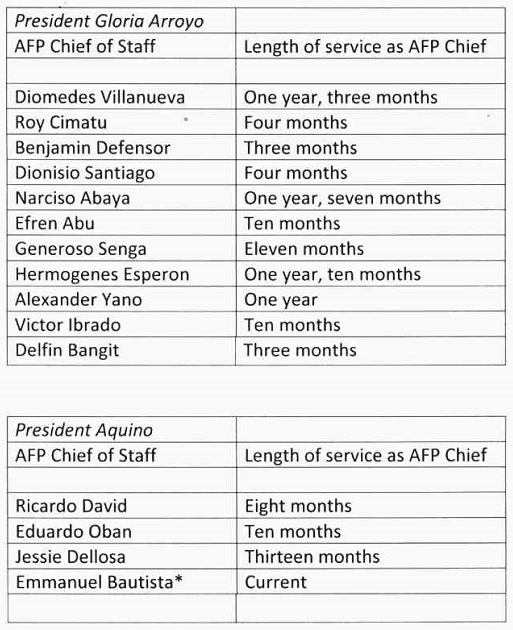
At the start of his presidency, there was a glimmer of hope that he would put an end to the pernicious “revolving door” policy of his predecessor in the appointment of AFP chiefs. However, in January 2012, he vetoed a bill ratified by Congress providing for a fixed term of office for the AFP chief of staff and major service commanders. His action has resulted in maintaining essentially the same record as his predecessor President Gloria Arroyo who had eleven chiefs in her 10 years in office.

* General Bautista retires in July this year; he would have served for 18 months.


I have always believed that the “revolving door” policy on the leadership of key AFP commands has been extremely detrimental to the organization, not only in terms of efficiency and effectiveness, but more so in terms of promoting and enhancing the professionalism of the officer corps. It served the purpose of Mrs. Arroyo to hold the entire officer corps hostage as the scramble for position and favor made it almost impossible to create a sense of loyalty to the institution rather than to an individual.

One of the most respected figures in Philippine management circles is Washington Sycip, founder of Sycip Gorres Velayo and Co. (SGV &Co.) and the Asian Institute of Management (AIM).

Three years ago, Mr. Sycip was the guest speaker at the annual general membership meeting of the PMAAA Inc. He started his speech with a brief statement about his short military career, after which he cautioned: “You may regret having me with you today.” He then proceeded to provide his impressions on one of the issues affecting the AFP: “We who are in the private sector wonder about the rapid changes in the military leadership. In the private sector, we will not have CEOs with one- or two-year terms if we want reforms or proper planning for the future. Is it possible to carry out reforms in an organization as large as the Armed Forces when there is such a rapid change in the leadership?”

My own question: Is the AFP condemned to short-term leadership for the rest of its natural existence?

http://opinion.inquirer.net/68913/another-new-year-another-afp-chief