Wednesday, April 17, 2019

Commentary: China goes unconventional in South China Sea's escalating confrontation

Commentary posted to the Japan Times (Apr 17, 2019): China goes unconventional in South China Sea's escalating confrontation (Peter Apps/Reuters)


U.S. Marines observe the assault ship USS Wasp, laden with F-35B jets, off the coast of the Philippines on April 11 during this year's annual joint US-Philippines military exercise. | AFP-JIJI

In early December, a flotilla of two dozen Chinese fishing boats and escort warships sailed to the disputed Filipino-occupied reef of Thitu. By the end of the month, Beijing had almost 100 vessels in and around the archipelago, creating an initially largely hidden confrontation that could yet spark outright war.

When China’s People’s Liberation Army Navy turns 70 in October, the celebrations will center on its largest, highest-profile warships — particularly its pair of aircraft carriers, set to be the first of many. High-tech saber-rattling is clearly at the heart of Beijing’s strategy to dominate its immediate neighborhood, with jets and warships particularly aggressive around Taiwan’s borders in the last six months.

What the confrontation with the Philippines demonstrates, however, is that such conventional naval posturing is complemented by something much less conventional: the hundreds if not thousands of small fishing and other vessels of China’s “maritime militia.” Usually unarmed, albeit increasingly escorted by Chinese warships and coast guard cutters, they have become more assertive by the month.

With U.S.-Chinese relations already complicated by U.S. President Donald Trump’s trade war, such confrontations are now clearly drawing in the United States. Earlier this month the U.S. Navy announced it was sending the assault ship USS Wasp — essentially a small aircraft carrier operating 20 F-35B Joint Strike Fighters and a Marine Expeditionary Force — to exercise with the Filipino Navy. On March 1, U.S. Secretary of State Mike Pompeo warned any Chinese attack on Filipino forces or civilian vessels would trigger a U.S. military response under a 1951 mutual defense treaty.

The confrontation with the Philippines suggests Beijing’s faceoff with its neighbors is reaching a new and potentially more volatile stage. China has spent the intervening time building a network of sometimes vast reclaimed outposts on some of the most contentious islands. Now, however, Beijing is becoming much more assertive right up to territory held by other nations, both with conventional military force and “civilian” vessels such as its fishing fleet.

This has also demonstrated how complex the political dynamics of such a faceoff can be. Philippine President Rodrigo Duterte had been considered one of the closest regional leaders to China, with Beijing much less likely than the U.S. to criticize his government’s often brutal crackdown on suspected drug dealers that has left thousands dead. Chinese investment in the Philippines has increased sharply under his administration, including purchases of major strategic commercial port infrastructure.

Throughout this most recent crisis, Duterte has walked an awkward path between placating hawkish voices at home and further antagonizing his unraveling relationship with Beijing. Nationalist voices in the Philippines, meanwhile — as well as much of the country’s national security establishment — have been pushing him relentlessly toward a tougher line.

The current faceoff began when the Philippines stepped up construction of its own island military outpost, albeit on a much smaller level than China’s giant island-building elsewhere in the region. With over half the world’s fishing fleet, Beijing has more than enough vessels to swarm an area.

Satellite footage from the Asia Maritime Transparency Initiative, part of the Center for Strategic and international Studies in Washington, shows the flotilla almost always supported by one or more Chinese warships or coast guard vessels, usually keeping their distance several kilometers further from any of the disputed islands. Their message appears clear — that if the Philippines chose to follow Indonesia or Vietnam in firing warning shots at Chinese fishing vessels or seizing them in disputed waters, they would be risking an immediate military clash.

How far either side is truly willing to go remains extremely unclear. While Duterte has said war with China would be “suicidal,” he’s also warned that he would send the Philippine military to confront China if it did not “lay off” its islands. Still, it remains likely Beijing will maintain the status quo, frequently or continually maintaining large flotillas around both Thitu, scene of the current dispute, as well as Scarborough Shoal, where a similar faceoff took place in 2012.

Even that, it is increasingly clear, would bring with it a significant rise in regional tension. While the Pentagon has remained largely tight-lipped about the exact location and activities of the Wasp and its task force, Filipino media cited reports from local fisherman putting it near Scarborough Shoal, also known for regular Chinese fishing fleet and possible “maritime militia” activity. If that were true, that would be the most assertive the U.S. Navy has been in the region when it comes to pushing back at China’s maritime claims.

To make matters more complex still, a small flotilla of Russian warships is now also exercising in the South China Sea, the latest sign of growing cooperation between Moscow and Beijing. That included an apparently prearranged visit to the Philippines, another sign of just how conflicted Duterte and others in his government remain on their alliance to the United States — and keen to hedge their bets.

In the almost a decade since the Obama administration announced its “pivot” to confront a rising China, both Washington and Beijing have invested considerable energy in imagining and preparing for conventional all-out war with each other. Such a conflict would prove devastating to the economies of both countries and the wider world — a key reason it has not happened so far.

Through pushing its neighbors in slightly less direct military ways, China clearly hopes to dominate the region without needing to fire a shot. But we may have decades more of these confrontations to come — and with other nations increasingly pushing back, they will become riskier by the year.

[Peter Apps is a writer on global issues.]

Clash erupts in Cotabato while serving warrant vs. BIFF member

From GMA News Online (Apr 17, 2019): Clash erupts in Cotabato while serving warrant vs. BIFF member

Clash erupted between security forces and members of the Bangsamoro Islamic Freedom Fighters (BIFF) when authorities served a warrant of arrest against Samad "Madrox" Masgal on Tuesday in Midsayap, North Cotabato.

According to the military on Wednesday, the firefight took place around 3 a.m. when Masgal resisted arrest.

The encounter resulted in the wounding of Masgal and neutralization of a certain Pakindal "Tawantawan" Baganian.

A soldier was also injured during the firefight, the military said.

"The success of the operation was manifested by the strong cooperation and commitment among the security forces and civilian residents in the area to fight against criminality,” said Ltc. Glenn Loreto Caballero, commanding officer of 34th Infantry Brigade.

Masgal, who is a BIFF member under Karialan faction, has pending cases for violation of Comprehensive Dangerous Drugs Act of 2002 and illegal possession of firearms and ammunition.

He was also allegedly involved in bombing attacks, liquidation and harassment of military detachment in the area. He also has seven counts of murder and attempted murder.

Authorities also seized one M14 rifle and one magazine loaded with nine live ammunition during the operation.

https://www.gmanetwork.com/news/news/nation/691618/clash-erupts-in-cotabato-while-serving-warrant-vs-biff-member/story/

Fighter under new Philippine ISIS leader Sawadjaan arrested in Sulu

From the Manila Bulletin (Apr 17, 2019): Fighter under new Philippine ISIS leader Sawadjaan arrested in Sulu

An Abu Sayyaf fighter under new Islamic State of Iraq and Syria (ISIS) in the Philippines leader Hajan Sawadjaan was arrested while the body of another suspected terrorist was recovered in the ongoing military offensive in Sulu, the military said Wednesday.

Col. Gerry Besana, spokesman of the Western Mindanao Command, said Abu Sayyaf member Aldie Wajid was already turned over to the local police for the filing of criminal charges.

“He is an Abu Sayyaf member under Hajan Sawadjaan. Seized from him were a .45 caliber pistol and two rolls of electric wire,” said Besana.


Sawadjaan, said to be the new ISIS leader in the Philippines, was tagged as the mastermind behind the Jolo Cathedral bombing in December last year that left more than 20 people dead.

Besana said Wajid was collared in Sitio Kan Bading, Barangay Taung, Patikul, Sulu, at 7 a.m. Wednesday by elements of the 32nd Infantry Battalion.

Troops also found the body of a suspected Abu Sayyaf fighter in Sitio Hagas-Hagas, Barangay Pangkayahan, also in Patikul, Sulu, at 8 a.m. Wednesday.

“Troops of the 1st Scout Ranger Battalion recovered human remains believed to be of an ASG member slain during the series of encounters on April 11, 2019, in the same barangay,” said Besana.

“Our troops immediately buried the recovered dead body since it is already in the state of decomposition,” he added.

4 Abu Sayyaf members charged at DoJ

From The Manila Times (Apr 17, 2019): 4 Abu Sayyaf members charged at DoJ

CRIMINAL charges have been filed against four alleged members of the terror and kidnap group Abu Sayyaf who were arrested earlier this week in Zamboanga City.

Charged via preliminary inquest at the Department of Justice were Jainab Ibrahim, 29; Khadeeja Tawasil Jainal, 24; Abdurarafi Jalas Danial, 28; and Fatma Musa Narimen, 45.

The Philippine National Police Criminal Investigation and Detection Group lodged the charges of illegal possession of explosive devices under Republic Act 9516 on Wednesday.

Based on PNP intelligence reports, the suspects included three women, who were allegedly wives of Abu Sayyaf commanders.

They allegedly aided the Abu Sayyaf in their financial transactions, helped procure guns and bomb parts, and arranged the travels of foreign terrorists to the Philippines.

The suspects were nabbed in raids at houses in Zamboanga City, where authorities seized two grenades, a bag of suspected ammonium nitrate and electrical parts for making bombs.

The women worked under Abu Sayyaf leader Hajan Sawadjaan, the main suspect in the January 27 bombing of Jolo Cathedral that killed 23 people.
Advertisements

They were brought to the DoJ main office in Manila after their arrest on Tuesday.

The respondents were presented before Senior Assistant State Prosecutor Olive Torrevillas, who was tasked to resolve the complaint of PNP.

https://www.manilatimes.net/4-abu-sayyaf-members-charged-at-doj/541895/

Ex-NDF man: 9 ‘trapos’ paying millions for Red endorsement

From the Manila Standard (Apr 17, 2019): Ex-NDF man: 9 ‘trapos’ paying millions for Red endorsement

Nine politicians, including five senatorial candidates in the May 13 elections, have been endorsed by communist groups in exchange for millions of pesos, a former officer of a leftist group said Wednesday.


THUMBS DOWN. Former rebels of the New People's Army-Communist Party of the Philippines Ka Isko, Kilusan at Alyansa ng Dating Rebelde (KADRE) spokesman; Ka Mario of the Communist Terrorist Coalition; Ka Jamie of the Dating Kaguma National Democratic Front-CPP and former Alliance of Concerned Teachers organizer; and Ka Ernesto, former organizer of the National Union of Journalists of the Philippines, give the communist movement the thumbs-down during a forum organized by former rebels in Quezon City in this file photo. PNA photo

In a press statement, “Ka Nonoy” Alcantara, who said he was the National Democratic Front’s former liaison officer of its Electoral Unit, said among the politicians were incumbent Senators Grace Poe, Nancy Binay and Bam Aquino, former senators Serge Osmena, and former congressman Erin Tanada.

These lawmakers and three other “traditional politicians,” whom Alcantara did not name, were paying up to P20 million each to the Communist Party of the Philippines, its armed wing the New People’s Army, the NDF, the Makabayan party-list coalition and other “communist terrorist groups” (CTG) to gain their endorsement, he added.

At posting time, only TaƱada among the group of lawmakers has so far denied his involvement with the leftist groups. He said he was merely a human rights lawyer, not a communist.

Alcantara, who said he was a political officer for the Makabayan coalition, said he revealed this because former Interior Secretary Mar Roxas, who is running under the opposition Otso Diretso slate, was poised to be named as the last candidate to be endorsed by the communists for the midterm elections.

The former leftist leader also said Poe, Binay and Aquino each gave the CTGs P20 million, Osmena P10 million, and Tanada “got a discount” because his family has been a “long-time ally of the CPP-NPA-NDF.”

Alcantara said he was dismayed that his former comrades are endorsing Aquino, since the local communist movement itself had called for trashing “the US-Aquino tandem that was advancing imperialist and feudal interests in the country.”

“Now, they have exchanged their loyalties for huge sums or simply forgotten about them,” he added.

The former NDF officer said he would not be surprised if his former colleagues “in the lower units at the ‘White area base’ and even in the [main] Red area base” would be demoralized or raise more questions with these developments.

“It’s clear that the movement is now all about money, especially when it is tightening the collection of permit to campaign fees in the countryside” ahead of the midterm elections in less than a month, Alcantara said.

Even his old group, the NDF Electoral Unit, has become an alternative venue to bring in funds for the communist movement, he said.

Alcantara said the movement has also come to accept that its senatorial bet, Neri Colmenares, will be losing in the May elections, so it is “advancing its Plan B to retain its influence in Congress.”

The CTGs are also “cooking up” their support for a Manny Villar-Grace Poe tandem for the 2022 presidential elections, which the movement also did for the 2010 and 2016 general elections, he added.

“This is how desperate the CPP-NDF-NPA-CTG are, they will do everything just to ally with ‘trapos’ (traditional politicians) in exchange for power,” Alcantara said. He called on all voters to be smart in picking their candidates, because what the senatoriables being endorsed by the communists are doing “is treason against the nation.”

“Do these ‘trapos’ still have hearts and consciences? Why are they helping the devilish CPP/NPA/NDF that has cruel and bloody goals? Or maybe they don’t know? Please have pity on our children and their future,” Alcantara said.

http://www.manilastandard.net/news/national/292848/ex-ndf-man-9-trapos-paying-millions-for-red-endorsement.html

NPA attack kills 9-year old child

From the Manila Bulletin (Apr 17, 2019): NPA attack kills 9-year old child

Following the death of 2 soldiers on Monday, a child was killed in another attack by suspected members of the New People’s Army in Las Navas, Northern Samar at around 09:45 a.m. Wednesday (April 17).

The improvised explosive device (IED) blast fatally wounded a child identified as Armando Remolde, 9 years old and a resident of Brgy San Miguel, Las Navas, Northern Samar.

Reports disclosed that suspected communist rebels harassed the troops of the 20th Infantry Battalion’s temporary patrol base in Barangay San Miguel of said town, wherein the child was hit in the said explosion.

Authorities tried to revive the victim but to no avail.

Lt. Col. Juan Ariola, who only assumed as 20th IB commander yesterday condemns strongly the atrocity perpetrated by the rebel groups.

He said that they are in close coordination with the PNP to track the still unidentified suspects.

On Monday, Cpl. Robert Bueno and PFC Ronel Labid, both intelligence operatives of the 20th Infantry Battalion were killed in an ambush between the boundary of Brgys. San Antonio and Catotoogan, both in Las Navas town.

They were providing a clearing and route security for the personnel of the 543rd Engineering Construction Battalion (ECB) who were conducting a road project inspection under the Payapa at Masaganang Pamayanan (Pamana) program.

DILG cites Quezon City’s E-CLIP, the only one in the Metro

From the Manila Bulletin (Apr 17, 2019): DILG cites Quezon City’s E-CLIP, the only one in the Metro

The Department of Interior and Local Government – National Capital Region (DILG-NCR) has cited the Quezon City government for its successful and effective implementation of the Enhanced Comprehensive Local Integration Program (E-CLIP) for rebel-returnees.

Managed by local governments, the program provides surrendered communist rebels benefits such as livelihood and medical services, education, housing, and legal assistance.

Quezon City is the only Metro Manila city with a functional E-CLIP, the DILG said.

“We congratulate QC, lalo na si Mayor Herbert M. Bautista, for continuously functionalizing and strengthening its E-CLIP committee and providing optimum services to E-CLIP enrollees,” DILG-NCR Assistant Regional Director Juan Jovian Ingeniero said.

Four former New People’s Army-Milisya ng Bayan members from Sorsogon who had surrendered in QC received P15,000 cash assistance from the national government and social protection services from the city government in a recent ceremony attended by Mayor Herbert Bautista at the Quezon City Hall.

Three of the former rebels received a total of P257,000 for firearm remuneration.

They earlier received P65,000 immediate aid last October 2018.

Also present in the ceremony were representatives from the Quezon City Police District, the Department of National Defense, and the Joint Task Force – NCR.

The Department of Interior and Local Government – National Capital Region (DILG-NCR) has cited the Quezon City government for its successful and effective implementation of the Enhanced Comprehensive Local Integration Program (E-CLIP) for rebel-returnees.

The Department of Interior and Local Government – National Capital Region (DILG-NCR) has cited the Quezon City government for its successful and effective implementation of the Enhanced Comprehensive Local Integration Program (E-CLIP) for rebel-returnees.

Bautista, who served as one of the government’s advisers to the peace talks with Leftist rebels, approved Executive Order 8 Series of 2018 last year, creating the E-CLIP committee of Quezon City.

The QC-Social Services Development Department serves as the secretariat of the committee.

QC’s implementation of the E-CLIP is being implemented as part of its social welfare services to marginalized sectors of the city.

https://news.mb.com.ph/2019/04/17/dilg-cites-quezon-citys-e-clip-the-only-one-in-the-metro/

2 NPA members surrender in Bukidnon

From GMA News Online (Apr 17): 2 NPA members surrender in Bukidnon

Two members of the New People's Army (NPA) surrendered to the military in Barangay Poblacion, Impasug-ong in Bukidnon on Wednesday morning.

The NPA member is identified by the military as a certain Jeffrey, is Team Leader of Squad 2, Platoon 2, RSDG COMPAQ, North Central Mindanao Regional Command (NCMRC) and his wife, who was identified only as Maymay is the medical and former supply officer of the same platoon surrendered to the 8th Infantry “Dependable” Battalion, 4th Infantry “Diamond” Division through localized negotiation efforts that started last year.

The NPA members are residents of Sitio Ki-ongkog, Barangay Palabucan, Libona, Bukidnon.

“We were just looking for a chance to surrender because we want to live a peaceful life and create a family away from the armed struggle. We realized that fighting against the government will bring no peace but to our graves,” Jeffrey was quoted as saying.

Maymay was emotional as she remembered her sufferings, “Joining the NPA did nothing good to my life and I regret every bit of my decision. I have wanted a child but because of lack of sleep and food, I had two miscarriages. I lost my children because of the NPA.”

Lieutenant Colonel Ronald M. Illana, 8th Infantry Battalion commander, said, “I am happy with the decision of Jeffrey and his wife Maymay. We will process their inclusion as beneficiaries of the Enhanced Comprehensive Local Integration Program (E-CLIP) and recipients of free housing from the National Housing Authority (NHA). We just hope that more of their comrades will follow their lead and choose to live a peaceful life.”

The E-CLIP is a program of the government for those members of the NPA who will return to the fold of the law.

The program includes financial assistance up to P65,000, free housing, free education. A reintegration process will also take place which will prepare them in their return to the community and live peacefully together with their families.

https://www.gmanetwork.com/news/news/regions/691663/2-npa-members-surrender-in-bukidnon/story/

WESTMINCOM: Sayyaf apprehended in Sulu

Posted to the Western Mindanao Command (WESTMINCOM) Website (Apr 17, 2019): Sayyaf apprehended in Sulu


While conducting focused military operation, troops of the 32nd Infantry Battalion apprehended one Abu Sayyaf Group member under Hajan Sawadjaan, identified as Aldie Wajid in Sitio Kan Bading, Barangay Taung, Patikul, Sulu at 7:10 am today (April 17).

Seized from Wajid were 1 caliber .45 pistol, 1 magazine with 4 rounds of ammunition and 2 rolls of electric wire.

Wajid underwent custodial debriefing at the 32IB headquarters and was subsequently turned over to Patikul Municipal Police Station for further investigation and filing of appropriate charges.

Meanwhile, amid the conduct of focused military operation in Sitio Hagas-Hagas, Barangay Pangkayahan, Patikul, Sulu at 8am today, troops of the 1st Scout Ranger Battalion led by Major Aling, recovered human remains believed to be of an ASG member slain during the series of encounter last April 11, 2019 in the same barangay.
Troops immediately buried the recovered dead body since it is already in the state of decomposition.

Rallies held vs. NPA atrocities

From the Visayan Daily Star (Apr 17, 2019): Rallies held vs. NPA atrocities

Simultaneous rallies against atrocities allegedly perpetrated by the New People’s Army were held yesterday in several towns and cities of Negros Occidental, spearheaded by local government and state security officials.

The Mt. Cansermon Command of the NPA also issued a statement where they claimed a successful ambush against government forces on April 9 in Sitio Asaran, Brgy. Buenavista, Himamaylan City, by using IEDs (Improvised Explosives Device), that resulted in the injuries of seven Army soldiers.

Brig. Gen. Benedict Arevalo, 303rd Infantry Brigade commander, and P/Col. Romeo Baleros, officer-in-charge of the Negros Occidental Police Provincial Office, yesterday led the rally in Moises Padilla, two days after slain town Councilor Jolomar Hilario was buried on Sunday at the public cemetery.

The NPA Leonardo Panaligan Command claimed responsibility for the death of Hilario.

Similar protest actions were also held in the cities of Bago, Sagay, Himamaylan, Cadiz, Talisay and Kabankalan, where participants carried placards denouncing NPA violent activities.

Rebel spokesman Ka Dionesio Magbuelas denied military claims that they suffered two casualties in the Himamaylan ambush.

The NPA Roselyn Jean Pelle Command Northern Negros Guerilla Front also issued a statement condemning the arrest of Francisco Laza, chairman of the Danao River Fishermen Association (DARIFA), on April 5 in Escalante City.

The arrest of Laza, who was trying to escape from a checkpoint, yielded a .38 caliber revolver with five live ammunition, and a fragmentation grenade. But rebel spokesperson Cecil Estrella claimed that these were planted by authorities.

http://www.visayandailystar.com/2019/April/17/topstory9.htm

Two brgy watchmen injured in rebel indiscriminate firing

From the Visayan Daily Star (Apr 17, 2019): Two brgy watchmen injured in rebel indiscriminate firing

Two barangay watchmen were injured from indiscriminate firing by suspected New People’s Army rebels in Brgy. Nalundan, Bindoy, Negros Oriental, Monday.

The two victims, identified as Nalundan barangay tanod chief Jose Arlito Amper and Aldrin Palumar suffered gunshot wounds in the left cheek and left arm, respectively.

Both were brought to the Bindoy District Hospital for treatment of the injuries.

The harassment came two days after Army soldiers overran a rebel camp and seized three high- powered guns left behind by suspected NPA rebels in Brgy. Cabcababan, Bindoy, Negros Oriental, on Sunday, after five minutes of gunbattle.
Police investigations showed that the Nalundan barangay captain, Charlito Damian, and his group were in the house of Amper, when they were fired at by a group of NPA rebels, hitting the two victims.

The armed rebels left after 10 minutes of indiscriminate firing, investigations of the Bindoy police showed.

Troopers of the 2nd Provincial Mobile Force Company of the Negros Oriental Police Provincial Office and the 94th Infantry Battalion are still pursuing the armed suspects, as of this waiting.*

http://www.visayandailystar.com/2019/April/17/topstory8.htm

First Quarter 2019 Social Weather Survey: Net trust stays “Very good” for the United States; “Good” for Japan and Australia; “Neutral” for China

Posted to the Social Weather Stations (SWS) Website (Apr 16, 2019): First Quarter 2019 Social Weather Survey: Net trust stays “Very good” for the United States; “Good” for Japan and Australia; “Neutral” for China


SWS Special Report (printer-friendly version here) 

Of the four specific countries tested for public trust, the net trust ratings (% much trust minus % little trust) were “very good” for the United States, “good” for Japan and Australia, and “neutral” for China, based on the First Quarter 2019 Social Weather Survey, conducted from March 28-31, 2019.

The survey found a very good +60 net trust rating for the United States [Chart 1].

It found good net trust ratings for Japan, at +34, and Australia, at +33.

It found a neutral -6 net trust rating for China.

Compared to when they were last surveyed, the March 2019 net trust ratings stayed within the same grade for all four countries.

The SWS terminology for Net Trust Ratings: +70 and above, "excellent"; +50 to +69, "very good"; +30 to +49, "good"; +10 to +29, "moderate"; +9 to -9, "neutral"; -10 to -29, "poor"; -30 to -49, "bad"; -50 to -69, "very bad"; -70 and below, "execrable."

Net trust stays “Very Good” for the United States

Net trust rating stayed very good for the United States, at +60 (70% much trust, 10% little trust) in March 2019, similar to the +60 (71% much trust, 11% little trust) in December 2018 [Table 1].

Net trust in the United States has been positive since SWS first surveyed it in December 1994, ranging from a moderate +18 in May 2005 to as high as excellent +82 in December 2013. It has been at +60 and above in six out of seven surveys since June 2017.

Net trust stays “Good” for Japan

Net trust rating stayed good for Japan, at +34 (54% much trust, 20% little trust) in March 2019, similar to the +34 (53% much trust, 19% little trust) in December 2018 [Table 2].

SWS first surveyed public trust in Japan in December 1994, and found neutral net ratings from December 1994 to December 1996, ranging from -2 to +9. It rose to a moderate +17 in June 1997, and has since then been at moderate to good levels, reaching as high as very good +54 in December 2017.

Net trust stays “Good” for Australia

Net trust rating also stayed good for Australia, at +33 (51% much trust, 18% little trust) in March 2019, up by 2 points from +31 (49% much trust, 19% little trust, correctly rounded) in December 2018 [Table 3].

Net trust in Australia was a moderate +11 when SWS first surveyed it in April 1995. It ranged from neutral +3 to moderate +25 from September 1995 to March 2008. It rose to good +31 in September 2008, and has since then been at +30 and above, except for the moderate +19 in September 2009.

Net trust stays “Neutral” for China

Net trust stayed neutral for China, at -6 (32% much trust, 39% little trust, correctly rounded) in March 2019, up by 1 point from -7 (31% much trust, 39% little trust, correctly rounded) in December 2018 [Table 4].

Net trust in China has been positive in only 9 out of 49 surveys since SWS first surveyed it in August 1994. It reached as high as moderate +17 in June 2010 and as low as a bad -46 in September 2015.

Survey background

The March 2019 Social Weather Survey was conducted from March 28-31, 2019 using face-to-face interviews of 1,440 adults (18 years old and above) nationwide: 360 each in Balance Luzon, Metro Manila, the Visayas, and Mindanao (sampling error margins of ±2.6% for national percentages, and ±5% each for Balance Luzon, Metro Manila, the Visayas, and Mindanao).

The area estimates were weighted by the Philippine Statistics Authority medium-population projections for 2019 to obtain the national estimates.

The Social Weather Survey items on public trust in selected countries are non-commissioned. These items were included on SWS's own initiative and released as a public service. The specific countries included in the surveys are based on their relevance to foreign affairs.

The exact questions on public trust in selected countries are as follows: "Pag-usapan po natin ang tungkol sa ilang bansa. Sa mga sumusunod, maaari po bang sabihin ninyo kung ang pagtitiwala ninyo sa (bansa) ay Napakalaki, Medyo malaki, Hindi tiyak kung malaki o maliit, Medyo maliit, Napakaliit, o Wala pa kayong narinig o nabasa kahit na kailan tungkol sa (bansa)? Pakisabi ang sagot ninyo sa pamamagitan ng paglagay ng mga kard sa naaangkop na lugar sa rating board na ito (SHUFFLE CARDS). [Let's now talk about some countries. For the following, please indicate if your trust/faith in (country) is Very much, Somewhat much, Undecided if much or little, Somewhat little, Very little, or You have not heard or read anything about the (country) ever? You may indicate your answers by placing each card on the appropriate box on this rating board (SHUFFLE CARDS).]"

Q117. United States of America or USA

Q118. China

Q119. Japan

Q120. Australia

SWS employs its own staff for questionnaire design, sampling, fieldwork, data-processing, and analysis, and does not outsource any of its survey operations. This report was prepared by Leo S. Laroza.
#
Chart 1

Table 1


Table 2


Table 3


Table 4


First Quarter 2019 Social Weather Survey: Most Pinoys agree that the suit against Xi Jinping in the ICC tells the world that China should leave the West PH Sea

From the Social Weather Stations (SWS) Website (Apr 17, 2019): First Quarter 2019 Social Weather Survey: Most Pinoys agree that the suit against Xi Jinping in the ICC tells the world that China should leave the West PH Sea


SWS Special Report (printer-friendly version here) 

The First Quarter 2019 Social Weather Survey, done on March 28-31, 2019, found that 49% of adult Filipinos agree that the suit filed by former officials of the Philippine government against Chinese President Xi Jinping before the International Criminal Court (ICC) tells the world that China should leave the islands it has occupied in the West Philippine Sea.

To the test statement, “The suit filed in the ICC by Albert Del Rosario and Conchita Carpio-Morales, former officials of the PH government, against Chinese Pres. Xi Jinping for wrongful destruction of the livelihood of Filipino fisherman shows the world that China should leave the islands it has occupied in the West Philippine Sea [Ang paghabla sa ICC ni Albert Del Rosario at Conchita Carpio-Morales, dating opisyales ng PH government, laban kay Xi Jinping, Pangulo ng Tsina, tungkol sa walang-karapatang paninira ng Tsina sa hanapbuhay ng mga mangingisdang Pilipino ay nagpapakita sa mundo na dapat umalis ang Tsina sa mga islang inokupa nya sa West Philippine Sea],” 27% strongly agree (lubos na sumasang-ayon), 22% somewhat agree (medyo sumasang-ayon), 28% are undecided if agree or disagree (hindi tiyak kung sang-ayon o di sang-ayon), 10% somewhat disagree (medyo hindi sumasang-ayon), and 7% strongly disagree (lubos na hindi sumasang-ayon) [Chart 1].

This gives a net agreement score (% strongly/somewhat agree minus % somewhat/strongly disagree) of +32, classified by SWS as very strong.

SWS terminology for Net Agreement: +50 and above, “Extremely Strong”; +30 to +49, “Very Strong”; +10 to +29, “Moderately Strong”, +9 to –9, “Neutral”; –10 to –29, “Moderately Weak”; –30 to –49, “Very Weak”; –50 and below, “Extremely Weak”.

Net agreement is “Very strong” regardless of trust or distrust in China

Net agreement with the statement was very strong regardless of people’s trust or distrust in China as a country.
It was very strong +34 among those with much trust in China, very strong +30 among those undecided with their trust, and very strong +33 among those with little trust in China [Chart 2].

On April 16, 2019, SWS reported the First Quarter 2019 survey results showing that, of the four specific countries tested for public trust, China obtained the lowest net trust (% much trust minus % little trust) of neutral -6, compared to the United States with very good +60, Japan with good +34, and Australia with good +33 (“First Quarter 2019 Social Weather Survey: Net trust stays ‘Very good’ for the United States; ‘Good’ for Japan and Australia; ‘Neutral’ for China”, www.sws.org.ph, 16 April 2019).

“Very strong” in Metro Manila and Balance Luzon, “Moderately strong” in Mindanao and the Visayas

Net agreement that the ICC suit against Chinese President Xi Jinping tells the world that China should leave the islands it has occupied in the West Philippine Sea was highest in Metro Manila at very strong +43, followed by Balance Luzon at very strong+39, Mindanao at moderately strong +23, and the Visayas at moderately strong +18 [Chart 3].

“Very strong” in classes ABC and D, among high school graduates and above

Net agreement with the statement was highest in class ABC at very strong +42, followed by class D or the masa at very strong+33, and class E at moderately strong +23 [Chart 4].

By education, it was highest among college graduates at very strong +45, followed by high school graduates at very strong+37, elementary graduates at moderately strong +26, and non-elementary graduates at moderately strong +17 [Chart 5].

Survey background

The March 2019 Social Weather Survey was conducted from March 28-31, 2019 using face-to-face interviews of 1,440 adults (18 years old and above) nationwide: 360 each in Balance Luzon, Metro Manila, the Visayas, and Mindanao (sampling error margins of ±2.6% for national percentages, and ±5% each for Balance Luzon, Metro Manila, the Visayas, and Mindanao).

The area estimates were weighted by the Philippine Statistics Authority medium-population projections for 2019 to obtain the national estimates.

The Social Weather Survey question on public opinion about the ICC suit against Chinese President Xi Jinping and China leaving the islands it has occupied in the West Philippine Sea is non-commissioned. It was included on SWS's own initiative and released as a public service.

The exact question was: “Ngayon po, mayroon ako ritong mga statements o pangungusap na maaaring maglarawan sa nararamdaman o naiisip ng mga tao ngayon.  Pakisabi po kung kayo ay sumasang-ayon o hindi sumasang-ayon sa mga statements o pangungusap na ito. Pakilagay lang po ang kard na may pangungusap sa naaangkop na lugar sa rating board na ito. (Lubos na sumasang-ayon, Medyo sumasang-ayon, Hindi tiyak kung sumasang-ayon o hindi sumasang-ayon, Medyo hindi sumasang-ayon, o Lubos na hindi sumasang-ayon) [I have here some statements which may reflect how people feel or think about certain matters at present.  Please tell me if you agree or disagree with these statements.  You may indicate your answers by placing the card with the statement in the appropriate place on this rating board. (Strongly agree, Somewhat agree, Undecided if agree or disagree, Somewhat disagree, or Strongly disagree)]:”

Q124. “Ang paghabla sa ICC ni Albert Del Rosario at Conchita Carpio-Morales, dating opisyales ng PH government, laban kay Xi Jinping, Pangulo ng Tsina, tungkol sa walang-karapatang paninira ng Tsina sa hanapbuhay ng mga mangingisdang Pilipino ay nagpapakita sa mundo na dapat umalis ang Tsina sa mga islang inokupa nya sa West Philippine Sea [The suit filed in the ICC by Albert Del Rosario and Conchita Carpio-Morales, former officials of the PH government, against Chinese Pres. Xi Jinping for wrongful destruction of the livelihood of Filipino fisherman shows the world that China should leave the islands it has occupied in the West Philippine Sea]”

SWS employs its own staff for questionnaire design, sampling, fieldwork, data-processing, and analysis, and does not outsource any of its survey operations. This report was prepared by Leo S. Laroza, with special tabulations done by Joanne C. Evangelista.

#
Chart 1


Chart 2


Chart 3


Chart 4


Chart 5

Trust in China 'neutral' as U.S. keeps 'very good' rating

From Rappler (Apr 17, 2019): Trust in China 'neutral' as U.S. keeps 'very good' rating

Japan and Australia maintain their 'good' net trust ratings in a recent survey by polling firm Social Weather Stations

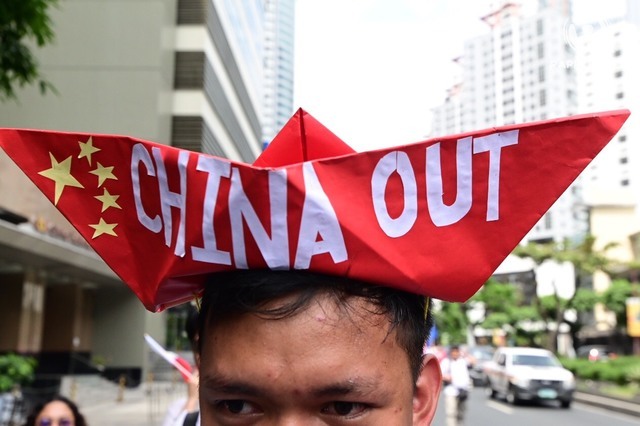
UNPOPULAR COUNTRY. One of hundreds of protesters wears a 'China out' hat at a Day of Valor rally in front of the Chinese consulate in Makati City on April 9, 2019. Photo by Alecs Ongcal/Rappler

UNPOPULAR COUNTRY. One of hundreds of protesters wears a 'China out' hat at a Day of Valor rally in front of the Chinese consulate in Makati City on April 9, 2019. Photo by Alecs Ongcal/Rappler
MANILA, Philippines – Defying the preferences of Philippine President Rodrigo Duterte, Filipinos' trust in China stayed "neutral" as the United States maintained its "very good" rating in a recent survey by polling firm Social Weather Stations (SWS).

The survey, released by the SWS on Tuesday, April 16, showed the US maintaining its "very good" net trust rating of +60 as of March this year. The SWS said this is similar to its +60 trust rating in December 2018.

China got a "neutral" trust rating of -6 in March. This was up by one point from its -7 in December 2018.

The SWS conducted its survey from March 28 to 31 through face-to-face interviews with 1,440 adults. The survey items on countries were non-commissioned, which means these were included "on SWS's own initiative and released as a public service."

The margin of error was ±2.6% for national percentages.

In the same SWS survey, Japan maintained its "good" +34 net trust rating. Australia's rating also stayed "good" at +33.

The survey comes as the Duterte administration draws flak for accepting controversial Chinese loans and grants while the Asian giant continues its incursions in the West Philippine Sea (South China Sea).

President Rodrigo Duterte is seeking friendlier ties with China in exchange for loans and grants, as he distances himself from the US because he detests its supposed interference in his anti-drug campaign.

On the ground, however, Duterte's men continue close engagements with Washington, while Beijing remains unpopular among Filipinos.

https://www.rappler.com/nation/228363-filipinos-trust-in-china-us-sws-survey-march-2019

CHR warns red-tagging has 'serious implications' on security of groups

From Rappler (Apr 17, 2019): CHR warns red-tagging has 'serious implications' on security of groups

The Commission on Human Rights reminds the government that branding any group as a communist front without proper trial violates their constitutional guarantee of presumption of innocence

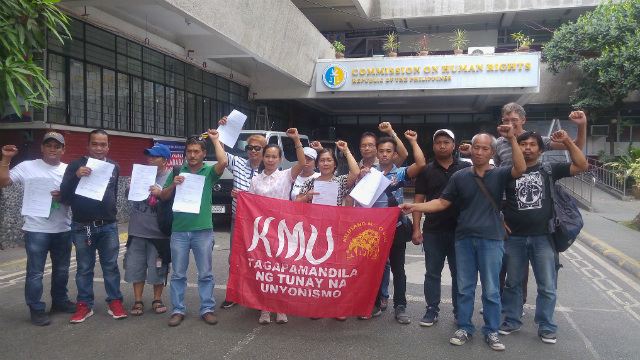
END TO ATTACKS. Kilusang Mayo Uno asks the Commission on Human Rights to probe red-tagging and harassment against progressive groups. Photo from the Center for Trade Union and Human Rights

END TO ATTACKS. Kilusang Mayo Uno asks the Commission on Human Rights to probe red-tagging and harassment against progressive groups. Photo from the Center for Trade Union and Human Rights

MANILA, Philippines – The Commission on Human Rights (CHR) on Wednesday, April 17, cautioned the government against red-tagging of several groups, including workers' unions, as it endangers the lives of members.

In a statement, CHR Spokesperson Jacqueline de Guia said allegations branding any group as a communist front should be "tried before fair and competent courts."

"Labeling groups before an objective judgment violates the constitutional guarantee of presumption of innocence and may have serious implications on the security and movement of individuals and groups involved," she said.

Labor group Kilusang Mayo Uno (KMU) on Tuesday, April 16, filed a complaint before the CHR against attacks and harassment, including red-tagging and alleged fabrication of criminal charges.

In the complaint, KMU expressed its concerns over threats that affect workers' right to organize and assemble. The CHR said it has endorsed these concerns to several regional offices for investigations.

KMU is among the progressive groups that National Security Adviser Hermogenes Esperon Jr accused of fronting for the Communist Party of the Philippines, in a letter sent to the European Union.

Major General Antonio Parlade Jr, the deputy chief-of-staff for civil military operations, also claimed that KMU was one of the groups used as a legal front for illegal activities by National Democratic Front consultant Rey Casambre.

Dangerous

Several organizations have also slammed the government for red-tagging, including health workers' groups who emphasized that their members are only doing their jobs in calling for better social services.

Karapatan, meanwhile, said the government's actions against human rights groups are "meant to dissuade international actors from providing resources to their work, research, and humanitarian support."

"This situation imperils the many efforts of human rights defenders and various organizations to access and inform the international community on cases of rights violations and the overall human rights situation in the Philippines and their initiatives to provide services for marginalized indigenous, peasant, and urban poor communities," it added.

The National Union of Peoples' Lawyers on Monday, April 15, filed petitions before the Supreme Court seeking protection from alleged harassment by the military.

Human rights groups have consistently condemned the government for red-tagging, profiling, and surveillance. In March 2018, the Department of Justice sought to tag several activists and leaders of progressive groups as terrorists.

https://www.rappler.com/nation/228374-commission-human-rights-red-tagging-serious-implications-security-progressive-groups