Wednesday, January 31, 2024

In Marcos’ Hanoi visit, South China Sea issues take the spotlight

From Rappler (Jan 31, 2024): In Marcos’ Hanoi visit, South China Sea issues take the spotlight (By BEA CUPIN)
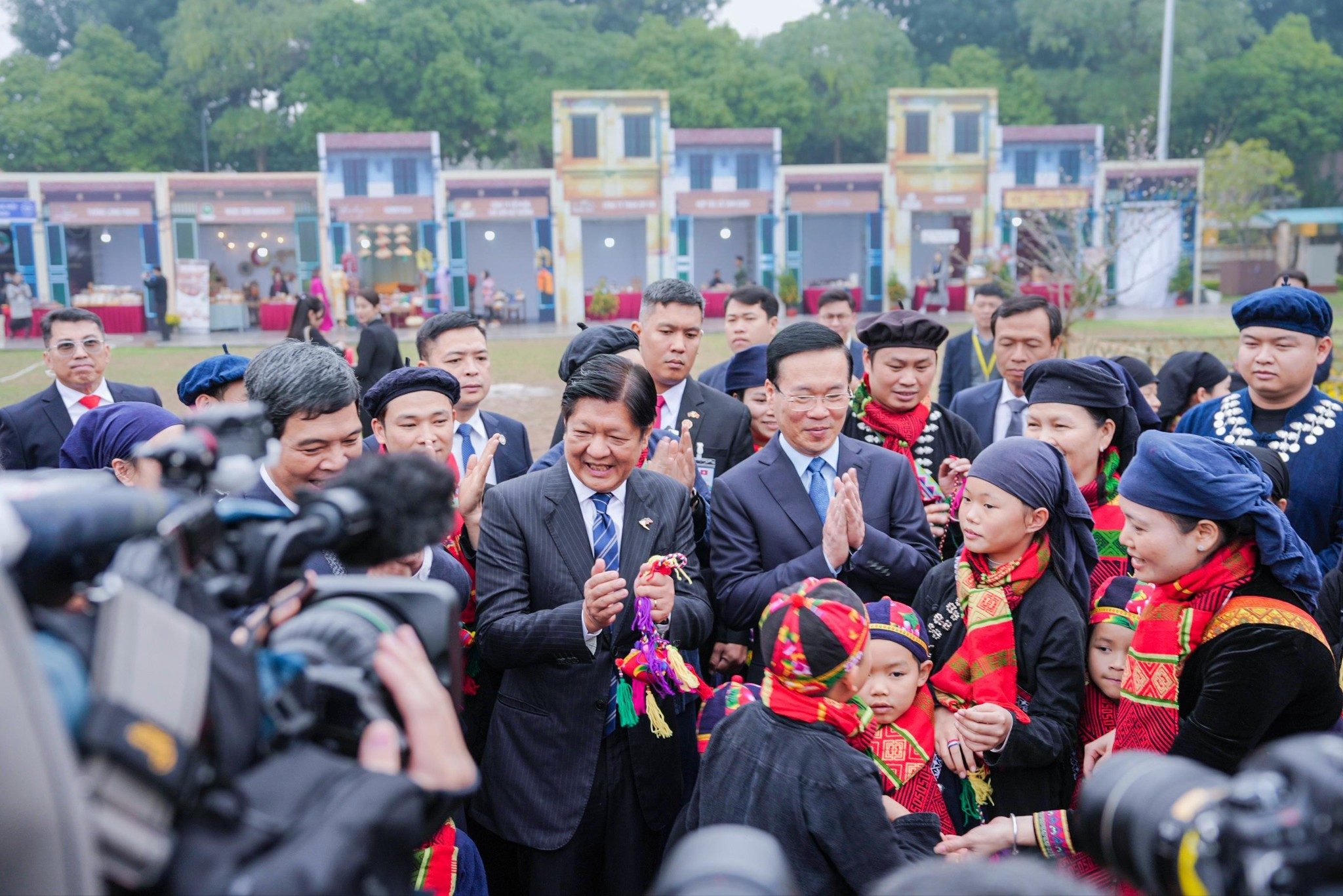


The two countries share similar concerns as China asserts its claims more aggresively in the South China Sea

MANILA, Philippines – For his first bilateral visit for 2024, President Ferdinand Marcos Jr. put security and safety issues in the South China Sea at the forefront as he met with leaders from Vietnam, which also has claims in the critical waterway.

In speeches delivered during meetings with Vietnamese President Võ Văn Thưởng and Prime Minister Pham Minh Chinh, the Philippine president repeatedly called attention to agreements between the two countries covering their coast guards and “cooperation and coordination” in the South China Sea, as well as a future joint submission before the United Nations Commission on the Limits of the Continental Shelf.

Marcos was in Hanoi from January 29 to 31 for a state visit.

Why do these agreements and commitments matter?

Both the Philippines and Vietnam are claimant states in the South China Sea – a crucial waterway that superpower China claims practically in its entirety. China’s 9-dash line, which evolved into the 10-dash line, includes large swaths of the sea claimed by several other states including Vietnam, the Philippines, Malaysia, Brunei, and the independently-governed Taiwan.

The line encompasses the West Philippine Sea, which includes parts of the South China Sea within the Philippines’ exclusive economic zone (EEZ). The 2016 Arbitral Ruling invalidated the 9-dash line, but China has refused to acknowledge its validity.

China’s assertions

The two Southeast Asian neighbors face the same dilemma as other nations in the region and beyond: China’s aggressiveness in asserting its claims in the South China Sea.

“On regional and international issues, the South China Sea remains to be a point of contention. The Philippines’ position on the South China Sea has been consistent, clear, and firmly anchored in the 1982 United Nations Convention on the Law of the Sea,” said Marcos to both Vietnamese leaders.

The South China Sea is crucial for security and stability not just of the countries that surround it, but of the global economy, too.

For countries like the Philippines and Vietnam, stability and peace means access to the resources of the South China Sea, and their ability to truly exercise their sovereign rights in those waters, ensure their food supply and the livelihoods of small-scale fisherfolk. It also means it need not think about threats to its territory.

An estimated $3 trillion in trade passes through the South China Sea yearly.

“It is imperative to the Philippines and the world that the sailings and the air traffic over the South China Sea remain free for the large amount of trade that goes through those areas,” added Marcos.

The Philippines has been a front row witness and victim to China’s aggressive actions.

In 2023 especially, the Philippines, through its “transparency initiative,” put a spotlight on the harassment its ships face during resupply missions to Ayungin Shoal, where a rusty warship serves as a military outpost.

Hanoi, while not showing the same transparency as Manila, has had its share of publicized incidents of conflict with China in the South China Sea. In May 2023, a Chinese research ship and five escort vessels entered Vietnam’s EEZ. Vietnam rebuked China’s actions.

That same month Vietnam also rebuked the Philippines’ decision to place navigational buoys within its EEZ.

Bringing tensions down

Diplomacy and continued dialogue is always essential, especially when tensions on the ground – or at sea, in this case – run high.

Manila has been keen on keeping communication lines with Beijing open. In mid-January 2023, the Philippines and China agreed to better their “maritime communication mechanism in the South China Sea,” during a meeting in Beijing.

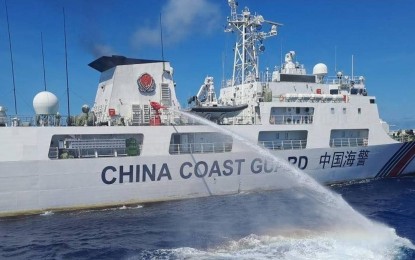
Just a month prior, on December 9 and 10, Philippine vessels in Bajo de Masinloc and Ayungin Shoal – features that are well within the Philippines’ EEZ – were targeted by water cannons by the China Coast Guard. Outside of collision and allision incidents, the weekend firing of water cannons would have been the worst instance of rising tensions and danger in those waters.

Marcos brought up the weekend incident in Vietnam, calling it China’s “undertaking of unilateral and illegal actions that violate our sovereignty, our sovereign rights, and jurisdiction, and exacerbate tensions in the South China Sea.”

“We are firm in defending our sovereignty, sovereign rights, and jurisdiction against these Chinese provocations. But at the same time, we are also seeking to address these issues with China and all other partners through peaceful dialogue and consultations as two equal sovereign states,” said Marcos.

But there is a bigger agreement that’s long-overdue: the Code of Conduct (COC) in the South China Sea between the Association of the Southeast Asian Nations (ASEAN) and China.

Absent a COC, bilateral agreements, such as the Memorandum on Incident Prevention and Management in the South China Sea signed in Hanoi, matter – if only to make it clear between two countries how their maritime agencies should function in the waterway.

“I hope that through dialogue, we can maintain a peaceful, friendly, and harmonious environment in the South China Sea,” said Marcos of the agreement, the full text of which has yet to be made public.

Marcos had said in a November 2023 forum that the Philippines was seeking separate codes of conduct with other Southeast Asian nations. It’s likely he was referring to bilateral agreements akin to a COC such as the one signed with Vietnam.

“I hope that we can seriously implement this agreement as quickly as we can,” Macos would say of the agreement after calling on Prime Minister Phạm.

Another agreement, this time on cooperation between the Philippine Coast Guard and the Vietnam Coast Guard, also ensures a more peaceful South China Sea. It builds on two existing agreements – one signed in 2010 for search and rescue at sea, and another in 2011 to create a hotline communications mechanism.

Vietnamese ships – small fishing vessels, especially – often sail through or stay in different parts of the West Philippine Sea without any untoward incident. It was Vietnamese fisherfolk, for instance, who came to the rescue of Filipino fisherfolk whose vessel was sunk by a Chinese ship in Recto bank. Philippine authorities have also rescued Vietnamese fisherfolk in need of help at sea.

Marcos also “noted” Vietnam’s “continued interest” in a joint submission on the extended continental shelf before the Commission on the Limits of the Continental Shelf (CLCS).

The CLCS helps states figure out the limits of a country’s continental shelf when it goes beyond 200 nautical miles, or the EEZ. According to the Sasakawa Peace Foundation, CLCS also “[provides] scientific and technical advice, if requested by the coastal state.”

“As maritime nations, we share a similar assessment of the current state of our regional environment with other maritime nations of the Asia-Pacific. Our countries have crucial roles to play in shaping the regional security discourse and in upholding the rules-based international order,” said Marcos.
Trade ties

Vietnam, like the Philippines, has very close trade ties with China.

But unlike Manila, Hanoi also shares a land border with its Chinese neighbor. In late-December, Hanoi agreed to be part of Beijing’s “community of shared future,” although experts, according to the Voice of America, did not see it as a significant upgrade.

Socialist Vietnam has forged closer ties with the West.

Upping trade ties was part of Marcos’ main agenda in flying to Hanoi. The two countries signed an agreement on rice trade, with Marcos eyeing to “expand” bilateral trade, currently at just US$7 billion.

Agreements were also signed on tourism cooperation, as well as cultural cooperation.

https://www.rappler.com/newsbreak/explainers/marcos-jr-hanoi-vietnam-visit-south-china-sea-issues-take-spotlight/


AFP loyal to the Constitution: Brawner

From the Mindanao Times (Jan 30. 2024): AFP loyal to the Constitution: Brawner (By RHODA GRACE SARON)

THE ARMED Forces of the Philippines (AFP) reaffirmed its loyalty to the Constitution and commitment to the chain of command.

AFP Chief of Staff General Romeo Brawner Jr. said the military “shall be at the vanguard” to ensure the fulfillment of the Commander-in-Chief’s vision.

“In our national effort to usher in this vision, the AFP shall remain to be a highly professional military organization, loyal to the Constitution, the chain of command, and our people,” Brawner said in a statement.

On Sunday, former president Rodrigo Duterte appealed to the military and police to “protect the Constitution and people” as he claimed that efforts to amend the Supreme Law of the Land through people’s initiative were marred by alleged signature-buying.

President Ferdinand Marcos Jr.’s launching of the “Bagong Pilipinas” concept that he equates to a call for national transformation.

Duterte called on the President to stop underhanded tactics to change the constitution. “Kung nakikinig kayo, gusto niyo iwasan ang dugo, kayo lang makakapigil nito. Tigilin niyong kalokohan na ‘yan or yung mga rally na ganito will multiply all over the Philippines (If you are listening, stop this foolishness to avoid bloodshed. Only you can stop this or else protest rallies like this will multiply),” he said.

He also urged the military and the police to do their jobs of protecting the people. Duterte said they are duty-bound to stop any action that violates the constitution.

“Nasa inyong kamay yan (It’s in your hands),” he added.

https://mindanaotimes.com.ph/afp-loyal-to-the-constitution-brawner/

Army chief visits 10ID to boost troop morale

From the Mindanao Times (Jan 31, 2024): Army chief visits 10ID to boost troop morale
(By RHODA GRACE SARON)


ARMY CHIEF Lieutenant General Roy Galido commended the 10th Infantry Division for its commitment to maintaining peace and stability in its area of responsibility.

Galido visited Camp General Manuel T. Yan Sr. in Mawab, Davao De Oro on Jan. 29 where he conducted a comprehensive briefing with Major General Allan D Hambala, 10ID commander, alongside the brigade, battalion, and other subordinate commanders.

The discussions centered around strategic plans and operational capabilities to enhance the troops’ efforts in maintaining peace and stability within the division’s area of responsibility.

Addressing the troops, Galido emphasized the values of discipline, a healthy lifestyle, and good family relations, highlighting their pivotal role in creating reliable, responsive, and relevant soldiers crucial to meeting the nation’s needs.

Expressing gratitude for their diligence and dedication, Galido commended the troops and the Civilian Human Resource (CHR) of 10ID, acknowledging the challenges of military service and lauding their voluntary commitment and service-oriented approach.

“I would like to thank you [troops]. Mahirap ang pagiging sundalo pero nag-volunteer pa rin kayo. Pati na rin sa Civilian [Human Resource], thank you for volunteering, rendering service, for acting like soldier service-oriented,” Galido said.

The purpose of the Army chief’s visit was not only to boost the morale of the troops but also to assess the operational readiness and capabilities of the 10ID.

The division covers Davao Region, parts of Region XII, including the 2nd district of North Cotabato, Malungon, Alabel, Malapatan, and Glan, all of Sarangani province, Tampakan in South Cotabato, and Columbio in Sultan Kudarat.

It also covers parts of Caraga including Bislig, Hinatuan, Tagbina, Lingig, and parts of Barobo all of Surigao del Sur, Bunawan, Rosario, Trento, Loreto, Sta. Josefa, Veruela, nine barangays of San Francisco, and two barangays of La Paz, all of Agusan del Sur.

Finally, the 10ID is also responsible for parts of Bukidnon like Damulog, Kibawe, Dangcagan, Kitaotao, eight barangays of San Fernando, and six barangays of Quezon, Valencia, Quezon, San Fernando, Kadingilan, Don Carlos and Maramag.

https://mindanaotimes.com.ph/army-chief-visits-10id-to-boost-troop-morale/

AFP: No approval needed for resupply, rotation missions in WPS

From the Philippine News Agency (Jan 30, 2024): AFP: No approval needed for resupply, rotation missions in WPS (By Priam Nepomuceno)


HARASSMENT. A China Coast Guard vessel trains its water cannon on a Philippine Coast Guard vessel escorting military boats on Aug. 5, 2023. The boats were delivering food, water, fuel and other supplies to troops stationed at BRP Sierra Madre in Ayungin Shoal. (Photo courtesy of PCG)

MANILA – The Armed Forces of the Philippines (AFP) on Monday said it does not need permission from any country to conduct rotation and resupply (RORE) for its troops deployed at the BRP Sierra Madre (LS-57) in Ayungin Shoal.

Col. Francel Margareth Padilla, in an interview in Camp Aguinaldo, Quezon City, said the RORE is a regular military duty and can be conducted anytime.

Padilla added that it is the mission of the AFP to give its troops the required provisions for their morale and welfare and will continue to do so in coordination with other agencies.

"We do not actually need any permission from any country for us to do so," Padilla noted.

Reports earlier claimed that the China Coast Guard made a "temporary special arrangement" to allow the Philippines to deliver supplies to its troops manning the BRP Sierra Madre.

A RORE mission was earlier postponed due to some "technical difficulties" with one of the ships tasked for the mission.

https://www.pna.gov.ph/articles/1217800

Retirement of more senior officials to trigger major PNP reshuffle

From the Philippine News Agency (Jan 30, 2024): Retirement of more senior officials to trigger major PNP reshuffle (By Christopher Lloyd Caliwan)


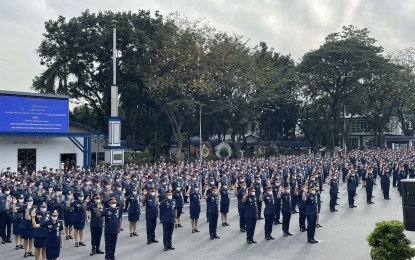
(File photo)

MANILA – A major reshuffle looms at the Philippine National Police (PNP) as more senior police officers are set to retire soon.

“As a matter of regular movement, we will expect in the coming days ay magkakaroon ng movement and transfer ng (we will see a movement and transfer of) senior officers to fill up yun mga na-vacate as a result ng pagkakaretiro ng ating No. 2 man, si (those vacated as a result of the retirement of our number 2 man), Lt. Gen. Rhodel Sermonia and in the coming days we are expecting more retirements sa ating (among) senior officers so definitely this will trigger the usual transfer and placement of our senior officers,” PNP spokesperson Col. Jean Fajardo told a press briefing at Camp Crame late Monday afternoon.

Sermonia, the PNP's deputy chief for administration, retired from the service on Jan. 26.

Fajardo said as a matter of practice, the one who will take over the helm of the office would be an officer-in-charge.

Possible contenders for the post are Lt. Gen. Michael John Dubria, deputy chief for operations, the PNP's third highest official; and Maj. Gen. Emmanuel Peralta, chief of the directorial staff, the PNP's fourth top post.

Meanwhile, six senior police officers from the Office of the PNP Chief were reassigned to the Personnel Holding and Accounting Unit (PHAU) based on PNP chief Gen. Benjamin Acorda Jr.'s order that took effect on Monday.

These officials are Maj. Gen. Arthur Bisnar, Brig. Gen. Narciso Domingo, Brig. Gen. John Guyguyon, Brig. Gen. Roderick Mariano, Brig. Gen. Nicolas Torre III and Col. Marc Anthony Baun.

https://www.pna.gov.ph/articles/1217873

'Rehorizon 3' to allow AFP to address evolving security threats

From the Philippine News Agency (Jan 30, 2024): 'Rehorizon 3' to allow AFP to address evolving security threats (By Priam Nepomuceno)


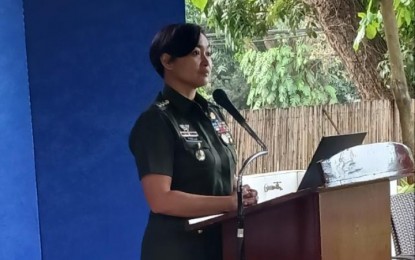
AFP spokesperson Col. Francel Margareth Padilla (PNA photo by Priam Nepomuceno)

MANILA – The Armed Forces of the Philippines (AFP) on Tuesday announced that enhancements under the approved "Rehorizon 3" of its modernization program will allow it to address evolving security threats.

In a press briefing at Camp Aguinaldo, Quezon City, AFP spokesperson Col. Francel Margareth Padilla said the approval of the adjustments to the program signifies the government's commitment to enhancing the capabilities and readiness of the military and ensures that it it is "well equipped to address evolving security challenges".

"The approved capability enhancements range from domain awareness, connectivity, intelligence capability of C4ISTAR (Command, Control, Communications, Computers, Information/Intelligence, Surveillance, Targeting Acquisition and Reconnaissance system) and deterrence capability on maritime and aerial domains," Padilla said.

She added these enhancements will contribute to strengthening Philippine defense capabilities as the AFP transitions from internal security operations towards territorial defense.


"We look forward to the effective implementation of the adjusted modernization plans which would enable our forces to operate more efficiently and respond effectively to emerging threats," Padilla said.

Earlier, Defense Secretary Gilberto Teodoro Jr. said President Ferdinand R. Marcos Jr. approved "Rehorizon 3" that aims to boost the military's intelligence, area denial and deterrence capabilities.

Meanwhile, Padilla said the AFP welcomes the proposed Archipelagic Sea Lanes Bill as it will help safeguard the nation's sovereignty and territorial integrity.

"The proposed bill, the Archipelagic Sea Lanes, or ASL legislation reflects our shared commitment to strengthen our maritime security framework. We appreciate the collaboration dedicated to preserving the integrity of the territorial waters," she added.

Under the bill, the President would have the power to fix the coordinates of the designated sea lanes and substitute or add to them for compelling reasons relevant to national security, the preservation of key biodiversity areas, and the safety of navigation.

https://www.pna.gov.ph/articles/1217884

AFP expects ‘bigger, more diverse' Balikatan in April

From the Philippine News Agency (Jan 30, 2024): AFP expects ‘bigger, more diverse' Balikatan in April (By Priam Nepomuceno)


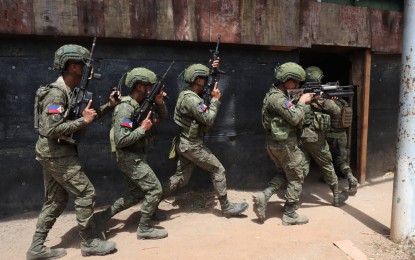
(File photo courtesy of Philippine Army)

MANILA – The Armed Forces of the Philippines (AFP) on Tuesday said this year's iteration of the "Balikatan" military exercises with the United States will be longer and more diverse.

“The difference now and last year's 'Balikatan' is we are going to have more exercises in key positions all over the country. Aside from quantity we will heavily lean on towards quality training," AFP spokesperson Col. Francel Margareth Padilla said in a press conference at Camp Aguinaldo, Quezon City.

She said the number of Filipino and American soldiers have yet to be determined along with the equipment that will be used in the annual military exercises along with possible locations.

Last year's "Balikatan" consisted of 17,767 soldiers -- 12,187 Americans; 5, 469 Filipinos; and 111 Australians.


During last year's iteration, Filipino and American troops conducted the first ever sinking exercise (SINKEX) off San Antonio, Zambales where a decommissioned World War II corvette was sunk jointly.

"Aside from kinetic activities and littoral airspace and landscape, we will also be doing exercises in the non-physical domain such as cyberspace and information warfare," Padilla said.

https://www.pna.gov.ph/articles/1217891

Presence of Chinese warships in Mischief Reef not alarming: PH Navy

From the Philippine News Agency (Jan 30, 2024): Presence of Chinese warships in Mischief Reef not alarming: PH Navy (By Priam Nepomuceno)


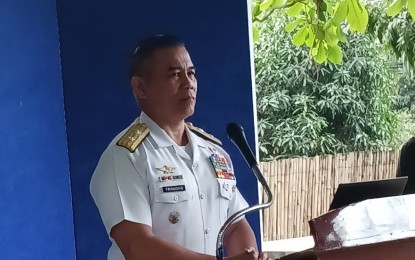
Philippine Navy spokesperson for the WPS Commodore Roy Vincent Trinidad (PNA photo by Priam Nepomuceno)

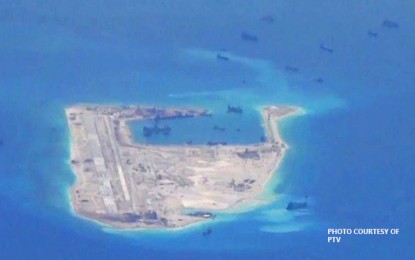
MANILA – There is no reason to be alarmed over reports of 15 to 25 Chinese warships spotted in the Mischief Reef in the West Philippine Sea (WPS), a ranking Philippine Navy (PN) official said Tuesday.

It's normal seeing those many ships "at any given time," according to Commodore Roy Vincent Trinidad, PN spokesperson for the WPS, during a press briefing in Camp Aguinaldo in Quezon City.

Trinidad said the Chinese warships and those of the China Coast Guard (CCG) are generally spotted inside Mischief Reef, which he called an "enclosed safe harbor."

"It is based on [the] South Sea Fleet they could deploy so a lot of these, ‘yung sa (their) grey ships nila just like any other Navy, their numbers are also limited based on the operational tempo, of repair, and training, maintenance," he said.

"At any one time they would be moving, some of them would be at anchor, especially (the) maritime militia, so it is difficult to give you the exact number at (an) exact point in time," he added.

Trinidad noted that while Chinese maritime militia vessels have been increasing, the warships and CCG vessels have been constant for the past eight to 10 years.

The PN decided to have a spokesperson for the WPS as the Armed Forces of the Philippines is now shifting from internal security operations to external defense, according to Trinidad.

"We deemed it appropriate and right that there will be a Navy spokesperson to provide further inputs or clarifications to the broad efforts of the Armed Forces in addressing all our media friends," he added.

He also said the PN and the Philippine Coast Guard (PCG) have enough assets in the area, but “given more, we can perform even better."

https://www.pna.gov.ph/articles/1217904

Marcos says PH opts for ’peaceful’ resolution to SCS disputes

From the Philippine News Agency (Jan 30, 2024): Marcos says PH opts for ’peaceful’ resolution to SCS disputes (By Ruth Abbey Gita-Carlos)


(File photo)

MANILA – President Ferdinand R. Marcos Jr. on Tuesday maintained his stance to settle the territorial disputes in the South China Sea (SCS) with China and other claimants in a “peaceful” manner.

Amid the growing tensions in the SCS because of China’s provocative acts, Marcos told Vietnamese President Vo Van Thuong and Vietnamese Prime Minister Pham Minh Chinh in separate meetings in Hanoi that the Philippines wants to address the maritime row through peaceful dialogue and consultations.

“On regional and international issues, the South China Sea remains to be a point of contention,” Marcos said.

“We are firm in defending our sovereignty, sovereign rights, and jurisdiction against these Chinese provocations. But at the same time, we are also seeking to address these issues with China and all other partners through peaceful dialogue and consultations as two equal sovereign states,” he added.

Still, Marcos expressed dismay over China’s “unilateral and illegal actions that violate our sovereignty, sovereign rights, and jurisdiction, and exacerbate tensions” in SCS.

He lamented that China’s aggressive actions led to “unfortunate” incidents involving Chinese and Philippine vessels.

Despite this, Marcos said the Philippine position on the SCS “has been consistent, clear, and firmly anchored in the 1982 United Nations Convention on the Law of the Sea.”

“As a maritime nation, we share a similar assessment of the current state of our regional environment with other maritime nations of the Asia-Pacific. Our countries have crucial roles to play in shaping the regional security discourse and in upholding the rules-based international order,” he said.

“I also wish to stress that the Philippines has an independent foreign policy. The Philippines considers both the United States and China as key actors in maintaining peace and security, as well as economic growth and development of our region,” Marcos added.

Marcos stressed that sailings and air traffic over the SCS must “remain free” for the large amount of trade that goes through the busy waterway.

Noting Vietnam’s continued interest in undertaking a Joint Submission on Extended Continental Shelf to the United Nations Commission on the Limits of the Continental Shelf (CLCS), Marcos said the Philippines is willing to work with for a joint submission “at the appropriate time.”

Marcos said the Philippines is committed to work with other “like-minded” states to ensure a rules-based international order in the Asia-Pacific region governed by international law.

“Our support for ASEAN (Association of Southeast Asian Nations) centrality and the ASEAN Outlook on the Indo-Pacific as the foremost regional framework and as the architecture for collective peace, stability and prosperity remains steadfast,” he said.

Long-lasting resolution of global conflicts

Meantime, Marcos called for a “long-lasting” resolution of international conflicts.

He cited his concern over the escalating tensions in Taiwan Strait, Myanmar, Gaza, Lebanon and the Red Sea.

"The Philippines stands ready to work with other countries towards a long-lasting resolution to the conflict in accordance with pertinent UN (United Nations) Security Council Resolutions and the general principles of international law,” Marcos said.

Marcos likewise thanked Vietnam for supporting the Philippines’ bid to the UN Security Council as a non-permanent member for 2027-2028.

https://www.pna.gov.ph/articles/1217928

OPAPRU: 'Bagong Pilipinas' to foster greater peace, dev’t

From the Philippine News Agency (Jan 31, 2024): OPAPRU: 'Bagong Pilipinas' to foster greater peace, dev’t (By Priam Nepomuceno)


MANILA – Office of the Presidential Adviser on Peace, Reconciliation, and Unity (OPAPRU) Secretary Carlito Galvez Jr. on Wednesday called on Filipinos to rally behind President Ferdinand R. Marcos Jr.'s "Bagong Pilipinas" initiative, stressing that this would bring greater peace, progress and unity to the nation.

“I urge my fellow Filipinos to fully support the national government’s Bagong Pilipinas campaign. This is a multi-sectoral effort that seeks to bring all of us together as one nation regardless of ethnicity, religion, economic status or personal beliefs,” Galvez said in a statement.


He added that "Bagong Pilipinas" is the Marcos administration’s clarion for national renewal, as it seeks to build a society that will provide all Filipinos with equal opportunities to uplift their lives and fulfill their full potential.

“‘Bagong Pilipinas’ is a new mindset, a paradigm shift that will enable our nation to overcome issues that have pushed back its growth and caused divisiveness among our people. This will enable our country to move forward under the President’s banner of unity,” he said.

Marcos on Jan. 28 launched the “Bagong Pilipinas” campaign and outlined “a master plan for genuine development that benefits all our people.”

The Chief Executive, in his speech, said this is not a “mere slogan,” but a holistic and inclusive “brand of governance” that will guide the government in its development and peacebuilding efforts.


Marcos said “Bagong Pilipinas” is not a political game plan that caters to a privileged few, but a master plan for genuine development that benefits people from all walks of life.

“It is an invitation to all of us to think about being a Filipino and view the nation from a renewed perspective. It is a call for transformation. The transformation of our idea of being a Filipino, and the transformation of our economy, of governance, of society,” he added.

https://www.pna.gov.ph/articles/1217955

BrahMos 'game changer' in PH's push for stronger defense posture

From the Philippine News Agency (Jan 31, 2024): BrahMos 'game changer' in PH's push for stronger defense posture (By Priam Nepomuceno)


National Security Council Assistant Director General Jonathan Malaya (PNA file photo)

MANILA – The upcoming delivery of the Indian-made BrahMos cruise missile system would bring the Philippines' military capability to the "supersonic" missile era and greatly enhance the country's defense capabilities, a ranking security official said Wednesday.

"It is a real game changer because it brings the Philippines to the supersonic age. For the first time in our history, the Philippines will have three batteries of supersonic cruise missiles that have a speed of (Mach 2.8) or almost 3x (times) the speed of sound," NSC Assistant Director General Jonathan Malaya said in a message to the Philippine News Agency, when asked how this weapon system would contribute to national security.

Malaya also called the BrahMos cruise missile system acquisition a "landmark development in our modernization program" that would significantly increase the capacity of the Armed Forces of the Philippines, the Philippine Navy and the Philippine Marine Corps in addressing threats to the country's territorial integrity.

The delivery of the BrahMos cruise missiles and all its systems are expected to be completed within the first quarter of this year.

Malaya said that the BrahMos, which will serve as the country's first shore-based anti-ship missile system, makes concrete the credible defense posture calls of the Marcos administration's national security policy.


"With this acquisition, we can no longer be considered the weakest Armed Forces in the region. We have now become a middle power in the region," he added.

This weapon platform is expected to address the country’s military’s weaknesses and vulnerability in sea control, anti-access/area-denial (A2/AD), and coastal and island defense operations.

Former DND Secretary Delfin Lorenzana and BrahMos Aerospace director general Atul Dinkar Rane signed the contract worth PHP18.9 billion in a virtual ceremony at defense headquarters at Camp Aguinaldo, Quezon City in January 2022.

https://www.pna.gov.ph/articles/1217963

Año: China's repeated claims over Bajo de Masinloc unfounded

From the Philippine News Agency (Jan 31, 2024): Año: China's repeated claims over Bajo de Masinloc unfounded (By Priam Nepomuceno)


National Security Adviser Edduardo Año (PNA file photo)

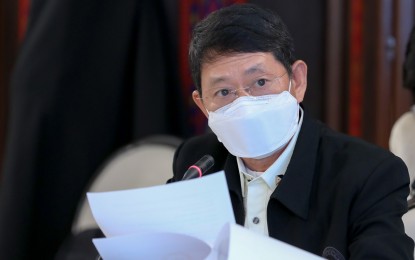
MANILA – National Security Adviser (NSA) Eduardo Año on Wednesday slammed the China Coast Guard's claims that Beijing has an "indisputable sovereignty" over the Bajo de Masinloc (also known as Scarborough Shoal) and its adjacent waters, reiterating that the waterway is located inside the Philippines' exclusive economic zone (EEZ).

He added that Bajo de Masinloc is an integral part of Philippine territory, being part of the municipality of Masinloc in Zambales province.

"It is located 124 nautical miles west of Luzon mainland and is well within the 200-nautical mile EEZ and the Philippine continental shelf," Año said in a statement.

Under international law, Año said Manila exercises sovereign rights and jurisdiction over the Bajo de Masinloc, as well as the waters and continental shelf surrounding it.

He added that it is an important fishing ground for local fishermen of the provinces of Zambales, Bataan and Pangasinan.

"China’s repeated claims of sovereignty over Bajo de Masinloc have no basis in international law or in fact. International law is clear. China cannot, therefore, lawfully exercise sovereignty over it. As clearly stated by the 2016 arbitral award, UNCLOS (United Nations Convention on the Law of the Sea) superseded any ‘historic rights’ as claimed by China. Therefore, China cannot claim entitlements in areas of the ‘nine-dashed line,’ now ‘10-dashed line,’ that exceed UNCLOS limits," Año said.

He also pointed out that based on early Spanish maps of the Philippines, including the 1734 Pedro Murillo Velarde Map, the Bajo de Masinloc was always part of the country's territory.

He added when Spain ceded the Philippines to the United States under the 1898 Treaty of Paris, the Scarborough Reef was included in the census of islands done by the US government.

"This was affirmed under the Treaty of Washington of 1900 where Spain ceded all other islands and places to which it had title or claim of title even if not within the lines drawn by the Treaty of Paris,” he said.

Since then, he said the Philippines has always exercised jurisdiction over the shoal by setting up light stations and navigational aids, regular visits by the Philippine Coast Guard, law enforcement operations and geodetic surveys.

"Since the Philippines exercises sovereign rights over Bajo de Masinloc and its surrounding waters under international law, only the Philippines has the authority to exercise maritime law enforcement functions to the exclusion of other countries. No amount of statements or illegal actions by other states can alter these facts," Año noted.

https://www.pna.gov.ph/articles/1217986

PH, Vietnam coast guards establish hotline for maritime cooperation

From the Philippine News Agency (Jan 31, 2024): PH, Vietnam coast guards establish hotline for maritime cooperation (By Raymond Carl Dela Cruz)


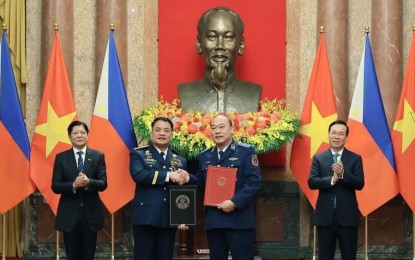
MARITIME COOPERATION. President Ferdinand R. Marcos Jr. (left) and Vietnamese President Vo Van Thuong (right) witness the signing of a memorandum of understanding between their countries’ coast guards by Philippine Coast Guard (PCG) chief, Adm. Ronnie Gil Gavan and Vietnam Coast Guard (VCG) Commander, Maj. Gen. Le Quang Dao, (center, left and right, respectively), in Vietnam's capital Hanoi on Tuesday (Jan. 30, 2024). The MOU aims to enhance strategic partnership and cooperation between the PCG and VCG through the establishment of a hotline. (Photo courtesy of PCG)

MANILA – The Philippine Coast Guard (PCG) and the Vietnam Coast Guard (VCG) signed an agreement on the establishment of a hotline to boost communication between the two maritime security groups.

The memorandum of understanding (MOU) was signed during the state visit to Vietnam on Tuesday by President Ferdinand R. Marcos Jr., PCG Chief, Admiral Ronnie Gil Gavan, and other government officials, the PCG said in a news release on Wednesday.

Marcos and Vietnamese President Vo Van Thuong witnessed the signing of the agreement by Gavan and VCG commander Maj. Gen. Le Quang Dao.

The MOU seeks to strengthen the “understanding, mutual trust, and confidence” between the PCG and VCG through the discussion of common issues and interests and the establishment of the hotline.

Gavan said the MOU would enhance the strategic partnership and cooperation between the PCG and VCG towards “promoting, preserving, and protecting mutual interest in the Southeast Asian region.”


Marcos returned to Manila early Wednesday from his state visit to Vietnam, which began on Monday.

During the visit, Thuong lauded Marcos’ achievements in developing the country’s economy, foreign policies, security, and defense achievement.

The Philippine economy grew by 5.6 percent year on year in the fourth quarter of 2023.

Among the major emerging economies in Asia that have already released their economic growth performance in the fourth quarter of 2023, the Philippines recorded the second fastest, after Vietnam (6.7 percent) but ahead of China (5.2 percent) and Malaysia (3.4 percent).

https://www.pna.gov.ph/articles/1218020

2 NPA rebels killed, 1 captured in Agusan Norte clash

From the Philippine News Agency (Jan 29, 2024): 2 NPA rebels killed, 1 captured in Agusan Norte clash (By Alexander Lopez)


DEAD REBELS. Two communist rebels lay dead following a clash with government troops in Barangay Sangay, Buenavista, Agusan del Norte on Monday (Jan. 29, 2024). Another rebel was captured during the encounter. (Photo courtesy of 23IB)

BUTUAN CITY – Two communist New People’s Army (NPA) guerillas were killed while another was captured in an encounter with government troopers in Agusan del Norte’s town of Buenavista on Monday morning.

Brig. Gen. Adonis Ariel Orio, the Army’s 402nd Infantry Brigade (Bde) commander, said the clash erupted between the troopers of the 23rd Infantry Battalion (IB) and the rebels following a report from residents in Sitio Kipundaw, Barangay Sangay of the town.

Government troops seized two high-powered firearms, an M16 rifle and an M4 rifle, during the encounter.

One of the dead rebels was identified as Fuerlan Sugalong, a member of the NPA Sub-Regional Sentro De Grabidad Sagay (SRSDG Sagay) under the North Central Mindanao Regional Committee.

The other one was only known as “Kasikas,” a political instructor.

The captured NPA rebel, identified as Romeo Maestrado Micabalo, is also a member of SRSDG Sagay.

“The government troopers sustained their momentum following the two armed encounters that occurred in its area of operation in Agusan del Norte and Butuan City earlier this month,” Orio said in a statement.

On Jan. 16, an encounter took place between government troopers and the rebels in Barangay Simbalan, Buenavista town that resulted in the death of two NPA rebels and the surrender of two others.

On Jan. 24, a clash also transpired in Barangay Bitan-agan here. Two female NPA guerillas were captured.


Two NPA couriers yield

Meanwhile, two NPA couriers in the same province surrendered to the police over the weekend, the Police Regional Office in the Caraga Region (PRO-13) said.

Maj. Jennifer Omiter, PRO-13 information office chief, identified the surrenderers as Jhonny Escobal and Rey Doldol, both aged 46 and who separately yielded in Remedios T. Romualdez town on Saturday night.


Omiter said the duo surrendered to the police’s 2nd Agusan del Norte Provincial Mobile Force Company.

https://www.pna.gov.ph/articles/1217835

Government offices vulnerable to cyberattacks – NorMin cyber cop chief

From the Philippine News Agency (Jan 29, 2024): Government offices vulnerable to cyberattacks – NorMin cyber cop chief (By Nef Luczon)


Anti-Cybercrime Unit, Philippine National Police-10, Cagayan de Oro City. (PNA file photo by Nef Luczon)

CAGAYAN DE ORO CITY – The chief of the Northern Mindanao Police Regional Anti-Cybersecurity Unit (RACU-10) warned on Monday that even personnel and government offices are vulnerable to cyberattacks.

RACU-10 chief Col. Lemuel Gonda said the caution "think before you click" must be remembered when using gadgets or devices that are connected to the internet.

"We have victims of (online) financial fraud who are members of the banking (and) financial institutions. They are frequently reminded about cybersecurity, how much more ordinary people and those in government offices?" he said in a statement.

Gonda warned that "black hat" hackers, who uses ransomware and malware to penetrate a system, can obtain sensitive information of online users, including banking and financial transactions.

One of the common methods used by hackers is "social engineering," which involves tricking unsuspecting victims into providing sensitive information.

Other than dubious internet links, Gonda warns of free Wi-Fi and charging stations in the public, as these are also vulnerable to cyberattacks.

"The hackers will not stop. Even all your details, name, address, friends, how you call them, they will imitate that," he said.

https://www.pna.gov.ph/articles/1217806