Friday, April 28, 2023

14 BIFF members surrender in Maguindanao

Posted to the Manila Times (Apr 29, 2023): 14 BIFF members surrender in Maguindanao (By Franz R. Sumangil)

FOURTEEN members of the Bangsamoro Islamic Freedom Fighters (BIFF) operating in Rajah Buayan town, Maguindanao del Sur surrendered to military authorities, an Army official said Thursday.

Brig. Gen. Oriel Pangcog, commander of the Army's 601st Infantry Brigade, said he accepted the surrender of the BIFF batch at the brigade headquarters in Ampatuan town on Wednesday afternoon.

Rajah Buayan Mayor Bai Maruja Mastura, together with other local officials, presented the former rebels to Pangcog at the brigade headquarters in Kamasi village, Ampatuan.

"They made the right decision in laying down their guns and abandoning their armed struggle. We welcome them to the fold of the law," Pangcog said of the surrenderers.

The BIFF members also yielded assorted firearms, including a homemade sniper rifle, and explosives.

"We are tired, we fear for our lives, so we decided to come out and be with our loved ones," BIFF sub-commander Miranda, one of the surrenderers, said.

As initial assistance, the former rebels received rice and financial assistance from the provincial government.

They will also be enrolled soon in the provincial government's peace and rehabilitation program.

Since January, at least 80 BIFF members have surrendered to various field units of the Army's 6th Infantry Division in Camp Siongco, Maguindanao del Norte this year.

https://www.manilatimes.net/2023/04/29/news/regions/14-biff-members-surrender-in-maguindanao/1889138

Philippines: After decades of terror, peace returns to island of Jolo

Posted to Yahoo News (Apr 28, 2023): Philippines: After decades of terror, peace returns to island of Jolo


For a long time, the island of Jolo, one of the southernmost points of the Philippines archipelago, was off limits. It was the stronghold of one of the most violent terrorist movements in the world, Abu Sayyaf. In 2000, a group of 20 tourists were kidnapped in Malaysia and taken to Jolo. Journalists who covered the kidnapping were then also captured. Negotiations for their release took several months. Today, after 30 years of fighting with the Philippine army, Abu Sayyaf is almost defeated and the island has begun to find peace. FRANCE 24’s Constantin Simon, Alexis Bregere, Sherbien Dacalanio and Aruna Popuri report.

Created in the 1990s, Abu Sayyaf carried out numerous atrocities – assassinations, kidnappings, piracy and extortions – with the aim of creating an Islamist state in the south of the Philippines. The group's favourite method of execution was beheading with a sword.

Today, its last members are hiding out in the jungle and mountains. The army claims to have secured the island and has set up a programme to help Abu Sayyaf's repentant members reintegrate into society.

https://uk.news.yahoo.com/philippines-decades-terror-peace-returns-151235470.html

Police arrest most wanted Abu Sayyaf member after 26 years

From the Philippine Daily Inquirer (Apr 28, 2023): Police arrest most wanted Abu Sayyaf member after 26 years (By: John Eric Mendoza)


INQUIRER FILE PHOTO

MANILA, Philippines — After 26 years of hiding, a “most wanted” Abu Sayyaf Group member finally yielded to authorities in Tawi-tawi, the Philippine National Police (PNP) said.

“In a successful intelligence-led police operation, the PNP arrested a notorious most wanted Abu Sayyaf member who had been evading the authorities for the past 26 years,” the PNP said in a statement on Thursday.

The PNP said Tatoh Datu Adingih, who had been using the false name of “Tatoh Moro,” was apprehended by joint police and military operation in the afternoon of April 26, Wednesday in Barangay Simalak in Languyan town.


Judge Abdulmaid Muin of the Regional Trial Court Branch 5 in Bongao, Tawi-Tawi issued on June 14, 2007, the warrant of arrest for Adingih for the crime of murder.

Adingih was wanted for murder and was the top 9 most wanted person in Tawi-Tawi. — Aliah Gumasing, trainee

https://newsinfo.inquirer.net/1762466/police-nets-most-wanted-abu-sayyaf-member-after-26-years

6 dead in clash of MNLF groups

Posted to the Philippine Star (Apr 29, 2023): 6 dead in clash of MNLF groups (By Roel PareƱo)

Zamboanga City, Philippines — Six people were killed in a firefight between warring groups of the Moro National Liberation Front in Indanan, Sulu on Wednesday.

The clash occurred between the groups led by Hadji Julhajan Hajani and a certain Sinti based in Barangays Tagbak and Timbangan, respectively, according to the Sulu police.

Police identified the fatalities as Ruminier Mannan, 15; Aljimar Gajih, 17; Basir Makdirul, 52, and Mini Boy Hajani, 45, who were with Hajani’s group, and Benhar Hajiri Ahamad and Andi Juljani, followers of Sinti.

Probers said the two groups have long been engaged in clan war or rido due to a land dispute.

The Hajiri clan also reportedly blamed Hajani’s group for the killing of a certain Marajan Hajiri, said to be an Abu Sayyaf sub-leader.

https://www.philstar.com/nation/2023/04/29/2262533/6-dead-clash-mnlf-groups

PH Navy deploys BRP Antonio Luna for ASEAN-India drills

From the Philippine News Agency (Apr 28, 2023): PH Navy deploys BRP Antonio Luna for ASEAN-India drills (By Priam Nepomuceno)


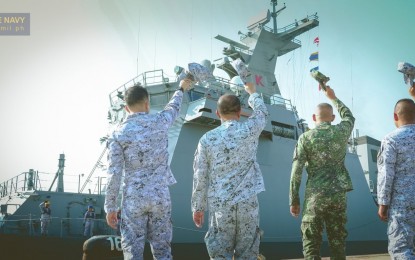
SEND-OFF. The Fleet Marine Ready Force headed by Brig. Gen. Edwin Amadar, waves at BRP Antonio Luna (FF-151) as they get underway to participate in the ASEAN-India Maritime Exercise (AIME) 2023 to be conducted in Singapore from May 2-8, 2023. The event will feature harbor and at-sea events aimed at enhancing interoperability and exchange of best practices among participating navies. (Photo cortesy of Philippine Navy)

MANILA – The Philippine Navy (PN) on Friday announced it has deployed missile frigate -- BRP Antonio Luna (FF-151), along with an AW-109 naval helicopter to take part in the ASEAN-India Maritime Exercise (AIME) 2023 which will be held in Singapore.

The 140-strong contingent, named Naval Task Group 80.5, had its send-off ceremony on Thursday.

"Fleet-Marine Ready Force (FMRF) commander, Marine Brig. Gen. Edwin Amadar, led the send-off of a 140-strong contingent held at the Naval Operating Base Subic," PN spokesperson Captain Benjo Negranza said in a statement sent to the Philippine News Agency.

He said AIME 2023 will be conducted in Singapore from May 2 to 8.

It will feature harbor and at-sea events aimed at enhancing interoperability and exchange of best practices among participating navies.

"The Philippine contingent will also attend the coinciding event in Singapore, the International Maritime Defense Exhibition Asia (IMDEX) 2023," Negranza said.


The event provides a platform for the defense and maritime sectors to foster engagements and showcase latest innovations.

The PN's participation in this exercise fulfills the requirement to enhance the skills of its personnel with the acquisition of modern assets.

It likewise conveys its unwavering commitment to enhance cooperation with ASEAN and Indian navies toward regional peace and stability.

https://www.pna.gov.ph/articles/1200338

AFP: Balikatan 2023 ‘very successful’

From the Philippine News Agency (Apr 28, 2023): AFP: Balikatan 2023 ‘very successful’ (By Priam Nepomuceno)


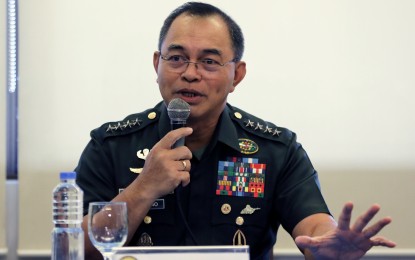
Armed Forces of the Philippines chief of staff Gen. Andres Centino (File photo)

MANILA – This year’s iteration of the "Balikatan" joint military exercises between the Philippines and the United States was a “very successful” one with a number of firsts on several fronts, Armed Forces of the Philippines (AFP) chief of staff Gen. Andres Centino said Friday.

He said this year’s "Balikatan," which lasted three weeks, was the first with new activities in multiple venues -- even as the Philippines starts preparations for next year’s exercises.

“We had a very successful Balikatan this year, nasabi ko nga kanina a lot of firsts, maraming mga bagong activities that we included sa halos na three weeks nating exercise. First time din na nagkaroon tayo ng multiple venues, napakaraming lugar na kung saan tayo nagconduct ng ating exercise and after this. Pagkatapos nito will be another preparation -- it's a whole year preparation actually and right after this makikita natin what needs to be improved or refined. We will continue planning again for next year (We had a very successful Balikatan this year with a lot of firsts. We had many new activities in the last three weeks in multiple venues. After this will be another round of preparations -- it’s a whole year preparation where we will see what needs to be improved or refined),” Centino said in an interview shortly after the exercise's closing ceremonies.


He added there is a chance there will be more soldiers involved in next year’s edition.

“Kung makita natin there is a need na talagang dagdagan natin, and of course it would be better na magkaroon tayo ng chance to train with other armies also, mga friends and allies natin (If we see there is a need to add people, it will be better if we have a chance to train with other armies of our friends and allies),” the AFP chief added.

Centino said this year’s "Balikatan" showed the need for better coordination, noting some delays in this aspect, even as he said this was “tolerable.”

He added there is a need to find new locations for holding the joint exercises.

The AFP chief said the "Balikatan" exercises would also help greatly in resolving internal security issues, noting live fire and similar exercises are “very relevant” in their efforts to improve their capabilities.

Meanwhile, Centino said the National Task Force on the West Philippine Sea [WPS] will discuss ways to address the latest sighting of Chinese militia vessels in the disputed waters.

He added the AFP is part of the task force and will cooperate with other agencies including the Philippine Coast Guard in determining the respective roles the agencies will perform.

“Nandiyan din ang Coast Guard, so this… will be discussed [by the] National Task Force on the West Philippine Sea. Doon na pag-uusapan on what respective roles ng iba't ibang agencies will conform (The Coast Guard is also there so this will be discussed by the national task force on WPS. The discussions will determine the respective roles the agencies will perform),” he said.

https://www.pna.gov.ph/articles/1200375

PCG spots more than 100 Chinese vessels over 7 days in WPS

From the Philippine News Agency (Apr 28, 2023): PCG spots more than 100 Chinese vessels over 7 days in WPS (By Raymond Carl Dela Cruz)
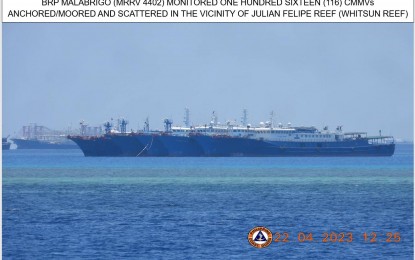


(Courtesy of Philippine Coast Guard)

MANILA – The Philippine Coast Guard (PCG) has spotted over 100 alleged Chinese maritime militia (CMM) vessels, a People’s Liberation Army (PLA) Navy corvette, and two China Coast Guard (CCG) vessels throughout a seven-day maritime patrol in the West Philippine Sea (WPS).

In a statement on Friday, the PCG said the patrol was made by two 44-meter PCG vessels -- BRP Malapascua and BRP Malabrigo -- from April 18 to 24 in the waters off Sabina Shoal, Iroquis Reef, Lawak, Patag, Likas, Parola, Pag-asa, Tizzard Bank, Julian Felipe Reef, and Ayungin Shoal.

“Eighteen Chinese maritime militia vessels were detected near Sabina Shoal. Despite the numerous radio challenges by the two PCG vessels, the CMM did not respond or comply with the order to leave the area immediately,” according to the PCG statement.


Four CMM vessels engaging in fishing activities, it said, were later driven away from the sea of Pag-asa.

On the other hand, at least 17 groups of CMM vessels -- estimated to exceed 100 vessels-- were observed around Julian Felipe Reef.

In response, the PCG vessels deployed their rigid hull inflatable boats to disperse the large CMM gathering.

“However, no CMM vessels reacted or made any attempts to vacate the area,” it said.

On April 21, the PCG was challenged by a PLA Navy vessel with bow number 549 over the radio and directed them to leave the area.

“The Chinese navy issued a warning to the PCG, suggesting that failure to comply might cause problems,” it said.

The PCG vessels responded by asserting their rights to carry out operations within the territorial sea of Pag-asa Island and asked the Chinese navy vessel to leave the area immediately.

On April 23, the two PCG vessels were intercepted by two CCG vessels in the vicinity of Ayungin Shoal.

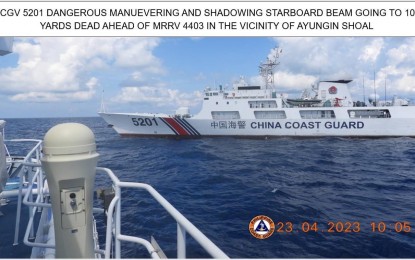
“CCG vessels 5201 and 4202 exhibited aggressive tactics towards BRP Malapascua and BRP Malabrigo, respectively. CCG vessel 5201 was reported to have carried out dangerous maneuvers near BRP Malapascua, maintaining a perilous distance of only 50 yards,” the statement said.

On the other hand, CCG vessel 4202 followed BRP Malabrigo at a distance of 700 yards to monitor its movements.

“The PCG has already submitted a report to the National Task Force West Philippine Sea, highlighting the presence of a Chinese warship, the continued appearance of alleged CMM vessels within the Philippines' exclusive economic zone (EEZ), as well as the aggressive actions of the CCG against PCG vessels,” it said.

It assured the public that the PCG is working closely with the Western Command of the Armed Forces of the Philippines and the Area Task Force-West to defend the country’s sovereign rights in territorial waters.

“[We] diligently and tirelessly work together to protect the Philippines' exclusive sovereign rights in its EEZ, its sovereignty, territory, and continental shelf in the WPS,” the PCG statement added.

In a press briefing also on Friday, Senator Jinggoy Estrada lauded the PCG for not backing down despite the more superior Chinese vessels and said he plans to conduct an ocular inspection in the disputed area in June.

Estrada had earlier filed Senate Bill No. 2016 or the PCG Modernization Act, saying it is high time for the armed service be upgraded in terms of logistical support.

He said PCG assets are not enough to patrol the country's territorial waters and protect Filipino fisherfolk against foreign aggressors.

"The PCG is vested with powers to perform five major functions of maritime safety, security, search and rescue, law enforcement, and environmental protection. With the colossal task of enforcing regulations in accordance with maritime international conventions, treaties, and national laws within the country's jurisdiction, surely a fleet of merely three offshore patrol vessels would not suffice to carry out their perilous and critical tasks," he said in a previous statement.

https://www.pna.gov.ph/articles/1200388

DFA rebukes Chinese Coast Guard’s ‘dangerous maneuvers’ in WPS

From the Philippine News Agency (Apr 28, 2023): DFA rebukes Chinese Coast Guard’s ‘dangerous maneuvers’ in WPS (By Joyce Ann L. Rocamora)


DANGEROUS. The Chinese Coast Guard vessel shadowing the BRP Malapascua in the vicinity of Ayungin Shoal on April 23, 2023. The Department of Foreign Affairs rebuked China for "dangerous maneuvering" in the West Philippine Sea. (Courtesy of PCG)

MANILA – The Department of Foreign Affairs (DFA) on Friday criticized China over its “highly dangerous maneuvers” against the Philippine Coast Guard (PCG) in the waters off Ayungin Shoal recently.

In a statement, Foreign Affairs spokesperson Ma. Teresita Daza reiterated Manila’s call on China to respect the country's rights over the West Philippine Sea as stated in the United Nations Convention on the Law of the Sea (UNCLOS).

“[I] would like to emphasize that the Philippines has the legal right to carry out routine maritime patrols in our territorial waters and EEZ (exclusive economic zones). The deployment of the BRP Malabrigo and BRP Malapascua in the West Philippine Sea from April 18 to 24 was one such mission,” she said.

The PCG on Friday reported that two Chinese Coast Guard (CCG) vessels “intercepted” them in the vicinity of Ayungin Shoal, with CCG vessels 5202 and 4201 exhibiting “aggressive tactics” towards Malapascua and Malabrigo, respectively, on April 23.

The Chinese vessel carried out “dangerous maneuvers” coming within 50 yards of BRP Malapascua, which a team from Agence France-Presse (AFP) aboard the Filipino boat said resulted in a “near-collision.”

The DFA said similar maneuvers were documented on April 19, involving CCG 5201 and 4202, and the BRP Malapascua while the latter was en route to Ayungin Shoal.


“The China Coast Guard’s interference with this routine patrol mission was totally inconsistent with freedom of navigation, and a number of documented incidents also involved highly dangerous maneuvers that were contrary to standard navigational practices,” Daza said.

“We again call on China to respect the Philippines’ rights over the West Philippine Sea, as provided by UNCLOS, and refrain from actions that may cause an untoward incident,” she added.

The Chinese Foreign Ministry claimed that the near-miss was caused by Manila’s “premeditated and provocative action for the Philippine vessel to barge into the waters of Ayungin with journalists on board."

The AFP quoted a ministry spokesperson as saying on Friday that the alleged act’s aim was “to deliberately find fault and take the opportunity to hype up the incident.”

Daza said routine patrols in Philippine waters are “neither premeditated nor provocative.”

“It is a legal right that we exercised and will continue to exercise,” he said.

China used the recently established communication line on maritime issues and informed the agency about the reported near-miss on the day of the incident.

The call was made by a focal person from the Chinese Foreign Ministry on April 23 at 5:56 pm.

“Our side informed China that it was a routine patrol and that we have every right. to carry out such an activity,” Daza said.

The PCG likewise reported that a Chinese People’s Liberation Army Navy vessel with bow number 549 had “crossed paths” with its ships seven nautical miles (NM) from Pag-asa Island.

The Chinese gray ship challenged the presence of the PCG vessels over the radio on April 21 and ordered the PCG to leave while suggesting that failure to comply might “cause problem.”

Pag-asa Island also known as Thitu is Kalayaan, Palawan’s seat of power while Ayungin Shoal is located 105 nautical miles off Palawan, which is within the country’s 200NM EEZ.

Under UNCLOS, a coastal state has the “sovereign rights” to explore and exploit resources within the EEZ.

The latest development comes on the heels of Chinese Foreign Minister Qin Gang’s working visit to Manila from April 22 to 24. He met with President Ferdinand R. Marcos Jr.

https://www.pna.gov.ph/articles/1200379

Army official: NPA in E. Visayas could not find potential leaders

From the Philippine News Agency (Apr 28, 2023): Army official: NPA in E. Visayas could not find potential leaders (By Sarwell Meniano)


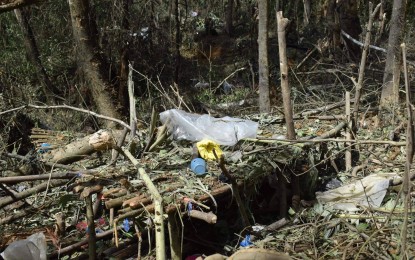
DESTROYED. A portion of the regional headquarters of the New People's Army (NPA) destroyed by a fierce gun battle between government forces and rebels on Nov. 23, 2022. The Philippine Army said on Friday (April 28, 2023) the NPA in Eastern Visayas region is now on the verge of collapse with the deaths of key leaders and the surrender of combatants and staunch supporters. (Contributed photo)

TACLOBAN CITY – The New People’s Army (NPA) in Eastern Visayas region is now on the verge of collapse with the deaths of key leaders and the surrender of combatants and staunch supporters.

Maj. Gen. Camilo Ligayo, commander of the Army’s 8th Infantry Division, said Friday the NPA in the region could not find potential leaders who would direct and make critical decisions for the group.

“We are not sure who leads them since they are disorganized after the death of the Tiamzon couple and Helenita Pardales last year,” Ligayo said in an interview.


On April 21, the Communist Party of the Philippines (CPP) confirmed the deaths of its leaders, couple Benito and Wilma Tiamzon during a boat explosion in Catbalogan City, Samar province on Aug. 22, 2022.

The Tiamzon couple made critical decisions for the armed struggle. Benito was believed to be the chairman of the Communist Party of the Philippines-National Democratic (CPP-NDF) and its armed wing, the NPA.

On the other hand, Pardales, secretary of the NPA’s Eastern Visayas Regional Party Committee (EVRPC) died during a fierce gun battle on Nov. 23, 2022, at the rebel’s regional headquarters in the mountains of Imelda village in Las Navas town, Northern Samar.

“Their strength is now diminishing and the trend is irreversible following the deaths and surrender of their key leaders and members,” Ligayo added.

Based on estimates, there are still 200 armed NPA members in the entire region, majority of them are in Northern Samar, said the official.

Only two NPA guerilla fronts in Samar Island remain in existence after the dismantling of one front and the weakening of another during the first quarter of the year.

Ligayo said the rebel’s Front Committee 2 operating in the boundary of Samar and Northern Samar has been demolished after the capture and surrender of some of their combatants and recovery of firearms.

The NPA Front Committee 3, which operates near the boundaries of Northern and Eastern Samar, has also weakened after the series of operations conducted by government forces, according to Ligayo.

Last year, at least 51 NPA combatants in the region were either killed or captured through intensified operations, according to the Philippine Army.

Also in 2022, some 3,505 supporters from communities have withdrawn their support for the CPP and National Democratic Front local chapters.

The dwindling number of NPA combatants and loss of support from communities has raised the confidence of the military to end the armed conflict within the year.

https://www.pna.gov.ph/articles/1200334

Thursday, April 27, 2023

Next for Philippines, US: Cope Thunder drills

From the Philippine Star (Apr 23, 2023): Next for Philippines, US: Cope Thunder drills (By Michael Punongbayan, Pia Lee-Brago)


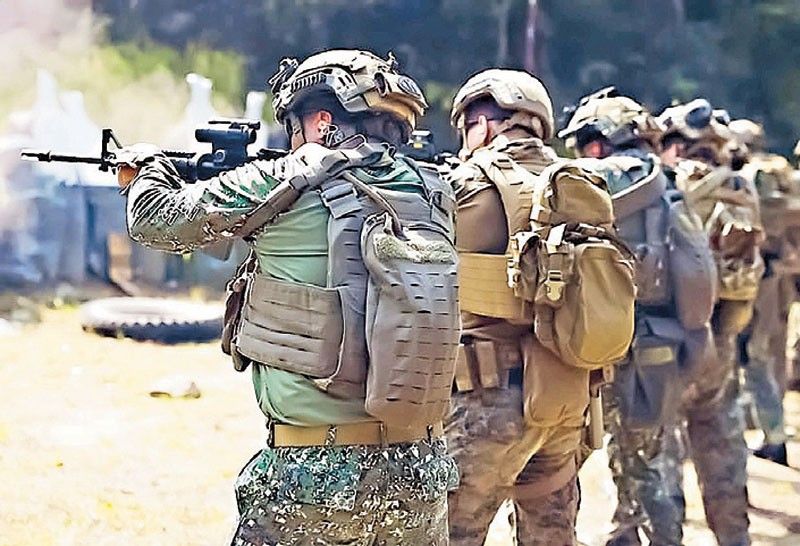
US and Philippine Marines sharpen their skills at the firing range of Gen. Gregorio Lim Marine Base in Ternate, Cavite as part of Balikatan 2023.  US Marine Corps photo

MANILA, Philippines — With the conclusion of this year’s Balikatan exercise today, the United States and the Philippines are set to revive on May 1 a joint air-training maneuver they last conducted 33 years ago.

Cope Thunder-Philippines 23-1 is scheduled to take place at Clark Air Force Base on Monday until May 12.

The Pacific Air Forces Public Affairs said Cope Thunder Philippines, the first since 1990, would involve bilateral fighter training with the Philippine Air Force aimed at improving combined interoperability.


“It provides a unique opportunity to integrate forces and improve interoperability between the Philippines and the United States,” the Pacific Air Forces Public Affairs said in a statement.

The US Air Force will dispatch 12 aircraft from the 35 Fighter Wing, Misawa Air Base, Japan for Cope Thunder, according to the statement.

US Air Force personnel will fly the 12 aircraft as well as handle their maintenance and support services while participants from the AFP will share tactics, techniques and procedures for improving interoperability.


Cope Thunder began in the Philippines in 1976 when Clark Air Base was still under US control. The air force training event was moved to Eielson Air Force Base in 1992, and eventually renamed Red Flag Alaska. Monday’s event would be the first time Cope Thunder would be held in the Philippines since 1990. The Pinatubo eruption in 1991 and the dismantling of the US bases in the Philippines the following year dealt a deathblow to Cope Thunder.

Some 100 members of different militant groups picketed outside the US embassy in Manila to protest the holding of another round of military exercises between the US and Filipino forces.

“It is US militarism that has kept us in this sorry state for nearly eight decades,” Renato Reyes, secretary general of Bagong Alyansang Makabayan (Bayan), said.

“Peasant women should unite with the Filipino people to defend the country’s national sovereignty against the continuing military intervention of the US government,” said Zenaida Soriano, president of the Amihan National Federation of Peasant Women.

Fishers’ group Pambansang Lakas ng Kilusang Mamamalakaya ng Pilipinas or Pamalakaya said the Balikatan exercises in Zambales have put the livelihood of fishermen at greater risk.

Highlighting this year’s Balikatan, meanwhile, was a grand display of firepower including the sinking of an “enemy” ship off San Antonio, Zambales on Wednesday.
Interruption

A light civilian plane straying into a no-fly zone and a motorized boat entering restricted waters interrupted the joint exercises.

Beginning on April 11, 17,600 Filipino and American soldiers trained together in various locations in the country involving live fire events, military drills, learning exchanges, and humanitarian assistance and disaster response activities in the biggest iteration so far of the annual joint war games between the Armed Forces of the Philippines (AFP) and the United States military.

Maj. Gen. Marvin Licudine, Balikatan exercise director for the Philippine side, called the joint maneuver a huge success with no less than President Marcos personally witnessing the deadly performance of modern weapons launched from ground, sea and air. Capping the event was the sinking of an “enemy ship” 12 nautical miles off San Antonio, Zambales last Wednesday.

“So far, I believe we have achieved all the exercise goals of the Balikatan Exercises – that is achieving the interoperability between the combined forces of the Philippines and the US and the different services that includes the army, navy and the air force and special operations forces,” he told reporters yesterday. — Ralph Edwin Villanueva, Rudy Santos, Emmanuel Tupas

[Retired Analyst Note: The protesting groups, BAYAN, AMIHAN, and PAMALKAYA, are all Communist Party of the Philippines (CPP) front organizations who have long opposed any US military presence in the Philippines and especially Philippine-US military exercises.]

https://www.philstar.com/headlines/2023/04/28/2262291/next-philippines-us-cope-thunder-drills

Marcos has turned the Philippines towards America – not without risks

Posted to the Lowrey Institute//The Interpreter (Apr 28, 2023): Marcos has turned the Philippines towards America – not without risks (By ANDREA CHLOE WONG)

An expanded US military presence will benefit efforts to stand up to China. But Filipinos are wary of the social cost.


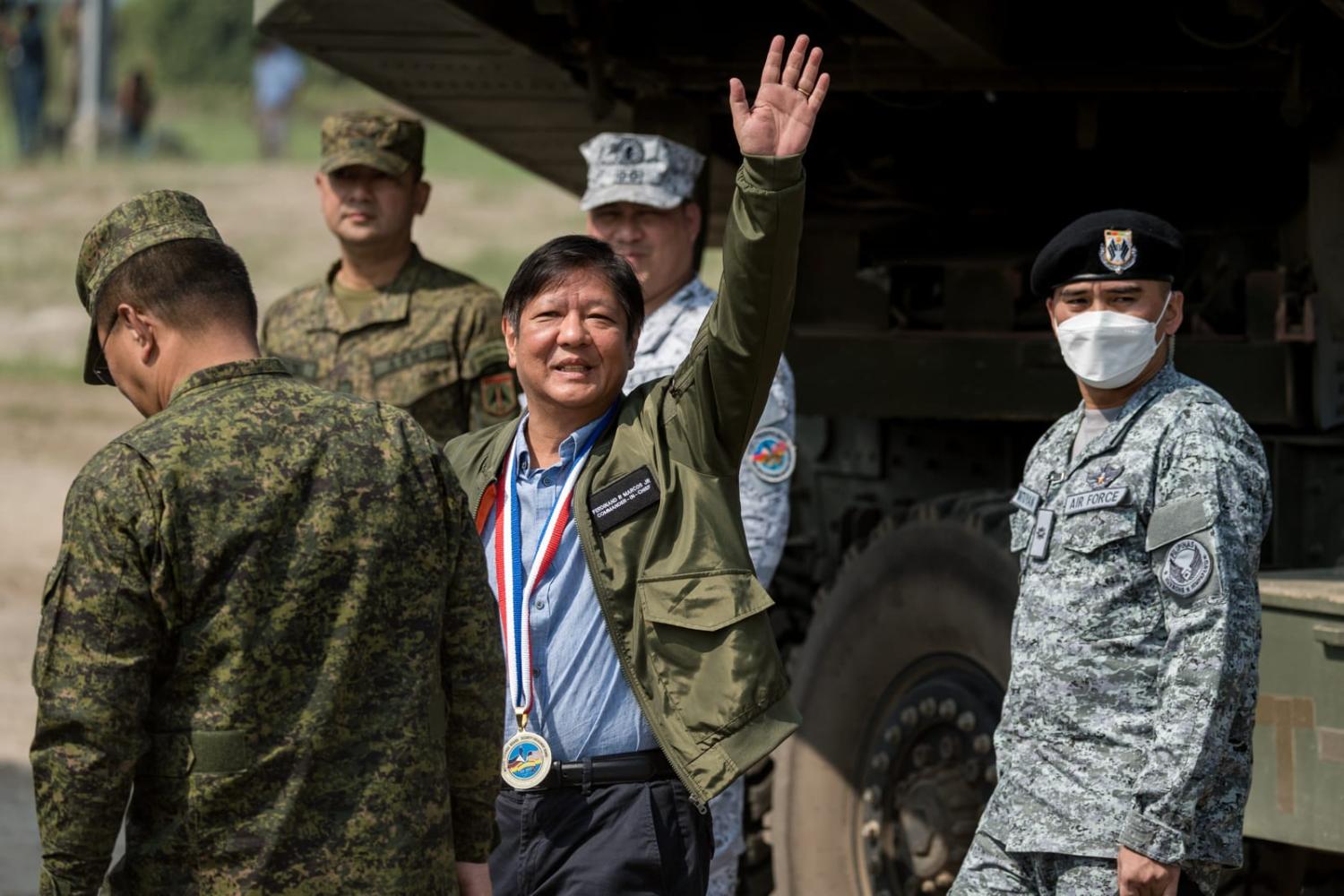
Philippines President Ferdinand Marcos Jr waves ahead of a live fire drill as part of the US-Philippines Balikatan joint military exercise at Zambales on 26 April (Iya Forbes/Bloomberg via Getty Images)

With President Ferdinand Marcos Jr about to make an official visit to Washington, the Philippines this month granted the United States rotational access to four more military facilities in the country. This expansion will be in addition to the five existing sites under the Enhanced Defence Cooperation Agreement (EDCA) signed in 2014.

Although the agreement does not allow the establishment of permanent military bases, it does permit the United States to build and operate facilities on Philippine bases such as runways, fuel storage, and military housing. Following the latest announcement, the US Embassy in the Philippines stated “through EDCA, the United States supports the Armed Forces of the Philippines’ goals of force readiness, military modernisation, infrastructure improvements, and interoperability with US forces.”

Under Marcos, the expansion of EDCA is intended to benefit the Philippines through the revitalisation of its alliance with the United States, which had been relegated during former president Rodrigo Duterte’s term. The most recent joint Balikatan military exercises in the Philippines saw in the largest number of participants to date, with 5,400 from the Philippines, 12,000 from the United States, and 111 from Australia. The additional EDCA sites also allows supplies and materials to be positioned around the country, which can be used during combating local insurgencies or in response to disasters.

Most importantly, the Philippines benefits from EDCA as it can serve as a deterrence against China’s belligerent actions in the West Philippines Sea (also called the South China Sea), which, despite Duterte’s appeasement policy towards China, continues to challenge Philippine sovereignty. One of the new EDCA sites is Balabac Island, located at the southwestern tip of Palawan, closest to the Spratly Islands, where China’s coast guard and maritime militia chase Filipino fishing vessels away and swarm islands and maritime features in Philippine territory.

The Philippines has recent memories of crimes committed by US Marines, including rape and murder, cases that roused domestic uproar among Filipinos.

But the expanded EDCA is not without its own challenges. Some Filipino senators have questioned the new access sites in the country’s north – Camp Melchor Dela Cruz, Lal-lo Airport, and the Camilo Osias Naval Base – given that the main threats to the Philippines lie in the west. These northern locations can potentially be used in a conflict between the United States and China over Taiwan. Camilo Osias, for example, is located approximately 500 kilometres from Kaohsiung in southern Taiwan. These Philippine military bases could provide crucial logistical support for American troops against China, despite Marcos’ assertion that the new EDCA sites are not intended for offensive attacks. One analyst concluded that whether willingly or not, “the Philippines has, in effect, joined the US in making preparations to defend Taiwan.” And if hostilities break out, the Philippines could be targeted by Chinese attacks due to American military presence in the country.

Another issue of the expanded US military presence is the potential social ills it may bring. The Philippines has recent memories of crimes committed by US Marines, including rape and murder, cases that roused domestic uproar among Filipinos. The expanded EDCA will result in the largest American military footprint in the country since 1992, when the United States closed its large military facilities in Clark Air Base in Pampanga and Subic Bay Naval Base in Zambales. The 1999 Visiting Forces Agreement provides the rules, guidelines and legal status of the US military stationed in the Philippines, yet its most contentious provision is its criminal jurisdiction, which provides American military authorities custody of its soldiers that commit crimes in the Philippines. In the recent cases the agreement was seen to have favoured the welfare of the American servicemen at the expense of their Filipino victims.

So while the increase in American military presence can provide a balancing force for the Philippines in developing at least a “minimum credible defence” posture, it is not with strategic risks or the danger of social harm. Given the asymmetrical relationship between the Philippines and the United States, the Marcos administration will present the agreement carefully – not to imply a dependence on the United States, especially given its colonial legacy, or overcommit the country to America’s broader security agenda in the region. But equally, standing up to a great power bully in its neighbourhood will be helped by a powerful friend.

https://www.lowyinstitute.org/the-interpreter/marcos-has-turned-philippines-towards-america-not-without-risks

Kill Chain Tested At First-Ever Balikatan SINKEX

Posted to Naval News (Apr 27, 2023: Kill Chain Tested At First-Ever Balikatan SINKEX (By Aaron-Matthew Lariosa)

U.S. and Philippine forces tested various concepts at Balikatan 2023's SINKEX, including the linking of sensing, fires and command and control.


U.S. Army HIMARS “Tommy” from the 5-3 Long Range Fires Battalion of the 1st Multi-Domain Task Force fires at BRP Pangasinan. (U.S. Marine Corps photo by Sgt. Samuel Fletcher)

For the first time, U.S. and Philippine forces jointly targeted and sunk a target in the South China Sea off Zambales for Balikatan 2023. The sinking of a World War II-era corvette was the main event for the largest iteration of the joint U.S.-Philippine military exercise to date.

The target


BRP Pangasinan (PS-31) shortly before the commencement of the SINKEX. Philippine Navy Photo.

Serving from 1948-2021, Pangasinan was one of nine Malvar-class corvettes that the Philippine Navy received from the U.S. during the Cold War. The corvette partook in many actions during its service life, from disaster relief to engagements against rebel groups. After an inspection by Philippine officials, BRP Pangasinan was towed out of Cavite in its last mission as Balikatan 2023’s SINKEX target off Zambales.

The SINKEX


BRP Jose Rizal fires the first shots of the SINKEX. Philippine Navy Photo.

The SINKEX kicked off with naval gunfire from BRP Jose Rizal (FF-150). After that, more assets from various U.S. and Philippine branches joined in. The most publicized section of the SINKEX was the ground fires component, in which both the Philippine President and U.S. Ambassador were in attendance. Philippine Army Artillery Regiment ATMOS 2000s, M-71 Soltams, and M101 guns were deployed for the Philippine ground fire contribution towards the SINKEX. Meanwhile, the U.S. Army deployed a HIMARS battery from the 1st Multi-Domain Task Force (MDTF), a first for the service. The 25th Infantry Division also contributed with their guns.
 

From left to right: Philippine M101s, ATMOS 2000s, and M-71 Soltams engage BRP Pangasinan. Philippine Army Photo

While this was the main event of Balikatan 2023, several unforeseen incidents occurred during the SINKEX. Intrusions into the area of the SINKEX from “interlopers,” which supposedly included at least one vessel and an aircraft, stopped firing from the ground-based fires for almost an hour.
 

U.S. Army HIMARS “Tommy” from the 5-3 Long Range Fires Battalion of the 1st Multi-Domain Task Force fires at BRP Pangasinan. (U.S. Marine Corps photo by Sgt. Samuel Fletcher)

The performance of the Army HIMARS was also questionable, with it being reported on the SINKEX’s live stream that the system missed all six of its shots at the World War II-era corvette. In previous SINKEXs, such as those held at RIMPAC exercises, targets were relatively static which allowed for munitions that struggle or cannot hit moving targets to participate. One of these systems that cannot hit moving targets is HIMARS with its current set of rockets. Due to unknown circumstances, BRP Pangasinan developed a drift that threw off the HIMARS’ targeting.

Yet, even with these difficulties, the SINKEX was deemed to be “amazing” by both forces. Lt. Col. Nick Mannweiler, Communications Strategy Planner for U.S. Marine Corps Forces Pacific, told Naval News the actual purpose of the exercise.

Connecting the Kill Chain


The 13th Marine Expeditionary Unit conducted Expeditionary Advanced Basing Operations during the SINKEX, transmitting their sensing to another Marine unit for target processing and designating fires. (U.S. Marine Corps photo by Cpl. Marcus E. Melara)

The SINKEX was more about deploying concepts relating to Force Design 2030 and Expeditionary Advanced Basing Operations rather than just sinking a ship. Specifically, concepts relating to integrating fires, sensors, and command and control:

“Sinking the ship is an obvious desired outcome from a professional warfighter’s perspective, but the goal wasn’t to do this as quickly and realistically as possible. Otherwise, we would have used a Mk-48 ADCAP or a Harpoon or JAGM or JDAM. The true purpose of yesterday and the mutual training value was sensing the target at sea with an ashore sensor expeditionary advanced base location, pass that to a Marine Division COC in Cavite, augment it with a combined joint sensor and intel fusion center, then pass 10-digit grid coordinates to ground and air fires from both countries.”


Information from the sensors of the 13th MEU at Zambalewasre transmitted to Marine Base Gregorio Lim, where command and control coordinated the joint fires of the SINKEX. (U.S. Marine Corps photo by Cpl. Davin Tenbusch)

During the SINKEX, the joint U.S.-Philippine force managed to connect this kill chain.

“That’s extremely hard to do for just the U.S. in a joint environment. We did it fast enough that HIMARS rounds could get extremely close for point detonation, but still have to aim ahead with 5 minute time of flight.”


A Philippine Air Force Hermes 900 filming bombs impacting BRP Pangasinan. Alongside U.S. Air Force MQ-9A Reapers, the two countries’ drones provided a live feed of the exercise to command and control. Screenshot from 300th Aerial Intelligence, Surveillance, and Reconnaissance Wing

Mannweiler highlighted the variety of aviation employed, which included F-35Bs, F-16s, FA-50PHs, A-29Bs, AH-1s, T-129Bs, and AH-64s:

“Aviation-delivered fires demonstrated the most amazing killing power. Cobras hit [the] bridge and waterline. Apaches drilled it with a barrage of Hellfires. Then F-35Bs ruined the fun for everyone else, dropping 10x GBU-12s and GBU-32s in under two minutes. The smoke cleared and she was nowhere to be seen.”

After a hail of naval gunfire, artillery shells, and laser-guided bombs, Pagasinan slipped under the waves.

The Philippine perspective

Many of the concepts tested and employed during this SINKEX are being closely followed by Philippine forces, specifically the Philippine Army and Marine Corps. The two forces are looking to develop similar units to the American MDTF and Marine Littoral Regiment (MLR).


Members of the Philippine Marine Corps’ Coastal Defense Regiment attend a presentation on the Avenger. The CDR’s Shore-Based Air Defense System Battalion is currently searching for missiles to protect the Regiment’s incoming BrahMos missiles. (U.S. Army photo by Sgt. Connor Davis.)

The PMC was seen to have deployed elements of its Coastal Defense Regiment (CDR) during Balikatan 2023, learning from their American counterparts on the Avenger anti-aircraft system and HIMARS. The CDR is to operate three batteries of BrahMos anti-ship cruise missiles, previously ordered by Manila in 2022. The Philippine Army’s Artillery Regiment is also expected to order the missiles in the next phase of modernization.

This SINKEX was one of the many firsts, including a joint littoral operation in Batanes and a Patriot missile live fire, held during this year’s Balikatan exercise.

[Aaron-Matthew is a freelance writer based in Washington, D.C. He is currently studying International Relations at American University, and is interested in U.S. Marine Corps developments in the Pacific and Philippine Naval modernization efforts.]

https://www.navalnews.com/naval-news/2023/04/kill-chain-tested-at-first-ever-balikatan-sinkex/

AFP eyes amnesty for Reds amid final push to end communist insurgency

From the Manila Bulletin (Apr 27, 2023): AFP eyes amnesty for Reds amid final push to end communist insurgency (By AARON RECUENCO)

Gen. Andres Centino, chief of staff of the Armed Forces of the Philippines (AFP), has expressed support for the granting of amnesty to all communist rebels in a bid to finally end the decades-long armed conflict in the country.

In a statement, Centino said there are a number of New People’s Army (NPA) fighters who are discouraged to surrender due to the criminal charges filed against them during the course of their armed struggle.

“Some members of the New People’s Army (NPA) are quite apprehensive about surrendering because of their pending cases in court,” said Centino during his interview on the “Balik-Loob sa Pagbabago” program of Task Force Balik-Loob on Thursday, April 27.

“I have advocated that other approaches of the government in dealing with insurgency should be considered, such as the granting of the amnesty,” he added.

Based on the military intelligence reports, the strength of the NPA in the country is now only around 2,000—from its peak of over 25,000 during the 1980s.


The same reports disclosed that the NPA fighters in the country are allegedly demoralized due to the vacuum of leadership following the death of Communist Party of the Philippines (CPP) founder Jose Maria “Joma” Sison late last year.

The supposed replacements, couple Benito and Wilma Tiamzon, died in the clashes with the military in the Visayas.

“Their presence is only in a few remaining areas in the country, and that is where our focus is. We are confident that it will not take long before their force is reduced to a minimum,” said Centino.


Since the Duterte administration, the national government opted for localized peace talks through the National Task Force to End Local Communist Armed Conflict (NTF-ELCAC). The agency, however, became controversial over red-tagging allegations.

The localized peace talks is reinforced with Enhanced Comprehensive Local Integration Program (E-CLIP), a reintegration program of government that seeks to effect social healing and national unity through a whole-of-nation approach towards the higher objective of lasting peace.

It provides social equity to former members of the NPA by providing assistance in their reintegration process into mainstream society.

Centino then encouraged the remaining active members of the armed rebel groups to return to the fold of the law and mainstream society, saying that the AFP has been the catalyst in harnessing the collective efforts of the government and other agencies that aimed to put an end to insurgency in the country.

He also urged Filipinos to accept the former rebels, also called “friends rescued,” in their community and give them fair treatment and support, so they can easily adjust in their new life back in the mainstream society.

“By achieving the goal of really creating an environment of enduring peace, I think that will be the victory of the Filipino people. Then we will have progress and development that we, for so long, deserve. With peace, there is progress,” said Centino.

The CPP-NPA has been waging more than five decades of armed struggle against the government, one of the longest in the world. Efforts for peace talks repeatedly bogged down due to differences on the conditions set by the CPP-NPA.

https://mb.com.ph/2023/4/27/afp-eyes-amnesty-for-reds-amid-final-push-to-end-communist-insurgency

Anti-communist task force reiterates: CPP-NPA-NDFP a terrorist organization

From the Manila Bulletin (Apr 23, 2023): Anti-communist task force reiterates: CPP-NPA-NDFP a terrorist organization (By TARA YAP)

ILOILO CITY – The government’s anti-communist task force has reiterated that the Communist Party of the Philippines (CPP), the New People’s Army (NPA), and the National Democratic Front of the Philippines (NDFP) are terrorist organizations.


THE alleged body of Rogelio Posadas, a high-ranking leader of the New People’s Army (NPA) killed during an encounter with the Philippine Army in Binalbagan town, Negros Occidental province. (3rd ID)

Gonzales reiterated this after a newspaper (not the Manila Bulletin) labeled slain high-ranking NPA leader Rogelio Posadas as an NDFP consultant.

Posadas was killed in an encounter with soldiers under the 303rd Infantry Brigade (IBde) of the Philippine Army on April 20 in Negros Occidental.

Gonzales slammed the report for describing Posadas as a “revolutionary.”

“It cannot alter the fact that Rogelio Posadas is a CPP-NPA-NDFP leader responsible for several atrocities against the people of Negros Island,” said Gonzales.

“It is about time that mainstream media must learn to stick to the facts rather than to water down the facts by playing with words for the purpose of painting a totally different picture of the reality,” added Gonzales.


https://mb.com.ph/2023/4/23/anti-communist-task-force-reiterates-cpp-npa-ndfp-a-terrorist-organization

NPA now ‘leaderless’ in Western, Central Visayas – military

From the Manila Bulletin (Apr 23, 2023): NPA now ‘leaderless’ in Western, Central Visayas – military (By MARTIN SADONGDONG)

AT A GLANCE
  • The New People’s Army (NPA) units in Western and Central Visayas are now “leaderless” with the death of an alleged high-ranking communist rebel in Negros Occidental recently, the military said Sunday, April 23.
  • The Armed Forces of the Philippines’ Visayas Command (AFP VisCom) said that the death of Rogelio Posadas alias “Putin” further contributed to the leadership vacuum suffered by the NPA.
  • Posadas was identified by the military as the alleged secretary of the NPA Regional Committee Negros – Cebu – Bohol – Siquijor.
The New People’s Army (NPA) units in Western and Central Visayas are now “leaderless” following the death of an alleged high-ranking communist rebel in an armed encounter in Negros Occidental recently, the military said Sunday, April 23.


(Rogelio Posadas / Courtesy of Philippine Army 94th Infantry Battalion, 3rd Infantry Division)

The Armed Forces of the Philippines’ Visayas Command (AFP VisCom) said that the death of Rogelio Posadas alias “Putin” further contributed to the leadership vacuum suffered by the NPA.

Posadas was identified by the military as the alleged secretary of the NPA Regional Committee Negros – Cebu – Bohol – Siquijor.

“With the death of Rogelio Posadas, the CPP – NPA [New People’s Army] – NDF [National Democratic Front] in Western and Central Visayas are now leaderless with no clear operational direction on the ground,” said Lt. Col. Israel Galorio, chief of VisCom public information office.


The Philippine Army’s 303rd Infantry Brigade reported that [Posadas died in an armed encounter]between suspected communist rebels and joint units from the 62nd Infantry Battalion (62nd IB) and 94th Infantry Battalion (94th IB) in Binalbagan, Negros Occidental last April 20.

According to the military, the troops clashed with the armed individuals for 10 minutes.

The skirmish resulted in the death of Posadas who, according to the VisCom, was a “notorious” NPA leader that orchestrated “numerous terroristic activities” in Western and Central Visayas.

Posadas was tagged by the military in the killing of three civilians and wounding of three others during an ambush of a cargo truck in Toboso, Negros Occidental in 2009; bombing and attack to two construction firms that built the Bacolod-Silay International Airport in Silay City in 2006; and burning of facilities of the Central Lopez and Victorias Milling Company in Toboso in 2008 and 2010, respectively.

“His death is a crushing defeat to the CPP-NPA-NDF as this will clearly manifest the decimation of the terrorist group in the Visayas region and will send a strong message to their already demoralized ranks that they have no safe haven to hide,” Galorio said.

Posadas’ death came several days after the arrest of Eric Casilao in Malaysia on April 1 and his deportation to the Philippines on April 17.

Casilao was identified as the alleged secretary of the Southern Mindanao Regional Committee (SMRC) of the Communist Party of the Philippines (CPP) – NPA, and an “active member” of the Central Committee of CPP.

https://mb.com.ph/2023/4/23/npa-now-leaderless-in-western-central-visayas-military