Sunday, December 15, 2019

Duterte, Misuari meet anew in Davao; push for peace in Mindanao

From the Philippine Daily Inquirer (Dec 15, 2019): Duterte, Misuari meet anew in Davao; push for peace in Mindanao  (By Nestor Corrales)


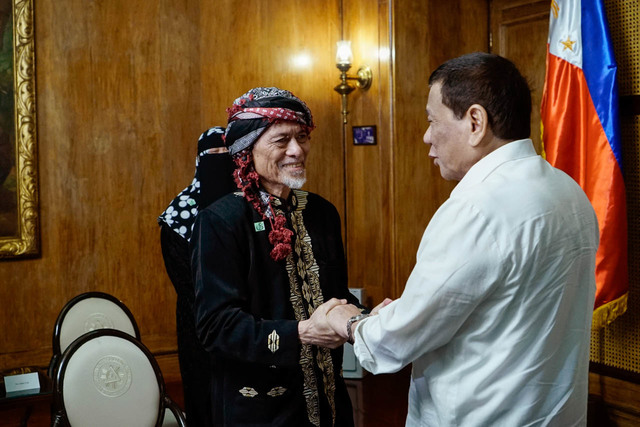
President Rodrigo Duterte meets with Moro National Liberation Front founding chair Nur Misuari in Mindanao. PRESIDENTIAL PHOTO

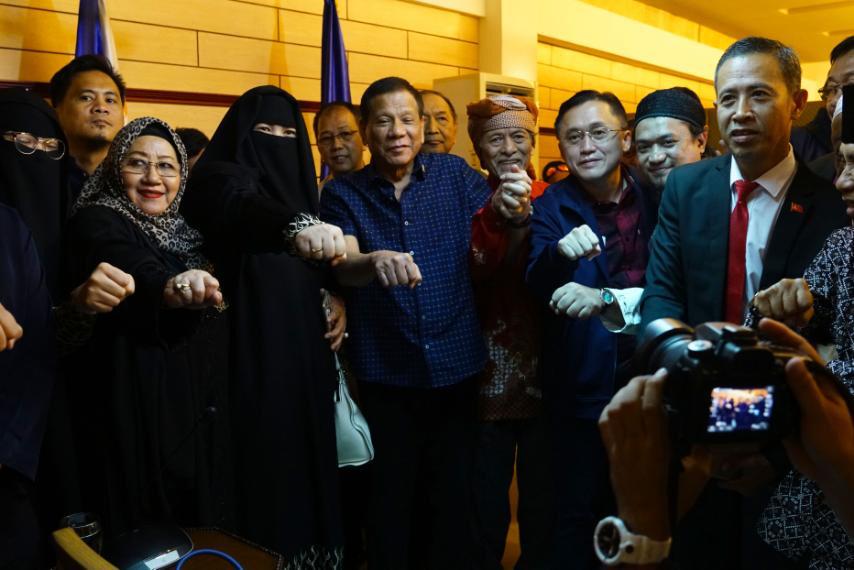
President Rodrigo Duterte met Friday with Moro National Liberation Front (MNLF) founder Nur Misuari.

Misuari, together with members of the Peace Coordinating Committee, “had a fruitful discussion” with Duterte and the members of the government peace panel.


“President Duterte reiterated that he wants to make some headway towards peace at least before his term ends, adding that concerned government agencies are working hand in hand to achieve the desired results,” Malacañang said in a statement.

“The President expressed gratitude to MNLF Chair Nur Misuari for his unwavering support for the government, and assured him of the government’s commitment to achieve peace and development in Mindanao,” it added.

Duterte and Misuari met in November this year and agreed to organize the government and MNLF panels that would serve as the foundation of the peace coordinating committee.

https://newsinfo.inquirer.net/1201498/duterte-misuari-meet-anew-in-davao-push-for-peace-in-mindanao

Misuari vows to help government in anti-terrorism efforts

From the Philippine Star (Dec 14, 2019): Misuari vows to help government in anti-terrorism efforts (By Roel Pareño)

Moro National Liberation Front (MNLF) chair Nur Misuari promised President Rodrigo Duterte he will help the government in their efforts to wipe out terror groups in Mindanao, particularly in Sulu where the Abu Sayyaf group is actively operating.

In a statement issued by the Office of the Presidential Adviser on the Peace Process (OPAPP), Misuari gave his assurance during a meeting with presidential adviser on the peace process Carlito Galvez Jr. Friday night in Davao City.

“There is no place for them to go…We can assure the president that the MNLF will fully support the resolution of this problem. Try us on how effective we are,”
Misuari said.


Misuari, who was facing rebellion charges in connection with 2013 Zamboanga siege, is out on bail and has been tapped by the Duterte administration to help work on the peace process.

Misuari have been sought before to help free kidnapped victims brought in Sulu.

Many of the followers of Misuari were even killed in a failed attempt to rescue former captive Jordanian journalist Baker Atyani. This was even confirmed by Atyani in a television show based in Manila Friday night.

Galvez said the military, police and MNLF forces on the ground can establish a close coordination efforts through the Peace Coordinating Committee to run after the terror groups.

“There will be security coordination with MNLF forces to persuade the Abu Sayyaf members to return to the mainstream society and to eradicate the problem of terrorism and kidnapping incidents, particularly in Sulu,” he said.

The military was given until the end of this this year to crush the Abu Sayyaf group to prevent foreign terrorists from establishing a caliphate in southern Philippines.

https://www.philstar.com/headlines/2019/12/14/1976990/misuari-vows-help-government-anti-terrorism-efforts

Joma: Reds to withdraw from staged peace talks

From the Manila Times (Dec 15, 2019): Joma: Reds to withdraw from staged peace talks (By Darwin Pesco)

The National Democratic Front of the Philippines (NDFP) will withdraw from peace talks with the government if the negotiations are just a “set-up,” its chief political consultant Jose Maria “Joma” Sison said on Saturday.


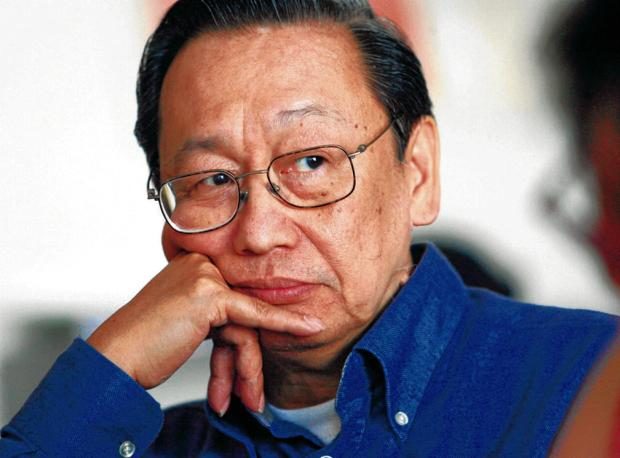
Chairman Jose Maria “Joma” Sison

Sison, the founding chairman of the Communist Party of the Philippines (CPP), said orchestrated peace talks are aimed at escalation of tyranny and repression and “for Charter change that violates the national patrimony and sovereign rights of the Filipino people.”

“The NDFP negotiating panel can withdraw from the peace negotiations if and when these are being used by the GRP (Government of the Republic of the Philippines) merely to compromise and set up the NDFP and the revolutionary movement,” he said in a statement.

The CPP and its armed wing, the New People’s Army (NPA), are among the members of the NDFP, an umbrella group.

“Of course, there are big risks taken by the NDFP in agreeing to negotiate peace with the GRP and address the roots of the armed conflict by agreeing on social, economic and political reforms,” Sison said.

He added that the NDFP was aware of the risks if it agreed to a resumption of peace negotiations to end over five decades of the communist insurgency in the country.

Based on his conversations with Labor Secretary Silvestre Bello 3rd on December 7 and 8 in Utrecht, The Netherlands, Sison said he saw the desire of the principals of Duterte’s administration and the NDFP to resume the peace talks.

“Informal meetings could resolve issues and serve as preparation for the formal meeting to resume the peace negotiations through reaffirming bilateral agreements since The Hague Joint Declaration of 1992,” he added.

Moreover, Sison said communist revolutionary forces had the right to wage “all forms of revolutionary struggle,” while no final peace agreement has been signed.

“While there is still adequate reason for carrying out peace negotiations, both the GRP and the NDFP should strive to use these in undertaking goodwill and confidence-building measures and making comprehensive agreements on social, economic and political reforms
for the benefit of the people,”
he added.

In a speech last week, the President said he would send Bello, along with the rest of the government peace panel, to negotiate with Sison in March.

Bello, the former chief negotiator for the government panel in previous peace negotiations with the rebels, said the talks were likely to resume next year.

Sison, who is living in exile in The Netherlands for more than three decades, said he was willing to face Duterte personally only if they meet in a country near the Philippines.

Ties between Duterte and Sison soured last year after the President accused rebel troops of continuing attacks against government forces despite ongoing peace talks.

In March, the President formally terminated the peace negotiations with the rebels, saying he would no longer entertain any “persuasions” from the communists.

Duterte signed Proclamation 360 on Nov. 23, 2017 declaring the termination of the peace talks with NDFP-CPP-NPA.

Another resumption was scheduled in late June last year but it was canceled as the government sought to review all agreements that the communists signed with past administrations.

https://www.manilatimes.net/2019/12/15/news/top-stories/joma-reds-to-withdraw-from-staged-peace-talks/664305/

Army’s 302nd IB intensifies security patrols as CPP anniversary draws near

From the Philippine Daily Inquirer (Dec 15, 2019): Army’s 302nd IB intensifies security patrols as CPP anniversary draws near (By Florence Baesa)

DUMAGUETE CITY, Negros Oriental — Colonel Noel Baluyan, commander of the 302nd Infantry Brigade, has ordered two of its battalions and all Citizen’s Armed Forces Geographical Units (Cafgu) here to intensify its security patrols and continue its combat operations against the New People’s Army (NPA).

Baluyan’s order followed after the ambush of a police patrol car in Borangan City, Eastern Samar on Friday afternoon, December 13, 2019 where a policeman, two civilians and several others were injured in the attack.

READ: Civilian injured in rebel ambush in Samar rose to 12

Baluyan said government troops are on high alert during the Christmas season as December 26 is the 51st founding anniversary of the Communist Party of the Philippines (CPP).

“Every time they celebrate their anniversary, they will conduct tactical offensives to all AFP (Armed Forces of the Philippines) and PNP (Philippine National Police) forces. We are all ready for that, “ Baluyan said.

He said they will continue to “conduct combat operations to avert enemy attacks and protect the civilians against NPA atrocities.”

Baluyan said the army and the police are in close coordination in Negros Oriental.

“Kung meron silang lakad or mag-operate sila (When they have other activities or when they operate) somewhere, we are always informed so that we will avoid misencounters… Or we will be informed of their activities so that we will be warned. We will do our part to complement their security operations to support our ISO (Internal Security Operation),” Baluyan said.

Baluyan also condemned the ambush in Samar and criticized the rebels for disregarding the safety of the civilians who were on board the police’s patrol car.

“These are the atrocities we are talking about. The terrorist groups would say that they are for human rights, that they are securing people. But what happened there [in Samar] when civilians were hurt? They still went ahead with the target even when they know that there were civilians,” Baluyan said in a mix of Filipino and English.

4 Reds killed in Sorsogon clash

From the Philippine Daily Inquirer (Dec 15, 2019): 4 Reds killed in Sorsogon clash
(By Mar S. Arguelles)

At least four suspected members of the New People’s Army (NPA) were killed when a firefight broke out between Army soldiers and the rebels on Sunday morning in Matnog town in Sorsogon province.

Major Maria Luisa Calubaquib, Bicol police spokesperson, said
clash started around 7:15 a.m and was still on-going in Barangay (village) Calpi as of Sunday noon.
Report said a platoon of Army soldiers chanced upon a 60-man NPA group led by Arnel Estiller, aka “Mando,” of the NPA Larangan 2 operating in Sorsogon.

Apart from the four still unidentified fatalities, government forces also found four high powered firearms, including an M203 rifle, the report said.

Police checkpoints were set up in strategic areas and police forces were on standby for possible reinforcement, Calubaquib said.

https://newsinfo.inquirer.net/1201782/4-reds-killed-in-sorsogon-clash

8 Red fighters surrender in Quezon, says PH Army

From the Philippine Daily Inquirer (Dec 14, 2019): 8 Red fighters surrender in Quezon, says PH Army (By Delfin T. Mallari Jr)

At least eight alleged former New People’s Army (NPA) rebels, two them reportedly “child warriors,” surrendered to police and Army representatives in General Nakar town in Quezon province.

In a press statement issued Friday, Captain Jayrald Ternio, head of the public affairs office of the Army’s 2nd Infantry Division, said the surrender took place on December 12.

Ternio said the former rebels turned over two shotguns, three handguns, and ammunition.

One of the minors is a 13-year-old boy while the other is 17, who was reportedly forced to join the underground movement when he was still 15.

“They were forced by the rebels to join their ranks and were forbidden to leave a terrorist camp under threat of severe repercussions to their families,” said Colonel Alex Rillera, commander of the Army’s 202nd Infantry Brigade which has operational jurisdiction in northern Quezon.


However, there was no means to immediately verify and validate the claims of the military and the narrative of the alleged rebel returnees.

But on Thursday, the NPA rebels in Southern Tagalog refuted the military report that 48 Red fighters surrendered after the arrest and death of two ranking rebel leaders in the region.

“It was psywar and fake news,” the NPA’s Melito Glor Command, said in a statement.

The NPA command accused the military of concocting lies and fomenting intrigue with the “malicious” report.


The military refuted the claims of the communist rebels.

“That’s their mother tongue speaking. Any reports from the government or military are always fake for them,” Ternio retorted.

After 3 Failures, Philippines to Restart Talks With Violent Communist Rebel

From the Voice of America (Dec 14, 2019): After 3 Failures, Philippines to Restart Talks With Violent Communist Rebels (By Ralph Jennings)


Masked members of the outlawed National Democratic Front of the Philippines, the umbrella organization of the Philippine communist movement, hold a sign during a demonstration in Manila, Philippines, March 25, 2019.

Analysts say Philippine President Rodrigo Duterte's announced plan to restart peace talks with violent communist rebels, aimed at ending a 50-year conflict after three failed efforts, would earn him a place in history if he succeeds and help bring investment to impoverished, strife-torn parts of the country.

Previous talks broke down when each side accused the other of initiating attacks, sometimes violating cease-fires. The most recent round collapsed in March.

Duterte said December 5 he will send a peace negotiator to the Netherlands to restart talks with Communist Party of the Philippines founder Jose Maria Sison, the presidential office website states.

A peace deal with the party and its armed unit, the New People’s Army, would boost Duterte’s image as a peacemaker when he steps down in 2022 due to term limits, country analysts believe.

“For Duterte, he has two years left in his term and he probably is thinking of a legacy, and one of his legacies would be to end the communist insurgency,” said Eduardo Araral, associate professor at the National University of Singapore’s public policy school.

“At least he could say he tried to talk to the reds but it would appear that the reds are unreasonable and he cannot be blamed for using his strong-arm tactics," he said.

Restart to talks

Philippine officials and the insurgency may be able to negotiate a peace deal if the government first frees party-backed prisoners and the rebels suspend acts of violence, Araral said.

Government attacks on the New People’s Army have reduced the number of combatants to 4,000, down from a peak of some 17,000, domestic media reports say. The party claims about 70,000 members. The New People’s Army may feel “cornered” in parts of the country, Araral said.

“There’s enough motivation from both sides to get the peace talks moving forward again,” he said.

Fighting such as ambushes on soldiers has killed about 30,000 people over the past five decades. The rebels further frustrate the government with continued requests for prisoner releases followed by new attacks. They sometimes attack construction firms and demand that companies pay taxes.

Rebel leaders have said they believe Duterte has not released enough prisoners.

Legacy seeker
Duterte said via his office website he had tried to negotiate three times with the Communists but “failed.” He pledged before taking office in 2016 to eradicate a range of criminal activity and prides himself on an understanding of rebel causes because he served for 22 years as mayor in Davao City, near some of their strongholds.

Duterte should realize use of force against the New People’s Army does little good because the Communists – initially inspired by former Chinese leader Mao Zedong – have support in poor areas that feel ignored by the state, and can easily recruit new people, analysts say. About one-fifth of Filipinos live in poverty.

“They have a quite strong follow among the well-educated youth in a number of universities, and those are going to become the future ideologues of the party, so there is a very important underground of very well-educated scholars and students and other people dealing with these matters,” Enrico Cau, Southeast Asia specialist at the Taiwan Strategy Research Association, told VOA.

Duterte had said in March, when he cut off talks most recently, that he would let the next president take up the issue.

Now he’s probably thinking now about his “legacy,” said Renato Reyes, secretary general of the Manila-based Bagong Alyansang Makabaya alliance of leftist organizations.

“It’s impossible to wipe them out because of the prevailing social conditions, so what we are proposing is that instead of a military solution you undertake a political solution and do this through negotiations, which is more productive than any militarist option,” Reyes said, referring to the advice his group would give Duterte.

Investment in conflict zones

The National People’s Army operates largely in the Philippine archipelago’s Visayan Islands and in Mindanao, a southern island where Muslim rebels have additional strongholds. Duterte said on December 5 the Bicol region southeast of Manila also “remains a hotbed for communist insurgency.”

Poverty persists in many of those spots because of incomplete land reforms, high minimum wages that discourage hiring and a lack of government incentives to seek work in cities, the Carnegie Endowment for International Peace said in a study published online. Some farmers live in one-room thatched huts with only dirt roads to move produce to markets.

Investors in developing countries often worry about “the risk of asset destruction,” an unavailability of infrastructure, and “abrupt declines in domestic demand” in civil war zones, the World Bank’s Multilateral Investment Guarantee Agency says in a report posted to its website.

Tourism infrastructure is expanding along the Philippine coastlines and near the capital Manila. Factory investors often pick ex-urban Manila because of its advanced infrastructure. The Philippines economy as a whole is expected to grow 6% this year, well above the world average, the Asian Development Bank forecasts.

“If there’s insurgency, that hinders development,” Cau said.

BARMM earmarks P100 million for community, peace-building programs

From the Philippine Star (Dec 14, 2019): BARMM earmarks P100 million for community, peace-building programs (John Unson)


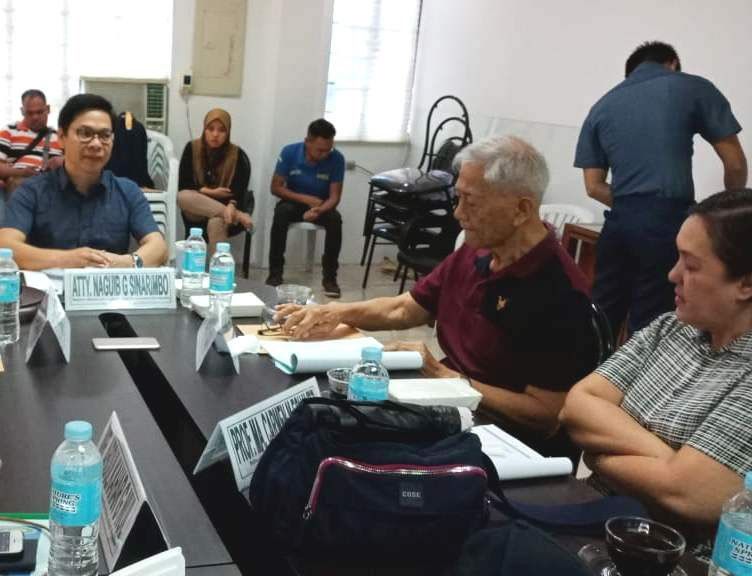
Bangsamoro Local Government Minister Naguib Sinarimbo presided over Friday’s council of advisers to the regional police. Philstar.com/John Unson

COTABATO CITY, Philippines — The Bangsamoro local government ministry has earmarked a total of P100 million for 2020 community services and peace-building programs of the region’s cross-section police regional advisory council.

Lawyer Naguib Sinarimbo, local government minister of the Bangsamoro Autonomous Region in Muslim Mindanao, said Saturday his office has P60 million for development initiatives next year of the BARMM police and its cross-section Regional Advisory Council, or RAC.

The RAC, comprised of representatives from the local communities, including the region’s media community, helps the Police Regional Office-Bangsamoro Autonomous Region (PRO-BAR) on advisory capacity.

The PRO-BAR covers Maguindanao and Lanao del Sur, which are both in mainland Mindanao, the island provinces of Basilan, Sulu and Tawi-Tawi and 63 barangays in North Cotabato.

Sinarimbo said the Ministry of the Interior and Local Government-BARMM also allocated P40 million for programs meant to hasten the return to mainstream society of members of the Bangsamoro Islamic Freedom Fighters, or BIFF.

The group is not covered by the ceasefire accord between the government and the Moro Islamic Liberation Front, whose leader, Hadji Ahod Ebrahim, is now chief minister of BARMM.

The creation of BARMM that replaced early this year the 29-year-old Autonomous Region in Muslim Mindanao was an offshoot of 22 years of peace talks between the government and the MILF.

Sinarimbo was elected on Friday as new chairperson of the RAC of the regional police, a post left vacant with the resignation of lawyer Laisa Masuhud-Alamia, former executive secretary of the defunct ARMM and now minority floor leader of the Bangsamoro parliament.

He said the MILG-BARMM now has a program dubbed Tulong ng Gobyernong Nagmamalasakit, or TUGON, that shall provide humanitarian interventions needed in the reintroduction to the local communities of reforming former BIFF members.

More than 50 members of the BIFF from the adjoining North Cotabato and Maguindanao provinces surrendered in batches to units of the Army’s 6th Infantry Division in the past 24 months.

Sinarimbo said it is important to provide relief, rehabilitation and livelihood support to former BIFF members for them to have sources of income as they reform for good.

Sinarimbo, who presided over on Friday the RAC meeting in his office in Cotabato City, said he is also open to the inclusion in the advisory council of representatives from the Bureau of Jail Management and Penology, from the Bureau of Fire Protection and from the 6th ID to maximize cooperation among security sectors in support of the Mindanao peace process.

https://www.philstar.com/nation/2019/12/14/1976969/barmm-earmarks-p100-million-community-peace-building-programs

Bangsamoro chief minister makes call for investments

From Anadolu Agency (Dec 15, 2019): Bangsamoro chief minister makes call for investments (By Riyaz ul Khaliq)

Chief Minister Murad Ebrahim thanks Turkey for its support and training


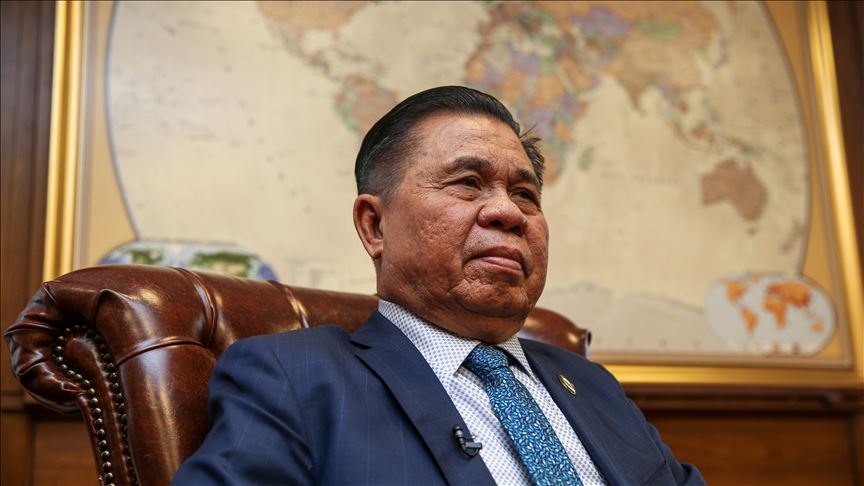
Chief Minister of Bangsamoro Autonomous Government (BAG) Haji Murad Ebrahim

Thanking Turkey for its support, Chief Minister of Bangsamoro Autonomous Government (BAG) Haji Murad Ebrahim invited investors to explore opportunities in his region.

Speaking at the annual 28th International Congress of Muslim Communities Union in Ankara, Ebrahim said that under the transition agreement plan with the Philippine government led by Rodrigo Duterte, BAG is moving forward with an agenda of governance and development.

"As a representative of people of Bangsamoro, I invite our friends from different countries to explore opportunities as our region is filled with natural resources including minerals and make investments in our region," Ebrahim told the conference, hosted by Turkey-based Economic and Social Research Center.

At least 120 delegates from 60 countries are attending the annual gathering in the Turkish capital.

Turkey is one of the three member-states monitoring the implementation of an agreement reached between Duterte's government and Moro Islamic Liberation Front (MILF) led by Ebrahim before he was sworn-in as chief minister early this year in February.

"We have challenges but friends like Turkey are helping us in many ways," he said. "We are sending our people to Turkey for training in bureaucracy and diplomacy and we expect other countries will come forward to help us succeed in our transition from a revolutionary movement to one which has an agenda of governance and development."

"We want to give an effective government to our people who have struggled for long," Ebrahim said.

In his address, the chairman of MILF explained the struggle of Bangsamoro people for justice and rights.

"We had no choice in 1968 than to launch Jihad to safeguard our children, women, identity and homeland," he added, referring to atrocities inflicted upon people living in the southern Philippines in the mid-twentieth century.

"It is a long struggle but now we are here with an achievement that we are able to govern," he said.

However, BAG chief minister acknowledged the challenge of the Daesh/ISIS group in the region.

"We have a small group affiliated to ISIS but we want to solve it for which we want to set up a structure with President Duterte's government," he said.

Ebrahim said: "We can still influence and attract this small group so that they join us. We are working, conducting dialogue with them."

Referring to his governance model, Ebrahim said: "It is a parliamentary form of government where we have 80 lawmakers. And government is run by 15 ministries.

Duterte appoints Misuari economic envoy to Organization of Islamic Cooperation

From Rappler (Dec 14, 2019): Duterte appoints Misuari economic envoy to Organization of Islamic Cooperation (By JC Gotinga)

The government and Misuari's Moro National Liberation Front agree to implement remaining items from the 1996 Final Peace Agreement, after the former rebel leader complained of being left out of the Bangsamoro peace process


NUR MISUARI. President Rodrigo Roa Duterte gives a warm welcome to Moro National Liberation Front Founding Chairman Nur Misuari prior to their meeting at the Malacanan Palace on July 9, 2019. KING RODRIGUEZ/PRESIDENTIAL PHOTO

President Rodrigo Duterte has appointed Moro National Liberation Front (MNLF) founding chairman Nur Misuari as the country’s Special Economic Envoy on Islamic Affairs to the Organization of Islamic Cooperation (OIC), the Office of the Presidential Adviser on the Peace Process (OPAPP) announced on Saturday, December 14.
Duterte and Misuari met in Davao City on Friday, December 13, along with other government officials and a panel from the MNLF, to convene the newly-established Government-MNLF Peace Coordinating Committee.
During the meeting, the two sides agreed to implement the remaining commitments contained in the Tripartite Review Process of the 1996 Final Peace Agreement between the government and the MNLF.

Those commitments are the establishment of the Bangsamoro Development Assistance Fund, and the creation of the Tripartite Implementation Monitoring Committee.

Duterte and Misuari also agreed to continue pushing for a federal form of government.


Duterte appointed Misuari as representative to the OIC “in order to accelerate the implementation of the peace agreements and to develop further the support of the Islamic countries,” the OPAPP said.

The OIC is “the collective voice of the Muslim world,” the group’s website states. It has 57 member states in 4 continents. The organization works “to safeguard and protect the interests of the Muslim world in the spirit of promoting international peace and harmony among various people of the world.”

The MNLF is a non-state observer in the OIC. The Philippines has been seeking observer status in the organization since 2003, but the MNLF opposed it then, claiming to be the legitimate representative of the Bangsamoro people.

Duterte picked up talks with Misuari after the former rebel leader complained that he and the MNLF were left out of the Bangsamoro peace process brokered by the Moro Islamic Liberation Front (MILF).

Misuari was governor the Autonomous Region in Muslim Mindanao (ARMM) from 1996 to 2001. The ARMM, established in 1989, was the settlement between the government and the MNLF, which opted for autonomy after initially fighting for secession in the 1970s.

In 1996, the government and the MNLF signed a “Final Peace Agreement” in Jakarta, Indonesia, on the full implementation of the the 1976 Tripoli Agreement that paved the way for the ARMM.

However, the ARMM failed to quell unrest and violence in Mindanao, especially because splinter groups from the MNLF kept fighting for independence.

In January 2019, the ARMM was replaced by the broader and more substantial Bangsamoro Autonomous Region in Muslim Mindanao (BARMM) led by the MILF.

The MILF splintered from the MNLF in 1977 to fight for secession until it, too, opted for autonomy in 2012.

Although the BARMM’s transitional government includes a faction of the MNLF, Misuari insisted on reviving his claim that the government honor past commitments to his group.

In August, after a series of meetings with Misuari, Duterte ordered the creation of a “coordinating committee” with the MNLF to tackle pending commitments to the MNLF, and to help secure the group's bailiwick, Sulu province, which is also the turf of the Abu Sayyaf bandit group.

In September 2013, Misuari’s faction of the MNLF laid siege to Zamboanga City in a push to establish an independent Bangsamoro state. At least 6 people were killed and 24 others wounded in the 20-day battle with government forces.

https://www.rappler.com/nation/247196-duterte-appoints-misuari-economic-envoy-organization-islamic-cooperation

Marawi-like attacks won't happen again, AFP WestMinCom says

From GMA News Online (Dec 15, 2019): Marawi-like attacks won't happen again, AFP WestMinCom says

Armed Forces of the Philippines' Western Mindanao Command (WestMinCom) spokesperson Lieutenant General Cirilito Sobejana on Sunday said attacks like the one launched by the Maute group in Marawi City in 2017 will never happen again.

As the martial law enforced in Mindanao since the 2017 siege will soon be lifted, Sobejana assured that such hostilities will never happen again due to the reduced strength of terrorist groups.

“Marawi (City-like attacks) will never happen again. Ang strength ng terrorist groups sa ating bansa ay na-reduce na significantly,”
Sobejana said in an interview on Dobol B sa News TV aired on GMA News TV.

“They are on the run. We will sustain it. As much as possible, we will confine itong terrorism problem particularly the ASG (Abu Sayyaf Group), BIFF (Bangsamoro Islamic Freedom Fighters), and Jemaah Islamiyah,”
he added.


Even without martial law in Mindanao, Sobejana said there are other interventions like Executive Order 70 that will enable them to continue their efforts against the threats.

“Our security posture will remain the same at tuloy ang ating isinasagawang focused military operations against various threat groups here in the area of responsibility of the Western Mindanao Command,” he added.

Sobejana said eight foreign terrorists were confirmed to be present in the country while 60 are still for validation.

According to him, these terrorists have no capacity to stage an attack as destructive as the 2017 attack in Marawi City.

Last week Malacañang said President Rodrigo Duterte will not extend martial law in Mindanao upon its expiration on December 31, following the assessment of his security and defense advisers of the “weakening of the terrorist and extremist rebellion.”

https://www.gmanetwork.com/news/news/regions/719181/marawi-like-attacks-won-t-happen-again-afp-westmincom-says/story/

Civilian-AFP tieup backed

From the Philippine Daily Inquirer (Dec 15, 2019): Civilian-AFP tieup backed (By Divina M. Suson)

Leni: In lieu of martial law, private sector partnership with military key to Mindanao security


In the face of the lifting of martial law in Mindanao by year-end, Vice President Leni Robredo has called for a strong partnership between the private sector and the Armed Forces of the Philippines and the rest of the government to ensure that communities in Marawi City and Lanao del Sur province are free from terrorist attacks.

During her visit to Marawi City on Thursday, Robredo noted that local leaders have wanted to maintain the state of martial law, even if only in Lanao del Sur, because they feel more protected that way.

But she deferred to President Duterte to consider and decide on the matter.

Mr. Duterte earlier announced he would no longer seek an extension of martial law in Mindanao.
Functioning relationship

Martial law was first imposed on May 23, 2017, when Islamic State-linked militants attacked Marawi, precipitating a five-month long war that ravaged the city’s central business district.

It has since been extended thrice by Congress, and will expire by year-end.Amid the prospect of martial law’s nonextension, Robredo said a functioning relationship between the private sector and the military should be built.

“For example, the private sector can provide the military with information … For me, security is as much the responsibility of everyone as it is the responsibility of government and the military,” she said.

She asked Marawi residents to report to authorities any information about security threats so these can be acted upon swiftly.

Securing rehab workers

Lanao del Sur Gov. Mamintal Adiong Jr. called on the extension of martial law, especially in his province, to secure the people undertaking the work of rehabilitating Marawi.

Adiong said keeping martial law would help ensure the smooth implementation of rehabilitation work because increased military and police presence reduced the threat from violent extremists.

This view was shared by Marawi Mayor Majul Gandamra, who said that many residents were still struggling to normalize their disrupted lives after the siege.

https://newsinfo.inquirer.net/1201470/civilian-afp-tieup-backed

6 NPA rebels surrender to Masbate Coast Guard

From the Manila Bulletin (Dec 14, 2019): 6 NPA rebels surrender to Masbate Coast Guard (By Erma Edera)

Six members of the New People’s Army (NPA) surrendered to the Philippine Coast Guard (PCG) in Masbate on Wednesday, a belated report showed.

The former rebels yielded one M16 rifle, one .45 caliber pistol, and one .38 caliber pistol.


A PCG station in Masbate led by Lt. Edgardo Aguilar turned over the former rebels to Joint Task Force Bicolandia Commander Major General Fernando Trinidad of the Armed Forces of the Philippines (AFP) at Sitio Baclay, Barangay Bacolod, Milagros, Masbate.

The surrenderers received monetary assistance and will be enrolled in the government’s Enhanced Comprehensive Local Integration Program (E-CLIP).

PCG said they will receive training and livelihood programs from various government agencies to make them productive members of society.

Police wary of CPP anniversary attacks

From Panay News (Dec 14, 2019): Police wary of CPP anniversary attacks (By Ruby Silubrico)

On Dec. 26, the 51st founding anniversary of the Communist Party of the Philippines (CPP), there could be rebel offensives against government security forces and vital installations in Western Visayas, according to the Police Regional Office 6 (PRO-6).

The CPP usually marks its anniversary with attacks against the police and military carried out by its armed wing, the New People’s Army (NPA).

Police Brigadier General Rene Pamuspusan, regional police director, ordered police units across Western Visayas to step up anti-insurgency operations in coordination with the Armed Forces of the Philippines (AFP).

Intensify intelligence monitoring, maximize defense posture, he told them.


PRO-6 spokesperson Police Lieutenant Colonel Joem Malong said, “Our regional director also directed our policemen to carry both short and long firearms.”

In Iloilo province, towns with insurgency problems were told to be wary of strangers as these could be rebels.

These were San Joaquin, Guimbal, Miag-ao, Tubungan, Igbaras, Alimodian, Leon, Calinog, Maasin, Bingawan, Badiangan, San Enrique, San Rafael and Lemery, and the component city of Passi.

On the other hand, the Philippine Army already started troop deployment in the towns.

“We are ready. But we are asking the help of the community,” said Army Captain Cenon Pancito III, spokesperson of the 3rd infantry Division, Philippine Army.

The CPP was formed by Prof. Jose Maria Sison on Dec. 26, 1968. It was designated as a terrorist group by current Philippine president and Sison’s former student, Rodrigo Duterte in December 2017.

The CPP has been fighting a guerrilla war against the state since its establishment. Although its ranks initially numbered around 500, the party grew quickly, supposedly due to the declaration and imposition of martial law by former president and dictator Ferdinand Marcos during his 21-year rule.

By the end of Marcos’ dictatorship, the number of combatants had expanded to include more than 10,000 fighters. In a speech before the US Congress in 1986, Marcos’ successor Corazon Aquino accredited the party’s rapid growth as being caused by Marcos’ attempts to stifle it with the “means by which it grows” with his establishment of martial law, suggesting that other governments view it as a lesson when dealing with communist insurgencies.

As of 2019, the organization claims that the number of its members and supporters is growing, despite claims by the Philippine government that the organization is about to be destroyed.

The organization remains an underground operation, with its primary goals being to overthrow the Philippine government through armed revolution.

https://www.panaynews.net/police-wary-of-cpp-anniversary-attacks/

No formal talks yet but only informal meeting – Sison

From the Philippine Daily Inquirer (Dec 15, 2019): No formal talks yet but only informal meeting – Sison (By Delfin T. Mallari Jr)


Jose Maria Sison, founding chairman of the Communist Party of the Philippines (File photo from the Philippine Daily Inquirer)

Exiled Communist Party of the Philippines (CPP) founder Jose Maria “Joma” Sison said the report on President Duterte’s coming announcement on the resumption of the aborted peace talks would only deal with the start of the “informal meeting” between government and communist representatives and not yet the formal peace negotiation.

“Anything not yet to be resolved has to be resolved in an informal meeting prior to the formal meeting to resume the peace negotiation,” Sison explained in an online interview on Friday afternoon.

He said the informal meeting is the “normal practice” in peace negotiation.

He said the informal meeting between government and National Democratic Front of the Philippines (NDFP) peace panels will be held in a “neutral foreign venue”.

“Possibly soon to prepare the formal meeting to resume the peace negotiation abroad in January,” Sison said.

Labor Secretary and government peace negotiator Silvestre Bello III reported that President Duterte is set to make the announcement on the resumption of the peace talks possibly next month.

Bello made the declaration after he briefed the President on the result of his backchannel talks with rebel leaders in Utrecht on Dec. 6.
On Thursday, Sison declared that there was a 90-percent chance that the peace talks would resume, but that the remaining 10 percent of unresolved issues could still make or break the prospect.

Among the contentious issues that have yet to be resolved include the venue of the formal peace talks and the freedom for elderly and sickly political prisoners, as well as the safety and immunity guarantees for the NDFP consultants in the peace negotiations.

https://newsinfo.inquirer.net/1201458/no-formal-talks-yet-but-only-informal-meeting-sison