Wednesday, March 6, 2019

MILF: Foreign Benefactor sponsors 1st Ever Strategic Governance Planning Workshop for BARMM

Posted to the Moro Islamic Liberation Front (MILF) Website (Mar 6, 2019): Foreign Benefactor sponsors 1st Ever Strategic Governance Planning Workshop for BARMM


Sultan Kudarat, Maguindanao-A foreign benefactor supporting the southern peace process sponsored the 1st Strategic Governance Planning Workshop of the Bangsamoro Autonomous Region in Muslim Mindanao (BARMM), said a report by NDBC News.

The two-day event held in Cotabato City was a joint initiative of BARMM’s Ministry of Local Government, or MLG, and the United Nations Development Programme (UNDP).

According to the NDBC News, the activity aims to strengthen governance in BARMM, which covers all five provinces in the defunct Autonomous Region in Muslim Mindanao, Cotabato City and 63 barangays in different towns in North Cotabato.

Lawyer Naguib Sinarimbo, Minister of Local Government (MLG) of BARMM said Tuesday that he is thankful to Winston Aylmer CamariƱas, head of UNDP’s field office in Cotabato City, for helping them push the two-day strategic planning exercise forward.

Twenty three local government units in the defunct Autonomous Region in Muslim Mindanao were awarded with the 2018 Seal of Good Local Governance by the central office of the Department of the Interior and Local Government for efficient operation and good domestic socio-economic and security programs.

The MLG covers 118 towns in ARMM’s five provinces, Cotabato City and the 63 barangays in North Cotabato province.

The UNDP and several other entities under the United Nations have actively been supporting the peace process between the government and the Moro Islamic Liberation Front whose figurehead, Hadji Murad Ebrahim, is now appointed chief minister of BARMM, the NDBC News report said.

Sinarimbo said that Al Haj Murad Ebrahim, Chief Minister of BARMM, and also head of the Bangsamoro Transition Authority, or BTA, was a speaker in the opening program of the MLG’s two-day workshop.

The UNDP-assisted strategic governance planning activity is meant to identify measures that can maximize governance in BARMM’s territory for the bilateral peace and development goals of the newly-established regional government and President Rodrigo Duterte to fully takeoff.

CM Ebrahim said BARMM’s initial normalization thrusts, intended to foster peace and sustainable development in areas beset with poverty and underdevelopment due to armed conflicts, are hinged on education, infrastructure, health and social welfare interventions. (NDBC News)

http://www.luwaran.com/news/article/1754/foreign-benefactor-sponsors-1st-ever-strategic-governance-planning-workshop-for-barmm-

NDF/Sison: On the anti-communist witch hunt against legal democratic organizations

Jose Maria Sison propaganda statement posted to the National Democratic Front Philippines (NDFP or NDF) Website (Mar 6, 2019): On the anti-communist witch hunt against legal democratic organizations

By Jose Maria Sison
NDFP Chief Political Consultant
March 6, 2019

Albayalde and his ilk continue to malign me as having identified the Alliance of Concerned Teachers (ACT) and other legal democratic organizations as “front” organizations of the Communist Party of the Philippines.

I am therefore reissuing my press statement of January 8, 2019 (attached hereto ) which frontallly answered Albayalde the first time he made his lie against me and against patriotic and progressive mass organizations. It carries the following paragraphs:

“It is in the context of the anticommunist witch-hunt that PNP’s Albayalde tries to use my name for his vile purposes. I say categorically that Albayalde is a big liar. He is capitalizing on a distorted spy report on a 30-year old video of a speech of mine in Brussels in which I actually differentiate the legal democratic forces and the forces of the armed revolution.

I have never identified or enumerated any legal organization as a “front” or facade of the CPP. The language is entirely that of the un-intelligent or stupid witch-hunting police dog Albayalde. I have always referred with respect and accuracy to legal organizations adhering to the line of national independence and democracy as legal democratic formations independent of the CPP. “

The witch hunt being conducted by the political and military minions of Duterte against legal democratic organizations is calculated to intimidate them, their leaders and mass activists, prepare them for the kill by the Duterte death squads, prevent them from exercising their freedom of speech and assembly, discredit them and possibly outlaw them as “terrorist” organizations and disable them from expressing themselves during the electoral campaign period.

The anti-communist witch hunt against ACT and other legal democratic movements is part of the scheme of the Duterte terrorist regime to intimidate and discredit the forces of the opposition and make it appear that Duterte’s corrupt and high-spending candidates are real winners in the forthcoming May elections which are now increasingly emerging as characterized by fraud and terrorism by the agents of Duterte in the Comelec, the military and police.

The political life and fascist ambitions of Duterte depends on stealing the elections by fraud and terrorism in order to pack the Senate with enough puppets to railroad the charter change to a bogus kind of federalism in which powers are centralized in the hands of the fascist dictator who handpicks his regional and provincial subordinates from the narrow circles of the big compradors, landlords and corrupt bureaucrats.

https://www.ndfp.org/on-the-anti-communist-witch-hunt-against-legal-democratic-organisations/

WESTMINCOM: Tired of hiding, 10 more NPA members yield in Maguindanao

From Western Mindanao Command (WESTMINCOM) (Mar 7, 2019): Tired of hiding, 10 more NPA members yield in Maguindanao


Amid the relentless pursuit operations conducted by the Joint Task Force Central troops, 10 more NPA militants yield to the troops of the 1st Marine Battalion Landing Team 7 (MBLT-7) led by Lieutenant Colonel Oliver Baylon in Upi, Maguindanao on Tuesday (March 5).


Said surrenderors affirmed the resentful system of the New People’s Army of merely propagating lies to the Teduray people in the Municipality of Upi.

The successful surrender was facilitated by the troops of the MBLT-7 in coordination with the officials of Barangay Rifao, Upi, Maguindanao.

The ten were members of the NPA squad Primera led by Cesar Marcos Manguda a.k.a Commander Amina/Alas of the Cherry Mobile Platoon, Guerilla Front 73 operating in the municipalities of Lebak and Kalamansig, all of Sultan Kudarat Province.

Subject surrenderors turned over two AK47 rifles, one M16 rifle, one hand grenade, and assorted ammunitions.

They were subsequently presented to Brigadier General Eugenio V. Hernandez, Commander, 1st Marine Brigade, North Upi Mayor Ramon Piang, and South Upi Mayor Reynalbert Insular at the headquarters of MBLT-7 in Sitio Plateau, Barangay Mirab, Upi, Maguindanao.

“We are tired of hiding, worn out of hunger and fatigue, and dissatisfied of the NPA ideology,” expressed by Jerome a.k.a Jun-Jun, one of the surrenderors.

The LGUs of North and South Upi provided the initial financial assistance to the surrenderors and included them in the municipal payroll as casual employees with a monthly compensation amounting to Php5, 000.00.

“Ang inyong Marine Battalion Landing Team-7 ay kaagapay ng ating mga kapatid na minsa’y naligaw ng landas patungo sa kanilang pagbabalik-loob at pagbabagong buhay,” said LtC Baylon.

Joint Task Force Central Commander Major General Cirilito E. Sobejana welcomed the former rebels and assured that if they are eligible, they may avail the E-CLIP of the government for them to start a new life with their families.

“Our intensified efforts through combat operations and information disseminations against terrorist group with the support of all local chief executives and other stakeholders encourage more the rebels to surrender,” Major General Sobejana added.

Subject surrenderors are currently undergoing custodial debriefing.

“It is good that the former NPA militants who surrendered have realized the true nature of their group’s intentions,” said WestMinCom Chief Lieutenant General Arnel B. Dela Vega.

“Gone are the days wherein people easily believe in their lies and propaganda. All their devious intentions and resolves are already made known to the public,” LtGen Dela Vega added.

The E-CLIP program of the government intended for those who surrendered continues.

“We would like to encourage those who are still hiding in their lairs, now is the time for you to join the rest of your former comrades who have decided to return to the folds of the law,” LtGen Dela Vega concluded.

http://www.westmincom.com/tired-of-hiding-10-more-npa-members-yield-in-maguindanao/

4 NPA members surrender in Iligan City

From the Business World (Mar 5, 2019): 4 NPA members surrender in Iligan City


FOUR MEMBERS of the New People’s Army (NPA), the armed wing of the communist movement, surrendered with their weapons to the Joint Task Force ZamPeLan in Iligan City last Feb. 28, the Western Mindanao Command (WestMinCom) reported yesterday.

“The returnees decided to surrender because of the hardships they experienced on the mountains. They are also tired of hiding from the government forces who are conducting military operations in the area,” said Lieutenant Colonel Jasper Edward Obar, head of the 51st Infantry Battalion.

“We warmly welcome the four returnees who realized that their lives with the communist NPA terrorist will lead nowhere. We will ensure that, through the E-CLIP (Enhanced Comprehensive Local Integration Program), they will be provided with the necessary assistance,” said Colonel Ezra James Enriquez, the 2nd Mechanized Brigade commander.

https://www.bworldonline.com/4-npa-members-surrender-in-iligan-city/

Water Wars: Much Ado about Thitu

From Lawfare Blog (Mar 5, 2019): Water Wars: Much Ado about Thitu (By Nathan Swire)


From December through at least February, China deployed a fleet of vessels to the area around Thitu Island (called Pag-Asa Island in the Philippines), the largest of nine features claimed by the Philippines in the Spratly Islands, according to satellite analysis conducted by the CSIS Asia Maritime Transparency Initiative (AMTI) and reports from local fishing vessels.

China’s deployment may be a response to new Philippine construction on Thitu Island. On Dec. 20, 2018, the Philippine government announced that a new beaching ramp is under construction and that the government plans to repair the military barracks and runway on the island.

Analysis by AMTI indicates that the Chinese fleet deployed to the area consists of People’s Liberation Army-Navy (PLAN) ships, Coast Guard ships, and dozens of fishing vessels showing the characteristic signs of China’s maritime militia. These deployments began in mid-December and reached a high of 95 vessels in December, before dropping in January. A smaller Chinese fleet had previously deployed to the area around Thitu Island when the Philippine government first announced the plans to upgrade the facilities there in August 2017.

According to Roberto del Mundo—mayor of the town of Kalayaan, which administers Thitu Island—the Chinese vessels were driving Philippine fishermen away from a sandbar located off the coast of the island during January and February. Del Mundo said China’s actions did not constitute “harassment” but did say the Chinese vessels were stopping access to the sandbars, which the Philippines considers its own fishing grounds. The Philippine government previously halted construction on one of the sandbars between Thitu Island and Chinese-controlled Subi Reef 12 miles away, due to an agreement between the two countries to refrain from claiming features in the region. It is unclear if the Chinese vessels still remain in the area.

Philippine Defense Secretary Delfin Lorenzana defended the Philippines’s decision to invest in facilities on the island, after the AMTI published its report. Lorenzana told reporters that the construction was in full accordance with international law, and that “we expect other countries to respect Philippine sovereignty and to conduct themselves in a civilized manner befitting members of the global community.”

The Philippine government has declined from confirming these reports, though a spokesman for President Rodrigo Duterte stated that China’s actions would be “not correct” if they are truly blocking Philippine fishing vessels from accessing the sandbar.

In Other News

In the Philippines…

U.S. Secretary of State Mike Pompeo announced on March 1, during a joint news conference in the Philippines with Philippine Secretary of Foreign Affairs Teodoro Locsin, that “any armed attack on Philippine forces, aircraft, or public vessels in the South China Sea will trigger mutual defense obligations under Article 4 of our Mutual Defense Treaty.”

The mutual defense treaty states that both countries would come to each other’s defense in the event of an armed attack.

Pompeo’s statement signals a higher level of commitment by the United States, as it has never before assured the Philippines that it would invoke the MDF in response to an attack on a Philippine feature in the South China Sea. The Philippines has long sought this guarantee by the United States, but in 2018, then-Defense Secretary James Mattis declined to make the same guarantee when asked by a reporter.

Pompeo’s visit comes as skeptics in the Philippine government are considering reviewing the mutual defense treaty, which was signed in 1951, partially over concerns that its language is too vague. Some members of the government have also called for increased ties with China, even at the expense of the United States.

Locsin stated at the conference that his government’s response to the new commitment would require “further thought,” but added, “we are very assured, we’re very confident, that the United States has—in the words of Trump to our president: We have your back.”

However, on March 5, Philippine Defense Secretary Lorenzana said that the Philippines will continue its review of the treaty over concerns that the Philippines itself could be dragged into a conflict between the U.S. and China. In a statement, Lorenzana said, “[I]t is not the lack of reassurance that worries me. It is being involved in a war that we do not seek and do not want.”

Under the Sea …

Australia, Singapore and India have all made significant strides in the long-term development of their submarine fleets in the last month.

On Feb. 11, Australia signed its largest-ever defense procurement—a $35 billion deal with France to build 12 diesel-powered attack submarines based on the French defense contractor Naval Group’s Barracuda-class design at a new shipyard in South Australia. The first submarines are expected to begin operational testing in 2032.

Naval Group, in partnership with Australia, is also planning on establishing a new naval and maritime research lab in Adelaide called the OzCean Technocampus.

On Feb. 18, the first of four submarines destined for Singapore launched from its shipyards in Kiel, Germany. This state-of-the-art Type 212 submarine, titled the Invincible, will replace Singapore’s Challenger-class submarines purchased from Sweden in the 1990s, though it does have several other submarines purchased in the past 10 years.

Singapore’s defense minister Ng Eng Hen emphasized the new submarine’s ability to combat smuggling and piracy, but it will also give the small nation increased control over the narrow Straits of Malacca. The new submarine class boasts increased maneuverability, intelligence-gathering sensors and sophisticated automation systems, as well as a heavier weapons load.

India plans to sign a $3 billion deal this week with Russia to lease an Akula-class nuclear attack submarine, which will be titled the Chakra III. This is the third submarine of this class that India has leased from Russia, and the Chakra II is currently in service in the Indian fleet. The new submarine is expected to be ready in 2025, and India plans to begin preparing it for service, including installing Indian-developed technology, this year.

News and Analysis

In the Global Times, Jiang Yanchian and Hu Bo present China’s position that AMTI has misinterpreted the satellite imagery of Thitu Island, arguing that China’s vessels in the region are unrelated to the Philippine construction. The authors argue that the Chinese vessels were not positioned to block Philippine supply routes, and that the presence of the ships can be explained by the increased demand for seafood surrounding the Chinese New Year.

In Forbes, Panos Mourdoukoutas discusses recent examples of pushback against China by Vietnam and Indonesia, arguing that standing up to China does not lead to war. Mourdoukoutas notes the decision by Indonesia to draw a “red line” establishing exclusive fishing zones in the South China Sea and Vietnam’s push for a pact to ban China’s aggressive activities in the Sea, as well as the calm reaction by the financial markets in response to these actions. Mourdoukoutas also calls out the Philippine government for being too deferential to China out of fear of retaliation.

And at the Australian Strategic Policy Institute, Ramesh Thakur analyzes India’s and China’s projects to develop their nuclear submarine forces, concluding that China’s political system will allow its leaders to take a longer-term view of its nuclear submarine policy, and that China will ultimately end up with the more effective undersea fleet.

[Nathan Swire is a third-year student at Harvard Law School. Prior to law school he served for four years as an Infantry Officer in the U.S. Army, primarily with the Second Cavalry Regiment based out of Vilseck, Germany. He holds a bachelor's degree in Government from Dartmouth College.]

https://www.lawfareblog.com/water-wars-much-ado-about-thitu

CPP foreign funding revealed; PH asks Belgium, EU to stop cash flow

From the Manila Bulletin (Mar 6, 2019): CPP foreign funding revealed; PH asks Belgium, EU to stop cash flow

BRUSSELS, Belgium – As the government takes its war against communist terrorists a step further, the National Task Force was assured by European officials that it would look into the reported funding of the Com­munist Party of the Philippines (CPP) by Belgium and other EU-member countries.


A protester is silhouetted behind a Communist sickle and hammer banner as members and supporters of an underground Communist movement march along a street in Manila, March 31, 2017.  (REUTERS/Erik De Castro / MANILA BULLETIN)

In a series of engagements with of­ficials of the European Union (EU), the European Parliament, and the Euro­pean Commission (EC), the Philippine delegation requested to “stop the flow of funds to identified communist terrorist front organizations.”

Data presented by the Phil­ippine delegation showed that communist front organizations receive funds from the Belgian government and some European countries in the guise of marginalized and pro-poor programs.

Documents obtained by the Armed Forces of the Philippines (AFP) also revealed that the Belgian government has released its first tranche of more than 621,000 Euros (P36,663,840) out of the 15-million Euro (P885,600,000) grant to some non-government organizations for the 2017-2021 program.

This year, some 1.3 million Euros (P76,752,000) are expected to be re­leased.

According to Brig. Gen. Antonio Parlade Jr., AFP Deputy Chief of Staff for Civil Military Operations, the com­munist terrorist groups hide behind legitimate organizations.

The military has identified seven recipient organizations based on docu­ments from the Belgian Ministry of Foreign Affairs, excluding those from other European countries.

“We bring this to the EU as one of our major concerns and we seek your cooperation for the sake of our people by helping us stop the flow of funds,” said Alex Paul Monteagudo, Director General of the National Intelligence Coordinating Agency.

Parlade said the information about the EU and Belgian government unwit­tingly funding organizations affiliated with the CPP and NewPeople’s Army (NPA), came from EU and the Belgian government themselves.

“Many of these money was chan­neled by these NGOs to other organiza­tions whose only objective is to portray President (Rodrigo) Duterte as a tyrant and his administration as oppressive,” he added.

“What we wanted the EU and UN (United Nations) to also know is that the CPP and its front organizations, like Karapatan, are consistent and per­sistent in providing UN and European governments with all these false data,” Parlade added.

Multi-funding scheme

Monteagudo said what is even more appalling is that funding countries are not aware of the multiple funding scheme that communist terrorist front organizations employ.

Multiple funding, he added, refers to a project wherein communist front organizations would solicit simultane­ously for funds from three or four dif­ferent agencies or countries. It would be a fortune if these funding agencies approve their requests because it would allow them to undertake the legitimate programs and still have extra money to spend for anti-government activities.

“This is the revelation of surren­dered communists who said that on the average, they are able to divert 60 percent of funds to the communist party, which uses the money to support their activities, such as rallies, armed activities, purchase of weapons and am­munition, and terrorizing and killing of Filipinos,” he said.

These front organizations, Mon­teagudo said, have mastered the art of sourcing and diverting funds to buy weapons and train children to become warriors in their alleged schools.

“They focus on the indigenous people because they are vulnerable and entrust their children to these schools,” he added.

Independent audit

Gilles de Kerchove, EU Counter-Terrorism coordinator, vowed to look into the information very seriously and develop a more intense cooperation.

He said he will talk with his col­leagues in the European Commission and conduct an independent financial audit.

“You can be assured that we will monitor the country’s expenditures and donors who may have given to the organizations for the same activity,” de Kerchove added. “We will share with you the outcome of (the) external audit.”

De Kerchove expressed concern about terrorist financing and that the level of threat remains serious, saying it can happen anytime, like what hap­pened in the Jolo church bombing.

“Some terror groups are re-emerg­ing like al-Qaeda, persisting propagan­da that can easily seduce (the) young. There is no reason to be complacent,” he said.

He added that the EU has posted counter terror experts to its Jakarta delegation to enhance security in ASEAN and other states.

“We hope to send our colleague to the Philippines who will reach out to you soon. We are eager to explore with the Philippines to maximize efforts,” he said.

Meanwhile, Gunnar Weigand, Man­aging Director of European External Action Service and European Com­mission South East Division of Devel­opment and Cooperation (DEVCO), promised to conduct an independent financial audit this month.

“It is important that the taxpayers’ money is well spent. We take concerns seriously,” Weigand said.

He requested the Philippine delega­tion to provide any information at the soonest possible time so that they can inform auditors of what to look into.

“We share the same challenges. We have done it in the last two years and we will do more,” he added.

As the EU tries to engage countries faced with terrorism, mainly in Asia, Weigand promised to channel to their different networks the information pre­sented by the Philippine delegation.

“They (communist front organiza­tions) should not be able to collect money in any way. We will talk to the people in charge,” he said.

Weigand also echoed de Kerchove’s promise to task the security attache in Indonesia to look into the communist funding information.
European Parliament member Pe­ter Kouroumbashev also vowed to make an alarm of the information and conduct an investigation of the funds.

The Philippine delegation expressed optimism for a productive European engagement, saying that so long as the funding continues to pour into these front organizations, the CPP-NPA will have the capability to sustain their ter­ror activities.

“We look at communist terrorists in the same manner as other terror groups. If we have to win the war against terrorism, we have to share information,” Monteagudo added.

https://news.mb.com.ph/2019/03/06/cpp-foreign-funding-revealed-ph-asks-belgium-eu-to-stop-cash-flow/

Duterte approves order on transition for MILF armed units

From the Business World (Mar 5, 2019): Duterte approves order on transition for MILF armed units

Rodrigo R. Duterte

MALACAƑANG ON Tuesday said President Rodrigo R. Duterte has approved the proposed executive order for the implementation of the next plan for the newly-established Bangsamoro Autonomous Region in Muslim Mindanao (BARMM), which includes the disarming of private armies and former rebels in the area.

“The Chief Executive during the…Cabinet Meeting [last Monday] approved the proposed Executive Order on the Implementation of the Annex on the Normalization under the Comprehensive Agreement on the Bangsamoro between the Government of the Philippines (GPH) and the Moro Islamic Liberation Front (MILF), which was led by Presidential Adviser on Peace, Reconciliation and Unification Secretary Carlito Galvez, Jr.,” Presidential Spokesperson Salvador S. Panelo said in a statement.


The Annex on Normalization is the last of the four annexes to the Framework Agreement on the Bangsamoro (FAB). “Normalization” means the beginning of an end of conflict or war between the state and an armed group.

The Annex states that the police force for the Bangsamoro “shall be professional, civilian in character, effective and efficient in law enforcement, fair and impartial, and accountable under the law for its actions.”

The police force, it also says, “shall be responsible both to the Central Government and the Bangsamoro Government, and to the communities it serves.”

The Annex states that there shall be an Independent Decommissioning Body (IDB) that will oversee the process of decommissioning of the MILF forces and weapons.

The national government, for its part, “shall redeploy Armed Forces of the Philippines (AFP) units and troops from or within the Bangsamoro, consistent with a normal and peaceful life and the progress in the other aspects of normalization.”

“There shall be coordination between the Central Government and the Bangsamoro Government in the movement of the AFP in the Bangsamoro region. In the exercise of this coordination, protocols shall be established by the Central Government and the Bangsamoro Government.”

As for the disbandment of private armed groups, the document states that “appropriate approaches or methodologies” should be applied by both the GPH and the MILF through the Joint Normalization Committee (JNC).

To facilitate the healing of the wounds of conflict and the return to normal life, the Annex says that the Central Government “shall take immediate steps through amnesty, pardon and other available processes towards the resolution of cases of persons charged with or convicted of crimes and offenses connected to the armed conflict in Mindanao.”

https://www.bworldonline.com/duterte-approves-order-on-transition-for-milf-armed-units/

More NPAs surrender in 2019 due to starvation and fear — AFP

From the Manila Bulletin (Mar 5, 2019): More NPAs surrender in 2019 due to starvation and fear — AFP

The Armed Forces of the Philippines’ (AFP) Tuesday said that in the first two months of 2019, there were already a total of 608 Communist Party of the Philippines-New People’s Army (CPP-NPA) members and supporters who have surrendered to government troops.

Col. Noel Detoyato, the Chief of the Public Affairs Office, said of the 608 CPP-NPA members that have surrendered, 107 of them were regular armed members, 137 are Milisyang Bayan, and 364 are mass supporters.


Col. Noel Detoyato (REUTERS / MANILA BULLETIN)

Just last Sunday, March 3, 2019, a certain Jobert Buenaflor alias Toto voluntarily surrendered to the troops of the Army’s 39th Infantry Battalion, in Columbio, Sultan Kudarat. He also revealed an arms cache located in Tulunan, Cotabato where the 39th IB troops recovered an M60 machine gun; a Garand rifle; an M16 rifle; and four barrels of M14 rifles.

Alias Toto said in the initial interview facilitated by the 39th IB that he surrendered due to starvation and fear of the intensified operations done by the military.

Moreover, a total of 25 NPA members who used to operate in Negros Occidental surrendered to the 23rd Infantry Battalion on Saturday, March 2, 2019. The surrenderees turned over three M16 rifles; an M14 rifle; four Garand rifles; 12 Cal .45 pistols; a Cal .22 with scope; four 12 gauge shotguns; and two 9mm Uzis.

Detoyato also attributed the surrender to the Enhanced-Comprehensive Local Integration Program (E-CLIP) of the government which is still in full swing to ensure that former members of the CPP-NPA will have a holistic package of benefits that they can avail of such as, but not limited to, livelihood assistance, medical assistance, education, housing, and legal assistance.

“We hope that more members of this group realize that they are fighting for a lost cause, and we call on those remaining members to avail of the E-CLIP and come back to their families to live a free and peaceful life away from violence,” Detoyato said.

Detoyato said the reintegration assistance is in support of the receiving unit to which the rebels surrendered. These units spend money for the former rebels’ daily meals, mobility, identification cards, papers, and other basic expenses.

The AFP, he said, also helps provide protection to hundreds of E-CLIP beneficiaries from their former cadres who might hurt them and deprive them of this opportunity to be with the mainstream society again.

“These actions manifest the sincerity and the desire of the government to eradicate communist terrorism through peaceful means,” Detoyato said.

“We hope to receive more rebels who want to return to the folds of the law rather than the casualties we record daily in the bloody battlefield,” he added.

https://news.mb.com.ph/2019/03/05/more-npas-surrender-in-2019-due-to-starvation-and-fear-afp/

Why the US Might Reject Selling Arms to the Philippines

From the Voice of America (VOA) (Mar 6, 2019): Why the US Might Reject Selling Arms to the Philippines


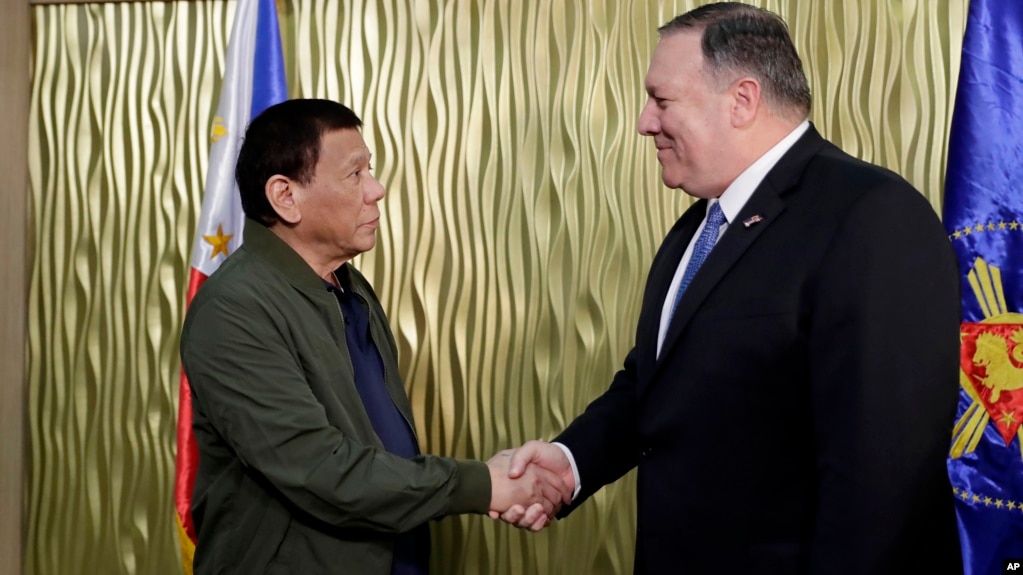
Philippine President Rodrigo Duterte, left, greets U.S. State Secretary Mike Pompeo upon arrival at Villamor Air Base in suburban Pasay city southeast of Manila, Philippines, Thursday, Feb. 28, 2019.

The Philippine foreign secretary says his country wants to buy American weaponry to shore up defense. But although the two countries have worked closely together on security over the past 70 years, costs and broader security worries will make any arms hard to get, experts in Asia caution.

Secretary Teodoro Locsin told a news conference in Manila that he and visiting U.S. Secretary of State Michael Pompeo had discussed the “vital support” of the United States for Philippine military modernization. Mutual defense, he said, “should cover a partner’s back as well as its front.”

Locsin later tweeted that he hopes the U.S. government will sell weapons to “re-arm our military” for self-defense.

But the Philippines may not be able to afford complex new weapons systems, while U.S. officials would worry that Philippine President Rodrigo Duterte might use them in his deadly anti-drug campaign, experts believe. Duterte for his part might not want any new U.S. hardware to upset a 3-year friendship with China, which has its own differences with the United States.

“The geopolitical issue, that’s one, second is the limited funding as well as security concerns when it comes to sourcing equipment,” said Collin Koh, a maritime security research fellow at Nanyang Technological University in Singapore. “So, in a way it limits the AFP (Armed Forces of the Philippines).”

Political complexity

The U.S. Arms Export Control Act governing foreign sales is what one political consultant called for this report “a minefield of intricacies and legalities.” For that reason, scholars say, the U.S. government sells its new, high-end arms such as aircraft largely to long-term partners such as Australia, Singapore and Taiwan.

Those partners know the Act, can pay the billions of dollars for new equipment and do not turn the weapons on their own people. Sales sometimes irk China as its navy expands onto the high seas, but Chinese leaders are used to the repeat customers.

The anti-drug campaign may raise questions in the United States about “human rights” issues, said Eduardo Araral, associate professor at the National University of Singapore’s public policy school. Human rights groups say anti-drug police have killed thousands of people without due process.

China hopes the Philippines, a rival claimant to sovereignty in the sea between them, will ease away from the United States as part of a Sino-Philippine friendship that included China’s pledge in 2016 for $24 billion in aid and investment.

“If you sell one or two ships to the Philippines and the Philippines buys it, what signal does that send to China, that the Philippines is an un-loyal and unreliable neighbor and partner?” Araral said. “For the Philippines, you don’t want to send the wrong signal to China.”

In Southeast Asia, only Singapore has the formula down for getting U.S.-made weaponry, said Carl Thayer, emeritus professor at the University of New South Wales in Australia. Singapore buys American fighters, helicopters and drones. Officials in Vietnam, he noted, have looked into buying American-made arms but fear they might get turned down, he said.

American lawmakers may worry Manila would use weapons “recklessly,” Thayer said.

“There’s no one there, leaving Singapore out, where you have a well-established relationship that would run smoothly, and where there is none it hits the bumps in the road," he said.

Smaller, used and donated arms

Manila and Washington have lived by a mutual defense treaty since 1951, followed by a visiting forces agreement in 1991 and ongoing joint naval exercises. U.S. officials count the Philippines as an Asian ally useful for containing China’s maritime expansion – also a reason Manila wants to upgrade its navy in case its relations with Beijing someday sour.

Washington also has sold the Philippines pistols, assault rifles, ammunition and rocket launchers since 1980, according to a Federation of American Scientists research paper.

Small arms used for anti-terrorism work or coast guard patrols normally cause little political concern, scholars note.

The database GlobalFirePower.com ranks the Philippine military strength No. 63 out of 137 countries. Ex-president Benigno Aquino kicked off a military modernization program that called for two new frigates or warships, but domestic media said last year a special assistant to Duterte had “intervened” in the deal to acquire those from a builder in South Korea.

Philippine officials may need to keep depending on small, donated, refurbished arms for low-key use, and not just from the United States, Koh said. Foreign sellers are already obliging. In 2017 South Korea donated a corvette warship to the Philippine navy, and last year an Australian shipbuilder said it would deliver six offshore patrol vessels.

But Reds say surrender of 25 fake

From the Visayan Daily Star (Mar 6, 2019): But Reds say surrender of 25 fake

The news of the surrender of 25 New People’s Army members at the Army’s 79th Infantry Battalion headquarters in Sagay City, Negros Occidental, on Saturday is not true, Ka Juanito Magbanua, NPA Negros spokesperson, claimed.

Magbanua said those who supposedly yielded to the authorities were not real rebels. “They are just ordinary civilians or members of Revolutionary Proletarian Army (RPA) used by the Army,” he said.

He claimed the surrender of the so-called rebels was a ploy by the state forces to deceive the public and discredit the revolutionary movement. “It’s part of their black propaganda and money-making scheme,” he said.

He stressed that no rebels in the province have surrendered to the authorities, adding that the five guerrilla fronts of the NPA in the province remained strong and on a tactical offensive mode.

The Army earlier said that 25 rebels operating in Murcia, Don Salvador Benedicto and San Carlos yielded to the authorities with their firearms, and also took their oath of allegiance.

Lt. Col. Emelito Thaddeus Logan, 79th IB commanding officer, said village officials were instrumental in urging the rebels to give up insurgency.

Government officials continue to call on the rebels to return to the fold of the law.

http://www.visayandailystar.com/2019/March/06/topstory7.htm

Army says NPA demoralized

From the Visayan Daily Star (Mar 6, 2019): Army says NPA demoralized

The Army’s 3rd Infantry Division expects demoralization among remaining members of the New People’s Army in Negros, following the surrender of 25 of their members operating in northern Negros, its commander, Maj. Gen. Dinoh Dolina, said yesterday.

The 25 ex-rebels, who are now undergoing debriefing at the 79th Infantry Battalion in Sagay City, also surrendered 27 firearms, and this entitled them to receive cash remuneration of from P50,000 to P500,000, depending on the firearms turned over to the authorities.

Dolina said that the surrender of the 25 NPA rebels will surely weaken the strength and armed capability of the communist terrorist organization in Negros island.

“It is also a strong indication of the continued downfall of the communist terrorist group,” he added, stressing that they are expecting the demise of the group very soon.

Dolina also reiterated his appeal for the remaining rebels, who are still fighting against the government, to abandon the armed struggle, and avail of the Enhanced Comprehensive Local Integration Program (E-CLIP) of the government, for them to start a new and peaceful life.

Police Brig. Gen. John Bulalacao, regional police director of Western Visayas, and Col. Benedict Arevalo, 303rd Infantry Brigade commander, attributed the surrender of 25 NPA members to of their ongoing efforts in localized peace talks.

http://www.visayandailystar.com/2019/March/06/topstory6.htm

Bangsamoro gov't success 'most important goal' vs terrorism in PH – report

From Rappler (Mar 6, 2019): Bangsamoro gov't success 'most important goal' vs terrorism in PH – report

The Institute for Policy Analysis of Conflict urges close cooperation between officials of the Bangsamoro region, the national government, and the military as 'consequences of failure could be devastating'

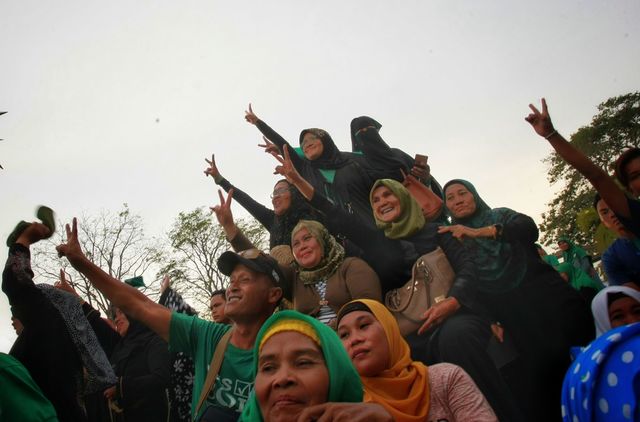
PROMISES OF PEACE. Supporters of the new Bangsamoro region gathered in Cotabato City for a peace assembly before the January 21, 2019 plebiscite. Photo by Rappler

PROMISES OF PEACE. Supporters of the new Bangsamoro region gathered in Cotabato City for a peace assembly before the January 21, 2019 plebiscite. Photo by Rappler

Ensuring the success of the Bangsamoro government in fostering peace and development in the new autonomous region is the "single most important goal" of counter-terrorism efforts in the Philippines, a Jakarta-based think tank said.

This is among the findings of the Institute for Policy Analysis of Conflict (IPAC) in its report released on Tuesday, March 5, titled "The Jolo Bombing and the Legacy of ISIS in the Philippines."

"The single most important goal of counter-terrorism programs and funding in the Philippines now should be trying to ensure that BARMM succeeds in meeting the huge challenges it faces," the report said.

The report said failure to establish a functioning government Bangsamoro Autobnomous Region in Muslim Mindanao where there may be corruption, dispute over access to jobs, resources, and land, among others could leave residents disillusioned and give Islamic State-inspired groups "a new lease on life."

"Stronger support for pro-ISIS components is only one of several possible outcomes of a failed BARMM but it could be the deadliest…. The key to reducing the appeal of Islamic State is to produce a more attractive alternative for Mindanao’s Muslims," said IPAC.

High hopes, higher stakes: Many residents in the Bangsamoro region have pinned their hopes of peace and security, reduced poverty, and better opportunities on the new Bangsamoro region.

It’s a huge challenge the interim government, known as the Bangsamoro Transition Authority (BTA), will need to deliver on as Moros and the Moro Islamic Liberation Front (MILF) claimed it could be their last chance at peace.

The establishment of BARMM, IPAC said, was also the "point of no return."

"At every other juncture during the long years of negotiation, if the process broke down, it was always possible to pick up the pieces because the final goal of genuine autonomy had never been reached. Now both sides have no choice but to make it work because there are no other options on the table," it said. (READ: From peace talks to plebiscite: The road to the new Bangsamoro region)

IPAC said the deadly Jolo Cathedral bombing in February showed the Philippines "will be living with the impact of ISIS for years to come, regardless of what happens in the Middle East." The bombing turned what was a place of worship to a site of ripped bodies where at least 23 people were killed and 109 others injured.

IPAC said the Islamic State (IS, formerly known as ISIS or the Islamic State in Syria and Iraq) left behind not only remaining members of ISIS-linked groups who tried to take over Marawi in 2017, but also the option of a “pure” Islamic state as an alternative to the status quo.

Cooperation is crucial: Given the challenge ahead, IPAC said the Philippine government and BTA should tap the expertise of MILF base commanders who have knowledge on why individuals may choose to join militant groups.

"Both the BTA and the national government should seek out their views on workable strategies to prevent alienation as the new government finds its way. The obstacles to success are formidable but the consequences of failure could be devastating," IPAC said.

It added that "serious attention" should be given to preventing recruitment efforts by ensuring communities, schools, and universities know what to do when they suspect recruitment among the youth.

IPAC said BARMM officials should also work with the military to end the bounty system, which placed rewards on the heads of wanted extremists. It said the set up caused competition for reward money that encouraged the killing of suspects over capturing them alive to get information on their networks.

Aside from this, attention should also be given to the rebuilding of Marawi City to avoid recruitment there. Rehabilitation in the city has been slow and many residents remain displaced despite the war declared over in October 2017.

"The Philippines needs to move beyond military operations aimed at killing known extremist leaders, because that only produces a new generation bent on vengeance," said IPAC director Sidney Jones. (READ: Duterte in Jolo: Crush Abu Sayyaf by whatever means)

"The Duterte government needs to be thinking more about why the ISIS message resonated so strongly in Mindanao at the time of Marawi and why it still exerts a pull today," she added.
https://www.rappler.com/nation/225082-bangsamoro-government-success-most-important-goal-vs-terrorism-philippines

Cebuano PR: Pulong-pulong batok terorismo gitambungan sa 230 ka mga indibidwal sa Surigao Norte

Posted to the Philippine Information Agency Website (Mar 6, 2019): Cebuano PR: Pulong-pulong batok terorismo gitambungan sa 230 ka mga indibidwal sa Surigao Norte

SURIGAO CITY, Surigao del Norte -- Nakigpulong bag-uhay pa lamang ang kapulisan sa Gigaquit sa pagpanguna ni Police Inspector Jay Bayeta ngadto sa kapin 230 ka mga mulupyo sa Barangay Camam-onan, Gigaquit, Surigao del Norte nga mitambong sa usa ka seminar nga gipahigayon sa Bravo Company sa 30IB, Philippine Army.

Sa maong pakigpulong, gihangyo ni Inspector Bayeta ang mga mitambong nga naglakip sa mga lumad ang paghunong na sa away ug hinuon, ipatigbabaw ang kalinaw para sa kalambuan sa lugar.

Sa maong tigum, gidasunan usab ni PO3 Ariel E. Esperon, imbestigador sa Gigaquit Police Station, ang paghisgot kalabot sa hulga sa terorismo aron makab-ot ang tinuod nga kalinaw ug kalambuan.

Gipasabot ni Esperon ngadto sa katawhan ang balaod nga Republic Act 9372 kun Human Security Act ug ang Republic Act 10168 kun Terrorism Financing Prevention and Suppression.

Subay sa maong balaod, ang terorismo mahimo ni bisan kinsa nga tawo nga makabuhat sa krimen nga rebelyon, insureksyon, pagpatay, pagpandagit ug pagpangsunog nga nagmugna og malukpanon nga kahadlok/kalisang sa katawhan aron pugson ang gobyerno sa ilang demanda nga dakong supak sa balaod ug ang pagpondo o paghatag og suporta materyal o salapi aron gastuhon o gamiton sa mga buhat sa terorismo pagasilotan sa balaod.

Sa katuyuan nga dili na mudagsang kining problema sa terorismo, gawas sa grupong Abu Sayyaf, gideklara usab ni Pangulong Rodrigo Duterte nga terorista ang pundok nga New People's Army (NPA) pinaagi sa Proclamation No. 374, s. 2017. Ang mga mitambong lanog kaayong mitingog nga adunay mga hulga sa terorismo nga nahitabo sa lugar og kini binuhatan sa NPA nga dugay na usab nga gihinganlang terorista sa Estados Unidos.

Gipasabot usab ni Esperon ang katawhan sa Camam-onan nga kung sila magsuporta sa teroristang grupo, mapa-pinansyal man o materyal sama sa pagkaon o sud-an o ba kaha mutabang aron mapahimuslan ang mga materyal o pinansyal nga tabang, sila mamahimong makasuhan sa paglapas sa R.A. 10168 diin adunay silot nga dili muminos sa 17 ka tuig ngadto 40 ka tuig nga pagkabilanggo ug multa nga tunga sa milyon ngadto usa ka milyon ka pesos.

Gipakita usab ni Esperon sa mga mitambong ang mga hulagway sa terorismo ug ang epekto niini ngadto sa ekonomiya, kapanginabuhian ug sa kinatibuk-an, sa kalinaw ug kalambuan.

https://pia.gov.ph/news/articles/1019331

CENTCOMM hosts Q1 2019 Visayas JPSCC Meeting

Posted to the Philippine Information Agency Website (Mar 6, 2019): CENTCOMM hosts Q1 2019 Visayas JPSCC Meeting


CENTCOM Commander Lieutenant General Noel S Clement presiding the 1st Quarter CY 2019 JPSCC Meeting for the Visayas. To his left is Police Major General Rolando B Felix.
CAMP LAPULAPU, Cebu City, 01 March (PIA) - The Central Command (CENTCOM) led by Lieutenant General Noel S Clement, Commander, Armed Forces of the Philippines, hosted the 1st Quarter (Q1), Calendar Year 2019 meeting of the Visayas Joint Peace and Security Coordinating Council (VJPSCC) last February 28, 2019 at the De Goma Hall, Headquarters CENTCOM, Camp Lapulapu, Cebu City.

The meeting was attended by Atty. Veronico Petalcorin, the Assistant Director of the Commission on Election 7; Police Major General Rolando B Felix, The Director for Integrated Police Operations (DIPO) Visayas; Commodore Rennie Gil L. Gavan of the Philippine Coast Guard Central Visayas; and the Joint Task Force Commanders and Police Regional Directors from the different regions in the Visayas.

Tackled during the meeting are the Joint Implementing Plans (IMPLANs) in connection with the May 13, 2019 National and Local Elections; National Coast Watch System, National Coast Watch Center, and Regional Coordinating Center Central; Threat Situation updates in the Visayas; and AFP-Philippine National Police Campaign Plan “Kapanatagan.”

“We will plan thoroughly for the deployment of our troops during the May 13, 2019 National and Local Elections,” says Lt.Gen Clement.

He also said that the AFP will work together in partnership with the COMELEC in order to have a safe and peaceful conduct of elections.

While preparing for the elections, LtGen. Clement reminded the Joint Task Force to not forget their usual and regular task of keeping the peace and supporting development, which they had been doing even when there are no elections.

Before the end of the meeting PMGen. Felix and LtGen Clement reminded all JPSCC members to enhance and continue coordination and information sharing, and to adopt best practices that had resulted to excellent results. (Report from AFP-CentCom).


Joint Task Force Commanders and Police Regional Directors from Regions 6 (Western Visayas), 7 (Central Visayas) and 8 (Eastern Visayas) during the JPSCC Meeting.

https://pia.gov.ph/news/articles/1019217

NPA rebel's remains turned over to family in MisOr town

Posted to the Philippine Information Agency Website (Mar 6, 2019): NPA rebel's remains turned over to family in MisOr town

CLAVERIA, Misamis Oriental, Feb. 26 – The Philippine Army’s 58th Infantry Battalion and the Local Government Unit (LGU) of Talisayan in Misamis Oriental returned the remains of an New People's Army (NPA) terrorist to his family on Feb. 24, 2019.

Civil Military Operation Officer of 58IB Captain Leoden C Bajado and Talisayan Municipal Mayor Rommel C. Maslog led the turnover of the remains of Mente A. Lindayo to his mother, Serapen A. Lindayo.

The following also witnessed the turnover: Police Senior Inspector Maribeth Ramuga, chief of police of Talisayan Municipal Police Station (MPS); Nonoy Candano, Municipal Disaster Risk Reduction and Management Office (MDRRMO) Officer of Talisayan; representative from MisOr Cares as well as the residents.

The turnover was done at their house in Brgy Cabacungan, Claveria town in Misamis Oriental.


Philippine Army’s 58th Infantry Battalion and the Local Government Unit (LGU) of Talisayan in Misamis Oriental returned the remains of an NPA terrorist to his family on Feb. 24. (Contributed photo)

The personal property of the deceased was claimed by his brother, Romel A. Lindayo, at the Talisayan Police Station.

Mente was the overseer of PPH, Sub-Regional Committee 1 of NPA’s North Central Mindanao Regional Committee.

His body was recovered by the troops of 58IB under 2Lt. Jestoni G Viernes after the encounter at the hinterlands of Brgy Macopa in Talisayan on Feb. 23 wherein the troops of 58IB recovered five firearms, subversive documents, medicines, backpacks, and personal belongings.

“The LGU of Talisayan is prepared to provide assistance in the proper return of the dead to his family and give necessary assistance. We are calling on those still out there to surrender as we will assist them to their proper reintegration to the society because we support the localized peace talks,” Maslog said.

LtCol. Roy Anthony O. Derilo, 58IB commanding officer, on the other hand, called the leadership of NPA terrorists to obey the provisions of International Humanitarian Law (IHL).

"I am urging them to bring their dead and wounded to the proper authorities. We will facilitate the proper burial of their dead and ensure that their wounded will be brought immediately to the hospitals and the LGU of Talisayan and the province will provide the necessary assistance. The NPA should not continue to violate the provisions of IHL,” Derilo said. (58IB/PA)

https://pia.gov.ph/news/articles/1019374