Sunday, January 13, 2019

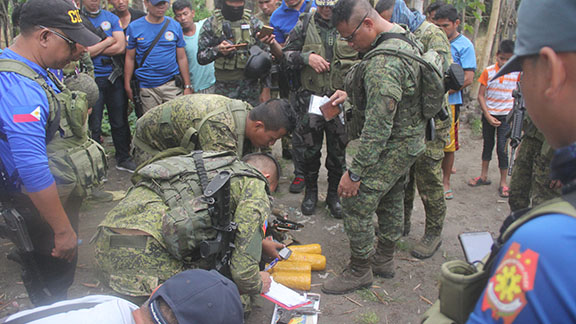
Duterte: Philippines will not buy weapons from US

From the Philippine Star (Jan 11, 2019): Duterte: Philippines will not buy weapons from US

President Rodrigo Duterte declared that the Philippines would no longer purchase arms and military equipment from the United States for its criticism of the government's campaign against illegal drugs.

In a speech before soldiers in Bulacan, the president recalled how Washington supposedly pressured Manila due to Duterte's human rights violations.

Duterte cited US President Donald Trump's new order prohibiting countries to enter into arms deal with China or Russia.

 "I will not agree to buy. Pangit tingnan. Hindi maganda (It doesn't look good). It does not sit well with the Filipino na ganunin ka tapos pasunod-sunod ka na lang (they will treat you that way and you just obey)," Duterte said.
 
"Pagka bumili ka sa China o maybe Russia, magsali ka sa embargo (If you buy from China or maybe Russia, you will be included in embargo), you cannot trade with America," he added.

A US Defense official cautioned the Philippines last August against procuring weapons from Russia, saying it might not be "a helpful thing to the alliance." The US and its former colony the Philippines are treaty allies.

“When you buy weapons systems, particularly major platforms, you’re not just buying capability, you’re investing in a relationship,” US Assistant Secretary of Defense and Pacific Security Affairs Randall Schriver said then.

He stressed that US platforms are key to sustaining interoperability between US and Philippine forces.
Ties with Russia, China

Since assuming office in June 2016, Duterte has been seeking closer ties with China and Russia, becoming hostile toward the US despite the Philippines' long-standing alliance with Washington.

"Sabi ko naman sa (I told them) — your superiors and the civilian leaders, with that kind of arrangement, do not expect me to buy arms from the United States," the president added.

RELATED: Duterte to talk with Trump on arms purchase

Duterte recalled how China and Russia provided assistance to the Philippines when the conflict in Marawi City ensued in May 2017.

The president was in Russia when ISIS-inspired local terrorists seized Marawi, pushing him to cut his trip short upon declaring martial law in the entire Mindanao.

"I flew to Russia. And at a last minute, kasi pumutok and Marawi nandoon ako sa Russia (Marawi happened while I was in Russia). So I had to sign the martial law power, doon ako sa Russia. And we had a talk with Putin and he said, 'you can have it and I'll give you some trucks," Duterte said, referring to firearms acquired from Moscow.

China also offered the guns for free after the deal with the US did not push through.

"We had that order from America fortunately, unfortunately they stopped that. That prompted me to go to China to buy... and China said, 'no it's all right. You can have the guns free,'" Duterte said.

In November 2016, Duterte ordered a deal for 26,000 M4 assault rifles from the US cancelled after the US State Department halted the sale. US Sen. Ben Cardin had previously said he would oppose the deal over concerns over human right violations attributed to the government's war on drugs.

"We will just have to look for another source that is cheaper and maybe as durable and as good as those made from the place we are ordering them. We will not insist on buying expensive arms," Duterte said then.
US assistance in Marawi

Despite Duterte's tirades against Washington, the country's long-time ally was among the first foreign countries to provide assistance to Marawi.

American troops provided technical assistance in the campaign against the Maute group but did not involve "boots on ground," former presidential spokesperson Ernesto Abella earlier confirmed.

The US still provides assistance to residents affected by the conflict in Marawi and nearby areas. In October, the US government launched the Marawi Response Project that seeks to improve economic and social conditions of communities in the area.

PNP seeks AFP help in probing 2 arrested ‘terror suspects’ in Manila

From the Manila Bulletin (Jan 12, 2019): PNP seeks AFP help in probing 2 arrested ‘terror suspects’ in Manila

The National Capital Region Police Office (NCRPO) will be seeking assistance from the military to conduct its own background check and investigation on two suspected sympathizers of a notorious terror group who were collared days before the Black Nazarene procession in Manila.

This, as police investigation, disclosed that there is no direct connection between the presence of the two arrested suspects and the Traslacion where more than two million devotees flocked to Manila for the procession and other related activities.

NCRPO chief Director Guillermo Eleazar said the military may have additional information with regard to alias Abu Nas and Jeran Aba alias Abu Sinan.

Abu Nas, who was arrested in Binondo on December 20, is a wanted Abu Sayyaf member who was accused of kidnapping of 15 employees of Golden Harvest Plantation in 2011; while Aba, who was collared on December 25 in Quiapo, is a member Dawlah Islamiyah.

“We are seeking assistance from our counterparts in the Armed Forces of the Philippines to conduct their own investigation,” said Eleazar.

He explained that they could not just assume that their presence in Manila days before the Black Nazarene procession as mere coincidence.

But Eleazar said that if indeed the two were planning to conduct bombings in Metro Manila, especially during the Traslacion, then their plan was foiled because of their arrest.

“This is proof that we are really serious in making Metro Manila, and even other parts of the country, safe. Our coordination with the military is great and fruitful and this will be a continuous one,” said Eleazar.

Security officials have been saying that there were no serious threats on the Black Nazarene procession.

But to ensure the safety of millions of devotees, thousands of policemen and soldiers were deployed in Manila, and other security protocols were put in operation to include jamming communication signals and declaring Manila as no fly and no sail zone during the procession.

https://news.mb.com.ph/2019/01/12/pnp-seeks-afp-help-in-probing-2-arrested-terror-suspects-in-manila/

9 soldiers wounded in encounter with NPA

From the Manila Bulletin (Jan 12, 2019): 9 soldiers wounded in encounter with NPA

Nine soldiers were wounded in an encounter with suspected Communist New People’s Army (NPA) terrorists in a remote area of Barangay Bay-ang, San Jorge, Samar on Saturday (January 12).

In a report from Lt. Col. Rizaldo Laurena, Commanding Officer of the 63rd Infantry (Innovator) Battalion, based in San Jorge, Samar, he said his troops were on their way to Barangay Bay-ang of said town at around 6:50 a.m. when they chanced upon a group of fully-armed men in the area.

This triggered a brief firefight, which was also marked by the detonation of an improvised explosive device (IED).


When the smoke cleared from the battle, nine soldiers were found to have been wounded, mostly from shrapnel wounds sustained from the IED attack.

Laurena said there was also an undetermined number of casualties on the side of the enemy.

The wounded troops were immediately brought to the nearest hospital for treatment.

https://news.mb.com.ph/2019/01/12/9-soldiers-wounded-in-encounter-with-npa/

‘Reds biggest threat to Negros polls’

From the Philippine Star (Jan 13, 2019): ‘Reds biggest threat to Negros polls’

The New People’s Army (NPA) is the biggest threat to this year’s elections in Negros, according to the military.

“We know that it has a political intention in the forthcoming elections,” Col. Benedict Arevalo, 303rd Infantry Brigade commander, said during the activation of the Negros Occidental Provincial Joint Security Control Center in this city on Friday.

Arevalo said soldiers are bracing for a possible escalation of attacks by communist rebels as elections near.

On Thursday night, suspected NPA rebels stormed a military outpost in Kabankalan City, leaving an Army soldier wounded.

Prior to the attack, a militiaman was killed in Guihulngan City while heavy equipment valued at around P120 million were burned in Ayungon, both in Negros Oriental.

Arevalo urged candidates to report extortion attempts by NPA rebels even as he warned local officials against supporting the communist movement.
     
https://www.philstar.com/nation/2019/01/13/1884555/reds-biggest-threat-negros-polls

NPA harassment at Army patrol base

From the Manila Bulletin (Jan 11, 2019): NPA harassment at Army patrol base

A government soldier was wounded after an attack staged by New People’s Army (NPA) guerrillas in an Army patrol base in Kabankalan City, Negros Occidental on Thursday, January 10.

Col. Benedict Arevalo, the chief of the Army’s 303rd Brigade, said about seven to nine Communist NPA terrorists attacked the Hilamonan Temporary Patrol Base in Barangay Hilamonan, Kabankalan City under the 62nd Infantry Battalion at about 7:45 p.m.

Arevalo said an intermittent firefight ensued for about 15 minutes after which the NPAs withdrew towards Brgy. Buenavista, Himamaylan City where an NPA encampment was seized last January 1, 2019 by troops of the 62nd Infantry Battalion.


The incident resulted in the wounding of Corp. Andin Jamison in his right thigh.

With the latest NPA attack, Arevalo reminded troops to be more aggressive and vigilant at all times.

“Moreover, I also encourage the civilian populace to continuously support the government forces and report any NPA activities in their area in order to prevent NPA terroristic activities in the community,” Arevalo said.

https://news.mb.com.ph/2019/01/11/npa-harassment-at-army-patrol-base/

From 649 to 8: DOJ cuts communist terror list

From the Philippine Star (Jan 13, 2019): From 649 to 8: DOJ cuts communist terror list


This is a significant decrease from the 649 alleged communist terrorists in the earlier version filed, which included United Nations special rapporteur on the rights of indigenous peoples Victoria Tauli-Corpuz and 45 other human rights defenders.
Edd Gumban/File

The Department of Justice (DOJ) has reduced to eight the alleged officers of the Communist Party of the Philippines (CPP) it wants declared as terrorists in an amended petition filed before the Manila regional trial court (RTC).

This is a significant decrease from the 649 alleged communist terrorists in the earlier version filed, which included United Nations special rapporteur on the rights of indigenous peoples Victoria Tauli-Corpuz and 45 other human rights defenders.
 
Corpuz has since been dropped from the list after Manila RTC Branch 19 Presiding Judge Marlo Magdoza-Malagar declared her, former Bayan Muna party-list representative Satur Ocampo, former Baguio city councilor and former Asia representative to the UN Expert Mechanism Jose Molintas and National Democratic Front consultant Rafael Baylosis as nonparties due to petitioner’s failure to present evidence they are officers of the CPP-New People’s Army (NPA).

Several others have sought the court’s permission to be dropped from the terror list, including Beverly Longid, Joanna CariƱo, Joan Carling and Jeanette Cawiding of the Cordillera People’s Alliance.

In the amended petition, the DOJ prosecutors implicated as communist officers founding chairman Jose Maria Sison, Jorge Madlos of the NPA National Operations Command; Jaime Padilla, a supposed leader of the Melito Glor Command; Francisco Fernandez, an alleged secretary of the Negros Region Committee; Cleofe Lagtapon, a Southeast Front head of the same committee; Antonio Cabanatan, secretary of the Mindanao Commission; Leonido Nabong, head of the Western Mindanao Regional Party Military Commission; and Myrna Sularte, secretary of the Northeastern Mindanao Regional Committee.

The names and addresses of the other alleged CPP-NPA officers, however, are “unknown” but “are also operating in different parts of the Philippine territory,” the amended petition read.

The petition identified a significantly fewer number of alleged officials, unlike its first petition where it identified 18 alleged top communist leaders, 46 human rights defenders, four Catholic priests, a former party-list lawmaker and several others.

The amended petition still enumerated the alleged crimes of the CPP-NPA on the people such as murder, bombings and extortion, in convincing the court that the CPP-NPA should be declared as terrorists, and that the communists are only deceiving the Philippine government in entering into peace talks.

“The CPP and NPA are merely buying time by deceiving the Philippine government in entering into peace talks, while their main purpose is to mobilize all their forces in preparation for the ‘people’s war’ aimed at overthrowing the duly constituted authorities, seizing control of the Philippine government and imposing a totalitarian regime. Thus, there is no other time to put an end to their deception… but through the filing of this petition,” the amended petition read.

The DOJ filed an amended petition after suffering a blow on the first one when the judge cleared four people of involvement in the communist movement.

The court directed them to serve summons to alleged CPP-NPA officers by publication in a newspaper, “considering the petitioner’s obvious lack of knowledge of the official address of the CPP-NPA.”

The petition was also amended after Justice Secretary Menardo Guevarra, in a budget hearing at the House of Representatives, admitted that the first terror list, submitted during his predecessor Vitaliano Aguirre’s term, was not properly vetted and was merely based on intelligence reports.
 
https://www.philstar.com/headlines/2019/01/13/1884659/649-8-doj-cuts-communist-terror-list

Seeds of insurgency: The youth of Marawi (Pt. 1)

From Rappler (Jan 13, 2019): Seeds of insurgency: The youth of Marawi (Pt. 1)
 
As grievances persist from generation to generation, so do challenges in protecting
young Filipino Muslims from radicalization


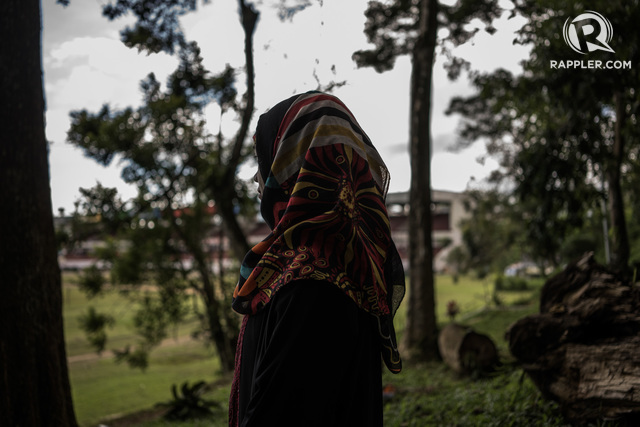
MARAWI, Philippines – "That is the ideal death," said 24-year-old aspiring filmmaker Sakeena*. For her, to be a freedom fighter  or  a mujahideen  is the greatest honor for a Muslim.
 
In her first year in college, Sakeena recalled being invited to a 3-month training with an armed group to prepare for an upcoming jihad –  an Arabic word often associated with war against non-Muslims but which she also refers to as an effort to make society better.
 
She wanted to follow in the footsteps of her father, a member of the erstwhile separatist group Moro National Liberation Front (MNLF), whose story she only knew about through his diary. Her father believed that dying in a jihad as a mujahideen was the greatest expression of faith. "That's the only thing that had driven him, for the sake of Allah," she said.
 
Sakeena thought of taking up arms. But her mother eventually prevailed on her to pursue her studies.
 
Sakeena lives in what used to be a prosperous city in the southern Philippines  –  the Islamic City of Marawi . It was razed to the ground after the terrorist Maute Group attacked the city on May 23, 2017, sparking a 5-month siege.
The Maute Group previously pledged allegiance to the Islamic State (ISIS) in 2014. Many of the fighters who joined the siege were just like Sakeena  – young Filipino Muslims or Moros from different provinces in the Autonomous Region in Muslim Mindanao (ARMM). Most were 18 to 27 years old, according to first-hand accounts from the fighters' acquaintances themselves, and as affirmed by a source in the Philippine Army.


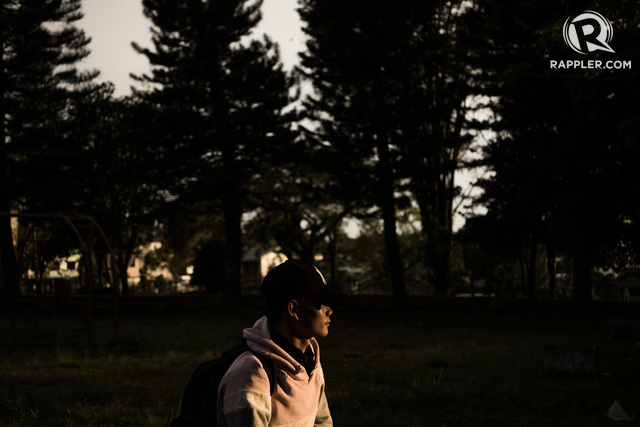
Like Sakeena, Zaldy*, 20, was once lured to that world. "I wanted to be a mujahideen, because as they promise, paradise is assured when you die," he said.
 
He went to the extent of undergoing a military training in a nearby city. Zaldy graduated from the program on the day of the Marawi siege.
 
"My friends kept on sending me text messages. 'Where are you? We're here in Marawi!' I thought of going home to join. I called up my friends and asked what their plans were. 'Are we going?' Some did remain in Marawi," Zaldy recounted.
 
Two of his cousins and a number of his friends joined the siege. Zaldy was itching to join them, but security was tight and he could not get in.
 
LURED TO FIGHT. Zaldy was on his way to join his friends in the Marawi siege on May 23, 2017, but was stopped at checkpoints. 'My friends and I usually have the same life story – €Šsingle parents, broken families€,' he says. Photo by Martin San Diego/Rappler
 
LURED TO FIGHT. Zaldy was on his way to join his friends in the Marawi siege on May 23, 2017, but was stopped at checkpoints. 'My friends and I usually have the same life story – €Šsingle parents, broken families€,' he says. Photo by Martin San Diego/Rappler

Frustrated youth
 
What could have driven these young minds at a time when they were expected to be finishing college and starting their careers?
 
Nearing the two-year mark since the Marawi siege, we look at the factors that pushed the young fighters who came to Marawi, and how these stand in 2019 as a new law grants further autonomy to Filipino Muslims. A test of narratives will also be at play as this comes at a time when ISIS' operations are shifting toward Southeast Asia.
 
It's not the money.
 
Months of interviews and research show a central theme: a persisting, deeply-rooted frustration among the Moro youth.
 
This shared frustration stems from the discrimination and marginalization that Filipino Muslims experience both on a national and personal level, especially when outside the ARMM, said Acram Latiph, an expert on conflict resolution at Mindanao State University (MSU) in Marawi City.
 
"It boils down to the feeling that you do not belong," added Latiph.
 
Islamic scholars note that no Filipino Muslim has been elected to a national post since 1992. The last was former senator Mamintal Tamano from Tamparan, Lanao del Sur.
 
"Muslims are frustrated in a sense that they are not really participating in the government. In the Senate, is there a Muslim? We are no longer in the times of Alonto and Tamano. Yes, there are those appointed Cabinet positions. But in sensitive posts like security, are we appointed there? We are always eyed with suspicion," said Hamid Barra, president of the National Ulama Conference of the Philippines.
 
"We want to have constructive participation in governance," he added.
 
For Zaldy, who went to elementary and high school in Manila, it was more personal. "Whenever I introduced myself as a Muslim, people would distance themselves."
 
Discrimination is more felt by women donning Islamic pieces like the hijab. Some shared having difficulty hailing taxis, and taking longer in security inspections when in Manila.
 
"It is like you're not trusted if you're a Muslim," said Zaldy.


This persisted for generations because the reason to be angry and frustrated has not been addressed, said Latiph, who himself felt the discrimination in the 2000s when he applied for jobs in Makati City, a business district adjacent to Manila.

Also, the oral narratives about these grievances continue.
 
Constant retelling
 
Ask any adolescent Muslim about the current situation and he or she would be quick to point out specific events in history where the Moros felt shortchanged by the national government.
 
"One of the reasons I found was the Jabidah massacre," said Sakeena. "Not only that, there were many other massacres." She then recited a litany of events, dating back to the Spanish occupation until the time of dictator Ferdinand Marcos, when the infamous massacre of at least 23 Muslim  recruits happened on Corregidor Island.


It's easy for the Moro youth to relate to the stories of their grandparents because little has changed today, Latiph said. "That oral narrative is transferred from children to children, over generations. So that feeling of persecution dating back to the Spanish [occupation] was actually preserved."
 
The most highlighted of these narratives are the military operations against Muslim separatist movements that were established in the last 4 decades, such as the Moro National Liberation Front and the Moro Islamic Liberation Front. The war cost the lives of at least 100,000.
 
What were celebrated military victories created a fertile environment for rebellion. Each attack produced martyrs and children of martyrs –  sons and daughters who picked up from their slain fathers and brothers, and who continue to find reason to do so.
 
IDEAL DEATH. 'For me, dying as a mujahideen is the ideal death€,' says Sakeena, who thought of joining Maute-ISIS training, but was discouraged by her mother. Photo by Martin San Diego/Rappler
 
IDEAL DEATH. 'For me, dying as a mujahideen is the ideal death€,' says Sakeena, who thought of joining Maute-ISIS training, but was discouraged by her mother. Photo by Martin San Diego/Rappler 

Poor governance
 
Though the ARMM was established in 1990 as an answer to the Moros' call for self-governance, even the Philippine government has called it a "failed experiment."
 
 Incompetent and self-serving officials have been elected through the years, plunging the region deeper into poverty.
 
Sakeena pointed out that the government's role is to improve the quality of life, but this is something she said the Muslims have always been deprived of.
 
Zaldy, who grew up in a place where vote-buying was the norm, said dirty politics and corrupt officials are to blame for why majority are poor.
 
"Many politicians here in the ARMM have made a business out of being mayors. That is the reason why other Moros are getting left behind and why others are not able to receive education."
 
In Lanao del Sur, where Marawi City is located, 74.3% of the population lived below the poverty threshold in 2015, according to the Family Income and Expenditure Survey released by the Philippine Statistics Authority, making it the poorest province in the Philippines.
 
The ARMM itself is the poorest region in the country, with at least 59% of the population living below the poverty line, according to the same report.
 
And as of 2016, there have been at least 4 ISIS-linked armed groups operating in the region.
 
(To be concluded)
 
*Subjects' names have been changed for their safety. All quotes have been changed to English.
 

Don't pay 'permit to campaign' fees to NPA, warns DILG

From Rappler (Jan 13, 2019): Don't pay 'permit to campaign' fees to NPA, warns DILG

The Department of the Interior and Local Government says candidates and local officials found paying fees to gain access to rebel strongholds will face sanctions

NO TO FEES. The government warns against paying fees for campaigning to members of the New People's Army. File photo by Alecs Ongcal/Rappler

NO TO FEES. The government warns against paying fees for campaigning to members of the New People's Army. File photo by Alecs Ongcal/Rappler

The Department of the Interior and Local Government (DILG) warned local government units (LGUs) and candidates for the 2019 elections not to pay "permit to campaign" (PTC) fees to communist rebels.

Interior Secretary Eduardo AƱo issued Memorandum Circular 2018-11 which reminds local executives that "giving any form of support to communist rebels" is a violation.

AƱo's memo states that local peace and order councils must recommend sanctions against violators, if any.

"The DILG may also file other charges pursuant to the Revised Penal Code and other pertinent laws and seek the disqualification of all those candidates who shall be proven to have cooperated with said non-state actors in accordance with the provisions of the Omnibus Election Code," added DILG Spokesperson Jonathan Malaya.

PTC fees will supposedly give candidates access to rebel strongholds across the country.

The New People's Army (NPA), in the past, has urged candidates to coordinate with them for the "conduct of a smooth campaign," especially in areas that are considered strongholds of the communist rebels.

The DILG urged LGUs, the military, and the police to ensure that candidates will be able to freely enter areas where they wish to campaign.

"The DILG is calling all LGUs and law enforcement agencies to ensure that all candidates and political parties are allowed unhampered entrance in every LGU and to ensure the peace and order in all areas...without intimidation or manipulation by any group," Malaya said.
 
https://www.rappler.com/nation/politics/elections/2019/220907-dilg-warning-paying-permit-to-campaign-fees-new-peoples-army

Landmine recovered after government, NPA firefight

From the Mindanao Times (Jan 12, 2019): Landmine recovered after government, NPA firefight

An anti-personnel mine of the New People's Army was seized by the troops of the 8th Infantry Battalion after an encounter at the vicinity of Sitio Miaray, Iba, Cabanglasan, Bukidnon on Thursday at 1:20 p.m.

Lt. Col. Ronald Illana, the 8th IB commander, said the soldiers were conducting security operations at the area when they encountered the rebels.

"While the army troopers are advancing on the NPA unit, an anti-personnel landmine was detonated by the terrorists and they immediately withdrew to their escape area," Lt. Col. Illana said.

He said the firefight lasted for about five minutes which resulted to the capture of another anti-personnel landmine of the NPA.

"There was no casualty on our troops," he added. “We condemn this desperate act by the terrorists which only shows their true nature."

The use of anti-personnel landmine is a violation of Comprehensive Agreement on Respect for Human Rights and International Humanitarian Law.

"Part 3, Article 2, Section 15 outlines the right not to be subjected to indiscriminate bombings, shelling, strafing, gunfire and the use of landmines," he added.
 

Murad: “Peace is life. No peace, no life.”

From MindaNews (Jan 14, 2019): Murad: “Peace is life. No peace, no life.”

“Peace is life. No peace, no life. Peace to everyone,” Al Haj Murad Ebrahim, chair of the Moro Islamic Liberation Front (MILF) wrote on the ‘peace wall’ of Museyo Kutawato on Saturday, January 12.

North Cotabato Governor Emmylou TaliƱo-Mendoza toured Ebrahim and Presiential Peace Adviser Carlito Galvez inside the museum, which features the history of the then Cotabato empire.


North Cotabato Gov.Emmylou TaliƱo-Mendoza tours Moro Islamic Liberation Front (MILF) chair Al Haj Murad Ebrahim inside Museyo Kutawato on Saturday, January 12, 2019. MINDANEWS PHOTO

Murad was ecstatic after earning the assurance from the local government officials for their full support to the ratification of RA 11054 or the Organic Act for the Bangsamoro Autonomous Region in Muslim Mindanao.

The tour concluded the half-day gathering at the provincial gym where some 5,000 Moro residents joined local government officials in manifesting their support.

Like Murad, Galvez, Undersecretary Nabil Tan and other Bangsamoro Transition Commission officials also left a note on a piece of cardboard posted on the ‘peace wall.’

During the gathering, the governor expressed a full support for the ratification of the BOL as she urged constituents of seven towns to vote ‘yes’ in the coming plebiscite on February 6.

The seven towns are Aleosan, Carmen, Kabacan, Matalam, Midsayap, Pigcawayan, Pikit and Tulunan.

Mendoza, who hails from Carmen, called on her constituents to support the ratification of the law as it will help pave the way for genuine and lasting peace not just in the province but as well as in the entire region.


The message of Moro Islamic Liberation Front (MILF) chair Al Haj Murad Ebrahim left at the ‘peace wall’ of Museyo Kutawato on Saturday, January 12, 2019. MINDANEWS PHOTO

Murad, who was the last to speak in the jampacked gymnasium, thanked the provincial government for its overwhelming support to the Bangsamoro.

He recalled the harmonious relationship of Christians and Muslims in the village he grew up in.

Even in Darapanan, where the MILF camp is, Murad recalled the harmonious relationship.

“This law is not only for the Bangsamoro people but for all,” he said.

Pigcawayan Mayor Eliseo Garcesa Jr. also told the crowd that since the fighting is over, it’s time to unite for a common cause to address the roots of the conflict.

In a separate statement, former Aleosan town Mayor Loreto Cabaya Jr., also called on his townmates to give what is due to the Muslim communities saying: “Ako ay sumusuporta sa pag ratipika ng BOL dahil hatid nito ay kapayapaan at magbibigay pagkakataon sa ating mga kapatid na Moro upang pamahalaan at pagsilbihan ang Bangsamoro.”

When Cabaya was still a mayor in 2008, it was also in Aleosan where then MILF commander Amiril Umra Kato attacked civilian communities following the aborted signing of the controversial Memorandum of Agreement on Ancestral Domain (MOA-AD).

The fighting escalated in different towns of Central Mindanao and led to the evacuation of at least 600, 000 residents.

On January 21, a plebiscite will be conducted in the provinces Maguindanao, Lanao del Sr, Sulu, Tawi-tawi and the cities of Cotabato and Isabela.

On February 6, the plebiscite will be held in the six towns of Lanao del Norte and in North Cotabato’s Aleosan, Carmen, Kabacan, Matalam, Midsayap, Pigcawayan, Pikit and Tulunan.


North Cotabato Gov.Emmylou TaliƱo-Mendoza expresses her full support for the ratification of the Bangsamoro Organic Law in her speech during a gathering at Amas Capitol Gym, Kidapawan City on Saturday. MINDANEWS PHOTO

“Panahon na para tuldukan ang paghihirap ng mga bata kababaihan at matatanda sa kaguluhan. Ang BOL ang magbibigay daan sa tunay na kapayapaan sa Probinsya ng Cotabato” (It is time to put an end to the sufferings of the children, women and the elderly due to the conflict. The Bangsamoro law will pave the way for genuine peace in the provine of Cotabato), Mendoza said.

http://www.mindanews.com/peace-process/2019/01/murad-peace-is-life-no-peace-no-life/

5 pro-ISIS militants captured, leaders elude in South

From the Mindanao Examiner (Sep 13, 2019): 5 pro-ISIS militants captured, leaders elude in South

Security forces captured 5 suspected pro-ISIS militants, but two of their leaders manage to elude arrest and escaped during a dramatic raid by troops on a terrorist hideout in southern Philippines.

Officials said soldiers and police commandos carefully snaked their way through thick bushes under cover of darkness undetected by militants and surprised them, and capturing 5 men before dawn Saturday in Pagalad village in Maguindanao’s Paglat town.

Two notorious and elusive militant leaders Ustadz Yasser Saligan and Sheik Makakena alias Abu Jihad escaped the daring raid by the 33rd Infantry Battalion and 4th Special Action Force of the regional police force.

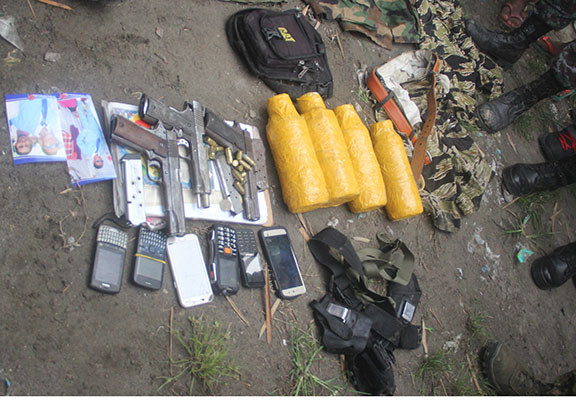
“The raiding teams collared five persons who were caught off-guard by the presence of heavily armed soldiers and SAF commandos. The troops seized four anti-personnel mines and three pistols. Two of the primary suspects, Abu Jihad and Ustadz Yasser, eluded arrest by jumping into the murky water of the Liguasan Marsh upon sensing the presence of government troops,” a statement from the 6th Infantry Division said Sunday.


Military photos release to the regional newspaper Mindanao Examiner show recovered IEDs and weapons from suspected pro-ISIS militants in Maguindanao’s Paglat town over the weekend.
Lt. Col. Harold Cabunoc, commander of the 33rd Infantry Battalion, who led the raid, said they have intelligence the militants were planning to bomb civilian targets in Sultan Kudarat province after an informant passed on photos of the militants blowing an improvised explosives to test whether they were lethal or deadly enough to kill as many people as they could.

After locating the terrorist hideout, Cabunoc launched the operation to capture the militants. “Our informant showed us the pictures of terrorist bombers Ustadz Yasser Saligan and his cohort, Sheik Makakena as they detonated a bomb to test its lethality. We had been tracking them since November 2018,” he said.

Troops were still tracking down the two militants leaders while those captured are being interrogated separately at an undisclosed locations in the restive region.

Cabunoc said 5 militants belonging to the Bangsamoro Islamic Freedom Fighters headed by Mayogantong Bansil also surrendered over the weekend in General Salipada Pendatun town and handed over their weapons.

Several pro-ISIS groups are operating in the region and fighting for the establishment of a caliphate in Mindanao, which was previously under the Muslim rule.
 

3 militants yield in Lanao del Sur

From the Mindanao Examiner (Jan 13, 2019): 3 militants yield in Lanao del Sur

Three pro-ISIS fighters have surrendered to the military in southern Philippines where security forces are battling several militant groups seeking to put up a strict caliphate in the troubled region.

Capt. Clint Antipala, a spokesman for the 1st Infantry Division, said the trio – who fought troops during the Marawi City siege in 2017 – also yielded one anti-tank rocket launcher, a grenade launcher and one M1 rifle and ammunition when they surrendered January 12 to the 82nd Infantry Battalion in Lanao del Sur’s Piagapo town.

Two of their companions earlier surrendered to the 55th Infantry Battalion in Pagayawan town.


“Dissatisfied and discontented with the leadership and capabilities of the group is the reason why they’ve surrendered,” Antipala said, quoting Lt. Col. Jumawan, 82nd Infantry Battalion commander.

Maj. Gen. Roseller Murillo, the division commander, praised soldiers for their efforts in convincing militants to surrender. “Our campaign against terrorists will be relentless and we will take advantage of their weakened leadership and capabilities in order to attain a just and lasting peace in our area of operation,” he said, according to Antipala.

Antipala also released photos of the trio, but all their faces were blurred and cannot be used for news. Their names were not made public.

https://mindanaoexaminer.com/3-militants-yield-in-lanao-del-sur/

Gov’t troops foil BIFF bomb plot; 5 rebels surrender

From the Philippine News Agency (Jan 13, 2019): Gov’t troops foil BIFF bomb plot; 5 rebels surrender


SEIZED. The recovered bombs and handguns from five mebers of the outlawed Bangsamoro Islamic Freedom Fighters on Saturday (Jan. 12) in Paglat, Maguindanao. (Photo by 33rd IB)

PAGLAT, Maguindanao -- Acting on an informant’s report about plots by an Islamic State-linked group to carry out bombings in Sultan Kudarat and North Cotabato, the Army and police forces raided on Saturday dawn a safe house that also resulted to the surrender of five local terrorists.

State forces also seized powerful improvised explosive devices and four handguns.

“What is important is we prevented bloody bombings these terrorists are planning to carry out,” Lt. Col. Harold Cabunoc, commander of the 33rd Infantry Battalion (IB) said.

The “lightning attack” counter-terrorist operation was launched at 3 a.m. Saturday in Barangay Palagad here.


He said the operation was quickly launched after an “asset” showed photos of bomb makers Ustadz Yasser Saligan and his cohort, Sheik Makakena alias Abu Jihad, trying to test the destructiveness of a homemade bomb.


Under the cover of darkness, government forces swooped down on the pinpointed terrorist lair.

Five gunmen were caught sleeping and were surprised to see soldiers and police surrounding them right inside their homes.

“We successfully got inside the house without anyone of them knowing,” Cabunoc said.

“However, the subject bombers managed to elude arrest by jumping into the murky waters from separate shanty nearby,” he added.

Seized from the suspects were four improvised bombs and three .45-caliber pistols.


Four hours later, relatives of a BIFF leader informed Cabunoc about the former’s group’s desire to surrender peacefully for fear that they might be subjected to Army offensives.


“They belonged to the BIFF faction led by Commander Mayogantong Bansil,” Cabunoc said.

Bansil and his men surrendered four high-powered firearms including a .50-caliber sniper rifle, two M1 Garand rifles, and a 40mm M79 grenade launcher.

The surrendered weapons were presented to Brig. Gen. Robert Dauz, commander of the 1st Mechanized Infantry Brigade, the unit that has operational control over the 33rd IB.

“You have shown the expertise in handling the security threats without incurring casualties. Share these best practices in the conduct of operations to all Army units in Central Mindanao,” said Dauz, who earned his first star rank last week.

Maj. Gen. Cirilito Sobejana, commander of the Army’s 6th Infantry Division, said the "BIFF’s world is getting smaller every day.”

“The public is now helping us, this is very encouraging and discouraging on the part of the terrorists,” Sobejana said.

http://www.pna.gov.ph/articles/1058746

Army gathers MILF, MNLF leaders for peaceful BOL plebiscite

From the Philippine News Agency (Jan 13, 2019): Army gathers MILF, MNLF leaders for peaceful BOL plebiscite


CALL FOR UNITY. Rajah Buayan Mayor Zamzamin Ampatuan speaks during AFP-MNLF-MILF dialogue for a peaceful plebiscite on BOL on January 21, 2019. (Photo from 6th ID)
 
CAMP SIONGCO, Maguindanao — The military held a dialogue Saturday with various stakeholders in Maguindanao to ensure a peaceful and orderly Bangsamoro Organic Law (BOL) plebiscite in the province.

The military-led "security meeting" was attended by area commanders of the Moro Islamic Liberation Front (MILF) and Moro National Liberation Front (MNLF) from various municipalities in the province, said Army Lt. Colonel Edgar Catu, commanding officer of the Army's 40th Infantry Battalion (IB).

Held at the 40IB's headquarters in Rajah Buayan town, Catu said the meeting was "part of my unit’s efforts in preparation for the successful conduct of upcoming plebiscite and to establish good rapport, and promote peace among the participants."

Brig. Gen. Diosdado C. Carreon, commander of the Army's 601st Infantry Brigade, lauded the dialogue as it sought to "strengthen our good relationship and communication with other peace incline groups to pursue genuine reform and development in Central Mindanao."

The plebiscite scheduled on January 21 in Maguindanao will determine the composition of the new political entity to be called Bangsamoro Autonomous Region in Muslim Mindanao.

The creation of BARMM is a product of the government and MILF peace process in Mindanao after years of negotiation.

http://www.pna.gov.ph/articles/1058772

Army reservists urged to continue serving sans benefits

From the Philippine News Agency (Jan 13, 2019): Army reservists urged to continue serving sans benefits


ASSUMPTION OF COMMAND. Army Reservist Brigadier General Erik Miguel Espina (center) passes the unit flag to Reservist Lieutenant Colonel Antonio Esmero, a university professor, who is installed by the Army Reserve Command (ARESCOM) as the new battalion commander of the 701st Ready Reserve Battalion during the assumption of command ceremony held at the 7th Regional Community Defense Group (7RCDG) conference hall on Jan. 13, 2019. Colonel Jerry Borja (left), 7RCDG chief, looks on. (Photo by John Rey Saavedra)

 CEBU CITY — The chief of Army reservists in Central Visayas on Sunday said they should keep serving the country despite being volunteers without compensation and benefits.

Reservist Brig. Gen. Erik Miguel Espina, commander of the 1901st Infantry Brigade Ready Reserve, said the only volunteer army in the whole world is found in the Philippines.

“Under peace time condition, we have no salary, no allowance, no nothing, except that we are volunteer army for them,” Espina said during the assumption of command ceremony for the new battalion commander of Army reservists in Cebu province.

Espina was the guest of honor and speaker in the ceremony installing the new chief of the 701st Ready Reserve Battalion, Lt. Col. Antonio Esmero.

Esmero replaced Maj. Rudy Marcelo who held the position in the reservist battalion in acting capacity for five years.

According to him, aside from volunteerism, reservists must keep in mind the spirit of unity and service.

Being a leader of a reservist unit, Espina said, one must be willing to spend his own money.

“You have to allocate from your personal money. You must be able to contribute. You don’t have to spend for all (the needs of the reserve unit). But you must be the first to put your hand on your pocket,” he said.

The highest officer of all reservists in the Central Visayas region reminded those who attended the assumption ceremony to be reformative so they would always be “willing to embrace positive change.”

Espina, a graduate of Master in National Security Administration at the National Defense College, urged the new reserve battalion commander to always visit the sub-units which are geographically spread all throughout the province, as mandated under Republic Act 7077, the Armed Forces of the Philippines Reservist Act of 1991.

“Each one of us must know that we're in an unending relay (for) nation building. In every new relay or run, we are constantly passing the baton, Espina said. “The runner may change but the baton is always the same, the marathon always exists so long as the Republic of the Philippines exists, so long as the AFP is there to make sure that it (unit) continues to survive,” Espina said.

Esmero, on the other hand, said his assumption signals the union between the brigade and the battalion of reservists in supporting civic action programs of the entire AFP.

He added that reservists must wear their uniforms properly and with pride.

Esmero is a university professor and finished the General Staff Course (GSC) at the GSC College in Camp Aguinaldo, along with top officials of the Duterte administration like Budget and Management Secretary Benjamin Diokno and Foreign Affairs Assistant Secretary Elmer Cato, Senators Manny Pacquiao and Loren Legarda, former House Speaker Pantaleon Alvarez and deputy speakers Gwendolyn Garcia of Cebu and Rodolfo FariƱas of Ilocos Norte.

According to Colonel Jerry Borja, chief of the 7th Regional Community Defense Group (7RCDG), Esmero is the first and only reservist officer who has been installed as battalion commander covered with an order from the Army Reserve Command (Arescom) under the leadership of Brig. Gen. Bernie Langub.

The reservists are engaged in medical and civic action program, as well as humanitarian assistance and disaster response aspect of the military. They are also tapped in environmental activities such as coastal and river cleanup, tree growing and mangrove planting.
http://www.pna.gov.ph/articles/1058775