Monday, May 29, 2017

COMMENTARY: Addressing challenges posed by the Abu Sayyaf Group (10): The Role of Religious Leaders

From MindaNews (May 29): COMMENTARY: Addressing challenges posed by the Abu Sayyaf Group (10): The Role of Religious Leaders

Last of 10 parts
29 May 2017


By definition, the majority of the population of the Autonomous Region in Muslim Mindanao (ARMM) are Muslims – 98% in Sulu, 97% in Tawi-Tawi, 94% in Lanao del Sur, 82% in Maguindanao and 80% in Basilan.  As anyone who is even slightly familiar with the Muslim faith knows, Islam is a religion that touches every aspect of a person’s life.  From the moment a faithful adherent wakes in the morning to the last moment before retiring in the evening, from the simple greetings of peace which precede all communications to his conduct of business transactions, Islam influences the actions of the faithful.

For this reason, religious leaders carry great weight in the societies they live in, since they serve to counsel and guide the members of the ummah, the community of the faithful, on which actions accord with the will of Allah and which do not.  They are persons of great influence in their communities.

However, in the author’s view, it is puzzling why, in the face of the unrelenting violence and even the barbaric actions undertaken by the Abu Sayyaf Group – particularly in recent years – the religious leaders of the area have been relatively silent.  One has yet to hear the religious leaders of Sulu or Basilan take a clear and unequivocal position regarding the activities of the Abu Sayyaf in their respective provinces.


True, the National Ulama Conference of the Philippines (NUCP), an organization which has over 1,000 religious leaders as members, has spoken out.  For example, after Robert Hall, a Canadian kidnap victim, was executed by the ASG in June 2016, the NUCP issued a statement, branding the Abu Sayyaf’s act as “un-Islamic, inhuman, and condemnable”.[1]  But the NUCP, as an umbrella organization, serves to hide the positions of individual members or member organizations.  Organizational statements or positions are not necessarily unanimously supported by its members.

When Jurgen Kantner, a German, was killed by the Abu Sayyaf in February 2017, Muslim legislators likewise issued a statement condemning the act as “not [being] in accordance with Islamic religion or way of life”.[2]  The leadership of the ARMM and even of the Catholic Bishops’ Conference of the Philippines (CBCP) condemned this barbarous act.

But, to the author’s knowledge, the religious leaders of Sulu — those closest to the battlefront, as it were, where these and other killings took place, where the bulk of kidnap victims have been held captive over the last six years – have themselves not taken a public stand on the actions of the ASG.

The same observation can be made about the religious leaders of Basilan, the other area where the Abu Sayyaf is deeply entrenched.

Sometime within the last three years, the author was asked to help a family explore options to secure the release of their sibling who had been kidnapped by the ASG.  Thinking that perhaps some of the religious leaders could convince the kidnappers to release their sibling, the family asked for an opportunity to speak to some religious leaders who would be willing to consider this.  Through friends who were close to a number of religious leaders, the author conveyed the request of the victim’s family to some Ulama, but unfortunately the Ulama contacted declined to even speak with the family.

What is behind this seeming reluctance to confront the issue of the Abu Sayyaf frontally?  One realizes that this is a sensitive issue which entails security risks for anyone who delves into it.  And the security risks come from both sides of the conflict.  While there is the possibility of retaliation on the part of the ASG against anyone speaking out against them, there is also the possibility of the government security agencies looking with suspicion on parties delving into issues involving the ASG.

In fact, one of the reasons given by one of the Ulama contacted was precisely this:  that they may be misconstrued by the military for involving themselves in matters concerning the ASG.  An unfortunate incident in the past was brought up as an example.  In 2007, the AFP distributed posters of ASG commanders who were being pursued.  One of those included was Yasser Igasan, also known as Tuan Ya, who at one point was considered as the possible successor of Khadaffy Janjalani as Amir of the ASG following Khadaffy’s death in 2006.  Unfortunately, the poster showed the picture of another person, Ustadz Yahya Abdulla, a member of the Sulu Ulama Council for Peace and Development, as being Yasser Igasan, who is also a religious scholar.  While this was an obvious mistake, it created serious problems for Ustadz Abdulla who had to go to the military authorities to clear the matter up lest someone, not knowing him personally but seeing his picture, mistake him for a wanted person and attempt to either capture or, worse, kill him for whatever reward may have been offered for Igasan.

But is there something deeper than concern for one’s security?  A close friend, a native of Sulu, highly educated and deeply religious, whom the author consulted on this issue opined that there may still be a residue of bias or even resentment among Suluanos against Christians due to the history of the struggle between Muslims and colonial powers, despite decades of efforts on the part of Christians to reach out to Muslims, inter-faith dialogues, and despite the veneer of civility that educated Muslims may display toward Christians.  In the deepest recesses of the psyche of some Muslims, perhaps below the levels of conscious thought, at the levels of the subconscious that are the real influences of one’s thoughts and actions, the resentment may still exist.  This was discussed in the second article in this series.

Major efforts were exerted in the past to explore innovative ways by which tenets of Islam could help shape development efforts.  There was, for example, a program some ten years ago, the Local Government Support Program in the Autonomous Region in Muslim Mindanao (LGSPA) funded by the Canadian International Development Agency (CIDA) which aimed at upgrading the quality of governance in the ARMM.  One of the components of the project attempted to harness Islamic teachings for social development and produced guidelines for khutbas, the sermon during the noontime worship on Fridays, covering such topics as leadership in Islam, addressing graft and corruption, eliminating a contaminated political system, addressing social concerns like health and the protection of the environment, preservation of Islamic culture, promotion of law and order, the effects of violence and war in the lives of people, and others.  These guidelines were produced by the Muftis of the five provinces in the ARMM assisted by their Shari’a advisers.[3]

We described in a previous article another program, the EcoGov program, which utilized Islamic precepts to describe how the environment should be protected and preserved.

These would be examples of how the tenets of the Islamic faith can guide the faithful in different aspects of their lives.

The guidance of the religious leaders is needed much more today given the inroads that the  Islamic State has made among militant groups in the region.  The IS claims that they are

“…reviving Islam, returning it to its pure form, uniting the Muslim world under truly Islamic rule, and so restoring the dignity and greatness of its people.”[4] 

It aims to “re-establish” a global caliphate but in doing so it espouses the intolerance of Jihadi-Salafism.  Comparing the IS with al-Qaeda, Bunzel says that

“In contrast with al-Qaeda, [the IS] is absolutely uncompromising on doctrinal matters, prioritizing the promotion of an unforgiving strain of Salafi thought.”[5]

The IS views even other Muslims who do not agree with its views as being unbelievers or apostates, deserving death.  Moreover, while Abubakar Janjalani emphasized defensive Jihad or Jihad Deefa, defending Muslim homelands from the invasion of the kafir or unbelievers, the IS places equal emphasis on offensive Jihad or Jihad Talab, attacking the kafir in their homelands.  As Abu Mohammed al-Adnani, the official spokesman of the IS (until his death in August 2016), urged IS supporters in September 2014:

“If you can kill a disbelieving American or European – especially the spiteful and filthy French – or an Australian, or a Canadian, or any other disbeliever from the disbelievers waging war, including the citizens of the countries that entered into a coalition against the Islamic State, then rely upon Allah, and kill him in any manner or way, however it may be.
“Smash his head with a rock, or slaughter him with a knife, or run him over with your car, or throw him down from a high place, or choke him, or poison him.”[6] 

This call of al-Adnani echoed the threat of the ASG’s Abu Solaiman in 2005 following the police raid on the high security prison Camp Bagong Diwa which resulted in the death of a number of ASG commanders,

“To you people [referring to then President Gloria Arroyo and the Philippine government], you don’t have to bring the war to Mindanao.  We will bring it right into your doorstep.”[7]

It is good to note that in recent weeks there have been two Ulama Summits held to address the issue of terrorism, the first being the ARMM Ulama Summit Against Terrorism sponsored by the ARMM Darul Ifta, held from May 12-14, and the second being the 1st Muslim Religious Summit for Peace and Security sponsored by Joint Task Force Central, held from May 17-19.  This is certainly a good start.  However, as of this writing, the results or specific resolutions/agreements reached during these two Summits have not been publicly announced.  Whatever the resolutions or agreements are, what will be important will be how these will be translated into concrete actions taken by the Ulama on the ground.

Can the Muftis and Ulama in the concerned areas of Mindanao take the lead in guiding the Muslim faithful in addressing the issue of terrorism posed by the Abu Sayyaf and other militant groups in their respective areas?  In the face of a movement which uses religion to promote hate and violence, can they remind the Muslim faithful in the Philippines that in fact their religion is a religion of tolerance and peace?  Can they provide the Muslim faithful the resolve to stand up to the many challenges facing them today?  This is a question that only Muslims from the area and their religious leaders can answer.

(The author is writing a postscript to this series)

[Vic M. Taylor, originally from Cebu, has been involved in various peace and development activities in Mindanao, particularly in Basilan-Sulu-Tawi-Tawi (BaSulTa) in the different positions he has held in government and the private sector over the last 50 years. 

He started as an instructor at the Notre Dame of Jolo College after his graduation from the Ateneo de Manila University in the late 1960s.  Subsequently, he oversaw the Rehabilitation and Development Program for Muslim Mindanao during the early years of martial law under the Office of the President.

Within the last 16 years and upon the request of the families of some kidnap victims, Mr. Taylor assisted these families to help secure the safe release of five victims from the ASG.

Recently, he has been working with a private group that is assisting a community of the Moro National Liberation Front in the Zamboanga peninsula in bringing development projects to their area.

This series is a revised version of a paper written by the author for the Mackenzie Institute, a Canadian security think tank, in light of the execution of two Canadian hostages by the Abu Sayyaf last year]


[1] Karlos Manlupig, “Muslim leader condemns Abu’s beheading of 2nd Canadian hostage”, Inquirer.Net, June 13, 2016, globalnation.inquirer.net/140103/muslim-leaders-condemn-abu-sayyafs-beheading-of-canadian-hostage.

[2] Mara Cepeda, “Muslim lawmakers denounce beheading of German national”, Rappler, March 1, 2017, www.rappler.com/nation/162914-muslim-lawmakers-denounce-beheading-german-national.

[3] A copy of the publication containing the khutba guidelines can be found in https://www.scribd.com/document/38725567/Selected-Khutba.

[4] Richard Barrett, “The Islamic State”, The Soufan Group, November 2014, quoted in Thomas Koruth Samuel, “Radicalisation in Southeast Asia: A Selected Case Study of Daesh in Indonesia, Malaysia and the Philippines”, (Kuala Lumpur: The Southeast Asia Regional Centre for Counter-Terrorism, 2016), page 13.

[5] Cole Bunzel, “From Paper State to Caliphate:  The Ideology of the Islamic State”, (Center for Middle East Policy, Brookings Institution, March 2015), page 9.

[6] Yara Bayoumy, “Isis urges more attacks on Western ‘disbelievers’ “, Independent, September 22, 2014, www.independent.co.uk/news/world/middle-east/isis-urges-more-attacks-on-western-disbelievers-9749512.html. Also, Cole Bunzel, ibid., page 36.

[7] Associated Press, “Philippine Cops Raid Prison; 28 Dead”, Fox News, March 15, 2005, www.foxnews.com/story/2005/03/15/philippine-cops-raid-prison-28-dead.html.

http://www.mindanews.com/mindaviews/2017/05/commentary-addressing-challenges-posed-by-the-abu-sayyaf-group-10-the-role-of-religious-leaders/

ARMM steps up humanitarian interventions in Marawi crisis

From the Mindanao Examiner (May 29): ARMM steps up humanitarian interventions in Marawi crisis

The incursion of the local terror group Maute and elements of the Abu Sayyaf into Marawi City has inflicted immense sufferings to residents in the city that are bound to persist long after the end of the siege.

The Autonomous Region in Muslim Mindanao (ARMM) has recorded nearly 85,000 internally displaced persons (IDPs) who are either staying in designated evacuation centers or in their relative’s houses in nearby towns in Lanao del Sur or Iligan City. Its crisis management center has also confirmed at least 3,717 stranded individuals and 59 missing persons in the city.

ARMM Governor Mujiv Hataman immediately activated and convened the region’s Crisis Management Committee to plan and evaluate the region’s response upon confirmation of the crisis. He called for the establishment of a crisis management center at the region’s seat in Cotabato City with emergency hotlines to facilitate assistance to affected residents.

Meanwhile, Regional Vice-Governor and concurrent secretary of the region’s Department of Social Welfare and Development (DSWD) headed to Marawi City to lead the ARMM’s emergency response on the ground.

The ARMM government through its Humanitarian and Emergency Action and Response Team (HEART) has already provided help to 13,522 internally displaced families and will be dispatching more relief operations to identified evacuation centers.

The Islamic City of Marawi

Marawi is one of the only two cities in the ARMM. It is situated in the province of Lanao del Sur and has a population of more than 200,000 based on the 2015 census, a vast majority of whom are Muslims.

It is home to the main campus of the Mindanao State University (MSU), a premier state university that attracts thousands of students all over Mindanao and the rest of the country.

The terror and displacement have made the observance of Ramadan unusually sombre and taxing for the city’s vastly Muslim population.

Halfway Home
It was a typical afternoon of May 23 at the MSU Iligan Institute of Technology (MSU IIT) campus in Iligan City when Dr. Marie Joy Banawa, dean of the school’s College of Arts and Social Sciences (CASS), heard news of the unfolding crisis in Marawi City. She was alarmed upon seeing a post of MSU students in distress in her social media feed.

Dean Joy said she didn’t know then where to get the resources or how to mobilize support, but she was determined that her campus must help. With the support of MSU IIT’s chancellor, her fellow faculty and student volunteers, Dean Joy established a halfway center at the CASS building for MSU students caught in the fighting.

She said through the donations and student volunteers, they were able to provide food, shelter, minimal financial assistance and psychosocial aid to the affected students. Dean Joy said they have already catered to approximately 800 students.

Among those they’ve assisted are the Altorino siblings Francis, Janelli and Joseph who hail from Butuan City. The eldest, Francis, 24, a first year law student in MSU Marawi City said they were initially reluctant to evacuate.

“Medyo sanay na po kami kung barilan lang ang naririnig. Di lang namin inexpect na ganito kalala. (We were used to hearing gunfights. We didn’t expect that it would get this worse),” Francis said.

He said they were alarmed about reports that the terrorist group only targets Christians like them, but they worry more for the people trapped in their homes amidst the gunfight and airstrikes. The siblings are confident that the crisis will not erode the bond among people of different faiths in Marawi City.

Student Volunteer
MSU IIT’s halfway center has also attracted volunteer students like 19-year old Esnaira Tambie, a junior high student from Marawi City who herself is an evacuee. She and her family now stay at a relative’s house in Iligan City after making an arduous 12-hour travel to escape the fighting.

Esnairah said she feels heartbroken for what’s happened to her city and for the families who might have to spend the entire month of Ramadan away from home.

Despite her personal ordeal, Esnairah keenly volunteered to assist in the halfway center for the distress students.

ARMM is ready
Marawi City has never faced a crisis of this extent which threatens to break not just its thriving infrastructures but also the spirit of its people.

The ARMM government, on the other hand, is expecting a drawn-out crisis and is preparing for a comprehensive humanitarian intervention.

Governor Hataman assured residents that the regional government is ready to respond to their needs and is working closely with other government agencies and private institutions to ensure the safety and well-being of civilians. (Bureau of Public Information)

http://mindanaoexaminer.com/armm-steps-up-humanitarian-interventions-in-marawi-crisis/

AFP assures control of Marawi as clearing ops continue

From CNN Philippines (May 29): AFP assures control of Marawi as clearing ops continue


The military on Monday refuted claims that Maute forces were in control of half of Marawi, saying it had near "complete control" of the city, with the exception of certain Maute-held areas where clearing operations continue.

"It is not true that half of the city is controlled by the rebels. Totally untrue. The Armed Forces and the Police... our forces are in complete control of the city, except for certain areas of the city where they continue to hold," Armed Forces of The Philippines (AFP) Spokesman Bgen. Restituto Padilla said Monday.

Speaking at the first-ever "Mindanao Hour" briefing, Padilla denied reports that the Maute group, which last Tuesday stormed Marawi, had a hold of the key Mindanao city.

Padilla added, military forces have secured movement within the conflict zone, although he admitted it still needed to isolate "pockets of resistance" within the Marawi.

"We are in full control, meaning to say we can control who comes in and who comes out, who moves around and who doesn't," he said.

Padilla said, the military does not have a definite timeline for when military operations will end, but ensured "our ground commanders have assured that the end is almost there."

He added, the military has reason to believe target Abu Sayyaf Leader Isnilon Hapilon, who Solicitor General Jose Calida claims has been declared the emir or leader of ISIS in the country, is still in Marawi.

"Naniniwala kami na nariyan pa siya at maaaring ito ang dahilan kaya ang pag-depensa sa mga ilang lugar ay nagiging matindi. So 'yun lang po ang masasabi ko sa ngayon," he said.

61 terrorists, 18 government forces killed

Padilla's statement comes as the clash between government troops and Maute forces approaches its seventh day.

Since starting last May 23, Presidential Spokesman Ernesto Abella said the crisis has left 61 terrorists, 15 AFP troops, 3 policemen, and 19 civilians dead.

It has also prompted the evacuation of thousands of Marawi residents and has displaced more than 12,509 families within Region 10 and the Autonomous Region of Muslim Mindanao (ARMM).

This, as residents flee from the firefight and airstrikes in Marawi city.

At the Mindanao Hour briefing, Abella said along with clearing Marawi of militants, the government is prioritizing the rescue of trapped residents and recovery of civilian victims area.

As of 6 p.m. on May 28, Abella said the government has rescued around 390 civilians in clearing operations.

He added, the government has provided some P1,172,725 in assistance for affected families in ARMM via the Department of Social Welfare and Development.

The Department of Trade and Industry also enforced a price freeze on basic necessities in Mindanao, two days after President Rodrigo Duterte declared martial law in the region on May 23.

The price freeze covers Regions 9, 10, 11, 12 and Caraga and is valid for a period of 60 days.

Reported lockdown

Padilla also clarified reports of a lockdown in Marawi City's neigboring province, Lanao del Norte.

"So far 'yung terminong lockdown naman ay hindi naman talaga lockdown na wala nang makapasok, wala nang makalabas," he said. [Translation: The term 'lockdown' doesn't really mean lockdown, wherein nobody can go in and out.]

Padilla said security forces merely ensured that no dangerous forces citizens would be able to move to and from the area.

He added citizens who could prove they followed the law would not be blocked from travelling and have nothing to fear.

Iligan City Mayor Celso Regencia likewise explained the reported lockdown in Marawi's neighboring City.

Speaking to CNN Philippines' Balitaan, Regencia confirmed there was a lockdown from 12 midnight to 4a.m. in Iligan City on Sunday, but added that this was only during select AFP and PNP operations.

"Ang ibig kasi sabihin nun, hindi yung tuloy tuloy ma'am kasi kung sa loob ng city mag-conduct ng operations eh sarado talaga yung mga exit tsaka mga entrance po ma'am para kung magkaroon man ng habulan, hindi maka-reinforce yung mga kasama ng lawless elements," he said.

[Translation: It doesn't mean it's continuous, ma'am. It's because if there are operations inside the city, they will really close the exit and entrance so if there's a chase, allies of the lawless elements won't be able to reinforce them.]

"Yung lockdown kung may operations lang po ang AFP natin at PNP, ay papayag din tayo na i-lockdown para po sa seguridad ng ating mga tauhan po dito sa Iligan City," he added. [Translation: The lockdown will only happen if AFP and PNP has operations, we'll allow the lockdown for the security of residents of Iligan City.]

He said it was business as usual in Iligan City following this lockdown, which has since been lifted.

He added so far there's enough food, water, and medicine supplies for the 17,720 Marawi residents in evacuation centers in Iligan City.

http://cnnphilippines.com/news/2017/05/29/AFP-Marawi-control-clearing-ops.html

Final 2 FA-50PHs arriving on Wednesday

From Update Philippines (May 29): Final 2 FA-50PHs arriving on Wednesday


The Philippine Air Force (PAF) will be receiving its last two FA-50PH “Fighting Eagle” jet aircraft on May 31. These jets, with tail numbers 011 and 012, will be arriving at Clark Air Base, Pampanga around 11 a.m., said PAF spokesperson Col. Antonio Francisco on Monday.

The jets will be formally received by PAF Air Logistics Command head Major Gen. Arnold A. Mancita, he added.

FA-50PHs with tail numbers 009 and 010 arrived in the Philippines last April 26.

While FA-50PHs with tail numbers 007 and 008, fourth batch, arrived in the country last March 29 and were commissioned into service last April 6.

Francisco said the FA-50PHs are very useful for the PAF as it can be used for territorial defense and pilot training which is important as they are now focusing on the “generation” of pilots capable of manning sophisticated jet fighters which the country is planning to acquire for its military modernization program.

The first two FA-50PH units were delivered last November 28, 2015 while the second batch was handed over last December 8, 2016.

While the third batch was turned over to the PAF last February 22.

https://www.update.ph/2017/05/final-2-fa-50phs-arriving-on-wednesday/17816

18 troopers killed, 64 wounded in Marawi City crisis

From Update Philippines (May 29): 18 troopers killed, 64 wounded in Marawi City crisis


As of early Sunday evening, 18 government troopers have been killed and 64 others wounded in the ongoing clearing operations to dislodge Maute Group terrorists in Marawi City, Lanao Del Sur.

This was confirmed by Armed Forces of the Philippines (AFP) spokesperson Brig. Gen. Restituto Padilla in a message to the PNA Monday morning.

Padilla said 15 military personnel were killed in action along with three Philippine National Police (PNP) operatives.

Reported wounded as of this posting are 61 soldiers and three policemen.

The AFP spokesperson added that Maute Group losses are placed at 61 with 42 of these being confirmed through body count and the remaining 19 by eye witness reports.

Captured firearms are placed at 41 including 37 high-powered ones.

Civilians executed by the Maute Group are placed at 19, Padilla said, while placing those rescued at 390.

“Clearing of Marawi City of militants still and rescue of trapped civilians and recovery of civilian casualties and victims are the current focus of the ongoing operations,” he said.

Fighting started when government security forces tried to arrest Abu Sayyaf leader Isnilon Hapilon, a known ally of the group and designated ISIS leader, last May 23.

https://www.update.ph/2017/05/18-troopers-killed-64-wounded-in-marawi-city-crisis/17818

BRP Tarlac en route to deliver essential supply for Marawi operation

From Update Philippines (May 29): BRP Tarlac en route to deliver essential supply for Marawi operation


Full speed ahead. This was the apparent message of the Philippine Navy (PN) as it dispatched Monday the BRP Tarlac (LD-601), its first strategic sealift vessel, to transport military vehicles and other supplies which is essential to dislodging the Maute Group terrorists in Marawi City, Lanao Del Sur.

PN spokesperson Capt. Lued Lincuna said the ship sailed from Subic Bay, Zambales carrying 30 military vehicles and 253 tons of essential supplies.

These cargos will be distributed to the different AFP units in Mindanao to cater to the transport and logistical requirements of the ongoing military operations against terrorists.

The ship, with its capability to accommodate more than 4,000 tons of cargo and 500 personnel onboard, is utilized not only to support military operations, but also for mass evacuation and even international humanitarian assistance during disasters and crisis.

Another strategic sealift vessel, the BRP Davao Del Sur (LD-602), is expected to be commissioned on May 31, the Navy’s 119th founding anniversary which will be held at Sasa Wharf, Davao City.

https://www.update.ph/2017/05/brp-tarlac-en-route-to-deliver-essential-supply-for-marawi-operation/17822

Sunday, May 28, 2017

Half of Marawi controlled by rebels? Not true says AFP

From the Philippine Daily Inquirer (May 29): Half of Marawi controlled by rebels? Not true says AFP
The Armed Forces of the Philippines denied reports that half of Marawi City is still controlled by the Maute terrorist group.

“We have complete control of the city, contrary to what is coming out of social media,” Armed Forces of the Philippines (AFP) spokesperson Brig. Gen. Restituto Padilla told Palace reporters.

“It is not true that half of the city is controlled by the rebels. Totally untrue,” he said.

“The Armed Forces and the police are in complete control of the city except for some areas of the city they (Maute group) continue to hold,” he said. “These are the subject of clearing operations that are continually being conducted.”
Padilla said they do not have a timeline for military operations in Marawi but that their “ground commanders have assured them that the end is almost there.”

No exact number of terrorists

However, Padilla said they do not have a number of the remaining rebels in the area.

He described the situation has “very fluid.” He said that while they have received reports that there are around 40 to 50 “armed elements,” the number could go up because of the possibility that some escaped prisoners have joined the group.

“As to the exact number of terrorists remaining, exact figures are not available,” Padilla said.

President Rodrigo Duterte last week declared martial law in Mindanao after the Maute group took over and burned down several establishments, including hospitals and schools. According to Duterte’s report to Congress, the group attacked Marawi City Jail and facilitated the escape of at least 68 inmates.

During the first so-called “Mindanao Hour” briefing in Malacañang on Monday, Presidential Spokesperson Ernesto Abella said 61 terrorists, 19 civilians and 18 government security forces have been killed in Marawi as of Sunday.

Factors in lifting martial law

Asked if the AFP will recommend an extension of martial law, Padilla said it has just started and they have yet to give an assessment on the matter.

“What we are trying to do right now, expedite what needs to be done in order to restore law and order in the whole of Mindanao, particularly in Marawi,” he said.

He said among the factors that they will consider in deciding whether to recommend the lifting of martial law is the restoration of law and order and the absence of “remnants of resistance within the city.”

Padilla said the military will turn over control of the city to civil authorities once the military determines that there is no longer resistance from the terrorists within the city.

He explained that the military currently has full control of the city, which means they have “control (of) who comes in and who comes out, who moves around and who doesn’t.”

 http://newsinfo.inquirer.net/900532/half-of-marawi-controlled-by-rebels-not-true-says-afp

Explainer: how and why Islamic State took over part of a Philippine city

From The Guardian (May 29): Explainer: how and why Islamic State took over part of a Philippine city

Rebels linked to the jihadist have hunkered down in Marawi, with close to 100 dead following six days of clashes

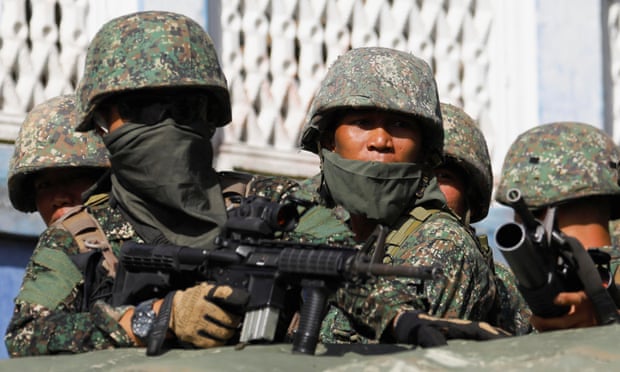
Troops aboard a vehicle as more soldiers reinforce to fight the Maute group in Marawi in southern Philippines.

Troops aboard a vehicle as more soldiers reinforce to fight the Maute group in Marawi in southern Philippines. Photograph: Erik de Castro/Reuters

https://www.theguardian.com/world/2017/may/29/explainer-how-and-why-islamic-state-took-over-part-of-a-philippine-city

CPP/NPA-Central Panay: Militar sa Panay naglunsad ng malawakang operasyon kasabay ng deklarasyon ng Martial Law

NPA-Central Panay propaganda statement posted to the Communist Party of the Philippines Website (May 28): Militar sa Panay naglunsad ng malawakang operasyon kasabay ng deklarasyon ng Martial Law

Jury Guerrero, Spokesperson
NPA-Central Panay (Jose Percival Estocada Jr. Command)

27 May 2017
           
Mula Mayo 23, malawakang operasyon ang inilunsad ng 301st Brigade sa ilalim ng 3rd Infantry Division, Philippine Army sa buong isla. Sa inisyal na ulat, saklaw ng operasyon ang sumusunod na mga bayan: Maasin, Alimodian, Leon, Tubungan, Igbaras, Miag-ao sa probinsya ng Iloilo; Sibalom at San Remegio sa probinsya ng Antique; Tapaz sa probinsya ng Aklan. AAbot sa mahigit 200 tropa ng kaaway ang pinakawalan ng kaaway sa mga combat at clearing operations. Pinatotohanan nito ng pahayag ni Defense Secretary Delfin Lorenzana na bahagi ang NPA sa mga target ng Martial Law na idineklara ni Presidente Duterte.

https://www.philippinerevolution.info/statements/20170527-militar-sa-panay-naglunsad-ng-malawakang-operasyon-kasabay-ng-deklarasyon-ng-martial-law

CPP/CNL: Statement of the Christian for National Liberation On its 8th National Congress April 24-26, 2017

CNL propaganda statement posted to the Communist Party of the Philippines Website (May 28):
Statement of the Christian for National Liberation On its 8th National Congress April 24-26, 2017


Renmin Malaya, Spokesperson
CNL National Executive Committee

28 May 2017

We the 57 official delegates of the 8th National Congress of CNL uphold and resolve to carry over the theme of the Congress and over-all thrust of the organization to “Persevere in Attaining greater Heights in the National Democratic Revolution with Socialist Perspective; intensify our participation in the people’s armed revolutionary struggle.”

We commend the entire membership of CNL both the living and the deceased for the heroic achievement of maintaining and sustaining the correct line of struggle enthusiastically and even have expanded the sphere of influence in most of the regions despite the ideological attack from within its own sector and state brutal repression from without.

It is in this context of moving forward the current level of the revolution from the middle phase to the advanced sub-stage of the strategic defensive that we re-vitalize the Christian imperative of being in unity/ in close fervent participation in the struggle of our neighbor especially the poor and the oppressed and as solid moral basis for the justness of war of liberation.

It is also at the service of pursuing armed revolutionary vigorousness and growth that we need to acknowledge and repudiate the currents of conservatism, individualism, liberalism and sluggishness in our methods of revolutionary work. We criticize the slow and minimal increase of recruiting subjective forces for the revolution in the last fourteen years. We also need to address the minimal participation and support of the church sector both for armed revolution and open democratic mass movement. Specifically we call on the youth of the sector to revolutionize their ideas and actions and respond to the signs of the times.

In this regard we also place special emphasis on the need to increase our ranks among Roman Catholic lay, priests and nuns which in the past contributed greatly to the advancement of the anti-dictatorship struggle and the fight against fascist terror. We need to develop deeper relations with its church hierarchy by storming their doors together with the poor, deprived and oppressed. Ecumenical partnerships must also be enhanced and CNL members in different denominations have the responsibility to reach out to their counterparts in the Roman Catholic church.

We thus now resolve at this juncture to address our weaknesses by completing the summing-up of our revolutionary work in the past 15 years, identify our errors, derive lessons that will guide our aspiration to attain an expanded and more militant organization.

We take note of the landmark significance of this 8th congress being held at a Moro community being organized by the CPP/New People’s Army. This provides us with a real and visible situation of the struggle of the Moro people for self-determination.
We offer our great resolve and enthusiasm to all the martyrs and heroes of CNL who have sacrificed and gone before us. In their honor we pledge our commitment and allegiance to the moral emancipation of the poor.
Ultimately the 8th Congress reinforces our conviction that earthly salvation is always a collective and participatory endeavor by the toiling and exploited people.

Long live the struggling people!
Long live the Christians for National Liberation

https://www.philippinerevolution.info/statements/20170528-statement-of-the-christian-for-national-liberation-on-its-8th-national-congress-april-24-26

CPP/CNL: On the Declaration of Martial Law in Mindanao and the Burning of a School

CNL propaganda statement posted to the Communist Party of the Philippines Website (May 28): On the Declaration of Martial Law in Mindanao and the Burning of a School


Renmin Malaya, Spokesperson
CNL National Executive Committee

28 May 2017

We, the Christians for National Liberation (CNL) strongly denounces the imposition of martial law in Mindanao. By putting the people in military rule President Duterte has curtailed the civil-democratic rights of the people across Mindanao. Reminiscent of Marcos Martial Law , the detested ASSO (Arrest, Search and Seizure Order), as President Duterte ordered the military to carry out searches and arrests without warrant. He has ordered the AFP to conduct checkpoints, curfew and other restrictions which violate the people’s freedom of movement. By imposing such severe measures, he aims to establish himself as a strongman who will not tolerate challenges to his authority. Few minutes after that declaration, Davao City was placed into “lock down” as her daughter Mayor Sarah Duterte Carpio in a press conference immediately announced the list of anti-democratic measures which seeks to restrict people’s freedoms, particularly the right to assemble, to express grievance and seek redress. Like her father, she also wants to prohibit other acts which she deems as challenges to her authority and power.

Months after his election President Duterte’s continued threatening words that he will be “as harsh” as Marcos, practically he is ordering the military and the police to impose its rule and carry out more human rights abuses and fascists attacks against the people with impunity. The more that the big multinational corporations and capitalists will employ forces from the military and police to suppress the struggle of the workers hot higher wages, the farmers for genuine land reform, better living conditions and environmental protection. He has appointed (26) retired military officials in his cabinet occupying positions in other government agencies. The few progressives in his cabinet have become more marginalized facing threat of non- confirmation by the Commission on Appointment.

Now it is clear that the Duterte administration has intensified its counter-revolutionary “Oplan Kapayapaan “ campaign of extrajudicial killings, abductions, torture, indiscriminate firing, military occupation of communities, forcible evacuation and hamletting of communities, aerial bombings and a myriad forms of military abuses. In the past few months, his army has committed countless abuses against the people, placing entire communities under military rule. Reminiscent of Martial Law , the detested ASSO (Arrest, Search and Seizure Order) of Marcos, the President ordered the military to carry out searches and arrests without warrant. He has ordered the AFP to conduct checkpoints, curfews and other restrictions which violate the people’s freedom of movement. By imposing such severe measures, he aims to establish himself as a strongman who will not tolerate challenges to his authority.

The martial law imposition was made on the pretext of armed clashes in Marawi City between the AFP and the Maute Group, a bandit group whose leaders have known links with military officials. In the vain hope of justifying the martial law declaration, the fascists are turning Marawi City into a wasteland in the same way that few years ago parts of Zamboanga City was razed to the ground by the AFP with aerial bombardments and heavy gunfire.

With the majority in congress in his control he aims to get support for his martial law declaration and give him the authority to extend it to the entire country, not only in Mindanao. He can easily come up with more pretexts such as “fighting criminality” and so on. With Marcos-like authoritarian powers, he can push for the implementation of large infrastructure projects beyond public scrutiny.

CNL calls on the Duterte administration for the immediate lifting of martial law in Mindanao. Never again to the horrible experiences of military rule as it left bitter memories of abductions, torture, extrajudicial killings, incarceration of many civilians, evictions and forced evacuations as well as confiscation of land and property. No to Martial Rule!
On the Burning of a School.

As collateral damage to the imposition of Martial Law some very important infrastructures especially the Science, Laboratory and Library buildings of Dansalan College of Marawi.

Unfortunately, with this chilling environment the St. Mary’s Cathedral was also burned and its parish priest taken as hostage. The Ninoy Aquino school and the Amai Pakpak Medical Center were also burned.

The church and school contributes to the value formation of the youth and to equip them with skills necessary for nation building. But with this trend it looks as if it is the other way around, as the present dispensation is destroying the institutions that are supposed to be molding the youth. Hence, we at CNL strongly denounces this bastardly act, because as a country we are a signatory to very important documents, the Geneva Conventions and Protocol 2 which ensures that educational institutions, churches and hospitals are not to be destroyed in the course of the internal conflict .

We at CNL view this as a diversionary tactic of the present administration not to address the growing number of Filipinos crying out to fulfill the promise of “change” such as the release of political prisoners, land reform, end to contractualization and higher wages of workers etc. US troops are present within Marawi City due to the Balikatan exercise as in the past , when a Filipino interpreter was found dead inside their barracks, with NO justice for his death up to the present.

Lift Martial Law Now !

https://www.philippinerevolution.info/statements/20170528-on-the-declaration-of-martial-law-in-mindanao-and-the-burning-of-a-school

CPP/NPA-Southern Tagalog: On GRP’s Cancellation of the 5th Round of Peace Talks

NPA-Southern Tagalog propaganda statement posted to the Communist Party of the Philippines Website (May 28): On GRP’s Cancellation of the 5th Round of Peace Talks

Jaime “Ka Diego” Padilla, Spokesperson
NPA-Southern Tagalog (Melito Glor Command)

28 May 2017

The GRP panel cancellation of the 5th round of talks in The Netherlands is blatantly one-sided, unjustified and flimsy. It based its reason on illogical ground centering on the New People’s Army’s (NPA) escalating armed offensives while omitting the fact that since the breakdown of the reciprocal interim ceasefire agreement between the Government of the Republic of the Philippines and the National Democratic Front of the Philippines last February, the Duterte government has given the marching order to launch full-scale offensives against the revolutionary forces. This left the NPA with no option but to defend the people and its own forces by launching counter tactical offensive in self-defense.

In fact, during the informal talks between representatives of the GRP and NDFP panels held on March 10-11, in The GRP-NDFP Joint Statement released, the two parties agreed to “reinstate their respective unilateral ceasefires which shall take effect before the scheduled fourth round of talks in April 2017.” In this regard, upon the announcement of the Communist Party of the Philippines that it will issue a ceasefire order prior to the opening of the peace talks, the NPA suspended its tactical offensives to show respect and goodwill. However, the GRP didn’t reciprocate and proceeded with its all out war that has caused casualties on the side of the NPA.

In Southern Tagalog, the NPA has sustained casualties in numerous defensive actions as a result of standing-down their offensive preparations while the Armed Forces of the Philippines (AFP) is unrelenting in launching offensive military operations since Duterte’s all out war declaration last February. Some of these are the encounters that occurred in Mindoro, North Quezon, South Quezon, and Palawan.

The GRP panel and the Duterte government have been drumbeating that the NDFP Panel has no control over the NPA and local forces in order to undermine and cast doubt on the integrity as well as discredit the authority and trust given by the Party and the entire revolutionary forces on the NDFP Panel to negotiate peace with the reactionary regime.

It should be clear that the NDFP Panel derives its authority and receives directives from its principal based on the home front with regards to any agreement entered by the NDFP with the GRP in the same way that the GRP Panel receives instructions and order from its principal Duterte. For instance, when Duterte didn’t approve of a ceasefire declaration before the fourth round of peace talks, the GRP Panel had to follow the directive of its principal even though the GRP and NDFP panels agreed to reinstate its respective unilateral ceasefire declarations.

Jesus Dureza and Silvestre Bello III of the GRP Panel are lamenting that the NDFP Panel has no control over the NPA to justify the option of local peace negotiation. They are forgetting that even the GRP Panel has no power and control over the AFP and the PNP. So why should Dureza and Bello make a big fuss over this matter?

The Hawks and the peace spoilers in the Cabinet Cluster E embodied by the likes of Lorenzana and Esperon as well as in the AFP have long been scheming since day one how to scuttle the peace talks. They are only interested in securing the demise of the revolutionary forces through surrender and pacification. They are never interested in addressing the root causes of the armed conflict which are deep-seated in the exploitative and oppressive semicolonial and semifeudal Philippines.

The GRP Panel has been acting on this track since day one also. They are only interested in first securing a permanent cessation of hostilities through prolong ceasefire while setting aside and giving lip-service interest in forging the Comprehensive Agreement on Socio-Economic Reforms, Comprehensive Agreement on Political and Constitutional Reforms and using the promise of releasing the more or less 400 political prisoners as bait to secure a ceasefire agreement with the revolutionary forces represented by the NDFP.

After the series of release of NDF consultants last year, the Duterte government has not released a single political prisoner and has even violated the Comprehensive Agreement on Respect for Human Rights and International Humanitarian Law and the Joint Agreement on Safety and Immunity Guarantees. The Duterte regime rearrested NDF Consultant Ariel Arbitrario right after the termination of its unilateral ceasefire. Moreover, the GRP also arrested NDF Consultants Ferdinand Castillo, Promencio Cortez and Rommel Salinas, and other JASIG-protected personnel.

While the GRP Panel has been speaking out against the offensives launched by the NPA, it is mum on the attacks carried out by the AFP against the revolutionary forces and the people. It is excluding the fact that the actions launched by the NPA are self-defense in nature due to the unceasing military operations of the AFP. In Southern Tagalog, one of these incidents was the peace consultation conducted by the NPA in Sityo Pahimuan, Barangay Lumutan in Gen. Nakar, Quezon that was attacked by elements of the 80th Infantry Battalion. In self defense, the NPA had to maneuver and counter the offensive of the AFP.

The revolutionary movement in Southern Tagalog has the full confidence and trust on the NDFP Panel and the Chief Political Consultant and fully support them as the sole authority entrusted by the Party and the NPA to negotiate a long and lasting peace with whoever hold the helm of the reactionary government. The revolutionary forces under the leadership of the Southern Tagalog Regional Party Committee will not be enthused by the scheme of the Duterte government to negotiate peace at the local level. This is a divide and rule policy long discredited and frustrated by the revolutionary forces but always dreamed-of by the past reactionary rule.

While the revolutionary movement in Southern Tagalog lends its support and wishes for the success of the peace process, the NPA forces are ready and determined to pursue all forms of revolutionary struggle and escalate armed tactical offensives should the Duterte government scuttle the peace talks and put the entire Philippines under Martial Rule.

https://www.philippinerevolution.info/statements/20170528-on-grps-cancellation-of-the-5th-round-of-peace-talks

CPP: Martial Law in Mindanao: Atrocities and fake news

Posted to the Communist Party of the Philippines Website (May 24-27): Martial Law in Mindanao: Atrocities and fake news


Communist Party of the Philippines
27 May 2017

On March 23, 10 p.m., officials of the Duterte regime announced GRP Pres. Rodrigo Duterte’s declaration placing the entire Mindanao under martial rule while in Moscow at 5 p.m. (Russian time). Since then, progressive organizations, concerned agencies and ordinary individuals have documented increasing cases of atrocities and human rights violations, including aerial bombings of civilian communities. Bearing the brunt of these bombings are the residents of Marawi City which the AFP have overran with armed personnel and tanks. Undemocratic measures, such as checkpoints, searches and arbitrary detentions, are intensified in Davao City and other centers of Mindanao. The violations are as follows:

#NotoMartialLaw #StoptheBombings #LiftMartialLawNow

Day 4, May 27

Tacloban city government put up checkpoints in entry and exit points for arbitrary searches supposedly “in solidarity with the declaration of martial law.” Said checkpoints will stay for the duration of martial law in Mindanao.

AFP carries out “surgical airstrikes” in Marawi using guided rockets fired from helicopters, hitting civilian homes, including that of a lawman

Curfew implemented in Kabacan, Cotabato, requiring citizens to carry “identification cards” at all times.

Elements of 66th IB who occupied the premises of Shin Sun Company in Compostela, Comval Province since May 26, barged into the picketline of the striking workers today (May 27) and threatened the workers that their “illegal” strike will be dispersed tomorrow (May 28) as ordered by their higher command.

KMP reports two peasant leaders arrested by 66th IB, PA in Maragusan, Compostela Valley.

Residents discover bodies of dead civilians inside homes destroyed by military air strikes in Marawi.

Restituto Padilla clarifies that the AFP “will enforce the law uniformly such that all violators of the law, regardless of group affiliations, will be dealt with accordingly.” This is after announcing “peace-inclined groups such as the MILF, MNLF and the NPA will not be affected by the ongoing military operations.”

Day 3, May 26

AFP aerial bombing by MG250 attack helicopters, shelling by 105 Howitzer cannons, firing by .50 cal machine gun in Sitios Pedtobawan, Campo, Apulan, and Centro in Brgy Salat, So. Libpas, Brgy. Tuael, all in President Roxas, and Brgys. Tangkulan and Anggaan in Dumulog, Bukidnon. One civilian killed, 5 wounded, more than 2,000 affected. This is 90 kilometers from Marawi.

Duterte to MLBT2: Trabaho lang kayo, ako na ang bahala… Pagnaka-rape ka ng tatlo, aminin ko na akin ‘yon [Just go to work, I’ll take charge… if you rape three, I’ll take the blame]…During martial law, your commanders, you can arrest any person, search any house, wala nang warrant. Kagaya noon, ASSO lang [no more warrant. Like before, just ASSO (Arrest Search and Seizure Order].

Restituto Padilla, AFP spokesperson, announces AFP will exercise the right to censure (sic), especially in social media. To netizens: control of posts in social media necessary.

Police Regional Office 11: Leaders and organizers of “anti-goverment” rallies will be arrested, more so if this will cause public disturbance. Under Martial Law, the writ of habeas corpus is suspended and they can directly arrest anyone who breaks the law.

News outlet GMA7 clarifies that Amay Pakpak Medical Center was never overrun by the Maute group, contrary to AFP report of a takeover on May 24

Day 2, May 25

Task Force Davao and PNP launched Oplan Bulabog at Brgy. 23-C, Davao City arresting 260 civilians only because they could not present IDs.

Davao City government releases 30-point guidelines for the curtailment of civil liberties.

1,800 families from Marawi who have evacuated since May 22 to the municipality of Sagiuaran, Lanao del Sur are suffering from hunger despite availability of food supply from DSWD because of tight and strict military checkpoints.

30 women composed of Lumad, women, Moro, pastors and churchworkers who gathered for an ecumenical forum were put under interrrogation for an hour by 6th Marine Landing Battalion in Brgy. Domulon, Sulatan Kudarat.

LaSurECo (Lanao del Sur Electric Company) management clarifies that the Lasureco office was never overran by the Maute, contrary to AFP report.

Sr Inspector Romeo Enriquez, Police Chief, Malabang, Lanao del Sur clarifies that he was never beheaded by the Maute, contraty to Duterte declaration

Day 1, May 24

Massive bombing of Marawi City, 1 child killed. Disorganized, massive evacuation of civilians ensue.

Shelling and bombing in Matanao, Davao del Sur, more than 120 kilometers from Marawi.

https://www.philippinerevolution.info/statements/20170527-martial-law-in-mindanao-atrocities-and-fake-news

https://www.philippinerevolution.info/

NDF-Sison: NDFP Negotiating Panel recommends reconsideration of order to intensify attacks vs GRP forces

Propaganda statement posted to the National Democratic Front Website (May 26): NDFP Negotiating Panel recommends reconsideration of order to intensify attacks vs GRP forces 

Statement of Prof. Jose Maria Sison
NDFP Chief Poliitcal Consultant
May 26, 2017


NDFP archive

As chief political consultant of the NDFP, I deplore the reported statementof DND Secretary Lorenzana that the NPA is also a target of Mindanao-wide martial law.

The GRP side has clarified that the NPA is not a target. In fact President Duterte himself told Fidel Agcaoili in their recent meeting that the GRP and NDFP should unite against terrorist groups like the Maute group and Abu Sayyaf.

We in the NDFP are together with the GRP in opposing and fighting the ISIS-affiliated and CIA-supported groupslike the Maute group and Abu Sayyaf.

We in the NDFP condemn the attack by Maute group on Marawi City. Earlier NDFP-Mindanao condemned this attack and expressed the deepest concern andsolidariy for the people of Marawi city.
The terrorist act by theMaute group should not be an obstacle to the fifth round of formal talks but should be an incentive to the GRP and NDFP to meet and agree tofight groups that are terrorist because they target, terrorize and harm civilians solely or mainly.

The NDFP Negotiating Panel has recommended to the National Executive Committee of the NDFP andin effect the Central Committee of the CPP to reconsider the order to the NPA to intensify tactical offensives as response to the Lorenzana statement that the NPA is a target of martial law.

https://www.ndfp.org/ndfp-negotiating-panel-recommends-reconsideration-of-order-to-intensify-attacks-vs-grp-forces/

NDF-Agcaoili: Opening speech for the Fifth Round of the Formal Talks in the GRP-NDFP peace negotiations

Propaganda statement posted to the National Democratic Front Website (May 27): Opening speech for the Fifth Round of the Formal Talks in the GRP-NDFP peace negotiations 

[This is the full text of the remarks that should have been delivered at the opening ceremony of the fifth round of peace talks in the GRP-NDFP peace negotiations by Fidel V. Agcaoili, at the Radisson Blu Palace Hotel in Noordwijk aan Zee on May 27, 2017. Unfortunately, the Office of the Presidential Adviser on the Peace Process (OPAPP) and the GRP Negotiating Panel cancelled the fifth round of talks on short notice.]

Noordwijk aan Zee, The Netherlands
27 May 2017

By Fidel V. Agcaoili
Chairperson, NDFP Negotiating Panel

Your Excellencies of the Royal Norwegian Government, Special Envoy Ambassador Elisabeth Slattum and her team of facilitators,

Compatriots in The Netherlands and the Negotiating Panels and Delegations of the Government of the Republic of the Philippines (GRP) and the National Democratic Front of the Philippines (NDFP),

Esteemed guests,

We in the NDFP Negotiating Panel have received a Directive from its Principal, the NDFP National Executive Committee.

Firstly, we have been directed to firmly adhere to The Hague Joint Declaration as the framework agreement for the GRP-NDFP peace negotiations. This Declaration sets forth the substantive agenda which aims to result in one comprehensive agreement after another on respect for human rights and international humanitarian law, social and economic reforms, political and constitutional reforms and the end of hostilities and disposition of forces.

The Declaration is reinforced by the Joint Agreement on the Sequence, Formation and Operationalization of the Reciprocal Working Committees. Thus, the subject of any prolonged and indefinite ceasefire or cessation of hostilities cannot be negotiated and agreed upon before the GRP and NDFP principals have signed and approved the Comprehensive Agreement on Social and Economic Reforms (CASER) and the Comprehensive Agreement on Political and Constitutional Reforms (CAPCR). The proper time to discuss a prolonged and indefinite ceasefire is when we reach the point of negotiating and agreeing on the Comprehensive Agreement on End of Hostilities and Disposition of Forces (CAEHDF).

If the NDFP agrees to put the subject of a prolonged and indefinite ceasefire ahead of CASER and CAPCR, it would fall into the trap of capitulation and pacification and it would be abandoning the substantive agenda which are aimed at addressing the roots of the armed conflict through agreements on social, economic and political reforms to lay the basis for a just and lasting peace.

Secondly, the NDFP must demand compliance with Comprehensive Agreement on Human Rights and International Humanitarian Law (CARHRIHL) – an already existing comprehensive agreement, especially in the face of certain violations. If the GRP does not comply with this comprehensive agreement, there would be no point in making further agreements.

In this regard, the NDFP raises the following prejudicial questions in demanding compliance with CARHRIHL.

1. Why are the political prisoners listed by the NDFP still being kept in prison in violation of the CARHRIHL and its provision on the Hernandez political offense doctrine as well as the Joint Agreement on Safety and Immunity Guarantees (JASIG)? There are expeditious remedies to set aright what is wrong.

2. Why is the GRP carrying out an all-out war policy, occupying communities, taking over civilian functions and using aerial bombs and artillery fire, against the people and revolutionary forces in violation of the CARHRIHL? The use of disproportionate force victimizes most the civilian population rather than the highly mobile guerrilla forces of the NPA.

3. Why are the NDFP Panel member and consultants to the peace talks continuously threatened and harassed?

4. Fourth, it must be pointed out that in raising these prejudicial questions, the NDFP is in no way attempting to hinder the peace talks. We must remember that the NDFP has no record of terminating the peace negotiations. A number of times, it was the GRP, under the Estrada, Arroyo, Aquino and Duterte regimes that has scuttled the peace negotiations, sometimes even without bothering to terminate the JASIG with the proper notice of termination given 30 days in advance.

At this point, the NDFP is faced with two possible reactions from the GRP.

One is that President Duterte may terminate the JASIG and the peace negotiations as he did last February 5 even before he could consult with his Negotiating Panel on February 20. In this event, the responsibility for the further escalation of the civil war will rest squarely on the GRP.

In truth, an all-out war has long been waged by the GRP against the revolutionary forces and people, despite the fact that there were unilateral ceasefire declarations.

As to the release of the hundreds of political prisoners, more than a year of negotiating with the Duterte government has thoroughly convinced the NDFP that the regime has no intention of releasing even the very small number of 15 it last mentioned. Instead, it is increasing the number of political prisoners and the concomitant violations of human rights and international humanitarian law. As of May 15, 2017 there are 403 political prisoners, 37 of them were arrested under President Duterte. There have been 59 cases of politically-motivated killings under President Duterte. In addition, there are tens of thousands of displaced persons all over the country as a result of military operations.

The recent martial declaration in Mindanao will surely lead to a burgeoning in the number of political prisoners and human rights violations.

The other possibility is that the GRP and NDFP continue to negotiate peace even while fighting continues in the battlefield. If this be the case, the NDFP remains willing to accelerate the peace negotiations and forge at the soonest time possible the comprehensive agreements on social and economic reforms and on political and constitutional reforms before the end of 2017 and early part of 2018, respectively.

Subsequently, the GRP and NDFP can discuss such subjects as the expeditious release of all political prisoners listed by the NDFP and a prolonged and indefinite ceasefire related to the implementation of all comprehensive agreements and the prospective end of hostilities and disposition of forces.

In any case, it is unacceptable to the NDFP for the GRP to insist on putting its demand for any joint or bilateral prolonged and indefinite ceasefire ahead of CASER and CAPCR in order to obtain the capitulation and pacification of the revolutionary forces and the people, and lay aside the substantive agenda and the ever urgent demands of the people for social, economic and political reforms necessary for achieving a just and lasting peace.

https://www.ndfp.org/opening-speech-fifth-round-formal-talks-grp-ndfp-peace-negotiations/