Wednesday, January 21, 2015

MILF: Tawi-Tawi MILF Provincial InfoCom holds meeting to outline messages on BBL

Posted to the MILF Website (Jan 21): Tawi-Tawi MILF Provincial InfoCom holds meeting to outline messages on BBL


The Moro Islamic Liberation Front’s Provincial Information Committee of Tawi-Tawi held meeting to outline common messages on Bangsamoro Basic Law (BBL) aimed to solicit support for the Bangsamoro Law.
   
The meeting was held at Sowangkagang, Bongao, Tawi-Tawi on January10, 2015. The agenda of the meeting were:


1. To develop and outline a 5-point BBL messages;
2. To organize the Barrio Information Officers;
3. To accelerate the campaign for registration with Comelec; and,
4. Updates on the peace process and the BBL.

Hajji Mansur Sakili, Tawi-Tawi Provincial Information Director emphasized that, while it is premature to discuss the BBL in public forums due to various constraints, taking actions to advocate its highlights are commendable. At this point, we are formulating pre-campaign strategies to make people understand what the law is all about while waiting for the outcome of the deliberations in Congress.

The 5-point common BBL messages agreed are as follows:

1.    The BBL provides the establishment of a Ministerial Government;
2.    BBL assures of the Block Grants;
3.    BBL guarantees Wealth Sharing;
4.    BBL ensures Social Development Funds
5.    BBL enhances the institutions of Madaris


With regards to the BBL discussions involving our people living in the rural areas, Sakili said, “The discussions may not be comprehensive but we convey the right information to arouse their interest that will surely counts most”.

After presenting the five (5) of the most important features of the BBL, Director Sakili urged everyone in attendance to struggle by intensifying campaign for those that haven’t registered to register with COMELEC to be able to vote during the plebiscite. The Municipal Information Officer of Panglima Sugala was telling that they will encourage their people in Balimbimg to register in Bongao so that their votes shall be counted after the conduct of the plebiscite.

Before ending his presentation, Director Sakili recalled the special training held at the BLMI last December 25-28, 2014 on Campaign Management Training participated in by information officers from Western Mindanao with 24 members came from Tawi-Tawi.

On December 31, 2014 meeting with Chairman Mohagher Iqbal with Information Directors at the same venue, he (Iqbal) updated the participants on the status of BBL.   Director Sakili queried on the status of Sama Province; and on where shall the people report once the BBL is ratified?  Chairman Iqbal said, the people of Sama shall report to Tawi-Tawi

The meeting was attended by forty (40) members of information committee and ended with a prayer or Du’a. Bongao (Capital of Tawi-Tawi) Information Committee Director told Director Sakili, “Our meeting is a success, we attained our objectives”.

http://www.luwaran.com/index.php/welcome/item/1459-tawi-tawi-milf-provincial-infocom-holds-meeting-to-outline-messages-on-bbl

MILF: BBL has solid support of Mayor Duterte

Posted to the MILF Website (Jan 21): BBL has solid support of Mayor Duterte


In a meeting between BTC Chairman Mohagher Iqbal and other BTC Commissioners with Davao City Mayor Rodrigo Duterte at Marco Polo Hotel, the latter expressed solid support to the Bangsamoro Basic Law (BBL).
  
The meeting of Chairman Iqbal and his delegation with Duterte was made to solicit the mayor’s support for the passage of the Bangsamoro Law.

Duterte believes that the enactment of BBL and its implementation will pave the way for more progress and development in Mindanao.

BBL, Iqbal noted, was the only formula available right now to achieve lasting peace and development in Mindanao.

He added that BBL needed the support of Mindanao leaders, including Mayor Duterte who is known for his unrelenting advocacy for peace and development in the region.

Mayor Duterte is a staunch advocate of federalism saying that it will not only address the problems on insurgency in Mindanao but also the disparities in terms of wealth-sharing.

In said meeting, Duterte pointed out that the BBL could be a precursor for federalism and assured Iqbal he would be willing to talk about federalism in the Bangsamoro.

Iqbal expressed gratitude for the support of Duterte and suggested that the best venue that the mayor could share his thoughts on Mindanao and federalism is in the upcoming public hearing set for local government unit executives on January 21 at the House of Representatives.

http://www.luwaran.com/index.php/welcome/item/1458-bbl-has-solid-support-of-mayor-duterte

MILF: Pope Francis supports GPH-MILF Peace deal

Posted to the MILF Website (Jan 19): Pope Francis supports GPH-MILF Peace deal

Pope Francis for the second time expressed support to the peace process between the Government of the Philippines and Moro Islamic Liberation Front (MILF) with the Bangsamoro Basic Law (BBL) now in Congress for deliberations.
   
In his first public statement delivered at MalacaƱan Palace, he ended it with a specific reference to the Comprehensive Agreement on the Bangsamoro.

“In a particular way, I express my trust that the progress made in bringing peace to the south of the country will result in just solutions in accord with the nation’s founding principles and respectful of the inalienable rights of all, including the indigenous peoples and religious minorities”, the Inquirer quoted him saying.

His remarks were read before an audience that included President Aquino, senior government officials and members of the diplomatic corps.

Last Monday, January 12 before living for Sri Lanka he also mentioned the Bangsamoro peace breakthrough.

“I also note with pleasure that last March an agreement was signed to end long years of tension in the Philippines,” he said.

Pope Francis, who was elected Bishop of Rome and thus head of the Roman Catholic Church only in March 2013, has already acquired a reputation as a risk-taking believer in the Vatican’s diplomatic prowess, the Inquirer said in its report.

“One example close to my heart of how dialogue can build bridges comes from the recent decision of the United States of America and Cuba to end a lack of communication which has endured for more than half a century, and to initiate a rapprochement for the benefit of their respective citizens”, the Inquirer also quoted him saying.

http://www.luwaran.com/index.php/welcome/item/1457-pope-francis-supports-gph-milf-peace-deal

MILF: MILF thanks Pope Francis for “blessing” GPH-MILF Peace Process

Posted to the MILF Website (Jan 19): MILF thanks Pope Francis for “blessing” GPH-MILF Peace Process

The Moro Islamic Liberation Front (MILF) in a statement posted as editorial of Luwaran.com dated January 18 thanked Pope Francis for ‘blessing’ the peace process between the Government of the Philippines (GPH) and the Moro Front. 
   
“There is nothing we can ask for from the highest personality of the Catholic Church, Pope Francis, except to thank him for “blessing” the Bangsamoro peace process between the Government of the Philippines (GPH) and Moro Islamic Liberation Front (MILF)’, it said.

Thank you Pope! We know how much value and influence your simple words work with people who follow and listen to you. Ordinary mortals can shout and shout to the world but only few people would listen to them, but that of a leader of 1.2 billion Catholics all over the globe including those in this country is unimaginable. The moral suasion penetrates the heart and soul of every Filipino Catholics; we are sure, including those in the highest echelon of government and the lawmakers, the MILF also said.

"I note with pleasure ‎that last March an agreement was signed to end long years of tension in the Philippines," Pope Francis said.

The Pope in his first public statement delivered before President Benigno Aquino III, other government officials and members of the diplomatic corps  at MalacaƱan Palace made specific reference to the Comprehensive on the Bangsamoro (CAB).

In Rome, before living for Sri Lanka, he also told members of the diplomatic corps about the on-going peace process between the GPH and MILF.

The Pope's "words of encouragement and blessing” follow the recent statement of the surviving framers of the 1987 Constitution expressing full support to the Bangsamoro Bangsamoro Basic Law (BBL) including its constitutionality. They said that the vision, spirit and the core principles behind the provisions on autonomous regions constitute the essential constitutionality of the proposed BBL”, the MILF continued saying.

Both statements came at a critical time as Congress enters the final, difficult stages of deliberation of the proposed BBL, the MILF said.

Clearly, there has been no better time in the past and in the near future that the chance of resolving the Bangsamoro Question presents itself than today.

 Except for few naysayers or doomsayers, the entire nation and the international community, fourteen of the 18 surviving framers of the 1987 Constitution, and now Pope Francis by blessing the peace process urge us to solve this question now, the MILF said in its statement.

http://www.luwaran.com/index.php/welcome/item/1456-milf-thanks-pope-francis-for-“blessing”-gph-milf-peace-process

CPP/Ang Bayan: Dismantle and end privatization

English language translation of Ang Bayan editorial/propaganda statement posted to the CPP Website (Jan 21): Dismantle and end privatization

Logo.cpp
CPP Ang Bayan
 
The Filipino people suffer from ever heavier burdens due to the series of hikes in fees and expenses. The huge MRT and LRT fare hikes, the water rate hike and the impending power rate hike are but the latest burdens to be heaped anew by the US-Aquino regime on the Filipino people’s shoulders. They come on top of the already spiralling costs of education, medical care, communications, housing and other social services and infrastructure.

The higher fees and costs now confronting the people are the result of close to three decades of the privatization and deregulation of key social infrastructure. Enterprises that used to be state-owned and run by the government, funded by public funds and declared to be serving the “social interest” are now run by a handful of big comprador bourgeoisie and their foreign big capitalist partners in the name of profit without any obligation whatsoever to protect the people’s interests.

In exchange for credit, the International Monetary Fund (IMF) and other imperialist agencies imposed on the Philippines at the close of the 1980s the policies of privatization and deregulation—meaning the removal of state controls on services and utilities to give way to big foreign capitalist and bourgeois comprador investment and management. They took advantage of the Filipino people’s anger at the bureaucrat capitalist Marcos dictatorship and its minions who enriched themselves by running state enterprises in order to make privatization palatable to the public.

The lofty promise of privatization’s apologists was to create a “level playing field” to attract investments, promote competition and reduce prices for the people. Through the “build-operate-transfer,” “public-private partnership” and various other schemes, privatization and deregulation were enforced in almost all fields of social and economic life.

Water distribution, power generation and distribution, roads, hospitals and universities or parts thereof were privatized, as were vast public landholdings, telecommunications and postal services, and the companies Petron, Philippine National Bank, Philippines Airlines and other enterprises established, owned or run by the state. The biggest enterprises fell into the hands of the biggest bourgeois compradors in the Philippines, among them Lucio Tan, the Ayalas, Lopezes, Cojuangcos, Sys and eventually the Pangilinan group and their foreign big capitalist partners.

The privatization process in the Philippines is fraught with corruption. High-ranking government officials always line their pockets full whenever state properties are put on the auction block and government enters into private investment contracts. Sometimes, such corruption is exposed when the rival political party takes power—not to get rid of corruption but to forge new contracts, favor other businessmen and pocket their own share of the loot.

No less than the Filipino people’s close to 30 years’ experience with unbridled privatization puts to the lie the claims and promises of privatization. Wherever privatization reigned, social services and public infrastructure became commercial ventures whose main goal is to rake in profits for big capitalists. Services that used to be affordable are now practically beyond the reach of the Filipino toiling masses who comprise the majority.

Many of such public infrastructure were built and funded by the ruling state in order to facilitate the flow of commerce and production for the local ruling classes and foreign big capitalists.

Because they were funded by public monies, these formerly state-owned enterprises were categorized as “publicly owned” and their operations deemed as “public service.” During the US-Marcos dictatorship, a number of private enterprises were “nationalized” and controlled by Marcos and his cronies using public funds. To conceal the corruption, they were hailed as enterprises run “in the public interest.” On the other hand, becuase they were run “in the public interest” and with the use of public monies, they were obliged by the people to operate and provide services affordable to ordinary folk.

Within the framework of nationalizing public enterprises, infrastructure and services, the democratic forces are fighting for the allocation of bigger public funds to enable these entities to provide quality and affordable services to the people. They resist commercialization, or running these entities in order for the state to earn profits, and regard operating at a loss as necessary investment for the greater social good. They likewise expose and resist bureacrat capitalist management and fight for more democratic means of managing enterprises, infrastructure and public services.

Privatization has done away with the “public interest” aspect. Because they are funded by private capital (although mainly through state-guaranteed loans), there is a demand to run these entities “efficiently and profitably.” The so-called “user-pay” principle has been forced into the picture to justify all-out commercial operations and wanton hikes in fees and expenditures.
It is right and just for the Filipino people to demand the renewed nationalization or state conrol of infrastructure and services being utilized by, and of benefit to, the people and that facilitate the flow of commerce and production. It is right for the people to demand an end to contracts with private companies that have been granted concessions for water and power distribution, telecommunications, hospitals and universities or granted contracts to use public land or extract mineral or oil resources.

The people can fight for the renationalization of transport, energy and petroleum companies and others that play a significant role in economic affairs and people’s livelihoods.

They must likewise resist policies that call for national budgetary cuts in much-needed social services such as health and education. Year after year, the reactionary government has been allotting woefully inadequate funds for public universities and hospitals. In accordance with the principle that the bulk of public funds must be allocated to the majority, the people must thoroughly resist the allotment of more than a third of the government’s annual budget to servicing debts to foreign banks.

In the particular case of the LRT, MRT and other public transport systems, the people would do right by demanding that these be placed under full state control. It is to the Filipino people’s interest to cancel the contracts with the Ayalas and Pangilinans that grant them the right to control the operations of the metrotrains for 50 years—and this includes the right to hike fares on an annual basis. They must also demand an end to contracts privatizing water distribution in various parts of the country.

The nationalization of public services and utilities must be demanded by the Filipino people in the face of the ever worsening social and economic crisis. It is just for the people to fight for the nationalization of these entities to ensure decent standards of living for everyone. Under the present ruling semicolonial and semifeudal system, they must likewise fight for the democratic management of these enterprises to prevent them from becoming instruments of bureaucrat capitalist enrichment.

These people’s democratic demands are part of the agenda in the peace talks between the National Democratic Front of the Philippines (NDFP) and the Government of the Republic of the Philippines.

State ownership and control over the biggest and key industries, land and natural resources, infrastructure and services are critical aspects of the social and economic programs of the Party and the NDFP. Through all this, the proletariat and the democratic government would have the power to plan the production and distribution of wealth for the benefit of all and ensure than everyone has work and is provided free education and health services within the frame of a dynamic, progressive and modern society.

[Ang Bayan is the official news organ of the Communist Party of the Philippines and is issued by the CPP Central Committee. It provides news about the work of the Party as well as its analysis of and views on current issues. Ang Bayan comes out fortnightly and is published in Pilipino, Bisaya, Ilokano, Waray, Hiligaynon and English.]

http://www.philippinerevolution.net/statements/20150121_dismantle-and-end-privatization

US, PH prioritize 'high value' joint exercises amid China row

From Rappler (Jan 21): US, PH prioritize 'high value' joint exercises amid China row

The Philippines and the US agree to step up joint maritime exercises amid 'massive' Chinese activities in the South China Sea

PH-US DIALOGUE. Philippine and US officials report the outcome of the 5th annual Bilateral Strategic Dialogue in a news briefing on January 21, 2015. Rappler Photo

PH-US DIALOGUE. Philippine and US officials report the outcome of the 5th annual Bilateral Strategic Dialogue in a news briefing on January 21, 2015. Rappler Photo
 
The South China Sea (West Philippine Sea) took center stage at the 5th annual Bilateral Strategic Dialogue between the United States and the Philippines held in Manila, as China continues to engage in "massive" construction activities in the disputed area.
 
During the dialogue, Philippine and US officials agreed to step up joint military exercises focused on maritime security and maritime domain awareness, even as a US official called for “maximum restraint” in the South China Sea.

"We examined regional and international issues such as the South China Sea in which we reaffirm our continuing concern over destabilizing activities that are contrary to the Declaration of the Code of Conduct in the South China Sea as well as international law," said David Shear, US Department of Defense Assistant Secretary for East Asian and Pacific Security Policy.

Defense Undersecretary Pio Lorenzo Batino said this means prioritizing joint military exercises on maritime security and maritime domain awareness.

“We have developed a clearer direction for the Mutual Defense Board and Security Engagement Board to prioritize high value exercises that would focus on maritime security, maritime domain awareness, and humanitarian assistance and disaster relief," Batino said in a news briefing after the dialogue.

Assistant Secretary of State for East Asia and Pacific Daniel Russel also noted how the US is modernizing its alliances, as US President Barack Obama explained in his State of the Union Address (SOTU) that coincided with the Bilateral Strategic Dialogue.

"The President emphasized a smarter kind of leadership that combines military power with strong diplomacy, leveraging that power with partners. He said that we are upholding the principle that bigger nations cannot bully the small," Russel added.

‘Maximum restraint’

Russel said the South China Sea dispute is an "ongoing concern" of the US but the two countries should exercise "maximum restraint" in favor of diplomacy.

“We look forward to the day when China and its neighbors would have a binding Code of Conduct but in the meantime, we think there is a powerful case to be made for the maximum exercise of restraint,” he said.

Russel made the call even as he noted that China has “a number of projects underway in the South China Sea reclaiming land in shoals and rocks in sensitive areas whose sovereignty are contested.

"This is a topic of discussion, naturally, between the US and the Philippines. It’s a topic of conversation between the US and China as well," he added.
The Philippines is protesting the reclamation projects but China remains undeterred by such complaints.

"The Chinese activities in the West Philippine Sea continue to be of serious concern for the Philippine defense and military establishment especially arising from the recent reports of greater development of its reclamation projects," said Batino.

Armed Forces chief General Gregorio Catapang Jr earlier said the reclamation at the Kagitingan (Fiery Cross) Reef is about 50% complete.

China has several reclamation activities in the West Philippine Sea but only Kagitingan, so far, can accommodate a runway. If built, it will greatly change the security situation in the region.

http://www.rappler.com/nation/81547-us-maximum-restraint-china

57 Abu Sayyaf, MILF detainees involved in foiled Zambo jailbreak - PNP

From InterAksyon (Jan 21): 57 Abu Sayyaf, MILF detainees involved in foiled Zambo jailbreak - PNP

At least 57 detainees of the Zamboanga City Reformatory Center with ties to the Abu Sayyaf and a “rogue” faction of the Moro Islamic Liberation Front were involved in a jailbreak attempt that was foiled Monday, police said.

Military intelligence reports earlier said the plot was hatched by Basilan-based Abu Sayyaf sub-commander Furiji Indama, mainly to spring his brother Benzar, who is detained at the ZCRC.

Although the plan fell through, authorities have placed Zambonga City on red alert and security forces have mounted patrols in Barangay Cawa-Cawa, a few kilometers from the jail in Barangay Zone 2, following reports the Abu Sayyaf was fielding teams from Basilan and Sulu to aid the jailbreak.

Inspector Dahlan Samuddin, acting public information chief of Police Regional Office 9 (PRO9), said Wednesday a Special Weapons and Tactics team has deployed to reinforce security at the ZCRC while a police combat platoon has been positioned along Cawa-Cawa Boulevard.

Quick reaction teams from Zamboanga City police and the Regional Public Safety Battalion have also been dispatched on round-the-clock patrols, while maritime police boats patrol the city’s shoreline.

The military has also deployed troops to the ZCRC and put armored personnel carriers on standby at Camp Batalla.

ZCRC guards, acting on a tip, mounted a surprise search of the jail Monday and seized firearms and ammunition that had been smuggled in for the jailbreak.

http://www.interaksyon.com/article/103471/57-abu-sayyaf-milf-detainees-involved-in-foiled-zambo-jailbreak---pnp

Firefight, airstrike kill 3 Abu bandits in Basilan, says military

From InterAksyon (Jan 21): Firefight, airstrike kill 3 Abu bandits in Basilan, says military

Fresh firefights supported by airstrikes by government troops in Basilan against the Abu Sayyaf Group (ASG) have resulted in the death of at least three bandits and the wounding six others Tuesday, Lieutenant Colonel Harold Cabunoc, public affairs chief of the Armed Forces of the Philippines (AFP), said Wednesday.

“Initial result shows there were three bandits killed and six others wounded from the series of firefights and airstrikes including artillery barrages,” Cabunoc told reporters at Camp Aguinaldo in Quezon City.

However, no bodies were found at the encounter site as the bandits “will do everything to bring their dead or conceal them” as they withdraw.

“Our troops on the ground based their figure from what residents told them. (They) saw the dead bandits and the wounded,” Cabunoc said.

Earlier, a report from 1Lt. Sally Christine Ma. Magno, acting civil military operations officer of the Army’s 104th Infantry Brigade, said troops from the 4th Special Forces Battalion encountered at around 11 a.m. up to 25 Abu bandits led by sub-leader Juhaibel Alamsirul alias Abu Kik in the vicinity of Sitio Penas, Barangay Pamantsaken, Sumisip.

She said a bandit was killed during the 15-minute fierce firefight and a certain Yusof Sandatan was “seriously wounded.” The bandits withdrew northward to Barangay Baiwas.

“We’ve no casualty,” Magno saod.

While doing clearing operations, the troops from the 64th Infantry Battalion were met by sniping spree from the bandits at around 12:55 p.m. in the Pamantsaken-Baiwas boundary.

This led to another close-quarter battle at around 1:40 p.m.

“This time the combined groups of sub-leader Radzmil Janatul alias Khubayb and Alamsirul numbering more than 50 engaged our troops for about two hours in Sitio Crossing Baiwas,” Magno said.

The soldiers were provided artillery fires and close-in air support from SF260s from the Philippine Air Force (PAF).

“The bandits were forced to withdraw toward the west direction. Initial reports received states that the ASG incurred one (fatality) with three others wounded. We’ve no casualty,” Magno said.

An arms cache was recovered from the encounter site.

http://www.interaksyon.com/article/103490/firefight-airstrike-kill-3-abu-bandits-in-basilan-says-military

MILF’s Camp Abubakar eyed as arms storage facility during decommissioning process

From MindaNews (Jan 21): MILF’s Camp Abubakar eyed as arms storage facility during decommissioning process

CAMP IRANUN, Barira, Maguindanao – The Independent Decommissioning Body (IDB) tasked to oversee the process of decommissioning the Moro Islamic Liberation Front’s (MILF) forces and weapons is eyeing Camp Abubakar, now known as Camp Iranun of the Army’s 603rd Infantry Brigade, to be the storage facility of firearms to be handed to IDP once the normalization process of the GPH-MILF peace agreement takes off.

The IDP, headed by Turkish Ambassador Haydar Berk, conducted on Tuesday a site inspection inside the camp, which was once the main camp of the MILF until the “all-out war” in 2000, and was briefed by Col. Arnel dela Vega, 603IB commander.

Berk was accompanied by his vice chairman, Gen. Jan Erik Wilhelmsen of Norway, other Norwegians, Brunei delegates and GPH and MILF local experts.

Dela Vega said Camp Iranun is conducive for both the MILF and GPH, with various kinds of activities that can be performed there, now also accessible, and with the various peace-driven initiatives conducted by the military in the surroundings for a decade now.

“It’s the best option since the place has historical relevance for the MILF. Until now it is a sentimental place. The home of their former leader and founder, Salamat Hashim, is still preserved in the thickly forested site inside the camp,” Dela Vega stressed.

The storage facility will be jointly guarded by the Joint Security Peace Team (JSPT), which is composed of 1,400 men coming from the police and the Army, and Moro Islamic Liberation Front combatants. Each side will have 700 mean men.

The Camp Iranun compound is also eyed as training ground for the composite team who will  complete the Joint Security Peace Team.

Other options being considered by the IDB are the Police Regional Headquarters in Parang, Maguindanao and the old provincial capitol in Sultan Kudarat town.

At the moment the organization of the JSPT is underway. Aside from securing the arms storage facility, they are also tasked in the maintenance of peace and order in critical areas like those with lawless armed groups and private armed groups, areas where rido exists, where there are drug operations, and those known to be election hot spots.

Both parties have yet to decide what to do with the firearms – kept these in container vans to be securely monitored and guarded by the IDP and JSPT, or destroy them.

“They [IDB] will be sending some technical people to assess and determine what requirements are needed in the establishment of a storage facility”, Dela Vega said.

Under the normalization process, the IDP will conduct inventory, verification and validation of Bangsamoro Islamic Armed Forces (BIAF) members, their firearms and other weapons.

Furthermore, the group is tasked to develop and implement a schedule of decommissioning, plan, design using techniques and technologies for weapons collection or retrieval, transport and storage in accordance to the agreement of the parties and report on the progress of its work to the GPH-MILF panels.

On the first week of February, there is a scheduled ceremonial turnover of 75 firearms to the decommissioning body.

http://www.mindanews.com/top-stories/2015/01/21/milfs-camp-abubakar-eyed-as-arms-storage-facility-during-decommissioning-process/

Photos in the News: Western Mindanao Command hands out medal, awards to personnel

From the Mindanao Examiner BlogSpot site (Jan 20): Photos in the News: Western Mindanao Command hands out medal, awards to personnel


Lieutenant General Rustico Guerrero, chief of the Western Mindanao Command, hands over the Special Awards to the 7 top performers of the Physical Fitness Test for 2nd Semester of 2014.  And Major Benjamin Pajarito, of the Philippine Army, also receives the Military Merit Medal for his “meritorious and valuable service rendered” as Deputy and Branch Chief of Administrative and Reserve Force, Office of the Assistant Chief of Unified Command Staff for Operations from July 3, 2011 to January 16, 2015.

The Western Mindanao Command also awards Zamboanga City Rep. Lilia NuƱo the “AFP Bayanihan Award 2014” for her “invaluable services and support to the Bayanihan Team Activity in the conduct of medical and dental outreach to the less fortunate people in the east coast area of Zamboanga City.”

Same award was also handed to Datu Zamsamin Ampatuan, Mayor of Rajah Buayan town in, Maguindanao province by the 6th Infantry Division under Major General Edmundo Pangilinan for his “significant contributions to the 45th Infantry Battalion, 5th Infantry Division, Philippine Army in the implementation of the AFP’s Internal Peace and Security Plan “Bayanihan,” among others.


http://www.mindanaoexaminer.net/2015/01/photos-in-news-western-mindanao-command.html

Grand Mufti visits Sulu province

From the Mindanao Examiner BlogSpot site (Jan 21): Grand Mufti visits Sulu province


Governor Totoh Tan speaks to Muslim religious leaders led by Grand Mufti, His Eminence Abdulbaqi Abubakar, who visited the Sulu province recently. (Photo by Franzie Sali)

SULU - Muslim religious leaders led by Grand Mufti, His Eminence Abdulbaqi Abubakar, recently visited the southern Philippine province of Sulu and met with Govenor Totoh Tan.

Governor Tan, who is also the chairman of the Sulu Area Coordinating Council, discussed with the Grand Mufti various issues.

Several leaders of other faiths and faith-based organizations have also met in many instances with the Governor, mainly to discuss not about differences, but common grounds in furtherance of better living for all constituents in Sulu Archipelago and its neighboring communities.

Governor Tan is a strong peace advocate and believer that diversity should not be source of great divide among fellow men and women of goodwill, but an avenue towards communal dynamism in improving societal conditions.

He said nobody should be sidelined because one is different, adding despite mixture of preferences and orientations for betterment by constituents, respect and relationship must be intact.

Religious leaders also held their gathering in Sulu. Among those who attended the gathering of Imam, Ulama, Khatib in the province were Ustadz Sharif Jul-Asiri Abirin, Mufti of Sulu (Madinah Al-Munawwarah); Ustadz Mohd. Suwaib Abedin, Mufti of Socsargen (Madinah Al-Munawwarah); Ustadz Abdulrafih Sayedy, Grand Imam, Blue Mosque and Cultural Center, MM (Azhar), former Dean, Islamic Study, U.P.; Ustadz Said Ahmad Basher, chairman of the Imam Council of the Philippines (Al-Azhar); Ustadz Ahmad Barcelon, head, Balik Islam Group; Ustadz Abbas (SABIR) Omar, Holy Qur'an Islamic Center (Islamic University, Hashimite Kingdom of Jordan(; Ustadz Ahmad Manonas, Director, Ma'had Munawwarah in Davao City (Kulliyatud Da'wah, Libya);  Ustadz Said Amin, coordinator, Alfarouq Islamic Institute, Palawan (Madina Graduate); Shariff Mohsen Julabbi, Al-Azhar University Graduate (among the pioneers); Ustadz Yahiya Mohammad, adviser of Sabilal Mohtadeen (Madinah Al-Munawwarah); Sukarno Ikbala, president of ESPERANZA Group; Atty. Meltino Sibulan, human rights advocate; and Professor Nurhassan Danial, (ZamBaSulta Muslim Youth Leader).

Just last month, Governor Tan also held the 2nd Special Regional Peace and Order Council Meeting for Basilan, Sulu and Tawi-Tawi here. The regional leadership presided over the meeting where some important issues and concerns were tackled.

Also in December, a dialogue between the military officials and ulama was also held at the Sumadja Hall at the Provincial Capitol. The event was organized and facilitated by Western Mindanao Command and concurred by the Sulu Ulama Council for Peace and Development.

Nearly a hundred Muslim religious leaders attended led by Tuan Sharif Julasiri Abirin ( Mufti of Sulu), Tuan Muhaymin Abubakar (SUCPD Chairman) and Tuan Yahya Abdulla (SUCPD/Farmers Federation) attended the dialogue.

The military contingent was headed by General Rustico Guerrero, chief of the Western Mindanao Command and Rear Admiral Yoma, commander of the Task Force Zambasulta, among others.

The Armed Forces of the Philippines, particularly through the current Joint Task Group-Sulu and the Sulu Ulama Council for Peace and Development are two of the actively-engaged network partners of Sulu Area Coordinating Council.

http://www.mindanaoexaminer.net/2015/01/grand-mufti-visits-sulu-province.html

Troops kill 6 Sayyaf rebels; capture 2 camps in Philippines

From the Mindanao Examiner BlogSpot site (Jan 21): Troops kill 6 Sayyaf rebels; capture 2 camps in Philippines

Government troops assaulted two Abu Sayyaf camps on Wednesday, killing at least 6 rebels in Sumisip town in the restive province of Basilan in the Muslim autonomous region in southern Philippines, officials said.

Officials said two rebel camps were eventually overtaken by soldiers and that explosives had been recovered from the site. At least 6 rebels were also wounded in the clashes in the village called Baiwas. Sumisip, a known stronghold of the Abu Sayyaf, is the hometown of Mujiv Hataman, the regional governor.

Two of the slain rebels were identified as Yusop Sandatan and Usop Balaman. There were no immediate reports of military casualties, but two military ambulances – their sirens blazing - were spotted speeding in downtown Zamboanga City.

Marine Captain Maria Rowena Muyuela, a spokeswoman for the Western Mindanao Command, said the operations, which started on Tuesday, were part of a fresh offensive aimed at crippling the Abu Sayyaf group blamed by authorities for the spate of terror attacks and kidnappings in the region.

She said troops first clashed with the group of Abu Sayyaf sub-leaders Juhaibel Alamsirul, Radzmil Janatul and Pasil Bayali in Sumisip’s Pamatsaken village and that sporadic clashes spread in Baiwas.

In another report, Army Lieutenant Sally Christine Maria Magno, of the 1st Infantry Division, said the camps can accommodate about 100 rebels. “The Armed Forces of the Philippines together with the Philippine National Police and the local governments are continuously intensifying the conduct of law enforcement operations in order to defeat these lawless elements who continuously initiate atrocities in the province of Basilan and its neighboring areas,” she said.

http://www.mindanaoexaminer.net/2015/01/troops-kill-6-sayyaf-rebels-capture-2.html

Tuesday, January 20, 2015

Soldiers, Reds clash as ceasefire ends

From the Philippine Star (Jan 21): Soldiers, Reds clash as ceasefire ends 

Government troops and New People’s Army (NPA) rebels engaged in a shootout in Camarines Norte yesterday, hours after the end of a month-long suspension of military operations.

No fatalities were reported on either side.

Armed Forces Southern Luzon Command spokesman Maj. Angelo Guzman said the fighting occurred at Barangay Scout Fuentebella in Goa town at 10:35 a.m.

The troops are still conducting clearing and pursuit operations, according to Col. Amador Tabuga, Army’s 902nd brigade commander.

They recovered an M16 rifle, a rifle grenade, an improvised explosive device and three backpacks from the scene.

The NPA said the government ceasefire was a farce.

Soldiers occupied several parts of Davao City, Compostela Valley, Davao Oriental, Cotabato and Agusan del Sur during the truce, according to the National Democratic Front (NDF)’s Mindanao chapter.

Its spokesman Jorge Madlos said the presence of troops in these areas constituted actual offensive maneuvers within and in the periphery of NPA territories.

“Their blatant occupation of civilian areas while supposedly in suspended military operations is highly  provocative and increases the risk of armed engagements with the Red fighters amid civilian-populated areas,” he said.

Maj. Ezra Balagtey, Armed Forces Eastern Mindanao Command spokesman, said the NPA planted a landmine and deployed snipers along the San Isidro-Mahaba Road in Surigao del Norte on Dec. 26.

The NPA violated its own truce when it harassed a patrol base in Lupon, Davao Oriental on Jan. 18, Balagtey said.

The ceasefire between the government and communist rebels ended at midnight yesterday.

http://www.philstar.com/headlines/2015/01/21/1415104/soldiers-reds-clash-ceasefire-ends

US exec in Manila for bilateral talks

From the Philippine Star (Jan 20): US exec in Manila for bilateral talks

US Assistant Secretary of State for East Asian and Pacific Affairs Daniel Russel is in Manila for bilateral meetings with his counterparts in the government, the US embassy announced yesterday.

Russel, who described China’s activities in the South China Sea as “wholesale reclamation and source of clear anxiety and instability in the region,” came with Assistant Secretary for Defense David Shear.

He will fly today to Kuala Lumpur, then Bangkok and Phnom Penh and return to Washington on Jan. 28.

In a press conference at the New York Foreign Press Center last Sept. 26, Russel said the US had spoken and would continue to speak to each of the claimants, particularly the Chinese, about Washington’s concerns over reclamation work “that means digging up the bottom of the sea, creating landfill to build out what are essentially rocks or shoals into a large enough territory to hold facilities of various types.”

He said “wholesale reclamation is an example of unilateral action that changes the status quo.”

The State Department official said the South China Sea is not a bilateral issue between China and the US. He said Washington takes no position on the merits of sovereignty claims by China or other claimants to particular land features in the disputed waters.

However, Russel said the US holds the South China Sea issue as an important area of conversation in its bilateral talks with China and in the appropriate regional fora, such as the ASEAN context.

http://www.philstar.com/headlines/2015/01/21/1415102/us-exec-manila-bilateral-talks

Should the ARMM be replaced by another entity? MNLF factions’ views differ

From the Philippine Daily Inquirer (Jan 20): Should the ARMM be replaced by another entity? MNLF factions’ views differ
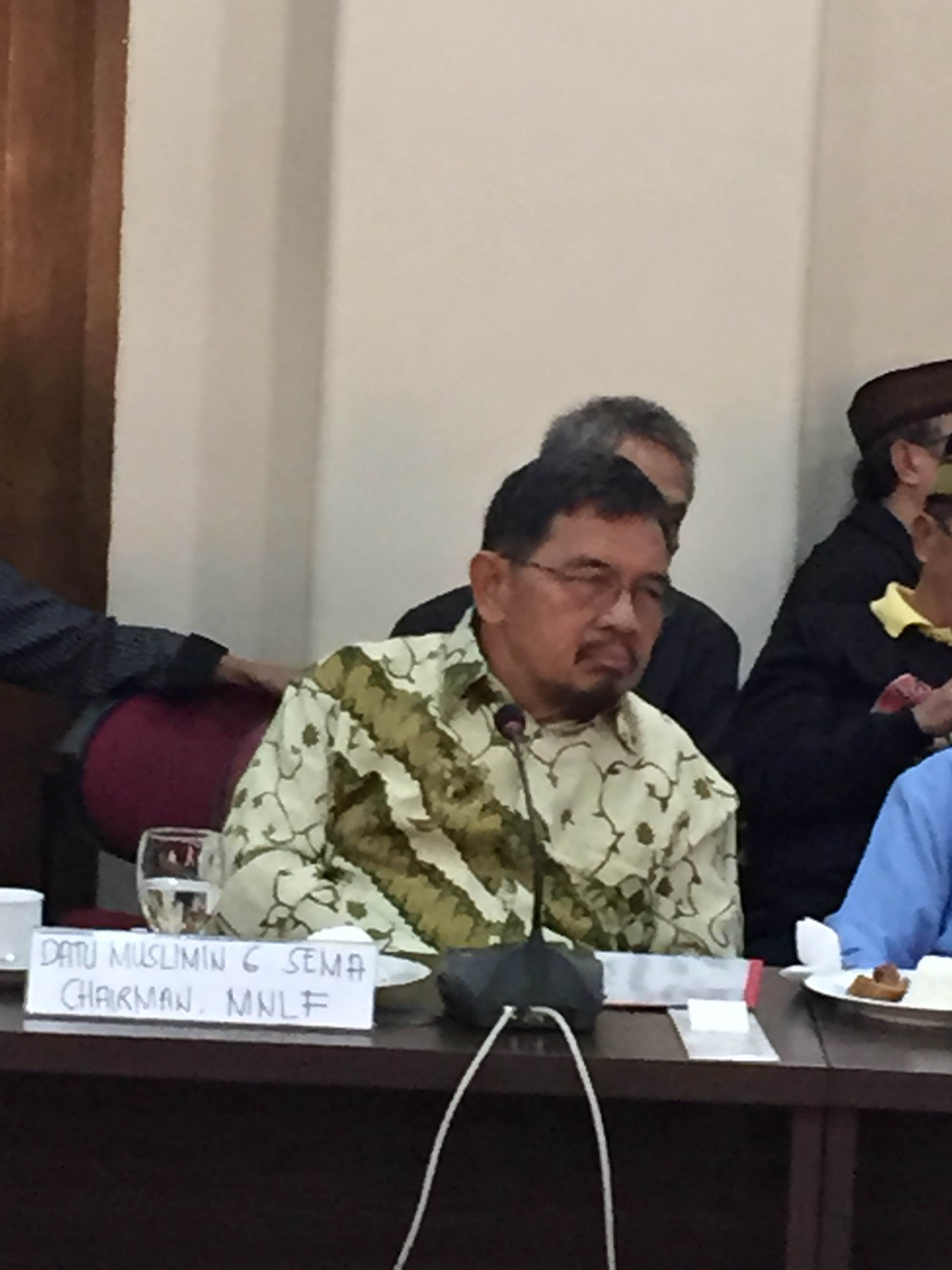
Muslimin Sema. Photo by: Marc Cayabyab/INQUIRER.net

Muslimin Sema. Photo by: Marc Cayabyab/INQUIRER.net
 
While they have a united stand on independence, two factions of the Moro National Liberation Front (MNLF) differed on their views on several points of the Bangsamoro basic bill (BBL) particularly on the creation of another entity and its leadership.

Much like their conflicting views on the leadership over the Moro separatist group, the MNLF factions Alonto and Sema also disagreed on their stands on the bill that seeks to create a Bangsamoro entity to replace the Autonomous Region in Muslim Mindanao (ARMM).

During the Bangsamoro ad hoc committee hearing in the House of Representatives Tuesday, Muslimin Sema, chairman of their MNLF faction, said the Bangsamoro people stand to lose the gains under the ARMM if the law creating the autonomous region is replaced with a new political entity.

While he did not oppose outright the creation of the Bangsamoro bill, he said the current form of the bill will disregard the gains under the ARMM law.

“Despite the bitter branding in our foreheads, we remain firm that we will not set aside all that we have gained in the last 40 years. How can we achieve that in the current order of things?” Sema said.

“Moreover, the idea of repealing the current organic act and putting in place a totally new law means our people will go back to square one, on a system that is totally new to us…” he added.

Sema, however, said their faction was not in the hearing to reject outright the Bangsamoro bill.

“The MNLF did not come here… to register our rejection as well as our acceptance of the Bangsamoro Basic Law,” he said.

Sema clarified though that the Bangsamoro bill “in its current form… is a recipe for disintegration of the current autonomous region unless our perspective on this matter is taken with a grain of salt.”

“The way the BBL is written we are bound to lose what we have gained in the last four decades of our people’s struggle,” Sema said.

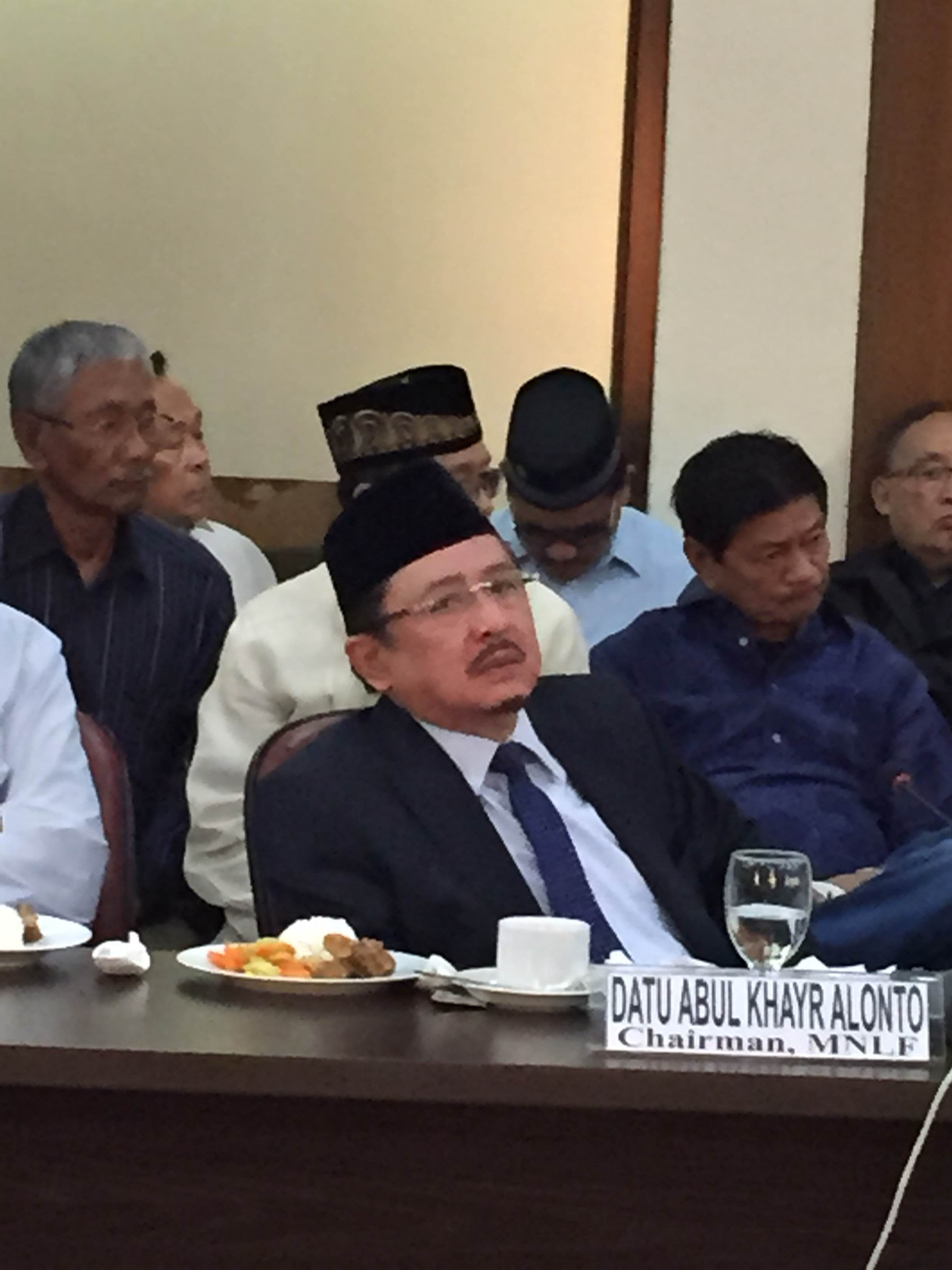
For his part, Abul Khayr Alonto, chair of their MNLF faction, said the Aquino administration had earned the Bangsamoro people’s trust for long-lasting peace in Mindanao.

“(The) Aquino government has committed to this peace process and had earned the trust of the Bangsamoro people… BBL can be an instrument of peace,” Alonto said.

He said he hoped his son will not grow up to be where he is now still defending the bill.

“If the House (and the) Senate cannot do this, I pray to God that my son will not be back here talking on the same issue,” he said.

Alonto said their faction supports the bill to finally end the decades of war in Mindanao.

Abul Khayr Alonto. Photo by: Marc Jayson Cayabyab/INQUIRER.net

Abul Khayr Alonto. Photo by: Marc Jayson Cayabyab/INQUIRER.net
“We will fight not with arms but through a peaceful democratic process,” he said.
Alonto even supported amending the 1987 Constitution if need be just so to pass the bill. The Bangsamoro bill is hounded with issues of constitutionality for its intent to give political autonomy in Mindanao.

Former military chief and Muntinlupa Representative Rodolfo Biazon scored the two MNLF factions for “bickering” on their views.

“What we heard are bickering statements of interests by different groups,” Biazon said.
The two factions quickly reacted and said they are united in their position for a just and lasting peace in Mindanao.

“We have been united. When we talk of independence, it is in every heart of every Moro people,” Sema said.

“There (are) no differing interests. We are united,” he added.

Alonto meanwhile quoted Senator Alauya Alonto who said of “unity in diversity.”
“If unity cannot be achieved in a strictly unity system then let us revert back to unity in diversity. Let us forge that unity,” he said.

“There is no other way for the Bangsamoro people to be united… but through the Bangsamoro bill formula,” Alonto added.

“We are one in the pursuance of the right to self-determination,” he said.

Noticeably absent was MNLF founder Nur Misuari, who was ousted as MNLF chair at the height of leadership problems which divided the Moro separatist group.

Misuari, chair of his own MNLF faction, faces an arrest warrant for leading a failed siege in Zamboanga City on September 2013 in an independence bid. He has since been in hiding.

He led the siege accusing the government of failing to implement and sidelining a 1996 peace pact when government signed another peace deal with the Moro Islamic Liberation Front. MILF is a breakaway group of the MNLF.

The House is conducting consultations over the bill that seeks to replace the Autonomous Region in Muslim Mindanao with a new Bangsamoro entity and end decades of Muslim secessionist movement in the region.

Once the bill is passed, it would have to go through a plebiscite for ratification.
http://newsinfo.inquirer.net/666746/mnlf-factions-clash-amid-differing-stands-on-bangsamoro-bill